
New Book Reviews: Bernard Jan, Cruel Summer. This is a review of a novel that gave me an insight into the world of Young Adult Fiction, skateboarding, and a new author. Reviewed for Goodreads.

Sue Wilkes, Jane Austen’s England. This is an excellent combination of contemporary information, allusions to Jane Austen’s novels and life and accessible writing, while providing the reader with a good index and impressive bibliography. Reviewed for Net Galley.
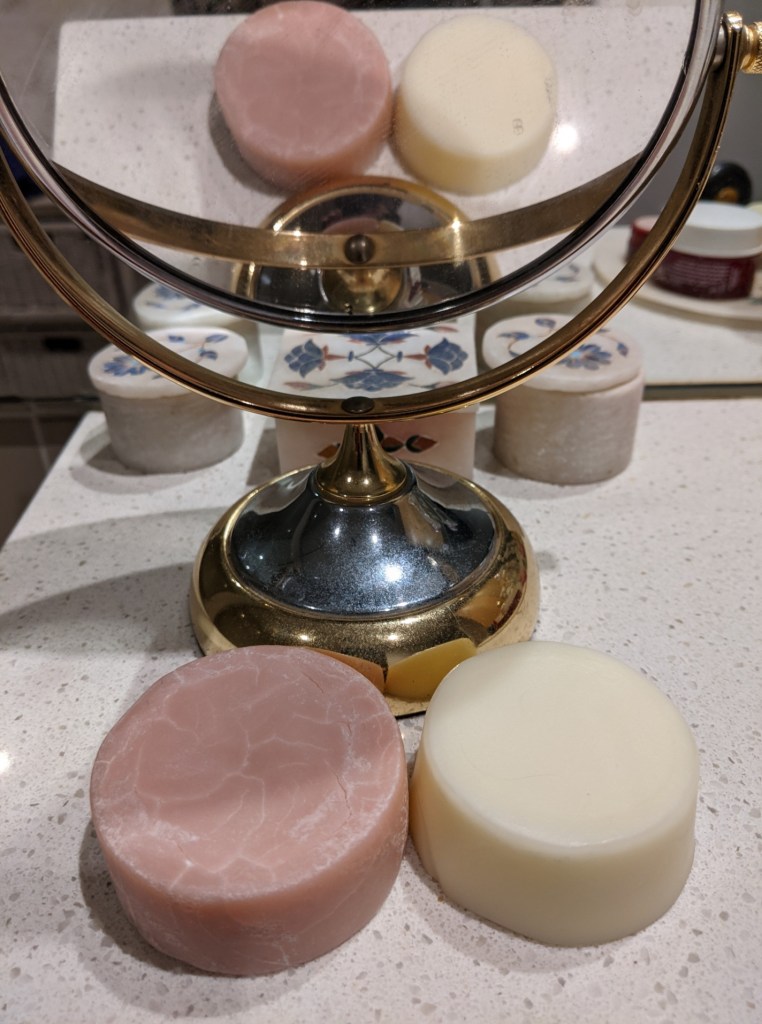
The following statement from Seed and Sprout is a great example of transparency. I love their shampoo bars – no plastic – and shall continue ordering them when Seed and Sprout sort out the problem. In the meantime read below to see what they are doing to rectify the problems already caused by a mistake beyond their ability to readily identify earlier. Some other companies might well be suffering from the same mistake.
‘We effed up.
We effed up. We’re sorry.
On Friday, February 5th we were made aware that some of our products may contain traces of Palm Oil.
Like many others, we believed that the ingredients used in our products were Palm Oil free and sourced from coconut oil – including derivatives. After consulting with independent experts, we have discovered that this is not always the case.
We had put our faith in trusted Australian specialists in our supply chain. However, this recent discovery has uncovered the difficult truth – that unknowingly, the coconut derived ingredients which we were led to believe to be palm free, do in fact contain Palm Oil. This has made us feel that we have not been fully transparent with you, our valued customers and community.
As a team, we are completely devastated that we weren’t aware of that hard truth, and many tears have been shed. We feel angry, betrayed, frustrated and sad.
We are acutely aware that Palm Oil has been, and continues to be, a major driver of deforestation of some of the world’s most biodiverse forests along the equator belt, and in turn, responsible for the pending extinction of the critically endangered species who rely on these forests for survival. We are fully committed to further educating ourselves on this problem, and to demanding more action to tackle this global issue.
We are also learning that Palm Oil derived ingredients are mixed with an uncertified supply and cannot be traced back to plantation, making it impossible to know where the Palm Oil is coming from and if it is contributing to deforestation.
Everyday we show up wanting and working to do the right thing – always, and in all ways. Through this turmoil, at no point did any one of us think that we shouldn’t share what we are going through. Doing the right thing is hard, but we welcome this difficult time with open arms as we walk together through this new reality. After all, we must do what is right, not what is easy.
When we launched our Bar range, it was all centered around our tagline of “Raise The Bar”. It’s with this exact sentiment that we’re holding ourselves accountable. We are raising the bar on ourselves, and also urging others to follow suit. We hope that by using our platform (and profits) as an agent of change, we can make significant strides towards a better future for all people & the planet.
What specific products this affects
- Shampoo Bar – Rose Geranium
- Shampoo Bar – Citrus & Mint
- Conditioner Bar
- Body Bar
- Face Bar
- Exfoliate Bar
- Hand Sanitiser Bar
- Pet Bar
- Sunscreen – Un-tinted
- Sunscreen – Tinted
So, what now?
It’s been 10 days since we found all of this out, here is what we are doing:
We have made a $50,000 donation to the Orangutan Alliance.
We will continue to sell the affected products so as to not make unnecessary waste.
Effective immediately, we will be donating 10% of all profits to International Animal Rescue Indonesia (IAR), who support land protection and restoration, and promote better land use planning practices.
We are working closely with Palm Oil Investigations to support us on our journey and to deepen our understanding of this issue.
We are currently conducting a company wide health check on all our manufacturers and partners.
We believe that we are nothing without transparency, a core pillar within Seed & Sprout. We will continue to update our community as we learn more, as this is all happening in real time. We are committed to always being open and honest with you, to have the hard conversations, to leave no stone unturned, and to continue to educate ourselves and others whilst we ignite change on what is an issue of global concern.
It’s never too late to do the right thing.
Statement from Palm Oil Investigations (POI) regarding our recent discovery
“Unfortunately this issue which has occurred with Seed & Sprout is not uncommon and other brands need to take note and step up.

POI estimates that at least 80% of brands making palm free claims on their hair care and cleaning product ranges, are in fact using Palm Oil derived ingredients. Coconut derived does not necessarily mean Palm Oil free.
Brands should never place blind faith in what they are being told regarding ingredients used. Palm Oil free claims should never be placed on products, marketing material and communication with consumers until they have fully traced ingredients right back to the source, being the actual manufacturer of the ingredient (not the formulating chemist, ingredient distributor or product manufacturer). Manufacturers, formulators and ingredient distributors need to be held accountable for misleading information supplied to brands. Always obtain Palm Oil free guaranteed documentation in writing. We thank Seed & Sprout for their honesty and transparency”.‘
To continue the conversation, please feel free to email us at: forum@seedandsprout.com.
The roll out of the Coronavirus Vaccines began in Australia on Sunday 21 February 2021. It seems pertinent to provide one of the debates around the vaccines.
The article below originally appeared in The Conversation, February 19th 2021. Thank you to The Conversation for its generous policy on republishing articles.

Disclosure statement
Ben Bramble does not work for, consult, own shares in or receive funding from any company or organisation that would benefit from this article, and has disclosed no relevant affiliations beyond their academic appointment.
Partners
Some of my vegan friends are reluctant to get the COVID-19 vaccine.
These vaccines do not contain animal products. Yet animals were used to develop and test them. For instance, early trials involved giving the vaccines to mice and macaque monkeys. So my friends say they feel uncomfortable having a product that uses animals in these ways.
I am very sympathetic to their concerns. Animals are treated appallingly in the production of many goods and in many areas of life.
Nonetheless, I believe vegans can get the COVID-19 vaccine in good conscience. Let me explain why.
Getting the vaccine prevents harming others
A key feature of COVID-19 is you can catch it and pass it on without even knowing you have it, despite your best efforts to avoid this.
This means we each pose a potentially deadly risk to others. Getting the vaccine yourself greatly reduces the chance of you having serious disease. And evidence is emerging that vaccines reduce the chance of you passing on the virus to others.
This means there is an important difference between avoiding products like shampoos and cosmetics tested on animals and not getting the vaccine. Doing the former doesn’t put anyone else at risk. But doing the latter does.
Let’s start with fruit and vegetables versus cosmetics
Vegans acknowledge it is virtually impossible to avoid contributing to animal harm entirely. Even most fruit and vegetables are grown in a way that kills or displaces wild animals, uses fish meal and blood and bone to fertilise plants, or requires killing “pests” like mice to protect crops and grain stores.
Many vegans therefore distinguish between animals harmed in this sort of food production, and animals harmed more directly by the meat and dairy industries, as well as in the production of consumer products such as cosmetics.
What is the right basis of this distinction? One possibility is the latter group of animals are killed or harmed directly, as a means to an end, whereas the former group suffers harm as a mere by-product or side-effect of other processes.
But this cannot be the right basis. Killing animals for use in fertiliser or as pests is direct killing.
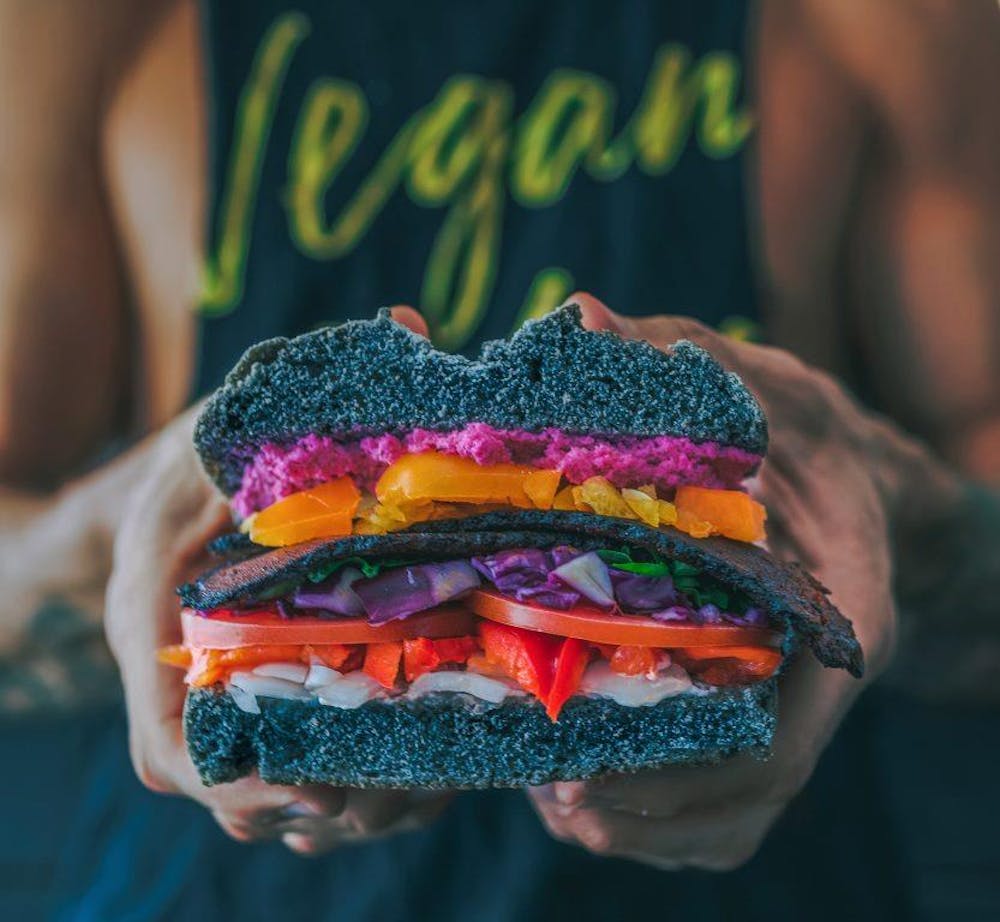
A more plausible basis for the distinction is unavoidably killing animals in the production of things that are necessary or clearly worth it. We need to grow large amounts of fruit and vegetables. And we cannot — at least, given current technologies — do so without killing some animals along the way.
But we do not need to consume meat or dairy, or wear animal-based clothing or cosmetics tested on animals. There are plenty of excellent alternatives.
So, in ethical terms, which of these products is a COVID-19 vaccine most comparable to: fruit and vegetables, or cosmetics tested on animals?
I think they are more like fruit and vegetables. COVID-19 vaccines are necessary — there is no other credible way out of this devastating pandemic. And the animal harm involved in developing and testing these vaccines was unavoidable.
There was no reasonable alternative available, at least not without making big sacrifices in terms of how long we have to wait for vaccines to arrive.
For this reason, I think even though the vaccines used animals directly, their use under the circumstances was permissible, and so vegans can get these vaccines in good conscience.
Why can’t we test on humans?
Some might argue there is an alternative to using animals to develop and test these vaccines — using humans instead, in “human challenge trials”, where volunteers are exposed to the virus in lab-controlled conditions. In fact, the United Kingdom has just given the green light for this type of trial to go ahead for later stages of the testing process.
If we allowed humans to volunteer to be involved at earlier stages of the development and testing process as well, some might put up their hands for this, too. While human challenge trials face serious moral issues, it might be ethically preferable to use consenting humans rather than unconsenting animals.
But involvement at these earlier stages may be so dangerous too few people would volunteer, or we should not allow them to take part. Still, this is a proposal worth considering further.
But I still feel too awful
Some vegans might accept my reasoning but find they just cannot bear to use a vaccine tested on animals.
To these people, I would say: it is perfectly understandable and reasonable to feel uncomfortable about getting the vaccine for this reason. It doesn’t follow, though, that you shouldn’t get it. If the only way to save the planet or your fellow humans is to kill an animal, you should do so even if it is incredibly emotionally hard to do so.
Even so, if as a vegan you simply cannot bring yourself to get the vaccine, this won’t make me grumpy in the same way it makes me grumpy when I hear others — for example, anti-vaxxers motivated by conspiracy theories — say they won’t get vaccinated.
Your reluctance to get the vaccine is rooted in a legitimate grievance about human mistreatment of animals more broadly.
By contrast, people who refuse to get vaccinated because they think Bill Gates is hoping to microchip humanity have no such legitimate grievance behind their aversion.
Humanity caused the pandemic
Experts widely predicted a pandemic would happen sooner or later. Many believe it was a direct result of human activity — indeed, mistreating animals.
Moreover, the fact there aren’t good alternatives to using animals in development and testing is due largely to society’s failure to properly explore and fund such alternatives earlier.
Nevertheless, under current circumstances, our need to use animals to develop and test these vaccines is real.
So, the correct path is not to reject COVID-19 vaccines. It’s to reluctantly accept them and lobby hard for better treatment of animals.
More on dealing with former President Trump
14th Amendment Section 3 Former GOP lawmakers , Jack Stanforth and Tom Coleman suggest the the 14th Amendment Section 3 should be used to prevent Trump being eligible to take office again. Another 57 officials who were at the Capitol insurrection may also be impacted by this amendment. There is no technicality that can encroach on the efficacy of this amendment, according to the discussion on its merits on The Last Word. It can therefore apply even when Trump is out of office. This seems to be a worthwhile matter to keep up with.
The New York Times reports that the Supreme Court has rejected former resident Trump’s ‘Final Bid to Block Release of Tax Returns’.

| No ifs. No buts. Women must be safe at work. – Anthony Albanese | Facebook facebook.com |
Every workplace – yes; every instance – yes; every time – yes.
Brittany Higgins will be sick and tired of seeing her name in the headlines. But will she, and others in her situation, wish that instead of working at Parliament House, they worked elsewhere? Would she have been safer from rape if she were a teacher? Worked in an office in a private or public organisation? Been a tour guide? Joined a voluntary organisation? Worked part time instead of full time? Was a casual, thus limiting the hours she was in contact with the men in the workplace?
The answer is, of course, no. This is not to say that the people at Parliament House responsible for the rape and the way in which it was handled are not accountable. As they should be in all the other workplaces in which women are raped. The culture at Parliament House must be examined, as indeed the culture in any workplace should be examined for its contribution to rape and sexual harassment.
Salacious reporting of the rape cannot help Ms Higgins. That the story has been a matter of salacious reporting largely because the rape occurred at Parliament House is a high possibility. The idea that Parliament House has a special culture in which rape is likely to occur and be swept under the carpet is a serious dereliction of the duty of reporting such stories. The sexist culture in which many women work is the key to any story of rape and the treatment of the perpetrator and victim.
Women such as Brittany Higgins should be afforded the respect that their experience should be given. That is, regardless of the workplace in which they have suffered, will continue to suffer, and are likely to remain traumatised into the foreseeable future, their personal story is important. Brittany Higgins, not Parliament House, is the important focus of the story. It is her story that should be given just due. It should not be forced aside while others make their own stories (unless they are also victims of rape) the focus. So, do the work that needs to be done in the political parties and the place in which the rapist and victim happened to work. But do not let this become the story – there are few workplaces in which the culture is likely to be one in which women are treated equally, do not have to wonder if their complaint about rape will impact on their career, or even on just keeping the job. Few indeed, in which they will never be the victims of some sort of sexual harassment, or even rape.
A week before this story broke I was astounded at the comments made by the Principal of Cheltenham Girls High School, reported in the article below:
Sydney school principal warns girls ‘skimpy’ clothes could ‘compromise the employment’ of male teachers at Cheltenham, Riley Stuart, Saturday 13 February, 2021.
The NSW Department of Education says a Sydney Upper North Shore principal, who warned female students not to wear “skimpy” clothes because it could “compromise” the employment of male teachers, will apologise.
Key points:
- Cheltenham Girls High School principal Suellen Lawrence lectured pupils about the dress code
- Pupils told the ABC they believed the principal’s lecture was “misogynistic”
- When confronted by pupils, Ms Lawrence said she wasn’t attacking individuals or anyone with “gender-identity” issues
In a video address seen by the ABC, Cheltenham Girls High School (CGHS) principal Suellen Lawrence told pupils not to wear “stringy, skimpy or revealing” clothes at casual dress days.
It is understood the lecture was prompted by dress standards at a recent swimming carnival.
“Please remember, girls there are men teachers in this school and they don’t want to be looking at that either,” she said in the video, which was shown to students at the girls-only school on Friday.
“Don’t compromise their employment.”
Cathy Brennan, the executive director of the school performance metropolitan north, said Ms Lawrence’s comments were “unfortunate” and “inappropriate”.
“We’re really proud of the fact that our girls there were empowered to raise concerns when it did occur,” Ms Brennan said.
“Certainly the comments that were made were not appropriate. We’ve taken that seriously … she’s absolutely ready to apologise [and] recognise those were not the comments that were aligned with our view of how we give confidence to our students.”

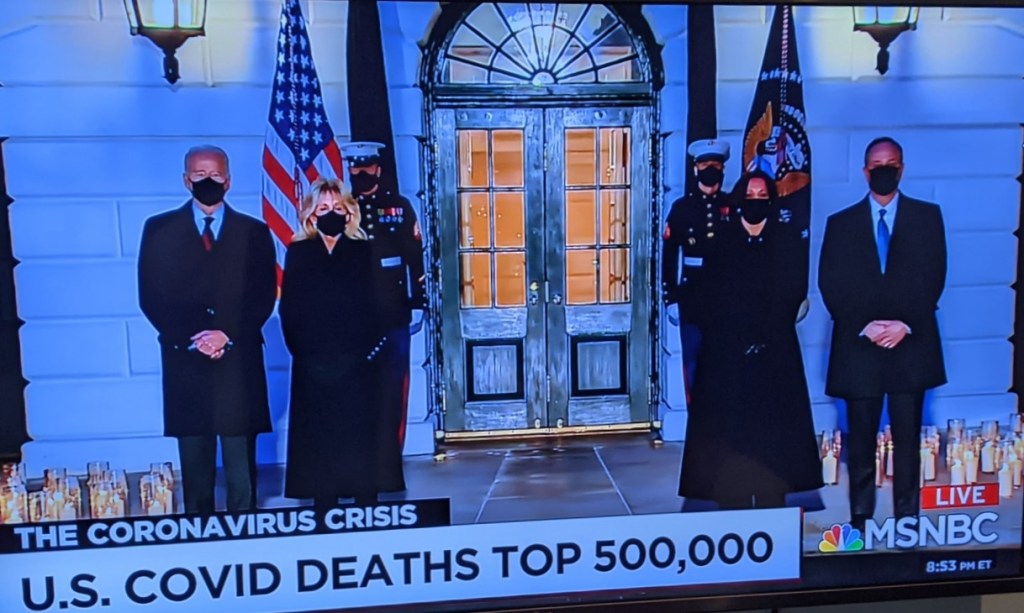
President Joe Biden and Vice President Kamala Harris
recognised the need for a memorial for the Americans dead from Covid 19 the night before their inauguration. The White House candles, Cathedral bells and flags at half mast again recognise the enormity of the deaths and need to honour the families of those suffering from the losses.
American families have lost more than 500,000 sons and daughters, mothers and fathers to COVID-19. Today and every day, we’re remembering them and fighting for them. Vice President Kamala Harris


We often hear people described as ordinary Americans. There’s no such thing. There’s nothing ordinary about them. The people we’ve lost to COVID-19 were extraordinary. President Joe Biden
 Robin's Room