
This week’s book reviews:
Scott Ryan’s Moonlighting An Oral History is an absolute delight. The first point to be made is pedestrian, but so important in a book that is, in Ryan’s words ‘a scholarly look’. I would also like to suggest that this book is so much fun (while scholarly) that it is not just for the academic, but for a wider audience. Bearing both in mind, my pedestrian point is how well organised I found the material in the well-designed chapters.
Amanda Prowse, Waiting To Begin, Lake Union Publishing, June 2021.

In the works of most prolific writers, it is likely that a reviewer reads work that stands out, as well as that which is disappointing. I have mixed feelings about this novel. While it does not stand out, there are some delightful nuggets of humour and characterisation, and the story line is feasible. However, I could not warm to the main character, despite her harrowing story with which I would expect to have sympathy.
New post on Women’s Film and Television History Network – UK/Ireland 100 Years of Women at the BBCby sarahlouisesmyth 100 Years of Women at the BBCby sarahlouisesmyth Mary Malcolm Mary MalcolmCritical Studies in Television Workshop: 100 Years of Women at the BBCFriday 7 May 2021 1pm – 5.30pm (BST), OnlineCo-sponsored by Critical Studies in Television and Edge Hill University Institute for Social ResponsibilityIn 2022, one hundred years will have passed since the formation of the British Broadcasting Company, later to become the pioneering public service broadcaster best known as the BBC.This workshop will explore one specific aspect of the BBC’s history: its relationship with women.Characterised from early in its life as ‘Auntie’, the BBC itself has been gendered female in the cultural consciousness. But this belies an historically male-dominated institution in which women have often had to fight for their rights to be heard. Recent controversies around equal pay, misogynistic abuse towards BBC personalities and a lack of female representation at the top of the corporation suggest that the institution has far to go in matters of gender equality.The workshop will present fresh and innovative work-in-progress research on women at the BBC. Our presentations will explore the careers of some pioneering female workers at the BBC. The workshop aims to shed fresh light on influential figures such as Grace Wyndham Goldie and Jill Craigie; to draw attention to careers that are often overlooked – such as gramophone operators or production designers; to re-examine forgotten on-screen personalities; and to consider women’s contributions to prestigious BBC strands such as Play for Today. We will also think about the tools we use to explore women’s television history, with a panel that focuses on the pros and cons of using interviews as a research method for historical studies.Registration for the event is free. Please visit the event website: ISR Public Event: 7th May 2021This free site is ad-supported. Learn moresarahlouisesmyth | April 23, 2021 at 12:35 pm | Categories: Upcoming Events | URL: https://wp.me/p1ImEC-268LikeUnsubscribe to no longer receive posts from Women’s Film and Television History Network – UK/Ireland. Change your email settings at Manage Subscriptions.Trouble clicking? Copy and paste this URL into your browser: https://womensfilmandtelevisionhistory.wordpress.com/2021/04/23/100-years-of-women-at-the-bbc/ |
Dr Robin Hughes: Australian Biography
Dr Robin Hughes is the Managing Director of Chequerboard Productions, a film maker, director and producer. She was a member of the ANU Council between 2004 and 2017 (Pro-Chancellor between 2014 and 2017) and has worked for the BBC, the ABC, commercial television and freelance. She was Chair of the Council of the Australian Film Television and Radio School, Convener of the ABC’s Independent Complaints Review Panel, a director of the Bangarra Dance Company and Chair of Performing Lines.
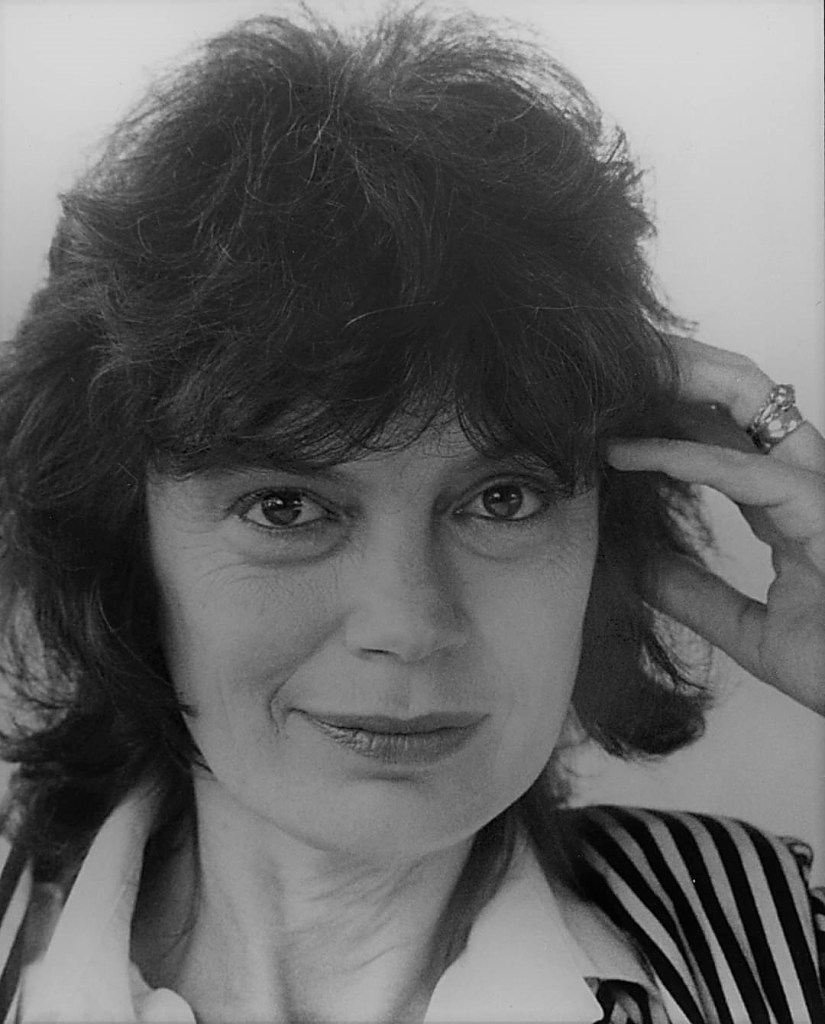
I was thrilled to be able to talk over a wide range of topics when I met Dr Robin Hughes while I was in Sydney. Amongst the debates around American and Australian politics, social issues, and the joy of walking through the Sydney Botanical Gardens one topic really resonated. Having enjoyed the SBS Series of Australian Biography, directed and produced by Hughes, I had wondered about its continuing accessibility.
At the time I saw some of the interviews, I knew only that they were enthralling. I should, of course, have watched the credits as avidly as I did Robin Hughes interviewing people such as Tom Uren, Anne Deveson, Bob Santamaria, David Williamson, Betty Churcher, Jack Mundy, Zelda D’Aprano, Faith Bandler and Nugget Coombs, to name only a small selection. So, to me, Robin Hughes was the marvellous interviewer. Now I know better and see that her commitment to the series included writing, producing, and directing. On the other hand, my one dimensional knowledge has led to my dwelling on Robin Hughes’ interviewing style. It has been an important benchmark I use when watching other interviewers.
Markedly, the interviewee always had the floor. Each subject was the star of the interview, providing their responses, verbal and physical, to the gentle, knowledgeable probing from an accomplished interviewer. Having watched Robin Hughes being interviewed by Ray Argall in June 2009 it is clear that she has a lot to offer the camera – but, by maintaining her role as a person predominantly interested in her subjects she ensured that the Australian Biography audience became totally enmeshed in her interviewees. A wonderful series.
To return to the news about the program’s continuing accessibility. The Australian Archives have established a site through which clips of the interviews can be accessed, together with written material based on the interviews.
AustralianBiographyOnline is a web-based biographical resource profiling some of the most extraordinary Australians of our time. The website draws from valuable material collected for Film Australia’s AustralianBiography TV series, which features remarkable individuals who have had a major impact on our cultural, political and social life.
Australian Biography – About this site
Bob McMullan: West Australian Election
WA election: an untold story
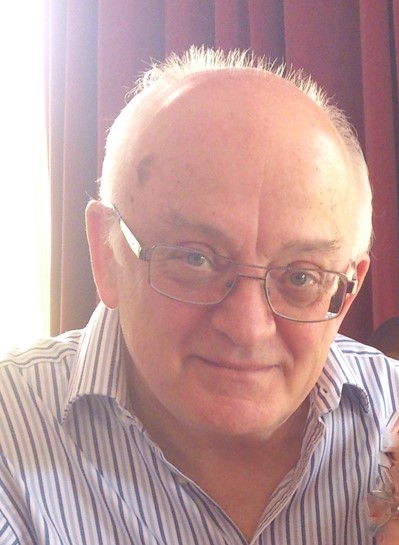
Of course, the dominant story of the recent WA election is the magnitude of the Labor victory. This is thoroughly justified. It was an unprecedented victory for Labor in both Houses. However, there is an untold story. The total failure of the “don’t give Labor total control” message run at the end of the campaign by the Liberals and the parallel failure of the Nationals’ campaign highlighting the threat to the grotesquely weighted rural vote in the Upper house.
Now that all votes have been counted, not only did Labor win by a record margin in the Lower House, but voters also overwhelmingly voted the same way in the Upper House. In fact, they went further. According to the WA Electoral Commission the total primary vote numbers were: Labor vote Legislative Assembly 846116 ; Labor vote Legislative Council 868374. That means more than 20,000 people who did not vote Labor in the landslide Legislative Assembly election voted Labor in the Upper House. It is, of course plausible that the difference is explained by a personal vote for Assembly members.
However, this has not been the usual pattern. In the 2017 Labor victory the ALP gained 557,794 votes in the Assembly but only 544,938 in the Council. Apart from illustrating the magnitude of the increase in the Labor vote, these figures suggest that there has been more than a 30,000 vote turn around in vote differential. The Labor Upper House vote has gone from 12,856 less than the Lower house vote to 22,258 more. Furthermore, as there were many more candidates in each Upper House contest than in the Assembly there would be likely to be a leakage of votes away from both major parties. It is clear the scare campaigns failed. If they failed, as seems to be the case, what is the explanation?
Obviously one large part of the explanation is that Mark McGowan was unthreatening, and the idea that he would go crazy with power if he won the Upper house was not credible.
It also appears clear that, whatever his other virtues, Zak Kirkup was not an effective advocate for the Liberals, but why didn’t it work for the Nationals in the bush?
Perhaps people in the country areas, as defined by the Electoral Act, are not as obsessed with their excessive voice in the parliament as the National Party is about protecting their party interests.
It is also possible that people do not care as much about checks and balances as political insiders (like me) tend to think.
What was also missing was a legitimate minor party which ran a “keep the bastards honest” campaign. There were many minor parties running on the off-chance that the” preference whisperer” could rort the result to get them elected, which he did for a few of them. But there was no party pitching itself as a plausible moderate option.
It is also possible that voters saw through the scare campaign because they were aware that every conservative government since 1891 has had an effective majority in the Legislative Council, so the conservatives’ cries of alarm about Labor having such a majority rang hollow.
There are undoubtedly lessons to draw from the recent WA election, but the result was so extraordinary as to render much of the usual post-election analysis redundant. But the failure of the “Don’t give them absolute power” argument warrants particular assessment in the light of the excessive malapportionment in favour of rural areas which still remains in the WA Upper House, but which has been abolished federally and in every other state.
Cindy Lou’s reviews: Goulburn Breakfast
Cindy Lou has been a long time contributor to Trip Advisor. There she reviewed numerous hotels, restaurants and tourist venues in the UK, Europe and America. Now, back in Australia for the foreseeable future, she is enjoying the Australian restaurant and hotel scene. She will contribute occasional reviews to this blog.
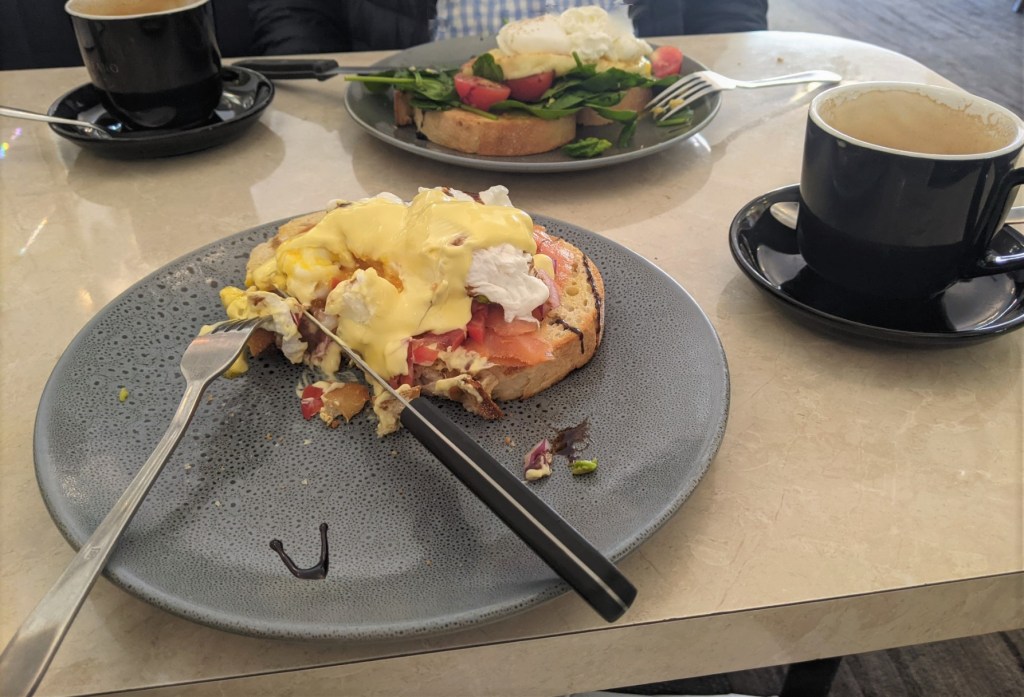
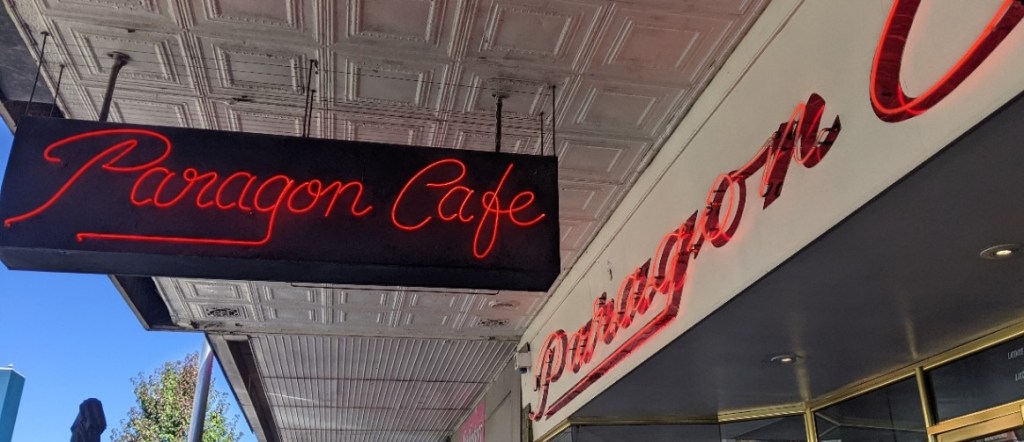
The Paragon Café has been in Goulburn, it seems forever. I recall eating there over ten years ago and was pleased to have the opportunity to reprise the generous breakfast. The menu is lengthy, but the food does not seem to suffer from this, as can sometimes be the case when a café tries to be all things to all people. Café Paragon achieves the latter with no downside. The service is friendly and quick, ideal for the traveller who wants to eat and be on their way. My eggs benedict with smoked salmon was pleasant, although I found the sauce a little too heavy. In contrast, the toast was excellent, not some awful white sliced, but a crisp crusty thick slice from a fancy loaf. The coffee was hot and made to my taste. A good meal, served efficiently, and a reasonable price.
The cafe reviewed above observed Covid rules, displaying the check in logo prominently and maintaining distance between tables.
 Robin's Room