Book reviews this week:

Nicola West, Catch Us The Foxes, Simon & Schuster 2021. The prologue introduces Marlowe Robertson, ‘author, journalist and Co-creator of The Lily Foundation’. She is interviewed on the seventh anniversary of Lily’s death, as the person who exposed her killer. Marlowe, colloquially known as Lo, dressed in clothing reminiscent of her past friendship with Lily, is asked to return to the moment she found Lily’s body. She finds it easy to talk about Lily, her death, the causes, and events because ‘she had been reliving them through her bestselling novel The Showgirl’s Secret.’ The remainder of the story is provided mostly through Marlowe’s novel, with the Epilogue describing the completion of the interview, a demonstration thwarted, and Marlowe Robertson and her companion’s reflection on their experiences.
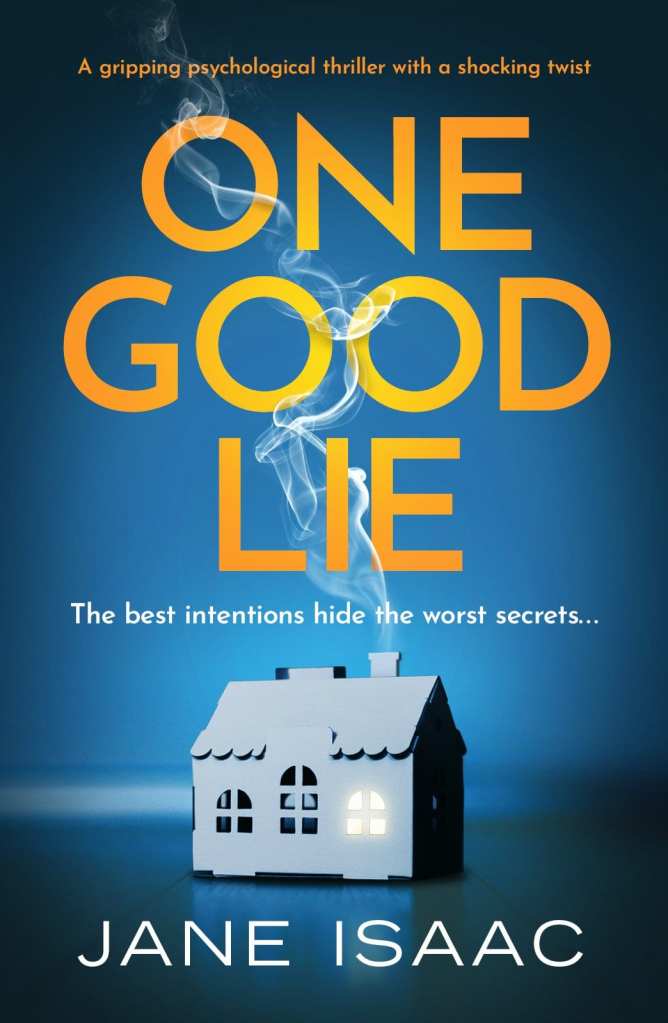
Jane Isaac, One Good Lie, Canelo, 2021, A chilling prologue introduces a female victim and her captor – a man who is known to her. Subsequent chapters introduce male and female characters, two of whom must be those featured in the prologue. Who are they? What has caused this event? Will the incidents leading to the capture be worth following to find the answers? What will happen to the victim and her captor?
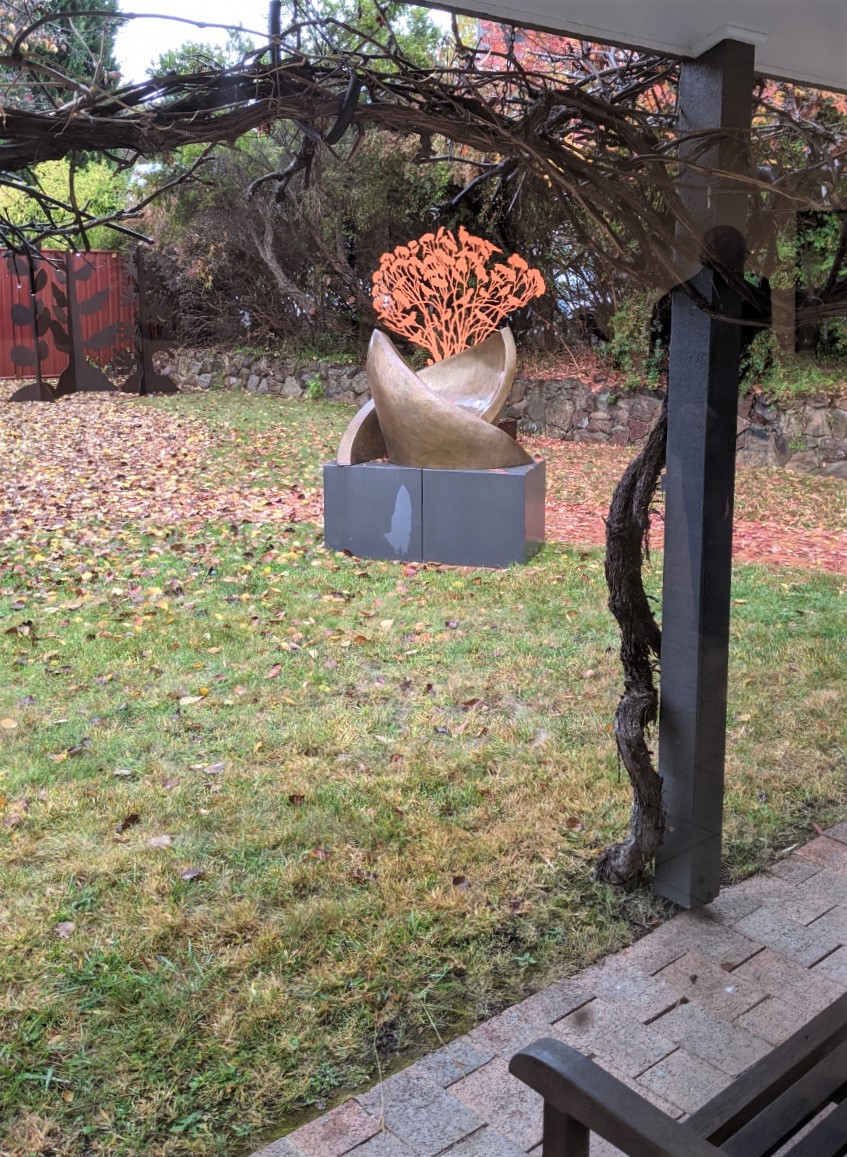
Visit to Beaver Galleries
Art in the garden observed on a cold Canberra day from the warmth inside the galleries


eX de Medici exhibition – Double Crossed

Watercolours with gold leaf on paper.

‘ Mesmerising exactitude of detail…and painstaking attention to detail, textures, surfaces and vivid colours’, Sasha Griffin , The Canberra Times.
The exhibition can be viewed on line on the Beaver Galleries website: https://www.beavergalleries.com.au/exhibitions/doublecrossed/de/
Alex Asch – First Fire back of Braidwood

Melinda Schawel







We also visited The Kitchen, the café at the Beaver Galleries, for lunch. The staff and food were pleasant. However, the meals did not arrive at the same time. Fortunately the conversation (politics, American and local, literature, the exhibitions) was enough to weather the comments that are attendant on such an event – ‘do start, don’t let it get cold’ etc. Possibly my next visit will be in the morning so as to take advantage of the coffee and cake (the cakes look delicious) as part of an enjoyable morning at the Beaver Galleries.
Heather Cox Richardson https://www.facebook.com/heathercoxrichardson

May 28, 2021 (Friday)This afternoon, Republicans in the Senate killed the bill to establish a bipartisan independent commission to investigate the January 6 insurrection. The vote was 54 to 35, and yet the thirty-five “no” votes won because of the current shape of the Senate filibuster, which requires 60 votes to break, even if the minority doesn’t show up to vote. For their part, having killed the bipartisan, independent commission, Republicans are now complaining that the Democrats might set up a committee on their own. Maine Senator Susan Collins told Politico, “The most likely outcome, sadly, is probably the Democratic leaders will appoint a select committee. We’ll have a partisan investigation. It won’t have credibility with people like me, but the press will cover it because that’s what’s going on.”
House Speaker Nancy Pelosi could indeed set up such a House committee, although she has been clear that she preferred the bipartisan approach. Such a select committee could issue subpoenas and hold hearings to investigate the people involved in the attack. Republicans, who likely fear some of their own would be implicated, are already claiming such a committee would be partisan. President Biden could also set up a commission, which he could then staff in a bipartisan fashion, but without congressional support it could not issue subpoenas. On Thursday, Senator Joe Manchin (D-WV) continued to hope Republicans would vote for the commission, saying, “…the Democrats have basically given everything they’ve asked for, any impediment that would have been there, and there’s no reason not to now unless you just don’t want to hear the truth.” Today, after the vote, he said, “I never thought I’d see it up close and personal that politics could trump our country. I’m going to fight to save this country.” Indeed, by refusing to investigate what is arguably the most dangerous attack on our democracy in our history, Senate Minority Leader Mitch McConnell (R-KY) has brought out into the open just how radical the Republican Party has become.
As if in illustration of the party’s increasingly antidemocratic radicalism, in Georgia last night, Representatives Matt Gaetz (R-FL) and Marjorie Taylor Greene (R-GA) continued to stoke the same Big Lie that drove the insurrectionists, claiming (falsely) that former president Trump won the 2020 election. The two representatives are on a tour of rallies, possibly to distract from the scandals in which they’re embroiled. Last night, Gaetz, who is under federal investigation for sex trafficking, told attendees that the nation’s founders wrote the Second Amendment to enable citizens to rise up against the government. “It’s not about hunting, it’s not about recreation, it’s not about sports,” he said. “The Second Amendment is about maintaining, within the citizenry, the ability to maintain an armed rebellion against the government if that becomes necessary.” As the audience cheered, Gaetz continued: “I hope it never does, but it sure is important to recognize the founding principles of this nation and to make sure that they are fully understood.”
For his part, President Biden appears to be trying to undercut the increasingly radical Republicans by trying to improve conditions across the country, especially for those hurting economically as the nation’s factories automate and as their jobs move overseas. When he took office, his first order of business was to get the coronavirus under control, demonstrating that the federal government could, indeed, do good for the people. That has been a roaring success, with about 62% of American adults currently having received at least one vaccine. Biden is now aiming to have 70% of American adults vaccinated by July 4. New cases are plunging as the vaccines take effect, and the country is reopening rapidly. Biden also turned quickly to repairing the economy, with the $1.9 trillion American Rescue Plan, which expanded unemployment benefits and the child tax credit. That credit will start to show up in people’s bank accounts in mid-July and is expected to cut child poverty in half. So far, Biden’s approach to turning the mood of the country seems to be working: while his predecessor is polling at 39% approval and 57% disapproval, Biden is currently enjoying a 63% job approval rating. We’ll see how these two themes play out.
Today, Biden released a proposed $6.01 trillion budget, tying together three plans he’s already proposed—the $2.3 trillion American Jobs Plan, the $1.8 trillion American Families Plan, and $1.5 trillion in discretionary spending—and adding more to invest in education, health, science, and infrastructure. The proposal increases defense spending by 1.7% and nondefense spending by 16%. Overall, it increases federal spending to levels like those of WWII. By 2031, it would peg spending at $8.2 trillion. Deficits would run higher than $1.3 trillion for the next ten years but then would begin to decrease. The president proposes to pay for the additional spending by increasing revenue by $4.17 trillion through taxes on individuals who have an annual income of more than $1 million and by revising the top capital gains rate to 39.6%, plus a 3.8% Medicare surtax, bringing the rate to 43.4%. (The current rate is 20% plus the Medicare surtax, making it 23.8%). The White House figures the capital gains tax reform should raise about $322 billion over the next decade. The budget shows Biden aiming to rebuild the middle class and make America globally competitive again. Acting director of Office of Management and Budget Shalanda Young said that the administration had earlier called for such investment because, “The country had been weakened by decades of underinvestment in these areas.” The 2022 budget would, she said, “grow the economy, create jobs, and do so responsibly by requiring the wealthiest Americans and big corporations to pay their fair share.” Doubling down on the 2017 Trump tax cuts, which funneled money upward even as corporate tax revenues fell 31%, Republicans have vowed to oppose all tax increases and want no part of Biden’s proposed spending. Today, McConnell responded to the budget proposal with words that were somewhat unfortunate coming, as they did, on the same day the Republicans refused to create a bipartisan commission to investigate an attack on our government. “If Washington Democrats can move beyond the socialist daydreams and the go-it-alone partisanship,” he said, “we could get a lot of important work done for our country.”


WHAT IS NATIONAL RECONCILIATION WEEK
National Reconciliation Week (NRW) is a time for all Australians to learn about our shared histories, cultures, and achievements, and to explore how each of us can contribute to achieving reconciliation in Australia.
The dates for NRW are the same each year; 27 May to 3 June.
These dates commemorate two significant milestones in the reconciliation journey— the successful 1967 referendum, and the High Court Mabo decision respectively.
27 May 1967 On this day, Australia’s most successful referendum saw more than 90 per cent of Australians vote to give the Australian Government power to make laws for Aboriginal and Torres Strait Islander people and recognise them in the Census.
3 June 1992 On this day, the Australian High Court delivered the Mabo decision, the culmination of Eddie Koiki Mabo’s challenge to the legal fiction of ‘terra nullius’ (land belonging to no one) and leading to the legal recognition of Aboriginal and Torres Strait Islander peoples as the Traditional Owners and Custodians of lands. This decision paved the way for Native Title.
Reconciliation must live in the hearts, minds and actions of all Australians as we move forward, creating a nation strengthened by respectful relationships between the wider Australian community, and Aboriginal and Torres Strait Islander peoples.
A BRIEF HISTORY
National Reconciliation Week (NRW) started as the Week of Prayer for Reconciliation in 1993 (the International Year of the World’s Indigenous Peoples) and was supported by Australia’s major faith communities. In 1996, the Council for Aboriginal Reconciliation launched Australia’s first National Reconciliation Week. In 2001, Reconciliation Australia was established to continue to provide national leadership on reconciliation. In the same year, approximately 300,000 people walked across Sydney Harbour Bridge as part of National Reconciliation Week-and subsequesntly across bridges in cities and towns-to show their support for reconciliation. Today, National Reconciliation Week is celebrated in workplaces, schools and early learning services, community organisations and groups, and by individuals Australia-wide.


Information from Reconciliation Australia
 Robin's Room