The books reviewed this week include one that is pertinent to the debate about democracy and voting rights in America today. Included this week is also Heather Cox Richardson’s commentary on these events. The book is Democracy, Race and Justice The Speeches and Writings of Sadie T.M. Alexander, edited by Nina Banks and published by Yale University Press. The other book to be reviewed this week is about Amanda Gorman, whose riveting reading at President Joe Biden’s inauguration deserves this early recognition in Work Up: The Life of Amanda Gorman by Marc Shapiro, Avenue Books, 2021. Both books were sent to me by NetGalley for review.
Work Up: The Life of Amanda Gorman by Marc Shapiro, Avenue Books, 2021.
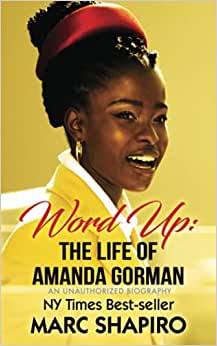
Marc Shapiro has penned numerous biographies, some with contributions from the subject, others unauthorised, and, in this case, although the subject or her associates did not take part, apparently accepted by them as a contribution to Amanda Gorman’s fame. The dedication is instructive in that it applauds powerful women who are smart and encourages them to flourish. Shapiro sees Amanda Gorman’s voice as an essential contribution to those with gravitas re- envisioning an America after the former president’s four years in the White House. Shapiro began the book after watching Amanda Gorman provide a lightning strike for hope in her poem ‘The Hill We Climb’ at President Biden’s Inauguration. He states that the outcome of his research was a rarity. He found nothing negative, in both the minor and major senses of the word, in his work on the Amanda Gorman excursion. The complete review appears at Books: Reviews.
Nina Banks (ed.), Democracy, Race, and Justice The Speeches and Writings of Sadie T.M. Alexander, Yale University, 2021.
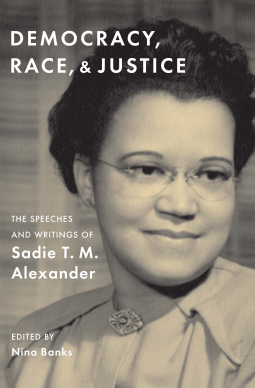
What an opportune time for a collection of papers such as these to be published. The speeches and writing reach so much into the past that it seems beyond belief that in 2021 Congress is having to consider voting rights as a right as well as an antidote to the various state legislators’ introduction of laws which limit the voting rights of black and brown Americans. This collection, adroitly introduced by Nina Banks, would be a worthy read at any time, I am pleased to be able to review the book when voting rights in America are under attack after the major contribution black and brown Americans made to the election of President Joe Biden. The full review can be found at: Books: Reviews
Heather Cox Richardson heather.richardson@bc.edu

July 13, 2021 (Tuesday)
“Are you on the side of truth or lies; fact or fiction; justice or injustice; democracy or autocracy?”
In a speech at the National Constitution Center in Philadelphia today, President Joe Biden asked his audience to take a stand as he called defending the right to vote in America, “a test of our time.” Biden explained that the 2020 election has been examined and reexamined and that “no other election has ever been held under such scrutiny and such high standards.” The Big Lie that Trump won is just that, he said: a big lie.
Nonetheless, 17 Republican-dominated states have enacted 28 laws to make it harder to vote. There are almost 400 more in the hopper. Biden called this effort “the 21st-century Jim Crow,” and promised to fight it. He pointed out that the new laws are doing more than suppressing the vote. They are taking the power to count the vote “from independent election administrators who work for the people” and giving it to “polarized state legislatures and partisan actors who work for political parties.”
“This is simple,” Biden said. “This is election subversion. It’s the most dangerous threat to voting and the integrity of free and fair elections in our history.”
While Biden was on his way to Philadelphia, more than 50 members of the Texas House of Representatives were fleeing the state to deny the Republicans in the legislature enough people to be able to do business. They are trying to stop the Republicans from passing measures that would further suppress the vote, just as they did when they left the state in May. Along with voting measures, the Texas Republicans want to pass others enflaming the culture wars in the state: bills to stop the teaching of Critical Race Theory in public schools (where it is not taught) and to keep transgender athletes from competing on high school sports teams. Both of these issues are part of a wider program pushed by national right-wing organizations. When the Democrats left the state two months ago, Republican governor Greg Abbott was so angry he vetoed funding for the legislature (that effort is being challenged in court). This time, he has vowed to arrest the Democratic members and hold them inside the Capitol until the special session of the legislature ends in late August. This threat has no effect outside of Texas, where state authorities have no power, and even within the state it is unclear what law the legislators are breaking.
But it does raise the vision of a Republican governor arresting Democratic lawmakers who refuse to do his bidding. What is at stake in Texas at the local level is that Abbott is smarting from two major failures of the electrical grid on his watch: one in February and one in June. What is at stake at the national level is that the electoral math says that Republicans cannot expect to win the White House in the future unless they carry Texas, with its 40 electoral votes, and the state seems close enough to turning Democratic that Abbott in 2020 ordered the removal of drop boxes for ballots. The electrical crisis of February, which killed nearly 200 Texans and in which Republican senator Ted Cruz was filmed leaving the state to go to Cancun, has hurt the Republican Party there. And so, Abbott and his fellow Republicans are consolidating their power, planning to “win” in 2022 and 2024 by making sure Democrats can’t vote. Biden today went farther than he ever has before in calling out Republicans for what they are doing. He described the attempt to cast doubt on the 2020 election and to rig the vote before 2022 for what it is: an attempt to subvert democracy and steal the election. “Have you no shame?” he asked his Republican colleagues.
But as strongly as Biden worded his speech, the former speechwriter for Republican President George W. Bush, David Frum, in The Atlantic today went further.
“Those who uphold the American constitutional order need to understand what they are facing,” Frum wrote. “Trump incited his followers to try to thwart an election result, and to kill or threaten Trump’s own vice president if he would not or could not deliver on Trump’s crazy scheme to keep power.”
Since the insurrection, he noted, Trump supporters have embraced the idea that the people who hold office under our government are illegitimate and that, therefore, overturning the election is a patriotic duty. “It’s time,” Frum said, “to start using the F-word.” The word he meant is “fascism.” “We are facing the most significant test of our democracy since the Civil War,” Biden said today…. I’m not saying this to alarm you; I’m saying this because you should be alarmed.” We must, he said, have “the will to save and strengthen our democracy.”
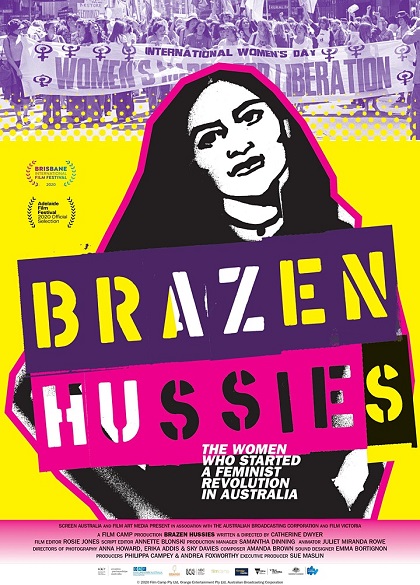
‘Brazen Hussies’ film screening & panel discussion

Presenter/s: ANU Film Group; ANU Gender Institute
Event type: Film screening
Event date: Saturday, 14 August 2021 – 5:00pm
Event venue: Cinema, Cultural Centre Kambri (ANU Building 153), University Avenue
Further information: Registration
Join the ANU Gender Institute and the ANU Film Group, alongside a panel of trailblazing women, for a FREE Q+A screening of Brazen Hussies!
Screening on ANU Open Day 2021 at the Kambri Cinema, this inspiring doco introduces contemporary audiences to Australia’s pioneering second-wave feminists.
Stick around after the film for an exclusive panel discussion, chaired by ANU Gender Institute Convenor Fiona Jenkins, featuring two stars of the women’s movement, Elizabeth Reid AO and Biff Ward.
About Brazen Hussies
Brazen Hussies introduces contemporary audiences to the Australian second-wave feminists, who declared war on ‘male chauvinism’, traditional sex roles and demanded that women be set free from the ‘chains of femininity’. This feature documentary traces how the Australian Women’s Liberation Movement was born amidst the tumultuous politics of the 1960s, influenced by the anti-war, anti-imperialist, and civil rights movements worldwide. The film combines a treasure trove of startling archive footage with interviews from key activists from around Australia.
Where does the next Australian federal election stand?

We now know the redistribution framework for the federal election expected in 2022. With the redistributions in Victoria and Western Australia completed a number of skilled analysts have attempted to draw the revised pendulum based on the new boundaries.
At the most fundamental they agree. The Liberals have lost one seat, the former seat of Stirling in WA has been abolished, and the ALP has gained one, the newly created safe Labor seat of Hawke.
The various analysts also agree that unlike the 2019 election, no seat has notionally changed hands as a result of the boundary changes. The margins for a number of seats have changed, but they have all stayed on the same side of the line.
This means the LNP go into the election with 76 seats (if we include Hughes which is only temporarily classified as Independent), Labor with 69 and 6 Independents. Therefore, Anthony Albanese needs to win 7 seats if he is to win a Labor majority. If we assume that at least two of the Independents Adam Bandt (Melbourne, Vic) and Andrew Wilkie (Clark, Tas.) would support a Labor government in the event of a hung parliament then 5 seats would be enough for a change of government. Some of the other Independents, and any new ones which might be elected are wild cards which could change the equation. However, a 7-seat target and a 5-seat minority government target are a good enough basis for subsequent analysis.
Within those parameters a number of seats were significantly changed, most of which will have little impact on the likely election outcome, although they are of course significant to the members concerned. In WA, on the Labor side the seat of Cowan was made slightly better for the sitting member, Anne Aly. The margin seems to have gone from a microscopic 0.8% to a wafer thin 1.5%. Conversely, the seat of Perth has been reduced from 4.9% to 3.4%. Given how bad the last election was in WA this should still be won by Patrick Gorman, but it will be tighter. In Victoria, none of the marginal Labor seats seem to have been significantly affected. A notable change is the relative strengthening of the Labor vote in Hotham from 5.9% to 12% while the reverse applies to Bruce (14.2% down to 7.1%).
On the conservative side, the most significant change seems to be to Chisholm. However, the different analysts have very different assessments of the likely impact of the changes. I will go into this in more detail later in this analysis. However, what is agreed is that it remains the key marginal seat target for the ALP in Victoria. After the redistribution in WA several key marginals have got more difficult for Labor, while another has become a serious prospect. The margin in Swan has blown out from 2.7% 3.3%. This doesn’t seem a lot but it makes the task more difficult. Similarly, the margin in Hasluck has increased a little, from 5.5% to 5.9%. The more significant change was in Pearce, where the margin for Christian Porter, if he runs again, has collapsed from 7.5% to 5.5%.
The overall outcome of the last election and the recent redistribution suggests the ALP needs a 3.3% swing to win, which would mean 51.7% of the two-party preferred vote. Of course, this means that Labor could win more than 51% of the vote and still not win. However, a look at state-by-state prospects could change this assessment.
Recent elections in Australia and overseas have made clear that polling is an imprecise predictor of likely outcomes. However, it remains the best guide we have of the overall picture. So, what does the polling show and how much notice should we take? The recently released consolidated Newspoll results paint a very interesting picture. Those results are an aggregation of polls taken from April to June. This gives sufficiently large samples to allow a reasonable state-by state breakdown for every state except Tasmania. While these results are taken over a period which would undoubtedly contain week-to week variations the results are as good a guide as we will get. They show a very interesting stability, which tends to suggest such changes as it shows are quite well established. And the results overall are not contrary to what a reasonable observer might expect.
In NSW, where Labor polled a disappointing 48% in 2019, Newspoll suggests a 50/50 result. Such a uniform swing would put the seat of Reid on a knife edge. The swing would need to be more than 4% to bring more seats such as Robertson and Lindsay into serious contention. Local factors tend to impact which seats will perform above or below statistical expectations, but these tend to cancel each other out from an overall party point of view.
For Victoria, the results look like the status quo. This is not surprising given the very strong result in 2019 (53-47). If this were to be the result it would not be likely that any seats would change hands. This brings me to the interesting case of Chisholm. After the last election the Liberals held the seat with a 0.6% margin. Antony Green and the Poll Bludger differ about the impact of the redistribution. Green suggests that the Liberal vote has become worse, the other says it has improved. But it is still very close whichever is correct. 1.1% is the most generous assessment. In truth, it is impossible to judge the consequences of redistributions with that degree of precision. Both analysts are credible and do a good job, but once you get down to dividing the results in polling booths there is always an element of guesswork involved at the margin. Add to that the controversy around the use of misleading information at the last election and this seat would have to be likely to be very close even with no swing in Victoria.
The really interesting movements in the Newspoll aggregation are in Queensland and Western Australia. These were states in which the ALP did very badly in 2019, so there is significant room for improvement. The data suggests a swing of 5.5% in Queensland. A uniform swing of this magnitude would mean a Labor gain of 4 seats. Of course, swings are never uniform, but the local variations tend to even out such that the pendulum is a reasonable predictor of the number of seats, but not of which individual seats will change hands. In Western Australia the Newspoll results suggest a swing of 8.5%. This would seem incredible if it were not for the very low base from which Labor will be starting this election in WA. Such a swing could deliver as few as three seats, but a number of others would be on the cusp. This would mean enough seats for Anthony Albanese to win a majority could be won in Queensland and Western Australia alone.
Newspoll also suggests that Labor could gain one seat in South Australia. It has nothing to say about Tasmania, the ACT or the Northern Territory as the samples would be too small even on a quarterly basis.
Taken at face value this polling indicates that Labor is in a winning position, albeit with a long way to go until the next election. This is without taking into account the most recent Newspoll which showed Labor leading 53/47, which would mean a 4.5% swing to Labor. How much faith should we put in these polls? After all they got it seriously wrong in 2019 and in the USA in 2016. A recent article by Murray Goot in the Australian Journal of Political Science reinforces the view that we should proceed with caution, although he does not suggest that there is evidence of a systemic bias in favor of the ALP within Australian polling organisations. This is based on a study of the last ten elections in Australia. 2019 was the first time that all the polls picked the wrong winner! In 2019 the error was 2.9%, compared to a long-term average error of 1.8%. However, this was not the biggest average error. In 2004 it was 3.2%. The Poll Bludger’s tracking poll suggests a swing to labor of 2.9% since the last election and an upwards trend since September last year.
Even allowing for a small discount in case of any emerging pro-labor bias in the polling the results indicate a very winnable election for the ALP with the trends going in the right direction. Add to this the emerging perception of the “Prime Minister for NSW”, which could be a very potent weapon in WA, for example, the seats required to win are within reach.
The next few months will determine whether Anthony Albanese and his team can finalise the deal.
 Robin's Room