This week I am reviewing Hillary Rodham Clinton and Chelsea Clinton’s Gutsy Women Favourite Stories of Courage and Resilience . One of the interesting aspects of this exciting range of stories is their resonance with some of the books I have reviewed previously in this blog.
Hillary Rodham Clinton and Chelsea Clinton Gutsy Women Favourite Stories of Courage and Resilience Simon & Schuster, 2021
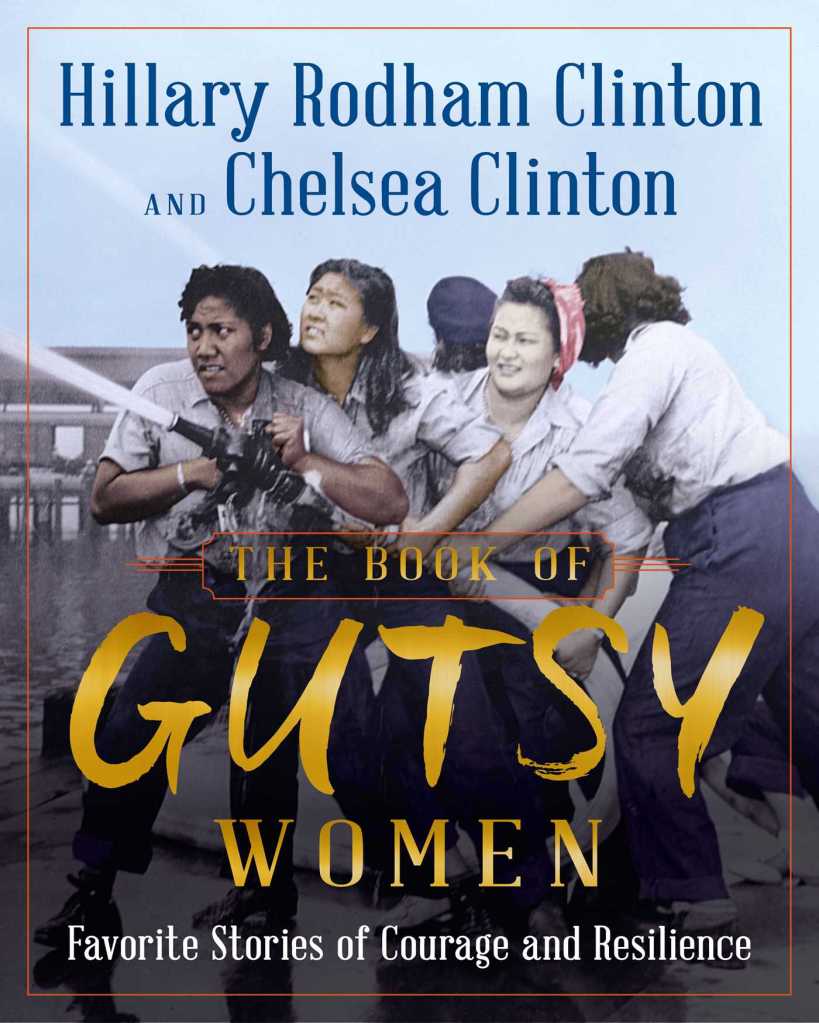
The introduction to Gutsy Women Favourite Stories of Courage and Resilience is the key to the way this book is planned, its purpose and what the authors hope that the reader will do after reading it. Libraries feature as an important part of Hillary and Chelsea Clinton’s world, and their aim is to introduce readers to a host of women whose stories are worth following up with further reading. They encourage readers to seek additional information through borrowing books from their library.
As well as admiring and reflecting upon the agency of the women they describe, the authors encourage readers to exert their own agency – enjoy and marvel at the range of options made available through this book, then choose for yourself about whom you would like to know more. At the same time, the role of grandmothers, mothers, and daughters in helping women achieve is portrayed and described though Hillary and Chelsea’s interaction, both as mother and daughter relating to each other through past experiences, and then through the focus of devising the book; Hillary’s relationship with her mother; and Chelsea’s with her grandmothers.
The book is organised around interaction and discussion between Hillary and Chelsea and grouping women’s activism under topics such as Early Inspirations which includes First Inspirations detailing the personal impacts of family women on both authors; and women outside the family whose stories were also early influences; Education Pioneers; Earth Defenders; Explorers and Inventors, Healers; Advocates and Activists; Storytellers; Elected Leaders; Groundbreakers; and Women’s Rights Champions. There are photographs, and an index. For the full review see Books: Reviews
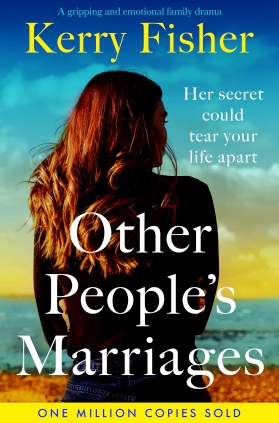
The complete book reviews for Bill Clinton and James Patterson, The President’s Daughter, Random house UK, Cornerstone Century, 2021; Kerry Fisher, Other People’s Marriages, bookoutre, 2021; and Danielle J. Lindemann, True Story What Television Says About Us, Farrar, Strauss and Giroux, 2021 are now available on Books: Reviews, 23 June 2021.


Hillary Clinton on Facebook comments on another gutsy woman-

@hillaryclinton · Politician
After she gave birth to her daughter, Olympic runner Allyson Felix was given a pay cut by her sponsor, Nike. She joined two other Olympians—Alysia Montaño and Kara Goucher—to break her nondisclosure agreement, talk about it, and make change for other women. Now she’s coming home from Tokyo with 11 medals. Congratulations to all the gutsy women of Team USA. You make us proud.

Anthony Albanese , Leader of the Australian Labor Party, recently announced that the taxation policies the ALP took to the 1919 Federal Election would no longer be part of Labor Party policy. Below Dennis Glover brings his eagle eye to the Emerson- Weatherill Report that followed the result of that election, ending with the paragraphs below. The complete article can be accessed at the end of this blog or at the link in the following text.
OPINION Sydney Morning Herald
George Orwell, me and the longest suicide note in Labor history
By Dennis Glover
August 7, 2021 — 5.00am
These are the last paragraphs of Dennis Glover’s article. The complete article appears at https://www.smh.com.au/national/george-orwell-me-and-the-longest-suicide-note-in-labor-history-20210804-p58fqm.html and the article in full appears at the end of this post.
Over the past week, many have vented their anger over changes to Labor’s tax policies. There’s no getting away from it: those decisions will make the tax system less progressive than otherwise might have been. That decision was, however, inevitable. Those tax policies were put to the people twice and rejected twice, including by many of the very people they were designed to benefit.
The new national platform is in no danger of winning the Miles Franklin, clearly, but anyone reading it will see its story is a world away from the Coalition’s.
To put it simply: even though inequality persists in Australia, our increasingly affluent electorate, including the old working class that once joined unions and reflexively voted Labor, won’t accept the old solutions. Sad, but true.
By recognising this hard reality, Labor has decided to try to win. How? By refusing to do what romantic progressives are forever calling upon it to do, and which Orwell’s old comrades did back in 1937: go over the top and charge into the trap carefully prepared by its opponents.
Dennis Glover is a speechwriter and author who has worked for the ALP.
10 August 1993 at the White House: Ruth Bader Ginsberg appointed to the Supreme Court

Casualty, a British night time serial, has been in the news recently in relations to reruns from the 1980s. However, I have been interested in their communication in relation to Covid 19.
Casualty slapped with ‘racist language and attitudes’ warning Andrew Bullock For Mailonline

This is a fascinating piece, and addresses issues that certainly did not appear in the episodes I watched while living in London between 2011 and 2015. The warnings appear on reruns of the series which began in 1986. In 2016 a long term star of the show expressed pride in the stories that are now airing.
I was initially impressed by Casualty and Holby City because of their commitment to the NHS, and have recently been viewing them to consider the way in which they treat the impact of Covid 19 on the characters, story lines and observable warnings about Covid and personal responsibility for hygiene in the hospital settings. See Television: Comments for the related stories.
Voting Rights America
Heather Cox Richardson *
*This article appears on Facebook and the discussion associated with it is worth following.
August 6, 2021 (Friday)

August 6, 2021 (Friday)Fifty-six years ago today, on August 6, 1965, President Lyndon B. Johnson signed the Voting Rights Act. The need for the law was explained in its full title: “An Act to enforce the fifteenth amendment to the Constitution, and for other purposes.” In the wake of the Civil War, Americans tried to create a new nation in which the law treated Black men and white men as equals.
In 1865, they ratified the Thirteenth Amendment to the Constitution, outlawing enslavement except as punishment for crimes. In 1868, they adjusted the Constitution again, guaranteeing that anyone born or naturalized in the United States—except certain Indigenous Americans—was a citizen, opening up the suffrage to Black men. In 1870, after Georgia legislators expelled their newly seated Black colleagues, Americans defended the right of Black men to vote by adding that right to the Constitution. All three of those amendments—the Thirteenth, Fourteenth, and Fifteenth—gave Congress the power to enforce them. In 1870, Congress established the Department of Justice to do just that.
Reactionary white southerners had been using state laws, and the unwillingness of state judges and juries to protect Black Americans from white gangs and cheating employers, to keep Black people subservient. White men organized as the Ku Klux Klan to terrorize Black men and to keep them and their white allies from voting to change that system. In 1870, the federal government stepped in to protect Black rights and prosecute members of the Ku Klux Klan.
With federal power now behind the Constitutional protection of equality, threatening jail for those who violated the law, white opponents of Black voting changed their argument against it. In 1871, they began to say that they had no problem with Black men voting on racial grounds; their objection to Black voting was that Black men, just out of enslavement, were poor and uneducated. They were voting for lawmakers who promised them public services like roads and schools, and which could only be paid for with tax levies. The idea that Black voters were socialists—they actually used that term in 1871—meant that white northerners who had fought to replace the hierarchical society of the Old South with a society based on equality began to change their tune. They looked the other way as white men kept Black men from voting, first with terrorism and then with state election laws using grandfather clauses, which cut out Black men without mentioning race by permitting a man to vote if his grandfather had; literacy tests in which white registrars got to decide who passed; poll taxes; and so on. States also cut up districts unevenly to favor the Democrats, who ran an all-white, segregationist party. By 1880 the south was solidly Democratic, and it would remain so until 1964.
Southern states always held elections: it was just foreordained that the Democrats would win them. Black Americans never accepted this state of affairs, but their opposition did not gain powerful national traction until after World War II. During that war, Americans from all walks of life had turned out to defeat fascism, a government system based on the idea that some people are better than others. Americans defended democracy and, for all that Black Americans fought in segregated units, and that race riots broke out in cities across the country during the war years, and that the government interned Japanese Americans, lawmakers began to recognize that the nation could not effectively define itself as a democracy if Black and Brown people lived in substandard housing, received substandard educations, could not advance from menial jobs, and could not vote to change any of those circumstances. Meanwhile, Black Americans and people of color who had fought for the nation overseas brought home their determination to be treated equally, especially as the financial collapse of European countries loosened their grip on their former African and Asian colonies, launching new nations.
Those interested in advancing Black rights turned, once again, to the federal government to overrule discriminatory state laws. Spurred by lawyer Thurgood Marshall, judges used the due process clause and the equal protection clause of the Fourteenth Amendment to argue that the protections in the Bill of Rights applied to the states, that is, the states could not deprive any American of equality. In 1954, the Supreme Court under Chief Justice Earl Warren, the former Republican governor of California, used this doctrine when it handed down the Brown v. Board of Education decision declaring segregated schools unconstitutional.
White reactionaries responded with violence, but Black Americans continued to stand up for their rights. In 1957 and 1960, under pressure from Republican President Dwight Eisenhower, Congress passed civil rights acts designed to empower the federal government to enforce the laws protecting Black voting.
In 1961 the Student Nonviolent Coordinating Committee (SNCC) and the Council of Federated Organizations (COFO) began intensive efforts to register voters and to organize communities to support political change. Because only 6.7% of Black Mississippians were registered, MIssissippi became a focal point, and in the “Freedom Summer” of 1964, organized under Bob Moses (who passed on July 25 of this year), volunteers set out to register voters. On June 21, Ku Klux Klan members, at least one of whom was a law enforcement officer, murdered organizers James Chaney, Andrew Goodman, and Michael Schwerner near Philadelphia, Mississippi, and, when discovered, laughed at the idea they would be punished for the murders.
That year, Congress passed the Civil Rights Act of 1964, which strengthened voting rights. On March 7, 1965, in Selma, Alabama, marchers led by John Lewis (who would go on to serve 17 terms in Congress) headed for Montgomery to demonstrate their desire to vote. Law enforcement officers stopped them on the Edmund Pettus Bridge and beat them bloody. On March 15, President Johnson called for Congress to pass legislation defending Americans’ right to vote. It did. And on this day in 1965, the Voting Rights Act became law. It became such a fundamental part of our legal system that Congress repeatedly reauthorized it, by large margins, as recently as 2006.But in the 2013 Shelby County v. Holder decision, the Supreme Court under Chief Justice John Roberts gutted the provision of the law requiring that states with histories of voter discrimination get approval from the Department of Justice before they changed their voting laws. Immediately, the legislatures of those states, now dominated by Republicans, began to pass measures to suppress the vote. Now, in the wake of the 2020 election, Republican-dominated states have increased the rate of voter suppression, and on July 1, 2021, the Supreme Court permitted such suppression with the Brnovich v. DNC decision.If the Republicans are allowed to choose who will vote in the states, they will dominate the country in the same way that the Democrats turned the South into a one-party state after the Civil War. Alarmed at what will amount to the loss of our democracy, Democrats are calling for the federal government to protect voting rights.
And yet, 2020 made it crystal clear that if Republicans cannot stop Democrats from voting, they will not be able to win elections. And so, Republicans are insisting that states alone can determine who can vote and that any federal legislation is tyrannical overreach. A recent Pew poll shows that more than two thirds of Republican voters don’t think voting is a right and believe it can be limited.And so, here we stand, in an existential crisis over voting rights and whether it is states or the federal government that should decide them. Right now, there are two major voting rights bills before Congress. The Democrats have introduced the For the People Act, a sweeping measure that protects the right to vote, ends partisan gerrymandering, stops the flow of cash into elections, and requires new ethics guidelines for lawmakers. They have also introduced the John Lewis Voting Rights Act, which focuses more tightly on voting and restores the protections provided in the 1965 Voting Rights Act.
Republican senators have announced their opposition to any voting rights bill, so any law that gets through will have to get around a Senate filibuster, which cannot be broken without 10 Republican senators. Democrats could break the filibuster for a voting rights bill, but Senators Joe Manchin (D-WV) and Kyrsten Sinema (D-AZ) indicated earlier this summer they would not support such a move. And yet, there are signs that a voting rights bill is not dead. Democratic senators have continued to work to come up with a bill that can make it through their party, and there is no point in doing that if, in the end, they know they cannot make it a law. “Everybody’s working in good faith on this,” Manchin told Mike DeBonis of the Washington Post. “It’s everybody’s input, not just mine, but I think mine, maybe…got us all talking and rolling in the direction that we had to go back to basics,” he said. Back to basics is a very good idea indeed. The basic idea that we cannot have equality before the law without equal access to the ballot gave us the Thirteenth, Fourteenth, and Fifteenth Amendments to the Constitution, and established the power of the federal government over the states to enforce them.

| JULY 1, 2021 |
| Caroline Mimbs Nyce Senior associate editor |
| Voting rights had a tough day at the Supreme Court. Now it’s up to Congress to act. Then: One walrus clapped so hard, he hurt his fingers. |
On the Future of Voting Rights (Drew Angerer/Getty)In the legal battle over who gets to vote in America, Republicans just scored a point.Today the Supreme Court effectively green-lit a restrictive voting law in Arizona. The decision will make it easier for similar laws—the likes of which continue to be passed in Republican-controlled statehouses around the country—to survive challenges. And with this ruling, the nation once again saw the Voting Rights Act weakened.Below, our writers offer two quick takeaways that don’t require you to paw through the legalese yourself.1. A decision like this was inevitable.It was always a long shot for existing interpretations of Section 2 of the Voting Rights Act to completely survive today’s decision. The conservatives on the Supreme Court have long signaled their hostility to that provision of the law, which allowed Americans to challenge voting laws that have disproportionate racial effects. In 2013, Shelby County v. Holder defanged proactive federal oversight of the racial effects of voting laws. Although Section 2 wasn’t completely destroyed today, as many feared it would be, the decision leaves states to make it ever harder for people of color to vote, while chasing imagined voter fraud.— Vann R. Newkirk II, senior editor2. Only Congress can save voting rights now.Today’s Supreme Court decision further weakening the Voting Rights Act affirmed that the only way Democrats can reverse the wave of restrictive voting laws in GOP-controlled states is to pass new federal voting rights by curtailing the Senate filibuster. … It makes plain that if Congress doesn’t establish new federal standards, the nation is headed toward a two-tier voting system, with red states imposing ever-tightening restrictions that especially burden Democratic-leaning constituencies—young, minority, and lower-income voters.— Ronald Brownstein, senior editor (Drew Angerer/Getty)In the legal battle over who gets to vote in America, Republicans just scored a point.Today the Supreme Court effectively green-lit a restrictive voting law in Arizona. The decision will make it easier for similar laws—the likes of which continue to be passed in Republican-controlled statehouses around the country—to survive challenges. And with this ruling, the nation once again saw the Voting Rights Act weakened.Below, our writers offer two quick takeaways that don’t require you to paw through the legalese yourself.1. A decision like this was inevitable.It was always a long shot for existing interpretations of Section 2 of the Voting Rights Act to completely survive today’s decision. The conservatives on the Supreme Court have long signaled their hostility to that provision of the law, which allowed Americans to challenge voting laws that have disproportionate racial effects. In 2013, Shelby County v. Holder defanged proactive federal oversight of the racial effects of voting laws. Although Section 2 wasn’t completely destroyed today, as many feared it would be, the decision leaves states to make it ever harder for people of color to vote, while chasing imagined voter fraud.— Vann R. Newkirk II, senior editor2. Only Congress can save voting rights now.Today’s Supreme Court decision further weakening the Voting Rights Act affirmed that the only way Democrats can reverse the wave of restrictive voting laws in GOP-controlled states is to pass new federal voting rights by curtailing the Senate filibuster. … It makes plain that if Congress doesn’t establish new federal standards, the nation is headed toward a two-tier voting system, with red states imposing ever-tightening restrictions that especially burden Democratic-leaning constituencies—young, minority, and lower-income voters.— Ronald Brownstein, senior editor |

OPINION Sydney Morning Herald
George Orwell, me and the longest suicide note in Labor history
By Dennis Glover
August 7, 2021 — 5.00am
On federal election day 2019, I was in Aragon, touring the battlefields of the Spanish Civil War with Richard Blair, George Orwell’s son. While the vote was being counted back in Australia, we were inspecting the remains of fascist machine gun positions outside Huesca, which Orwell’s left-wing militia had besieged in 1937.

The previous day we had been up in the mountains at the spot where Orwell was famously shot in the throat by a sniper. Orwell’s trenches are still there and from them you can see the lie of the battlefield below. When his comrades rose from those trenches to assault the city, few survived. As my distraught 18-year-old son relayed the Australian election count to me by text message, the moral of both results was obvious: don’t charge into a well-prepared trap if ever you can avoid it.
Six months later , the Australian Labor Party – still reeling from defeat in the election it had been widely expected to win – asked me to help redraft its platform. The review of the election loss by Craig Emerson and Jay Weatherill had targeted the document – dubbed by some “the longest suicide note in history” – for serious attention. My job, if I chose to accept it: get it down from 310 pages to 50, without reducing the font size.
Another crazy mission? That platform had a lot of history and stakeholders. After the divisions of the Rudd-Gillard era, the federal caucus had sought unity. Rocking the boat was discouraged. You want a policy change to repay some supporters? Fine. Impressed by the ideas of some tidy-minded economics professor? OK! Few proposals were rejected. Ironically, in its understandable desire to show internal discipline, the party had abandoned all policy discipline. And the election loss was the result.
Shortening the document, though, ended up quite easy. I employed a number of cunning strategies. The first was removing repetition. Why mention a contentious issue once when you can mention it 80 times? (I kid you not.) Those 310 pages were soon 150.
RELATED ARTICLE
Opinion
Political leadership
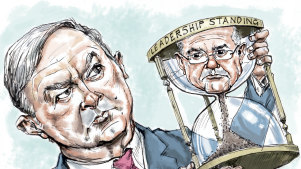
Albanese proving an elusive target for Coalition’s election playbook
Sean Kelly
Columnist and former adviser to Labor prime ministers Kevin Rudd and Julia Gillard.
The second was removing unnecessary detail. Surely we could tell voters what we intended to do in government without mentioning the multiple departmental reorganisations needed to make it happen. Labor articles of faith such as workers’ rights, environmental sustainability and gender equality could be taken for granted and stated once, couldn’t they? That took it down to 125 pages.
After that, I turned to grammar and managerial jargon. I love the brothers and sisters of the Labor Party, but why don’t they know what a verb is? Simply by exorcising the word “impact” I saved a whole page. Paragraph after paragraph of indecipherable nonsense evaporated. Just 100 pages left.
Advertisement
Things then got a little harder. Political criteria needed to be applied. My drafting instructions were to remove all spending commitments, tax rates, policy targets and promises to create new government departments, agencies, advisory boards and committees. Foreign policy discussion was also to be given less detail – it’s a famously tricky subject.
After a summer of slashing, I had almost exactly 50 pages.
RELATED ARTICLE

Opinion
ALP
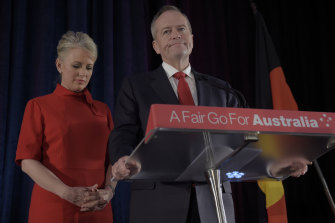
The ruthless decision Albanese had to make
David Crowe
Chief political correspondent
The committee I reported to blew it back out to 100 pages – 50 obviously being a cunning union-style ambit to get to 100 – but Labor now had a social-democratic platform that could just about be read in a sitting, be easily understood, and maybe even win votes instead of losing them.
Why is this important? Because it shows that following the 2019 disaster, the ALP under Anthony Albanese adopted a steely political discipline. If you listen closely, you can hear it in the tone of caucus members’ voices. Time and again during the consultations with frontbenchers, I heard the same pleas: Tell people what we plan to do and can do – not what we don’t plan to do and can’t.
The new national platform is in no danger of winning the Miles Franklin, clearly, but anyone reading it will see its story is a world away from the Coalition’s.
Over the past week, many have vented their anger over changes to Labor’s tax policies. There’s no getting away from it: those decisions will make the tax system less progressive than otherwise might have been. That decision was, however, inevitable. Those tax policies were put to the people twice and rejected twice, including by many of the very people they were designed to benefit.
RELATED ARTICLE
Analysis
Australia votes
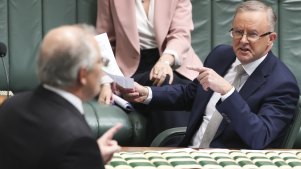
Things get personal and political between Morrison and Albanese
To put it simply: even though inequality persists in Australia, our increasingly affluent electorate, including the old working class that once joined unions and reflexively voted Labor, won’t accept the old solutions. Sad, but true.
By recognising this hard reality, Labor has decided to try to win. How? By refusing to do what romantic progressives are forever calling upon it to do, and which Orwell’s old comrades did back in 1937: go over the top and charge into the trap carefully prepared by its opponents.
Dennis Glover is a speechwriter and author who has worked for the ALP. His novel, The Last Man in Europe, is about George Orwell. His latest novel is Factory 19.
 Robin's Room