Reviews this week are the fiction books, You Need to Know by Nicola Moriarty and Laura Lippman’s Dream Girl. The latter was provided to me by NetGalley for review. The full reviews can be found at – Books: Reviews.


A list of all the books reviewed appears on the Home Page Home Page, with the dates they were published.
Laura Lippman, Dream Girl, First Published in the UK, Faber & Faber Ltd 2021, First Published USA, William Morris, Harper Collins 2021, CPI Group (UK) 2021.
Tess Monaghan PI, one of Laura Lippman’s continuing characters, makes only a short appearance in this novel. However, her interaction with the main character, Gerry Anderson, is instructive. It tells the reader something about Tess Monaghan as well as much of Gerry’s story that good PI that she is, Monaghan has investigated. Gerry has done nothing to apprise himself of her ability – the person he wants to employ to enquire into mysterious phone calls from a woman purporting to be the Dream Girl of his successful novel. Gerry’s knowledge of Tess is limited to an interview with her in a magazine, when his immediate reaction to her photograph was that she was ‘not his type’. Although ‘it had not occurred to him that she could turn him down’ she does so and leaves the novel. Her explanation for refusing his request is his lack of self-awareness which would undermine any examination of events and their cause. This is a clever use of Tess Monaghan, although potentially disappointing for her fans. However, the value of her short commentary should not be underestimated. A clever move by Lippman.
Nicola Moriarty, You Need To Know, Penguin 2021
The title is the directly connected to Jill. She is a complex combination of strength with which she deftly achieves her aims in handling her family, weakness in relation to adopting the email heading command to know, and, although belated, courage. Jill is the wife of Frank; mother of three brothers, Tony, Pete, and Darren; mother-in-law to Andrea and Mimi, and formerly prospective mother-in-law to Charlotte; and grandmother to four girls, ranging from teenaged Callie, eight-year-old Tara and new-born twin girls, Elliot, and James.

Patricia Highsmith People Who Knock on the Door
Patricia Highsmith’s novel is worth reading in the context of the changes to legal changes made in Texas that impact on women’s reproductive health. Reviewed at Books: Reviews 28 October 2020.

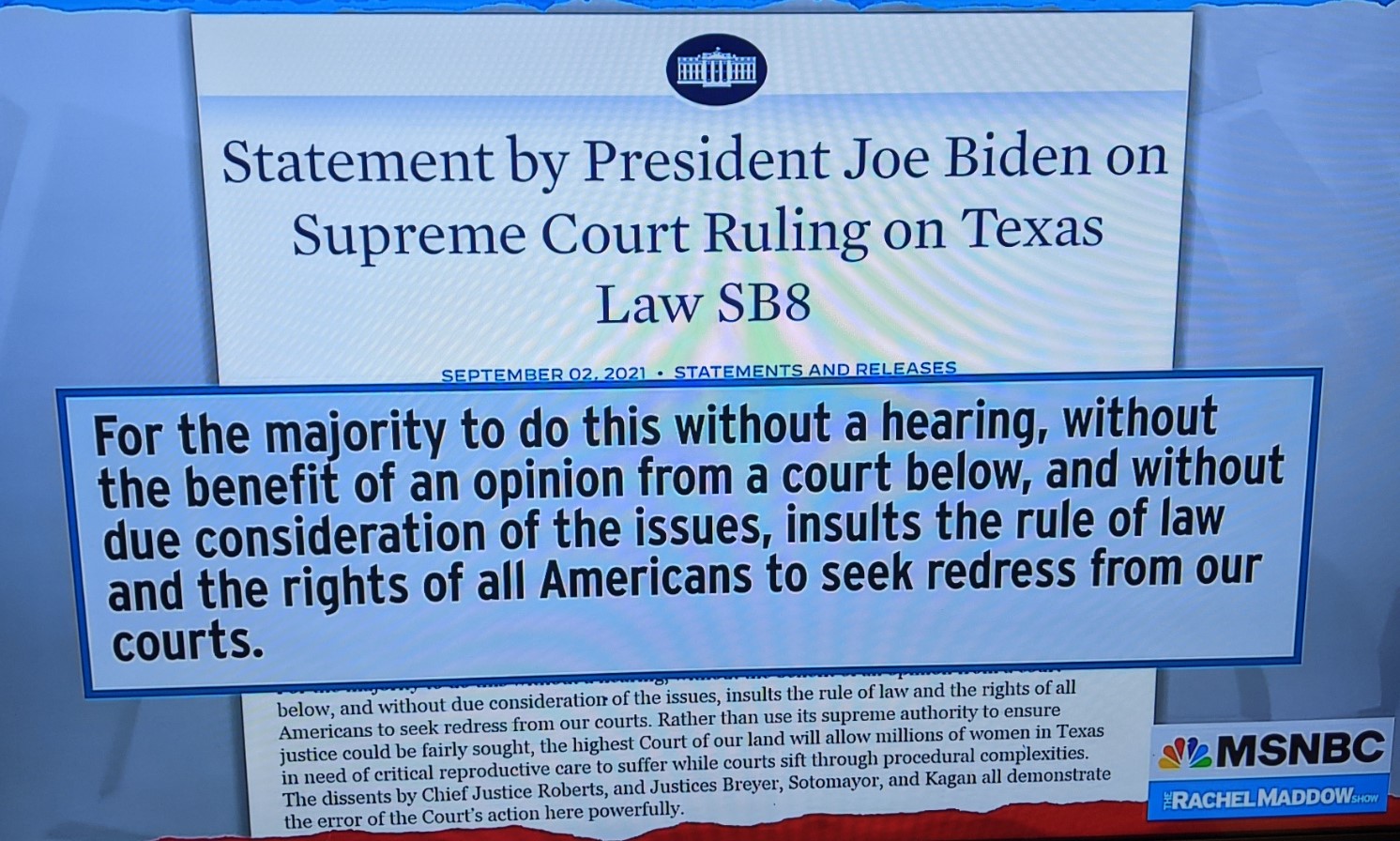
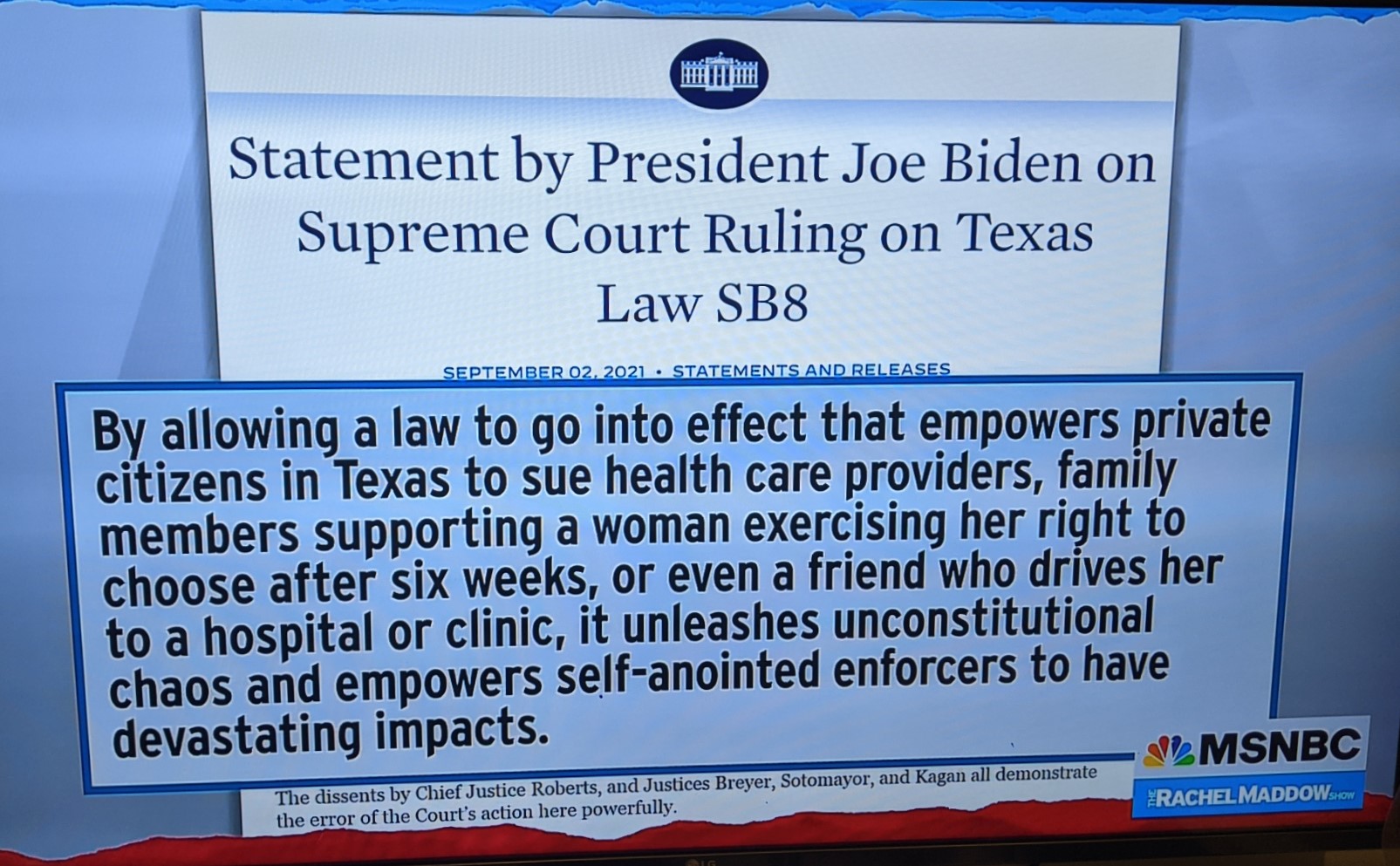

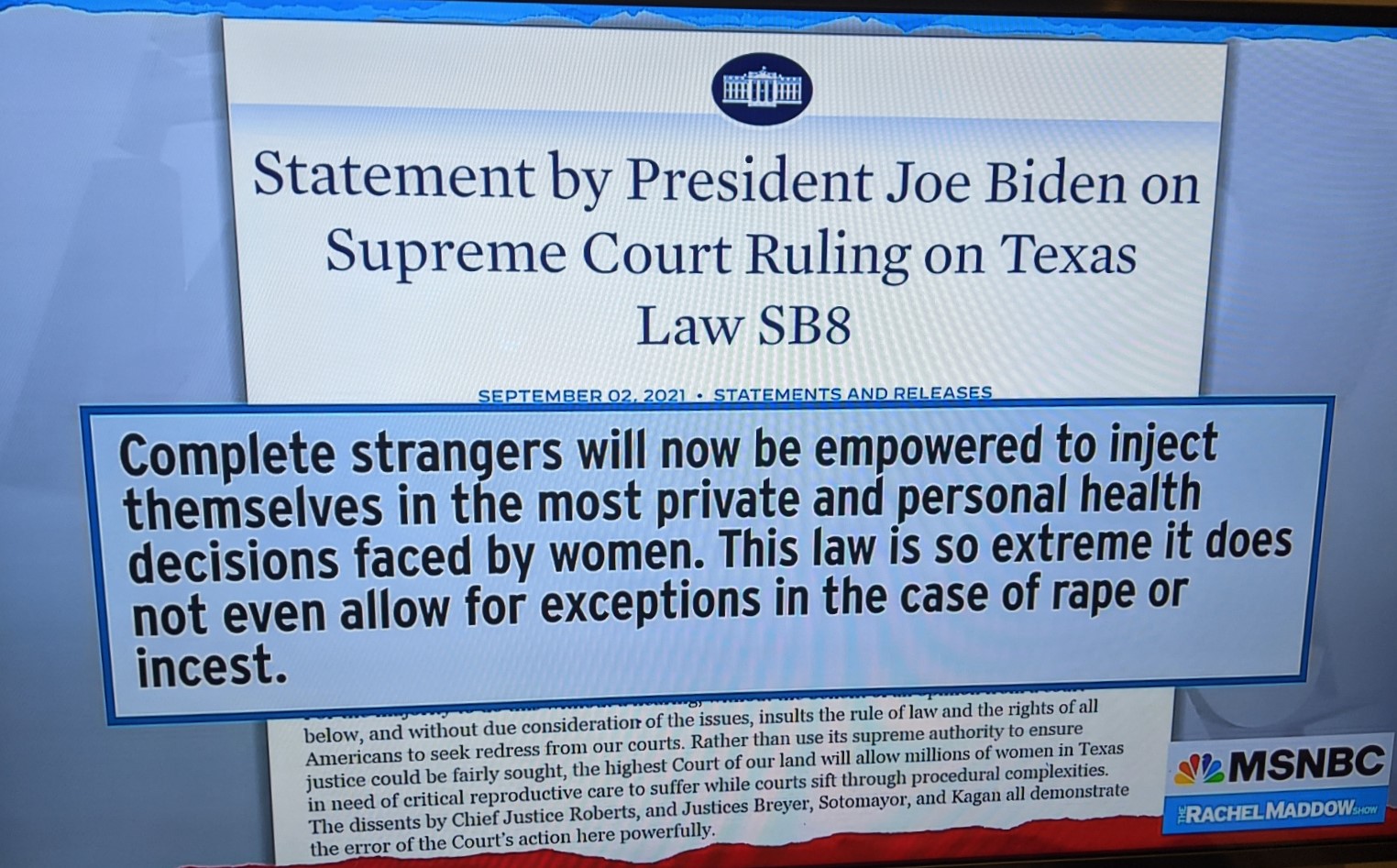

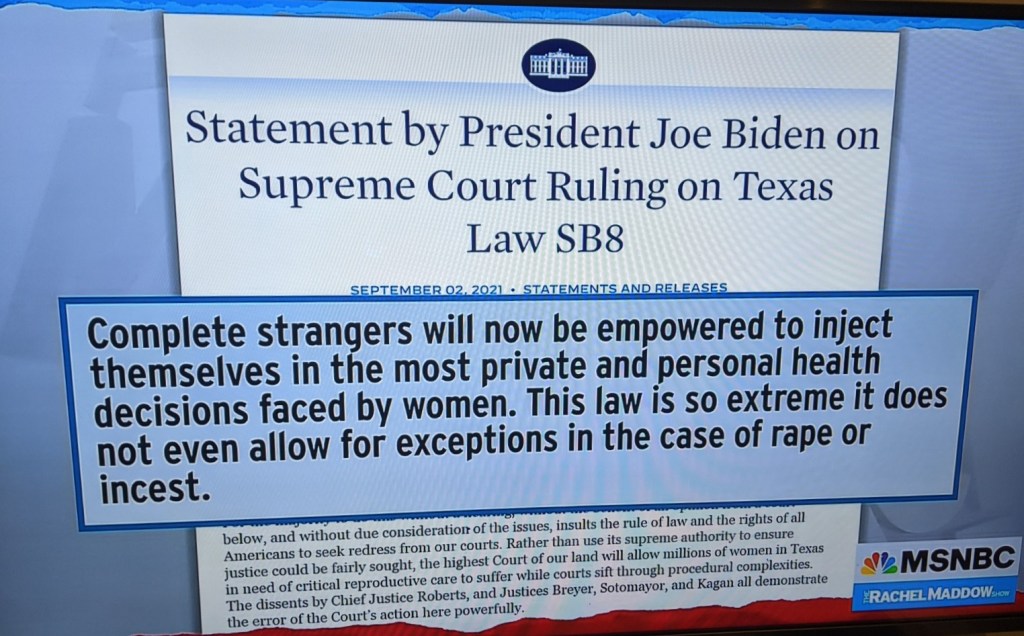
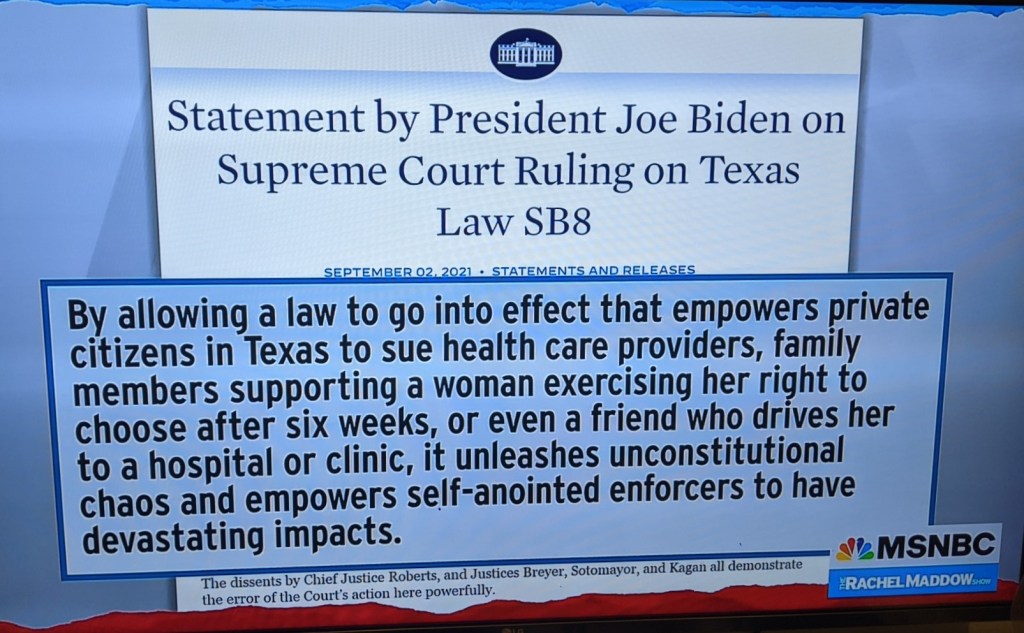
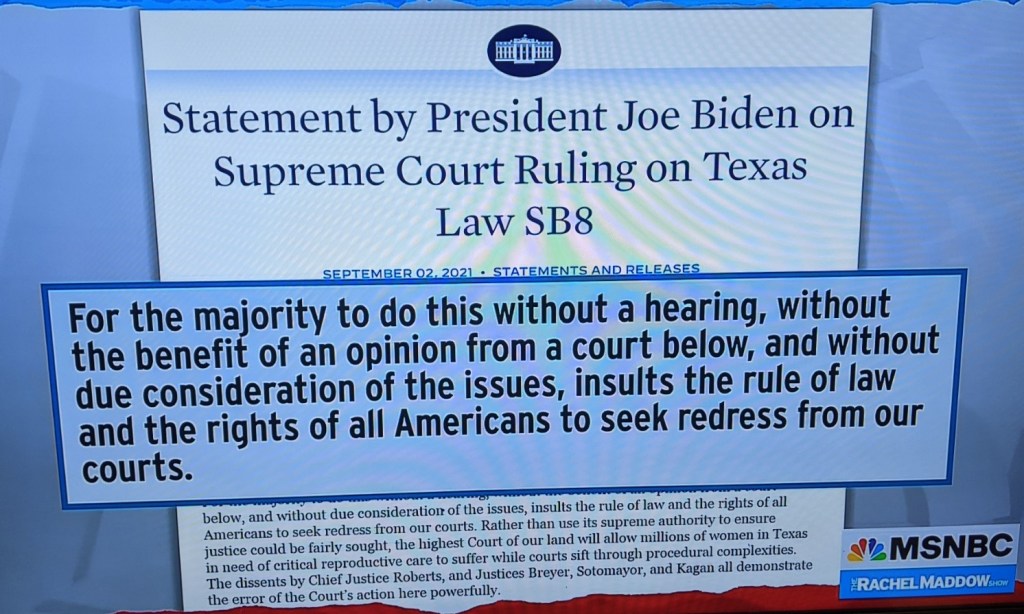
Heather Cox Richardson’s article on the Texas Law appears at the end of this post. Also, an article from the New York Times, Statements from President Joe Biden and Rachel Maddow’s list of questions are at the end of this post.
Day 21 Lockdown
Today it is reported that there are twelve new cases of Covid 19, bringing the total for the ACT to 258 active cases.
Day 21 lockdown walk





Day 22 Lockdown
Eighteen new cases have been recorded in the ACT. Fifteen have been in the community while infected; thirteen are linked to an existing case or cluster; five are still under investigation. The number of people in hospital is now reduced to ten, including three people who remain in ICU. One of the latter requires ventilation. Year 12 students will be given priority for Pfizer vaccines as more stock has become available. These students will be facing exams and the ACT Scaling Test. Chief Minister Andrew Barr encouraged people , even with the mildest of symptoms, to be tested. I did so, as foolish as I felt about the mildness of my symptoms and my fully vaccinated status. The test was quick and easy with friendly staff. Even better, the result well before predicted, was negative.
Day 22 lockdown walk

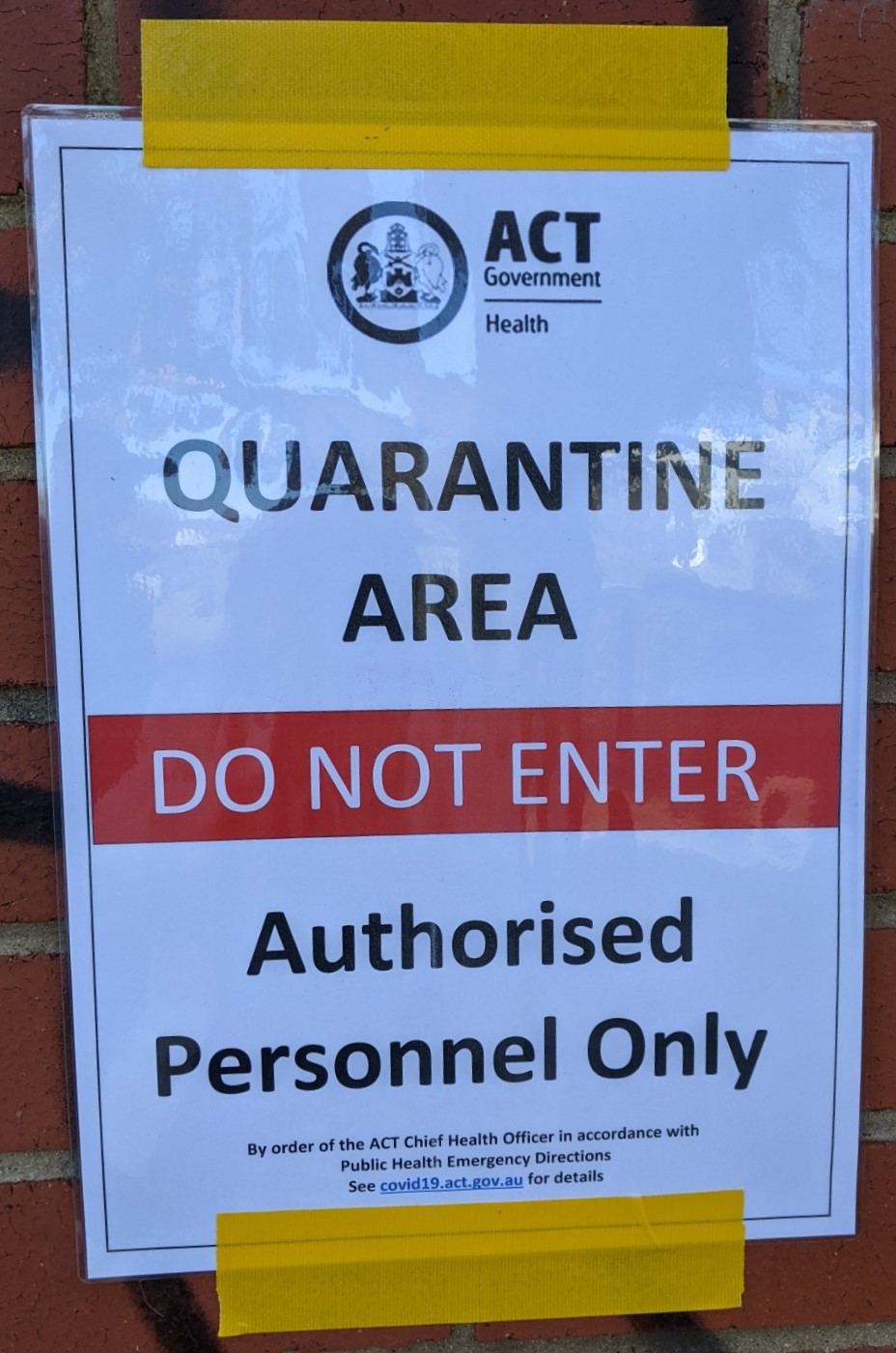
Two different aspects of lockdown: construction has recommenced, with health and safety protocols; two accommodation buildings have been designated quarantine areas.
Day 23 Lockdown
Thirty two new cases have been recorded, the highest total number of cases in a 24-hour period in Canberra. Eight were in quarantine , but nineteen were infectious in the community. Five cases are under investigation. Ten people are in hospital, two in intensive care and one requiring ventilation.
Mr Barr said that number of people infectious in the community remains “obviously very concerning”. “Our contact tracers are now going to have a very busy weekend,” he said. Mr Barr said that the ACT will receive a decent portion of Pfizer doses in the latest vaccine swap from the UK.
“This is above our population share. The reason for this is that there is a rebalancing under way across Australia to see the jurisdictions that didn’t receive their per capita share of the Poland one million doses or the Singapore 500,000 doses.”This is great news for the ACT.”
“In very good news we have been advised that the ACT will receive 86,797 Pfizer doses from the Commonwealth’s Pfizer swap with the United Kingdom,” he said.
Day 23 lockdown walk
It was raining so Leah was not impressed. The walk was short…very short. However, her tail remains wagging as she is encouraged to weather the rain. Do bear in mind that she usually drags us around, and demands extra circuits, when you sympathise with her reluctance on this occasion.








Day 24 Lockdown
There were fifteen more cases recorded in the ACT today, with thirteen linked to known cases or ongoing clusters. Seven people were in the community during part of their infectious period. Recovered cases: 137; active cases associated with this outbreak: 237.
Day 24 lockdown walk
Happier Leah and some sun before the rain this afternoon.





Day 25 Lockdown
The quarantine sign has been removed from the accommodation building – congratulations to the occupants and the ACT services which assisted in this lockdown. The number of new cases recorded has dropped to eleven, with 222 active cases and 163 recovered. only one person remains in ICU. The time between Astra Zeneca vaccinations has been reduced to a 4 – 8 week interval.
Day 25 and Day 26 lockdown walks
Both days feature birds photographed over the past weeks. During the first lockdown birds were far more apparent. However, they sing loudly in the morning, and at least some of them appear to be photographed later in the day.








Day 26 Lockdown
Today 19 new cases have been recorded, with 230 active cases and 174 recovered. Of the 19, 13 are linked to known cases or clusters, and six remain under investigation. Eleven were in quarantine during their infectious period and six in the community for part of their infectious period. Eight people are in hospital, and one remains in ICU.
Day 27 Lockdown
Twenty cases, with at least seven infectious in the community have been recorded. Nine cases are lonked to other identified cases or known exposure sites. Ten people are in hospital, with two in intensive case , one requiring ventilation. There was a record day of vaccination on Monday, with 4,737 people receiving either their first or second dose of vaccine. 80% of the population above 70 years of age in the ACT is now fully vaccinated. More than 90% over 50 have had their first dose. The ACT is awaiting more supplies , for which many Canberrans are waiting – registered and booked. We are now in our fifth week of lockdown.
Day 27 lockdown walk




Heather Cox Richardson

heather.richardson@bc.edu
September 2, 2021 (Thursday)In the light of day today, the political fallout from Texas’s anti-abortion S.B. 8 law and the Supreme Court’s acceptance of that law continues to become clear.
By 1:00 this afternoon, the Fox News Channel had mentioned the decision only in a 20-second news brief in the 5 am hour. In political terms, it seems the dog has caught the car.As I’ve said repeatedly, most Americans agree on most issues, even the hot button ones like abortion. A Gallup poll from June examining the issue of abortion concluded that only 32% of Americans wanted the U.S. Supreme Court’s 1973 Roe v. Wade decision overturned, while 58% of Americans opposed overturning it.
“’Overturning Roe v. Wade,’” Lydia Saad of Gallup wrote, “is a shorthand way of saying the Supreme Court could decide abortion is not a constitutional right after all, thus giving control of abortion laws back to the states. This does not sit well with a majority of Americans or even a large subset of Republicans. Not only do Americans oppose overturning Roe in principle, but they oppose laws limiting abortion in early stages of pregnancy that would have the same practical effect.”While it is hard to remember today, the modern-day opposition to abortion had its roots not in a moral defense of life but rather in the need for President Richard Nixon to win votes before the 1972 election. Pushing the idea that abortion was a central issue of American life was about rejecting the equal protection of the laws embraced by the Democrats far more than it was ever about using the government to protect fetuses. Abortion had been a part of American life since its inception, but states began to criminalize abortion in the 1870s. By 1960, an observer estimated that there were between 200,000 and 1.2 million illegal U.S. abortions a year, endangering women, primarily poor ones who could not afford a workaround. To stem this public health crisis, doctors wanted to decriminalize abortion and keep it between a woman and her doctor. In the 1960s, states began to decriminalize abortion on this medical model, and support for abortion rights grew. The rising women’s movement wanted women to have control over their lives. Its leaders were latecomers to the reproductive rights movement, but they came to see reproductive rights as key to self-determination. In 1969, activist Betty Friedan told a medical abortion meeting: “[M]y only claim to be here, is our belated recognition, if you will, that there is no freedom, no equality, no full human dignity and personhood possible for women until we assert and demand the control over our own bodies, over our own reproductive process….”In 1971, even the evangelical Southern Baptist Convention agreed that abortion should be legal in some cases, and vowed to work for modernization. Their convention that year reiterated its “belief that society has a responsibility to affirm through the laws of the state a high view of the sanctity of human life, including fetal life, in order to protect those who cannot protect themselves” but also called on “Southern Baptists to work for legislation that will allow the possibility of abortion under such conditions as rape, incest, clear evidence of severe fetal deformity, and carefully ascertained evidence of the likelihood of damage to the emotional, mental, and physical health of the mother.” By 1972, Gallup pollsters reported that 64% of Americans agreed that abortion was between a woman and her doctor. Sixty-eight percent of Republicans, who had always liked family planning, agreed, as did 59% of Democrats.
In keeping with that sentiment, in 1973, the Supreme Court, under Republican Chief Justice Warren Burger, in a decision written by Republican Harry Blackmun, decided Roe v. Wade, legalizing first-trimester abortion. The common story is that Roe sparked a backlash. But legal scholars Linda Greenhouse and Reva Siegel found something interesting. In a 2011 article in the Yale Law Journal, they showed that opposition to the eventual Roe v. Wade decision began in 1972—the year before the decision—and that it was a deliberate attempt to polarize American politics.
In 1972, Nixon was up for reelection, and he and his people were paranoid that he would lose. His adviser Pat Buchanan was a Goldwater man who wanted to destroy the popular New Deal state that regulated the economy and protected social welfare and civil rights. To that end, he believed Democrats and traditional Republicans must be kept from power and Nixon must win reelection. Catholics, who opposed abortion and believed that “the right of innocent human beings to life is sacred,” tended to vote for Democratic candidates. Buchanan, who was a Catholic himself, urged Nixon to woo Catholic Democrats before the 1972 election over the issue of abortion. In 1970, Nixon had directed U.S. military hospitals to perform abortions regardless of state law; in 1971, using Catholic language, he reversed course to split the Democrats, citing his personal belief “in the sanctity of human life—including the life of the yet unborn.”
Although Nixon and Democratic nominee George McGovern had similar stances on abortion, Nixon and Buchanan defined McGovern as the candidate of “Acid, Amnesty, and Abortion,” a radical framing designed to alienate traditionalists.
As Nixon split the U.S. in two to rally voters, his supporters used abortion to stand in for women’s rights in general. Railing against the Equal Rights Amendment, in her first statement on abortion in 1972, activist Phyllis Schlafly did not talk about fetuses; she said: “Women’s lib is a total assault on the role of the American woman as wife and mother and on the family as the basic unit of society. Women’s libbers are trying to make wives and mothers unhappy with their career, make them feel that they are ‘second-class citizens’ and ‘abject slaves.’ Women’s libbers are promoting free sex instead of the ‘slavery’ of marriage. They are promoting Federal ‘day-care centers’ for babies instead of homes. They are promoting abortions instead of families.” Traditional Republicans supported an activist government that regulated business and promoted social welfare, but radical right Movement Conservatives wanted to kill the active government. They attacked anyone who supported such a government as immoral. Abortion turned women’s rights into murder.
Movement Conservatives preached traditional roles, and in 1974, the TV show Little House on the Prairie started its 9-year run, contributing, as historian Peggy O’Donnell has explored, to the image of white women as wives and mothers in the West protected by their menfolk. So-called prairie dresses became the rage in the 1970s.This image was the female side of the cowboy individualism personified by Ronald Reagan. A man should control his own destiny and take care of his family unencumbered by government. Women should be wives and mothers in a nuclear family. In 1984, sociologist Kristin Luker discovered that “pro-life” activists believed that selfish “pro-choice” women were denigrating the roles of wife and mother. They wanted an active government to give them rights they didn’t need or deserve.By 1988, Rush Limbaugh, the voice of Movement Conservatism, who was virulently opposed to taxation and active government, demonized women’s rights advocates as “Femi-nazis” for whom “the most important thing in life is ensuring that as many abortions as possible occur.” The complicated issue of abortion had become a proxy for a way to denigrate the political opponents of the radicalizing Republican Party. Such threats turned out Republican voters, especially the evangelical base. But support for safe and legal abortion has always been strong, as it remains today. Until yesterday, Republican politicians could pay lip service to opposing the Roe v. Wade decision to get anti-abortion voters to show up at the polls, without facing the political fallout of actually getting rid of the decision.
Now, though, Texas has effectively destroyed the right to legal abortion. The fact that the Fox News Channel is not mentioning what should have been a landmark triumph of its viewers’ ideology suggests Republicans know that ending safe and legal abortion is deeply unpopular. Their base finally, after all these years, got what it wanted. But now the rest of the nation, which had been assured as recently as the confirmation hearings for Supreme Court Justice Brett Kavanaugh that Roe v. Wade was settled law that would not be overturned, gets a chance to weigh in.
The New York Times
| . Texas’ new abortion restrictions are having an immediate effect. |

The New York Times Evening Briefing
Remy Tumin September 2 2021
| Clinics around Texas saw dramatic drops in patients after the Supreme Court declined just before midnight on Wednesday to temporarily block a new law that effectively bans abortions after about six weeks of pregnancy. Women, confused about their options, crowded phone lines. Some began seeking services across state lines. Phone calls and walk-ins to pregnancy crisis centers run by anti-abortion groups surged. |
| The law is novel in that any person from Texas or elsewhere in the nation could now bring a lawsuit against anyone who “aids or abets” an illegal abortion. Its success surprised even some in the anti-abortion movement. “I didn’t think it would happen in my lifetime,” a director of one crisis center said. |
| The Supreme Court’s vote was 5 to 4, with Chief Justice John Roberts joining the court’s three liberal members in dissent. “The statutory scheme before the court is not only unusual, but unprecedented,” he wrote. |
| President Biden excoriated the court’s refusal to block the law, and directed a gender-focused policy council to investigate how the federal government could protect existing constitutional abortion rights. |
Rachel Maddow’s Questions

 Robin's Room