Two fiction books are reviewed this week. Both are an excellent read, with my rating of four (The Perfect Family) and five stars (The Tulip Tree) on Goodreads. They were provided to me by NetGalley for honest reviews.
Suzanne McCourt The Tulip Tree The Text Publishing Company 2021
I was drawn to this novel because of the connection between Poland and the Snowy Mountains of south-eastern Australia. That the story also includes a period with which I was familiar through the Polish film, Cold War, was enticing. I was rewarded: the resilience, love, small facets of humour that glimmered through that film, along with the fear and cruelty, are abundant in this novel. The strength of the people, and complexity of the events was brought home to me when reference is made to the Royal Palace in Warsaw being opened to the community by the communists – a venue where during my visit to Poland I saw two of the most remarkable Rembrandts (recently authenticated). The public opening did not take place in a vacuum, or apart from suffering. It is the way in which McCourt takes the characters through so many multifaceted situations, complete with ironies, personal conflicts and world events that makes this novel a thoroughly rewarding and valuable read.
Robyn Harding The Perfect Family Simon & Schuster, 2021.

What a wonderfully smart writer I have found in my first reading of a Robyn Harding novel. Usually, I feel reluctant to accept the short comings of a character and resist becoming thoroughly involved in their world. Each of the characters in The Perfect Family is flawed, sometimes egregiously so, but with this author’s deftness, sense of humour and good plotting I found them too enthralling to consider whether they are likeable.
Full reviews available at Books: Reviews
Six Feet Under: 20 years on, the drama set in a family funeral home still feels ahead of its time – see Television: Comments for complete story.
Articles in this post: Hillary Clinton and Louise Penny, State of Terror; London Tube Map marks Black History Month; Heather Cox Richardson on voting rights in America; John Lewis quotes.
Day 62 Lockdown
Forty six new cases have been recorded, bringing the total number of cases for this outbreak to 1,359. Thirty of the new cases are linked to known cases or ongoing clusters. Twenty two are household contacts. Sixteen are a risk of transmitting to others in the community. The number of lives lost during this outbreak is now seven , and ten since the start of the pandemic. Sixteen people are in hospital, including six in intensive care, five of whom require ventilation.
Canberra is well on the way to being the most vaccinated city in the world and is the most vaccinated in Australia.
Day 62 lockdown walk




Pathway forward
Lockdown finishes at midnight. We shall need to wear masks, maintain good hand hygiene, maintain the physical distance rules and check in with the CBR app. A meal out, hairdresser, and fewer stories here about our walks.
Coffee shop during lockdown – and now, tables to sit at for our coffees (still takeaway cups, but that’s fine); construction Covid restrictions remain in place, but do not prevent construction proceeding.

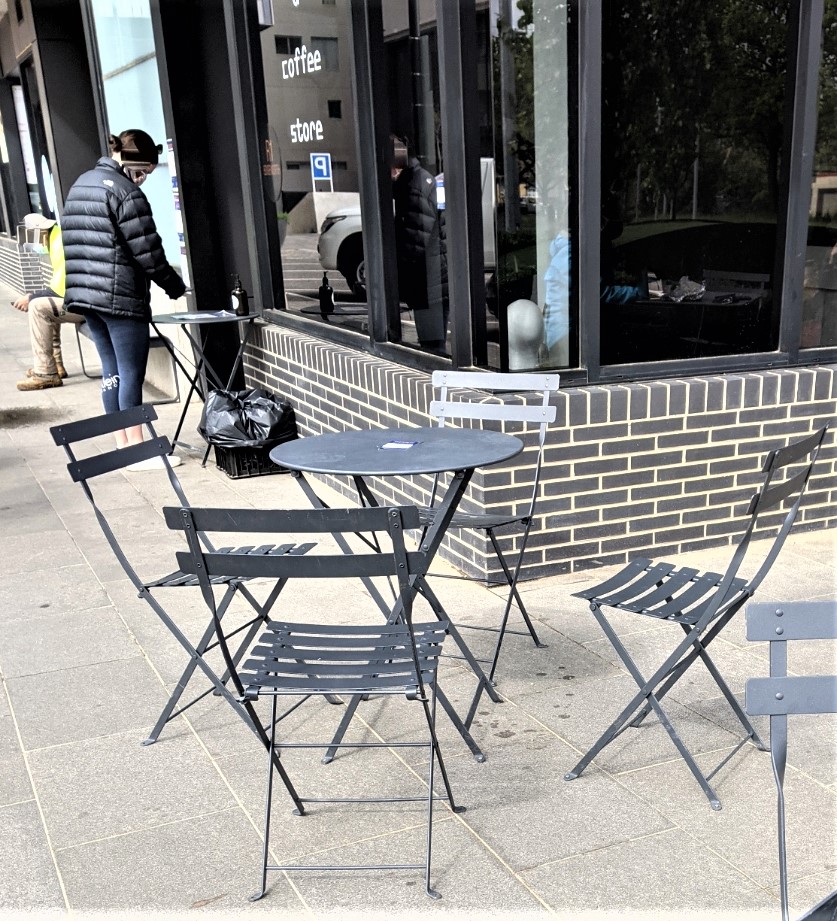


6:10am, Oct 15
The ACT will shift its focus from daily case numbers to vaccine coverage as the territory tentatively emerged from more than two months in lockdown at 11.59pm Thursday.
Restrictions have been eased allowing cafes, pubs and restaurants to open while Canberrans can have up to five people in their homes, however retail cannot serve customers in store until October 29.
Health authorities are predicting a rise in case numbers in the days and weeks ahead, but the increase is not expected to be sharp and their public focus will shift towards vaccinations.
During the nine weeks of lockdown, there were 1359 COVID-19 cases reported — including 46 on Thursday — and seven deaths.
The latest figures show 98.8 per cent of Canberrans aged over 12 have received one dose of the vaccine, while almost 75 per cent are fully vaccinated.
“We want to see our world-leading first dose vaccination rate translate into a word-leading, fully vaccinated rate,” Chief Minister Andrew Barr said.
“The statistic that matters and the one we will focus on is the percentage of our community which is fully vaccinated.”
Canberrans are also now able to enter Victoria, provided they apply for an exemption and isolate until they get a negative test result.

On the first Day After Lockdown finished there were twenty new cases, fourteen of them linked to known cases. We walked, had coffees sitting at a table, and noticed people taking advantage of the opportunity to meet with twenty five people outdoors as they enjoyed picnics in the park.

First weekend out of lockdown: seventeen recorded new cases, with eleven linked to a known source; there are seventeen people in hospital, with nine in intensive care. More than 79.5% of Canberrans over twelve have been fully vaccinated.
News on Tuesday, 19th October 2021 — 80% full vaccination rate for people over twelve (unlike sixteen as in the other jurisdictions) was met by mid-afternoon on Monday; non-essential retail with density limits and masks will open at 11.59 on Thursday; the ACT will no longer record vaccination rates over 95% up to 100% as anomalies begin to appear after that level of record.
Wednesday 20th October –twenty four new cases reported. Twenty people are in hospital with Covid 19, and eight are in intensive care.



Hillary Clinton’s Nightmares Inspired New Thriller with Louise Penny: Read an Excerpt
State of Terror hits bookstores on Tuesday
By Sandra Sobieraj Westfall October 08, 2021 12:31 PM Products in this story are independently selected and featured editorially. If you make a purchase using these links we may earn commission.
Hillary Clinton and Louise Penny, the bestselling mystery writer, formed a close bond after devastating losses. The result is their first thriller together, State of Terror — drawn straight from the former secretary of state’s own nightmares.
“My husband died in 2016. Then Hillary lost the election,” Penny, 63, tells PEOPLE in a joint interview in this week’s issue of PEOPLE. “We connected so deeply — two wounded women who understood that deep hurt we both had.”
State of Terror, which will be published on Tuesday, follows the fictional Secretary of State Ellen Adams, who has been recently appointed by a mercurial new president despite the fact that she’s his political rival.
When Adams realizes that terrorist attacks are actually part of a larger international conspiracy, she teams up with a young foreign service officer and a journalist to combat the threat to the nation.ADVERTISING
RELATED: Hillary Clinton and Louise Penny Dish on the Bawdy Good Time They Had Writing New Thriller

CREDIT: SIMON & SCHUSTER/ST. MARTIN’S PRESS
“In the summer of 2019 we were throwing ideas back and forth [when] Louise said, ‘As secretary of state, what kept you up at night?’ ” explains Clinton, 73. “I told her a couple things. One was the threat of nuclear weapons in the hands of terrorists.”
Keep reading for an exclusive excerpt from State of Terror.
After a tumultuous period in American politics, a new administration has just been sworn in, and to everyone’s surprise the president chooses a political enemy for the vital position of secretary of state. There is no love lost between Doug Williams, the president of the United States, and Ellen Adams, his new secretary of state. But it’s a canny move on the part of the president. With this appointment, he silences one of his harshest critics, since taking the job means Adams must step down as head of her multinational media conglomerate. Ellen Adams now returns from her first overseas diplomatic mission, which has been an unqualified failure, and must face the anger of her new boss.
First, she meets at the state department with her Chief of Staff Charles Boynton, a Williams loyalist who was assigned to work with Ellen.
Together Ellen and her Chief of Staff rushed down the wood-paneled corridor of Mahogany Row toward the Secretary of State’s office, trailed by aides and assistants and her Diplomatic Security agents.
“Don’t worry,” said Betsy, racing to catch up. “They’re holding the State of the Union address for you. You can relax.”
“No, no,” said Boynton, his voice rising an octave. “You can’t relax. The President’s pissed. And by the way, it’s not officially a SOTU.”
“Oh, please, Charles. Try not to be pedantic.” Ellen stopped suddenly, almost causing a pileup. Slipping off her mud-caked heels, she ran in stocking feet along the plush carpet. Picking up her pace.
“And the President’s always pissed,” Betsy called after them. “Oh, you mean angry? Well, he’s always angry at Ellen.”
Boynton shot her a warning glance.
He didn’t like this Elizabeth Jameson. Betsy. An outsider whose only reason for being there was because she was a lifelong friend of the Secretary. Boynton knew it was the Secretary’s right to choose one close confidante, a counselor, to work with her. But he didn’t like it. The outsider brought an element of unpredictability to any situation.
And he did not like her. Privately he called her Mrs. Cleaver because she looked like Barbara Billingsley, the Beaver’s mother in the TV show. A model 1950s housewife.
Safe. Stable. Compliant.
Except this Mrs. Cleaver turned out to be not so black-and-white. She seemed to have swallowed Bette “Fuck ‘Em If They Can’t Take a Joke” Midler. And while he quite liked the Divine Miss M, he thought perhaps not as the Secretary of State’s counselor.
Though Charles Boynton had to admit that what Betsy said was true. Douglas Williams had no love for his Secretary of State. And to say it was mutual was an understatement.
It had come as a huge shock when the newly elected President had chosen a political foe, a woman who’d used her vast resources to support his rival for the party nomination, for such a powerful and prestigious position.
It was an even greater shock when Ellen Adams had turned her media empire over to her grown daughter and accepted the post.
The news was gobbled up by politicos, pundits, colleagues, and spit out as gossip. It fed and filled political talk shows for weeks.
The appointment of Ellen Adams was fodder at DC dinner parties. It was all anyone at Off the Record, the basement bar of the Hay-Adams, could talk about.
Why did she accept?
Though by far the greater, more interesting question was why had then President-Elect Williams offered his most vocal, most vicious adversary a place in his cabinet? And State, of all things?
The prevailing theory was that Douglas Williams was either following Abraham Lincoln and assembling a Team of Rivals. Or, more likely, he was following Sun Tzu, the ancient military strategist, and was keeping his friends close but his enemies closer.
Though, as it turned out, both theories were wrong.
For his part Charles Boynton, Charles to his friends, cared about his boss only to the extent that Ellen Adams’s failures reflected badly on him, and he was damned if he’d be clinging to her coattails as she went down.
And after this trip to South Korea, her fortunes, and his, had taken a sharp turn south. And now they were holding up the entire fucking not–State of the Goddamned Union.
“Come on, come on. Hurry.”
“Enough.” Ellen skidded to a stop. “I won’t be bullied and herded. If I have to go like this, so be it.”
“You can’t,” said Boynton, his eyes wide with panic. “You look—”
“Yes, you’ve already said.” She turned to her friend. “Betsy?”
There was a pause during which all they could hear was Boynton snorting his displeasure.
“You look fine,” Betsy said quietly. “Maybe some lipstick.” She handed Ellen a tube from her own purse along with a hairbrush and compact.
“Come on, come on,” Boynton practically squeaked.
Holding Ellen’s bloodshot eyes, Betsy whispered, “An oxymoron walked into a bar . . .”
Ellen thought, then smiled. “And the silence was deafening.”
Betsy beamed. “Perfect.”
She watched as her friend took a deep breath, handed her big travel bag to her assistant, and turned to Boynton.
“Shall we?”
While she appeared composed, Secretary Adams’s heart was pounding as she walked in stocking feet, a filthy shoe dangling from each hand, back down Mahogany Row to the elevator. And the descent.
From State of Terror, by Hillary Rodham Clinton and Louise Penny. Copyright (c) 2021 by the authors and reprinted by permission of St. Martin’s Press and Simon & Schuster.
London’s Tube map has been powerfully recreated to honour hundreds of people who helped shape black history in Britain.
The 272 station names have been replaced by notable black figures from pre-Tudor times to the present day.
They include the first black woman to serve in the Royal Navy, who disguised herself as a man called William Brown.
Other people featured are Victorian circus owner Pablo Fanque, who inspired the Beatles song Being for the Benefit of Mr Kite!, and composer and poet Cecile Nobrega, who led a 15-year campaign to establish England’s first permanent public monument to black women in Stockwell.
The map was produced by Transport for London in partnership with Black Cultural Archives, a cultural centre in Brixton, south London.
The names of Tube lines have also been changed to link them by common themes.
The Bakerloo line represents sports stars, like Olympic runner Harry Edward, while the Central line relates to those in the Arts, the Circle line remembers Georgians and the District line honours trailblazers.


The Jubilee line marks LGBTQ+ idols, the Hammersmith and City recognises vanguards, the Metropolitan line medics, the Northern line campaigners, the Piccadilly line performers, the Victoria line literary stars and finally the Waterloo and City line honours cultural heroes.
Modern names on the list include novelist Andrea Levy, comedian Felix Dexter, the Hot Chocolate singer Errol Brown and footballers Laurie Cunningham and Justin Fashanu.
The map also pays tribute to community figures such as Claudia Jones, a political activist who co-founded Notting Hill Carnival, and Paulette Wilson, who fought her own deportation to Jamaica and brought media attention to the human rights violations of the Windrush scandal.
Some stations were renamed after historic inhabitants. Tottenham Hale has been renamed Bernie Grant Centre, after the building in honour of the former Labour MP, while Battersea Power Station is John Archer, the first black mayor in London.
Meanwhile, West Brompton station has been renamed Ivory Bangle Lady, the name given to the remains of a high-status North African woman from fourth-century Roman York.
Her remains were found with jet and elephant ivory bracelets, helping archaeologists discover that wealthy people from across the Roman empire were living in the UK at the time.

The central line represents people in the arts, while the district line represents ‘Firsts and Trailblazers’ (Picture: PA)

The work honours Black History Month, which happens every October (Picture: PA)
London mayor Sadiq Khan said: ‘Black history is London’s history and this reimagination of the iconic Tube map celebrates the enormous contribution black people have made, and continue to make, to the success of our city.
‘I’m determined to create a more equal city where black lives truly matter.
‘This starts with education and that’s why this new black history Tube map is so important.
‘It gives us all the chance to acknowledge, celebrate and learn about some of the incredible black trailblazers, artists, physicians, journalists and civil rights campaigners who have made such significant contributions to life in the capital, as well as our country as a whole.’
The work honours Black History Month, which happens every October and aims to celebrate the enormous contribution Black Britons have made to UK society
Black Cultural Archives managing director Arike Oke said: ‘London’s black history is deeply embedded in its streets and neighbourhoods.
‘We’re delighted, as part of our 40th anniversary celebrations, to use this opportunity to share new and old stories about black history with Londoners and visitors to London.
‘We hope that the map will be an invitation to find out more and to explore.’
Get in touch with our news team by emailing us at webnews@metro.co.uk.
For more stories like this, check our news page.
Voting Rights in America Heather Cox Richardson

Heather Cox Richardson is a political historian who uses facts and history to make observations about American Politics
October 15, 2021 (Friday)
Yesterday, Senate Majority Leader Chuck Schumer (D-NY) told his colleagues that on Monday evening he plans to bring up the Freedom to Vote Act and to try to get it through the Senate. The Republicans are determined not to let Democrats level the electoral playing field. While Democrats in the House, where legislation can pass with a simple majority vote, have passed voting rights laws, Democrats in the Senate have to deal with the filibuster, which enables senators in the minority to block legislation unless the Democrats can muster 60 votes. Republicans are dead set against voting rights laws. Senate Minority Leader Mitch McConnell (R-KY) has called voting reform “a solution in search of a problem,” driven by “coordinated lies about commonsense election laws that various states have passed.”
Are the 33 election laws 19 states have passed to restrict the vote really “commonsense election laws”?
Today, Meridith McGraw at Politico reported that America First Policy Institute (AFPI), a think tank of former Trump officials, says the priority for a second Trump administration would be new election laws. The president of AFPI, Brooke Rollins, who was in the Trump White House, said election reform would be top priority. Trump argues, without evidence, that the 2020 election was stolen. But, Rollins said, Trump might not have to push voting restrictions because the states have passed them already. In 1776, the Founders declared “that all men are created equal, that they are endowed by their Creator with certain unalienable Rights, that among these are Life, Liberty and the pursuit of Happiness.–That to secure these rights, Governments are instituted among Men, deriving their just powers from the consent of the governed….”There have always been fights over who should have a say in our society, and until 1870, most voters in the United States were white men. After the Civil War, in 1870, the Republicans then in charge of Congress expanded the pool of voters to enfranchise Black men attacked by white gangs and undermined by white legislators. In that year, the Fifteenth Amendment to the Constitution declared that “the right of citizens of the United States to vote shall not be denied or abridged by the United States or by any State on account of race, color, or previous condition of servitude.” That amendment also gave Congress power to enforce that amendment.
Almost immediately, white southerners determined to prevent their Black neighbors from affecting society through their votes began to keep Black Americans from the polls. By the early 1960s, fewer than 5% of eligible Black voters were registered in Mississippi, and when organizers tried to help them enforce their right to vote, white gangs and government officials harassed them, occasionally to the point of murder.
Appalled at the violence playing out on the streets and then again on the evening news, lawmakers in 1965 passed the Voting Rights Act. It required that states with a history of discrimination get preapproval from the Department of Justice to change state election laws. The measure passed on a bipartisan basis. But the impulse to expand voting rights in America would face a backlash in 1986, when Reagan Republicans realized they were in danger of losing control of the government and thus losing the 1986 tax cuts. Republicans began to talk of cutting down black voting under a “ballot integrity” initiative in 1986, and new voter restrictions in Florida paid off in the 2000 election, when Republican George W. Bush won by a handful of votes there after many more votes had been suppressed. When Democrats tried to shore up voting with an expansion of voter registration at certain state offices in 1993, with the so-called Motor Voter Law, Republicans exploded. A New York Times writer said Republicans saw the measures “as special efforts to enroll core Democratic constituencies in welfare and jobless-benefits offices.” As Democrats began to focus on expanding voting rights, Republicans focused on restricting the vote.
By 1994, losing Republican candidates were charging that Democrats won elections with “voter fraud.” In 1996, House and Senate Republicans each launched yearlong investigations into what they insisted were problematic elections, helping to convince Americans that voter fraud was a serious issue and that Democrats were winning elections thanks to illegal, usually immigrant, voters.
When voters nonetheless reelected Democratic president Bill Clinton in 1996, Republicans did their best to undermine his presidency—and eventually impeached him—but the elevation of biracial Democrat Barack Obama to the White House in 2008 prompted a new level of attacks on the electoral system. The Supreme Court in the 2010 Citizens United decision permitted a flood of corporate money to flow into the electoral system, and then, in the 2013 Shelby v. Holder decision, it gutted the 1965 Voting Rights Act. With Justice Department preclearance out of the way, states promptly began to pass discriminatory election laws. In 2021, in Brnovich v. Democratic National Committee, the Supreme Court said such laws were not prohibited, thus greenlighting the new election laws passed by Republican-dominated states after voters choose Democrat Joe Biden in 2020. And so, here we are. Republicans are trying to regain control of the government by making sure their opponents can’t vote, while Democrats are trying to level a badly tilted playing field. If the Democrats do not succeed in passing a voting rights law, we can expect America to become a one-party state that, at best, will look much like the American South did between 1876 and 1964. Our nation will no longer be a democracy.
There are currently three voting measures before Congress. The For the People Act is a sweeping measure that cuts back on voter suppression, ends partisan gerrymandering, curbs dark money in politics, and combats corruption. The House of Representatives passed this measure in early March 2021 and sent it to the Senate, where Republicans blocked it using a filibuster.
The John Lewis Voting Rights Advancement Act would restore the protections of the 1965 Voting Rights Act that the Supreme Court gutted in the 2013 Shelby County v. Holder decision. The House of Representatives passed this measure in late August 2021 and sent it to the Senate, where it sits under threat of a filibuster. In the Senate, Joe Manchin (D-WV) expressed misgivings about the voting measures and vowed to hammer out a voting rights bill that could attract the votes of ten Republicans and thus break a filibuster. He and a number of Democratic colleagues announced the Freedom to Vote Act in mid-September 2021. If there are ten Republicans to support the measure, we have not yet seen them.
The Senate will vote on the Freedom to Vote Act on Wednesday.
John Lewis and Getting Into Good Trouble
John Lewis quotes
“The vote is the most powerful nonviolent tool we have.”
“The vote is precious. It’s almost sacred, so go out and vote like you never voted before.”
“You must be bold, brave, and courageous and find a way… to get in the way.”
“Never give up. Never give in. Never become hostile… Hate is too big a burden to bear.”
“The scars and stains of racism are still deeply embedded in the American society.”
“Sometimes I hear people saying, ‘Nothing has changed.’ Come and walk in my shoes.”
“Some of us gave a little blood for the right to participate in the democratic process.”
“We must continue to go forward as one people, as brothers and sisters.”“You have to be optimistic in order to continue to move forward.”
 Robin's Room