Robin Fields, “I Love My Air Fryer” 5 – Ingredient Recipe Book, From French Toast Sticks to Buttermilk Chicken Thighs, 175 Quick and Easy Recipes Adams Media, An Imprint of Simon & Schuster, 2021 was provided to me by NetGalley.
Two weeks after she unwrapped her new air fryer my granddaughter told me how exciting it was to use, and how often she had cooked in it. I looked at mine, acquired several months before, and although I was impressed with it, barely used in comparison with my familiar appliances. Requesting “I Love My Air Fryer” from NetGalley seemed a logical conclusion. Would the cookbook serve both purposes? Those of the enthusiastic young cook and the ambitious but hesitant older cook moving from the familiarity of the microwave and small oven in her double oven just installed? My request was successful, and my review will include observations from my granddaughter about using an air fryer in general.
The complete book review is at Books: Reviews
Post lockdown Covid in Canberra

New cases in Canberra on the 18th and 19th November are: twenty five, and seventeen. The vaccination rate for ACT residents over twelve is now 97% fully vaccinated! New cases on the 20th, 21st and 22nd were seventeen, sixteen and eleven. There were nineteen new cases recorded on the 23rd and fifteen on the 24th.
Two dose vaccinations for people over twelve in the ACT are now 97.4%.
Claudia Karvan is on the trail of the great Australian novel
By Melinda Houston Sydney Morning Herald
November 22, 2021 — 8.30am
One of the more surprising facts to emerge from a new documentary series about Australian fiction is that its host, Claudia Karvan, was not a big reader as a kid. “I just used to watch a lot of classic movies,” she says.
So it’s fitting that it’s a role in a classic movie – or at least a movie that became a classic, High Tide – that persuaded her of the importance of books.
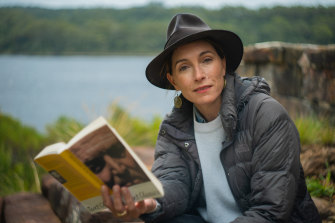
“Judy Davis [High Tide’s star] is so smart, she has such an extraordinary mind,” Karvan says. “When I went back to school I was at the bottom of my English class, and I thought if I want to be an actor I have to be smart and I have to be a reader and be literate and understand how to analyse texts. So I really started applying myself.”
Karvan is now an ambassador for the Stella Prize and our guide through the world of Australian literature, both highbrow and not so much, in Books That Made Us.
One of the pleasures of the three-part series is its broad canvas. Peter Carey, Tim Winton, David Malouf are, of course, represented. But so are Melissa Lucashenko, Tara June Winch, Sofie Laguna, Craig Silvey and Liane Moriarty.
Nor is it all about Karvan’s personal favourites (although she did lobby to have Laguna’s The Choke included). In the first episode, she’s obliged to confess that she couldn’t finish The Slap, so loathsome did she find all its characters. Imagine her dismay when the producers told her she was going to have to interview its author Christos Tsiolkas.
“I thought, how am I going to meet this author and talk about this book? I don’t even want to go back and try again. So that was a really honest conversation,” she says. (Tsiolkas, to his credit, takes her confession in his stride.)
That range of authors necessarily means the conversations are expansive. Karvan talks to people whose books vividly reflect the culture or subculture from which they spring – whether that’s Michael Mohammed Ahmad’s The Lebs or Lucashenko’s Too Much Lip. She also talks with authors who have written wildly outside their experience, like Craig Silvey with Honeybee.
One of the vexed 21st century questions – and not just in Australian literature – is who gets to tell the stories. Karvan says there should be no rules.
“But if you are delving into uncharted territory you have to be very aware of the responsibility you’re taking on,” she says.
“If you’re not telling a story that is innately yours, you’d want to have exceptional craft. You’d want to be doing a lot of research. A lot of thinking. A lot of consultation. And be sure it’s coming from a good place.”

Karvan also rejects the notion that Australian literature has any kind of defining character: “These are utterly, utterly individual voices telling completely individual experiences and that’s what’s so beautiful about doing this series – appreciating the myriad different perspectives and voices.”
What all great Australian fiction has in common, though, is that – like all good fiction – it represents something true about the world and the people in it.
When Karvan was a mother to young kids, she went through a long non-fiction binge. She felt she needed to urgently educate herself. About everything. Now – and having worked on her first documentary – she wonders if fiction can be as truthful, if not more so, than fact.
“I think in fiction the truth can be more disguised and you tend to absorb it in a subconscious or unconscious way,” she says. “You sort of marinate in it.”
In non-fiction, it’s more out in the open, it’s more cerebral, it’s more a glaring statement. “But it’s not less manipulated,” she says. “The perception is that in non-fiction the truth just is. But I think it’s sometimes more manipulated than a drama.”
In the TV series Bump, on which Karvan is a producer and star, a lot of the team’s personal stories made it into the scripts. “You can kind of slip truths in there,” she says.
She rejects the idea that scripts and books are anything like each other. “I can’t compare them. A script is just part of a long process, whereas a book is complete,” she says, before adding that they do share crucial characteristics.
“Reading definitely does speak to my profession. Words and dialogue and psychology and storytelling … reading and writing and books have played a huge part in my life – I don’t think I’d be doing what I do today without them.”
Books That Made Us is on ABC, Tuesday, 8.30pm.
This article raises the question – what about The Fortunes of Richard Mahoney by Henry Handel Richardson? Is there some way that books of significance can be discussed without having an author interview? It seems a travesty to ignore this book (and possibly others) that surely belongs in a series referred to as in search of the great Australian novel.


The following slightly edited articles are from my Google alert – women and literature, weekly update 24 November 2021. The first raises one of the controversial issues flagged by Leslie Kern in Feminist City, reviewed September 15 2021 in Books: Reviews. The second was of particular interest to me after reading Nicci French’s House of Correction (Simon & Schuster, 2020). The central character’s most public image is the lack of any traditional feminine features. Her story is engrossing and she is a delight!

HOW IS IMMIGRANT LITERATURE DISMANTLING WHITE FEMINISM?
Dee Das Nov 19, 2021
This content contains affiliate links. When you buy through these links, we may earn an affiliate commission.
White feminism, with its exclusionary policies and parochial thought process, has not only exacerbated the condition of immigrant women of color but also has rendered them invisible by relegating their issues to the margin. However, with the advent of immigrant literature and more and more authors of color becoming vocal about the status of women of their communities, the anxieties, loneliness, and fears of abandonment of immigrant women are coming to the limelight. Again and again, immigrant literature poses the question of why immigrant women, with all the potential they carry, still don’t have the right to live a dignified life.
SELF-LIBERATION FOR ALL(?)
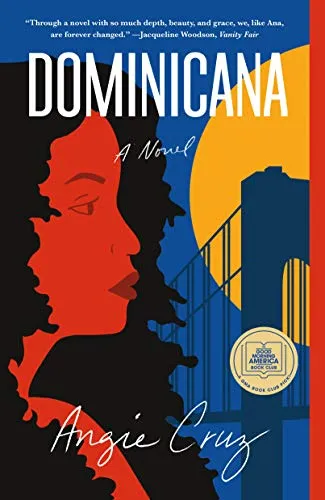
In Koa Beck’s White Feminism, she writes that the trope of the “white, depressed housewife” often overrides other cultural identities. Lack of financial autonomy, abusive marital dynamics, and prolonged stress and exhaustion are issues explicitly studied with respect to the ultra-feminine, dainty, middle-class, young white housewife. However, thanks to immigrant literature, this narrative is slowly changing. In Dominicana, Angie Cruz debunks this archetype of the white housewife being the ultimate victim of patriarchy by centering the story of a Dominican teenage bride named Ana. This novel is a bleak portrayal of a doubly disenfranchised female undocumented immigrant who has to battle with her brute of a husband and the fear of getting deported every day.
In the 1970s, “self-liberation” became a new mantra for white feminists. Asserting their humanity and value became quintessential to the preachers of white feminism. While encouraging women to become more self-interested and start existing as more than just a constant source of resources to others was imperative, this type of thinking prioritized individual ascension over collective female empowerment. Ana’s green eyes were considered “a winning lottery ticket”. Her family wanted her to settle down with her husband and eventually demand money, education, and papers facilitating her family’s rehabilitation to America. Cruz shows that for Ana, the goal of independence would come at the cost of her family’s ticket to a better life. Issues of education and political justice are of little impact to women like her because, in most cases, they don’t have access to dignified living conditions and public spaces, owing to their status as undocumented immigrants.
THE ILLUSION OF CHOICE
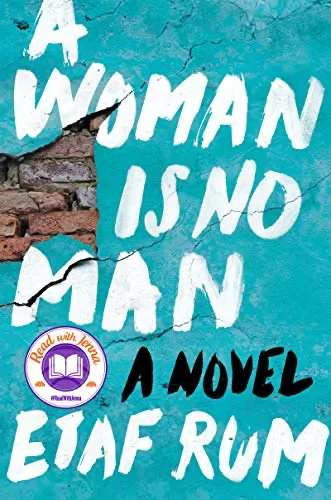
Traditional women’s labor has never been considered as part of the economic equation. Performing rigorous labor, as we see in the cases of Adah in Buchi Emecheta’s Second Class Citizen and and Isra in Etaf Rum’s A Woman Is No Man, is thought of as women’s default state of being. Adah had to work outside her home in addition to executing domestic labor. Since Black women like Adah, to sustain themselves and their immigrant families, had to work, they didn’t fit into the white feminist archetype of the moneyed housewife advocating for her skincare regime and the importance of me-time. Her children are tended to by women from economically underprivileged backgrounds in the next room, so it’s easy for her to think the way she does. Adah couldn’t hire a nanny like her white counterparts, and courtesy of her dislocation, nor could she rely on her family members to help her raise her children. Isra’s domestic labor was thought of as a natural resource by her family that didn’t need to be accounted for. The way she was ill-treated, it felt like her labor didn’t need maintenance, replenishing, or acknowledgment of any kind, let alone appreciation. It seemed like she was brought to America by her husband’s family to slowly annihilate herself while taking care of them.
When economics think of women’s labor as “natural”, capitalism has coded it as “choice”. For white feminist ideologies like autonomy, agency, and self-empowerment to prosper, the barriers specific to women of color had to be left unacknowledged as white feminism catered to white women whose privilege of ‘choice’ didn’t come at the expense of their having a roof over their head. It excluded the narratives of women of color, like Adah and Isra, as their rebeling could lead to ostracization and physical harm. They couldn’t choose to stop laboring for their husbands because of their precarious positions as immigrant women. The men pushed them to vulnerable situations, leaving them no room to operate on their own terms. By bringing into fore the nuanced nature of the lives of these women, authors like Emecheta and Rum are preventing the dangers of the single-story enshrined by white feminism from doing more damage than it has already done.
White feminism has been the bane of women of color’s existence, but with the emergence of immigrant literature, the situation is bound to take a turn for the better. If you’re interested to venture into the world of immigrant literature further, check out Why You Need To Read More Black Immigrant Literature.

When I first checked out The Hunger Games from my middle school library, I excitedly dove into the story, ready to experience the thrilling novel I’d heard so much about. But I wasn’t even fifty pages into the book when I realized I had one rather large problem: I couldn’t stand Katniss.
While her four-note whistle, three-fingered salute, and iconic French braid marked a new era of young adult literature finally dominated by women, the long wait for female representation allowed us to readily embrace heroines who were, at best, subpar. All these new depictions of strong female leads—women who sparked revolutions, held power, and were fierce and unstoppable—came at a price. Series after series, authors made their female characters “strong” by stripping them of traditionally feminine qualities.
This characterization perpetuates dangerous ideas about the relationship between femininity and strength, an occurrence we cannot afford in a literary world with so few female protagonists.
Take Katniss. She detests intimacy and is seemingly determined to avoid close relationships. In her mind, showing vulnerability or asking for help are nothing more than displays of weakness. She keeps herself from crying at all costs. She is a thinker over a feeler and a fighter over a lover. These aspects of her made her completely unrelatable—she was as cold as an ice cube and as expressive as a rock. I hated her personality, and having to read hundreds of pages narrated by her made my brain spin in circles inside my head.
I bitterly finished the novel and the rest of the series, holding out hope until the very end that it—and Katniss—would grow on me (they didn’t). My twelve-year-old self accepted the fact that maybe I just didn’t have the same taste in books, or characters, as everyone who had enjoyed the novel, and moved on to the next mainstream dystopian trilogy. But the other female leads, like Tris of Divergent and Teresa of The Maze Runner, were just as insufferable as Katniss.
The truth is, the traits these characters lacked, the ones treated as impediments to success, were exactly the ones associated with traditional femininity: emotionality, vulnerability, and empathy. My dislike for the protagonists stemmed from an inability to connect to them—an inability caused by the absence of typically feminine traits I value as part of my identity. Society often sees women as providers of comfort and warmth, and sees this softness as a limiting factor, so these female leads had to break this norm to make a name for themselves. These heroines sent the message that in order for women to be strong or achieve power, they must shed any qualities that make them traditionally feminine. But stripping female characters of these traits implies that womanhood is inherently incompatible with strength.
The presence of this idea in YA novels poses a danger to the self-image of the young girls reading them. Classifying this depiction of strength as the definition of female power tells young women that they must sacrifice a portion of their womanhood if it conforms to societal norms to gain respect and validity as leaders.
Not only do these female characters reinforce harmful ideas of what it means to be strong, but they also fall short from a literary perspective; in effect, the women of these novels lack depth. The emotional sides of their personalities are left underdeveloped out of fear that focusing too much on them would make the women too “girly” and thus less powerful and fierce. YA authors’ method of creating unstoppable female characters by overcompensating for their femininity left them with characters who lacked the traits many women—and people in general—relate to.
In reality, the inclusion of such characteristics would have improved not just the books’ messages on womanhood, but also the depth of their personalities and the literary value of their novels as well—a truth evident in novels with male protagonists.
For example, emotionality, though a traditionally feminine trait, was ever present in perhaps the most well-known male YA lead: Harry Potter. His reckoning with his parents’ deaths and ability to mourn, miss, and remember them added purpose to his quest against Voldemort. Harry is in touch with his emotions, giving his story a personal meaning that readers could connect to. He is able to show vulnerability and ask for help when he needs it. He understands that he can’t do everything alone and recognizes the value of teamwork, allowing others to take the lead when necessary.
Meanwhile, Katniss is the opposite. Since her emotional side is poorly developed, she is incapable of seeking out assistance and is hesitant to connect with others on an emotional level. However, a greater appreciation for these seemingly feminine qualities—vulnerability and sensitivity—could have been in her best interest. Had Katniss been more open to accepting help, perhaps she would not have had so many close encounters with death. If she had been more empathetic, maybe she could have avoided making so many enemies. The difference in the character-building highlights society’s double standards for women. Since men like Harry Potter are considered natural leaders, emotionality is not considered an obstacle to their success. But as women are consistently underestimated, they cannot afford the same luxury of vulnerability.
YA depictions of women fall short of their initial intentions. While many were created by female authors and stemmed from a valid desire to put women in the spotlight, they lack authenticity and range. We must question the validity of female representation if it fails to embody the traits many women relate to. Women can be emotionally expressive and vulnerable—both traditionally feminine traits—and still be independent and inspiring. They can be stereotypically feminine and still rise to positions of power. Unlike Katniss, they can be lovers and fighters.
While we still need more female representation in media and literature, we must be critical of the depictions we receive. If the price of a female character is femininity, are we really willing to pay?
 Robin's Room