
One of the books I have reviewed features in the final round for the Goodreads Best Books of 2021, and another I reviewed, is a biography of Amanda Gorman. Marc Shapiro, Work Up: The Life of Amanda Gorman reflects upon the life of the finalist, writer of The Hill We Climb, An Inaugural Poem for the Country and was reviewed on 28 July, 2021. Come Fly the World The Jet-Age Story of the Women of Pan Am by Julia Cooke was reviewed on 17 March, 2021. See Books: Reviews


The book reviewed this week is Fiona Hill’s There Is Nothing For You Here Finding Opportunity In The 21st Century HarperCollinsPublishers Boston New York, 2021.
Fiona Hill’s father did readers of this book an immense favour when he told his daughter, ‘There is nothing here for you, pet’. That wise understanding of Fiona Hill, together with his and her nurse/midwife mother’s steadfast support, joined by various people along the way, gave this resilient, thoughtful, and intellectually astute woman the power to study and excel, find a range of a careers, and most effectively, a voice. See full review Books: Reviews.
Canberra post lockdown Covid

There has been one confirmed case of the Omicron variant in Canberra recorded, on December 3. On 2 December eight new cases of Covid were recorded, and on December 3, four cases, including the one of the new variant, were recorded. There were four people in hospital, with three in intensive care, although none is ventilated. At this stage the total number of cases for this outbreak in Canberra is 2,022; ACT residents over twelve who are fully vaccinated is 97.9%. Children have been back at school for four weeks.
On the 4th, 5th, and 6th December there were seven, six, and six new cases recorded. On the 7th and 8th there were three cases, and then eight, recorded. On the 8th there were 79 active cases, with 1,675 new negative tests recorded. Two dose vaccinations for people over twelve are now at 98.1%.
Cindy Lou eats out in a variety of venues in Canberra – and enjoys them all.
Blackfire


It was very pleasant to return to Blackfire with friends. Having enjoyed the prawns so much on the last occasion, I opted to have them again, with the crab and prawn filled peppers as an entrée. Again, because of my great experience with the crème caramel (of which I could only share a small portion) I took the opportunity to order a whole one this time. Two of my friends opted for the two entrées as well, and we ordered some bread to soak up the delicious sauce with the prawns.

As always, service was pleasant and efficient. The atmosphere is delightful, with the tables spaced well, and the noise level low. Covid protocols were observed.

Years ago we found Blackfire when looking for outside seating for breakfast, and were impressed. We have now enjoyed several lunches there, with large and small numbers, and several dinners. This is always a really enjoyable venue and I shall certainly return.

Soul Origin

Quite a contrast, but nevertheless, an enjoyable casual meal, was my huge salad at in Soul Origin in the Woden shopping centre.
A section has been set aside for eating in Covid aware circumstances, with good spacing, hand sanitiser and check in.
The food ranges over a variety of filled rolls and a large swag of salad choices. The portions are more than generous – and that was for the small dish.
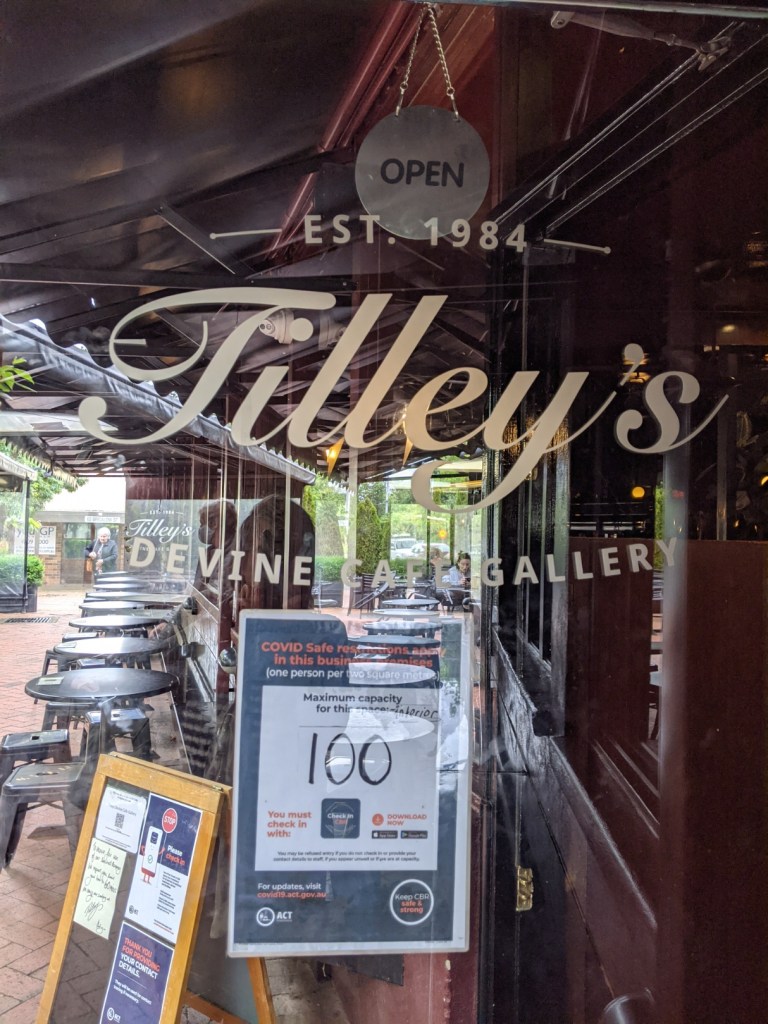
Tilley’s Devine Cafe and Gallery
Tilley’s is always fun, not only is it a reminder of the success of a small business venture financed and encouraged under the Hawke Labor Government, but it provides good food and service, and a comfortable venue. This time I sat inside, and fumbled with ordering from the table – it worked! The music is low enough to hear conversation; the floor is carpeted, again helping keep any noise down; and families, couples and groups are all customers.



Heather Cox Richardson
Disconnect between the popularity of the Biden Administration policies and the President
November 27, 2021 (Saturday)
Today, Nate Cohn noted in the New York Times that the policies President Joe Biden and the Democrats are putting in place are hugely popular, and yet Biden’s own popularity numbers have dropped into the low 40s.
It’s a weird disconnect that Cohn explains by suggesting that, above all, voters want “normalcy.” Heaven knows that Biden, who took office in the midst of a pandemic that had crashed the economy and has had to deal with an unprecedented insurgency led by his predecessor, has not been able to provide normalcy.
In her own piece, journalist Magdi Semrau suggests that the media bears at least some of the responsibility for this disconnect, since it has given people a sense of the cost of Biden’s signature measures without specifying what’s in them, focused on negative information (negotiations are portrayed as “disarray,” for example), and ignored that Republicans have refused to participate in any lawmaking, choosing instead simply to be obstructionist. As Semrau puts it: “Democrats want to fix bridges, provide childcare and lower drug costs. Republicans don’t. These are political facts and voters should be aware of them.”
To this I would add that Republican attacks on Democrats, which are simple and emotional, get far more traction and thus far more coverage in the mainstream press than the slow and successful navigation of our complicated world. In illustration of the unequal weight between emotion and policymaking, Biden’s poll numbers took a major hit between mid-August and mid-September, dropping six points. That month saw the U.S. withdrawal from Afghanistan, which was widely portrayed as a disaster at Biden’s hands that had badly hurt U.S. credibility. In fact, Biden inherited Trump’s deal with the Taliban under which the U.S. promised to withdraw from Afghanistan by May 1, 2021, so long as the Taliban met several requirements, including that it stop killing U.S. soldiers. When Biden took office, there were only 3500 U.S. troops in Afghanistan, down from a high of 100,000 during the Obama administration. Biden had made no secret of his dislike of the U.S. involvement in Afghanistan and, faced with the problem of whether to honor Trump’s agreement or send troops back into the country, committed to complete the withdrawal, although he pushed back the date to September.
What he did not know, in part because Trump’s drawdown had taken so many intelligence officers out of the country, was that as soon as Trump’s administration cut the deal with the Taliban, Afghan troops began to make their own agreements to lay down their arms. The Biden administration appears to have been surprised by the sudden collapse of the Afghan government on August 15. As the Taliban took the capital city of Kabul, Afghans terrified by the Taliban takeover rushed to the Kabul airport, where an attack killed 13 U.S. military personnel who were trying to manage the crowd.
Republicans reacted to the mid-August chaos by calling for Biden’s impeachment, and the press compared the moment to the 1975 fall of Saigon. That coverage overshadowed the extraordinary fact that the U.S. airlifted more than 124,000 people, including about 6000 U.S. citizens, out of Afghanistan in the six weeks before the U.S. officially left. This is the largest airlift in U.S. history—the U.S. evacuated about 7000 out of Saigon—and evacuations have continued since, largely on chartered flights. By comparison, in October 2019 under Trump, the U.S. simply left Northern Syria without helping former allies; the senior American diplomat in Syria, William V. Roebuck, later said the U.S. had “stood by and watched” an “intention-laced effort at ethnic cleansing.” And yet, that lack of evacuation received almost no coverage.
Complicating matters further, rather than agreeing that the withdrawal was a foreign policy disaster, many experts say that it helped U.S. credibility rather than hurt it. According to Graham Allison, the former dean of Harvard Kennedy School, “The anomaly was that we were there, not that we left.” And yet, in mid-September, while 66% of the people in the U.S. supported leaving Afghanistan, 48% thought Biden “seriously mishandled” the situation.Aside from getting the U.S. out of Afghanistan, is it true that Biden has not accomplished much?
Biden set out to prove that democracies could deliver for their people, and that the U.S. could, once again, lead the world. He promptly reentered the international agreements Trump had left, including the Paris Climate Accords and the World Health Organization, and renewed those Trump had weakened, such as the North Atlantic Treaty Organization. Biden set out to lead the world in coronavirus vaccinations, making the U.S. the world’s largest donor of vaccines globally, although U.S. vaccinations, which started out fast, slowed significantly after Republicans began to turn supporters against them.
Under Biden, the U.S. has recovered economically from the pandemic faster than other nations that did not invest as heavily in stimulus. In March 2021, the Democrats passed the $1.9 trillion American Rescue Plan stimulus package to rebuild the economy, and it has worked spectacularly. Real gross domestic product growth this quarter is expected to be 5%, and the stock market has hit new highs, as did Black Friday sales yesterday. Two thirds of Americans are content with their household’s financial situation. The pandemic tangled supply chains both because of shortages and because Americans have shifted spending away from restaurants and services and toward consumer goods.
The Biden administration mobilized workers, industry leaders, and port managers to clear the freight piled on wharves. In the past three weeks, the number of containers sitting on docks is down 33%—and shipping prices are down 25%. Major retailers Walmart, Target, and Home Depot all say they have plenty of inventory on hand for the holiday season. With more than 5.5 million new jobs created in ten months, unemployment claims are the lowest they have been since 1969, prompting House Speaker Nancy Pelosi’s (D-CA) office to tweet, “Armstrong Walks the Moon!… Wait, sorry! That’s a headline from the last year unemployment claims were this low.” Workers’ pay has jumped as much as 13% in certain industries, and there are openings across the labor market.
The American Rescue Plan started the reorientation of our government to address the needs of ordinary Americans rather than the wealthy who have dominated our policymaking since 1981. It provided more than $5 billion in rental assistance, for example, and expanded the Child Tax Credit, so that by the end of October, $66 billion had gone to more than 36 million households, cutting the child poverty rate in half. Over the course of the summer, Biden negotiated an extraordinarily complicated infrastructure package, winning a $1.2 trillion bipartisan bill that will repair roads and bridges and provide broadband across the country, and getting the larger, $2.2 trillion Build Back Better bill through the House. Now before the Senate, the bill calls for universal pre-kindergarten, funding for child care and elder care, a shift from fossil fuels to renewable energy, and protection against climate change. Has the Biden administration accomplished anything? It has created a sea change in our country, rebuilding its strength by orienting the government away from the supply-side economics that led lawmakers to protect the interests of the wealthy, and toward the far more traditional focus on building the economy by supporting regular Americans.
| BREAKING NEWS |
| Stacey Abrams, the prominent Georgia Democrat and voting rights activist, announced she would run again for governor in 2022. |
| Wednesday, December 1, 2021 3:56 PM EST |
| The move sets up a likely rematch with Gov. Brian Kemp, the Republican who narrowly defeated Ms. Abrams in 2018. |

 Robin's Room