After the beach reads reviewed last week I am pleased to make a change and review a non fiction book. NetGalley and Sword and Pen provided me with Dr Vivien Newman’s Changing Roles Women After the Great War. I am reading The Times They Were a-Changin’ 1964, the Year the Sixties Arrived and the Battle Lines of Today Were Drawn by Robert S McElvaine for review. However, this is a lengthy and dense read and I have not finished it yet. A few weeks ago I mentioned a book that began in a way that inspired me to think it could be a great read. Unfortunately I was disappointed in The Trivia Night by Ali Lowe.
Dr Vivien Newman, Changing Roles Women After the Great War, Pen & Sword History, 2021.
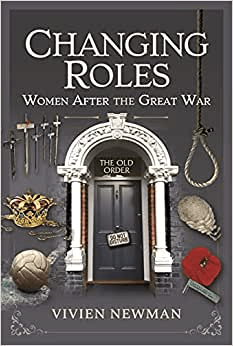
How I loved this book.
Dr Vivien Newman incorporates the familiar accessible nature of the Pen & Sword publications with academic thoroughness; where appropriate, a deftly comic touch; and a range of interesting, arresting women whose post WW1 activities make a wonderful read.
The introduction sets the post WW1 scene – a time of claims about the wonders women had performed during the war, and the bitter reality they faced as they were expected to return to their former pursuits. Some of the women who refused to do so changed roles. As social innovators they also changed other women’s lives. Their stories are told in Chapter 3, Changing Others Lives. Other women made their impact in a less socially conscious way. For example, Chapter 4, Murder Most Foul, includes writers, Agatha Christie and Dorothy Sayers, and, from the Thomson and Bywaters Case, Edith Thompson. See the full review at: Books: Reviews
After the Canberra Covid report: American politics – Heather Cox Richardson and Roe vs. Wade; Nick Pearson and impact of Supreme Court decision on voting in the mid terms; Australian politics – comment on Independents and Bob McMullan – Where Did Zed Lose?; Cindy Lou eats at two rather different cafes – Melted and Walter.

Covid in Canberra after the end of Lockdown
New cases recorded 23 June – 1,134; 88 in hospital; 1 in ICU.
New cases recorded 24 June – 1,038; 99 in hospital; 1 in ICU.
New cases recorded 25 June – 1,116; 105 in hospital; 1 in ICU.
New cases recorded 26 June – 819; 116 in hospital; 1 in ICU. New cases recorded 27 June – 927; 119 in hospital; 1 in ICU. New cases recorded 28 June – 1,159; 121 in hospital. New cases recorded 29 June – 1,458; 116 people in hospital; 1 in ICU; 1 ventilated.
American Politics
Heather Cox Richardson
June 26, 2022 (Sunday)

States and the Supreme Court’s decision to overturn Roe v. Wade
Defenders of the Supreme Court’s decision overturning Roe v. Wade insist that Dobbs v. Jackson Women’s Health does not outlaw abortion but simply returns the decision about reproductive rights to the states.
“It is time to heed the Constitution and return the issue of abortion to the people’s elected representatives,” Justice Samuel Alito wrote. He quoted the late Justice Antonin Scalia, who wrote: “The permissibility of abortion, and the limitations, upon it, are to be resolved like most important questions in our democracy: by citizens trying to persuade one another and then voting.” This, Alito wrote, “is what the Constitution and the rule of law demand.”
The idea that state voters are the centerpiece of American democracy has its roots in the 1820s, when southern leaders convinced poorer Americans that the nation was drifting toward an aristocracy that ignored the needs of ordinary people. The election of 1824, when established politicians overrode the popular vote to put John Quincy Adams into the presidency, seemed to illustrate that drift. Supporters of Adams’s chief rival, Andrew Jackson, complained that a wealthy elite was taking over the country and, once in charge, would use the power of the federal government to cement their control over the country’s capital, crushing ordinary Americans.
The rough, uneducated Andrew Jackson, who promised to break the hold of northeastern elites on the government and return democracy to the people, began to articulate a new vision of American government. He insisted that democratic government should actually look like a democracy: it should be formed by the votes of local people, not those from some far-off capital, and it should be made up of those same ordinary voters, not eastern elites like Adams, whose wealthy president father, John, had reared his son to follow in his footsteps.
Jackson’s new vision made ordinary Americans central to the democratic system. Democratic government put the power into the hands of individual voters. Local and state government was the most important stage of this system; the federal government always ran the risk of being taken over by an elite cabal that could override the will of the people. It must always be kept as small as possible.
But there was a power play in this argument. By the time Jackson was elected president in 1828, white southerners already knew they were badly outnumbered in the nation as a whole. In that year, quite dramatically, a congressional fight over tariffs ended up with a strong bill that hurt the South in favor of northern manufacturing. Outraged, southern leaders with Vice President John C. Calhoun of South Carolina at their head claimed the right to “nullify” federal laws. (Jackson later said that one of the two regrets he had at the end of his term was that he “was unable to…hang John C. Calhoun.”)
Congress lowered the tariff and the southerners backed down, but the idea that states were superior to the federal government only gained strength among southern enslavers as they felt the heat of a growing movement to abolish slavery. When it became clear that the U.S. might well acquire territory in Latin America, Democrats sympathetic to the South pushed back against the national majority that wanted to stop the spread of slavery into those lands by insisting on the doctrine of “popular sovereignty”: permitting the people who lived in a territory to decide for themselves whether or not to permit enslavement in it (although Mexico had outlawed enslavement in 1829). The U.S. acquired the vast territory of the American West in 1848, and two years later, Congress turned to popular sovereignty to try to avoid a fight about enslavement there.
The issue turned volatile in 1854 when Illinois Senator Stephen A. Douglas pushed through Congress a law overturning the 1820 Missouri Compromise and organizing two super-states out of the remaining land of the 1803 Louisiana Purchase. Rather than being free as the Missouri Compromise had promised, those huge states of Kansas and Nebraska would have enslavement or not based on the votes of those who lived there. This, Douglas insisted in his debates with Illinois lawyer Abraham Lincoln in 1858, was the true meaning of democracy:
“I deny the right of Congress to force a slaveholding State upon an unwilling people,” he said, “I deny their right to force a free State upon an unwilling people…. The great principle is the right of every community to judge and decide for itself, whether a thing is right or wrong, whether it would be good or evil for them to adopt it…. It is no answer to this argument to say that slavery is an evil, and hence should not be tolerated. You must allow the people to decide for themselves whether it is a good or an evil….” “Uniformity in local and domestic affairs,” he said, “would be destructive of State rights, of State sovereignty, of personal liberty and personal freedom.”
A strong majority in the U.S. opposed the extension of enslavement, but Douglas’s reasoning overrode that majority by carving the voting population into small groups the Democrats could dominate by whipping up voters with viciously racist speeches. Then, in the 1857 Dred Scott decision, a stacked Supreme Court blessed this plan by announcing that Congress had no power to legislate in the territories. In our system, this would mean that states taken over by pro-slavery zealots would eventually win enough power at the federal level to make enslavement national.
“A house divided against itself cannot stand,” Lincoln warned Americans. “I believe this government cannot endure, permanently half slave and half free. I do not expect the Union to be dissolved—I do not expect the house to fall—but I do expect it will cease to be divided. It will become all one thing or all the other. Either the opponents of slavery, will arrest the further spread of it, and place it where the public mind shall rest in the belief that it is in the course of ultimate extinction; or its advocates will push it forward, till it shall become alike lawful in all the States, old as well as new—North as well as South.”
After the Civil War had proved the power of the federal government to defend the will of the majority from the tyranny of the minority, Congress found itself once again forced to override the will of state governments. When state legislatures put in place the Black Codes, which created a second-class status in the South for Black Americans, Congress passed and the states ratified the Fourteenth Amendment to the Constitution, overriding the Dred Scott decision to make Black Americans citizens, and establishing that “[n]o state shall make or enforce any law which shall abridge the privileges or immunities of citizens of the United States; nor shall any state deprive any person of life, liberty, or property, without due process of law; nor deny to any person within its jurisdiction the equal protection of the laws.”
Almost 80 years later, it was this amendment—the Fourteenth—to which the Supreme Court turned to protect the rights of Black and Brown Americans, women, LGBTQ, and so on, from state laws that threatened their health and safety or treated them as second-class citizens. In using the power of the federal government to guarantee “the equal protection of the laws,” it made sure that a small pool of voters couldn’t strip rights from their neighbors. It is this effort today’s Supreme Court is gutting.
When today’s jurists talk of sending decisions about civil rights back to the states, they are echoing Stephen Douglas. “Citizens trying to persuade one another and then voting” is indeed precisely how democracy is supposed to work. But choosing your voters to make sure the results will be what you want is a different kettle of fish altogether.
Wishful thinking? When 40% of Americans support the actions of the Supreme Court, it seems to me that it well could be.
Roe v Wade has just turned the next US election on its head
Nick Pearson Nine News

Almost every US president in recent memory has had their party lose a mass of seats in the House of Representatives and the Senate in the subsequent election, costing them most of their power.
But an earth-shaking decision unconnected to elected politicians may turn those elections back in the Democrats’ favour.
© APThousands of protesters gathered across the US for a second day after the overturning of an abortion law.
On Friday the Supreme Court overturned Roe v Wade, the 50-year-old law enshrining abortion as a constitutional right in the US.
And today several polls have shown Democrats may not only keep their control of Congress, but make substantial gains.
Morning Consult has found Democrats have a 45-42 per cent advantage on the generic ballot. A week ago the parties were tied in the same poll.
The difference was even more stark in a Marist College poll. Democrats led 48-41 per cent. An April poll by Marist showed Republicans with a three-point lead.
Australian Politics
Independents and Party Responsibilities to their Electors
The article below is local and possibly of greatest interest to ACT readers.
However, it does raise the relevance of Members of Parliament responding to their constituencies, within the legitimate concern with their party affiliation.
In the context of a historical number Independents being elected to the Australian Federal Parliament in the 2022 election, there is a debate to be had about this issue. Independents go to the election claiming that they have their constituents’ demands at the forefront of their fight to be elected. Of course, this is utter nonsense – how can any one person represent the diverse views in an electorate?
At least the Independents who ran in 2022 were clear about one issue – their commitment to climate change. Some were focussed on the introduction of a Federal Integrity Commission, as well. These Independents did not run on an unfocussed promise to represent their constituents, in comparison with what some independents claim to be the major parties’ failure to do so. Major parties, including the Greens, have platforms setting out their promises and principles by which they will govern if elected. Voters choose the platform that most closely meets their needs and aspirations. They know what they are voting for.
Zed Seselja represented a particular wing of the Liberal Party rather than representing the views of the majority of the ACT electorate. Independents were able to demonstrate that they were more likely to represent a majority of the ACT electorate on issues that are important to this electorate – not all electors, that is as impossible as it is for the major parties. An independent won.
Once elected, it is essential that an Australian Government do its best to represent electors. The government has a responsibility to govern for all, not just those who voted for it. At the same time, voters have been told clearly what the principles are that govern a Party representative, the policy platform on which they run, and the individual’s personal aspirations for governing.
In the case of Zed Seselja not enough voters liked the latter at the same time as they preferred to elect a Labor Government nationally.
Where did Zed lose?

Canberra is still reckoning with the extraordinary result in this years Senate election. For the first time in our almost fifty years of electing two Senators one of the major parties has failed to win a Senate seat in the ACT.
Some are celebrating, others are sad, but the result is there for all to see.
Now that the result is confirmed, although it has been clear for some time, it is possible to begin the analysis of what happened. Many people will have theories about why Zed Seselja was defeated and David Pocock won.
As a first cut at a statistical analysis of the results I have looked at the fall in the Liberal vote by electorate and across some of the range of polling booths across Canberra.
The first reflection on the result is that Zed lost everywhere.
In the southern seat of Bean, where he might have expected to do better, the Liberal vote overall was 27.17% compared to 34.84% in 2019. A fall of 7.67%.
In the central seat of Canberra, where the Liberals traditionally do badly, the Seselja vote was a mere 20.25%, a fall of 7.48% from the 2019 level of 27.73%.
The northern seat of Fenner saw a similar fall. In 2019 the combined Liberal vote in this seat was 34.37%. In 2022 it fell to 26.92%, a decline of 7.45%.
This shows a remarkable similarity across Canberra at the large scale of electorate-by electorate. David Pocock’s vote showed a pattern not far removed from this. His vote ranged from 19.02% in Fenner to 21.33% in Bean and 23.11% in Canberra. This shows he was taking votes from the Greens and Labor as well as from Zed Seselja directly.
At the more local level, on a booth-by booth analysis, the variation is greater, although the pattern of decline in support for former Senator Seselja is common across all booths and regions.
What the statistics appear to show is that some of the biggest swings against the former Senator occurred in some of the Liberal party’s strongest areas.
In Conder, where the vote for the Liberal Senate ticket was over 40% in 2019 the result in 2022 was a massive 10% drop in support and in Gordon the decline in support was from 44.7 in 2019 to 35.2 in 2022.
These were not he biggest swings against the Liberals in Bean in 2022, that title goes to Mawson with a more than 11% swing (unless you count Norfolk Island where for some reason the swing was 22%).
The apparent pattern becomes clearer when the booth figures in Canberra and Fenner are examined.
In the leafy suburb of Deakin, which bears some resemblance to the “teal” suburbs in Sydney and Melbourne, the drop in support for the Liberal Senate ticket was 12.5%!
In Fenner, the usually strong Liberal polling booths at Forde and Nicholls showed swings of more than 10%.
The swings against Zed Seselja in the strongest Liberal areas do not tell the whole story. There was a substantial swing everywhere.
In the traditionally strong Labor booths in the Inner North there were not many votes for the Liberals to lose. But lose votes they did. The lowest vote for the former Senator was in Lyneham, where his ticket polled a mere 12.3%, a drop of 4.6% from a pretty dismal result in 2019.
Of course, some of the credit must go to David Pocock. It appears that he did not fall for the trap of focusing his campaign in the anti-Liberal areas like the Inner North. He did well there and won votes from all the other parties in a way which helped him stay ahead of the Greens.
However, the figures reinforce the anecdotal evidence during the campaign that he campaigned effectively all across the ACT, and he appears to have done particularly well in the Weston Creek area.
Major electoral upsets always have a number of causes. In this case there was a national mood for change and there was a very appealing Independent candidate. Without these factors there would not have been a change.
However, the magnitude and location of the big swings in the ACT Senate election in 2022 reinforce the view that Zed Seselja was the main cause of the Liberals failure for the first time to win a seat in Canberra.
Cindy Lou eats out in Canberra
Melted
Melted is a relatively new caravan eating place in O’Connor. It has always looked as though the customers, seated at wooden tables under umbrellas, were having fun. We decided to join in on a grey Canberra day when we just wanted a coffee and something simple to eat. We enjoyed ourselves. My friend had a tremendous toasted melt, full of savoury beef, cheese, pickles and slaw . Mine was a little less exotic – tomato, cheese and pesto, but also really delicious. The coffees were good. Service was friendly and efficient.



Walter Cafe Regatta Point
This was the first time I have eaten at Walter, although I have heard really good things about it. My feelings are mixed. The site is wonderful, with plenty of pay parking, and if you think you can eat a cream scone in an hour, free parking. There is seating inside and out. On this occasion we sat inside. However, hardier Canberrans (for who else would brave the cold? ) sat outside where it was indeed cold, but sunny with magnificent views.

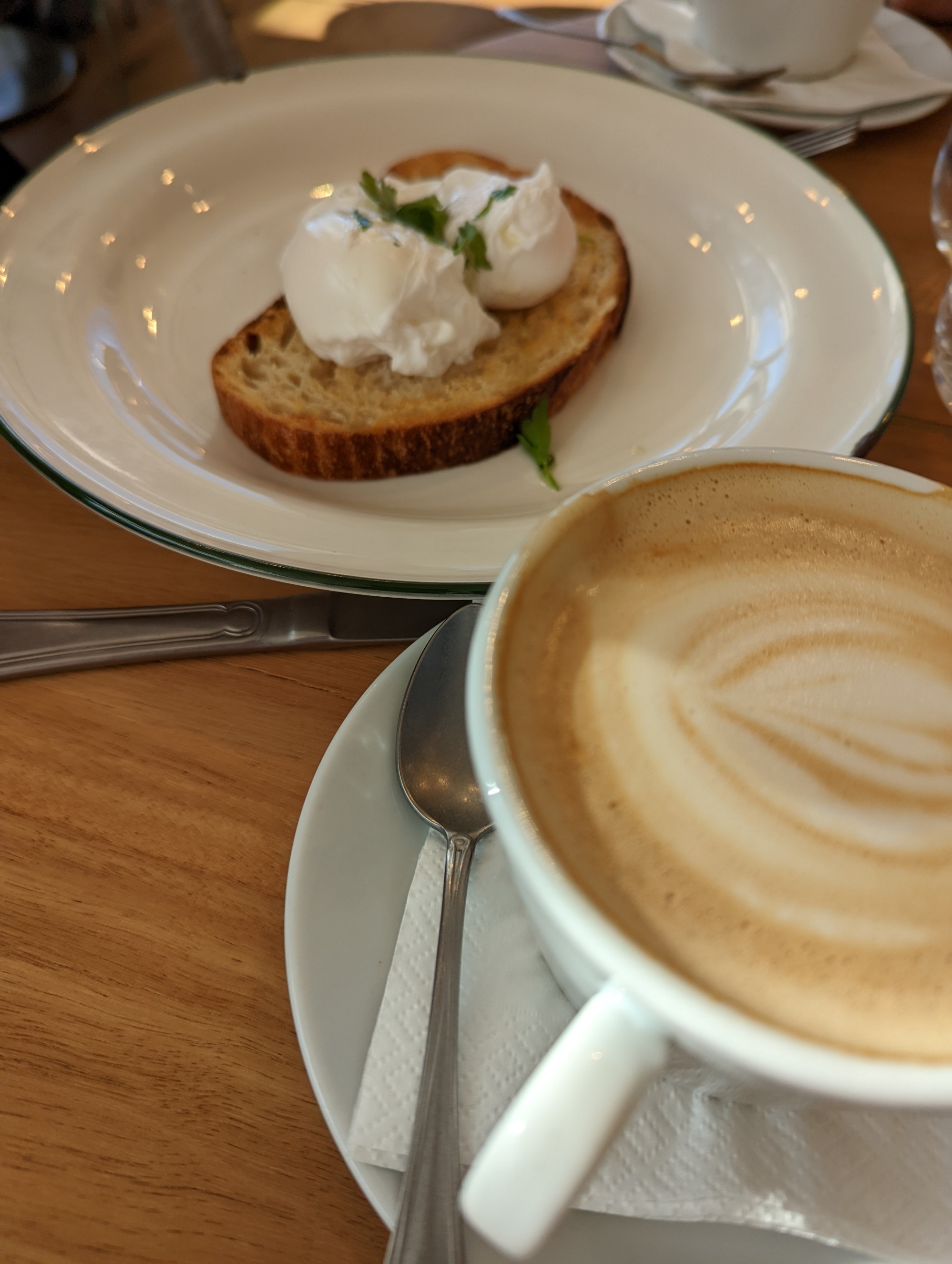
My fritters with salmon and additional pleasant flavours were good. However, the eggs were overcooked, as they were on my friend’s dish of poached eggs. The coffees were generous and exactly right.
Service was mixed. The meals all arrived at the same time. The water glasses were filled as soon as needed. The waitperson was charming. However, some additional training is needed. Instead of moving around the table to deposit plates and cups of coffee, the constant leaning across in front of us was a real problem. This is not unique to Walter, it happens at other establishments. But, how lovely when it does not!




 Robin's Room