Two fiction books are reviewed this week, Murder on Sea, by Jane Adams, and Why She Left, by Leah Mercer. Both were sent to me by NetGalley as uncorrected proofs for review.

Jane Adams Murder On Sea Joffe Books 2021 (First published by Severn House Publishers 2007).
This is Book 1 of the Rina Martin Mysteries, and augers well for this ‘new’ (but republished from its earlier iteration in 2007) series written by Jane Adams. As well as Rina Martin, the series introduces Mac, Inspector McGregor, and the location in which the two unlikely collaborators solve crime, Frantham-on-Sea. Books: Reviews for complete review.
Leah Mercer Why She Left Bookoutre 2021.
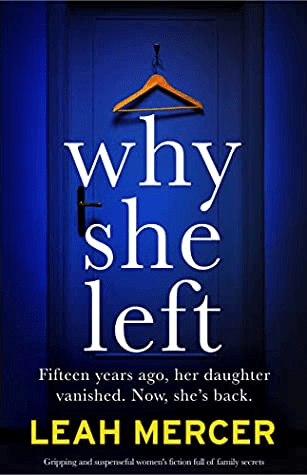
Leah Mercer develops a sensitive family story around a searing public issue, in a well written, gripping story. The reason for Isobel’s departure from her mother’s beautiful home and the associated prestigious private school on Burlington Square is not revealed until well into the narrative. Her arrival with her teenage son, Isaac, years after she departed possibly provides a clue. However, regardless of an apparent resolution, there is far more to be unearthed in this story about a family with a commitment to the family heritage; family dysfunction associated with this commitment; affection for each other impacted by the legacy; and the family’s interaction with students, parents, and teachers at the school. Books: Reviews for the complete review.
Articles after Covid Report: First Two Weeks of Labor Government; Australian Letter, NYT, climate change policy; National Press Club address, Minister for the Environment and Water Tanya Plibersek; Bob McMullan, Trump may save the Democrat’s Senate bacon in November, with addendum; Cindy Lou at Courgette; Judith Durham; Olivia Newton-John.
Covid in Canberra after lockdown ends, and impact of new variants
As can be seen from previous weeks, the new variants have impacted in Canberra as well as elsewhere in Australia. More people are wearing masks in closed environments, despite not having to, which is a positive sign. Masks are mandatory in some situations, and in general the requirement to wear them on public transport is observed, although this could be better. It is interesting to live in an environment where the obligatory mantra, wallet, keys and kindle is joined by mask. Vaccinations have been introduced for children at risk aged 6 months to under 5 years. The Public health Emergency Declaration was extended on 8 August. This means that the Chief Medical Officer is allowed to take all necessary actions to reduce threats to public health from Covid 19.
3 August – 889 new cases recorded; 143 people in hospital; 2 in ICU.
4 August – 641 cases recorded; 147 people in hospital; 4 people in ICU; 1 person ventilated.
5 August – 705 new cases recorded; 141 people in hospital; 2 people in ICU; 1 person ventilated.
6 August – 579 new cases recorded; 135 people in hospital; 2 people in ICU; 1 person ventilated.
7 August – 415 new cases were recorded; 140 people are in hospital; 1 person is ventilated.
8 August – 509 new cases were recorded; 144 people in hospital; 5 people in ICU; 1 person ventilated.
9 August – 498 new cases recorded; 146 people in hospital; 4 people in ICU; 3 people ventilated.
10 August – 556 new cases recorded; 138 people in hospital; 3 in ICU; 2 ventilated.
Over this period eleven lives were lost. One hundred and seven lives have been lost to Covid in Canberra since March 2020.
In the first two weeks of the Albanese Labor Government the following was accomplished:

The House passed first climate change bill for over a decade.
Aged Care legislation was passed to implement 17 of the Royal Commission recommendations.
The House introduced legislation to establish 10 days domestic violence leave.
The House outlined details for progressing Uluru Statement from the Heart.
The House introduced legislation to scrap the punitive cashless debit card.
Legislation to restore territory rights was passed.
The Senate consultations and decisions led to this headline: The climate wars are nearly over’: Labor, teals and Greens take a win on emissions as Liberals watch on‘, Brett Worthington, ABC.
And some analysis:
The Australian Letter New York Times
| The Australia Letter is a weekly newsletter from our Australia bureau. This week’s issue is written by Damien Cave, the Australia bureau chief. |
| For as long as I’ve been in Australia, climate change policy has stymied governments, leading to division, inaction and embarrassment, most recently as the country became a global laggard at last year’s international climate conference in Copenhagen. |
| That now stands poised to change with the lower house of Parliament passing a bill this week that will finally put Australia on a path toward reducing carbon emissions by a significant amount — 43 percent from 2005 levels by 2030. |
| The bill is expected to pass the Senate next month, after the Labor government secured reluctant support from the Australian Greens, which had pushed for a higher target. And it is being hailed as the most significant piece of climate legislation in a decade, while also being criticized for not going far enough. |
| Both can be true, of course, and in my conversations this week with experts in both climate science and climate politics, I was struck by their expectation that the legislation would produce momentum and progress. |
| The first thing they noted: The target itself produces a framework for stability and stepped-up action; enshrining a 43 percent reduction in law gives businesses and local governments the confidence to invest in reducing carbon emissions without worrying that competitors eager to avoid such an expense will be rewarded later by another government that doesn’t think the changes are necessary. |
| A second element of the legislation that I heard a lot about was a mechanism for independent assessment and improvement of this first step. |
| As the Climate Council notes in its analysis of the legislation: |
| It hands authority back to an independent group of experts (the Climate Change Authority) to monitor Australia’s progress against the targets, and to help shape the move toward future targets, including what’s expected under the Paris Agreement for 2035.Under the new law, the Minister for Climate Change will be required to report back to Parliament each year on Australia’s progress toward the country’s targets. |
| What those two elements do is force Australia to continue the conversation, with scientific experts playing a lead role. It’s the kind of thing good governance experts often call for with contentious policy issues, and it helps counter what psychologists who study humanity’s response to risks of all kinds describe as the “single action bias.” |
| Elke Weber, a professor of psychology at Princeton University who I interviewed for my book (which has been published in Australia and will be out next year in the United States), described the concept as a major impediment to sustained action on big problems like climate change. The idea is that, in response to uncertain, frightening situations, humans tend to simplify their decision-making and rely on one action, without any further action — usually because the first one reduced their feeling of worry or vulnerability. |
| What makes the climate bill so interesting to me, as a student of risk, is that it builds into its structure a framework for further action, and a trigger that could force that action to continue and build over time. It sets repeated action and adjustment as the default. |
| Many other pieces of legislation do this too, in Australia and in other countries. The United States is also on the verge of passing landmark climate legislation that will help the country reach its goal of cutting emissions in half by 2030, largely with tax breaks and other incentives that will build momentum over time. But Australia, after years of politicized “climate wars,” seems to have found a model that acknowledges more will have to be done. |
| It is not a solution so much as the belated beginning of a major transition that the entire world has been slow to embark upon. |
| “This Climate Bill will not be enough to meet the Paris Agreement goals but it is a huge leap forward and opens a new era of cooperation and constructive policymaking,” said Richie Merzian, the climate and energy program director at the Australia Institute. “There is still a lot of work to go to reverse Australia’s role as the third largest exporter of fossil fuel, but there is hope and momentum that things are finally starting to change.” |
National Press Club address, Minister for the Environment and Water Tanya Plibersek
19 July 2022

Minister for the Environment and Water
*** CHECK AGAINST DELIVERY ***
Acknowledgments omitted.
SUBJECTS: 2021 State of the Environment Report
TANYA PLIBERSEK, MINISTER FOR THE ENVIRONMENT AND WATER: I want to begin by acknowledging the traditional owners of the land on which we meet today, the Ngunnawal and Ngambri people, and pay my respects to their Elders past and present.
First Nations peoples have the oldest continuing cultures on earth, and are the world’s most successful environmental custodians.
They have managed land and sea country for 65,000 years.
As Minister for the Environment and Water, I’m committed to learning from their remarkable example.
Thank you to the National Press Club for having me today.
It’s been six weeks since I started in this portfolio.
On top of the usual departmental briefings, I’ve used these six weeks to travel to some of the most remarkable parts of Australia…
…reminding me again how grateful I am to live in the most beautiful country on earth. And how thankful I am to the generations of activists and good governments who protected our unique natural and cultural heritage.
But there is another story here too.
A difficult, confronting, sometimes depressing story.
At the same time as seeing some of the most beautiful places on earth, I’ve been reading the data that tells me these places are under threat.
If we continue on the trajectory we are on, the precious places, landscapes, animals and plants that we think of when we think of home, may not be here for our kids and grandkids.
Today, as part of my statutory duty as Minister, I am publicly releasing the 2021 State of the Environment Report.
It’s one of the most important documents in environmental science.
Every five years, a group of independent experts, some of Australia’s most respected scientists (a number of whom are with us today), are given access to our best available tools.
They are told to show us the full national picture of the health of our environment.
Or as one of the authors put it, to help us ‘take a good hard look at ourselves’.
This report was delivered to government last year.
The previous Minister, Sussan Ley, received it before Christmas, but chose to keep it hidden – locked away until after the federal election.
When you read it, you’ll know why.
But while it’s a confronting read, Australians deserve the truth.
We deserve to know that Australia has lost more mammal species to extinction than any other continent.
We deserve to know that threatened communities have grown by 20 per cent in the past five years, with places literally burned into endangerment by catastrophic fires.
That the Murray Darling fell to its lowest water level on record in 2019.
And that for the first time, Australia now has more foreign plant species than native ones.
Individually, each of these revelations is dreadful.
But it’s only when you think about their cumulative impact that you begin to get the full picture of environmental decline.
It’s right there on page one of the report – ‘Overall, the state and trend of the environment in Australia are poor and deteriorating’ – with ‘abrupt changes in ecological systems being recorded in the past five years’.
And it’s downhill from there.
Since the last report, marine heatwaves have caused mass coral bleaching in the Great Barrier Reef.
Warming temperatures have reduced kelp beds along the southeast coast, as well as threatening reef habitats and the abalone and lobster industries they support.
At the same time, Australia has experienced a plague of marine plastics.
In Perth, scientists have found up to 60,000 pieces of plastic per square kilometre of water.
In Brisbane, they found between 40,000 and 80,000.
And at the top end, in the Torres Strait and Timor Sea, abandoned fishing gear has been killing marine animals on an industrial scale.
These underwater hurricanes of debris are known as ‘ghost nets’ – and they’re strangling up to 14,000 turtles a year.
Turtles which are listed as threatened.
Our waters are struggling – and so is the land.
As a result of erosion, deforestation, intensive agriculture and climate change, Australia’s soil is now generally in poor condition – and getting worse.
We are losing topsoil – letting it blow away without vegetation to protect it….
Making our soil less productive, less fertile, and less efficient at holding water.
Which means our agricultural output is lower than it could be.
Our land is more susceptible to drought.
And our soil’s ability to regenerate and support life is diminished.
Australia is one of the world’s deforestation hotspots. Between the year 2000 and 2017, Australia cleared over 7.7 million hectares of threatened species habitat across the country.
That’s an area bigger than Tasmania.
Much of this clearing occurred in small increments. More than 90 per cent of it was never assessed under our environmental laws.
When we destroy these habitats – and when we don’t restore them elsewhere – endangered creatures lose their homes.
And that has consequences.
In February this year, Koalas were officially moved from threatened to endangered in Queensland, New South Wales, and the ACT.
These drowsy creatures have grazed on Australian eucalyptus for over 25 million years.
And it’s only this year, of all years, that they became endangered.
Of course, this disturbing list is being made worse by climate change.
Global warming multiplies environmental pressure everywhere.
It heats our oceans.
It deepens drought.
It intensifies disease.
It destroys habitats.
And it worsens extreme weather events, which tilt the balance of ecosystems beyond recognition.
The bushfires of 2019 and 2020 are still being felt today.
Those bushfires were an ecological bomb, ripping through south-eastern Australia.
They killed or displaced up to three billion animals.
They burnt over 80 per cent of the Greater Blue Mountains area, almost 60 per cent of our Gondwana rainforests, and more than 40 per cent of the Stirling Range National Park.
And they tipped clouds of sediment and ash into our waterways, leading to mass marine death.
That summer was terrifying for everyone who lived through it.
And if we don’t act, those awful red nights will become more common.
This is just a taste of what the report lays out.
And for six months, it sat on the previous Minister’s desk.
As Professor Emma Johnston told the Sydney Morning Herald in April:
‘We have put a huge amount of effort and hard yakka into this, and we really hope the report can be used for long term planning, immediate action, for changing our investments … but we can’t start that work until the report is released’.
I agree.
It’s well past time we get to work.
As we see from the State of the Environment Report, the previous government was no friend of the environment.
Too many urgent warnings were either ignored or kept secret.
But there were other failures too.
The former government made nice promises, but rarely bothered to deliver them.
For example, the previous government had a decade to fulfil the Murray Darling Basin Plan.
It’s a good plan. Labor made it. Labor delivered it.
And it saved the river system from dying in 2019.
But it’s yet to be fully implemented.
By the time the Morrison Government left office, they had only delivered two of the promised 450 gigalitres of environmental water.
And they had no plan to find the extra 448 gigalitres by 2024, when it’s due.
The former government promised $40 million for Indigenous water – of which they never delivered a drop.
The Morrison Government made a series of pledges on recycling.
Pledges the Labor Government broadly supports.
But I think most Australians would be shocked to know how far we are from meeting these targets – and that the former government had no real plan to reach them.
Again and again, the previous government behaved in a way that undermined public trust in environmental management.
They gave a private charity almost half a billion dollars, without tender or process, to guide our response to the crisis in the Great Barrier Reef.
It doesn’t matter how good an organisation is – no one should walk into the Prime Minister’s office and leave with hundreds of millions of dollars they never even asked for.
For nine years, the previous government oversaw a broken, barely regulated national water market.
As the ACCC found, it was market with no rules against insider trading.
With no requirements to keep proper records.
This led to widespread distrust in the system.
Worse than that, they inflicted wilful damage as well.
From Tony Abbott to Scott Morrison, from Barnaby Joyce to Matt Canavan…
…the Liberals and Nationals came to power with a mission to put the environment last, to repeal climate legislation and slash emissions reduction targets.
They cut funding to the Environment Department by 40 per cent. Which they thought was very clever, until they realised what it meant in practice.
Without proper funding, environmental decision times exploded.
According to a National Audit Office review in 2020, the average federal decision for a new project was 116 days behind schedule.
And of these decisions, around 80 per cent were either non-compliant or contained errors.
The previous government’s funding cuts held back business, they damaged the economy, and they undermined practical efforts to protect our environment.
In 2018, the former government cut the highly protected areas of Commonwealth Marine Parks in half – removing the largest area from conservation in Australian history.
The Liberals and Nationals spent less than $17 million of the $216 million they promised to upgrade Kakadu National Park’s infrastructure.
And in their final term, the Morrison Government’s relationship with the Traditional Owners of Kakadu broke down completely – to the point where a government review, co-chaired by Amanda Vanstone, called it ‘deplorable’ and ‘untenable’.
The previous government was told, loud and clear, that Australia’s environmental laws weren’t working.
But they did nothing to fix that.
Almost two years ago, the Morrison Government received an official review into the Environmental Protection and Biodiversity Conservation Act.
It was written by Graeme Samuel – and its message was as blunt as the State of the Environment Report.
To quote Professor Samuel:
‘The EPBC Act is outdated and requires fundamental reform’.
‘The EPBC Act is ineffective. It does not enable the Commonwealth to effectively protect environmental matters that are important for the nation. It is not fit to address current or future environmental challenges.
‘The resounding message that I heard through the Review is that Australians do not trust that the Act is delivering for the environment, for business or for the community’.
Professor Samuel’s work was thorough. But it wasn’t a revelation.
The federal government has been receiving the same messages for years now.
And the central theme, over and over again, is trust and integrity.
People don’t trust that the Commonwealth is protecting the environment.
They don’t trust the development application process to be smooth, on time, and without unnecessary duplication.
And frankly, that scepticism is justified.
Under the current laws, we don’t clearly define the environmental outcomes we’re trying to deliver.
When we make environmental decisions, we don’t ensure they’re being enforced in practice.
Even if we wanted to, we often don’t have the data or resources to do it properly.
And because no one trusts the system, these processes are often duplicated by state and federal governments.
Which delays projects, drives up business costs, and jeopardises investment.
At the same time our environment is not getting the protection it needs.
This is what Graeme Samuel told us.
There’s an almost universal consensus that change is needed.
Indeed, business and environmental groups very maturely put aside differences to back Professor Samuel’s recommendations.
But again, the Morrison Government chose to ignore that.
They tried to ram through a select few changes – and instead delivered nothing.
This is the situation I’m inheriting as Minister for the Environment and Water.
Years of warnings that were ignored or kept secret.
Promises made, but not delivered.
Dodgy behaviour, undermining public confidence.
Brutal funding cuts.
Wilful neglect.
Laws that don’t work to protect the environment, or smooth the way for sensible development.
All against the backdrop of accelerating environmental destruction.
It’s time to change that.
Australia’s environment is bad and getting worse, as this report shows.
And much of the destruction outlined in the State of the Environment report will take years to turn around.
Nevertheless, I’m optimistic about the steps we can take over the next three years.
Legislating strong action on climate change is a great start.
Australian scientists are world class.
We know how to restore landscapes, repair coral reefs, and recover threatened species.
We’ve got thousands of volunteers out there, every weekend, planting trees, collecting rubbish, and cleaning up their local creek – many of them through community Landcare groups.
Australians really care about the landscapes they live in, and about the precious places they will never visit, but want protected anyway.
They just need a government that cares as much as they do.
Which is why, in this term of government, I will be guided by three essential goals.
To protect, to restore, and to manage Australia’s environment.
We need to protect our environment and heritage for the future.
We need to restore environments that have already been damaged.
And we need to actively manage our landscapes, oceans and waterways, and the critical places we’ve vowed to protect – so they don’t become run down through neglect.
That’s our agenda.
To offer proper protection, we need to set clear national environmental standards – with explicit targets around what we value as a country, and what the law needs to protect.
This will require a fundamental reforming of our national environment laws – and empowering a new Environmental Protection Agency to enforce them.
We need trust and transparency.
Decisions need to be built on good data – to show the public how we’re tracking in real time; data that can be shared so we don’t keep collecting the same information again and again, but instead we build over time a useful, usable, rich picture of our environment.
We also need certainty and efficiency.
This will allow us to speed up most processes – so we can build new housing, construct renewable energy projects, and lay the roads that connect our communities.
Better environmental outcomes and faster, clearer decisions.
For too long, people have seen these goals as mutually exclusive. They’re not.
Good environmental law reform is also good economic reform.
That’s why by agreement with the Treasurer, the historic wellbeing budget will also include environmental indicators.
As the Treasurer recently said:
‘It is really important that we measure what matters in our economy, in addition to all of the traditional measures. Not instead of, but in addition to.’
Because this is not a conflict between jobs and the environment.
We’ve got to go beyond that thinking when we reform our environmental laws.
To help guide that change, I’m announcing that by the end of the year the Australian Government will formally respond to the Samuel Review.
We will then aim to develop new environmental legislation for 2023.
We will consult thoroughly on environmental standards.
But in the meantime, I’d like to see an immediate start on improving our environmental data and regional planning – establishing a shared view around what needs to be protected or restored, and areas where development can occur with minimal consequence.
I’m not naïve: I know improving our environmental laws is going to be challenging.
People will have different ideas of what national standards should look like.
And as Minister, I will make calls that some people disagree with.
But I’m determined to improve the system.
The truth is that everyone will have to give a bit to achieve real, lasting, national progress.
It is encouraging to know that groups with very different interests worked to find common ground during the Samuel Review.
Business, industry, environmentalists, scientists, traditional owners, farmers, unions, and your standard keen bushwalker like me, came to the table to see what progress they could make.
I want to work across the board to build on that good will.
Because ambition is important. But it’s not much good without achievement.
I understand that campaigns to stop individual projects will motivate and energise some people.
Others will want to focus on individual species, or a particularly beautiful place.
I know these campaigns can capture the public imagination.
But in my judgement – what our environment really needs is a changed system.
That’s the message from the Samuel review.
That’s the message from the State of the Environment Report.
Without structural reform, we’ll be resigning ourselves to another decade of failure; without the tools we need to arrest our decline.
We all want to pass on a healthy environment to our children and grandchildren.
That’s why I’m also very happy to announce that we will expand Australia’s national estate.
Our Government will set a national goal of protecting thirty percent of our land and thirty percent of our oceans by 2030.
We will explore the creation of new national parks and marine protected areas – including by progressing the East Antarctic Marine Protected Area.
This will be the latest chapter in a very proud Labor story.
Labor protected Kakadu, the Daintree, the Great Barrier Reef, Antarctica, and the Tasmanian World Heritage Area.
As Minister, I intend to add to that legacy.
The State of the Environment Report also makes it clear that we must do a better job at repairing environmental damage.
Too much clearing of habitat has already occurred.
Too many ecosystems and species are under threat.
We can’t just stop future destruction – although this is essential and the most cost effective way to address the environmental crisis – we also need to actively repair past damage.
The Australian Land Conservation Alliance estimates that we need to spend over $1 billion a year to restore and prevent further landscape degradation.
The scale of this challenge means that governments can’t do the job alone.
We need to work with industry and philanthropic partners – many of whom are already doing great work.
I want to look at ways to make these investments easier – to support land-based carbon projects that deliver biodiversity, improve drought resilience, and drive agricultural productivity.
And to ensure that we prioritise the most important areas for ecological restoration.
Better data, laws that focus on outcomes, and good regional planning will help protect and restore the places with the greatest carbon and biodiversity value.
We will also support investment in blue carbon projects – restoration of mangroves, tidal marshes, and sea grasses that provide habitat for marine life, support our fisheries, and protect our coast lines from rising tides and storms.
An Australian scientist has described these places as the ‘blue diamond’ of carbon storage.
And he’s right: these environments are precious – absorbing carbon at up to five times the rate of tropical rainforests and storing it for thousands of years.
The State of the Environment Report shows the urgent need to better manage our waste, and to actively manage the places we’ve vowed to protect.
These are areas of clear community interest.
Most people want to reduce their plastics footprint, they want to recycle the things they use, and they want government to help them do it as easily as possible.
I’m genuinely excited by our prospects here.
We can reduce pollution, increase recycling, and support local manufacturing at the same time.
For example – I recently visited the Samsara lab at the Australian National University, where researchers are using enzymes to break down plastics and infinitely remake new plastic.
I’ve seen the research UTS is doing in making plastics from algae.
It’s fascinating work – just a couple of the many innovations being trialed around the country.
I want to support these efforts to replace petrochemical products – while working with the states and territories to encourage a circular economy…
That means promoting recycling, reusing, and repairing as much as possible.
We know how important this issue is to our friends in the Pacific.
At the UN Oceans Conference last month, our Pacific family told me about the impact plastics are having on their health, their environment, and their livelihoods.
This is an area where Australia can form strong regional partnerships.
As I said to Pacific leaders, I want to see a plastics free Pacific in our lifetime.
Every Pacific leader I have spoken with is eager to work with Australia on this project – to share what we know with each other.
There is also the question of managing the land we’ve promised to protect.
Here I see the environment and water portfolio going hand in hand with Labor’s reconciliation agenda.
First Nations Australians have managed this country for 65,000 years.
And they did it through changing seasons, shifting climates, and across radically different environments.
These systems of environmental knowledge have been passed down for thousands of generations.
Any modern conservation program should incorporate them.
That’s why the Labor Government will double the number of Indigenous Rangers by the end of the decade to 3,800.
We will significantly boost funding for Indigenous Protected Areas.
We will deliver the $40 million of Indigenous water promised by the Morrison government in 2018, but never produced.
And we will make it easier for First Nations to protect their cultural heritage.
We’ve committed to introduce standalone cultural heritage legislation – which we will co-design with the First Nations Heritage Protection Alliance.
A healthy environment sits at the heart of our national legacy.
And it feeds our national soul.
Our sense of ourselves, and our health as a society is bound up with the health of our land and water.
Australians know how lucky we are to live in this country.
It’s the feeling we get whenever we come back from overseas.
You see it all with fresh eyes and fresh appreciation.
It’s the crystal blue sky – clearer than anywhere in the world.
It’s the glimmer and sparkle of Sydney Harbour.
It’s the long green stretches of national park, bordering our cities.
It’s the perfect ring of beaches that meet the sea.
Or the corrugated red ridges of central Australia.
And every time, the same feeling – the feeling of home stirring inside us.
That’s our natural heritage – and that’s what we’re committed to protecting.
In 2022, Australians voted for the environment.
They voted for action on climate change.
They voted for their children and their grandchildren and every generation of Australians who will follow us.
When you change the government – you change the country.
After a lost decade; after a decade of going backwards; we can’t waste another minute.
Thank you.
Trump may save the Democrat’s Senate bacon in November.

Bob McMullan
All the signs point to a disastrous result for the Democrats in the House of Representatives in the mid-terms in November.
Inflation, the unpopularity of the president and the usual mid-term set-back for the incumbent President’s party should combine to deliver a comfortable majority for the
Republicans in the House. After all, the Democrats have only the slimmest of majorities to begin with.
The extent to which the reaction to the Supreme Court decision in overturning Roe vs Wade will change the electoral equation in the House is unknowable at this stage but may prove to be a mitigating factor in November. This may reduce the losses but it is very hard to see
the Democrats holding on in the House.
However, the Senate may paint a different picture. In the state-wide races like Senate seats (and Governor’s races) candidates are more exposed and their merits count for more. And Trump has delivered some candidates of very
doubtful quality which should give the Democrats a chance to hang on and perhaps even to make gains.
By way of background, the 100 member Senate is currently split 50/50 with the Vice president having a casting vote. In 2022 35 Senate seats are up for election. It would normally be only 34 but a Senator from Oklahoma is retiring early even though he is only 86!
Of the 35 seats in contest the Republicans hold 21 and the Democrats 14. This means that the continuing Senators are 36 Democrats and 29 Republicans. However, many of the Republican held seats up for election this year are rock solid Republican strongholds, including the special election in Oklahoma.
The influential Cook Report suggests as many as 16 of the 21 Republican seats can be considered safe. This is substantially correct, but there may be interesting issues to watch in four of the “safe” seats.
This would mean 12 certain extra seats, taking the Republicans to 41.
The other four usually safe seats are Iowa, Missouri, Utah and Alaska.
In Iowa, the Senator seeking re-election for a six year term, Senator Grassley, will be 89 on election day and 95 at the end of the term he is seeking! Early polling was very strong for Grassley but since the Democrat primary in which they chose Michael Franken the most recent polling has seen the gap narrowing. It is difficult to see Grassley losing but it will be
worth watching on the night.
In Missouri the problem the Republicans have is a potentially very controversial candidate. Eric Greitjens is a previous Governor who lost office as a result of a series of scandals. At the moment he is leading in the polls for the August 2 primary, although only narrowly. His potential candidature has mobilized senior Republicans in the state to support an Independent Republican. It would not be unprecedented for the Republicans to lose the
Senate seat in Missouri due to the selection of an unacceptable candidate. Should Greitjens win the primary it will be another worth watching on the night.
In Utah the interest is generated by a strong Independent candidate, Evan McMullin. He has managed to persuade the Democrats not to run for the seat and as a consequence has an outside chance of beating the incumbent Republican, Mike Lee. Lee was an early critic of Trump but signed on to the “Big Lie” about the stolen election.
The Alaska Senate election is interesting because it is a contest between Lisa Murkowski, a Republican who voted to impeach Trump, and a Trump loyalist Kelly Tshibaka. The interesting question is, should Murkowski lose the primary will she still contest the election as an Independent or take advantage of new voting system in Alaska which will allow the top four candidates in the primary ballot to compete in a ranked choice election in November. I think Murkowski is most likely to win in November.
Should any of these potential Independents win they would not necessarily deprive the Republicans of a majority but they would create more opportunities for negotiation about legislation and appointments.
Nevertheless, the wise thing to do is assume that the Republicans will win all four seats in one way or the other. This would take them to 45 seats.
The Democrats have 42 “safe seats” and four others they are likely to win: Illinois; Colorado; Connecticut and Washington state. If we assume that the Republicans are likely to win 45 seats and the Democrats 46, that leaves 9 to be fought over:
Arizona (D)
Georgia (D)
New Hampshire (D)
Nevada (D)
Pennsylvania(R)
Wisconsin (R)
North Carolina(R)
Ohio (R) and
Florida (R).
I intend to assess the prospects in each of these states and follow-up on them and any other developments of interest in the Senate race on a regular basis.
Arizona
Trump’s support for Blake Masters as Republican candidate for the Arizona Senate seat appears to be a blessing for the Democrat incumbent Mark Kelly. The primary will be held on 2 August but polling suggests Masters is leading the internal Republican race by about 7%. However, he does not appear to be the strongest candidate for the general election. At this stage the polling suggests that Kelly is leading Masters by 9-10%. This would be a very
difficult gap to close by November.
Georgia
The situation here is similar. Herschel Walker, the Trump endorsed Senate candidate, staggers from one crisis to another. This does not mean he cannot win in what is still a slightly Republican state but it makes it harder for the Republicans than it otherwise would be. A recent poll had the Democrat incumbent Senator Raphael Warnock, ahead by 10%. This is an outlier and probably wrong. The RCP average of polls has Warnock ahead by 1-2%.
Given the numerous vulnerabilities of Walker I think Warnock has a better than even chance of pulling off another unlikely victory.
New Hampshire
The situation in New Hampshire is not clear. The Republican primary is not until September and there is no current sign that I have seen of a Trump-endorsed candidate in the field, The incumbent Democrat Senator, Maggie Hassan, is a former Governor and seems a strong candidate. She won very narrowly last time but should win this time unless national trends count too strongly against her. The lack of a Republican candidate means there in no useful polling data to serve as a guide to the likely outcome. Such current data as there is suggests Hassan is ahead of any of the Republican contenders by more than 4%, but this is likely to change once the candidate becomes clear.
Nevada
The Republicans seem to have selected a reasonably good candidate in Nevada in Adam Laxalt to run against the incumbent Democrat Senator Catherine Cortez Masto. Recent polling suggests Cortez Masto has her nose in front but it is likely to be a close contest in November.
Pennsylvania
Pennsylvania is another state where Trump’s influence in the Republican primary has opened the door for the Democrats to have a chance of making a gain in the Senate. Trump supported Dr Oz, because he always said nice things about him in his (Oz’s) TV programs! Oz is handicapped by the impression, probably true, that he actually comes from New Jersey, and the extreme positions he had to take up to win the Trump endorsement and
then to win the primary. Early polling has the Democrat candidate, John Fetterman, ahead by between 4 and 9%. This would be a gain for the Democrats because the retiring Senator is a Republican. The key question is whether the national trends will be sufficient to enable Oz to close the gap.
Wisconsin
The opportunity for the Democrats in Wisconsin is generated by the apparent weakness of the incumbent Republican Senator, Ron Johnson. His approval numbers are very low (37%) and he does not poll well against any of the Democrat alternative candidates. The Democrats will choose their candidate on August 9 and there does not appear to be a clear favorite. They all poll well enough against Johnson to suggest a close race in November. It is hard to believe that an incumbent Republican Senator could lose in the electoral climate in the USA in 2022, but if anyone can do it Ron Johnson can.
North Carolina
The Senate contest in North Carolina is close at the moment between the Republican candidate Ted Budd and the Democrat Cheri Beasley. However, Budd has been consistently ahead by between 3 and 4%. Despite the narrow margin and some signs of improved prospects for the Democrats in recent national polls it is not clear what path to victory Ms. Beasley has. The incumbent Republican Senator is retiring.
Ohio
Ohio is a state which is going steadily more Republican but in which the Democrats have an opportunity to make a Senate gain in 2022. With the retirement of popular Republican Senator Portman and the subsequent decision to choose a Trump backed candidate, JD Vance, the Democrat Tim Ryan is currently leading in some polls and is competitive in all of them. It would be a surprise if Ryan were to win in 2022 but it appears to be a realistic
possibility.
Florida
It is hard to see incumbent Republican senator, Marco Rubio, being beaten, Trump won Florida easily and Ron de Santis is running for re-election as Governor which should help the Republican turnout. However, intelligent observers suggest that it is a seat to watch and the Democrats have put up a strong candidate in Val Deemings. Current polling has Rubio ahead by at least 5% and up to 9%.
The Democrats have to win four of these nine states to maintain their 50/50 status which would enable them to continue to use the Vice-President’s casting vote. As they are currently leading in five of the states the evidence suggests that Donald Trump’s control of the Republican party has given the Democrats a realistic chance of maintaining Senate control from 2022-2024.
Addendum:
US Senate election update, Bob McMullan
This report is an addendum to the main report I published recently on the forthcoming mid-term Senate elections in the United States. In that report I concluded that the Republicans have a certain 41 seats together with four probable wins.
The situation in one of the probables has become clearer.
In Missouri the mainstream Republican leadership managed to defeat Eric Greitjens, the candidate who would have put their hold on this
otherwise safe seat in jeopardy. This seat can now be taken out of consideration.
The other three, Iowa, Utah and Alaska remain likely Republican gains but still require watching over the remaining time.
In the other 9 seats which will be the centre of the campaign, the situation has, on balance, improved slightly for Democrats over the intervening period.
Arizona
Now that Trump’s pick, Blake Masters, has won the primary the situation is a little clearer. The only poll since Masters’ selection has had the incumbent Democrat, Kelly, ahead by 5%. If this is sustained it indicates a narrowing of the gap, which would not be surprising as Republicans now have a clear
candidate.
Georgia
Raphael Warnock continues to lead Trumps pick, Herschel Walker, by a small but consistent margin across all the polls. On average his lead is approximately 3%.
New Hampshire
No change.
Nevada
No change
Pennsylvania
John Fetterman continues to expand his advantage oner Dr Oz. On average it is now 10.7%.
North Carolina
Cheri Beasley continues to narrow the gap to the Republican candidate, Ted Budd (who was Trump’s pick). She has been ahead in the last two polls and on average trails by only 0.3%.
Ohio
The Democrat, Tim Ryan continues to lead JD Vance. The latest average is 3.9%, but he has been ahead in every recent poll, by as much as 10%.
Wisconsin
The outline of this race is now clear. The primaries on Tuesday have chosen Republican incumbent, Ron Johnson and Democrat Lieutenant Governor, Mandela Barnes. There have been no polls since Tuesday of course, but the latest to pit these two against each other had Barnes ahead by 2%.
Florida
This still looks strong for Marco Rubio, but the gap appears to be narrowing and the most recent poll had him in a tie with Val Deemings.
The recent legislative and national security successes for Joe Biden and the consequences of the FBI search warrant against Trump have not had time to influence any of these races.
It remains a surprisingly interesting contest.
Cindy Lou eats at Courgette
Courgette is always a delight, with its pleasant staff, wonderful food, warmthand even parking next door. The seating is comfortable, as well las being well spaced, even before Covid required social distancing. The atmosphere is quiet and conducive to conversation. Service is efficient, friendly and timely. We chose the Four Course Dinner Menu for $95.
The warm rolls and ash butter are a lovely start to a delicious meal. The meals are resplendent with variety so we did not order side dishes.
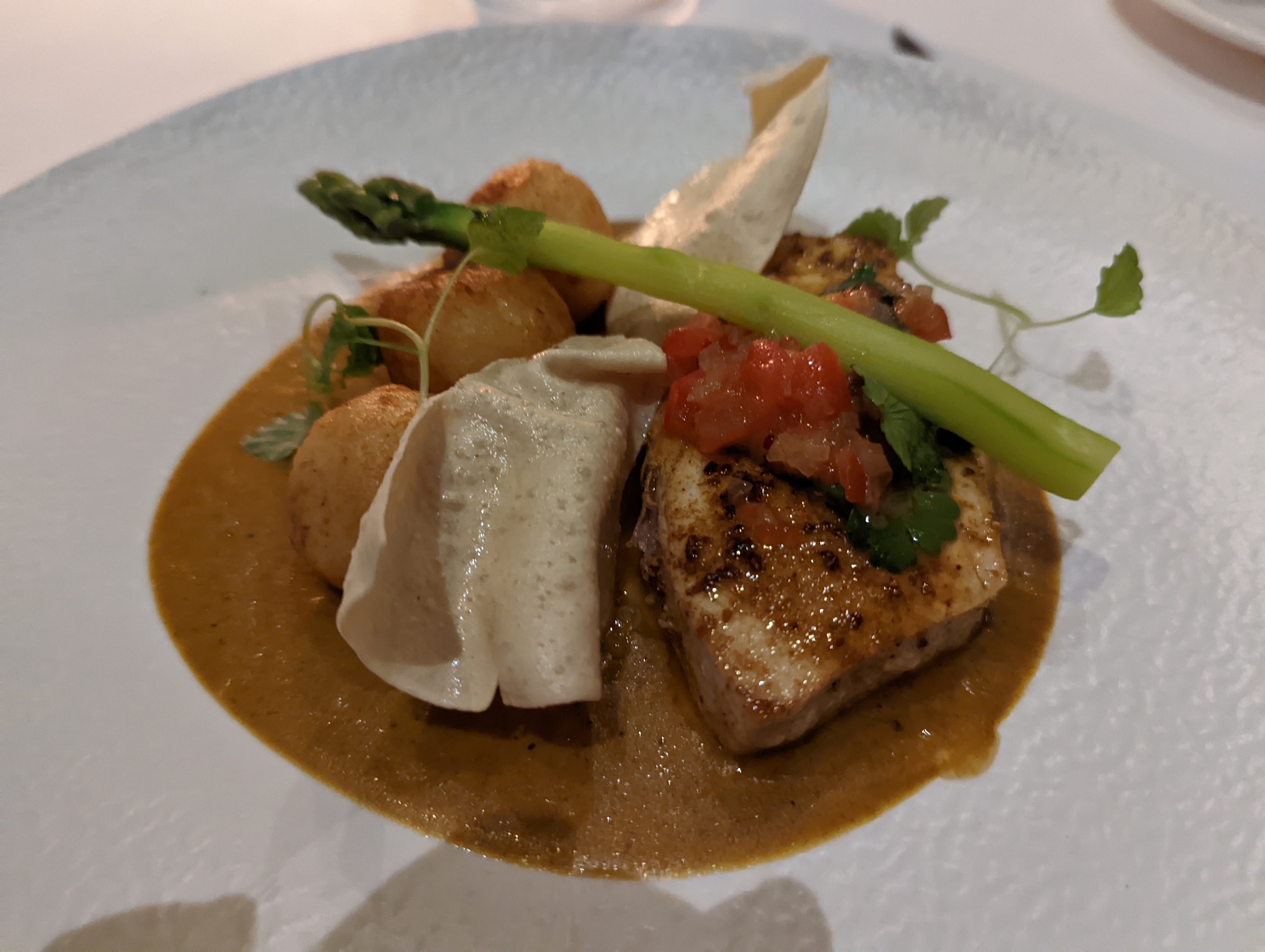
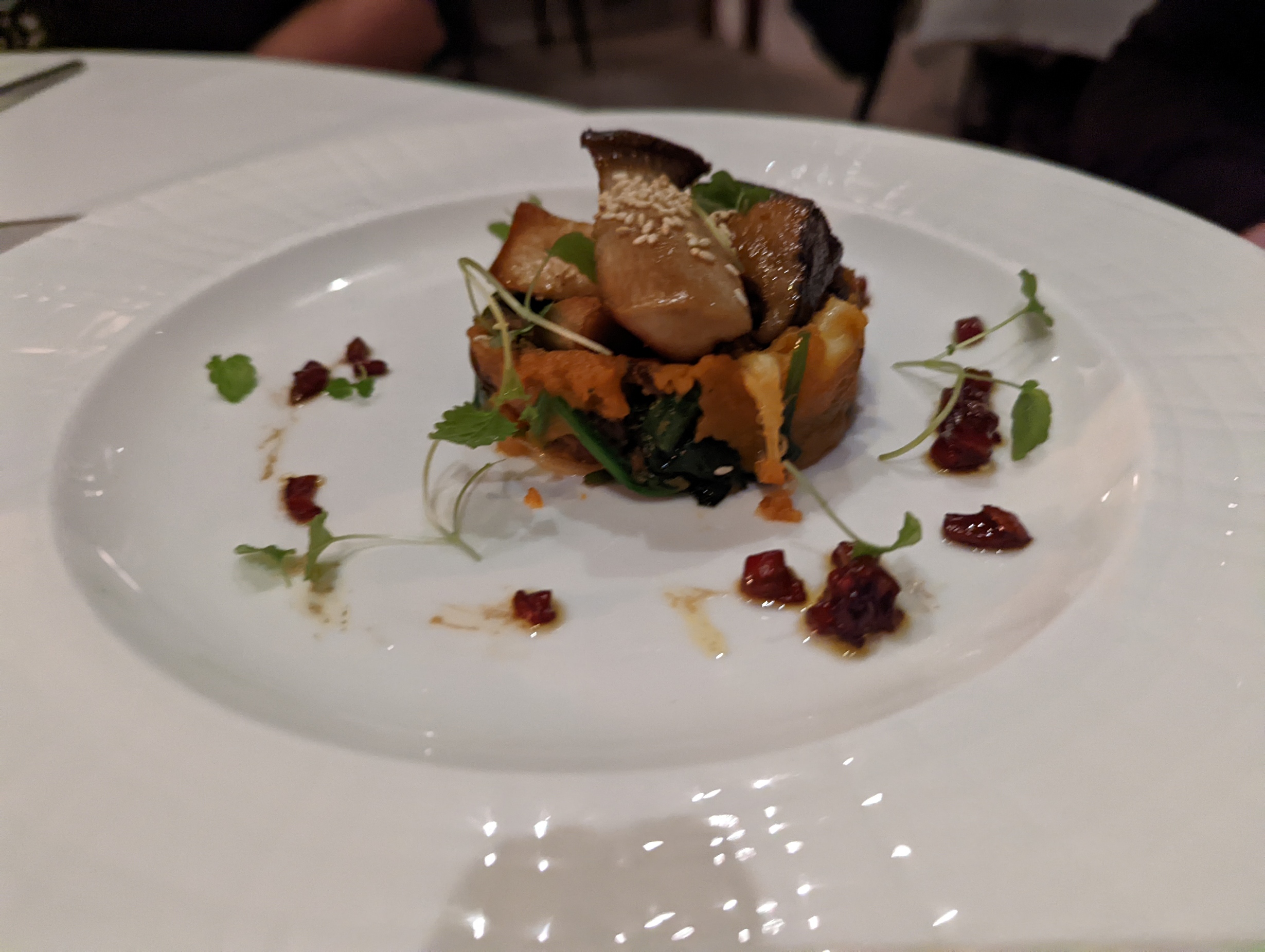
The savoury meals from the four course menu that we chosen at our table were the sword fish, mushrooms, beef cheek, salmon ceviche, chicken, eggplant, scallops, and courgette flower. The details are below:
First
Courgette Blossom, Stracciatella, Kalamata Olive Tapenade,
Roasted Tomato Puree & Foraged Herb Snow.
Seared Atlantic Salmon Fillet, Salmon Ceviche, Fresh Dill,
Radish & a Warm Smoked Potato Sabayon.
Second
Miso Glazed Eggplant, Spiced Cauliflower Beignet,
Cauliflower Puree, Puffed Rice & Nori.
Seared Hervey Bay Scallop, Fennel & Apple Puree,
Green Beans, Basil Pesto & Fresh Almonds.
Free Range Chicken Breast, Celeriac Puree, Beetroot,
Confit Chicken Cigar & Truffle Jus.
Third
Roasted King Brown Mushroom, Buffallo Mozzarella,
Sweet Potato Smash, Baby Spinach & Balsamic Red Peppers.
Aromatic Spiced Kingfish, Coconut Curried Potato,
Asparagus & Finger Lime.
Wagyu Beef Cheek, Paris Mash, Glazed Carrot, Carrot Puree,
Hazelnuts & Café de Paris Sauce.
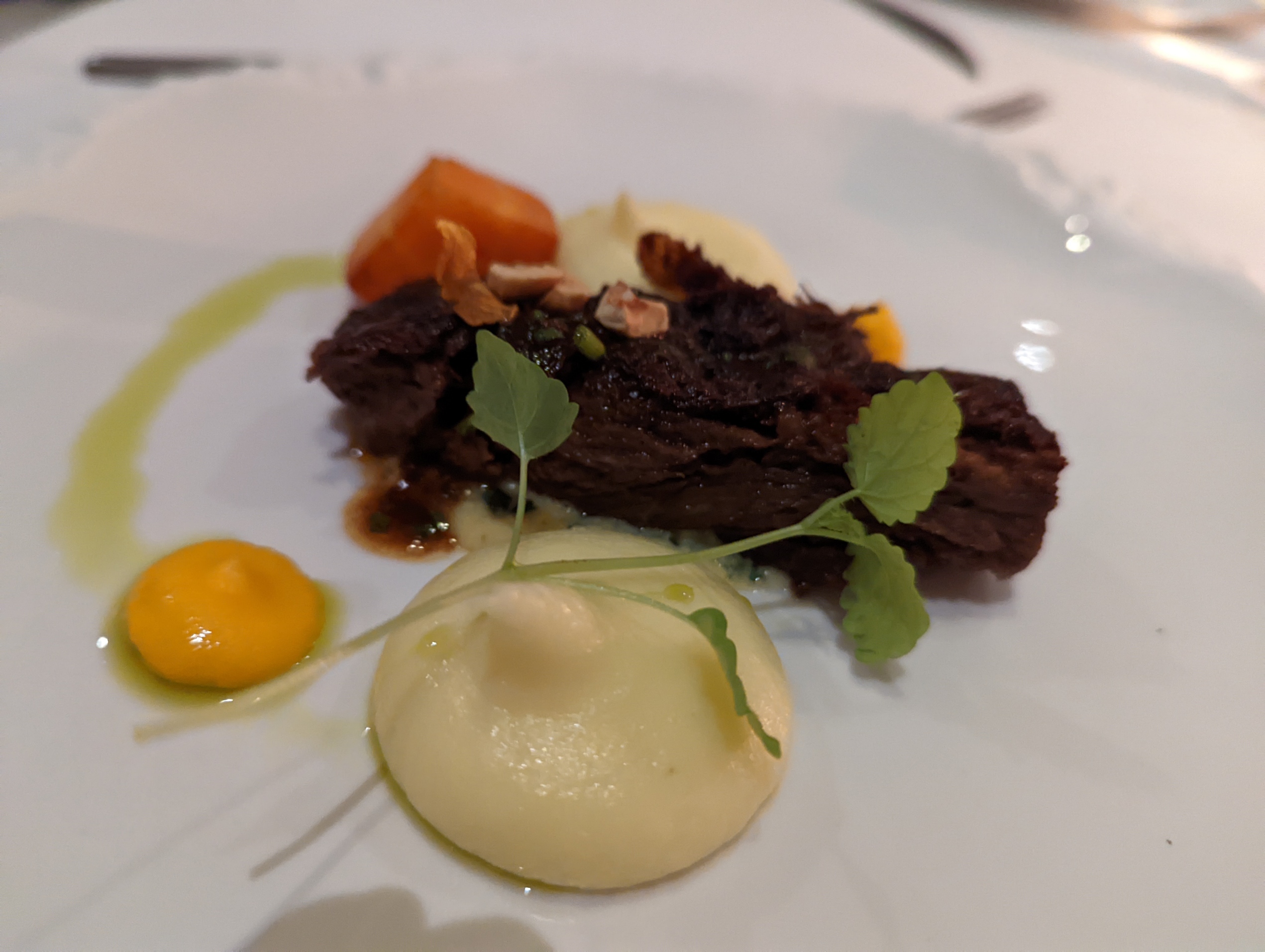



Although there were several desserts, we chose the raspberry tart with Baileys Ice-cream, and the Brulée. Both were delicious. There is a range of teas and coffees. The drink menu was very successful – a bottle of Cloudy Bay was there and we could not go past that!


Fourth
Raspberry and White Chocolate Tart, Bailey’s and Hazelnut Ice Cream
Fresh Raspberries, Lemon Balm.
Bittersweet Chocolate Brulée, Cherry & Hazelnut Financier,
Buffalo Yoghurt Sorbet & Sour Cherry Glaze.
‘National treasure’: Australia mourns Seekers’ legend Judith Durham, dead at 79


Olivia Newton-John · Died
8 Aug 2022
 Robin's Room