Two books are reviewed this week. Both are non-fiction and the uncorrected proofs were provided to me by NetGalley for review. Harriet A Jane Austen Variation by Alice McVeigh and Stroller by Amanda Parrish Morgan.

Harriet A Jane Austen Variation Warleigh Press 2022 continues Alice McVeigh’s delightful work on alerting readers to fascinating new interpretations of Jane Austen’s characters. They do not need to be the heroines of Austen’s novels. For example, in this case, Harriet usurps Austen’s Emma. Although Susan: A Jane Austen Prequel, is an interpretation of Austen’s main character in Lady Susan, young Susan’s appearance again usurps Austen’s character of the older woman. Even more importantly than appearance, although the making of her sharp practices is abundantly apparent in the younger version, she is a more sympathetic character. Books: Reviews
Amanda Parrish Morgan Stroller Bloomsbury Academic 2022.

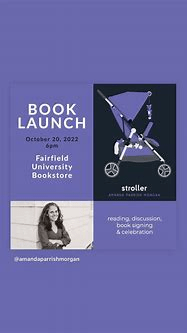
Stoller is another addition to the delightful series, The Object Lessons, published by Bloomsbury Academic. The series takes what appear to be simple items and develops a well-researched story around them. Amanda Parrish Morgan’s Stroller is an excellent contribution to the series, with its accessible language, personal anecdote, research and political observations.
The book begins with a list of the other publications in this series – a veritable host of objects that make one wonder how they can become the focus of an interesting book – a refrigerator? Office? Password? Rust? Sticker? Like Sticker, (the first in this series I read, enjoyed and reviewed) Stroller makes an impact that is beyond the title. Books: Reviews
Stroller raises issues around child safety which are reflected in discussion around a new playground in Melbourne. Amanda Parrish Morgan comments her leaving her child in the stroller in a situation where she had to decide between maneuvering two children around the questionable safety of the staircase at her older child’s nursery school or leaving the younger one in the stroller, where other parents and children were arriving at the nursery school. Parrish Morgan’s commentary suggests that she would be interested in the debate around child safety issues associated with the playground. See below.
After the Covid Report: The ‘Risky’ playground; US Mid Term Elections.
Covid in Canberra
The ACT has recorded 910 new cases of Covid. Thirty-seven people with Covid are hospitalised, and one is in ICU. One life was lost this week.
This new ‘risky’ playground is a work of art – and a place for kids to escape their mollycoddling parents
Sanné Mestrom
Senior Lecturer, DECRA Fellow, Sydney College of the Arts, University of Sydney DECRA Fellow for project Art/Play/Risk (http://artplayrisk.com.au)
ART/PLAY/RISK is an interdisciplinary project providing new creative and scholarly research into public art’s role in the design and planning of intergenerational future-cities.
Positioning play as a vital tool for learning, social interaction and public engagement, our research explores the potential of public art to contribute to broadened and diversified opportunities for play in the public sphere. With a specific concentration on questions related to ‘risk’, ART/PLAY/RISK combines scholarly, artistic and interdisciplinary research to develop collaborative approaches to designing child-friendly cities.
Published: November 9, 2022 1.42pm AEDT

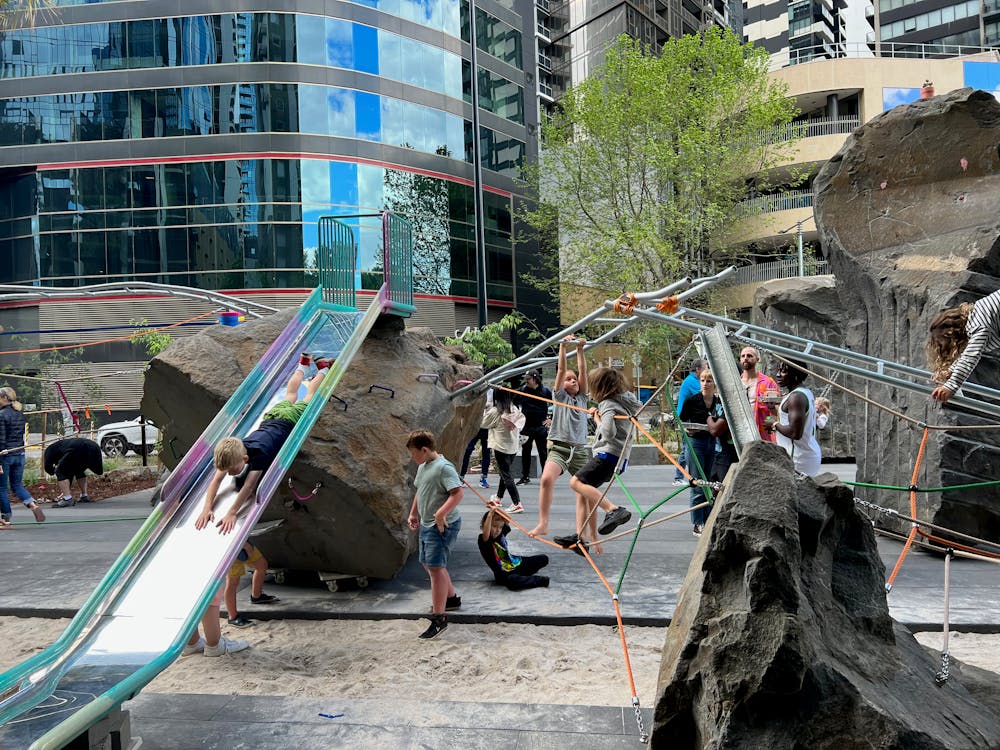
Imagine this: a heap of colourful plastic buckets stacked on top of each other to form a climbable bridge, monolithic bluestone boulders holding up a contorted slide, a pile of concrete demolition debris moonlighting as a resting spot.
At every point, children can be seen swinging their bodies from warped, dented monkey bars and balancing along rope-webs strung between stones.
Would you let your kids come here and play?
This new playground in Melbourne’s Southbank is the work of artist Mike Hewson. The project can be confusing for the public. Is it a playground? A sculpture? Or an unfinished piece of infrastructure?
Hewson’s playable public art parks in Sydney and Melbourne are known to be “risky” – but risk means different things to different people. And it’s exactly the risks his art takes that makes it so valuable.
The risk of no risk
Urban play has long been synonymous with the cultural life of art and the city. In the decades of Europe’s baby boom, new playground concepts emerged with a focus on “free play” (distinct from earlier playgrounds resembling open-air gymnasiums), as one of children’s fundamental needs.
“Tufsen”, Egon Möller-Nielsen’s unusual sculpture was the first unscripted free play sculpture of its kind, created in 1949, bringing together abstract art and play in a public space.
This new approach generated a boom in playground sculptures.

In the early 1980s, we saw a significant shift in response to questions of risk, hazards and children’s safety, which resulted in fears and threats of litigation.
As play-safety standards were introduced in Australia, the United States and the United Kingdom, innovation in the arena of a playable public realm slowed. As soon as the standards began to be referenced in liability cases, playspace designers began to follow them.
Designs outside the specifications were avoided and playgrounds were standardised into the “boring” versions that still dominate most of our play spaces, where the potential movement of children is scripted: up, across and down.
Over the past 30 years, interpretations of these safety standards continue to regularly confuse the meanings of “risk” and “hazard”. A risk is something the child is aware of, forcing them to identify, analyse and overcome the challenge; a hazard puts one in danger because a condition for injury exists the user cannot perceive.
Conflating these meanings has resulted in a cultural attitude toward play that is highly risk-averse.
This risk-aversion is in contrast to the mounting research on the benefits of risk for children.
Risk-aversion can have long-term health implications on adolescence and into adulthood, potentially impacting the development of anxiety, depression, obesity and diabetes.

In fact, researchers Jonathan Haidt and Pamela Paresky suggest contemporary society “mollycoddles” children. The risk-of-no-risk is a question of resilience – not only physical but also, perhaps more importantly, psychological resilience.
Psychological resilience is the capacity for adaptation in the face of tragedy, trauma, adversity, threats or significant stress. Put simply, resilience is the ability to “bounce back” from challenging experiences.
Based on this premise, Hewson’s “risky” sculptural play environments can bolster, fortify and increase psychological resilience among children.
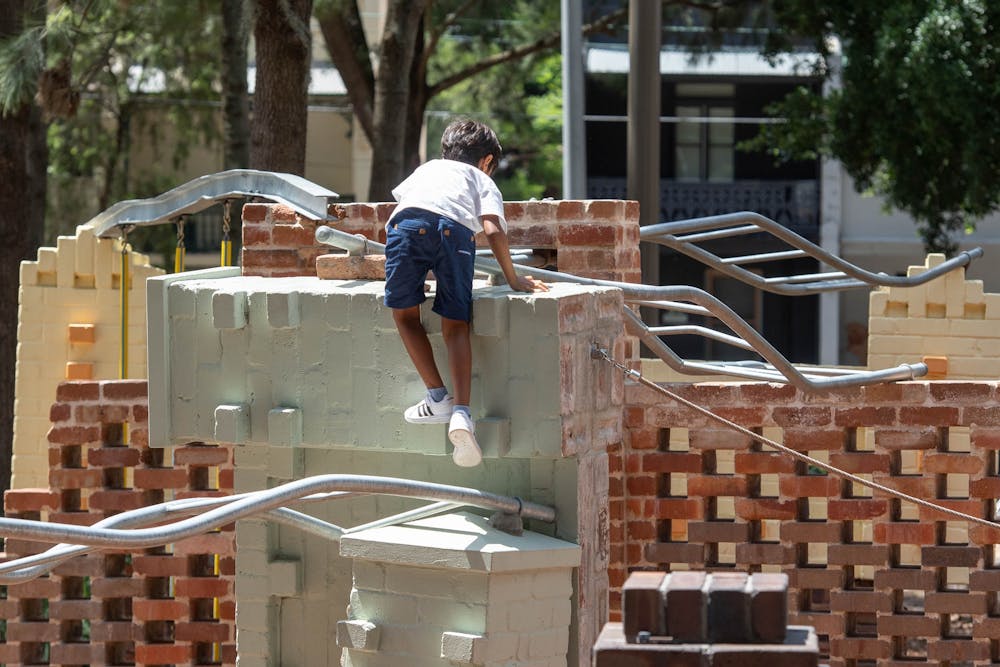
In contrast to the conventional playground where movement is predetermined, Hewson’s projects offer children the opportunity to explore unfamiliar, unscripted, innovative and playable sculptural worlds.
When given the chance, even very young children show clear abilities to negotiate unfamiliar spaces, manage risks and determine their own limitations.
Read more: Giant tube slides and broken legs: why the latest playground craze is a serious hazard
Playable sculpture
Hewson’s sculptural playgrounds don’t just offer the opportunity for children to take risks. Their very construction appears to be risky: all playable parts appear to be improvised, cobbled together with cardboard and chicken wire, balanced just-so or teetering on the verge of collapse.
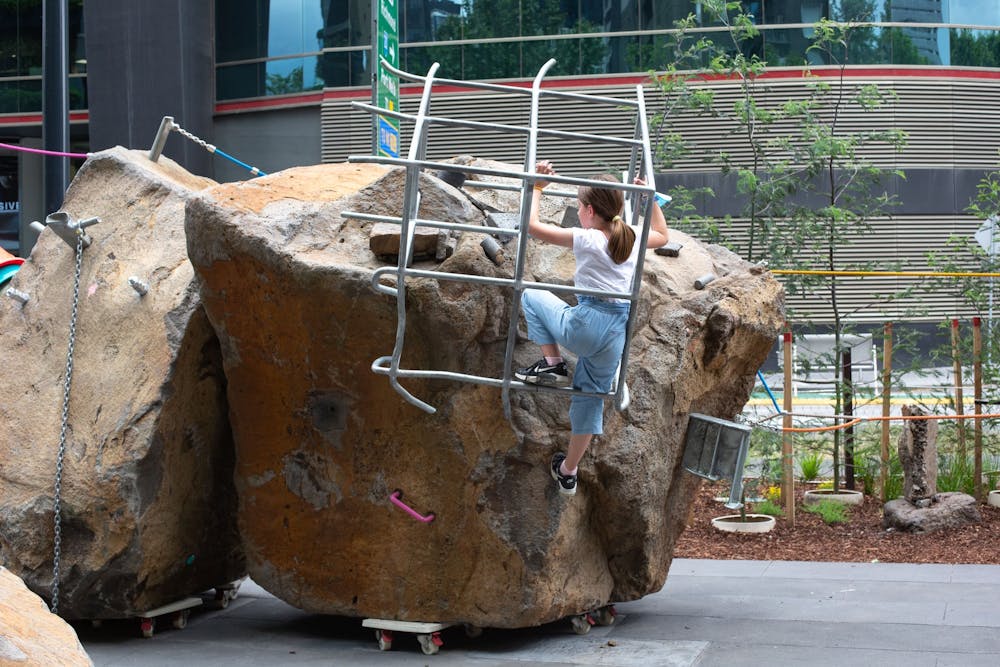
And yet nothing is quite as it appears. With Hewson’s background in engineering, each playable element has been meticulously designed, structurally engineered and thoughtfully integrated into the urban realm.
This illusion of danger gives the works a sense of the uncanny, appealing to art-lovers and children alike.
In the art world, Hewson’s works are important for their bold and cheeky irreverence of the traditions of public art.
By making these sculptures playable – and seemingly defective – they tip the hierarchy of “art” upside down.
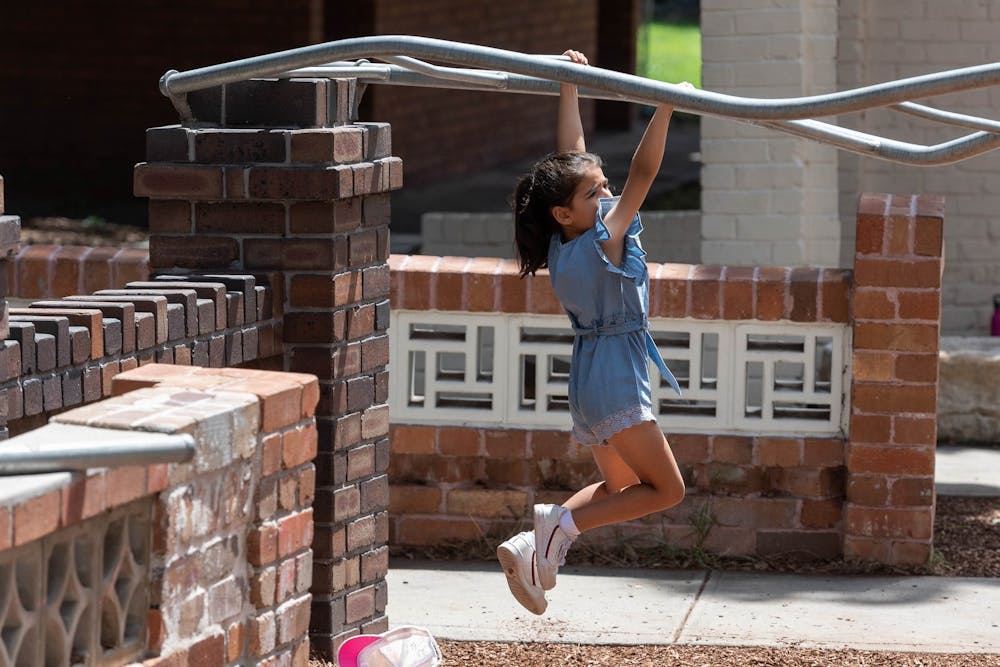
Australia has a long-standing reputation of presenting “plonk art” in public spaces. Plonk art is a pejorative slang term for the large Modernist artworks intended for government plazas, corporate atriums and open parks designed to be looked at but not touched.
Hewson takes sculpture off its pedestal and integrates it directly into the public domain, while also engaging local communities in the creative development stages of his projects.
For this experimentation, he receives some backlash from certain sections of the community – but his convictions keep him pushing forward.
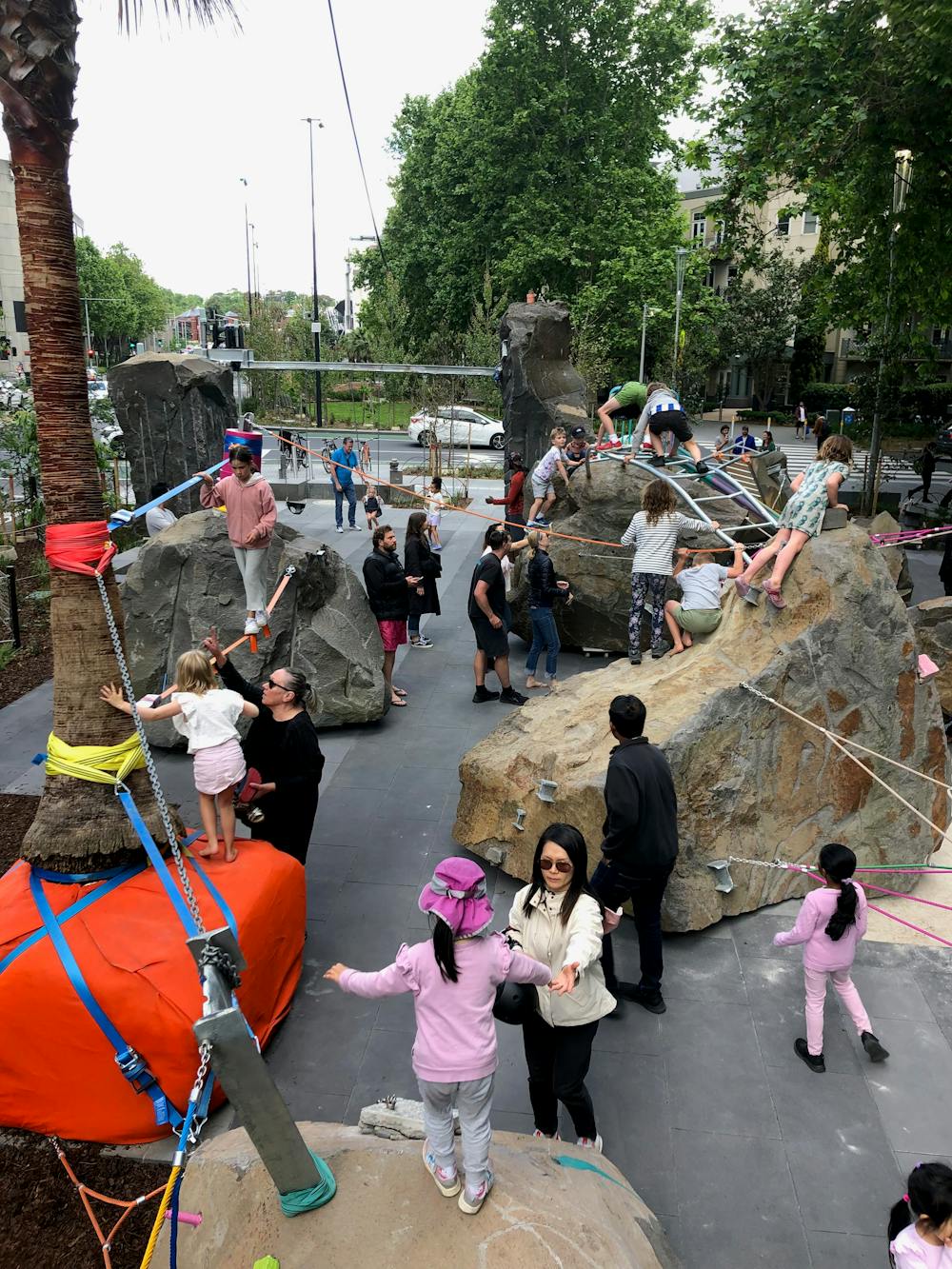
His works advance the role of public art in creating a more culturally rich, intergenerational public domain while also challenging conventions of the ubiquitous de-risked playground.
The Conversation – produced here under Creative Commons Licence.
US Mid Term Elections
At the time of writing results for both the Senate and House are underdetermined. However, the tsunami that was anticipated by the Republicans did not eventuate. Lawrence O’Donnell, possibly a little optimistically, but so poetically described it as a lake lapping around a shore, when commentating on MSNBC tonight.
A sad result in Georgia – and possibly another runoff for the Senate position which Raphael Warnock won last time in the runoff.

Abrams after gubernatorial loss: ‘I won’t stop running for a better Georgia’
BY BRAD DRESS – 11/09/22 3:37 AM ET
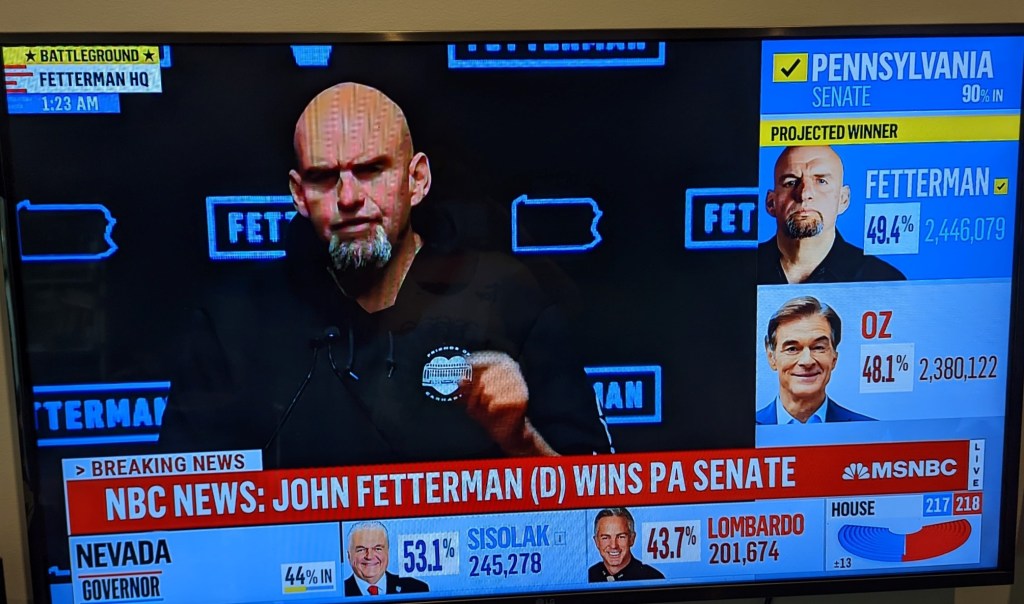
One wonderful result was John Fetterman’s success in Pennsylvania, overcoming the impact of the stroke he suffered, and his problems in the debate with his opponent. It had been seen as a mistake – but perhaps courage is rewarded at times.
And it’s nice to see Lauren Boebert suffer a little concern over her seat. Let’s hope it becomes a huge concern!

 Robin's Room