This week I review Fearless Women by Elizabeth Cobbs.

Elizabeth Cobbs Fearless Women Feminist Patriots from Abigail Adams to Beyoncé Harvard University Press, Belknap Press, March 2023.
Thank you, NetGalley, for providing me with this uncorrected proof for review.
Elizabeth Cobbs expands the way in which feminism is used to investigate women who call themselves feminists, and some who do not, worked to improve ‘their country’. This, as Cobbs acknowledges, is a broad definition, and one that I do not endorse, although I do acknowledge that society (and therefore country) would be improved if women’s lives were improved – the work that I think of feminists performing. However, rather than let the broadness of Cobb’s view limit the way in which this book is read, I found it an energising read, with a lot with which I could identify, some that left me questioning (Phyllis Schlafly a feminist?), engrossing stories of marvellous women, horrendous stories of the treatment of women and the beliefs that underlie such treatment, and a veritable wellspring of information. In short, Fearless Women is a worthwhile read, a contribution to debate about feminism, and a history of women’s endeavour.
Cobbs adopts an interesting approach – two women feature as the major figures in each chapter, each contributing to the theme of the chapter, usually in markedly different ways. The chapter headings provide useful information, ranging from the first, ‘The right to Learn’ featuring Abigail Adams and Abigail Bailey; through ‘The right to Speak’ with Angelina Grimke and Harriet Jacobs; to Frances Perkins and Ann Marie Riebe taking up ‘The Right to Earn’, and ending with Beyoncé Knowles-Carter and the Women of Me Too providing a face to ‘The right to Physical Safety’. ‘The Right to Compete’ features Phyllis Schlafly and Muriel Siebert (the first woman to have a seat on the New York Stock Exchange). Familiar themes such as ‘The right to Lobby’, ‘The Right to Vote’ and ‘The right to Equal Treatment’ feature the following partnerships: Susan. B. Anthony and Elizabeth Packard; Mary Church Terrell and Rosa Cavallari; and Martha Cotera and Yvonne Swan. A prologue and epilogue, notes and illustrations, are valuable and complete the book. See Books: Reviews for the complete review.

After the Canberra Covid update: Heather Cox Richardson updates American politics since the Republicans won the House and compares the insurrection in Brazil with that at the US Capitol; Women hidden from history and the story of an excellent apple; Cindy Lou at 86 and Blackfire.
Update on Covid in Canberra

Canberra has recorded 1,012 new cases of Covid this week. There are 59 cases in hospital, but fortunately no one is on a ventilator or in ICU. There were 6 lives lost to Covid this week over an age range from 40 years of age to two people in their 90s.
Heather Cox Richardson
January 10, 2023 (Tuesday)
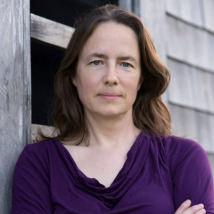
National security scholar Maria W. Norris of Coventry University, who is covering events in Brazil, reports that today, President Luiz Inácio Lula da Silva gathered around him the president of the supreme court and the governors or vice-governors of each state, the senators, the attorney general, and congressional representatives, all of whom condemned the coup. Many had been staunch supporters of former president Jair Bolsonaro, but since the coup failed, they have thrown their lot behind Lula. After they declared their support, Lula led them through the vandalized buildings, symbolically reclaiming them.
Lula and his administration say that police worked with the rioters, and a judge has approved warrants for the arrest of two key law enforcement officials close to Bolsonaro: Anderson Torres and Colonel Fábio Augusto Vieira. Police have also searched Torres’s home. Pro-Bolsonaro groups have been camped near military posts and buildings since the election; it appears the insurrectionists’ plan was to induce the military to join them.
In the wake of the unsuccessful attempt to overthrow the government, Bolsonaro supporters are claiming that the attack was by leftists who infiltrated a peaceful protest. Police have so far arrested about 1500 participants.
Bolsonaro left Brazil for Florida before Lula took office, while he was still president. That status apparently enabled him to enter the U.S. on an A-1 visa, reserved for heads of state. That visa is normally canceled when the person holding it leaves office, but since he is already in this country, it is not clear what its status is. Normally, anyone on an A-1 visa who is no longer on official business must leave the country within 30 days, but if Brazil tries to extradite him, the process could stretch on, putting the Biden administration in an awkward position.
In contrast to the Bolsonaro supporters running from the coup, from his perch in the U.S., former Trump advisor Steve Bannon, who insisted all along—without evidence—that the election in Brazil was fraudulent, remained adamant that Lula must be replaced. “I’m not backing off one inch on this thing,” he said to Politico. Bannon is close to Bolsonaro’s son, who has been seen hobnobbing with Trump-affiliated people, including Trump’s daughter Ivanka.
Observers have noted the many similarities between the attack on the Brazilian government on January 8 and the attack on the U.S. government almost exactly two years earlier. But there are differences, too, and one of the big differences is that power had already changed hands in Brazil, and President Lula has compelled other leaders into a show of support even as the government is arresting rioters.
In the U.S., Trump was still in office when his supporters tried to overthrow the government, and there was neither a house cleaning nor a demand for lawmakers to declare their support for the duly elected government.
Many of those who supported Trump in the events of January 6, 2021, are still in Congress. At least six Republican congress members asked Trump for a preemptive pardon, and four of them are still in office. They make up the core of the far-right Republicans House speaker Kevin McCarthy had to bargain with to win the speakership: Representatives Scott Perry (R-PA), Andy Biggs (R-AZ), Matt Gaetz (R-FL), and Marjorie Taylor Greene (R-GA). Representative Jim Jordan (R-OH) was also part of the group that pressured McCarthy, and he, too, appears to have been deeply involved in the events of January 6: just days afterward, Trump awarded Jordan the Presidential Medal of Freedom with a somewhat generic citation that raised questions about why Trump was really giving Jordan the award.
Today the House voted on the rules package McCarthy promised to the far-right Republicans. As expected, it contained a threat to McCarthy: any single member can force a vote to toss out the House speaker. This rule was in place in 2015, when then-representative Mark Meadows (R-NC) invoked it against Speaker John Boehner (R-OH), who resigned rather than face a vote.
The deal cut with the far-right group gives them plum committee assignments, including a number of seats on the House Rules Committee. The deal required McCarthy to permit a number of symbolic votes on things important to that far-right group, and it appears to have promised to cap government funding at 2022 levels, worrying both those who want more defense spending and those who want to protect Social Security and Medicare. It also appears that McCarthy said he would not agree to raising the debt limit—that is, honoring the debts the country has already incurred—without “fiscal reforms.” That promise seems to hold the threat of a showdown over a national default.
And there are rumors of a secret agreement that has not been disclosed, an unfortunate start for the Republican majority, which promised to be transparent. Even some Republicans are demanding more information.
One of the things McCarthy did agree to was the creation of a select subcommittee in the Judiciary Committee to investigate the “weaponization of the federal government.” By a party line vote, the House today approved that committee to investigate what Republicans insist is an anti-Republican bias in the FBI and the Department of Justice. Jim Jordan will chair the committee, which theoretically can review ongoing criminal investigations, pretty clearly to protect Republicans in trouble. Former federal prosecutor Joyce Vance points out that the Department of Justice will never allow such a thing but dealing with the committee will waste time and resources. The Democrats will not boycott the select committee as the Republicans did the January 6 committee, suggesting that Jordan will not reign unchallenged.
Republicans clearly intend the committee to spread a narrative that will undermine the one established so powerfully by the Mueller investigation, the Trump impeachment committees, and the January 6 committee. The modern Republicans have always been closely tied to right-wing media, and nothing made that clearer than Fox News Channel personality Sean Hannity’s broadcast tonight. He did his show from the Rayburn Reception Room of the House of Representatives, “interviewing” Republican congress members so they could repeat talking points.
Yesterday, news broke that in November, President Joe Biden’s lawyers found “a small number” of classified documents from his vice-presidential years in a locked closet in Biden’s former office at Penn Biden Center for Diplomacy and Global Engagement. They immediately contacted the National Archives and Records Administration, which retrieved the documents the same day. Biden said that he did not know the documents were there and that his lawyers “did what they should have done” when they called NARA. Attorney General Merrick Garland assigned a Trump-appointed U.S. attorney, John R. Lausch Jr., to see if he should appoint a special counsel.
Trump and his supporters immediately tried to suggest Biden was getting better treatment than he did, but journalist Matthew Miller notes that classified documents often get taken from government facilities by accident. Those errors are reported, the documents recovered, and a damage assessment made to determine whether further action needs to be taken.
In Trump’s case, NARA repeatedly asked him simply to return the documents it knew he had. He refused for a year, then let them recover 15 boxes that included classified documents, withholding others. After a subpoena, his lawyers turned over more documents and signed an affidavit saying that was all of them. But of course it wasn’t: the FBI’s August search of Mar-a-Lago recovered still more classified documents. Trump is being investigated now for obstruction and violations of the Espionage Act, which makes it a crime to withhold documents from a government official authorized to take them.
Today, New York State Supreme Court Justice Juan Merchan sentenced former Trump Organization chief financial officer Allen Weisselberg to five months in jail at New York’s Rikers Island complex and five years probation after he pleaded guilty to 15 felonies in a scheme to provide Trump Organization employees direct benefits to avoid paying taxes. Weisselberg was the key witness in the trial last fall of the Trump Corporation and the Trump Payroll Corporation for tax fraud and falsifying records. A jury found the entities guilty of all charges, meaning the Trump Organization has been found guilty of criminal conduct, likely impacting its ability to do business and hurting Trump’s defense in other cases.

Hidden women of history: how ‘Lady’ Williams founded a great Australian apple
Published: January 18, 2023 6.02am AEDT
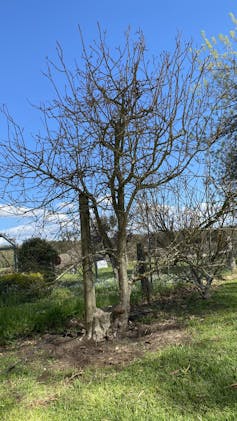
On Boronia Farm, just outside Donnybrook in Western Australia, stands an 80-something-year-old apple tree (Malus domestica) that’s at the heart of a global industry.
This tree produced an apple no one had seen or tasted before, now called the Lady Williams. Without the Lady Williams, there could be no Sundowner®, no Pink Lady®, no Bravo® – apple varieties that, along with the Lady Williams, have made a enormous contribution to the global apple industry.
Boronia Farm’s apple tree is now listed in the register of the National Trust, but the woman behind the Lady Williams is not well known. Yet, as her son Bob remembered, Maud Williams was crucial to the story of this tree and the apple it produced.
A remarkable chance seedling
From the 1930s, Maud, her husband Arthur and their two boys Bob and Ron worked their 12 acres of orchard, with its apples and stone fruit, and 40 cows.
Maud collected ideas for plants to grow, from catalogues and women’s magazines, experimenting with her taste for the unusual, remembers her son Ron. Not content with roses and petunias, Maud was instead growing feijoas and hydrangeas.
With her eye for horticultural novelty, it was perhaps not surprising that she identified the very special qualities of the tree with the bright red apples that had sprung up unexpectedly next to the tank stand beside the house.
The fruit was firm and crisp and showed great suitability for long storage, ideal for Australia’s export market. The Williams family gathered a good price for their cases of apples grown from this tree and over time, the family propagated new trees from the original one.
This tree was a chance seedling, a spontaneous creation whose likely parent cultivars were Granny Smith and Rokewood.
Some of our most common apple varieties began as chance seedlings. But chance seedlings do not reach our supermarkets as a matter of course.
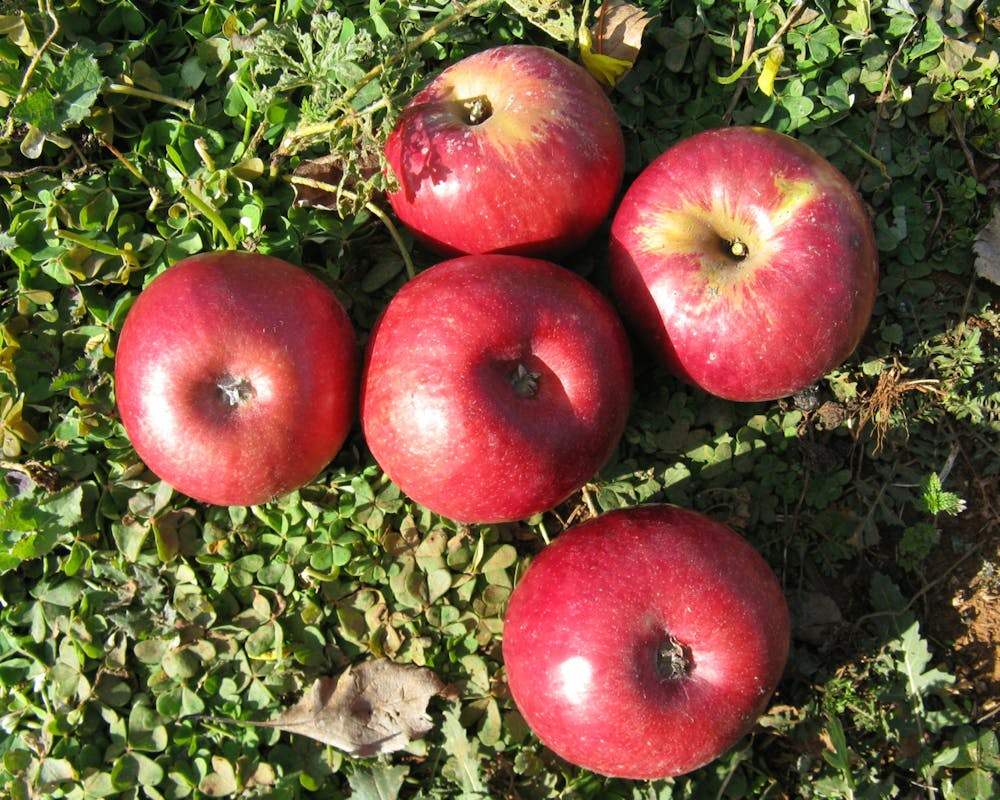
Apples frequently produce chance seedlings. But for a chance seedling to be put into production and become known as a variety, many factors are involved, not least people who recognise distinctive apples that will have value in their contemporary context.
Only a select few chance seedlings are ever turned into varieties with impact in the orchard industry. For that to happen, there need to be people who make the necessary investment of care, time or funding – just as Maud did.
In its inconvenient location, the unfamiliar apple tree was almost cut down many a time, but it survived thanks to Maud’s protection and care. On one occasion when he almost destroyed it, Bob recalled getting a severe telling-off from his mum, who “stood it up again, bandaged it up and it took off again”.
Reflecting Maud’s importance in the creation of this new variety, the apple was given the name Lady Williams. This was the name that the little girl, Lynette Green, who lived on a neighbouring farm, used for Maud.
Maud’s recognition of the qualities of the fruit from this tree, and her initiatives to protect it, were about to enable a remarkable new phase of the Australian apple industry.
Lady Williams, parent of the Pink Lady
Lady Williams apples were introduced commercially in 1968, the same year Maud died. By the early 1970s, the Lady Williams was the subject of attention at the WA Department of Agriculture and its new apple-breeding program. There, a team led by the horticulturalist John Cripps was experimenting with combinations of Lady Williams and Golden Delicious.
In an interview conducted as part of the Apples and Pears Oral History Project in 2010, Cripps reflected that the cross-breeding process involved intensive manual labour, high degrees of dexterity and immense patience, a set of qualities Cripps identified in women technicians.
In 1984, one of the over 100,000 experimental seedlings produced an attractive fruit; it was bright pink, crisp, flavoursome and long-storing. Cripps had a hand in both its names: the Cripps Pink, and its commercial name, Pink Lady®. It was the first apple variety ever to be trademarked.

From the same breeding program emerged the Sundowner® and more recently, in 1992, the Bravo®.
All the world’s Lady Williams, Pink Lady®, Sundowner® and Bravo® trees share DNA with the original tree Maud Williams had nurtured many years before.
Writing women’s agricultural contributions
Women’s contributions to the agricultural sector have often occurred, just as Maud’s did, outside of professional roles. They do not always fit easily in conventional profiles for innovation and entrepreneurship in agriculture, nor into standard narratives of Australia’s agricultural development.
Documenting Australian women’s activities in agricultural innovation faces considerable challenges. Remarkably, only 30 years ago, women were not able to be recognised as farmers in their own right on Australian census forms.
Making women’s activities and innovation visible in this domain is key to providing role models for the future. It will also increase the diversity of participation in Australia’s future decision-making about the lands we live and work on.
We may have to look and listen in different places for the histories of these women. What we know so far of Maud’s role has been gathered from interviews with her family and members of the local community of which she was part. We can also consider how our histories could become more inclusive by thinking about what constitutes participation and contribution to agricultural innovation more expansively.
There are many women working in the south-west orchard industry today: running the farm businesses, packing apples, testing for new varieties, leading the industry’s peak body. They are the inheritors of a dynamic industry that Maud Williams helped to create.
Image credits: State Library of Western Australia.
A new podcast for the State Library of Western Australia delves into women’s roles in the Western Australian apple industry.

We believe in the free flow of information
Republish our articles for free, online or in print, under Creative Commons licence.
Republish this article
Before you go …

The Conversation serves society by making knowledge accessible to everyone, not just a select few. Our only agenda is a better informed public. If you care about what we do please make a donation now and help secure our future.
Donate now
Misha Ketchell
Editor
Cindy Lou at a favourite restaurant, 86 – again
I was pleased to be able to book 86 for four people at an outside table on Tuesday night. We had a pleasant table, with foliage almost hiding the road, comfortable seating, and not too crowded. Unlike the inside seating in an atmosphere that is often noisy, we were able to talk peacefully (but animatedly) for over three hours.
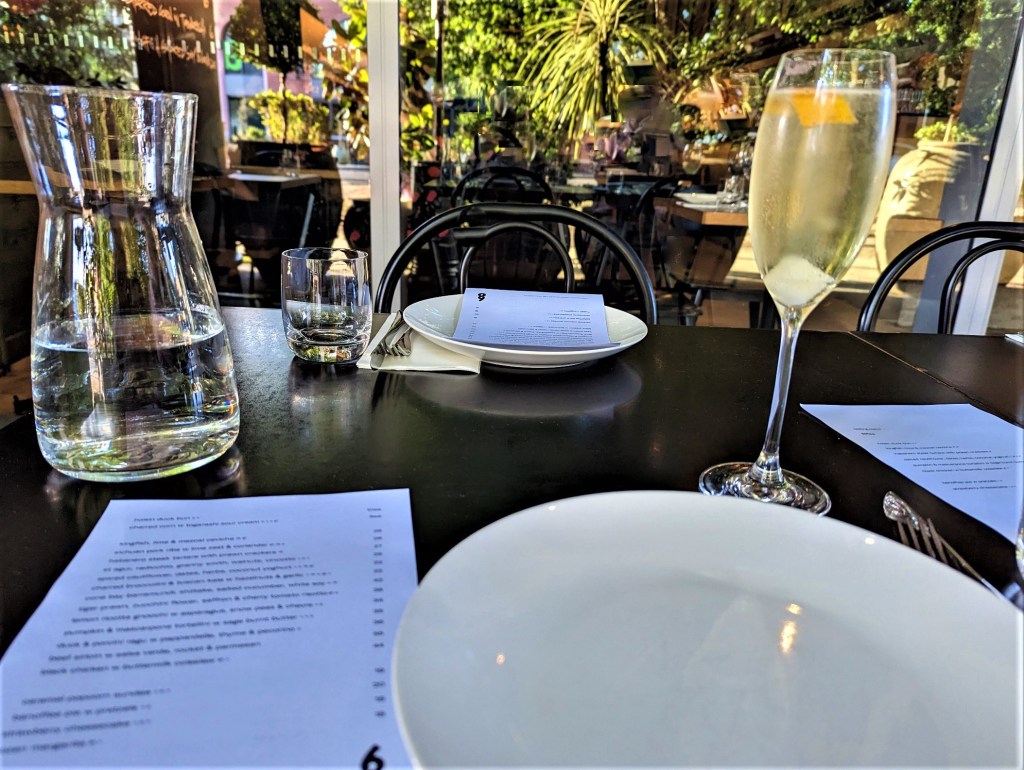
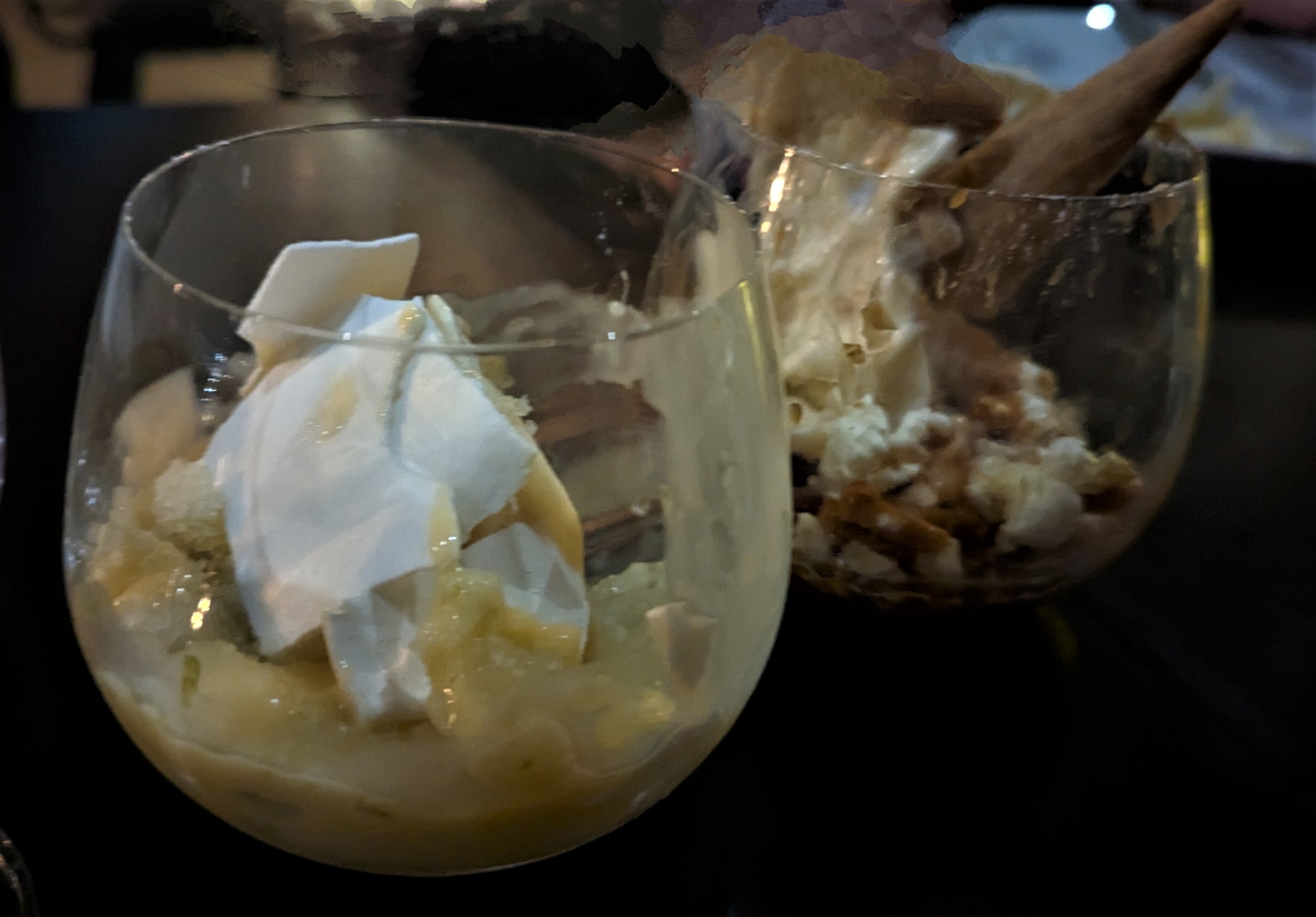
We were able to try two new dishes, along with the always popular corn cobs in a delicious sauce, with parmesan and cilantro. Yes, these require a napkin around the neck, giving up on looking sophisticated, and a firm intention to enjoy them whatever the consequences to face and image. They are worth it. The new dishes we tried were the tuna ceviche and the black chicken with buttermilk slaw. And for dessert, we shared the child’s favourite (mine), Carmel Popcorn Sundae with the sophisticated Frozen Margarita. They were a winning combination.
Some familiar favourites – broccolini, and cauliflower. The pumpkin and mascarpone pasta vanished before I remembered to take a photo – I was the chief culprit as it is an excellent dish.


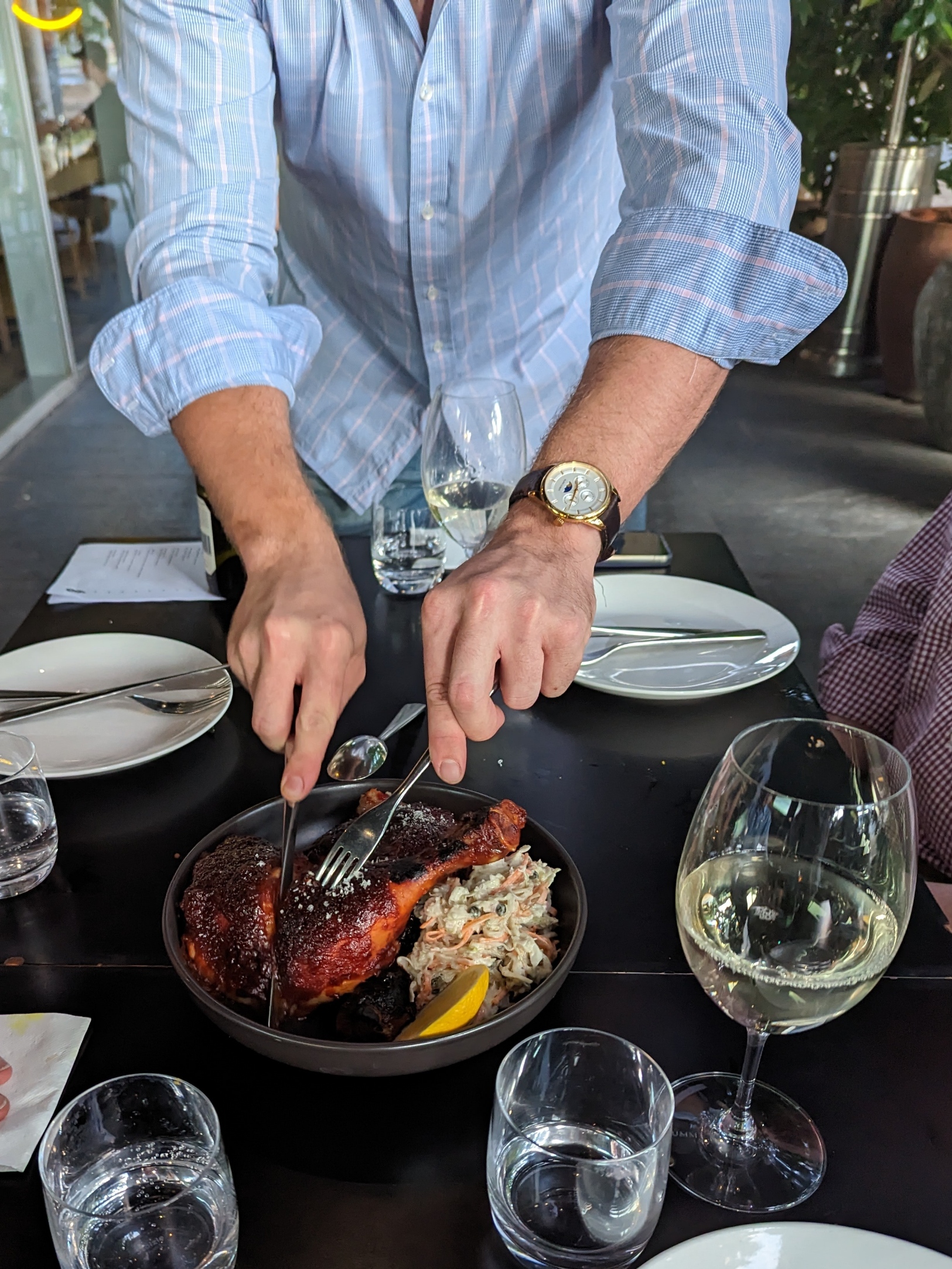
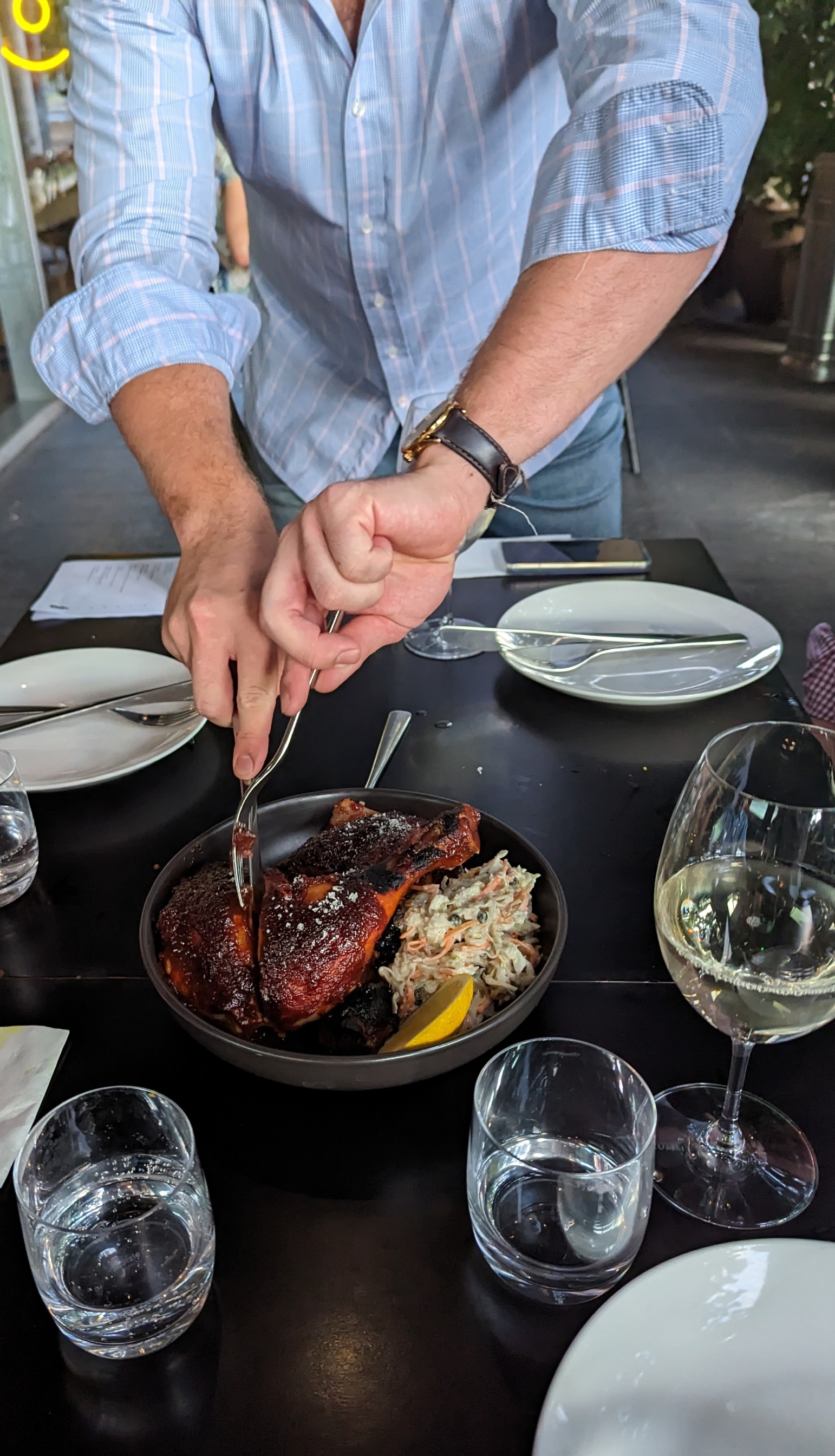
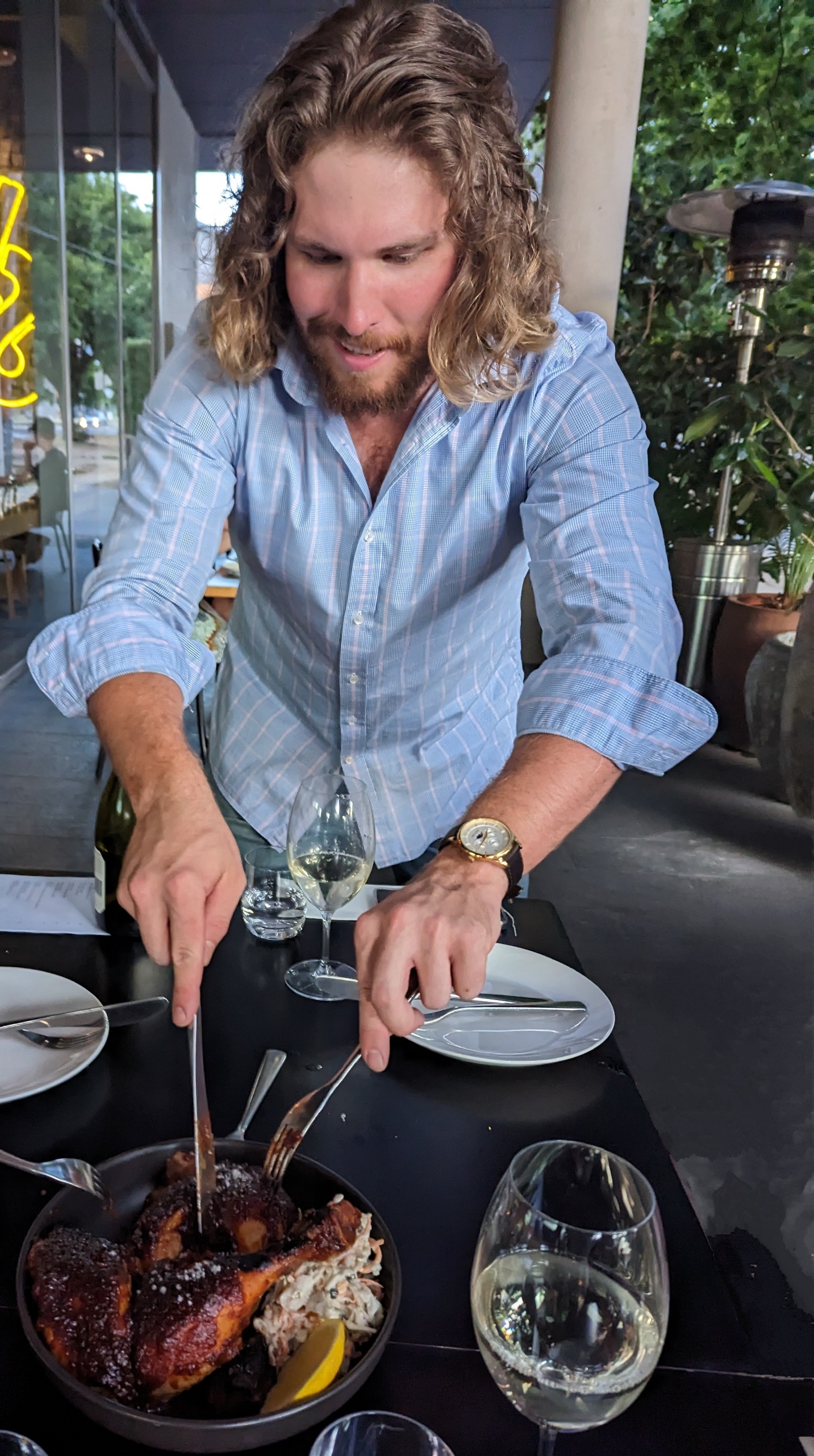
New dishes – tuna ceviche, and the splendid chicken dish


Deftly cutting up the chicken – not our forte!
Dessert but a bit of a disappointment that there were no teas other than English Breakfast. Peppermint would be a nice addition.

Back to Blackfire and some different menu choices
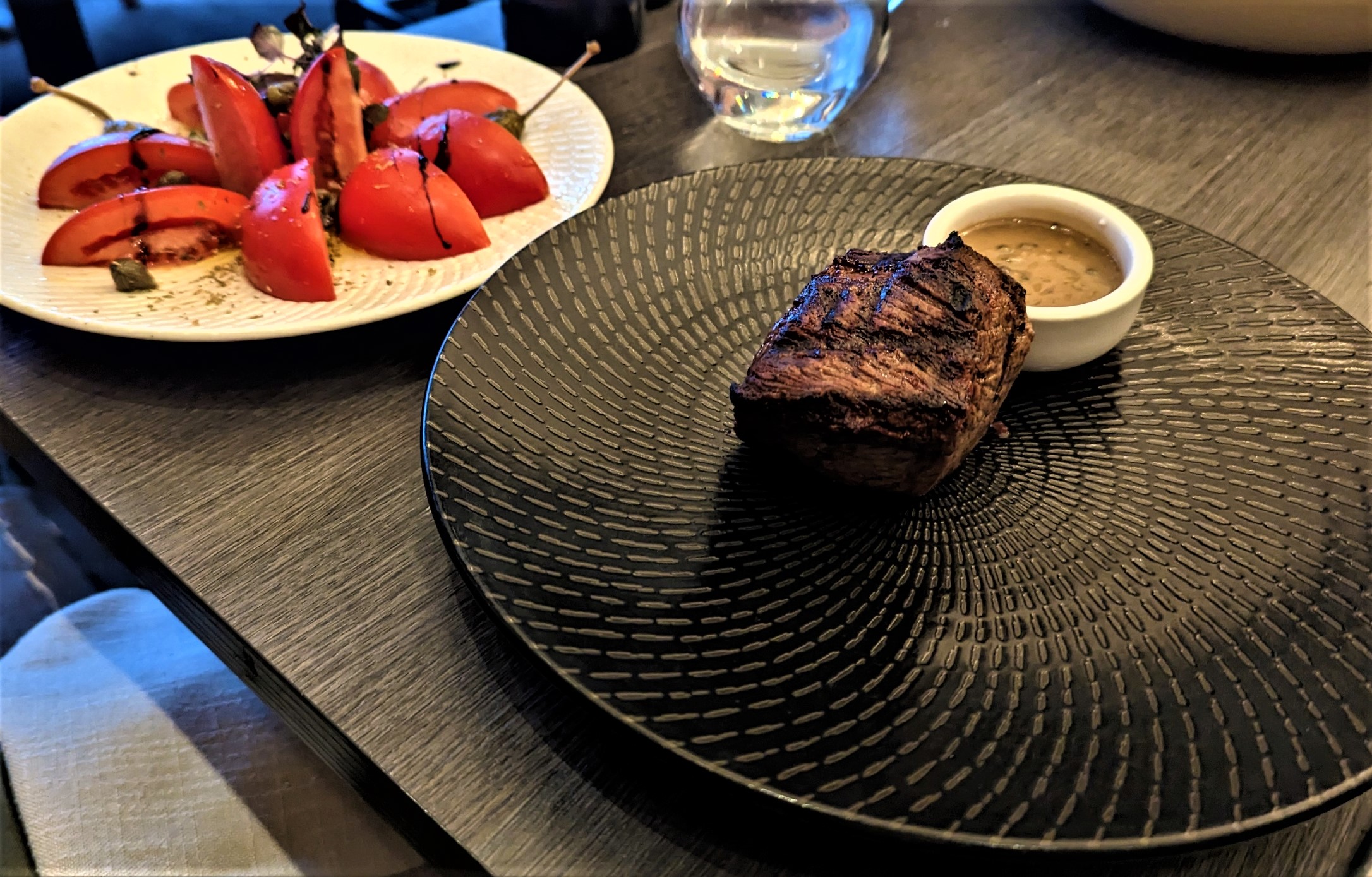
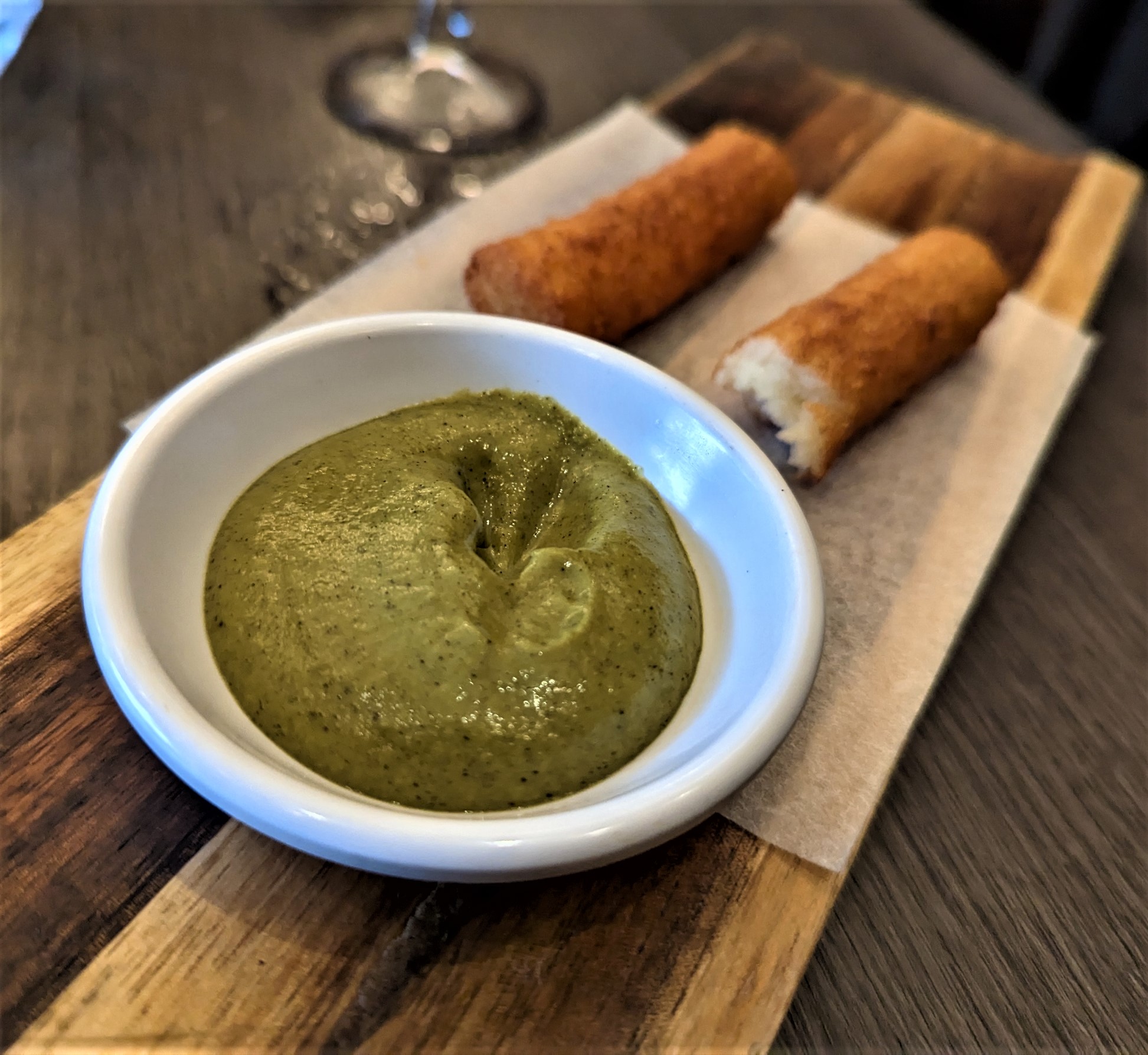
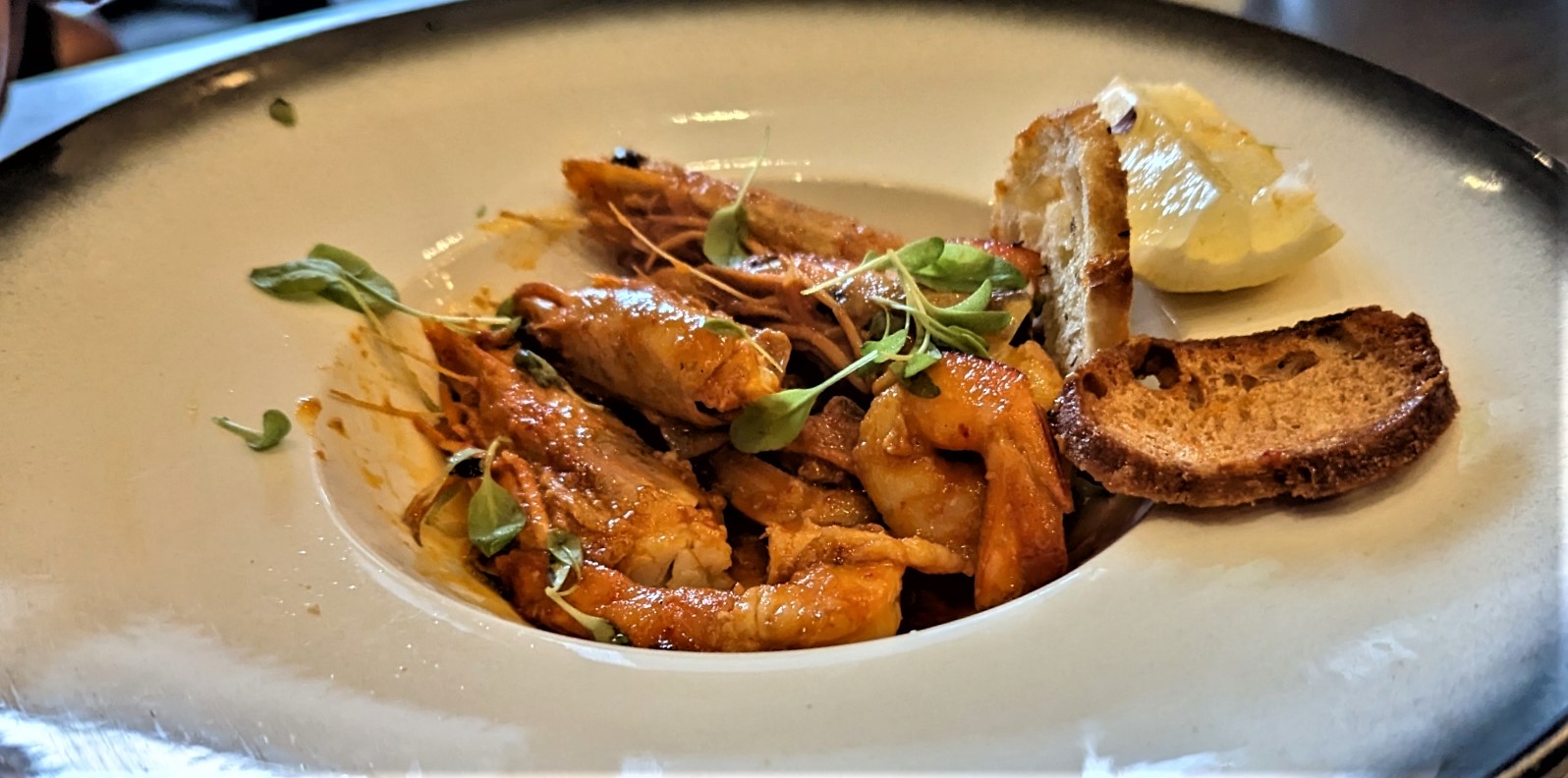
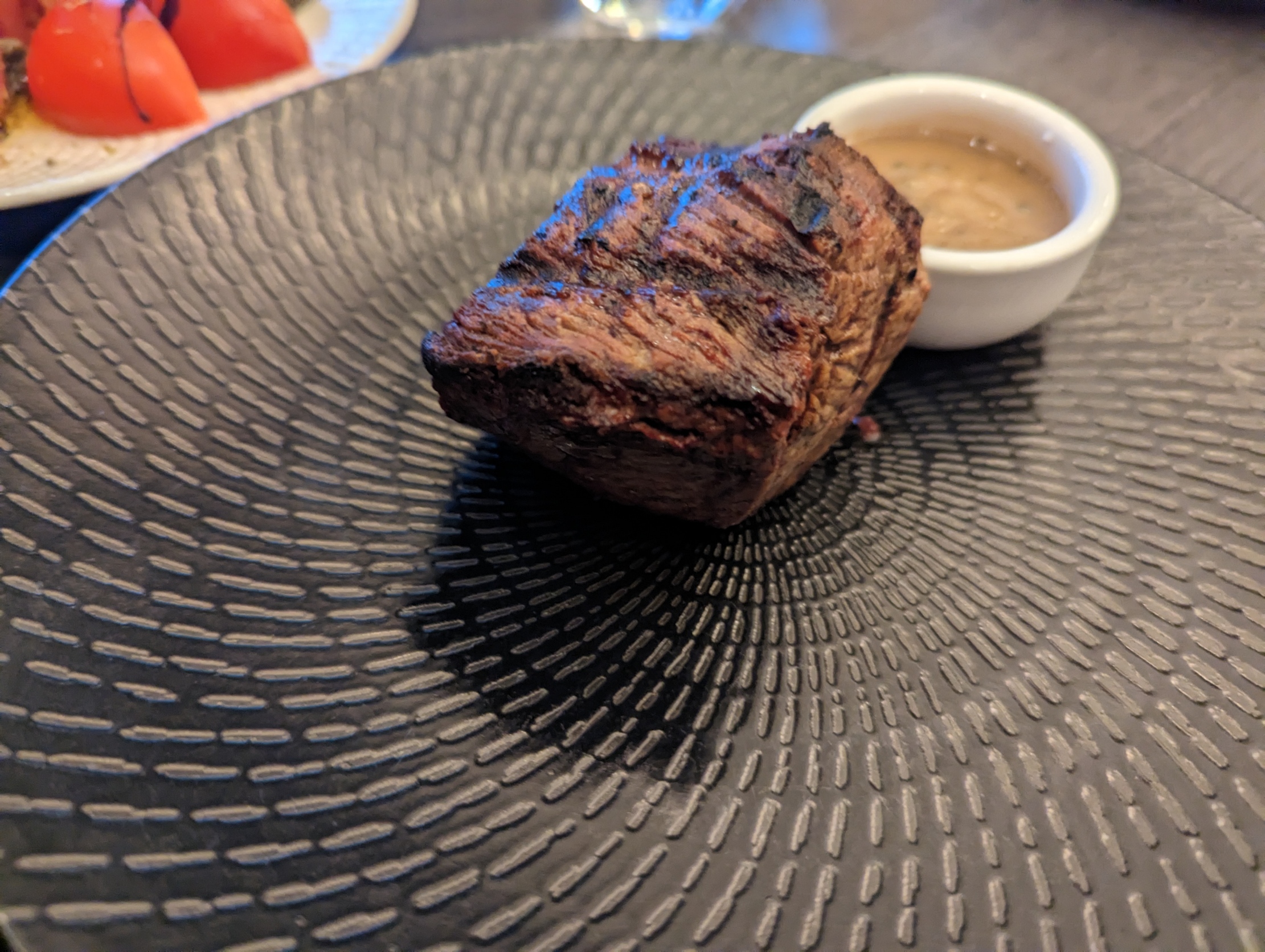
It’s always pleasant to try something different, and this time I did not have my crab filled red peppers followed by the chili prawns. There were four of us and we began with Spanish olives, which were accompanied by crisp slices of toasted crusty bread, and anchovies; and the delicious Pan Tumca – bread with a fresh tomato topping. A mushroom dish, the goats cheese churros and prawns made light entrees. The puttanesca pasta was nice, but not as silky as I would like, although the sauce was very good. Another pasta, a hearty Maltagliati, made a delicious meal. Butifarra Blanco is a Spanish sausage dish, served with a generous portion of mushrooms. The steak was cooked to order and served with a side of choice – on this occasion a fresh tomato dish with capers.




 Robin's Room