This week’s review is of another Pen & Sword publication, this time reviewing Beverley Adams’ The Forgotten Tudor Royal Margaret Douglas, Grandmother to King James VI & I. I have reviewed two of her books, The Rebel Suffragette (December 1, 2021) and Ada Lovelace The World’s First Computer Programmer ( March 29, 2023). The Pen & Sword series is known for its accessible writing, and stories of people and events that are less well known. Yes, Margaret Douglas is yet another Tudor – but one of whom we have heard little.
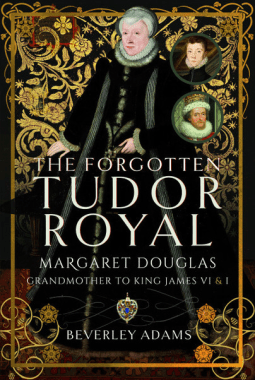
Beverley Adams The Forgotten Tudor Royal Margaret Douglas, Grandmother to King James VI & I Pen & Sword, Pen & Sword History, 2023.
Thank you, NetGalley, for providing me with this uncorrected proof for review. I was impressed with Beverley Adams’ ability to assemble a plausible story and character development from a small amount of material in The Rebel Suffragette The Life of Edith Rigby (Pen & Sword History 2021) and Ada Lovelace The World’s First Computer Programmer, (Pen & Sword History 2023).
Unfortunately, The Forgotten Tudor Royal Margaret Douglas does not meet the standard of Adams’ previous work. There is repetition, some awkward phrasing and, more importantly, Margaret Douglas does not shine from the pages as do Edith Rigby, in particular, and Ada Lovelace. Nevertheless, for those interested in Tudor history, this book makes a solid contribution to evoking the period, the ramifications of religious, geographic and personal interests that permeated the finery and theatre of the royal courts of Henry V11, Henry V111, Mary 1, Elizabeth 1 and Mary Queen of Scots. From her birth in 1515 to her death at sixty-two, Margaret Douglas had an important role in the Tudor hierarchy as she matured, grasping opportunities for herself and her children. She achieved her aim, her grandson, James became James V1 of Scotland and James 1 of England. See Books: Reviews for the complete review.
Covid-19 cases at Friday 7 July – there are 233 new cases, with 14 people with covid in hospital, and 1 in ICU.
British elections

Bob McMullan
It is as certain as any future event can be that the British Labour Party will win the next UK election, which is likely to be held in the latter part of 2024.
It is technically possible that the election could be delayed until January 2025 but it is hard to imagine the government choosing to campaign over Christmas.
The combination of factors which make this result all but inevitable go beyond a simple reading of the polling data.
The polling data as shown in the Politico poll-of- polls shows the Labour Party in an extraordinarily strong position The support has been strong for more than twelve months. Of course, the support for Labour shot up as a consequence of Liz Truss’s extremely short but disastrous tenure as PM. While it has improved a little for the Tories since then the support for the British Labour Party remains very strong.
The latest Politico poll- of-polls suggests the Labour Party has a 46% to 27% lead over the Conservative Party. This represents a 14% improvement over the Labour Party’s miserable 2019 result.
In addition, the corruption controversy around the SNP in Scotland suggests that Labour will win back a significant number of seats in Scotland.
The most recent polling I have seen of national election voting intentions in Scotland suggests Labour and the SNP are tied on 34% each. This would mean a 15% improvement for Labour on their 2019 performance.
The “Red Wall” of previously safe Labour Party seats in the North of England which were lost so disastrously in 2019 appear to be reverting to pre-Boris/ Brexit levels as the Tories fail to deliver the promised support to the North, Boris disappears into the wilderness, Brexit fades as an issue and the Labour Party presents a more acceptable face to many traditional Labour voters.
The combined effect of all these factors, when taken with an apparently tired and divided government, makes it clear that unless they score an astoundingly bad own goal the Labour Party must win.
The steady leadership style of Keir Starmer, like that of Anthony Albanese before the last Australian election, should be enough for a clear win for the Labour Party.
The current Prime Minister, Rushi Sunak, appears competent but does not seem to have the ability to establish a rapport with the “Red Wall” voters or to recover lost ground in other areas. He is also continually being undermined by Boris Johnson’s supporters and faces several difficult by-elections.
Reports from the UK, particularly with regard to Prime Minister’s questions, suggest Starmer and his deputy, Angela Rayner, have the measure of Sunak and his deputy.
It all points to a strong result for Labour, and the recent Local Government elections reinforce that view.
In fact, the Election Predictor model suggests a sweeping landslide.
The most recent prediction, based on polling essentially the same as that from Politico, indicated that if the current numbers were reflected at a General election the result would be Labour 475 seats (an increase of 273), Conservatives 100 (a loss of 265), SNP 28 ( a loss of 20) and Liberal Democrats 23 ( a gain of 12).
It is hard to believe that the final result could be as extreme as the Predictor suggests, but it is equally hard to imagine a scenario under which Keir Starmer does not become Prime Minister with a solid majority by the end of next year.
First published in Pearls and Irritations
Here is the truth about Aboriginal ‘elites’: all they have achieved had to be fought for – Marcia Langton
Story by Lorena Allam • 10h ago
The Guardian
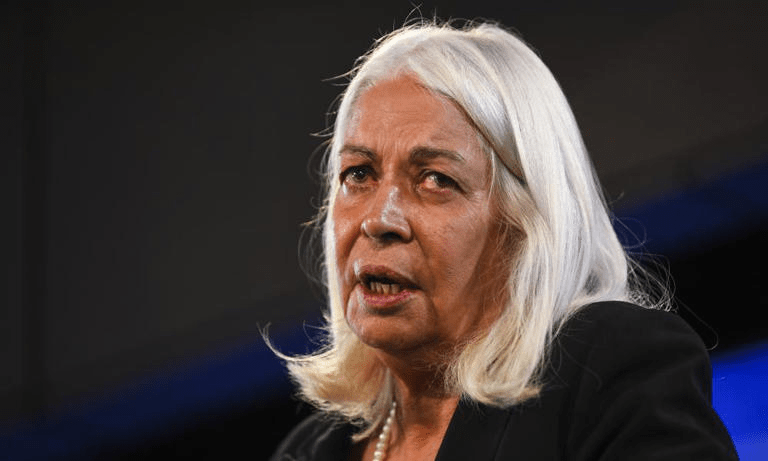
That some Aboriginal people today such as Prof Marcia Langton hold a PhD or own a house or drive flash cars, it is an achievement against the odds.’ Photograph: Lukas Coch/AAP
The need to produce ID was one reality of the draconian protection era that she, her brothers and sisters grew up in. Every aspect of their young lives was controlled by the government: where they could travel, live and work. Their wages were paid as “pocket money” or withheld by the “board”. They had to seek permission to buy a dress, book a train ticket, attend a funeral. If your “papers” weren’t in order, you’d be picked up by police. My grandmother never stopped having hers ready.
Related: New Australia v old Australia: a yes vote on the voice is a vote for the future | Megan Davis
As a child on the mission, she was given a year’s worth of schooling, delivered at the end of a cane by the stern Anglican manager’s wife. Still a child, she was sent away at 14 to work as a “domestic”. As the cook in a shearer’s camp, she met my grandfather and fled the terrors of that servitude as quickly as she could. They, and later their children, moved constantly to keep ahead of the New South Wales protection board, which could have taken their children, including their youngest, my father. He was a talented footballer and a bright student with a love of numbers, but he had to leave school at 15 to help support his family.
They are both gone now. My father died at 60, far too young. It’s not uncommon for Aboriginal men: the average life expectancy at birth is now 71 years, but that’s the optimistic end of the scale for earlier generations. So many of our cousins, fathers, uncles, brothers don’t make it.
I finished high school and went to university. My cousins and I were the first to pass through the foreign land of tertiary education. We have good jobs and can pay our bills. We have used that education to improve our lives and those of our children. We advocate for the rights of First Nations people because we can, and we do it to honour the sacrifices of those who went before us.
The no campaign says the voice to parliament will create a ‘two-tier society’, but that is already where we live
At a forum in inner-west Sydney this week, Warren Mundine told the audience he was concerned the voice to parliament amounted to “a power grab by academics in the Indigenous elite, people and that [sic] who are concerned about losing their power”.
Our elders didn’t work for personal enrichment or to accumulate an investment portfolio. They didn’t collect antiques or buy holiday homes. They didn’t leave us generational wealth. They shielded us as best they could against intergenerational trauma. It got to us anyway. They worked to keep us safe in a racialised system that shortened their lives, limited their opportunities and pushed them to the fringes of a hostile society in their own land.
The no campaign says the voice to parliament will create “permanent race-based privilege” and a “two-tier society”, but that is already where we live. Generations have fought for everything we now enjoy. Land rights, native title, education, jobs: any progress has come from Aboriginal struggle, not from some benevolent external force, or from the exercise of some undefined power.
“I’m really sick of people questioning our honesty and integrity,” Prof Marcia Langton said recently, rubbishing allegations she was part of some secret cabal of Indigenous academic power elite.
A Noongar Elder is urging Australians to learn more about the proposed Indigenous Voice to Parliament.
“I’m on the public record for over 30 years on the empowerment of Indigenous people. And yes, I work at a university. But I grew up in a native camp and in housing commission, and tents, in Queensland. And I know the track record of the members of the referendum working group. Every one of them is an outstanding and honourable person.”
They are not elites, she said. They are survivors of a system that did its best to ensure they did not succeed. And they are a reflection of the black excellence in our communities, where so many brilliant, creative people have had their potential cut short by the preventable diseases of poverty and the violence of the carceral system, entrenched over more than a century of racially discriminatory laws and policies.
That some Aboriginal people today hold a PhD, or own a house, or drive flash cars – whatever the shifting set of criteria the right uses to determine this “elite” status – it is an achievement against the odds.
The right tell us we must pull ourselves up by the bootstraps and make a contribution to society. But when First Nations people appear to prosper in the system, they are called “elites”. Perhaps it’s the contribution they disagree with.
At a voice forum in Sydney in May, the Gumbayngirr-Dhungutti man Phil Dotti caused a stir when he took to the stage. After listening to non-Indigenous people talk about the voice for an hour and 40 minutes, he decided it was time to speak up.
Dotti, the first Aboriginal person to play for the Cronulla Sharks, told me later he went on the stage to speak his mind because “people needed to see someone with strength and character”, qualities his mother and grandfather instilled in him when growing up “very poor” in a tin shack on the Burnt Bridge mission in Kempsey, NSW.
His unexpected speech was cut short; some people got up and left.
“I know they’re scared because I might be an educated blackfella, and there’s nothing more scary than that,” he said.
In a speech to the National Press Club this week, the Indigenous Australians minister, Linda Burney, spoke of a beloved friend who died far too young.
Michael Riley was a photographer and film-maker, one of the cofounders of the Boomalli Aboriginal artists’ cooperative. His luminous, lyrical works work hang in galleries around the nation.
“Michael grew up in poverty in Dubbo during the 1960s and spent time on the Talbragar Aboriginal reserve, an overcrowded place where basic hygiene was all but impossible and medical care was almost nonexistent,” Burney said.
“Like so many others who were forced to live in those poor conditions, Michael suffered from chronic infections and got rheumatic fever, a condition from which his immune system never recovered.”
Riley died at the peak of his career, of renal failure, at the age of 44.
“I was very close to him. I visited him every day in hospital. I watched him go blind in one eye,” Burney said. “His Aboriginality condemned him to an early death, a preventable death.”
Burney said the injustice of his passing motivated her every day “to put one foot in front of the other, to do better by Indigenous Australians”.
Regardless of where on the spectrum of yes to no Aboriginal people sit in their views on the voice, we all know losses like this. We miss good people who unjustly left us way too soon. We mourn the opportunities they should have had, and wonder what more they could have achieved. We carry them with us.
Crikey journalist, Bernard Keane, sees the elite as being associated with the No Campaign. See his story: How elite is the No campaign? Let’s count the ways in Crikey.
Noticed white labels stuck to random objects in Civic? They’re part of the ‘Festival of Everyday Art’ 5 July 2023 | James Coleman
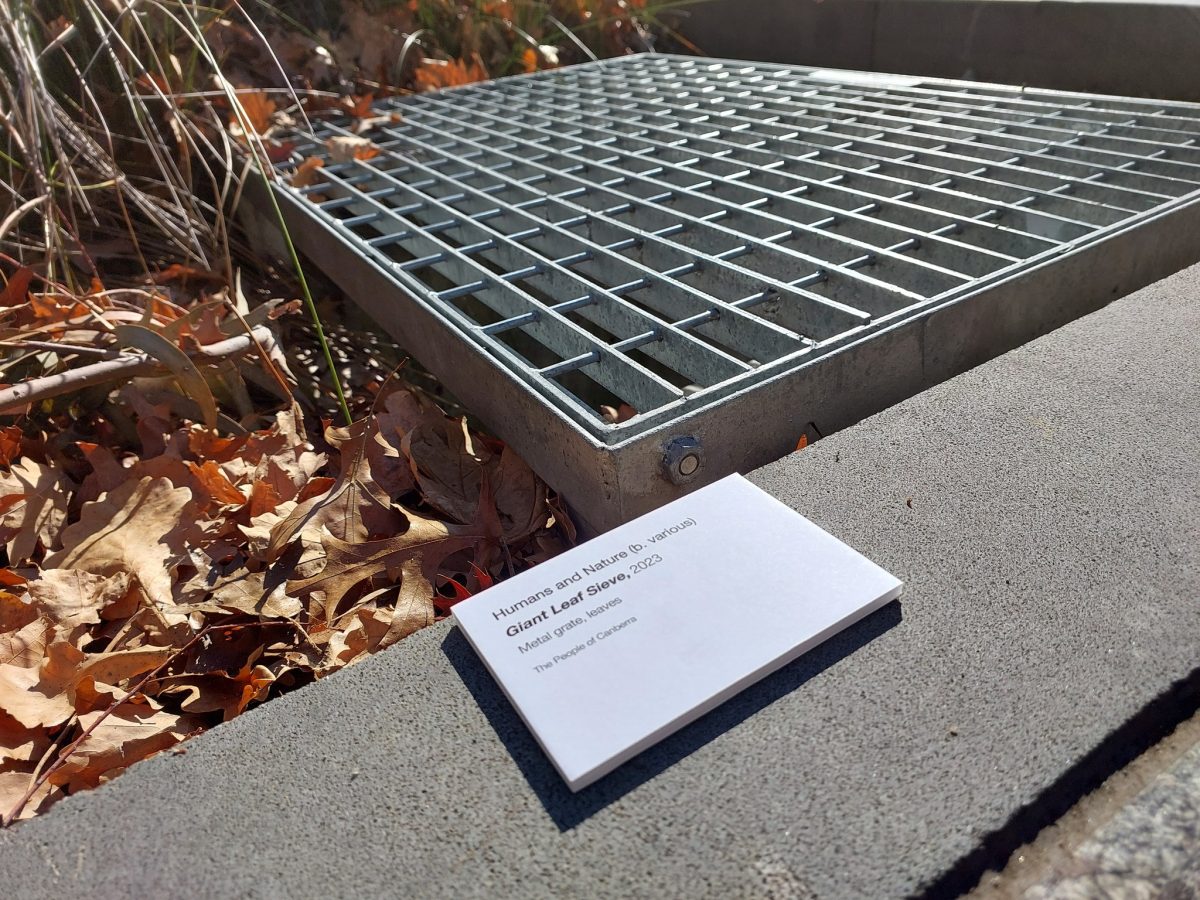
Labels on ‘artwork’ for the Festival of Everyday Art. Photo: People Lab.
A metal plate with the initials ‘FH’ on them. A drain. Leftover paint on a brick wall.
All examples of regular ‘city things’ you probably walk past on your morning commute. Chances are, you’ve certainly never stopped to study them, let alone regard them as examples of contemporary art.
Claire Granata’s ‘People Lab’ project is here to change that.
Since 2018, Claire and fellow artist Pablo Latona have worked on a “public art experiment” with grant funding from the City Renewal Authority (CRA). It started simply enough with a greyhound-patting experience in an empty shop front in Civic’s Sydney Building.
“We tested all these things that were really basic but could hype people up and make them appreciate everyday things,” she says.
“The whole idea was to get people really engaging with their city and community.”
It now takes the form of the ‘Festival of Everyday Art’.
The festival starts each month with a workshop (this month on Saturday, 8 July), where members of the public spend up to two hours scouting the city and photographing literally anything that catches the eye. Think of it like a photo scavenger hunt.
“You’re finding things that are exciting, bizarre, unnoticed or funny,” Claire says.
“You’re curating the art, essentially.”
It’s then up to Claire’s team to come up with printed labels for each of the photos ahead of the next part on 15 July – the ‘Treasure Hunt’.
“We set up a marquee near the Street Theatre, off Childers Street, and people drop in anytime between 11 am and 3 pm, and we give them a map of the city and a bunch of labels. Their job is to go out and find where those labels belong and stick them in place.”
The result is a “huge outdoor public art gallery” involving more than 100 little white labels tacked onto an eclectic mix of objects. And some laughs.
“Sometimes people really enjoy it but don’t actually get the memo, and they’ll go and stick the label somewhere completely wrong, which can be quite funny.”
The team with the best photos “of a label in place” receive a particularly nice leaf in return.
“At the end of the day, when people have photographed their labels in place and come back, they get to choose from a suitcase full of leaves.”
The stakes are higher the following day for the ‘Treasure Trail’ when vouchers to local businesses (including Good Games) are up for grabs.
“Again, we set up our marquee over at the ANU, and it’s people’s job to find as many labels as they can and photograph them.”
It might sound simple enough, but Claire says it’s striking a chord with locals and tourists alike.
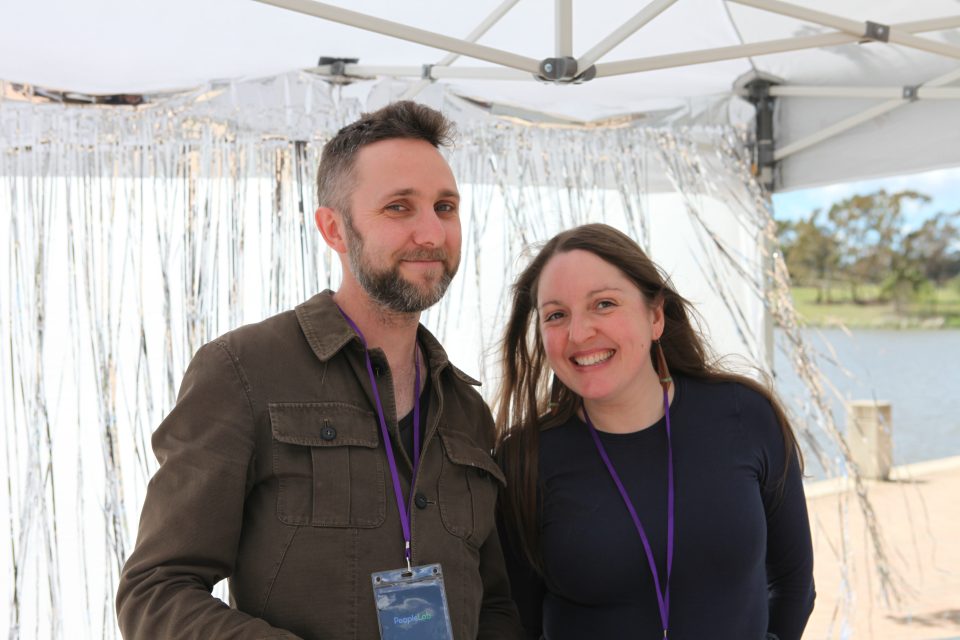
Claire Granata and Pablo Latona.
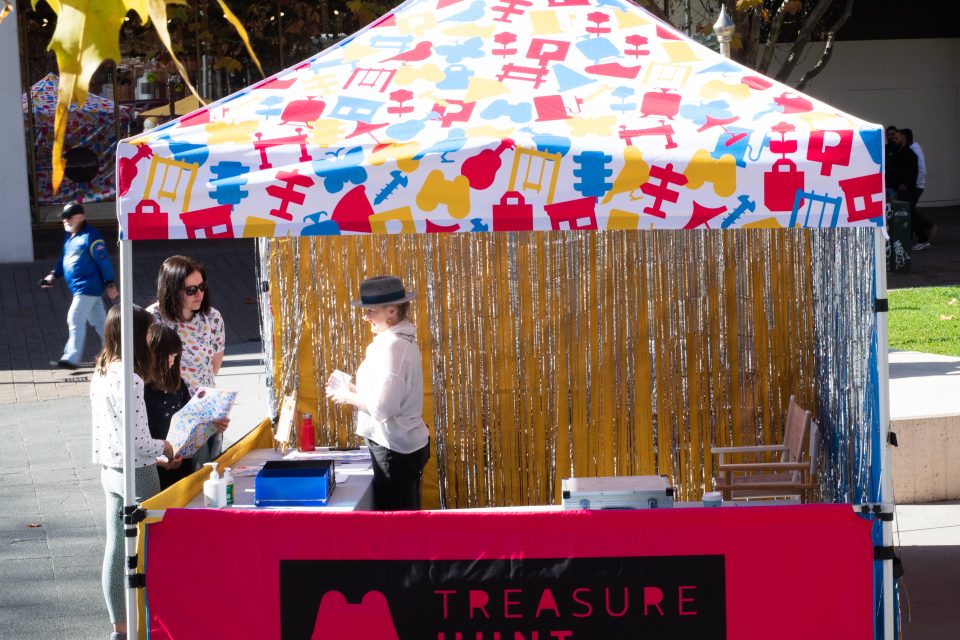
Photos: People Lab.
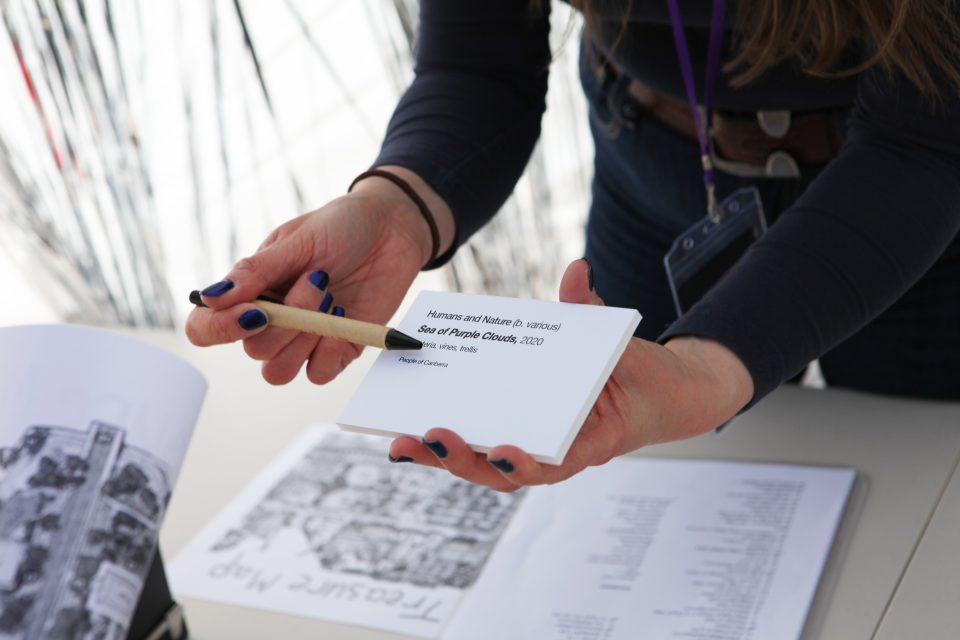
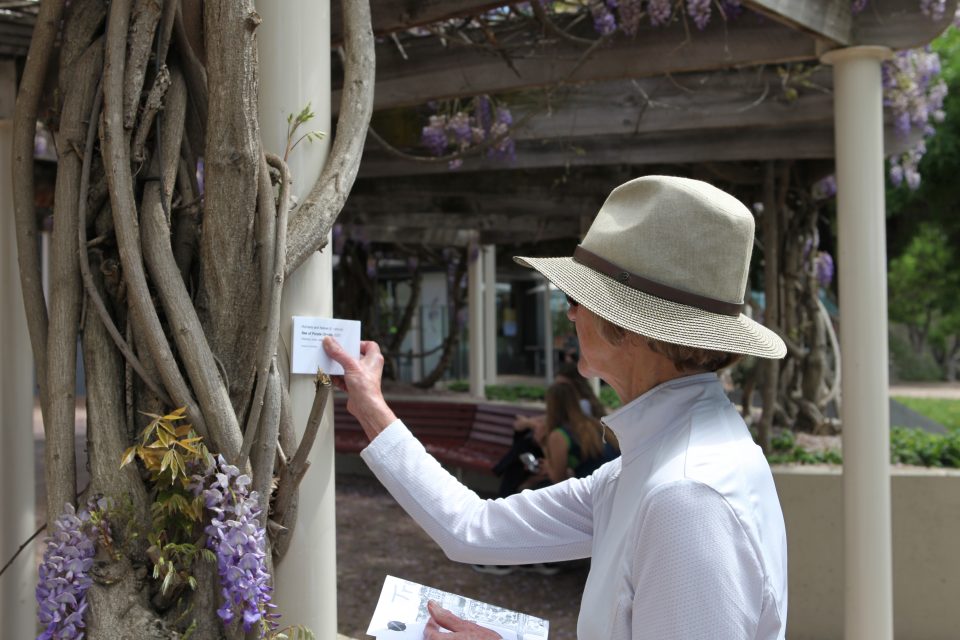
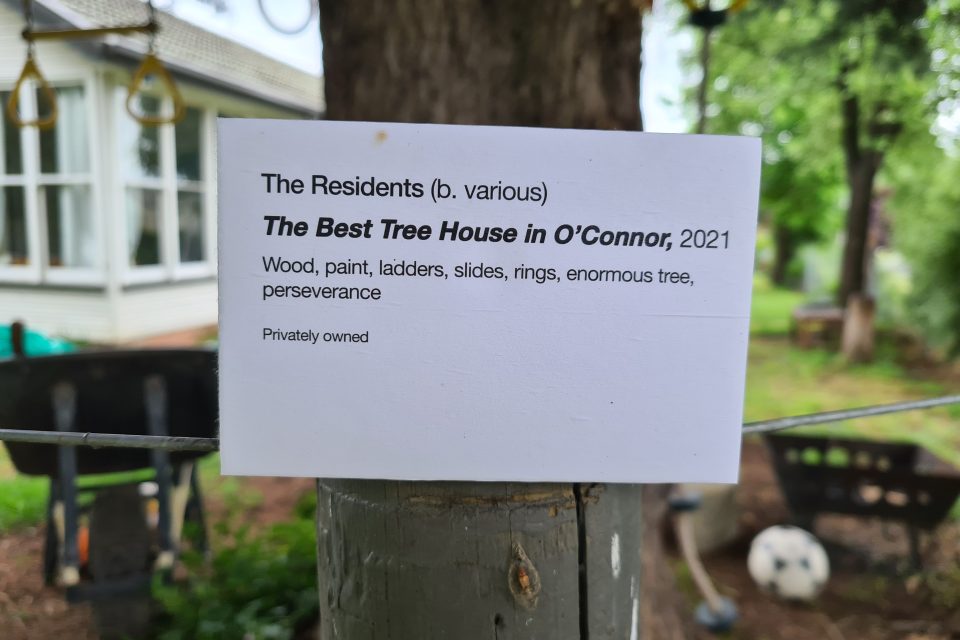
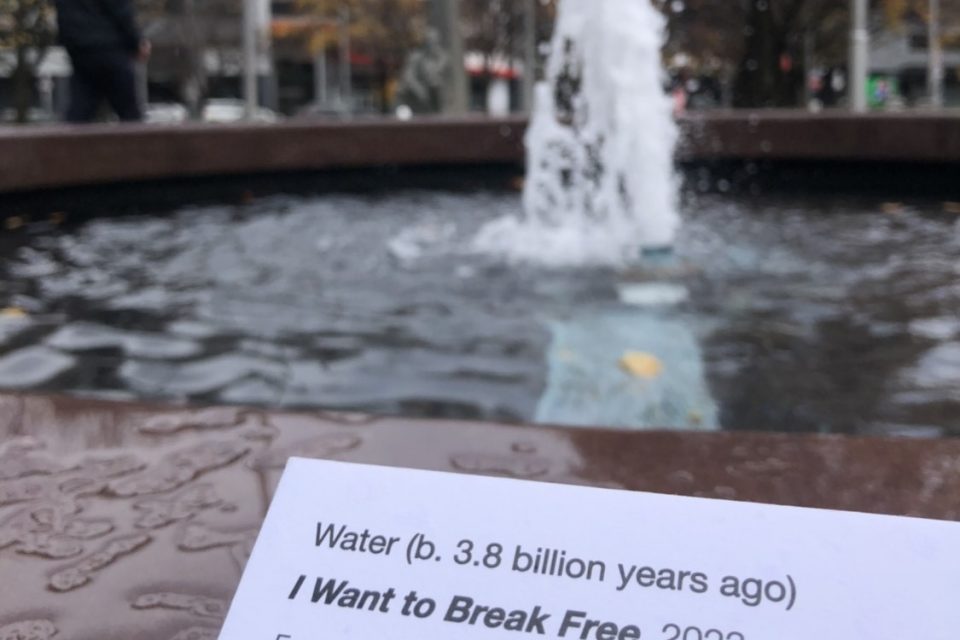
“We got an email after the last event series in June from a lady who is in Canberra but has lived in Melbourne for 12 years, saying how much she enjoyed seeing Canberra in a different light.
“We also had a 15-year-old girl who had travelled in with her family from Bungendore specifically for the Treasure Hunt to celebrate her birthday.”
Several national institutions here in Canberra have also shown interest in the festival, and Claire and Pablo are preparing to head to Sydney soon to introduce it to the Inner West Council. News is even spreading overseas.
“We might take it to Canada in a couple of years’ time,” Claire says.
“We’ve got a local creative who joined our team and is moving over there, so we’ll try to get some funding and take it overseas.”
As for whether Canberra will continue to host the public art gallery in the future, Claire’s response is unequivocal.
“Absolutely.”
Visit People Lab on Facebook for more information.
 Robin's Room