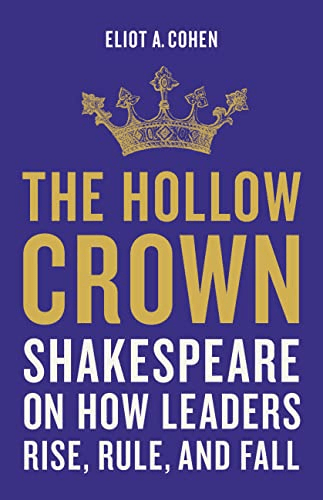
Eliot A. Cohen The Hollow Crown Shakespeare on How Leaders Rise, Rule, and Fall Basic Books: New York, 24 October 2023
Thank you, NetGalley, for providing me with this uncorrected proof for review.
This is an exciting read, from an author whose political experience and preceptive approach to politics, power and Shakespeare is only occasionally influenced by his own politics. Eliot A. Cohen’s The Hollow Crown Shakespeare on How Leaders Rise, Rule, and Fall is a book to be read, savoured, read again, and used to interpret both modern and historical politics as well as every time you read or see a Shakespeare play. Although his political plays with their power-oriented characters predominate, there is an occasional reflection on a wider range of Shakespeare’s work. Readers of this book will find it difficult to watch any of Shakespeare’s plays without thinking about the way in which Cohen might approach them. This is an added joy to this thoroughly compelling work.
The book is divided into three sections: Acquiring Power; Exercising Power; and Losing Power. Chapter 1, Why Shakespeare? And the Afterword, Shakespeare’s Political Vision provide sharp and detailed bookends to the sections. Cohen acknowledges that Shakespeare’s political views, if any, were not known. Nor are they conveyed sharply through his work. As Cohen observes, Shakespeare’s characters are ambiguous, their arguments and stances are ambiguous, the plays do not simplify the political themes he addresses. However, as Cohen also observes, the questions and themes inform aspects of power, and it is these he addresses in detail. See Books: Reviews for the whole review.
After the Covid update: Vote Yes and date announcement to be announced; Are the Greens going to elect Trump (again)?- Bob McMullan; Slavery stole Africans’ ideas as well as their bodies: reparations should reflect this; Canberra welcomes spring early: London gardens next week!; Last supper? – Jane Goodall; Letter from America – Heather Cox Richardson.
Covid update

Australia cases – Updated 28 Aug at 7:06 pm local
Confirmed 11,576,428
Deaths 22,696
Global cases – Updated 28 Aug at 7:06 pm local
Confirmed 769,805,366
Deaths 6,955,484
–
There were 160 new cases recorded on 25 August, with 7 in hospital and none in ICU or ventilated. Three deaths were recorded in this period.


Prime Minister Anthony Albanese is expected to announce the voice referendum date as October 14.© Bianca De Marchi/AAP PHOTOS
Are the Greens going to elect Trump (again)*

Bob McMullan
There are some worrying signs in recent polling which raise the disturbing possibility that a third-party campaign by the Green Party may once again divert enough votes from the Democratic Party candidate, in this case almost certainly Joe Biden, to get Donald Trump over the line in some key states and thereby deliver another Trump victory.
As this would be devastating for all the policies the Green Party supports it is worth considering how such a perverse outcome may come about.
It is early days yet, and I am more optimistic than some about Biden’s prospects, but the alarming possibility of a further and more dangerous term for Trump is realistically possible.
Harry Enten, the respected CNN analyst, wrote recently that “The chance of Trump winning another term is very real”. I am more optimistic about the probability than Enten, but his conclusion is correct, there is a real chance of Trump winning again.
Enten points out that no-one in Trump’s current polling position in the modern era has lost a presidential primary that didn’t feature an incumbent.
And while it is early days in the presidential election proper Trump is currently competitive in a contest with Biden.
Anyone thinking of becoming involved should measure their impact against this awkward reality.
A quick glance at history illustrates the potential problem for the Green Party.
There is no doubt that Ralph Nader cost Al Gore the 2000 election, with all the consequences that followed from George Bush’s election.
The data is clear. In Florida, the key state in deciding the outcome of the 2000 election, the final margin in favour of Bush was a mere 537 votes. Ralph Nader received more than 97000 votes in that state. If only 1% of them had voted for Gore he would have been President.
And election results have consequences. Bush was not as dangerous as Trump for American democracy, but there is little doubt that if Gore had been the president there would have been no invasion of Iraq.
What a difference that would have made to global peace and stability.
It is arguable, but not so obviously clear, that Jill Stein cost Hilary Clinton the 2016 election and therefore gave us the first iteration of Donald Trump as president.
The underlying evidence suggests that Stein definitely won sufficient votes in some key states to make the difference between Clinton winning and Trump. For example, in Michigan, Trump won by 10000 while the Greens candidate received more than 50000 votes.
In 2024 the potential for the most likely Green Party candidate, Cornel West, to help to elect Trump is emerging as a possibility. The first sign was a recent Emerson poll in Michigan. Between Biden and Trump, the poll indicated a probable tied vote. But when West was included in the question, Trump won by 2%. Another recent poll showed West having a similar net impact, this time in New Hampshire. Biden was clearly ahead in both surveys, but the inclusion of the Green Party candidate cut Biden’s margin by 2%.
Of course, the Green Party have every right to run a candidate and advocate for their preferred positions. And I don’t suggest the election of Trump is in anyway part of their motivation.
However, when potentially disastrous consequences may flow from actions you are considering I believe any failure to take them into account constitutes wilful neglect at best and dangerous adventurism at worst.
Ralph Nader may have been able to say that the impact of his candidature could not have been foreseen.
No-one in 2024 will have the same excuse.
- First published in Pearls and Irritations, and The New Daily.
Slavery stole Africans’ ideas as well as their bodies: reparations should reflect this.

Jenny Bulstrode
Lecturer in History of Science and Technology, UCL.

Published: August 24, 2023 10.32pm AEST
The authors do not work for, consult, own shares in or receive funding from any company or organisation that would benefit from this article, and have disclosed no relevant affiliations beyond their academic appointment.
Republished from The Conversation under Creative Commons Licence
In a speech to mark Unesco’s campaign for the Remembrance of the Slave Trade and its Abolition, UN secretary-general António Guterres told the United Nations general assembly earlier this year that the inequalities created by 400 years of the transatlantic chattel trade persist to this day. “We can draw a straight line from the centuries of colonial exploitation to the social and economic inequalities of today,” he said.
Guterres’ words were echoed by Judge Patrick Robinson of the international court of justice, who has called for the UK to recognise the need to pay reparations for its part in the slave trade, telling The Guardian on August 22 that: “Reparations have been paid for other wrongs and obviously far more quickly, far more speedily than reparations for what I consider the greatest atrocity and crime in the history of mankind: transatlantic chattel slavery.”
Investment into the trafficking of African people in the Caribbean created a lucrative economic system that helped Britain develop into a global economic superpower. The consequences continue to be felt today – not only in vast inequities in the distribution of wealth and resources, but also in the denial and effacement of the people of African descent whose skills and knowledge helped power that industrial and societal transformation.
This year marks the 240th anniversary of arguably one of the biggest thefts in the history of intellectual property. The so-called “Cort process”, patented by the financier Henry Cort between 1783 and 1784, has been called one of the most important innovations of the British industrial revolution. Yet recently published findings show the process was first developed by 76 black metallurgists, many of them enslaved, in an 18th-century foundry in Jamaica.
The foundry was forcibly shut down for presenting too much of a threat to Britain’s economic and political domination. We know some of these black metallurgists’ names: Devonshire, Mingo, Mingo’s son, Friday, Captain Jack, Matt, George, Jemmy, Jackson, Will, Bob, Guy, Kofi and Kwasi.
Stolen heritage
African enslavement may be considered one of the quintessential depictions of global theft and destruction in human history. In 2018, Felwine Sarr and Bénédicte Savoy’s report on the restitution of cultural heritage pointed out that 90% of sub-Saharan Africa’s material cultural heritage is held outside the continent. From the kidnapping of Africans from their homelands, the eradication of native populations, to the forced loss of African culture, history and identity, the damage that chattel enslavement has done continues to permeate development and economic discourse the world over.
But as the global reparations movement gains traction it opens a new discourse about the debt owed for that which was stolen. It also highlights the need to create a robust educational system aimed at highlighting the realities of slavery and colonialism. The history of the black metallurgists is just one example of the contributions of people of African descent to the wealth of European and US societies today.
For much of recent history, institutions in the global north have dominated the narrative of where and who drives innovation. But history – and history taught in schools – must also recognise and name enslaved Africans as true innovators of their times. In Florida, the governor and Republican presidential hopeful, Ron DeSantis, has introduced new educational standards which teach that some enslaved people benefited from slavery. History must challenge this constant narrative of black bodies merely being machines.
Truth and reparation
In the search for truth and reparation, truth of brutalities inflicted alone is not enough. There must also be truth about the pioneers and innovators of colonised and enslaved societies – such as the 76 black metallurgists – whose ideas changed the trajectory of civilisation and who laid the building blocks for growth, change and development.
The simultaneous theft and denial of black innovation has served a purpose for the global north. The Caricom Reparations Commission, notes that one of the main policies of the European colonisers was that there should be “not a nail to be made in the colonies”. A fundamental part of the global north’s accumulation has been to create captive markets and maintain those markets post-independence. Colonies and post-independence states alike have been actively deprived of the developmental apparatus to create a thriving society.
Resource extraction during this period was not merely centred on sugar, tobacco and cotton. It also drew on intellect and innovation which was stolen from the colonies and used to help build the prosperous nations of the global north.
Reparation is not only about money. It is also about recognition. Alongside the names of freedom fighters such as Sam Sharpe and Queen Nanny, children must learn the names of black innovators. Part of truth and reconciliation must be this re-centring of black identity as part of a decolonised education system across former colonial and colonising states.
It must be a curriculum which includes the names and identities of enslaved African people whose skill and knowledge both challenged and transformed the global industrial and economic system. Through this, descendants will gain an understanding of the importance of their own history and ancestral cultures and all it contributed.
Recognition of the theft of black intellectual property provides a starting point for quantifying the harms that were done and continue to resonate to this day. This is necessary for any process of truth and reconciliation.
Quantification and monetary reparation, while necessary, are not in themselves enough. They must be combined with institutional recognition through an education system that acknowledges the role of enslaved African people in both challenging and driving forward the economies, scientific innovations and cultures of European enslavers.
Canberra welcomes spring early: London gardens next week!







Below is a follow up to the story posted on the week beginning 16 August 2023. I wonder what other people think about Jane Goodall’s reflection on the ABC audience of Kitchen Cabinet? I believe that they are fully capable of dealing with everything served up in this political program that dares to be a little different – a basket? a gathered full skirt replete with petticoats from the 1950s? Is this really a problem? A risk that Annabel Crabb will be swallowed? I do not think so. The Hollow Crown, reviewed this week takes a more academic approach to politics and politicians, joining the many approaches, including Kitchen Cabinet, to this topic that should be in the public arena. Goodall’s claim that ‘Crabb’s enterprise serves only to inflame the ferocity’ is at best overstated. It is melodramatic to suggest that Annabelle and the ABC are now, or will at any time in the future, be in the same category as former President Trump and Fox News.
Last supper?
Inside Story Books and Arts
In its attempt to be light-hearted, Kitchen Cabinet has steered into dangerous waters.
JANE GOODALL TELEVISION 24 AUGUST 2023 1366 WORDS
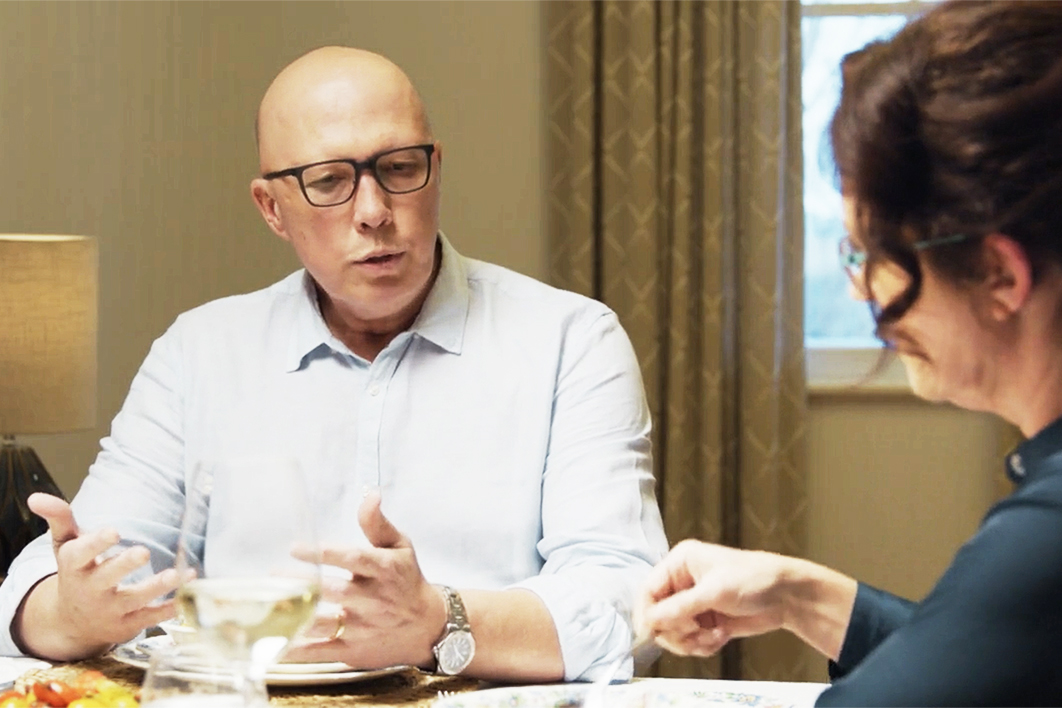
Time to draw a line? Opposition leader Peter Dutton dining with Annabel Crabb. ABC
“What big teeth you have, grandma!” We all know what comes next. And so does Annabel Crabb, dressed in a sweet fifties frock with a basket on her arm, as she arrives at the front door of some smiling politician for another episode of Kitchen Cabinet, now embarking on its seventh season.
The Red Riding Hood persona is surely tongue in cheek, but Crabb is taking a real risk by evoking a fairytale figure who proved terminally naive: quite literally, since she was swallowed alive. Whether or not there’s a wolf in the house, Crabb can expect savage attacks in the surrounding media environment.
In another reversal of traditional symbolism, rather than discovering a wolf in the guise of a trusted human, she is about to use a cheerful domestic setting to reveal the human who, in political guise, may have inspired fear and loathing. “Every single politician we elect has a backstory that dictates the way they behave in politics, and whether you love or loathe them, it’s always worth knowing that story,” she says.
Given the temperature of responses to the program, that has proved a too-easy assumption. This week’s episode with opposition leader Peter Dutton showed, not for the first time, that Crabb’s enterprise serves only to inflame the ferocity. For Charlie Lewis, writing in Crikey, the “cosy and humanising profiles of people responsible for variously sized portions of national shame” come across as “a prank on everyone involved.”
Amy McQuire’s excoriating review in New Matilda, prompted by the season five episode featuring Scott Morrison, was circulating again on social media in the lead-up to the Dutton appearance. McQuire calls the program “ridiculous, sickening,” “junk food journalism.”
The chorus on Twitter, where #KitchenCabinet has been trending since the start of the new season, has been virulent. A photoshopped image shows Crabb lunching with Adolf Hitler, whom she describes as “good company” and “funnier than I was expecting.” Other posts focus on those who have suffered the consequences of Dutton’s political decisions: the Biloela children, Reza Barati and others held in long-term detention, communities in Melbourne vilified in response to his “African gangs” claims.
These and other highly charged issues, including Dutton’s current campaign for the No vote on the Voice, are raised over a lunch of chowder cooked by the opposition leader in the kitchen of his beautiful old Queenslander house. He seems to take Crabb’s insistence that some of his public remarks are straight-out racism in his stride, without seeming riled, excessively defensive or especially embarrassed.
Crabb encourages him to talk about his life before politics, including the experience of attending violent crime scenes as a police officer. In answer to Crabb’s suggestion that he might suffer from PTSD, he says that probably most police officers do. That exchange triggered his antagonists, who saw it as a bid for sympathy put forward by Dutton himself.
Distortions like that are par for the course on social media, where criticisms of programs and presenters often take the form of personal abuse. The problem has been serious enough for Leigh Sales, Stan Grant and Hamish Macdonald to leave political roles at the ABC, and has led to the broadcaster’s recent decision to withdraw its program accounts from Twitter.
While the personal abuse is intolerable, the reactive high dudgeon is often too sweeping. Professional journalists, especially if they have a television profile, are prone to characterising social media users as a rabid species, demented by a diet of disinformation and immune to reason or civility. But something of vital importance gets missed: behind the apparent savagery lies an essentially human response that warrants serious attention. Seen collectively, the attacks on Kitchen Cabinet are not in the vein of criticism or argument but are manifestations of a visceral moral outrage.
This is what Crabb in her smiling Red Riding Hood persona has failed to take account of. “Sometimes people who disagree with each other, and even people who agree with each other on some things, do not have conversations with each other,” she says. “And I think that’s madness.” Is it? Suggesting that the reaction reflects a pathological refusal to have conversations across lines of disagreement is missing the point by a country mile.
“The tygers of wrath are wiser than the horses of instruction”: the poet William Blake might not have written that line if he’d been around in the age of social media, but it remains a succinct and unforgettable evocation of wrath as a moral force, and one that may be collectively generated. Blake himself wrote under its influence in response to the social cruelties and political degeneracies of the industrial revolution.
We in Australia may no longer send children down mines or up chimneys, but we do put them into solitary confinement, isolate them in island compounds, and subject their parents to prolonged and abject misery. As we’ve learned from the robodebt debacle, we drive people to suicide through government-initiated programs of extortion. We create pariah communities through the racial stereotyping that is sometimes explicitly promoted by elected politicians.
Is it really so incomprehensible that many people take offence at being vicariously invited by the national broadcaster to have a chatty meal with those seen as instrumental in perpetuating these kinds of torments? Or if we do decide to spend half an hour in this way, and we find the company genial and good-humoured, and the host quite a decent bloke, where does this leave us?
Kitchen Cabinet started out as an experiment in genre-crossing: equal parts reality TV, chat show, cooking program (the dessert recipes are posted on the ABC site) and political inquisition. Crabb’s deliberately ingenuous persona was presumably intended to push the dial to the lighter end of the spectrum, but she was an experienced enough journalist to know how to introduce more serious registers as the conversation rolled along.
Guests have been chosen from across the political spectrum, with a predominance of women, and they do tend to open up in unexpected ways, offering new perspectives on the personalities and motivations of those in power. But personal trust in politics is a high-risk investment.
In season one, lunch with National Party senator Nigel Scullion, Indigenous affairs minister at the time, involved a trip up river in the Northern Territory to catch crab and giant prawns that he cooked on a makeshift barbecue. “How do you fit into the Senate?” Crabb asked. The Australian people shouldn’t be represented in parliament just by lawyers, he responded; there should be tradies and fishermen too.
He sounded like a good bloke. Referring to the Warramirri people as “my mob,” he talked of his responsibility for finding better ways to address disadvantage in Indigenous communities. Barnaby Joyce, too, sounded like a good bloke when he weighed in against “back-pocket politics” and “the clever club” of lobbyists, mining companies and foreign investors in season two.
Five years later Scullion was in hot water with allegations he’d given Indigenous funding to his own former fishing-industry lobby group, and Barnaby Joyce had resigned as leader of the Nationals over an affair with a former staffer, with attendant allegations of nepotism over the appointment of his new partner to an unadvertised position. In retrospect, the good bloke talk does seem rather… disingenuous.
Many of the other guests on the program no doubt really are good people who maintain ethical standards and principled positions in situations of evolving complexity. But it would be impossible to draw a line between those who should and should not be featured in this pseudo-innocent format. Might the best thing therefore be to draw a line under it? There was, after all, a seven-year gap between this season and the last.
True, we’d have missed out on engagements with some of our most interesting and dynamic female politicians: Dai Le, Linda Burney, Anika Wells, Lidia Thorpe. The diversity of the current parliament, according to Crabb, was the compelling case for another season. Perhaps, though, it’s a sign of a lack of new ideas at the ABC, and a compelling case for a different kind of program.
JANE GOODALL
Jane Goodall, Inside Story’s TV critic, is an Emeritus Professor with the Writing and Society Research Centre at Western Sydney University. Her latest book is The Politics of the Common Good (NewSouth, 2019).
Letter from America – Heather Cox Richardson
| On this date in 1920, the U.S. Secretary of State received the official notification from the governor of Tennessee that his state had ratified the Nineteenth Amendment to the Constitution. Tennessee was the 36th state to ratify the amendment, and the last one necessary to make the amendment the law of the land once the secretary of state certified it. He did that as soon as he received the notification, making this date the anniversary of the day the Nineteenth Amendment was ratified. The new amendment was patterned on the Fifteenth Amendment protecting the right of Black men to vote, and it read: “The right of citizens of the United States to vote shall not be denied or abridged by the United States or by any State on account of sex.“ Congress shall have power to enforce this article by appropriate legislation.” Like the momentum for the Fifteenth Amendment, the push for rights for women had taken root during the Civil War as women backed the United States armies with their money, buying bonds and paying taxes; with their loved ones, sending sons and husbands and fathers to the war front; with their labor, working in factories and fields and taking over from men in the nursing and teaching professions; and even with their lives, spying and fighting for the Union. In the aftermath of the war, as the divided nation was rebuilt, many of them expected they would have a say in how it was reconstructed.But to their dismay, the Fourteenth Amendment explicitly tied the right to vote to “male” citizens, inserting the word “male” into the Constitution for the first time. Boston abolitionist Julia Ward Howe, the author of the Battle Hymn of the Republic, was outraged. The laws of the age gave control of her property and her children to her abusive husband, and while far from a rabble-rouser, she wanted the right to adjust those laws so they were fair. In this moment, it seemed the right the Founders had articulated in the Declaration of Independence—the right to consent to the government under which one lived—was to be denied to the very women who had helped preserve the country, while white male Confederates and now Black men both enjoyed that right.“The Civil War came to an end, leaving the slave not only emancipated, but endowed with the full dignity of citizenship. The women of the North had greatly helped to open the door which admitted him to freedom and its safeguard, the ballot. Was this door to be shut in their face?” Howe wondered. The next year, Elizabeth Cady Stanton and Susan B. Anthony formed the National Woman Suffrage Association, and six months later, Lucy Stone and Julia Ward Howe founded the American Woman Suffrage Association.The National Woman Suffrage Association wanted a larger reworking of gender roles in American society, drawing from the Seneca Falls Convention that Stanton had organized in 1848.That convention’s Declaration of Sentiments, patterned explicitly on the Declaration of Independence, asserted that “all men and women are created equal” and that “the history of mankind is a history of repeated injuries and usurpations on the part of man toward woman, having in direct object the establishment of an absolute tyranny over her,” listing the many ways in which men had “fraudulently deprived [women] of their most sacred rights” and insisting that women receive “immediate admission to all the rights and privileges which belong to them as citizens of these United States.” While the National Woman Suffrage Association excluded men from its membership, the American Woman Suffrage Association made a point of including men equally, as well as Black woman suffragists, to indicate that they were interested in the universal right to vote and only in that right, believing the rest of the rights their rivals demanded would come through voting.The women’s suffrage movement had initial success in the western territories, both because lawmakers there were hoping to attract women for their male-heavy communities and because the same lawmakers were furious at the growing noise about Black voting. Wyoming Territory granted women the vote in 1869, and lawmakers in Utah Territory followed suit in 1870, expecting that women would vote against polygamy there. When women in fact supported polygamy, Utah lawmakers tried unsuccessfully to take their vote away, and the movement for women’s suffrage in the West slowed dramatically. Suffragists had hopes of being included in the Fifteenth Amendment, but when they were not, they decided to test their right to vote under the Fourteenth Amendment in the 1872 election. According to its statement that anyone born in the U.S. was a citizen, they were certainly citizens and thus should be able to vote. In New York state, Susan B. Anthony voted successfully but was later tried and convicted—in an all-male courtroom in which she did not have the right to testify—for the crime of voting.In Missouri a voting registrar named Reese Happersett refused to permit suffragist Virginia Minor to register. Minor sued Happersett, and the case went all the way to the Supreme Court. The justices handed down a unanimous decision in 1875, deciding that women were indeed citizens but that citizenship did not necessarily convey the right to vote. This decision meant the fat was in the fire for Black Americans in the South, as it paved the way for white supremacists to keep them from the polls in 1876. But it was also a blow to suffragists, who recast their claims to voting by moving away from the idea that they had a human right to consent to their government, and toward the idea that they would be better and more principled voters than the Black men and immigrants who, under the law anyway, had the right to vote. For the next two decades, the women’s suffrage movement drew its power from the many women’s organizations put together across the country by women of all races and backgrounds who came together to stop excessive drinking, clean up the sewage in city streets, protect children, stop lynching, and promote civil rights. Black women like educator Mary Church Terrell and journalist Josephine St. Pierre Ruffin, publisher of the Woman’s Era, brought a broad lens to the movement from their work for civil rights, but they could not miss that Black women stood in between the movements for Black rights and women’s rights, a position scholar Kimberlé Crenshaw would identify In the twentieth century as “intersectionality.” In 1890 the two major suffrage associations merged into the National American Woman Suffrage Association and worked to change voting laws at the state level. Gradually, western states and territories permitted women to vote in certain elections until by 1920, Colorado, Utah, Wyoming, Idaho, Washington, California, Oregon, Arizona, Kansas, Alaska Territory, Montana, and Nevada recognized women’s right to vote in at least some elections.Suffragists recognized that action at the federal level would be more effective than a state-by-state strategy. The day before Democratic president Woodrow Wilson was inaugurated in 1913, they organized a suffrage parade in Washington, D.C., that grabbed media attention. They continued civil disobedience to pressure Wilson into supporting their movement. Still, it took another war effort, that of World War I, which the U.S. entered in 1917, to light a fire under the lawmakers whose votes would be necessary to get a suffrage amendment through Congress and send it off to the states for ratification. Wilson, finally on board as he faced a difficult midterm election in 1918, backed a constitutional amendment, asking congressmen: “Shall we admit them only to a partnership of suffering and sacrifice and toil and not to a partnership of privilege and right?”Congress passed the measure in a special session on June 4, 1919, and Tennessee’s ratification on August 18, 1920, made it the law of the land as soon as the official notice was in the hands of the secretary of state. Twenty-six million American women had the right to vote in the 1920 presidential election. Crucially, as the Black suffragists had known all too well when they found themselves caught between the drives for Black male voting and women’s suffrage, Jim Crow and Juan Crow laws meant that most Black women and women of color would remain unable to vote for another 45 years. And yet they never stopped fighting for that right. For all that the speakers at the 1963 March on Washington for Jobs and Equality were men, in fact women like Fannie Lou Hamer, Amelia Boynton, Rosa Parks, Viola Liuzzo, and Constance Baker Motley were key organizers of voting rights initiatives, spreading information, arranging marches, sparking key protests, and preparing legal cases.And now women are the crucial demographic going into the 2024 elections. Democratic strategist Simon Rosenberg noted in June that there was a huge spike of women registering to vote after the Supreme Court in June 2022 overturned the 1973 Roe v. Wade decision recognizing the constitutional right to abortion, and that Democratic turnout has exceeded expectations ever since.— Notes:https://www.nps.gov/articles/declaration-of-sentiments-the-first-women-s-rights-convention.htm |

 Robin's Room