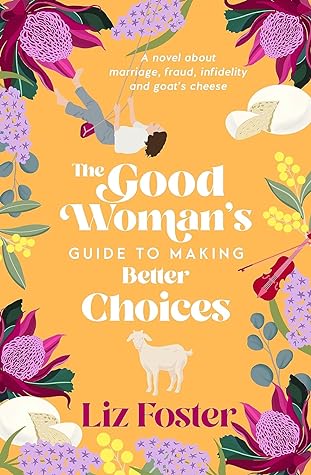
Liz Foster The Good Woman’s Guide to Making Better Choices Affirm Press, December 2023.
Thank you, NetGalley, for providing me with this uncorrected proof for review.
With its strong beginning The Good Woman’s Guide to Making Better Choices promises much. What could be more attractive than a penthouse with a view to Bondi Beach as a setting? However, as the lift to the penthouse rises after Libby answers the intercom and invites its occupants, one showing a police badge, into her life this scene is shattered. Ludo, her husband, ends the prologue with an apology.
Chapter 1 leaves the Bondi penthouse behind with a return to the past in rural Victoria. Here, Foster regales the reader with some lovely comedy – Kim Kardashian being told to hurry? Residing in an abode with an old five bar gate and a gravel drive? The goat farm introduces Maggie and Ana, Libby’s mother and daughter, her aunt Dido, together with the mention of friend Hazel and her parrot Miss Marple. The visit to the farm recalls Libby’s happy childhood with her brother Evan and their mother. The absence of a father has had little impact on their lives with their mother and aunt, friend Jake, the goats and the business. Books: Reviews for the complete review.
After Covid update: NGA EMILY KAM KNGWARRAY; Australia’s pandemic strategy; Pat Dodson Retires; Dale Spender.
Covid update for Canberra

On 1 December there were 411 new cases, with 14 hopitalised and none in ICU or ventilated. Records do not include those people who isolate at home after testing positive with a RAT and do not advise the authorities.

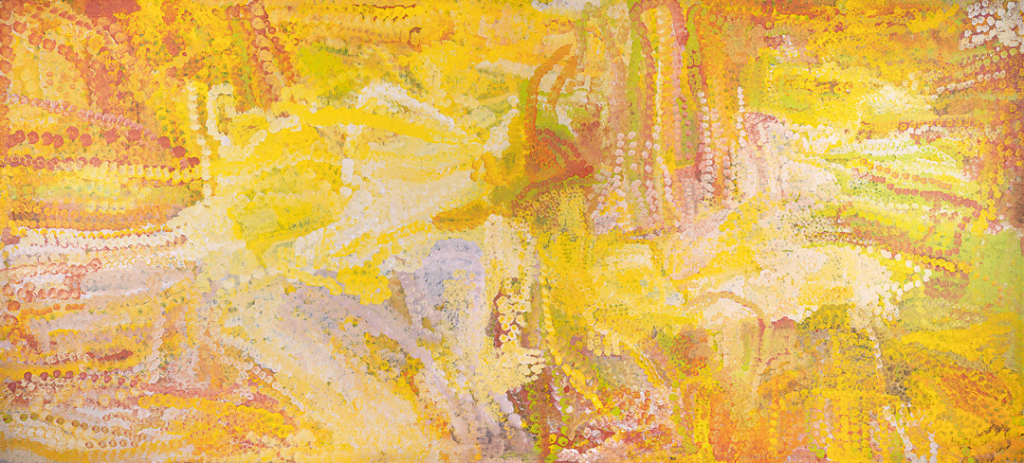
| EMILY KAM KNGWARRAY 2 Dec 2023 – 28 Apr 2024 | Ticketed ‘Emily Kam Kngwarray: stunning retrospective brings perspective – and agency – to an Australian great’ – Paul Daley, The Guardian Bringing together works created over the span of Emily Kam Kngwarray’s short but extraordinary career, this exhibition is a rare opportunity to see one of Australia’s most celebrated artists from the heart of the Country, in one unforgettable experience. Book your tickets and make the most of your visit with the exhibition audio guide, illustrated publication and guided tours.BOOKSign up as a National Gallery Member and see Emily Kam Kngwarray for free. Plus, enjoy great art and benefits for 12 months. Join today. |
New COVID data shows how Australia’s pandemic strategy compares with other countries
By the Specialist Reporting Team’s Leonie Thorne
Posted Wed 29 Nov 2023 at 12:07amWednesday 29 Nov 2023 at 12:07am, updated Yesterday at 9:38am
abc.net.au/news/australia-covid-data-on-masks-tests-deaths-spending/103160238Copy link
Link copiedShare article
New analysis from the Australian Institute of Health and Welfare (AIHW) shows how much was spent on healthcare during the first three years of the pandemic.
And while it’s probably no surprise that governments spent billions of dollars fighting the virus, the numbers reveal individual Australians spent millions trying to protect themselves from the disease too.
The analysis also sheds light on how Australia’s COVID-19 response stacks up when compared to other countries.
Here are some of the key takeaways.
COVID-19 was not kind to our hip pockets
Soon after COVID-19 arrived in Australia in January 2020, we spent millions of dollars trying to protect ourselves from it.
Collectively, Australians had spent about $12.1 million on respirators, face masks and face shields and almost $34 million on hand sanitiser by July 2020.
In the years that followed, spending on sanitiser basically halved each year while we increased our spend on face masks.
But the biggest expense of all was rapid antigen tests (RATs), which cost Australians close to $597 million in the 2021-22 financial year.
Health economist Martin Hensher said the changing spending behaviour over the years likely reflected what products were available at the time.
“Rapid tests didn’t even exist at the beginning of the pandemic, and respirators and face masks were in incredibly short supply,” he said.
“If you think back, you know, we were all initially making our own masks because it was extremely difficult to source even surgical masks.”
Australians also spent $1.3 million out-of-pocket on TGA-approved COVID-19 treatments, including the antiviral Paxlovid.
All up, over three years, Australians spent $878 million on COVID-related products. Divided by our current population it is about $33 per person.
These numbers reflect what individuals in the general population bought and don’t include spending by organisations like hospitals.
It also doesn’t include spending on other items you might buy to get yourself through a COVID infection, such as painkillers or cold and flu tablets.
The countries that spent more on fighting COVID — but with worse results
Diving into the data, it’s clear that when it comes to healthcare spending and excess deaths, Australia has fared pretty well compared to other countries included in the AIHW analysis.
Unsurprisingly, the pandemic meant most OECD countries spent more than expected on healthcare.
The following chart shows how much different countries spent on their health system between 2020 to 2022, relative to what they were expected to spend before COVID-19.
Australia is pretty far down the list, with health spending growing by less than 2 per cent over what was forecast during the pandemic.
Some places, like Japan, Chile and Mexico, actually spent less than expected on healthcare.
But looking at the excess mortality rate — which is how many more people died than would be expected — paints a striking picture.
Mexico, which had the lowest health system spending compared to its trend, had the highest excess mortality rate. By January 2021, the country had lost 150,000 people to COVID.
However Japan, which also spent less than expected on health care, had one of the lowest excess mortality rates in the world.
Like Japan, Australia also had one of the world’s lowest excess mortality rates.
But the reasons behind their successes were very different, said Jaya Dantas, a professor of international health at Curtin University.
“Japan was indeed an interesting case with a low death rate despite an ageing population,” she said.
“This can be attributed to a number of factors – an already healthy population, mask wearing even before the pandemic, extensive vaccination uptake, free medical care, and social compliance with public health measures.
“So, with very few restrictions, they managed the pandemic really well.”
Meanwhile, Australia closing its borders early and putting strict lockdowns in place played a large role in reducing both healthcare spending and excess deaths, Professor Dantas said.
“Our population is also lower [than densely populated OECD countries], quarantine measures were in place, testing and contact tracing at the height of the pandemic and then successful roll out of vaccinations … were all important factors that helped us,” she said.
However, even though it is low compared to other countries, Australia’s 4.4 per cent excess mortality rate still meant 22,000 extra people lost their lives.
Hospital spending on COVID-19 has grown every year
Our governments spent billions on responding to COVID-19, chucking money at everything from supporting businesses and workers through JobKeeper to helping people with disaster payments.
But compared to what Australia spent on the economy, the amount spent on actually treating COVID-19 was relatively small.
The government’s COVID-19 hospital spend came close to $12 billion in the three years to June 2022.
In the first year of the pandemic, when shutting the borders and implementing lockdowns helped slow the spread, less than $2 billion was spent on COVID in hospitals.
By the next year, when there were thousands more cases and hospital admissions, this doubled.
In the 2021 to 2022 financial year, when we said goodbye to lockdowns, the number of COVID-19 cases skyrocketed, and the AIHW’s report revealed a $6.1 billion spend on hospitals.
However, Dr Hensher said this could have been worse.
Estimates vary, but research shows COVID-19 measures helped Australia save thousands of lives and hospitalisations.
“If we let it rip [and we saw] the same sort of rates as, say, the UK or the US … we would have been spending many, many more billions of dollars on treating them,” he said.
Posted 29 Nov 202329
Why, oh why couldn’t we have passed The Voice Referendum?
Pat Dodson Retires
From – ABC News Homepage
Pat Dodson, a dignified diplomat, is a rare politician. He will leave behind a cavernous hole in Canberra
Analysis Pat Dodson, a dignified diplomat, is a rare politician. He will leave behind a cavernous hole in Canberra
Indigenous Affairs Editor Bridget Brennan
Posted Wed 29 Nov 2023 at 12:20pmWednesday 29 Nov 2023 at 12:20pm
abc.net.au/news/pat-dodson-retires-rare-politician-indigenous-leader/103164756Copy link
In what has often been a dispiriting year for his people, Senator Pat Dodson must have hoped his departure from Canberra aligned with a more hopeful outlook for reconciliation.
It wasn’t to be.
Announcing his retirement, the “Father of Reconciliation” leaves an immense legacy, but the resounding No vote on the Voice was a reminder of divides that are still entrenched.
His departure from the parliament will leave a cavernous hole in Canberra as he takes with him a dignified approach to diplomacy and a lifetime of hard-won battles in the fight for his mob.
Pat Dodson to retire on January 26
Dodson, who has been battling cancer, says he is leaving politics because he can no longer discharge his duties as a Western Australian senator.
He has been an elder statesman in the parliament, commanding respect from both sides of the aisle. As Prime Minister Anthony Albanese said: “There are few more reassuring sights in parliament than seeing Patrick and his hat coming down a corridor towards you.”
It was a great shame that Dodson was not able to play a greater part during the referendum campaign. He has a way of cutting through spin and lies with a calm and commonsense pragmatism often missing in our national debate.
Typically understated, the Yawuru man says he is grateful for the opportunity to play “a little part” in political life.
“I do leave this place with some sense of sorrow, in that as a nation we were not able to respond positively to the referendum. I think that would have helped our country.”
A lifetime of experience, wisdom
Dodson, thought to be Australia’s first Aboriginal Catholic priest, has been a rare politician. Someone who came to politics late in life, but who brought a lifetime of experience and wisdom.
The term “Indigenous leader” is overused but Dodson was exactly that — and balancing his ministerial and cultural obligations cannot have been easy.
As a 75-year-old Aboriginal man, he has also lived through the White Australia Policy, a witness to an Australia that few in Canberra would be able to fathom.
He was an integral player in the land rights movement and passionately spoke about the pain of the Stolen Generations, having watched on as many of his contemporaries were forcibly taken from their parents.
Interviewing Senator Dodson was always a treat. He didn’t trade in stock-standard news grabs, double-speak or dodging. Instead, he was honest, interesting, fiercely intelligent and pragmatic.

No matter the debate about Indigenous affairs, he would always remind journalists to study Australia’s history to understand the existing structural issues that have led to the subjugation of his people.
His speech marking 30 years since the Aboriginal deaths in custody royal commission was a landmark moment in the parliament. Dodson was a commissioner and he could still recite passages from the inquiry and each careful recommendation, many of which, to this day, have never been properly implemented.
He decried the hundreds of deaths of young prisoners as an “awful blight on this nation’s history”.
The parliament would be richer if more elders of Dodson’s calibre were to follow him into the chamber. It’s fitting that a new generation of Aboriginal politicians will carry his legacy and his lessons.
Posted 29 Nov 2023
Ceremony at the Chilean Ambassador’s Residence

Sally McManus, Michelle O’Neil and Bob McMullan receiving awards in recognition of their roles in helping the resistance to the right-wing coup in Chile in 1973 .
Dale Spender AM (22 September 1943 – 21 November 2023)
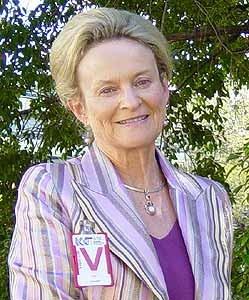
Jocelynne Scutt responded to the Courier Mail obituary for Dale Spender as follows:
A great read- she was a great woman, a great feminist and a great scholar…We live in a time lacking historical memory – sometime in the future a young woman will discover this great trove of books and remark upon the scope and sheer wit of Dale Spender’s work. Thank you for living such a wonderful life, Dale and bringing to us all your intellect abounding! Vale, Dale Spender – a one off gift to us from the goddesses!
Of the amazing list of publications below, I have only Man Made Language (at the moment!) The reviews of Man Made Language from Goodreads, from an early one in 2013 to the latest in 2023 make interesting reading.

Publications (from Wikipedia)
- The Spitting Image, Reflections on language, education and social class (Rigby, 1976). Co-author with Garth Boomer (ISBN 0-7270-0162-0)
- Man Made Language (Routledge & Kegan Paul, 1980)
- Learning to Lose: Sexism and Education (Women’s Press, 1980). Co-editor with Elizabeth Sarah
- Men’s Studies Modified: The Impact of Feminism on the Academic Disciplines (Pergamon Press, 1981)
- Invisible Women: The Schooling Scandal (Writers & Readers Ltd, 1982, Women’s Press, 1989)
- Women of Ideas and What Men Have Done to Them: From Aphra Behn to Adrienne Rich (ARK Paperbacks, 1982)
- Feminist Theorists: Three Centuries of Women’s Intellectual Traditions (Women’s Press, 1983). Editor.
- There’s Always Been a Women’s Movement This Century (Pandora Press, 1983)
- Time and Tide Wait for No Man (Pandora Press, 1984)
- For the Record: The Making and Meaning of Feminist Knowledge (Women’s Press, 1985)
- Mothers of the Novel: 100 Good Women Writers Before Jane Austen (Pandora Press, 1986). Includes a list of 106 little-known early women novelists.
- Series editor for Pandora Press Mothers of the Novel series (1986–89) which has republished novels by Mary Brunton, Frances Burney, Maria Edgeworth, Eliza Fenwick, Sarah Fielding, Mary Hamilton, Mary Hays, Eliza Haywood, Elizabeth Inchbald, Harriet Lee and Sophia Lee, Charlotte Lennox, Sydney Owenson, Amelia Opie, Frances Sheridan, and Charlotte Turner Smith.
- Scribbling Sisters (Camden Press, 1986) Co-author with Lynne Spender.
- The Education Papers. Women’s Quest for Equality in Britain, 1850-1912 (Routledge 1987). Editor.
- Writing a New World: Two Centuries of Australian Women Writers (Penguin Books, 1988)
- The Penguin Anthology of Australian Women’s Writing (Penguin Books, 1988) Editor.
- The Writing or the Sex?, Or, Why You Don’t Have to Read Women’s Writing to Know It’s No Good (Pergamon Press, Athene Series, 1989)
- Co-edited with Janet Todd, Anthology of British Women Writers: From the Middle Ages to the Present Day (Pandora, 1990)
- Heroines, Anthology of Australian Women Writers; with articles by Ruby Langford Ginibi, Eva Johnson and Diane Bell (Penguin, 1991). Editor.
- The Diary of Elizabeth Pepys (Grafton, 1991). A spoof of Samuel Pepys‘ excesses from his wife’s imagined diary
- Living by the Pen: Early British Women Writers (Teachers College Press, 1992). Editor.
- The Knowledge Explosion: Generations of Feminist Scholarship (Teachers College Press, 1992). Co-editor with Cheris Kramarae.
- Weddings and Wives (Penguin, 1994). Editor.
- Nattering on the Net: Women, Power and Cyberspace (Spinifex Press, 1995)[15]
- The Education Papers. Women’s Quest for Equality in Britain, 1850–1912 (Routledge 1987). Editor.
- Routledge International Encyclopedia of Women: Global Women’s Issues and Knowledge. 4 volumes. General editors: Cheris Kramarae & Dale Spender, 800 contributors (Routledge, 2000). Translated into Spanish and Mandarin.


 Robin's Room