BookTrib BookTrib Lit Picks First Chapters from the Hottest Books Meridian Editions, November 2023.

Thank you, NetGalley, for providing me with this proof for review.
I understand that this edition is available as an eBook download for people who subscribe to BookTrib, providing a valuable resource to readers who want to see what their favourite or familiar writers are publishing as well as finding new authors. Meryl Moss, publisher of BookTrib Lit picks refers to this publication as a ‘special holiday gift’, in her introduction to the inaugural edition launched in ‘Holiday/Winter 2023. Of course, winter is in different months depending on the hemisphere, but I assume that the winter referred to here is in the northern hemisphere. I prefer the month of publication to be clear wherever the reader is located, but using seasons is an affectation of many journal publishers, so BookTrib is not alone.
The first chapters of numerous books are featured, ranging from the familiar Jane Corry to less familiar, for books published as early in 2020 to those anticipated in 2024. Publishers are independent and traditional, providing an interesting range of works that provide the opportunity to compare the standing of books published by different methods. Having attended a Guardian Workshop, in the years around 2012 where the merits of various forms of publishing were discussed after excellent presentations on behalf of the types of publishing, I believe that excellent books (and poor ones) can be published in either of the forms – traditional or independent. This collection fulfils this belief – first chapters from both types of publishing stand out as substantial examples of their genre. See Books: Reviews for the complete review.
After the Canberra Covid update: NSW Covid Report; Girlboss Feminism- Michelle Arrow; ‘Funny-looking solution’ could be answer to food waste; Cindy Lou at Kopiku.
Covid Canberra (Reporting from 29 December to 4 January 2024) and NSW increase in Covid cases.

There were 120 new cases in this period (no results from RATs, PCR only). Twenty people are in hospital with 2 in ICU. None is ventilated and no lives were lost in this period in Canberra.
NSW reports highest level of COVID in a year as those infected with the virus are reminded to stay home
By Jesse Hyland
NSW health authorities are calling on those who contract COVID to stay home and take precautions to limit its spread as the state grapples with its highest level of the virus in a year.
Key points:
- NSW has recorded a significant rise in COVID infections
- Two variants are responsible for most cases in the state
- Those with the virus are urged to stay home or wear a mask outside
A new COVID wave has swept across the state over the holiday period, with two variants being behind the bulk of infections being reported.
Dr Jeremy McAnulty revealed about 1,400 people in the state were presenting to emergency departments with the virus and about 400 were being admitted to hospital each week.
“That’s just people presenting to hospital, so we know there are many more people out there who, fortunately, are not sick enough to require hospitalisation or a visit to the emergency department,” he said.
“This reflects a high level of COVID activity in the community at the moment.
“We’re seeing the highest level of COVID in a year.”
New variants behind the rise
Testing has revealed the EG.5 variant has been responsible for about 40 per cent of recent cases and the JN.1 variant has accounted for about 35 to 36 per cent of infections, according to Dr McAnulty.
“We’re seeing a variant called EG.5 and an emerging variant called JN.1, which has been very infectious in many parts of the world,” he said.
“Each of these new variants appears to be more infectious, they’re getting a mutation. It’s kind of what viruses do, they mutate to get around our immune system.”
There’s no evidence JN.1 poses a greater health risk than other COVID-19 variants.
How long should you self-isolate now COVID-19 cases are on the rise again?
Dr McAnulty recommended those in NSW who test positive to the virus to stay home or wear a mask if there’s a need to go outside.
“Stay at home if you’ve got symptoms, until those symptoms resolve. If you need to go out for essential reasons, then wear a mask,” he said.
“Don’t go visiting other people, particularly people at high risk, particularly don’t go to aged care facilities or residential care facilities or disability services.”
He also urged people to get a booster when required to increase immunity to the virus.
More on Girlboss Feminism
See also my review of Kim Hong Nguyen’s Mean Girl Feminism in the post of 15 November, 2023.

The following article is republished under Creative Commons from The Conversation: December 6, 2023 10.33am AEDT.

Asher Keddie is outstanding in Strife – but the show gives us an uneven look at girlboss feminism
The inner workings of magazines, television stations and newspapers have been rich fodder for film and television for decades.
From All the President’s Men (1976) to Frontline (1994–7), Paper Giants: The Birth of Cleo (2011) and The Newsreader (2022–3), we remain fascinated by stories of how our media are made. These kinds of films and series immediately immerse viewers in a precise historical setting and allow commentary on it. This year’s series of The Newsreader reminded us of the divide in Australian culture over the bicentenary commemorations of 1988.
Set around 2012 (when Tinder was a “new app”), Strife is a fictionalised adaptation of Mia Freedman’s 2017 memoir, Work Strife Balance, which told the story of starting her hugely successful women’s website Mamamia in her lounge room in 2007.
By 2014, the site was attracting 2 million to 4 million women a month and Freedman was famous. In the mid-2010s she was one of Australia’s most highly visible feminist faces, dropping soundbites on Sunrise and writing confessional essays about her life.
Freedman was relatable yet highly successful, a “busy mum” who was open about her shortcomings and the moments where the “wheels fall off”.
Strife’s Evelyn Johnson (Asher Keddie) is a spikier, colder figure than Freedman appears to be. She is running Eve, a new women’s website, but she’s two months behind on the rent. She has left her marriage and is living alone in a city apartment; she is co-parenting two teenage children with her estranged husband (Matt Day).
Evelyn is singularly focused on making her website work. She is tough on her writers, a bit forgetful about her children’s activities, and doesn’t really know how to cook. Here, the series treads a fine line between making Evelyn relatable and simply foolish: turning up to her daughter’s hockey game with the halftime oranges still in their string bag, or trying to make a last-minute family meal with a slow cooker.
The art of the confessional
As the series begins, Evelyn is struggling with writer’s block – not great timing for an editor running a site that is losing money. But by the end of the first episode, she writes a piece called “I ended my marriage over a flat white”.
It goes viral, and Eve has found its formula.
Evelyn tells one of her writers who is nervous about exposing her personal life for clicks “it can be empowering to share if you’re the one telling the story”.
Strife has an impeccable pedigree for a bingeable women’s drama: it was produced by Bruna Papandrea, whose credits include Big Little Lies, and it stars Asher Keddie, one of Australia’s most bankable television stars. Eve’s writers are a diverse bunch, oversharing and endlessly scrambling for story ideas. The series is set in the world of Sydney’s eastern suburbs, full of well-dressed women dropping their kids at private schools in 4WDs.
In other words, it is aspirational – and more than a little oblivious about the privileged world it depicts.

Despite claiming to be a “feminist publisher”, Evelyn shoots down most politically and socially aware story ideas because they won’t “get clicks”. The success of Eve is measured entirely in page views, clicks and advertising deals. Hiring young women to work as unpaid interns also seems at odds with Evelyn’s feminist credentials: indeed, one tells Evelyn she “can’t work for free”.
Evelyn’s relationships with her family and friends are the other main subject of the drama. A quick check of her browser history reveals her son is watching porn; she tries to broach the subject of buying a first bra with her daughter; a friend has put a profile of her husband on Tinder because she doesn’t want to have sex with him anymore.
While all of these topics would work for an Eve confessional essay, the series breezes over them far too quickly to capitalise on their dramatic potential.
A uncertain tone
Strife’s brand of feminism – where empowerment comes from telling personal stories online – is very much of the mid-2010s, when women’s online media were on the rise.
As gender studies academic Kath Kenny points out, confessional story-telling emerged at the same time media budgets were being cut: after all, confessions don’t require research or reporting. While this kind of writing can raise awareness of important issues, it’s not enough to solve them. “Girlboss feminism” is still with us, unfortunately, but I think we know now that we won’t solve the gender pay gap or domestic violence with mere “empowerment”.
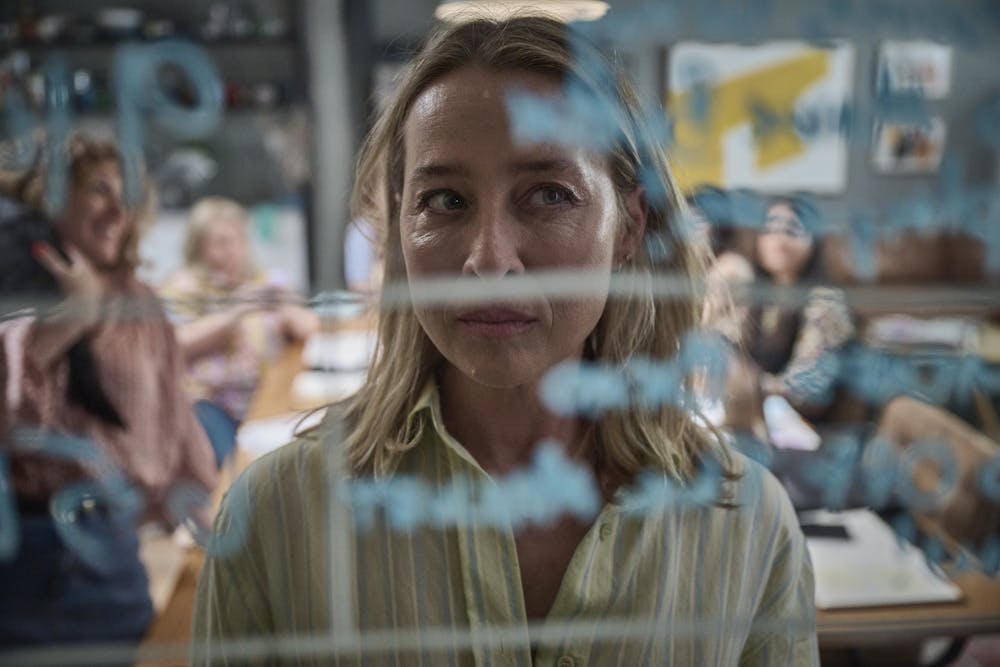
Keddie’s brittle performance here recalls her outstanding work in Love My Way, where she wasn’t afraid to make her character unlikeable. Tina Bursill is cool as ever as Evelyn’s mother, and Maria Angelico is terrific as Eve’s editor.
But despite some wry jokes, the series’ tone is uncertain, and Evelyn’s confessions are largely of other people’s experiences. Perhaps if Evelyn was more willing to confront her own shortcomings we’d have the making of real drama.
Strife left me with the jittery feeling you get after spending too many hours in an office in front of a computer screen. Which, considering that’s probably how Eve’s writers feel, might be quite the achievement.
Strife is on Binge from today.
- More about Michelle Arrow, whose works seems well worth following.

Michelle is professor of history at Macquarie University. Her first book, Upstaged: Australian Women Playwrights in the Limelight at Last, (Currency, 2002) and was shortlisted for five national prizes in 2003. Michelle was a presenter on the ABC TV history series Rewind in 2004. Her second book, Friday on Our Minds: Popular Culture in Australia since 1945 (UNSW Press 2009) was shortlisted for the NSW Premier’s Australian History Prize. She won an ALTC citation for her teaching in 2010. Michelle served on the advisory panel of the Prime Minister’s Prize for Australian History between 2009-12. She has published numerous book chapters and articles on topics ranging from the Lindy Chamberlain case, the history of the women’s movement, Helen Reddy’s feminist anthem I Am Woman, reality history TV, Australian popular culture, and the representation of history on television. She has held research fellowships at the National Archives of Australia and the National Library of Australia. Her most recent book, The Seventies: The Personal, The Political and the Making of Modern Australia (NewSouth 2019) won the 2020 Ernest Scott Prize for History.
‘Funny-looking solution’ could be answer to food waste

Sezen Bakan
Jan 06, 2024, updated Jan 06, 2024
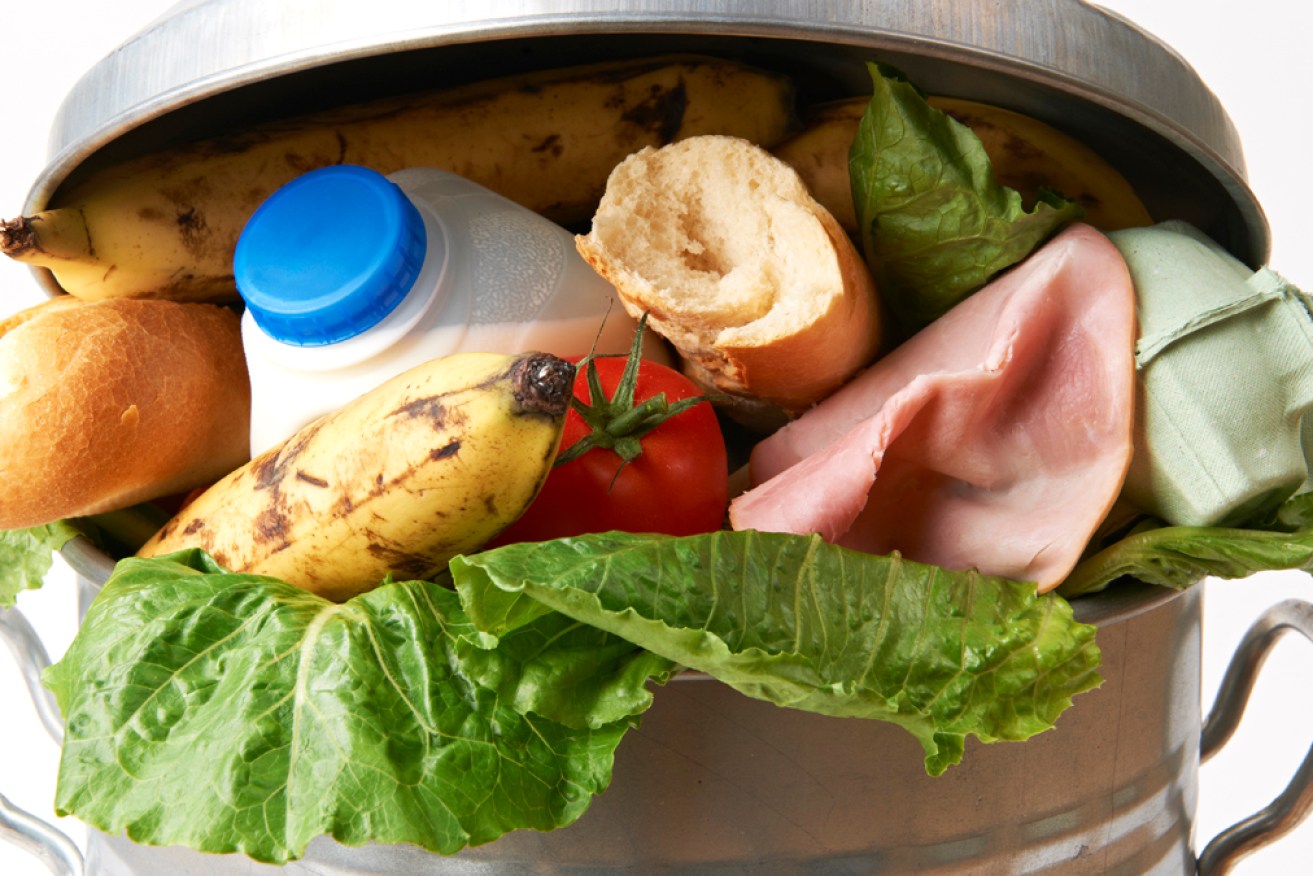
It may not look as appealing as we expect. But that might be the key to resolving the issue of food waste. Photo: Getty
Many of us enjoy biting into a perfectly glossy apple, or chopping a pleasingly-symmetrical capsicum – but our desire for perfection in fresh produce has an alarming downside.
It creates a huge amount of food waste, with millions of tonnes of fresh fruit and vegetables left to rot on farms simply because they don’t meet big retailers’ cosmetic standards.
Alarm at that waste is driving clever ideas to make better use of Australia’s abundant produce.
A recent addition to the ranks is Offbeat Harvest. Founder Alex Dask said he was inspired after learning how much of an issue food waste is in Australia.
Food rescue charity OzHarvest says Australia wastes more than 7.6 million tonnes of food every year. More than 2.5 million tonnes of that is from farms and primary producers.
Half of all fresh produce never even gets off the farm where it is grown because one of the key reasons for dumping it is that it doesn’t meet supermarket standards.
Food left rotting on farms
Dask said he didn’t feel the major supermarket chains would have any real drive to solve the problem because produce with cosmetic issues (the blemished, the misshapen and the otherwise unattractive) tended to sit longer on shelves.
Dask started Offbeat Harvest in late 2023. It offers a subscription model that sends boxes of “imperfect” produce to customers at prices it claims are 40 per cent lower than the regular retail market – billed on its website as “the funny-looking solution”.
OffBeat Harvest so far works with 10 farmers to fulfil orders across greater Sydney. Dask said many of those farmers had tales of tonnes of produce left to rot on their land.
A longer-than-usual cucumber or a bumpy carrot are just as good to eat as picture-perfect versions. Photo: OffBeat Harvest
And the issue goes beyond wasted food – it’s also environmental.
Keeping it fresh: Delicious salads that make the best of summer’s bounty
An OzHarvest spokesperson said about 10 per cent of global greenhouse gas emissions came from food waste.
In Australia, this represents 17.5 million tonnes of CO2 each year.
“I feel like startups are filling that gap in taking the responsibility to educate the market,” Dask said.
“One of the advantages [to] a lot of these startups that are popping up in this space is we are just focused on this imperfect range.
“Therefore, we need to ensure that we’re educating the market about the benefits, which primarily is a cost benefit at this stage … But beyond that, I think there’s that broader education piece of … ultimately improving [the issue of] food waste here in Australia.”
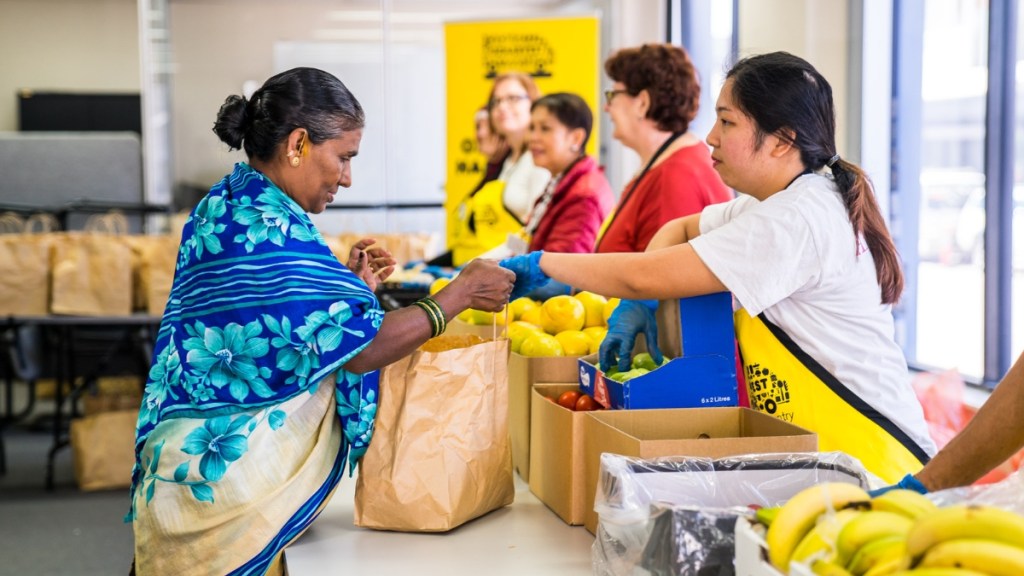
‘Ugly’ fresh produce could be part of the answer to helping Australians struggling with the surging cost of living. Photo: OzHarvest
Innovation key to easing food waste
OffBeat Harvest is one of several start-ups that have emerged in recent years to try to resolve the issue of food waste. Others include Farmers Pick, Good & Fugly, Funky Food and OddProd.
Major retailers such as Coles and Woolworths also offer ranges of imperfect fresh produce.
Efforts to redirect food waste have also led to apps such as the Woolworths-backed Refresh:Food. It offers a platform for farmers to sell surplus or imperfect food.
The OzHarvest spokesperson pointed to innovation as a crucial way to resolve the national issues of food waste and food insecurity.
“We’ve all seen some of the weird, wonky and wonderful shapes of so-called ‘imperfect’ produce, but the truth is it all tastes the same,” they said.
“Consumers have been conditioned over years of buying perfectly sized vegetables, so both consumer and supermarket standards lead to perfectly edible produce not being sold.
“With cost-of-living pressures increasing, the number of people who are food insecure, it’s crazy to be wasting good quality, nutritious food when there are people who could eat it.”
The spokesperson said OzHarvest, alongside Foodbank Australia and SecondBite, was also advocating for a national tax incentive for farmers and logistics companies to help get perfectly edible food from farms to plates. They said other countries had reaped “huge benefits” from similar policies.
For example, in the US, businesses that donate food inventory to qualified organisations are generally entitled to tax deductions; in France, businesses also receive tax breaks for donated food.
Master Chef UK has a valuable and interesting task that encourages viewers to see that the remains of food can be used to advantage. Chefs are required to prepare a meal from the residue of meals for which the finest cuts of meat, fish and vegetables have already been used. Most contestants make excellent meals from what is left behind because they are innovative and resourceful. They manage this under the pressure of competition, it seems a small ask that home cooks manage to do similarly on occasion.
Cindy Lou breakfasts at Kopiku, O’Connor
Kopiku is a great breakfast, lunch and afternoon coffee venue that bravely started under the difficulties of Covid 19 and the attendant controls on cafes. The owners’ pleasant and efficient service, the wide-ranging menu that includes Indonesian meals as well as familiar breakfast and lunch dishes such as seen in the photos below and includes delicious rustic pizzas and the reasonable prices make this a popular site.
Indeed, when the new owners took over the customers who had found other cafes under the previous ownership hurried back, expressing their delight at the change as we drank our coffees, enjoyed the food, found our dogs welcome, and most importantly were greeted with smiles. On their return from holidays this week one owner said how pleased they were to be back – they had missed the shop.

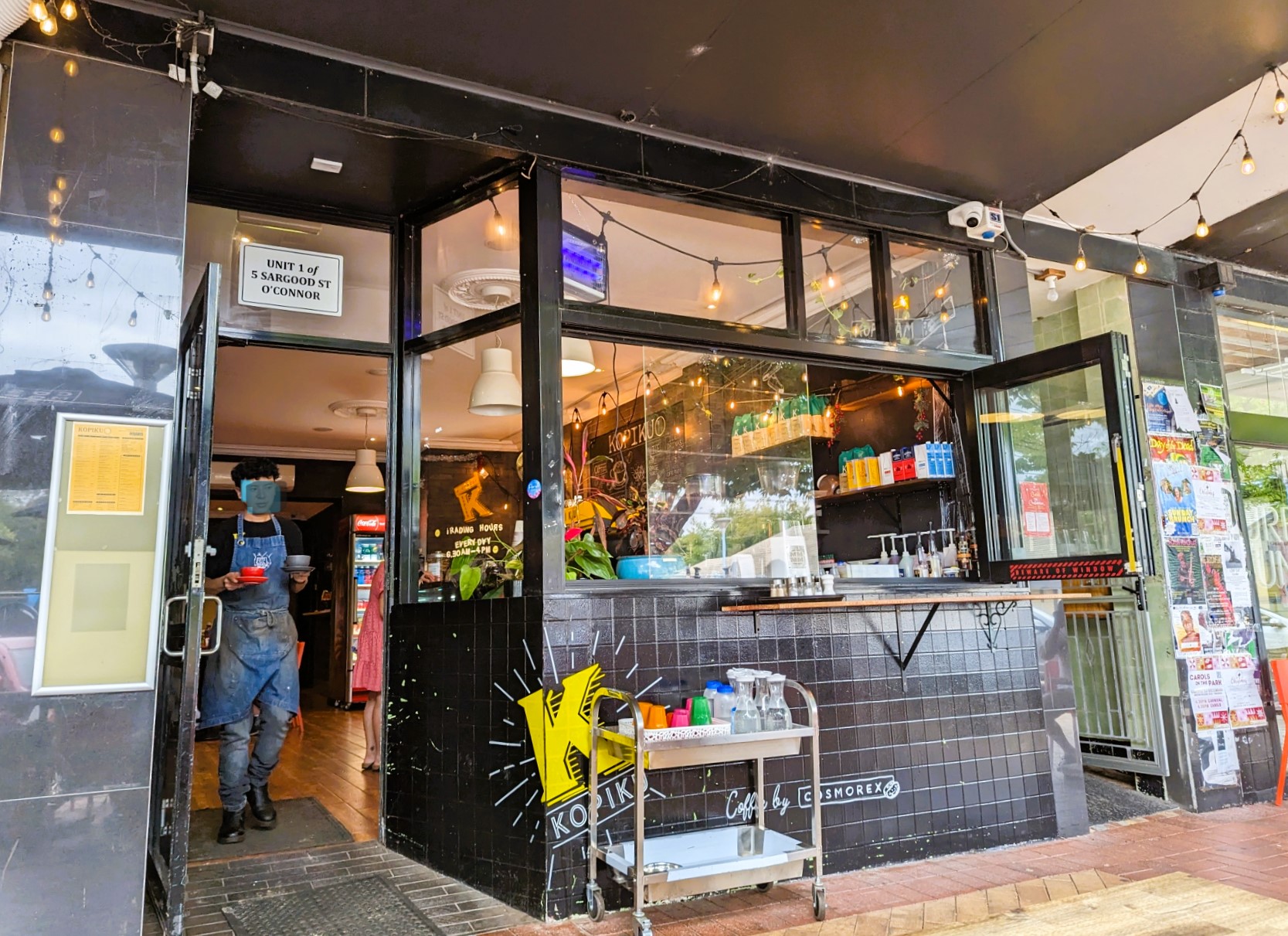
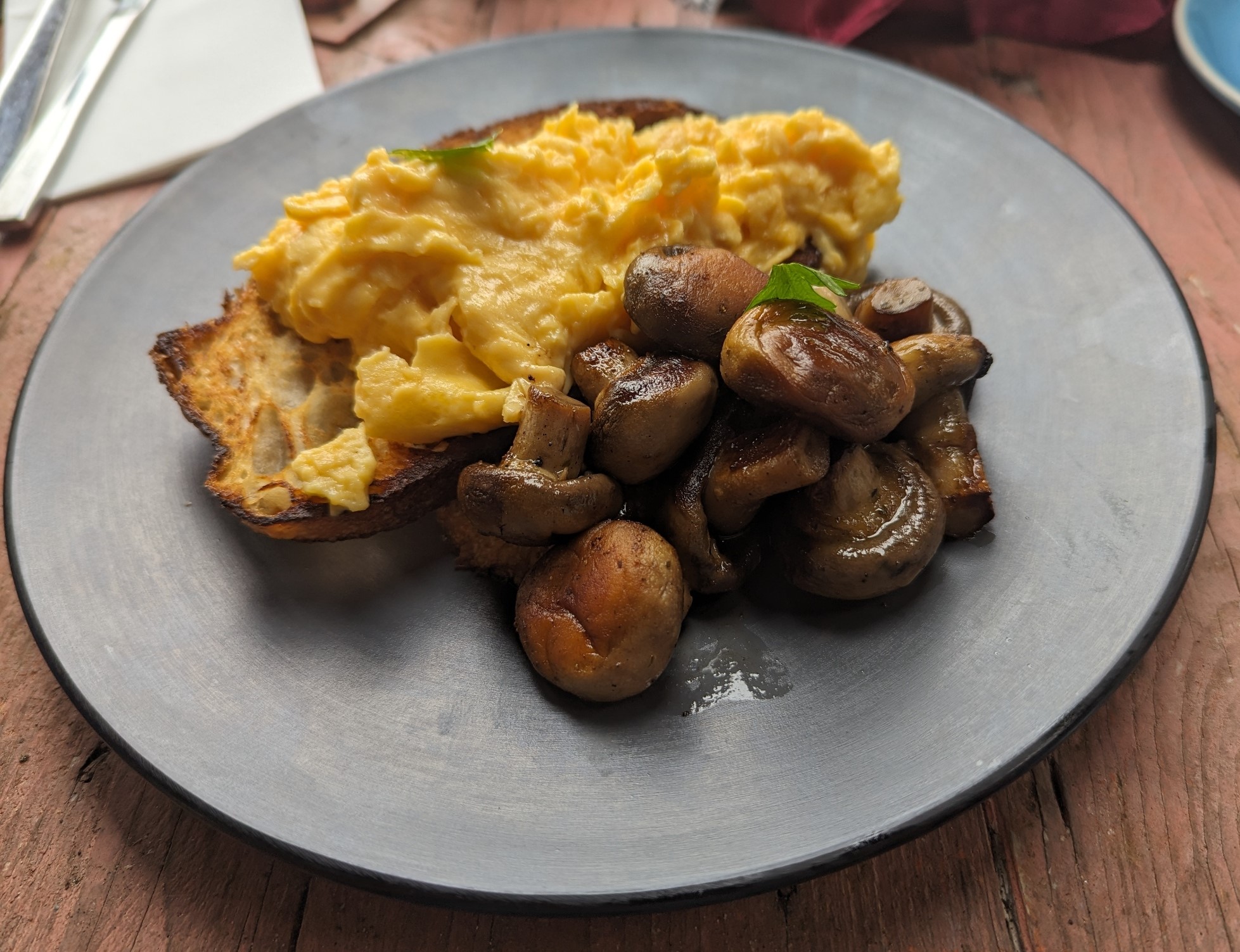
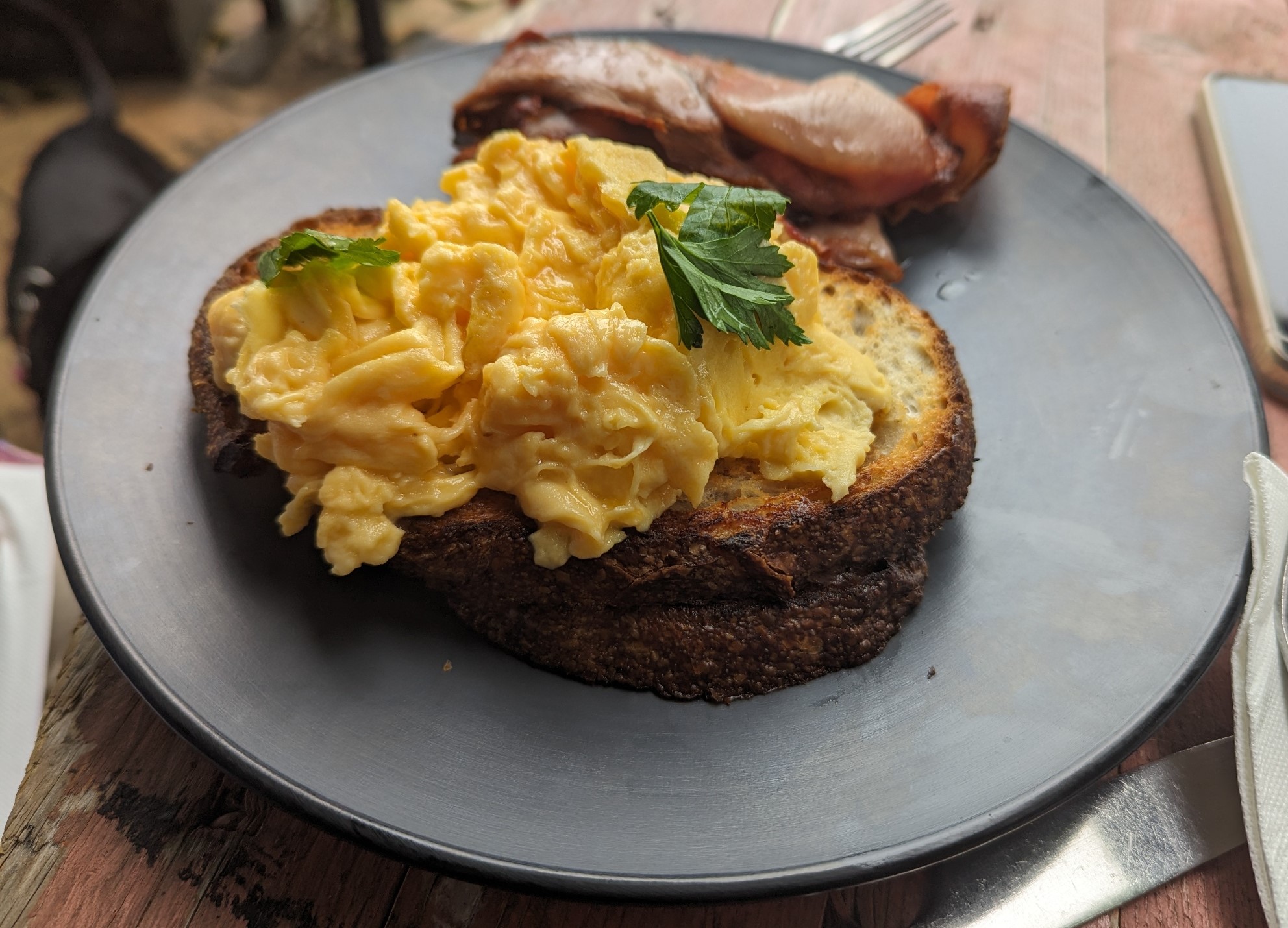

There is indoor and outdoor seating, the latter enjoying the shade of trees and umbrellas when necessary. The tables are large enough to accommodate several customers, or in our case, Leah’s bag of treats, some shopping, the ubiquitous phone, and of course, delicious meals and good coffee.

 Robin's Room