
Kathryn Atherton Mary Neal and the Suffragettes Who Saved Morris Dancing Pen & Sword History, January 2024. *
Thank you, NetGalley, and Pen & Sword History for providing me with this uncorrected proof review.
Reading Katheryn Atherton’s book has been an absolute delight. It is well written, with the usual Pen & Sword accessible language, format and lightness of touch, while providing a wealth of well researched information. Mary Neal and the Suffragettes Who Saved Morris Dancing includes information about women’s suffrage organisations and personnel, with marvellous vignettes of the most active, and details of the action in which the women participated; the background to Morris Dancing, highlighting the divergent views of how it should be understood, appreciated and developed; and the significant social history associated with Neal’s work and her commitment to changing the lives of women from a very different class from her own and her companions in the suffrage organisations involved in saving Morris Dancing.
The exploration of the suffragette contribution to restoring Morris Dancing to its former prominence after it had died out by the early 20th century begins with Mary Neal’s work with young working-class women in St Pancras. The role of her club, the Esperance, in the resurrection of this dance form, and as part of Neal’s commitment to women and girl’s rights makes a stirring story. So, too does the all too familiar falling out over the way in which Morris dancing should be executed – or was it just that a man wanted a prestigious role? This part of the book makes remarkably interesting reading from a feminist perspective as well as for anyone for whom dance and the manner in which it should be performed, observed and understood is an issue. See Books: Reviews for the complete review.
Covid report: Australia figures
The latest COVID-19 news and case numbers from around the states and territories (edited)
COVID-19 cases by jurisdiction (as at 22 January 2024)
Western Australia – 978 new cases; South Australia 4,305 new cases; Northern Territory 187 new cases; Queensland 4,712 new cases; New South Wales 9,980 new cases; Victoria 3,639 new cases; Australian Capital Territory 327 new cases; and Tasmania 1,929 new cases.
Note: Due to changes in testing and reporting requirements, the number of COVID-19 cases is an underestimate of the actual disease incidence.
ABC News Source: Department of Health and Aged Care
As school holidays come to an end and people return to work, Australians are reminded to take precautions against another “substantial” wave of COVID-19.
There are currently more than 26,000 active cases of COVID-19 across the country, according to the federal government’s latest daily figures.
Professor Kelly says the spike in cases since early December is driven by a new variant called JN.1, which descended from Omicron.
“People are kind of sick of it,” Professor Kelly says.
“Their lived experience of COVID now is nowhere near as severe for most people compared with earlier in the pandemic, but it is still a serious issue for those that are more vulnerable to severe disease.”
He reminds Australians to keep their vaccinations up to date.
From Labour List, British Labour Party
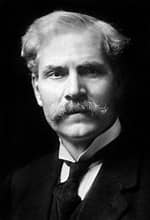
John Cruddas
On this day 100 years ago, the first Labour government was elected. For Labour’s first Prime Minister Ramsay MacDonald it was “an insane miracle”.
The government was defeated just over nine months later, yet it proved to the country that our party was willing and able to govern.
To mark the centenary, LabourList is publishing a series of articles that look back over Labour’s sprawling, turbulent history.

Elected in 1906 as one of twenty-nine Labour MPs.
Labour has achieved many extraordinary things, including the introduction of the welfare state, the National Health Service and pioneering equalities legislation. Yet it has held power for just 33 years.
Only three of Labour’s many leaders, Clement Attlee, Harold Wilson and Tony Blair, have won a general election. If this year Keir Starmer becomes the fourth, it will be an historic achievement.
Nan Sloane

Margaret Bondfield
This year sees the centenary of the first Labour-led government, and the first government in which a woman – Margaret Bondfield – held any kind of ministerial post, serving as parliamentary secretary to the Minister for Labour. As Labour took office, it was a very different party from that of the pre-1914-18-War years, and one of the main reasons for that was that the majority of its members were now women.
The 1918 Representation of the People Act gave the vote to all men and to women over the age of 30 who met a property qualification, either directly themselves or through their husbands.
As a result, although any woman over the age of 21 could stand for Parliament, about 40 percent could not vote. Thus Ellen Wilkinson, first elected to Parliament in 1924, was unable to vote for herself because she did not meet the property qualification.
In 1914 the Labour Party had been a loose grouping of more-or-less like-minded affiliates, but in 1918 the introduction of individual membership made it a mass membership organisation.
However, although working-class men tended to stick with their affiliated trade unions and exercise their political rights through that route, women, who had much less presence in the trade union movement, joined the Labour Party as individual members very quickly in large numbers. In 1918 there were just 5,000 women members, but within three years this had risen to over 70,000 and continued to grow throughout the decade.
The Women’s Labour League (WLL), an independent organisation of women affiliated to the Party before 1918 (and the last women’s affiliate until Labour Women’s Network affiliated nearly a century later) was absorbed into the Labour Party and its branches became Women’s Sections. As part of the deal, and in the earliest known use of a quota, women were guaranteed four places on the National Executive Committee (NEC). The WLL Secretary, the redoubtable Marion Phillips, became the first National Woman Officer.
To cater for the new women members an entire organisational structure was built to support them. Each region had a Woman Organiser whose job it was to develop women’s sections, provide them with political education and train them for election work. Various bodies were set up to bring women together and to connect them to the mainstream of the movement, and Women’s Conference met annually as a delegate body. Women were also encouraged to stand for public office, although as might have been predicted many found it difficult to find winnable seats.
Perhaps unsurprisingly the sudden arrival of women into the Party with their own structures and conference led to a build-up of tension and disagreement both between women members and the Party leadership, and between women themselves.
Leading men were often alarmed to find that the issues women wanted progressed were not what they thought they ought to be, and that women had demands which were at variance with their traditional roles.
One of the major issues that the new Labour government took on in 1924 was housing. Because poor housing was considered to be (and still is) a major factor in poverty and ill-health, responsibility for it lay with the Minister of Health, John Wheatley, and his Parliamentary Secretary, Arthur Greenwood.
After the War many women had been forced back into their homes by post-war employment policies which had systematically removed them from the workplace in order to accommodate men returning from the trenches.
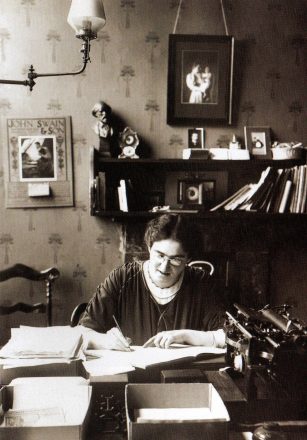
As talk of ‘homes fit for heroes’ increased, Marion Phillips and Averil Sanderson-Furniss noted in an article in The Labour Woman in 1918 that: ‘The working woman spends most of her time in her home, yet she has nothing to do with its planning. It’s time this state of affairs ended.’
Unfortunately, neither Liberal nor Labour Health Ministers agreed, and Wheatley failed to consult even the most senior Labour women when drawing up his (otherwise rightly praised) Housing Act in 1924. This state of affairs continued for many years; in the 1940s Labour women like Margaret Bondfield were still trying to persuade their colleagues that women might have something significant to say about housing.
A more controversial issue was access to birth control, which many Labour women believed was the key to improving women’s health, decreasing maternal and infant mortality and reducing poverty. However, Wheatley was adamantly opposed to it, even suggesting that if ‘respectable’ women arrived at maternity clinics to find birth control advice on offer they would be put off attending at all.
Both the Parliamentary Party and the NEC backed Wheatley. Marion Phillips was also hostile on the grounds that supporting birth control would be an electoral liability, an early example of the mistaken belief that controversial issues are to be avoided at all costs by parties wishing to be elected.
By the time Labour returned to government in 1929, however, opinion had begun to change. Greenwood became Health Minister with Susan Lawrence as his Parliamentary Secretary and in 1930 local authorities were allowed to offer birth control advice if they wished.
As Keir Hardie had remarked before the War, it was never likely that men would surrender power simply because they were asked. Like many other parts of society, Labour has struggled over the last century to accommodate the full diversity of the electorate it serves.
There is still a long way to go, but the progress the Party has made and is making is at least in part down to the persistence of those first women who joined in 1918 and began to make their voices heard.
This article is part of a series to mark the centenary of the first ever Labour government, guest edited by the Labour MP and writer Jon Cruddas, who has written a new history, ‘A Century of Labour’ (Polity Books).
Secret London
The article below is edited to provide details of only some of the restaurants. The names of all of the restaurants are included so that these can be researched for further information. Cindy Lou hopes to get to some of them and will report in June/July 2024.
32 Of The Prettiest Restaurants In London For A Special Meal
Enjoy stunning food in correspondingly stunning surroundings at these gorgeous London restaurants.
ALEX LANDON – EDITOR • 5 JANUARY, 2024
Plenty of restaurants have style, and many more have the substance. But putting the two together isn’t always easy, which is why we’ve simply got to applaud the prettiest restaurants in London for marrying delicious food and a keen aesthetic sense. Whether they’ve opted for muted pastel tones or wildly OTT décor, these truly are some of the prettiest restaurants around.
1. sketch, Mayfair
This list of the prettiest restaurants in London isn’t in any particular order, but whichever way we did order it, sketch would probably have emerged at number one amongst London’s prettiest restaurants. From the breathtaking spectacle of The Glade, to their ever-Instagrammed toilets, this place is straight up gorgeous. Read all about it here.
You’ll find sketch at 9 Conduit Street, London, W1S 2XG.

Nearest station is Oxford Circus.
2. Bacchanalia, Mayfair
Bacchanalia is one of those restaurants that finds your jaw hitting the floor as soon as you walk in, only to return to its rightful position when you leave. The cavernous venue is absolutely packed full of gorgeous sculptures, busts and paintings. In their own words: “This is not merely a restaurant, it is a breath-taking feast for the senses”. Mediterranean and Greek dishes complement the grandeur of the restaurant, harking back to the strength of their empires and rich history, with dishes that invite you to “Banquet like Bacchus”. Find out more here.
You’ll find Bacchanalia at 1-3 Mount Street, London, W1K 3NA.
Nearest stations are Green Park and Bond Street.

3. 14 Hills, City of London
A beautiful addition to the capital, where it sits beneath tranquil rooftop The Garden at 120, 14 Hills is one hot spot. I mean, just look at the fancy furnishings, elegant bar, and tropical plants, artfully festooned around the place. They also do a mean brunch, in case you needed another reason to visit… Learn more here.
You’ll find 14 Hills on the 14th floor of 120 Fenchurch Street, London, EC3M 5AL.

Nearest station is Fenchurch Street.
4. Clos Maggiore, Covent Garden
5. La Poule au Pot, Belgravia
6. Mari Vanna, Knightsbridge
7. Amazonico, Mayfair

Rocking a pretty gorgeous arboreal theme, here’s Madrid transplant Amazonico, which brings the flavours of Peru, Colombia, and Brazil to Mayfair. It’s a toss-up as to what’s more exciting – the caramelised pineapples, spun over a gentle flame for four hours for maximum taste, or the tropical interiors, dotted with models of peacocks and tropical creatures. You can read all about it here.
You’ll find Amazonico at 10 Berkeley Square, London, W1J 6BR.
Nearest station is Green Park.
8. Bob Bob Ricard, Soho
I’d estimate a good 60% of Bob Bob Ricard’s attraction lies in their downright dangerous “press for champagne” button, but you can also feast your eyes upon vintage blue and gold interiors, whether that be at the bar or in their ultra-luxe dining room. Happily, there’s a second, similarly champagne-happy site over in The Cheesegrater, but the Soho spot remains the OG. Find out all the details here.
You’ll find Bob Bob Ricard at 1 Upper James Street, London, W1F 9DF.

Nearest station is Piccadilly Circus.
9. Casa Do Frango, London Bridge

Piri piri is, naturally, so good they named it twice, but equally nice are Casa Do Frango’s exposed brick interiors, light-flooded dining room, and artfully dotted house plants. Plus, with cocktail bar The Green Room hidden in the basement, it’s a place you’ll want to spend plenty of time in – especially once you’ve tucked into the chicken! They also boast venues in Shoreditch and Piccadilly so you’re spoiled for choice. See more here.
You’ll find Casa Do Frango at 32 Southwark Street, London, SE1 1TU.
Nearest station is London Bridge.10. Ziggy Green, Mayfair

Courtesy of the Daisy Green group, Ziggy Green offers up gorgeous environs with more than a touch of Bowie flair. Artworks hang from every spare bit of wall, and guests are greeted by a stunning light sculpture when they arrive, which provides an interactive ‘Ziggy’ moment as they enter the space. The menu ranges from Bowie’s favourite dish – a sharing Shepherd’s pie – to open-fire BBQ dishes courtesy of Aussie chef Chris Lyon (previously of Estelle Maison, Lisboeta, and Scully). Don’t miss the deconstructed Tim Tam chocolate dessert, or the Bowie-inspired cocktails.
The team also recently reopened the Colony Room Club downstairs from Ziggy Green – which acts as a time capsule back into the past. Part living art installation, part seedy drinking den, it recreates the heyday of what was once the beating Bohemian heart of Soho. The best part? The drinks prices are also authentic to the time!
Find out more here.
You’ll find Ziggy Green at 4 Heddon Street, London, W1B 4BD.
Nearest station is Piccadilly Circus.
11. Luca, Clerkenwell
12. Cafe Laville, Little Venice
13. Linnaean, Nine Elms
14. Bar Douro, London Bridge and City of London

We’re eternally grateful for all that Portugal has given the world, but especially for the holy trinity of port, pasteis de nata, and azulejos. Luckily, you’ll find them all in spades at Bar Douro, which marries brilliant small plates with a sense of design flair. Just look at those tiles! Find out more here.
You’ll find Bar Duoro at 35B, Arch, 85B Southwark Bridge Road, London, SE1 0NQ and at Unit 3, 1 Finsbury Avenue, London, EC2M 2PF. Nearest stations are London Bridge and Moorgate.
15. Uchi, Hackney
16. Santo Remedio, London Bridge
’17. Circolo Popolare, Fitzrovia
Circolo Popolare and sister restaurants Gloria, Ave Mario, and Jacuzzi, certainly aren’t known for their subtlety. Gigantic pizzas, outlandish pasta dishes, and a fabulously OTT lemon meringue pie are the standouts here… if your eyes are fixed only on the menu, of course. Otherwise, you’re probably looking at the fairy lights and 20,000 bottles of booze – which is pretty understandable. Full information here. You’ll find Circolo Popolare at 40-41 Rathbone Place, London, W1T 1HX. Nearest station is Tottenham Court Road.

18. The Petersham, Covent Garden and Richmond
19. La Bodega Negra, Soho
20. Minnow, Clapham
21. Peggy Porschen, Belgravia and Chelsea
22. Berenjak, Soho
23. Dalloway Terrace, Fitzrovia
24. Brother Marcus, Spitalfields
Another of our prettiest restaurants that goes heavy on the plant life, Brother Marcus have just recently opened a branch in Spitalfields. It’s all very aesthetic, but perhaps even prettier is The Step Sister, a tower of sweet potato, courgette and feta fritters, avocado and kale, turmeric yoghurt and a poached egg which had our Georgie swooning. Read her review here. (Brother Marcus also now counts locations in Angel and Borough under their belt.)
You’ll find Brother Marcus at 2 Crispin Place, Whitechapel, London, E1 6DW. Nearest station is Liverpool Street.

25. SUSHISAMBA, Covent Garden
Nearest station is Covent Garden.
26. Brunswick House, Vauxhall
A worthy addition to this roundup of the prettiest restaurants in London here. Ever been in a restaurant and wished you could walk out with a load of the fixtures? I mean, apart from all the previous spots on this list, of course. Well, at Brunswick House, you can, for everything you see is for sale – because the fancy restaurant doubles up as an antiques shop, filled with chandeliers, mirrors, and chairs. You’ll be leaving with more than just a full stomach, I’m sure. See more here.
You’ll find Brunswick House at 30 Wandsworth Road, London, SW8 2LG.
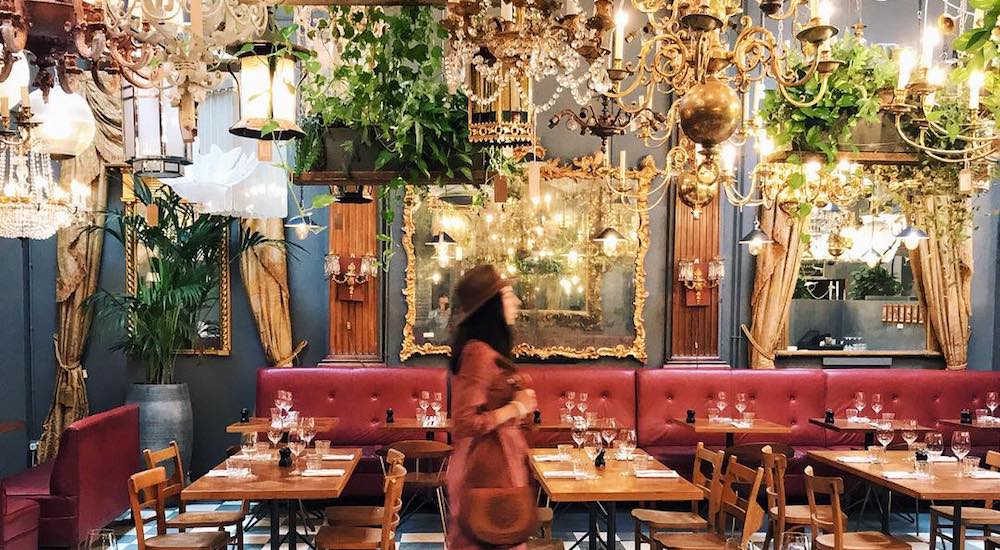
Nearest station is Vauxhall.
27. A.O.K, Marylebone
28. Bancone Golden Square, Soho
29. Tiffany Blue Box Cafe, Knightsbridge
30. Apple Butter, Seven Dials
31. Maggie Jones’s, Kensington
32. Gold, Notting Hill
For even more foodie updates and dreamy restaurants, be sure to follow our dedicated food & drink page The Mouthful on Instagram!
After a pretty-as-a-picture bar, for a drink after the meal? Check out The Prettiest Bars In London For Picture-Perfect Cocktails.
In 1959 Agatha Christie explains the attraction of the tyrant in political life

Agatha Christie, in her novel, Cat Amongst the Pigeons (1959) had a decent, educated leader with a social conscience make the following plea about the appeal of a tyrant in comparison with himself who ‘built hospitals and schools, welfare, housing…all the things people are said to want. Don’t they want them? Would they prefer a reign of terror like my grandfather’s?’
In response his somewhat ordinary, unimaginative and decent companion says, ‘ I expect so…seems a bit unfair, but there it is’. Asked to expand on this he responds, ‘Well…he put up a show – I suppose that’s it really. He was – sort of – dramatic, if you know what I mean’ (p. 30).
Although Christie goes on to explain further, drawing upon her familiar racist idea that the British have certain qualities that do not entertain dramatic flourishes in their leaders, while other races do, the conversation is arresting in the context of American politics.
Cindy Lou dines at Trev’s
Once again Trev’s proved the best place to be for a casual quick, but delicious meal. The menu has changed, and I was disappointed to see that the wonderful pomegranate salad has disappeared. However, there are several choices, including a crisp green salad, and a more robust pumpkin salad. On this occasion we chose only main courses – a good decision as they were generous, as well as being flavorsome. A friend’s stuffed field mushroom was the winning dish, but the pasta and lamb shoulder meals were also good choices. The duck breast needed a crispier skin and I suspect would not pass muster on Master Chef, although it was a pleasant enough meal. Service at Trev’s is always friendly and efficient, and I was pleased to return to this casual restaurant with good quality meals from a well-designed menu.


The Conversation provides articles such as the one below for publication through Creative Commons License. Thank you to The Conversation for this generosity.

Senior lecturer, Royal Central School of Speech & Drama
Disclosure statement
Sylvan Baker is a researcher at Royal Central School of Speech and Drama and receives funding from AHRC. He is a Co-Lead Researcher on The Verbatim Formula with Dr Maggie Inchley Reader on Drama at Queen Mary, University of London.
Mr Bates vs The Post Office: why docudramas have the power to inspire real social and political change
If you have been watching the news lately, then you might have heard of the Post Office Horizon IT scandal. From 1999 to 2015, more than 900 sub-postmasters were prosecuted by the Post Office after faulty software wrongly recorded that money was missing from branches. The miscarriage of justice only seems to be coming to the fore of public consciousness now, a staggering ten years after the fact.
The four-part ITV drama, Mr Bates vs The Post Office is responsible for the sudden attention. The series recounts the true story of the legal battle between former sub-postmaster Alan Bates and over 700 sub-postmasters and mistresses.
To date it has been watched by a staggering 9.2 million viewers. The drama has stirred public indignation and pushed ministers to accelerate the justice process for the postal staff wrongly accused.
It has also caused Paula Vennells, the chief executive of the Post Office from 2012 to 2019, to hand back her CBE. Fujitsu, the company responsible for the system, has admitted that is it likely their staff knew glitches were wrongly recorded in Post Office accounts five years before prosecutions were stopped and that they are responsible for providing compensation.
You might be surprised that a TV show has inspired this sort of reaction, rather than a serious journalistic investigation (the first of which broke the story in 2009). Or a public inquiry – which has been going on without much attention since 2022. However, this isn’t the first time dramas have been able to inspire public sentiment. Mr Bates is just one in a long tradition of British docudramas that have inspired real change. See Television,Film and Popular Culture: Comments for the complete article.
Two interesting bookshops in London
This barge on the Regents Canal will be one that I shall find easy to visit on my next trip, if it is not closed as it was the last time I walked along Regents Canal, Paddington.

Word on the Water, London, England, UK©Landscape Stock Photos/Shutterstock
You’ll find all sorts of peculiar barges traversing London’s Regent’s Canal but Word on the Water has to be among the most unusual. Moored amid the office-heavy landscape of King’s Cross, the vessel houses an assortment of contemporary fiction and non-fiction as well as children’s literature. Open for nearly a decade, the 1920s Dutch barge previously had to change location every couple of weeks due to canal regulations but now the boat has been granted a permanent berth thanks to a successful campaign led by its many supporters.

Barter Books, England©Shutterstock
The shop operates a barter system whereby customers can exchange their books for credit against future purchases.
It is located at Alnwick, Northumberland.
Heather Cox Richardson Letter from an American, 21 January 2024

On January 22, 1973, the Supreme Court handed down the Roe v. Wade decision. By a 7–2 vote, the Supreme Court found that the Fourteenth Amendment to the Constitution guaranteed the right of privacy under its “concept of personal liberty and restrictions upon state action.” This right to privacy, the court said, guarantees a pregnant woman the right to obtain an abortion without restriction in the first trimester of a pregnancy. After that point, the state can regulate abortion, it said, “except when it is necessary to preserve the life or health of the mother.”
The right to privacy is a “fundamental right,” the court said, and could be regulated by the state only under a “compelling state interest.”
Abortion had always been a part of American life, but states began to criminalize the practice in the 1870s. By 1960, an observer estimated, there were between 200,000 and 1.2 million illegal U.S. abortions a year, endangering women, primarily poor ones who could not afford a workaround.
To stem this public health crisis, doctors wanted to decriminalize abortion and keep it between a woman and her doctor. In the 1960s, states began to decriminalize abortion on this medical model, and support for abortion rights grew. The rising women’s movement wanted women to have control over their lives. Its leaders were latecomers to the reproductive rights movement, but they came to see reproductive rights as key to self-determination.
By 1971, even the evangelical Southern Baptist Convention agreed that abortion should be legal in some cases, and by 1972, Gallup pollsters reported that 64% of Americans agreed that abortion should be between a woman and her doctor. Sixty-eight percent of Republicans, who had always liked family planning, agreed, as did 59% of Democrats.
In keeping with that sentiment, the Supreme Court, under Republican Chief Justice Warren Burger, in a decision written by Republican Harry Blackmun, overrode state antiabortion legislation by recognizing the constitutional right to privacy under the Fourteenth Amendment.
The common story is that Roe sparked a backlash. But legal scholars Linda Greenhouse and Reva Siegel showed that opposition to the eventual Roe v. Wade decision began before the 1972 election in a deliberate attempt to polarize American politics. President Richard Nixon was up for reelection in that year, and with his popularity dropping, his advisor Pat Buchanan urged Nixon to woo Catholic Democrats over the issue of abortion. In 1970, Nixon had directed U.S. military hospitals to perform abortions regardless of state law, but in 1971, using Catholic language, he reversed course to split the Democrats, citing his personal belief “in the sanctity of human life—including the life of the yet unborn.”
As Nixon split the U.S. in two to rally voters, his supporters used abortion to stand in for women’s rights in general. Railing against the Equal Rights Amendment, in her first statement on abortion in 1972, activist Phyllis Schlafly did not talk about fetuses but instead spoke about “women’s lib”—the women’s liberation movement—which she claimed was “a total assault on the role of the American woman as wife and mother, and on the family as the basic unit of society.”
A dozen years later, sociologist Kristin Luker discovered that “pro-life” activists believed that selfish “pro-choice” women were denigrating the roles of wife and mother and were demanding rights they didn’t need or deserve.
By 1988, radio provocateur Rush Limbaugh demonized women’s rights advocates as “feminazis” for whom “the most important thing in life is ensuring that as many abortions as possible occur.” The issue of abortion had become a way to denigrate the political opponents of the radicalizing Republican Party.
Such rhetoric turned out Republican voters, especially the white evangelical base, and Supreme Court justices nominated by Republicans began to chip away at Roe v. Wade.
But support for safe and legal abortion has always been strong, and Republican leaders almost certainly did not expect the decision to fall entirely. Then, to the surprise of party leaders, the white evangelical base in 2016 elected Donald Trump to the White House. To please that base, he nominated to the Supreme Court three extremists, Neil Gorsuch, Brett Kavanaugh, and Amy Coney Barrett. The three promised in their confirmation hearings to respect settled law, which senators chose to interpret as a promise to leave Roe v. Wade largely intact.
Even so, Trump’s right-wing nominees could not win confirmation to the Supreme Court until then–Senate majority leader Mitch McConnell (R-KY) in 2017 ended the filibuster for Supreme Court justices, reducing the votes necessary for confirmation from 60 to as low as 50. Fifty-four senators confirmed Gorsuch; 50 confirmed Kavanaugh; 52 confirmed Barrett.
On June 24, 2022, by a vote of 6 to 3, in the Dobbs v. Jackson Women’s Health Organization decision, the Supreme Court overturned Roe v. Wade. Five of the justices said: “The Constitution does not confer a right to abortion.”
For the first time in American history, rather than expanding the nation’s recognition of constitutional rights, the Supreme Court took away the recognition of a constitutional right that had been honored for almost 50 years. Republican-dominated states immediately either passed antiabortion legislation or let stand the antiabortion measures already on the books that had been overruled by Roe v. Wade.
But the majority of Americans didn’t support either the attack on abortion rights or the end of a constitutional right. Support for abortion rights had consistently been over 60% even during the time Roe was under attack, but the Dobbs decision sent support for abortion as Roe v. Wade established it to 69%. Only 13% want it illegal in all circumstances. Since Dobbs, in every election where abortion was on the ballot, those protecting abortion rights won handily, including last week, when Tom Keen won a special election in Florida, flipping a seat in the state House from Republican to Democratic.
But I wonder if there is more behind the fury over the Dobbs decision than just access to abortion, huge though that is.
In the 1850s, elite southern enslavers quietly took over first the Democratic Party, and then the Senate, the White House, and then the Supreme Court. Northerners didn’t pay much attention to the fact that their democracy was slipping away until suddenly, in 1854, Democrats in the House of Representatives caved to pressure from the party’s southern wing and passed the Kansas-Nebraska Act. That law overturned the Missouri Compromise, which had kept enslavement out of much of the West, and had stood since 1820, so long that northerners thought it would stand forever.
With the passage of the Kansas-Nebraska Act, human enslavement would become the law of the land, and the elite southern enslavers, with their concentration of wealth and power, would rule everyone else. It appeared that American democracy would die, replaced by an oligarchy.
But when the Kansas-Nebraska bill passed, northerners of all parties came together to stand against those trying to destroy American democracy. As Illinois lawyer Abraham Lincoln put it: “We rose each fighting, grasping whatever he could first reach—a scythe—a pitchfork—a chopping axe, or a butcher’s cleaver,” to fight against the minority trying to impose its will on the majority. Within a decade, they had rededicated themselves to guaranteeing “that government of the people, by the people, for the people, shall not perish from the earth.”
I wonder if Dobbs, with its announcement that when Republicans are given power over our legal system they do not consider themselves obligated to recognize an established constitutional right, will turn out to be today’s version of the Kansas-Nebraska Act.
—
Notes:
https://news.gallup.com/poll/350804/americans-opposed-overturning-roe-wade.aspx
Linda Greenhouse and Reva B. Siegel, “Before (and After) Roe v. Wade: New Questions About Backlash,” The Yale Law Journal, 120 (June 2011): 2028–2087, at https://www.jstor.org/stable/41149586
https://www.law.cornell.edu/supremecourt/text/410/113
https://www.washingtonpost.com/history/2022/05/15/abortion-history-founders-alito/
Kristin Luker, Abortion and the Politics of Motherhood (University of California Press, 198).
https://news.gallup.com/poll/506759/broader-support-abortion-rights-continues-post I’ll-dobbs.aspx
Visit to the National Gallery of Australia
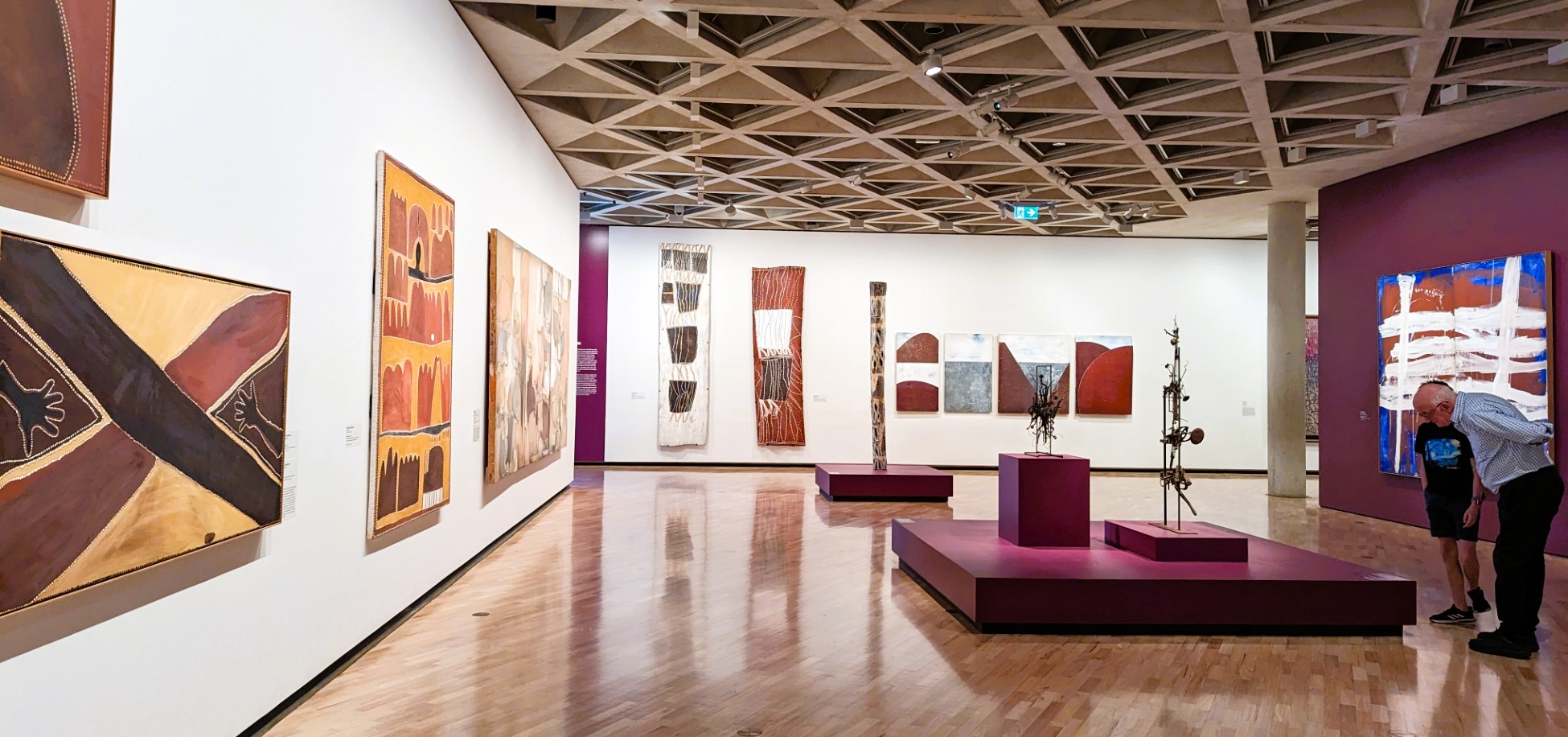
More of the galleries have been opened, demonstrating the good use to which the Federal Government’s grants to institutions such as the NGA have been put. A small example of the exhibits appears below. A future must is the Emily Kame Kngwarreye Exhibition, which is free to members, but requires an entrance ticket purchased upon arrival at the main entrance to the NGA. Waiting is not an onerous task as there is plenty to see while doing so.


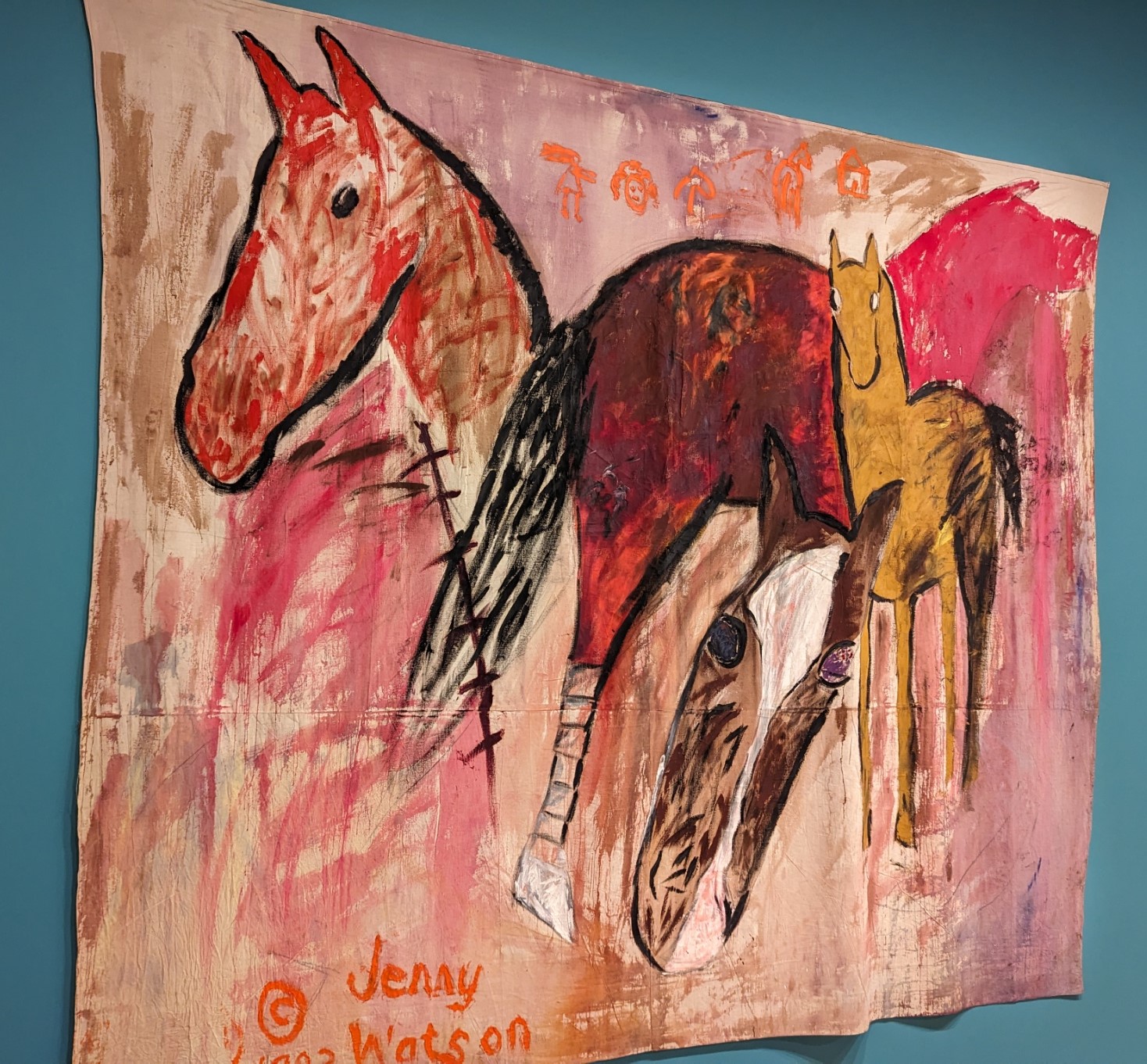
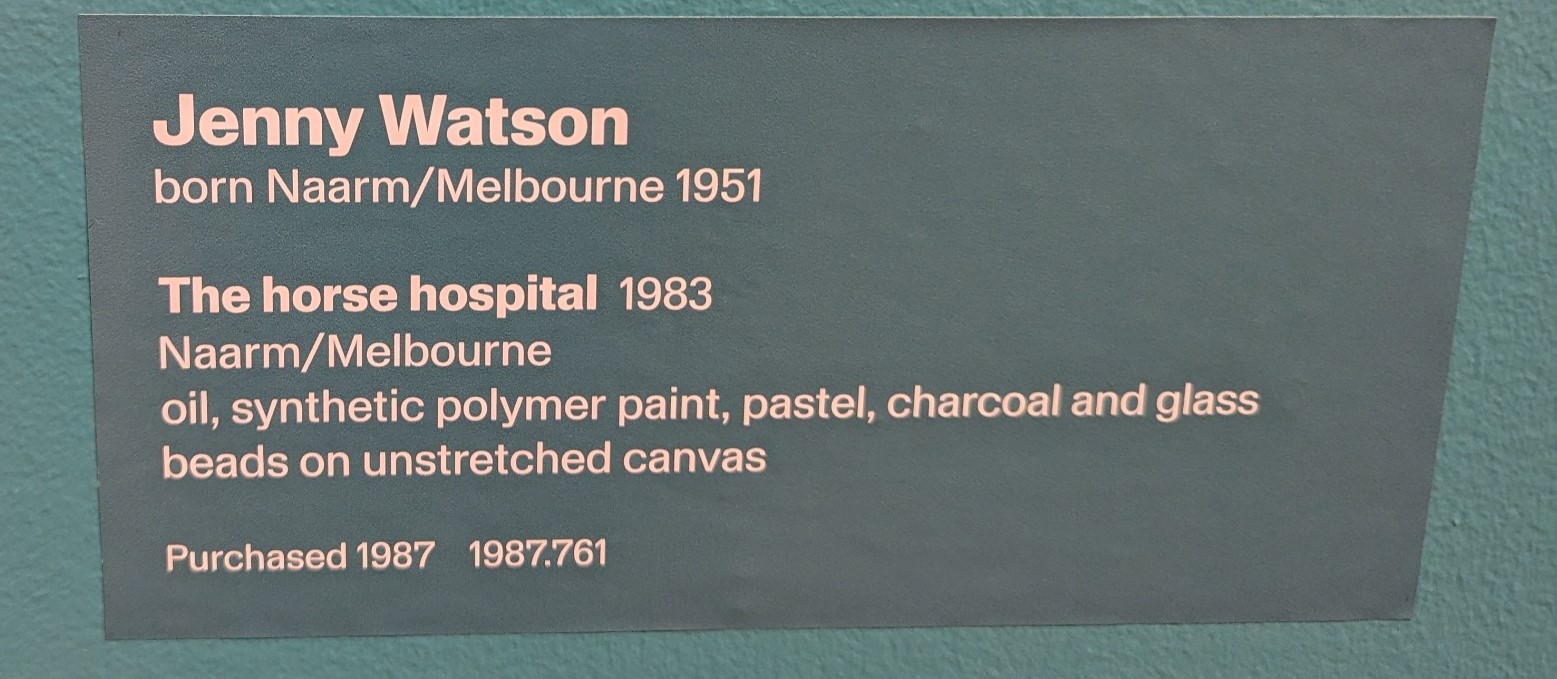

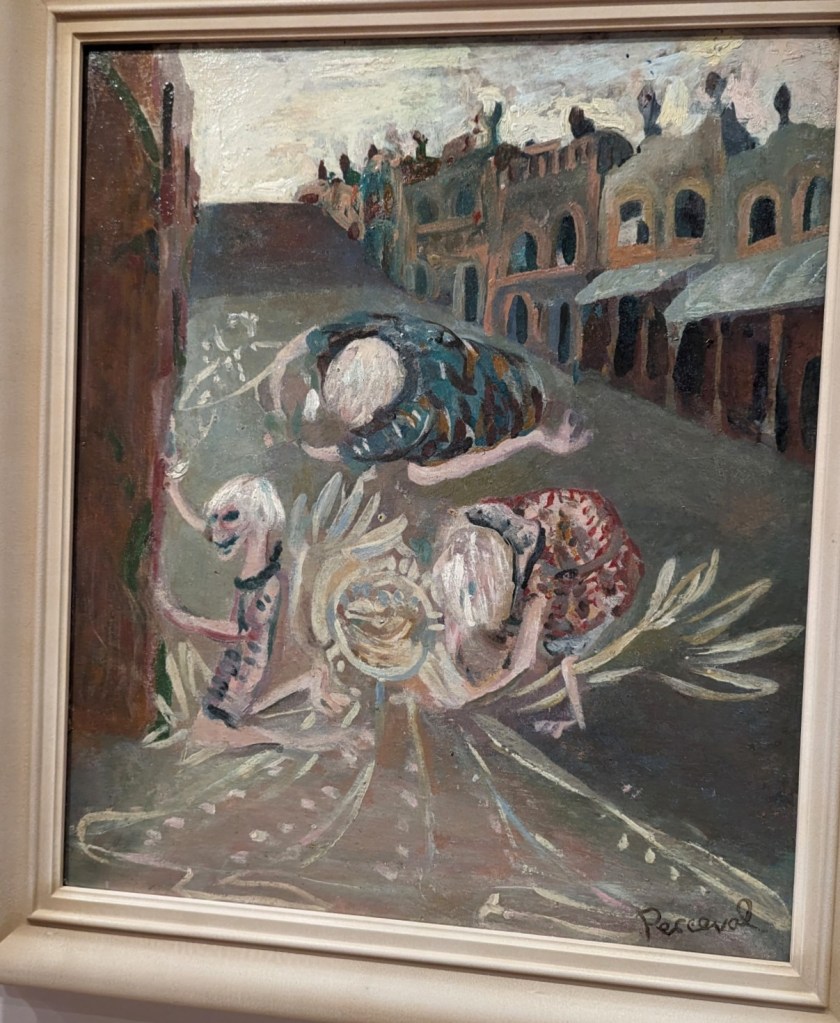
Children drawing in a Carlton Street 1943, Naarm/Melbourne.
Oil on cotton gauze on cardboard adhered to hardboard.
John Perceval, Australia 1923 – 2000, England 1963 – 1965.
Gift of John Hindmarsh AM and Rosanna Hindmarsh OAM 2012. Donated through the Australian Government’s Cultural Gifts Program, 2012.1296.
 Robin's Room