
C.L. Taylor Every Move You Make Avon Books, March 2024.
Thank you, NetGalley , for providing me with this uncorrected proof for review.
The fear and helplessness endured by people who are stalked resonates through this well-crafted novel. Those who suffer in the same way are all too aware of the threat that remains even after the stalker has been incarcerated; those who are not directly involved try to instil optimism that a punished stalker will not reoffend. A Family Liaison officer advises moving, changing their name and phone number, moving house. Those stalked take all these precautions but know no changes will work, understanding of what it is to be stalked is theirs, fear is theirs, inability to live an ordinary life is theirs. Natalie, Alexandra, Bridget and River are being stalked. Their response is to be in a WhatsApp group for survivors of stalkers.
The story opens as Natalie leaves work. She takes evasive action when she sees her stalker, changing tube destinations, speculating on the best way to evade him, then understanding that he has her phone number as he bombards her with aggressive messages, at which she is staring as she is approached. The WhatsApp messages between the other members demonstrate their incapacity to do more than try phoning Natalie as she has disappeared from the group. Their conversation instils even more understanding of the way in which stalking has impacted the lives of Alexandra, Lucy, Bridget and River. It also raises questions, why has River been excluded from some of the conversations? See Books: Reviews for the complete review.

Valerie Keogh The Mistress Boldwood Books, March 2024.
Thank you, NetGalley, for providing me with this uncorrected proof for review.
Valerie Keogh’s The Mistress brings together a couple whose marriage has, without their conscious recognition, become stale and the husband’s former lover who regrets having left him. The two women at the centre of the struggle for Mark have pasts that have undermined their capacity to become fully functioning adults and are also dealing with current catastrophes. The brutal attack on Hannah by her husband introduces the novel; in contrast, Susan’s despair over the departure of her son to what she sees as a far-flung university rather than one of those close by which she would prefer is a minor affair. However, for Susan it, and her suspicions about Mark, are imperatives which force her to act out of character. In comparison, Hannah’s relationship with her husband, and her determination to wrest Mark from Susan which forms the other thread in the novel, is very much in character. See Books: Reviews for the full review.
After Covid report: Heather Cox Richardson – America, international issues; Cherokee Language Preservation; Women’s History, Inspiring young Women Readers.
Covid in Canberra

Between 16 to 22 February 2024 there were 96 PCR tested new cases reported; 20 people with covid are in hospital and 1 is in ICU. One life was lost in this period, making the total lives lost to Covid in Canberra, 303.
Letters from an American

Heather Cox Richardson
I’m a history professor interested in the contrast between image and reality in American politics. I believe in American democracy, despite its frequent failures.
Lots of moving pieces on this Monday, with the biggest stories coming in international affairs.
The U.S. has appointed a special envoy for Sudan, which is ten months into a civil war that has turned 8 million people into refugees, sending 1.5 million into other countries; closed 80% of the hospitals in the area of the fighting; and prompted torture, rape, and deliberate starvation of civilians, at least 14,600 of whom have been killed. Tom Perriello will, the State Department said, “coordinate the U.S. policy on Sudan and advance our efforts to end the hostilities, secure unhindered humanitarian access, and support the Sudanese people as they seek to fulfill their aspirations for freedom, peace, and justice.”
The North Atlantic Treaty Organization (NATO) is about to expand again. After 19 months of stalling, Hungary’s parliament voted today to approve Sweden as a new member, bringing the number of NATO countries to 32. Hungary’s prime minister Viktor Orbán, who has good relations with Russia’s president Vladimir Putin, has a history of using his country’s veto power over NATO to extract concessions; in exchange for Hungary’s approval, Sweden has agreed to provide it four fighter jets and for Saab to open an artificial intelligence research center in Hungary.
There is also a major piece moving in the Middle East. This morning, the Palestinian Authority’s prime minister Mohammad Shtayyeh and cabinet offered to resign in order to clear the way for a new government. Palestinian Authority president Mahmoud Abbas accepted the resignations but asked the government to stay in place as a caretaker until a new government can be formed.
This is a big deal because it’s part of a larger plan for the Palestinian territories after the war.
Since Hamas attacked Israel on October 7, 2023, the U.S. government has maintained that Israel has a right and a duty to defend itself against Hamas, but that it must operate within international humanitarian law that limits harm to civilians and that it must have a vision for a postwar political process to establish a Palestinian state next to Israel: the two-state solution.
On the first condition, Zack Beauchamp of Vox reported last week that Israel Defense Forces (IDF) permitted far higher civilian casualties after October 7 than it had in previous wars. The result has been the dramatic destruction of lives and Gaza’s infrastructure that have so horrified many Americans that yesterday an active-duty U.S. airman set himself on fire outside the Israeli embassy in Washington, D.C., dying by suicide in protest of civilian deaths in Gaza.
The Biden administration has worked to get aid into Gaza but has stood firm against a permanent ceasefire because it maintained that permitting Hamas to rebuild would leave the conditions for further warfare in place. It has also insisted that Hamas must return all the hostages its militants took on October 7. But in the U.S., the devastation in Gaza has fueled angry opposition to the administration by those who insist that Biden is fueling “genocide” and who demand an immediate cease-fire.
Beauchamp suggests that Israel’s prime minister, Benjamin Netanyahu, has largely ignored the second condition—that Israel must consider a postwar formula—at least in part because of his own legal troubles.
Netanyahu is facing an ongoing corruption trial and apparently counts on staying in office to keep himself out of prison. To stay in office, he must hold his coalition together, and that means bowing to his far-right partners, who want to rebuild Israeli settlements in Gaza and oppose any Palestinian control there. Any plan for a postwar settlement threatens to break his coalition and lead to new elections that Netanhayu would likely lose. Until last week, Netanyahu vowed only “total victory” over Hamas.
But while Netanyahu refused to discuss a postwar plan, leaders in Arab states, as well as the U.S. and the European Union, appeared to see the crisis in Gaza as an opportunity to change the longstanding political dysfunction in the Middle East. For months now, they have been developing plans for a postwar settlement that includes a Palestinian state overseen by a revitalized Palestinian Authority along with security guarantees for Israel backed by normalization of relations between Israel and Saudi Arabia. Arab states have offered billions of dollars to rebuild Gaza so long as neither Hamas nor Israel is in charge of the territory.
As Dennis Ross, U.S. Middle East specialist under both Republican George H.W. Bush and Democrat Bill Clinton, noted, for the first time in the long struggle in the modern Middle East, the Gulf Arab states see normalizing ties with Israel as important to their own security and economies. They have refused to get drawn into the conflict, pointing out to Israel their reliance on diplomacy rather than arms to prove that normalization of relations is key to Israeli security.
Such a process required remaking the Palestinian Authority, which administers the West Bank and administered Gaza for a year between the time that Israel withdrew from Gaza in 2005 and Hamas won legislative elections in 2006. In mid-January, according to Barak Ravid of Axios, national security officials from Saudi Arabia, Jordan, Egypt, and the Palestinian Authority met secretly in Riyadh to figure out how to revitalize the Palestinian Authority to enable it to play its role in governing Gaza.
At the end of January, Secretary of State Antony Blinken asked officials at the State Department to review procedures for the U.S. and the international community to recognize a Palestinian state, and the Biden administration sent CIA director William Burns to help Egypt and Qatar broker a deal between Hamas and Israel for the release of all remaining hostages held by Hamas and a pause in fighting to get humanitarian aid to Gaza.
Meanwhile, Netanyahu made clear his determination to retain control of Gaza and stood firm against the two-state solution. At his back, he has had Trump and his loyalists, who are staunch supporters of Netanyahu. The news that the State Department was figuring out procedures for recognizing a Palestinian state prompted outrage from Trump’s former ambassador to Israel, David Friedman. He wrote: “I’m hoping this is just unauthorized and false messaging from one of the many at State who despise Israel. But make no mistake—this “recognition” would be even more devastating to Israel than the attacks of October 7!! Not to mention rewarding terrorists for their brutality! Unconscionable!”
Perhaps with the security of such support behind him, on February 23, Netanhayu released to his cabinet his own plan for a postwar settlement. It said that Israel will keep control over Gaza and that rebuilding the devastated territory will depend on its demilitarization, and rejects the “unilateral recognition” of a Palestinian state. On the same day, the Israeli government announced it would add more than 3,300 new homes to settlements in the Israeli-occupied West Bank after three Palestinian gunmen killed an Israeli settler and wounded five more.
During its time in office, the Trump administration reversed four decades of U.S. policy by saying that such settlements did not violate international law, but following Friday’s announcement, Secretary of State Blinken promptly restored the old rule, saying that settlements are “counter-productive to reaching an enduring peace. They’re also inconsistent with international law. Our administration maintains a firm opposition to settlement expansion and in our judgment this only weakens, it doesn’t strengthen, Israel’s security,” he said.
Meanwhile, Netanhayu said yesterday on CBS’s Face the Nation that Israel plans to continue its assault on Hamas by attacking Rafah, a city in southern Gaza where about 1.4 million displaced Palestinians are taking shelter, something Biden has warned him against doing without a credible plan for protecting civilians. On February 24, Netanyahu said he would convene the Israeli cabinet this week “to approve military plans for an operation in Rafah, including the evacuation of civilians.”
Negotiations for a release of the hostages and a pause in fighting continue. On Friday, officials from Israel, Egypt, the U.S., and Qatar, which serves as an intermediary for Hamas, met in Paris. White House national security advisor Jake Sullivan said he hoped for a final agreement “in the coming days.” Today, Biden told reporters that he hopes to see a temporary cease-fire by next Monday.
On February 13, Amy Mackinnon and Robbie Gramer of Foreign Policy referred to the administration’s attempt to pull a two-state solution out of the chaos of the Middle East as Biden’s “grand bargain,” and they point out that “it faces staggering challenges.” A week later, in Foreign Affairs, political scientist Marc Lynch and foreign affairs scholar Shibley Telhami replied that “the idea of a Palestinian state emerging from the rubble of Gaza has no basis in reality.”
Today’s announcement of a new Palestinian Authority appears to be a shift.
—
Notes:
https://www.washingtonpost.com/world/2024/02/26/israel-hamas-war-news-gaza-palestine
https://www.washingtonpost.com/world/2024/01/16/israel-hamas-war-news-gaza-palestine-updates
https://www.washingtoninstitute.org/policy-analysis/ending-the-war
https://www.vox.com/24055522/israel-hamas-gaza-war-strategy-netanyahu-strategy-morality
https://www.axios.com/2024/01/29/israel-gaza-saudi-egypt-jordan-palestine-meeting
https://www.axios.com/2024/01/31/palestine-statehood-biden-israel-gaza-war
https://www.cnn.com/2024/01/19/politics/joe-biden-benjamin-netanyahu-palestinian-state/index.html
https://www.washingtonpost.com/national-security/2024/01/25/william-burns-cia-gaza-israel-hostages
https://www.washingtonpost.com/world/2024/02/26/palestinian-authority-resign-gaza-israel-rafah
https://www.washingtonpost.com/national-security/2024/02/11/biden-netanyahu-call-rafah-hostages
https://www.washingtonpost.com/opinions/2024/01/02/arab-israeli-peace-palestinians-gaza
https://www.washingtonpost.com/world/2024/02/26/what-is-palestinian-authority-explained
https://www.washingtonpost.com/politics/2024/02/26/biden-cease-fire-gaza
https://www.foreignaffairs.com/israel/two-state-mirage-gaza-palestinians-lynch
Twitter (X):
jimsciutto/status/1762142611253383654
NTarnopolsky/status/1761458809506091189
DavidM_Friedman/status/1752753246551343208

More than words: New building a center for Cherokee language preservation
WRITTEN BY HOLLY KAYS WEDNESDAY, FEBRUARY 21, 2024
 A New Kituwah Academy student helps celebrate the event by participating in a traditional dance. Holly Kays photo
A ribbon-cutting ceremony held Friday, Feb. 16, for a building dedicated to preserving the Cherokee language was a celebration of the culture and language that has formed the Cherokee people for countless generations.
More than 200 people gathered for a ceremony that was nearly half over before a single word of English was spoken. Instead, it showcased Cherokee-language speeches from tribal elders who grew up speaking it and musical performances from the new generation learning their ancestral language at New Kituwah Academy. The school is located just a stone’s throw away from the new building, which is called kalvgviditsa tsalagi aniwonisgi tsunatsohisdihi, or in English, Cherokee Speakers Place.
Roger Smoker, chairman of the Cherokee Speaker’s Council, said that the building will be a place where Cherokee language learners can gather to hone their skills, where the Cherokee Speakers Council can meet and where the Speakers Consortium bringing together fluent speakers in all three Cherokee tribes can gather when it’s held on the Qualla Boundary.
“This new building will house the second language speakers, and it will benefit our communities and represent the committed values of the Eastern Band of Cherokee Indians,” he said.

Cherokee speakers, elected officials and leaders ribbon on the new Cherokee Speakers Place. Holly Kays photo
Not so long ago, Cherokee was the dominant language among tribal members, and English the minority. But over the last century or so that dynamic has reversed. Through the 1970s, Native American children were often forced to attend boarding schools where speaking the indigenous language was discouraged or even punished, leading to many children of that generation ceasing to speak the language of their elders fluently, or at all, and finding themselves incapable of passing it down to their own children. As the 21st century dawned, tribal leaders began to realize that, if they did nothing, there was a real danger of their native language dying out.
“Our language is sacred,” said Howard Paden, executive director of the Cherokee Language Department for the Cherokee Nation of Oklahoma. “God made that, and we can have the biggest buildings, the biggest casinos, but if we don’t have the very essence of who we are — when we speak in that form, there’s words that English doesn’t have. There’s concepts that English doesn’t have.”
Paden wasn’t the only person who attended the ceremony from one of the other two Cherokee tribes. United Band of Keetoowah Indians Chief Joe Bunch spoke to the crowd as well, and a delegation from the Cherokee Nation sat in the audience.
“As a group of tribes, we have to continue to make sure that we’re heard,” said EBCI Chief Michell Hicks.
Like many people his age, Hicks is not a fluent speaker, something that he acknowledged in his comments.
“My dad understood. My grandma spoke, but really didn’t teach,” he said. “My generation, we lacked resources — but it’s not an excuse. I don’t have an excuse other than, I’ve got to allow for more of an effort.”
Fluent Cherokee speakers say that there’s something elemental about the language, something that conjures meaning more specifically and paints verbal pictures more intimately than English allows. In a 2018 interview with The Smoky Mountain News, Beloved Woman and first language speaker Myrtle Driver Johnson said that Cherokee is more grounded in the relationships between words and the things they describe, producing richly layered meanings and preventing insincere expression.
The new building will offer a home base for language revival, the first significant capital investment toward that goal on the Qualla Boundary since New Kituwah Academy was built in 2009. New Kituwah offers Cherokee immersion education for children ages birth through elementary school grades. Recognizing that children learning Cherokee at school often come home to parents who can’t interact in the language, the tribe has also launched an adult language learning program in which participants earn a paycheck — for the duration of the program, learning the language is their full-time job.

Elder and first language speaker Marie Junaluska (left) claps as Cherokee Speakers Council Chairman Roger Smoker, also an elder and first language speaker, hands back the scissors they used for the ribbon-cutting. Holly Kays photo
The Cherokee Speakers Place offers more than 8,000 square feet of space for fluent speakers and language learners to gather, practice the language and preserve what they know. It includes a spacious lobby and large meeting room with a kitchen, offices, classrooms, a library, a recording room and a patio peppered with tables and chairs.
“I’m sure I’ve made some mistakes today, but I appreciate the chance to try, speak and learn,” said Miss Cherokee 2023-24 Scarlett “Gigage” Guy, who emceed the event completely in Cherokee.
Tribal leaders hope that the new building will facilitate more such “mistakes” made in the honest effort to learn the Cherokee language — so that one day, its future will be safe in the minds and on the lips of the tribe’s young people.
“We can’t be scared,” Hicks said. “We have to walk across and figure out how we do it, and how we do it better.”
From: School Library Journal, Women and Literature site.
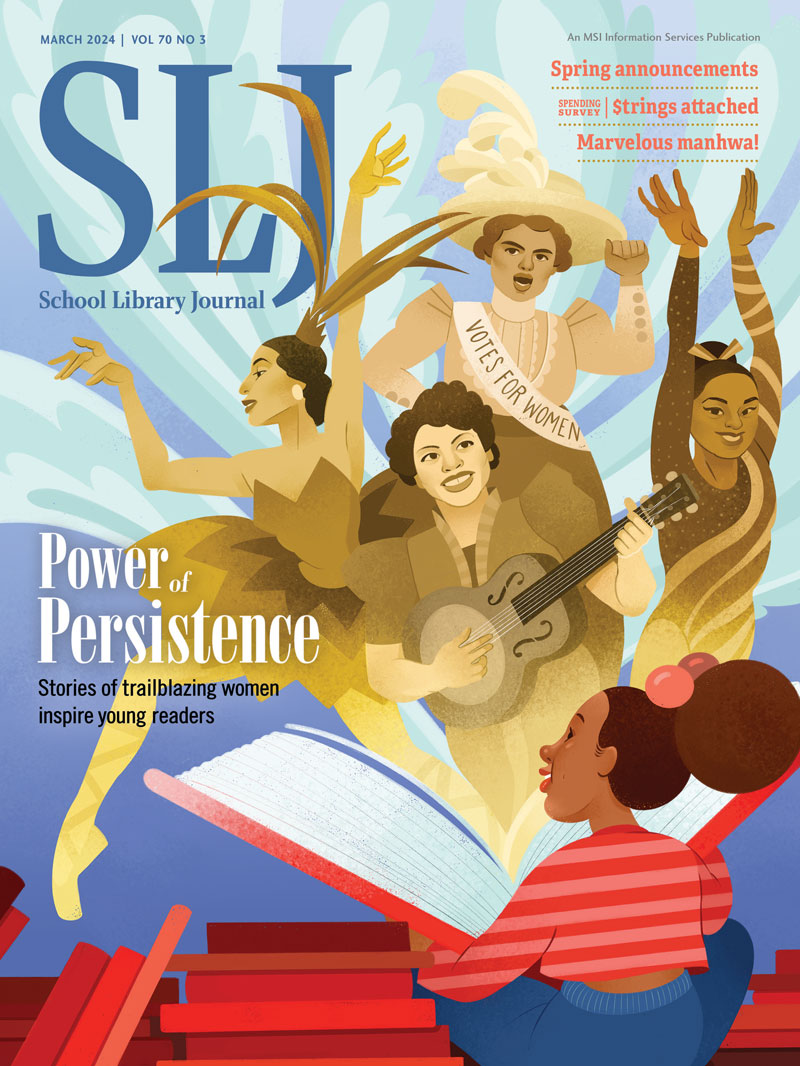
Power of Persistence: Publishers Embrace Women’s History, Inspiring Young Readers
by Chelsey Philpot Feb 27, 2024 | Filed in News & Features
It’s a good moment for new women’s history books—and also a good time for librarians to cull outdated titles.
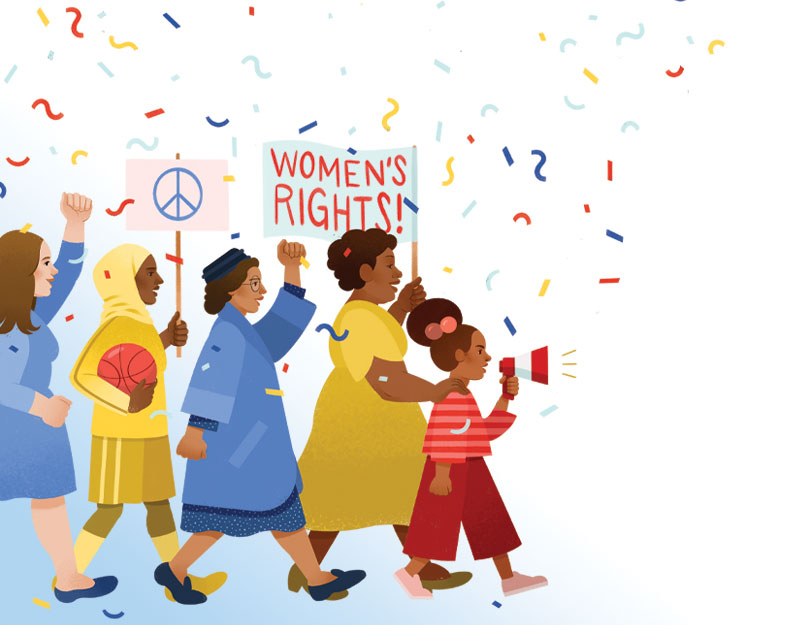 |
| Illustration and SLJ March cover by Caitlin Kuhwald |
In the 2023 blockbuster movie Barbie, Gloria, a frustrated mother and Mattel employee played by America Ferrera, delivers a monologue about society’s impossible expectations of women.
“We have to always be extraordinary, but somehow we’re always
doing it wrong. . . . And it turns out in fact that not only are you doing
everything wrong, but also everything is your fault.”
| Related Reading: How to choose high-quality women’s history titles 10 Recommended Feminist Books for Early Readers |
Barbie had earned more than $1.38 billion worldwide by September 2023 and is the highest-grossing movie directed by a woman. It garnered rave reviews from moviegoers and professional critics but also provoked impassioned reactions from those who didn’t like the film’s feminist message.
Historically, representations of feminism and strong, independent women in art and culture, including in the pages of children’s books, have inspired fervent reactions. Researchers from different academic fields have been studying women’s representation in children’s literature (e.g., how often they are depicted in illustrations and/or text) for decades. The big-picture view from these studies: over time, women have been underrepresented in children’s literature. Furthermore, much of the representation that did exist has tended to perpetuate sexist ideas.
In 1970, feminist writer Elizabeth Fisher affirmed that conundrum with this observation: “[Books] show some of the methods by which children are indoctrinated at an early age with stereotypes about male activity and female passivity, male involvement with things, women’s with emotions, male dominance and female subordination,” Fisher wrote in a New York Times column.
Since then, kid lit portrayals of women and diverse populations have vastly improved. Newer titles are better at portraying complex or intersectional identities, as Tessa Michaelson Schmidt, director of the Cooperative Children’s Book Center at the University of Wisconsin–Madison, recently noted; they’re of a “higher quality” and better at capturing authentic human experiences. It’s a good moment for women’s history books and also a good time for librarians to reconsider titles that are outdated in ways they might not have even considered.
Defining ‘‘women’s history’’ Women’s History Month began in 1978 as “Women’s History Week” in one California school district but soon spread to other communities and became nationally recognized in 1982 after years of lobbying by women’s groups. Several years and additional petitioning efforts later, Congress passed “Public Law 100-9” in 1987 designating March as Women’s History Month. And what does “women’s history” mean, exactly? According to the National Women’s History Museum, an online institution founded in 1996, “Women’s history contextualizes women within the social, political, legal, and cultural systems of their times. History that does not acknowledge women’s situations as well as their activities and accomplishments is, by definition, not a full history. At the same time, women’s history is not merely the addition of women’s contributions to the standard history timeline. Women’s history is not just add women and stir.” Women’s History Month began in 1978 as “Women’s History Week” in one California school district but soon spread to other communities and became nationally recognized in 1982 after years of lobbying by women’s groups. Several years and additional petitioning efforts later, Congress passed “Public Law 100-9” in 1987 designating March as Women’s History Month. And what does “women’s history” mean, exactly? According to the National Women’s History Museum, an online institution founded in 1996, “Women’s history contextualizes women within the social, political, legal, and cultural systems of their times. History that does not acknowledge women’s situations as well as their activities and accomplishments is, by definition, not a full history. At the same time, women’s history is not merely the addition of women’s contributions to the standard history timeline. Women’s history is not just add women and stir.” |
Nevertheless
For proof of positive trending, witness the instant success and staying power of “She Persisted,” the women’s biography series from Penguin. Former first daughter Chelsea Clinton launched the series in 2017 with the publication of She Persisted Around the World: 13 Women Who Changed History. The picture book’s enthusiastic reception inspired Clinton and her editor, Talia Benamy, to create more “She Persisted” titles for more ages.
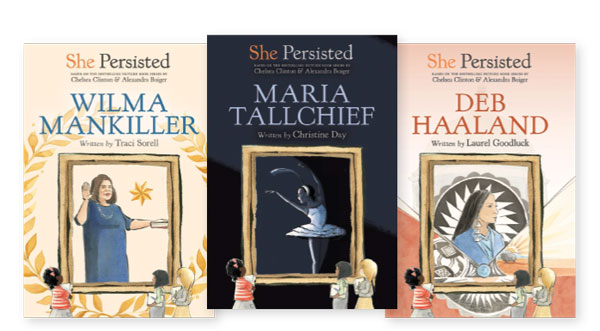
There are now more than 25 “She Persisted” titles, and award-winning authors such as Meg Medina, Rita Williams-Garcia, and Deborah Heiligman have written or co-written “She Persisted” chapter books for young readers about women like Supreme Court Justice Sonia Sotomayor, Olympic track and field star Florence Griffith Joyner, and labor activist Clara Lemlich, respectively. Recently three “She Persisted” chapter books—She Persisted: Maria Tallchief, She Persisted: Wilma Mankiller, and She Persisted: Deb Haaland—were 2024 American Indian Youth Literature Awards middle grade honor titles.
The “She Persisted” titles stay true to an activism ethos with their format—the chapter books conclude with lists of ways young readers can become activists—and with their storylines, which start with the subjects as children and chronicle failures and trying again.
“I think the idea of not giving up is so relevant and so resonant and such an important message for kids to see,” Benamy says.

Rebels rising
The idea of exposing young girls to stories of strong, inspiring women motivated Francesca Cavallo and Elena Favilli, in 2016, to crowd-fund the publication of Good Night Stories for Rebel Girls: 100 Tales of Extraordinary Women, a collection of mini biographies featuring women such as Egyptian ruler Cleopatra and Olympic gymnast Simone Biles, for ages six and up. The record-breaking success of their funding campaign (Cavallo and Favilli ultimately raised more than $1 million and sold more than 370,000 copies of their first book, according to Circana Bookscan), and their belief that there weren’t enough children’s books about history-making women and their accomplishments, convinced the pair to publish more “Rebel” stories.
Today, Rebel Girls is a global multimedia company with more than 40 books, an award-winning app, a podcast, and more. Its employees no longer rely on funding campaigns to keep afloat; Rebel Girls has raised millions for future ventures and counts Penguin Random House, Common Sense Growth, and Nike among its investors.
“We love what we do, and we love and are inspired by the audience that we serve,” says Rebel Girls CEO Jes Wolfe.
Seen but not heard from enough
A recent report on the dearth of women in U.S. social studies standards showed that women’s representation is nowhere near what it should be in social studies classrooms; in addition, a 2023 AI-based study on race and gender in children’s books showed that women’s inclusion has fallen short over the years.
In 2017, researchers with the National Women’s History Museum analyzed states’ K–12 social studies standards to identify areas where educators might need more resources on women’s history. The report and analysis found that “women’s experiences and stories are not well integrated into U.S. state history standards…This implies that women’s history is not important.”
And in 2023, researchers at the University of Chicago used cutting-edge technology to analyze representation in award-winning children’s books’ texts and images. Economist Anjali Adukia and her team developed an AI application built on existing face analysis software and natural language processing tools and trained it to detect faces, determine skin color, and predict depictions of gender, race, and ages. The tool allowed them to quantify representation in a new way and enabled researchers to standardize processes and eliminate the human biases said to sneak into many AI applications.
The study focused on over 1,000 books for children 14 and under that had won or been honored by the Association for Library Service to Children beginning in 1923. Prizes ranged from the Caldecott and Newbery to others including the American Indian Youth Literature Award, the Américas prize, the Arab American Award, the Asian/Pacific American Award for Literature, the Carter G. Woodson Award, the Coretta Scott King Awards, the Dolly Gray award, the Ezra Jack Keats Award, the Middle East Book Award, Notable Books for a Global Society, along with the Pura Belpré, Rise Feminist (formerly the Amelia Bloomer Award), the Schneider Family, Skipping Stones Honor, South Asia, Stonewall, and Tomás Rivera Mexican American awards.
When it came to representations of gender across books and time, the study concluded, “[W]e find that females are consistently more likely to be visualized in images than mentioned in the text. This suggests there may be symbolic inclusion of females in pictures without their substantive inclusion in the actual stories.”
“Females are persistently less likely than males to be represented in the text of books in our sample overall and over time,” the study noted. “This finding is consistent across all of the measures we use: pronoun counts, specific gendered terms, gender of famous individuals, and predicted gender of character first names.”
Such studies provide more impetus for libraries to seek outstanding representation in their collections and cull outdated titles. Fortunately, these days, exposing children to high quality books about inspiring women is easier than ever.
Chelsey Philpot is a journalist and YA author. She teaches writing at Boston University.
Research Project
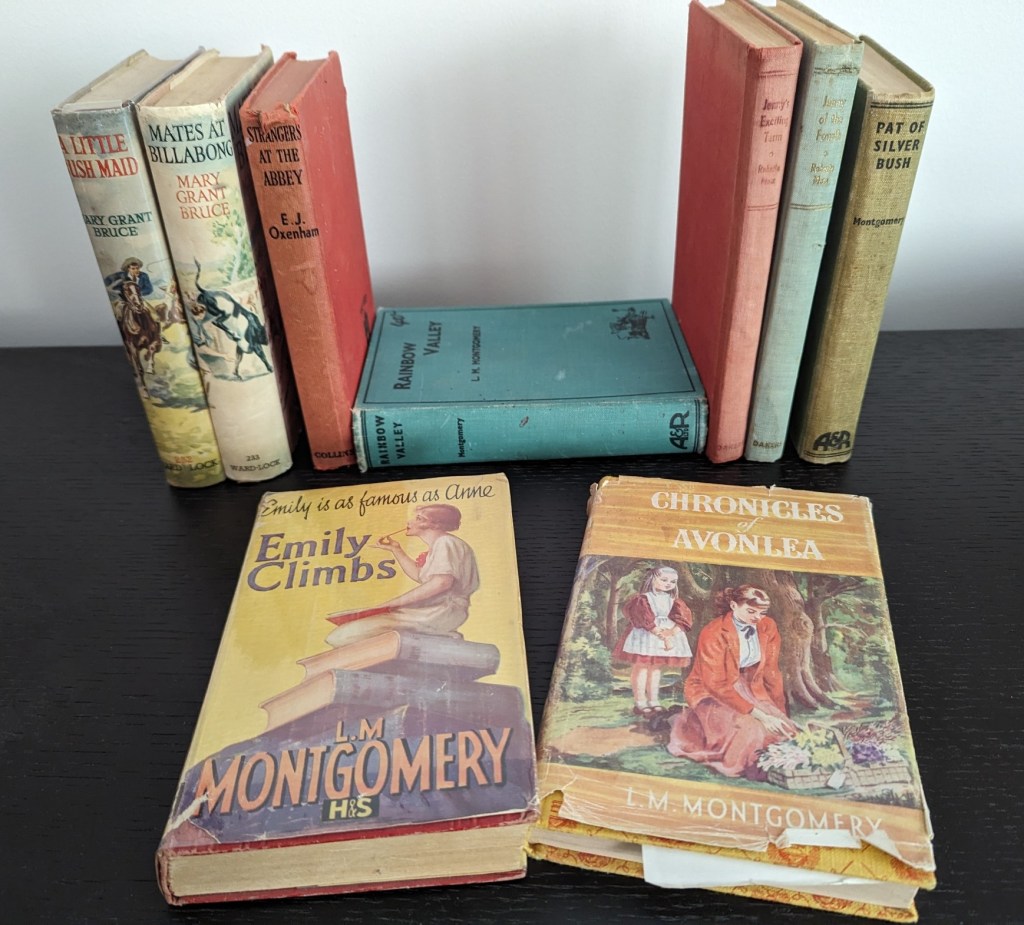
Did anyone read these books: the Billabong series by Mary Grant Bruce; L.M. Montgomery’s series, such as Anne of Green Gables, Emily of New Moon, Pat of Silver Bush or standalone novels such as Jane of Lantern Hill; the Abbey books by Elsie J. Oxenham; or Roberta Moss’s Jenny books? I am interested in whether other people can remember reading them in the 1950s and 1960s or can remember them being in their school library.
If so, could you comment in the comments section.

 Robin's Room