Kathy Lette, The Revenge Club, Aria and Aries, May 2024.
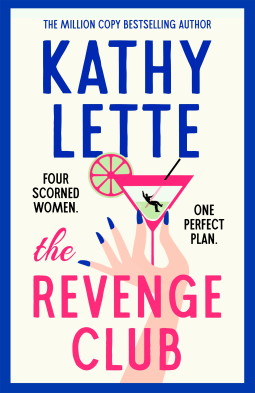
Thank you, NetGalley, for providing me with this uncorrected proof for review.
Kathy Lette has not let her joy in creating a comedy undermine her strong story line that promotes the abilities and strengths of women fast approaching their sixties, a continuing fight to break the glass ceiling, and the perfections and perils of friendship, partnerships and children. The Revenge Club is such a romp – but also such a marvellous insight into women’s friendships, partnering and dealing with children. It is Lette’s ability to combine joyous writing, graphic descriptions and serious content that makes this such a powerful and fun novel. See Books: Reviews for the complete review.
| Meet the author – Kathy Lette |
| Wednesday 13 March, 6-7pm Kathy Lette will be in conversation with Karen Hardy on her new novel The Revenge Club, a subversive, irreverent revenge romp. This event is in association with Harry Hartog Bookshop. Books will be available for purchase on the evening in the Cultural Centre foyer. Pre-event book signings will be available from 5.30pm, and available again after the event. Registration |
International Women’s Day 8 March 2024

The great trade union women of Australian history
This International Women’s Day while debate rages about the latest gender pay gap figures, LNL looks back at the women of Australia’s history who led the fight for better wages and conditions, writing letters, leading protests and strikes, taking on male-dominated jobs and challenging our governments and our biggest employers to do better.
Guests: Sally McManus, Secretary of the ACTU; Wil Stracke, Assistant Secretary at the Victorian Trades Hall Council and Tik Tok star; Robynne Murphy, former steel worker, union delegate and producer and director of the documentary “Women of Steel”.
This story contains an excerpt from the film FOR LOVE OR MONEY: A History of Women and Work in Australia by Megan McMurchy, Margot Nash, Margot Oliver & Jeni Thornley, 1983.
Guest Presenter Kylie Morris is also PRIMER’s gendered violence reporter.
Credits
Kylie Morris, Presenter; Catherine Zengerer, Producer
Broadcast 7 Mar 20247 Mar 2024
IWD special: the great trade union women of Australia’s history
Duration: 55 minutes 59 seconds Broadcast Thu 7 Mar 2024 at 10:00pm

9 Incredible Women Who Shaped London, In Honour Of International Women’s Day *
To mark International Women’s Day, we’re celebrating the stories of nine incredible women who have left their mark on London.
ALEX LANDON – EDITOR • 6 MARCH, 2024

International Women’s Day is a day to celebrate the power, achievements, and potential of all women, with an eye firmly on making the world a better and fairer place for all.
But it’s also a prime opportunity to look back into the past, and celebrate the work of the women who’ve come before us, and whose achievements still resonate loudly today.
Leaders, pioneers, visionaries – all feature in our list, and all made an impact on London in one way or another. Here are nine women who shaped London that you should know about!
1. Kate Hall

Here in 2023, the UK’s top visitor attraction (Tate Modern) is run by a woman, director Frances Morris. But back in 1893, no woman had ever ascended to the position of museum curator in England – until Kate Hall became the curator of the Whitechapel Museum.
A great lover of the natural world, Hall turned the museum into a popular community hub, adding plants and animals in order to help visitors learn about flora and fauna in a hands-on approach. She would go on to found her own museum – the Nature Study Museum, opened in 1904 – give lectures on the natural world at the Horniman Museum, write a book about London’s parks, and generally set a stellar example for female curators to follow in the years to come. The East End Women’s Museum has an excellent long read on Kate Hall, which you can read here.
2. Noor Inayat Khan

One can only blame the patriarchy for the fact that there’s no Hollywood blockbuster telling the tale of Noor Inayat Khan (she is, at least, a character in 2019 film A Call To Spy). A pacifist-turned-radio operator-turned WW2 spy, she helped organise the French resistance to Nazi rule, before being sold out by a double agent and executed – although not before she’d launched one last daring escape mission.
Though born in Moscow and raised mostly in Paris, she set off for her brave mission from London, and is honoured with both a statue and a blue plaque in Bloomsbury. You can read more about her here.
See also: How To Celebrate International Women’s Day In London
3. Rhaune Laslett


Portrait from The Voice
What could you achieve with borrowed costumes from Madame Tussauds and one good idea? Rhaune Laslett used those, plus a large helping of community spirit, to lay the foundations for an event that still draws the crowds today: Notting Hill Carnival. Born in London’s East End to a Native American mother and a Russian father, Laslett realised the importance of bringing today the communities of Notting Hill, and did so with The Notting Hill Fayre and Pageant, which drew a reported crowd of 1,500. And the rest, as they say, is history…
4. Claudia Jones

Of course, if we’re going to give Rhaune Laslett credit for Notting Hill Carnival, then we’ll need to mention the other towering figure who helped create the modern festival: Claudia Jones.
She took a rather circuitous route to London – born in Trinidad, raised in the USA, and deported to Britain on account of her membership with the US Communist Party – but once she arrived here, her influence was indelible.
Even before founding and editing the short-lived but influential West Indian Gazette, she was a vocal activist in the growing British African-Caribbean community, and eventually set up the Caribbean Carnivals first held in London in 1959, which would eventually grow into the modern Notting Hill Carnival.
Further proof of her standing in London can be found at her gravestone; not only is it in Highgate Cemetery (final resting place for many an influential Londoner), but it’s right next door to the tomb of her hero, Karl Marx.
5. Phyll Opoku-Gyimah

The only woman on our list still amongst the living, Phyll Opoku-Gyimah is the co-founder of UK Black Pride, now Europe’s largest celebration of African, Asian, Middle Eastern, Latin American, and Caribbean-heritage LGBTQ+ people.
Founded in 2005 with an aim to cross racial and cultural lines, and celebrate the entire LGBTQ+ spectrum of identity, UK Black Pride is as much a movement as it is a London festival (which falls in early July in non-pandemic years), and does excellent advocacy work throughout the year. Opoku-Gyimah remains a powerful force for equality and love, both in her role at UK Black Pride, and as Executive Director for international NGO Kaleidoscope Trust.
6. Hannah Dadds

Pioneers tend to leave an indelible mark on the places and industries they inhabit, and Hannah Dadds was no exception. As the first female Tube driver, Dadds broke through one of London transport’s biggest glass ceilings, with thousands of women following her since.
She took control of a District line train in 1978, the beginning of a 15-year career as the network’s first female driver, and when her sister Edna joined the London Underground, the duo teamed up to become the first all-female crew on the Underground. In 2019, a commemorative plaque was unveiled at her home base, Upton Park station, to detail her career and achievements.
7. Millicent Fawcett

The only woman to be honoured with a statue in Parliament Square – yes, we have so much more work to do on recognising and honouring women – Millicent Fawcett was a leading figure in the suffragette movement.
Sixty years of campaigning for women’s rights helped lead to the Equal Franchise Act of 1928, passed just a year before Fawcett died. Her other accomplishments include co-founding Newnham College at Cambridge University, and her statue made history in one other way: it’s the first in Parliament Square to be designed by a woman, having been created by Turner Prize-winning sculptor Gillian Wearing.
8. Elizabeth Garrett Anderson
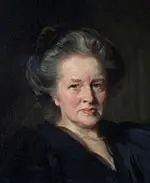
Millicent Fawcett wasn’t the only ground-breaking woman in her family, though. Elder sister Elizabeth Garrett Anderson made history of her own as the first woman to become a doctor and surgeon in Britain, and that is only the start of a long list of achievements.
With her gender preventing her from working in a hospital, she opened her first practice in Marylebone in 1865, tending to cholera patients in the outbreak of that year.
By 1873, she’d become the first woman appointed to a medical post in Britain, and the following year she co-founded the School of Medicine for Women (now part of UCL’s medical school) with fellow pioneer Dr Sophia Jex-Blake, before eventually serving as its dean. Oh, and she still found time to fight for women’s suffrage, and to serve as mayor of her hometown of Aldeburgh, becoming – you guessed it – the first female mayor in Britain.
9. Mary Seacole

‘Mother Seacole’ may not be as well known as her contemporary Florence Nightingale, but since she previously topped a poll to find the greatest Black Briton, she’s someone you really ought to know.
Born and raised in Jamaica, Seacole brought her nursing talents to British soldiers during the Crimean War, where she founded her ‘British Hotel’ to provide care for the wounded. Though her legacy faded after her death, historians and activists have helped raise awareness of her status and deeds over the past 40 years, bringing her back to the attention of the public. Now, hospital wards bear her name and NHS Seacole Centre at Headley Court in Surrey has been used to provide care for those recovering from Covid-19.
You’ll also find a blue plaque dedicated to her in Soho Square, and an impressive statue outside St Thomas’ Hospital – meanwhile, the Mary Seacole Awards recognise the outstanding work of people from Black and minority ethnic backgrounds.
*Some images edited to include those that appear to be not under copyright, replacing those from the article that appear to be copyright.
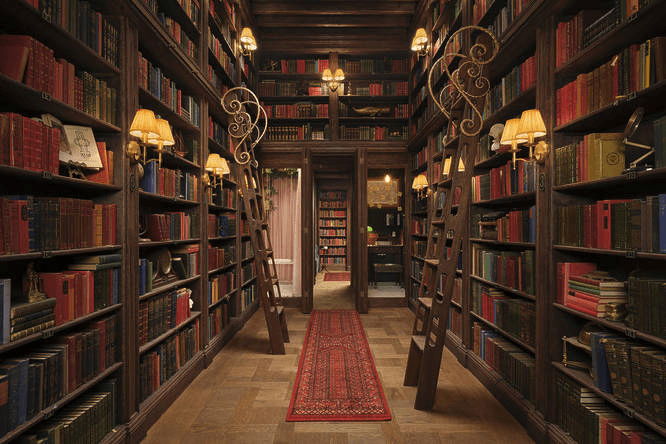
Here’s How You Can Stay Overnight Inside St Paul’s Cathedral For Just £7
Some lucky Londoners will get to peruse and snooze amongst the 22,000 books in the secret library nestled inside one of the capital city’s most iconic landmarks.
KATIE FORGE – STAFF WRITER • 5 MARCH, 2024
Literary-lovers of London, listen up. St Paul’s Cathedral is hosting the ultimate pyjama party to mark World Book Day. For the very first time since World War II; the hidden library nestled within the legendary London landmark will be available for an overnight stay. And it will cost just £7 for the night. Yes, you read that correctly. You can have a sleepover at St Paul’s Cathedral for less than the cost of a pint in most London pubs.
Hosted by #BookTok’s Abby Parker and exclusively listed on Airbnb; this blissfully bookish break will take place on Friday, March 15. The hidden library boasts a carefully-curated collection of over 22,000 books, from timeless classics to the latest.
What’s included in the stay?
Kicking off with a climb up the famous Geometric Staircase (which was designed 300 years ago by Sir Christopher Wren, FYI), the literary itinerary will also involve dinner, breakfast, a tour of the cathedral from the Dean of St Paul’s, a climb up the cathedral’s dome and – of course – plenty of time to get stuck in to the gigantic to-be-read pile.

Although sleep will be low on the list of priorities during this stay; guests will be slumbering in the bedroom section of the hidden library but will have access to the reading room, the reading nooks and the library. The lucky pair will also receive signed and stamped copies of the upcoming Penguin Random House US unreleased books to take home with them.
This highly-coveted night at the museum cathedral will be available for one night only on Friday, March 15 and is suitable for two adults. Guests can request to book the stay on March 12 at 10am – so clear your diaries, bookworms and bibliophiles. May the odds be in your favour.

Sandra Lynes Timbrell, Director of Visitor Engagement at St Paul’s Cathedral, said: “The recently restored library at St Paul’s has long been a secret gem of the Cathedral – cleverly concealed by the ingenious architecture of Sir Christopher Wren. Some very fortunate guests will now get the chance to delve deeper into the history and wonder of St Paul’s with this truly one of a kind stay.”
Amanda Cupples, General Manager of Northern Europe at Airbnb, said: “The Hidden Library of St Paul’s Cathedral’s is truly a haven for book-lovers seeking the ultimate literary escape. Whether you’re a bookworm, a history enthusiast, or simply seeking a unique experience in London, we are thrilled to open up the doors to the library of your dreams, and one of the most iconic buildings in the world, exclusively on Airbnb.”

Find out more information here.
This Is The Ultimate London Literary Walking Tour For Book-Lovers
We’ve created a walking tour that hits the very best literary spots that London has to offer (and trust us there’s a hell of a lot), so lace up those shoes and lets get walking.
FRANCHESCA VILLAR – STAFF WRITER • 6 MARCH, 2024

London is a true dream for any bibliophile, it has been the home to some of the world’s most renowned writers and has been the subject and inspiration of endless authors, poets, and storytellers so it’s no surprise that it’s heaped in literary history. With that said, it also makes for the perfect place for a literary walking tour.
Considering that London is chock-full of places with literary leanings—whether it was where an author lived, establishments or pubs they would frequent, or places in London that have ended up immortalised in their writing—a walking tour with every single one of these spots would most probably wear the soles of your shoes clean off and take a week to get through. So instead, we’ve come up with a walking tour that hits the best literary spots in London but is still doable within a day. It is a pretty extensive route, so feel free to tailor the tour for the time you have and the distance you’re willing or able to go, or even throw in a cheeky bus ride in between some stops to give your legs a much-needed rest.
So without further ado, it’s time to get those steps in and discover the London of some of the world’s most beloved writers.
1. Highgate Cemetery

We’re starting the walking tour off with a bang in North London’s Highgate Cemetery, the resting place of approximately 170,000 people most notably including Karl Marx and George Eliot. The tomb of the German philosopher and co-author of The Communist Manifesto stands in the Eastern Cemetery and consists of a large bust of Marx on a marble pedestal inscribed with the final words of the manifesto, ‘workers of all lands unite’. Marx’s tomb is one of the most famous tombs in the cemetery but has also had a history of vandalism and attacks by those who don’t agree with his theories. It’s definitely a must-see in any London literary walking tour, hence why it’s the starting point of our adventure!
The grave of George Eliot, or rather Mary Ann Stevens, is also found in the Eastern Cemetery and is inscribed with lines from her poem ‘The Choir Invisible’. She is known as one of the most celebrated novelists of the Victorian period, with her work including Middlemarch, Adam Bede, and The Mill on the Floss. Other influential literary figures can be found in Highgate Cemetery including Herbert Spencer whose political theories are the direct opposite of Karl Marx’s and whose ashes are interestingly found almost directly opposite from Marx’s grave. The tombs of the wife, parents, brother, and sister of Charles Dickens also reside in the cemetery.
Swain’s Lane, N6 6PJ
2. Keats House

Making our way down from Highgate to the lovely Hampstead is the house of John Keats. This was the home of John Keats from 1818 to 1820 and was where he stayed until he left for Rome in the hope that the warmer weather would ease the pain of his tuberculosis. It was built around 1815 and was originally called Wentworth Place and was where Keats composed some of his most famous works including La Belle Dame sans Merci, The Eve of St Agnes, and Ode to a Nightmare. In the house next door lived Fanny Brawne who was the fiancee and muse to Keats, although they were never able to marry because of Keats’ untimely death. Now the house is open as a museum and is well worth a visit inside as it has numerous well-preserved artefacts including the engagement ring given to Fanny Brawne and a copy of Keats’ death mask.
10 Keats Grove, NW3 2RR
3. The Sherlock Holmes Museum

A London literary walking tour simply would not be complete without a stop at our favourite detective’s house. Although the museum doesn’t technically stand on the actual 221b Baker Street address (a building society stands on it instead) we’re still happy to pretend the museum is where the fictional Sherlock Holmes once resided. The museum has been vamped up to look like a Victorian-era house, complete with gas lamps, authentic Victorian furniture and curiosities all fit for Arthur Conan-Doyles’ infamous detective.
The museum lets you step back in time to a bygone era and see where Holmes and Watson’s began. It’s probably the most immersive stop on the walking tour and although it’s a bit of a long walk from Hampstead, it’s definitely worth the trip and can easily be reached on a cheeky bus or tube detour to Baker Street.
22lb Baker Street although technically 237-241 Baker Street, NW1 6XE.
4. Platform 9 3/4
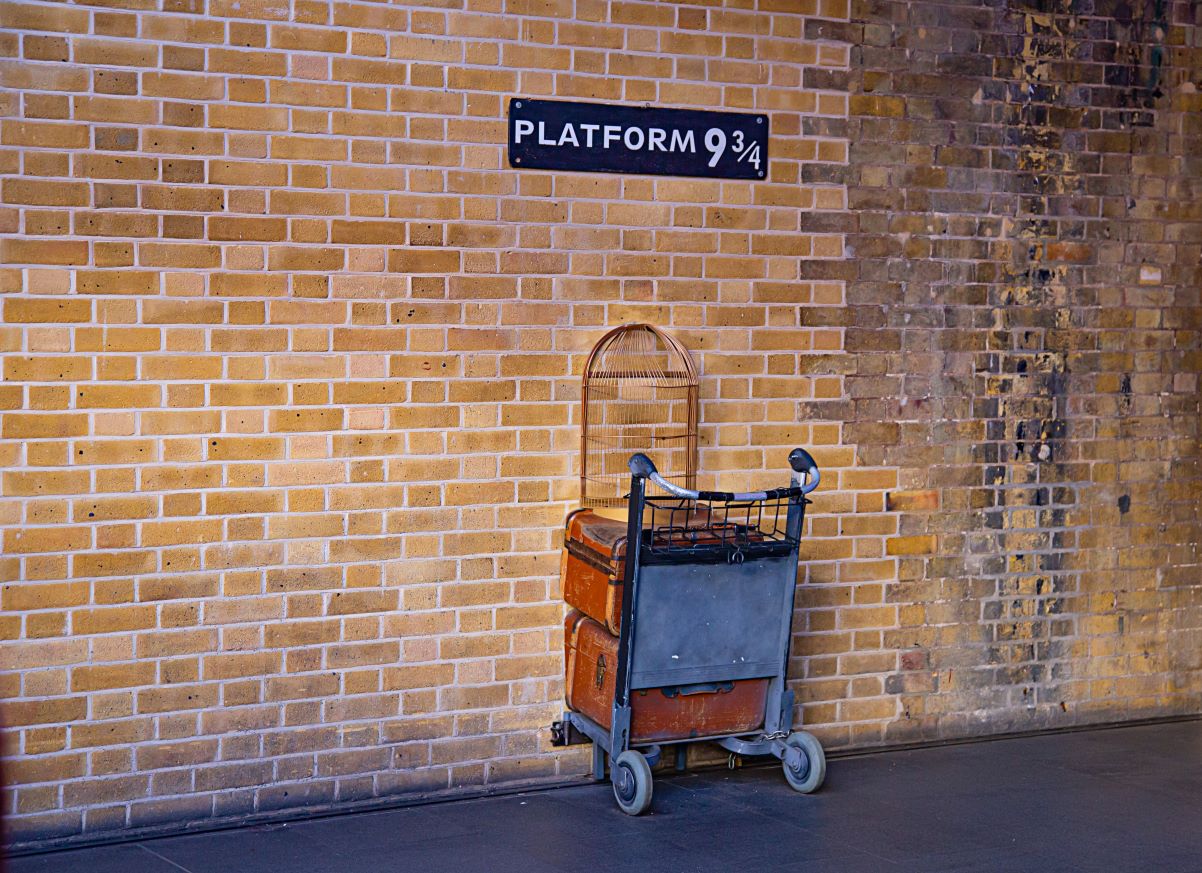
In King’s Cross Station you’ll find a trolly embedded in the wall on the platform ready for you to start your journey to Hogwarts, or so we can hope. This stop is a non-negotiable for any Potterheads in London and even has a handy Harry Potter gift shop nearby for you to get your wand and stock up on any essentials before you head to Hogwarts.
Kings Cross Station, N1 9AP
5. The British Library

The British Library is any book lover’s absolute dream. It’s a mammoth of a building with hundreds and thousands of books for you to explore. Some highlights of the library include its first edition collections of the most well-known and oldest books, and original copies of letters and documents that you’ll have access to once you sign up for a reading pass. It’s a place on the tour that deserves a lot of time for you to explore all that it has to offer so it’s well worth a return visit for you to hunker down with the books.
96 Euston Road, NW1 2DB
6. Gordon Square

Now entering Bloomsbury which is definitely a literary hotspot in London, and hence why it’s got a few entries on our walking tour, this area was a favourite among many writers and was a bustling hub for intellectuals. So much so that they even produced a group called the Bloomsbury Group in the 20th century made up of writers, intellectuals, artists, and philosophers including Virginia Woolf, John Maynard Keynes, E. M. Forster, and Lytton Strachey. All around Bloomsbury, you’ll find endless plaques signposting places where the Bloomsbury Group lived, worked, and met, with Gordon Square being the best place to find this as it’s where several members of the Bloomsbury Group lived, including Virginia Woold.
7. Senate House

Just a very short walk away from Gordon Square is Senate House which is the administrative centre of the University of London and a library which occupies the fourth to 18th floors of the building. It has a place on our walking tour as it was George Orwell’s inspiration for the Ministry of Truth in one of literature’s greatest dystopian novels, Nineteen Eighty-Four.
Malet Street, WC1E 7HU
8. The Charles Dickens Museum

Once Charles Dickens‘ from 1837 to 1839 and now a museum which remains just as he’s left it. It was whilst Dickens lived in this home with his wife and eldest son that he wrote The Pickwick Papers, Nicholas Nickleby, and most famous of all, Oliver Twist. The house became open to the public in 1925 and looks like a typical middle-class Victorian home decorated with items that belonged to Dickens.
48-49 Doughty Street, WC1N 2LX
9. Fitzroy Tavern

A popular watering hole among artists and intellectuals from the 1920’s to 1950’s was the Fitzroy Tavern, a perfect place for a mid-walking-tour drink. George Orwell and Dylan Thomas frequented the tavern, so if it’s good enough for them then it’s certainly good enough for us. The pub still has all the charms of its heyday and even has a photograph of Dylan Thomas drinking in the pub up on its walls.
16 Charlotte Street, W1T 2LY
10. The Old Curiosity Shop

The Old Curiosity Shop is another Charles Dickens stop on the tour and is said to have been the inspiration for Dickens’ novel of the same name. The building dates back to the sixteenth century, specifically 1567, in an area known as Clare Market and is made using timber from old ships, remaining intact even through the bombing during World War Two. The shop looks as if it’s been taken right out of a storybook and has kept its charming old-timey look, selling antiques and high-end shoes.
13-14 Portsmouth Street, WC2A 2ES
11. Ye Olde Cheshire Cheese

Another historic watering hole on the list is Fleet Street’s Ye Olde Cheshire Cheese. The pub was rebuilt in 1666 after the Great Fire of London but there has been a pub at this location since 1538 so it’s been around for a long old time – the creaking of the floorboards can tell you as much. The likes of Oliver Goldfield, Mark Twain, Charles Dickens, Alfred Tennyson, Sir Arthur Conan Doyle, G.K. Chesterton, P.G. Wodehouse, and Samuel Johnson are all said to have been regulars of this humble pub. Oh if only walls could talk. Ye Olde Cheshire Cheese has also been featured in several fictional works including Agatha Christie’s The Million Dollar Bond Robbery, and although not fictional but certainly quite random, in the Betty Crocker cookbook.
145 Fleet Street, EC4A 2BP
12. The Cockpit

With another pub on the list, we may be in danger of turning this walking tour into a pub crawl (which wouldn’t be a bad idea) but we promise The Cockpit is here for good reason. As you can probably tell by now London is certainly not short of its historic pubs, and this quaint little boozer in Blackfriars is one of them. The Cockpit stands on the site of a house once bought by Shakespeare for the eye-watering sum of £140, *cries in 21st century London renting crisis*.
7 St Andrew’s Hill, EC4V 5BY
13. Shakespeare’s Globe

Although it’s not the actual thing, Shakespeare’s Globe is a pretty excellent realistic reconstruction of the original Globe Theatre best associated with The Bard. The original theatre was built in 1599 but demolished in 1644 and is pretty much true-to-history as you can get, apart from its capacity of 1,400 spectators compared to the original theatre’s 3,000 which is due to modern safety requirements. Plays are on from May through to October with tours available all year round so we definitely recommend a visit during summer for your best chance to get a taste of Shakespeare’s plays in action in the space he intended it – sort of.
21 New Globe Walk, SE1 9DT
14. The George Inn

The final stop on this hefty walking tour is The George Inn, London’s last remaining galleried inn, for a well-deserved rest and a well-deserved drink. It’s been known to be a popular haunt of two of England’s most legendary writers; Charles Dickens and William Shakespeare. There are definite records of Charles Dickens drinking at The George and even mentions it by name in the Little Dorrit. Shakespeare also mentioned the pub in one of his plays, living in Southwark it’s not hard to imagine that he enjoyed many a local beer in this pub. Even Geoffrey Chaucer has ties with The George Inn, as it was just outside where he began his pilgrimage to Canterbury with his journey being canonised in The Canterbury Tales which is regarded as the birth of English literature.
75 Borough High Street, SE1 1NH
Read more: Literary Spots In London That Every Book Lover Needs To Visit
There is nothing here about one of my favourite authors, Barbara Pym. A member of the Barbara Pym Society has devised a Barbara Pym walk, based on her workplace and environs. This will be a treat for another post.

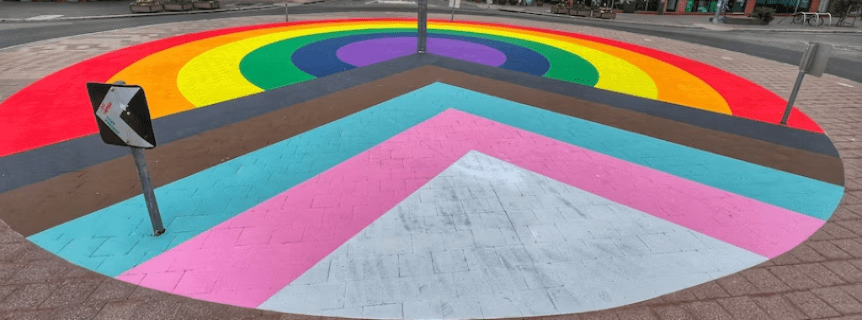

| Starting today for International Women’s Day, each Friday in March we’ll be bringing you a different blog article from our expert authors that sheds light on women’s experience and celebrates womanhood – with topics ranging from what we can learn globally from African matriarchitarian societies to how women in China are rejecting marriage and academic women’s experiences in religion. Head over to the blog right now to find out why women are key to improving city life. |
| Read the blog |



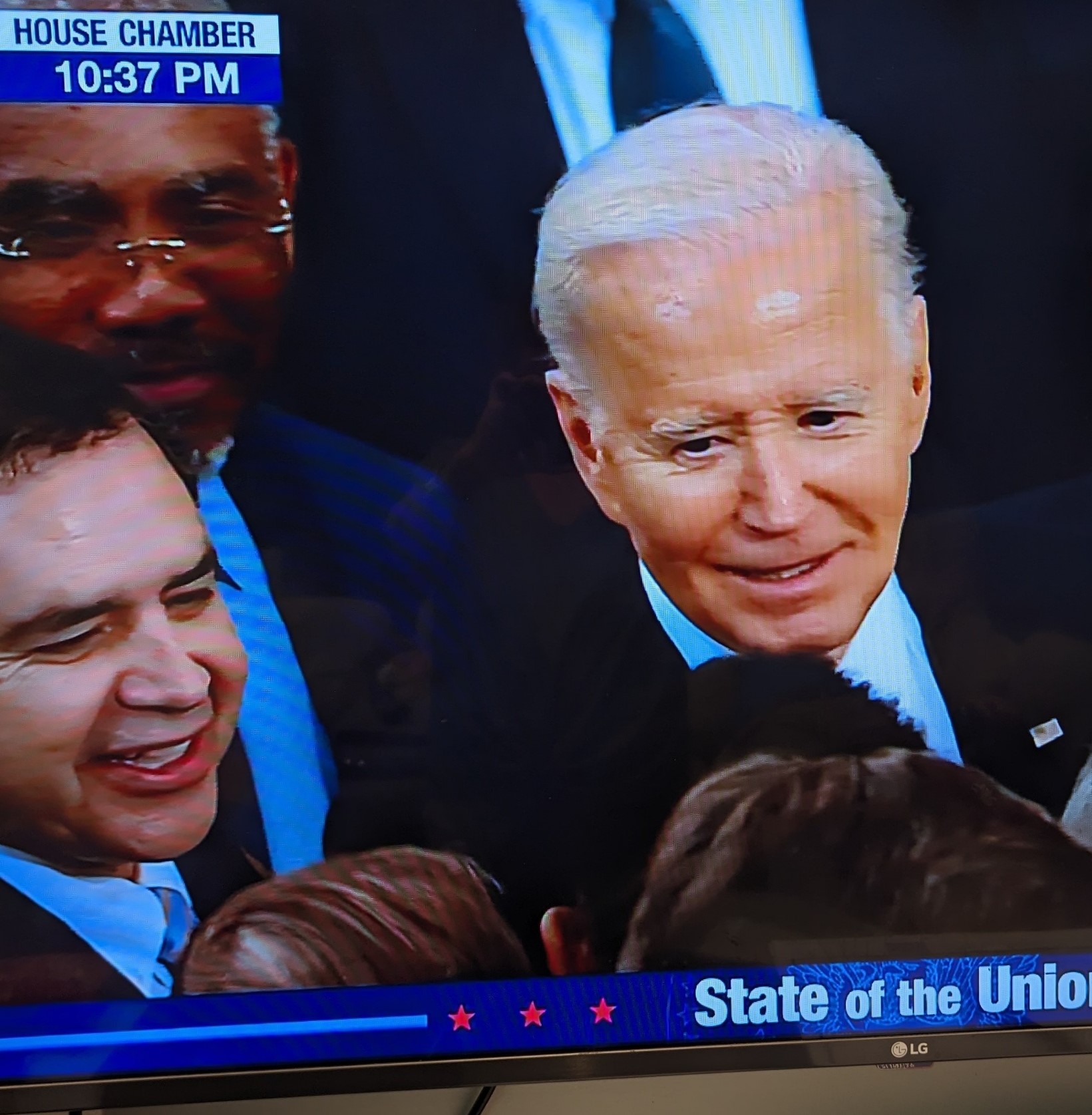
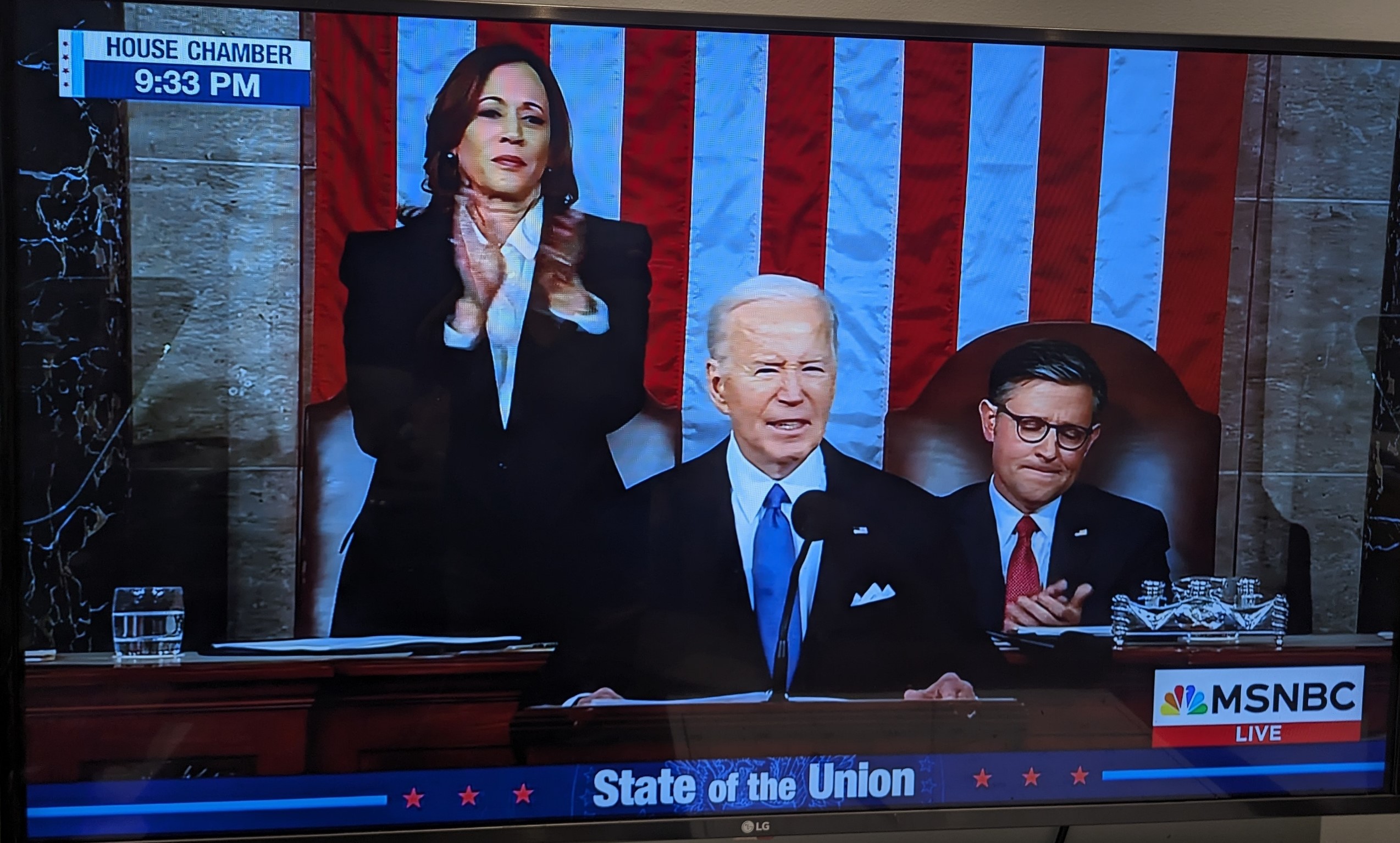

Heather Cox Richardson – Letters from an American, response to the State of the Union address

Last night, Republicans and Democrats offered very different visions of the roles and rights of women in American society.
In the State of the Union address, President Joe Biden thanked Vice President Kamala Harris “for being an incredible leader defending reproductive freedom and so much more.” Biden condemned “state laws banning the freedom to choose, criminalizing doctors, forcing survivors of rape and incest to leave their states to get the treatment they need,” and he called out Republicans “promising to pass a national ban on reproductive freedom.”
Biden quoted back to the right-wing majority on the Supreme Court, sitting in front of him in the chamber, their words when in June 2022 they overturned the 1973 Roe v. Wade decision that recognized the constitutional right to abortion.
The justices wrote: “Women are not without electoral or political power.”
Biden responded: “You’re about to realize just how much you were right about that.” “Clearly, those bragging about overturning Roe v. Wade have no clue about the power of women. But they found out. When reproductive freedom was on the ballot, we won in 2022 and 2023. And we’ll win again in 2024.” Biden promised to restore Roe v. Wade if Americans elect a Congress that supports the right to choose.
Senator Katie Britt (R-AL) gave the Republican rebuttal to the State of the Union address. Sitting in a kitchen rather than in a setting that reflected her position in one of the nation’s highest elected offices, Britt conspicuously wore a necklace with a cross and spoke in a breathy, childlike voice as she wavered between smiles and the suggestion she was on the verge of tears.
“What the hell am I watching right now?” an unnamed Trump advisor asked Nikki McCann Ramirez and Asawin Suebsaeng of Rolling Stone.
Britt’s performance was the logical outcome of right-wing demonization of women’s rights advocates since the 1960s. That popular demonization began soon after women calling for “liberation” from the strict gender roles of the post–World War II years protested the 1968 Miss America pageant in Atlantic City, New Jersey. The protesters tossed items related to women’s roles as homemakers and sex symbols—bras, girdles, pots and pans, and Playboy magazines—into a trash can. That act so horrified traditionalists that a journalist likened the women to young men burning their draft cards, starting the myth that the protesting women had burned their bras.
Two years later, with his popularity dropping before the 1972 election, President Richard Nixon wooed Catholic Democrats by abandoning his support for abortion rights. The following March, Congress passed the Equal Rights Amendment to the Constitution, declaring that “[e]quality of rights under the law shall not be denied or abridged by the United States or by any state on account of sex,” and sent it off to the states for ratification.
Advocates of traditional gender roles used abortion as a proxy to attack women’s rights in general. Railing against the Equal Rights Amendment in her first statement on abortion in 1972, activist Phyllis Schlafly did not mention fetuses, but instead attacked “women’s lib”—the women’s liberation movement—which she claimed was “a total assault on the role of the American woman as wife and mother, and on the family as the basic unit of society.”
The Supreme Court decided Roe v. Wade in 1973, including women in the ranks of marginalized Americans whose civil rights were protected by the federal government. Since the 1950s, opponents of such federal protection for Black and Brown Americans had tied such federal action to communism because it meant the government used tax dollars for the benefit of specific groups. In their minds, this amounted to a redistribution of wealth from hardworking taxpayers to undeserving special interests.
The cultural backlash to the idea of women’s equality strengthened. In 1974 the television show Little House on the Prairie, based on Laura Ingalls Wilder’s books, began its nine-year run. It portrayed western women as wives and mothers cared for by menfolk, complementing the image of the cowboy individualist championed by the antigovernment right wing.
As historian Peggy O’Donnell noted in Jezebel in 2019, prairie dresses, with their image of “traditional” femininity and motherhood, the female version of cowboy clothing, became fashionable, even as the era’s popular televangelists railed against feminists.
Constantly evoking the image of the western cowboy, Ronald Reagan won the White House. Four years later, sociologist Kristin Luker discovered that “pro-life” activists believed that selfish “pro-choice” women were denigrating the roles of wife and mother and were demanding rights they didn’t need or deserve.
Increasingly, Republicans portrayed women who demanded equality as a special interest made up of feminist scolds who wanted federal support they did not deserve. In 1984, when Democratic presidential candidate Walter “Fritz” Mondale tapped the very well qualified Representative Geraldine Ferraro of New York as his running mate, opponents circulated fake campaign buttons backing “Fritz and Tits,” and even 60 percent of Democrats thought Ferraro was there only because Mondale was under pressure from women’s groups who wanted special legislation.
Powerful women either fell out of public view or were pilloried for intruding on a man’s world as those opposing women’s equality portrayed women either as wives and mothers, who looked to their husbands for financial security and safety, or as sex objects available for men’s pleasure.
By 1988, talk radio host Rush Limbaugh had begun to demonize women’s rights advocates as “feminazis” for whom “the most important thing in life is ensuring that as many abortions as possible occur.” After the 1993 siege of the headquarters of a religious cult near Waco, Texas, that left 76 people dead and inspired the rise of right-wing militias to resist the federal government, Limbaugh emphasized that the attorney general who ordered the operation was the first female attorney general: Janet Reno.
Such rhetoric turned out Republican voters, especially the white evangelical base, and after it launched in 1996, the Fox News Channel (FNC) reinforced the idea that individualist men should be running society. Most FNC personalities were older men; the network’s female personalities were young, beautiful, and deferential. (FNC chair and chief executive officer Roger Ailes resigned in 2016 after accounts emerged of alleged sexual harassment.)
By 2016 the competing ideologies concerning the role of women in American society were encapsulated by the contest between Donald Trump and Secretary of State Hillary Clinton. Clinton was highly educated and extremely well qualified. She advocated protecting the rights of women and minorities and warned that Trump would pack the Supreme Court with extremists who would undermine abortion rights. She provided detailed policy papers.
Trump, in turn, bragged of sexual assault and called for Clinton to be arrested: “Lock her up!” became the call and response at his rallies. Ending access to abortion had become the rallying cry for the evangelicals who supported Trump, and he promised to end those rights, even flirting with the idea of criminal punishments for women seeking abortions. Far from being disqualifying, Trump’s denigration of women embodied the sort of traditional gender roles fundamentalists embraced.
Once in office, Trump nominated and the Republican-dominated Senate confirmed three radical Supreme Court justices who in June 2022 overturned Roe v. Wade, taking away the recognition of a constitutional right Americans had enjoyed for almost 50 years.
When Britt delivered the Republican rebuttal to the State of the Union from a kitchen, wearing a cross and using a submissive speaking style, she represented the outcome of the longstanding opposition to women’s equal rights in the United States.
The Democrats’ position last night was a sharp contrast. Biden stood in front of the nation’s first female vice president as he denounced the Republican assault on women’s rights. He warned the country: “America cannot go back.”
Perfect timing for today’s celebration of International Women’s Day.
—
Notes:
https://www.whitehouse.gov/state-of-the-union-2024
The following is an informative paper about the reply to President Biden’s State of the Union Address made by Republican Senator Katie Britt.
Jess Piper @jesspiper

Executive Director for Blue Missouri. Former nominee for State Rep, ‘22. Rural mom fighting for public schools. Host of “Dirt Road Democrat”.
The View from Rural Missouri by Jess Piper
I was about to head to bed after the State of the Union last night, when I heard a voice coming from my television that stopped me in my tracks. I didn’t know who was speaking, but it really didn’t matter—I recognized the voice. It was so many voices from my childhood. It was so many Sunday mornings and Wednesday evenings. It was potlucks, and baby show…
It was Senator Katie Britt using her well-practiced fundie baby voice.
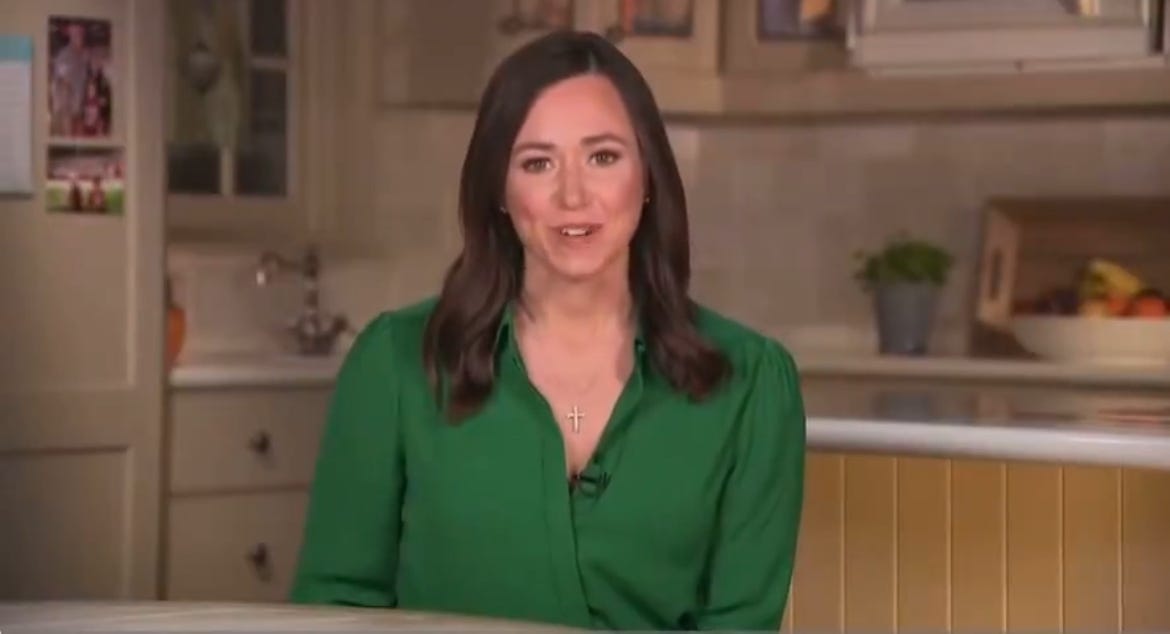
Senator Katie Britt, (R) Alabama
I threw so many folks for a loop last year when I discussed the voice in a video. I used my “training” as a former Evangelical, a Southern Baptist, to describe the breathy cadence and the soft, child-like high pitch. Folks outside of Fundamentalist culture had never heard the term—they just knew the voice made them uncomfortable.
I know that voice well…in fact I can’t shake it myself. It was engrained in every woman I knew from church and every time I speak about it, folks will point out that I sound that way myself. Yes, friends. That’s the point.
Be sweet. Obey. Prove it by speaking in muted tones. See Further Commentary and Articles arising from Books* and continued longer articles.
Axios AM – Mike Allen March 10, 2024

Charted: Rise of women inventors

Data: Invention, Knowledge Transfer, and Innovation report from the National Center for Science and Engineering Statistics. Chart: Danielle Alberti/Axios
Women’s participation in scientific patents has increased since 2000 — but there’s a large, lingering gender gap, Axios managing editor Alison Snyder writes from a National Center for Science and Engineering Statistics report.
- Why it matters: Gender influences what’s invented. In biotech, fewer women inventors resulted in fewer health products for women. (The reminder of this information is behind the pay wall. However, what is available is instructive and worthwhile recording in International Women’s Month.)

 Robin's Room