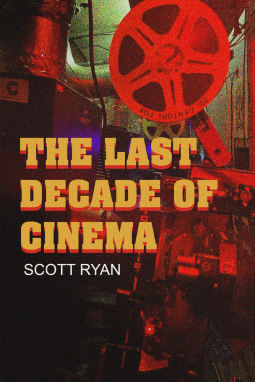
Scott Ryan The Last Decade of Cinema Black Chateau Fayetteville Mafia Press, June 2024.
Thank you, NetGalley, for providing me with this uncorrected proof for review.
Scott Ryan has a distinct writing style that carries this serious, perceptive and analytical approach to a decade of film with a firm grasp of the need to engage with his audience. At the same time, he ensures that he maintains the obligation he has imposed on himself to utter raw truths. His fidelity to exposing the failings that largely mar the aftermath of 1990s film underlies the way in which he approaches his prime aim. The responsibility he feels for the task he has set himself – bringing the sheer wonder of 1990s film to a large audience – is demonstrated by the choices he makes, the language he uses, the additional material and his tenacity in acquiring relevant interviews.
Ryan chooses the films that fit his criteria – but then, oh joy, he adds a supplementary list that could have equally been chosen. He also adds ten films from the immediately previous decade, and the one after that demonstrating that some films that meet his criteria do fall outside the strict period he gave himself for the bulk of the book. The films are supplemented by some excellent interviews – a tribute to his thoroughness in getting the best for to meet the challenge he set for himself; notes for each chapter; a comprehensive index; and informative acknowledgements. See Books: Reviews for the complete review.
Articles below: Bob McMullan, Can Albo overcome/overturn the paradox of class?; Agatha Christie, Murder by the Book; Eleanor Coppola; Heather Cox Richardson from Letters from an American; Pompeii: Breathtaking new paintings found at ancient city; Gender Institute Events; Cindy Lou eats out in Canberra.
Bob McMullan

Can Albo overcome/overturn the paradox of class?
Boris Johnson did it, Donald Trump specialises in it, Peter Dutton is trying it.
All these conservatives whose economic policies serve the special interests of the highest income earners have based, or are trying to base, their political strategy on winning the votes of working class voters, particularly working class men, and even more specifically, white working class men.
Renowned US journalist, EJ Dionne, recently described it this way:
“It’s the paradox of Bidenism: The President sees himself as the champion of the working class but can’t rely on its support to win reelection. To prevail he’ll need a mountain of ballots from college-educated voters in metropolitan areas.
The flip side is the paradox of the Republican Party, which now depends on white working class votes, especially in small towns and the countryside. Yet its economic policies remain geared to the interests of high earners and investors, many of whom have fled the party.”
A similar pattern emerged in the UK election in 2019. The Conservative Party, under Boris Johnson’s leadership, wrested a large cohort of traditional Labour seats in the so-called ‘red wall’ into their column which contributed to the worst Labour result for a generation.
It is no secret that Peter Dutton seeks to follow the same path in Australia. He is targeting the outer suburban seats in the major cities to compensate for the loss of urban seats to Labor, Teals and Greens.
Why is this happening? Is it an irreversible trend?
Obviously, there is no single cause of a major realignment in political support. And despite their similarities, the societal composition, history, geography, electoral systems and economies of the USA, UK and Australia are sufficiently different to create different drivers of change.
But it does appear that there are some common elements.
EJ Dionne attributes the working class support for Trump to “… white racial backlash and the rise of new cultural and religious issues.” And:
“Trump has bundled together all the resentments felt by voters experiencing both economic decline and cultural estrangement.”
Dionne also points to an interesting breakdown of the recent Quinnipiac poll. The top-line result was Biden 49 Trump 45. However, amongst voters with college degrees Biden led 60/34 whilst voters without a college degree favoured Trump 58/37.
An interesting explanation of the UK 2019 paradox is provided by The Economist in a recent issue. The argument they quote suggests:” …that a group of voters who should already have been swing voters (because they were close to the Tories on cultural issues like immigration) finally did swing. They left Labour when it ceased to offer them much…”
This same class paradox is the obvious basis for Peter Dutton’s strategy on behalf of the Australian coalition.
Rather than focusing on winning back the traditional Liberal seats lost in 2022, his strategy is focused on the outer metropolitan seats in the cities. This is clearly based on an assessment that the alienation of working class voters in the USA and UK is also happening here. There is no doubt some of the same factors are at play in Australia as issues like the Yes campaign for indigenous recognition was seen by many in these regions as a distraction from what they see as the appropriate primacy of cost of living issues.
This is similar to the argument I put forward in a recent article on the Hasluck Test for the Labor Party.
However, the early indications are that this strategy is not working, or at least not working yet. The recent Dunkley by-election was an opportunity to road test the strategy and it came up short.
Recent evidence from the UK suggests that the change is not irreversible.
The recent Economist article suggests the “classic ‘red wall’ voter is a white man aged between 55 and 64. In 2019 this kind of voter was more likely to vote Conservative than Labour. He is now twice as likely to back Labour.”
This analysis suggests that such voters have become swinging voters rather than part of an inevitable drift to the right side of politics.
It also suggests that there more factors than economic self-interest at play.
If the Australian Labor government can show genuine interest in the concerns of outer suburban voters, display the reasonable and competent government the Tories have so dramatically failed to do in the UK and have positive proposals for the future without promising to fix everything all at once they should be able to retain sufficient of these voters to retain the seats at risk.
Meanwhile, the coalition’s strategy of ignoring the interests of voters in the Teal seats is likely to guarantee most, if not all the “Teals” survive. They may even be joined by others either in the inner-city or regional seats similar to Indi.

Anthony Norman Albanese is an Australian politician serving as the 31st and current prime minister of Australia since 2022. He has been leader of the Australian Labor Party since 2019.


MURDER BY THE BOOK : NEW UK EXHIBITION
27th March 2024
A Celebration of 20th Century British Crime Fiction at Cambridge University Library
About The Exhibition
Cambridge University Library shines a spotlight on the UK’s most read, bought and borrowed genre : crime fiction. But of course, we didn’t need to tell Agatha Christie fans that… This free-to-visit exhibition celebrates some of the best books, classic and contemporary, that have captivated readers throughout the UK and beyond. Seize your chance to marvel at the Library’s remarkable collection of first editions, see rare manuscripts and curios from March 23rd to August 24th.
From Wilkie Collins to Charles Dickens, Arthur Conan Doyle to Agatha Christie, Ian Rankin to Val McDermid, award-winning crime writer Nicola Upson has curated a criminally good treat for visitors. Agatha Christie fans will get the chance to marvel at one of the author’s own typewriters, an original typescript for her final Poirot novel, Curtain, as well as notebooks and a Dictaphone which she used to plot her stories. Plus, there are almost 100 first edition crime classics in their original dust jackets from the library’s own collection, so you can rest assured that you’ll be coming away with a few new (or new to you) titles to add to your reading lists.
Key Info
Dates: Saturday March 23rd – Saturday August 24th 2024
Opening Times: Monday – Friday 9am – 6:30pm, Saturday 9am – 4:30pm
Tickets: Tickets are free. Simply book a date and timeslot to secure your visit. Book Now
Eleanor Coppola, artist and matriarch of filmmaking dynasty, dead at 87
By Dan Heching, CNN 2 minute read Published 1:24 PM EDT, Sat April 13, 2024

Eleanor Coppola attends the tribute to Francis Ford Coppola during the 11th Film Festival Lumiere on October 18, 2019, in Lyon, France. Stephane Cardinale/Corbis Entertainment/Getty ImagesCNN —
Eleanor Coppola, award-winning film documentarian, artist, writer and wife of Francis Ford Coppola, has died. She was 87.
The news was confirmed by Francis Ford Coppola’s representative Nesma Youssef, who said in an email Eleanor Coppola was “surrounded by her loving family” at home in Rutherford, California, at the time of her death on Friday.
Eleanor and Francis Ford Coppola were married for 61 years, with Eleanor accompanying her husband on many of his film shoots throughout his illustrious career.
In 1992, she won a Primetime Emmy Award for her documentary “Hearts of Darkness: A Filmmaker’s Apocalypse,” about the making of Francis Ford Coppola’s 1979 war epic “Apocalypse Now.” She made several other documentaries about her family’s films and, according to an obituary sent by Youssef, was most recently editing a documentary about the making of her daughter Sofia Coppola’s 2006 film “Marie Antoinette.”

(From left) Roman Coppola, Eleanor Coppola, Francis Ford Coppola and Sofia Coppola attend the 43rd Directors Guild of America Awards on March 16, 1991, in Beverly Hills, California. Ron Galella Collection/Getty Images
Eleanor Coppola was a feature filmmaker in her own right, making her directorial debut at the age of 80 in 2016 with the Diane Lane-starring romance “Paris Can Wait.” She also wrote the movie, which followed the wife of a successful movie producer as she makes her way across France with a driver.
Her second feature, 2020’s “Love is Love is Love,” was selected to screen at the Tribeca Film Festival and the Deauville American Film Festival in France.
In addition to her pursuits in filmmaking, Eleanor Coppola was an accomplished artist and writer.
Along with her husband, she was at the helm of one of the most prolific and successful filmmaking families in Hollywood. Her children Roman Coppola (writer and producer on several Wes Anderson films) and Sofia Coppola (“The Virgin Suicides,” “Lost in Translation”) are both successful filmmakers. Nicolas Cage, Talia Shire and Jason Schwartzman are part of the extended Coppola family.
Shortly before her death, Eleanor Coppola completed her third book, a memoir. In the manuscript, she wrote: “I appreciate how my unexpected life has stretched and pulled me in so many extraordinary ways and taken me in a multitude of directions beyond my wildest imaginings.”
I reviewed Ian Nathan’s, The Coppolas A Movie Dynasty on October 6 2021. The beginning of the review appears below.
Ian Nathan The Coppolas A Movie Dynasty Palazzo, 2021.

Thank you NetGalley for providing me with this uncorrected proof for review.
Ian Nathan has written an insightful and exciting contribution to our understanding of writing, directing and producing films; the role of family and ability in a dynasty such as the Coppolas; the studio system, and the contribution of film finance, box office returns and reviews; to the success of a film that begins with an idea that impels people such as Francis Ford and Sofia Coppola toward creative endeavour. Francis Ford and Sofia Coppola are the stars of this book.
However, other members of the Coppola family also make contributions to the Coppola dynasty’s work, and they are also given a place in this absorbing story: wife and mother, Eleanor Coppola; sister, Talia Shire; brother, August; sons, Gio and Roman Coppola; cousin, Nicholas Cage (formerly Coppola); granddaughter, Gia Coppola. So, too, are the actors who took their place, successfully or sometimes perhaps not, in the films. Francis Ford’s father, Carmine, makes an appearance. Here a story Nathan relates about a prank played on him by Francis Ford Coppola is very sympathetic to him, rather than acknowledging the impact on the father – an interesting comment on the investment Nathan makes in his portrayal of the son. See Books: Reviews, 2021 for the complete review.
Heather Cox Richardson from Letters from an American <heathercoxrichardson@substack.com>

April 13, 2024.
There are really two major Republican political stories dominating the news these days. The more obvious of the two is the attempt by former president Donald Trump and his followers to destroy American democracy. The other story is older, the one that led to Trump but that stands at least a bit apart from him. It is the story of a national shift away from the supply-side ideology of Reagan Republicans toward an embrace of the idea that the government should hold the playing field among all Americans level.
While these two stories are related, they are not the same.
For forty years, between 1981, when Republican Ronald Reagan took office, and 2021, when Democrat Joe Biden did, the Republicans operated under the theory that the best way to run the country was for the government to stay out of the way of market forces. The idea was that if individuals could accumulate as much money as possible, they would invest more efficiently in the economy than they could if the government regulated business or levied taxes to invest in public infrastructure and public education. The growing economy would result in higher tax revenues, enabling Americans to have both low taxes and government services, and prosperity would spread to everyone.
But the system never worked as promised. Instead, during that 40-year period, Republicans passed massive tax cuts under Reagan, George W. Bush, and Trump, and slashed regulations. A new interpretation of antitrust laws articulated by Robert Bork in the 1980s permitted dramatic consolidation of corporations, while membership in labor unions declined. The result was that as much as $50 trillion moved upward from the bottom 90% of Americans to the top 1%.
To keep voters on board the program that was hollowing out the middle class, Republicans emphasized culture wars, hitting hard on racism and sexism by claiming that taxes were designed by Democrats to give undeserving minorities and women government handouts and promising their evangelical voters they would overturn the Supreme Court’s 1973 Roe v. Wade decision recognizing the constitutional right to abortion. Those looking for tax cuts and business deregulation depended on culture warriors and white evangelicals to provide the votes to keep them in power.
But the election of Democrat Barack Obama in 2008 proved that Republican arguments were no longer effective enough to elect Republican presidents. So in 2010, with the Citizens United v. Federal Elections Commission decision, the Supreme Court freed corporations to pour unlimited money into U.S. elections. That year, under Operation REDMAP, Republicans worked to dominate state legislatures so they could control redistricting under the 2010 census, yielding extreme partisan gerrymanders that gave Republicans disproportionate control. In 2013 the Supreme Court’s Shelby County v. Holder decision greenlighted the voter suppression Republicans had been working on since 1986.
Even so, by 2016 it was not at all clear that the cultural threats, gerrymandering, and voter suppression would be enough to elect a Republican president. People forget it now because of all that has come since, but in 2016, Trump offered not only the racism and sexism Republicans had served up for decades, but also a more moderate economic program than any other Republican running that year. He called for closing the loopholes that permitted wealthy Americans to evade taxes, cheaper and better healthcare than the Democrats had provided with the Affordable Care Act (also known as Obamacare), bringing manufacturing back to the U.S., and addressing the long backlog of necessary repairs to our roads and bridges through an infrastructure bill.
But once in office, Trump threw economic populism overboard and resurrected the Republican emphasis on tax cuts and deregulation. His signature law was the 2017 tax cuts for corporations and the wealthy at a cost of at least $1.9 trillion over ten years. At the same time, Trump continued to feed his base with racism and sexism, and after the Unite the Right rally at Charlottesville, Virginia, in August 2017, he increasingly turned to his white nationalist base to shore up his power. On January 6, 2021, he used that base to try to overturn the results of the 2020 presidential election.
Republican senators then declined to convict Trump of that attempt in his second impeachment trial, apparently hoping he would go away. Instead, their acquiescence in his behavior has enabled him to continue to push the Big Lie that he won the 2020 election. But to return to power, Trump has increasingly turned away from establishment Republicans and has instead turned the party over to its culture war and Christian nationalist foot soldiers. Now Trump has taken over the Republican National Committee itself, and his supporters threaten to turn the nation over to the culture warriors who care far more about their ideology than they do about tax cuts or deregulation.
The extremism of Trump’s base is hugely unpopular among general voters. Most significantly, Trump catered to his white evangelical base by appointing Supreme Court justices who would overturn Roe v. Wade, and in 2022, when the court did so, the dog caught the car. Americans overwhelmingly support reproductive freedoms, and Republicans are getting hammered over the extreme abortion bans now operative in Republican-dominated states. Now Trump and a number of Republicans have tried to back away from their antiabortion positions, infuriating antiabortion activists.
It is hard to see how the Republican Party can appeal to both Trump’s base and general voters at the same time.
That split dramatically weakens Trump politically while he is in an increasingly precarious position personally. He will, of course, go on trial on Monday, April 15, for alleged crimes committed as he interfered in the 2016 election. At the same time, the $175 million appeals bond he posted to cover the judgment in his business fraud trial has been questioned and must be justified by April 14. The court has scheduled a hearing on the bond for April 22. And his performance at rallies and private events has been unstable.
He seems a shaky reed on which to hang a political party, especially as his MAGA Republicans have proven unable to manage the House of Representatives and are increasingly being called out as Russian puppets for their attacks on Ukraine aid.
Regardless of Trump’s future, though, the Reagan Era is over.
President Biden and Vice President Kamala Harris have quite deliberately rejected the economic ideology that concentrated wealth among the 1%. On their watch, the federal government has worked to put money into the hands of ordinary Americans rather than the very wealthy. With Democrats and on occasion a few Republicans, they have passed legislation to support families, dedicate resources to making sure people with student debt are receiving the correct terms of their loans (thus relieving significant numbers of Americans), and invested in manufacturing, infrastructure, and addressing climate change. They have also supported unions and returned to an older definition of antitrust law, suing Microsoft, Amazon, and Apple and allowing the federal government to negotiate with pharmaceutical companies over drug prices.
Their system has worked. Under Biden and Harris the U.S. has had unemployment rates under 4% for 26 months, the longest streak since the 1960s. Wages for the bottom 80% of Americans have risen faster than inflation, chipping away at the huge disparity between the rich and the poor that the policies of the past 40 years have produced.
Today, in an interview with Jamie Kitman of The Guardian, United Auto Workers president Shawn Fain, who negotiated landmark new union contracts with the country’s Big Three automakers, explained that the world has changed: “Workers have realized they’ve been getting screwed for decades, and they’re fed up.”
—
Notes:
https://time.com/5888024/50-trillion-income-inequality-america; https://www.cbpp.org/research/federal-tax/the-2017-trump-tax-law-was-skewed-to-the-rich-expensive-and-failed-to-deliver; https://www.theguardian.com/us-news/2024/apr/13/shawn-fain-president-uaw-union-interview; https://www.meidastouch.com/news/trump-glitches-yet-again-during-rally; https://www.cbsnews.com/news/donald-trump-175-million-civil-fraud-bond-valid-new-york; https://www.npr.org/2024/01/05/1222714145/jobs-report-december-labor-wages; https://www.salon.com/2024/04/10/theyre-still-playing-games-ex-prosecutor-warns-may-face-asset-seizure-over-invalid-bond
Pompeii: Breathtaking new paintings found at ancient city
By Jonathan Amos, Rebecca Morelle and Alison Francis,BBC Science News in Pompeii, southern Italy
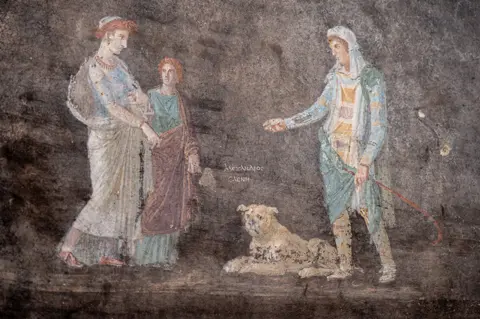
BBC/Tony Jolliffe The frescos depict Greek mythology: Paris kidnaps Helen which triggers the Trojan War
Stunning artworks have been uncovered in a new excavation at Pompeii, the ancient Roman city buried in an eruption from Mount Vesuvius in AD79.
Archaeologists say the frescos are among the finest to be found in the ruins of the ancient site.
Mythical Greek figures such as Helen of Troy are depicted on the high black walls of a large banqueting hall.
The room’s near-complete mosaic floor incorporates more than a million individual white tiles.
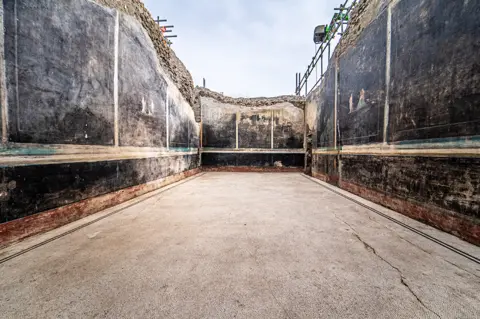
BBC/Tony Jolliffe The black room has only emerged in the last few weeks. Its white mosaic floor is almost complete
A third of the lost city has still to be cleared of volcanic debris. The current dig, the biggest in a generation, is underlining Pompeii’s position as the world’s premier window on the people and culture of the Roman empire.
Park director Dr Gabriel Zuchtriegel presented the “black room” exclusively to the BBC on Thursday.
It was likely the walls’ stark colour was chosen to hide the smoke deposits from lamps used during entertaining after sunset.
“In the shimmering light, the paintings would have almost come to life,” he said.
 BBC
BBC
Two set-piece frescos dominate.
In one, the god Apollo is seen trying to seduce the priestess Cassandra. Her rejection of him, according to legend, resulted in her prophecies being ignored.
The tragic consequence is told in the second painting, in which Prince Paris meets the beautiful Helen – a union Cassandra knows will doom them all in the resulting Trojan War.

BBC/Tony Jolliffe The god Apollo is depicted on one of the frescos trying to seduce the Trojan priestess Cassandra
The black room is the latest treasure to emerge from the excavation, which started 12 months ago – an investigation that will feature in a documentary series from the BBC and Lion TV to be broadcast later in April.
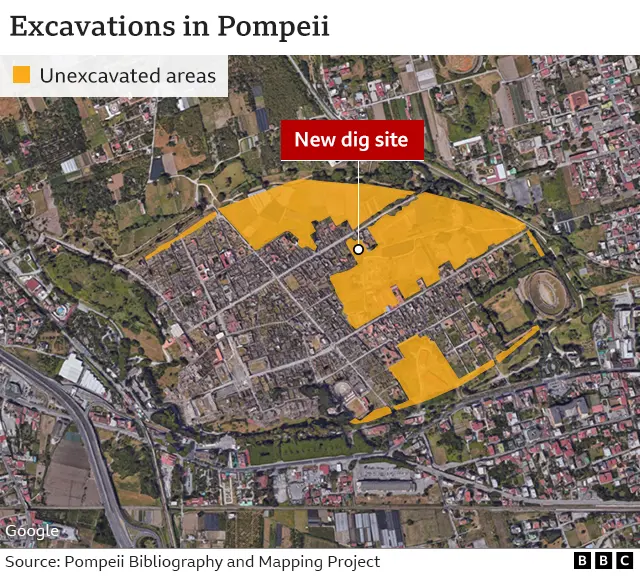
A wide residential and commercial block, known as “Region 9”, is being cleared of several metres of overlying pumice and ash thrown out by Vesuvius almost 2,000 years ago.
Staff are having to move quickly to protect new finds, removing what they can to a storeroom.
For the frescos that must stay in position, a plaster glue is injected to their rear to prevent them coming away from the walls. Masonry is being shored up with scaffolding and temporary roofing is going over the top.
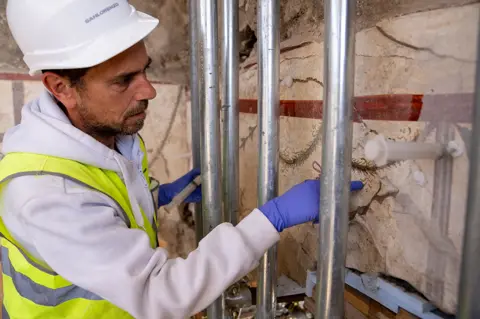
BBC/Tony Jolliffe A plaster glue must be injected behind a fresco or it is likely to come away from the wall
Chief restorer Dr Roberta Prisco spent Tuesday this week trying to stop an arch from collapsing.
“The responsibility is enormous; look at me,” she said, as if to suggest the stress was taking a visible toll on her.
“We have a passion and a deep love for what we’re doing, because what we’re uncovering and protecting is for the joy also of the generations that come after us.”
 BBC
BBC
Region 9 has thrown up a detective story for archaeologists.
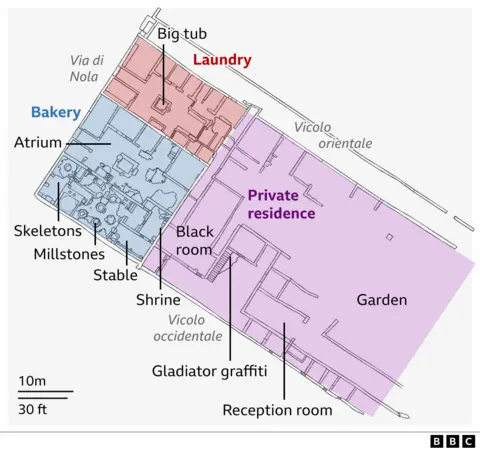
Excavations in the late 19th Century uncovered a laundry in one corner. The latest work has now revealed a wholesale bakery next door, as well as the grand residence with its black room.
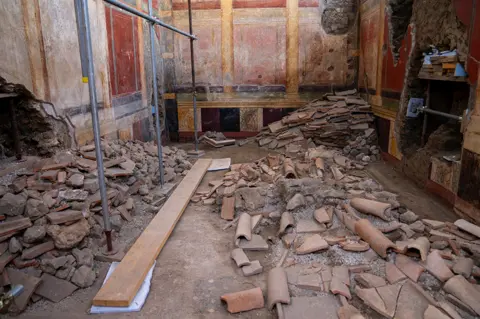
BBC/Tony Jolliffe In the reception hall, rubble in the far right corner is from renovation at the time of the eruption
The team is confident the three areas can be connected, physically via the plumbing and by particular passageways, but also in terms of their ownership.
“We know who ARV is: he’s Aulus Rustius Verus,” explained park archaeologist Dr Sophie Hay. “We know him from other political propaganda in Pompeii. He’s a politician. He’s super-rich. We think he may be the one who owns the posh house behind the bakery and the laundry.”
What’s clear, however, is that all the properties were undergoing renovation at the time of the eruption.
Escaping workers left roof tiles neatly stacked; their pots of lime mortar are still filled, waiting to be used; their trowels and pickaxes remain, although the wooden handles have long since rotted away.
Dr Lia Trapani catalogues everything from the dig. She reaches for one of the thousand or more boxes of artefacts in her storeroom and pulls out a squat, turquoise cone. “It’s the lead weight from a plumb line.” Just like today’s builders, the Roman workers would have used it to align vertical surfaces.
She holds the cone between her fingers: “If you look closely you can see a little piece of Roman string is still attached.”

BBC/Tony Jolliff It’s possible to see a remnant piece of string around the neck of the plumb line
Dr Alessandro Russo has been the other co-lead archaeologist on the dig. He wants to show us a ceiling fresco recovered from one room. Smashed during the eruption, its recovered pieces have been laid out, jigsaw-style, on a large table.
He’s sprayed the chunks of plaster with a mist of water, which makes the detail and vivid colours jump out.
You can see landscapes with Egyptian characters; foods and flowers; and some imposing theatrical masks.
“This is my favourite discovery in this excavation because it is complex and rare. It is high-quality for a high-status individual,” he explained.
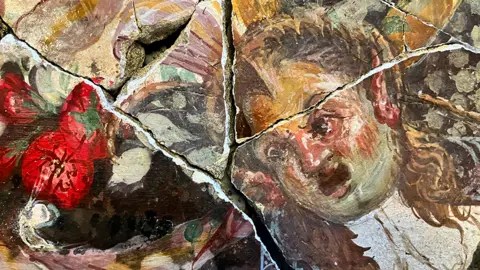
The archaeologists have had to piece together a ceiling fresco that was shattered during the volcanic eruption
But if the grand property’s ceiling fresco can be described as exquisite, some of what’s being learned about the bakery speaks to an altogether more brutal aspect of Roman life – slavery.
It’s obvious the people who worked in the business were kept locked away in appalling conditions, living side by side with the donkeys that turned the millstones. It seems there was one window and it had iron bars to prevent escape.
It’s in the bakery also that the only skeletons from the dig have been discovered. Two adults and a child were crushed by falling stones. The suggestion is they may have been slaves who were trapped and could not flee the eruption. But it’s guesswork.
“When we excavate, we wonder what we’re looking at,” explained co-lead archaeologist Dr Gennaro Iovino.
“Much like a theatre stage, you have the scenery, the backdrop, and the culprit, which is Mount Vesuvius. The archaeologist has to be good at filling in the gaps – telling the story of the missing cast, the families and children, the people who are not there anymore.”
Additional reporting by Tony Jolliffe.
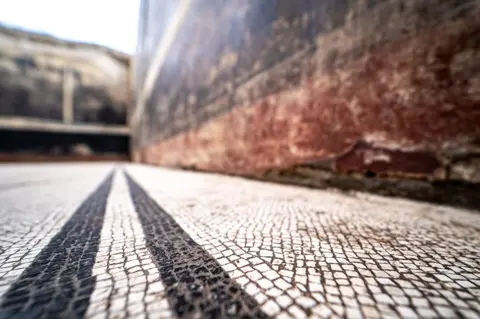
BBC/Tony Jolliffe There are certainly more than a million tiles in the mosaic floor, possibly up to three million
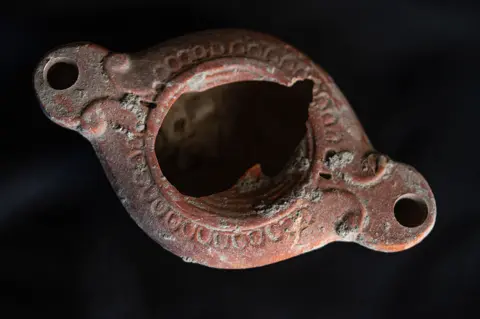
BBC/Tony Jolliffe Boxes full of artefacts: One of the many oil lamps recovered during the excavation
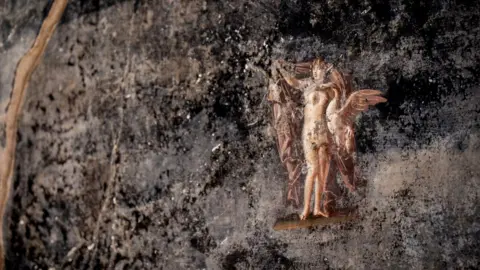
BBC/Tony Jolliffe Another fresco depicts Leda and Zeus in the form of a swan, whose union would lead to Helen’s birth

BBC/Tony Jolliffe Brilliant colours: Ornate cornicing was also preserved under the volcanic debris
The three-part series, Pompeii: The New Dig, begins on Monday 15 April, 21:00 BST, on BBC Two and BBC iPlayer. It will become available internationally. There is also an Open University website connected with the series.
| Gender Institute Events |
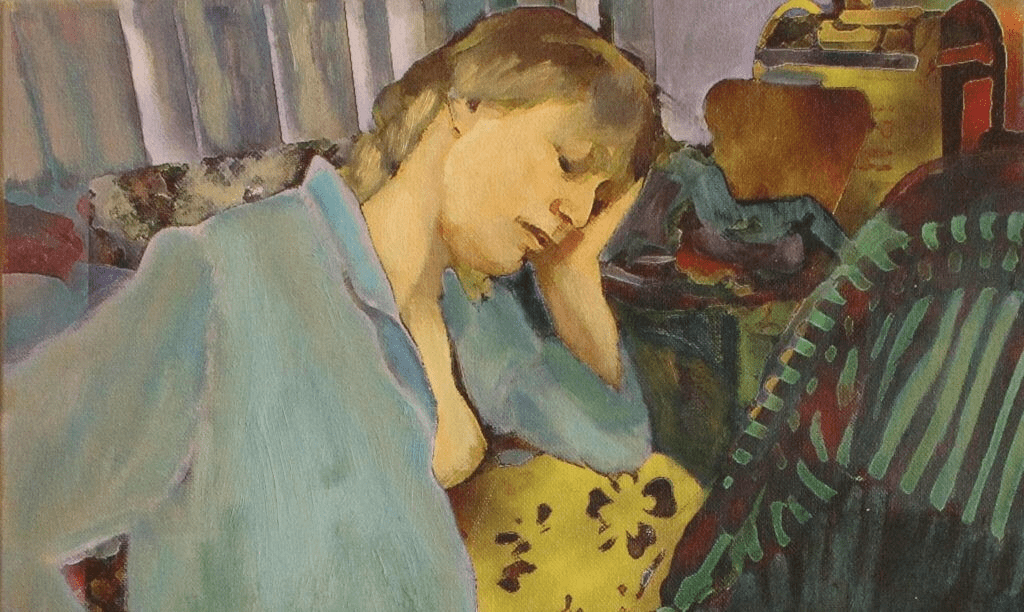
| Maternity and Art Thursday 9 May, 6-7.30pm The ANU Gender Institute and Maternal Health Matters Inc. invite you to join us online for the third in our seminar series that will explore the impact of maternity on women’s wellbeing and the transition to parenting. The presenters are Emeritus Professor Denise Ferris and Dr Bianca Williams. Register here Many Strands, One Wednesday 29 May, 11am-4.30pm Focusing on Papua New Guinea, the Many Strands, One Basket Seminar & Dialogue aims to create an opportunity for conversations between people working in diverse spaces (Many Strands) who may have a common interest in the nexus between politics, gender, culture and history (One Basket). Register here |

Cindy Lou eats out in Canberra
China Tea Club
Having enjoyed a takeaway meal from the China Tea Club (delivered by their own staff) I was pleased to be able to experience the food in their restaurant. The menu is varied and delicious, the service prompt and friendly, the seating comfortable and the ambience very pleasant. The table was large enough to accommodate eight people, but the conversation was easy to follow although the restaurant was full of other lively groups. The prawn dishes were delicious, as was the crispy whitebait. The duck pancakes were an authentic touch; however, the San Choy Bow we had delivered were perhaps better. The beef dishes met the high expectations, the fried rice and plain rice were generous and the vegetable, and mushroom dishes excellent too.

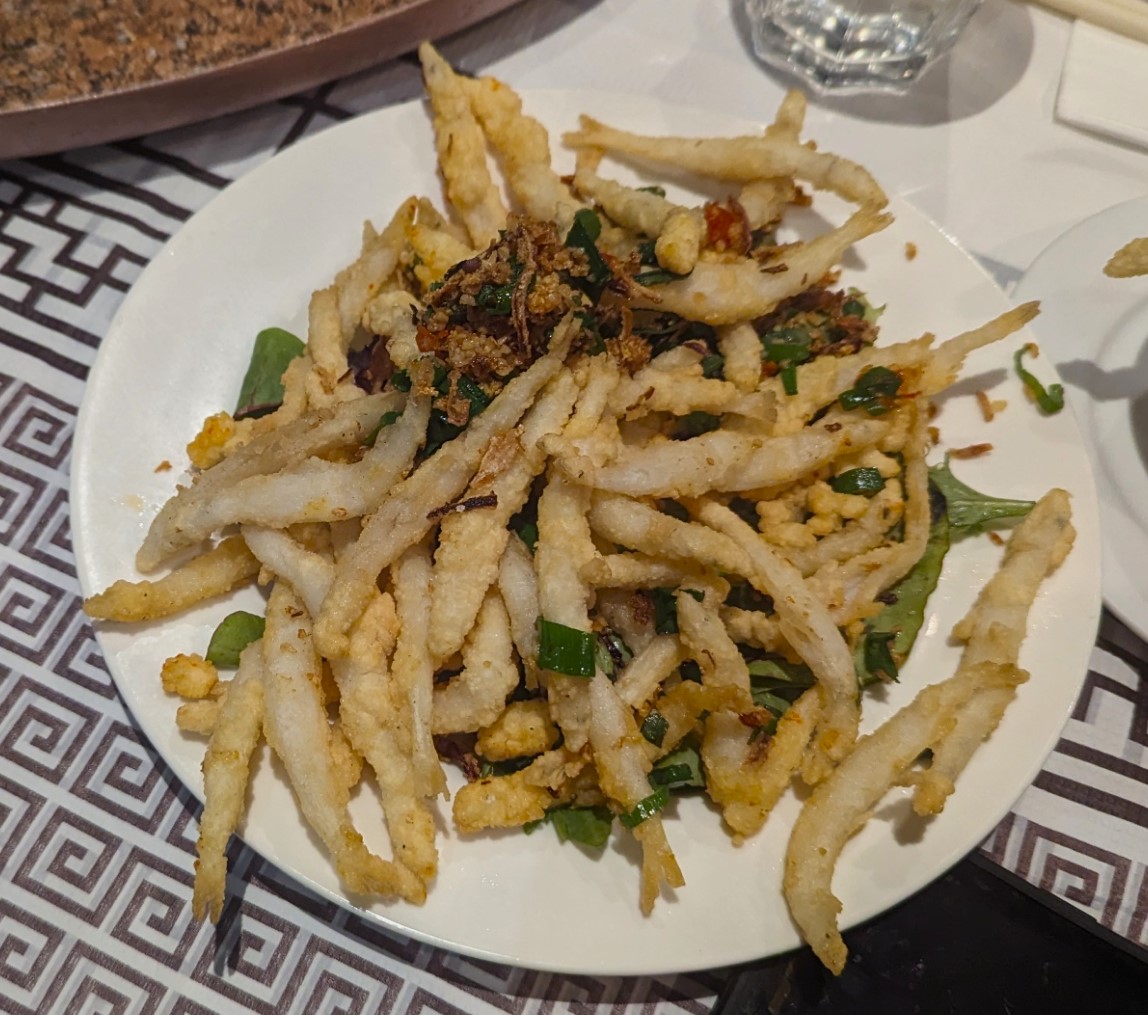


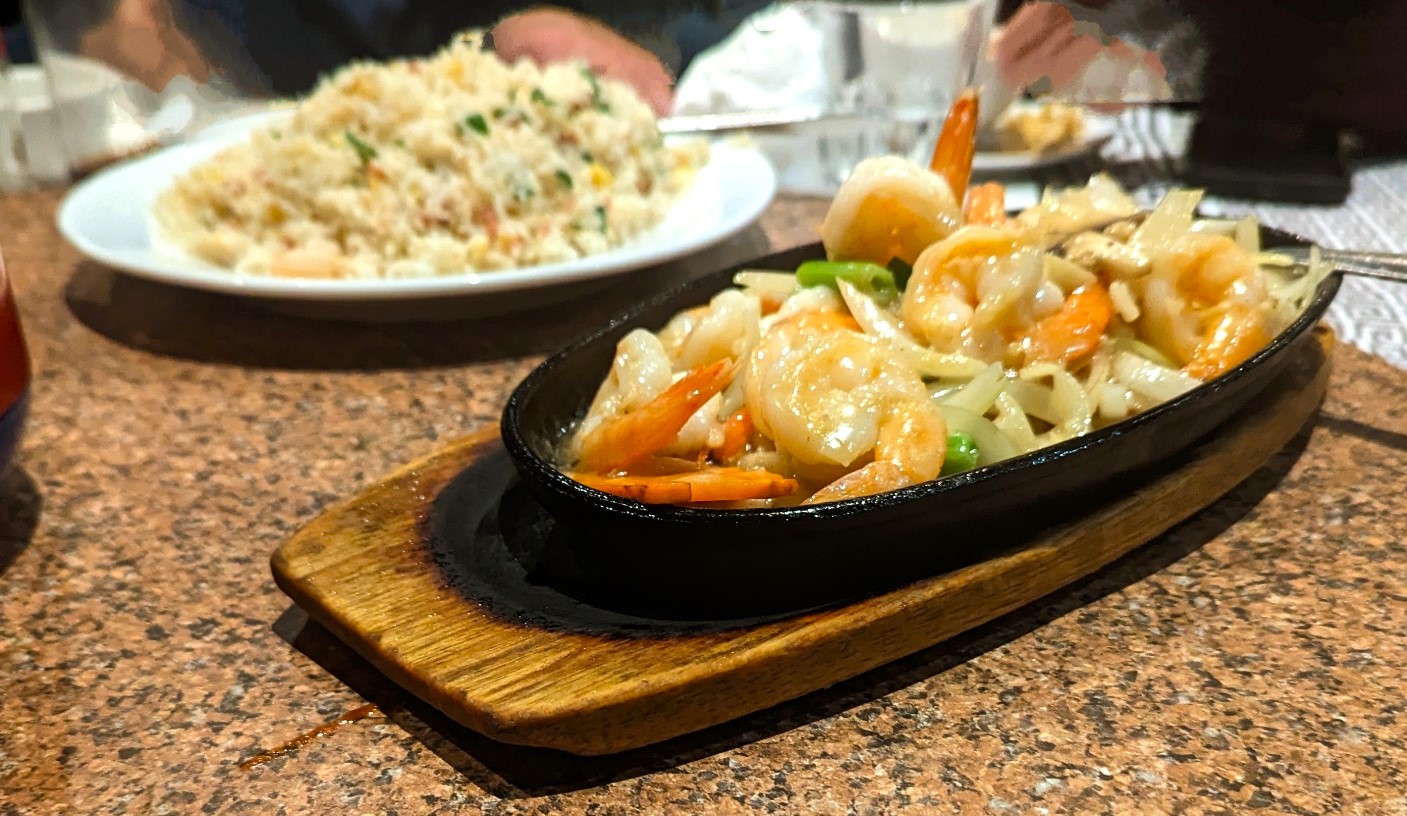
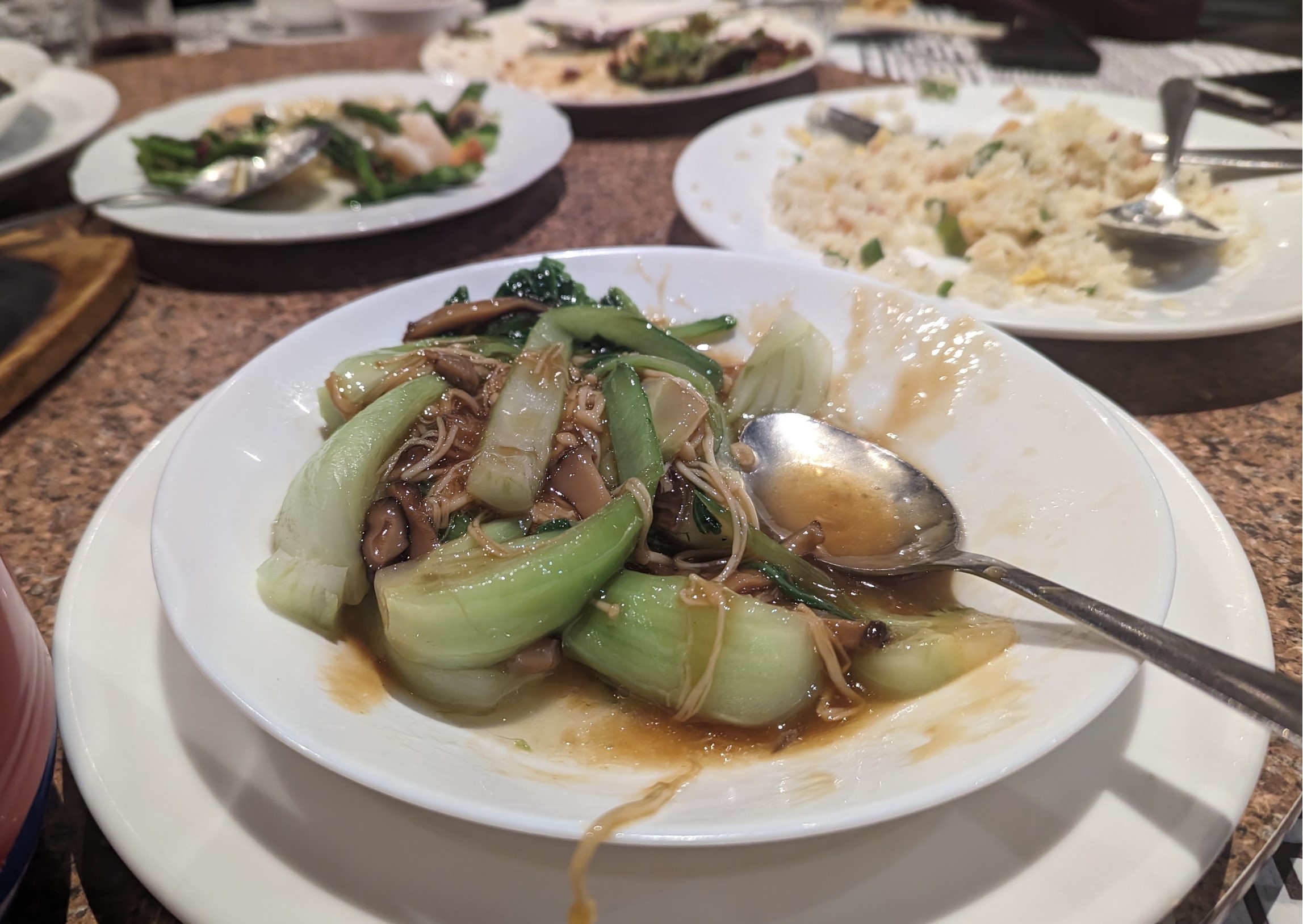

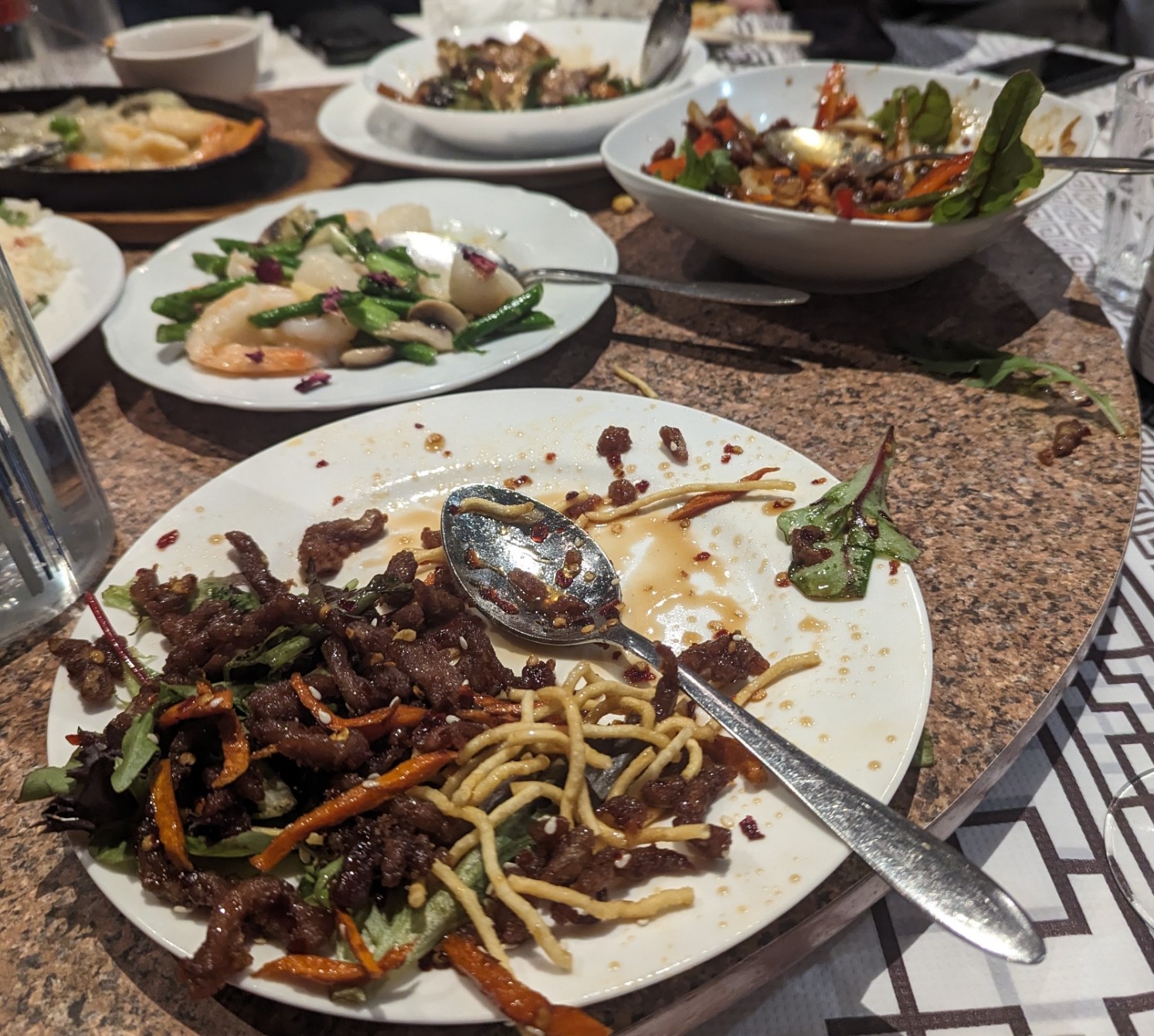

The dessert menu was tempting and even more so when the chosen dishes, fried ice-cream, and two different flavours of ice-cream with a cream and strawberry topping arrived.



Kopiku
A simple cup of coffee the next morning at our favourite coffee place, Kopiku, was an excellent follow up to the copious meal served at the China Tea Club.


Bookplate
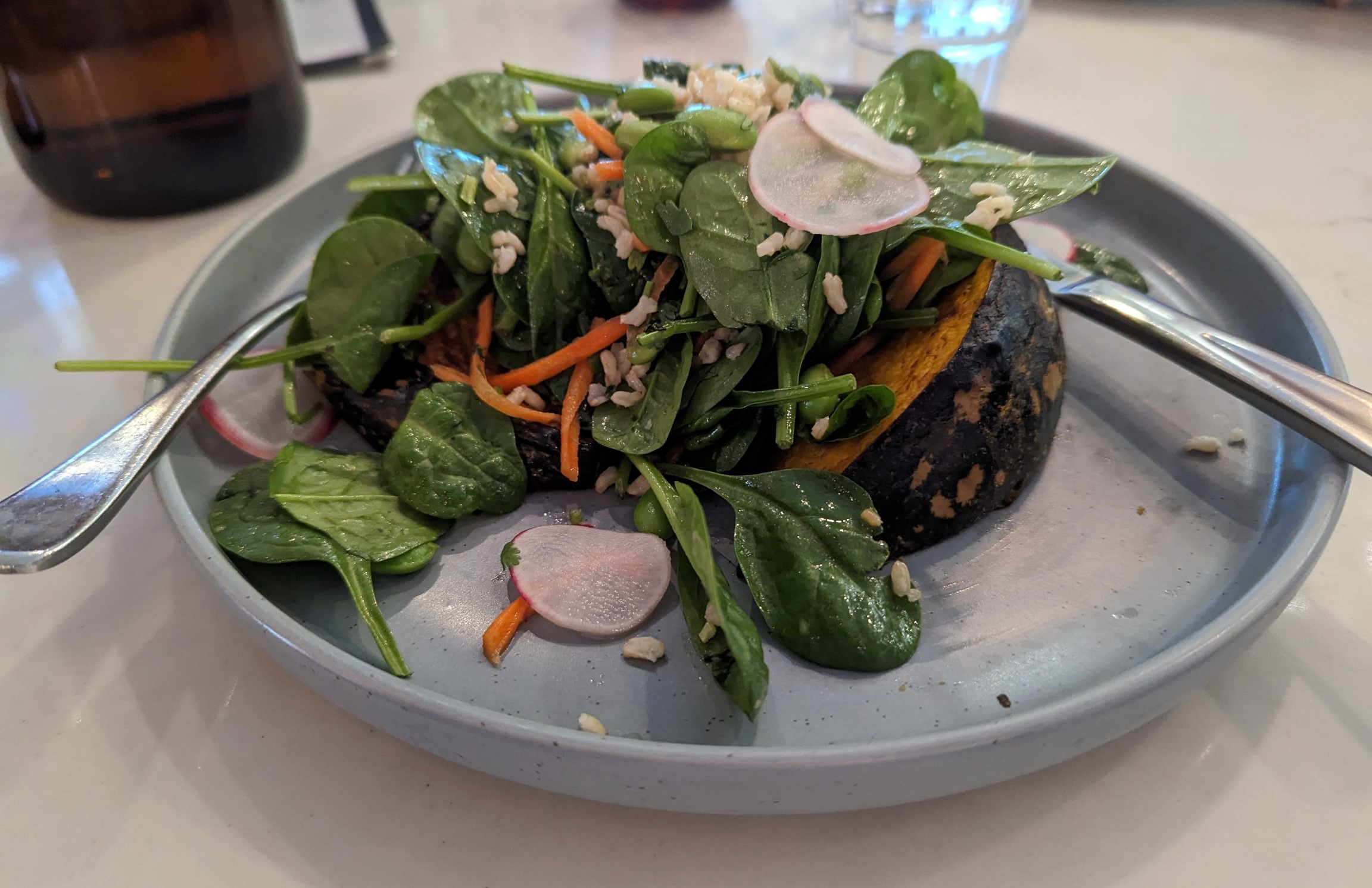
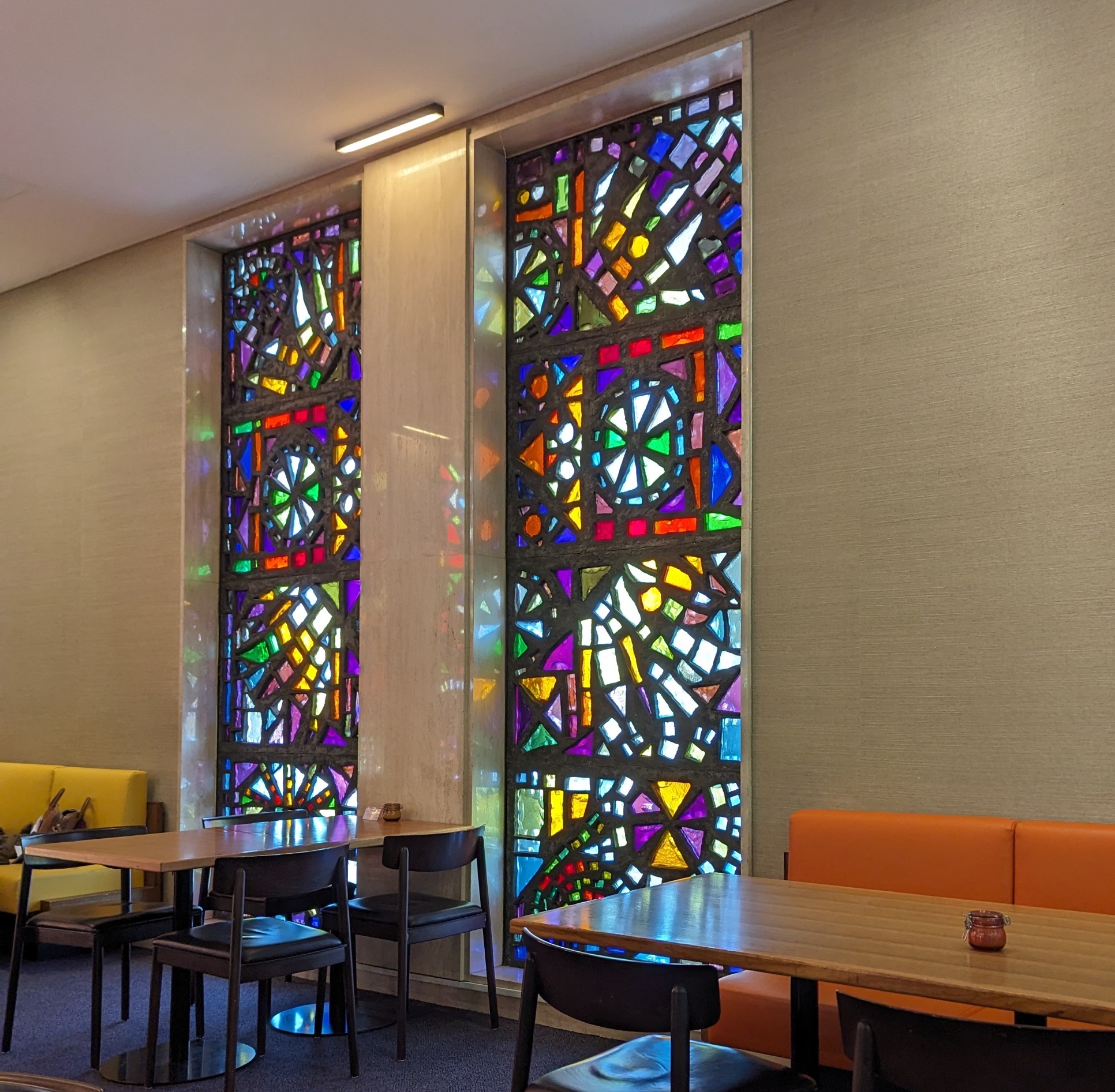
Bookplate at the National Library has changed its menu, so the sandwiches of the past are now provided at Paperplate, downstairs. Perhaps we’ll try that next time. The cooked meals, coffee and cakes at Bookplate are attractive, although I was disappointed that a brunch item (avocado and accompaniments) was not available at 11.45. I chose the pumpkin with miso salad. This was pleasant, but needed more miso, or possibly a different, tastier dressing. The coffees were fine, but not marvellous. An old-fashioned milk shake was a nice touch. Bookplate has a very attractive outdoor area with large umbrellas. But nothing can surpass being amongst the Leonard French panels around the indoors section.


 Robin's Room