Malcolm Hislop A Guide to the Medieval Castles of England Pen & Sword, Pen & Sword History, January 2024.

Thank you, NetGalley and Pen & Sword for providing me with this uncorrected proof for review.
A Guide to Medieval Castles of England must be packed in the luggage of anyone embarking on a tour that aims to include some of the most fascinating castles to be found in England. As I am familiar with the Wallingford Castle I thought a good test of the information in this book would be to investigate how this castle was covered. I was not disappointed. The overall assessment of the castle and grounds was honest and unlikely to lead to disappointment. But then, to the detail of the building that remains – what a delight. I felt as though I was back in Wallingford, climbing the uneven stairway, examining the door and its surrounds, looking out over the encompassing fields, and then walking back to the town through the cultivated land that is also part of this delightful spot. Reading this honest account suggests that there will be little to disappoint if this book is retained as guide. Books: Reviews for the complete review.

Susan Tate Ankeny American Flygirl Citadel Press, Kensington Books, April 2024.
Thank you, NetGalley, for providing me with this uncorrected proof for review.
American Flygirl is a wonderful amalgam of stories associated with women and flying, from the main protagonist Hazel and her companions, including their leader Jackie Corcoran, in the Women Airforce Service Pilots. All of these women battled prejudice, and some of the details are harrowing. At the same time, the women’s resilience and the personal face given this by is an impressive memorial to the women, those who supported them, and the changes they were able to inspire in women’s role in this most exciting and demanding occupation. Books: Reviews for the complete review.
Heather Cox Richardson from Letters from an American
<heathercoxrichardson@substack.com>

On Wednesday,* President Joe Biden issued an executive order instructing the National Park Service to “highlight important figures and chapters in women’s history.” “Women and girls of all backgrounds have shaped our country’s history, from the ongoing fight for justice and equality to cutting-edge scientific advancements and artistic achievements,” the announcement read. “Yet these contributions have often been overlooked. We must do more to recognize the role of women and girls in America’s story, including through the Federal Government’s recognition and interpretation of historic and cultural sites.”
In a time when American women are seeing their rights stripped away, it seems worthwhile on this last day of Women’s History Month to highlight the work of Supreme Court Justice Ruth Bader Ginsburg, who challenged the laws that barred women from jobs and denied them rights, eventually setting the country on a path to extend equal justice under law to women and LGBTQ Americans.
Ginsburg was born in Brooklyn, New York, on March 15, 1933, in an era when laws, as well as the customs they protected, treated women differently than men. Joan Ruth Bader, who went by her middle name, was the second daughter in a middle-class Jewish family. She went to public schools, where she excelled, and won a full scholarship to Cornell. There she met Martin Ginsburg, and they married after she graduated. “What made Marty so overwhelmingly attractive to me was that he cared that I had a brain,” she later explained. Relocating to Fort Sill, Oklahoma, for her husband’s army service, Ginsburg scored high on the civil service exam but could find work only as a typist. When she got pregnant with their daughter, Jane, she lost her job.
Two years later, the couple moved back east, where Marty had been admitted to Harvard Law School. Ginsburg was admitted the next year, one of 9 women in her class of more than 500 students; a dean asked her why she was “taking the place of a man.” She excelled, becoming the first woman on the prestigious Harvard Law Review. When her husband underwent surgery and radiation treatments for testicular cancer, she cared for him and their daughter while managing her studies and helping Marty with his. She rarely slept.
After he graduated, Martin Ginsburg got a job in New York, and Ginsburg transferred to Columbia Law School, where she graduated at the top of her class. But in 1959, law firms weren’t hiring women, and judges didn’t want them as clerks either—especially mothers, who might be distracted by their “familial obligations.” Finally, her mentor, law professor Gerald Gunther, got her a clerkship by threatening Judge Edmund Palmieri that if he did not take her, Gunther would never send him a clerk again.
After her clerkship and two years in Sweden, where laws about gender equality were far more advanced than in America, Ginsburg became one of America’s first female law professors. She worked first at Rutgers University—where she hid her pregnancy with her second child, James, until her contract was renewed—and then at Columbia Law School, where she was the first woman the school tenured.
At Rutgers she began her bid to level the legal playing field between men and women, extending equal protection under the law to include gender. Knowing she had to appeal to male judges, she often picked male plaintiffs to establish the principle of gender equality.
In 1971 she wrote the brief for Sally Reed in the case of Reed vs. Reed, when the Supreme Court decided that an Idaho law specifying that “males must be preferred to females” in appointing administrators of estates was unconstitutional. Chief Justice Warren Burger, who had been appointed by Richard Nixon, wrote: “To give a mandatory preference to members of either sex over members of the other…is to make the very kind of arbitrary legislative choice forbidden by the Equal Protection Clause of the Fourteenth Amendment” to the Constitution.
In 1972, Ginsburg won the case of Moritz v. Commissioner. She argued that a law preventing a bachelor, Charles Moritz, from claiming a tax deduction for the care of his aged mother because the deduction could be claimed only by women, or by widowed or divorced men, was discriminatory. The United States Court of Appeals for the Tenth Circuit agreed, citing Reed v. Reed when it decided that discrimination on the basis of sex violated the Equal Protection Clause of the Fourteenth Amendment to the Constitution.
In that same year, Ginsburg founded the Women’s Rights Project at the American Civil Liberties Union (ACLU). Between 1973 and 1976, she argued six gender discrimination cases before the Supreme Court. She won five. The first time she appeared before the court, she quoted nineteenth-century abolitionist and women’s rights activist Sarah Grimké: “I ask no favor for my sex. All I ask of our brethren is that they take their feet off our necks.”
Nominated to the Supreme Court by President Bill Clinton in 1993, she was confirmed by a vote of 96 to 3. Clinton called her “the Thurgood Marshall of gender-equality law.”
In her 27 years on the Supreme Court, Ginsburg championed equal rights both from the majority and in dissent (which she would mark by wearing a sequined collar), including her angry dissent in 2006 in Ledbetter v. Goodyear Tire & Rubber when the plaintiff, Lilly Ledbetter, was denied decades of missing wages because the statute of limitations had already passed when she discovered she had been paid far less than the men with whom she worked. “The court does not comprehend or is indifferent to the insidious way in which women can be victims of pay discrimination,” Ginsburg wrote. Congress went on to change the law, and the first bill President Barack Obama signed was the Lilly Ledbetter Fair Pay Act.
In 2013, Ginsburg famously dissented from the majority in Shelby County v. Holder, the case that gutted the 1965 Voting Rights Act. The majority decided to remove the provision of the law that required states with histories of voter suppression to get federal approval before changing election laws, arguing that such preclearance was no longer necessary. Ginsburg wrote: “Throwing out preclearance when it has worked and is continuing to work to stop discriminatory changes is like throwing away your umbrella in a rainstorm because you are not getting wet.” As she predicted, after the decision, many states immediately began to restrict voting.
Ginsburg’s dissent made her a cultural icon. Admirers called her “The Notorious R.B.G.” after the rapper The Notorious B.I.G., wore clothing with her image on it, dressed as her for Halloween, and bought RBG dolls and coloring books. In 2018 the hit documentary “RBG” told the story of her life, and as she aged, she became a fitness influencer for her relentless strength-training regimen. She was also known for her plain speaking. When asked when there would be enough women on the Supreme Court, for example, she answered: “[W]hen there are nine.”
Ginsburg’s death on September 18, 2020, brought widespread mourning among those who saw her as a champion for equal rights for women, LGBTQ Americans, minorities, and those who believe the role of the government is to make sure that all Americans enjoy equal justice under law. Upon her passing, former secretary of state Hillary Clinton tweeted: “Justice Ginsburg paved the way for so many women, including me. There will never be another like her. Thank you RBG.”
Just eight days after Ginsburg’s death, then-president Donald Trump nominated extremist Amy Coney Barrett to take her seat on the court, and then–Senate majority leader Mitch McConnell (R-KY) rushed her confirmation hearings so the Senate could confirm her before the 2020 presidential election. It did so on October 26, 2020. Barrett was a key vote on the June 2022 Dobbs v. Jackson Women’s Health Organization decision, the Supreme Court ruling that overturned the 1973 Roe v. Wade decision recognizing the constitutional right to abortion.
Ginsburg often quoted Justice Louis Brandeis’s famous line, “The greatest menace to freedom is an inert people,” and she advised people to “fight for the things you care about, but do it in a way that will lead others to join you.”
Setting an example for how to advance the principle of equality, she told the directors of the documentary RBG that she wanted to be remembered “[j]ust as someone who did whatever she could, with whatever limited talent she had, to move society along in the direction I would like it to be for my children and grandchildren.”
—
Notes:
https://variety.com/2020/politics/news/ruth-bader-ginsburg-reactions-hollywood-celebrities-1234775380; https://www.washingtonpost.com/local/crowds-gather-at-supreme-court-to-remember-justice-ruth-bader-ginsburg/2020/09/18/895ee13c-fa18-11ea-be57-d00bb9bc632d_story.html; https://www.rollingstone.com/politics/politics-news/ruth-bader-ginsburg-dead-777835; https://www.whitehouse.gov/briefing-room/presidential-actions/2024/03/27/executive-order-on-recognizing-and-honoring-womens-history; https://www.npr.org/2020/09/18/100306972/justice-ruth-bader-ginsburg-champion-of-gender-equality-dies-at-87; https://www.pbs.org/newshour/show/justice-ginsburg-enough-women-supreme-court; https://www.radcliffe.harvard.edu/news-and-ideas/ruth-bader-ginsburg-tells-young-women-fight-for-the-things-you-care-about.
*Wednesday March 27, 2024.

RBG at the Canberra Theatre
Below is a review of the Sydney Theatre Company’s RBG: One of Many, staged in Sydney. I was fortunate to find tickets for the 5.00 performance at The Canberra Theatre on Sunday.
RBG: Of Many, One is a beautifully crafted, virtuosically performed play about Ruth Bader Ginsburg
Published: November 8, 2022 2.36pm AEDT
Author Penelope Crossley Professor of Law, The University of Sydney Law School, University of Sydney
Disclosure statement:
Penelope Crossley received complimentary tickets for the purpose of reviewing this performance.
Republished here through the generosity of The Conversation under Creative Commons.
Review: RBG: Of Many, One, directed by Priscilla Jackman, Sydney Theatre Company
Writing a play about the life and legacy of American Supreme Court Justice Ruth Bader Ginsburg was always going to be an ambitious task for playwright Suzie Miller.
Ginsburg (or “RBG” to her many fans) was only the second female judge to be appointed onto the bench of the court in its more than 200-year history, when elevated to the court in 1993, aged 60.
Throughout her life, she was much admired for her trailblazing legal career, her work advocating for gender equality and her considered dissenting judgements against the often-conservative majority decision.
At the same time, both during her life and after her death, RBG was attacked for openly criticising former US president Donald Trump during the presidential race and for not resigning from the court during Obama’s presidency, despite her advanced age and cancer diagnosis.
When RBG ultimately died during the Trump presidency, she was not able to be replaced by another Democratic appointee, leading to the court becoming even more conservative.
Miller’s new play is beautifully crafted, written from the perspective of RBG. She discusses her most famous cases throughout her life and her conversations with three of the presidents who served during her 27-year term on the bench. Over this journey, the play takes the audience through a roller-coaster of emotions.
Read more: Ruth Bader Ginsburg forged a new place for women in the law and society
The light and the dark
RBG: Of Many, One, follows RBG’s time as one of the few women at Harvard Law School, along with her work challenging gender-based discrimination including the ability of women to serve on juries and the cancer that repeatedly afflicted her family.
Miller seamlessly weaves quotes from RBG’s most famous cases and judgements into the script, so we hear her authentic voice. The play demonstrates a complex understanding of the legal cases, but Miller doesn’t assume familiarity with RBG: this play is equally accessible for the non-lawyer who knows little of RBG’s history.

Miller doesn’t skate over the criticisms of RBG. She humanises the decisions she made and her later reflections on those decisions. In particular, the audience gets to see, upon reflection, how deeply troubled RBG was by her decision to criticise Donald Trump during the Trump/Clinton presidential election.
RBG: Of Many, One’s ultimate success or failure turns on the strength of the acting. Heather Mitchell is a virtuoso, giving the performance of her life.
She shows us Bader Ginsburg from a young girl through to her physical frailty in old age, poignantly characterising the emotional depth of her character.
The inner strength, the anxieties, the love, and the fears are all expertly conveyed to the audience. At times I have to remind myself that she is indeed playing RBG.

A simple staging
David Fleischer’s set design is stripped back to a beautiful simplicity. For most of the play the main prop is a solitary armchair, sitting isolated on the big stage.
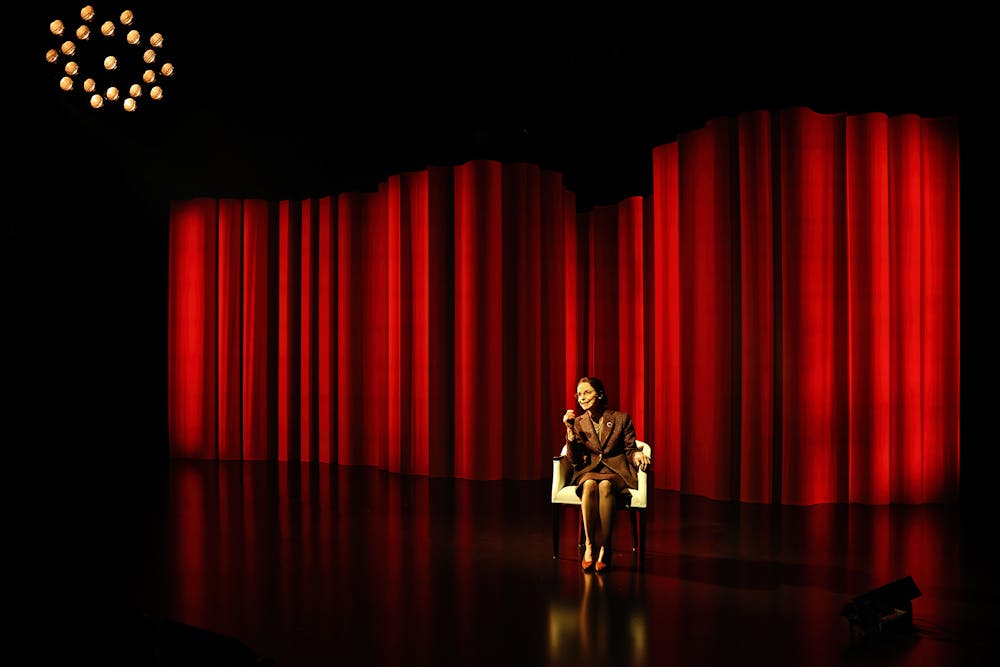
Paul Charlier’s composition and sound design is another strength. He juxtaposes some of the operas that RBG so loved with the music of the rapper the Notorious B.I.G. (from whom the nickname the Notorious RBG is derived). This deftly highlights the complexity of RBG’s character.
These simple design choices allow Mitchell to shine. This play will long be one that Miller and Mitchell will be remembered for.
RBG: OF MANY, ONE
by Suzie Miller
Directed by Priscilla Jackman
“One of the all-time great performances” The Sydney Morning Herald
After a wildly popular, sold-out premiere season in 2022, this smash-hit production returns to the stage with the brilliant Heather Mitchell reviving her award-winning “virtuosic performance” (The Conversation) of the woman who changed the face of the American legal system: the indomitable Ruth Bader Ginsburg.
The second woman to be appointed to the US Supreme Court, Ruth Bader Ginsburg was both a trailblazer in the American judiciary and a fierce advocate for gender equality and reproductive rights. Now, her life is brought to the stage by the extraordinary pen of Olivier Award-winning Australian playwright Suzie Miller (Prima Facie), in a story that chronicles Ginsburg’s wins and dissents, traces her steps forward and the steps back, and brings you right into the room with Ruth at the most pivotal moments of her life.
Director Priscilla Jackman reunites with Mitchell to reconjure RBG in this once-in-a-generation theatrical event that is “magnificent from start to finish” (Limelight). Don’t miss your second chance to see this sublime production.
Approx. duration 1 hr 40 mins (no interval). Subject to change.
Content Adult themes, herbal cigarettes and complete theatrical blackout. Subject to change.
Discover more about playwright Suzie Miller’s captivating smash-hit RBG: Of Many, One.

As a young female law student, I looked up to women judges; they were groundbreakers for me, and they remain so. The more women in powerful legal positions, the more opportunity for the law to be influenced by women’s lived experiences. Ruth Bader Ginsburg, herself, brought all her intelligence and thoughtfulness to her judicial profession; she brought her feminism, her roles as mother, daughter, life-partner; she bought her Jewish background, her childhood of loss and socio-economic repression, she brought her incredibly flexible mind and her sharp senses. She brought herself as a woman completely and without apology. All of which has not only influenced the USA but women’s lives around the world – including women and lawyers in Australia.
Throughout her life, RBG felt strongly about democracy and the rule of law, and to ensure both of these, she applauded the strict separation of executive and judicial powers. The rule of law, in short, means that no one is above the law – including leaders and politicians. This accountability and transparency must never be taken for granted, and the separation of powers – that the government and the courts must never interfere with or seek to influence each other – is a way of keeping the checks and balances on both the government and judges of the day. This is democracy in action.
With RBG: Of Many, One, I was so warmly supported by Kip Williams, Artistic Director at STC in expressing my unique vision for the play. I wanted to focus on the incredible legacy of RBG, and specific conversations/ dialogues she had with three different US presidents: Clinton, Obama and Trump. In particular, I wanted to explore how even the mighty and most brilliant of us can make mistakes, and that what protects our way of life is the rule of law itself.
In writing RBG: Of Many, One it was always Heather Mitchell who was to play her. Her talent is astonishing. Heather’s love of the character and her full-bodied soulful investment is a gift. In Priscilla Jackman I have found a brilliant director, one I admire for her talent, intellect, commitment and sheer bloody-mindedness in getting it right.
In David Fleischer’s design there is a magnificent realisation of the sheer size and power of the institution Ruth served, and the big life she led. The lights and sound have created a landscape that I could only have dreamed of, operatic, moody, fun and exciting – I thank both Paul Charlier and Alexander Berlage for their vision and hard work, together with Stage Manager Katie Hankin. For their dramaturgy, I thank; Polly Rowe, Kip Williams, Caleb Lewis, Paige Rattray and Jessica Arthur from STC, who offered valuable thoughts and insights. I also thank Robert Beech-Jones (my partner), Marty McGrath (Heather’s partner); and Karen O’Connell, Nicole Abadee, Rochelle Zurnamer, Hilary Bonney, Lisa Hunt and Sam Mostyn – my sisters ‘in law’ – who all encouraged the telling of this very female-focused law story.

My reflections
Heather Cox Richardson’s comments on Ruth Bader Ginsberg in her Letters from an American, came at a fortuitous time. I did not have to wait long to post it as I was fortunate to be able to see the play on Sunday evening. Heather Mitchell, who gave this one-person show was outstanding. From teenager to a bent woman in her eighties; Presidents Clinton, Obama and Trump; people who featured in her rise to Supreme Court Judge – Mitchell was amazing.
Her depiction of RBG as a teenager was so subtle – just her feet swinging above the ground as she hunched in her chair; using the art of depicting a straight back, a slightly bent one, and then her old age fragility as she does her morning workout; the voices of the other protagonists in her story as well as the simple reflections of a telling characteristic their repertoire of importance – Mitchell excelled at all. Sometimes she was so subtle, at others the audience responded to an almost farcical account of a self-important protagonist’s demeanour.
RBG’s reference to the support she received from the first woman appointed to the Supreme Court, Justice Sandra Day O’Connor (March 26, 1930 – December 1, 2023) a Republican appointed by President Regan recalls the dialogue running on MSBC at the moment.
Quotes were used throughout the play, some which appear below. Others I have added as I could not resist doing so.
“The decision whether or not to bear a child is central to a woman’s life, to her well-being and dignity. It is a decision she must make for herself. When the government controls that decision for her, she is being treated as less than a full adult human responsible for her own choices.”
― Ruth Bader Ginsburg
“When I’m sometimes asked when will there be enough [women on the Supreme Court] and I say, ‘When there are nine,’ people are shocked. But there’d been nine men, and nobody’s ever raised a question about that.”
― Ruth Bader Ginsburg
“Fight for the things that you care about. But do it in a way that will lead others to join you.”
― Ruth Bader Ginsburg
“Reading is the key that opens doors to many good things in life. Reading shaped my dreams, and more reading helped me make my dreams come true.”
― Ruth Bader Ginsburg
“How to be Like RBG:
Work for what you believe in, but pick your battles, and don’t burn your bridges. Don’t be afraid to take charge, think about what you want, then do the work, but then enjoy what makes you happy, bring along your crew, have a sense of humor.
-Ruth Bader Ginsburg, Notorious RBG by
Irin Carmon”
― Ruth Bader Ginsburg
“My mother was very strong about my doing well in school and living up to my potential. Two things were important to her and she repeated them endlessly. One was to ‘be a lady,’ and that meant conduct yourself civilly, don’t let emotions like anger or envy get in your way. And the other was to be independent, which was an unusual message for mothers of that time to be giving their daughters.”
― Ruth Bader Ginsburg, My Own Words: Ruth Bader Ginsburg
“Never underestimate the power of a girl with a book.”
― Ruth Bader Ginsberg
“Another often-asked question when I speak in public: “Do you have some good advice you might share with us?” Yes, I do. It comes from my savvy mother-in-law, advice she gave me on my wedding day. “In every good marriage,” she counseled, “it helps sometimes to be a little deaf.” I have followed that advice assiduously, and not only at home through fifty-six years of a marital partnership nonpareil. I have employed it as well in every workplace, including the Supreme Court of the United States. When a thoughtless or unkind word is spoken, best tune out. Reacting in anger or annoyance will not advance one’s ability to persuade.”
― Ruth Bader Ginsburg, My Own Words
“the greatest menace to freedom is an inert people; that public discussion is a political duty; and that this should be a fundamental principle of the American government. Brandeis”
― Ruth Bader Ginsburg, My Own Words
Briscola Italian Restaurant
We had just enjoyed seeing RBG at the Canberra Theatre and, having had the good fortune to attend a 5.00 session were ready for a meal, to eat and, more importantly discuss this magnificent performance.
Briscola had been recommended and we were very fortunate that a table was available. The meals were delicious, from the warm bread to the generous portions of ravioli (a blackboard menu item -RAVIOLI DEL GIORNO {v} locally made ravioli of the day); LINGUINE DI MARE {df} king prawns / scallops / mussels / garlic / chilli / shallots / cherry tomato // in olive oil or napoli sugo; POLLO GAMBERI {gf*} chicken breast/ king prawns / garlic / chilli/ brandy / macchiato sugo / roasted veg & chats; and my BARRAMUNDI seared barramundi/ vongole / fregola / green beans / cherry toms / salmoriglio.





Cindy Lou dines at Compa
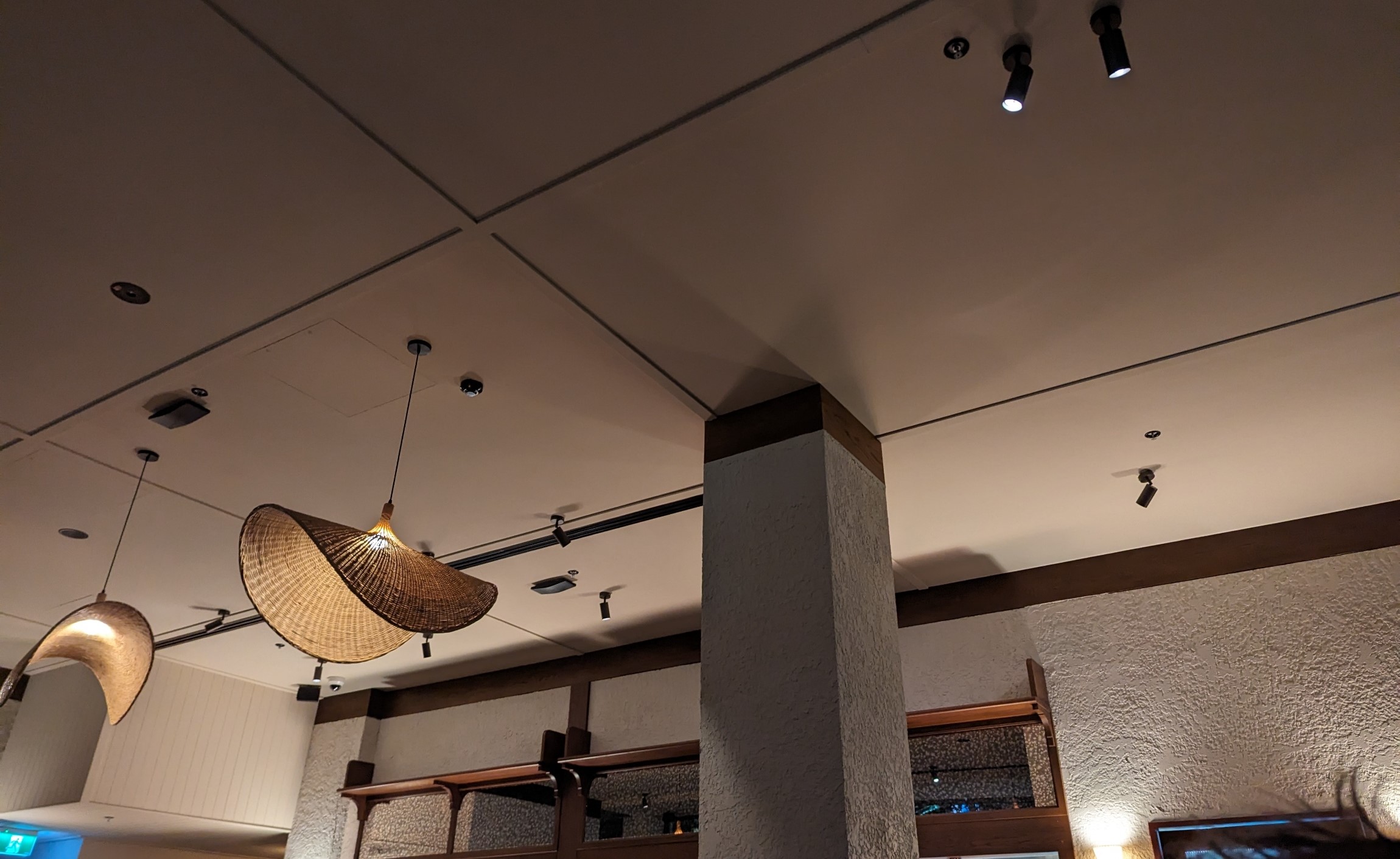
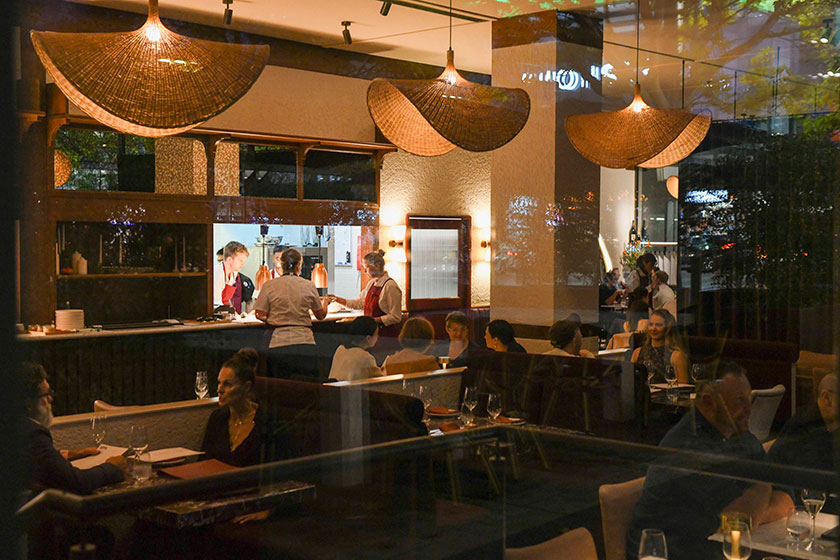
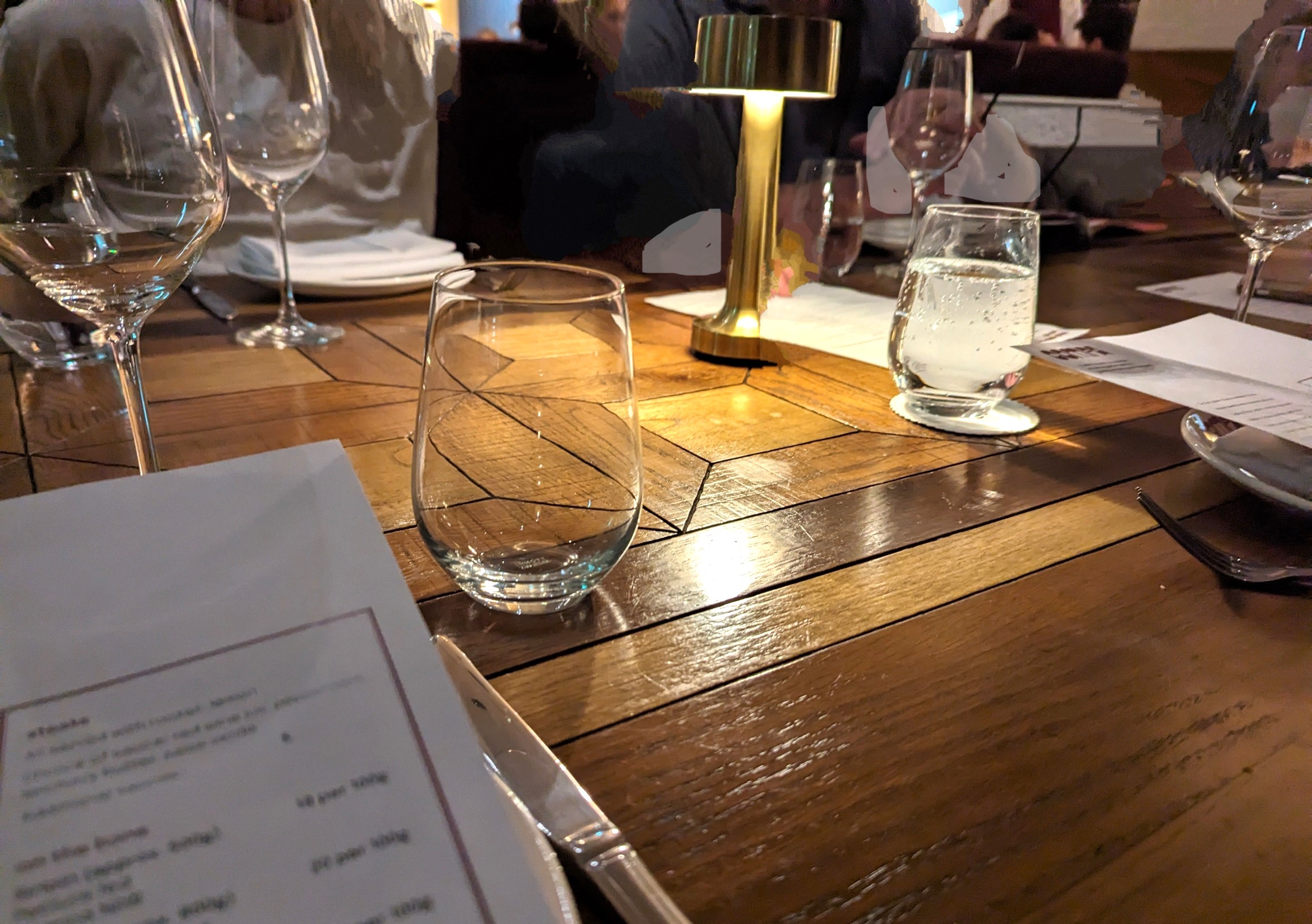
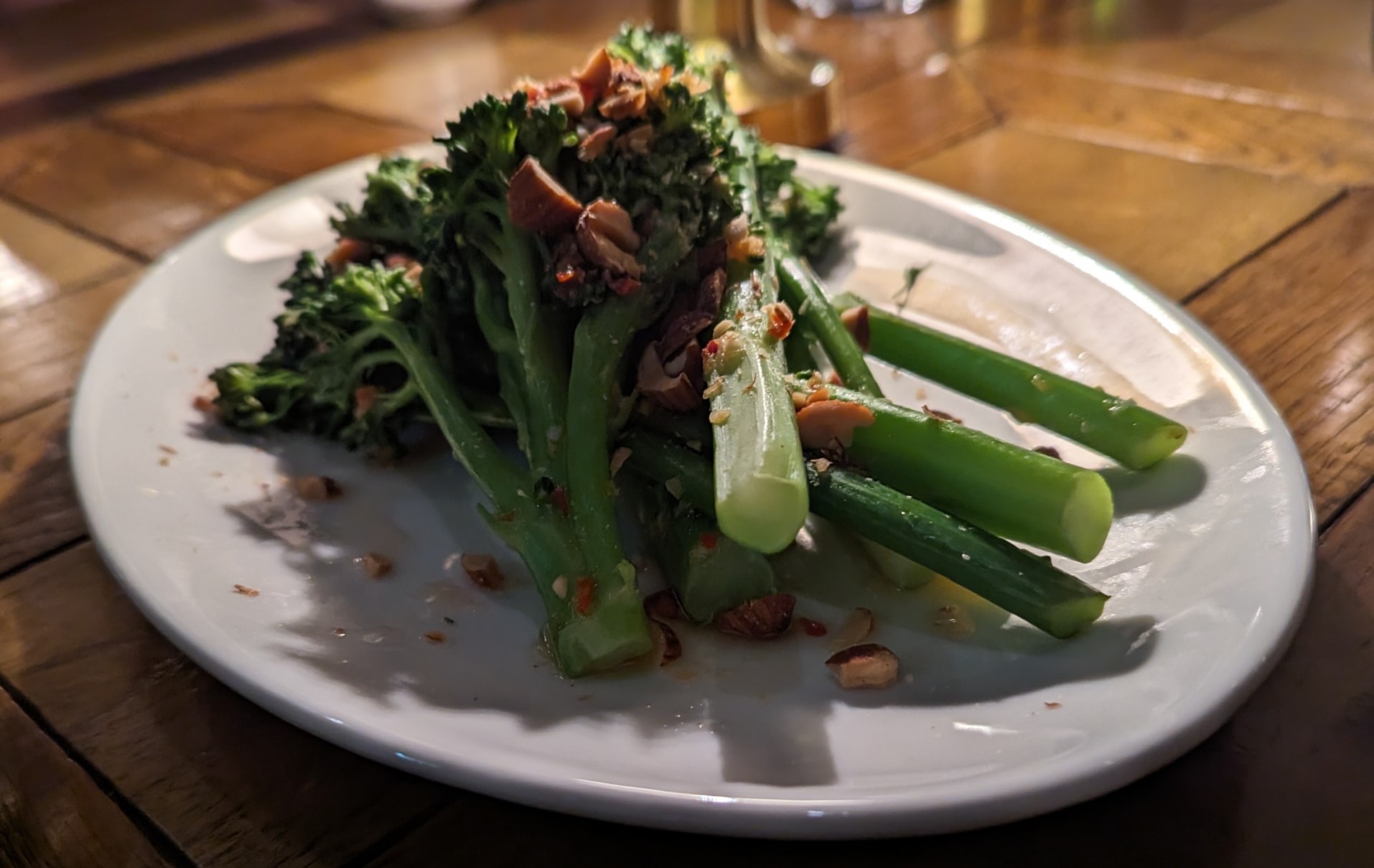
Aria is one of our favourite restaurants, and to hear that Matt Moran was bringing his style to Canberra with Sando, a sandwich outlet, and Compa, an Italian restaurant, was thrilling. I haven’t tried the sandwiches yet, as their popularity has led to queues in the street but was pleased to get a booking at 6.15 on a Tuesday night for Compa. There were six of us, and this is where I found the seating disappointing. The four person booths, or two person tables looked inviting. Where we were seated was at a long table, at which two smaller groups or one large group could be seated. As the restaurant was quite noisy, this was not ideal for conversation. On the other hand, the food could not be faulted. With several different steaks to assess, several sides and two whole trout dishes plus starting with olives and bread I feel that we are able to give Compa several stars for excellence. Although there was a slight glitch with service initially this was swiftly rectified by a very competent wait person. The service remained very good after that, we felt welcome and will return. However, this will probably be in numbers that ensure better seating.











 Robin's Room