Hannah McGregor Clever Girl, Jurassic Park ECW Press, October 2024.

Thank you, NetGalley for providing me with this uncorrected proof for review.
Clever Girl, Jurassic Park is written in a style that I often find unappealing. However, I must acknowledge that I was so captivated by the perceptive commentary, the substantial research that underlies the challenging style and Hannah McGregor’s strong personality that emerges through the pages, that I thoroughly enjoyed my reading. McGregor combines her own experiences with the narratives that emerge from the Jurassic Park franchise. She concentrates on the first, Jurassic Park, with some comments (frequently negative) about the others that follow. With her perceptive feminist approach, this book makes an excellent contribution to academic feminist film ideas, as well as a thoughtful read for those who are not in academe. See Books: Reviews for the complete review.

Monica Porter A History of Europe in 12 Cafes Pen & Sword Pen & Sword History, April 2024.
Thank you, NetGalley and Pen & Sword for providing me with this uncorrected proof for review.
I found Monica Porter’s A History of Europe in 12 Cafes an enthralling read. With its wealth of historical information covering visual art, writing, biographical material, politics and war through the beautifully described cafes, European and American, conveyed through accessible language that almost belied the density of the content, this book is a treasure trove. A treasure for the coffee aficionado who would like to visit these cafes; for the lover of history whose appetite will be slaked by the detailed accounts of political intrigue, war time measures and attendant developments; and those whose access to the culture associated with the cafes will be at once both satisfied and also keen to read the material and visit the galleries that house the art described. So, upon finishing the book one is at once replete, and fighting an appetite that can only be assuaged by rereading, delving into the bibliography or visiting the sites – no mean feat as they include ten different countries, twelve coffee houses, and galleries. See Books: Reviews for the complete review.
Canberra Times Meet the Author
‘Frank Bongiorno will be in conversation with Jennifer Rayner on A Little History of the Australian Labor Party in which acclaimed historians Nick Dyrenfurth and Frank Bongiorno tell the story of the Australian Labor Party’s rich history of more than 130 years and examine its central role in modern Australia. This is a second, updated and expanded edition’ Canberra Times. This was a scintillating session with perceptive questions from Jennifer Rayner and wonderfully discursive responses from Frank Buongiorno.
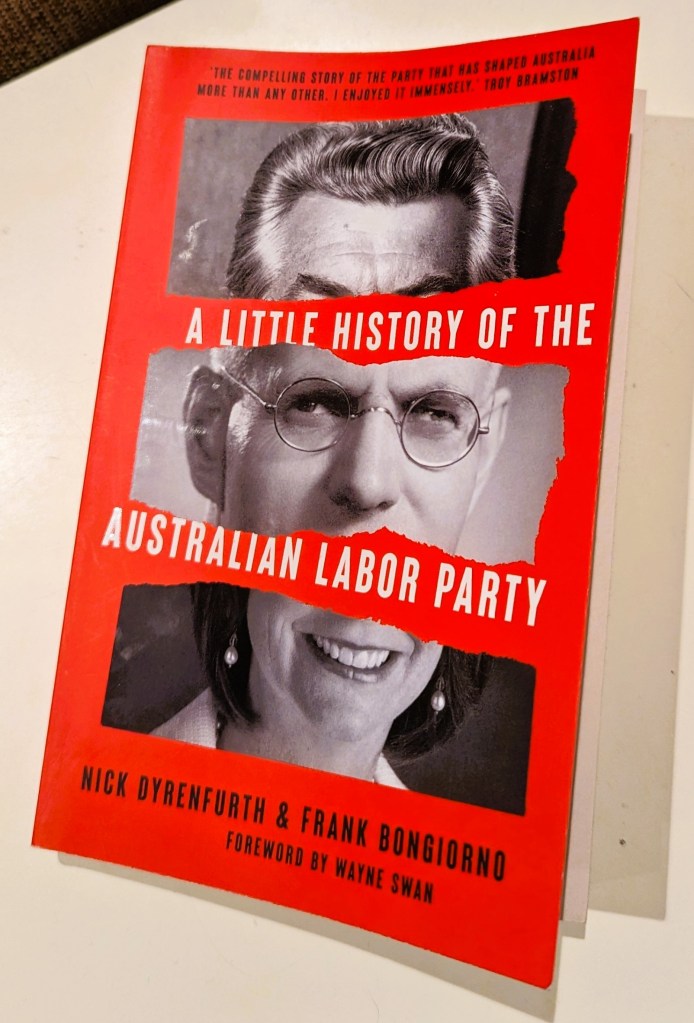




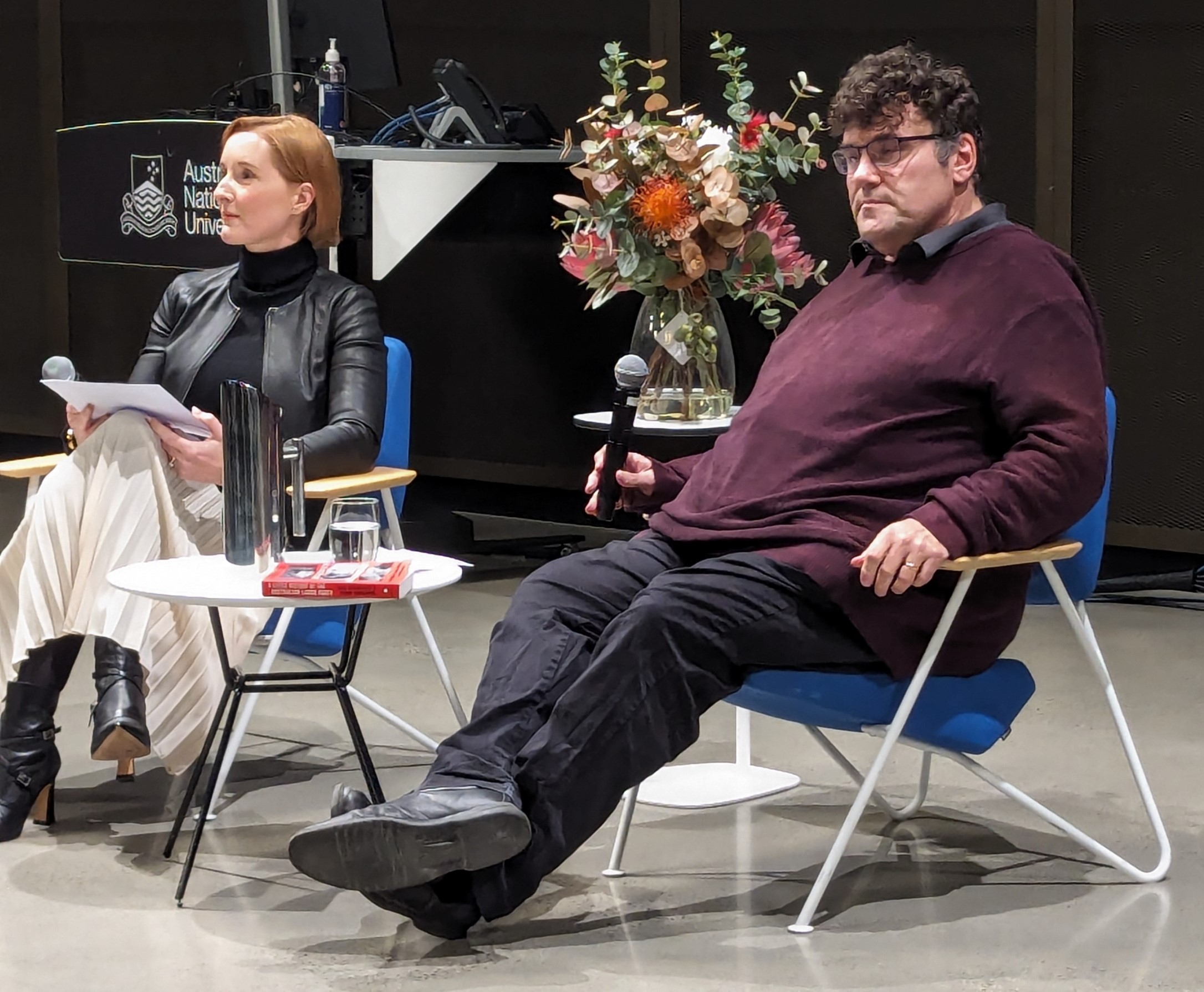

I now have a hard copy of A Little History of the Australian Labor Party. The presentation question and answer session, and the vote of thanks, were excellent and have encouraged me to set aside some of my NetGalley kindle downloads and come to grips with the hard copy. I shall review A Little History of the Australian Labor Party in coming weeks.
Bob McMullan

Prominent American political commentator, Michael Steel, uses the colourful phrases “bedwetting” and “handwringing” to describe Democratic party supporters who tend to focus on the weaknesses of their position rather than their strengths.
Steel is interesting because he is a former Chair of the Republican National Committee who is now disillusioned with the Republicans in the age of Trump and has become a respected political commentator, particularly on MSNBC.
I’m quite sure he would say that there is too much “bedwetting” and “handwringing” amongst Labor supporters and media commentators.
There is a serious disconnect between the objective polling data and the commentary from some Labor supporters. Some reporting also does not align with the objective reality.
This is not the product of media bias. It is rather a fascination with the heat of the moment rather than the light generated by a knowledge of political and electoral history. The most recent polling averages from both the Poll Bludger and Kevin Bonham put Labor distinctly ahead. The Poll Bludger has the ALP on 50.9 to the coalition on 49.1. Bonham has the ALP at 51.0 while the coalition is at 49.0.
Having examined polling data for the last 40 years of Australian federal elections I cannot find an example of a government that was leading twelve months out and yet went on to lose!
Of course, just because something has never happened doesn’t mean it can’t happen. But it does suggest that it is not probable. There are some unique variables about the current situation. The size of the crossbench and the likelihood that it will remain at least equally large is one such factor. The corresponding decline in primary votes for the major parties is another.
But every election has its unique characteristics. It might be 9/11 and Tampa in 2001, Mark Latham in 2004 or Scott Morrison in 2022, but each one is distinct. And yet there is an overall pattern which needs to be understood: governments in front with twelve months to go are likely to win.
There are also some factors which tend to add volatility to the current political landscape. The conflict in Gaza and associated protests in Australia may change some voting intentions. High interest rates and the possibility that they will not fall before the election and slightly elevated inflation all suggest a potent political mix. There are also the ongoing immigration issues.
But these should already be factored into the current polling. There have certainly been occasions when governing parties lost significant support in the last twelve months of a term. In the lead up to the 2010 election internal Labor party strife caused a significant loss of votes, but the government was still returned.
There have also been big movements in favour of incumbents in the lead up to the election. In 2004 the Howard government looked extremely vulnerable twelve months out from the election, but in the end they won comfortably.
So, there is obviously potential for significant movement in the last twelve months of a term.
History suggests that it is unlikely to be sufficient to lead to the defeat of a government with a lead in the polls such as that currently enjoyed by the Albanese government. In fact, the average movement of both the primary vote and two party preferred vote over the twelve months leading to a federal election has been approximately 1% towards the government, averaged over the last ten federal elections. However, this disguises big swings in both directions over the years. For example, in 2001 the Liberal government primary vote increased by 7.1% over the twelve-month period
leading up to the election, while the Labor government primary vote in 2010 fell by 8% over the same period.
There is certainly no room for complacency within the ALP. Labor has a proven capacity to seize defeat from the jaws of victory. Likewise, there is no reason for the coalition to despair. However, at the moment the interesting thing about the current polling is its apparent stability. After making allowances for the inevitable statistical variation driven by sampling
the recent polls have been quite stable, revolving around a two-point Labor lead in two party preferred vote. Nothing is certain in life or politics.
However, history suggests that the prospects for a Labor victory next year are stronger than many commentators and worried supporters are currently suggesting.
Wage Rage for Equal Pay
Australia’s Long, Long Struggle
Jocelynne A. Scutt, Plagrave McMillan © 2024
Overview
Authors: Jocelynne A. Scutt
- Contributes to the continuing legal and historical struggle for equal pay in Australia; Analyses and recounts campaigns, cases and debates; and Takes law, history and women’s and gender studies into consideration.
- About this book
- This book makes a major contribution to the continuing legal and historical struggle for equal pay in Australia, with international references, including Canada, the UK and US. It takes law, history and women’s and gender studies to analyse and recount campaigns, cases and debates. Industrial bodies federally and around Australia have grappled with this issue from the early-twentieth century onwards. This book traces the struggle through the decades, looking at women’s organisations activism and demands, union ‘pro’ and ‘against’ activity, and the ‘official’ approach in tribunals, boards and courts.
- Authors and Affiliations
- Jocelynne A. Scutt, University of Buckingham, Buckingham, UK Jocelynne A. Scutt
- About the author
- Jocelynne Scutt is Senior Fellow at the University of Buckingham, UK. She published Women and The Magna Carta: A Treaty for Rights or Wrongs, Women, Law and Culture – Conformity, Contradiction and Conflict with Palgrave in 2016, and Beauty, Women’s Bodies and the Law – Performances in Plastic with Palgrave in2020.
- See Further Commentary and Articles arising from Books* and continued longer articles as noted in the blog.
Cindy Lou eats at a Korean street stall
The O’Connor shops has a range of eating places that I have tried- Kopiku, Flatheads Fish Cafe, the Duxton and To Do. Today I went to the nearby street stall that provides a range of Korean meals. Nearby is a taco stall that I might try next time. However, it will have to be good to compete with the succulent, crispy chicken that I ate today – such a generous amount that the photo below shows what remained for another day!
There is pleasant seating in an attractive outdoor environment. A paper carry bag is provided for take away.





Gaslight at the Canberra Theatre
This was a rather mixed production. It certainly lacked the pace that might have improved a somewhat erratic script. At times, particularly in the early scenes, the negative impact of gaslighting was demonstrated, along with the capacity of a beloved person to inflict such pain on a person whose grip on reality becomes impaired under the assault. However, the seriousness of gaslighting was undermined because of the lack of subtlety in these scenes. Was it supposed to be a serious production? In later scenes, particularly in the first scenes of Act 2 it appeared that the tables were being turned, in some rather comic interplay between wife and husband. It was a pleasant enough evening, and I am pleased to be going to the Canberra Theatre and Playhouse more often.


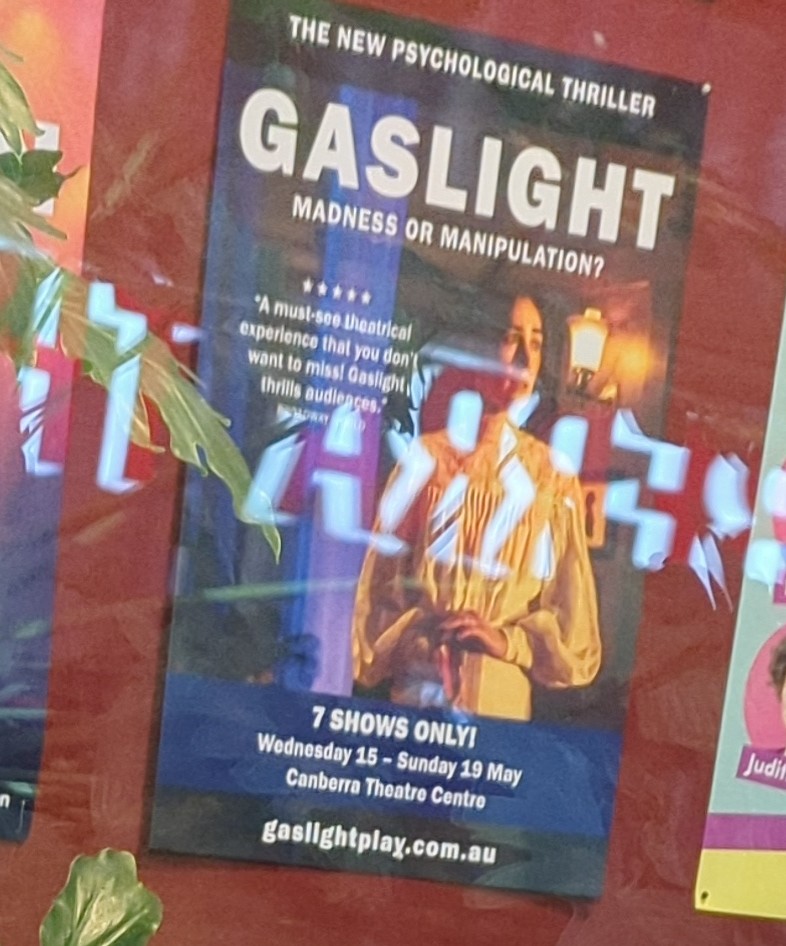
Contrary to my response, this is what one reviewer made of it…
Stunning Gaslight is beauty magnified

Theatre / Gaslight, adapted by Johnna Wright and Patty Jamieson. Directed by Lee Lewis for Queensland Theatre. At Canberra Theatre until May 19. Reviewed by ARNE FEALING.
It is a rare day you will attend a work of dramatic art that is so visually stunning, so carefully produced, and so precisely executed. This show is beauty magnified.
As soon as the curtains opened on this adaptation of Patrick Hamilton’s 1938 play Gaslight, it was obvious that what would follow would be a sumptuous experience.
An intense drama, each word was carefully timed, and vital to the unfolding of this psychological thriller. What is said is of utmost importance. Set inside quiet, yet foreboding splendour – the lighting and set design (Renée Mulder) worked a special illusionary magic to bring the audience into Gaslight’s private world. Working harmoniously and effectively with its sound design (Paul Charlier) both set and sound stage provided backdrop for the intense personal drama between Jack (Toby Schmitz) and Bella Manningham (Geraldine Hakewill).
Throughout, the highly realistic lighting design created astounding pallets. Stunningly real, the stage would become engulfed in the sunrise, as it softly streamed into the house.
The transition between day and night, a new day, and a new page in the softly unfolding world where Bella is going gently insane. But what is the cause of this unfolding torture? Much has been made of the connection between the modern use of the term gaslighting and its origins from this play, and the two films and various productions that followed. It has come to refer to the manipulation of a person by another in a similar way to Jack’s treatment of Bella.
A recent adaptation, the suspense and slow movement through its devastatingly clever plot are not lost. Bella is the key role, and Hakewill (Wanted, Ms Fisher’s Modern Murder Mysteries) is perfect in every sense. This drama turns around her. And it is up to her to find her way out.
As Jack, Schmitz (Boy Swallows Universe, Black Sails) executes his character arc with a calculated precision that belies the subplot underneath. An English gentleman of uncertain means, he succeeds in fooling the audience as much as he does his wife in the early potions of the play.
Prepare to be riveted and rocked.
There is a sense that everything about Gaslight was created to be as perfect as dramatically possible. It must be seen to be fully appreciated just how close this cast and crew have come to achieving that.
Research online is worthwhile if you are about to see this production. I was interested to see that one of the most important points in the story line was not well made in this production. I kept waiting for the information, as it was essential to the plot. Unlike the reviewer, I was not ‘riveted and rocked’ . I was bemused. Where I do join with him in wholehearted admiration is in relation to the set, and the impressive lighting. Not only did it move so well from day to night, but spot lighting changed the set by producing cleaver vignettes.
Brilliant & Bold
The discussion, featuring Jessica Williams, was streamed live on Facebook.
Some background:
WOMEN AND IMPRISONMENT … WOMEN IN PRISON THE UNITED NATIONS –
Women are imprisoned more rarely than men, yet when they are imprisoned, it is generally for offences for which men are never imprisoned – social security fraud, low-level drug use, offences associated with prostituted
women, shoplifting – low-level theft, receiving stolen goods …Yet some theories assert that far from being treated unfairly by the prison system, women are advantaged. One theory (Pollack) says that women escape
arrest, prosecution and imprisonment as they carry out their crimes through their male partners who are arrested, prosecuted and imprisoned in their place. Associated with this theorising is the contention that
women ‘get away with’ crimes because they are treated with chivalry by police, magistrates and judges. Some say that women are ‘to blame’ for men’s higher rates of imprisonment as single parent families (it is said)
generate criminality and as the majority of single parent families are headed by women it must be women’s inadequacy that drives the ‘broken home’ dynamic in male imprisonment. Another proposition is that women
avoid imprisonment as they are mothers and have dependent children, so courts take this into account, imposing alternative sanctions. Yet are these contentions realistic? Do they equate with the reality of women
in the world generally and in the criminal justice system in particular? Knowing that the vast majority of women in gaol are mothers with dependent children for whom they must find alternative care – or have their
children taken into care – counters one ‘theory’ at least.
Jessica Williams is an American-born woman who has lived in Australia for nearly 14 years. She currently lives in and is presenting from Victoria, Australia. Jess is a researcher and a political lobbyist, an author, and an advocate for women’s rights, animal rights, and for our environment. She recently presented on women in prison to the Criminology and Criminal Justice students at the University of Buckingham, England and is an experienced public speaker, particularly (though not only on women and crime and women’s incarceration.
.
Jesicca began by speaking about the case of a New South Wales (NSW) Corrective Services Officer who has been confirmed as having sexually assaulted at least 14 women prisoners. She also shared with us further examples of the ways in which women, children, and teenagers in Australia are routinely sexually and physically harmed and neglected by police and prisons officers.
Jessica Williams was ably supported by Jocelyne Scutt chairing and a host of articulate women who contributed questions and to the discussion. One issue that was raised that provoked discussion about whether Australia has implemented important related to imprisonment was The Mandela Rules. Details below:

The Mandela Rules: Minimum Prison Standards Must Be Implemented
Ensuring the dignity of detainees
The Nelson Mandela Rules are the revised version of the United Nations Standard Minimum Rules for the Treatment of Prisoners (SMRs). The original SMRs were first adopted by the UN Congress on Crime Prevention and Criminal Justice in 1955.
The rules were approved by the UN Economic and Social Council in 1957.
They set out the minimum standards as to how all prisoners should be treated, which is with respect and dignity. The SMRs also outline that no detainee should be subjected to “torture and other cruel, inhuman or degrading treatment or punishment.”
The second rule provides a basis for all others. It outlines that no inmate should be discriminated against on any grounds or status, including race, sex, religion, politics or national origin. And prison authorities must take into account the needs of all inmates, especially the most vulnerable.
In 2010, the UN General Assembly requested the Commission on Crime Prevention and Criminal Justice establish an expert group to revise the SMRs to reflect “recent advances in correctional science and best practices.”
The UN General Assembly adopted the revised SMRs on December 17 2015. They were dubbed the Mandela Rules to honour the legacy of the late South African president, who spent 27 years behind bars during his struggle for equality and human rights.
For every aspect of life on the inside
The Mandela rules aren’t legally binding. But they do set guidelines regarding a range of aspects of the prison environment. The very existence of the SMRs ensures that the protection of the human rights of prisoners, as well as all detainees, is an issue that is of concern for governments.
Minimum standards regarding prisoner hygiene, the provision of food, clothing and bedding, medical services, and discipline and punishment are all set out in the document. It also contains guiding principles regarding rehabilitation, education and post-release services.
And as you peruse the rules and recommendations outlined in the Mandela document, it becomes apparent that this nation’s prison system is failing to uphold the human rights of Australian inmates in several ways.
Overcrowding is a breach of standards
The rules 12 through to 17 outline the minimum standards of accommodation that inmates should be provided. If a prison contains individual cells, then these single rooms should only be occupied by one person at a time, as “it is not desirable to have two or more prisoners in one cell.”
Whereas, if dormitories are being used, then prisoners occupying that space should be carefully selected as suitable to associate with each other. Special consideration should be given to aspects of sleeping accommodation, such as “cubic content of air, minimum floor space… and ventilation.”
However, many Australian correctional facilities are bursting at the seams. In September last year, there were 41,262 adult prisoners in this country, which puts the nation’s prisoner population at an all-time high. The number of Australian inmates has been steadily increasing since the 1970s.
In 2016, inmates were being forced to share single cells at the Maryborough Correctional Centre in Queensland. One detainee would be forced to sleep on a mattress on the floor up close to the toilet. While at Victoria’s Dhurringile prison, shipping containers were being used as cells.
Prolonged isolation is torture
The Mandela Rules specifically state that the use of indefinite or prolonged solitary confinement should be prohibited. The document defines solitary confinement as up to 22 hours a day without meaningful human contact. And prolonged confinement is for more than 15 days.
The standards further outline that solitary confinement should only be used as a last resort. It should never be used on prisoners with disabilities if it will exacerbate their conditions. And the practice should be banned for women and children.
Australian prisons continue to use solitary confinement regularly, and this includes on women and children. And it was found that youths were being held in solitary confinement in the Don Dale facility for 17 days straight, for up to 23 hours a day.
“A form of sexual assault”
The rules also state that searches shouldn’t be used “to harass, intimidate or intrude unnecessarily upon a prisoner’s privacy.” And this is especially true of strip searches, which should be kept to a minimum, and only “undertaken if absolutely necessary.”
However, strip searches are still commonly used in Australian prisons. A recent Victorian Ombudsman investigation of Victoria’s main women’s prison – the Dame Phyllis Frost Centre – found that strip searches were regularly being used on detainees in the visiting section of the prison.
And this was despite the searches resulting in almost no contraband being discovered.
Victorian Ombudsman Deborah Glass said that the “humiliating, degrading and undignified practice” was of particular concern, as many women prisoners are victims of sexual abuse, and the strip searches can lead to further trauma.
Following the investigation, the Ombudsman made 19 recommendations to the Victorian Department of Justice and Regulation. The department agreed to all the recommendations, except for the one calling on the prison administration to stop the practice of routine strip searching.
For the benefit of all
As Ms Glass told Sydney Criminal Lawyers® last week, upholding the rights of prisoners is essential, as “how we treat prisoners is a mark of our civilisation, and preventing abuses in detention is simply the right thing to do.”
Not only is the protection of prisoner’s rights the humane way to proceed, but it also has flow on effects for the rest of the community, as the majority of inmates will eventually leave the prison system, and if they’ve been mistreated inside, this will impact on how they treat others on the outside.
Last updated on 18 Nov 2021
AUTHORS

PAUL GREGOIRE

Paul Gregoire is a Sydney-based journalist and writer. He’s the winner of the 2021 NSW Council for Civil Liberties Award For Excellence In Civil Liberties Journalism. Prior to Sydney Criminal Lawyers®, Paul wrote for VICE and was the news editor at Sydney’s City Hub.

UGUR NEDIM
Ugur Nedim is an Accredited Criminal Law Specialist with 25 years of experience as a Criminal Defence Lawyer. He is the Principal of Sydney Criminal Lawyers®.

 Robin's Room