Zöe Wheddon Jane Austen: Daddy’s Girl, The Life and Influence of The Revd George Austen Pen & Sword Pen & Sword History, March 2024.

Thank you NetGalley and Pen & Sword for providing me with this uncorrected proof for review.
A significant part of Jane Austen’s life has been omitted in the concentration on her relationship with her sister Cassandra. Such attention has been successful in showing Jane as a woman influenced by her own female friendships and then reflecting them in her work. Jane Austen: Daddy’s Girl, The Life and Influence of the Revd George Austen adds another important dimension to the influences on Austen’s writing, not only proving a detailed account of George Austen’s life from his early years but in the impact he had on Austen’s depiction of men, the social environment and moral imperatives with which her work is imbued, and the educational and inspirational environment in which she thrived.
Not only is this book a valuable addition to what is known about Austen and her writing, but it is a wonderful read. Packed with information it is, but a turgid recounting of events it is not. As is usual with the Pen & Sword style Zöe Weddon’s writing is extremely accessible. The book is entertaining to read and enhanced by frequent references to where Jane’s life and the influences upon it are reflected in her novels. Titles are in brackets and the text often elaborates on the connections she made between real life and fiction. See Books: Reviews for the complete review.
June Woolerton The Mysterious Death of Katherine Parr What Really Happened to Henry VIII’s Last Queen? Pen & Sword Pen & Sword History, March 2024.

Thank you, Net Galley and Pen & Sword, for providing me with this uncorrected proof for review.
June Woolerton begins her book with the dramatic events around the original uncovering of Katherine Parr’s coffin, its neglect over time, and the eventual burial that was worthy of a queen. For, indeed, Katherine Parr was a queen, even after her marriage to Thomas Seymour, as an outcome of Henry Vlll’s will, preserving this honour. It might be the power that she could possibly have exerted after Henry’s death, her departure from the court and new marriage that resulted in her death, hasty burial and the lack of publicity afforded her funeral. Woolerton attempts to unravel whether this was the case in a well-researched narrative that moves from these dramatic, almost gossipy speculations to the new marriage and birth of her daughter, and then returns to the past where Katherine has been an almost continuing presence in the Tudor courts, as the child of a Lady in Waiting to Catherine of Aragon, to a Lady in Waiting herself. Two earlier marriages seem to have had little impact on Parr’s ability to wield her own power. Eventually, as Woolerton suggests, such power might have been her undoing. See Books: Reviews for the complete review.
After Covid in Canberra update: Guilty verdict for former president Trump; Tristan Snell – review of his book, Taking Down Trump; two Letters from an American, Heather Cox Richardson; Dying with Dignity.
Covid in Canberra Update 24th to 30th May 2024

There have been 252,920 cases since March 2020. New cases this week (PCR only) number 242, of whom 67 are in hospital. No cases are in ICU and there were none ventilated. There were 4 lives lost in this period, bringing the total number of lives lost to Covid in Canberra to 316. Case number reporting for influenza and RSV will commence on Friday, 7th June .
Guilty
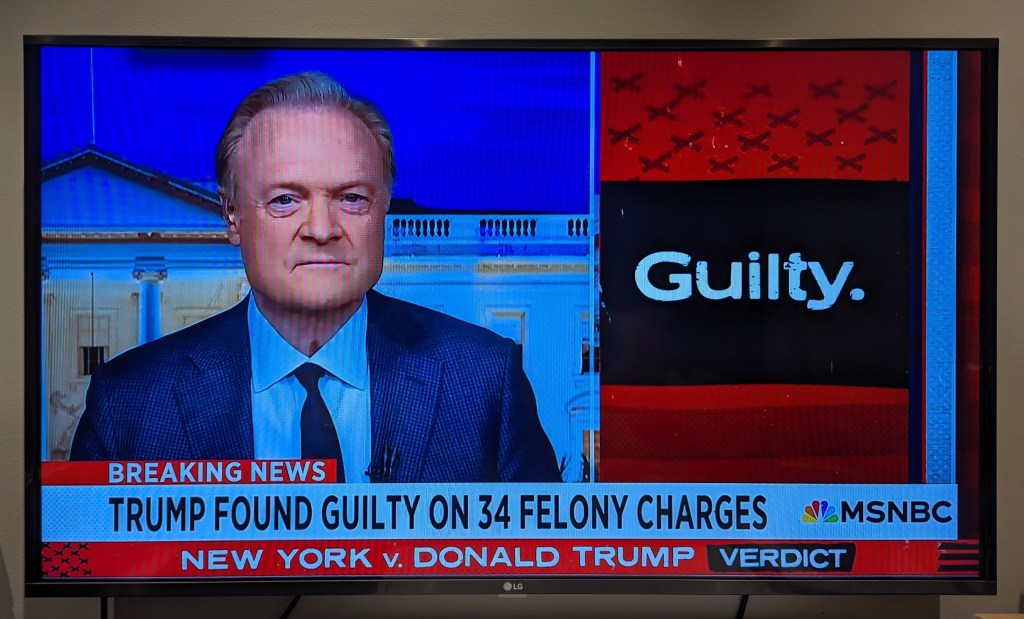
It is worth repeating my review of Tristan Snell’s book which makes so clear the courage of the Jurors, Judge, witnesses for the prosecution and prosecution lawyers who made the above headline possible. Lawrence O’Donnell made his viewers feel that they were in the court as the 34 guilty verdicts were enunciated. A good show by Lawrence, and the following, although initially reviewed for my November 26, 2023 blog, is a good read in relation to this successful prosecution.

Tristan Snell, Taking Down Trump 12 Rules for Prosecuting Donald Trump by Someone Who Did It Successfully, Melville House Publishing Melville House, January 2024.
Thank you, NetGalley, for providing me with this uncorrected proof for review.
As I read the headlines about former president Donald Trump fulminating against the courts, the cases in the courts and the personnel involved, the impact it has on his followers and the death threats to judges and court officials I am pleased to be reading Tristan Snell’s optimistic approach to a similar situation in his book, Taking Down Trump.
Snell was the Assistant Attorney General for New York who prosecuted Donald Trump for defrauding Trump University students in 2018. He also refers to the limited egregiously limited success in an earlier case where systematic racial discrimination prevented Black Americans becoming tenants in apartments owned by Trump. Partial success won (although the students did win back most of their fees under the $25 million settlement made by Trump despite his protestations that he would not settle) is less than those who challenged him deserved. However, Snell’s account of the obstacles facing anyone encountering Donald Trump in an attempt to win a legal case is instructive – surmounting the challenges in the Trump playbook is not a given. It takes honesty, resilience, courage and knowledge of the law. Snell had all of these. The judges and officials now under fire from Trump are in this situation because they also have these qualities.
As Snell suggests, it is not unusual for the Trump to benefit from those in power, including from the role of donations in the success of those standing for office, filing his own countersuits and attacking witnesses and lawyers opposed to them…familiar? The twelve rules Snell proposes demonstrate the familiarity of this conduct, and other ways in which Trump outmanoeuvres the law, while stating clearly how to overcome such obstacles. The first rule is that the leadership in a case involving Trump must be determined and committed, from the top. In addition, political incentives in favour of intervention need to be tilted in favour of doing so. Part 11 covers the rules needed to ensure that the investigation proceeds. One chapter title that will be familiar to those who follow American politics, is ‘Trump is incapable of being quiet’. Part 111 offers advice about being public about the case, ensuring it is flawless; and advice to ignore the noise and Trump’s hostile reactions. In short, to achieve any modicum of success, those challenging Trump must maintain control over their counterreactions.
The Epilogue recognises the concerns expressed by observers, provides some information about the way in which current cases demonstrate an awareness of the Trump playbook and methods of dealing with this behaviour and also notes some of the mistakes Trump’s lawyers have made. Here the time taken to bring cases forward is dissected briefly – suggesting that delays have included prosecutors’ need to familiarise themselves with the Trump pattern of dealing with litigation.
This is an important book, offering as it does some optimism about the way in which the law might eventually treat such a powerful person. It is also easy to read. Partly this is because the information is so provocative, but also because of the way in which Snell makes his case – clearly and succinctly, while providing plenty of information for the non-legal reader to understand. Taking Down Trump is a timely book, and well worth reading.
Heather Cox Richardson Letters from an American<heathercoxrichardson@substack.com>

Today felt as if there was a collective inward breath as people tried to figure out what yesterday’s jury verdict means for the upcoming 2024 election. The jury decided that former president Trump created fraudulent business records in order to illegally influence the 2016 election. As of yesterday, the presumptive Republican nominee for president of the United States of America is a convicted felon.
Since the verdict, Trump and his supporters have worked very hard to spin the conviction as a good thing for his campaign, but those arguments sound like a desperate attempt to shape a narrative that is spinning out of their control. Newspapers all over the country bore the word “GUILTY” in their headlines today.
At stake for Trump is the Republican presidential nomination. Getting it would pave his way to the presidency, which offers him financial gain and the ability to short-circuit the federal prosecutions that observers say are even tighter cases than the state case in which a jury quickly and unanimously found him guilty yesterday. Not getting it leaves Trump and the MAGA supporters who helped him try to steal the 2020 presidential election at the mercy of the American justice system.
After last night’s verdict, Trump went to the cameras and tried to establish that the nomination remains his, asserting that voters would vindicate him on November 5. But this morning, as he followed up last night’s comments, he did himself no favors. He billed the event as a “press conference,” but delivered what Michael Grynbaum of the New York Times described as “a rambling and misleading speech,” so full of grievance and unhinged that the networks except the Fox News Channel cut away from it as he attacked trial witnesses, called Judge Merchan “the devil,” and falsely accused President Joe Biden of pushing his prosecution. He took no questions from the press.
Today the Trump campaign told reporters it raised $34.8 million from small-dollar donors in the hours after the guilty verdict, but observers pointed out there was no reason to believe those numbers based on statements from Trump’s campaign. Meanwhile, Trump advisor Stephen Miller shouted on the Fox News Channel that every Republican secretary of state, state attorney general, donor, member of Congress must use their power “RIGHT NOW” to “beat these Communists!”
The attempt of MAGA lawmakers to shape events in their favor seemed just as panicked. Representative Jim Banks (R-IN) posted on social media that “New York is a liberal sh*t hole,” and Jim Jordan (R-OH) today asked Manhattan district attorney Alvin Bragg, who brought the case against Trump, to testify before the House Judiciary’s Select Subcommittee on the Weaponization of the Federal Government about “politically motivated prosecutions of…President Donald Trump.” Representative Dan Goldman (D-NY) noted that Trump is a private citizen and Congress has no jurisdiction over the case, but that Jordan is using his congressional authority illegally to defend Trump.
MAGA senators were even more strident. Republican senator Mike Lee of Utah melted down on X last night over the verdict, and today he led nine other Republican senators in a revolt against the federal government. Lee, J. D. Vance of Ohio, Tommy Tuberville of Alabama, Eric Schmitt of Missouri, Marsha Blackburn of Tennessee, Rick Scott of Florida, Roger Marshall of Kansas, Marco Rubio of Florida, Josh Hawley of Missouri, and Ron Johnson of Wisconsin issued a public letter saying they would no longer pass legislation, fund the government, or vote to confirm the administration’s appointees because, they said, “[t]he White House has made a mockery of the rule of law and fundamentally altered our politics in un-American ways. As a Senate Republican conference,” they said, although there were only 10 of them, “we are unwilling to aid and abet this White House in its project to tear this country apart.”
It was an odd statement seemingly designed to use disinformation to convince voters to stick with them. Ten senators said they would not do the federal jobs they were elected to do because private citizen Trump was convicted in a state court by a jury of 12 people in New York, a jury that Trump’s lawyers had agreed to. The senators attacked the rule of law and the operation of the federal government in a demonstration of support for Trump. A number of the senators involved were key players in the attempt to overturn the 2020 presidential election.
Awkwardly, considering the day’s news, a video from 2016 circulated today in which Trump insisted that Democratic presidential candidate Hillary Clinton, who he falsely insisted had committed crimes even as he was the one actually committing them, “shouldn’t be allowed to run.” If she were to win, Trump then said, “it would create an unprecedented constitutional crisis. In that situation, we could very well have a sitting president under felony indictment and, ultimately, a criminal trial. It would grind government to a halt.”
Josh Marshall of Talking Points Memo put it correctly: this is not an “outpouring of rage and anger,” so much as “an overwhelming effort to match and muffle the earthquake of what happened yesterday afternoon with enough noise and choreography to keep everyone in Trump’s campaign and on the margins of it in line and on side.”
Still, there is more behind the MAGA support for Trump than fearful political messaging. Trump has been hailed as a savior by his supporters because he promises to smash through the laws and norms of American democracy to put them into power. There, they can assert their will over the rest of us, achieving the social and religious control they cannot achieve through democratic means because they cannot win the popular vote in a free and fair election. With Trump’s conviction within the legal system, his supporters are more determined than ever to destroy the rules that block them from imposing their will on the rest of us.
Today the Federalist Society, which is now aligned with Victor Orbán’s Hungary, flew an upside-down U.S. flag as a signal of national distress. Their actions were in keeping with Russian president Vladimir Putin’s statement that Trump is being persecuted “for political reasons” and that the cases show “the rottenness of the American political system, which cannot pretend to teach others about democracy.”
Ryan J. Reilly of NBC News reported today on a spike in violent rhetoric on social media targeting New York judge Juan Merchan, who oversaw Trump’s Manhattan election interference trial, and District Attorney Bragg. Users of a fringe internet message board also shared what they claimed were the addresses of jurors. “Dox the Jurors. Dox them now,” one user wrote. Another wrote, “1,000,000 men (armed) need to go to [W]ashington and hang everyone. That’s the only solution.”
This attack on our democracy was the central message of a crucially important story from yesterday that got buried under the news of Trump’s conviction. In The New Republic, Ken Silverstein reported on a private WhatsApp group started last December by military contractor Erik Prince—founder of Blackwater and brother of Trump’s secretary of education, Betsy DeVos—and including about 650 wealthy and well-connected “right-wing government officials, intelligence operatives, arms traffickers, and journalists,” including Representative Ryan Zinke (R-MT), who served as Trump’s secretary of the interior.
Called “Off Leash,” the group discussed, as Silverstein wrote, “the shortcomings of democracy that invariably resulted from extending the franchise to ordinary citizens, who are easily manipulated by Marxists and populists,” collapsing Gaza into a “fiery hell pit,” wiping out Iran, how Africa was a “sh*thole of a continent,” and ways to dominate the globe. Mostly, though, they discussed the danger of letting everyone vote. “There is only one path forward,” Zinke wrote. “Elect Trump.” Another member answered, “It’s Trump or Revolution” “You mean Trump AND Revolution,” wrote another.
And yet the frantic MAGA spin on the verdict reveals that there is another way to interpret it. Americans who had lost faith that the justice system could ever hold a powerful man accountable as Trump’s lawyers managed to put off his many indictments see the verdict as a welcome sign that the system still works.
“The American principle that no one is above the law was reaffirmed,” Biden said today. “Donald Trump was given every opportunity to defend himself. It was a state case, not a federal case. And it was heard by a jury of 12 citizens, 12 Americans, 12 people like you. Like millions of Americans who served on juries, this jury is chosen the same way every jury in America is chosen. It was a process that Donald Trump’s attorney was part of. The jury heard five weeks of evidence…. After careful deliberation, the jury reached a unanimous verdict. They found Donald Trump guilty on all 34 felony counts. Now he’ll be given the opportunity as he should to appeal that decision just like everyone else has that opportunity. That’s how the American system of justice works. And it’s reckless, it’s dangerous, and it’s irresponsible for anyone to say this was rigged just because they don’t like the verdict. Our justice system has endured for nearly 250 years and it literally is the cornerstone of America…. The justice system should be respected, and we should never allow anyone to tear it down. It’s as simple as that. That’s America. That’s who we are. And that’s who we will always be, God willing.”
Today the publisher of Dinesh D’Souza’s book and film 2000 Mules, which alleged voter fraud in the 2020 election, said it was pulling both the book and film from distribution and issued an apology to a Georgia man who sued for defamation after 2000 Mules accused him of voting illegally.
MAGA Republicans confidently predicted yesterday that the stock market would crash if the jury found Trump guilty. Today the Dow Jones Industrial Average gained almost 600 points.
Notes:
https://www.nbcnews.com/politics/donald-trump/trump-supporters-try-doxx-jurors-post-violent-threats-conviction-rcna154882; https://www.nytimes.com/2024/05/31/business/media/cnn-nbc-trump-speech.html; https://www.npr.org/2024/05/31/g-s1-2298/publisher-of-2000-mules-election-conspiracy-theory-film-issues-apology; https://www.politico.eu/article/charges-against-donald-trump-are-politically-motivated-vladimir-putin-says-russia-us/; https://talkingpointsmemo.com/edblog/owhat-trump-requires/sharetoken/hnWkPTYknWwi; https://newrepublic.com/article/182008/erik-prince-secret-global-group-chat-off-leash; https://www.reuters.com/world/us/trump-supporters-call-riots-violent-retribution-after-verdict-2024-05-31/; X:; TomDreisbach/status/1796634041749271001 ; clearing_fog/status/1796688610345079191; carlquintanilla/status/1796673529364074902; jkarsh/status/1796607730767262128; RepDanGoldman/status/1796645275739537822; AccountableGOP/status/1796553224293589011; RonFilipkowski/status/1796500340239695948; Jim_Banks/status/1796293183430705353; greggnunziata/status/1796668421725139139; bidenhq/status/1796598389213159514; SenMikeLee/status/1796600766691672394; SenMikeLee/status/1796650441545073147; RonFilipkowski/status/1796723924882919627

Another Letter from an American, Heather Cox Richardson, (June 1, 2024) in which she looks at the history of another egregious period in the republican Party and the courage required to stand against this scourge. This is a great story of a woman who stood against Senator Joe McCarthy in the 1950s.
Heather Cox Richardson Letters from an American<heathercoxrichardson@substack.com>
Today, as MAGA Republicans attack the rule of law and promise to prosecute their political enemies if they get back into power, it’s easy to forget that once upon a time, certain Republican politicians championed reason and compromise and took a stand against MAGAs’ predecessors. On June 1, 1950, Senator Margaret Chase Smith, a Republican from Maine, stood up against Republican Senator Joe McCarthy of Wisconsin and his supporters, who were undermining American democracy in a crusade against “communism.”
Margaret Chase was born in Skowhegan in 1897, the oldest child of a barber and a waitress, and became a teacher and a reporter before she got into politics through her husband, Clyde Smith, who was a state legislator and newspaperman. Soon after they married in 1930, she was elected to the Maine Republican State Committee and served until 1936, when Maine voters elected Clyde to Congress.
Once in Washington, Margaret worked as her husband’s researcher, speechwriter, and press secretary. When Clyde died of a heart attack in April 1940, voters elected Margaret to finish his term, then reelected her to Congress in her own right. They did so three more times, always with more than sixty percent of the vote. In 1948, they elected her to the Senate with a 71% majority.
When she was elected to Congress, the U.S. was still getting used to the New Deal government that Democratic president Franklin Delano Roosevelt had ushered in first to combat the Great Depression and then to fight for victory in World War II. Smith’s party was divided between those who thought the new system was a proper adjustment to the modern world and those determined to destroy that new government.
Those who wanted to slash the government back to the form it had taken in the 1920s, when businessmen ran it, had a problem. American voters liked the business regulation, basic social safety net, and infrastructure construction of the new system. To combat that popularity, the anti–New Deal Republicans insisted that the U.S. government was sliding toward communism. With the success of the People’s Liberation Army and the declaration of the People’s Republic of China in October 1949, Americans were willing to entertain the idea that communism was spreading across the globe and would soon take over the U.S.
Republican politicians eager to reclaim control of the government for the first time since 1933 fanned the flames of that fear. On February 9, 1950, during a speech to a group gathered in Wheeling, West Virginia, to celebrate Abraham Lincoln’s birthday, an undistinguished senator from Wisconsin named Joe McCarthy claimed that he had a list of 205 communists working for the State Department and that the Democrats refused to investigate these “traitors in the government.”
The anti–New Deal faction of the party jumped on board. Sympathetic newspapers trumpeted McCarthy’s charges—which kept changing, and for which he never offered proof—and his colleagues cheered him on, while congress members from the Republican faction that had signed onto the liberal consensus kept their heads down to avoid becoming the target of his attacks.
All but one of them did, that is. Senator Smith recognized the damage McCarthy and his ilk were doing to the nation. She had seen the effects of his behavior up close in Maine, where the faction of the Republican Party that supported McCarthy had supported the state’s Ku Klux Klan. Clyde and Margaret Chase Smith had taken a stand against them.
On June 1, 1950, only four months after McCarthy made his infamous speech in Wheeling, Smith stood up in the Senate to make a short speech.
She began: “I would like to speak briefly and simply about a serious national condition. It is a national feeling of fear and frustration that could result in national suicide and the end of everything that we Americans hold dear…. I speak as a Republican, I speak as a woman. I speak as a United States senator. I speak as an American.”
Referring to Senator McCarthy, who was sitting two rows behind her, Senator Smith condemned the leaders in her party who were destroying lives with wild accusations. “Those of us who shout the loudest about Americanism in making character assassinations are all too frequently those who, by our own words and acts, ignore some of the basic principles of Americanism,” she pointed out. Americans have the right to criticize, to hold unpopular beliefs, to protest, and to think for themselves. But attacks that cost people their reputations and jobs were stifling these basic American principles. “Freedom of speech is not what it used to be in America,” Senator Smith said. “It has been so abused by some that it is not exercised by others.”
Senator Smith wanted a Republican victory in the upcoming elections, she explained, but to replace President Harry Truman’s Democratic administration—for which she had plenty of harsh words—with a Republican regime “that lacks political integrity or intellectual honesty would prove equally disastrous to this nation.”
“I do not want to see the Republican party ride to political victory on the Four Horsemen of Calumny—Fear, Ignorance, Bigotry, and Smear.”
“I doubt if the Republican party could do so,” she added, “simply because I do not believe the American people will uphold any political party that puts political exploitation above national interest. Surely we Republicans are not that desperate for victory.”
“I do not want to see the Republican party win that way,” she said. “While it might be a fleeting victory for the Republican party, it would be a more lasting defeat for the American people. Surely it would ultimately be suicide for the Republican party and the two-party system that has protected our American liberties from the dictatorship of a one-party system.”
“As an American, I condemn a Republican Fascist just as much as I condemn a Democrat Communist,” she said. “They are equally dangerous to you and me and to our country. As an American, I want to see our nation recapture the strength and unity it once had when we fought the enemy instead of ourselves.”
Smith presented a “Declaration of Conscience,” listing five principles she hoped her party would adopt. It ended with a warning: “It is high time that we all stopped being tools and victims of totalitarian techniques—techniques that, if continued here unchecked, will surely end what we have come to cherish as the American way of life.”
Six other Republican senators signed onto Senator Smith’s declaration.
There were two reactions to the speech within the party. McCarthy sneered at “Snow White and the Six Dwarves.” Other Republicans quietly applauded Smith’s courage but refused to show similar courage themselves with public support. In the short term, Senator Smith’s voice was largely ignored in the public arena and then, when the Korean War broke out, forgotten.
But she was right. Four years later, the Senate condemned McCarthy. And while Senator Smith was later awarded the Presidential Medal of Freedom, McCarthy has gone down in history as a disgrace to the Senate and to the United States of America.
—
Notes:
Today is a historic day for Canberra.
After a decades-long fight by countless passionate advocates, the ACT Legislative Assembly has passed laws to allow residents of the ACT to access voluntary assisted dying.
This means, at long last, ACT residents can choose to die with dignity.
In December 2022, the Federal Parliament removed the legislation that for too long had blocked territories from determining what was best for their community on this matter and today the people have spoken.
This milestone has only been reached following the many years of tireless work by community and political advocates including Go Gentle Australia, Dying with Dignity ACT, and Doctors for Assisted Dying Choice.
 |
| I was proud to work closely alongside my Labor colleagues, both here in Canberra and up in the Northern Territory, over several years to progress a private member’s bill through the Federal Parliament to advocate for the return of the ACT’s democratic rights. Until this bill passed, ACT residents were second-class citizens with fewer democratic rights than those who lived just over the border in Queanbeyan or Yass. We fought for the rights of Canberrans and today’s vote in the ACT legislative Assembly has showcased what we can deliver for our community when we work together. Together, we as a community have worked tirelessly to allow the ACT Legislative Assembly to determine its own laws, ones that reflect the needs and wants of our community. Together we have advocated for the right to have our voices heard and today, we, together, have succeeded in allowing for the residents of the ACT to be awarded the same right to choose voluntary assisted dying, as other states across Australia have done. No matter what your personal views may be about the issue of voluntary assisted dying, today marks an important day for the democratic rights of the people of the ACT. This shows the difference that Labor Governments can make. Katy Gallagher Senator for the Australian Capital Territory |
 |
 Robin's Room