Donna Leon A Refiner’s Fire, A Commissario Guido Brunetti Mystery Grove Atlantic, July 2024.

Thank you, NetGalley, for providing me with this uncorrected proof for review.
Donna Leon’s writing is such a joy, something to savour, as Guido Burnetti and his family navigate their personal lives and the newest case to be investigated. In this novel Burnetti’s investigation highlights the attraction of gangs, in this case named ‘baby gangs’ named as such because of the followers’ and leaders’ youth, the importance of a cult figure and the devastation such a figure can create in ordinary peoples’ lives. Throughout is woven the central theme: the ethics surrounding the making of a war hero. See Books: Reviews for the complete review.
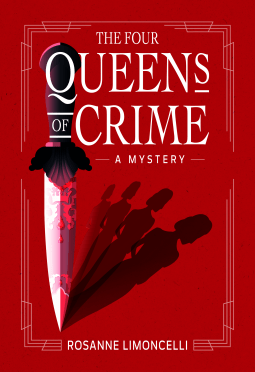
Rosanne Limoncelli, The Four Queens of Crime A Mystery, Crooked Lane Books, March, 2025
Thank you, NetGalley, for providing me with this uncorrected proof for review.
The Four Queens of Crime introduces Agatha Christie, Dorothy Sayers, Margery Allingham and Ngaio Marsh as sleuths investigating the death of their host at a fundraiser at which they are drawcards. They are well drawn characters, in the main following the understanding that readers would have of them through their novels, autobiographies and biographies. The women’s investigations include observations about the detectives who star in their work and the types of crimes that they are expected to solve, providing a skilled reflection on the crime and detective novels they write. DCI Lilian Wyles, the first woman detective chief inspector in the CID, joins the novelists as another non-fictional character. She also is a character who is written to fulfil the requirements of depicting a real person in a fictional landscape. Family members, staff and the other detectives who attempt to solve the murder are also characters who fulfill their roles well. See Books: Reviews for the complete review.
After Covid Canberra Update: Bob McMullan, US election review at 10th August; Cindy Lou at PJs; ANU Meet the Author; Heather Cox Richardson; Screen Studies- Cult TV Heroines.
Canberra Covid Update 2 – 8 August 2024

There have been 254,317 cases since March 2020.This week there have been 56 new cases (PCR only). Eleven people are in hospital with Covid, with none in ICU or ventilated. Three lives were lost in this period with the total of lives lost since March 2020, 350.

Bob McMullan – American politics
US election review at 10th August

The last week has seen Kamala Harris appear to maintain the momentum she had established.
A sure sign of this momentum is the decision by various analytical sites which are reviewing their assessments to improve their expectation of her chances. Nate Silver has made Harris the slight favorite after previously forecasting a clear Trump win. The Sabato Crystal Ball website and the Cook Report have both changed their forecasts for battleground states to be more favorable to Harris.
The Vice-President has held enormous rallies in the key battleground states of Pennsylvania (the most important), Michigan, Wisconsin and Arizona which appear to have rattled Donald Trump. He has now agreed to debate Harris on September 10th, which he had previously refused to do.
Early polling suggests that her Vice-presidential choice, Tim Walz, from Minnesota polling is quite popular, although this is not very important in voters’ choices.
Walz is coming under predictable attack from Republicans, but I think every day they spend attacking him is a wasted day for them. Kamala Harris is their opponent and they need to land some blows on her or Republicans will continue to slip in the polls.
My only concern is that some anti-Trump Republicans like Charlie Sykes and Susan del Percio have expressed concern about the running mate choice as they fear it will make the team “too liberal” for the key undecided voters.
With the Democratic Convention coming up Vice-President Harris should have no trouble maintaining the momentum for the next couple of weeks. After that it will get harder.
The polling situation is not altogether clear. What is obvious in every assessment is that Kamala Harris is improving against Donald Trump.
But the current national and battleground states standings are not consistent between the various poll result aggregators.
It is to be expected that individual polls will vary. This is an inevitable result of sampling. Furthermore, different pollsters use different weightings which tend to lead to different results. For example, Trafalgar and Rasmussen polling results tend to be more favorable to Trump than other polls.
However, averaging across different polls and pollsters should mitigate this variation.
Both the major sites, Real Clear Politics and 538, continue to show improvement for the Democrat ticket. However, they measure the Harris/Walz ticket’s chances significantly differently.
As at 10 August RCP has Harris in the lead at the national level by a mere 0.5%. 538 has her ahead by 2%.
Across the battleground states the differences are similar. RCP suggests that at the moment Harris leads in only two of the seven battleground states, Michigan and Wisconsin. This would result in Harris gaining 251 Electoral college votes and therefore a victory for Trump. 538 average suggests Harris also leads in Pennsylvania. If this were to occur Harris would win.
To paraphrase Fred Daly, the Democrats need to talk as if they believe the 538 assessment and campaign as if they believe the more pessimistic RCP averages.
(It is important to remember that while election day is almost three months away, early voting will begin in some states in about 5 weeks.)


Cindy Lou enjoys another meal at PJs in the City
PJs is close to the Post Office where I often need to collect a parcel from the convenient lockers there. Even more convenient is walking across the road, into this friendly pub and looking at the menu. PJ’s menu is everything I want from a pub – a variety, but not too much, a choice of burgers, salads and fish dishes, and a range of drinks, including coffee.
The chicken burger offers a grilled or crumbed option – one of the few places that I can get a nicely cooked chicken breast without unhealthy deep fired crumbs. The amount of salad is just right, and the chips excellent. On this occasion friends had beef burgers, and the squid salad – all pronounced flavoursome and generous.
The seating is comfortable, with plenty of booths or tables as well as stools.





ANU Meet the Author
The Meet the Author series at ANU is an excellent way of getting to know more about a book and the author/s. Most of the session comprises the author, or in this case two of them, in discussion with a presenter. Frank Buongiorno again provided a good opportunity for the writers to expand upon their work. Questions from the audience are taken in a short section at the end of the talk.
I was interested in the way in which the authors chose to juxtapose two policies or government actions in each chapter. I was less than impressed with the possibility that men’s sheds and women’s refuges could ever have been considered a viable juxtaposition. The eventual choice, Men’s Sheds and the Safe School Program, raised serious questions about the way in which children’s mental and physical safety are considered. Evidently the Men’s Shed Program has had far wider acceptance than the Safe School Program. Although it was not mentioned by the speakers, I am aware of the former being an integral part of episodes of Neighbours, suggesting its acceptability as part of popular culture.
Below is information about the book, as although I was pleased to attend the talk, I do not intend to buy Personal Politics for review.

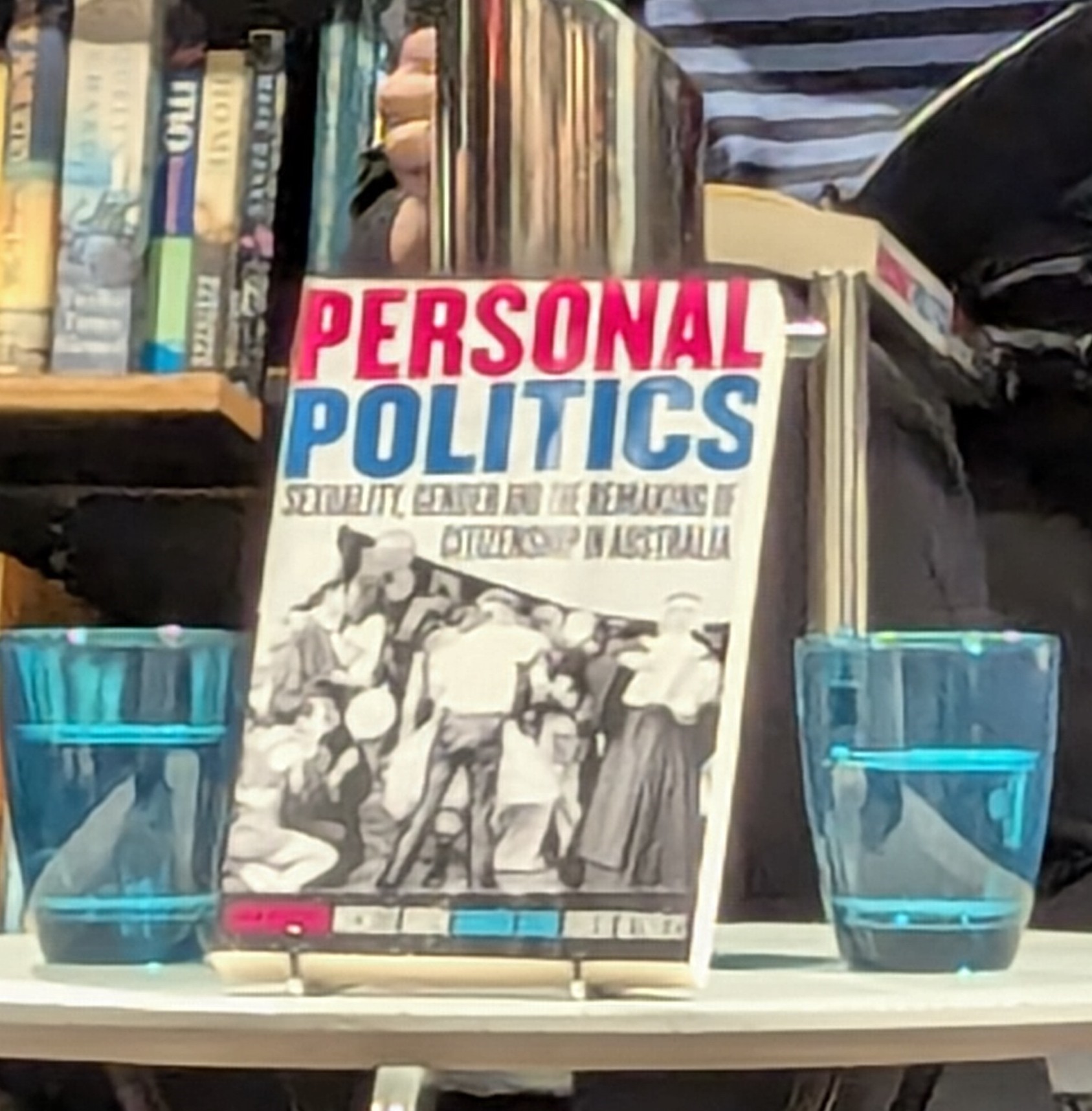


Personal Politics Sexuality, Gender and the Remaking of Citizenship in Australia. Leigh Boucher, Barbara Baird, Michelle Arrow, Robert Reynolds, Monash University Press, June 2024.
An insightful examination of the collective and cumulative impact gender and sexuality activism has had on citizenship in Australia
The achievement of marriage equality in Australia in 2017 was hailed by many as the crowning event of a fifty-year story of hard work by activists, which began with campaigns to decriminalise sex between men in the early 1970s. In that same five decades, feminist activism, including campaigns for abortion rights, the reform of family law and forms of welfare to support survivors of domestic violence, has similarly remade the rights and entitlements of Australian women. But has that story been one of continual progress and success? And who has been excluded from the privileges of Australian citizenship in the process?
Personal Politics brings together, for the first time, the voices and campaigns of a diverse set of activists who employed ideas about gender and sexuality to remake modern Australia. Beginning in the pivotal decade of the ’70s in which the ‘personal became political’, this book critically examines the wins and losses of these new ways of imagining citizenship and provides a revised political history of the past fifty years. This is a story populated and propelled by outraged feminists, radical homosexuals, angry fathers, maligned stay-at-home mothers, distressed trans kids, happy lesbian and gay couples, and even a few from the local Men’s Shed. These are the issues and identities that now dominate our public life: how and why did they emerge and what kind of political life have they produced?
About the authors
Associate Professor Leigh Boucher, Professors Michelle Arrow and Robert Reynolds (Macquarie University), and Associate Professor Barbara Baird (Flinders University) are groundbreaking historians of gender and sexuality in Australia, and they have been working together since 2015 on a project that investigates the relationship between gender, sexuality and citizenship in late modern Australia. Their previous work has reshaped our understanding of gay life in Australia (Reynolds, From Camp to Queer and Gay and Lesbian, Then and Now), the social and political history of abortion (Baird, Abortion Care is Health Care), the remaking of Australian political and social life in the 1970s (Arrow, The Seventies) and gendered citizenship in Australia (Boucher, Settler Colonial Governance).
Heather Cox Richardson

HCR writes about Biden, Harris, Walz and democracy
Vice President Kamala Harris’s choice of Minnesota governor Tim Walz to be her running mate seems to cement the emergence of a new Democratic Party.
When he took office in January 2021, President Joe Biden was clear that he intended to launch a new era in America, overturning the neoliberalism of the previous forty years and replacing it with a proven system in which the government would work to protect the ability of ordinary Americans to prosper. Neoliberalism relied on markets to shape society, and its supporters promised it would be so much more efficient than government regulation that it would create a booming economy that would help everyone. Instead, the slashing of government regulation and social safety systems had enabled the rise of wealthy oligarchs in the U.S. and around the globe. Those oligarchs, in turn, dominated poor populations, whose members looked at the concentration of wealth and power in the hands of a few people and gave up on democracy.
Biden recognized that defending democracy in the United States, and thus abroad, required defending economic fairness. He reached back to the precedent set by Democratic president Franklin Delano Roosevelt in 1933 and followed by presidents of both parties from then until Ronald Reagan took office in 1981. Biden’s speeches often come back to a promise to help the parents who “have lain awake at night staring at the ceiling, wondering how they will make rent, send their kids to college, retire, or pay for medication.” He vowed “to finally rebuild a strong middle class and grow our economy from the middle out and bottom up, giving hardworking families across the country a little more breathing room.”
Like his predecessors, he set out to invest in ordinary Americans. Under his administration, Democrats passed landmark legislation like the American Rescue Plan that rebuilt the economy after the devastating effects of the coronavirus pandemic; the Bipartisan Infrastructure Law that is rebuilding our roads, bridges, ports, and airports, as well as investing in rural broadband; the CHIPS and Science Act that rebuilt American manufacturing at the same time it invested in scientific research; and the Inflation Reduction Act, which, among other things, invested in addressing climate change. Under his direction, the government worked to stop or break up monopolies and to protect the rights of workers and consumers.
Like the policies of that earlier era, his economic policies were based on the idea that making sure ordinary people made decent wages and were protected from predatory employers and industrialists would create a powerful engine for the economy. The system had worked in the past, and it sure worked during the Biden administration, which saw the United States economy grow faster in the wake of the pandemic than that of any other developed economy. Under Biden, the economy added almost 16 million jobs, wages rose faster than inflation, and workers saw record low unemployment rates.
While Biden worked hard to make his administration reflect the demographics of the nation, tapping more women than men as advisors and nominating more Black women and racial minorities to federal judicial positions than any previous president, it was Vice President Kamala Harris who emphasized the right of all Americans to be treated equally before the law.
She was the first member of the administration to travel to Tennessee in support of the Tennessee Three after the Republican-dominated state legislature expelled two Black Democratic lawmakers for protesting in favor of gun safety legislation and failed by a single vote to expel their white colleague. She has highlighted the vital work historically Black colleges and universities have done for their students and for the United States. And she has criss-crossed the country to support women’s rights, especially the right to reproductive healthcare, in the two years since the Supreme Court, packed with religious extremists by Trump, overturned the 1973 Roe v. Wade decision.
To the forming Democratic coalition, Harris brought an emphasis on equal rights before the law that drew from the civil rights movements that stretched throughout our history and flowered after 1950. Harris has told the story of how her parents, Dr. Shyamala Gopalan, who hailed from India, and Donald J. Harris, from Jamaica, met as graduate students at the University of California, Berkeley and bonded over a shared interest in civil rights. “My parents marched and shouted in the Civil Rights Movement of the 1960s,” Harris wrote in 2020. “It’s because of them and the folks who also took to the streets to fight for justice that I am where I am.”
To these traditionally Democratic mindsets, Governor Walz brings something quite different: midwestern Progressivism. Walz is a leader in the Minnesota Democratic-Farmer-Labor Party, which formed after World War II, but the reform impulse in the Midwest reaches all the way back to the years immediately after the Civil War and in its origins is associated with the Republican, rather than the Democratic, Party. While Biden’s approach to government focuses on economic justice and Harris’s focuses on individual rights, Walz’s focuses on the government’s responsibility to protect communities from extremists. That stance sweeps in economic fairness and individual rights but extends beyond them to recall an older vision of the nature of government itself.
The Republican Party’s roots were in the Midwest, where ordinary people were determined to stop wealthy southern oligarchs from taking over control of the United States government. That determination continued after the war when people in the Midwest were horrified to see industrial leaders step into the place that wealthy enslavers had held before the war. Their opposition was based not in economics alone, but rather in their larger worldview. And because they were Republicans by heritage, they constructed their opposition to the rise of industrial oligarchs as a more expansive vision of democracy.
In the early 1870s the Granger movement, based in an organization originally formed by Oliver H. Kelley of Minnesota and other officials in the Department of Agriculture to combat the isolation of farm life, began to organize farmers against the railroad monopolies that were sucking farmers’ profits. The Grangers called for the government to work for communities rather than the railroad barons, demanding business regulation. In the 1870s, Minnesota, Iowa, Wisconsin, and Illinois passed the so-called Granger Laws, which regulated railroads and grain elevator operators. (When such a measure was proposed in California, railroad baron Leland Stanford called it “pure communism” and hired former Republican congressman Roscoe Conkling to fight it by arguing that corporations were “persons” under the Fourteenth Amendment.)
Robert La Follette grew up on a farm near Madison, Wisconsin, during the early days of the Grangers and absorbed their concern that rich men were taking over the nation and undermining democracy. One of his mentors warned: “Money is taking the field as an organized power. Which shall rule—wealth or man; which shall lead—money or intellect; who shall fill public stations—educated and patriotic free men, or the feudal serfs of corporate capital?”
In the wake of the Civil War, La Follette could not embrace the Democrats. Instead, he and people like him brought this approach to government to a Republican Party that at the time was dominated by industrialists. Wisconsin voters sent La Follette to Congress in 1884 when he was just 29, and when party bosses dumped him in 1890, he turned directly to the people, demanding they take the state back from the party machine. They elected him governor in 1900.
As governor, La Follette advanced what became known as the “Wisconsin Idea,” adopted and advanced by Republican President Theodore Roosevelt. As Roosevelt noted in a book explaining the system, Wisconsin was “literally a laboratory for wise experimental legislation aiming to secure the social and political betterment of the people as a whole.” La Follette called on professors from the University of Wisconsin, state legislators, and state officials to craft measures to meet the needs of the state’s people. “All through the Union we need to learn the Wisconsin lesson,” Roosevelt wrote.
In the late twentieth century, the Republican Party had moved far away from Roosevelt when it embraced neoliberalism. As it did so, Republicans ditched the Wisconsin Idea: Wisconsin governor Scott Walker tried to do so explicitly by changing the mission of the University of Wisconsin system from a “search for truth” to “improve the human condition” to a demand that the university “meet the state’s workforce needs.”
While Republicans abandoned the party’s foundational principles, Democratic governors have been governing on them. Now vice-presidential nominee Walz demonstrates that those community principles are joining the Democrats’ commitment to economic fairness and civil rights to create a new, national program for democracy.
It certainly seems like the birth of a new era in American history. At a Harris-Walz rally in Arizona on Friday, Mayor John Giles of Mesa, Arizona, who describes himself as a lifelong Republican, said: “I do not recognize my party. The Republican Party has been taken over by extremists that are committed to forcing people in the center of the political spectrum out of the party. I have something to say to those of us who are in the political middle: You don’t owe a damn thing to that political party…. [Y]ou don’t owe anything to a party that is out of touch and is hell-bent on taking our country backward. And by all means, you owe no displaced loyalty to a candidate that is morally and ethically bankrupt…. [I]n the spirit of the great Senator John McCain, please join me in putting country over party and stopping Donald Trump, and protecting the rule of law, protecting our Constitution, and protecting the democracy of this great country. That is why I’m standing with Vice President Harris and Governor Walz.”
Vice President Harris put it differently. Speaking to a United Auto Workers local in Wayne, Michigan, on Thursday, she explained what she and Walz have in common.
“A whole lot,” she said. “You know, we grew up the same way. We grew up in a community of people, you know—I mean, he grew up… in Nebraska; me, Oakland, California—seemingly worlds apart. But the same people raised us: good people; hard-working people; people who had pride in their hard work; you know, people who had pride in knowing that we were a community of people who looked out for each other—you know, raised by a community of folks who understood that the true measure of the strength of a leader is not based on who you beat down. It’s based on who you lift up.”
—
Notes:
https://people.com/all-about-kamala-harris-parents-donald-harris-shyamala-gopalan-7974352; https://apnews.com/article/kamala-harris-tennessee-gun-violence-lawmakers-expelled-0a5011694aa5cbf5917bac7f9e09551b; https://www.whitehouse.gov/briefing-room/speeches-remarks/2023/04/09/remarks-by-vice-president-harris-at-fisk-university/;https://www.theatlantic.com/business/archive/2018/03/corporations-people-adam-winkler/554852/; https://www.washingtonpost.com/news/answer-sheet/wp/2015/02/05/how-gov-walker-tried-to-quietly-change-the-mission-of-the-university-of-wisconsin/; https://www.whitehouse.gov/briefing-room/speeches-remarks/2024/08/08/remarks-by-vice-president-harris-and-governor-tim-walz-at-a-campaign-event-2/; Robert M. La Follette, La Follette’s Autobiography (Madison: University of Wisconsin Press, 1960).;Theodore Roosevelt, “Introduction,” in Charles McCarthy, The Wisconsin Idea (New York: MacMillan, 1912); ttps://www.whitehouse.gov/briefing-room/presidential-actions/2023/11/17/a-proclamation-on-national-family-week-2023/; X:; Acyn/status/1822058848330641692

An interesting newsletter from Bloomsbury Publishing arrived in my in box this morning.
Bloomsbury Film & Media Studies <csm@bloomsburynews.com>
Bloomsbury and Faber Screenplays and Criticism
This module brings together a wide range of content from Bloomsbury and Faber & Faber to support studies of the moving image. It offers searchable access to screenplays presented in industry-standard studio format; introductory overview articles with expert analysis of selected themes; and critical and contextual books on cinema, including coverage of practical techniques for filmmaking and screenwriting.
Article from Screen Studies
Cult TV Heroines
Since the 1990s, a new generation of female heroines has appeared on our TV screens: leading women who challenge gender stereotypes and redefine ‘main character energy’ for a 21st century audience.

One of the most iconic and enduring cult TV heroines is Dana Scully from The X-Files (1993-2018), portrayed by Gillian Anderson. Her character has had a profound and even quantifiable impact on audiences, as Jolene Mendel explores in her chapter ‘The Scully effect: The X-Files and women in STEM’, ‘Nearly two-thirds (63 per cent) of [American] women that work in STEM say Dana Scully served as their role model.’ The show resonated with audiences because of its inversion of gender stereotypes, as Lorna Jowett writes in this chapter of The Cult TV Book, ‘The X-Files presents the female Scully as logical, rational, and scientific and the male Mulder as impulsive, intuitive, and open to ‘irrational’ explanations…such representation helps develop contemporary cult characters who no longer match up neatly to traditional gender roles or gendered characteristics.’
Despite this, the show also reinforced gender roles, as evident in one of its longest story arcs, that of Scully’s alien abduction and subsequent pregnancy. Anne Sweet writes in her chapter ‘Moving into the mainstream: Pregnancy, Motherhood and Female TV Action Heroes’, ‘Scully was considered a trailblazer in terms of female agency on TV – with heroes like Xena and Buffy following directly in her wake – and yet she is also a victim, especially as pertains to maternity and her reproductive functions.’ The series’ ambiguous gender dynamics can be seen as a direct reflection of its generic ambiguity, as J.P. Telotte writes in this chapter of Science Fiction TV, ‘That sense of mixed elements, carries beyond plot lines and iconic images to the level of main characters, as the show centres its investigative activities on seemingly opposite central figures.’

This generic hybridity is equally present within Joss Whedon’s Buffy the Vampire Slayer (1997-2003). Sarah Michelle Gellar’s Buffy Summers is a high school student who fights vampires and other manifestations of the supernatural. As Carolyn Cocca writes in her chapter ‘Slayers. Every One of Us’, ‘Buffy is grounded in the Third Wave of feminism. She embodies an attractive female warrior while parodying it through her body and speech, criticizing the superhero and horror genres and gendered inequalities with humor.’ However, despite Buffy’s immense popularity, Gellar was never nominated for an Emmy. Rhonda Wilcox explains this oversight in her introduction to Why Buffy Matters, ‘Buffy suffers from prejudice related both to its medium, television, and its genre, fantasy.’ In contrast, Lorna Jowett writes in her chapter ‘Whedon, Feminism, and the Possibility of Feminist Horror on Television’, ‘the combination of TV and horror encourages, even necessitates, innovation and evolution. Buffy is one example of TV horror that examines how hard it is to be a woman over and over from all these different angles.’

Another notable 90s heroine is Xena from Xena: Warrior Princess (1995-2001) played by Lucy Lawless. As Kathleen Kennedy writes in this chapter of American Militarism on the Small Screen, ‘women like Xena, challenged men’s exclusive claim on the quest narrative…demonstrated women’s mastery of violence, command decisions, and rational problem solving.’ Over time, her character became equally as known for her martial skills as for her close relationship with her companion, Gabrielle. Although their sexuality is never explicitly confirmed, as Lynne Joyrich writes in this chapter of Queer TV, ‘sexual ambiguity is central to that show’s campy, fantasy appeal.’ Irrespective of whether their bond is interpreted as erotic, as Yvonne Tasker and Lindsay Steenburg write in their chapter ‘Women Warriors from Chivalry to Vengeance’, ‘for Xena, female friendship becomes a way both to redefine strength and to fight patriarchal dominance.’
These cult TV heroines share common traits of strength, intelligence, and emotional complexity. They break stereotypes and redefine gender roles, and while challenges in representation and character development persist, the impact of these heroines on society and popular culture is undeniable. As Catriona Miller writes in her conclusion to Cult TV Heroines, ‘the heroines are slowly gaining the ability to do things differently, opening up the possibilities of intergenerational solidarity and seeing progressive community as a source of change.’
Homepage banner image courtesy of LANDMARK MEDIA / Alamy Stock Photo.

 Robin's Room