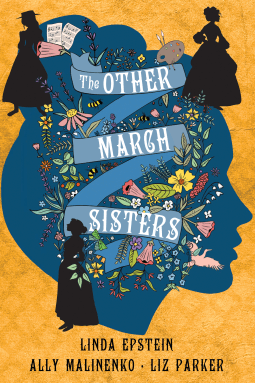
Linda Epstein; Ally Malinenko; Liz Parker The Other March Sisters Kensington Publishing, February 2025.
Thank you, NetGalley, for providing me with this uncorrected proof for review.
Liz Parker, Ally Malinenko, and Linda Epstein have woven a story that rejects the importance that Louise M. Alcott gave to Jo March and the sisters’ mother, Marmee. The authors have used Alcott’s sisters as their inspiration, giving them voices independent of Jo, who was based on herself. They also take a largely feminist approach, as well as rejecting the heterosexuality given to the sisters and their friend Laurie in the original novel. This is made most apparent in the case of Beth but is also suggested in the newly drawn characters of Jo and Laurie. The freshly honed stories and characterisations therefore have all the elements that, while maintaining a perspective that fits with the period in which Little Women was set, acknowledge the way in which sexism impacted the lives of the little women and their friends. So many aspects of the novel provide a feminist approach to the way the young women and their activities are depicted, and this is to be valued. However, there are also some very disappointingly sexist attitudes on display. See Books: Reviews for the complete review.
After early spring on a Canberra walk to coffee and Covid update: Bob McMullan – American Presidential Election update; Why Louisa May Alcott’s ‘Little Women’ Endures; Meg, Jo, Beth, Amy: The Story of Little Women and Why It Still Matters; Dream team from the ’80s in WA-based comedy drama.
Early Spring on a Canberra walk to coffee










Covid update Canberra
This covers the period from 9 to 15 August. Since March 2020 there have been 254,394 cases of Covid in Canberra. There are 80 new cases this week (PCR only), 16 0f whom are in hospital. Ther are no cases in ICU or ventilated. Two lives have been lost, bringing the total of lives lost since March 2020 to 352.
Lives lost is now reported as a Covid -19 related death, although it may not be the primary cause of death.
Caes of respiratory illnesses are reported.
Bob McMullan – US election review at 18th August

Kamala Harris continues to make progress in the national and battleground state polling. A Democratic strategist was recently quoted as saying “She’s had the best four weeks in modern American political history…” It is an important caveat, that after all this progress it is still a very tight race.
It is clear that Donald Trump has been rattled by the change in Democratic candidate. But it would be unwise to underestimate him. His campaign is always wild, tends to be unfocussed, but it can land some serious blows on his opponents as Hilary Clinton found out in 2016.
The current polling data certainly looks encouraging. The 538 polling averages in the battleground states would mean Harris winning Arizona, Michigan, Pennsylvania and Wisconsin. This would be enough for 281 electoral college votes and a clear win.
My problem is that I cannot align the averages on 538 with the underlying data.
Real Clear Politics has been more sobering although still showing a massive improvement in support for Harris.
This week the polling averages on RCP for the 5-way contest (i.e. Including Kennedy, West and the Green candidate) are more positive. As at 18th August RCP shows Harris winning Arizona, Michigan, Pennsylvania and Wisconsin while she is tied with Trump in North Carolina. This would lead to a clear victory for Harris.
Importantly, the possibilities in Arizona and North Carolina open up new paths to victory for the Harris-Walz ticket.
All this is encouraging but there are factors suggesting caution in assessing these results.
First, polls have in previous campaigns tended to underestimate support for Trump.
Second, it is important to remember that Trump has made big gains over the last three months in each of the last two elections.
If he gets his act together Trump may be able to do so again.
At the moment Kamala Harris has been able to present herself as the “change” candidate. This may be hard to sustain for the current Vice-President.
In a similar way to Keir Starmer in the recent UK election Harris has cast herself as the “turn the page” option as emphasized by her “we’re not going back” slogan at recent rallies.
One important aspect of the “change” in the campaign is the transfer of the media focus about age and intellectual decline from Biden to Trump.
This reminds me of the Nikki Haley quote during the Republican primaries: “The first party to get rid of their 80 year old candidate will win.”
She may well be proved right, but not in the way she hoped.
With the Democratic Convention next week, the Democrats should be able to make further gains, or at least maintain their momentum.
The wild-card here is the demonstrations planned in Chicago during the Convention. If these succeed in disrupting the Convention or overwhelming the coverage of the event the only beneficiary will obviously be Donald Trump.
Notwithstanding the risks, the recent pattern of events has been very good for Kamal Harris and makes her the slight favorite to win.
David Axelrod, one of the better Democratic strategists sums up the challenge before the Vice-President. “Her task is pretty simple. I don’t think there’s a majority of people who want to elect Donald Trump president. She needs to make herself an acceptable alternative…”


Why Louisa May Alcott’s ‘Little Women’ Endures
The author of a new book about the classic says the 19th-century novel contains life lessons for all, especially for boys
/https://tf-cmsv2-smithsonianmag-media.s3.amazonaws.com/accounts/headshot/Alice_George_final_web_thumbnail.png)
Alice George – Museums Correspondent September 18, 2018
:focal(1154x651:1155x652)/https://tf-cmsv2-smithsonianmag-media.s3.amazonaws.com/filer/f1/80/f180f190-6a9c-4a01-90f0-26020a6e3c2d/30527538.jpg)
When Louisa May Alcott lifted her pen after writing the last line of Little Women, she never would have believed that this piece of autobiographical fiction would remain in print throughout the 150 years after its September 30, 1868 publication. Alcott’s masterpiece is a 19th-century time capsule that still draws young readers and has spawned four movies, more than ten TV adaptations, a Broadway drama, a Broadway musical, an opera, a museum, a series of dolls, and countless stories and books built around the same characters. Earlier this year, PBS broadcast a two-night, three-hour Little Women film produced by the BBC. A modern retelling of the classic will arrive in theaters September 28, director Greta Gerwig is planning another film for late 2019.
A new book by Anne Boyd Rioux—Meg, Jo, Beth, Amy—explores the cultural significance of Alcott’s most successful work. Rioux says she was surprised by “the incredibly widespread impact that the book has had on women writers, in particular.” Little Women’s most flamboyant character, the high-tempered and ambitious Jo March, is an aspiring author and an independent soul, much like Alcott. Her nascent feminism has touched many who have admired her challenges to societal norms while embracing its virtues. Over the years, Jo has fed the ambitions of writers as diverse as Gloria Steinem, Helen Keller, Hillary Rodham Clinton, Gertrude Stein, Danielle Steel, J.K. Rowling, Simone de Beauvoir and national Poet Laureate Tracy K. Smith.
Little Women, which has never been out of print, follows the adventures of the four March sisters and their mother, “Marmee,” living in somewhat impoverished circumstances in a small Massachusetts town while their father is away during the Civil War. By the 1960s, Alcott’s story had been translated into at least 50 languages. Today sales continue, after having found a home among Americans’ 100 most favorite books in 2014, and being ranked among Time’s top 100 young adult books of all time two years later.
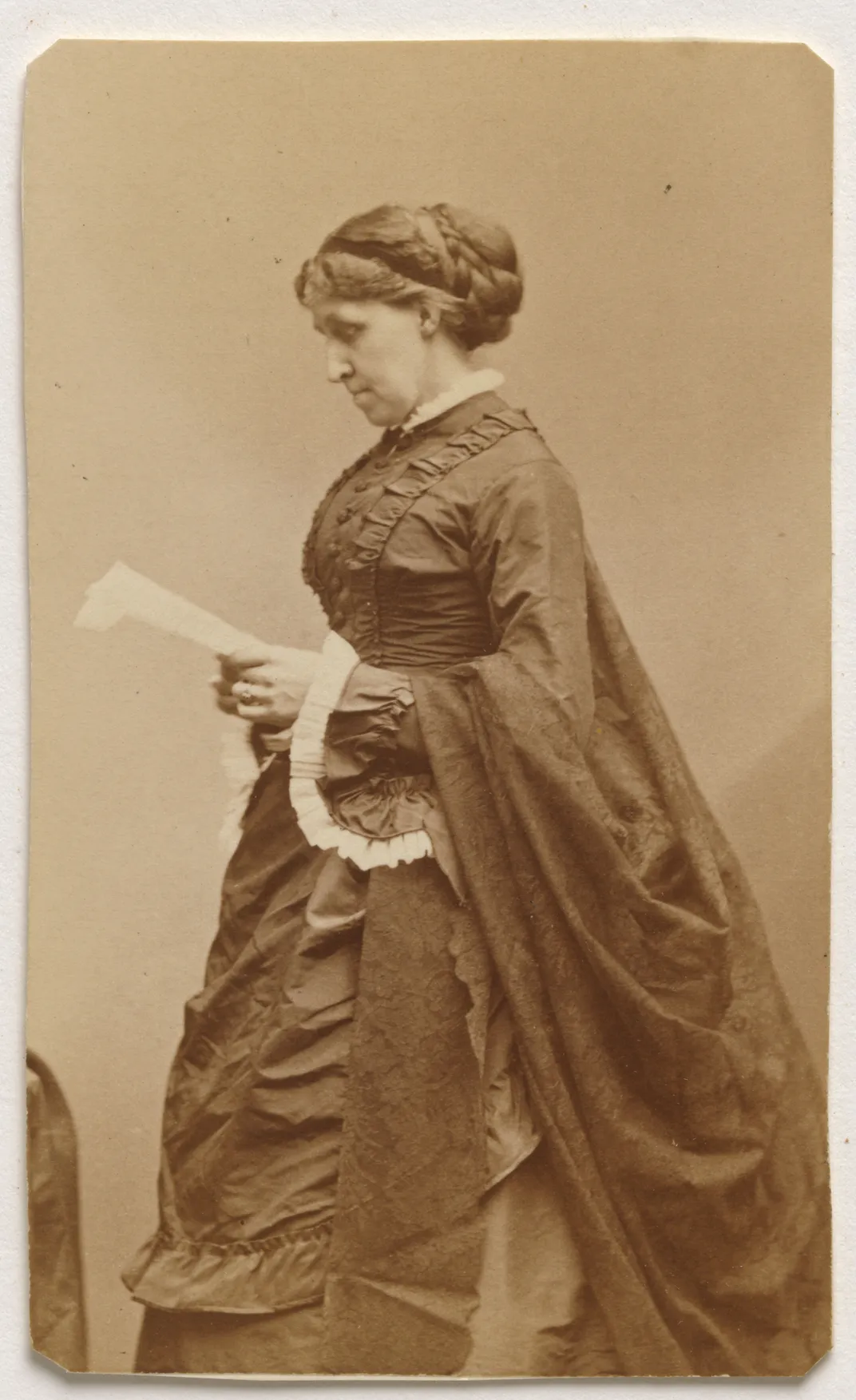
At the Smithsonian’s National Portrait Gallery, a photograph of Alcott taken by George Kendall Warren between 1872 and 1874 in his Boston studio shows the author, her head bent in profile, reading from a sheaf of papers she holds in her hands. Little is known about the image but the museum’s curator of photographs Ann Shumard was able to determine the date range based on the studio address on the back of the photo.
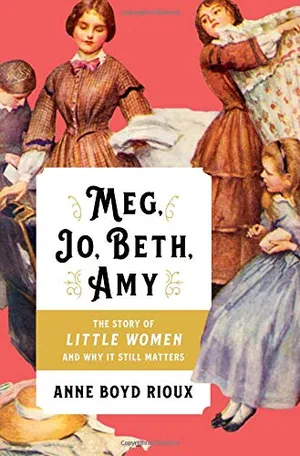
Meg, Jo, Beth, Amy: The Story of Little Women and Why It Still Matters
Today, Anne Boyd Rioux sees the novel’s beating heart in Alcott’s portrayal of family resilience and her honest look at the struggles of girls growing into women. In gauging its current status, Rioux shows why Little Women remains a book with such power that people carry its characters and spirit throughout their lives.
A former daguerreotypist, Warren “was well-known for documenting the literary celebrities that were in the orbit of Boston as well as individuals who came through that city to lecture or appear publicly or visit their publishers,” Shumard says. “Picturing Alcott with papers in her hand—that really is a way of situating her as a woman of letters.” Alcott’s elaborate draping attire, according to Shumard, represents “what a respectable, well-brought-up woman would have worn to have her portrait made,” Shumard says.
When a publisher asked Alcott to write a book for girls, the already-published author procrastinated. “I think the thought of a girls’ book was stifling to her,” Rioux says. In fact, Alcott once commented that she “never liked girls or knew many except my sisters.” When she finally wrote the book, she composed it quickly and with little deliberation, basing the characters on her own family.
Little Women triumphed immediately, selling the initial run of 2,000 books in just days. The original publication represented the first 23 chapters of what would become a 47-chapter book. Soon, her publisher was shipping tens of thousands of books, so he ordered a second installment, which would complete the classic. “Spinning out her fantasies on paper, Louisa was transported, and liberated. Her imagination freed her to escape the confines of ordinary life to be flirtatious, scheming, materialistic, violent, rich, worldly, or a different gender,” writes Alcott’s biographer Harriet Reisen.
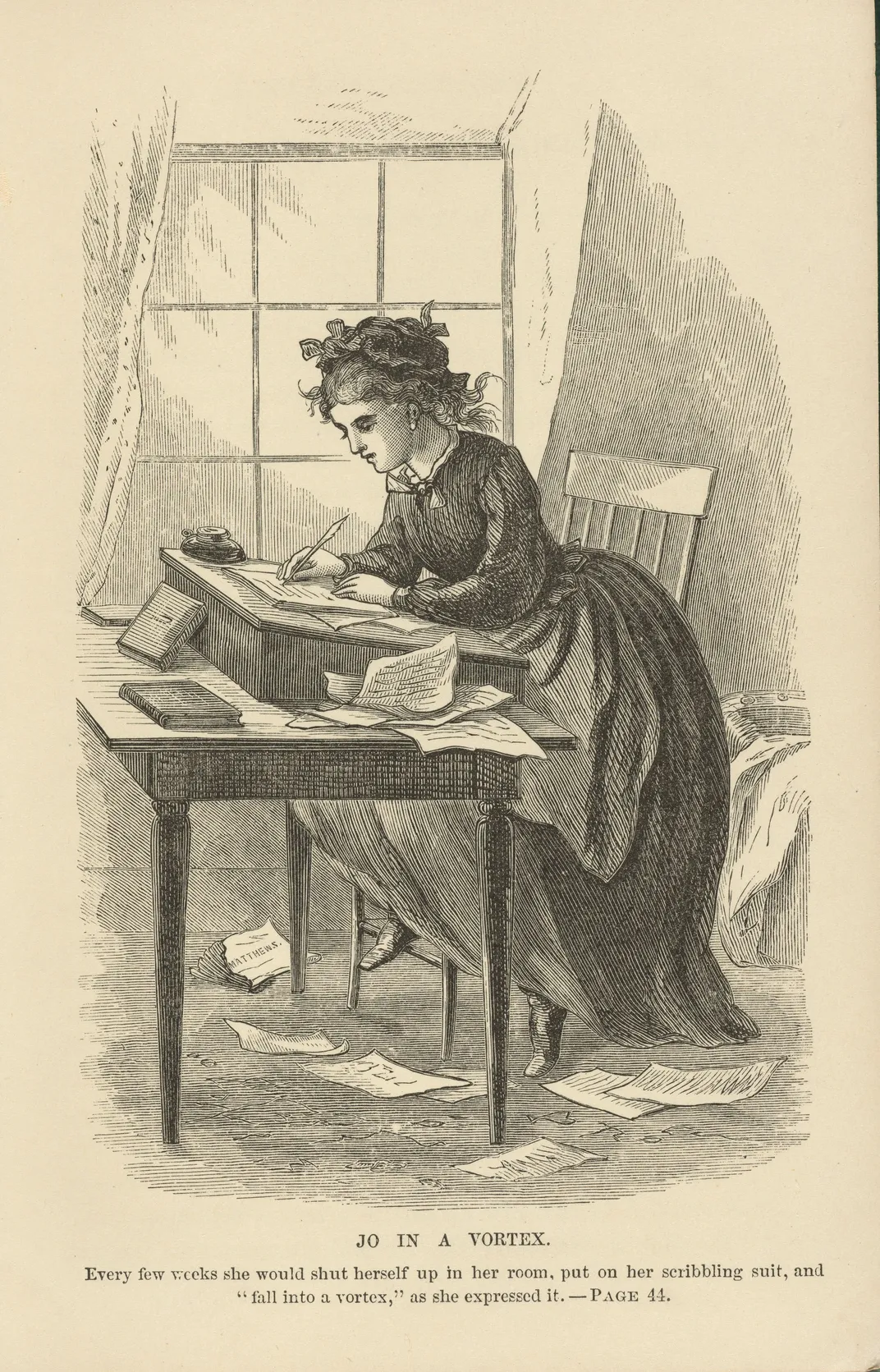
Little Women was not strictly for girls. Theodore Roosevelt, who was the very model of a manly man, admitted that “at the risk of being deemed effeminate,” he “worshipped” Little Women and its sequel, Little Men. At the end of the 19th century, Little Women appeared on a list of “the 20 best books for boys,” but in 2015, Charles McGrath of the New York Times confessed that as a child, he read Little Women in a brown paper wrapper to avoid taunts from other boys. Rioux says she understands that reading the novel and feeling like outsiders can be unsettling for boys, but she believes “that’s a great experience for them to have.”
Furthermore, “it’s a book that has had such widespread cultural ramifications, has ignited so many discussions over the years, and has had real world impacts on people’s lives and their perception of themselves and perception of each other and our culture,” says Rioux. She has found that Little Women is “a worldwide phenomenon” and “a story that has translated across time and space in a way that few books have.” Alcott’s decision to throw the spotlight on four different girls demonstrated to readers “that womanhood isn’t something you’re born with; it’s something that you learn and grow into,” Rioux says. “And you have the ability to pick and choose which parts of it you want.”
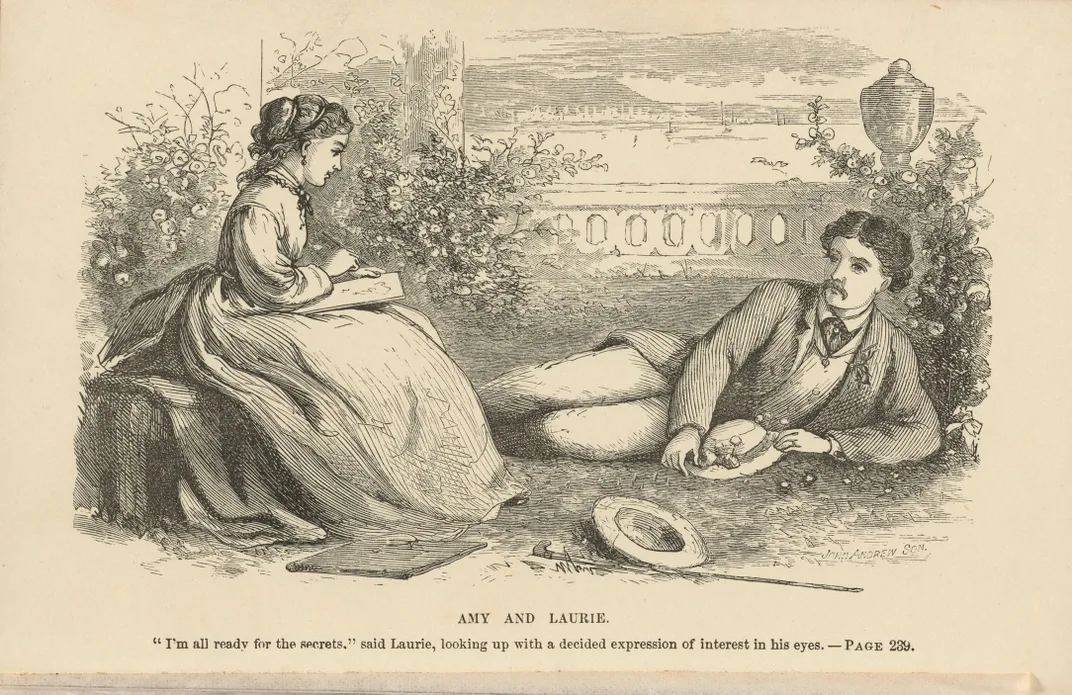
For many readers, the heart of the book’s second half was a simple question: Would Jo marry her charming neighbor, Laurie? Alcott had hoped to leave Jo a “literary spinster,” like herself; however, fans demanded that Jo marry. Alcott bowed to pressure but didn’t give her readers everything they wanted. Jo disappointed many 19th-century fans by rejecting Laurie’s marriage proposal in a scene made especially painful by her genuine affection for him. After denying Laurie, Jo wed a less obviously appealing older man. Faced with readers’ eagerness for a wedding, Alcott later said that she “didn’t dare to refuse & out of perversity went & made a funny match for her.” Equally to the dismay of 20th century feminists, the marriage caused Jo to abandon her writing career.
After the novel’s release, readers learned that Jo mirrored its author, while Alcott’s real-life sisters—Anna, Lizzie, and May—were models for the March sisters. What readers did not know was that unlike Jo, Alcott experienced an unstable family life. Her father Bronson was a Transcendentalist who rubbed shoulders with Henry David Thoreau and Ralph Waldo Emerson. Although he encouraged his daughter’s writing, he believed working for money would violate his philosophy. Consequently, his wife and daughters labored to feed the family, which moved often. This may explain Mr. March’s small-but-exalted role in Little Women.
In Little Women, Alcott brought the quite different March girls to life by endowing each with assets and flaws. Beautiful Meg was vain and dreamed of riches; stubborn-but-talented Jo was prone to fits of temper; sweet, timid Beth wanted to spend adulthood at home; and often-selfish Amy yearned to be an artist. Pulitzer Prize-winning author John Matteson wrote in Eden’s Outcasts: The Story of Louisa May Alcott and Her Father that what gave the second installment “its enduring power is that not one of the March sisters gets what she had once believed would make her happy.” Meg married a financially strapped man; Jo stopped writing; Beth suffered a lingering illness and died; and Amy abandoned her artistic dreams.
Initially, the book generated both literary and popular enthusiasm, but within two decades, fans remained ardent while elite support declined. Little Women sold well in Great Britain, and during the 19th century, it was translated into many languages, including French, Dutch, German, Swedish, Danish, Greek, Japanese and Russian. After its success, Alcott became a wealthy celebrity appalled by strangers who visited her Concord, Massachusetts, home. When she died in 1888, the New York Times wrote in a front-page obituary that “there is little in her writings which did not grow out of something that had actually occurred, and yet it is so colored with her imagination that it represents the universal life of childhood and youth.” Her home, Orchard House, became a museum in 1912, the same year Little Women premiered as a Broadway drama. A musical rendition reached Broadway in 2005.
Two now-lost silent films—one British, one American—emerged in 1917 and 1919. Katherine Hepburn starred as Jo in the first major film in 1933, and her performance remains the most indelible. A series of Little Women Madame Alexander dolls joined a host of other related products spurred by the film’s success. June Allyson became Jo in a 1949 film, and Winona Ryder tackled the role in 1994. Mark Adamo’s critically acclaimed opera debuted in 1998 and was broadcast by PBS in 2001.
In the 1970s and 1980s, feminists appreciated the book’s portrayal of gender as learned conduct rather than innate behavior. They also noted Alcott’s portrayal of the girls’ overworked mother, Marmee, who concedes, “I am angry nearly every day of my life, Jo, but I have learned not to show it.”
Despite feminist interest—or perhaps because of it—Rioux notes that the book began falling off school reading lists in the last half of the 2oth century.
It is no longer commonly read in U.S. schools, at least partly because it is seen as unappealing to boys. She believes this plays a role in depriving boys of the opportunity to understand girls’ lives. “I think that’s a real shame,” Rioux says, “and I think it has real world cultural consequences.”
A Note to our Readers
Smithsonian magazine participates in affiliate link advertising programs. If you purchase an item through these links, we receive a commission.
Alice George, Ph.D. is an independent historian with a special interest in America during the 1960s. A veteran newspaper editor, she is recently the author of The Last American Hero: The Remarkable Life of John Glenn and has authored or co-authored seven other books, focusing on 20th-century American history or Philadelphia history.Filed Under: American Writers, Literature, National Portrait Gallery, Portraiture, Women’s History,
Dream team from the ’80s in WA-based comedy drama

Louise Talbot
Aug 17, 2024, updated Aug 17, 2024

Bryan Brown has been a powerful advocate for Australia’s creative industries. Photo: AAP
For the first time in more than 40 years, screen legends Bryan Brown and director Bruce Beresford have reunited to make a “powerful, funny and moving family story” set in Western Australia.
Beresford first cast Brown in his 1978 crime flick, Money Movers, before casting him in his breakthrough role playing an Australian soldier during the Boer War in Breaker Morant in 1980.
Now the pair, whose combined careers since have clocked up to 200 films, TV series and documentaries between them, with trophies and awards galore on their bookshelves, have joined forces to make a comedy drama in Overture.
Like Money Movers and Breaker Morant, Beresford has written the screenplay and is behind the camera as production starts in various locations across Perth and “untouched” nearby country towns.
Oscar nominated Beresford, known for films such as Driving Miss Daisy (which won best picture), Mao’s Last Dancer and Ladies in Black, said the script practically “wrote itself”.
“When writing this story my aim was to create an involving story, with a range of characters supplying considerable humour.
“Once I started writing the script it practically wrote itself and I was delighted to find my characters dictating to me what they would do and even say next.”
He says he has a “fantastic line-up of cast”, and that includes Brown at the top of the credits list.
“He’s a fabulous actor,” Beresford has previously described Brown, who he cast as Lieutenant Peter Hancock – one of three Australians court-martialled for executing prisoners in Breaker Morant.
“He has a great naturalism about him. I remember he always seemed to be improvising the dialogue,” Beresford said.
“In fact, he’s very meticulous about saying what’s on the page, but he makes it seem absolutely real.
“I wanted a very natural, straightforward, shoot-from-the-hip Australian character, and I met him, and thought, ‘He can give me that.’ ”
He also cast Jack Thompson, Charles Bud Tingwell and Terence Donovan in the memorable feature film.

Bryan Brown (who grew a moustache), Lewis Fitzgerald and Edward Woodward in Breaker Morant in 1979. Photo: AAP
No doubt Brown is thrilled to be making more Australian stories, especially with major production investment from Screen Australia and Screenwest with post, digital and visual effects supported by Screen NSW.
At the National Press Club in Canberra last year, Brown, 77, delivered a passionate address, speaking both about regulating streaming giants and the importance of making local content to avoid a “cultural death”.
“If our ability to present ourselves on film is taken away, we will become unsure of ourselves, in awe of others and less as a people,” he said.
“A thriving film and television industry presents who we are to the world.”
Overture was made possible with the WA Production Attraction Incentive, Australia’s most competitive incentive, which is designed to attract high profile, market driven screen productions to the state.
To be released worldwide next year, the film follows the journey of Stephen Seary, played by Luke Bracey (Elvis, Hacksaw Ridge, Interceptor), who is a successful stage designer returning to his small Australian hometown to say goodbye to his dying mother.
“Chaos, drama and at times downright funny moments unfold as Stephen navigates family responsibilities, old friends and past lovers, all while trying to return to Europe for a major opera design contract,” reads the official synopsis.
Brown and Bracey star alongside Susie Porter (Mercy Road, Transfusion, Gold), with an ensemble cast of Celia Massingham (DC Legends of Tomorrow, Ladies in Black, Reef n Beef), and newcomers Shubshri Kandiah (Beauty and the Beast musical) and Nicholas Hammond (The Amazing Spider-Man, The Sound of Music, Once upon a Time in Hollywood).
“When I first read Bruce’s script, I was taken by the simplicity of structure but captivated by the complexity of the characters and situations,” says Ambience Entertainment’s producer, Michael Boughen.
“Bruce’s ability to tell this story and confront issues we all have or will face, resonated profoundly with me.
“Bruce is a unique and gifted filmmaker and he’s at his best with Overture.”
Screen Australia boss Grainne Brunsdon said Beresford has “built a career by creating distinctive Australian stories that connect with audiences and travel the world”.
“There is a real appetite for his next feature.”
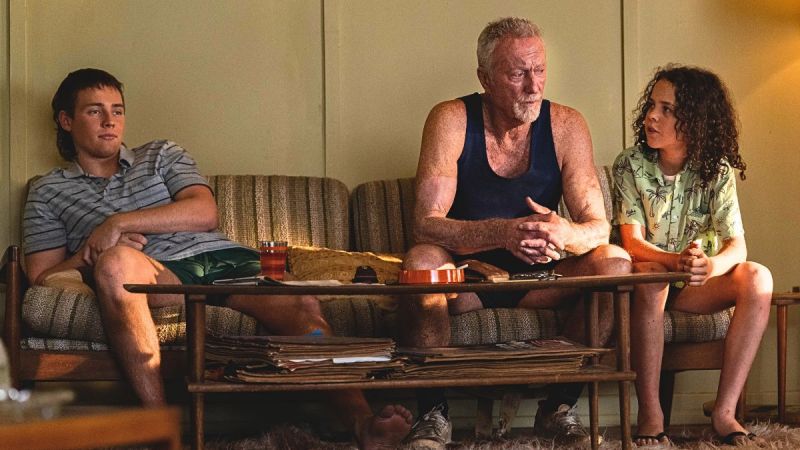
*Bryan Brown in Boy Swallows Universe. Photo: Netflix
Brown became an international success in the late 1970s with Breaker Morant, which premiered in 1980 and won 10 AACTA awards and was nominated for an Oscar for best screenplay.
He made A Town Like Alice, Love Letters from Teralba Road, and enjoyed golden years that produced classics such as The Chant of Jimmy Blacksmith, My Brilliant Career, Picnic at Hanging Rock and Mad Max.
A string of hits followed, including The Thorn Birds, Gorillas in the Mist, FX, Newsfront, The Shiralee, Cocktail and Two Hands.
Last year, he wrote his first novel based around an Aussie coastal town, The Drowning; starred in Sydney-produced feature film Anyone But You, and played a key role in Trent Dalton’s adaptation of Boy Swallows Universe (nominated this year for a Silver Logie for best supporting actor).
“What a story the Australian story is,” says Brown.
*‘Boy Swallows Universe’ wins big at Logies with five gongs
…Cameron, who played the central character Eli Bell in the adaptation of Trent Dalton’s best-selling novel, was awarded the Graham Kennedy Award for Most Popular New Talent, and the Silver Logie for Best Lead Actor in a Drama.
Joining him on the winners’ list were co-stars Bryan Brown and Sophie Wilde, named Best Supporting Actor and Actress, respectively. The seven-part series also took out Best Miniseries or Telemovie…

The Polish Club fundraiser for Ukraine. We bought the potato cakes which were delicious.
 Robin's Room