
Articles and some light relief: Bob McMullan; Heather Cox Richardson; Joyce Vance; Jess Piper; Cindy Lou and food.
American Politics
Bob McMullan

Final US election review
Less than one day until the polls close. In Australia it will be Wednesday before we know who wins.
The election remains very unpredictable. That does not necessarily mean that it will be close. A small consistent error in the polls could point to a clear victory for either side.
But it is extremely difficult to forecast a result with confidence.
I think it is possible to isolate three strands of thinking about the prospects of the candidates.
The first was outlined by veteran Democrat political consultant, James Carville. Carville outlined three reasons why he is confident Kamala Harris will win. My summary of his arguments is:
1) Under Trump’s leadership the Republicans have lost every election since 2018 and Trump has made very little effort to broaden his base of support.
2) Harris has a distinct financial advantage which should enable her to run a bigger and better ground game in the final days than Trump.
3) He can’t believe that the country he grew up in could re-elect such a man.
The first two arguments have validity, I hope the third one does, but I am not certain.
The second view of the likely outcome is represented by Nate Silver, the respected analyst of data-based probabilities. His criticism of some pollsters and analysis of the “herding” phenomenon by which some pollsters make sure their results are not too far from the mainstream is very interesting.
In this review, however, I am more interested in his polling averages. The most recent Silver averages have Harris winning only Michigan and Wisconsin among the battleground states. Which would mean Trump winning 287/251 in the electoral college.
A third view is from the Washington Post, which has been very careful in selecting only high quality pollsters for its voting average. The Post shows Harris increasing her lead over Trump in Michigan, Nevada and Wisconsin while continuing to hold a narrow but shrinking lead in Pennsylvania. Such a result on Tuesday would mean Harris winning 276/262.
These divergent views from smart and informed people show the difficulty in forecasting the result this time.
Some other indicators which I have fed into my ultimate conclusion.
1. The gender gap remains very large and early voting data suggests that women are voting more than men.
2. Related to this, Trump has always had a strong base but has seemed to have a ceiling of support at about 46-47%. In this election he seems to be relying on a low-propensity voting group, young men, to turn out for him. The early voting data suggests this may not be happening sufficiently to overcome the gender gap problem, but of course they may turn out on election day.
3. The measures of enthusiasm and indicators of organizational capacity appear to favour Kamala Harris, which should help with turn out on the day.
4. We recently had the astonishing Iowa poll from the usually very reliable Des Moines Register which gave Harris a three point lead in Iowa. If this is true Harris is in for a big win, but it may be an outlier.
5. Such data as exists suggest that those few late deciders are trending more towards Harris than Trump.
6. Late polls from NYT/Sienna, YouGov and Focaldata all have Kamala Harris winning enough states to win the Electoral college, although they don’t agree about which states she will win. These forecasts would mean Harris winning 270-292 votes to Trump 268-246.
7. Conversely Real Clear Politics predicts Trump will win all 7 battleground states. This would mean Trump winning 312/226.
Conclusion
Nobody knows who is going to win, but if the gender gap and the differential in turn-out between men and women continue I think Harris is more likely to win.
Those who read my predictions last time will recall that I ventured a guess about the margin. This time it is more difficult, as the range of possibilities makes clear.
Heather Cox Richardson
Letters from an American <heathercoxrichardson@substack.com>
However, the pattern of credible polling data over recent weeks has consistently suggested the most likely result is 276/262 to Harris.
I’m home tonight to stay for a bit, after being on the road for thirteen months and traveling through 32 states. I am beyond tired but profoundly grateful for the chance to meet so many wonderful people and for the welcome you have given me to your towns and your homes.
I know people are on edge, and there is maybe one last thing I can offer before this election. Every place I stopped, worried people asked me how I have maintained a sense of hope through the past fraught years. The answer—inevitably for me, I suppose—is in our history.
If you had been alive in 1853, you would have thought the elite enslavers had become America’s rulers. They were only a small minority of the U.S. population, but by controlling the Democratic Party, they had managed to take control of the Senate, the White House, and the Supreme Court. They used that power to stop the northerners who wanted the government to clear the rivers and harbors of snags, for example, or to fund public colleges for ordinary people, from getting any such legislation through Congress. But at least they could not use the government to spread their system of human enslavement across the country, because the much larger population in the North held control of the House of Representatives.
Then in 1854, with the help of Democratic president Franklin Pierce, elite enslavers pushed the Kansas-Nebraska Act through the House. That law overturned the Missouri Compromise that had kept Black enslavement out of the American West since 1820. Because the Constitution guarantees the protection of property—and enslaved Americans were considered property—the expansion of slavery into those territories would mean the new states there would become slave states. Their representatives would work together with those of the southern slave states to outvote the northern free labor advocates in Congress. Together, they would make enslavement national.
America would become a slaveholding nation.
Enslavers were quite clear that this was their goal.
South Carolina senator James Henry Hammond explicitly rejected “as ridiculously absurd, that much lauded but nowhere accredited dogma of Mr. Jefferson, that ‘all men are born equal.’” He explained to his Senate colleagues that the world was made up of two classes of people. The “Mudsills” were dull drudges whose work produced the food and products that made society function. On them rested the superior class of people, who took the capital the mudsills produced and used it to move the economy, and even civilization itself, forward. The world could not survive without the inferior mudsills, but the superior class had the right—and even the duty—to rule over them.
But that’s not how it played out.
As soon as it became clear that Congress would pass the Kansas-Nebraska Act, Representative Israel Washburn of Maine called a meeting of thirty congressmen in Washington, D.C., to figure out how they could fight back against the Slave Power that had commandeered the government to spread the South’s system of human enslavement. The men met in the rooms of Representative Edward Dickinson of Massachusetts—whose talented daughter Emily was already writing poems—and while they came to the meeting from all different political parties, often bitterly divided over specific policies, they left with one sole purpose: to stop the overthrow of American democracy.
The men scattered back to their homes across the North for the summer, sharing their conviction that a new party must rise to stand against the Slave Power. They found “anti-Nebraska” sentiment sweeping their towns; a young lawyer from Illinois later recalled how ordinary people came together: “[W]e rose each fighting, grasping whatever he could first reach—a scythe—a pitchfork—a chopping axe, or a butcher’s cleaver.” In the next set of midterm elections, those calling themselves “anti-Nebraska” candidates swept into both national and state office across the North, and by 1856, opponents of the Slave Power had become a new political party: the Republicans.
But the game wasn’t over. In 1857, the Supreme Court tried to take away Republicans’ power to stop the spread of slavery to the West by declaring in the infamous Dred Scott decision that Congress had no power to legislate in the territories. This made the Missouri Compromise that had kept enslavement out of the land above Missouri unconstitutional. The next day, Republican editor of the New York Tribune Horace Greeley wrote that the decision was “entitled to just so much moral weight as would be the judgment of a majority of those congregated in any Washington bar-room.”
By 1858 the party had a new rising star, the young lawyer from Illinois who had talked about everyone reaching for tools to combat the Kansas-Nebraska Act: Abraham Lincoln. Pro-slavery Democrats called the Republicans radicals for their determination to stop the expansion of slavery, but Lincoln countered that the Republicans were the country’s true conservatives, for they were the ones standing firm on the Declaration of Independence. The enslavers rejecting the Founders’ principles were the radicals.
The next year, Lincoln articulated an ideology for the party, defining it as the party of ordinary Americans defending the democratic idea that all men are created equal against those determined to overthrow democracy with their own oligarchy.
In 1860, at a time when voting was almost entirely limited to white men, voters put Abraham Lincoln into the White House. Furious, southern leaders took their states out of the Union and launched the Civil War.
By January 1863, Lincoln had signed the Emancipation Proclamation ending the American system of human enslavement in lands still controlled by the Confederacy. By November 1863 he had delivered the Gettysburg Address, firmly rooting the United States of America in the Declaration of Independence.
In that speech, Lincoln charged Americans to rededicate themselves to the unfinished work for which so many had given their lives. He urged them to “take increased devotion to that cause for which they gave the last full measure of devotion, that we here highly resolve that these dead shall not have died in vain, that this nation, under God, shall have a new birth of freedom, and that government of the people, by the people, for the people, shall not perish from the earth.”
In less than ten years the country went from a government dominated by a few fabulously wealthy men who rejected the idea that human beings are created equal and who believed they had the right to rule over the masses, to a defense of government of the people, by the people, for the people, and to leaders who called for a new birth of freedom. But Lincoln did not do any of this alone: always, he depended on the votes of ordinary people determined to have a say in the government under which they lived.
In the 1860s the work of those people established freedom and democracy as the bedrock of the United States of America, but the structure itself remained unfinished. In the 1890s and then again in the 1930s, Americans had to fight to preserve democracy against those who would destroy it for their own greed and power. Each time, thanks to ordinary Americans, democracy won.
Now it is our turn.
In our era the same struggle has resurfaced. A small group of leaders has rejected the idea that all people are created equal and seeks to destroy our democracy in order to install themselves into permanent power.
And just as our forebears did, Americans have reached for whatever tools we have at hand to build new coalitions across the nation to push back. After decades in which ordinary people had come to believe they had little political power, they have mobilized to defend American democracy and—with an electorate that now includes women and Black Americans and Brown Americans—have discovered they are strong.
On November 5 we will find out just how strong we are. We will each choose on which side of the historical ledger to record our names. On the one hand, we can stand with those throughout our history who maintained that some people were better than others and had the right to rule; on the other, we can list our names on the side of those from our past who defended democracy and, by doing so, guarantee that American democracy reaches into the future.
I have had hope in these dark days because I look around at the extraordinary movement that has built in this country over the past several years, and it looks to me like the revolution of the 1850s that gave America a new birth of freedom.
As always, the outcome is in our hands.
“Fellow-citizens,” Lincoln reminded his colleagues, “we cannot escape history. We…will be remembered in spite of ourselves.”
–-
Notes:
James Henry Hammond, Selections from the Letters and Speeches of the Hon. James H. Hammond, of South Carolina (New York: John F. Trow and Company, 1866), 126.
https://www.nps.gov/liho/learn/historyculture/peoriaspeech.htm
New York Tribune, March 7, 1857, p. 4.

November 3, 2024
Joyce Vance , Nov 4 Joyce Vance
This is it folks. This is the week we’ve been waiting for.
And it’s a jungle out there. The Trump camp’s borderline frivolous and outright meritless lawsuits, challenging both voters and ballots, are coming at a frenetic pace.
This morning I wrote about a lawsuit in state court in Georgia that was an effort to stop people from turning in their absentee ballots in person over the weekend. It’s too late to put them in the mail; they don’t count unless they’re received by election day. But lawyers for the Georgia GOP opposed keeping county offices open so people could turn their ballots in.
It wasn’t much of a case, and the judge promptly dismissed it. That should’ve been it, but it wasn’t. Tonight, the Republican National Committee (RNC) and the Georgia Republican Party filed the case a second time, in federal court.
You really can’t make this stuff up. It’s all about voter suppression and helping develop a winning narrative of voter fraud (that isn’t true) in case he loses.
Trump has, of course, spent his weekend exactly as you’d expect, saying it was okay with him if members of the press were killed.
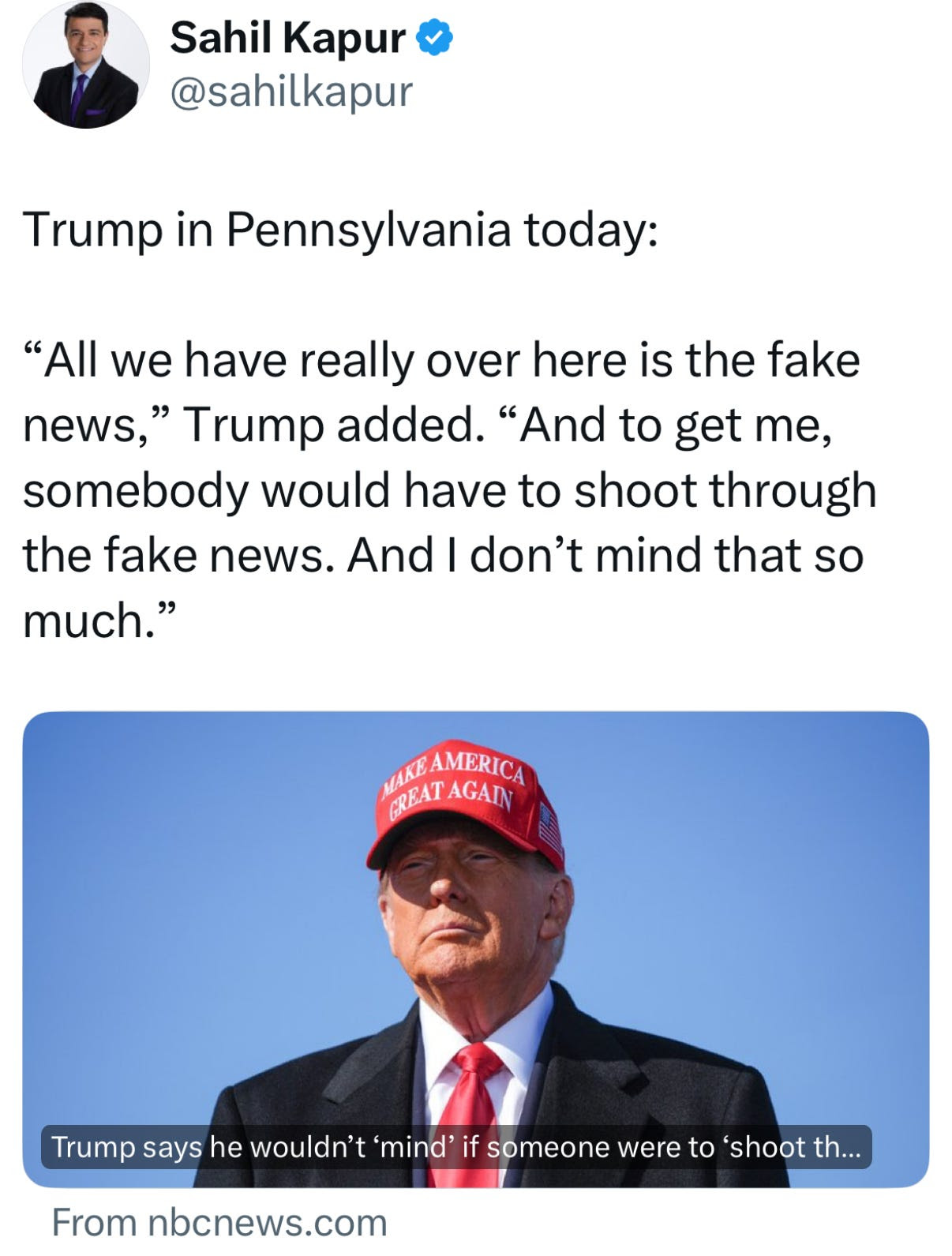
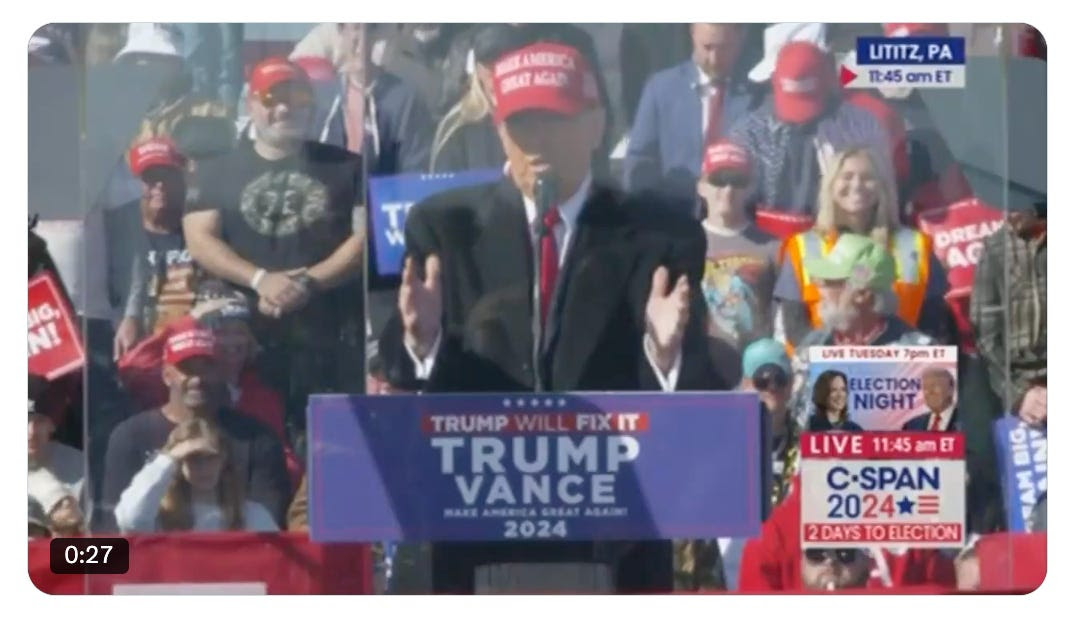
He also said that he should not have left the White House after losing the 2020 election. Thankfully, no microphones appear to have been abused in his Sunday appearances.
As the candidates make their very different closing arguments to the American people, expect the election-related litigation to continue. It will morph into recounts and challenges once the race is decided, which we should not expect to happen quickly. I’ve written before that I don’t expect the outcome to be decided in the Supreme Court. That can happen if you’ve got a situation like Bush v. Gore in 2000, where a small tranche of ballots in one state were going to decide the whole thing. But that’s not the usual case. It’s likely most of the litigation will be decided quickly in state courts, with some cases in federal district and appellate courts.
Law professor and election law expert Justin Levitt has written an excellent piece about this that you’ll enjoy if you want to dig in on this topic. It’s an antidote to the frenzy of concern that the Court we’ve come to hold in low esteem will weigh in for Trump: Please Stop Wishcasting the Supreme Court into a Decisive Election Role.
The GOP pre-election lawsuits were primarily designed to erode confidence in the election and fuel post-election narratives that the entire election was tainted by fraud. Some cases hinted at a post-election strategy of refusing to certify election results. But certification of election results is a mandatory legal duty, and courts like Georgia that have considered it have held thatstate and local officials do not have discretion to refuse to certify election results.
If an official delays or refuses to certify results, state officials and courts (as well as candidates and voters, in some circumstances) can step in to compel certification. Officials who refuse to certify can be held accountable through both civil and criminal penalties. There are plenty of opportunities baked into the process to ensure that the count is correct. But certification is not one of those points. Refusal to certify election results is really a refusal to count an entire jurisdiction’s votes.
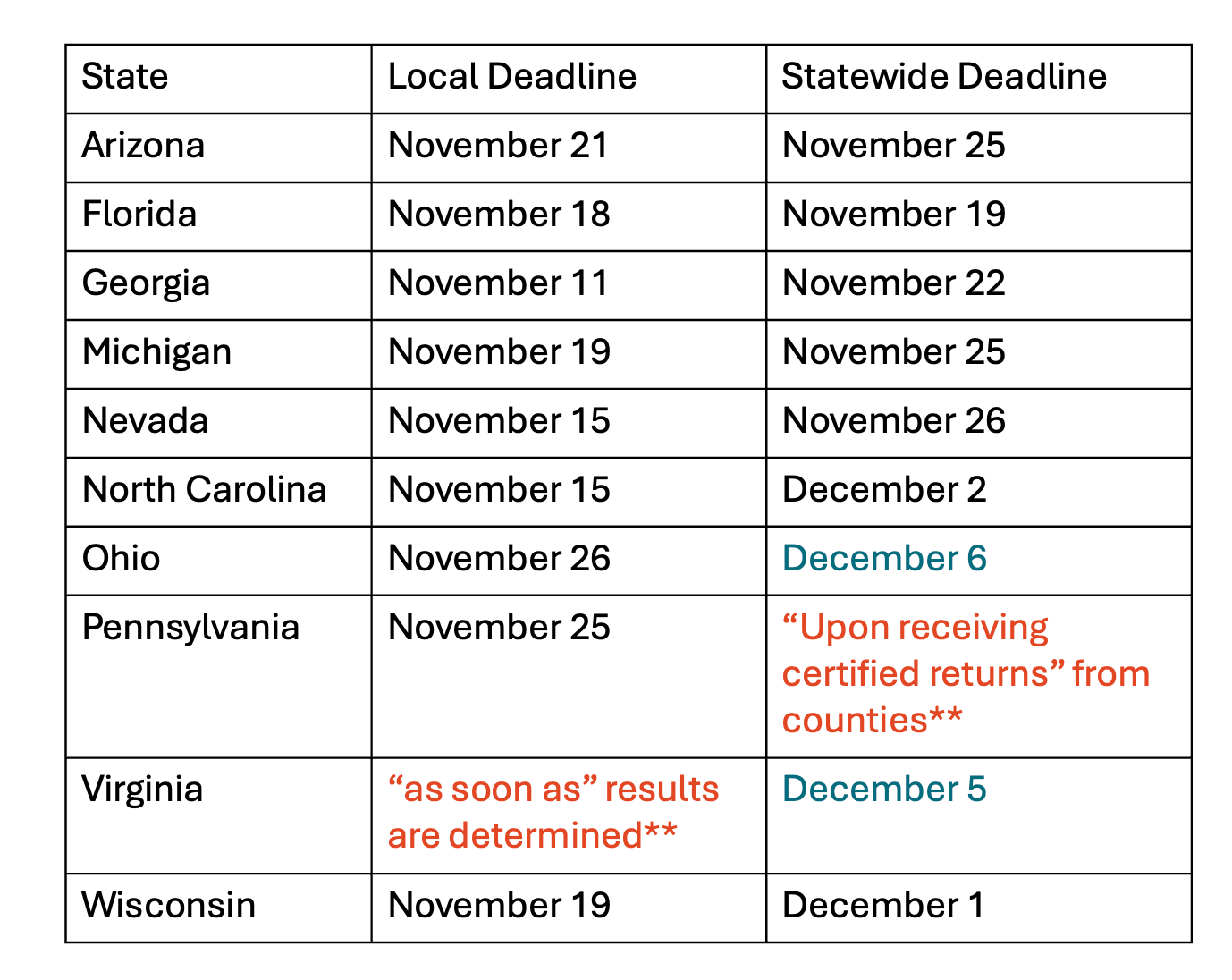
Each state sets its own deadline for certifying the count. Some examples below. A key date to look for is December 11, when the Electoral Count Reform Act (ECRA) requires the governor of each state to certify the appointment of electors well in advance of the electors’ votes. On December 17, the electors meet in their respective states to take part in the Electoral College and formally cast their state’s electoral votes for president and vice president. The ECRA removes the ambiguity that Trump’s lawyers exploited to create the fake electors scheme in 2020. Any refusal to certify the vote can be dealt with by lawsuits that force the certification or state rules that provide alternate paths for certification. People who refuse to follow the law and certify results can even face penalties.
In preparation for Tuesday, law enforcement officials have been vigilant about the possibility of violence at the polls or around the election, while hoping it won’t occur. Keep in mind that if it does, we will not see federal law enforcement or troops out at the polls. Election oversight is largely left to to the states; it’s even a crime for armed federal agents like FBI or U.S. Marshals’ personnel, along with members of the military, to be sent in. I’m told there is an unprecedented level of cooperation between federal, state, and local law enforcement to keep the election—and election workers—safe.
There’s also good news in preparation for election day. As many as 17,000 voters in Erie County, Pennsylvania, who didn’t receive their mail-in ballots are being permitted to vote early in person. The voters requested ballots but didn’t receive them, but a judge gave them permission to vote up through Monday and, equally as important, ordered that polling places needed to have sufficient numbers of ballots on hand in case these voters all show up at the precinct on election day. This case is a great example of how election-related issues frequently get resolved in the lower courts. And one of the sleeper stories emerging in this election already is about how some pockets of slow and delayed mail delivery are factoring into who gets a ballot and whose ballot makes it back in time to be counted.
In other words, we are all over the place as election day approaches, with lots of moving parts. I hope you’ll leave a note in the comments about what’s going on in your part of the country.
Today in North Carolina, Trump referenced a candidate named David as “one of the best” and looked around at the crowd, asking if he was out there. The only problem? David is David McCormick, a candidate for office in Pennsylvania. Imagine what would have happened if Joe Biden had done that?
S.V. Dáte at Huff Post tweeted tonight that he had reached out to the Trump campaign to ask “why the coup-attempting, now convicted criminal, former president is an unfocused mess in these final days.” He got this in response:
President Trump is the greatest orator in political history and his patented Weave is a brilliant method to convey important stories and explain policies that will help everyday Americans turn the page from the last four years of Kamala Harris’s failures. The media is too stupid and ignorant to understand or comprehend what is happening in the country and, therefore, is unable to accurately report on President Trump’s achievements while in office and the pro- American agenda he will implement in his second term. Or they knowingly misrepresent and purposely lie about President Trump because they suffer from a debilitating case of Trump Derangement Syndrome that prevents critical thinking or commonsense.
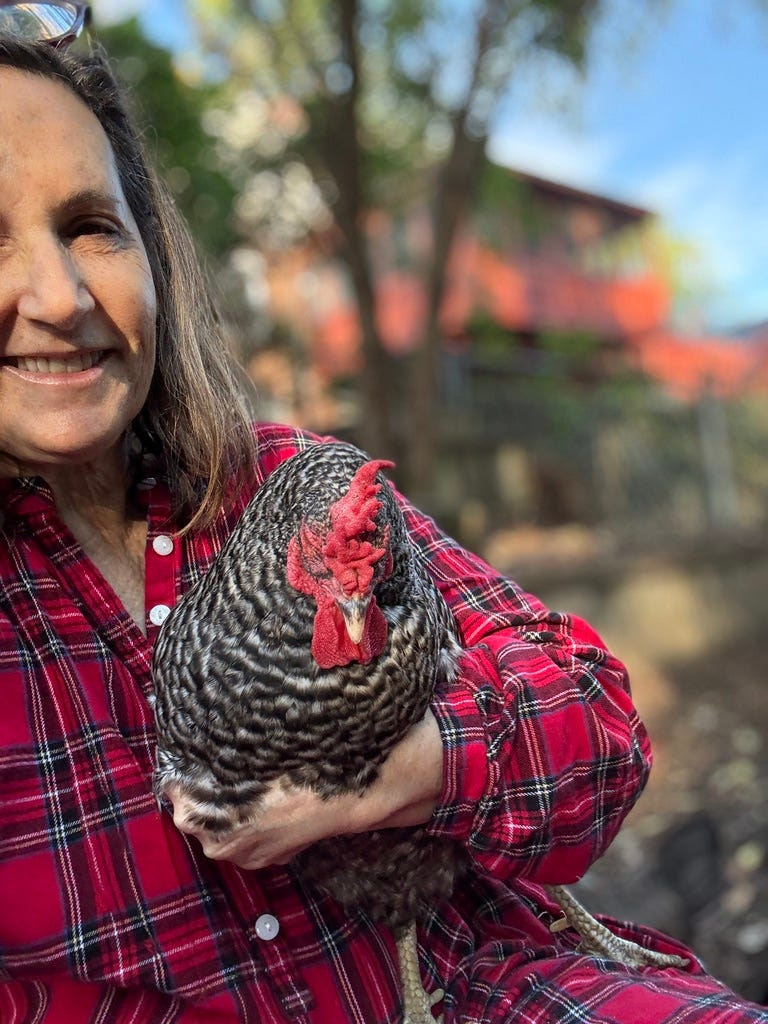
If this leaves you in need of an emotional support chicken, I’ll be here for you this week. This is Guida, who only agreed to sit on my lap this morning because I had Buñuelos that I shared with her. But she purred softly, and that was just what I needed.
I’m really grateful to all of you for being here with me this week.
We’re in this together,
Joyce
Jess Piper Nov 3, email
Harris Could Take …Iowa?
| Let me start by saying that I am not a data person. Numbers make my head hurt. I am a narrative person. I am full of the stories of rural people and rural areas and rural organizing. I also know a lot about the people in Iowa. I live three miles from the IA border, and I frequently speak in the state. There is a reason people who know numbers and assemble polls are talking about Iowa today. The Des Moines Register headline: Iowa Poll: Kamala Harris leapfrogs Donald Trump to take lead near Election Day. The nationally recognized Iowa Poll shows Kamala Harris picking up support from women to surpass Donald Trump in a ruby-red state he has won twice. The Selzer Poll shows something I have been talking about for a few years. The story of organizing in rural spaces and the stories of the women who make it happen.The poll shows that women — particularly those who are older or who are politically independent — are driving the late shift toward Harris. “Age and gender are the two most dynamic factors that are explaining these numbers,” Ann Selzer said of the numbers. I know this intuitively. I know that because I have been traveling into Iowa to speak to groups large and small for two years. I have been in small towns and big cities across the state and I know who is doing the organizing…It’s the women. I was in Howard County, Iowa a year ago. I was invited by a local Howard County Democrat, Laura Hubka. The entire county has fewer than 10K people.Laura and her group organized a potluck dinner with me as the keynote speaker and several candidates driving from across the state to talk politics and what sort of shot the Democrats had. The community center was full and as I drove back to Laura’s farmhouse to stay the night, I thought about the courage it takes to have a meeting in a rural space when you might only have ten folks show up. Laura did it anyway. I spoke in Davis County, Iowa almost two years ago. We met at the fairgrounds in the building next to the Swine Pavilion. I was asked to come and speak on state politics including Kim Reynold’s school voucher scheme and the Iowa abortion ban. I sat down to another potluck with midwestern sushi — a pickle slathered with cream cheese and rolled up in a piece of ham, sliced into little sushi rolls. I washed it down with lemonade and made sure to snag a Scotcharoo before I spoke.The abortion ban was the topic of conversation with the women in this group, and I have news for those politicians going around thinking that abortion bans are only relevant to women of child-bearing age…they are wrong. Women know that abortion bans impact every part of our lives. We know bans drive OBGYNs out of our states making any gynecological care difficult. We are losing women’s healthcare in states with bans. Rural women are hit particularly hard with an abortion ban.Fairgrounds, Davis County, Iowa. I drove from Davis County to Johnson County the next day. I was invited to be the Keynote speaker at a large event in Johnson County, Iowa. It was the annual BBQ held at the fairgrounds as well. This was a big event with several special guests including the Iowa Democratic Chair, Rita Hart and Congressional candidate Christina Bohannan. Again, the topic that most women were concerned about? Abortion and reproductive healthcare. I spoke on the issue at length and grabbed a piece of butter cake on the way out.The women who saw me out the door hugged me and told me that their daughters and granddaughters would not suffer the health repercussions that an abortion ban ushers in. That they would do whatever they had to do to make sure their children would be safe in Iowa. Here’s the thing that a lot of pollsters have been getting wrong: they don’t think abortion will be the reason that older women choose to vote for a Democrat. And I know that isn’t true. I have talked to hundreds of folks on the ground in places like Iowa. I’ve spoken to so many women. Abortion may be seen as a political strategy to some, but it is life or death for women and girls. I spoke in Mt Ayr, Iowa last year. The population is 1600. I was again summoned by the Ringgold County Democrats led by a woman. We met in a woman-owned bookstore. There was wine and food and desserts and they gave me one of my favorite t-shirts. It says “Hard Working Rural Democrat” and I wear it often.Over half of the folks who showed up to this Mt Ayr event were teachers. That’s very often the case in the spaces I travel to speak…they are quiet, but they always show up. You’d think with all of those teachers that the topic would be public schools and that is indeed where we started, but the Q and A session turned into a forum on abortion bans. Most of the women at the event were grandmothers — they worried that their daughters would need reproductive care and could die waiting for it under an abortion ban. That is a fair worry. A worry that women have been dealing with since the creation of the United States. “ desire you would remember the ladies and be more generous and favorable to them than your ancestors. Do not put such unlimited power into the hands of the husbands. Remember, all men would be tyrants if they could. If particular care and attention is not paid to the ladies, we are determined to foment a rebellion and will not hold ourselves bound by any laws in which we have no voice or representation. ”Abigail Adams to her husband John Adams, 1776. We have been fighting for equal rights under the law for hundreds of years.I have been in Council Bluffs. I have spoken in Iowa City. I traveled to Sioux City. I have been to Mount Pleasant. I have traveled the state for the past two years and I can tell you that while I am excited to see the data on Iowa, I have been telling you the stories for a while now. The rural stories — the organizing stories.The poll reinforces what we are seeing on the ground.The Selzer Poll shows that Trump still leads in rural spaces in Iowa, but here is what I know: he’s losing his grip on those folks. And the reason? Women voters. Rural women voters.The Republican ban on abortion was a step too far for most women…even for Independent and Republican voters. Especially with those rural voters who believe in limited government. Who believe that lawmakers don’t belong in doctor’s offices. Who believe in freedom. I also have to take every poll with a grain of salt. We know that polls don’t win elections — voters will decide who takes the Presidency on Tuesday. But here is what I am telling you; the vibes have changed. I am in the rooms and you have a reason to be hopeful. You have reason to think Iowa may just go for Harris and wonder if it can happen there, where else may it happen?I know that the women are making it happen. Boys, look away while I tell a funny story. Recently, I was at an event with Fred Wellman…he doesn’t speak at small rural events as often as I do. He said of this particular event: “This is running so well. We are on time and there is a schedule of events and food too.”I told him. “You know why, right? Women organized the event.” He laughed and then realized how truthful I was. I then told him about the one event I have attended in the last two years that was organized by a man. I knew it as soon as I arrived because there was no water, no coffee, and no sweet treats. True story. Women are taking the lead in this election and it’s because we have everything to lose. Our lives are on the line. Our children and grandchildren will suffer the consequences of a Trump win.Women will organize events and knock doors and make calls and participate as election judges and create GOTV events and we will also feed you. We will give you information and warm your belly. Women are driving this election and it’s being done in a particularly feminine fashion.This is the year of the woman. The stars have aligned. I am optimistic but a little scared. Excited but pragmatic.If Iowa can go for Harris, any state can go for Harris. The women are working. The women are voting. We can do this.~JessP.S. Thank you to all of the male allies. We couldn’t do this without you. Also, remember the snacks when you organize 🙂 |
Cindy Lou eats in Bomerano
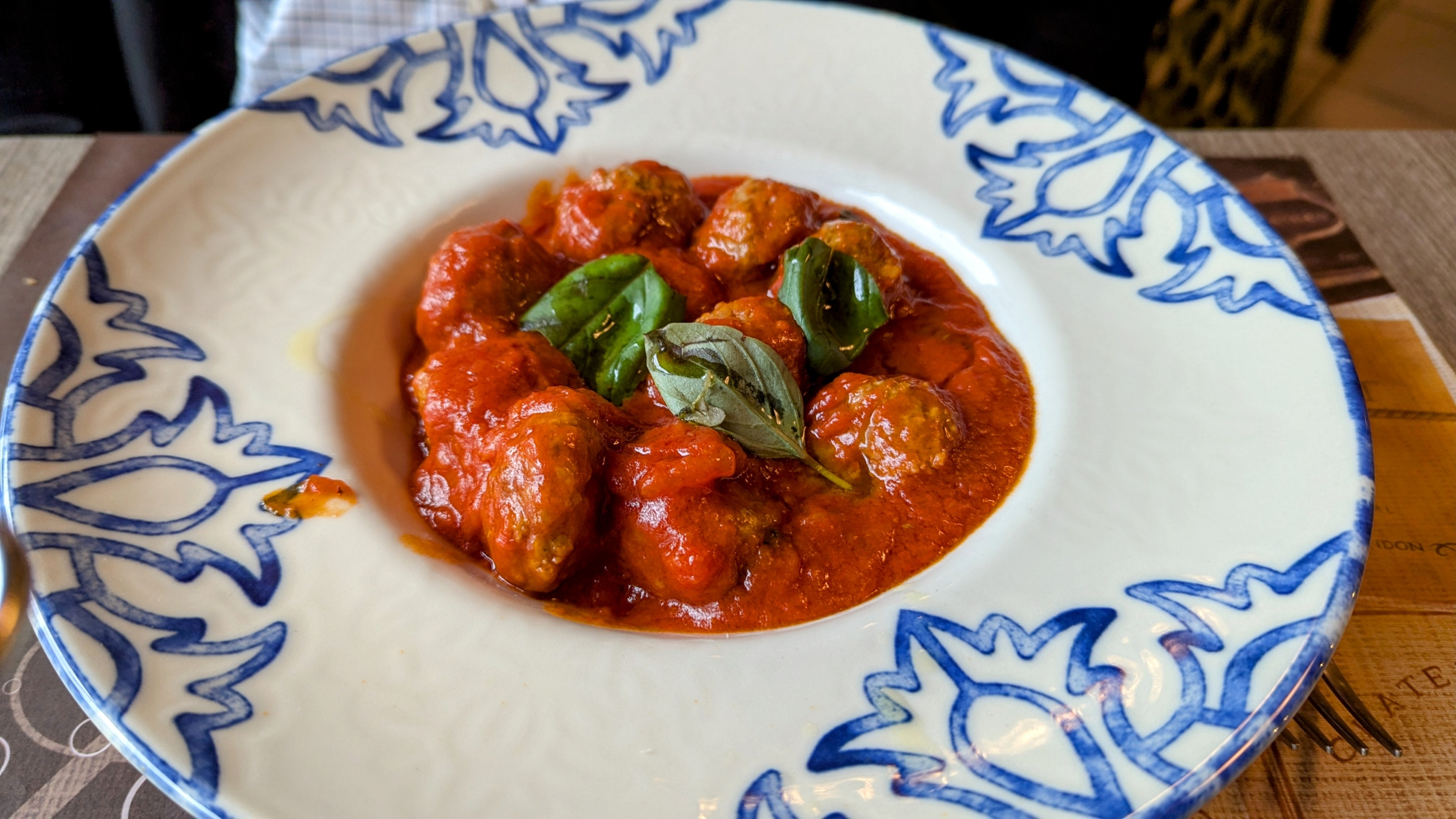
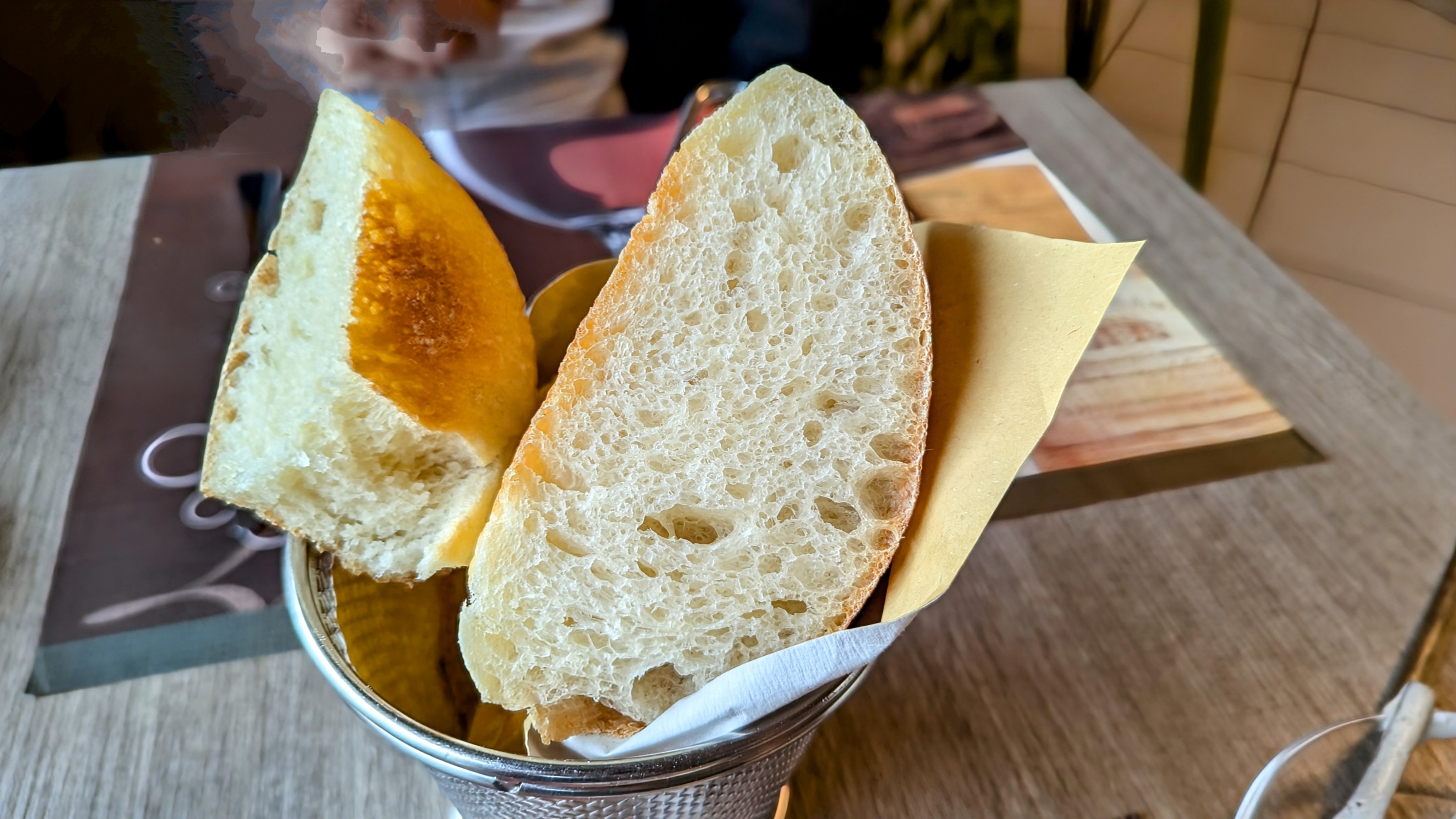
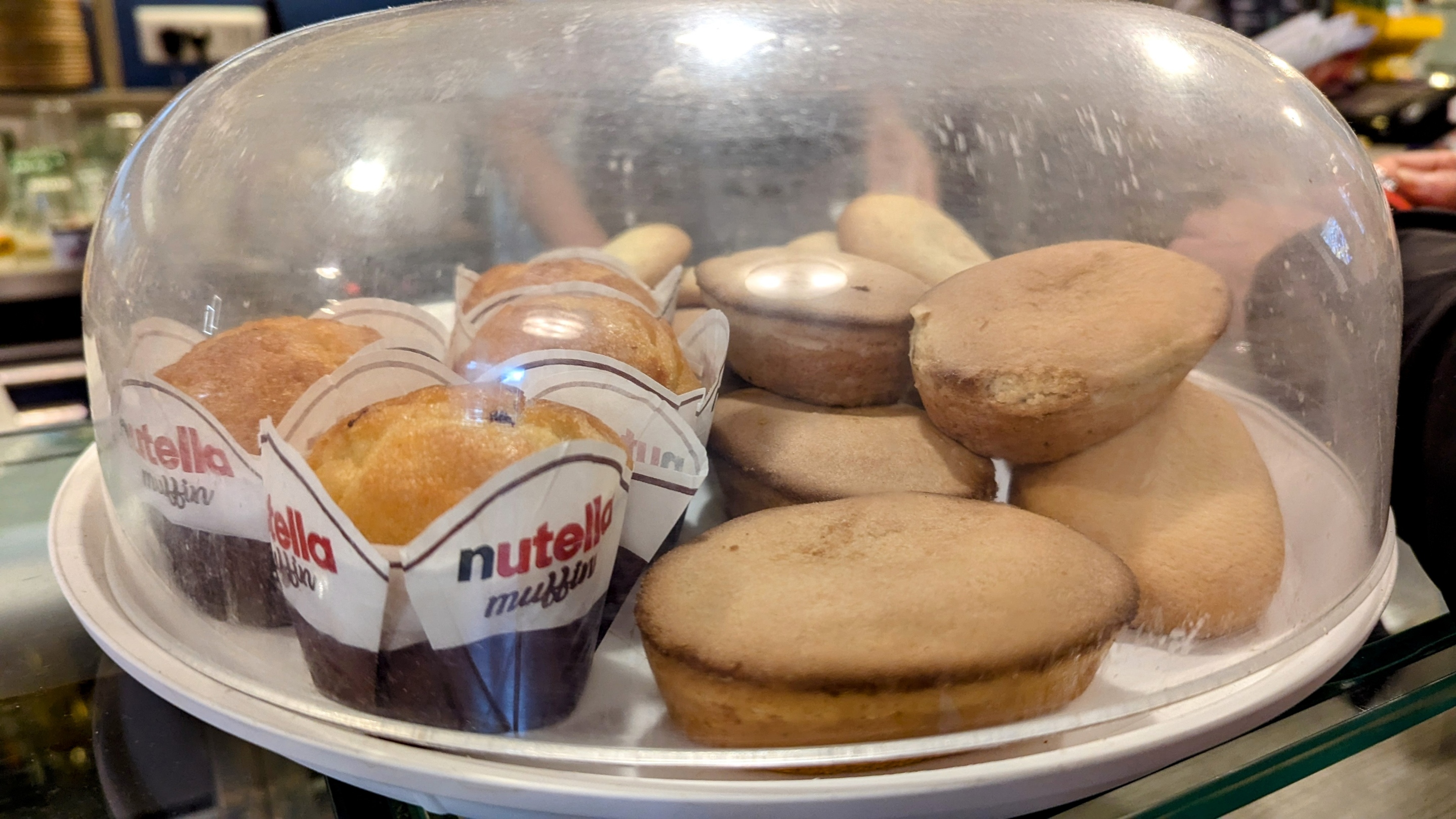
The village was not a culinary paradise. However, this cafe was a pleasant place to be as the rain poured down outside. Pizzas and pasta were the staples, with pizzas served only at dinner. There was also a range of pastries. So, pasta it was. Oh, and meat balls.




A gelato in Napoli

Eating in Sorrento – la Villa
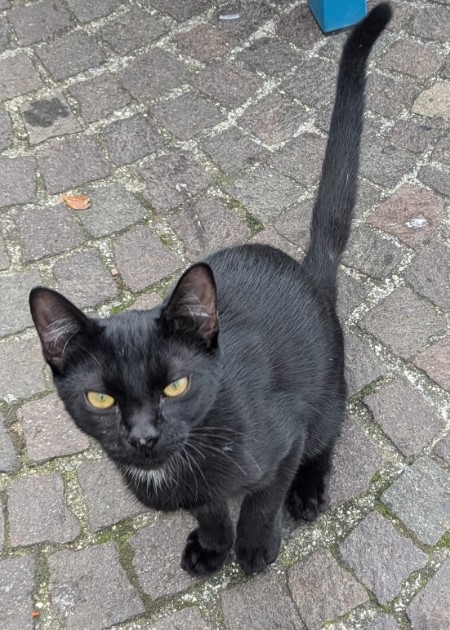
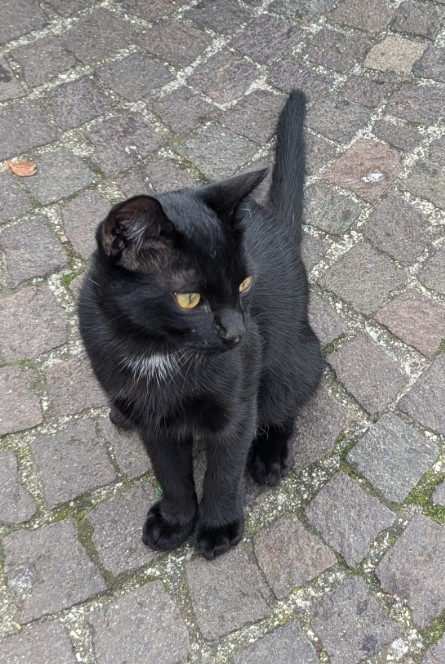
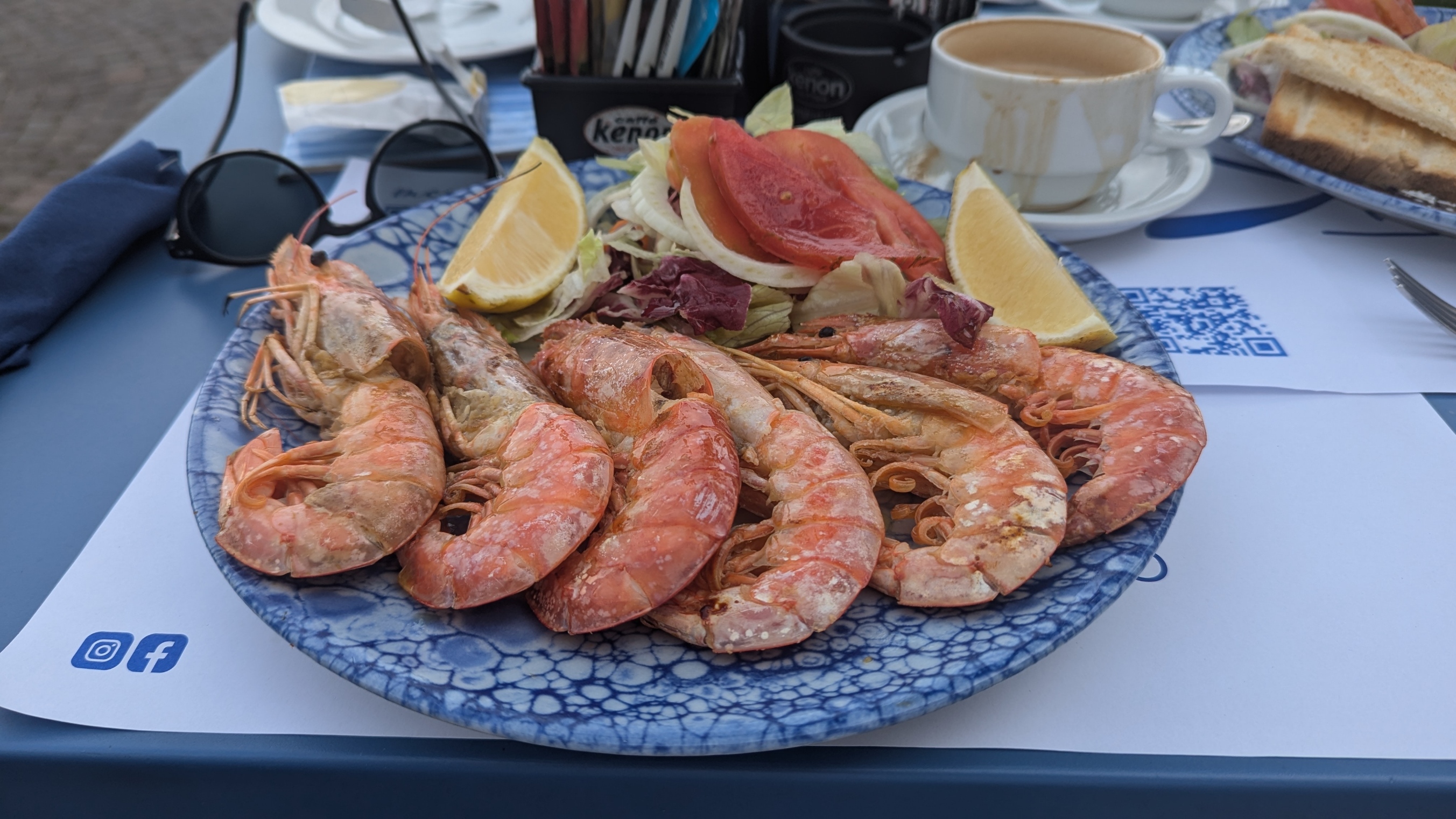
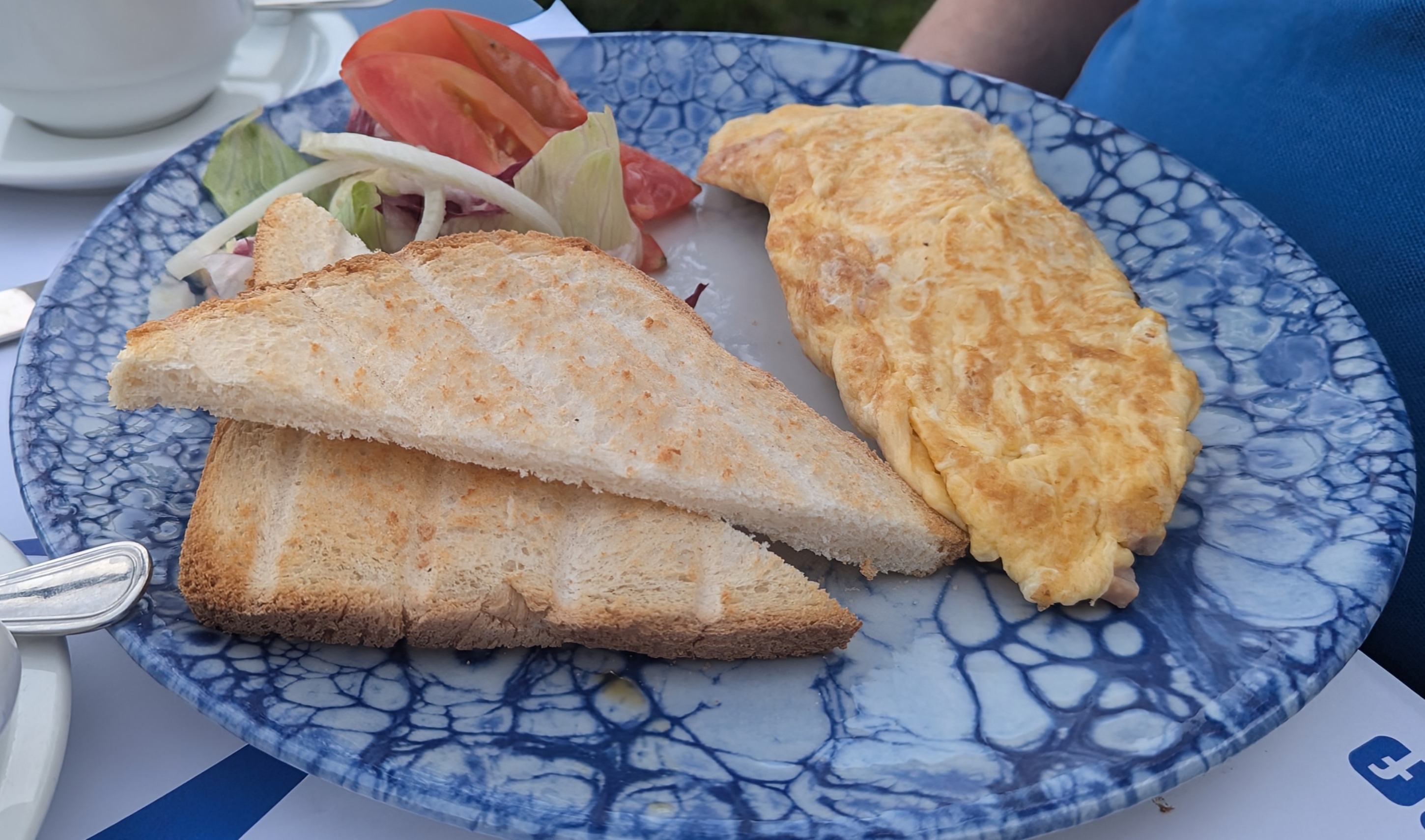
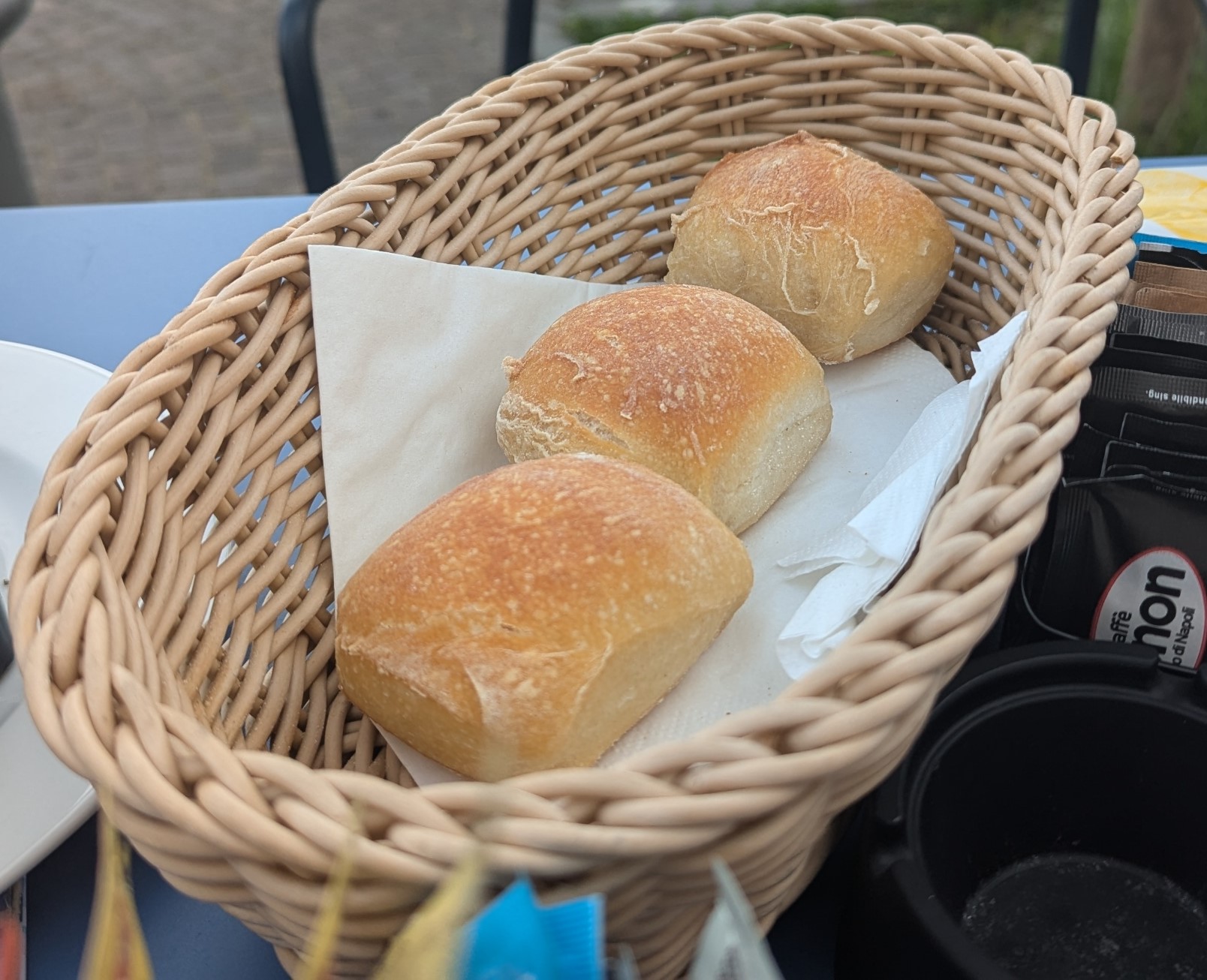
This cat joined us, but as she turned her nose up at the idea of a bread crumb, but leapt upon the prawn I did not think she was particularly hungry. I was, so ate most of my delicious prawns. The omelette (more suited to the breakfast hour at which we ate, was also deemed delicious).



A shocking ‘meal’ at the Archeological Museum in Napoli
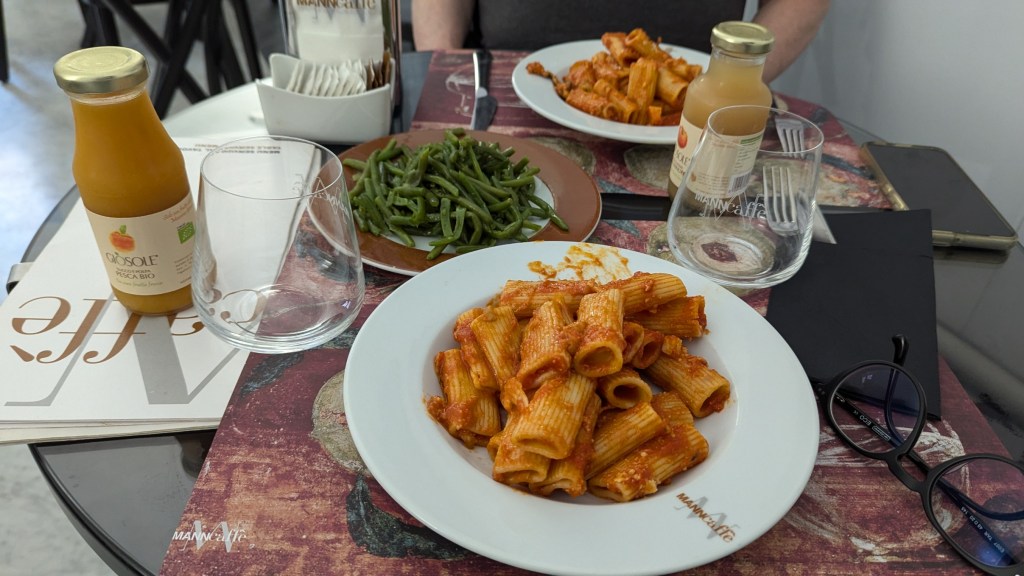
The museum is worth a visit but avoid the cafe. How anyone can serve such a mess is beyond comprehension. The side of green beans was cold, over cooked beans. The pastas were lukewarm. The juices served in unopened bottles. Service was unpleasant.
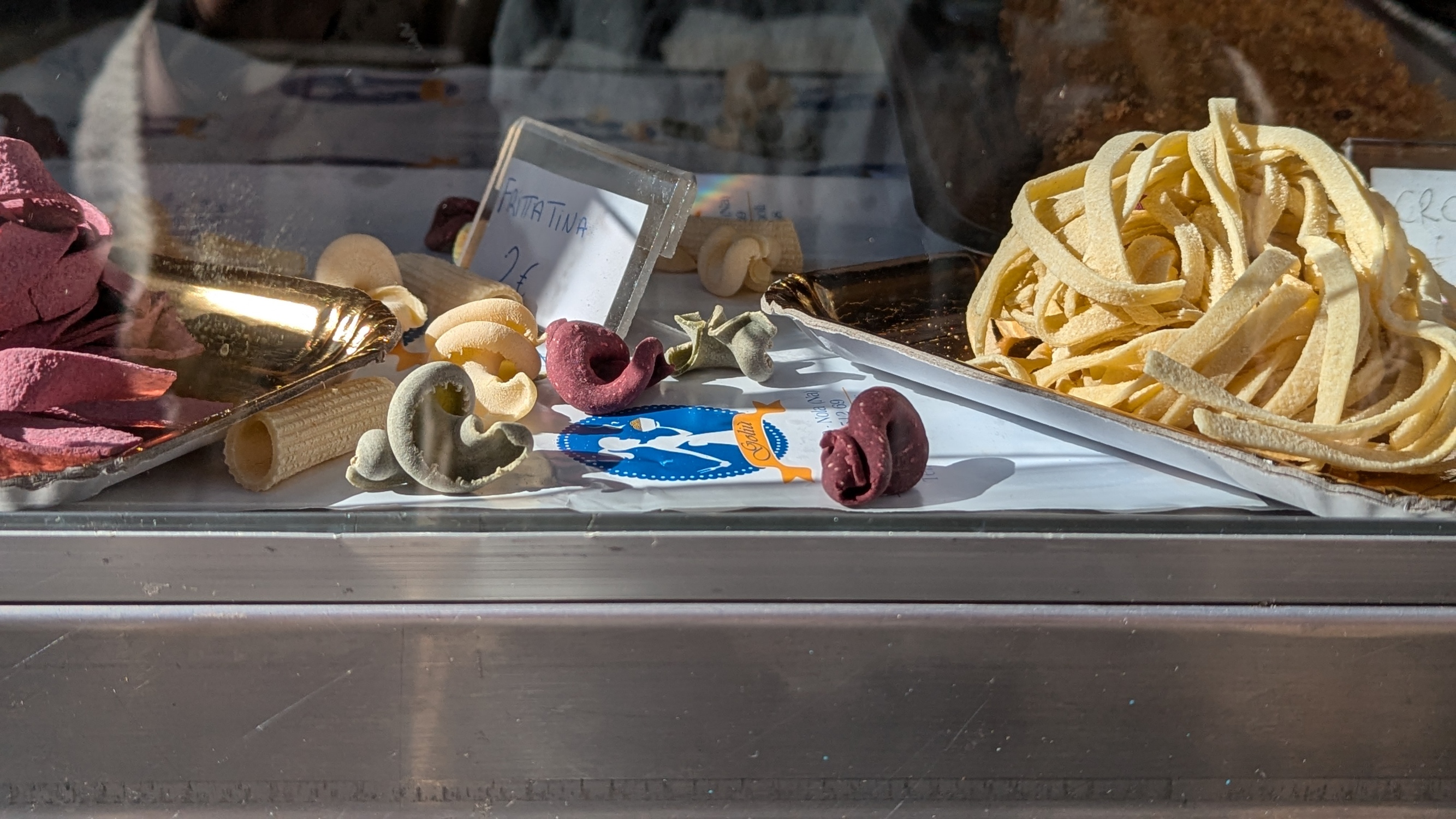
Food in Napoli cafes observed as walking through the streets.




 Robin's Room