
Margaret Ann Spence Cold War in a Hot Kitchen Wakefield Press, September 2024.
Thank you NetGalley for providing me with this uncorrected proof for review.
Cold War in a Hot Kitchen is a special read from beginning to end. It is a social history; a commentary on a sometimes unique, at others familiar, domestic life; a magic blend of feminism and loyalty to family beyond shared ideology; and a fascinating story of gold mining in Australia. With its references to Ballarat and Bendigo gold fields, to those in Western Australia, the story of management and miners, company houses and Indigenous communities, a truly Australian story emerges. With its broad sweep over world events that drew Margaret Ann Spence as a child into debates, or quiet thoughtful speculation and the Spence family move from Australia to different cultural, social and political environments the autobiographical features of this eminently readable book, almost merge into the fictional devices of ‘a good yarn’. Written in the most engaging style, in language that is almost musical at times, a strong story of robust characters in a history replete with social commentary emerges. See Books: Reviews for the complete review.
After the book review: Heather Cox Richardson – Obama speech; Duchess of Malfi; Oedipus; Iran: hijab ‘treatment clinics’ echo historical use of mental illness to control women
Heather Cox Richardson Letters from an American: Barack Obama Speech
<heathercoxrichardson@substack.com>
On Thursday, December 5, in Chicago, Illinois, former president Barack Obama gave the third in an annual series of lectures he has delivered since 2022 at his foundation’s Democracy Forum, which gathers experts, leaders, and young people to explore ways to safeguard democracy through community action.
Taken together, these lectures are a historical and philosophical exploration of the weaknesses of twenty-first century democracy as well as a road map of directions, some new and some old, for democracy’s defense. In 2022, Obama explored ways to counteract the flood of disinformation swamping a shared reality for decision making; in 2023 he discussed ways to address the extraordinary concentration of wealth that has undermined support for democracy globally.
On Thursday, Obama explored the concept of “pluralism,” a word he defined as meaning simply that “in a democracy, we all have to find a way to live alongside individuals and groups who are different than us.”
But rather than advocating what he called “holding hands and singing ‘Kumbaya’” as we all tolerate each other, Obama described modern pluralism as active work to form coalitions over shared issues. His argument echoed the concepts James Madison, a key framer of the Constitution, explained in Federalist #10 when he was trying to convince inhabitants of a big, diverse country that they should endorse the newly written document.
In 1787, many inhabitants of the fledgling nation objected to the idea of the strong national government proposed under the new constitution. They worried that such a government could fall under the control of a majority that would exercise its power to crush the rights of the minority. Madison agreed that such a calamity was likely in a small country, but argued that the very size and diversity of the people in the proposed United States would guard against such tyranny as people formed coalitions over one issue or another, then dissolved them and formed others. Such constantly shifting coalitions would serve the good of all Americans without forging a permanent powerful majority.
Obama called the Constitution “a rulebook for practicing pluralism.” The Bill of Rights gives us a series of rights that allow us to try to convince others to form coalitions to elect representatives who will “negotiate and compromise and hopefully advance our interests.”
Majority rule determines who wins, but the separation of powers and an independent judiciary are supposed to guarantee that the winners “don’t overreach to try to permanently entrench themselves or violate minority rights,” he said. The losers accept the outcome so long as they know they’ll have a chance to win the next time.
Obama noted that this system worked smoothly after World War II, largely because a booming economy meant rising standards of living that eased friction between different groups: management and labor, industry and agriculture. At the same time, the Cold War helped Americans come together against an external threat, and a limited range of popular culture reinforced a shared perspective on the world—everyone watched the sitcom Gilligan’s Island.
Most of all, though, Obama noted, American pluralism worked well because it largely excluded women and racial, gender, and religious minorities. He pointed out that as late as 2005, when he went to the Senate, he was the only African American there and only the third since Reconstruction. There were two Latinos and fourteen women.
In the 1960s, he noted drily, “things got more complicated.” “[H]istorically marginalized groups—Blacks, Latinos, Asians, Native Americans; women and gays and lesbians; and disabled Americans—demanded a seat at the table. Not only did they insist on a fair share of government-directed resources, but they brought with them new issues, born of their unique experiences that could not just be resolved by just giving them a bigger slice of the pie. So racial minorities insisted that the government intervene more deeply in the private sector and civil society to root out long-standing, systemic discrimination.”
Women wanted control over their own bodies, and gays and lesbians demanded equality before the law, challenging religious and social norms. “[P]olitics,” Obama said, “wasn’t just a fight about tax rates or roads anymore. It was about more fundamental issues that went to the core of our being and how we expected society to structure itself. Issues of identity and status and gender. Issues of family, values, and faith…. [A] lot of people…began to feel that their way of life, the American way of life, was under attack” just as increasing economic inequality made them think that other people were benefiting at their expense.
Increasingly, that economic inequality cloistered people in their own bubbles as unions, churches, and civic institutions decayed. “[W]ith the Cold War over, with generations scarred by Vietnam and Iraq and a media landscape that would shatter into a million disparate voices,” he said, Americans lost the sense of “a common national story or a common national purpose.” Media companies have played to extremes, and “[e]very election becomes an act of mortal combat.”
With that sense, there is “an increasing willingness on the part of politicians and their followers to violate democratic norms, to do anything they can to get their way, to use the power of the state to target critics and journalists and political rivals, and to even resort to violence in order to gain and hold on to power.”
For all that he was speaking in 2024, Obama could have been describing the realization of the fears of those opposed to the Constitution in 1787.
But he did not agree that those anti-Federalists had won the debate. Instead, he adapted Madison’s theory of pluralism to the modern era. Obama stood firm on the idea that the way to reclaim democracy is to build coalitions around taking action on issues that matter to the American people without regard to personal identities or political affiliations. Pluralism, Obama said, “is about recognizing that in a democracy, power comes from forging alliances, and building coalitions, and making room in those coalitions not only for the woke but also for the waking.”
And that, in many ways, identified the elephant—or rather the donkey—in the room. In the 2024 election, the Democratic Party under Vice President Kamala Harris and Minnesota governor Tim Walz very deliberately moved away from so-called identity politics: the idea that a person builds their political orientation around their pre-existing social identity. During the campaign, Harris rarely referred to the fact that if elected, she would be the first woman, as well as the first woman of color, to hold the presidency: when attendees at the Democratic National Convention wore white in honor of the suffragists, Harris wore black.
Instead, Harris and Walz embraced investing in the middle class and supporting small businesses. But that shift to the center did not translate into a presidential victory in 2024, and those on the political left, as well as progressive Democrats, are not convinced it was a good move.
Since the rise of Donald Trump, the MAGA party has been the one championing identity politics, rejecting American pluralism in favor of centering whiteness, a certain kind of individualist masculinity, Christianity, and misogyny. Making common cause with Republicans, even non-MAGA Republicans, in the face of such politics seems to the left and progressive Democrats self-defeating.
Obama disagrees. “[I]t’s understandable that people who have been oppressed or marginalized want to tell their stories and give voice fully to their experiences—to not have to hold back and censor themselves, especially because so many of them have been silenced in the past,” he said, “But too often, focusing on our differences leads to this notion of fixed victims and fixed villains.”
He stood firm against compromising core principles but said: “In order to build lasting majorities that support justice—not just for feeling good, not just for getting along, to deliver the goods—we have to be open to framing our issues, our causes, what we believe in in terms of ‘we’ and not just ‘us’ and ‘them.’”
And he emphasized that such cooperation works best when it’s about action, rather than just words, because action requires that people invest themselves in a common project. “It won’t eradicate people’s prejudices, but it will remind people that they don’t have to agree on everything to at least agree on some things. And that there are some things we cannot do alone.” “It’s about agency and relationships.”
Then Obama addressed the political crisis of this moment, the one the anti-Federalists feared: “What happens when the other side has repeatedly and abundantly made clear they’re not interested in playing by the rules?” When that happens, he said, “pluralism does not call for us” to accept it. “[W]e have to stand firm and speak out and organize and mobilize as forcefully as we can.” Even then, though, “it’s important to look for allies in unlikely places,” he said, noting that “people on the other side…may share our beliefs in sticking to the rules, observing norms,” and that supporting them might help them “to exert influence on people they’ve got relationships with within the other party.”
The power of pluralism, he said, is that it can make people recognize their common experiences and common values. That, he said, is how we break the cycle of cynicism in our politics.
Obama’s argument has already drawn criticism. At MSNBC, Ben Burgis condemned Obama’s “centrist liberalism” as inadequate to address the real problems of inequality and warned that his political approach is outdated.
But it is striking how much Obama’s embrace of pluralism echoes that of James Madison, who had in his lifetime witnessed a group of wildly diverse colonists talk, write letters, argue, and organize to forge themselves into a movement that could throw off the age-old system of monarchy in favor of creating something altogether new.
—
Notes:
https://avalon.law.yale.edu/18th_century/fed10.asp
https://www.obama.org/democracy-forum-2024/president-obama-remarks/
https://www.msnbc.com/opinion/msnbc-opinion/barack-obama-democracy-forum-speech-trump-era-rcna183127
https://barackobama.medium.com/my-remarks-at-the-2023-democracy-forum-32609c7ec237
https://barackobama.medium.com/my-remarks-on-disinformation-at-stanford-7d7af7ba28af
Back to London
The Trafalgar Theatre was close to where we were staying in London, and so an easy walk to see The Duchess of Malfi – something I read many years ago but had not seen staged. Like this reviewer I had mixed feelings about the production. However, how ever mixed the execution, the theme was clear and achingly familiar. A novel I recently read for review and the second act of this play in which every effort is made to send a woman mad, using her intelligence and refusal to succumb to norms as enunciated by her brothers, as well as incarcerate her are reminiscent of The Yellow Wallpaper by Charlotte Perkins Gilman, first published in 1892. Also, see article from The Conversation below.
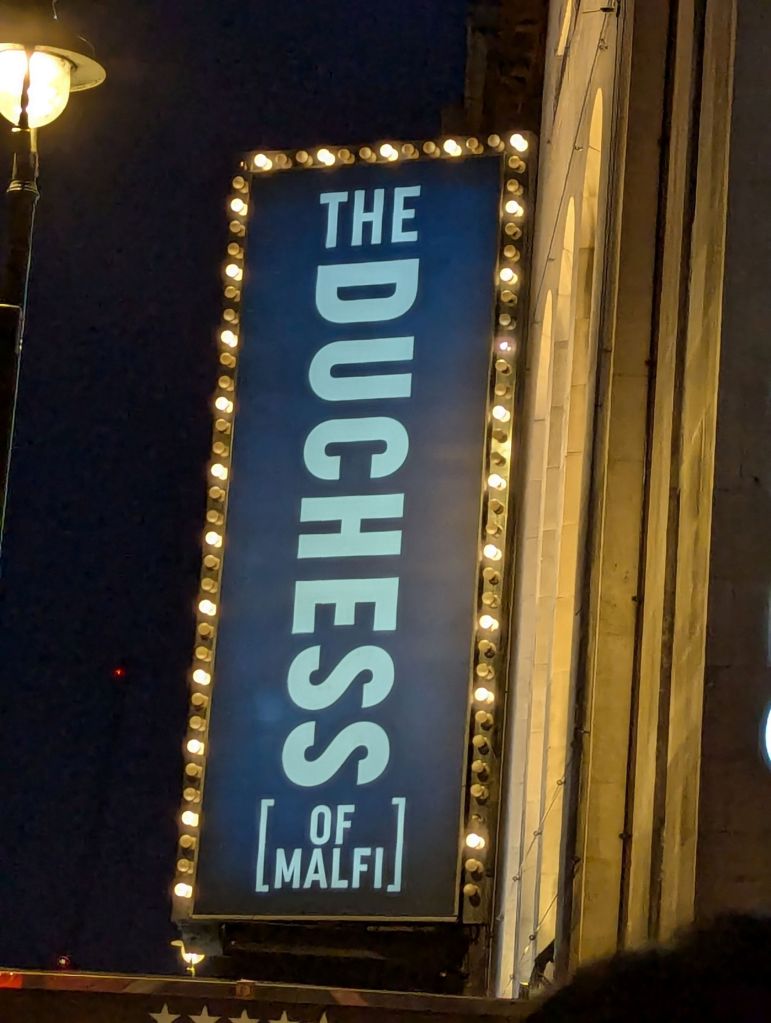
The Duchess [of Malfi] at Trafalgar Theatre review: it’s thrilling to see Jodie Whittaker back on stage
This updating of John Webster’s brutal Jacobean tragedy is uneven but comes together in the second half.
--Photo-Credit-Marc-Brenner.jpeg?trim=106,0,107,0&quality=75&auto=webp&width=1000)
Marc Brenner
Nick Curtis @nickcurtis 17 October 2024
Review at a glance
Jodie Whittaker makes a bold return to the stage after 12 years away, in Zinnie Harris’s uneven updating of John Webster’s brutal Jacobean tragedy. It’s an overblown peach of a role for the star of Doctor Who and Broadchurch, packed with passion, grandeur, and the gamut of life from birth to death. But Harris’s adaptation only comes into its own in the second half. Throughout the first, I wondered what the point was.
Harris, who also directs – bad move – keeps the bones of the story: a noble widow secretly marries her servant and has children by him. She is ruthlessly persecuted for this “sin” against the family name (and fortune) then killed by her brothers; one of them her twin Ferdinand, who then goes mad; the other a Cardinal who also kills his own mistress.
But she ditches Webster’s macabre poetry and shifts the action to round about the 1950s – though neither the mannered language nor the setting of her version feels evocative of any particular era. Tom Piper’s set of white metal gantries and grilles looks like something knocked up for a touring production of Prisoner: Cell Block H. The message is that patriarchal violence, often driven by a fear of female agency and desire, is eternal. Ditto, religious hypocrisy.
But man, it’s a mess at the start. Characters are introduced by fuzzy captions, bursts of static and reverberating swamp guitar chords played by a white-clad musician who sometimes strolls through the action.
Harris goes out of her way to make the steward Antonio (Joel Fry) a meek, mousy contrast to his imperious lover, here named Giovanna after the original’s historical source. “’Consummate’, what’s that?” he says after their covert marriage. “F*** each other’s brains out,” she replies.
-Jodie-Whittaker-(The-Duchess)-Flor-Gandra-Lobina-(Isabella)-Matti-Houg.jpeg?quality=75&auto=webp&width=960)
Hannah Visocchi, Jodie Whittaker, Flor Gandra-Lobina and Matti Houghton in The Duchess [of Malfi] Marc Brenner
Rory Fleck Byrne as Ferdinand, meanwhile, is psychotically over the top from the get-go, making explicit the incestuous undertones in Webster. Paul Ready is enjoyably loathsome as the cardinal, propositioning Elizabeth Ayodele’s supplicant Julia when she’s kneeling in prayer. Jude Owusu is impressive as henchman Bosola but lumbered with acres of verbiage.
It all comes together in the horrific, absurd second half where the indomitable Duchess is psychologically tortured in scenes that recall Abu Ghraib abuses. Whittaker exudes battered nobility as she declares Webster’s famous line: “I am the Duchess of Malfi still.”
Oedipus, deservedly, received a different reception, both from the critics and me. I have seen many fine adaptations. However, this production of Oedipus cannot be surpassed. It was stunning. The review below is interesting, in that I take issue with the reviewer’s concern that at first the ‘dusting of contemporary relevance seems too heavy’. Perhaps being a political junkie has its compensations at times like this – I loved these scenes.
Oedipus at Wyndham’s Theatre review: Mark Strong and Lesley Manville are spellbinding in this wrenchingly tense Greek tragedy
Strong is superb and surely there’s no better actress working today than Manville.

Oedipus play Mark Strong Lesley Manville at Wyndham’s Theatre
Nick Curtis @nickcurtis16 October 2024
Review at a glance
Lesley Manville and Mark Strong are spellbinding in Robert Icke’s wrenchingly tense reworking of Sophocles’ Greek tragedy. Here Oedipus is an insurgent political wunderkind, a bit Macron and a bit Obama. His promise to govern openly and honestly opens up the worst possible cache of family secrets, from patricide to incest.
Strong’s smart, passionate, utterly believable relationship with the luminous Manville as his older wife Jocasta roots the unravelling suspense as a rear-stage digital clock ticks down to Oedipus’s election victory.
A fine supporting cast, and the familiar Icke tools of dialogue that sounds both antique and modern, and a dislocating soundtrack, are used to brilliant effect. At the risk of blurting out the worst-kept spoiler in theatre history, this show is mother**in’ good.
At first, Icke’s dusting of contemporary relevance seems too heavy. We see Oedipus on screen amid placard-waving admirers, calling out fake news and promising to publish his birth certificate. Then the curtain rises and we’re plunged into the credible milieu of a nervously excited campaign headquarters.
Oedipus play Mark Strong Lesley Manville
Oedipus is surprised by soothsayer Tiresias, here imagined as a blind, homeless savant, and takes it out on his campaign manager, Creon (Michael Gould), Jocasta’s brother.
A bit unfair. But then, Oedipus’s father is dying and his mother Merope (magisterial June Watson) has something vital to impart that he doesn’t have time to hear. Then his and Jocasta’s boisterous adult children burst in and we’re engulfed in the reality of a tight, fraught family about to enter the political spotlight.
Strong has superb pacing and physical awareness, his lithe, shaven-headed form switching from loose daddish warmth to vulpine alertness and stricken anguish in a heartbeat. And surely there is no finer actress working today than Manville, who’s excelled at the Royal Court, National Theatre and Royal Shakespeare Company, and conquered Hollywood (The Phantom Thread), British sitcom (Mum) and lockdown binge-watch (Sherwood).
Icke provides a devastating speech for Manville’s Jocasta about her first husband Laius that makes sense of the tragedy’s troubling timeline. Her performance of this is as profound as the physical intimacy she brings to her relationship with Strong’s Oedipus, and her sardonic asides as both a wife and a mother.
As in his previous free adaptations of plays by the Greeks and Chekhov, Icke invokes a sense of the past in a vivid contemporary milieu: his Shakespeare productions stick to the original text.

Lecturer in Law, Royal Holloway University of London
Iran: hijab ‘treatment clinics’ echo historical use of mental illness to control women
Published: December 11, 2024 4.34am AEDT in The Conversation, and republished here under –

The opening of a “hijab removal treatment clinic” to “offer scientific and psychological treatment” for Iranian women who refuse to wear a hijab was announced in November.
There is international concern about what will happen at these centres. The news follows reports suggesting that women protesters are being tortured and forcibly medicated in state-run psychiatric services.
The moves by the Iranian authorities come shortly after student Ahou Daryaei walked onto the street in her underwear as an act of protest after being assaulted by state forces enforcing Iran’s hijab laws.
In response, the spokesperson for the university where Daryaei is studying posted on X (formerly Twitter) saying that she had a “mental disorder”, and news reports said that she had been taken to a psychiatric ward.
In Iran, the mandatory hijab law has been a contentious point of resistance ever since the Islamic Revolution in 1978. But it has become much more widespread in the past two years after the killing of Mahsa Amini, who was arrested by the morality police for not wearing a hijab correctly, and died in custody.
Women have been at the forefront of this resistance, engaging in protests as part of the Woman, Life, Freedom movement. It has called for the abolition of compulsory hijab laws and an end to gender-based oppression.
But rather than acknowledging these acts as legitimate political protests, the Iranian state has increasingly sought to frame them as symptoms of individual mental illness.
In 2023, three actresses, Afsaneh Bayegan, Azadeh Samadi and Leila Bolukat, were arrested for appearing in public without the hijab. Iranian judges labelled them as “mentally ill” and imposed a sentence which required them to attend bi-weekly psychological counselling sessions.
In another instance, a protester, Roya Zakeri, was taken to a psychiatric hospital in Tabriz after footage emerged of her shouting “death to the dictator” when harassed for not wearing a hijab. After being released on bail, she posted a video to say that “the Islamic Republic has tried to portray me as mentally ill; I am in complete physical and mental health”.Many women have protested against being forced to wear the hijab in Iran.
The political use of psychiatry is not uncommon, but rather part of a broader historical strategy employed by repressive states to counter dissent.
In the Soviet Union, up to a third of political dissidents were arbitrarily branded as suffering from “sluggish schizophrenia” and incarcerated in psychiatric hospitals.
And in China, political nonconformists and activists were subjected to psychological evaluations by police officers and then forcibly detained in “special” psychiatric hospitals in the 1990s. (Some suggest that these tactics continue today).
The specific misuse of psychiatry to “treat” those women who challenge the system, however, is particularly relevant. It echoes feminist concerns about how psychiatry has labelled certain behaviour by women as mental illnesses throughout history. It has also unfairly categorised them as “mad women”.
In my research, I argue that labelling women who challenge accepted ways of doing things as “mad” is a form of control. This strategy pressures women to conform to certain sets of expectations of how women “should” behave.
Controlling women who fail to comply
In Iran, the hijab is not simply about modesty or religious observance. It is about women’s compliance to traditional roles. Women who reject the hijab are seen as rejecting these, and, by extension, rejecting the authority of the state. In response, the state reframes that rejection not as an act of civil disobedience but as a form of psychological instability.
Women’s choice to not wear a headscarf is presented to the public as a symptom of mental illness, such as an “antisocial personality disorder”, “histrionic disorder” or “bipolar disorder”.
Legal scholar Amita Dhanda describes this as “psychologising”. This is a technique through which dissent is converted from a protest against society, to a reaction that originates solely from the dissenter’s troubled mind. This shifts the underlying problem – and the legitimacy of that dissent – away from being about the institution or society to being about the individual.
Iran’s reframing of women’s protests as manifestations of mental illness is an attempt to switch focus away from the issues that prompted those acts, such as the hijab laws, portraying them instead as “mad” women in need of correction.
The implications are immense. When women’s protests are dismissed as symptoms of mental illness, it reinforces patriarchal values as well as structures and laws that seek to maintain control over women’s bodies and voices.
Framing women as “mad” and sending them to “hijab removal treatment clinics” not only attempts to undermine the power of those that protest and the legitimacy of their political and social grievances, but also perpetuates the same systems of oppression that Iranian women seek to dismantle.
Literature Cambridge Summer Course 2025
Dear Friends,
Virginia Woolf: Writing Life – 5-day summer course 2025
We are really looking forward to our summer course in July 2025. This will run twice; first, live online, 10-14 July 2025.
The course will run again in person in Cambridge, 20-25 July 2025.
We will study 5 novels
Mrs Dalloway (1925)
To the Lighthouse (1927)
Orlando (1928)
The Waves (1931)
Flush (1933)
Plus talks on the life writings Leonard Woolf, Leslie Stephen, Jane Harrison, and more, and readings from Woolf’s writings.
Visits
In Cambridge, we will visit Newnham College (est. 1871) and Trinity Hall (est. 1350), with a talk and tour of both colleges.
Further details on our website
Virginia Woolf: Writing Life. Live Online summer course 2025
Virginia Woolf: Writing Life. Summer course in Cambridge 2025
Blog posts
You can read accounts of our summer courses on our Blog page.
I do hope you can join us.
Best wishes,
Trudi
—
Dr Trudi Tate
Director, Literature Cambridge Ltd
www.literaturecambridge.co.uk
Cindy Lou eats at Briscola
It was great to return to Briscola after the success it turned out to be when chosen by chance. On that early occasion, we were seated promptly, the menu was good, with pastas, risottos and courses of meat and fish; attractive entrees; and lovely desserts. The service was slow, and this was replicated this time, with less excuse as we had an early seating. On the other hand, the food is worth the wait and the service if slow, is pleasant. The atmosphere is vibrant, rather noisy in fact, but there is outdoor seating which would be quieter.
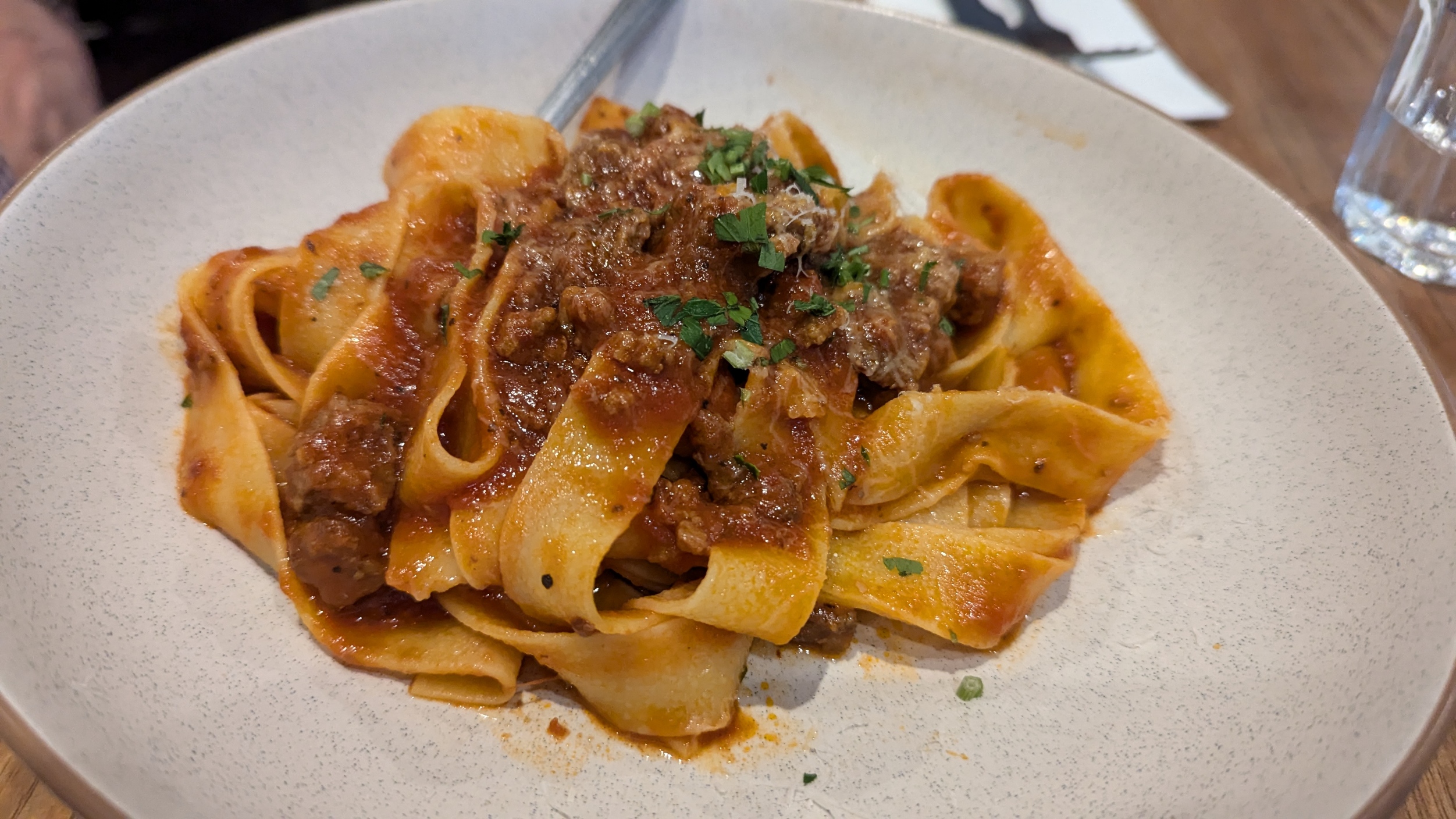
We chose to have only main courses, and this was quite enough as they are generous as well as being flavoursome. The two fish dishes, barramundi – one with a tomato sauce and the other with pesto, were excellent. The chicken and prawns looked delicious and was pronounced as not too spicey – I shall choose it next time. The beef ragu had a generous sauce and the pasta was nicely cooked.



 Robin's Room