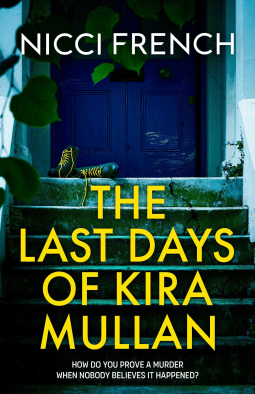
Nicci French The Last Days of Kira Mullan Simon & Schuster (Australia)|Simon & Schuster UK, January 2025.
Thank you, NetGalley, for providing me with this uncorrected proof for review.
I had just finished rereading Nicci French’s Frieda Klein series, and joy of joys, “The Last Days of Kira Mullan” became available. This book did not disappoint. Like the many Nicci French novels already published, this one also deserves the accolades they have garnered. “The Last days of Kira Mullan” reintroduces Detective Inspector Maud O’Connor from the earlier novel, “Has Anyone Seen Charlotte Salter?” However, before she arrives to investigate the Kira Mullan case anew, Nancy North’s story takes centre stage. This is an excellent device, reflecting a similar experience in the earlier novel where the detective also entered the narrative where the build-up gave Charlotte Salter’s story priority. At the same time, Maud O’Connor’s story moves forward, not only does she investigate but she makes a new friend and deals with old enemies.
Nancy North, would be restaurateur, has had a breakdown. Felix, her partner, is determined to care for her and ensure that there is no recurrence. Economic circumstances force them to move from their familiar flat and environment to a new area and into an inadequate and poorly located flat. The neighbours include a constantly crying baby, her young mother and overworked doctor husband, two male friends, and Kira Mullan. Next door is a similar house, which has remained intact, belonging to a mature married couple. Their superior economic situation creates an unequal power relationship with the flat dwellers despite fraternisation between them. See Books: Reviews for the complete review.
After the book review: Brief discussion of two books making a similar point on the way in which accusations of poor mental health can be used to diminish women’s autonomy – The Yellow Wallpaper and The Little House; Ethel Carrick | Anne Dangar at the NGA; American Politics: Joyce Vance, The Atlantic – Trump’s Sentencing Made No One Happy, Andrew Weissman’s podcast, Liz Cheney’s opinion; Lawrence O’Donnell interviews Neal Katyal and Andrew Weissmann; Huffington Post Commentary; London Activities in January.


The treatment of Nora North’s statements and evidence by her neighbors, police and her close friends reminded me of The Yellow Wallpaper by Frances Perkins Gilman. * In this story, a woman’s remedy, acknowledging her ability to decide upon her treatment for what is seen as her mentally unstable behaviour, is rejected. With the kindness exhibited by Felix, in The Last Days of Kira Mullan, the woman’s pleas are ignored by her husband. He, and her male doctors, know best. This woman finds her succour in writing, but she must do this in secret – her husband and doctors do not approve. The energy she must use to hide her writing becomes an important theme in the story. Her ennui is the inevitable outcome of the energy she must use to stave off madness in an environment where her word is nullified. The pressure of her male ‘supporters’ that she is incapable of choosing a beneficial lifestyle, makes it impossible for her to make that choice.
*There is a range of interpretations of the story advanced in Wikipedia that make interesting reading.
I found The Yellow Wallpaper and Herland by Charlotte Perkins Gilman on Amazon for 99p. Herland features in another book I shall be reviewing in a few weeks’ time, The Book Club for Troublesome Women.


The Little House Philippa Gregory, available on Amazon and secondhand – a great buy.
Philippa Gregory is more well known for her historical fiction. However, her earlier fiction is also well worth reading. The Little House, like The Yellow Wallpaper, and this week’s reviewed book, The Last Days of Kira Mullan, also looks at the impact of seeming kindness to obliterate a woman’s knowledge about herself and her abilities.
The little house is at the end of a road leading to the manor farm of yellow Bath stone. It is Ruth and Patrick’s, and later, Thomas’s house – or is it? Does it really belong to Elizabeth? Do Patrick and Thomas also belong to her? Just where does Ruth feature in the Cleary family? Frederick, Elizabeth’s husband is sometimes shadowy, sometimes benign, at others the friend of powerful people who can control what happens to Ruth.
This story is one of control, the powerful people will only be brought to bear if Ruth does not adhere to the plans the Clearys have for her and Thomas. Central to these are Elizabeth’s friendly dismissal of Ruth’s abilities, thoughts and identity; Frederick and Patrick’s concurrence; and Ruth’s initial gratitude to the Clearys for providing her with a family. As an orphan with unacknowledged overwhelming grief, Ruth is easy fodder. At least until she rebels, accepts that she is in a fight for survival as Thomas’s mother, and acts.
Ruth is committed to psychiatric care, considered a blot on her character and ability, by the Clearys and used to continue their dismissal of her identity as an able, although struggling, new mother. Recognising that only dramatic action can change her situation, Ruth plans.
In this novel Ruth and the control exerted upon her, undermining her mental health, is the focus. This is like the situation in The Yellow Wallpaper. However, the result is dramatically different in Gregory’s hands. And very satisfying.


Ethel Carrick | Anne Dangar
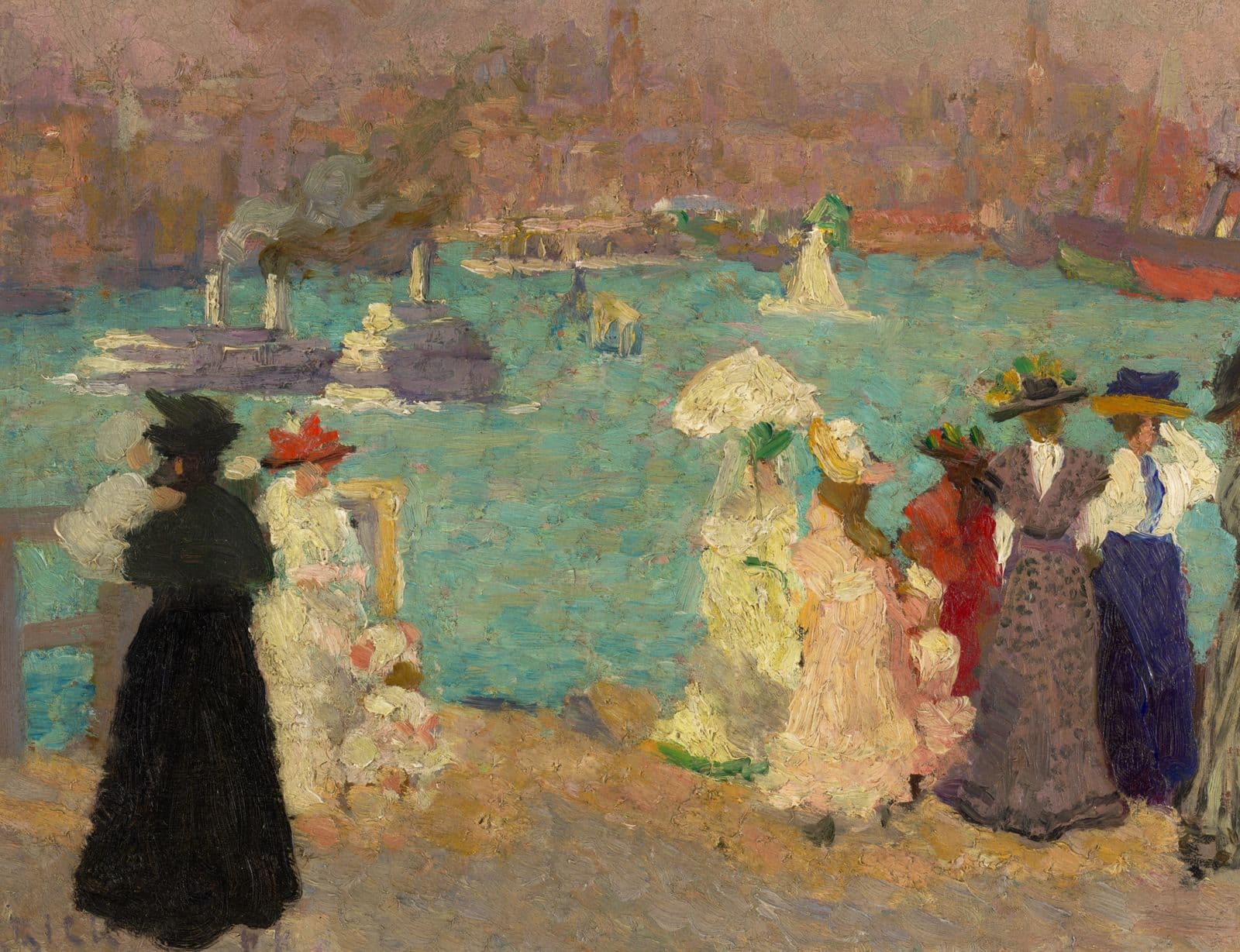
7 Dec 2024 – 27 Apr 2025
Level 1, Gallery 12
Free
This summer, the National Gallery explores the lives and artistic legacies of Ethel Carrick and Anne Dangar.
Ethel Carrick was a gifted painter and colourist who was among the first artists to introduce a post-impressionist approach to Australia. An intrepid traveller, Carrick had a fascinating life and this retrospective brings new insights into her remarkable artistic legacy, nationally and internationally.
Anne Dangar places the artist at the forefront of modern art in Australia. Living in France, she worked and exhibited alongside European cubists as their artistic peer, all the while exerting an irrevocable influence on the course of Australian abstraction.
These simultaneous exhibitions are Know My Name projects, the National Gallery’s initiative celebrating the work of all women artists to enhance understanding of their contribution to Australia’s cultural life.
Listen to the audio tour through exhibitions Ethel Carrick and Anne Dangar, narrated by Katy Hessel.

Anne Dangar, Plate 1934 -1935, National Gallery of Australia, Kamberri/Canberra, Gift of Ruth Ainsworth 1998.
American Politics

Sentenced
Jan 11, 2025
And just like that, what was once thought to be impossible happened. Donald Trump was sentenced on the 34 counts of conviction against him in Manhattan.
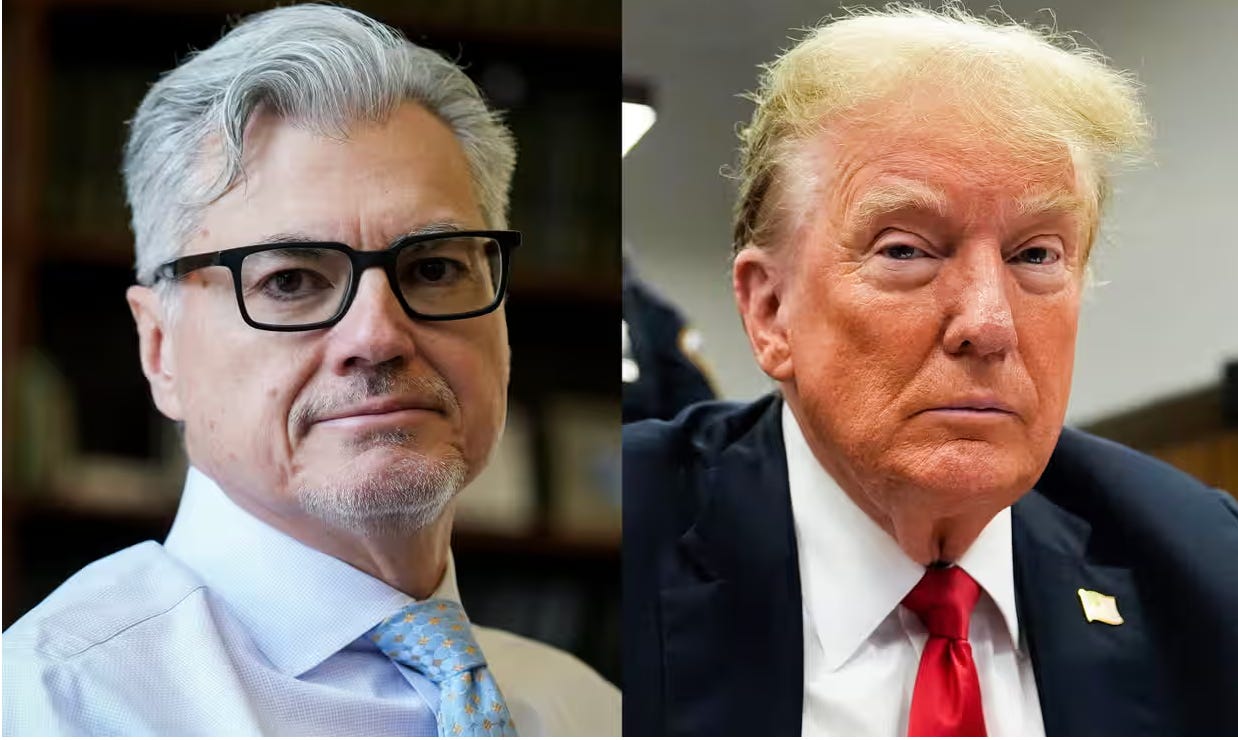
There were no surprises. Trump did not demonstrate remorse like many defendants do at this point. He didn’t apologize for the harm he’d done or the worry he’d caused his family. But then, we did not expect him to. Instead, he painted himself as a victim of political lawfare.
Judge Juan Merchan imposed the sentence of unconditional discharge he had said he would impose. Trump signed off from the hearing a convicted felon. But, he was also a free man. Trump has no further obligations to the court—no sentence, no fine, no supervision.
The Judge’s decision to forego imprisonment, or even a fine, did not sit well with some people. And after years of watching Trump delay, twist, and outrun the legal system for the most part, it’s easy to understand why.
Trump outran the reach of the criminal justice system, both in the two federal cases against him and the Fulton County, Georgia, prosecution. There will be no jury verdict in a criminal prosecution of Donald Trump for January 6. That is an unescapable fact that leaves Americans wondering, rightly, what comes next in our system of justice, where everyday Americans must face a jury and judgment if they commit crimes and are indicted, while Trump avoids that outcome.
Against that backdrop, today’s sentencing hearing, as strange as this may sound, gives me hope more than it gives me pause. It leads me to believe the damage Donald Trump has done and will continue to do to our system can be repaired through individual acts of conscience and courage. Hear me out.
The system is severely stressed at the moment. But the fact that this sentencing took place at all and that Trump now stands as a convicted felon, something that should have happened as a matter of course but was far from certain in this case, is a testament to what we can reclaim. The Judge and prosecutors in court today were American heroes. They put themselves squarely in the sights of a very powerful man. Their sacrifice and willingness to stand up for the rule of law is something we should all honor. They acted with true courage. They refused to obey in advance.
“This defendant has caused enduring damage to the public perception of the criminal justice system,” said prosecutor Joshua Steinglass. “He thinks he is above the law and not responsible for his actions.”
But Steinglass went on to acknowledge reality; that Trump would be the president in a few days and that Americans deserved a president who took office without a tail of obligations resulting from a sentence in a criminal case. What would have been fair to impose of citizen Trump would have harmed a country about to be led by President Trump. It is the ultimate unfairness, but it is also reality. And so, the court did the best it could in a bad situation.
The sentencing might not have happened but for Judge Merchan’s decision to announce in advance that he would proceed with an unconditional discharge. The Supreme Court narrowly signed off on it, in a 5-4 vote where Chief Justice Roberts and Justice Barrett joined Justices Sotomayor, Kagan, and Jackson to deny Trump the result he wanted.
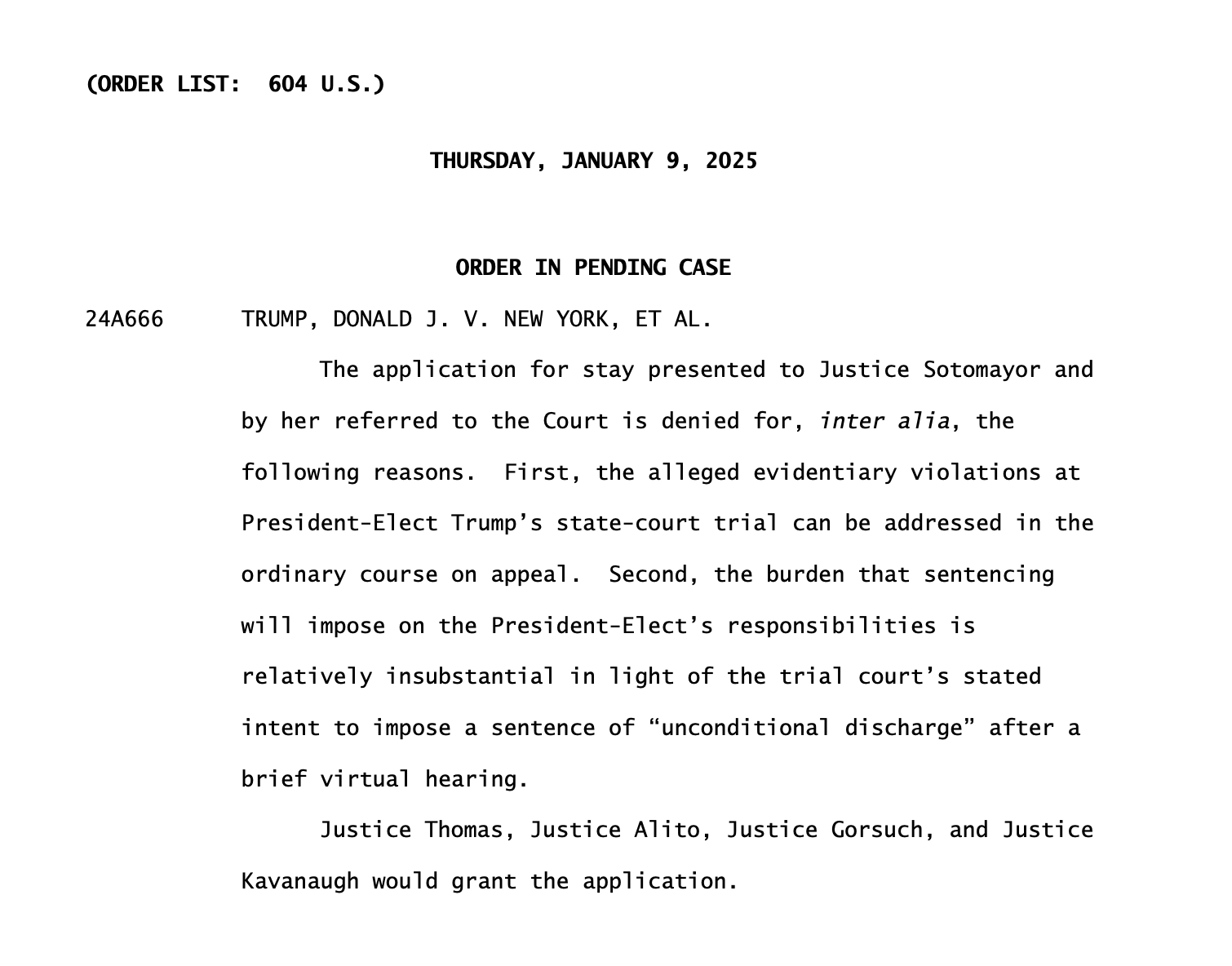
The five justices in the majority briefly explained Trump wasn’t entitled to postpone sentencing because his arguments could be addressed in the course of the appeal following sentencing (this is the process that applies to every other defendant) and that since Judge Merchan had already said he wouldn’t impose time in prison, any burden on “the President-Elect’s responsibilities” would be “relatively insubstantial.” Sentencing was on, the result a rare one in a Trump case that led to him being treated like other people. Trump got sentenced. He was not entirely above the law.
Now, Trump will take office in 10 days as a convicted felon. We should not gloss over how shocking it is to have a criminal for an American president. But it’s also a start. In the end, in this one case in Manhattan, Donald Trump was held accountable.
To those disappointed by the sentence, I’d encourage you to continue to consider the rationale. Insisting on a longer sentence would have meant there would be no sentencing at all based on what we know of the Supreme Court’s reasoning. First offenders convicted of similar crimes in New York don’t typically face jail time. The explanation for the sentence that Judge Merchan offered makes sense, even if its not the outcome people wanted: Trump got this treatment because of the office that the American people elected him to. It’s the office that merits these protections, not the man. The man was held accountable. The jury verdict that he continues to criticize was enforced.
As Judge Merchan said, “It is the legal protections afforded to the OFFICE of the president of the United States that are extraordinary, not the occupant of the office.” In an imperfect situation, men and women committed to the rule of law found a way to hold Donald Trump accountable when it would have been easier to give up. Ultimately the Judge did the right thing. He stood for the rule of law, and his fidelity will, perhaps, be viewed in the sweep of history as the first small step toward restoring it. Judge Merchan followed the law: He protected the presidency, but he held the man accountable. Donald Trump will walk up on the day of the inauguration and embark upon the presidency as a convicted felon.
Trump should, of course, have faced accountability before a jury for his conduct in regards to January 6 and for mishandling classified documents and lying about it. It’s a travesty that he didn’t. The Supreme Court has much to answer for. Those cases were not before Judge Merchan and he could not do anything about them. But he did do something about the case in front of him.
At a low point like this, it might be tempting to think that the rule of law is dead. That Donald Trump killed it. There is no doubt that the rule of law is battered, but this can still be a starting point; a low moment during which the only place we can permit ourselves to consider going is up. We will have to measure progress in imperfect, small steps. But making the effort is better than the alternative. Giving up is not an option.
If we abandon the rule of law and democracy because their weaknesses have been exposed, where does that lead? Autocracy is not a pretty place. When we look back years down the road, perhaps we’ll be able to see this as the moment that democracy got a jump start and that people began to find ways to solve the problems, even as Trump regained office. Perhaps it will be the case that Americans saw that decent people who act in a forthright manner in the face of corruption can make a difference, even if it’s a small one, and that what happened in a Manhattan courtroom gives people hope. We need that as we enter upon the second Trump presidency.
While we live through these moments, my heart remains with friends and family in Los Angeles. The other night, MSNBC host Lawrence O’Donnell, who also has Angeleno roots, said that everyone who is from Los Angeles, no matter where they are now, is living in Los Angeles again. My thoughts are with the people who are living through this tragedy. I know there are many of you among our readers at Civil Discourse, and I hope that as you can, you will let us hear from you and help us understand if there is anything we can do. Until then, we are here.
We’re in this together,
Joyce

Trump’s Sentencing Made No One Happy *
But it still mattered for the rule of law. By David A. Graham
Donald Trump, the first convicted felon to be elected president, was sentenced today in his New York hush-money case, pleasing virtually no one.
Justice Juan Merchan sentenced the president-elect to an unconditional discharge, meaning Trump will face no penalties other than the stigma of a conviction. Trump was furious that he was sentenced at all, and had mounted a campaign in the courts of law and public opinion to stop it. His critics won’t be happy with the sentence itself, which is less than a slap on the wrist.
This mutual unhappiness was perhaps the only point of agreement at the hearing in Manhattan. “This defendant has caused enduring damage to public perception of the criminal-justice system and has placed officers of the court in harm’s way,” the prosecutor Joshua Steinglass said. Trump, meanwhile, said the case had “been a tremendous setback” for the New York courts. “This has been a very terrible experience,” he said.
The fact that someone could commit the crimes that Trump has and still win a presidential election remains galling, but the difficulty of getting to this moment, and the ways the other criminal cases against him stalled out, shows how significant the sentencing is, even considering its leniency. Trump’s criminal trials have demonstrated that there is not equal justice for all, but there is some justice…* This is only the beginning of the article, but the point made already is significant.
Andrew Weissman’s opinion
I was unable to find Andrew Weismann’s opinion before posting this week. However, his podcast with Mary McCord will surely include this in the coming weeks. The podcast can be accessed through the renamed podcast, Main Justice. See below:
Jan. 9, 2025, 6:20 AM GMT+11
‘As the political landscape transforms and Donald Trump’s criminal cases wind down, MSNBC legal analysts Andrew Weissmann and Mary McCord shift focus to keep watch on the incoming president and how his Department of Justice will use the law to move his agenda forward. With this realignment comes a new name: Main Justice. In this episode, Andrew and Mary explain what Main Justice is before breaking down the barrage of incoming news, from Trump’s pending New York sentencing to his attempt to stop the public release of Special Counsel Jack Smith’s final report. They also give a taste of the broader scope they plan to cover, with analysis of Trump’s unusual filing in the Supreme Court, urging a pause in the TikTok ban until he takes office.‘

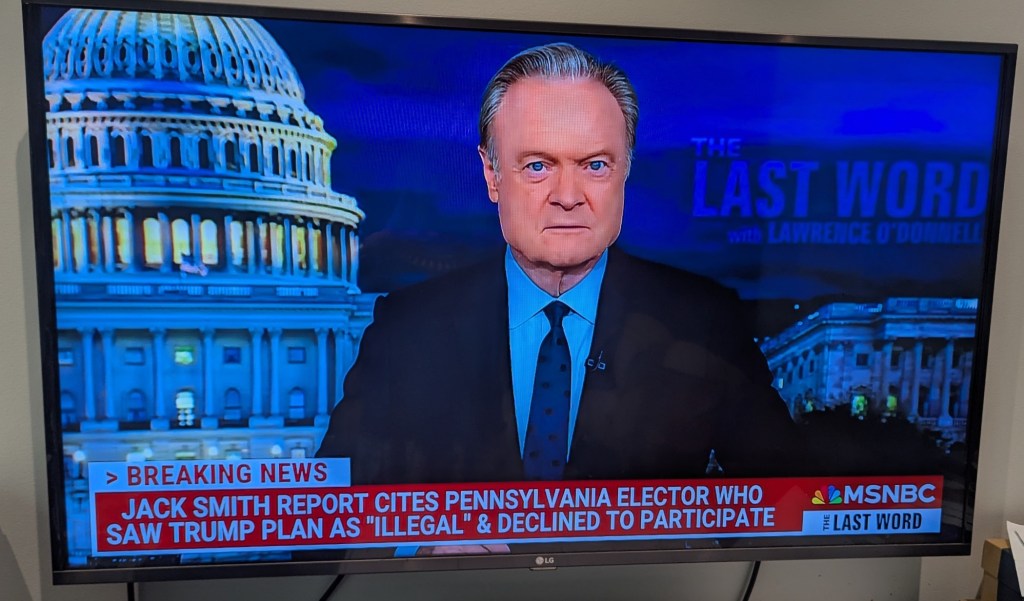
Lawrence O’Donnell MSNBC 14 January 2025
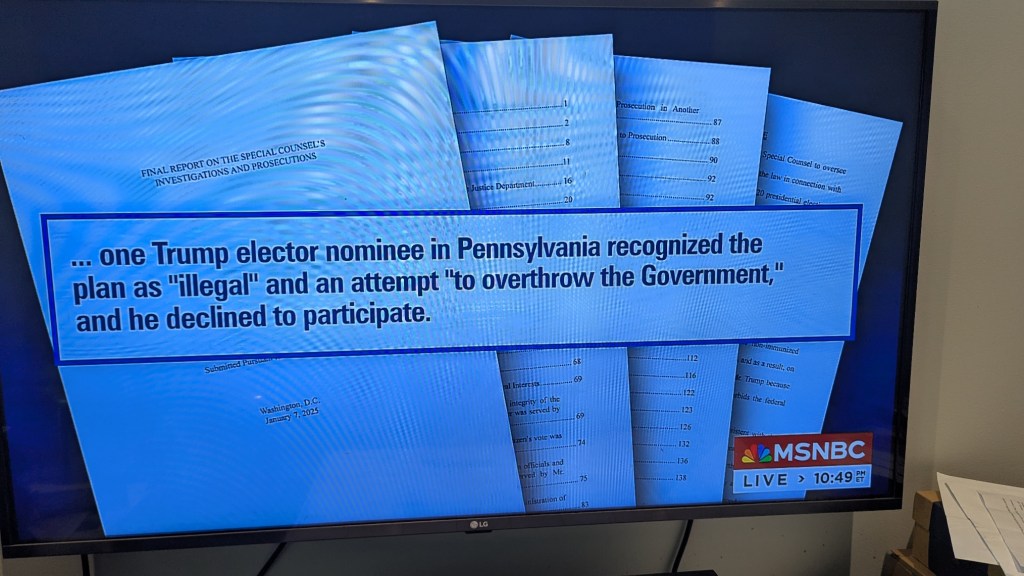
Neal Katyal and Andrew Weissmann, interviewed by Lawrence O’Donnell, gave excellent commentary on Jack Smith’s work, the outcome and the decision. There was also commentary on the response of one elector nominee (related to the fraudulent list of nominees for the Electoral College vote for the President) and that of the proposed Attorney General whose hearing will begin on the 15th of January 2025.

Liz Cheney’s Opinion
Republican former U.S. Rep. Liz Cheney, who served as vice chair of the House Select Committee on the January 6 Attack, on Tuesday cited the Special Counsel’s just-released, 174-page report on Donald Trump’s involvement with the January 6 insurrection, and his efforts to overturn the 2020 election, to deliver a prescient warning to members of the Senate. Starting today, the Senate begins confirmation hearings on the President-elect’s highly-controversial cabinet nominees. Focusing on Justice Department nominees, she warned Senators that those “compromised by personal loyalty to a tyrant” should not be confirmed.
Jack Smith, who resigned as Special Counsel on Friday ahead of the President-elect’s inauguration next week, emphasized in his report that there was sufficient evidence to warrant prosecuting Donald Trump. He also noted that if those cases had proceeded to a jury trial, the evidence was strong enough to secure convictions.
Smith wrote, “after conducting thorough investigations, I found that, with respect to both Mr. Trump’s unprecedented efforts to unlawfully retain power after losing the 2020 election and his unlawful retention of classified documents after leaving office, the [Principles of Federal Prosecution] compelled prosecution.”
READ MORE: LA Mayor a ‘Communist’ Alleges Fox News Host With Ties to Trump Nominee
Cheney says that Smith’s report makes clear that Trump’s nominees, specifically, Justice Department nominees, had anything to do with his efforts to overturn the election, they must not be confirmed by the Senate: “if those nominees cooperated with Trump’s deceit to overturn the 2020 election, they cannot now be entrusted with the responsibility to preserve the rule of law and protect our Republic.”
“The Special Counsel’s 1/6 Report,” her statement begins, “made public last night, confirms the unavoidable facts of 1/6 yet again. DOJ’s exhaustive and independent investigation reached the same essential conclusions as the Select Committee. All this DOJ evidence must be preserved.”
READ MORE: Senator Suggests Unusual Interpretation of ‘Advice and Consent’ Responsibility
“But most important now, as the Senate considers confirming Trump’s Justice Department nominees: if those nominees cooperated with Trump’s deceit to overturn the 2020 election, they cannot now be entrusted with the responsibility to preserve the rule of law and protect our Republic. As our framers knew, our institutions only hold when those in office are not compromised by personal loyalty to a tyrant.”
“So this question is now paramount for Republicans: Will you faithfully perform the duties the framers assigned to you and do what the Constitution requires? Or do you lack the courage?”
Sarah Longwell, a Republican and the publisher of The Bulwark, responded, writing: “This. Donald Trump has revealed how shallow the vast majority of the current GOP’s commitment is to the constitution and the American experiment. These confirmation hearings will be another inflection point for the few who claim they value their oath. I hope some rise to the occasion.”
Huffington Post Commentary on Jack Smith’s Report
Why Donald Trump Wasn’t Charged With Insurrection
Prosecutors had a mountain of evidence — but a series of key obstacles got in their way.

Jan 14, 2025, 06:57 PM EST
It fully investigated and completely cleared so you think you are completely cleared because you committed no crime
What happened at the U.S. Capitol on Jan. 6, 2021, according to many of the nation’s courts and judges, was an insurrection by the very definition of the word. So why, at the end of a yearslong probe, did special counsel Jack Smith ultimately forgo charging Donald Trump with inciting one?
The answer was spelled out in Smith’s charging report to Attorney General Merrick Garland that went public on Tuesday. The report was an unambiguous presentation of why Trump’s alleged criminal effort to unlawfully retain power left prosecutors no choice but to charge him with four felonies. A federal judge (and Smith) only agreed to dismiss the case because Trump won the election in November and prosecutions against sitting presidents are against long-standing Justice Department policy.
Smith’s report could be the final word any prosecutor ever has on Trump and Jan. 6. However, if prosecutors or congressional lawmakers can convince courts (and each other) in the coming years that an existing five-year statute of limitations for federal cases isn’t on pause while Trump is president, then Smith’s report may not be the end of one story, but the beginning of another.
First, to understand where Smith ended up, a bit of history is necessary.
The Mile-High Road To Nowhere
In November 2023, Colorado District Court Judge Sarah Wallace ruled that Trump engaged in an insurrection against the Constitution in violation of Section III of the 14th Amendment.
The judge’s ruling stemmed from a lawsuit brought by six Republicans in Colorado and one unaffiliated voter who wished to remove Trump from the ballot ahead of the 2024 election. They argued that Trump’s remarks from the Washington Ellipse on Jan. 6, his alleged intimidation of voters and election and state officials, his failure to immediately call down the mob, and his alleged pressure campaign on then-Vice President Mike Pence to overturn the results of the 2020 election amounted to insurrectionary acts, and therefore his ouster from the ballot in Colorado was warranted.
The voters argued that while Trump may not have engaged in violence personally on Jan. 6, that element did not need to be proven in order for him to be disqualified from the ballot.
They claimed it was simpler than that, because Trump violated his oath to uphold and defend the Constitution and spent “three hours watching [the events] unfold on television without doing a single thing even though he was the most powerful person in the world,” a lawyer for the voters argued in court.
In her 2023 ruling, Wallace said she was convinced Trump had “engaged” in insurrection, based on the harrowing evidence and testimony she’d considered. But she could not disqualify him.
Disqualification hung on a persnickety distinction: Section III, or the insurrection clause, did not actually consider whether the president of the United States was considered an “officer” of the United States, Wallace found.
Section III of the 14th Amendment states: “No person shall be a Senator or Representative in Congress, or elector of President and Vice-President, or hold any office, civil or military, under the United States, or under any State, who, having previously taken an oath, as a member of Congress, or as an officer of the United States, or as a member of any State legislature, or as an executive or judicial officer of any State, to support the Constitution of the United States, shall have engaged in insurrection or rebellion against the same, or given aid or comfort to the enemies thereof. But Congress may, by a vote of two-thirds of each House, remove such disability.”
For “whatever reason,” Wallace wrote in her ruling, the drafters of the Constitution’s insurrection clause “did not intend to include a person who had only taken the presidential oath,” and it wasn’t for her court to decide what the drafters meant.
Trump fought the ruling all the way up to the Colorado Supreme Court, which ruled against him in December 2023. In a 4-3 decision, the state justices concluded that Trump was an officer of the United States, that he engaged in insurrection and that he must be removed from the ballot on those grounds. Trump appealed to the U.S. Supreme Court, and in March 2024 — one day before Super Tuesday primaries — the nation’s most powerful court ruled for the first time in its history on how to apply the insurrection clause.
They reversed the Colorado Supreme Court’s ruling and declared that Colorado’s secretary of state had no authority to remove Trump from the ballot. While states could disqualify a person from running for office or holding it, the insurrection clause was something Congress alone had the power to enforce or modify, the court ruled.
Trump’s lawyers recoiled at the notion that he could be charged with providing rioters “aid or comfort” because, his attorney Scott Gessler argued, not a single Jan. 6 rioter was charged under the Insurrection Act. The fact that more than a dozen people were charged (and later convicted) of seditious conspiracy, or plotting to stop the nation’s transfer of power, was not acknowledged by Trump’s defense.
As Smith alluded to in his final report, Trump’s regular defense of his conduct around Jan. 6 hinged on claims that his words at the Ellipse — where he called on his supporters to “fight” — were broadly protected under the First Amendment.
But there is a difference between speech and incitement, and Smith wrote Tuesday that while the special counsel’s office had “reasonable arguments to be made that Mr. Trump’s Ellipse Speech incited the violence at the Capitol on Jan. 6 and could satisfy the Supreme Court’s standard for ‘incitement’… particularly when the speech is viewed in context of Mr. Trump’s lengthy and deceitful voter fraud narrative that came before it,” there was never any “direct evidence” that prosecutors were able to develop proving an explicit admission or communication with co-conspirators.
To succeed in trying Trump for inciting an insurrection, they would have to prove subjective intent showing that Trump meant to cause the full range of violence that day.
With other, more “solid” charges available to prosecutors that would allow them to forgo clearing any “rigorous” hurdles for speech, dropping pursuit of the insurrection charge was the most legally sound choice.
Unprecedented, Unparalleled, Uncertain
Wallace and the Colorado Supreme Court have not been the only parties in the legal system to characterize Jan. 6 as an insurrection.
As Smith pointed out Tuesday, judges in several Jan. 6-related cases have described the attack on the Capitol as an insurrection. This happened even when the charges were misdemeanors and the individual’s conduct was in no way connected, or described as being connected, to part of a “rebellion.”
For example, when a Chicago police officer and his sister, Karol and Agnieszka Chwiesiuk, were headed to trial for Jan. 6 misdemeanor offenses, they asked a federal judge to quash any reference to an “insurrection” or being among “insurrectionists” during proceedings. The judge refused.
These were “accurate descriptors,” because “what occurred on Jan. 6, 2021, was in fact an insurrection and involved insurrectionists,” the judge wrote.
This also happened in the case of Jan. 6 rioter Sara Carpenter, a former New York police officer who, prosecutors said, ignored orders to leave the Capitol and at one point used a tambourine to slap away a police officer’s arm. She spent 30 minutes inside the Capitol building that day. When she emerged, tambourine in the air, she exclaimed: “The breach was made and it needs to calm down now. Congress needs to come out, they need to certify Trump as president, and this is our house.”
Smith noted that in Carpenter’s case, the judge made it plain when writing that “what occurred on Jan. 6 was in fact a riot and an insurrection and it did in fact involve a mob.”
But in these and other instances, the courts were never obligated to resolve how to define an insurrection under Section III.
Before even touching the question of whether Trump incited an insurrection, prosecutors at minimum needed guidance on exactly what proof is required to establish that an insurrection took place, and how to distinguish an insurrection from a riot.
The special counsel’s office didn’t have that.
Dictionary definitions of “insurrection” sometimes make a distinction between an insurrection and a “rout, riot, or offense connected with mob violence” when it features both an organized and armed uprising against the government, Smith wrote.
But doubt began to creep in when prosecutors considered the very limited amount of case law regarding insurrection in the U.S.
Some U.S. courts have already defined “insurrection” as something that occurs when it involves “overthrowing a sitting government, rather than maintaining power.”
This dynamic posed “another challenge to proving beyond a reasonable doubt that Mr. Trump’s conduct on Jan. 6 qualified as an insurrection given that he was sitting president at that time,” the report states.
There was not a single case, Smith said, in which a criminal defendant in America had been charged with attempting to overthrow the U.S. government from the inside.
Prior to Jan. 6, such attacks had only ever come from the outside.
According to Smith, applying incitement for insurrection in the context of Trump’s case “would have been a first, which further weighed against charging it, given the other charges available, even if there were reasonable arguments that it might apply.”
London Activities in January

Citra Sasmita, Act One (detail), 2024, from Into Eternal Land, The Curve, Barbican, 2025 © Citra Sasmita
This exhibition was made possible thanks to Lead Support from the Bagri Foundation, additional support from the MENAEA Collection, Kuala Lumpur, the Henry Moore Foundation, and Natasha Sidharta, as well as a residency in partnership with Delfina Foundation.
In January 2025, Indonesian artist Citra Sasmita will transform The Curve for her first solo exhibition in the UK: a new commission titled Into Eternal Land. Working fluidly across painting, sculptural installation, embroidery and scent, Sasmita will invite visitors on a symbolic, multi-sensory journey through the 90-metre-long gallery to explore ideas of ancestral memory, ritual and migration.
An interdisciplinary artist, Sasmita’s practice challenges fixed ideas in relation to gender roles, hierarchies of power, systems of oppression, and more. Her work refuses categorisation both in terms of materials and iconographies, questioning reductive, colonial conceptions of traditional Indonesian art and the historic marginalisation of craft traditions. Into Eternal Land speaks to universal and urgent concerns: connecting with ancestral traditions, grappling with the power and precarity of the natural world, and proposing the possibility of feminist resistance.
Sasmita’s practice often engages with the Indonesian Kamasan painting technique. Dating from the fifteenth century, and traditionally practiced exclusively by men, Kamasan was used to narrate Hindu epics. Reclaiming this masculine practice, Sasmita is interested in dismantling misconceptions of Balinese culture and confronting its violent colonial past. Underpinning her work is a dedication to alternative narratives, particularly the experiences of women who have been fetishised, suppressed or erased. Reinventing inherited mythologies – from indigenous Indonesian histories to Dutch colonial narratives, to contemporary society – her protagonists are powerful women who populate a post-patriarchal world.
For her Barbican commission Into Eternal Land, the artist draws inspiration from a rich range of sources. These include centuries-long histories of displacement and migration across the Indonesian archipelago, as well as the symbolism of heaven, earth and hell across cultures – from the story of Bhima Swarga crossing hell to save his parents, as recounted in the Balinese epic Mahabharata, to Dante’s Inferno and beyond.
Panoramic scroll paintings – Sasmita’s reinterpretation of Kamasan paintings – unfurl along the curved walls of the gallery, depicting women undergoing transformation and reincarnation: becoming trees or bird spirits, emitting flaming auras, pouring forth water and blood. Shrine-like installations encircled by long braids of hair reference deep genealogies and memories held in the body, while paintings on python skin nod to rituals of sacrifice. Textiles hang from the ceiling like flags, conceived of as symbolic portals to another realm. They feature hybrid woman-plant beings, who hold powerful knowledge of herbal medicine. These works are made in collaboration with women artisans in west Bali, whose knowledge of this specific embroidery technique is in danger of disappearing. A mandala (circle) of ground turmeric serves as the focal point of the final chapter of the exhibition, offering a space for meditation. An ambient soundscape by Indonesian composer Agha Praditya Yogaswara offers a sonic response to Sasmita’s cosmologies.
Citra Sasmita said: “Facing the majestic space of The Curve makes my heart tremble, but at the same time it invites me to explore possibilities that I had never imagined before. As a Balinese person, I believe in the ability to be embodied in space and time. The Curve has allowed me to present a ritual for the space itself, along with the cosmology and cultural roots that I bring from Bali. I am very much looking forward to how visitors will feel when they experience this exhibition.”
About Citra Sasmita
Citra Sasmita (b. 1990, Bali, Indonesia) is a self-taught artist. She studied literature and physics, then worked as a short story illustrator for the Bali Post before she began developing her expanded artistic practice. Major group exhibitions include to carry, Sharjah Biennial (United Arab Emirates, forthcoming 2025); Precarious Joys, Toronto Biennial of Art (Canada, 2024); After Rain, Diriyah Contemporary Art Biennale (Saudi Arabia, 2024); Ten Thousand Suns, 24th Biennale of Sydney (Australia, 2024); Choreographies of the Impossible, 35th São Paulo Biennale (Brazil, 2023); The Open World, 3rd Thailand Biennale, Mae Fah Luang Art and Cultural Park, Chiang Rai (Thailand, 2023); Garden of Ten Seasons, Savvy Contemporary, Berlin (Germany, 2022); Kathmandu Triennale (Nepal, 2021-2022); ARTJOG MMXXII, Time To Wonder, Jogja National Museum, Yogyakarta (Indonesia, 2021); and the Biennale Yogyakarta (Indonesia, 2019). Solo shows include Atlas of Curiosity, Yeo Workshop (Singapore, 2023); Ode To The Sun, Yeo Workshop (Singapore, 2020); and Tales of Nowhere, Museum MACAN, Jakarta (Indonesia, 2020

 Robin's Room