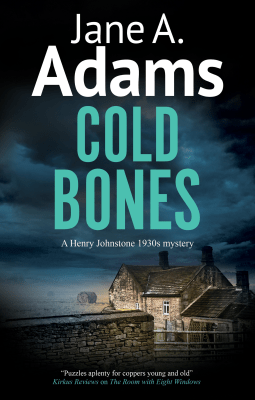
Jane A. Adams Cold Bones Severn House, December 2024.
Thank you, NetGalley, for providing me with this uncorrected proof for review.
This is book 10 of the Jane A. Adams series that features former Detective Chief Inspector Henry Johnstone. Set in the 1930s, it is described as a mystery. It is also a challenging social commentary. The gentle resolution of two brutal murders and a miscarriage of justice, is a departure from the usual thriller, until the juxtaposition of this style with the grisly realities of the punishment that the murderer will suffer, and details of the murders becomes apparent. A wealth of other attributes, make this novel satisfying in a rather different way from the page turner thriller. These attributes include the portrayal of a man finding his way from a demanding career to life at a different pace; a main character battling prejudice, which is reflected in the depiction of other female characters, depiction of the backgrounds to the various perpetrators and the very pleasing writing style. See Books: Reviews for the complete review.
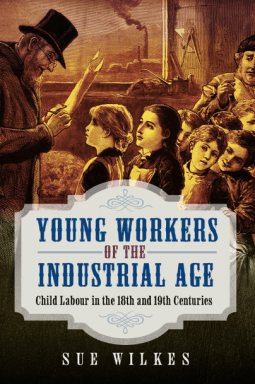
Sue Wilkes Young Workers of the Industrial Age Child Labour in the 18th and 19th Centuries Pen & Sword | Pen & Sword History, September 2024.
Thank you, NetGalley and Pen & Sword, for providing me with this uncorrected proof for review.
This is a harrowing account of child workers, and their occupations, in the 18th and 19th centuries. I found it impossible to read at one sitting, not because of the style (as usual in these publications it is eminently readable) but because of the inhumanity it brought so graphically to life. Equally, Wilkes’ attention to the philosophy behind the treatment of children in that period is distressing – after all, are the ideas behind punishment for poverty so removed from current circumstances? Then profits rather than people were considered of utmost importance. Wilkes leaves us with the question – and now? It is Sue Wilkes’ empathy with the workers and her enlightening discussion that makes this book powerful, and I reiterate, harrowing. However, this does not mean it should not be read. Although aware of the circumstances under which children laboured from other sources, Wilkes’ research is commendable, bringing as it does such detailed accounts of the occupations and conditions that endured in this period.
That children’s labour provided to those who could afford them, clothing items such as cotton, buttons, pins, lace, and straw hats is graphically described. Further, the point is made that children also produced household items such as glass, carpets, cutlery candles and pottery and swept the chimneys of these houses – again, for those who could afford them. That the houses warmed with these soot laden structures, above fires with matches that child labour produced, were cleaned by young people, for many hours a day becomes real under Wilkes’ hand. Reading this book, it is now less difficult to picture the well clad people that we see in film and on television in period dramas taking advantage of the philosophy around children and childhood in the period. See Books: Reviews for the complete review.
After the reviews: Ghosts to be made in Western Australia; the British version of Ghosts; Cindy Lou at 86 North and Cafe Cultura; Civil Discourse – Joyce Vance; An encore performance for ‘Miss Pym’; The Reality behind Barbara Pym’s Excellent Women The Troublesome Woman Revealed, Cambridge Scholars Publishing, 2023 – excerpt re comedy in Pym; ICYMI: Martin Luther King III Says His Father Would Be ‘Quite Disappointed’ With The Current World; On the third Monday of each January, Americans honor the memory of the Reverend Doctor Martin Luther King, Jr., a leader in the U.S. Civil Rights Movement, who advocated for social change through non-violent means; Kamala Harris and Joe Biden quotes on MLK Day; Civil Discourse, short excerpts; Michelle Obama on MLK Day.
BBC Studios Productions’ ‘Ghosts’ to haunt Western Australia
Staff Writer· NewsProductionTV & Streaming ·January 17, 2025

From left are Screenwest CEO Rikki Lea Bestall, ‘Ghosts’ executive producer Sophia Zachariou, WA Culture and Arts Minister David Templeman, ‘Ghosts’ producer Bree-Anne Sykes, and director Christiaan van Vuuren at the ABC Studios in East Perth (Image: Liang Xu).
BBC Studios Productions Australia has partnered with Screenwest to bring the production of supernatural comedy Ghosts to Western Australia.
Announced as part of Paramount ANZ’s 2025 upfronts, the eight-part series follows lovebirds Kate and Sean, a couple about to jump into the hellscape that is the inner-city rental market until Kate inherits a huge mansion in the country.
Moving in together for the first time the young couple are attempting domestic bliss, but unbeknown to them, the house is haunted by a collection of needy spirits who carked it in Ramshead Manor over the past 200 years.
The original series, produced by Monumental Television in association with Them There, first aired on BBC One in 2019, with the fifth and final season becoming the UK’s most-watched comedy of 2023. There has since been a US version – currently in its fourth season – and a newly announced German adaptation.
The Australian version will be filmed in Perth in the coming months with support from the Western Australian Production Attraction Incentive.
Christiaan Van Vuuren and Madeleine Dyer will direct the episodes, which are being produced by Bree-Anne Sykes and executive-produced by Sophia Zachariou.
Josh Mapleston leads a writing team that includes script editor Libby Butler, along with Shontell Ketchell (Gold Diggers), Philip Tarl Denson (Zero-Point), and Steph Tisdell. The cast is yet to be announced.
Screenwest CEO Rikki Lea Bestall said the production represented an exciting start to the year for the state’s screen sector, which recently welcomed the third season of Binge courtroom drama The Twelve and the second season of the ABC’s Mystery Road: Origin.
“GHOSTS has entertained audiences all around the world, and we’re so pleased to welcome Network 10, Paramount+ and BBC Studios Productions Australia to Western Australia for the Australian series,” she said.
BBC Studios Productions Australia general manager and creative director Kylie Washington said the state was the “perfect backdrop” for the series’ comedic antics.
“We’re excited to bring Ghosts to life with a unique cast of characters that reflect our very own history and culture,” she said.
The British version on which this Australian production is based
From Wikipedia, the free encyclopedia (edited)
Ghosts is a British sitcom …It follows a group of ghosts from different historical periods haunting a country house while sharing it with its new living occupants…
Premise
Alison Cooper unexpectedly inherits the vast but crumbling Button House from a distant relative. The house is haunted by numerous squabbling ghosts from across the ages who died on its grounds and are invisible and intangible to the living. Ignoring their solicitor’s advice to sell the property, Alison and her husband Mike decide to move in and renovate it, with the idea of turning the house into a luxury hotel.
At first, the ghosts are not happy with the living couple’s plans and conspire to get rid of the newcomers. After various failed attempts to scare them, one of the ghosts pushes Alison from an upstairs window, resulting in her being clinically dead for three minutes. When she awakens …Alison discovers that her husband has arranged a huge mortgage, and that her near-death experience has given her the ability to see and hear the ghosts.
Initially believing the ghosts to be an after-effect of her accident, Alison eventually accepts the truth and confronts them. Because the Coopers cannot leave for financial reasons, and the ghosts are bound to the mansion’s land until they can ascend into the afterlife (which they refer to as being ‘sucked off’, unaware that the phrase is a euphemism in modern times), both sides eventually agree that they have to coexist as best they can. Meanwhile, the house requires a lot of work, and Alison and Mike devise several schemes to assist their perilous finances.
Cindy Lou enjoys meals in Canberra
86 North
86 was great as usual. We sat outside as inside tends to become noisy – not that we are put off by this, the food and service more than make up for it. On this occasion there were four of us, and I was so busy talking (and eating) I forgot to take photos of some of the dishes. Those missing are the delicious spiced cauliflower, the broccolini (charred and with a generous portion of hazelnuts) the pumpkin tortellini with the sage and burnt butter sauce, and the crispy chicken with two sauces. Pictured are the entrees – the charred corn cobs with the most fantastic sauce and parmesan, and the duck bun, and the three desserts we chose. Of these, we found the frozen margherita a bit of a disappointment, but the strawberry cheesecake and the popcorn sundae made up for this. I enjoy the mocktails – the passionfruit is a favourite.






Cafe Cultura
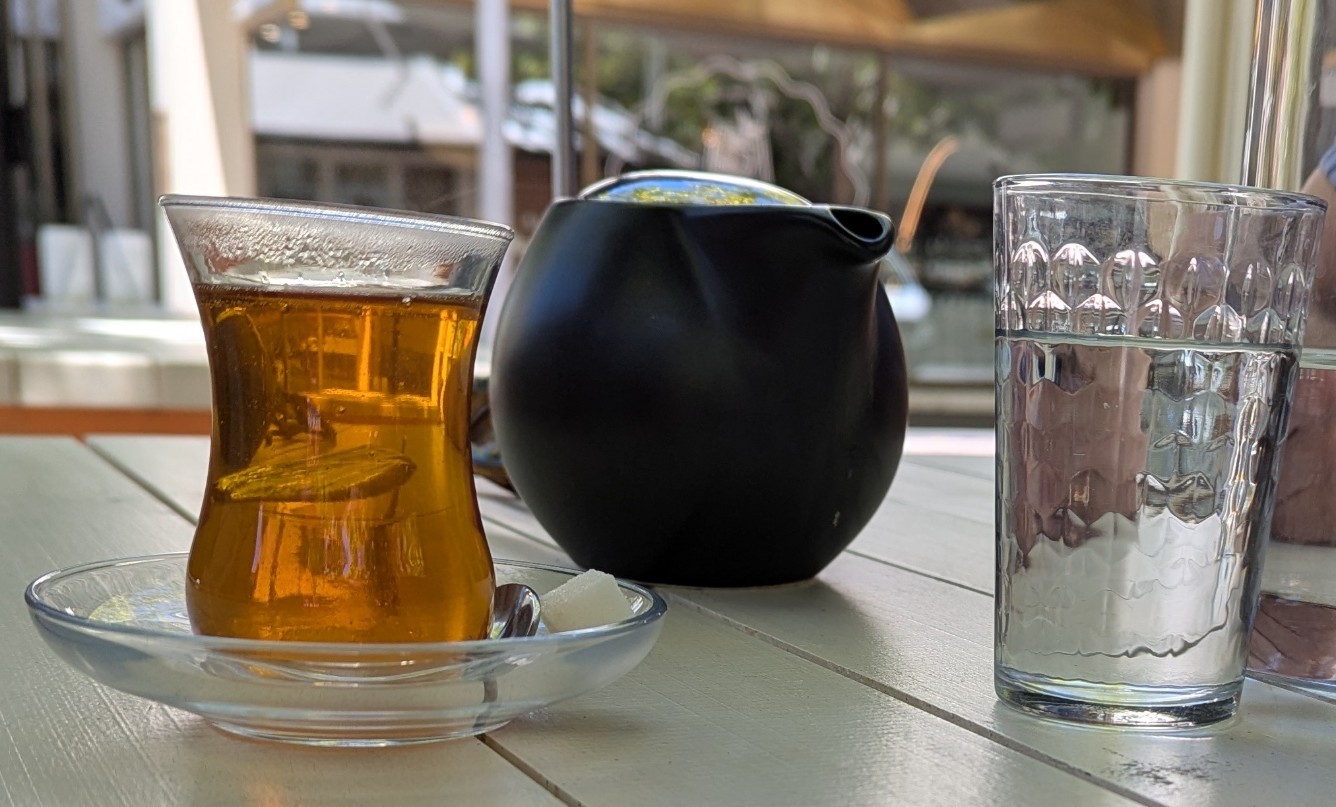
What a find! A great menu with a range of meals for breakfast and lunch the ones we chose from both sections of the menu were delicious. The service was friendly and there is a lovely outdoor setting. Complimentary baklava was a very generous touch. The zucchini fritters were full of zucchini and accompanied by a fabulous salad which cannot be seen in the photo. The Turkish tea looked fun, but water was also provided in carafes.








| I keep returning to one core thought: civics education really matters. It’s absence, at least in part, is what makes a Donald Trump and a MAGA movement possible. It’s the casual view among so many people that the form our government takes doesn’t matter. Living in a democracy isn’t something they view as important; politics is a spectator sport and not serious business. Trump is a symptom of that view. Why have serious governance when you can have the distraction of reality TV? As a voter, the only reason you would let Donald Trump control the levers of power is because you don’t understand what it means and that it’s deadly serious. I’m not talking about politicians or business people here, people who want to ride Trump’s coattails to power and or hope to remain there because of him—there’s a special circle of hell reserved for people like Mitch McConnell, who saw Trump’s behavior on January 6 for what it was and then got right back in bed with him. I’m talking about Trump’s base, our fellow citizens, and, regrettably, sometimes our friends and family.Civics education is important. It doesn’t have to be formal, although it can be wonderful and inspiring when it is. Some people educate themselves. I grew up used to seeing a well-worn copy of Thomas Paine’s Common Sense on my grandfather’s bookshelf. Civics education isn’t about advocating for one political view over another, it’s about understanding our constitutional democracy, the three branches of government, the importance of checks and balances, the rule of law, and the commitment of the Founding Fathers, as imperfect as it was at inception, to protecting the rights of all people, not just people who looked like them or prayed like them. The notion that the promise they created is one we should continue to work to fulfill, that American democracy is aspirational and a living body of work for all of us to take on, is important.When we don’t invest in civics education in our schools and our communities, we lose that awareness. And let’s be frank, it’s been lost in parts of our country, replaced with a Christian nationalism or a MAGA tribalism that would have shocked the Founding Fathers, not because they didn’t believe it could happen, but because they believed they had taken steps to prevent it. In ignorance of the Constitution and the Bill of Rights, and why they’re constructed the way that they are, a focus on what divides us instead of the work we can do if we stay united can become the prevalent view. This morning, I reread Norm Eisen and Jen Rubin’s answers to Five Questions Friday night, and I was struck again by this: Joyce: We are living in an era where many people are shocked Trump was reelected or have disengaged out of disgust. But we all understand the time is coming for us to get back in the game. What do you all think is at stake if Americans don’t wake up in time, and what advice do you have for people who are struggling to get back in or trying to figure out the right place to get involved? You both have a lot of experience with this. How do you think we keep the Republic? Jen and Norm: If we do not win the fight we will go the way of Viktor Orban’s Hungary. A robust, pluralistic democracy will be crushed under the boot of a thuggish regime dedicated to a vision of America based on race and religion, not on the constitutional creed (“All men are created equal…”). We will complete the transition from democracy to oligarchy. Corruption, kleptocracy and the cult of personality will rule the day.And when America ceases to be a force for democracy, international order, and stability, pro-democracy forces will shrivel too. We cannot lose the values that make America good and great – the rule of law, functional government, decency, inclusion. We insist that we continue the struggle to form a “more perfect union.” The alternative is unimaginable.There is no phony equivalence here, no effort to bothsides what happens when we fail to understand the importance of the moment we live in. We are going to need more of that in the months ahead. We need to be willing to call it what it is, to put our knowledge of civics to use.I continue to believe that although we live in the era of the heavy lift to keep democracy, we can do it. Unlike the countries in Eastern Europe that started from a weak position when they clawed out democracy from a non-democratic tradition, we have centuries of democracy to fall back on. Donald Trump won the 2024 election with 49.8% of the popular vote. He received the nod from 77,303,568 voters to Kamala Harris’ 75,019,230 people. That means that there were almost as many people as those who voted for him who didn’t want to reject democracy in favor of Trumpism. The election was not a romp for Trump. And, 90 million eligible Americans didn’t vote. The difference between Harris and Trump didn’t matter to them, or at least they didn’t feel sufficient urgency to vote. That’s a failure of civics education in America.Secretary of Defense Lloyd Austin, in his farewell speech, said, “American democracy is not a sprint but a relay race. And as we pass the baton, I am very proud of what we’ve achieved over the past four years … Every military defends a country. But the United States military also defends a Constitution.”We’re here for the relay race, to be part of a community that runs together toward the finish line of democracy. The community that finds a way to make sure more people understand what the stakes are and why being engaged matters. I saw a post on social media this week, that said, “In 2016, I was all in. In 2024, I will spend my days ignoring anything politically adjacent. Life’s too short.”We cannot do that. Politics is not some foreign apparatus, separate from our daily lives. Everything is politically adjacent: our families, our livelihoods, our freedoms. Our future world will be the one we are willing to fight for. If we don’t fight for democracy, it seems likely to slip further away during the next Trump administration. Already, we see a nominee to be Attorney General of the United States who is willing to buy the Big Lie and a president-elect who is already monetizing the presidency for personal gain.We need to find a way to infuse civics into daily life so more people will care about and understand what’s happening. Sitting back, doing nothing—not an option at this point. Evil happens when good people do nothing. We need just enough of us to stay awake, eyes open, to make a difference.We have that long tradition of democracy in this country, in our bones, to fall back on. It’s time to start believing in ourselves again and to get to work. Donald Trump does not define who we area. Do you have alternative plans for inauguration day? Are you participating in the tradition of engaging in community service to celebrate the Martin Luther King holiday? Share your good ideas with the rest of us in the comments. And, a request from my wonderful proofreader (and errors you see in the newsletter find their way in when I can’t resist the urge to edit after she’s finished), who has young children and asked for good books to read with them to fill the gaps in civics education. I suggested Preet Bharara’s Justice Is…: A Guide for Young Truth Seekers. What are your favorites? We’re in this together, Joyce |
An encore performance for ‘Miss Pym’
Posted January 17, 2025

Dozens came out to watch ‘An Afternoon with Miss Pym’ on Jan. 12.
Courtesy Dan DiPietro
Members of the Sea Cliff Civic Association presented an encore performance of “An Afternoon with Miss Pym” on Sunday, Jan. 12, at St. Luke’s Parish Hall. The play, an adaptation of a novel by British author Barbara Pym, was staged after enthusiastic feedback from audiences who attended the original show in November.
Barbara Pym wrote humorous and observant novels from the 1950s to the early 1980s. The live performance took place on St. Luke’s stage and served as a fundraiser for the church.
My feminist interpretation of Pym’s comedy
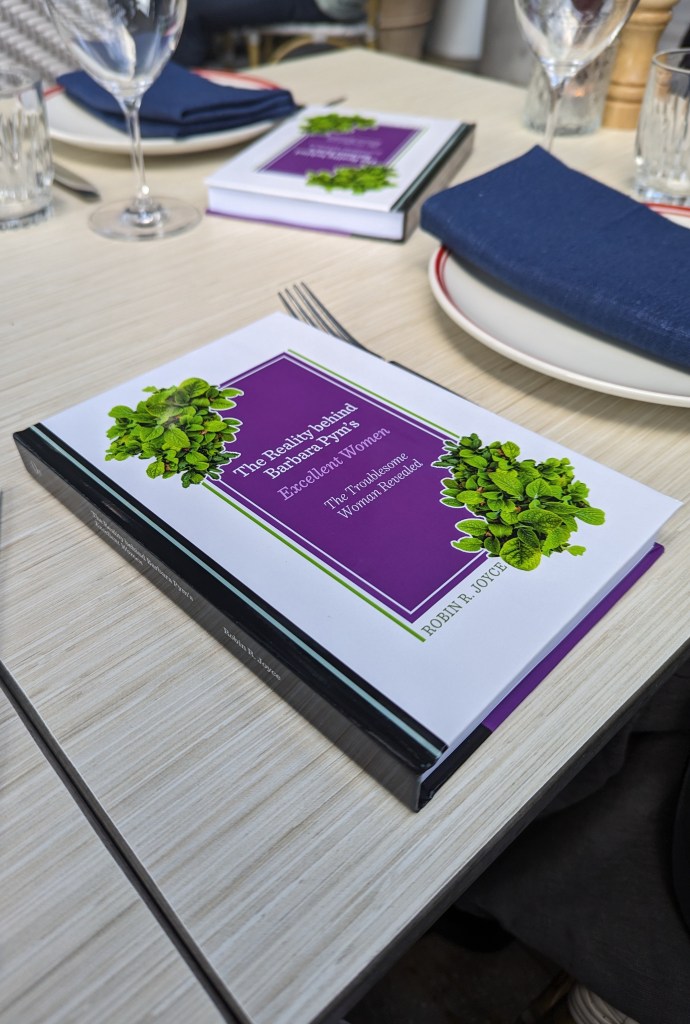
The Reality behind Barbara Pym’s Excellent Women The Troublesome Woman Revealed, Cambridge Scholars Publishing, 2023.
‘There are also alternative views of Pym’s undoubtedly comic touch. Pym uses her comedy as a feminist device. The most recent publication in which Pym’s humour is the focus, is Naghmeh Varghaiyan’s The Rhetoric of Women’s Humour in Barbara Pym’s Fiction. This is an excellent addition to the recognition of Pym’s feminist approach but takes only one aspect of her work to make the feminist argument. Earlier commentary is oblivious to the argument that Pym’s humour is a feminist tool. Hazel Holt’s report that readers have laughed aloud in the Bodleian while reading Crampton Hodnet is apt but does not examine the possibility that there are complex reasons for the laughter. Closer to recognising the biting nature of Pym’s comic writing is Mason Cooley, who links Pym’s writing with that of Moliere and Beckett, and Bruce Jacobs who sees her as a satirist. Annette Weld links Pym and Austen as typical of the comedy of manners oeuvre – Austen, Trollope, and Waugh, as well as lesser lights E.F. Benson, Elizabeth Taylor and Kingsley Amis’. Jacobs’ suggestion that there is an ‘anti-intellectual strain in Pym’s satire’, is counteracted by a feminist reading of her fictional accounts of libraries. Pym’s approach to libraries was part of her strategy to conflate the professional workplace to a domestic equivalent. Contemporary writers of women’s fiction have taken this approach to demonstrate that what has traditionally been seen as women’s work and part of a domestic environment often has its counterpart in the professions. As with these writers, conflating the two was a critical part of Pym’s feminist method.
Jane Nardin commends the quality of Pym’s humour. Judy Little recognises that Pym’s irony subverts patriarchal language and Orphia Jane Allen sees Pym’s ‘deflation of feminine myths at the heart of her comedy’. Glynn-Ellen Fisichelli suggests that Pym used comedy to deal with her own experiences as well as those of her fictional characters. Rather than accepting that morbidity, Rhoda Sherwood suggests that Pym’s work not only ‘contemplates the benefits of sisterhood through Some Tame Gazelle’ but also ‘transforms some conventions of romantic comedy in order to make her point that a woman may be happier with her sister than with a man’. Like Fisichelli, she concludes that ‘Pym uses romantic conventions […] Pym’s is a vision of warm, satisfying sisterhood, a vision that acts as an antidote to the treatment of sisterhood by Godwin, Trollope, Drabble, and West’. Both approaches to the romantic nature of Pym’s work contrast with my interpretation of Pym’s use of romantic conventions to challenge them. In keeping with my interpretation is Tsagaris’ suggestion that romance in Pym’s work is the opposite of romantic when she exposes the way in which Pym subverts romance.’
Also see: Robin Joyce, ‘Comic Rapiers: Barbara Pym’s Comedy and its Targets’, Alliance of Literary Societies Journal, (Autumn 2016), 1-3.
ICYMI: Martin Luther King III Says His Father Would Be ‘Quite Disappointed’ With The Current World
Story by Kecia Gayle
In a recent appearance on NBC News’s “Meet the Press,” Martin Luther King III, the son of the revered civil rights leader Martin Luther King Jr., talked about the current state of the nation and how his father’s legacy resonates today.
When asked about what his father would think of the present-day challenges, King III did not hold back. He honestly said that his father would likely be less than satisfied with the direction in which the world is heading.
“He’d be quite disappointed, quite frankly, that we are where we are,” he stated. While acknowledging that his father might not be surprised by the ongoing issues, he emphasized that the disappointment would still be palpable. “Probably wouldn’t be surprised, but he certainly would be disappointed because he always infused energy that was positive, bringing out the best of who we as Americans are.”
King III continued to address a troubling observation about American unity. He explained, “Unfortunately, in great tragedy, we see the best of who Americans are. But when it’s over, we go back to our corners and live in bubbles and separate.” He urged, “We need to exhibit the behavior that we exhibit in tragedy universally, all the time.”
Additionally, he responded to the controversial timing of Donald Trump’s inauguration, which fell on the same day that commemorates his father’s legacy. King III expressed a hope that Trump would engage in meaningful dialogue with all communities. “If you really want to bring the nation together so that it is the manifestation of what we call ourselves, the United States of America, we’re not reflective of the United States of America right this moment, in my judgment,” he said.
As many are aware, Martin Luther King Jr. Day, observed on the third Monday of January each year, is a federal holiday in the United States that honors the life and legacy of Dr. Martin Luther King Jr., a prominent civil rights leader who played a crucial role in the fight for racial equality and social justice during the 1950s and 1960s. Although the day happens to fall on Trump’s inauguration, many family members and supporters have made sure to shine a light on MLK Day.
On the third Monday of each January, Americans honor the memory of the Reverend Doctor Martin Luther King, Jr., a leader in the U.S. Civil Rights Movement, who advocated for social change through non-violent means.
On the third Monday of each January, Americans honor the memory of the Reverend Doctor Martin Luther King, Jr. A Baptist minister from the southern state of Alabama, Dr. King was a leader in the U.S. Civil Rights Movement, advocating social change through non-violent means. On January 15th, he would have turned 96 years old.
The country young Martin was born into was one of racial segregation and discrimination by design. Most southern states were governed by so-called Jim Crow laws, local and state legislation that codified and enforced segregation and behavior of the non-white population. But Dr. King believed in the biblical proposition that all people are created equal in the image of God. In keeping with the motto he chose for his civil rights movement, he set out “to redeem the soul of America.”
Believing that “change does not roll in on the wheels of inevitability, but comes through continuous struggle,” Dr. King organized and participated in mass-action boycotts, sit-ins, peaceful marches and other non-violent acts of civil disobedience.
Dr. King once stated that “an individual who breaks a law that conscience tells him is unjust, and who willingly accepts the penalty of imprisonment in order to arouse the conscience of the community over its injustice, is in reality expressing the highest respect for the law.” And so, activists sometimes deliberately, but peacefully and respectfully, broke laws aimed at segregating the white citizenry from the non-white, thus hoping to bring attention to the inherent unfairness of such legislation.
Dr. King’s greatest achievements came with the passage of the 1964 Civil Rights Act which outlawed employment discrimination and segregation in public places, and the 1965 Voting Rights Act. These two victories had a major impact not only on the United States, but around the world.
Dr. King once said that “Darkness cannot drive out darkness, only light can do that. Hate cannot drive out hate; only love can do that.” These words guided his life’s work, but ultimately, another’s hatred cost him his life at a young age. He was thirty-nine years old when an assassin’s bullet cut him down on April 4th, 1968. But his legacy lives on. In time, all segregationist laws were repealed, and discrimination is a legally punishable – and punished – offence.
Dr. King’s life is well summed up in his own words: “The quality, not the longevity, of one’s life is what is important.”

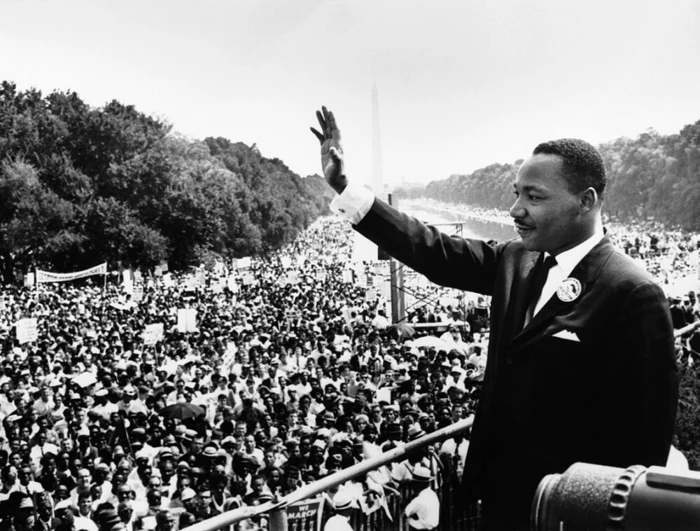
Martin Luther King Jr. addresses a crowd from the steps of the Lincoln Memorial where he delivered his famous “I Have a Dream” speech during the Aug. 28, 1963, march on Washington, D.C. | Public Domain
Some excerpts from Joyce Vance’s newsletter:

It’s 2025. It’s 1984. “The Party told you to reject the evidence of your eyes and ears. It was their final, most essential command.”
It’s not a great day for America, but perhaps a bit of a wake-up among sleepwalkers is coming, at least eventually.
So, have courage. Remember to make time for some fun and some joy. The most important thing you can do right now is reach out to friends and hold them close. Surround yourself with people who understand that the country is trending dangerously so you feel supported. You don’t have to engage with the “if I ignore it, it’s not happening” crowd today. Do everything you can to fight for our country in this perilous moment, but remember to find some happiness for yourself. Laughter and happiness can help to beat back anger and despair, even if we have to work hard right now to muster them.
Mother Nature weighed in:

As Kamala Harris reminded us after the election, “Sometimes the fight takes a while—that doesn’t mean we won’t win.” Don’t even consider giving up. Now, more than ever…
We’re in this together,
Joyce
From The Independent
Michelle Obama posts poignant message…
Michelle Obama posted the quote: “The time is always right to do what is right.” The message was also in support of the non-profit group When We All Vote.
“Reverend Dr. Martin Luther King Jr.’s legacy of service always inspires me,” Obama wrote. “This #MLKDay, I hope you’ll join me and @WhenWeAllVote in honoring Dr. King’s life and legacy by getting involved in your community.”
“Whether you’re mentoring students at your local school or volunteering for a cause that matters to you, it all helps make a difference…”.
Kamala Harris
Dr. King taught us the importance of lifting people up. Let us honor his enduring legacy as we march forward in the fight for freedom, opportunity, and equality for all.
Joe Biden
Today, on Martin Luther King Jr. Day, we reflect on the fact that the journey of our democracy is difficult and ongoing – and the distance is short between peril and possibility.
But we must keep it going.
Our march toward a more perfect union continues.

 Robin's Room