
Caroline Angus Planning the Murder of Anne Boleyn Pen & Sword | Pen & Sword History August 2024.
Thank you, NetGalley and Pen & Sword for providing me with this uncorrected proof for review.
Caroline Angus has set the stage for acknowledging the reality of Anne Boleyn’s death. She was murdered, and King Henry V111 planned the murder. However, as Angus demonstrates, he was not alone (although he alone could have saved her) and the political machinations that were part of court life leading to the murder are established in this history of the period. Most profoundly, Anne Boleyn is portrayed as not just a vehicle for producing a male child, but a politically active woman. Both factors were to make her remaining alive a threat to the king and his line and those with political power to lose or gain. The last line of Angus’s book makes the point that Anne’s murder took her off the stage at the time, but she is very much central to Tudor history in her own right, as well as the mother of Elizabeth 1.
Rather than remaining with the claustrophobia of the Tudor Court, as relevant and interesting as it may be in the context of the murder of Anne Boleyn, this study goes further afield. It has impressive international political content, drawing in foreign political figures whose impact on Anne’s future is drawn as political as well as personal terms. Investigating Jane Seymour’s role requires a return to the Tudor Court, with the possibility that unknowingly Mary had a role in Jane’s elevation. Her life as a 27-year-old unmarried woman and possible courtly love interest rather than necessarily a serious contender for marriage, at least initially, is another reflective piece of work. See Books: Reviews for the complete review.
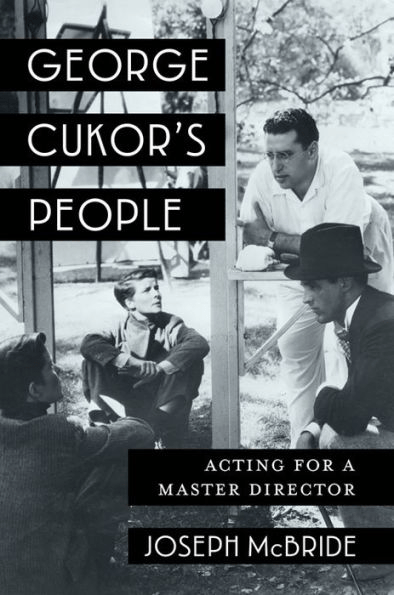
Joseph McBride George Cukor’s People Acting for a Master Directo Columbia University Press, January 2025.
Thank you, NetGalley, for providing me with this uncorrected proof for review.
Joseph McBride’s detailed account of George Cukor and his directorial excellence is such a good read. McBride makes the point that Cukor has been derided as a ‘woman’s director’ and establishes him as a director admired by the women he directed – but equally feted with accolades from the male actors who appeared in his films. Cukor’s collaborative spirit stands high amongst the praise he garners and is celebrated by McBride with examples that draw the reader into a director’s world that is rather different from that usually portrayed. In emphasising Cukor’s collaborative directorial nature, McBride has brought so much to this absorbing story. It is a story that not only demonstrates Cukor’s mastery of his craft but draws attention to a style that has great rewards – for the actors, script and eventually, audiences. This biography becomes something more than the narrative of one person under McBride’s own direction. Although it then becomes a complex as well as a detailed story, George Cukor’s People remains engaging.
As McBride explains, the book is arranged around the most successful of Cukor’s films; analysing the relevant theatrical and literary texts; and dedicating time to understanding the way creativity between actor and director brought Cukor’s genius to the audience. These early explanations about how McBride will approach his material are not only informative about this particular work, and its subject, but provide a blueprint for approaching similar biographies. It is McBride’s thoughtful approach, to the topic and his readers, that I found particularly appealing. See Books: Reviews for the complete review.
Articles after the reviews: Bob McMullan – How the States Vote; Australian of the Year; Cindy Lou eats in Canberra; Tom Nichols, The Atlantic Daily, Night at Camp David; The New Statesman – three comments on American politics; Jess Piper Commentary; Heather Cox Richardson; Vamp by Stephanie Wood.
Australian Politics
Bob McMullan*
How the states vote
The Virginia University’s publication, Sabato’s Crystal Ball, recently published an interesting article about the recent voting performance of the various states relative to the nation as a whole.
The US approach is not directly transferable to Australia. Particularly because we have only 8 states and territories compared to 50 states in the USA. In particular, NSW and Victoria, are a very large proportion of the national vote. As a result, the national figures will be more significantly affected by the vote in those states than is the case with even the largest states in the USA.
However, the patterns of support and the variability of that support from election to election is interesting and may provide some insights into Australian prospects in 2025.
Over the last twenty years the voting performance of voters in the various states has varied in some interesting ways.
It is not surprising that the vote in NSW has tracked the national vote very closely. The proportion of votes cast in NSW of the national vote was 31.6% and therefore some similarity of pattern would be expected. However, over the seven elections since 2004 the average of variation of the NSW vote from the national two party preferred vote for the ALP has been only -0.2%. Over this time there has been relatively little variance in the comparison of state to national vote.
The biggest over performance for Labor compared to the national vote was 1.0% in 2007, the biggest underperformance was -1.3% in 2010 making a variance of 2.3%.
The situation in Victoria is different. Victoria constitutes a smaller but still significant proportion of Australian voters 25.8%. However, Victoria has differed more significantly from the national average. Over the last seven elections since 2004 the average difference in two party preferred vote for the ALP between the national average and Victoria was 3.1% more in Victoria than the national average. The range of results was from +1.7% in 2004 to +5.3% in 2010, a range of 3.6%.
Queensland has been the strongest state for the conservative side of politics. Since 2004 it has registered results on average 4.4% below the national average for the ALP. There has, however been quite a range of results. The biggest variation was -6.9% in 2019 and the smallest was -2.3% in 2007, an election in which Labor’s leader was from Queensland.
Western Australia has had the biggest variation in results relative to the national support for the ALP. The average divergence has been only 3.6%, but this masks a very large variation in relative results. The worst relative result for Labor in WA was in 2010 when the party underperformed the national two party preferred result by 6.6% and the best result was +2.9% in 2022. The 9.5% differential form best to worst is the largest for any state or territory.
South Australian results have varied less wildly than WA and have over recent elections shown a distinct move towards the ALP in relative terms. Apart from NSW, which has essentially mirrored the national figures, South Australia has the smallest average difference between national and state results with an average difference of 1.2% from the national results. In the last five elections the ALP two party preferred vote in South Australia has been above the national average, with the largest difference, 3.0% in 2010, when the Labor leader had strong South Australian connections.
The comparative results in the smaller jurisdictions, Tasmania, ACT and Northern Territory, are likely to be distorted by events in individual electorates such as the retirement of a popular sitting member. Over the last twenty years all these jurisdictions have consistently shown support for the ALP above the national average.
This survey of state voting patterns and history is not predictive. However, when taken with the national polling averages published recently by the Poll Bludger website which showed a decline in the ALP’s lead in Victoria and WA and a small fall from the coalition’s average lead in Queensland these figures may go some way to explain why the Prime Minister commenced his 2025 campaigning in Queensland and Western Australia while the Opposition leader held his first 2025 campaign outing in Victoria.
*See also: 4 Corners 3 February 2025.
From side-eye to show stopper as Grace Tame stuns PM*
Abe Maddison Jan 25, 2025, updated Jan 25, 2025
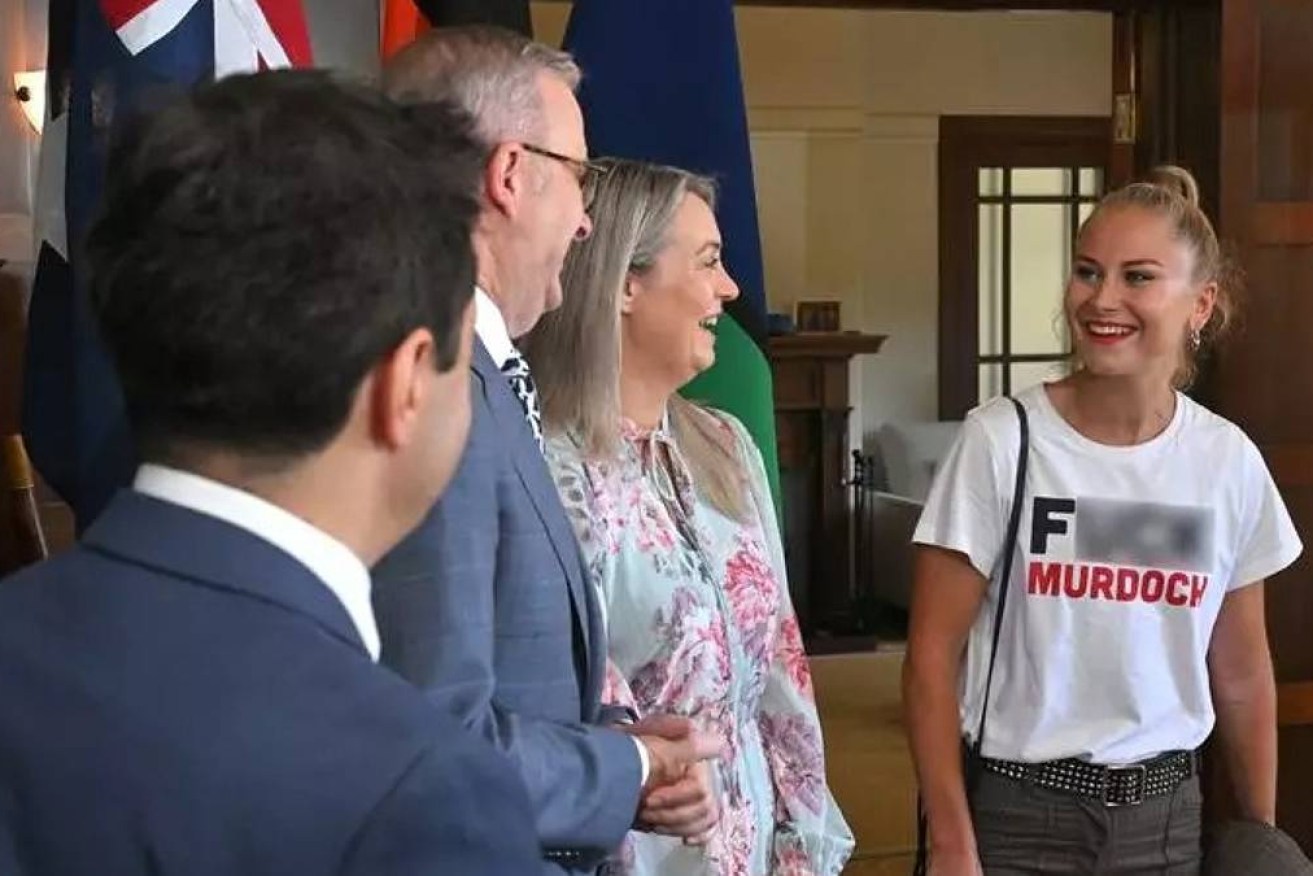
Grace Tame wore a provocative T-shirt when meeting the PM at an Australian of the Year event. Photo: AAP
A provocative act by former Australian of the Year Grace Tame has stolen the limelight – again – at a morning tea with Prime Minister Anthony Albanese for recipients of the 2025 awards.
The 2021 winner wore a “F**k Murdoch” T-shirt when she was greeted by Albanese and his fiancee, Jodie Haydon, at The Lodge in Canberra on Saturday.
The PM and Haydon smiled and greeted Tame, but there was no visible reaction to the incendiary statement on her shirt.
“[The T-shirt is] clearly not just about Murdoch, it’s the obscene greed, inhumanity and disconnection that he symbolises, which are destroying our planet,” Tame said after the event.
“For far too long this world and its resources have been undemocratically controlled by a small number of morbidly wealthy oligarchs,” she said.
In 2022, the outspoken advocate for survivors of sexual assault also stirred controversy when she attended the same event as the outgoing Australian of the Year.
When Tame and her fiance Max Heerey arrived, they were greeted by then prime minister Scott Morrison and his wife Jenny, who congratulated them on their recent engagement.
*I don’t think that he looks in the slightest bit stunned!

Football great Neale Daniher named Australian of the Year
But Tame remained stony faced as they posed for photographs, which famously captured her giving Morrison an ice-cold “side-eye” expression.
She later addressed that moment on Twitter, commenting that the survival of abuse culture “is dependent on submissive smiles, self-defeating surrenders and hypocrisy”.
“What I did wasn’t an act of martyrdom in the gender culture war,” she wrote.
“It’s true that many women are sick of being told to smile, often by men, for the benefit of men. But it’s not just women who are conditioned to smile and conform to the visibly rotting status-quo. It’s all of us.”
Tame had been highly critical of Morrison and his government’s response to allegations of sexual assault and toxic workplace culture in federal parliament.
Former football star and coach Neil Daniher was later named Australian of the Year for 2025, recognising his inspiring fight against motor neurone disease and his campaign that has raised millions of dollars in research for a long-awaited cure.
Scientist, industrial chemist and proud Mabuigilaig and Goemulgal woman Doctor Katrina Wruck was named the Young Australian of the Year.
Brother Thomas Oliver (Olly) Pickett AM was been named Senior Australian of the Year.
-AAP
Cindy Lou eats at Bamiyan, Canberra City.
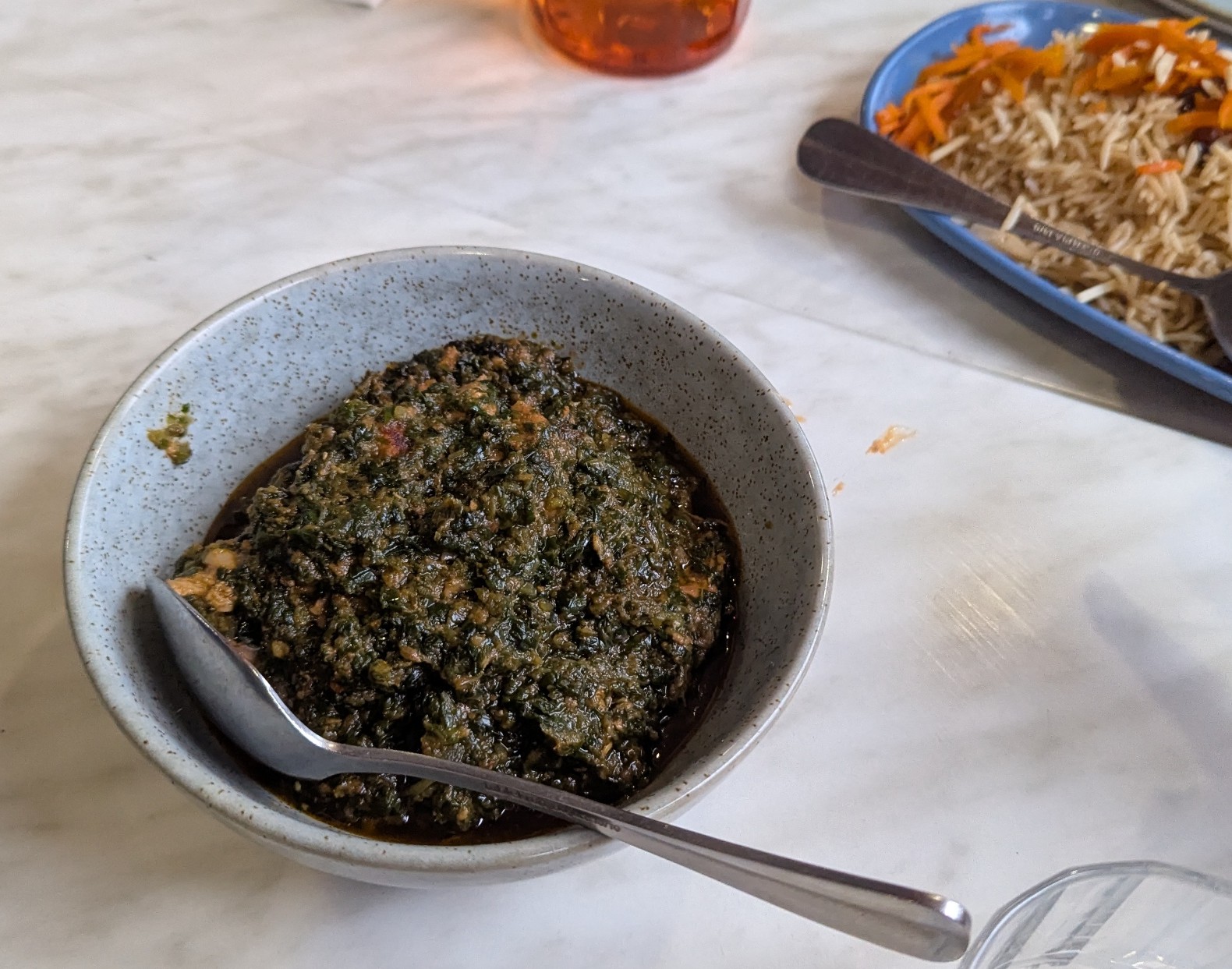
We had a wonderful meal, at a comfortable outside table. Arrangements had been made to reserve one for us inside if it began to rain – just one of the really pleasant things about the friendly and efficient staff. They also provide good advice about the portions of food that will suit the group. We had the mantu-e to begin – vegetarian, and lamb dumplings. The garlic butter prawns were delicious, and the chicken dishes – skewers (one thigh and one spicy breast on a large naan an accompanied by salad and a yoghurt dressing) and chicken sabzi were excellent. The eggplant dish was another favourite, and the Kabuli Pallow rice a great accompaniment. I was so busy serving myself prawns that I didn’t take a photo – suffice to say, there is a generous portion of prawns in an even more generous serve of delicious sauce. Next time I shall take a plastic container to take the remains of the sauce home, although on this occasion it was delicious on the rice and chicken from the skewers.







American Politics
 |
| Tom NicholsStaff writer |
| View in browser The aged president of the United States and the young midwestern senator he’d chosen as his second-term running mate were having a private, late-night discussion. The commander in chief wanted to share his plan to make America greater than it’s ever been. He flung an arm toward one end of the room as he explained the most audacious idea in the history of the republic. “Canada! Canada!” The senator, a veteran of America’s most recent war, was dumbfounded. “A union with Canada?” he asked. “Right. A union with Canada. … Canada is the wealthiest nation on earth … Canada will be the seat of power in the next century and, properly exploited and conserved, her riches can go on for a thousand years.” Not only did the president want to annex Canada, but he then declared the need to bring Scandinavia—with populations ostensibly blessed by genetics—into a new Atlantic union. “Sweden, Denmark, Norway and Finland, to be specific. They will bring us the character and the discipline we so sadly lack. I know these people … I’m of German extraction, but many generations ago my people were Swedes who emigrated to Germany.” Other NATO members would be frozen out, especially Great Britain, France, and Germany, nations the president believed had faded as world powers. He assured his running mate that eventually they would become part of the new union one way or another—even if that meant using force against former American allies to compel their submission to his plans for greatness. “Force?” the incredulous young senator asked. “You mean military force, Mr. President?” “Yes, force,” the president said. “Only if necessary, and I doubt it ever would be. There are other kinds of pressure,” the president continued, “trade duties and barriers, financial measures, economic sanctions if you will.” In the short term, however, the president’s first move would be to meet with the Russians—and to propose a nuclear alliance against China. These exchanges are—believe it or not—the plot of a 1965 political thriller, a book titled Night of Camp David. The author Fletcher Knebel (who also co-wrote the more widely known Seven Days in May) came up with these plans as evidence that a fictional president named Mark Hollenbach has gone insane. In the story, a crisis unfolds as the young senator, Jim MacVeagh, realizes that Hollenbach has told no one else of his scheme. He races to alert other members of the government to the president’s madness before the potentially disastrous summit with the Kremlin. Such ideas—including a messianic president talking about attacking other NATO members—were in 1965 perhaps too unnerving for Hollywood. Unlike Seven Days in May,a book about a military coup in the United States that was made into a well-regarded film starring Burt Lancaster and Kirk Douglas, Night of Camp David was never made into a movie despite decent reviews and more than four months on the New York Times best-seller list. In fairness, the market was glutted with such thrillers in the mid-’60s, but perhaps the idea was too disturbing even for Cold War America. And now, 60 years later, Donald Trump—an elderly president with a young midwesterner as his vice president—is saying things that make him sound much like Mark Hollenbach. He, too, has proposed annexing Canada; he, too, has suggested that he would use coercion against U.S. friends and allies, including Panama and Denmark. He, too, seems to believe that some groups bring better genes to America than others. Like Hollenbach, he dreams of a giant Atlantic empire and seeks the kind of accommodation with Russia that would facilitate an exit from our traditional alliances, especially NATO. One of the most important differences between the novel and real life is that until the titular night at Camp David, Hollenbach is a highly intelligent and decent man, a president respected by both parties after a successful first term. His new plans (which, in another moment of life imitating art, also include unleashing the FBI on America’s domestic “enemies”) are wildly out of character for him, and in the end, MacVeagh finally manages to convince the Cabinet that the president is suffering from a sudden illness, perhaps dementia, a nervous breakdown, or the onset of paranoia. Trump, however, has always talked like this. He is regularly caught up in narcissistic and childlike flights of grandeur; he routinely lapses into fits of self-pitying grievance; he thinks himself besieged by enemies; and he talks about international affairs as if he is playing a giant game of Risk. (In the novel, MacVeagh at one point muses that the president’s “once brilliant mind now was obsessed with fancied tormentors and played like a child’s with the toy blocks of destiny.”) Whatever one thinks of the 47th president, he is today who he has always been. I am not a doctor, and I am not diagnosing Trump. I’m also not the first one to notice the similarities between the fictional Hollenbach and Trump: The book was name-checked by Bob Woodward, Michael Beschloss, and Rachel Maddow during Trump’s first term, and then reissued in 2018 because of a resurgence of interest in its plot. Rumors that the United 93 director, Paul Greengrass, wanted to make a movie version circulated briefly in 2021, but the project is now likely languishing in development hell. In any event, rereading Night of Camp David today raises fewer disturbing questions about Trump than it does about America. How did the United States, as a nation, travel the distance from 1965—when the things Trump says would have been considered signs of a mental or emotional disorder—to 2025, where Americans and their elected officials merely shrug at a babbling chief executive who talks repeatedly and openly about annexing Canada? Where is the Jim MacVeagh who would risk everything in his life to oppose such things? (I’ve read the book, and let me tell you, Vice President J. D. Vance is no Jim MacVeagh.) The saddest part of revisiting the book now is how quaint it feels to read about the rest of the American government trying hard to do the right thing. When others in Congress and the Cabinet finally realize that Hollenbach is ill, they put their careers on the line to avert disaster. At the book’s conclusion, Hollenbach, aware that something’s wrong with him, agrees to give up the presidency. He resigns after agreeing to a cover story about having a serious heart condition, and the whole matter is hushed up. Perhaps such happy endings are why some thrillers are comforting to read: Fear ends up giving way to reassurance. Unfortunately, in the real world, the GOP is not responding to Trump’s bizarre foreign-policy rants by rallying to the defense of America’s alliances and its national values as the leader of the free world. Instead, Republican members of the United States Senate are seeing how fast they can ram through the nomination of an unqualified talk-show host as secretary of defense. In 2018, Knebel’s son was asked what his father would have thought about the renewed interest in the book. The younger Knebel answered: “He’d say, yeah, this is just what I was afraid of.” But at least Mark Hollenbach only dared whisper such ideas in the dark. Donald Trump says them, over and over, in broad daylight. |
Edited excerpts from –

Good morning. Welcome to the Saturday Read, the New Statesman’s guide to politics, culture, books and ideas. This is Finn with Nicholas and George.
Below there are ten [three of which are re-published here] of our favourite pieces from across the magazine and website this week. …
Thomas Piketty and Michael Sandel discuss how the left paved the way for right populism. NH
The taxpayer bailout of Wall Street cast a shadow over Obama’s presidency. It dashed the hopes for a revival of progressive or social democratic politics that his candidacy had inspired. And it generated two currents of protest: on the left, the Occupy movement, followed by the surprisingly successful candidacy of Bernie Sanders in 2016 against Hillary Clinton; on the right, the Tea Party movement, and the election of Donald Trump. Both of these strands grew from the anger and outrage and sense of injustice at the bailout and the building back up of Wall Street, without holding anyone to account. So in a way, the progressive, mainstream centre-left politicians who governed in the aftermath of Reagan and Thatcher laid the groundwork for the right-wing version of populism
Unusually aggressive weather patterns caused Los Angeles to burn for days in the middle of winter. But it was a long-fomenting combination of climate change, budget-slashing and general urban neglect that turned the region into a tinderbox, Richard Seymour writes. FMcR
Also at stake here is a defunct model of fire management. Lately, the right-wing press has credited Trump with having warned Governor Newsom about the wildfire danger. He claimed in 2019 that he told Newsom “from the first day we met that he must ‘clean’ his forest floors regardless of what his bosses, the environmentalists, DEMAND of him”. He also issued an executive order to increase logging on the grounds that this would curb wildfires in overgrown and fuel-dense forests. In fact, logging and “cleaning” the forest floors removes a source of moisture that retards flames. The evidence is that protected forests experience much less severe fires. As fire management expert Stephen J Pyne has been arguing for decades, suppression is bad management. It derives from an inappropriate importation by colonists of European fire practices, and it makes wildfires worse. California’s chapparal biome is adapted for fire: it burns, because it is meant to burn. It is human action, above all climate change, logging, real estate sprawl and dysfunctional public infrastructure that makes it more deadly than it need be.
To the question of the week – whether Musk intended that gesture – Ross Barkan has a controversial answer: it doesn’t matter. America is too big, wild and differentiated for fascism ever to take hold. GM
Those who speak of American fascism tend to do so from the airy citadels of media and academia. They barely seem to understand how the US functions. Consider public education. Any American fascist worth his bright red tie would be able to subdue the schools and begin to teach MAGAdemics, or at least get all those pesky liberal books banned – all of them, because fascism doesn’t demand anything less. In the US, there are nearly 14,000 separate public school districts with more than 94,000 elected board members. Some of the larger counties, like the battleground of Loudoun in Virginia, have a single board. Others are carved up into so many segregated duchies that consensus can never be achieved. On New York’s Long Island, among just two counties, there are 125 public school districts. There is no such thing as a centralised educational system in America. The US’s educational sprawl is Hapsburgian, with no single monarch able to dictate its direction for very long.
| Let’s See Who is Stronger A short post…Jess Piper Jan 26 I didn’t want to tell you what I did in the days after the Presidential election because I am ashamed of it. Not because it was unreasonable, but because I am an activist living in a red state, and I know better. I drove North into the woods with my checkbook a few days after Trump won. I was going to buy some land in a blue state and have a place to run and hide. I wanted to be close to the Boundary Waters so I could canoe my way to safety if I needed to.I am not on a national radar, but you can bet your next paycheck that every elected Republican in this state knows my name. And under the “anything goes” administration we are now facing, I know I could face backlash. I could face physical or financial consequences.I was scared. I talked to a few real estate agents and drove about nine hours wondering what I was doing. Nothing was right and everything was wrong — I drove in circles. I went to places I knew and places I didn’t know.I drove back home without using my checkbook.While in this blue state, I passed Trump flags and FJB signs. I listened to local radio cheer the election results. I bought gas at filling stations with MAGA hats for sale. I saw a huge barn with TRUMP written across the loft.What is the point of running? It is a blue state with more protections, but the rural areas are very similar to Missouri rural spaces and how am I helping anyone by running? What about my grown kids and my grandkids in Missouri? I am a straight, middle-aged white woman and MAGA passing at that. Wouldn’t I be better suited using my privilege to stay and fight in Missouri? Yes. I haven’t told my older kids what I did after the election. Don’t worry. They don’t read my Substack, so they still won’t know. My youngest knows I go into nature for a few days when things go wrong or I am overwhelmed by the work. My husband often tells me to go when he sees things are weighing on me. The trip provided clarity. The fascists want me to give up my home state. They want me to run to places and people that agree with me. They want us cornered in spaces, packed into populated areas, just like they want us to cede the less populated areas.How much easier would it be to win when all of the liberals are contained to a few urban areas in a few states. The Electoral College would be a slam dunk and corporations could run amok in rural spaces — you get a CAFO and you get a CAFO. I will not run. I will not compromise. I will not collaborate. I will be the opposition. I know this is a lot for all of us, but I have decided I will do one thing a day to stop the fascism creeping in. I know that all things no good and terrible will go through the states, so I will start in my own backyard. Yesterday, my State Senator sent his monthly newsletter expressing his opposition to the abortion amendment Missourians just passed. He said he would actively fight to overturn the will of Missouri voters. I spent about two minutes sending an email in response: It was short and to the point, and I shared it on social media to encourage others to do the same. Jess Piper to Rusty Black We voted on Amendment 3 and it passed. If I can deal with a lazy, no good, lying, cheating, traitor felon being my president, you can deal with the will of Missourians on abortion. It passed. Move on. Jess We can’t do everything, but we can do one thing. One thing. Every day. I can’t run away, but I can stand up. There is nowhere to run anyway, and I have spent the better part of a decade doing the work. I can teach others to do the same.Let’s do this. Let’s see who is the last one standing. Let’s see who is stronger. Let’s f’king go.~Jess |
Heather Cox Richardson Heather Cox Richardson from Letters from an American <heathercoxrichardson@substack.com>
We have all earned a break for this week, but as some of you have heard me say, I write these letters with an eye to what a graduate student will need to know in 150 years. Two things from last night belong in the record of this time, not least because they illustrate President Donald Trump’s deliberate demonstration of dominance over Republican lawmakers.
Last night the Senate confirmed former Fox News Channel weekend host Pete Hegseth as the defense secretary of the United States of America. As Tom Bowman of NPR notes, since Congress created the position in 1947, in the wake of World War II, every person who has held it has come from a senior position in elected office, industry, or the military. Hegseth has been accused of financial mismanagement at the small nonprofits he directed, has demonstrated alcohol abuse, and paid $50,000 to a woman who accused him of sexual assault as part of a nondisclosure agreement. He has experience primarily on the Fox News Channel, where his attacks on “woke” caught Trump’s eye.
The secretary of defense oversees an organization of almost 3 million people and a budget of more than $800 billion, as well as advising the president and working with both allies and rivals around the globe to prevent war. It should go without saying that a candidate like Hegseth could never have been nominated, let alone confirmed, under any other president. But Republicans caved, even on this most vital position for the American people’s safety.
The chair of the Senate Armed Services Committee, Roger Wicker (R-MS), tried to spin Hegseth’s lack of relevant experience as a plus: “We must not underestimate the importance of having a top-shelf communicator as secretary of defense. Other than the president, no official plays a larger role in telling the men and women in uniform, the Congress and the public about the threats we face and the need for a peace-through-strength defense policy.”
Vice President J.D. Vance had to break a 50–50 tie to confirm Hegseth, as Republican senators Lisa Murkowski of Alaska, Susan Collins of Maine, and Mitch McConnell of Kentucky joined all the Democrats and Independents in voting no. Hegseth was sworn in early this morning.
That timing mattered. As MSNBC host Rachel Maddow noted, as soon as Senator Joni Ernst (R-IA), whose “yes” was secured only through an intense pressure campaign, had voted in favor, President Trump informed at least 15 independent inspectors general of U.S. government departments that they were fired, including, as David Nakamura, Lisa Rein, and Matt Viser of the Washington Post noted, those from “the departments of Defense, State, Transportation, Labor, Health and Human Services, Veterans Affairs, Housing and Urban Development, Interior, Energy, Commerce, and Agriculture, as well as the Environmental Protection Agency, Small Business Administration and the Social Security Administration.” Most were Trump’s own appointees from his first term, put in when he purged the inspectors general more gradually after his first impeachment.
Project 2025 called for the removal of the inspectors general. Just a week ago Ernst and her fellow Iowa Republican senator Chuck Grassley co-founded a bipartisan caucus—the Inspector General Caucus—to support those inspectors general. Grassley told Politico in November that he intends to defend the inspectors general.
Congress passed a law in 1978 to create inspectors general in 12 government departments. According to Jen Kirby, who explained inspectors general for Vox in 2020, a movement to combat waste in government had been building for a while, and the fraud and misuse of offices in the administration of President Richard M. Nixon made it clear that such protections were necessary. Essentially, inspectors general are watchdogs, keeping Congress informed of what’s going on within departments.
Kirby notes that when he took office in 1981, President Ronald Reagan promptly fired all the inspectors general, claiming he wanted to appoint his own people. Congress members of both parties pushed back, and Reagan rehired at least five of those he had fired. George H.W. Bush also tried to fire the inspectors general but backed down when Congress backed up their protests that they must be independent.
In 2008, Congress expanded the law by creating the Council of Inspectors General on Integrity and Efficiency. By 2010 that council covered 68 offices.
During his first term, in the wake of his first impeachment, Trump fired at least five inspectors general he considered disloyal to him, and in 2022, Congress amended the law to require any president who sought to get rid of an inspector general to “communicate in writing the reasons for any such removal or transfer to both Houses of Congress, not later than 30 days before the removal or transfer.” Congress called the law the “Securing Inspector General Independence Act of 2022.”
The chair of the Council of Inspectors General on Integrity and Efficiency, Hannibal “Mike” Ware, responded immediately to the information that Trump wanted to fire inspectors general. Ware recommended that Director of Presidential Personnel Sergio Gor, who had sent the email firing the inspectors general, “reach out to White House Counsel to discuss your intended course of action. At this point, we do not believe the actions taken are legally sufficient to dismiss” the inspectors general, because of the requirements of the 2022 law.
This evening, Nakamura, Rein, and Viser reported in the Washington Post that Democrats are outraged at the illegal firings and even some Republicans are expressing concern and have asked the White House for an explanation. For his part, Trump said, incorrectly, that firing inspectors general is “a very standard thing to do.” Several of the inspectors general Trump tried to fire are standing firm on the illegality of the order and plan to show up to work on Monday.
The framers of the Constitution designed impeachment to enable Congress to remove a chief executive who deliberately breaks the law, believing that the determination of senators to hold onto their own power would keep them from allowing a president to seize more than the Constitution had assigned him.
In Federalist No. 69, Alexander Hamilton tried to reassure those nervous about the centralization of power in the new Constitution that no man could ever become a dictator because unlike a king, “The President of the United States would be liable to be impeached, tried, and, upon conviction of treason, bribery, or other high crimes or misdemeanors, removed from office; and would afterwards be liable to prosecution and punishment in the ordinary course of law.”
But the framers did not anticipate the rise of political parties. Partisanship would push politicians to put party over country and eventually would induce even senators to bow to a rogue president. MAGA Senator John Barrasso of Wyoming told the Fox News Channel today that he is unconcerned about Trump’s breaking the law written just two years ago. “Well, sometimes inspector generals don’t do the job that they are supposed to do. Some of them deserve to be fired, and the president is gonna make wise decisions on those.”
There is one more story you’ll be hearing more about from me going forward, but it is important enough to call out tonight because it indicates an important shift in American politics. In an Associated Press/NORC poll released yesterday, only 12% of those polled thought the president relying on billionaires for policy advice is a good thing. Even among Republicans, only 20% think it’s a good thing.
Since the very earliest days of the United States, class was a central lens through which Americans interpreted politics. And yet, in the 1960s, politicians began to focus on race and gender, and we talked very little about class. Now, with Trump embracing the world’s richest man, who invested more than $250 million in his election, and with Trump making it clear through the arrangement of the seating at his inauguration that he is elevating the interests of billionaires to the top of his agenda, class appears to be back on the table.
The notes are available at the end of the article at Letters from an American <heathercoxrichardson@substack.com>

—Vamp with Stephanie Wood <vampbystephaniewood@substack.com>
Welcome to Vamp, my modern mini-magazine.
Stephanie Wood’s newsletter is a fascinating amalgam which she describes as ‘… my personal writing and reflections on life, alongside a carefully curated collection of links exploring everything from relationships and food to current affairs and travel. Vamp is driven by my core belief in the transformative power of curiosity, creativity, audacity, and authenticity.‘
I loved this example, putting to rest the fear that overseas visitors appear to have of our spiders:
Spiders
There will be spiders in a Sydney summer. I am happy to see them. It means that all the sprays and chemicals we use around our homes haven’t completely wiped out the arthropods and insects. There has been a handspan-sized huntsman in my bedroom for some nights now. There one minute, gone the next, then back again. They are welcome … they stay clear of me, I stay clear of them and know that if I went near they’d run a mile. An explosion of newly hatched daddy long legs covers my bathroom ceiling. I gently removed what I think was a St Andrew’s Cross spider from my lounge room this morning. Up a ladder in my courtyard yesterday pruning back a tangle of star jasmine, I was diverted by a web seething with babies of some description (see video below). Meanwhile, I have nightly chats with an industrious neighbour, as yet unidentified (above … suggestions welcome; someone suggested a golden orb spider but my spider is determinedly brown). He/she (or his/her descendants) appears every year and spins their dreams, their food-traps, their gorgeous, glorious, great architectural creations from my kitchen window to my magnolia tree. I am happy to encourage their work, the work of all the rest of them, and, perhaps, hopefully, their appetite for the ever-present swarms of mosquitos which love me with a passion. (OK, I might need to remove, somehow, the daddy long legs – they make such a stonking great mess everywhere.)
This is a ‘mini-magazine well worth subscribing to – fun, informative and thoughtful.

 Robin's Room