
Kimberly Heckler A Woman of Firsts Margaret Heckler, Political Trailblazer Foreword by Jean Sinzdak, The Globe Pequot Publishing Group, Inc. | Lyons Press, February 2025. *
Thank you, NetGalley, for providing me with this uncorrected proof for review.
This biography not only covers the period in which five presidents, from different parties were elected (Johnson, Nixon, Ford, Carter, and Reagan) but when Sandra Day O’Connor and Ruth Bader Ginsberg made their mark on the Supreme Court. It would have been appealing without this context, but the additional information makes this biography exceptionally engaging. Of course, this context is only relevant to Margaret Heckler’s public life – her private life, including her upbringing with distant parents, her passion to do well and her marriage are also relevant. To have accomplished so much, to have been a loving and successful wife and mother, and to have made such a distinctive career makes for an absorbing read.
Kimberly Heckler’s biography is the very readable story of a woman, as in the title, of firsts. See Books: Reviews for the complete review. * This is a somewhat comforting read about normal Republican political behaviour. Although particularly positive in this instance, it is a reminder that what is happening in American Republican politics today is very different from the past as exemplified by Margaret Heckler and the period in which she flourished. Below are two articles, one by Heather Cox Richardson and the other by Joyce Vance which are enlightening about current American politics.
After the book review: Francoise Sagan – The Four Corners of the Heart and article about her and her first novel; Women’s History Network – conferences, call for papers, events and exhibitions; ‘Bright Circle’ illuminates the role of women in the American intellectual tradition; Bob McMullan, Australian Electoral Prospects; Heather Cox Richardson; Joyce Vance; National Gallery of Australia.
The Four Corners of the Heart An Unfinished Novel, Françoise Sagan, Amazon Crossing, 2023.*

Thank you, NetGalley, for providing me with this uncorrected proof for review.
How I wish that I had originally known Françoise Sagan’s work through this clever, comic , sensitive and thoughtful novel rather than the one with which I understood her work until now. Bonjour Tristesse was, to me, a self-absorbed work which left me with a feeling of antipathy and distress that I have carried over to my much later reading of Ian McKean’s Atonement. The Four Corners of the Heart, unfinished though it is, is such a satisfying read, with enough information to speculate about if you want a resolution. If this is not your only reason for reading a book, and I acknowledge it is not mine, this novel is something to be savoured, with its complex characters, edifying and unedifying moments, comedy and fully developed writing.
Ludovic Cresson survives a car accident, and begins to survive a more serious situation, his family’s belief that he is now mentally incapacitated. He has been ‘cared’ for in institutions, and, with this understanding of his abilities, he returns to his family. The chief mourners of his past capabilities and current fragile state are his glamorous wife, Marie-Laure, and his father, the patriarch, Henri. Henri is unimpressed by the remainder of his family and evinces concern for Ludovic’s seemingly fragile health and mental capacity. However, Ludovic’s fragility is based on his family’s expectations and misunderstanding. They are unable to see past their perceptions to the realities of the accident and its consequences. Their complicity in Ludovic’s treatment since the accident is perhaps innocent, but nevertheless impacts on their current relationships and the new connection made with Marie-Laure’s mother. These become apparent as the novel progresses, although never fully explained.
Ludovic is a party to the misconceptions about his abilities, perhaps because of his treatment since the accident or perhaps because of some event in his past. This is a question that is not answered, but drawing upon the information available is a worthwhile study. For example, it is abundantly clear that Ludovic has married unwisely, that he is prepared to abandon his marriage vows, and is able to enter an alliance that seems bound to result in a dramatic conclusion. We can only speculate what this might be! See Television,Film and Popular Culture: Comments for the complete reveiw, and accompanying article.
*This is the review I wrote in 2003. I thought it worth repeating in conjunction with the article below.
Why We Can’t—and Shouldn’t—Forget Françoise Sagan
Flavien Falantin uplifts the iconic French writer who inspired repressed women worldwide
By Laura MeaderPortrait by Ashley L. Conti January 22, 2025
The French writer Françoise Sagan lived a life of shocking intrigue. Gutsy and reckless, she fascinated readers with her flamboyant lifestyle and forthright novels. Now, 20 years after her death, scholars are revisiting the profound cultural and literary impact of her 1954 debut novel, Bonjour Tristesse, which took the world by storm.
Banned in several European countries and by the Vatican, the book was often read secretly. In South Africa, readers of Bonjour Tristesse (Hello Sadness) faced imprisonment if caught with the book. French readers found it both scandalous and liberating. In America, it reached No. 1 on the New York Times bestseller list a year after its publication. Hollywood turned it into a film in 1958.

Why all the fuss?
Bonjour Tristesse “heralded the arrival of female emancipation in France during the 1950s and the waning dominance of the patriarchal family structure,” said Flavien Falantin, assistant professor of French studies and one of four Sagan scholars worldwide. See Television,Film and Popular Culture: Comments for the complete article.
Women’s History Network
| Upcoming Events and Exhibitions Bletchley Park Women in Intelligence during World War Two 8 March 2025 A day symposium covering women in intelligence during World War Two, including stories relating to individuals from all over the world. Join Bletchley Park for a day of talks and discussions revealing the often hidden stories of women’s roles in intelligence during World War Two. The day will cover stories from all over the world, individuals from different countries or those based in other parts in the world.Visit Here for further information and to book your place. British Library Medieval Women: In Their Own Words25 October 2024 – 2 March 2025; ExhibitionWith over 140 extroardinary items, discover the rich and complex lives of women of medieval Europe, both famous and forgotten, through their own words, visions and experiences. Exhibition tickets here and events programmes here. The Women’s Library, LSE Making Modern Women: Women’s Magazines in Interwar Britain Online exhibitionUnearthing the Women’s Library’s rich collection of interwar women’s magazines, this exhibition demonstrates the vitality and breadth of feminist activism throughout the interwar years. We also mark the centenary of the Six Point Group, Britain’s leading gender equality organisation during this period, and the magazine with which it was closely identified, Time and Tide. Placing this iconic feminist magazine in the context of other serial publications, we show how women’s magazines contributed to the making of ‘modern women’ in British life. Details here. The Women’s Museum, Barking An Idea of Life Open Thursday, Friday and Saturday 11 – 5pm; ExhibitionAn Idea of a Life is the first exhibition at the Women’s Museum Barking. It responds to everyday histories of the women-led community who lived in Barking Abbey from c.666AD through to the early 16th Century. This exhibition tells stories that are both imagined and informed by archaeological finds, records and ongoing research emerging from the site of the former Abbey. Details here. |
| Upcoming Competitions, Scholarships & Internships World Anthropological Union (WAU) 2025 Congress Photo ContestFor decades, a limited vision of who “should” be doing fieldwork has erased and made invisible women anthropologists and social scientists. This limited vision has resulted in a lack of recognition for the photographic record of women doing fieldwork, and their image has not become a common symbol in the public understanding of social science disciplines.The WAU 2025 Congress Photo Contest seeks to highlight the importance of women in fieldwork, to reverse decades of invisibility in photographic repositories, and to provide images that show the diversity of scientific work by women social scientists, especially anthropologists.For further details on how to apply, please visit; https://filmfreeway.com/WAU2025CongressPhoto “ Apply now for research internships in women’s history at the University of Oxford UNIQ+. Research internships are designed to provide students from under-represented and disadvantaged backgrounds who are ordinarily resident in the UK with the opportunity to experience postgraduate study. Taking place from Monday 7 July – Thursday 21 August 2025, UNIQ+ gives you the chance to experience life as a graduate student at Oxford. You will undertake a research project, attend training and information sessions, and have the opportunity to take part in social events. Projects are available in a wide range of subjects, including archaeology, biology, history, engineering, pathology, sociology and statistics, with three projects this year in women’s history. These are: African women and decolonisation: nationalism, transnational networks and sisterhood 1920s-1960s, supervised by Dr Natalya Benkhaled-Vince; Feminism, democracy and transnational links in the early twentieth century, supervised by Dr Tania Shew, and ‘A word to the wives’: Letters from spouses in twentieth-century British election literature, supervised by Dr Lyndsey Jenkins. During the internship you’ll receive a stipend of at least £3,300, receive free accommodation in Oxford, improve your research skills, work with University of Oxford researchers, receive advice on opportunities for further study and research careers, and enhance your ability to make a competitive application for postgraduate study.For full eligibility criteria, the full list of projects available with more detailed descriptions, and to apply, visit: https://www.ox.ac.uk/admissions/graduate/access/uniq-plus/about.Applications close at 12:00 midday UK time on Wednesday 19 February 2025. |
| Online Documentary: Beyond All Odds – A Story of Hope, Faith and Resilience All The Unexpected focuses on the experience of parenthood through the lens of its most unexpected moments. The organization has recently shared 2 short documentaries online that highlight the history of black maternal health and history. Find out more here |
| WHN : Blue Sky Page WNH are pleased to announce they now have a BlueSky Page for the Women’s History Network. Please visit; https://bsky.app/profile/womenshistnet.bsky.social |
| WHN Members: Call for New Book Titles If you are a member of the Women’s History Network and have a recent or forthcoming book publication, we want to hear from you! We include a shortlist of books available for review in our journal Women’s History Today, and we are looking for new titles to promote. If you are happy to have your book included in this list please email us at bookreviews@womenshistorynetwork.org . |
| WHN Writing Retreats To help support Women’s History Network members, the WHN uses zoom to run a series of online, structured writing retreats. The aim of structured writing retreats is to provide dedicated time in which to progress writing projects. The retreats are on Friday mornings — 10 am to 1 pm (UK time) — and they follow the same programme each week. Interested in finding out more or joining us for the next retreat? Check the WHN website here for more details. |
| Women’s History Today – Share Your Project/Research Women’s History Today is the journal of the Women’s History Network. As well as academic articles, which we always welcome, the journal publishes short features on different aspects of doing and researching women’s history. These include Spotlight on Funded Research, which showcases funded research projects; From the Archives, about using archives to explore women’s history and Doing History, which highlights community/public history projects with a focus on women’s and gender history. We are also always open to ideas for ‘special’ themed issues. If you are interested in contributing to the journal in connection with any of the above, please contact: editor@womenshistorynetwork.org |
The University of Kansas KU News
‘Bright Circle’ illuminates role of women in American intellectual tradition
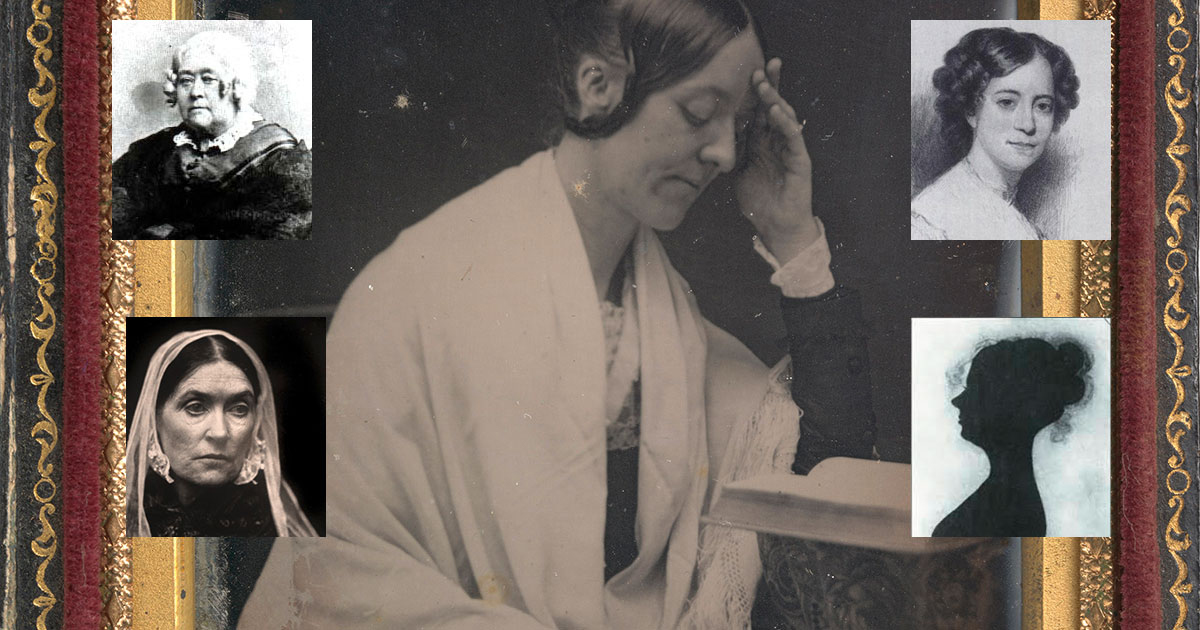
Illustration created from public-domain images of the subjects of Randall Fuller’s book: Elizabeth Palmer Peabody, (clockwise from top left) Margaret Fuller, Sophia Peabody Hawthorne, Mary Moody Emerson and Lydia Jackson Emerson. Credit: Rick Hellman, KU News Service
LAWRENCE — Almost every American high school graduate has been introduced to Henry David Thoreau and Walden Pond. But how many have heard of Elizabeth Palmer Peabody and her Boston bookshop?
Hardly any of them, which is why Randall Fuller, Herman Melville Distinguished Professor of American Literature at the University of Kansas, felt the need to write a new book in which he contends that the latter is every bit as important as the former to the creation of the first important American style of literature and philosophy.
Fuller sees “Bright Circle: Five Remarkable Women in the Age of Transcendentalism” (Oxford University Press) as something of a corrective to the “great man” hagiography that has gone before.
“Thoreau is remembered because of his fantastic writing of that experience,” Fuller said. “But he lived in a household full of women who were involved with all these other women, and he got ideas from them. He could go and live on that pond by himself because he was a guy. The women, on the other hand, were much more socially networked with each other, and that network attracted the attention of all sorts of writers, male and female. So, my argument is that the real birthplace of transcendentalism is in Elizabeth Palmer Peabody’s bookstore.”
Not only did the “Bright Circle” women give birth to transcendentalism, which Fuller defined as “a movement interested in the individual transcending the materialism of the moment for a greater connection to the absolute,” but one of them, Margaret Fuller, wrote what has come to be seen as the first work of American feminism with her 1845 book, “Woman in the Nineteenth Century.”
“Fifty-some years after the Declaration of Independence, when these women lived, there was just this ferment of ideas and a sense that, ‘Now we can create our own intellectual and literary culture,’” Fuller said. “So they’re excited about that. They’re getting ideas from England and Germany, but they’re also mixing them with more American experiences and creating something new.”
Fuller noted that he had “spent most of my professional career studying the men in the field of transcendentalism, especially (Ralph Waldo) Emerson and Thoreau, and … you quickly realize that there was this entire community of women in their lives who were contributing in all sorts of ways to their intellectual development.”
“For a long time I have thought the myth of the lone genius is just that — a myth — and that these really interesting women had largely been relegated to, for instance, the role of quirky aunt for Mary Moody Emerson or the subservient wife in the case of Lydia Emerson. And the more you delve into the archive of those women’s writings, the more you realize that they were actually, in many ways, not only at the forefront, but they were also influencing people like Emerson.”
Fuller said “the big aha moment” leading to “Bright Circle” came when he was interviewing for the position at KU and the Kenneth Spencer Research Library’s special collections curator, Elspeth Healey, told him she had something that might interest him: Ralph Emerson’s first book, “Nature,” inscribed to his aunt Mary, with her marginalia. Those notes, Fuller said, which were previously unknown to scholars of the field, “crystallized their relationship for me. It’s as if she had given intellectual birth to this person who then went beyond where she felt comfortable.”
The transcendentalists were, after all, descendants of the Puritans, Fuller said.
The scholar began tugging on that intellectual thread and ended up focusing on the work of five women who, he said, “contributed the most in a range of ways — some philosophically, some artistically, some culturally.”
The last of the five “Bright Circle” women was artist and writer Sophia Peabody, older sister of salon-keeper Elizabeth. Her sojourn in Cuba became fodder for an acclaimed journal that, in Fuller’s words, “expressed a poetic nature-worship that prefigured the more famous rhapsodies of male transcendentalists.”
Not only does “Bright Circle” provide a window into early American feminism, but Fuller said the intellectual shift from a Puritan view of nature “as a wicked place … to be feared and subdued” to the transcendentalist view of it as a place of self-realization remains attractive to students today.
“There’s at least a thread of that intellectual tradition continuing into our current life,” he said.
Australian Politics
Bob McMullan
Australian electoral prospects
There is a marked immaturity in the reporting of opinion polls and other political developments in Australia at the moment.
I see problems in two main categories.
First is the seemingly endless pursuit of uniquely Australian explanations for what are obviously global trends.
The second is the tendency to ignore the historical reality that polls three months out from an election can be important signposts but do not justify attempts to forecast likely election outcomes with any specificity.
With regard to the first category, writers of both right and left have tended to impose their own policy preferences as explanations of the decline in support for the ALP at the federal level. Sky News and other Murdoch outlets have suggested the change is part of a global move to the right in the electorate. This is not totally without foundation, inflation and unplanned immigration tend to play into the political interests of right wing parties. However, it ignores the large change in UK towards the Centre-Left and in France to the NFP, the French left wing alliance at the expense of the Centre parties.
Writers on the Left tend to preach that if only the government took a stronger stand on their particular issue of choice (climate change/ immigration /foreign and defence policy/ taxation for example) the party would be doing better.
However, the reality is, as reflected in research by the Financial Times, every incumbent government lost support in the developed world in 2024. This trend was also evident in African elections where the ANC and the ruling parties in Botswana and Namibia lost considerable ground and also in India where the ruling BJP was returned with a significantly reduced majority.
Not all the ruling parties lost, but they all suffered a swing against them.
So, why is it surprising that there has been a drift in support for the Labor government in 2024?
It is possible to argue that the remarkable thing is that the government is still with in striking distance of retaining office.
Perhaps it would be more useful to look for uniquely Australian explanations for that! I suspect it has more to do with the weakness of the Opposition than the strength of the government.
In the second category, we see reports such as “hung parliament likely” based on the most recent polling from particular outlets.
A hung parliament is definitely one of a number of possible outcomes but to use any poll at this relatively early stage as a predictor of a “likely” outcome is naïve to say the least.
There are ample precedents in recent Australian political history to suggest any of the possible outcomes may eventuate by the time the campaign is finished.
Many people may not recall the 1987 election, but I remember the decision to call the election despite polling saying the ALP was trailing, in the confident belief that we could make up the ground in the campaign. I distinctly remember similar initiatives at a state government level.
At the federal level, historical Newspoll data shows that in 1993, 2001, 2004, 2013, 2019 and even 2022 the government of the day improved their position relative to the polls over the last three months leading up to the election.
The situation in 2025 is more complex. The recent falls in support for the major parties, and the loss of “safe” seats to Independents and Greens has made prediction more challenging.
I can see the possibility of coalition seats going to the Teals and Teal seats reverting to the coalition. It is also easy to see the Labor Party challenging Independent and Green seats and vice versa. As with every election there is also the probability of seats changing hands between Labor and the coalition, possibly in both directions.
This makes prediction difficult.
One thing that can be said with certainty is that the best polling in the world cannot make definitive predictions three months out.
It is all still to play for.
American Politics
Heather Cox Richardson from Letters from an American
<heathercoxrichardson@substack.com>
On February 1, 1862, in the early days of the Civil War, the Atlantic Monthly published Julia Ward Howe’s “Battle Hymn of the Republic,” summing up the cause of freedom for which the United States troops would soon be fighting. “Mine eyes have seen the glory of the coming of the Lord,” it began.
“He is trampling out the vintage where the grapes of wrath are stored;
He hath loosed the fateful lightning of His terrible swift sword:
His truth is marching on.”
Howe had written the poem on a visit to Washington, D.C., with her husband. Approaching the city, she had reflected sadly that there was little she could do for the United States. She couldn’t send her menfolk to war: her husband was too old to fight, her sons too young. And with a toddler, she didn’t even have enough time to volunteer to pack stores for the field hospitals. “I thought of the women of my acquaintance whose sons or husbands were fighting our great battle; the women themselves serving in the hospitals, or busying themselves with the work of the Sanitary Commission,” she recalled, and worried there was nothing she could give to the cause.
One day she, her husband, and friends, toured the troop encampments surrounding the city. To amuse themselves on the way back to the hotel, they sang a song popular with the troops as they marched. It ended: “John Brown’s body lies a-mouldering in the grave; his soul is marching on.” A friend challenged Howe to write more uplifting words for the soldiers’ song.
That night, Howe slept soundly. She woke before dawn and, lying in bed, began thinking about the tune she had heard the day before. She recalled: “[A]s I lay waiting for the dawn, the long lines of the desired poem began to twine themselves in my mind…. With a sudden effort, I sprang out of bed, and found in the dimness an old stump of a pen…. I scrawled the verses almost without looking at the paper.”
Howe’s hymn captured the tension of Washington, D.C., during the war, and the soldiers’ camps strung in circles around the city to keep invaders from the U.S. Capitol.
“I have seen Him in the watch-fires of a hundred circling camps,
They have builded Him an altar in the evening dews and damps;
I can read His righteous sentence by the dim and flaring lamps:
His day is marching on.”
Howe’s Battle Hymn of the Republic went on to define the Civil War as a holy war for human freedom:
“In the beauty of the lilies Christ was born across the sea,
With a glory in His bosom that transfigures you and me.
As He died to make men holy, let us die to make men free,
While God is marching on.”
The Battle Hymn became the anthem of the Union during the Civil War, and exactly three years after it appeared in the Atlantic Monthly, on February 1, 1865, President Abraham Lincoln signed the Joint Resolution of Congress passing the Thirteenth Amendment and sending it off to the states for ratification. The amendment provided that “[n]either slavery nor involuntary servitude, except as a punishment for crime whereof the party shall have been duly convicted, shall exist within the United States, or any place subject to their jurisdiction.” It gave Congress power to enforce that amendment. This was the first amendment that gave power to the federal government rather than taking it away.
When the measure had passed the House the day before, the lawmakers and spectators had gone wild. “The members on the floor huzzaed in chorus with deafening and equally emphatic cheers of the throng in the galleries,” the New York Times reported. “The ladies in the dense assemblage waved their handkerchiefs, and again and again the applause was repeated, intermingled with clapping of hands and exclamations of ‘Hurrah for freedom,’ ‘Glory enough for one day,’ &c. The audience were wildly excited, and the friends of the measure were jubilant.” Indiana congressman George Julian later recalled, “It seemed to me I had been born into a new life, and that the world was overflowing with beauty and joy, while I was inexpressibly thankful for the privilege of recording my name on so glorious a page of the nation’s history.”
But the hopes of that moment had crumbled within a decade. Almost a century later, students from Bennett College, a women’s college in Greensboro, North Carolina, set out to bring them back to life. They organized to protest the F.W. Woolworth Company’s willingness to sell products to Black people but refusal to serve them food. On February 1, 1960, their male colleagues from North Carolina Agricultural and Technical State University sat down on stools at Woolworth’s department store lunch counter in Greensboro. David Richmond, Franklin McCain, Ezell A. Blair Jr., and Joseph McNeil were first-year students who wanted to find a way to combat the segregation under which Black Americans had lived since the 1880s.
So the men forced the issue by sitting down and ordering coffee and doughnuts. They sat quietly as the white waitress refused to serve them and the store manager ignored them. They came back the next day with a larger group. This time, television cameras covered the story. By February 3 there were 60 men and women sitting. By February 5 there were 50 white male counterprotesters.
By March the sit-in movement had spread across the South, to bus routes, museums, art galleries, and swimming pools. In July, after profits had dropped dramatically, the store manager of the Greensboro Woolworth’s asked four Black employees to put on street clothes and order food at the counter. They did, and they were served. Desegregation in public spaces had begun.
In 1976, President Gerald Ford officially recognized February 1 as the first day of Black History Month, asking the public to “seize the opportunity to honor the too-often neglected accomplishments of Black Americans in every area of endeavor throughout our history.”
On February 1, 2023, Tyre Nichols’s family laid their 29-year-old son to rest in Memphis, Tennessee. He was so severely beaten by police officers on January 7, allegedly for a traffic violation, that he died three days later.
In 2025 the U.S. government under President Donald Trump has revoked a 60-year-old executive order that protected equal opportunity in employment and has called for an end to all diversity, equity, and inclusion programs. This February 1, neither the Pentagon nor the State Department will recognize Black History Month.
Mine eyes have seen the glory.
—
Notes:
Julia Ward Howe, Reminiscences, 1819–1899, pp. 273–276, at Google Books: https://books.google.com/books?id=n1g4AAAAYAAJ&pg=PA244&source=gbs_toc_r&cad=4#v=onepage&q&f=false
https://www.washingtonpost.com/nation/2023/02/01/tyre-nichols-funeral/
Joyce Vance from Civil Discourse <joycevance@substack.com> Unsubscribe
Is It Really a Coup?
Feb 05, 2025
Is it really a coup if it doesn’t feel like one? If your day-to-day life hasn’t changed? Can it be a coup if I can still write posts like this?
What we’ve seen over the last two weeks and accelerating over the weekend looks like a coup, a hostile, undemocratic takeover of government. Merriam-Webster says a coup is “a sudden decisive exercise of force in politics and especially the violent overthrow or alteration of an existing government by a small group.” No violence so far because this is a coup fueled by tech bros, not the military. But we’re watching the alteration of government happen before our eyes.
Historian Ruth Ben-Ghiat calls it “a new kind of coup,” writing in Lucid about Elon Musk’s seeming power sharing with Trump: “And here is where the U.S. 2025 situation starts to look different. The point of personalist rule is to reinforce the strongman. There is only room for one authoritarian leader at the top of the power vertical. Here there are two.” It is unusual, but it is still an effort to use extra-legal, undemocratic practices to radically alter American democracy, undoing the balance of power the Founding Fathers established between the three branches of government by consolidating power in the hands of the presidency as a complacent, Republican-led Congress looks on.
Monday night, Heather Cox Richardson started her nightly column by explaining that if Republicans wanted to do away with the U.S. Agency for International Development (USAID), the federal agency the Trump administration suddenly shuttered over the weekend, they could do that legally. Republicans now control the White House and Congress. There is a 6-3 majority of justices appointed by Republican presidents on the Supreme Court. But instead of doing it lawfully, with Congress passing a bill for Donald Trump to sign, Richardson writes, “They are permitting unelected billionaire Elon Musk, whose investment of $290 million in Trump and other Republican candidates in the 2024 election apparently has bought him freedom to run the government, to override Congress and enact whatever his own policies are by rooting around in government agencies and cancelling those programs that he, personally, dislikes.”
Richardson concluded: “The replacement of our constitutional system of government with the whims of an unelected private citizen is a coup. The U.S. president has no authority to cut programs created and funded by Congress, and a private citizen tapped by a president has even less standing to try anything so radical.”
So, “coup” is the correct way to label the transformation of government we are living through. But with so much continuing normally, it’s easy to doubt what you’re seeing. Even experiencing it from the perspective of historians who understand this moment through the lens of history, it doesn’t seem quite real.
Reporter Garrett Graff wrote a piece titled, “Musk’s Junta Establishes Him as Head of Government,” that he pitched as “Imagining how we’d cover overseas what’s happening to the U.S. right now.” He started out like this: “I’ve long believed that the American media would be more clear-eyed about the rise and return of Donald Trump if it was happening overseas in a foreign country, where we’re used to foreign correspondents writing with more incisive authority. Having watched with growing alarm the developments of the last 24 and 36 hours in Washington, I thought I’d take a stab at just such a dispatch.” He concludes that “What started Thursday as a political purge of the internal security services accelerated Friday into a full-blown coup, as elite technical units aligned with media oligarch Elon Musk moved to seize key systems at the national treasury, block outside access to federal personnel records, and take offline governmental communication networks.”
Why damage the American experiment as we near the celebration of its 250th anniversary? Connecticut Democratic Senator Chris Murphy had some thoughts about that as he joined his colleagues outside of USAID’s closed offices on Monday. Suggesting this was not the time to pull punches, he called it a move to benefit the oligarchs who lined the front rows at Trump’s inauguration. “Elon Musk makes billions of dollars based off of his business with China. And China is cheering at [the destruction of USAID]. There is no question that the billionaire class trying to take over our government right now is doing it based on self-interest: their belief that if they can make us weaker in the world, if they can elevate their business partners all around the world, they will gain the benefit.” Senator Murphy also suggested that by closing agencies and cutting back the federal workforce, conservatives could “create the illusion they’re saving money” while they pass giant tax cuts that would benefit “billionaires and corporations.”
Sunday night, I called it a coup as well, writing in exasperation that “Musk and his crew of men barely out of their teens haven’t taken an oath to serve, and they are not accountable to the public. They are not a ‘Department’ of anything. They’re a private army that has taken over. Presidents can set up private advisory groups, but they have to function according to the rules, which include transparency. That’s not what’s happening here.” Worse still, there is little reason to believe that what starts in USAID, Treasury, and the FBI won’t continue to spread to other agencies that are in disfavor with Trump and Musk.
But long-term success is not a foregone conclusion with coups, especially when citizens are unwilling to accept them. Already, we are seeing signs Americans have no intention of letting it happen here. It’s a slow, still-fragile start, but elected officials and American citizens seem to be figuring it out.
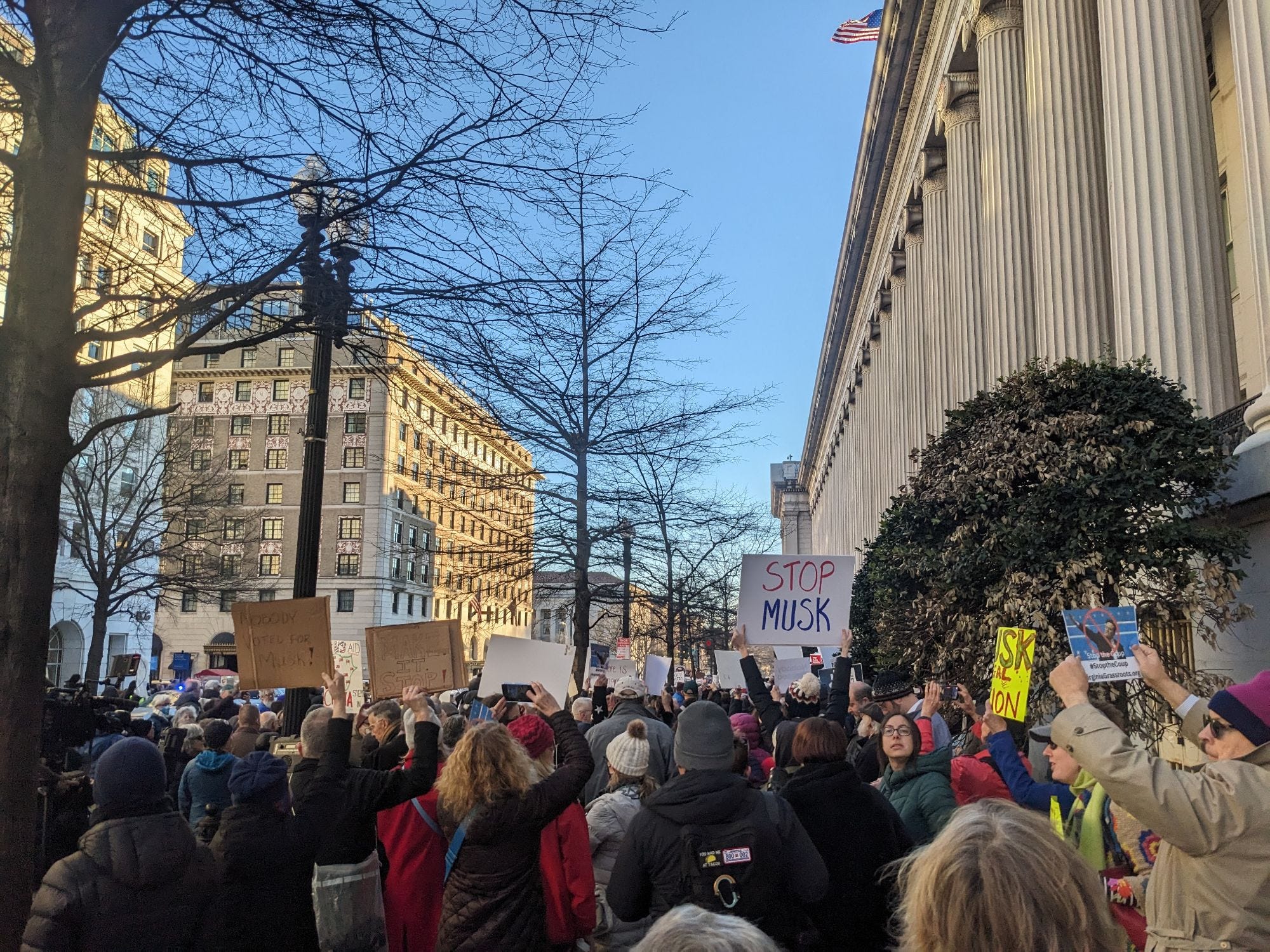
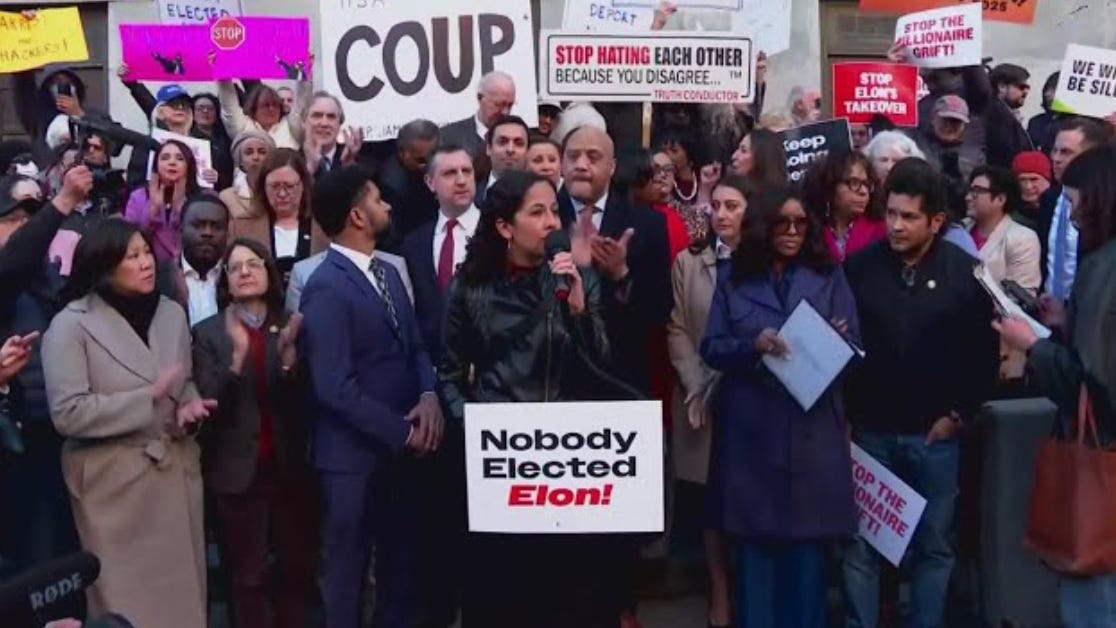
The lawyers are at work, too. So far, they’ve convinced courts to enjoin Trump’s birthright citizenship plans and his effort to stop federal spending that offends his sensibilities. Today, lawyers filed two separate cases designed to prevent the FBI from firing agents who worked on January 6 cases and to keep the Justice Department from making their names public. Placing faith in the courts feels like unsteady ground in light of the Supreme Court’s willingness to give Trump a pass on criminality. Having already given him immunity from criminal prosecution for any official acts he commits, perhaps the conservative majority will see the wisdom of declining to consolidate all of the power of government in the hands of the president.
There is still plenty of fight left in our democracy, but it’s an all-hands-on-deck moment. This isn’t a coup with tanks in the streets and mobs overrunning government offices. It’s a quieter coup, a billionaires’ coup. Talk with the people around you about what’s happening and what it means if they’re not aware.
Call it what it is: A coup. Let’s make sure it doesn’t succeed.
We’re in this together,
Joyce
National Gallery of Australia
Some examples from the Ethel Carrick and Anne Dangar NGA exhibition of work. Below are several of paintings by Ethel Carrick. There will be more from this splendid exhibition next week.

The Ferry, Kashmir 1937


 Robin's Room