
Sara Lodge The Mysterious Case of the Victorian Female Detective Yale University Press, November 2024.
Thank you, NetGalley, for providing me with this uncorrected proof for review.
The combination of a history of the female detective as a working part of the police force during the Victorian era, and her depiction in fictional accounts of the time makes for a fascinating read. Questions that immediately come to mind, and are answered include – how active were the real women detectives? What were their roles? Did they capture criminals or leave that to the male detectives? Were they courageous and killed on duty? What was the attitude in the police force and wider society towards these women active on behalf of law enforcement? And then, moving on to consider how these women detectives and the cases they worked on in the real world were depicted in fiction, there are more questions. Did fiction portray women’s contributions in an exaggerated form or were they always seen as secondary to those of men? Were any fictional characters based on real women and their activities? What did fiction say about women detectives and how did this impact the audience for these novels?
Sara Lodge answers these questions in this stimulating read which blends so much information about the police force and women’s role in it, the depiction of women detectives in fiction and the social conditions which were so vividly described in print – fictional and factual. At the same time as being an academic work, with copious citations, an amazing bibliography and index, Lodge has produced a great read. See Books: Reviews for the complete review.
After the review; Crime on Her Mind; A Modern Television Female Detective; The Conversation – Archie Roach and Ruby Hunter; Literature Cambridge; and Civil Discourse, Joyce Vance.

An earlier publication that concentrated on the fictional women detectives is written by Michelle B. Slung. Crime on Her Mind, Fifteen stories of female sleuths from the Victorian Era to the Forties, published by Penguin in 1984 has a valuable introduction which introduces the theme, women detectives in fiction from the Victorian era through the Golden Age of detective fiction (1918 to 1930) to the 1940s in some detail. Further brief references are made to ‘hard boiled’ woman detective, coinciding with Golden Age writers, and the dearth of women detectives in the 1950s and 60s fiction.
The fifteen writers whose work appear in this collection are: C.L. Pirkis, George R. Simms, Clarence Rook, L.T. Meade and Robert Eustace, Emmuska, Baroness Orczy, Hugh C. Weir, Anna katherine Greens, Arthur B. Reeve, Hulbert Footner, E. Phillips Oppenheim, Mignon G. Eberhart, William Irish, G.D.H. Cole and M. Cole, Gladys Mitchell and Stuart Plamer. it is noticeable that many male writers depicted female detectives in this period.
Each story is introduced with a short description of the writer and their work. There is a chronological survey which Michelle B. Slung refers to as ‘idiosyncratic and informal’ rather than scholarly. Nevertheless, it is a useful addition to this volume.
Michelle B. Slung wrote 17 books, the most recent of which was published in 2017. Women’s Wiles is described as : NOTHING’S WHAT IT SEEMS IN THIS SLYLY SINISTER COLLECTION OF DAMES DONE WRONG…AND DOING THE SAME! Shocking surprises, chilling comeuppances, and mercies that are anything but tender are just part of what to expect from these memorable stories of women.
A newer edition than mine is available on Amazon.

A Modern Television Female Detective
An article about a current detective – female, based on the 1960s Columbo styled detective series, and a familiar character from legal dramas of the 2000s – caught my attention. Elspeth Tascioni was a wonderful character in the legal dramas referred to below, and it seems a positive response to the breadth of depictions acceptable to a television audience for a female detective when eccentricity is adopted as a feature.
This quirky Good Wife spinoff is a joyful antidote to all the slick legal thrillers – from the Sydney Morning Herald.
Story by Ben Pobjie
ELSBETH ★★★½
Carrie Preston plays the eccentric detective Elsbeth Tascioni in the eponymous series created by Good Wife and Good Fight producers Robert and Michelle King.© Supplied

This opinion, one surmises, is one shared by the creators of Elsbeth, a modern crime series that follows the Columbo template closely enough that it verges on remake territory – perhaps just different enough be called a homage instead.
As in Columbo, we begin each episode with the murderer shown committing the crime. As in Columbo, it’s not about whodunnit, it’s about how they’ll be caught. And as in Columbo, the answer lies in the quicksilver mind of a criminological genius who presents as singularly unthreatening, even as they dig remorselessly for the truth.
Here, that genius is Elsbeth Tascioni, a character who may already be familiar to viewers of The Good Wife and The Good Fight. Elsbeth appeared in both those shows, with actor Carrie Preston winning an Emmy for her portrayal in the former. This is a different proposition to those slick, classy legal dramas, though: it’s a full-blooded quirky detective romp the way they used to make them, with murder as intellectual exercise, crime as fun and investigation as semi-comedic joyride.

Republished under Creative Commons license
A new public statue of Archie Roach and Ruby Hunter shows a bright future for Australian monuments
Story by Bronwyn Carlson, Macquarie University and Terri Farrelly, Macquarie University
Aboriginal and Torres Strait Islander readers are advised this article contains names and images of deceased people.
As authors of the book Monumental Disruptions: Aboriginal people and colonial commemorations in so-called Australia, we are often contacted by media to respond to whether colonial statues have a place in modern Australia.
Such statues create controversy because they often honour people who have dubious histories. Journalist Paul Daley has described such statues as “assorted bastards” who have profited from the dispossession and exploitation of Aboriginal and Torres Strait Islander peoples.
The problem with many statues is they do not represent a shared history. They either represent colonial figures who have harmed Aboriginal and Torres Strait Islander peoples, or they represent a one-sided perspective that erases the other.
This year we were asked to respond to a different kind of monument: a statue of music legends Archie Roach and Ruby Hunter, newly erected in the Melbourne suburb of Fitzroy in November 2024.
An inspirational, unifying force
Archie Roach, a Gunditjmara (Kirrae Whurrong/Djab Wurrung), Bundjalung senior Elder, songwriter and storyteller sadly died in 2022 aged only 66. Anthony Albanese described him as a “brilliant talent, a powerful and prolific national truth teller”.
His partner Ruby Hunter was a Ngarrindjeri woman and pioneering singer-songwriter. She was the first Indigenous woman to be signed to a major record label, and sadly died in 2010.
Both were members of the Stolen Generations – Aboriginal children who were forcibly removed from their families by Australian government authorities as part of the assimilation policy. They met on the street as homeless teenagers.
Their award-winning music took them around the world together. They performed alongside musical greats such as Tracy Chapman, Paul Kelly and Bob Dylan.
They have been described as an inspiration to many, and a unifying force who altered the way white Australia saw itself.
A statue that sits in conversation with community
The statue of Archie Roach and Ruby Hunter was commissioned by the Yarra City Council in partnership with the Wurundjeri Woi-wurrung Cultural Heritage Aboriginal Corporation and Victorian government.
The statue was made by local artist Darien Pullen. The surrounding park space was designed by Melbourne-based architect Jefa Greenaway (Wailwan/Kamilaroi) and landscape architect Paul Herzich (Kaurna/Ngarrindjeri).
Fitzroy’s Atherton Gardens is a culturally significant site that once served as a traditional meeting place. It later became a hub of political activism and resistance for Victoria’s Aboriginal community.
This monument stands in a place rich with history. It is where Archie and Ruby spent meaningful time with their family, and where Archie was reunited with his biological family.
Their son, Amos Roach, emphasised the deep cultural significance of the location: “it’s a place of cultural significance because it was a meeting place, it’s an old camp”.
He also reflected on his personal connection to the park, saying, “I was a parkie baby when I was born … and I still come here”.
The statue stands at street level, embodying an ongoing presence. They are casual, approachable and engaged, as if in conversation with the community.
Positioned to invite interaction, the statue forms a dynamic relationship with both the people who pass by and the place it inhabits.
It is embraced rather than imposed, welcomed and wanted.
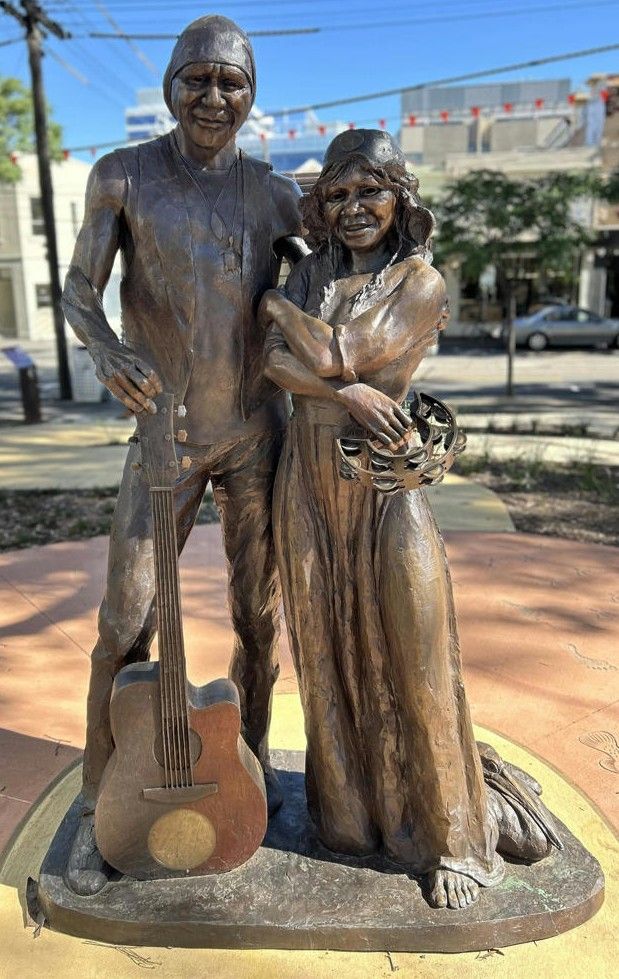
The statue stands at street level, in conversation with the community.© The Conversation
While these figures are Aboriginal icons, they are also remarkable individuals who made significant contributions to Australia. Their commemoration carries meaning and connection for all.
Compare it to the Cook statue in Hyde Park on Gadigal Country (Sydney). He is perched high above the observer, arm raised to the heavens in a theatrical “ta-daa”.
Positioned in a location where the man himself never set foot, the text at the base of the statue? make the historically incorrect allegation that he “DISCOVERED THIS TERRITORY, 1770” – something Cook never personally claimed.
A shared future
Rather than erecting monuments to colonial figures who oppressed Aboriginal and Torres Strait Islander peoples, reinforcing a history of injustice and loss, we should instead celebrate a shared vision for the future.
This vision should be built on recognition, respect and the commemoration of those who have made meaningful contributions to Australia.
This statue of Archie Roach and Ruby Hunter honours two individuals who, despite being shaped by the very colonial histories commemorated by other monuments, have profoundly enriched contemporary Australia through their resilience, talent and contributions.
Until recently, commemorations of Aboriginal people were largely confined to the realm of prehistory — portraying them as nameless “Natives” in conflict with settlers, as loyal guides and servants, or as tragic figures labelled “the last of their tribe”.
Like recent statues commemorating Aboriginal figures such as Pastor Sir Doug and Lady Gladys Nicholls, William Cooper, and William “Bill” Ferguson, this statue brings Aboriginal peoples into the present.
It is a powerful recognition of their enduring impact in shaping this nation – one that calls for acknowledgement, respect and inclusion from us all.
The authors do not work for, consult, own shares in or receive funding from any company or organisation that would benefit from this article, and have disclosed no relevant affiliations beyond their academic appointment.

Dear Friends,
We have made a wonderful start to the year, with superb lectures on Tragedy, Irish poetry, Virginia Woolf, Frankenstein, and more.
Women Writers Season
Our new Women Writers Season continues with great works of the 19th and early 20th centuries:
• Alison Hennegan on Jane Austen, Pride and Prejudice (1813), 22 February 2025 – just a few places left.
• Corinna Russell on Elizabeth Barrett Browning, Aurora Leigh (1857), 22 March 2025.
• Clare Walker Gore on George Eliot, Middlemarch (1872), 26 April 2025.• Trudi Tate on Elizabeth Bowen, To the North (1932), 24 May 2025.
• Lisa Mullen on Inez Holden, Night Shift (1941), 28 June 2025.
• Alison Hennegan on Sylvia Townsend Warner, Summer will Show (1936), 20 September 2025. … and more.
Bloomsbury Course 2025
Karina Jakubowicz’s popular course on Bloomsbury: Art and Politics starts soon. We study Vanessa Bell, Katherine Mansfield, E. M. Forster, Mulk Raj Anand, Virginia Woolf, and Leonard Woolf. Live online weekly on Fridays, 6.00 to 8.00 pm British time, 21 February to 28 March 2025.
Oscar Wilde Course 2025
Join us for a new live online course with Alison Hennegan on Oscar Wilde: Man of Many Parts. We study Lady Windermere’s Fan, The Importance of Being Earnest, The Ballad of Reading Gaol, the fairy tales. Fortnightly on Tuesdays, 25 March to 6 May 2025.
Looking ahead:•
Comedy and Irony in the Young Jane Austen. Live online with Fred Parker, 4–25 May 2025.
• Katherine Mansfield: Stories of Life and Death. Live online course with Gerri Kimber, Claire Davison, Trudi Tate and Karina Jakubowicz, May-June 2025.
• Doris Lessing: Women and Destiny. Live online course with Ann-Laure Brevet, September-October 2025
• Women and Power in 20thC Novels: 1950s-1980. Live online course with Miles Leeson, September-November 2025.
• London in Literature I. Live online course with Angela Harris, September-December 2025.
See you soon.
Best wishes,Trudi
Dr Trudi TateDirector, Literature Cambridge Ltd
www.literaturecambridge.co.uk
Virginia Woolf Summer Course 2025
Our summer theme in 2025 is Virginia Woolf: Writing Life.
The course will run twice: first, live online, Thursday 10 July to Monday 14 July 2025, including the weekend.
The course will run again from Sunday 20 July to Friday 25 July 2025, in person in Cambridge.
There will be lectures, tutorials, talks, visits and more.
Five days of intensive study and discussion on Mrs Dalloway, To the Lighthouse, Orlando, The Waves, and Flush; plus talks on the life writing of Leonard Woolf, Leslie Stephen, Jane Harrison, and a group reading of Freshwater. Brilliant.

Joyce Vance from Civil Discourse <joycevance@substack.com> Unsubscribe
The Courts Aren’t The Cavalry; We Are
So, what are WE going to do?
Joyce Vance
Lots of people are talking about early wins in court. I wanted to take a moment to clarify exactly what we are looking at.
If you’re one of the stalwarts who makes it through the newsletter every day, you probably already know what I’m going to say. Yes, pro-democracy forces are winning in just about every case that has been filed so far. But these cases are in an early, preliminary, procedural stage. Courts aren’t yet ruling on the substantive merits of the cases; they aren’t ruling on whether any of the challenges to how Trump and Musk are conducting affairs of government will ultimately succeed.
Federal judges across the country have entered a flurry of temporary restraining orders (TROs) designed to freeze the status quo in place while the litigation gets started. To get a temporary restraining order, the plaintiffs who are challenging actions by the new administration have to convince the judge that there’s a strong chance irreparable injury to their rights will take place without the freeze.
That’s why the judge in the impoundment case ordered the Trump administration to restore congressionally allocated spending they had frozen. It’s why multiple judges in the birthright citizenship cases told the administration it can’t deny newborns their rights for now. It’s not clear any of that will survive once we get to the point where courts consider longer preliminary restraining orders, which require a greater quantum of proof and more formal proceedings. Those proceedings will also undoubtedly be followed by appeals to higher courts by the Trump administration if it loses.
There are limits to how much the courts can or will do, even at the TRO stage. We saw judges reject requests because the parties in front of the court didn’t have standing, the necessary connection to a case to file suit (explained in the context of the mifepristone medication abortion case here). There are legal limits on these cases. And in the case that is (oh, the irony) pending before Judge Tanya Chutkan in Washington, D.C., the Judge declined to shut down all DOGE operations in a hearing Friday. She acknowledged the states’ concerns about the “unpredictability” of Musk’s operation but indicated that entering a TRO against everything he is doing seemed too broad, exceeding the level of irreparable injury the plaintiffs’ evidence demonstrated. Even at this early stage, the courts can’t provide a complete and total remedy for every disturbing act Trump commits or enables.
That’s not to say I don’t have confidence in the courts, because I do, and I think some progress will be made there, although as we know far too well, it may be very slow. But the courts aren’t the calvary. We are. We have to be in this fight for ourselves. We can’t get complacent. These early victories are important, but they are not ballgame. Just because it doesn’t feel like we’re in the middle of a constitutional crisis—Trump isn’t dramatically crossing out broad swaths of the Constitution with his sharpie marker in a made-for-television moment—doesn’t mean we aren’t there.
The courts can impose some restrictions when Trump exceeds the bounds of law. But if it’s “just politics”—or, problematically, if five justices on the Supreme Court believes it is—then it’s up to us, the voters, the citizens of the United States. There is a midterm election coming, and if your elected representatives aren’t working for you, now is the time to start doing something about it. No one thought, when they got into the race, that Senators Ossoff and Warnock could win in Georgia. But they did.
Ultimately, we’re the check on power run amuck. That means awakening slumbering moderate Republicans in Congress, stirring up the voters for the midterms, and keeping a public spotlight on the excesses of this administration, which has helped to rein them in as much as anything else right now.
If you need some ideas for getting started, the good folks at Choose Democracy have some advice. They suggest getting started with a local group and figuring out where there are weak links in MAGA support you can pressure. They suggest devoting yourself to a longterm project you can support. Other groups are organizing a variety of public protests and blackouts. Different ways of speaking up will work for different people. Pick yours. Make sure your voice counts. Start exercising your democracy muscles!
Earlier this week I wrote to one of my senators to ask her to reconsider before voting for Kennedy. She didn’t, but I did get a form letter back. I expect more than that from my senator when she votes for a man who vaccinated his own kids but doesn’t want you to vaccinate yours, particularly in an environment where the administration is gutting public health as we watch bird flu become more transmissible. Fortunately, I’m not alone. There are groups of people like me who are committed to making our senators do more than just send form letters, even if that requires persistence on our parts. Sadly, her response to me came from a “do not reply” email account, which makes it more difficult to ask a senator for follow-up, but I think I’m up to the challenge.
We have to find ways to do this because if all MAGA hears are self-congratulatory voices proclaiming their success, it’s a lot easier for them to kowtow to Trump’s every demand. It becomes more difficult—because these folks are politicians who are dedicated to staying in power whatever the cost—if they’re getting pounded by thousands of voices of sanity about their obligations as elected representatives. Let’s make them understand that we are here, we are engaged, and we are not going away. It would have only taken a few senators getting cold feet about Kennedy to make a difference. It’s worth pulling out all the stops and contacting your senators with the vote on Kash Patel looming ahead this week.
My take on what we need to do right now is this: stay informed about what’s happening nationally, and get engaged locally.
We’re in this together,
Joyce
Thanks for being here with me at Civil Discourse through all of this. If you aren’t already, please consider becoming a paid subscriber, which helps me devote more time and resources to this project.
 Robin's Room