
Jodi Bondi Norgaard More Than a Doll How Creating a Sports Doll Turned into a Fight to End Gender Stereotypes Post Hill Press, January 2025
Thank you, NetGalley, for providing me with this uncorrected proof for review.
Jodi Bond Norgaard begins with numerous examples of the sexism that drove her to create a sports doll. These include personal and friends’ anecdotal accounts of the sexism they experienced at school, work and socially. These accounts are augmented by published reports, and one unpublished report – Equal Play? Analyzing Gender Stereotypes, Diversity and Inclusion in Advertising and Marketing for the Most Popular Toys of 2022 for The toy Foundation. Bond Norgaard’s aim to produce a sports doll arose from the detailed information in the first section of the book.
Comparing Bond Norgaard’s first entrepreneurial experience, producing baskets of baked goods and chocolates, with that of producing Go! Go! Sports Girls is instructive. While both enterprises depended on the positive responses and assistance from other women, the latter required her to deal producing a product that conflicted with traditional responses to girls and dolls and the cultural environment. The practical features of production, for example where could the dolls be produced at a reasonable cost; legal issues; safety standards; marketing; competition from other brands; the role of large toy companies; changing doll images to meet demand; testing girls’ preferences; the importance of social media; and dealing with sexism, personal and public are canvassed. See Books: Reviews for the complete review.
After the review: Heather Cox Richardson- a peaceful healthy world that has allowed the seeds of destruction to flourish; Raw Story – female astronomer; Lost Ladies Who Feel Extra Relevant Right Now; The Last Showgirl: Pamela Anderson is perfectly cast in this intimate portrait of womanhood; Cindy Lou eats out in Sydney; Belvoir Theatre- Song of First Desire; Special Correspondent driving from Canberra to Perth; Joyce Vance – comment on State of the Union Address.
Heather Cox Richardson
Heather Cox Richardson from Letters from an American <heathercoxrichardson@substack.com>
On Monday [last week, not the 3rd March], James Marriott of The Times, published in London, noted that the very stability and comfort of the post–World War II liberal order has permitted the seeds of its own destruction to flourish. * A society with firm scientific and political guardrails that protect health and freedom, can sustain “an underbelly of madmen and extremists—medical sceptics, conspiracy types and anti-democratic fantasists.”
“Our society has been peaceful and healthy for so long that for many people serious disaster has become inconceivable,” Marriott writes. “Americans who parade around in amateur militia groups and brandish Nazi symbols do so partly because they are unable to conceive of what life would actually be like in a fascist state.” Those who attack modern medicine cannot really comprehend a society without it. And, Marriott adds, those who are cheering the rise of autocracy in the United States “have no serious understanding of what it means to live under an autocratic government.”
Marriott notes that five Texas counties that make up one of the least vaccinated areas in the U.S. are gripped by a measles outbreak that has infected at least 58 people and hospitalized 13. It may be, Marriot writes, that “[t]he paradise of fools is coming to an end.”
The stability of the U.S.-backed international rules-based order apparently meant that few politicians could imagine that order ending. When President Trump threatened to take the United States out of the North Atlantic Treaty Organization (NATO), a key guarantor of global security, Congress responded by passing a law in December 2023 that prohibits a president from withdrawing the U.S. from NATO without the approval of two thirds of the Senate or separate legislation passed by Congress. Then-senator Marco Rubio (R-FL) was a co-sponsor of the bill.
Now, with Secretary of State Marco Rubio overseeing the dismantling of U.S. support for our allies and a shift toward Russia, Republican senators appear to be discombobulated. As Joe Perticone reported Tuesday in The Bulwark, there appears to be consensus in Congress that “Russian President Vladimir Putin is a war criminal, NATO is critical to European and global security, and the United States has led the common defense. But Republicans just backed a presidential candidate and voted to confirm several key cabinet officials who do not accept those realities. Confronted with the consequences of their support for Trump and votes for his nominees, Perticone notes, Republican lawmakers are apparently shocked.
At home, the relative stability of American democracy in the late twentieth century allowed politicians to win office with the narrative that the government was stifling individualism, taking money from hardworking taxpayers to provide benefits to the undeserving.
Although the actual size of the federal workforce has shrunk slightly in the last fifty years even while the U.S. population has grown by about 68%, the Republican Party insisted that the government was wasting tax dollars, usually on racial, religious, or gender minorities. That claim became an article of faith for MAGA voters and reliably turned them out to vote. Now, political scientist Adam Bonica’s research shows that the firings at DOGE are “a direct push to weaken federal agencies perceived as…left-leaning.”
But the Trump administration’s massive and random cuts to the federal workforce are revealing that the narrative of government waste does not line up with reality. According to Linda F. Hersey of Stars and Stripes, about one third of all federal workers are veterans, while veterans make up only about 5% of the civilian workforce. In fiscal year 2023, about 25% of the federal government’s new hires were veterans, and they have been hit hard by the firings that cut people who were in their first year or two of service. “Let’s call this what it is—it is a middle finger to our heroes and their lives of service,” said Senator Tammy Duckworth (D-IL) who sits on the Senate Veterans’ Affairs and Armed Services committees and is herself a disabled veteran.
Meredith Lee Hill of Politico reported today that Republican lawmakers are panicked over this weekend’s firings, concerned about the fired veterans and the firings of USDA and CDC employees who were dealing with the spreading outbreak of bird flu that is threatening the nation’s poultry, cattle, house cats, and humans.
Since Trump took office just a month ago, cuts to government spending have also hit Republican voters hard, and those hits look to be continuing. In June 2024, Ella Nilsen and Renée Rigdon of CNN reported that nearly 78% of the announced investments from the Inflation Reduction Act in initiatives that address climate change went to Republican congressional districts. Today the Financial Times noted that House Republicans are in the position of cutting the law that brought more than $130 billion to their districts.
Now Republicans are talking about cutting Social Security, Medicare, Medicaid, and supplemental food programs, although Republican-dominated counties rely on those programs more than Democratic-dominated counties do. Yesterday, on the Fox News Channel, Trump’s commerce secretary, Howard Lutnick, praised the Department of Government Efficiency because it was “going to cut a trillion dollars of waste, fraud, and abuse.” Lutnick told personality Jesse Watters, “You know Social Security is wrong, you know Medicare and Medicaid is wrong, so he’s going to cut one trillion.”
The administration and the Department of Government Efficiency insist they are getting rid of “massive waste, fraud, and abuse” that they claim has lurked in the government for decades; House speaker Mike Johnson (R-LA) said that Congress has not been able to make those cuts in the past because “the deep state has hidden it from us.”
In fact, neither the administration nor DOGE has produced evidence for their claims of cutting waste. Instead, fact-checkers have pointed out so many errors and exaggerations in their claims that observers are questioning what they’re really doing. Former Maryland governor Martin O’Malley, who ran the Social Security Administration under Biden, told Jane C. Timm of NBC News: “There’s unelected people that are being given powers to go through and rummage through our personal data for reasons that nobody can quite figure out yet. It’s not for efficiency.”
Indeed, federal government spending since Trump took office is actually higher than it’s been in recent years.
Finally, it appears that the strength and stability of American democracy have also meant that lawmakers somehow cannot really believe that the U.S. is falling into authoritarianism. Today, in a 51–49 vote, all but two Republican senators voted to confirm Kash Patel as director of the Federal Bureau of Investigation. Senators Susan Collins (R-ME) and Lisa Murkowski (R-AK) voted with all the Democrats and Independents to oppose Patel’s confirmation. In a 2023 book, Patel published a list of more than 50 current or former U.S. officials that he claims are members of the “deep state” and are a “dangerous threat to democracy.” Opponents worry he will use the FBI to target those and other people he thinks are insufficiently loyal to Trump.
The reason Americans created the government that the Trump administration is now dismantling was that in the 1930s, they knew very well the dangers of authoritarianism. On February 20, 1939, in honor of President George Washington’s birthday, Nazis held a rally at New York City’s Madison Square Garden. More than 20,000 people showed up for the “true Americanism” event, which was held on a stage that featured a huge portrait of Washington in his Continental Army uniform flanked by swastikas.
Just two years later, Americans went to war against fascism.
Over the next century they worked to build a liberal order, one that had strong scientific and political guardrails.
—
Notes:
“22,000 Nazis Hold Rally in Garden,” The New York Times, February 21, 1939; Ryan Bort, “When Nazis Took Over Madison Square Garden,” Rolling Stone, February 19, 2019.
Bluesky:
carlquintanilla.bsky.social/post/3lime3waaa22t
adambonica.bsky.social/post/3lil7yl2jvk26
*This world was worth whatever comes next.
Raw Story
‘Absolutely furious’: Pioneering female astronomer’s legacy rewritten amid diversity purge
Lisa Song, ProPublica January 31, 2025 5:34PM ET
During his first presidential term, Donald Trump signed a congressional act naming a federally funded observatory after the late astronomer Vera Rubin. The act celebrated her landmark research on dark matter — the invisible, mysterious substance that makes up much of the universe — and noted that she was an outspoken advocate for the equal treatment and representation of women in science.
“Vera herself offers an excellent example of what can happen when more minds participate in science,” the observatory’s website said of Rubin — up until recently.
By Monday morning, a section of her online biography titled, “She advocated for women in science,” was gone. It reappeared in a stripped-down form later that day amid a chaotic federal government response to Trump’s campaign against diversity, equity and inclusion programs.
While there are far more seismic changes afoot in America than therevision of three paragraphs on a website, the page’s edit trail provides an opportunity to peer into how institutions and agencies are navigating the new administration’s intolerance of anything perceived as “woke” and illuminates a calculation officials must make in answering a wide-open question:
How far is too far when it comes to acknowledging inequality and advocating against it?
“Vera Rubin, whose career began in the 1960s, faced a lot of barriers simply because she was a woman,” the altered section of the bio began. “She persisted in studying science when her male advisors told her she shouldn’t,” and she balanced her career with raising children, a rarity at the time. “Her strength in overcoming these challenges is admirable on its own, but Vera worked even harder to help other women navigate what was, during her career, a very male-dominated field.”
That first paragraph disappeared temporarily, then reappeared, untouched, midday Monday.
That was not the case for the paragraph that followed: “Science is still a male-dominated field, but Rubin Observatory is working to increase participation from women and other people who have historically been excluded from science. Rubin Observatory welcomes everyone who wants to contribute to science, and takes steps to lower or eliminate barriers that exclude those with less privilege.”
That paragraph was gone as of Thursday afternoon, as was the assertion that Rubin shows what can happen when “more minds” participate in science. The word “more” was replaced with “many,” shifting the meaning.
“I’m sure Vera would be absolutely furious,” said Jacqueline Mitton, an astronomer and author who co-wrote a biography of Rubin’s life. Mitton said the phrase “more minds” implies that “you want minds from people from every different background,” an idea that follows naturally from the now-deleted text on systemic barriers.
She said Rubin, who died in 2016, would want the observatory named after her to continue her work advocating for women and other groups who have long been underrepresented in science.
It’s unclear who ordered the specific alterations of Rubin’s biography. The White House, the observatory and the federal agencies that fund it, the National Science Foundation and the Department of Energy, didnot respond to questions from ProPublica.
The observatory’s page on diversity, equity and inclusion was also missing Thursday afternoon. An archived version from Dec. 19 shows that it described the institution’s efforts “to ensure fair and unbiased execution” of the hiring process, including training hiring committee members “on unconscious bias.” The DEI program also included educational and public outreach efforts, such as “meeting web accessibility standards” and plans to build partnerships with “organizations serving audiences traditionally under-represented” in science and technology.
Similar revisions are taking shape across the country as companies have reversed their DEI policies and the Trump administration has placed employees working on DEI initiatives on leave.
If the changes to Rubin’s biography are any indication of what remains acceptable under Trump’s vision for the federal government, then certain facts about historical disparities are safe for now. But any recognition that these biases persist appears to be in the crosshairs.
The U.S. Air Force even pulled training videos about Black airmen and civilian women pilots who served in World War II. (The Air Force later said it would continue to show the videos in training, but certain material related to diversity would be suspended for review.)
One of Rubin’s favorite sayings was, “Half of all brains are in women,” Mitton said. Her book recounts how Rubin challenged sexist language in science publications, advocated for women to take leadership roles in professional organizations and declined to speak at an event in 1972 held at a club where women were only allowed to enter through a back door.
Jacqueline Hewitt, who was a graduate student when she met Rubin at conferences, said she was inspired by Rubin’s research and how she never hid the fact that she had kids. “It was really important to see someone who could succeed,” said Hewitt, the Julius A. Stratton professor of physics at the Massachusetts Institute of Technology. “It felt like you could succeed also.”
Rubin was awarded the National Medal of Science by then-President Bill Clinton in 1993. The observatory, located in a part of Chile where conditions are ideal for observational astronomy, was named after her in 2019 and includes a powerful telescope; it will “soon witness the explosions of millions of dying stars” and “capture the cosmos in exquisite detail,” according to its website.
Mitton said the observatory is a memorial that continues Rubin’s mission to include not just many people in astronomy, but more of those who haven’t historically gotten a chance to make their mark.
“It’s very sad that’s being undermined,” she said, “because the job isn’t done.”
Lost Ladies Who Feel Extra Relevant Right Now
Kim Askew and Amy Helmes from Lost Ladies of Lit <lostladiesoflit@substack.com>
History Keeps Repeating—Let’s Make Sure We’re Paying Attention
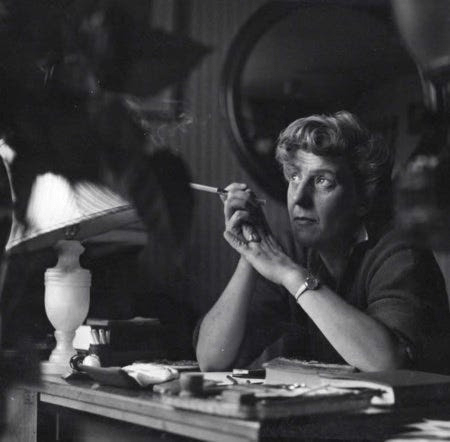
Author Kay Dick, Dear Lost Ladies of Lit Listeners
Some books refuse to stay in their century. They creep into the present, tapping on our shoulders, whispering, “Hey, haven’t we been here before?” And some of the women we’ve covered on Lost Ladies of Lit feel less like historical figures and more like people we should be texting for advice.Lately, we’ve been thinking about some of our past episodes that feel extra resonant right now—women who saw the future a little too clearly, who spoke truths people weren’t ready to hear, and whose words still pack a punch.
Sigrid Schultz – with Pamela Toler, author of The Dragon from Chicago– A journalist who covered the rise of fascism in real time, at great personal risk. If she were around today, she’d be throwing some serious side-eye at current events.
Frances Harper – Iola Leroy with Dr. Koritha Mitchell – A groundbreaking novel by one of America’s first Black women authors tackling race, identity, and freedom.
Mary Wollstonecraft – A Vindication of the Rights of Woman with Susan J. Wolfson – Because somehow, we’re still having the same arguments she was making in 1792.
Christine de Pizan – The Book of the City of Ladies with Kathleen B. Jones – A medieval woman imagining a utopia where women don’t have to justify their existence. Sound familiar?
Rose Macaulay – What Not with Kate Macdonald – A dystopian novel about government control of speech and thought, published before Orwell, but somehow left out of the conversation.
Kay Dick – They with Lucy Scholes – A chilling, overlooked dystopian novel about a world where artists and intellectuals are silenced. It reads like it was written yesterday.And speaking of voices that refuse to be silenced… we’ve got an upcoming episode on Frances Wright, a Scottish-born reformer who was loudly and unapologetically ahead of her time—advocating for abolition, women’s rights, and free thought long before the world was ready to listen. We have a feeling she’d be right at home in (and alarmed by) 2025.
So, if you’re looking for a few radical thinkers to add to your bookshelf, start with these. The conversation isn’t over yet.
Restack © 2025 Kimberley D Askew 548 Market Street PMB 72296, San Francisco, CA 94104
The Last Showgirl: Pamela Anderson is perfectly cast in this intimate portrait of womanhood
Published: February 13, 2025 1.23am AEDT
Daisy McManaman
Disclosure statement
Daisy McManaman does not work for, consult, own shares in or receive funding from any company or organisation that would benefit from this article, and has disclosed no relevant affiliations beyond their academic appointment.
 We believe in the free flow of information
Republished under Creative Commons licence.
Director Gia Coppola’s The Last Showgirl captures the bittersweet reality of a dreamer who has given everything to a career that will never love her back.
Pamela Anderson’s Shelley has devoted the past 30 years of her life to the Las Vegas revue Le Razzle Dazzle, a show she proudly describes as embodying “breasts and rhinestones and joy”. But as the show’s run comes to an end, Shelley is forced to confront an uncertain future, aged out of the career she so desperately loves.
Shelley is a woman out of time. From her pink Motorola Razr phone to her disbelief at the rising price of lemons, she clings to a romanticised vision of the showgirl as an ambassador of Las Vegas glamour.
But as Le Razzle Dazzle prepares to close and her co-stars, Jodie (Kiernan Shipka) and Mary-Anne (Brenda Song), audition for raunchier, neo-burlesque-inspired productions, both Shelley and the audience question whether the traditional showgirl still has a place in today’s cultural landscape.
The Last Showgirl explores the multifaceted nature of womanhood, offering an intimate portrait of the women of Las Vegas. It peeks into dressing rooms where, among tables scattered with false eyelashes and stray rhinestones, a performer struggles to balance single motherhood, her cultivated show community and a dream that may no longer have space for her.
Screenwriter Kate Gersten wrote The Last Showgirl after seeing the Las Vegas revue Jubilee! shortly before its closure in 2016.
As the last traditional showgirl revue on the Vegas strip, Jubilee! was a tribute to glamour and femininity. Jubilee!’s costume designers were Bob Mackie and Pete Menefee, and their original designs also feature in the film. They’re adorned with brightly coloured feathers and shimmering rhinestones so extravagant that they once caused an international Swarovski shortage.
In The Last Showgirl, these archival Jubilee! costumes become characters in their own right. Their opulent feathers and dazzling crystals create a spectacle on screen, embodying the larger-than-life fantasy of the showgirl.
As the title card plays, we see close-ups of the craftsmanship behind the showgirl aesthetic – hands caressing plumes, rich fabrics and expanses of rhinestones.
The Pamela renaissance
The true star of the film, however, is the woman whose performance shines brighter than the crystals she is adorned in. Anderson’s portrayal of Shelley cuts to the heart of the character, imbuing her with vulnerability that transcends the glittering surface of the showgirl persona.
The Last Showgirl marks Anderson’s first leading film role since the critically panned 1996 film Barb Wire, which earned her a Golden Razzie nomination for worst actress.
The casting of Anderson as Shelley feels almost kismet. One of the most notable sex symbols of our time, Anderson has recently undergone a cultural renaissance. This has been driven by the Hulu series Pam and Tommy (2022), which focused on the nonconsensual release of Anderson and her then-partner musician Tommy Lee’s sex tape (the series was ironically made without her consent).
But also Anderson’s own work in the 2023 Netflix documentary Pamela, A Love Story and her memoir, Love, Pamela, which was released the same year.
Anderson’s status as a sex symbol frequently stripped her of autonomy. In Love, Pamela, she states that she views her multiple appearances in Playboy as “an honour”, but also acknowledges that they’ve led some to treat her without respect.
She recalls being told in a deposition regarding her sex tape that she had “no right to privacy because I’d appeared in Playboy”. Both Anderson and Shelley refuse to be shamed for embodying feminine sexuality.
Subverting the showgirl
While The Last Showgirl paints a bleak image of the future of traditional Las Vegas revue, real burlesque dancers like Dita Von Teese offer a modernised alternative. Their performances honour showgirl glamour while breaking restrictive industry norms.
In 2024, Von Teese opened her own homage to Jubilee! by featuring the revue’s original Mackie and Manefee costumes (which she lent to The Last Showgirl). Von Teese’s Las Vegas revue features a diverse cast of showgirls, challenging stereotypes of gender, thinness and youth.
Dita Von Teese discusses her evolving show.
Performing at 52 – a similar age to Shelley – Von Teese invited 63-year-old retired showgirl Paula Nyland to perform on stage in the latest season of the Netflix show, Queer Eye. On the show, she explains: “We have to evolve and change and get rid of some of the unpleasant rules like height requirements, age requirements … I look to women older than me that can be examples of beauty and glamour.”
Perhaps, we could imagine an alternate timeline where Shelley finds a new home in Von Teese’s modernised showgirl revue, one that honours the glamour of the past while embracing a more inclusive future.
While The Last Showgirl paints a melancholic portrait of an ageing performer left behind by a changing industry, performers like Von Teese suggest that the showgirl can evolve rather than disappear. In a different version of Shelley’s story, she might have found a stage where rhinestones still sparkle, but the rules no longer dictate who gets to wear them.
Cindy Lou eats out in Sydney
Basket Brothers
Having enjoyed an exciting breakfast (sweeps of delicious sauces and sprinkles of seeds surrounding an interesting array of breakfast items) on an earlier trip, we decided upon plainer fare as a quick evening meal on our first night in Sydney. The fish was delicious and the chips too tempting. The gnocchi was a far fancier dish of delicious tastes, and the accompanying broccolini was the star of the meal. The staff here are friendly, and the service is always good. This is a go to place to eat – a good menu, nice meals, close to the hotel, and friendly.





Seeing this bus going past was quite reminiscent of being in London when a red bus also displaying this environmentally responsible sign was driven through Paddington.
Aria
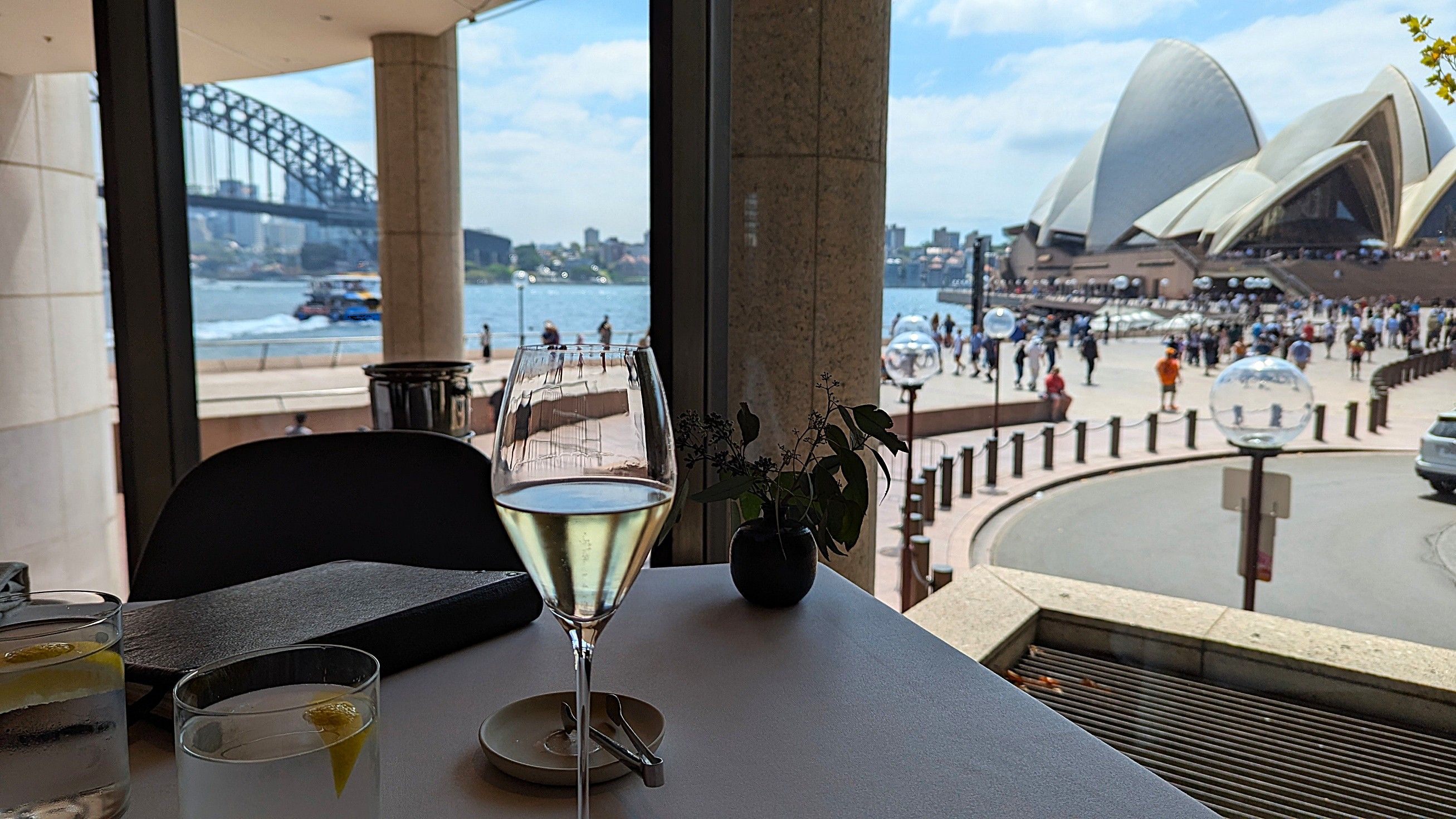
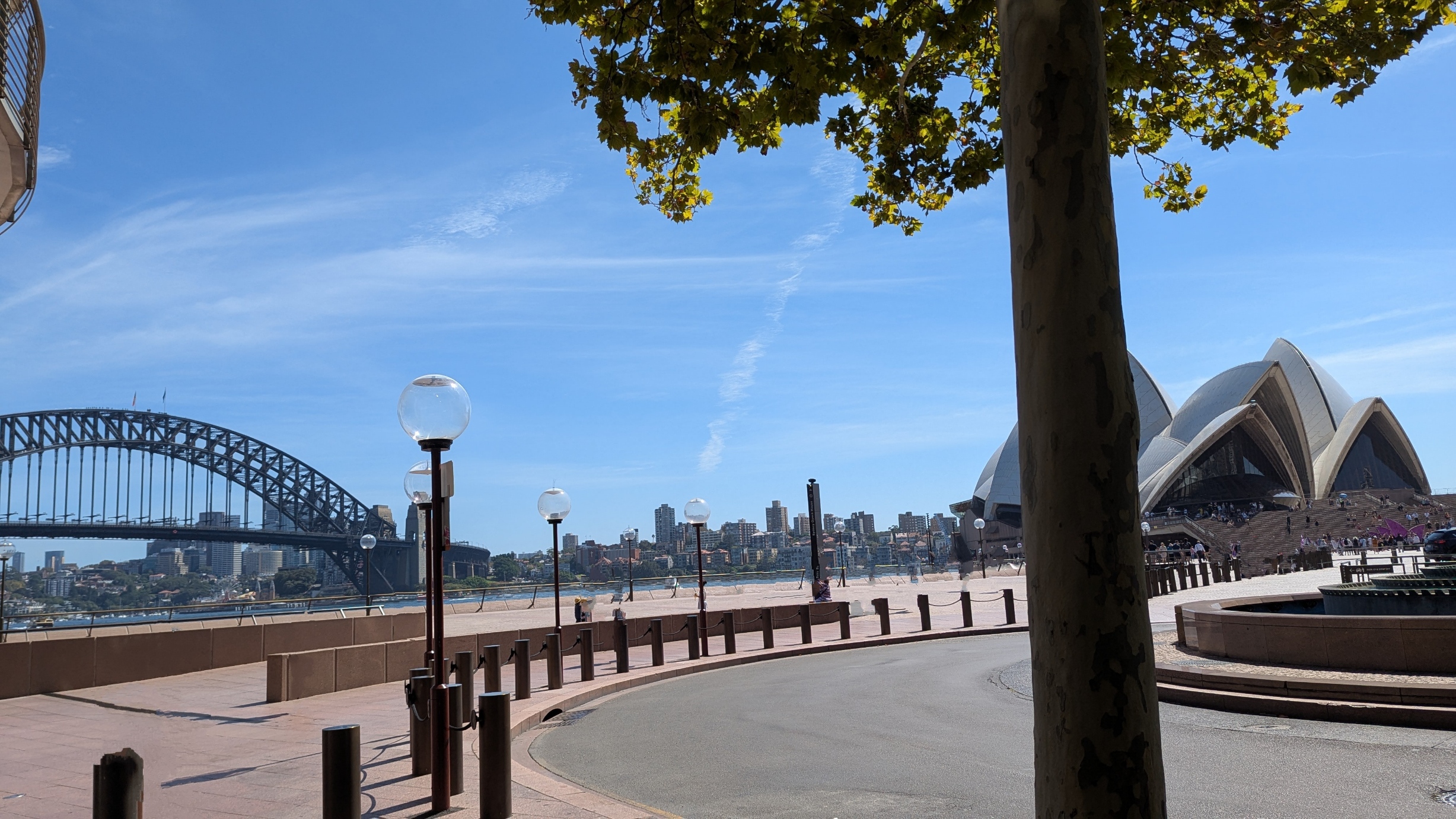
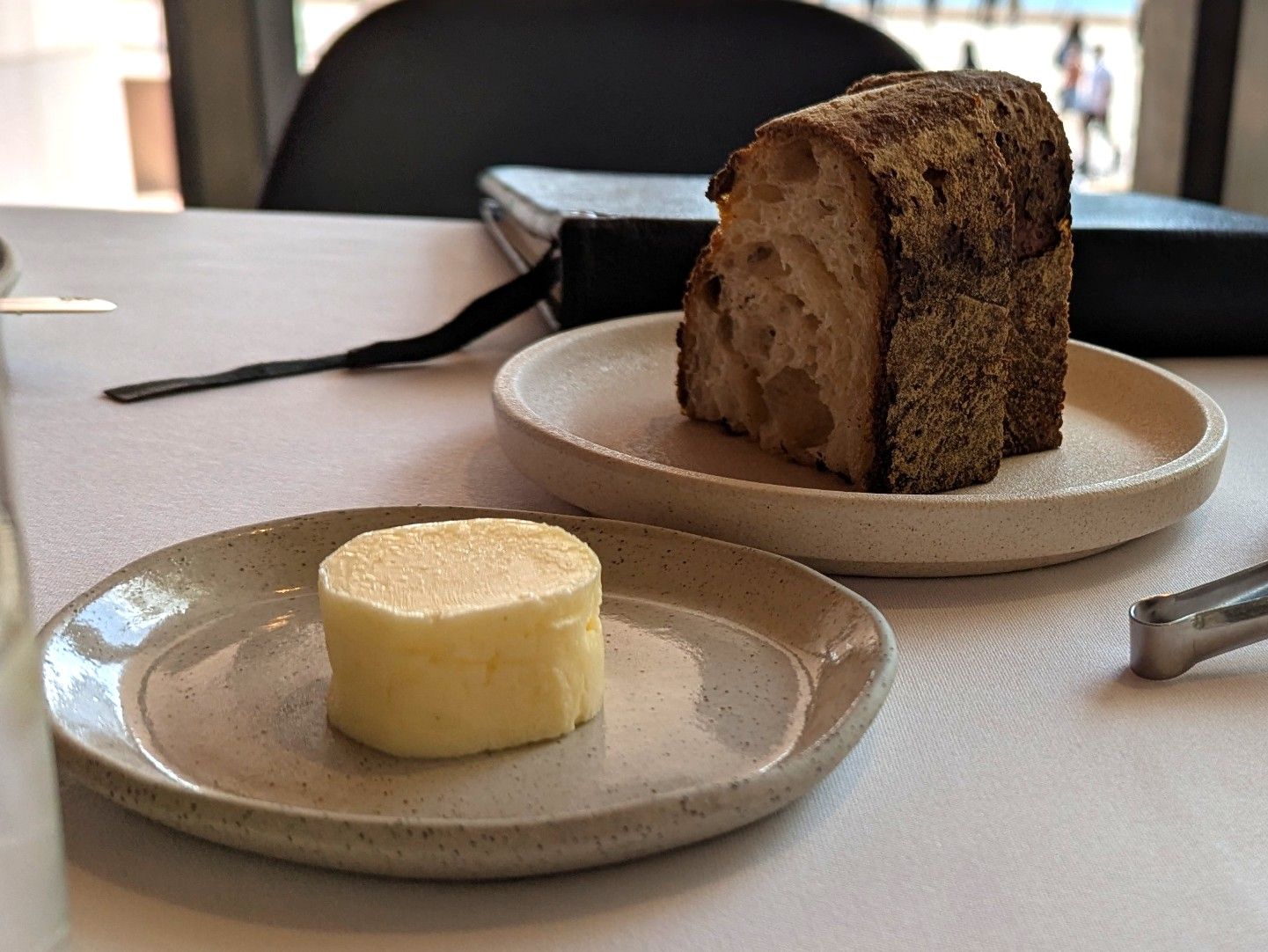
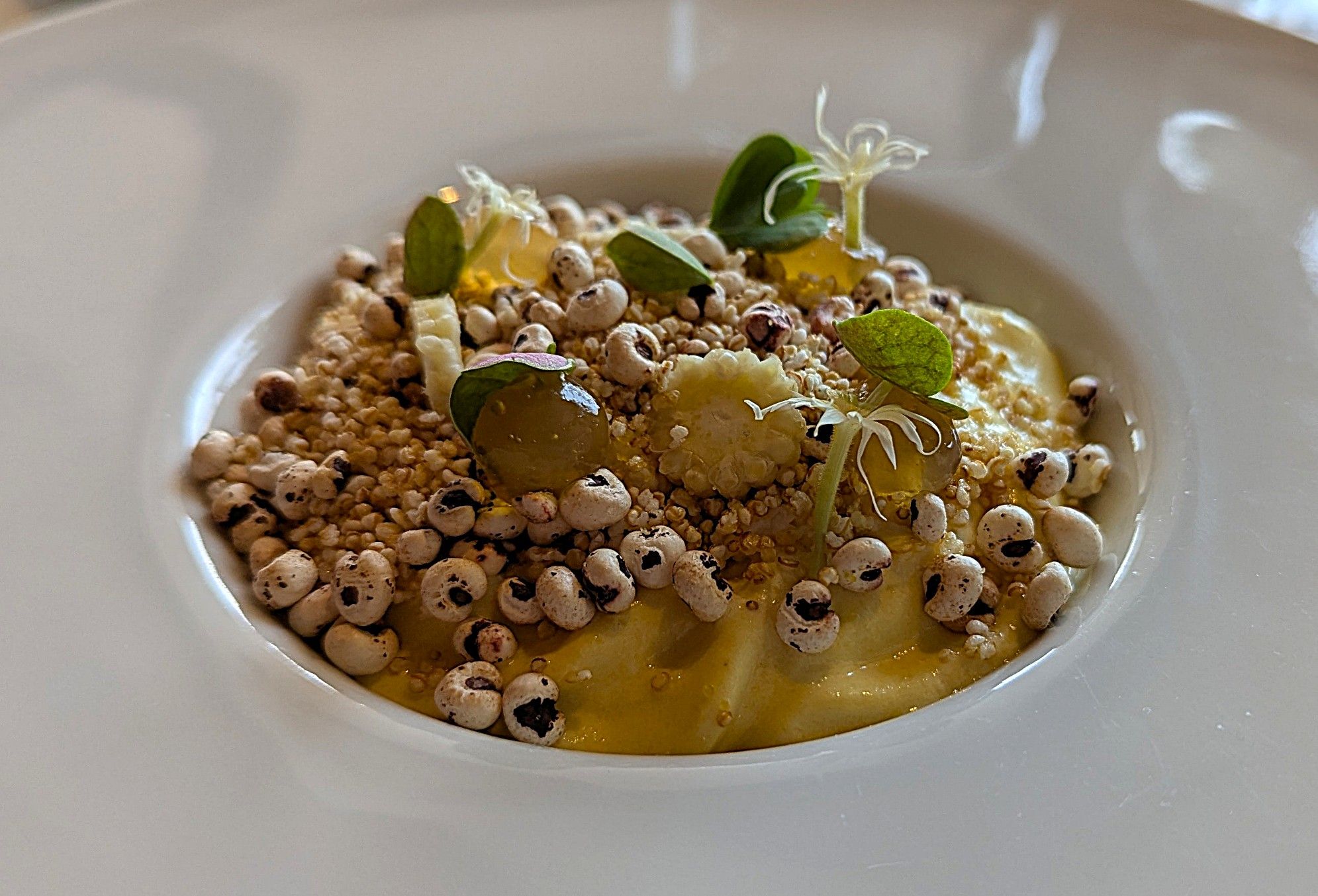
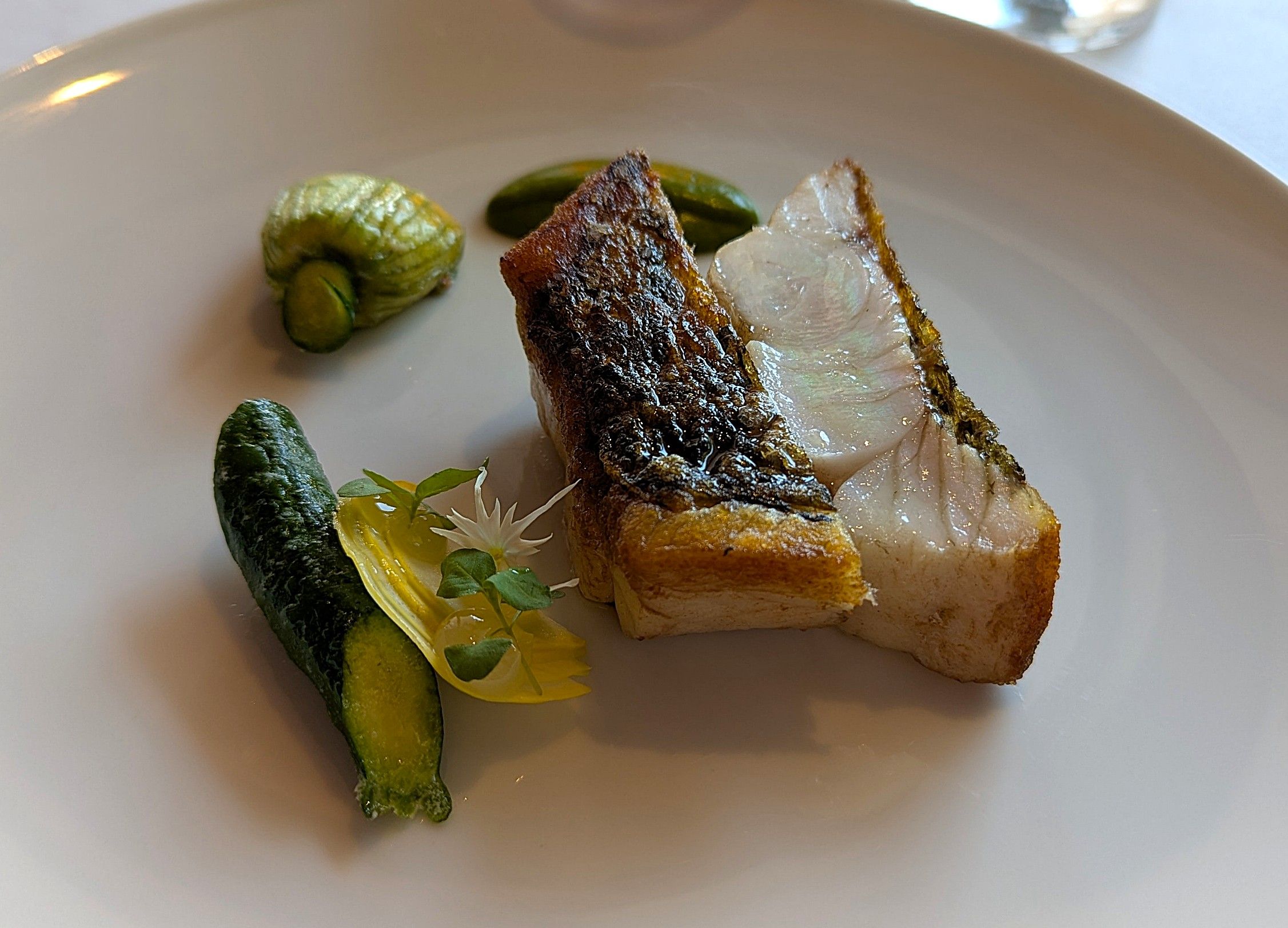
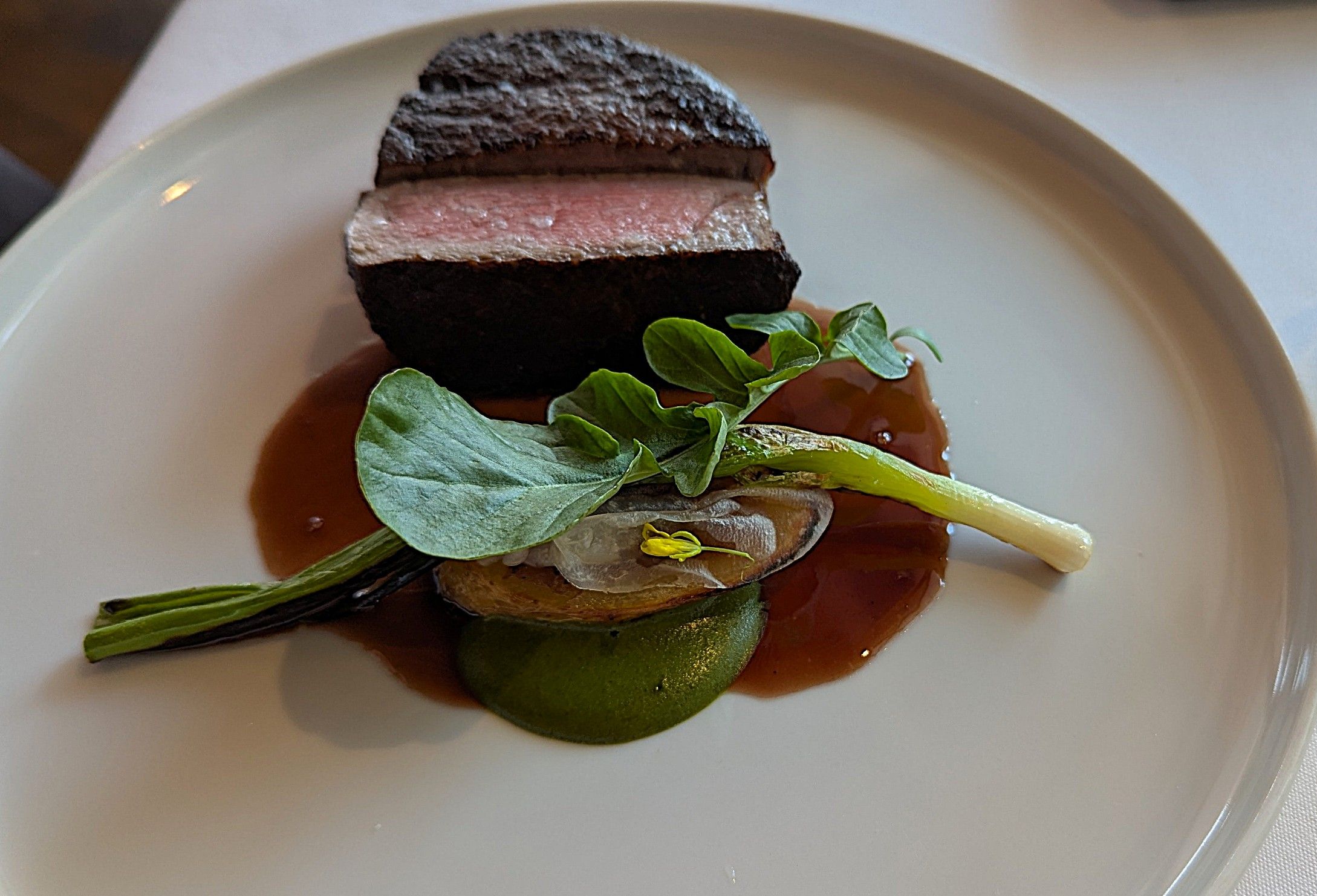
It was lovely to be at our favourite restaurant once again. Seated so that we could see both the Sydney Harbour Bridge and the Opera House was a benefit shared by most (if not all) of the customers – this is a brilliant feature of Aria. The dishes that we chose from the three-course menu were enhanced by the warm crusty bread and butter and the Amuse Buche of compressed melon and a zucchini ball with parmesan cheese (a very plain description of the Chef’s treat). The first courses were a tomato tart – heirloom tomato, artichoke, basil & buckwheat; and a spanner crab dish -K’gari spanner crab, corn, avocado & sorrel; followed by fish – barramundi, zucchini, tomatillo & basil and steak – O’Connor pasture fed angus fillet, kohlrabi, shallot, green peppercorn. The side of potato with burnt butter was amazing. Desserts – peach, hazelnut & earl grey ice-cream and a passionfruit souffle, liquorice & white chocolate were very special.
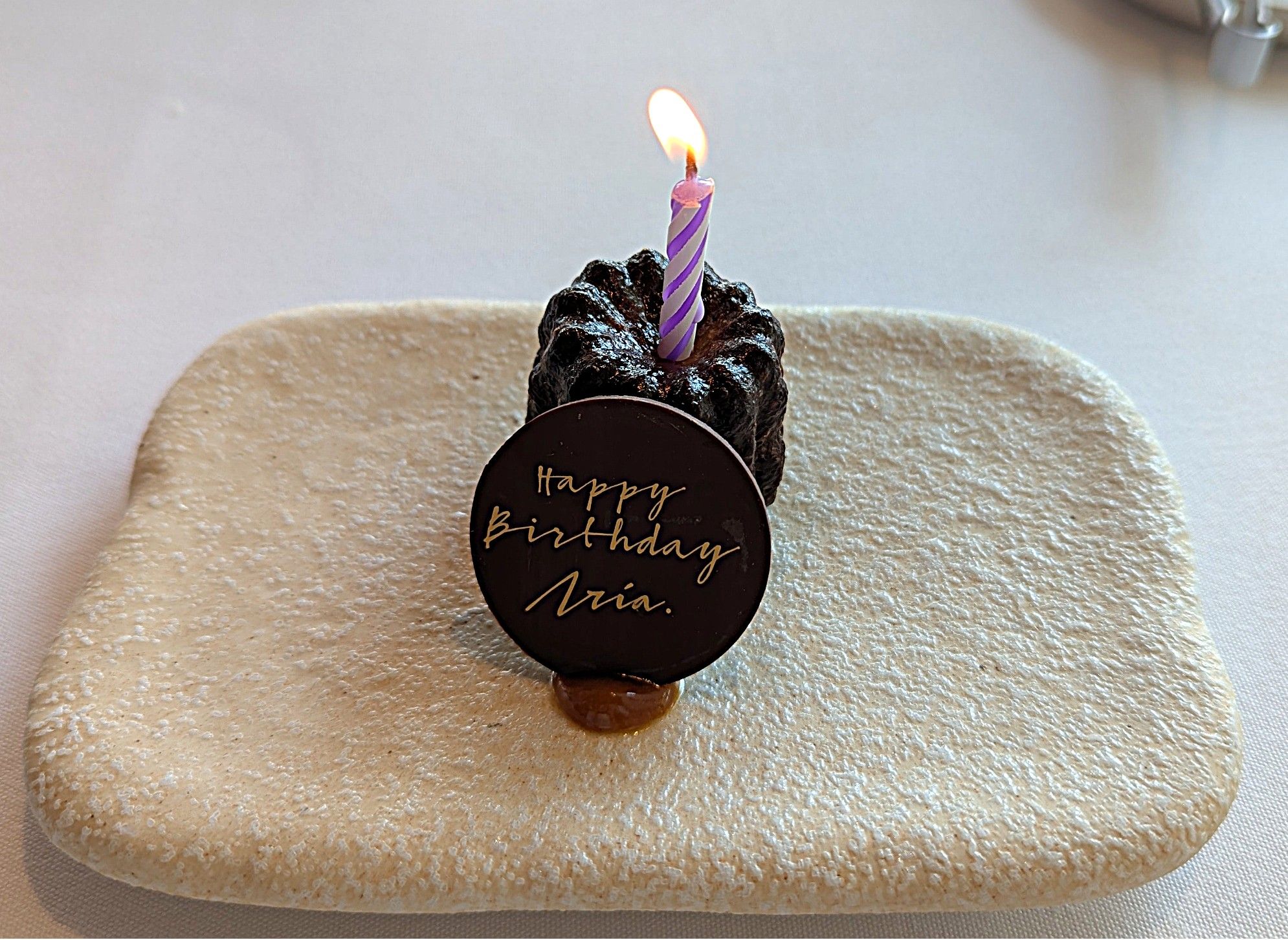
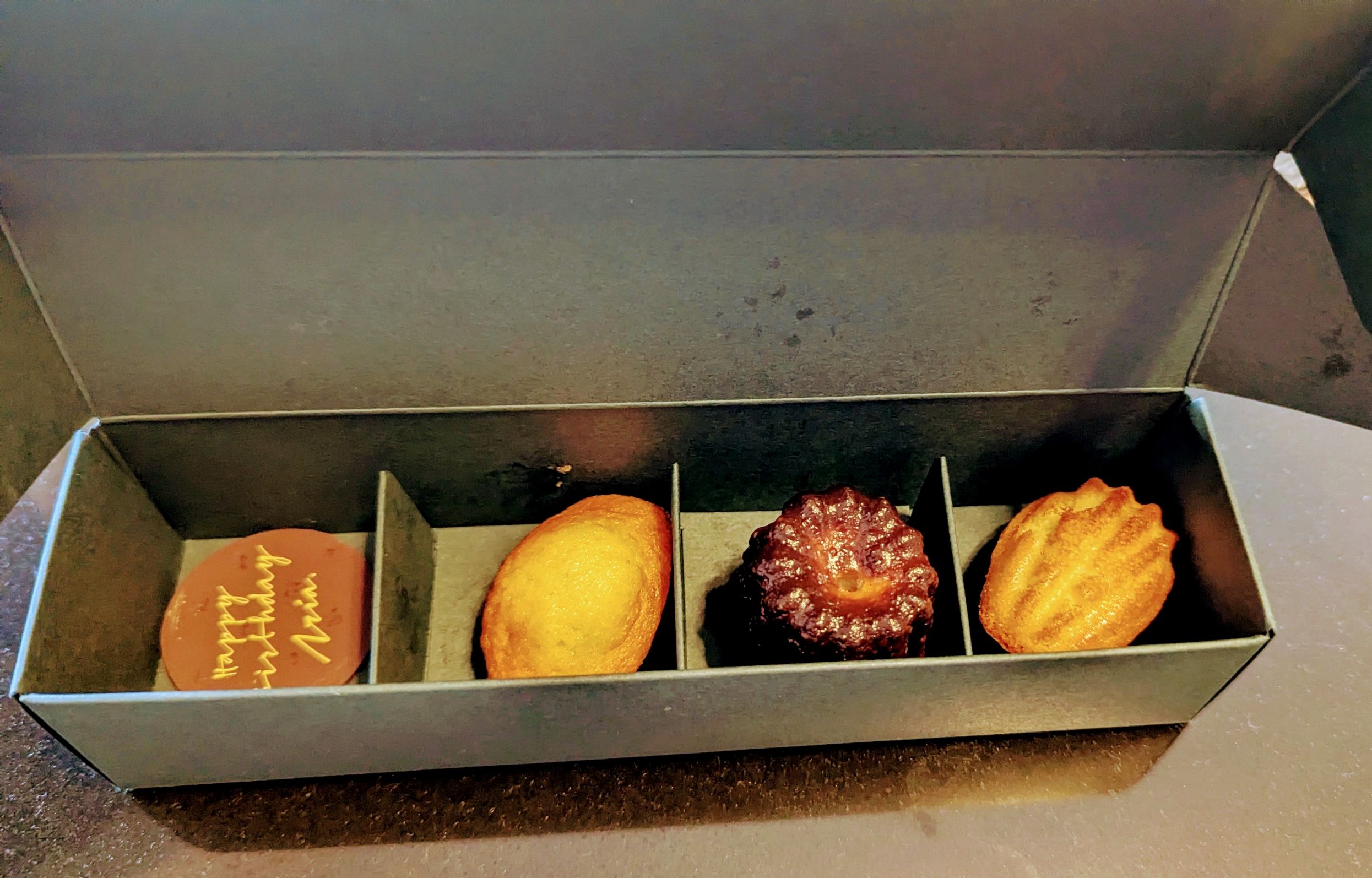
The tables are set well apart, feature white linen, comfortable seats and beautiful views. The staff are excellent, know the menu, and are friendly and efficient. I received a birthday cake with candle – and extra friands in an attractive box to take home.





Toast
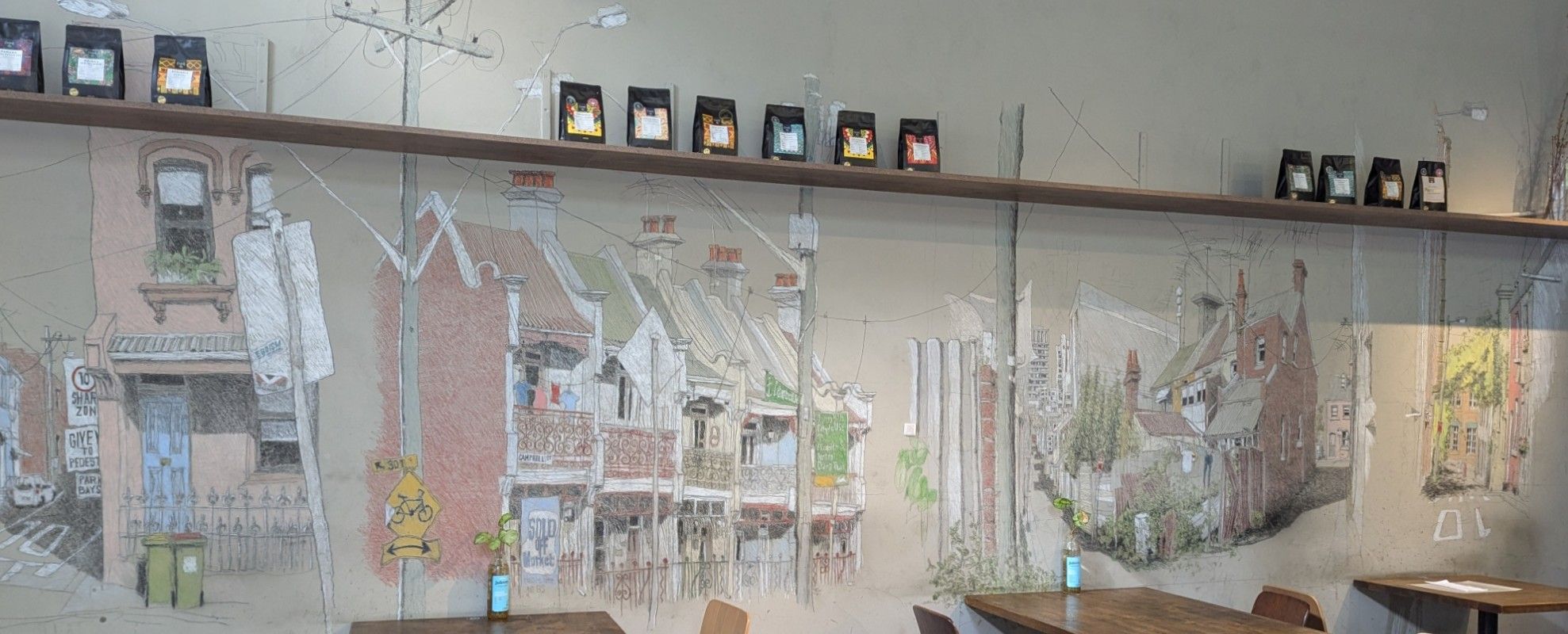
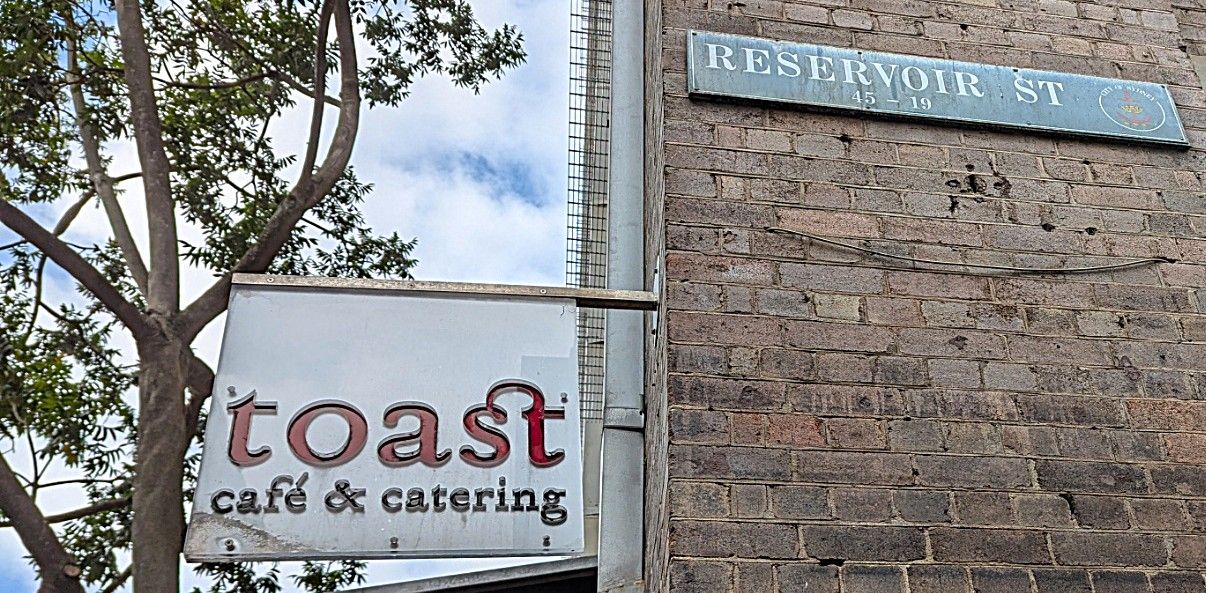
Toast is an excellent cafe, with a wide range of sweet and savoury offerings and lovely coffee. The service is friendly, and the environment, with indoor and outdoor seating, pleasant.




Sophia
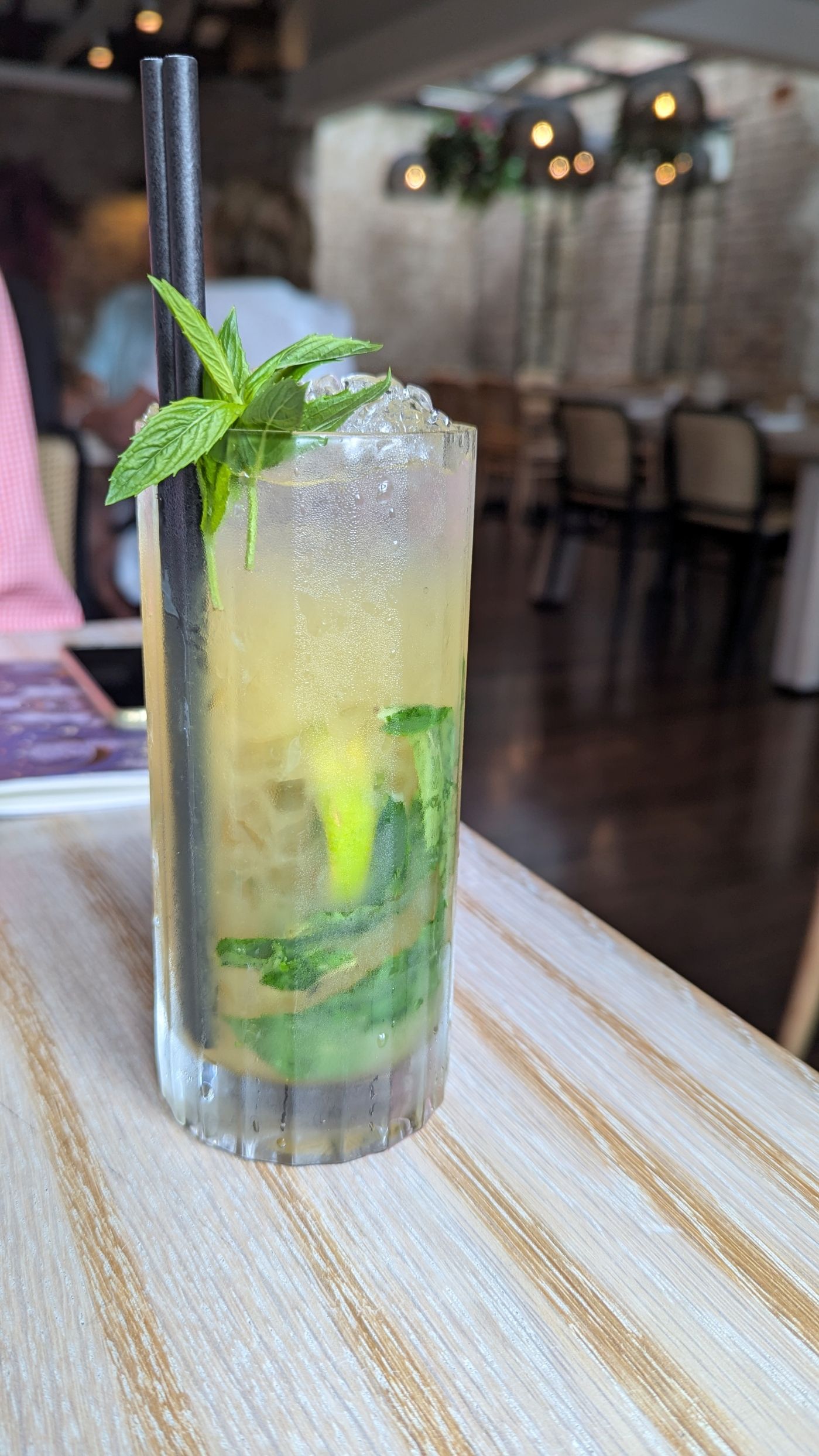
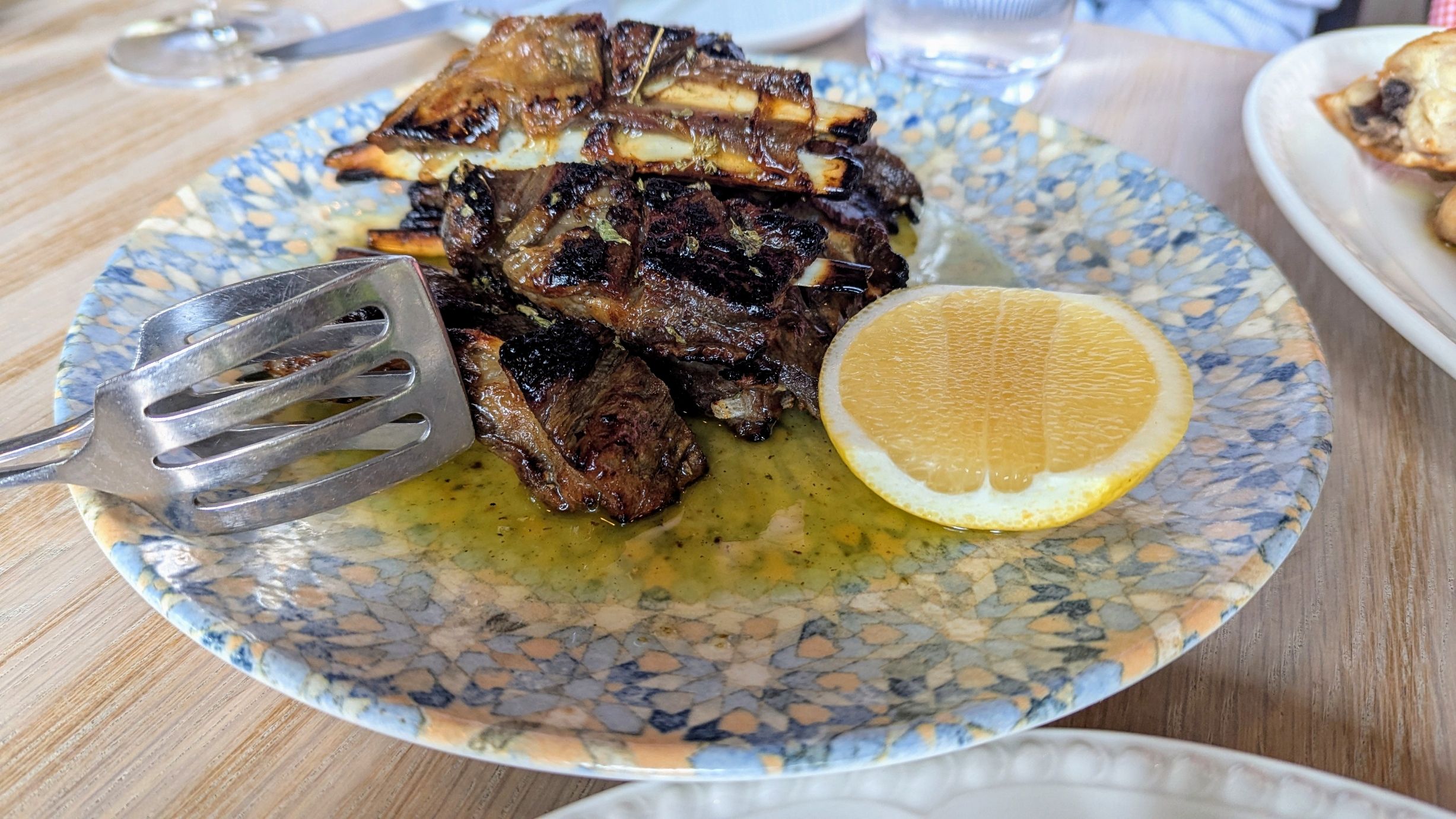
This is a delightful restaurant, with shared plates, small and large. Three small, the octopus, beetroot salad and eggplant and three large, the lamb ribs, chicken and cauliflower were just right for four of us. Coffees were very pleasant indeed and ended a lovely meal and excellent discussions.





Belvoir Theatre- Song of First Desire
In my experience Belvoir offers plays that leave one thinking about the layers of emotion and story telling that take the stage for a short time but have lasting impact. The reviews below are more positive than the feelings I had when I left the theatre. However, this was an evening of horror, ideas, and feelings that were exposed through the excellent performances and script. Much was made of the phrase ‘ Choose one’, referring to a mother being forced to choose one child with whom to escape. For me, the cruelty exhibited in that story was enough and did not need the embellishment of introducing the further shame of what happened to the child who was left behind. For me, the play would have been stronger with less domestic drama. The images evoked by the garden, Camilia’s feet covered with earth, the greenery that was shown at times, and at others hidden in shadows were powerful. I loved the Lorca references as they recalled my travels in Spain with a friend for whom he was a favourite poet.
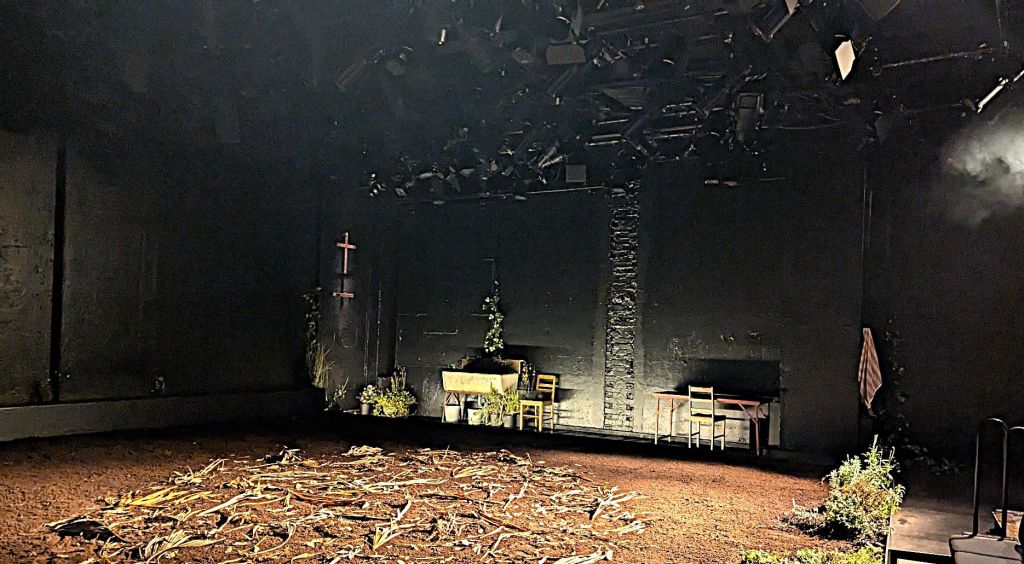
From the inimitable Andrew Bovell (When the Rain Stops Falling, Things I Know to Be True) comes a superb new play of passion, history and politics, intimate in its detail and epic in its storytelling.
Camelia is losing her grip, lost between the past and the present as she passes her days in the garden of her Madrid home. Her children employ Alejandro, a Colombian migrant, to look after her. But this house isn’t what it seems, keeping the terrible secrets of history in its stones. As Alejandro’s presence begins to unlock the past, it shakes a family that has buried its pain – and its country’s – for too long.
It’s an honour to take on Andrew’s new play, Song of First Desire. It’s five years since our collaboration on his marvellous Things I Know to Be True (my last production for Belvoir) and it’s thirteen years since we began work on a stage adaptation of Kate Grenville’s The Secret River. Writing a play from Australia about the inheritance of fascism in Spain might seem to be a massive reach, but Andrew’s fractal poetics come from a place with its own history of forgetting, of silence, of lies erasing a shameful past. If Spain enacted its Pacto del Olvido (Pact of Forgetting) to try to bury the heinous crimes committed under Franco, in Australia we didn’t need to – we already had the lie of Terra Nullius. – Neil Armfield
This is a dazzling piece of writing. Set in 1968 and the present, it unpicks the instincts that drive individuals and whole societies towards fear and violence – and perhaps, also, reconciliation. Andrew wrote it with and for an acclaimed theatre collective in Madrid, where it premiered, in Spanish, in 2023. We’ve invited Jorge Muriel and Borja Maestre from that original cast to join the great Kerry Fox and Sarah Peirse for the English premiere. I think you can call it a must-see. – Eamon Flack
Special Correspondent driving from Canberra to Perth
The following photographs depict the first part of the journey. The first, with some information below, is Yanga Homestead. Agatha Christie visited here, on her trip with her first husband, Archie Christie.
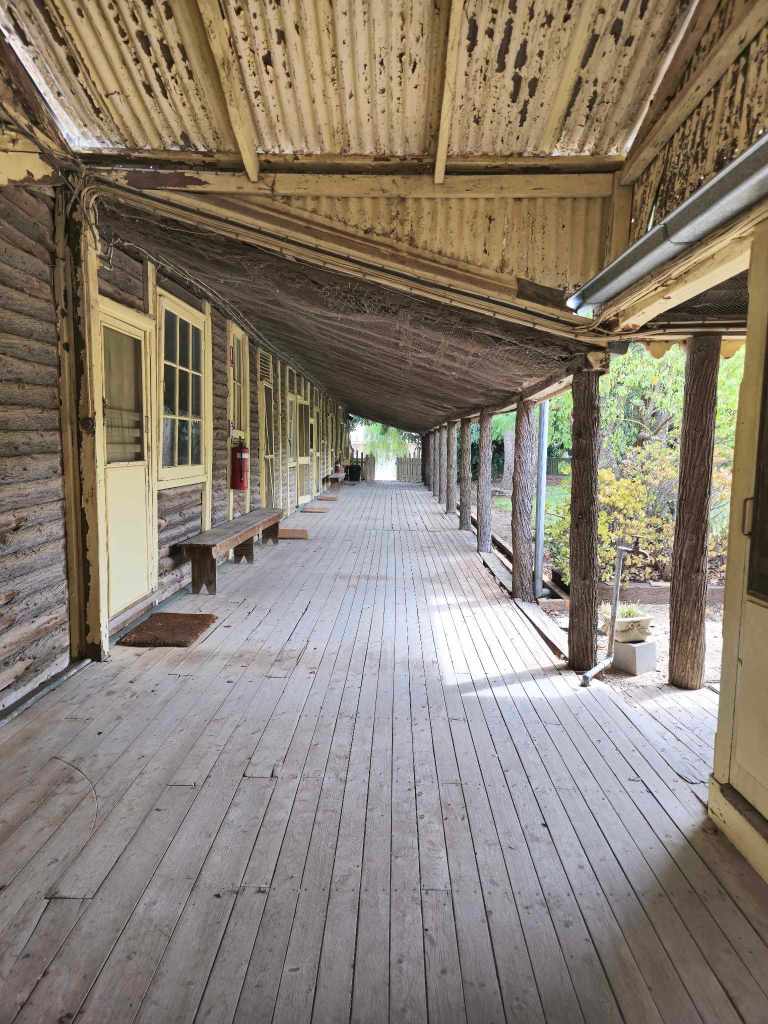
Yanga was a pastoral station established by William Wentworth in the 1830s. In July 2005, it was purchased by the New South Wales Government for the creation of a national park. The Yanga National Park is now part of the larger Murrumbidgee Valley National Par, created in 2010. It has an Aboriginal heritage, as the National Park lies within the traditional tribal areas of the Muthi Muthi people. There is a register of Aboriginal sites, such as mounds, sacred trees, historic sites, burials and middens.








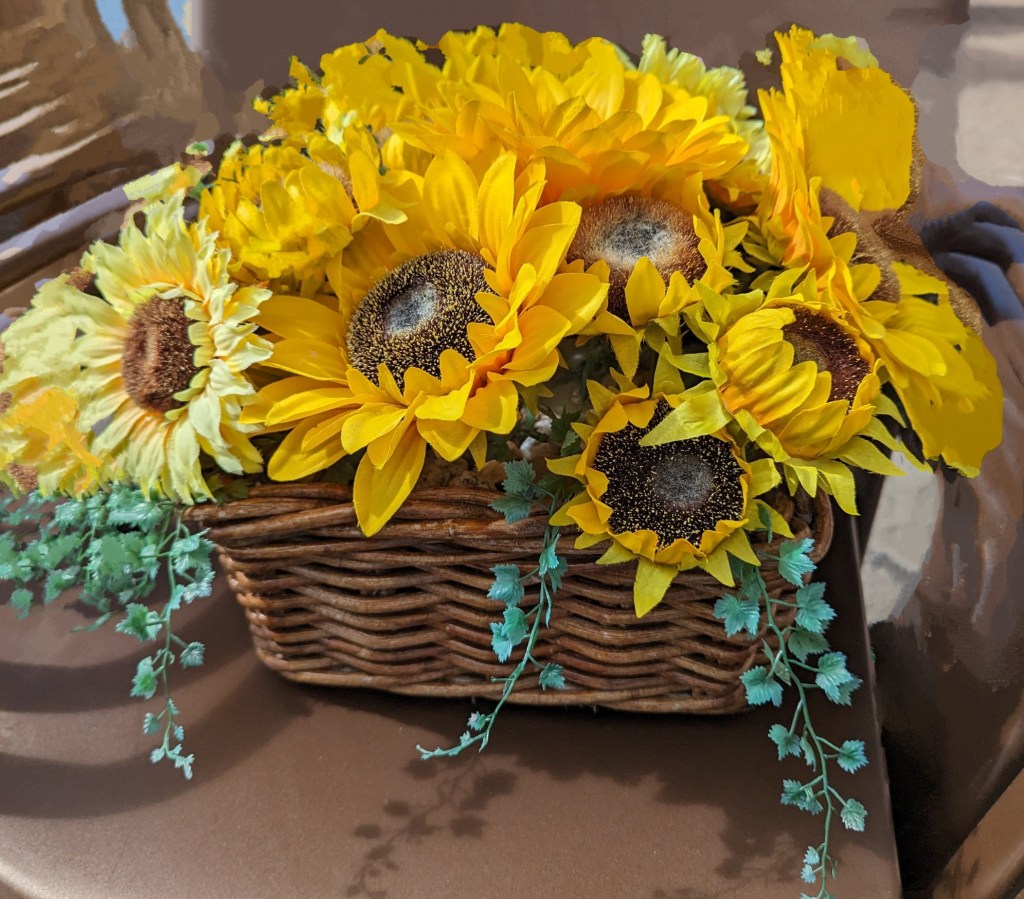
 Robin's Room