
Sue Watson Wife, Mother, Liar Bookature, January 2025
Thank you, NetGalley, for providing me with this uncorrected proof for review.
Sue Watson has combined a narrative of mysteries and twists with the development of relationships over almost twenty-five years of neighbourly friendships. There is also clever characterisation, provided though two friends’ recall of the past, their friendship and the flaws that are only glimpsed at the time, but become more apparent under the stress when a child goes missing. The picture of women having coffee and talking, each on her own back step symbolises the closeness, not only of their properties, but the ties they have woven through proximity and similar events in their lives. One that stands out and provides yet another vignette is the birth of Leo to Jill, and Olivia to Wendy. The two babies kick side by side, then go together to school, admired by doting mothers. The fathers have a presence, but it is seen through the eyes of the women, and quite often the men are missing.
Significantly, the four, although forming a foursome as neighbours and socially, are quite different. Wendy is attractive, flirtatious, and untidy. She is a hands-off parent. In contrast, Jill is depicted as plainer, a neat dresser with little flair, house proud and very much a hands-on parent. The men, Robert, Wendy’s husband, is a doctor who spends a great deal of time practising medicine overseas; Jill’s husband, Tim is also often away, at play rather than work: his affairs are a longstanding feature of their marriage.
The prologue establishes a sensational objective that Jill intends to pursue but is followed by the benign picture of a cottage in Wales where she and Wendy are to spend the weekend, a reminder of their past friendship, including friendly joking around their differences. See Books: Reviews for the complete review.
Another aspect of women’s friendship is a worthwhile read when reflecting upon the friendship depicted in Sue Watson’s novel: the friendship depicted in Elspeth.
What ‘Elsbeth’ Taught Me About Friendship
Story by Blake Turck
I didn’t start watching “Elsbeth” until May 2024 ― a few months after its premiere, but its timing was perfect.
After I had my first child prematurely, she was in the NICU for a month. While she was being cared for, I stayed home, pumped milk every three hours, and shuttled back and forth to the hospital. I was up during parts of the night and morning while the world slept, binge-watching “Elsbeth.”
The CBS crime procedural series — a spinoff of “The Good Wife”— moved its well-liked, unconventional lawyer Elsbeth Tascioni (Carrie Preston) from Chicago to New York City and gave her a new purpose. She was overseeing the NYPD homicide cases after the department was sued for a wrongful arrest. Elsbeth isn’t received well initially, but she quickly charms her co-workers, especially Captain C.W. Wagner (Wendell Pierce), and the more serious, straight-laced officer Kaya Blanke (Carra Patterson), with whom she forms a fast connection. See Television,Film and Popular Culture: Comments for the complete story.
Cézanne to Giacometti
Highlights from Museum Berggruen / Neue Nationalgalerie
Major Exhibition
31 May – 21 Sep 2025
Level 1, Gallery 12
Charges apply

About
Cézanne to Giacometti: Highlights from Museum Berggruen / Neue Nationalgalerie marks the first time works from this internationally significant collection will be seen in Australia. The exhibition presents a journey through the dynamic changes in European and Australian art in the twentieth century.
This exhibition examines the moments of contact and exchange between groundbreaking European artists and their Australian counterparts. The avant-garde visions of Paul Cézanne, Pablo Picasso, Georges Braque, Henri Matisse, Paul Klee and Alberto Giacometti shaped twentieth-century modern art in Europe. Australian artists such as Russell Drysdale, Grace Cossington Smith, John Passmore and Dorrit Black brought their ideas and style back to Australia, transforming Australian art in parallel.
Bringing together over 80 works from the Berggruen collection with over 75 works from the National Gallery’s collection, this exhibition illustrates how social connection and networks acted as driving forces during the development of international and Australian Modernism. This conversation will offer an expansive exhibition experience, introducing audiences to the artistic revolutions in perspective, colour, subject matter and materials that occurred over a 100-year period in Europe and Australia.
This exhibition is presented in partnership with Museum Berggruen, Berlin. One of the most significant hubs of modern art in Germany, the Berggruen collection originates from the prominent gallerist and passionate collector Heinz Berggruen (1914–2007). Berggruen, born and raised in Berlin, spent more than half a century living in Paris, building a truly unique collection.
The exhibition is accompanied by a publication celebrating the significant works from Museum Berggruen and National Gallery collections. It features a major curatorial essay by David Greenhalgh, Curator, National Gallery, Natalie Zimmer, Curator, Museum Berggruen and Deirdre Cannon, Assistant Curator, National Gallery.
Exhibition organised in partnership with Berlin’s Museum Berggruen / Neue Nationalgalerie.
National Gallery Curators: David Greenhalgh, Curator, International Art, Deirdre Cannon, Assistant Curator, Australian Art and Simeran Maxwell, Curator, Australian Art
Museum Berggruen Curators: Dr Gabriel Montua, Head of the Museum Berggruen and Natalie Zimmer, Curator, Museum Berggruen

‘A Revolution in March 11the Nursery’: Celebrating 80 Years of Pippi Longstocking
By Emma Kantor March 11, 2025
On March 7, the Swedish residence in New York City opened its doors to librarians and other members of the children’s book community for a gathering in honor of International Women’s Day and the 80th book birthday of the strongest girl in the world: Pippi Longstocking. The event was held in partnership with the Astrid Lindgren Memorial Award and Astrid Lindgren Company, PEN America, and the Swedish Institute.
Erik Ullenhag, Consul General of Sweden to New York City, kicked off the afternoon festivities by citing the tremendous impact of Lindgren’s storytelling. He noted that from the time of its publication in 1945, Pippi Longstocking was a cultural sensation, with some critics praising it as “a revolution in the nursery,” while others decried the nonconforming heroine as “an unpleasant thing.” Ullenhag remarked that, in addition to being “a goldmine of quotes,” the story is a beacon of “an independent childhood”; Pippi and her author are “feminist icons,” embodying the courage of all women.
Next, children’s literature historian Leonard S. Marcus led a panel on the enduring relevance and resonance of the Pippi Longstocking books. The speakers were Johan Palmberg, Lindgren’s great-grandson and member of the ALMA jury; Laurie Halse Anderson, 2023 recipient of the Astrid Lindgren Memorial Award; Jonathan Friedman, Sy Syms managing director of U.S. free expression programs at PEN America; and Jamia Wilson, feminist activist, writer, and VP and executive editor at Random House.
‘Obstinate, Headstrong Girl’
Marcus opened the discussion with a brief overview of Pippi’s publication history, including its translation into more than 80 languages worldwide. The book has also come up against its share of critics and censors. It was banned outright in Iran, and Marcus referenced how an early French translation downsized the horse that Pippi lifts to a pony, in a misguided attempt to make the tale more plausible—itself a form of censorship.
After reading aloud quotations from Lindgren underscoring how she centered the child’s point of view in her work, Marcus asked Palmberg about his first memories of encountering his grandmother’s creation. “Pippi was like the rain or the wind; she was always there,” Palmberg said. He recalled listening to the stories on cassette tape over and over as a boy.
Anderson said that as a child she struggled to read, and when she finally learned, “It was like this huge treasure cave had opened to me.” Lindgren’s book marked a turning point: “Pippi picked up a horse—not a pony!—and that changed me.” Anderson was drawn to the protagonist’s “brazenness and absolute joyfulness,” noting how she “dispatches with bullies” but immediately resumes her characteristic kindness. Pippi embodies the golden rule of courage and comedy: punch up, not down. Another one of Anderson’s childhood heroines was Wonder Woman, and she mused about the possible influence of the comic book on Lindgren’s imagination. “Can you think of another superhero who is a child?” she asked.
Wilson’s early experience with Pippi Longstocking highlights the book’s global reach. At the age of six, Wilson moved with her family from South Carolina to Saudi Arabia, where she said she spent a lot of her time in the library. When she found Lindgren’s book—which skirted the censors—it offered a way for her to connect with her classmates. And when a family from Stockholm moved in next door, she instantly bonded with her new neighbors over Pippi. “I see her as someone who brings people together,” she said. Pointing to her braids, Wilson said that as a young woman of color, she related to the feisty redhead and her pigtails, realizing, “It’s okay that I’m different from everyone else.”
Friedman of PEN America said that he was more of a “book-skimmer” than an avid reader as a kid, but he was always aware of Pippi Longstocking. Growing up in Canada, he found that a lot of his cultural references came from the U.S.; still, he was interested in other global influences. Lindgren’s stories show children that “there’s something more to the world,” Friedman said, adding that Pippi is “part of the echelon of global characters. Powerful, rebellious, opinionated—boy, do we need that right now.”
Pivoting to speak about Lindgren’s work from an adult perspective, Marcus posed the question of whether the book would be published today. Wilson replied, “We need fiction [like Pippi Longstocking]” that foregrounds “the visionary leadership of the child… to expand ourselves.”
Anderson agreed that the book is essential, adding that the heroine “carries within her the powers and strengths of all children. It’s earth-shaking.” However—and perhaps for the very reason of its radical empowerment—she said, “I’m not sure it would be published today.”
Marcus raised the issue that as the book moves through history, certain aspects are now seen as objectionable, including racial and cultural stereotypes. When the 1960s television series based on the books re-aired in 2014, parts were edited out, causing some uproar in Sweden. Marcus asked the panelists, “When is it okay to change a text?”
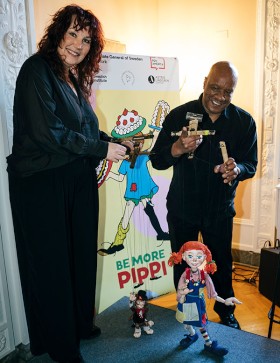
Forrest- A sneak peek from the Swedish Cottage Marionette Theatre.
Friedman pointed out that there are many problematic classics in the children’s canon and suggested that the approach to altering or reframing a text depends on whether the author is alive, the family oversees the estate, or it’s being managed by a larger company. He warned that the urge to update older works by smoothing over the offensive parts and the movement by conservatives to ban books may represent “different sides of the same coin.” He wondered, “Why can’t we reckon with the problems instead of hiding them?”
Wilson agreed, saying, “I believe that the conversation should be about media literacy and cultural competency.” Rather than shelter the reader, “We need to teach young people to engage with nuance and context and give kids the tools to come to their own critical evaluation.” For Wilson, there’s no single solution; “the conflict must be generatively confronted.”
Passing the Torch
When asked what Pippi Longstocking represents for the Swedish people, Palmberg replied that her influence is so large “she almost symbolizes Sweden itself.” She stands for the values the country hopes to present to the world: “anti-authoritarianism, free thinking, and free-spiritedness.” A key part of honoring and extending that legacy is the Astrid Lindgren Memorial Award, which was founded by the Swedish government in 2002, the year of Lindgren’s death, with the mission “to promote every child’s right to great stories.” It is the largest award for children’s literature, with a prize of five million Swedish kronor (just under $500,000 at present exchange rates).
Reflecting on how the award had changed her life, Anderson said, “It might have saved my soul.” When she received the call from the committee two years ago, she said, “I was deeply depressed” by the current political climate. She felt that everything she had worked for in her writing “was under attack.” The prize validated her efforts in the fight for authentic representation and free expression. “I’ve never felt more seen than when I read the judges’ description of my work. We are family,” she said of the extended ALMA community, gesturing to fellow laureate Jacqueline Woodson, who was also in attendance. Looking ahead, Anderson hopes to see Pippi Longstocking paired with the “spiritual descendants” of Lindgren—books by contemporary children’s authors such as Meg Medina, Linda Sue Park, and Kelly Yang—in classrooms and libraries.
During the q&a that followed, a member of the audience asked, “Will Pippi be banned?” While Friedman stressed that titles with BIPOC and LGBTQ+ authors and characters are primarily under fire, Wilson pointed out that another book starring a redheaded girl, Freckleface Strawberry by Julianne Moore, has been banned. Friedman acknowledged the librarians who are on the frontlines of the battle against censorship, saying, “It takes so much bravery.” Let’s bring it back to Pippi—full circle.”
The birthday celebration continues throughout 2025, with 60 performances of a new Pippi Longstocking play by the Swedish Cottage Marionette Theatre in all five boroughs of New York City, among other events. Also in honor of Lindgren, Penguin Random House and the Swedish Women’s Educational Association are donating a total of 7,500 books, which will be distributed across New York Public Library branches.
This year’s Astrid Lindgren Memorial Award laureate will be announced at the Bologna Children’s Book Fair on April 1.
AMERICAN POLITICS

Joyce Vance from Civil Discourse <joycevance@substack.com
Forwarded this email? Subscribe here for more
First They Came For…Joyce Vance March 12 2025
Mahmoud Khalil is a household name at the moment. A recent graduate of Columbia’s School of International and Public Affairs, he is a permanent resident of the United States, a green card holder, with an American citizen wife who is eight months pregnant.
Khalil was detained Saturday by federal immigration agents in New York. They came to his door, originally, according to reporting, telling him his student visa was being revoked. When advised he was a green card holder, agents reportedly said that was being revoked too. He is being held in an immigration facility in Louisiana.
A federal judge in New York has ordered the government to keep Khalil in the United States and refrain from deportation until it can resolve the issues in front of it. Protests against his arrest have sprung up.
Khalil has not been charged with any crimes, the most frequent reason a green card is revoked. Instead, the Department of Homeland Security says his custody is a result of Trump’s executive orders that prohibit anti-Semitism. Khalil was involved in pro-Palestinian protests at Columbia. It is not known if they plan to bring charges now.
That’s a very thin veneer. Executive orders do not alter constitutional rights.“
This is the first arrest of many to come,” Donald Trump posted on social media. “We know there are more students at Columbia and other Universities across the Country who have engaged in pro-terrorist, anti-Semitic, anti-American activity, and the Trump Administration will not tolerate it.” If there is evidence protestors have committed crimes, they can be charged and have their day in court.
Let’s be clear about what this isn’t. This is not an attempt to protect Jewish Americans from antisemitism. That is a complicated problem that requires education and a long-term commitment. If they were actually concerned about it, Trump’s white supremacist, pro-Nazi supporters, including the guy who threw a couple of Nazi salutes recently would meet a similar fate. This is about using anti-Semitism to justify unconstitutional actions, and no one, least of all the Jewish community, benefits when a dictator begins to seize people who have not been charged with any crime. This is the classic lament of Pastor Martin Niemöller over what happened in Nazi Germany:
First they came for the socialists, and I did not speak out—because I was not a socialist.
Then they came for the trade unionists, and I did not speak out—because I was not a trade unionist.
Then they came for the Jews, and I did not speak out—because I was not a Jew.
Then they came for me—and there was no one left to speak for me.
Public discourse in America around the October 7 attack on Israel by Hamas and Israel’s response has been deeply divisive. Rather than trying to heal those wounds, the Trump administration is seizing upon them to divide us further. Whatever you think of Khalil’s views, we would tolerate his arrest at our own peril. We should oppose his detention because it’s wrong, without regard to the content of his speech. We should oppose it because it is one more step towards taking away more people’s First Amendment rights. Perhaps your Christian beliefs run afoul of Christian nationalist designations of some sects as heterodox—maybe you’re suddenly the “wrong kind” of Protestant. Or could it be that this week’s attack is against labor unionists, LGBTQ people, or pro-democracy advocates? Once you accept the arrest of a person for no reason other than their speech, we are all in danger.
Khalil’s detention means we are just a hop, skip, and jump away from political persecutions. It’s a steep, slippery slope from here to “speak out against Trump and go to jail.” Being different, unpopular, or “other” will get you removed from your home in this new world.
Trump’s efforts to strip people of their rights, whether they are people we align with and agree with or not, are a danger to democracy. This is the moment where we must all stand up for what we believe in. If we are willing to turn a blind eye when other people are at risk, we lose. If we cede our democracy to the Trump administration out of fear—fear that what they are doing to other people, they might do it to us—we lose. There is no reason to believe they will stop; they will be emboldened. For people who believe they have the ability to sit it out without being affected personally, just how much are they willing to watch happen to others while they continue on with their own lives? Freedom is worth the hard work it’s going to take to keep it. We have to all pull together. This is one of those moments.
We’re in this together,
Joyce
Heather Cox Richardson from Letters from an American <heathercoxrichardson@substack.com>
Forwarded this email? Subscribe here
Lately, political writers have called attention to the tendency of billionaire Elon Musk to refer to his political opponents as “NPCs.” This term comes from the gaming world and refers to a nonplayer character, a character that follows a scripted path and cannot think or act on its own, and is there only to populate the world of the game for the actual players. Amanda Marcotte of Salon notes that Musk calls anyone with whom he disagrees an NPC, but that construction comes from the larger environment of the online right wing, whose members refer to anyone who opposes Donald Trump’s agenda as an NPC.
In The Cross Section, Paul Waldman notes that the point of the right wing’s dehumanization of political opponents is to dismiss the pain they are inflicting. If the majority of Americans are not really human, toying with their lives isn’t important—maybe it’s even LOL funny to pretend to take a chainsaw to the programs on which people depend. “We are ants, or even less,” Waldman writes, “bits of programming to be moved around at Elon’s whim. Only he and the people who aspire to be like him are actors, decision-makers, molding the world to conform to their bold interplanetary vision.”Waldman correctly ties this division of the world into the actors and the supporting cast to the modern-day Republican Party’s longstanding attack on government programs. After World War II, large majorities of both parties believed that the government must work for ordinary Americans by regulating business, providing a basic social safety net like Social Security, promoting infrastructure projects like the interstate highway system, and protecting civil rights that guaranteed all Americans would be treated equally before the law. But a radical faction worked to undermine this “liberal consensus” by claiming that such a system was a form of socialism that would ultimately make the United States a communist state.
By 2012, Republicans were saying, as Representative Paul Ryan did in 2010, that “60 Percent of Americans are ‘takers,’ not ‘makers.’” In 2012, Ryan had been tapped as the Republican vice presidential candidate. As Waldman recalls, in that year, Republican presidential candidate Mitt Romney told a group of rich donors that 47% of Americans would vote for a Democrat “no matter what.” They were moochers who “are dependent upon government, who believe that they are victims, who believe the government has a responsibility to care for them, who believe that they are entitled to health care, to food, to housing, to you-name-it.”As Waldman notes, Musk and his team of tech bros at the Department of Government Efficiency are not actually promoting efficiency: if they were, they would have brought auditors and would be working with the inspectors general that Trump fired and the Government Accountability Office that is already in place to streamline government. Rather than looking for efficiency, they are simply working to zero out the government that works for ordinary people, turning it instead to enabling them to consolidate wealth and power.Today’s attempt to destroy a federal government that promotes stability, equality, and opportunity for all Americans is just the latest iteration of that impulse in the United States.The men who wrote the Declaration of Independence took a revolutionary stand against monarchy, the idea that some people were better than others and had a right to rule. They asserted as “self-evident” that all people are created equal and that God and the laws of nature have given them certain fundamental rights. Those include—but are not limited to—life, liberty, and the pursuit of happiness. The role of government was to make sure people enjoyed these rights, they said, and thus a government is legitimate only if people consent to that government. For all that the founders excluded Indigenous Americans, Black colonists, and all women from their vision of government, the idea that the government should work for ordinary people rather than nobles and kings was revolutionary.
From the beginning, though, there were plenty of Americans who clung to the idea of human hierarchies in which a few superior men should rule the rest. They argued that the Constitution was designed simply to protect property and that as a few men accumulated wealth, they should run things. Permitting those without property to have a say in their government would allow them to demand that the government provide things that might infringe on the rights of property owners.
By the 1850s, elite southerners, whose fortunes rested on the production of raw materials by enslaved Black Americans, worked to take over the government and to get rid of the principles in the Declaration of Independence. As Senator James Henry Hammond of South Carolina put it: “I repudiate, as ridiculously absurd, that much lauded but nowhere accredited dogma of Mr. Jefferson that ‘all men are born equal.’”
“We do not agree with the authors of the Declaration of Independence, that governments ‘derive their just powers from the consent of the governed,’” enslaver George Fitzhugh of Virginia wrote in 1857. “All governments must originate in force, and be continued by force.” There were 18,000 people in his county and only 1,200 could vote, he said, “[b]ut we twelve hundred…never asked and never intend to ask the consent of the sixteen thousand eight hundred whom we govern.”
Northerners, who had a mixed economy that needed educated workers and thus widely shared economic and political power, opposed the spread of the South’s hierarchical system. When Congress, under extraordinary pressure from the pro-southern administration, passed the 1854 Kansas-Nebraska Act that would permit enslavement to spread into the West and from there, working in concert with southern slave states, make enslavement national, northerners of all parties woke up to the looming loss of their democratic government.A railroad lawyer from Illinois, Abraham Lincoln, remembered how northerners were “thunderstruck and stunned; and we reeled and fell in utter confusion. But we rose each fighting, grasping whatever he could first reach—a scythe—a pitchfork—a chopping axe, or a butcher’s cleaver” to push back against the rising oligarchy. And while they came from different parties, he said, they were “still Americans; no less devoted to the continued Union and prosperity of the country than heretofore.” Across the North, people came together in meetings to protest the Slave Power’s takeover of the government, and marched in parades to support political candidates who would stand against the elite enslavers.
Apologists for enslavement denigrated Black Americans and urged white voters not to see them as human. Lincoln, in contrast, urged Americans to come together to protect the Declaration of Independence. “I should like to know if taking this old Declaration of Independence, which declares that all men are equal upon principle and making exceptions to it where will it stop?… If that declaration is not the truth, let us get the Statute book, in which we find it and tear it out!”
Northerners put Lincoln into the White House, and once in office, he reached back to the Declaration—written “four score and seven years ago”—and charged Americans to “resolve that…this nation, under God, shall have a new birth of freedom—and that government of the people, by the people, for the people, shall not perish from the earth.”
The victory of the United States in the Civil War ended the power of enslavers in the government, but new crises in the future would revive the conflict between the idea of equality and a nation in which a few should rule.In the 1890s the rise of industry led to the concentration of wealth at the top of the economy, and once again, wealthy leaders began to abandon equality for the idea that some people were better than others. Steel baron Andrew Carnegie celebrated the “contrast between the palace of the millionaire and the cottage of the laborer,” for although industrialization created “castes,” it created “wonderful material development,” and “while the law may be sometimes hard for the individual, it is best for the race, because it insures the survival of the fittest in every department.”
Those at the top were there because of their “special ability,” Carnegie wrote, and anyone seeking a fairer distribution of wealth was a “Socialist or Anarchist…attacking the foundation upon which civilization rests.” Instead, he said, society worked best when a few wealthy men ran the world, for “wealth, passing through the hands of the few, can be made a much more potent force for the elevation of our race than if it had been distributed in small sums to the people themselves.”
As industrialists gathered the power of the government into their own hands, people of all political parties once again came together to reclaim American democracy. Although Democrat Grover Cleveland was the first to complain that “[c]orporations, which should be the carefully restrained creatures of the law and the servants of the people, are fast becoming the people’s masters,” it was Republican Theodore Roosevelt who is now popularly associated with the development of a government that took power back for the people.
Roosevelt complained that the “absence of effective…restraint upon unfair money-getting has tended to create a small class of enormously wealthy and economically powerful men, whose chief object is to hold and increase their power. The prime need is to change the conditions which enable these men to accumulate power which it is not for the general welfare that they should hold or exercise.” Roosevelt ushered in the Progressive Era with government regulation of business to protect the ability of individuals to participate in American society as equals.
The rise of a global economy in the twentieth century repeated this pattern. After socialists took control of Russia in 1917, American men of property insisted that any restrictions on their control of resources or the government were a form of “Bolshevism.” But a worldwide depression in the 1930s brought voters of all parties in the U.S. behind President Franklin Delano Roosevelt’s “New Deal for the American people.”
He and the Democrats created a government that regulated business, provided a basic social safety net, and promoted infrastructure in the 1930s. Then, after Black and Brown veterans coming home from World War II demanded equality, that New Deal government, under Democratic president Harry Truman and then under Republican president Dwight D. Eisenhower, worked to end racial and, later, gender hierarchies in American society.
That is the world that Elon Musk and Donald Trump are dismantling. They are destroying the government that works for all Americans in favor of using the government to concentrate their own wealth and power.
And, once again, Americans are protesting the idea that the role of government is not to protect equality and democracy, but rather to concentrate wealth and power at the top of society. Americans are turning out to demand Republican representatives stop the cuts to the government and, when those representatives refuse to hold town halls, are turning out by the thousands to talk to Democratic representatives.
Thousands of researchers and their supporters turned out across the country in more than 150 Stand Up for Science protests on Friday. On Saturday, International Women’s Day, 300 demonstrations were organized around the country to protest different administration policies. Senator Bernie Sanders (I-VT) is drawing crowds across the country with the “Fighting Oligarchy: Where We Go From Here” tour, on which he has been joined by Shawn Fain, president of the United Auto Workers.“
Nobody voted for Elon Musk,” protestors chanted at a Tesla dealership in Manhattan yesterday in one of the many protests at the dealerships associated with Musk’s cars. “Oligarchs out, democracy in.”—Notes:https://www.nytimes.com/2025/02/16/opinion/ezra-klein-podcast-congress-audio-essay.htmlhttps://www.salon.com/2025/02/24/what-elon-musks-on-workers-owes-to-gamergate/
1 big thing: Axios

Liberals in lion’s den
Deprived of all levers of federal power, and with their party’s popularity at rock bottom, some Democrats are taking a polarizing new tack: Engaging with the enemy, Axios’ Neal Rothschild and Zachary Basu write.
- Why it matters: Backlash against cultural elitism — and a reluctance to take risks — fueled the party’s loss in 2024. Ambitious Democrats are reckoning with the need to reach beyond their base as they try to claw out of the wilderness.
None has been as daring as California Gov. Gavin Newsom, who has rankled the Democratic base by hosting a trio of hardline MAGA voices for the first three episodes of his new podcast.
- Other party favorites are itching to take the fight to Republicans on their home turf, sensing opportunity as President Trump’s honeymoon fades and DOGE cuts grow more unpopular.
- Rep. Alexandria Ocasio-Cortez (D-N.Y.), Sen. Bernie Sanders (I-Vt.) and former VP nominee Tim Walz are touring red districts, filling a vacuum where some Republicans have refused to hold town halls.
The intrigue: Far from staging combative debates, Newsom — who’s widely expected to run for president in 2028 — struck a conciliatory tone and sought middle ground in his debut podcast episodes.
- In a discussion with MAGA activist Charlie Kirk, Newsom broke with his party on trans athletes and owned up to “the dumbest bonehead move of my life” — dining maskless indoors at a French restaurant during COVID.
- With former Trump strategist Steve Bannon, Newsom was cordial and polite while giving Bannon ample time to promote his economic populist views — and his false claims that Trump won the 2020 election.
Between the lines: Other prominent liberals have ventured into the belly of the beast with a different mindset — engage in fierce but respectful debate with the goal of publicly exposing MAGA’s flaws.
- A YouTube debate series by Jubilee Media — featuring titles such as “20 Trump Supporters Take on 1 Progressive” — routinely produces viral fireworks.
- Former Transportation Secretary Pete Buttigieg, another likely 2028 candidate, appeared on Jubilee’s “Surrounded” series, as have several liberal streamers.
The big picture: Most Democrats have kept conservative media at arm’s length, shunning the biggest MAGA platforms and personalities to avoid “normalizing” fringe rhetoric such as election denialism.
- “I think Democrats are afraid to talk to Trump voters,” Sen. Ruben Gallego (D-Ariz.), whose victory was one of the party’s few bright spots in 2024, told the N.Y. Times’ Lulu Garcia-Navarro (gift link).
- With little to lose and a lot of ground to make up, that’s beginning to change — for podcasters and politicians alike.
The bottom line: The right has built some of the country’s most potent megaphones. Now Dems are using them to try to climb their way out of a deep political hole.
Heather Cox Richardson from Letters from an American <heathercoxrichardson@substack.com>
Forwarded this email? Subscribe here for more
March 14, 2025 Heather Cox RichardsonMar 15
Today the Senate passed a stopgap measure from the House of Representatives to fund the government for six months through September 30. The measure is necessary because the Republican-dominated House has been unable to pass the appropriations bills necessary to fund the government in 2025. Congress has kept the government open by agreeing to pass a series of continuing resolutions, or CRs, that fund the government at the levels of the previous budget.
The most recent continuing resolution to keep the government funded expires at midnight tonight. The Republicans in the House passed a new measure to replace it on Tuesday and then left town, forcing the Senate either to pass it or to kill it and leave the government unfunded.
The new measure is not a so-called clean CR that simply extends previous funding. Instead, the Republican majority passed it without input from Democrats and with a number of poison pills added. The measure increases defense spending by about $6 billion from the previous year, cuts about $13 billion from nondefense spending, and cuts $20 billion in funding for the Internal Revenue Service. It forces Washington, D.C., to cut $1 billion from its budget, protects President Donald Trump’s ability to raise or lower tariffs as he wishes, and gives him considerable leeway in deciding where money goes.
House Democrats stood virtually united against the measure—only Jared Golden of Maine voted yes—and initially, Republican defectors on the far right who oppose levels of funding that add to the deficit appeared likely to kill it. But Trump signed on to the bill and urged Republicans to support it. In the end, on the Republican side, only Representative Thomas Massie (R-KY) voted against it.
Like the House, the Senate is dominated by Republicans, who hold 53 seats, but the institution of the filibuster, which requires a two-thirds majority of the Senate to end it, gave Democrats room to stop the measure from coming to a vote. Whether they should do so or not became a heated fight over the past three days. To vote on the measure itself, Republicans needed 60 votes to end the potential for a filibuster. To get to 60 votes, Republicans would need some Democrats to agree to move on to a vote that would require a simple majority.
The struggle within the Democratic Party over how to proceed says a lot about the larger political struggle in the United States.
House Democrats took a strong stand against enabling the Trump Republicans, calling for Democratic senators to maintain the filibuster and try to force the Republicans to negotiate for a one-month continuing resolution that would give Congress time to negotiate a bipartisan bill to fund the government.
But Senate minority leader Chuck Schumer (D-NY) said he would support advancing the spending bill. He argued that permitting the Republicans to shut down the government would not only hurt people. It would also give Trump and his sidekick billionaire Elon Musk full control over government spending, he said, because under a shutdown, the administration gets to determine which functions of the government are essential and which are not.
In an op-ed in the New York Times yesterday, Schumer noted that Musk has said he was looking forward to a government shutdown. Jake Lahut, Leah Feiger, and Vittoria Elliott reported in Wired on Tuesday that Musk wanted a government shutdown because it would make it easier to get rid of hundreds of thousands of government workers. During a shutdown, the executive branch determines which workers are essential and which are not, and as Josh Marshall of Talking Points Memo highlights, Trump has issued an executive order calling for the government to stabilize at the skeleton crew that a government shutdown would call essential. Yesterday was the government-imposed deadline for agencies to submit plans to slash their budgets with a second wave of mass layoffs, so at least part of a plan is already in place.
Schumer said that Trump and the Republicans were forcing Democrats into a choice between a bad bill and a shutdown that would hand even more power to Trump. “[T]he Republican bill is a terrible option,” he wrote. “It is deeply partisan. It doesn’t address this country’s needs. But…Trump and Elon Musk want a shutdown. We should not give them one. The risk of allowing the president to take even more power via a government shutdown is a much worse path.”
There appeared to be evidence this morning that Trump and Musk wanted a shutdown when before the vote had taken place, Trump publicly congratulated Schumer for voting to fund the government, seemingly goading him into voting against it. “[R]eally good and smart move by Senator Schumer,” he posted.
But as Schumer and a few of his colleagues contemplated allowing the Republicans to pass their funding measure, a number of Democrats called on them to resist the Trump administration and its congressional enablers. House Democrats urged their Senate colleagues to take a stand against the destruction Trump and Musk are wreaking and to maintain a filibuster. At the forefront, Representative Alexandria Ocasio-Cortez (D-NY) mobilized her large following to stop Schumer and those like him from deciding to “completely roll over and give up on protecting the Constitution.”
Representative Nancy Pelosi (D-CA), the former speaker of the House, backed Ocasio-Cortez, issuing a statement calling the choice between a shutdown and the proposed bill a “false choice.” She called instead for fighting the Republican bill and praised the House Democrats who had voted against the measure. “Democratic senators should listen to the women,” she wrote, who have called for a short-term extension and a negotiated bipartisan agreement. “America has experienced a Trump shutdown before—but this damaging legislation only makes matters worse. Democrats must not buy into this false choice. We must fight back for a better way. Listen to the women, For The People.”In the end, Schumer voted to move the measure forward. Joining him were Democratic senators John Fetterman of Pennsylvania, Catherine Cortez Masto of Nevada, Brian Schatz of Hawaii, Dick Durbin of Illinois, Kirsten Gillibrand of New York, Gary Peters of Michigan, Maggie Hassan of New Hampshire, and Jeanne Shaheen of New Hampshire, and Independent Angus King of Maine. One Republican—Senator Rand Paul of Kentucky—voted against moving the measure forward.
Once freed from the filibuster, Senate Republicans passed the bill by a vote of 54 to 46, with New Hampshire’s Shaheen and Maine’s King joining the Republican majority and Republican Rand Paul voting against.
And so, the government will not shut down tonight. But today’s struggle within the Democratic Party shows a split between those who lead an opposition party devoted to keeping the government functioning, and a number of Democrats who are stepping into the position of leading the resistance to MAGA as it tries to destroy the American government. Praise for those resisters shows the popular demand for leaders who will stand up to Trump and Musk.
In a similar moment in 1856, newly elected representative from Massachusetts Anson Burlingame catapulted to popularity by standing up to the elite southern enslavers who had dominated the government for years. Blustering, threatening, and manipulating the mechanics of the government, southern lawmakers had come to expect their northern political opponents, who valued civil discourse and compromise, to cave. Southern leaders threw their weight around to gather more and more power over the country into their hands. Finally, in 1854, they overreached, forcing through Congress the Kansas-Nebraska Act that permitted them to spread human enslavement into the American West. In the following elections, northerners sent to Congress a very different breed of representatives.
On May 22, 1856, pro-slavery representative Preston Brooks of South Carolina came up behind Massachusetts senator Charles Sumner and beat him nearly to death on the floor of the Senate after Sumner had given an antislavery speech Brooks found objectionable. But rather than pleading for calm and compromise in the wake of the attack, Burlingame had had enough. On June 21 he rose and gave a speech about his colleague and his state, calling it “Defence of Massachusetts.”
Burlingame stood up for his state, refuting the insults southerners had thrown at Massachusetts in recent speeches and insulting southerners in return. And Burlingame did something far more important. He called out the behavior of the southern leaders as they worked to attack the principles that supported “the very existence of the Government itself.”“[T]he sons of Massachusetts are educated at the knees of their mothers, in the doctrines of peace and good will, and God knows, they desire to cultivate those feelings—feelings of social kindness, and public kindness,” Burlingame said. But he warned his southern colleagues that northerners were excellent soldiers and that “if we are pushed too long and too far,” northerners would fight to defend their lives, their principles, and their country.
Burlingame provoked Brooks, and he, temperamentally unable to resist any slight, challenged Burlingame to a duel. Brooks assumed all Yankees were cowards and figured that Burlingame would decline in embarrassment. But Burlingame accepted with enthusiasm, choosing rifles as the dueling weapons. Burlingame was an expert marksman.
Burlingame also chose to duel in Canada, giving Brooks the opportunity to back out on the grounds that he felt unsafe traveling through the North after his beating of Sumner made him a hated man. The negotiations for the duel went on for months, and the duel never took place. Burlingame had turned Brooks, known as “Bully” Brooks, into a figure of ridicule, revealing that when he faced an equal opponent, his bravado was bluster.
Forgotten now, Burlingame’s speech was once widely considered one of the most important speeches in American history. It marked the moment when northerners shocked southerners by standing up to them and vowing that the North would fight for democracy. Northerners rallied to Burlingame’s call and, in so doing, reshaped politics.
Notes: https://www.wsj.com/politics/policy/gop-house-spending-bill-vote-shutdown-a73f7f14https://www.nbcnews.com/politics/congress/schumer-senate-democrats-votes-gop-funding-bill-shutdown-rcna196029 https://talkingpointsmemo.com/edblog/looking-squarely-at-a-shutdownhttps://www.reuters.com/world/us/us-agencies-face-thursday-deadline-submit-mass-layoff-plans-2025-03-13/ https://www.nytimes.com/2025/03/13/opinion/trump-musk-shutdown-senate.html https://www.cnn.com/2025/03/13/politics/ocasio-cortez-schumer-democratic-shutdown-plan/index.html https://www.newsweek.com/full-list-democrats-voted-trump-gop-spending-bill-2045209 https://www.wired.com/story/elon-musk-has-wanted-the-government-shut-down/ https://quod.lib.umich.edu/m/moa/AAR7990.0001.001/7https://marktwainstudies.com/the-calculated-incivility-of-anson-burlingame-the-only-congressman-mark-twain-could- tolerate/ https://clerk.house.gov/Votes/202570 Bluesky:kenklippenstein.bsky.social/post/3lkdrksntnk2isahilkapur.bsky.social/post/3lkdz4z4alk27
Gender Institute Newsletter – 13 March 2025

The Unliterary Eighteenth Century: Gender and Marginal Texts
Friday 11 April, 8.45am-7.15pm
This one-day symposium hosted by the Gender Institute at the Australian National University, and in collaboration with the Centre for Early Modern Studies, explores texts of the long eighteenth century that, despite their popularity and cultural centrality in their own time, have been marginalised because of their resistance to contemporary categories of literary genre, and, whatever else they might be called, are rarely if ever considered to be literary.
Their marginalisation has implications not only for our understanding of literary history but our knowledge of the history of gender and sexuality. Not only did women and anonymous writers work within “unliterary” forms, but these ephemeral and sometimes pornographic texts challenge contemporary understandings of bodies and gender. How might we better understand and appreciate the impact of these texts on eighteenth-century culture? How do they invite, and how might they resist methods of close reading? What does eighteenth-century literary studies do with the disjunction between contemporary definitions of our discipline, based around “literature” as a category, and what “literature” was understood as being in the eighteenth century?
This one-day symposium explores texts of the long eighteenth century that, despite their popularity and cultural centrality in their own time, have been marginalised because of their resistance to contemporary categories of literary genre, and, whatever else they might be called, are rarely if ever considered to be literary.
Keynotes by Professor Kathleen Lubey, St. John’s University and Professor Gillian Russell, The University of York.
Register here (in person only)

See Maria Teresa Hart Doll Bloomsbury Academic 2022, reviewed November 30, 2022. There is a section on Barbie dolls which, while going over old ground at times, is an important part of this worthwhile read.

See Marc Shapiro Work Up: The Life of Amanda Gorman Riverdale Avenue Books, 2021, reviewed July 23, 2021. This is an accessible and enlightening short biography of Amanda Gorman, who made an uplifting contribution to President Joe Biden’s Inauguration.

The captivating story behind the iconic Blue Poles – the painter, the process, the patronage, the politics and the national scandal.
Is reality TV ‘harmful’? We asked 5 experts – including an ex-reality TV participant
Published: February 24, 2025 6.05am AEDT
Reality TV – love it or hate it, there’s no denying it’s addictive. From explosive arguments to over-the-top love triangles, it can be hard to look away. But is all this drama just for fun, or might it do more harm – to watchers and participants – than we realise?
We asked five experts, and most of them said it might, especially when it comes to promoting negative body image and leaving contestants emotionally scarred.
But one expert argued reality TV is a valuable form of entertainment overall, which reflects modern culture and sparks important conversations.
Here are their detailed responses:
Rebecca Trelease Senior Lecturer in Communication Studies and former reality TV contestant
Yes
Watching reality TV content created at the expense of participants is harmful. Different reality TV formats have varying levels of participant immersion. Shows that isolate contestants from support systems – banning phones and internet so they’re completely reliant on the crew – are the most harmful.
It’s unacceptable that any number of former reality TV participants have passed away from suicide. As a former participant of The Bachelor New Zealand, I spent six and a half weeks either in an isolated mansion, or overseas with no return flight until eliminated. With no running water, food kept under lock and key and chicken served from a rubbish bin, we were reminded of how we could not choose to leave and how “worth it” the bachelor was (he wasn’t).
We were taped to mics the entire time, including when we went to the bathroom. After returning home, I found myself automatically reaching for a mic that wasn’t there to distort the recording of family conversations. I had panic attacks and lost 12% of my body weight in two weeks.
As an academic studying reality TV, I think these shows must be informed by research into defining “post-traumatic reality show syndrome”. Participants’ experiences have long-lasting effects, but technically can’t be labelled PTSD due to a requirement of “exposure to actual or threatened death, serious injury or sexual violation”.
There are also wider effects, particularly for participants’ family members, who effectively lose a loved one for a period of time and then must support their return back to the world.
Jessica Ford Senior Lecturer in Media
No
The idea that there is a direct correlation between what we consume and how we behave (often called the “media effects” model) has long been disproven.
Yes, reality TV has a social and cultural impact, but it is not as simple as watching antisocial behaviour on a screen and then being more likely to repeat it in real life. Despite watching many hours of Real Housewives, I have never flipped a table or thrown a drink in someone’s face.
I have, however, spent many hours defending the cultural value of reality TV. Why is the gossip, manipulation and political struggles of Westeros or the Roy family considered “art”, but the same power games in the Bachelor mansion considered a “guilty pleasure”? Is it because the stakes are lower in the latter? Surely not, as they’re both constructed.
It’s usually media aimed at women which ends up being labelled as “trashy” or a “guilty pleasure”. Reality TV’s perceived lack of cultural value reflects a long history of classed, raced and gendered taste cultures.
Reality TV is a space where contemporary cultural debates play out – whether its questioning problematic relationship dynamics in Married at First Sight, the boundaries of heteronormativity in The Bachelorette, or the norms and demands of parenting in Parental Guidance. These conversations continue into homes and workplaces.
The negative impacts of reality TV largely land with those involved in production. Our cultural devaluing of these shows has led to horrendous working conditions being excused because contestants “knew what they were getting into”. See Television,Film and Popular Culture: Comments for the complete article, including links to panelists’ profiles.
See Robin Joyce, ‘It’s Time to Go!’ ‘You’re Fired’: Australian Big Brother (2005) and Britain’s The Apprentice (2014), in Jocelynne Scutt, ed. Women, Law and Culture, Conformity, Contradiction and Conflict, Palgrave Macmillan, 2016.
Special Correspondent Travelling from Canberra to Perth
From the Eyre Peninsula to Mundrabilla, WA, via sleeps at Perlubie Beach and Mexican Hat Beach. We saw caves, the Tub, and did the clifftop sculpture tour at Elliston, where the artworks have no info to tell you the artist or rationale for the work! We also found the biggest windmill in the world (apparently) in Penong and camped on the beach for the first time – absolute luxury. Since Ceduna we have had to pay for water at water stations which has been novel and very efficient – only $4 for about 130 litres.
SA had some fabulous beaches and sunsets but the water tastes absolutely disgusting. I can’t say I would rush back to the Eyre Peninsula, but def plan to check out the Yorke and Fleurieu to compare on our way back if poss.
















 Robin's Room