Bonnie Garmus Lessons in Chemistry Penguin, Kindle edition, 2024.

Bonnie Garmus has skilfully woven together comedy, whimsy, engaging characters, and a story line that draws attention to a series of notions that, seemingly relatively benign initially, reach their logical conclusion with the terror of sexual harassment and a well-argued case that discrimination against women is endemic and supported by even the pinnacle of expression of freedom, ideas and merit – a university. Only a writer with spirit and elegance can make this uneasy amalgam work, and Bonnie Garmus has done so. Like the chemistry she writes about in her depiction of scholarly laboratory work, the chemistry she introduces into the kitchen and cooking, and the chemistry between the beautiful and intellectual Elizabeth Zott and the plain and intellectual Calvin Evans this book is an exercise in chemistry – putting together the disparate pieces to form a successful whole.
Elizabeth Zott’s attention is focussed on doing the best she can – working hard, raising questions about the validity of findings to ensure scientific excellence, accepting that she is less able than those ahead of her in the university hierarchy. However, even her best will never achieve her the accolades and distinction she deserves, let alone a job and income to which such best entitles her equally with the ‘best’ demonstrated by her male coworkers and superiors. Meeting Calvin gives her domestic happiness, along with a leisure activity he pursues – rowing. Although the former is short lived, rowing becomes an important part of her life, together with her dog, daughter, and alternative chemistry world.
This world takes the idea that women’s traditional tasks are only one manifestation of a group of activities and ideas, and in women’s case the domestication of these, to a remarkable level. Cooking under Elizabeth’s guidance to the women watching, becomes a scientific task as she prepares meals on her television program, Supper at Six. The program provides Elizabeth with status, income, and security. However, her preferred world is the one that is Calvin’s, rowing on the river and his laboratory. The book ends in the laboratory, bringing together disparate parts that having been moving towards each other from the beginning of the novel, a school family tree project becoming yet another stimulus for successful resolution.
Lessons in Chemistry is an absorbing read, with harsh lessons making poignant social commentary. At the same time, the characters, humour, and warmth provide a comfortable vehicle for expression of those lessons. Storytelling that combines lessons to be learnt – unfortunately where discrimination based on sex, they seem unending – and an engaging read is a real accomplishment. Bonnie Garmus has excelled in doing so in this work.
This review is dedicated to the late Bill Wood AM (4 November 1935 – 19 May 2024). Bill recommended Lessons in Chemistry to me on a visit around Easter 2024. Not only did Beverly Wood provide us with easter buns and coffee in the sunshine in the hospital courtyard but Bill recommended this book. He provided me with a lasting memory of a wonderful person who certainly knew his audience.
Barbara Pym
For lovers of Barbara Pym connections with ideas, people and books are always a pleasure to find. They abound, and Green Leaves, the Barbara Pym Newsletter, often records them. I noticed that a commentator I often see on MSNBC’s Morning Joe has such a connection. Katty Kay, like Barbara, studied at St Hilda’s College, Oxford. She also has a BA from St Hilda’s (1988). Another connection with Barbara is that, like Barbara’s younger sister, Hilary, Katty Kay worked at the BBC.
Another connection is that Katty Kay was born in Wallingford. While I was researching my PhD (with Barbara Pym as the topic of course) in the Bodleian Library in Oxford, I stayed with Australian friends, and later when they returned home, English friends, in Wallingford.
From Wikipedia, the free encyclopedia
Katherine “Katty” Kay (born 14 November 1964) is a British-Swiss journalist, author and broadcaster. She has anchored BBC coverage of two Presidential elections. She also appears weekly on NBC News and Morning Joe.
Kay has co-written two books with Claire Shipman, Womenomics (2009) and The Confidence Code: The Science and Art of Self-Assurance—What Women Should Know (2014). Kay is a board member at the International Women’s Media Foundation.
As a child, she spent time in various Middle Eastern countries where her father was posted as a British diplomat.
Kay anchored coverage of US Presidential Election nights across all BBC platforms in 2016 and 2020 and in 2021, she anchored the BBC’s coverage of the Presidential inauguration of Joe Biden. In April 2024, it was announced that Kay would host The Rest is Politics: US Edition alongside Anthony Scaramucci (former White House Director of Communications for Donald Trump).
Barbara Pym set upon a rather different path, graduating with her BA from St Hilda’s in the early 1930s, although returning to assist a lover with his thesis in 1936. Barbara had written plays, short stories and novels from the mid-1920s. Her first novel, Some Tame Gazelle, was published in 1950, followed by Excellent Women (1952), Jane and Prudence (1953), Less Than Angels (1955), A Glass of Blessings (1958) No Fond Return of Love (1961), Quartet in Autumn (1977), The Sweet Dove Died (1977), An Unsuitable Attachment (1982) A few Green Leaves (1980), An Academic Question (1982), and several novellas in Civil to Strangers (1987).
Barbara Pym: A Quiet Social Historian, first published in the Women’s History Network blog, November 2, 2013.
Barbara Pym’s novels provide a social history of the period over which she wrote from the 1920s to 1980. ‘Young Men in Fancy Dress’, written when she was sixteen, inspired by the 1920s, is unpublished. Unlike the novels that follow it depends on its 1920s setting for its story. In comparison, the later novels are subtle historic accounts. From her first published novel, Some Tame Gazelle (written 1935-50, published 1950) to her posthumously published An Academic Question (written 1970, published 1986), Pym’s work is a social history of England from the 1930s to 1980. Although her novels are seen as stories of middle class village life, largely featuring spinsters and vicars, they cover some of the big questions of the era as well as deft descriptions of life in villages, the suburbs and city communities. Her approach to feminist issues, most clearly enunciated in Quartet in Autumn (written 1973-76, published 1977) and An Academic Question permeates her work from the 1930s; class and race, although less fundamental to her reflections, appear in particularly strong terms in An Unsuitable Attachment (written 1960-65, published 1982) in which class is central to the suitability of the attachment at the heart of the novel; in Less Than Angels (written 1953-54, published 1955) the racist elements of anthropological endeavour are probed; and An Academic Question in which the strong reference to race issues apparent in the original draft is moderated but not entirely lost. See the complete article in Further Commentary and Articles arising from Books* and continued longer articles as noted in the blog.
From CNN 5 things
Faux masterpieces
Italy’s arts and culture police uncovered a workshop in Rome that had been used to produce hundreds of fraudulent works sold online. They said the fake Picassos and Rembrandts were part of a “clandestine painting laboratory.”
This was one of the topics in Karen Brook’s The Good Wife of Bath (2021), reviewed 21 April 2021.

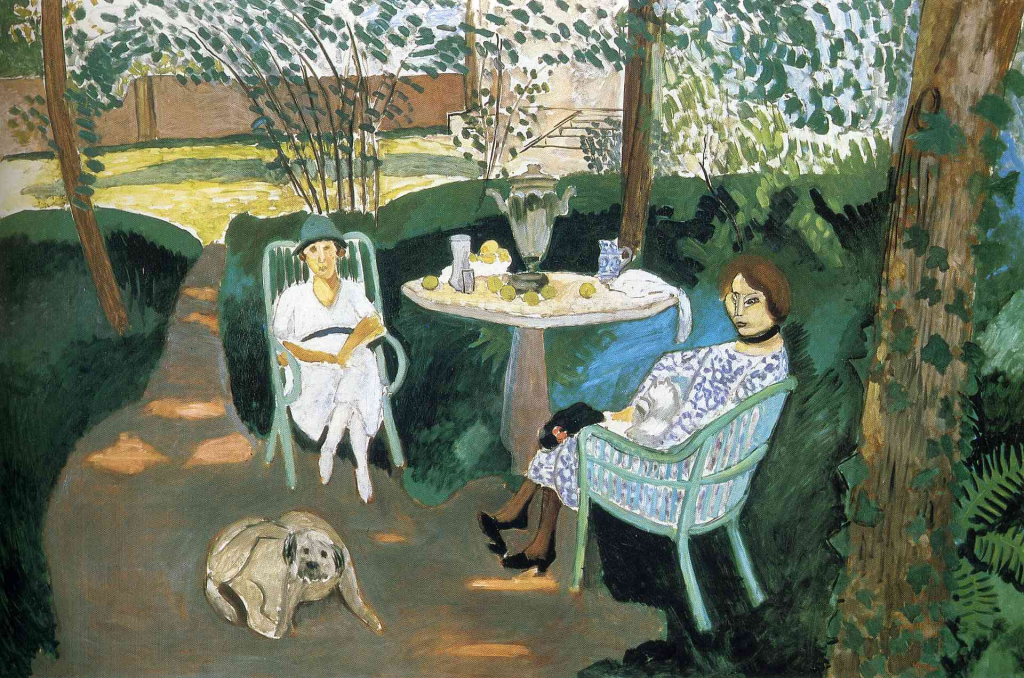
Matisse, Tea in the Garden, 1919
Dear Friends,
We have enjoyed several brilliant live online courses already this year, with more starting soon, followed by our Virginia Woolf Summer Course in July.
Coming up: Comedy and Irony in the Young Jane Austen course, May 2025
Jane Austen’s writing career began in her early teens, with a series of spoofs and pastiches of contemporary fiction that were written to entertain her family and herself. Before she reached her mid-twenties, she had already drafted the first three of the published novels, Northanger Abbey, Sense and Sensibility, and Pride and Prejudice. Those novels were revised later, but the texts we have still show the spirit of those early writings: playful, comedic, irreverent, and ironic. We will study:
• The unpublished teenage writings
• Northanger Abbey
• Pride and Prejudice
• Sense and Sensibility
Four sessions, weekly on Sundays, from 4 May to 25 May 2025.
Katherine Mansfield: Stories of Life and Death, Wednesdays, 14 May to 18 June 2025.
Katherine Mansfield was a shrewd observer of human relations and human betrayals. She brought pioneering, wide-ranging creative energies to the art of the short story, showing how this concise form could convey a wealth of ideas and emotion. She is often described as a writer who says much through what is not on the page. How does this work? Her writing, though often simple to read on the surface, conveys a complexity of meanings.
With Gerri Kimber, Claire Davison, Karina Jakubowicz, and Trudi Tate
Virginia Woolf Summer Course 2025
The summer course will run twice: first, live online (10-14 July) then in person in Cambridge (20-25 July). Our theme is Virginia Woolf: Writing Life. We study five of her greatest works over five days, with lectures, tutorials, talks, and more. It’s an intensive, brilliant week; unforgettable.
We study: Mrs Dalloway, To the Lighthouse, Orlando, The Waves, and Flush. Plus talks on the life writings of Leslie Stephen, Leonard Woolf, Jane Harrison, and more.
• Live online summer course, 10-14 July.• Summer course in Cambridge, 20-25 July.
New: Woolf in August 2025
We repeat some popular lectures on Woolf on Sundays in August at 10.00 am or 6.00 pm British Summer Time.
10 August 2025. Women in A Room of One’s Own (1929) with Trudi Tate. 10.00am-12.00 noon British Summer Time. 17 August. War Trauma in Mrs Dalloway (1925) with Trudi Tate. 10.00am-12.00 noon British Summer Time. 17 August. War Trauma in Mrs Dalloway (repeat session) with Trudi Tate. 6.00-8.00 pm British Summer Time.24 August. Politics in Mrs Dalloway with Mark Hussey. 6.00-8.00 pm British Summer Time.31 August. Sapphic Love in Orlando (1928) with Alison Hennegan. 6.00-8.00 pm British Summer Time.
Later in the year, we have courses on Doris Lessing, London in Literature, Women and Power in Twentieth-Century Fiction, George Orwell, and more.
We look forward to seeing you soon.
Trudi
Dr Trudi Tate, Director, Literature Cambridge Ltd
www.literaturecambridge.co.uk
Women Writers Season 2025
Our Women Writers Season continues with great women writers of the 19thC and 20thC. One session per month on Saturdays until December 2025, with a break over summer.
• 26 April. Clare Walker Gore on George Eliot, Middlemarch (1872)
• 24 May. Trudi Tate on Elizabeth Bowen, To the North (1932)
• 28 June. Lisa Mullen on Inez Holden, Night Shift (1941)
• 20 Sept. Alison Hennegan on Sylvia Townsend Warner, Summer will Show (1936)
• 25 Oct. Valerie Waterhouse on Malachi Whitaker, The Journey Home and Other Stories (1920)
… and more
The Female Quotient – Facebook post
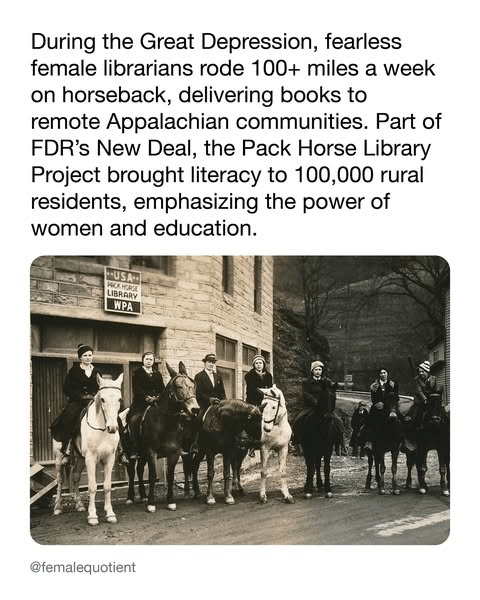
They were called “the book women” and they delivered books every single week, rain or shine.
Their inventory depended on donations, so they set up collection points at post offices, stores, and homes, helping them serve thousands of isolated residents with literature that improved literacy. Like if you’d LOVE to be a book woman.
And, thinking of Appalachian readers, I reviewed Barbara Kingsolver’s novel, Demon Copperhead, Faber and Faber 2022, on my blog December 7, 2022. My feelings were mixed, with the review beginning:
Barbara Kingsolver has been one of my favourite authors since reading The Poisonwood Bible. However, this has not been consistent – some of her books I have really enjoyed; others I have admired; and yet others have disappointed. I came to Demon Copperhead with this history so was prepared for any of my three reactions. I am left wondering, perhaps the most honest I can be is that my reaction is a mixture of the three.
And ending: So many reviewers loved this novel, and I am disappointed that I did not. With the provisos noted, it just was not for me.
Australian Politics
Anthony Albanese and Peter Dutton in prime ministerial battle that’s been decades in the making By Brett Worthington (edited – photos deleted)
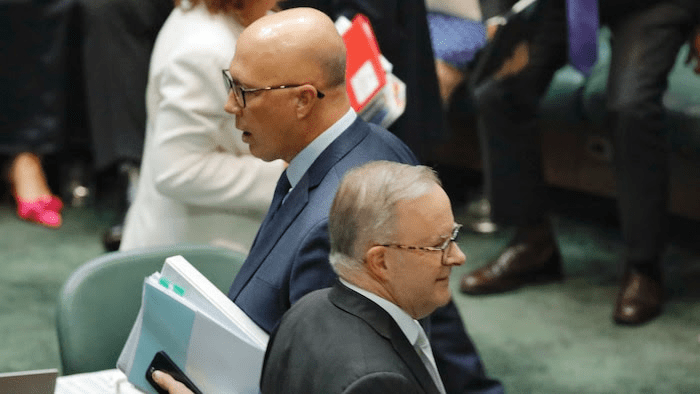
There’s little Anthony Albanese and Peter Dutton don’t know about each other’s political instincts.
Federal election 2025 live: Follow our coverage as the campaign unfolds
Veterans of the parliament, they’ve sat opposite each other for decades.
This last three years, sitting just a sword’s length apart in parliament, they’ve had even a closer look.
Having sized each other up, they now face the ultimate test.
Come May 3 only one can be prime minister.
For Albanese, the stakes seem even higher. His job security is on the line. A loss in the coming weeks will likely stain the end of an almost 30-year federal political career.
The Albanese-Dutton contest is one that seemed unlikely two years ago.
Albanese and Labor charged into government and enjoyed a protracted honeymoon.
At his first caucus meeting he told colleagues that if Labor lived up to what it told voters before the 2022 election, the party should get at least two terms in power.
Soaring in the polls, the ALP defied history and became the first government to win a seat from an opposition at a by-election in more than 100 years.
Fast-forward to today and Labor finds itself facing the prospect of defying history again — but not in a good way.
Not since 1931 has a federal government failed to win a second term. If the polls are to be believed, another once in a 100 year political event could be on the cards.
Peter Dutton was facing open questions about his leadership after his party lost the once safe Liberal seat of Aston, in Melbourne’s outer eastern suburbs in early 2023.
The ex-cop turned political strongman was always going to need to win seats in Victoria if he was to become prime minister.
Liberals wondered if he was unelectable in Victoria.
Within months though, he’d silenced those critics.
Dutton gambled his leadership on the Voice referendum. Just 90 minutes after the polls closed on October 14, the proposal was dead, the opposition leader the biggest political winner.
He capitalised on the pain households were experiencing from inflation savaging budgets and hasn’t looked back since.
Dutton too has a safety net underneath him that Albanese isn’t afforded.The seats that will determine the federal election
Australians could head to the polls in a federal election within months. So when will it be and what are the key seats in the battle to lead the country?
Unrivalled within the caucus, losing looks different for him.
History suggests oppositions don’t win after one term. It’s why Tony Abbott and Bill Shorten were able to hold onto their leaderships after losing close elections.
Should the Coalition fall short, Dutton is widely tipped to remain leader. A two-term strategy worked for Abbott, less so for Shorten.
A loss for Albanese would trigger generational renewal for Labor and likely see him retire from politics.
Campaign far from decided
It’s not like Labor is without achievements.
An anti-corruption commission has been established, climate targets have been pledged and soured relationships with world leaders repaired.
Labor has delivered two budget surpluses, something that hadn’t happened in Australia for almost two decades.
Medicines have been made cheaper, energy bill relief has flowed, taxes have been cut, wages have risen, unemployment has remained steady and record numbers of jobs created.
The ability to offer pre-election cash splashes that have long dominated federal politics haven’t been an option this time, amid fears it would likely make inflation worse. The electorates home to nation’s most indebted households
Labor has long held these outer-suburban electorates in Australia’s mortgage belts. They might not be the most marginal but they will likely determine the election.
The Reserve Bank’s decision to cut rates injected life into Labor’s campaign.
In the days before that decision, one Labor MP insisted it was crucial just to keep the government in the fight.
Albanese has often been underestimated but has achieved something his predecessors Kevin Rudd and Julia Gillard could not achieve — a publicly united team.
His political opponents arrive at an election day having been light on for policy announcements. But that’s not something that stopped John Howard from becoming prime minister in 1996.
A complicated electoral map
Notionally, Labor enters the campaign with 78 of the 150 seats in the House of Representatives. The Coalition is on 57, with 15 crossbench and minor party MPs. ABC Politics in your inbox
The Coalition needs another 18 seats to form majority government. If it’s unable to win back the seats it lost to the so-called teal independent MPs, the Liberals will need to win long-held Labor seats.
Scott Morrison hoped to win those seats at the last election but was unsuccessful.
Rising interest rates have made Peter Dutton’s task a bit easier, especially in outer suburban Melbourne, which is home to electorates with some of the highest proportions of mortgages in the country.
For Dutton, his message boils down to reminding households about the pain they’re feeling, openly questioning if they’re better off than they were three years ago.
For Albanese, he’ll argue the dice was cast at the last election and that life was always going to be hard this term.
But he will point to falling interest rates as a sign that brighter days are ahead, reminding voters too that inflation is falling but not at the expense of jobs.
These two men have spent three years looking into each other’s eyes.
Voters are about to see what they’ve learned.
Guardian Podcast, relevant to the points made below regarding the possible impact of the Trump Presidency on Australian politics. Bridie Jabour talks with the editor, Lenore Taylor, head of newsroom, Mike Ticher and deputy editor Patrick Keneally about text leaks, tariffs, and Trump’s looming threat #auspol#election2025#trump. These journalists appear to recognise the importance of being ‘between a rock and a hard place’ when they say:
With the prime minister expected to call the election at any moment, the impact of American politics on our security, economy and defence cannot be underestimated. Australian politics has been dominated by a pre-election budget, but has this overshadowed our ability to guard ourselves against a much more volatile geopolitical climate?
British Politics

The world has changed since Rachel Reeves’ first budget as chancellor back in October. Global tensions, tariffs and borrowing costs are up, while growth expectations are down by half. But in terms of making the country’s finances add up, Reeves is still stuck between a rock and a hard place. For a Labour chancellor, this place is about as rocky as it gets. Her spring statement, delivered yesterday, came across as a trade-off between welfare and defence spending. Like other European countries, Britain is coming to terms with its new relationship with the US and scrambling for money to up its defence spend. Taken alone, that might not have been a tricky sell. But delivered alongside detail on yet more cuts to sickness and disability benefits, it becomes very difficult indeed.
Our experts pointed to the strict fiscal rules Reeves set for herself, intended as assurances on responsibility but now blamed for making unpopular cuts necessary. And, as one of our panel argues, the bind she finds herself in has led to some spending smoke and mirrors. Meanwhile, another of our experts got stuck into the defence figures. After years of cutbacks, he says this new spending will be little more than a drop in the ocean. Reeves may have found herself between a rock and a hard place, but that doesn’t mean she was without choices. As it all begins to shake down, she’ll have to be ready to answer for them.
As Britain ponders the future of its defence, officials will no doubt be watching the intelligence fiasco that’s emerging in the US. It’s hard to imagine a bigger one. A group of America’s most senior national security officials got together for a group chat on an unsecured commercial platform to discuss bombing Yemen hours before it happened with operational details including the what, where and when, plus a scathing critique of America’s “pathetic” European allies. And they inadvertently invited along a journalist. Intelligence and security expert Robert Dover believes that whatever action Donald Trump takes in response, America’s allies in Europe and elsewhere will be considering the future of intelligence sharing with the US…
Sarah Reid, Senior Business Editor

David Blunkett: the world has changed since Liz Truss’s mini budget, so what is Labour still so scared of?
Published: March 28, 2025 4.20am AEDT
Much has been said about UK chancellor Rachel Reeves’ self-imposed fiscal rules, and her repeated assertion – which she included in the spring statement – that they are “non-negotiable”. Of course, this is true if you’re not prepared to listen to alternatives, but in the real world there is no set economic template with which people cannot argue.
Put simply, the chancellor’s rules demand that day-to-day expenditure should be covered by government income at the end of the five-year economic cycle. This is what has led to the current need to cut spending – including to health and disability benefits – so drastically. The length of this cycle is determined by the government as part of their “rule”.
All of this is predicated on the government’s belief that economic policy will be undermined if the international financial markets (including the bond markets on which governments depend for borrowing) react badly. Which, it is commonly asserted, would significantly push up the cost of borrowing. Other factors, such as US president Donald Trump’s extraordinary threats to trade, and the borrowing requirements of other countries, will also have an immediate impact.
Underpinning all of this is the split between capital investment – spending on things like roads and hospitals – and day-to-day revenue to keep services operating.
Therefore, the chancellor imposes rules to avoid the financial markets hitting the UK in the way they did when former prime minister Liz Truss and her chancellor Kwasi Kwarteng introduced a “mini budget”. The unfunded tax cuts it contained led to the markets losing confidence in the UK’s financial stability.
This is the spectre at the feast. Everything being done by the present government is with the backcloth of what happened in 2022. We are, in effect, binding ourselves to a moment in time.
Many economists disagree with the rigidity (or what is known as “Treasury orthodoxy”) about how the economy works. Leading international economist Mariana Mazzucato, along with a group of other renowned academics, published a letter in the Financial Times spelling out their concerns about the imposition of the “rules”.
In practice, while public spending over the next two years will not be hit drastically (other than the welfare budget), the following three years will see a massive tightening of what is available for most public services. This includes local government and the criminal justice system – which have seen eye-watering cuts in previous years.
The average 1.2% increase in departmental budgets projected over the three years from 2027 is far less than this for many government departments and for local government. This is because spending in areas such as health and for schools (but not education more broadly) is predicated to rise much more substantially.
This is why people are starting to use the word “austerity” – they are seeing a reflection of the years between 2010-2017, when many felt that public services were decimated.
Scorecard for government spending plans
During that austerity period, the body known as the Office for Budget Responsibility (OBR) was brought in by the then-chancellor George Osborne. Now being carried through even more rigidly by Reeves, this is intended to be an independent group which “scores” the government’s likely success against its predictions. I use the word “likely”, because just three members are charged with the analysis, by the Treasury, of how successful the policy is likely to be.
The OBR has come to have massive influence over what the government believes it can undertake, confining the options even beyond the self-imposed rules.
Just before her spring statement, the chancellor altered the amount that would have to be saved from changes in the welfare system. This was in order to take account of the analysis by these three individuals who believed that the reforms as proposed would not achieve the savings required.
So, we go round in a circle – with one set of economists double-checking the calculations and projected analysis of another set of economists. But they have such enormous influence that they can change government policy.
You might believe that the OBR (being full of experts) is pretty much infallible. You would be wrong. Since its inception, it has often been wide of the mark. Even when only marginally, this has had an impact on both policy and perceptions, including by those financial markets that have such a stranglehold on nation states.
In 2012, the OBR projected that over the five years ahead, growth would average 2.8%. In fact, it was 1.7%. In 2020, their prediction was that gross domestic product (GDP) would fall by 11.3% when in fact the drop was 9.8%. Most recently, in 2023, it projected a fall in GDP of 0.3% – which sadly turned out to be 0.8%.
I use these stats merely to illustrate that forecasts and scorecards as to whether the government has got its sums wrong are highly subjective. For politicians to place their economic and political policies in the hands of a group of disparate individuals with their own political and economic outlook and personal experiences is, in my view, bizarre.
This is why some of us who know about the difficulties of government from having been there, and who are not in any way dismissive of the huge power of the international markets, are challenging this economic orthodoxy.
We are simply asking whether rigid economic respectability is truly more important than long-term investment and sustaining essential public services.
Labour List, a British Labour newsletter reports even handedly on Party reflections on the difficulties faced by Rachel Reeves:
One side, little reported on in the media, totally respects the Chancellor’s predicament, however much they might wish it were different. One MP tells us the “overwhelming majority” of MPs support the Chancellor. Another suggests colleagues are being naive over the need to make difficult choices.
The other side warns any perception of austerity will be devastating, having been partly elected as the antidote to austerity, and wants some kind of wealth tax or revision of the fiscal rules. It is clear plenty of MPs baulk at Reeves’ planned keyhole surgery on the state, with significant cuts looking likely in multiple departments even if overall spending nominally keeps rising.
American Politics – a range of views and responses.*
It is a rather large rock and a very hard place for Rachel Reeves, Chancellor, Britain. Far easier for Sarah Reid, Senior Business Editor of The Conversation, to make the point then ignore it. What does she mean by ‘came across’ – does she suggest that the interpretation to which she refers is valid? If so, give some more detail. If not, ditto. The new relationship with the United States, based on the transcript below, the background story, and the continuing story surely suggests the serious nature of this change. David Blunkett, Chair in Politics in Practice, Department of Politics and International Relations, University of Sheffield, refers only to the difficulties imposed by ‘international markets’.
The Signal conversation:
Nothing about the release of the actual text messages in which senior Trump officials discussed strikes in Yemen has changed the White House’s belief that this will all blow over soon, Axios’ Marc Caputo tells me.
- The Atlantic today released specific texts from the Signal chain on which its editor-in-chief, Jeffrey Goldberg, was inadvertently included.
- White House communications officials quickly downplayed the release, noting that the new Atlantic headline used the phrase “attack plans” rather than “war plans.”
- Defense Secretary Pete Hegseth has said, unequivocally, that “nobody was texting war plans.”

Screenshot: The Atlantic
What they were saying: Screenshots released by The Atlantic show Hegseth providing the group with a timeline of the attack,
- “Just CONFIRMED w/CENTCOM we are a GO for mission launch,” one update said.
- Another said, “THIS IS WHEN THE FIRST BOMBS WILL DEFINITELY DROP.”
From Facebook – Americans Against the Republican Party
It’s terrifying that the only competent, knowledgeable, and ethical person on that Signal thread was the guy they added by mistake.
Cory Booker Condemns Trump’s Policies in Longest Senate Speech on Record
Senator Cory Booker, his voice still booming after more than a day spent on the Senate floor railing against Trump administration policies, surpassed Strom Thurmond for the longest Senate speech on record.
MSNBC cohosts get into heated argument over Bernie Sanders and AOC’s ‘tone-deaf’ tour
Story by Alexa Cimino For Dailymail.Com
MSNBC’s Symone Sanders-Townsend pushed back against co-host Michael Steele’s criticism of Sen. Bernie Sanders and Rep. Alexandria Ocasio-Cortez‘s ‘Fight Oligarchy’ tour.

Sen. Bernie Sanders, I-Vt., and U.S. Rep. Alexandria Ocasio-Cortez, D-N.Y., have drawn large crowds during their “fighting oligarchy” tour.
The tour, which began in Las Vegas and includes stops in several major cities, made its way to Denver on Friday.
While Steele acknowledged the lawmakers’ efforts, he questioned whether the term ‘oligarchy’ truly resonates with everyday Americans.
‘The oligarchy tour, I think, kind of misses middle America because, again, Democrats, in my view, being tone deaf from what the American people are saying, you know, folks sitting at the local pub aren’t using the term oligarchy,’ Steele said on The Weekend.
Sanders-Townsend quickly pushed back. ‘OK, wait, but I’m sorry, they’re in middle America. He launched a tour in Omaha. They were in Denver,’ she countered.
Steele held firm, arguing that the issue wasn’t where the tour took place but how its message was framed.
‘It doesn’t matter where you launch it. It’s what you say when you launch it. And if you’re using terms and phraseology that is not directly connecting people, then that becomes a concern in the process,’ he explained.
While Steele acknowledged the lawmakers’ efforts, he questioned whether the term ‘oligarchy’ truly resonates with everyday Americans’The oligarchy tour, I think, kind of misses middle America because, again, Democrats, in my view, being tone deaf from what the American people are saying, you know, folks sitting at the local pub aren’t using the term oligarchy,’ Steele said on The Weekend.
Sanders-Townsend quickly pushed back. ‘OK, wait, but I’m sorry, they’re in middle America. He launched a tour in Omaha. They were in Denver,’ she countered.
Steele held firm, arguing that the issue wasn’t where the tour took place but how its message was framed.
‘It doesn’t matter where you launch it. It’s what you say when you launch it. And if you’re using terms and phraseology that is not directly connecting people, then that becomes a concern in the process,’ he explained.
Eugene Daniels added that his conversations with Democrats largely echoed Steele’s concerns.
Meanwhile, Sen. Elissa Slotkin (D-MI), a former House representative, took aim at Ocasio-Cortez during a town hall as she faced questions about her approach to Donald Trump.
Slotkin pushed back against calls for her to take a more aggressive stance, distancing herself from progressives. ‘Things require me to be more than just an AOC,’ she told the crowd.
‘I can’t do what she does because we live in a purple state and I’m a pragmatist.’
In another exchange, when a constituent referenced Sanders, Ocasio-Cortez, and Rep. Jasmine Crockett (D-TX), Slotkin delivered another jab at progressives.
‘Everyone you mentioned has a lot of words, but what have they actually done to change the situation with Donald Trump?’ she asked.
At the same time, a new poll suggests that former Vice President Kamala Harris is the Democratic Party’s clear frontrunner for 2028—despite her crushing loss to Donald Trump just months ago. Former Transportation Secretary Pete Buttigieg lags behind at 10 percent. Harris has kept a low profile since her defeat in November, but the poll results raise questions about whether Democrats have truly reckoned with their 2024 loss — or if they even have an alternative.
Once seen as the future of the party, Harris watched her presidential bid collapse as Trump reclaimed the White House. Despite raising nearly $1.8 billion — outpacing even Joe Biden — she failed to convert that funding into momentum in key battleground states.
* In my view the range of views and responses is a positive at this stage of the second Trump presidency. Clearly some voters are in a turmoil about what is happening. Likewise, until it affects them, others are ecstatic. Democrats are appealing to the wide range of responses from electors, and until they are necessarily geared up to fight the mid-terms all these activities seem valid. One proviso, while I really like Bernie Sanders Alexandria Ocasio-Cortez’s approach in general, I believe that Michael Steele has a valid point about the language.
News just in (edited)
Wisconsin Supreme Court election results: Susan Crawford defeats Brad Schimel in most expensive judicial race in US history
Alison DirrDaniel BiceLaura SchulteMary Spicuzza
Milwaukee Journal Sentinel
Liberal Dane County Judge Susan Crawford scored an unexpectedly easy victory in the high-stakes race for a crucial seat on the state Supreme Court in the most expensive judicial race in U.S. history.
Crawford, 60, had received 55% of the vote to conservative Waukesha County Judge Brad Schimel’s 45% with 82% of the vote in, according to unofficial results. Decision Desk HQ called the race less than an hour after polls closed at 8 p.m.
At Crawford’s election night party in Madison, supporters cheered in response to calls that she had won the race early in the night. Groups in justice’s robes and cow-printed cowboy hats flooded the party to celebrate, while others dressed in America-themed outfits broke out in dance.
When Crawford took the stage, she called the campaign an “incredible, life-altering experience.”
“As a little girl growing up in Chippewa Falls, I never could have imagined that I’d be taking on the richest man in the world for justice in Wisconsin. And we won!” she said to cheers, referring to the $20 million-plus billionaire Elon Musk in an attempt to defeat her…
At stake in the race was not solely a seat on the state’s seven-member high court but also its ideological control. Crawford’s victory effectively locks out conservatives from retaking the majority until at least 2028.
Those high stakes contributed to the bitterness — and record spending — that defined the race…
Conservatives also said her election to the court would allow liberals to redraw congressional districts in a way that is more favorable to Democrats, a contention that Democratic U.S. House Minority Leader Hakeem Jeffries confirmed last week.
But Crawford has said she has never discussed the issue of congressional redistricting either publicly or privately.
Florida special elections
While Democrats pointed to the fact that Republicans in both races underperformed Trump’s 2024 general election performance, Republicans celebrated the victories after voicing concerns about a much tighter race in Florida’s 6th Congressional District.
Both Florida seats were won by Republicans, although by smaller margins than the GOP would have liked.
Some lighthearted eating –
Cindy Lou eats out on a wet and cold Canberra Day
Fortunately, we were joined by friends so did not eat all that was before us at Smith’s Bookshop.



Sunny day eating at Kopiku – no friends to help eat these generous portions


Feminist Films??*
15 movies that are surprisingly feminist©Paramount Pictures
While most audiences just want to grab some popcorn and be entertained when they sit down to watch blockbusters like Barbie or Legally Blonde, in the hands of the right filmmakers these movies not only deliver just that, but they carry refreshing feminist perspectives that are both relatable and digestible. Like Mary Poppins, some films can deliver a spoonful of sugar with doses of feminist themes, like financial independence, reproductive rights, positive body image, and the multi-dimensionality of identity—without being advertised as such. These films challenge stereotypes and celebrate gender equality all while winning the applause and attention of mass audiences.
Here are 15 surprisingly feminist movies you’ll want to add to your must-watch list.
Alien (1979)©20 Century Fox
While audiences are more accustomed to women and gender-diverse leads kicking butt in action or science-fiction films nowadays, that wasn’t always the case. When Sigourney Weaver battled hostile extra-terrestrials as the slightly reluctant heroine of the 1979 sci-fi thriller Alien, it was considered the first feminist blockbuster. While it wasn’t the first film to feature feminist themes, it certainly ended up shattering the glass ceiling, making way for more women to lead mainstream action and sci-fi films.
Barbie (2023)©Warner Bros. Pictures
While Mattel’s Barbie doll did more damage to women’s body image over the years than any other toy, the company did try to make amends with its involvement in the 2023 Barbie movie, directed by Greta Gerwig. Poking fun at radical feminism and the crushing impact of the patriarchy on all genders, it’s a conversation starter about power and success. Accidentally or not, it used an iconic toy to underline the weight of contradictory social norms and expectations women face today—just check out America Ferrera’s Barbie monologue.
The ‘Resident Evil’ (2002–2021) and ‘Underworld’ (2003–2016) movies©Constantin Film / Impact Pictures
Although horror films aren’t typically crammed with feminist themes, the Resident Evil franchise and its close cousin, the Underworld movies, are notable exceptions. Based on popular video games, Resident Evil’s unlikely feminist icon Milla Jovovich and Underworld’s Kate Beckinsale have been compared to the likes of Alien’s Sigourney Weaver. If anything, these long-running franchises accidentally prove that movies with strong—and weapon-slinging—women in the lead are good for business and for on-screen representation.
The ‘Scream’ movies (1996–2023)©Dimension Films
The Scream movies are campy popcorn horrors with often laughable characters, one-liners, and plot lines. But there is no doubt that Scream still steals the show for the way it has portrayed strong female leads and rewritten age-old storylines for women in horrors. Rather than being punished for their individuality, sexual independence, and wit, which was the fate of many women in horrors like Halloween, Scream’s leads are determined to outsmart the killers.
The Silence of the Lambs (1991)©Orion Pictures
The award-winning Silence of the Lambs tells the chilling story of an FBI agent who is trying to catch a serial killer. With a Rotten Tomatoes score of 95%, it is considered a feminist fable with its searing commentary on sexual assault, misogyny, and voyeurism. Agent Clarice Starling, played by Jodie Foster, battles chauvinism and casual workplace sexism all while facing the horrors of humanity, from a psychotic serial killer to a self-absorbed cannibal.
The Color Purple (1985)©Warner Bros./Amblin Entertainment/The Guber-Peters Company
Based on Alice Walker’s Pulitzer Prize-winning novel of the same name, The Color Purple masterfully tackles themes of racism, gender inequality, sexual assault, and injustice. Now a staple of American literature and a feminist classic, The Color Purple tells the story of a Black girl who survives sexual assault. At the intersection of race and gender, the story has had such a lasting impact on our culture and portrayed women of colour in such important ways that it was remade in 2023.
Clueless (1995)©Paramount Pictures
While the characters in this romantic comedy may not be immediately relatable with their Beverly Hills lifestyle and pastimes, what makes Clueless an enduring classic—and a surprisingly feminist movie—is the way it unapologetically handles certain themes. From body autonomy and freedom of gender expression to the value of friendships among women, Cher and her glam gang model positive traits for women in the most realistic and stylish manner.
Queen of Katwe (2016)©Walt Disney Pictures
What has made Disney’s Queen of Katwe an accidentally iconic feminist movie is how it depicts the inspiring true story of the chess champ who hailed from the slums of Kampala and defied the odds to win the junior championship in Uganda. Women, gender-diverse folks, and girls who bootstrap with perseverance, intellect, and determination are the kind of positive role models portrayed in this film. The film is directed by Mira Nair, known for centring women’s stories in films like Monsoon Wedding.
Crouching Tiger, Hidden Dragon (2000)©Asia Union Film and Entertainment Ltd.
With stunning visuals evoking the Chinese Qing dynasty era, Ang Lee’s Crouching Tiger, Hidden Dragon challenges traditional gender roles with its lasting feminist legacy. With surprising twists, supernatural martial arts, and women warriors at the centre, this award-winning movie tells the story of multi-dimensional women in the most empowering and artistic way.
Mad Max: Fury Road (2015)©Warner Bros.
Laser-focused on survival, Mad Max’s Furiosa character is a femme fatale who skillfully navigates the wasteland and oppressive system that is trying to trap her into domestic subordination. In true feminist fashion—albeit with a dash of white saviourism—Furiosa helps other women escape this fate. Women’s leadership, solidarity, and resistance are in full force for this instalment of the Mad Max sci-fi movies.
The Hours (2002)©Paramount Pictures / Miramax / Scott Rudin Productions
The constraints of domestic life are central to the resistance portrayed throughout The Hours. Starring Hollywood juggernauts Meryl Streep, Nicole Kidman, and Julianne Moore, the film centres around three women whose stories are interconnected through Virginia Woolf’s novel, Mrs. Dalloway. A feminist icon, Woolf wrote novels and stories that may have inspired women to step into their independence and sexuality amid the confines of duty and obligation.
Legally Blonde (2001)©Facebook @LegallyBlondeMovies
“What? Like it’s hard?” is the iconic line from Legally Blonde when ditzy lead Elle Woods, played by Reese Witherspoon, confronts her ex-boyfriend after getting into Harvard Law School. This mission to win her ex back becomes a journey of self-discovery, making this movie a feminist classic in recent years. Staying true to herself, Elle Woods may not be for everyone, but she helps us shed our biases, proving that stilettos and pink suits won’t stop a woman from winning cases in the courtroom.
Dear White People (2014)©Lionsgate
Thanks to the success of shows like Insecure, fearless Black women are more frequently depicted with authority and autonomy on screen these days. That wasn’t always the way, especially when Dear White People came out in 2014. At the time, it offered a refreshing look at sexuality, self-actualization, and autonomy at the intersection of gender and race. Emphasizing the importance of taking control of one’s desires and destiny, the film influenced how women and gender-diverse characters of colour are depicted on screen.
Sister Act (1992)©Touchstone Pictures
When a disco lounge singer, played by Whoopi Goldberg, witnesses a murder, she is put into witness protection as a nun in a convent. What makes this movie so remarkable is that, as a Black woman, Goldberg headlined not one but two movies (Sister Act 2 came out in 1993) that were box-office smashes. This comedy thrives on the power of women’s friendships, their journey to self-discovery, and the transformative role of faith.
The Stepford Wives (1975)©Columbia Pictures
From women of influence to domestic slaves overnight, the wives in the town of Stepford are transformed into robots in this chilling tale. The Stepford Wives is a commentary on the power dynamics of the patriarchy and traditional gender roles. Based on the feminist horror novel by Ira Levin, this movie claps back at domesticity and is considered a battlecry for second-wave feminism. The film’s long-lasting legacy emphasizes the power of women’s agency, financial independence, and autonomy.
*See also Corrina Antrobus I Love Romcoms and I am a Feminist A manifesto in 100 romcoms, reviewed in blog September 4, 2024.

 Robin's Room