
Marie Bostwick The Book Club for Troublesome Women HarperCollins Focus | Harper Muse, April 2025.
Thank you, NetGalley, for providing me with this uncorrected proof for review.
Marie Bostwick’s book begins with her revelation about her inspiration for it – a conversation with her ninety-one-year-old mother in which Bostwick learnt that Betty Freidan’s The Feminine Mystique had, in her mother’s words, changed her life. She then describes the research she undertook, often arousing feelings of anger, but also admiration of the women facing egregious discrimination. She recognises what Freidan, and those moved by her, did for women – an excellent start to a work of fiction that introduces courageous characters who respond to the discrimination they faced. The women’s coming together, through a book club based on reading extensively and eventually sisterhood, is an engaging topic and Bostwick’s book is a fine vehicle. See Books: Reviews for the complete review.
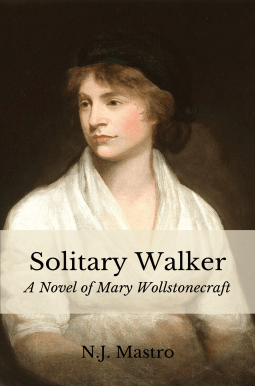
N.J. Mastro Solitary Walker A Novel of Mary Wollstonecraft Black Rose Writing, February 2025.
Thank you, NetGalley and Black Rose Writing, for providing me with this uncorrected proof for review.
Solitary Walker A Novel of Mary Wollstonecraft is an ideal start to learning more about this complex feminist, the writer of important documents; accommodating and helpful sister; a friend of women of worth, and also a critic of many; mother of Mary Shelley; and friend, lover and wife of men of merit – and, unfortunately, some who do not deserve this accolade. As with any worthy writer of historical fiction, Mastro concludes her work with an explanation of where fiction and fact mix; where the former overtakes the reality, or fictional characters comprise several real people; and reference to the biographical works and Wollstonecraft’s texts that she uses.
This novel admirably blends the woman who wrote so convincingly about the rights, first of men, and in a later treatise, of women, fiction and adjurations about the way in which women should be educated and measured, with the flawed person who gave far more attention to the opinions of some men, together with her imprudent emotional attachments. Mastro convincingly argues that much of the emotional dilemmas to which Wollstonecraft was prey arise from her childhood. This is not dwelt upon, but is made apparent through clever, but brief, references to the past and Wollstonecraft’s continuing sense of responsibility to sometimes unappreciative. See Books: Reviews for the complete review.
Australian Politics
Bob McMullan
Some thoughts on the recent WA election
The recent victory of the Labor party in WA was remarkable in a number of ways.
First, it was more of a rout than a landslide. The Liberal party had a disastrous election in 2017. 2025 was worse. 2021 can be considered a post-covid anomaly, but measured against 2017 the Liberals have gone backwards.
The smallest swing to the Liberals was in Churchlands. This was the seat they selected for their “saviour”, Perth Lord Mayor, Basil Zempilas. The swing to him was only 2.2% against a state-wide average of more than 10%. It is a very weak basis for a new leadership contender to mount a challenge.
It may not come as a surprise to many that I find the internal workings of the Liberal Party hard to understand sometimes.
However, their response to another drubbing at the WA state election is baffling to say the least.
Why on earth would you choose someone who was demonstrably the worst candidate of the 59 Liberal candidates at the election to be the new Leader?
This is not just my opinion. It is very clear. Of all the seats contested between the Liberals and Labor, the smallest swing was in the seat of Churchlands.
The swing in this seat was a mere 2.2% from the disastrous result of 2021.
The range of swings away from the historically high ALP 2021 result ranged from a high of 26.4% to a miserably low 2.2%.
The 26.4% result may have been an outlier, but more than half of the coalition candidates achieved a swing of 12% or more.
This shows up the Churchlands result as disastrously bad.
Perhaps more importantly, the election outcome shows that candidate Zempilas failed to win back the traditional Liberal voters in this affluent and previously very safe seat.
The best way to judge this issue is by a comparison with the 2017 result.
Remember, this was considered a Labor landslide at the time. However, the Liberal candidate in Churchlands managed to gain a very healthy 63.2%. This was well down on previous results but a solid and safe win all the same.
This time, Mr. Zempilas won only 50.7%.
Therefore, almost a quarter of the rusted on Liberal voters who stayed with the Liberals in 2017 did not support the Zempilas candidature in 2025.
At the end of the day, he won the seat of Churchlands, if only just. However, by any measure it was a highly unsatisfactory performance.
Given all the publicity about his potential as a future leader he should have won handsomely.
This constitutes a failure of major proportions. Not a very sound basis on which to build future leadership.
The federal implications of the strong Labor result will obviously not be finally understood until the federal election is concluded.
However, history does suggest some probable consequences.
First, it can’t be a bad thing that the Labor brand is strong in WA.
Second, the results in the seats that constitute Tangney suggest the sitting member, Sam Lim, is in with a strong chance.
Third, although there were strong swings against Labor, particularly in the outer suburbs the overall results in those suburbs were still strong. This is a potential vulnerability for the Albanese government but the data suggests all of the held seats will be within reach if the national and local campaigns are strong enough.
Bullwinkel is the wildcard. This is a new seat and notionally Labor based on the very strong result in Perth in 2022. The Nationals candidate, Mia Davies must have been disappointed with their showing in this area. However, it will be difficult for Labor to hold this seat.
The strong showing of Teal candidates in Cottesloe and Fremantle certainly suggest Kate Chaney has a strong chance of retaining her seat of Curtin at the forthcoming election. While the Liberals won back Nedlands, which is the heart of the federal seat of Curtin which Chaney currently holds, they must have been disappointed with the result across the Curtin area as a whole.
Overall, the result in the 2025 State election was surprisingly stable given the previous two state elections.
This suggests the potential for a status quo result at the federal election in May.
American Politics
Heather Cox Richardson from Letters from an American <heathercoxrichardson@substack.com> Unsubscribe
Forwarded this email? Subscribe here for more April 1, 2025Heather Cox Richardson Apr 2
Today Senator Cory Booker (D-NJ) made history. For more than 25 hours he held the floor of the Senate, not reading from the phone book or children’s literature, as some of his predecessors have done, but delivering a coherent, powerful speech about the meaning of America and the ways in which the Trump regime is destroying our democracy.
On the same day that John Hudson of the Washington Post reported that members of Donald Trump’s National Security Council, including national security advisor Michael Waltz, have been skirting presidential records laws and exposing national security by using Gmail accounts to conduct government business, and the same day that mass layoffs at the Department of Health and Human Services gutted the Centers for Disease Control and Prevention (CDC), the National Institutes of Health (NIH), and the Food and Drug Administration (FDA), Booker launched a full-throated defense of the United States of America.
Booker began his marathon speech at 7:00 on the evening of March 31 with little fanfare. In a video recorded before he began, he said that he had “been hearing from people from all over my state and indeed all over the nation calling upon folks in Congress to do more, to do things that recognize the urgency—the crisis—of the moment. And so we all have a responsibility, I believe to do something different to cause, as John Lewis said, good trouble, and that includes me.”
On the floor of the Senate, Booker again invoked the late Representative John Lewis of Georgia, who had been one of the original Freedom Riders challenging racial segregation in 1961 and whose skull law enforcement officers fractured on the Edmund Pettus Bridge in Selma, Alabama, in 1965 as Lewis joined the marchers on their way to Montgomery to demand their voting rights be protected.
Booker reminded listeners that Lewis was famous for telling people to “get in good trouble, necessary trouble. Help redeem the soul of America.” Booker said that in the years since Trump took office, he has been asking himself, “[H]ow am I living up to his words?”
“Tonight I rise with the intention of getting in some good trouble. I rise with the intention of disrupting the normal business of the United States Senate for as long as I am physically able. I rise tonight because I believe sincerely that our country is in crisis and I believe that not in a partisan sense,” he said, “because so many of the people that have been reaching out to my office in pain, in fear, having their lives upended—so many of them identify themselves as Republicans.”
Standing for the next 25 hours and 5 minutes, without a break to use the restroom and pausing only when colleagues asked questions to enable him to rest his voice, Booker called out the Trump administration’s violations of the Constitution and detailed the ways in which the administration is hurting Americans. Farmers have lost government contracts, putting them in a financial crisis. Cuts to environmental protections that protect clean air and water are affecting Americans’ health. Housing is unaffordable, and the administration is making things worse. Cuts to education and medical research and national security breaches have made Americans less safe. The regime accidentally deported a legal resident because of “administrative error” and now says it cannot get him back.“
These are not normal times in America, and they should not be treated as such,” he said. “This is our moral moment. This is when the most precious ideas of our country are being tested…. Where does the Constitution live, on paper or in our hearts?”
Throughout his speech, Booker emphasized the power of the American people. He told their stories and read their letters. And he urged them to stand up for the country. “In this democracy,” he said, “the power of people is greater than the people in power.”
He emphasized the power of the people by calling out South Carolina Senator Strom Thurmond, who until today held the record for the longest Senate speech: a filibuster he launched in 1957 to try to stop the passage of that year’s Civil Rights Act. Thurmond spoke for 24 hours and 18 minutes, but unlike Booker, who used his time to make a powerful and coherent case for reclaiming American democracy, Thurmond filled time with tactics like reading from an encyclopedia.
But, Booker noted, Thurmond’s attempt to stop racial equality failed. After he ended his filibuster, Congress passed the Civil Rights Act of 1957, and Black Americans and their allies used it to demand the equal protection of the law, including the right to vote. “I’m not here…because of his speech,” Booker said. “I’m here despite his speech. I’m here because as powerful as he was, the people were more powerful.”
“It is time to heed the words of the man I began this whole thing with: John Lewis. I beg folks to take his example of his early days when he made himself determined to show his love for his country at a time the country didn’t love him, to love this country so much, to be such a patriot that he endured beatings, savagely, on the Edmund Pettus bridge, at lunch counters, on freedom rides. He said he had to do something. He would not normalize a moment like this. He would not just go along with business as usual. He wouldn’t know how to solve it, but there’s one thing that he would do, that I hope we all can do, that I think I did a little bit of tonight.
“He said for us to go out and cause some good trouble, necessary trouble, to redeem the soul of our nation. I want you to redeem the dream…. Let’s be bolder in America with a vision that inspires with hope. It starts with the people of the United States of America—that’s how this country started: ‘We the people.’ Let’s get back to the ideals that others are threatening, let’s get back to our founding documents…. Those imperfect geniuses had some very special words at the end of the Declaration of Independence…when our founders said we must mutually pledge, pledge to each other ‘our lives, our fortunes, and our Sacred Honor.’ We need that now from all Americans. This is a moral moment. It’s not left or right, it’s right or wrong.
“Let’s get in good trouble.
“My friend, madam president, I yield the floor.”
According to Washington Post technology reporter Drew Harwell, before he was through, Booker’s speech had been liked on TikTok 400 million times.

Let’s Get in Good Trouble see review of John Lewis The Last Interview, in Blog November 17, 2021.
Hillary Clinton warns Trump ‘stupidity’ will leave US ‘feeble and friendless’
Former presidential candidate writes op-ed excoriating Signal leak and White House’s ‘dangerous’ actions.
Hillary Clinton on Friday called the Trump administration’s approach to governing both dumb and dangerous in an essay excoriating the Signal chat scandal and the Elon Musk-led mission to slash the federal workforce, and concluding that Trump would make the US “feeble and friendless”.
The former secretary of state and Democratic presidential candidate wrote an op-ed for the New York Times that has been given the headline: “How much dumber will this get?” and opens: “It’s not the hypocrisy that bothers me; it’s the stupidity.”
Clinton starts with the Signal chat group scandal, when Donald Trump’s national security adviser, Mike Waltz, mistakenly added a top US journalist to a small group of government leaders on the encrypted but unclassified app and then the defense secretary, Pete Hegseth, proceeded to discuss intricate details of a forthcoming airstrike on Houthi militants in Yemen and report back to the group on the deadly results.
The US vice-president, JD Vance, was included, who took another swipe at European reliance on US military security, and so was the director of national intelligence, Tulsi Gabbard. Hegseth relayed times that US fighter jets would take off and his updates on death and destruction on the ground elicited triumphant comments and emojis from some others in the group.
Clinton wrote: “Top Trump administration officials put our troops in jeopardy by sharing military plans on a commercial messaging app and unwittingly invited a journalist into the chat. That’s dangerous. And it’s just dumb.”
She went on: “This is the latest in a string of self-inflicted wounds by the new administration that are squandering America’s strength and threatening our national security.”
Clinton sharply criticized the slashing of the federal workforce that has been under way since the first days of the new administration, overseen by the top Trump adviser and tech billionaire Elon Musk, although she did not mention the mogul by name or comment on the growing oligarchy that is alarming many outside the White House.
Clinton especially criticized the dismantling of the US Agency for International Development – a so-called soft power program introduced by John F Kennedy as president to help spread American influence around the world through human rights work, in contrast to military and diplomatic power alone.
“In a dangerous and complex world, it’s not enough to be strong. You must also be smart. As secretary of state during the Obama administration, I argued for smart power, integrating the hard power of our military with the soft power of our diplomacy, development assistance, economic might and cultural influence,” she wrote.
“None of those tools can do the job alone. Together, they make America a superpower. The Trump approach is dumb power. Instead of a strong America using all our strengths to lead the world and confront our adversaries, Mr Trump’s America will be increasingly blind and blundering, feeble and friendless.”
She slammed “swagger” over competence and wisdom in Trump and Hegseth’s attacks on diversity policies in the military and called the administration’s overall approach reckless.
Clinton concluded that the administration appeared not to know its way, was putting the US in danger and mused that perhaps Trump “is in way over his head”.
“If there’s a grand strategy at work here, I don’t know what it is … He’s gambling with the national security of the United States. If this continues, a group chat foul will be the least of our concerns, and all the fist and flag emojis in the world won’t save us,” she said.

Joyce Vance from Civil Discourse <joycevance@substack.com>
All across the country, people got out and protested today. Big rallies and small ones. In some places, people lined city streets and waved at passing cars. Elsewhere, people gathered in parks or in front of state office buildings.
Birmingham, Alabama, was one of those cities. I was excited to see some friends who confided they had never been to a protest before, but thought it was important to be there today. Because we are a community where the economy is fueled by doctors and research done at the University, there were a lot of medical professionals in the crowd, protesting cuts in research work and in the provision of medical care. The LGBTQ community turned out even though they were fearful, as did people protesting Trump’s immigration policies. And there were some Trump voters there too, people who voted for a better economy and got this, whatever this is, instead. Like people across the country, we gathered.
Some of my favorite signs were simple and elegant in expressing their message, like this one.

My favorite sign was carried by some close friends. I feel the same way when I think about my Grandfather.
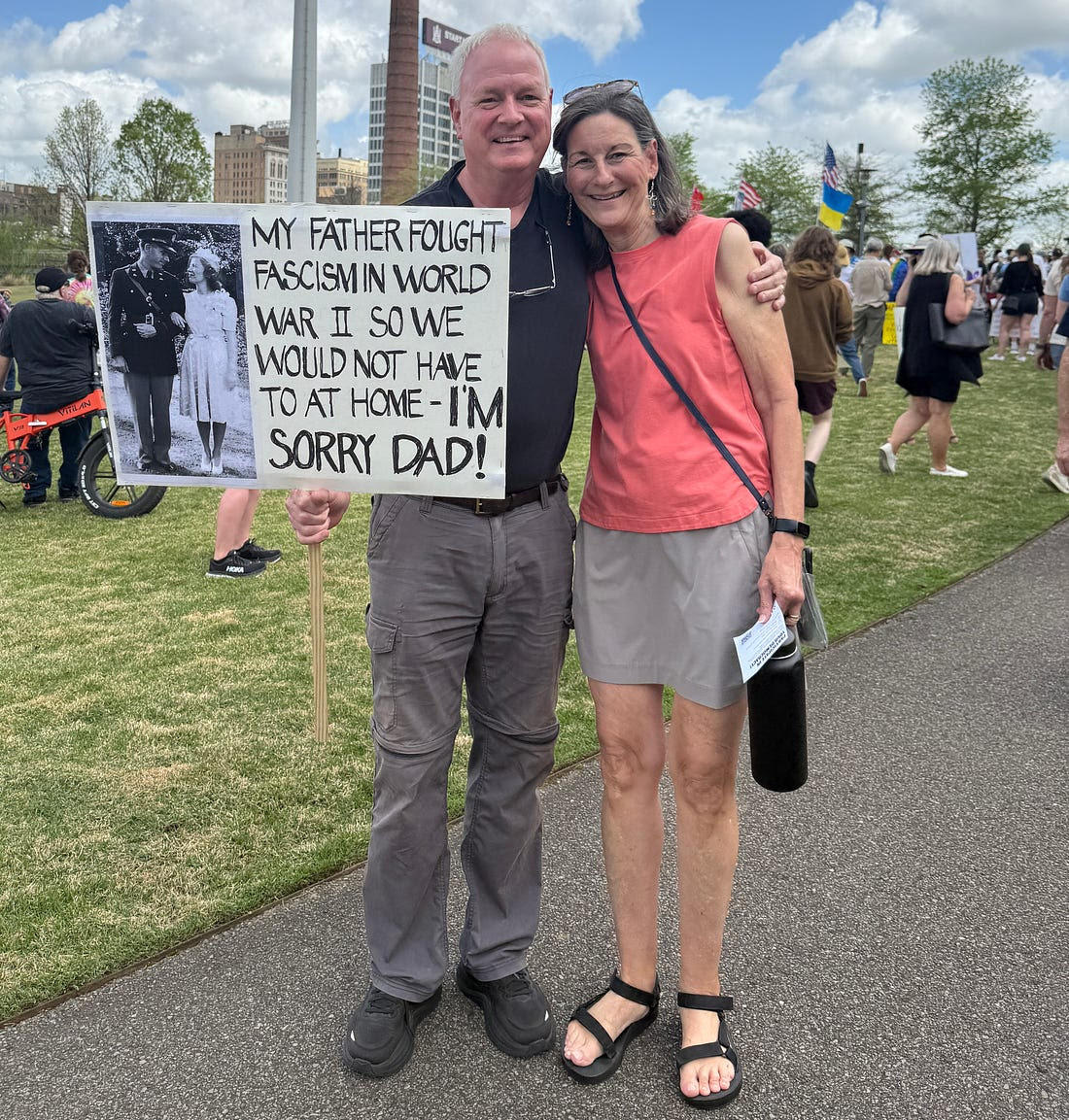
It was a crowd full of angry people. We are southerners, so we were polite about it as we visited with neighbors and made new friends, but the anger was palpable.
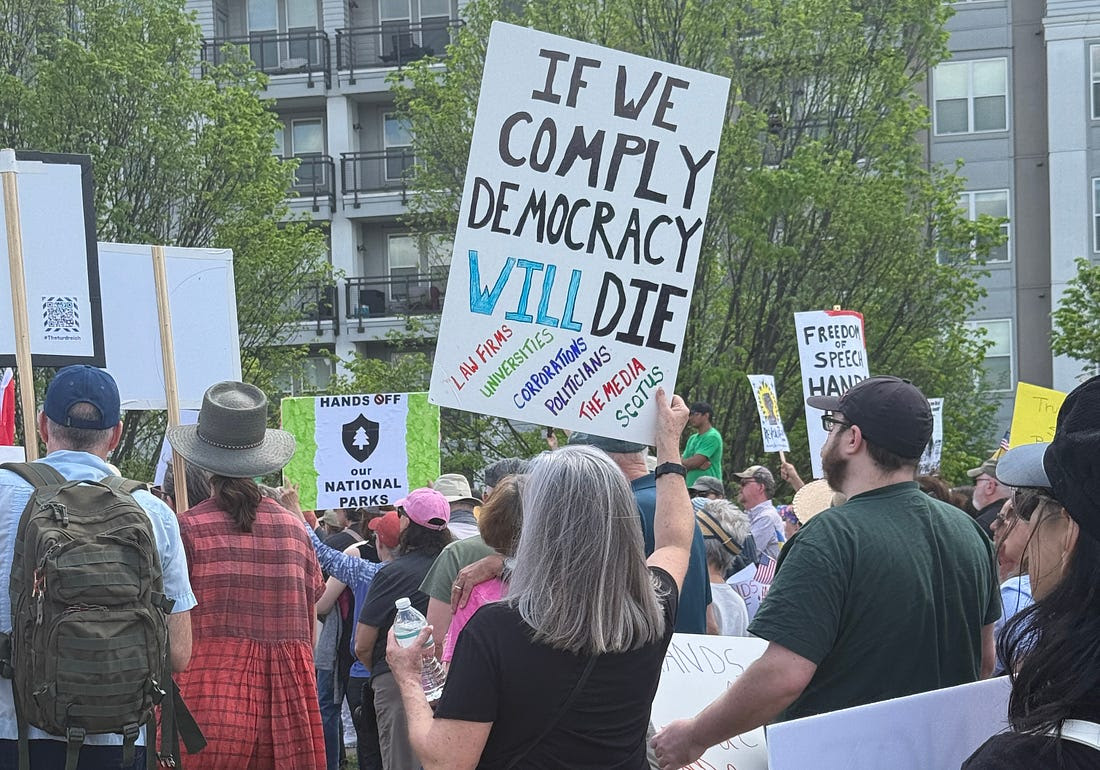
If Donald Trump thinks we’re going back quietly, he’s wrong.

I ran into not one, but two people wearing the fabulous re-SIS-tence tee-shirts from the Sisters in Law podcast.
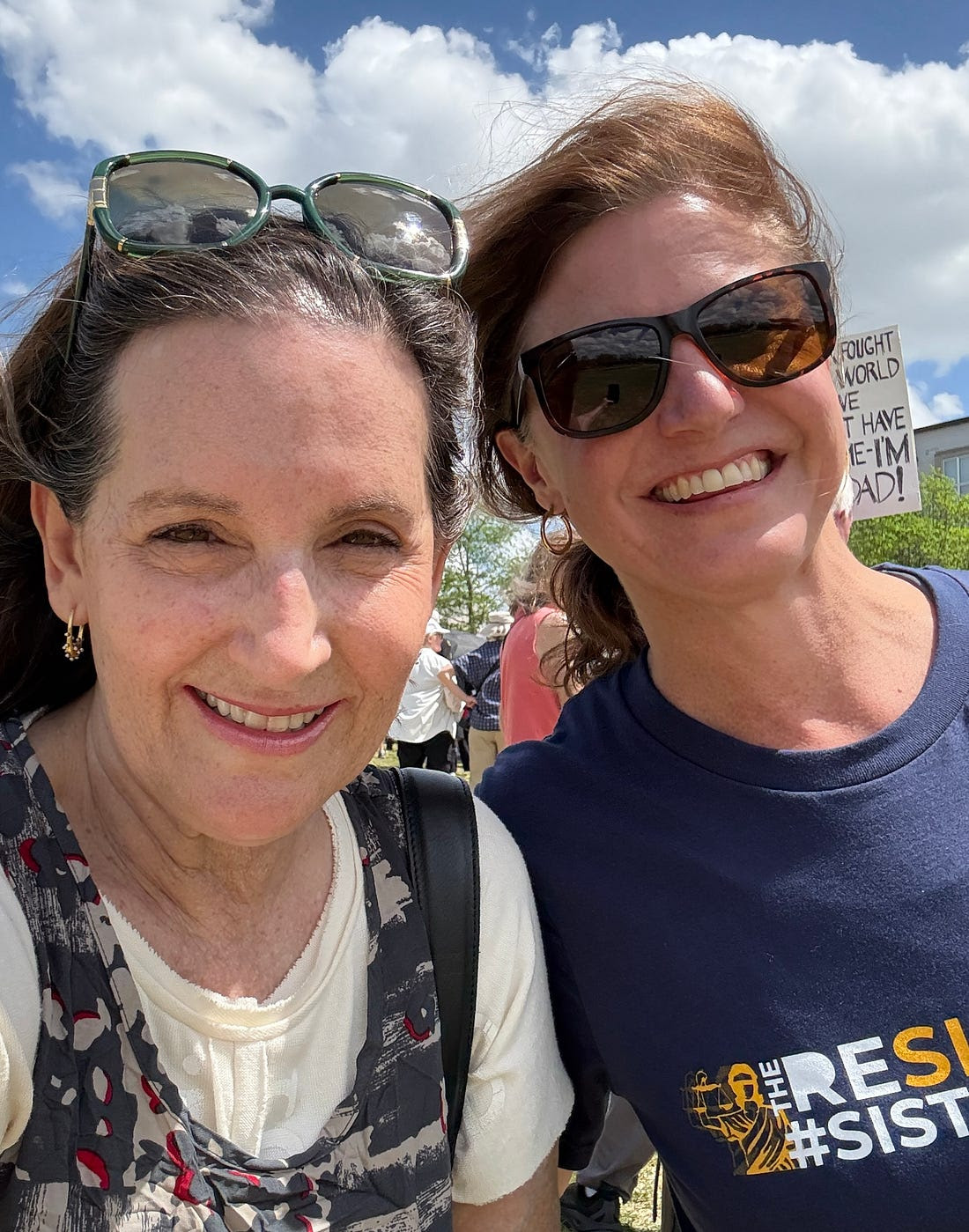
There were some seriously artistic people in the crowd.

It was a gorgeous day here and people enjoyed themselves, but it was also deadly serious.


Friends tagged in from across the country.

Americans understand what’s at stake.

And, from Chattanooga.


So many people referred to Cory Booker when they talked about why they were there, a reminder that our own acts can inspire other people to stand for democracy too. Booker told Aaron Parnas in an interview shortly after he finished his tremendous 25-hour filibuster on the Senate floor that we each have to be “little points of ignition” now. “Demanding more of ourselves,” that’s what Cory Booker says comes next. But for today, it was enough to march and to be with friends and fellow American.
Courage is contagious. Marching provides encouragement for people who aren’t in the thick of things in Washington or New York. Big protests, little protests, it’s all part of the great cacophony of democracy and a reminder that we still have rights and power, if we are willing to exercise them.
Today, Americans marched. We made it clear: We have no intention of sitting down and accepting the end of democracy.
If you marched today, tell us about it.
We’re in this together,
Joyce
AI and the future of literature.
A debate with Sam Khan.
Henry Oliver and Sam Kahn Feb 14
When Sam Kahn asked if I wanted to have a written debate about AI and literature (after my recent piece ‘Literary Culture Can’t Just Dismiss AI’) I immediately agreed. What a good idea!
We conducted the discussion over email for the last couple of weeks. As you’ll see, we don’t agree at all (though we do have some overlap), and so it was a very stimulating discussion. My thanks to Sam for suggesting this!
Sa: Hi
Henry: Nice to have this exchange!
We can start with AI, and start with the exchange we’ve already had, and branch out from there. I imagine the terrain we’ll really want to get to is the sort of moral obligation of literature to keep pace with the times (which is something that I certainly have mixed feelings about).
So — for readers joining us — the jumping off point for this is this fiery manifesto that the editors wrote up for The Metropolitan Review, in which we denounced AI (in addition to denouncing many other things). You wrote on your Substack that you liked the general idea of the publication but that something struck you as wilfully atavistic about our stance here. “But the most significant thing happening to writing and culture right now is Artificial Intelligence,” you wrote. “It is changing everything. Suddenly [by rejecting AI], they [The Metropolitan Review] are not racing to the future anymore.”So, first of all, I think of you as such a classicist that I was surprised to see you leap to AI’s defense! Do you want to lay out how you think the literary community should view AI and where there can be some sort of harmonious interaction between literature and whatever is coming out of AI?
All best!- Sam
Henry: Hello Sam,
Many thanks for suggesting this! I am always interested to have these discussions. Let me start by reiterating my enthusiasm for your attitude at The Metropolitan Review, which is not only one of opposition to the dreariness of much modern culture, but a willingness to do something new in response.
I will try and answer your question, but I want to fill in a few relevant points that come prior to what you asked.
I am a classicist in the sense that I promote the value of old books, but not, alas, in the sense that I can read Latin and Greek. So in the longer view, I am a modern. (Obviously, I venerate the ancients.) The old debates, from the time of Shakespeare and running through Swift and Johnson, were about the ancient classics versus the modern classics. It’s a debate we still have: traditional literature or modernism and its inheritors? Like Swift, I want to take an ambivalent position. I like both. I want both. I choose abundance. I love Shakespeare and Helen DeWitt.
One reason why we are able to have the luxury of this discussion is technology. Without the printing press, there would be no First Folio, no Paradise Lost. As John Pistelli so lucidly discussed (I would give my fingernails to be able to write like that), many other technologies, such as the typewriter, have been instrumental to the production of literature. Of course, yes, there would still be literature without these technologies, but not the same sort of literature.
Art is often the result of technology: Shakespeare and the indoor theatre, Hollywood and celluloid. The essence of poetry, said Samuel Johnon, is invention. He was describing the way poets found new ways to say old things, but he knew full well that in the modern world (the world of innovation in technology) that has meant new ways of saying new things as well. He saw the rise of the novel, which is still shifting and changing as a form.
The biggest change technology has inflicted upon literature was the invention of the radio. That produced a break with the past unlike anything else. Voices in the air! From there on, entertainment technology became an alternative to print: film, television, videogames, computers, the internet, social media, and smartphones. AI is the latest in that line. See Further Commentary and Articles arising from Books* and continued longer articles as noted in the blog for the complete transcript.
A guest post by Sam Kahn – Sam Kahn writes the Substack Castalia. Subscribe to Sam
| Henry Oliver from The Common Reader <commonreader@substack.com> U |
Rewind: Ted Kotcheff On Wake in Fright
With the release of the outback shocker The Royal Hotel this week, we revisit our interview with director Ted Kotcheff.
By Dov Kornits
38 years after he completed his masterpiece Wake in Fright, director Ted Kotcheff finally returned to Australia for the first time to present the restored classic at the Sydney Film Festival. He proudly confesses that his busy schedule could only allow for one trip in the first half of 2009, and instead of going to The Palais for the Cannes Classics presentation of the film, he instead chose to return to the scene of the crime. “There are two things about a film,” the surprisingly animated and enthusiastic 78-year-old starts. “There’s the film itself, and then there’s the whole experience of making it. I had the greatest time here. I really loved the Australian crew. They were young, enthusiastic, and unspoiled. Prop men helped the electricians move the lights; electricians helped the prop men move the furniture. You’d never find that in America or in England, where there are strict union lines. The crew here worked together, and they wanted to make the best film possible. There was this tremendous energy, and I adored them. I remember it with great fondness.”

The Canadian-born Kotcheff should know a thing or two about international film crews, having worked all around the globe on films as diverse as North Dallas Forty, First Blood and Weekend at Bernie’s. “I love the gypsy quality about directing,” he says. “I made a film in Israel [Billy Two Hats], I made a film in France [Who Is Killing The Great Chefs Of Europe?], and I made a film in Thailand [Uncommon Valor]. I love making films around the world. It’s the joy of being a director. That appealed to me about taking on Wake in Fright. I made this film called The Apprenticeship of Duddy Kravitz about a Jewish boy growing up in Montreal. Someone says to him, ‘Kravitz, why do you always run around like you’ve got a red hot poker up your ass?’ I’m always interested in characters that don’t know themselves, and in the process of the film discover the truth about themselves. That was the other quality about Wake in Fright that was so entrancing for me. There was this teacher who has no idea how he’s going to behave at extremis, and he finds that he is no different from all these people that he’s had total contempt for.”
It may seem strange today that Kotcheff got the gig of telling a distinctly Australian story, but this was 1970, before Australia’s New Wave, and around the same time that Brit Nicolas Roeg was shooting another Australian classic in Walkabout. “I made a film in London called Two Gentleman Sharing,” says Kotcheff by way of explaining how he became involved. “It was about the race situation in London in the sixties, and the script was written by a Jamaican named Evan Jones, who did a lot of Joseph Losey’s films. As a result of working together, we’d developed this friendship, and he said, ‘I’ve got this job adapting a book, and it’s written by an Australian called Kenneth Cook. It’s fabulous.’ He said that I’d love it, and that it was right up my alley.”

Wake in Fright quickly opened and closed without much fanfare in the US and, more disturbingly, Australia. In the US, it was re-cut and retitled Outback, and in Australia the powers that be thought that it wasn’t an image that they wanted to promote of the country. What’s worse, a print of Wake in Fright has been impossible to find for more than thirty years. It must be an amazing feeling for a director to have their film rediscovered after so many years in the wilderness. “Two things are amazing,” says Kotcheff. “Firstly, that the film is being re-released in Australia, but secondly that it was declared a Cannes Classic. In 1971, it was invited into the competition at Cannes. At the screening, there was a voice behind me that kept saying, ‘Wow, that’s great! What a sequence!’ When it came to the climax, he was going, ‘He’s gone all the way!’ When the lights went up, I realised that it was a lad about 23-years old. I went outside and asked the PR guys who it was. They said, ‘Oh, that’s a young American director who’s only done one film…his name’s Martin Scorsese.’ 38 years later, and who happens to be in charge of the classics department that chose Wake in Fright as a Cannes Classic? Martin Scorsese. He remembered my film after 38 years. I felt so great about that.”

A 2009 screening at Cannes and the Australian re-release would not have been possible if, as has been widely documented, the negatives of the film hadn’t been discovered in Pittsburgh USA, only weeks away from heading to the garbage dump. “I consider the film to be one of my finest achievements,” Kotcheff says. “Had those negatives been discovered two weeks later, they would have been burned. That would have been like a knife into my heart. I love that film,” gushes Kotcheff. “When you make a film, you’re always aiming for a hundred. Out of all the films that I’ve made, Wake In Fright comes closest to achieving almost the full hundred that I aimed for.”
This article appeared in FilmInk Magazine in 2009. Wake in Fright 4k Restoration is screening in cinemas on 20 March 2025
And, In Australia, the following sign as we walked to coffee this morning. As Joyce says, ‘We’re in this together’.

Queanbeyan’s Sleepbus is back from the brink 26 March 2025 | James Coleman

Queanbeyan Night Podz Service. Photo: Kelli Rixon.
The same charity that originally brought the ‘Sleepbus’ to Queanbeyan has swooped in at the last moment to save it from extinction.
Residents will know it as the big bus parked up by the town’s Visitor Information Centre on Farrer Street a few nights a week, designed to provide a safe place for locals experiencing homelessness.
Inside, it’s kitted out with 14 separate bed ‘pods’ (each with a mattress, pillows, sheets, blankets, USB charging, a lockable door and a television), two toilets, personal storage lockers, pet kennels, security and an intercom system.
It first rolled into town in March 2021 as one of several similar Sleepbuses around the country designed by Melbourne businessman Simon Rowe.
Mr Rowe had found himself homeless for several months at the age of 19 after his car’s engine unexpectedly blew up and he had to spend his rent money on repairs in order to keep his job. He started the charity so others didn’t have to go through the same experience.
The Terry Campese Foundation, founded by former Canberra Raiders captain Terry Campese (who grew up in Queanbeyan), is credited with bringing the Sleepbus to Queanbeyan after it united several local charities under a Queanbeyan Housing Action Collective (Q-HAC) and raised thousands of dollars to launch it.
Over the years, however, the bus has struggled to attract volunteer drivers or caretakers and dropped down to only run on Friday nights and weekends.
Earlier this year, Mr Rowe announced he was winding up the Sleepbus business due to financial issues.
“As many of you would know if you’ve followed me for any of this 10-year journey … we’ve really been struggling financially as a very small organisation for the past 18 months,” he said in a video shared to his Facebook page in January.
“It’s just become impossible and I don’t see any improvement coming in this 2025 … We’ve just run out of money and we can’t do this anymore.”
He said he would try to find local charities in each of the locations to “take ownership of the vehicles and get the services up and running” before the end date of 30 June 2025. He added he was “very confident” Queanbeyan’s bus could continue.
As of last Friday (21 March), the Sleepbus is back, now under the name of Queanbeyan Night Podz Service, run by the Terry Campese Foundation and open seven nights a week.
Long-time volunteer Kelli Rixon hopes the new approach will bring an end to its staffing issues and provide better outcomes for people experiencing homelessness.
“Sleepbus was run very separately from all the other local organisations – they were very standalone and didn’t really engage a whole lot with us,” she says.
“I think that’s probably part of the reason why it doesn’t succeed … So now it’s come back … owned by the local community. All those local services, like St Benedict’s Community Centre, are now wrapped around the service to provide support.
“Ideally, this service shouldn’t exist – it’s a bit of a stopgap to give them a safe place to sleep, but now it’s linked in with local services, these services will be able to get engaged early with guests and help provide them a pathway out of homelessness.”
The rest of the service remains largely the same, with the exception of the brighter, whiter bus.
“It’s fully air-conditioned for summer and heated for winter, which is obviously the important part, and there are toilets in each of the pods, so people don’t need to get off the bus during the night.”
Ms Rixon says the foundation is in talks with the Queanbeyan-Palerang Regional Council (QPRC) about a more permanent home for the bus.
“There’s just some work being done with council at the moment. The local bus company CDC Canberra have been super supportive of looking after the bus for us mechanically and accommodating it when it’s not in service, but they’re expanding and need more space, so we’re working with the council at the moment to get a permanent place where the bus can park.”
Sleepbus founder Simon Rowe at the arrival of the Queanbeyan Sleepbus in March 2021. Photo: Michael Weaver.
Volunteers from the foundation’s youth programs will also help staff it, but more are always welcome.
“Getting those shifts filled for seven nights a week is where we definitely want some more volunteers,” she says.
“We’ve definitely had a lot of interest in the last few weeks since we’ve had the changeover … with people putting their hand up and wanting to help out.”
Contact the Terry Campese Foundation if you’re interested in volunteering for the Queanbeyan Night Podz Service.

I really enjoy this site, and usually make plans to visit some of the locations suggested by the writers. Saffron Walron is a town we visited years ago (because it was mentioned as a location in a novel) but it sounds as though it is due for another visit.
This Charming Town In Essex Has Been Recognised As The Best Place To Live In The UK
London may have missed out on the crown, but it turn out the best place to live in the UK isn’t too far from our fair city.
Sam Barker – Staff Writer • 28 March, 2025

Recently, the Times released its annual list of the best places to live in 2025. Naturally, we initially honed in on the list and scoured it for mentions of areas in London. After all, we have to make some claim to London being among the best places to live in the UK. We’ve got a reputation to uphold over here! But the highest anywhere in London managed to rank was 11th position – which went to East London’s Walthamstow. Taking the top position, though, was Saffron Walden – making it officially the best place to live in the UK.
To create their list of the best places to live, The Times assessed places all over the country based on a variety of factors. They looked at everything from schools to transport, culture, and even broadband speed. And after combing through all the of the information, The Times decided that Saffron Walden in Essex is the cream of the crop.

Now, before you start complaining, I get it. We’re Secret London. Saffron Walden is in Essex. And Essex is not in London. (At least, not last time I checked…) But do you really think we’re not going to cover the reveal of the very best place to live in all of the UK? Of course not! Especially when it’s so damn charming and picturesque? Just look at it – this picture-perfect town looks like it could have been plucked straight from the front of a postcard! Plus, it’s not even that far from London.
Saffron Walden
So what is it about Saffron Walden that makes it such an aspirational place to live? The Times praised the area for combining “knockout historic looks with excellent state schools, a rich cultural offering and an exploding foodie scene that’s defying the Essex stereotypes one aperitif and spicy gordal olive at a time”.
Saffron Walden also boasts a convenient proximity to the countryside as well as Cambridge and London. It’s just 15 miles and 45 miles away from each place, respectively. And while newcomers to the area are bringing fresh ideas and businesses, tradition still holds on strong in the town. One example is the market, “which has been going strong since 1141 and is now held twice a week.”

If the name suggests anything, you’d think it would be a pretty pricey place to live! And it is, with an average property price of £607,100. But that’s clearly skewed by expensive properties in the area. After all, according to The Times, “Two-bedroom cottages in the medieval centre, many of which are listed, start at about £350,000”.
Join the free Open Iftar celebration in Trafalgar Square

Experience the vibrant community spirit of Ramadan at the Open Iftar event in Trafalgar Square. The event, hosted by the Ramadan Tent Project, will feature engaging speakers, prayers, and a communal meal to break the fast. When the sun sets, attendees will join together to break the day’s fast with a wonderful community experience. Everyone is welcome, regardless of faith, to join this joyful celebration of community, inclusivity and cultural exchange, which includes delicious food, prayers, spiritual reflection, engaging speakers and, no doubt, great conversations.

Looking to escape the hustle and bustle of London already? Surround yourself with the rolling green hills of England on one of the best country walks near London. From exploring the birthplace of the Magna Carta in Runnymede to hiking through the iconic Seven Sisters cliffs, these trails offer stunning landscapes, historical landmarks, and even cosy pubs to warm up in. Bundle up and enjoy Instagrammable views, wildlife sightings, and peaceful countryside vibes.
Henry Oliver: The common Reader
Does Jane Austen undermine her own endings? No. No she does not.
An unconvincing new study.
So says Henry Oliver, who produces an Austen Book club on zoom for paid subscribers. See below:
Henry Oliver Apr 4∙ Preview READ IN APP The next Austen book club is this Sunday, 19.00 UK time. The zoom link is sent to paid subscribers over the weekend. Upgrade to paid.
I choose not to upgrade to paid – for a start, I am not convinced by the review below:
Because this is the year of Jane Austen’s anniversary—two hundred and fifty years since her birth—we are being treated to several new books about her work. I shall not review all of them, but some of the more promising critical options will be covered here for paid subscribers. This is a review of Jane Austen and the Price of Happiness by Inger Brodey, a book which I thought was quite poorly argued.
The first part is free. To read the rest, and to read all my work about Austen such as whether Jane Austen hates you, Mr. Bennet’s not-so-bad parenting, or why Lizzie Bennett will never be poor, become a paid subscriber. You’ll be able to come to the book clubs (Austen and Shakespeare), as well as read through the archives about Victorian novels, Shakespeare’s plays, and my irregular review of reviews, along with all the other things I write.
Why do Jane Austen’s novels end the way they do? No wedding ceremony, no profusions of romance, no sunset scenes. A new book this year, Jane Austen and the Price of Happiness, argues that Austen’s endings subtly undermine the idea of marriage. Inger Brodey argues that Austen’s endings are “artificial”. It is the arrival of poultry thieves that prompt Mr. Wodehouse to give Emma permission to marry Mr. Knightly. A mysterious viscount appears at the end of Northanger Abbey, allowing a resolution. I shan’t give more example, for fear of spoiling the plots. But Brodey argues there are many “sudden resolutions” which feel “artificial, gratuitous, and anti-romantic.”
This is, of course, the Austen we want. Critics often go hunting for a feminist Austen and are often able to fashion one. Brodey has no qualms about telling us, based on a single rather thin quote in a letter, that “Austen clearly feared the loss of time and independence involved in marriage.” In fact, we know no such thing. The general critical point that Austen not only promoted the happy ending of marriage but also challenged its conventions and strictures is over-stated. You can present marriage in the ambivalent terms which Austen often does (how few of her marriage couples of set a shining example, other than the Crofts?) without that being a means of challenging the institution.
When you are steeped in the jargon and tropes of modern criticism, it is easy to see these ideas in Jane Austen: when you look at her in her own time, on her own terms, the challenge she presents to marriage seems much less theoretical and absolute. …
My perspective differs from that of Henry Oliver and is more in tune with Inger Brody’s the ideas. It appears below. JANE AUSTEN: WAS SHE A TROUBLESOME WRITER? was first published in the Women’s History Network Blog, March 22, 2016.
JANE AUSTEN: WAS SHE A TROUBLESOME WRITER?
Jane Austen, was indeed, a troublesome writer. Troublesome for whom? Although the historical context in which she wrote has some relevance, Austen is often troublesome in a way that reflects feminist writing since the 1970s. She is quintessentially an observer of her society. She asks difficult questions about what she observes and produces confronting writing based on them. Most confronting to her contemporaries and later are those she asks about the nature of marriage and its economic significance for women. In turn, the answers raised questions about women’s position. Austen was a social observer who, by interposing herself between the reader and the narrative, used her authorial voice to emphasise particular points or debates about discrimination against women.
Austen’s novels establish a template for the writer who seems to conform, but in reality challenges the society in which she writes. Although her fictional accounts are the most telling, with their carefully crafted narratives and characters which embrace her observations Austen’s (Jane Austen’s Letters, 1995) and biographies provide additional evidence of the purposely troublesome nature of her work.
Gilbert and Gunbar’s suggestion that Austen used her characters’ dilemmas to explore her own problems (The Madwoman in the Attic, pp.154-155) raises the question of the links between writers’ lives and their fiction. The answer can only be speculative. Writers’ non-fictional accounts are, like their fiction, often written for the public gaze. Austen’s letters were written for a wider audience than the acknowledged recipient and many of her presumably more confidential letters were destroyed.
Austen’s contribution to the study of marriage and economics and what it means for women is impressive. The questions she raises demonstrate that whatever the constraints, she is at heart an uncompromising woman against and within the society in which she wrote, her portrayal of women characters being influenced, but not controlled, by the cultural and social context. While writing in a landscape that included political writers such as Mary Wollstonecraft, Austen did not overtly join their cause on behalf of women. Nonetheless, her clear-eyed observation of her society is apparent through her letters, and in her fictional accounts she brings her observations to a larger audience in a more accessible form. Park Honan’s biography, Jane Austen Her Life (1997) provides an explanation of Austen’s ability to defy convention, however genteelly. Through Honan’s synthesis Austen naturally emerges as an unconventional woman whose public persona often belied that description. Honan’s work complements the representation of Austen who has been reassessed by commentators such as Gilbert and Guber (The Madwoman in the Attic, 1984).
Although she could be expected to approach feminism with more caution than writers from the 1970s and later, to suggest that Austen did not respond to feminist non-fiction writers such as Wollstonecraft, would be to ignore an important part of the cultural landscape of the 1800s and a writer’s sensitivity to her environment. However, the extent to which this influence can be detected in simple terms is limited. After all, in the 2000s many of Austen’s women characters would be seen as little more than irksome. However, it is rare that they do not have a powerful impact on their fictional environment and other characters. Most importantly, they provide Austen’s readers with alternative views of marriage. Women as diverse as Marianne (Sense and Sensibility, 1811), Elizabeth Bennett (Pride and Prejudice, 1813), Maria Bertram and Mary Crawford (Mansfield Park, 1814), Anne Elliot and Mary Musgrove (Persuasion, 1818) and Lady Susan (Lady Susan, 1871) [1] all undermine fairy tale images of marriage.
Although recognising that all authors are subject to a variety of understandings the commentary on Austen arises in part from her gender. It is certainly her gender that has rendered descriptions of her as “a nasty old maid”, suggesting that her depictions of marriage in particular have offended. The subversive nature of Austen’s cynicism also denotes her as troublesome. One commentator considered her cynicism so radical he called Austen “the most merciless, though calmest, of iconoclasts” (Quoted in Johnson, p.49). Despite these clear indications of the challenges presented by Austen her reputation at the time was unsullied. Sales of her novels suggest that they were popular and they were widely considered suitable reading.
[1] These publication dates refer to the first publication of each of the novels. Northanger Abbey and Persuasion were published posthumously in 1818. James Edward Austen-Leigh published Lady Susan, The Watsons and Sanditon in the second edition of his Memoir of Jane Austen in 1871.
Part 2 appears at Further Commentary and Articles arising from Books* and continued longer articles as noted in the blog.

 Robin's Room