Alafair Burke The Note Faber and Faber, April 2025.
Thank you, Net Galley, for providing me with this uncorrected proof for review.
Alafair Burke always creates an absorbing story with logical twists and turns that, rather than arising unexpectedly and having little to do with the plot, always make sense. This does not mean that they do not surprise, but that Burke always develops her plot well, with minute clues along the way, good character development, and a narrative that is engaging. The early slow burn in The Note is an excellent way to develop the characters, relationships, and possibilities when three women get together on a holiday break that has taken years to accomplish.
Lauren, Kelsey, and May met at a music camp, where Lauren was a counsellor and the other two twelve-year-old students. Over time their friendship has developed, and their diverse backgrounds, age and eventual professions are subsumed under the shared companionable jokes and puzzle solving.
The relationship between the three women is realistic, various flaws are apparent in each of them, past resentments colour their current behaviour and attitudes, and when a joke becomes a police matter, suspicions abound. At the same time, Alafair Burke’s depiction of the women’s friendship also demonstrates that despite some failures, strong links bind them together. These are at risk of fracture as past deaths and an investigation into a missing man gain momentum. See Books: Reviews for the complete review.
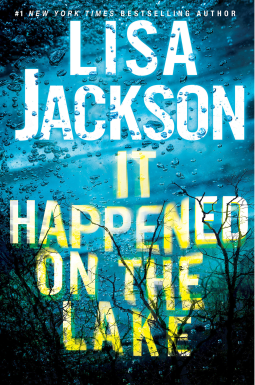
Lisa Jackson It Happened on the Lake Kensington Publishing|Kensington, June 2025.
Thank you, NetGalley, for providing me with this uncorrected proof for review.
It Happened on the Lake follows the well-worn theme of a woman returning to her inheritance and secrets from the past being canvassed anew. There is a cast of unpleasant characters, and even Harper, the main protagonist, is not exempt. Several deaths or disappearances have taken place in the past, and Harper has been in the vicinity of each. In the present she is again a spectator at a gruesome death. Men from her past make contact, one in his capacity as a police officer, another as a possible contractor to bring the huge house Harper has inherited to a standard for selling. That is, if Haper succumbs to the pushiness of her real estate friend, or is she a friend?
Initially I felt that Lisa Jackson had done far more with this theme and cast than had been done in similar novels. Certainly, the mysteries and tension came thick and fast. No character seemed exempt from suspicion, and the threads from the past seemed worth following to a conclusion. However, the pace of the book slowed markedly and Harper’s ruminations, the back stories of her friends and the investigation of the current death became almost tedious. See Books: Reviews for the complete review.
Australian Politics
Leadership ballots have been completed, and the Liberal Party has chosen Sussan Ley, the Greens have chosen Larissa Waters, and the National Party retained its leader, David Littleproud. The Liberal Party and National Party met to decide on the form their historical coalition, by secret agreement, would take. This is the usual process after an election, the open part of the process being how many ministries/shadow ministries each party will have as part of the agreement. The latest news is that the National Party will have none – no agreement was reached by the parties.
Channel 7 – Teal candidate Nicolette Boele provisionally wins Sydney seat of Bradfield in federal election
But there is still one more roadblock to bypass before she can pop the champagne.
Teal candidate Nicolette Boele has provisionally claimed the Sydney seat of Bradfield by a wafer-thin margin, with a recount now on the cards.
Boele finished ahead of Liberal Party candidate Gisele Kapterian by 39 votes following the latest round of ballot counting on Monday, figures from the Australian Electoral Commission (AEC) show.
Given it was so close, ABC election guru Antony Green flagged a re-count.
“Boele has won by 40 votes based on an indicative preference count, not a full distribution of preferences,” he said.
“The full distribution will now begin and will take about a week.”
If the margin between the two candidates remains fewer than 100 votes once this process is finished, polling staff will take a fresh look at the ballots.
“It now looks like the result in Bradfield will come down to just a few dozen votes out of around 120,000,” Boele said.
“There may be a recount and I await the final declaration from the AEC.
“This has been a nail-biting couple of weeks for our volunteers and I’m sure for Gisele Kapterian and her team as well.
“No matter the final result, our community has sent a powerful message to the major parties: ‘We are not the safe seat we used to be.’
Bradfield was previously called by some for the Liberals, but the result swung back into the balance by a surge in absent and postal votes that went Boele’s way.
Boele narrowly lost the same seat to Liberal Paul Fletcher in 2022, but he did not contest it in 2025 after retiring from federal politics.
If Boele does hold on this time around, she will become the 10th independent in the lower house.
Labor currently holds 93 of 150 seats in the House of Representatives, while the Coalition has 43.
The Greens have one and other minor parties have two seats.
The Victorian seat of Calwell remains in doubt.*
*My resident expert says that Labor will have 94 seats.
American Politics
May 18, 2025
Joyce Vance
As we head into the coming week, a reminder: Trump is less inevitable than he tries to make it seem. Last week, he lost part of his cheering section when right wing podcasters Ben Shapiro and Laura Loomer each came out against his plan to accept a (second hand) Air Force One from Qatar. Then, five Republican Congressmen voted against his budget bill in committee, blocking it from advancing. Republicans Andrew Clyde of Georgia, Chip Roy of Texas, Josh Brecheen of Oklahoma, Ralph Norman of South Carolina, and Lloyd Smucker of Pennsylvania told Trump “no” in an embarrassingly public way.
Sometimes, it’s important to not lose sight of the facts. The facts are that despite his election to the presidency, Donald Trump is a convicted felon. Two federal cases, each bringing serious charges that were voted forward by a grand jury, were dismissed, but only because Trump won the election. A fourth case in Georgia is on hold.
That takes us today, Sunday, May 18, which is E. Jean Carroll Day, the anniversary of the first of two verdicts Carroll obtained against Trump in defamation cases. Carroll wrote in a book that Trump sexually assaulted her in a New York City department store dressing room. Trump called her a liar, and she sued, winning verdicts against him in not one, but two cases.
On this day in 2023, a jury found Trump liable for sexually abusing Carroll when it returned a verdict in the defamation case. Trump was ordered to pay $5 million in damages. Because it was a civil case, the finding of sexual abuse had only to be supported by the preponderance of the evidence, not guilt beyond a reasonable doubt, the standard in a criminal case. The verdict was for sexual abuse, not rape. New York used an old-fashioned definition that limited rape to forcible penetration by a penis, as opposed to more modern definitions of the crime that are more expansive. In July 2023, Judge Lewis Kaplan said this equated with the common definition of rape today.
Trump doesn’t always win.
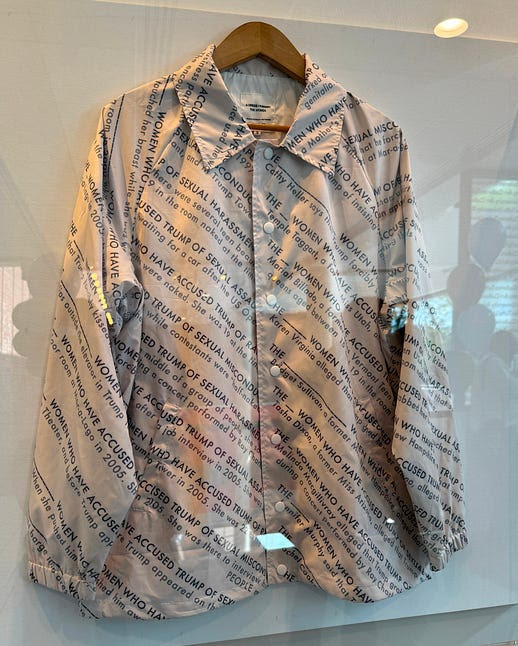
At my daughter’s graduation today, in an auditorium inside of an art gallery on campus, this amazing piece of wearable art, a jacket. was on display.
This is the entire piece.
The story behind the artwork.
So, when you see stories like the one about Stephen Miller saying that suspending habeas corpus is under serious consideration, don’t accept it as a done deal. It’s a ridiculous, anti-constitutional suggestion from someone who isn’t a lawyer. His idea that the writ can be “suspended in a time of invasion” skips a couple of steps, including who is doing the invading and precisely who can no longer seek the writ—even if there was an invasion of gang members running across the border on Trump’s watch, that would hardly justify suspending habeas for the people who use it the most, prisoners in custody in federal and state prisons.
Trump’s plans success isn’t inevitable, and while taking Trump’s intent to damage if not destroy the rule of law seriously, we shouldn’t hesitate to dismiss some of the ideas his people float for what they are—ridiculous.
Thanks for being here with me at Civil Discourse. The coming weeks are going to be critical ones. Please leave your comments, any questions for me, or ideas for people you’d like to have join us for Substack Live, in the comments.
We’re in this together,
Joyce
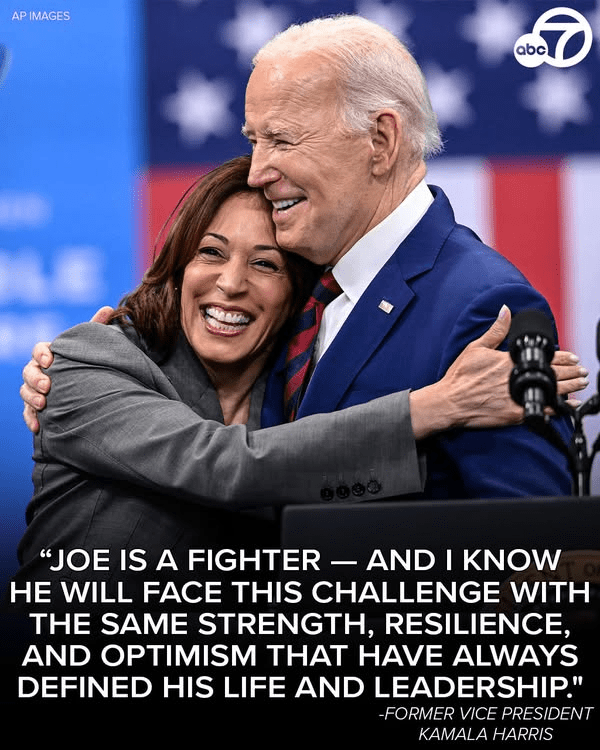
Former Vice Pres. Harris posted on social media that she and her husband are keeping Pres. Biden and his family in their prayers following his cancer diagnosis.
Raw Story
Supreme Court justice’s stunning premonition of Trump era: ‘How Roman Republic fell’
Story by Krystina Alarcon Carroll
Long before President Donald Trump ran for his first term in office, conservative Supreme Court Justice David Souter appeared to glimpse the future in a stunning warning of how democracy could die.
The judge, who retired from the High Court in 2009, died last week at the age of 85. However, His 2012 comments were recalled in a New York Times column Monday by Adam Liptak.
“One person will come forward and say, ‘Give me total power, and I will solve this problem,’” Souter said while speaking at an open forum at a New Hampshire Arts Center.
Liptak said Souter was usually the opposite of excitable, but when asked, “What should schools be doing to produce civically engaged students?” The Judge grew “animated.”
He recalled his own high school days, saying, “There were two required civics courses. When we got out of high school, we may not have known a lot, but we at least had a basic understanding of the structure of American government.”
“I’ll start with the bottom line,” Souter said. “I don’t believe there is any problem of American politics and American public life which is more significant today than the pervasive civic ignorance of the Constitution of the United States and the structure of government.”
According to Liptak, “Souter said he was worried that public ignorance about how the American government works would allow an authoritarian leader to emerge and claim total power.”
“That is the way democracy dies,” Souter said. “An ignorant people can never remain a free people. Democracy cannot survive too much ignorance.”
“That is how the Roman Republic fell,” he added.
Liptak noted, “Augustus became an autocratic emperor by promising to restore old values.”
Justice Souter warned, “The day will come when somebody will come forward, and we, and the government will, in effect, say: ‘Take the ball and run with it. Do what you have to do.’”
The remarks, from 2012, were made during an hour-long interview with Margaret Warner of “PBS NewsHour.”
What Trump has changed
By Jess Bidgood
President Trump barreled back into office intent on using his second term to exercise raw political power and transform the country in his image.
It’s been four months, and he already has.
In a presidential opening act more aggressive and polarizing than anything the nation has seen before, Trump has set off a barrage of changes that have left hardly any aspect of American life untouched: the economy, the nation’s place in the world, its systems of gaining and building knowledge and, of course, the government itself. It’s been a shock-and-awe campaign that has surprised his allies and staunch critics alike.
It is chaotic and often hard to follow, and that’s by design. Trump and his advisers have managed to flood the zone, intentionally overwhelming political opponents who are still grasping for a message and a means with which to fight back. It can seem like only the stock market has done so with much success.
Whether you are delighted by or aghast at what the president has been up to, the shock of his first 100 days may be wearing off. (His approval numbers have slipped overall, too.) So let’s consider what we’ve learned so far.
1. Trump has upended the global order and America’s alliances. The president has openly dabbled with imperialism, suggesting the nation acquire Canada, Greenland and the Panama Canal. But his impact on foreign policy goes much further. He has pursued a foreign policy based purely on power, casting longtime allies to the side in favor of muscular dealings with the likes of Russia and China. On that basis, Europe is a nuisance and even a close ally like Israel can be reduced to an afterthought.
2. He’s testing the limits of the law. The administration has repeatedly resisted court orders — including one order, endorsed by the Supreme Court, that the government take steps to return a wrongly deported man — while Trump himself has attacked judges who have ruled against him. With the Republican-controlled Congress offering little oversight and refraining from exerting its constitutional checks on his power, some legal scholars are already warning of a constitutional crisis. What’s clear is that the administration is testing the most basic principles of the separation of powers.
3. He’s exerting his influence across society. Law firms. Universities. Scientific research. Media companies. Diversity, equity and inclusion policies. Trump has used executive orders, the deportation of international students, lawsuits and funding cuts to impose his agenda on a broad swath of American institutions — many of which have given in to his demands so readily that critics are increasingly sounding the alarm about a slide toward autocracy.
4. He’s turned fear into a tool. Trump promised a surge in deportations that has not yet materialized, but his jettisoning of due-process rights for immigrants and use of unrelated government data against them have spread fear in immigrant communities, among their employers and even their children. Trump and his allies have also stoked fear of prosecution or retaliation to silence his critics inside and outside government.
5. He’s profiting from being president. Many presidents cash in after they leave office. But Trump’s businesses are openly profiting off his brand, striking deals overseas and rewarding some buyers of his family’s cryptocurrency with a private dinner and a tour of the White House. And then there’s that luxury plane from Qatar, a remarkable illustration of how this president feels unencumbered by the longstanding norm against accepting foreign gifts.
Special Correspondent Perth to Canberra
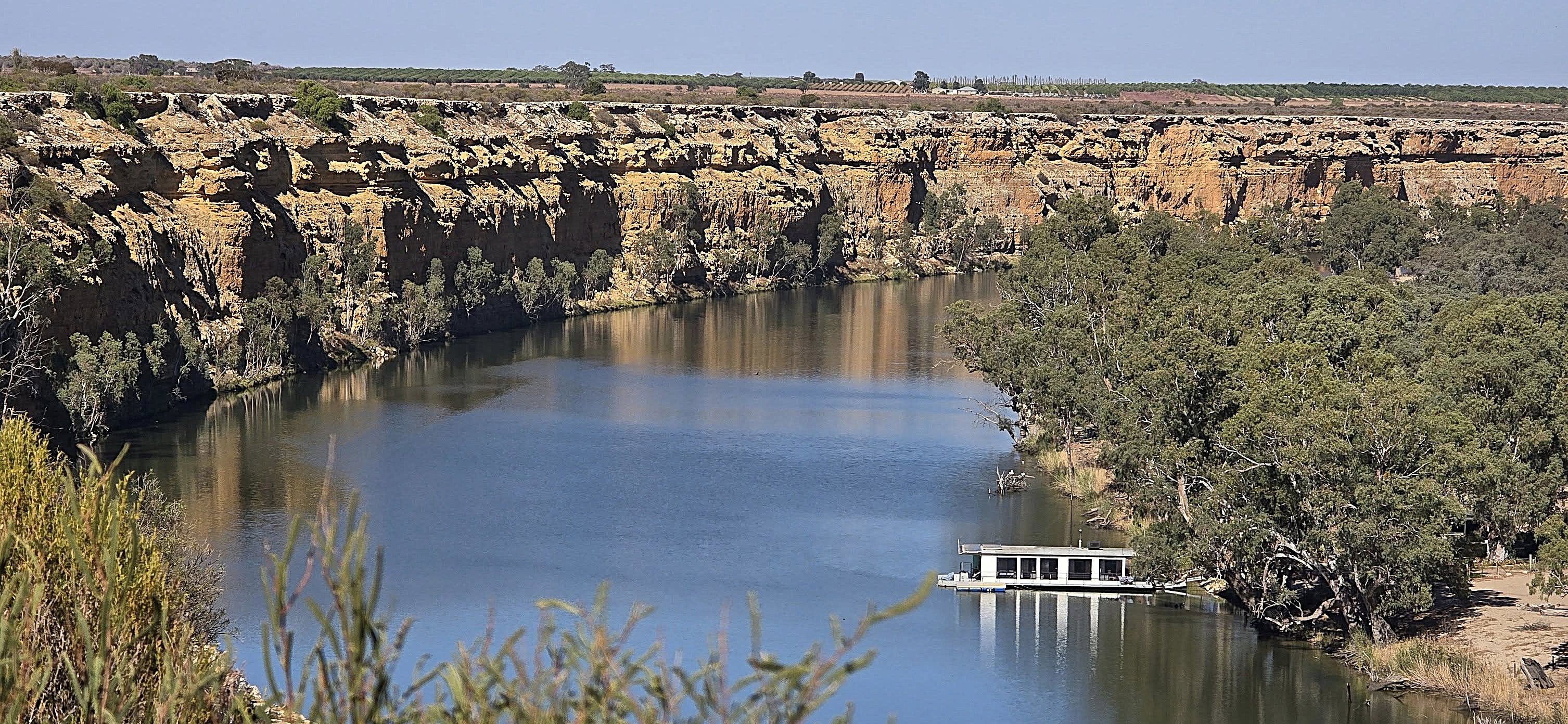
Back on the Murray
Canberra weather is cold, cold, cold …but we have the autumn colours












 Robin's Room