
Kerrie Davies Miles Franklin Undercover The little-known years when she created her own brilliant career Allen & Unwin, November 2025.
Thank you, NetGalley, for providing me with this uncorrected proof for review.
I thoroughly enjoyed reading this work but was constantly wanting to be reassured about where elements of accuracy and imagination lay. As always must be the case with biographies when the subject or circumstances contrive to preserve some privacy, speculation is a legitimate tool. One of the most interesting facets of reading about events that cannot be authenticated is following the author’s acknowledgment of this and their process for composing conclusions. All biographies must include elements of speculation and imagination, after all, conversations are not always recorded – and how influenced by such recording and therefore questionably authentic are these – and thoughts can only be developed in the author’s imagination, and I would have liked to see more recognition and discussion of this aspect of the work. However, the acknowledgements and bibliography, together with notes for each chapter, were useful as were references to the value of the unpublished manuscript about Franklin’s domestic work. Also, Davies’ generous recognition of Miles Franklin’s other biographers and work on her topic is valuable. see Books: Reviews for the complete review.
Friday essay: Miles Franklin’s other brilliant career – her year as an undercover servant*
Story by Kerrie Davies, UNSW Sydney
In the Miles Franklin archive in the State Library of New South Wales there are two brown, cloth-bound volumes, titled, “When I was Mary-Anne, A Slavey”. The thick, handwritten pages are amended with glued paper inserts copied from the missing diary the author of My Brilliant Career kept for roughly a year between April 1903 and April 1904.
In an accompanying summary, on which Franklin based her 1904 letter to the Bulletin about the experience, she wrote:
Some people wonder what domestic servants have to complain about […] No one could understand the depth of the silent feud between mistress and maid without, in their own person, testing the matter …
There is a picture of Franklin in the archive too, dressed in her “get up”: a black-and-white tunic and apron, with a lacy parlour cap pinned atop her piled-up brunette hair. The photograph, taken in a studio in Melbourne, is captioned “yr little mary-anne”. She beckons you into her impersonation.9 min readAlong with the letters Franklin wrote or received during the year, the summary and photo authenticate her little known upstairs–downstairs experiment in Sydney and Melbourne, which she details in the manuscript. She cooked in flammable kitchens, plunged her hands into steaming washing up, and swept the dust that scattered behind her employers’ shoes.
In today’s Instagram culture, it is improbable that a celebrity like Franklin could work incognito and not be recognised. But this was the Edwardian era of the early 1900s, when a photograph was a special occasion and names were known more widely than faces. Franklin loved that a lady she’d once met at a government reception unknowingly flung her coat at her when she opened the door, and that she stoked the fire while guests discussed My Brilliant Career.
Bronte of the bush
Aged 21, Franklin dazzled Australia with her debut novel. Published in 1901, My Brilliant Career inspired young women to write to her about their own frustrations and dreams. She denied her novel was autobiographical, to little effect. She was compared to novelist Charlotte Bronte and to Marie Bashkirtseff, the Russian–Parisian teen artist who declared in her memoir, “I am my own heroine”.
Despite Franklin’s later fervent wish that My Brilliant Career’s heroine, Sybylla Melvyn, would be forgotten, the book endured. It became a feminist literary classic, and in 1979 a film, produced by Margaret Fink and directed by Gillian Armstrong. Today, her cultural touchstone continues with her bequest of the Miles Franklin Literary Award and recent stage adaptations of My Brilliant Career. The Stella literary prize is named in her honour, after her first given name, Stella Maria Sarah Miles Franklin.
Franklin’s iconic success is, however, misleading. Like many authors, she experienced fame and acclaim, but minimal royalties, in part due to an unfair contract for colonial authors with her Edinburgh publisher, William Blackwood and Sons. Books were also a luxury during the punishing Federation drought, which lasted from 1895 to 1902.
Franklin could have married. Her grandmother took every opportunity to remind her she was expected to wed. “Have you found anyone you like better than yourself?” she archly asked.
Instead, she disappeared into undercover journalism.
Stunt girl reporters
Franklin was likely inspired by the “gonzo” women journalists known as “girl stunt reporters”, who disrupted male-dominated journalism in the late 19th and early 20th centuries.
To prove their journalistic chops, they risked their safety and health to go undercover and expose factory exploitation and illegal abortion clinics. Most famously, New York reporter Nellie Bly feigned hysteria to gain admission to the city’s public women’s mental health institution for ten days in 1887. Their stories captivated audiences, as much as their daring.
American journalist Elizabeth Banks transported the trend to London, where she worked as a servant, leaving her poodle, Judge, with a friend. Her reports in “In Cap and Apron” for the Weekly Sun caused a sensation, and Banks’ memoir Autobiography of a Newspaper Girl was reviewed in Australia in late 1902 and early 1903.
Apart from Catherine Hay Thomson’s investigation of Kew Asylum and Melbourne Hospital in 1886, the “stunt girl reporter” only noticeably appeared in Australia in 1903.
That year, the fledgling New Idea magazine published a series of undercover articles, including about experiences such as working in a tobacco factory and applying for domestic service at an employment agency. Unlike Franklin, the New Idea journalist stopped there, while Franklin spent a full, gruelling year as a servant.
The “servant question” was an ideal local investigation. The newly federated Australia was growing due to the wool industry – “on the sheep’s back”. But in the cities, factories were an alternative engine for young women’s employment rather than domestic service. Fretting “mistresses” complained about the dearth of remaining girls available.
That year, the fledgling New Idea magazine published a series of undercover articles, including about experiences such as working in a tobacco factory and applying for domestic service at an employment agency. Unlike Franklin, the New Idea journalist stopped there, while Franklin spent a full, gruelling year as a servant.
The “servant question” was an ideal local investigation. The newly federated Australia was growing due to the wool industry – “on the sheep’s back”. But in the cities, factories were an alternative engine for young women’s employment rather than domestic service. Fretting “mistresses” complained about the dearth of remaining girls available.
Servants retorted that if they were treated better, perhaps they would stay. One suggested scandalously that mistresses should give references about how they treat servants to prospective hires, pre-dating contemporary suggestions that owners and agencies should prove their fitness as landlords to tenants.
The debate around “the servant question” exposed Australia’s myth of equality. Franklin’s family was no exception. While drought drove her parents off their farm, Stillwater, to a plot in Penrith (then a rural town outside Sydney), they were cultured and educated. Franklin’s wealthy grandmother ran a station in the Snowy Mountains, on which Franklin based the elegant homestead, Caddagat, in My Brilliant Career. A governess or nurse was acceptable, she wrote in her accompanying summary to her manuscript, but “a servant raised considerable horror among my circle”.
Franklin was undeterred. As well as a new writing project, she needed money and a roof if she wanted to live in the city rather than at home. Suffragette Rose Scott, who called Franklin her “spirit child”, invited her to stay. But while Franklin appreciated the support, at times Rose was suffocating.
Revealing the independent streak that would define her life, Franklin wrote, “it was imperative I get work to sustain myself”.
‘This suppression!’
Franklin’s real servant pseudonym was “Sarah Frankling”, a play on her middle name and her surname. “Mary-Anne”, at the time a well known slang name for servants, was only used for the manuscript, to hide identities.
Franklin’s live-in domestic servant positions included kitchen maid, parlour maid and “general” servant. She worked in a terrace she dubbed a “cubby house”, an upmarket boarding house, a harbourside villa, a wealthy merchant home, and mansions in Sydney and Melbourne. Franklin stayed a maximum of two months at each post for a year in total, after which she planned to write.
In the manuscript, Franklin recounts that she rapidly lost weight and felt her spirit become “suppressed” by the monotony and tiring nature of servant work. Depending on the number of staff and her duties, she hand-rolled heavy, wet clothes through a washing mangle; served pre-breakfast tea and toast in bed, which she thought was an obscene indulgence; cooked and served full hot breakfasts and dinners daily; waited on guests in the boarding house’s dining room, nicknamed “the zoo”; cleaned the guest rooms and parlours; and helped at high-society balls. She kept fires burning in winter and sweated through heavy housework and cooking in summer.
The hours were brutal. She usually woke at dawn, and only finished after the evening dinners were served, or if she was a kitchen maid, after she cleaned the mess away. Not all her employers offered a luxurious whole afternoon off per week. She worked through burns sustained on the job, and was brought to tears by a mistress who ordered her to change her carefully arranged hair. The house’s Irish cook opined that the mistress was threatened by Franklin’s “toy figure” and “fairy face”.
As the months passed at different employers, fatigue turned to anger, and loneliness to friendships with fellow servants. It is heartening to see a snobby young Franklin mature and change as she rubbed tired elbows with those she previously saw as beneath her status. She cheekily flirted with a lovestruck tradie, just as she traded Shakespearian quips with an intrigued young naval officer staying at the posh boarding house.
When Scott learned Franklin was working as a servant, she chided her for not refusing the conditions as an example to others. However, Franklin knew any insolence or objection meant instant dismissal, ruining her research and current livelihood.
Scott also misread Franklin’s long-term goal – writing the servant book. In her diary, Franklin recorded what she could not say out loud. She cynically noted that “to be sensitive would be unfortunate” for a servant. “The maid must not want for pleasure,” Franklin warned, “because she will have no time to gratify it”. Be presentable but not too pretty, she advised; be polite but not so fancy or fussy to refuse tiny, “ill-aired” servant quarters next to the laundry.
The servant year confirmed her lifelong views of marriage as stifling. Echoing My Brilliant Career, Franklin vented her feminist frustration in the diary entries. She wrote of the terrace’s “Mistress”: “sooth, when a woman of ordinary intelligence gives the whole of her time, brain and energy to the running of a miniature establishment”.
As for the husband, an irritated Franklin wrote that he was “boss of his own backyard and lord of his little suburban dining room”.
Biographers brush over servant year
Biographies of Miles Franklin have largely followed the traditional “cradle to grave” of her life, in which the critical servant year has been brushed over like a quick sweep of the biographical floor. One of Franklin’s first biographers, Marjorie Barnard, dismissed Mary-Anne as of little interest.
Jill Roe, author of the epic biography Stella Miles Franklin, read the existing Mary-Anne draft manuscript, describing it in her book as Franklin’s “social experiment”. Yet even Roe is succinct about Mary-Anne, compared to other years in Franklin’s eventful life. Roe lists Franklin’s known servant employers, admires her pluck and commiserates over it not being published due to concerns she had defamed her employers. (Franklin’s pseudonyms for her employers were chiffon thin, so easily identifiable.)
There were other intractable problems too with the manuscript, though Franklin may have edited another draft before submitting it for publication. The existing draft is overlong, unwieldy and inconsistent in its point of view. Franklin switches between “I” and later, “Mary-Anne”, as if she fully collapses into her servant life.
Despite her failure to find a publisher for her manuscript, Franklin continued her journalism. She began writing for the Sydney Morning Herald, which suited her fast writing style, and helped her earn money with a pen.
In 1908, Franklin joined the women’s trade union movement and advocated for working women, all the while working on her own novel, writing and resisting the status quo of the Edwardian era. She finally returned to literary acclaim with the award-winning All That Swagger in 1936, a colonial saga of a pioneering family, and another historical series she wrote under the pseudonym “Brent of Bin Bin”.
Upon her death in 1954, tributes reported that “Australian literature lost one of its great figures”.
The ‘servant question’ remains
Franklin’s investigation of the servant question now seems quaint. Appliances have changed from washing mangles and melting iceboxes to sleek stainless steel and glossy white machines that beep and hum in the background.
Yet demand for service remains. “Servants” are still in our lives; they just answer to an app rather than a bell. They clean our houses while we are out, or they are chefs on call who cook meals delivered by mobile waiters on electric bikes and scooters who brave traffic as they dash to door to door. Uber and Dido chauffeurs compete to pick us up from wherever we happen to be.
The exploitation remains, too. At the extreme, the Sri Lankan Embassy in Canberra has been ordered to pay $117,000 in back wages to its domestic servant, paid 90 cents an hour. More broadly, Fair Work last year moved to protect gig workers in the share economy, recognising its endemic lack of rights and risks.
Since Franklin’s Mary-Anne, low-wage service work has been revisited periodically by writers interested in social justice. In 1933, inspired by Jack London, George Orwell chronicled the months he spent impoverished and doing menial jobs in Down and Out in Paris and London.
In 2001, Barbara Ehrenreich published the acclaimed Nickel and Dimed, about working and living on minimum wage. Elisabeth Wynhausen wrote an Australian version, Dirt Cheap: Life at the wrong end of the job market in 2005. Alexandrea J. Ravenelle brought the history full circle in 2019 with her collected stories of 80 gig economy workers in her book, Hustle and Gig. All these authors had similar conclusions to Franklin: low-wage service work is grinding and exploitative.
At its core, the servant question hasn’t changed at all since Franklin’s investigation over a hundred years ago.
Miles Franklin Undercover by Kerrie Davies is published by Allen & Unwin.
*Slightly edited to omit photographs.
Alice McVeigh at the London Book Fair
Alice McVeigh is the author of several novels which speculate on Jane Austen characters and plots. The first I read was Susan A Jane Austen Prequel, Warleigh Hall Press, 2021, reviewed in the blog November 10, 2021. In part I wrote:
In Alice McVeigh’s novel, Susan Smithson, with luxuriant black curls and acknowledged as the prettiest girl in the school, is expelled because she flirted with the music master and did not cry out when he kissed her hand. She must return to her aunt and uncle’s house in London, but under far more intrusive guard than in the past. Her reputation for beauty, flirtation, achieving her own desires, despite her poverty and low expectations of a grand marriage set the scene for this forerunner of Jane Austen’s Lady Susan…
Although the story begins slowly, the pace, intrigue and vitality with which Susan approaches every possible pitfall, her delightfully devious use of others’ weaknesses and attempts to maintain the hierarchical workings of the society Susan wishes to defeat become fully engaging. McVeigh, unlike Austen who had to mute her criticisms of the role of class and money somewhat, is clear about the discrimination Susan and Alicia (the ‘Parsonage girls’) suffer. Here, we can see glimmerings of the way in which Lady Susan is possibly forced to operate, or at least has become accustomed to fighting battles that arise only because she is a woman, and poor…
The book can … [encourge you to reread] Jane Austen’s novels or can be enjoyed as a standalone story of two friends, Alicia and Susan, whose role as ‘the Parsonage girls’ is overturned with delightful intervention by Susan.
Mcveigh followed up Susan A Jane Austen Prequel with Harriet which I also enjoyed, and then Darcy and Pride and Perjury.
For the second consecutive year, Alice McVeigh was shortlisted for the UK Selfies Book Fiction Award at the London Book Fair. Following is her comments on the Fair and the role of less well-known authors:
Despite the humiliation of coming fifth (out of, um, six) in the Bromley Tennis Centre Elemis tennis tournament – not to mention failing with my Kickstarter AND failing to win the London Book Fair’s prestigious UK Selfies in adult fiction, for the second year in a row… I’m still finding lots to celebrate.
For a start, my fellow competitors for the UK Selfies were fantastic. With two, in particular, I suspect that I’m destined to be lifelong pals: one a rival in the adult fiction, the other a finalist in the children’s fiction. (For my cheap-and-cheerful guide on how to survive the London Book Fair, click on the link below!!!!)In short, the London Book Fair is NOT as glam as it sounds.
Your friends will regard you with ill-placed envy upon hearing of your being invited, imagining you swanning about, chin-wagging with top agents and swiping the autographs of celebrity authors such as Osman or Colleen Hoover.
In fact, if you want two seconds with a celeb you have to queue up for decades, and though the top agents are there (you get nudged, ‘Wow!!! Look, isn’t that Wiley!!!?’) they only deign to speak to their fellows, while the less-famous agents sweat in rows of desks a mere elbow’s-width away from their hard-pressed colleagues, in hot and humid holes the punters never wander into. And – apparently – not even these lesser-spotted agents can be seen without an appointment.
In short, unless you ARE a celeb or an agent, this is NOT the place to ignite your career.
You can spot the newbies because they have hopeful expression and books to sell. (Sadly, not even Penguin Random House sells BOOKS at the London Book Fair!)
The LBF guide advises shoes good for walking, but what they cannily refrain from saying is that you won’t be walking so much as STANDING… There are seats only for the lucky few, and all of us Selfie finalists were sitting on the floor, lol. You have to queue for ages for a coffee, or for the loos, or for an interesting panel (some of these were great) but often you’ll be standing to listen, if they’re really good. At times, the crush of people just gets to be too much and you slink into a dark corner, plop down on your winter coat and dig out your Kindle. (Yes, you escape from the London Book Fair with a good book!)Though you feel a little guilty at this pleasure, as you feel you ought to be networking with your fellow scribes, collaring a translation deal in Bulgarian or laughing at a panel discussion (one, hilariously, was a lesbian erotica author selling so many cartloads per month from her website alone that she’s had to HIRE A WAREHOUSE. Believe me, I’m in ENTIRELY the wrong genre!!!) (See my video: Alice’s cheap and cheerful guide to the London Book Fair!!!)
American Politics
Heather Cox Richardson from Letters from an American <heathercoxrichardson@substack.com> Unsubscribe
June 7, 2025 Heather Cox RichardsonJun 8
In April, John Phelan, the U.S. Secretary of the Navy under President Donald J. Trump, posted that he visited the U.S.S. Arizona Memorial “to pay my respects to the service members and civilians we lost at Pearl Harbor on the fateful day of June 7, 1941.”The Secretary of the Navy is the civilian head of the U.S. Navy, overseeing the readiness and well-being of almost one million Navy personnel. Phelan never served in the military; he was nominated for his post because he was a large donor to Trump’s 2024 presidential campaign. He told the Senate his experience overseeing and running large companies made him an ideal candidate for leading the Navy.
The U.S. naval base at Pearl Harbor, Hawaii, is famous in U.S. history as the site of a surprise attack by 353 Japanese aircraft that destroyed or damaged more than 300 aircraft, three destroyers, and all eight of the U.S. battleships in the harbor. Four of those battleships sank, including the U.S.S. Arizona, which remains at the bottom of the harbor as a memorial to the more than 2,400 people who died in the attack, including the 1,177 who died on the Arizona itself.
The day after the attack on Pearl Harbor, the United States entered World War II.
Pearl Harbor Day is a landmark in U.S. history. It is observed annually and known by the name President Franklin Delano Roosevelt called it: “a date which will live in infamy.”
But that date was not June 7, eighty-four years ago today.
It was December 7, 1941.The Trump administration claims to be deeply concerned about American history. In March, Trump issued an executive order calling for “restoring truth and sanity to American history.” It complained, as Trump did in his first term, that there has been “a concerted and widespread effort to rewrite our Nation’s history, replacing objective facts with a distorted narrative driven by ideology rather than truth. This revisionist movement seeks to undermine the remarkable achievements of the United States by casting its founding principles and historical milestones in a negative light.”
The document ordered the secretary of the interior to reinstate any “monuments, memorials, statues, markers, or similar properties” that had been “removed or changed to perpetuate a false reconstruction of American history, inappropriately minimize the value of certain historical events or figures, or include any other improper partisan ideology.” It spelled out that the administration wanted only “solemn and uplifting public monuments that remind Americans of our extraordinary heritage, consistent progress toward becoming a more perfect Union, and unmatched record of advancing liberty, prosperity, and human flourishing.”
To that end, Trump has called for building 250 statues in a $34 million “National Garden of American Heroes” sculpture garden in order to create an “abiding love of country and lasting patriotism” in time for the nation’s 250th birthday on July 4, 2026. On May 31, Michael Schaffer of Politico reported that artists and curators say the plan is “completely unworkable.” U.S. sculptors tend to work in abstraction or modernism, which the call for proposals forbids in favor of realism; moreover, there aren’t enough U.S. foundries to do the work that quickly.
Trump is using false history to make his followers believe they are fighting a war for the soul of America. “[W]e will never cave to the left wing and the left-wing intolerance,” he told a crowd in 2020. “They hate our history, they hate our values, and they hate everything we prize as Americans,” he said. Like authoritarians before him, Trump promised to return the country to divinely inspired rules that would create disaster if ignored but if followed would “make America great again.” At a 2020 rally, Trump said: “The left-wing mob is trying to demolish our heritage, so they can replace it with a new oppressive regime that they alone control. This is a battle to save the Heritage, History, and Greatness of our Country.”
Trump’s enthusiasm for using history to cement his power has little to do with actual history. History is the study of how and why societies change. To understand that change, historians use evidence—letters, newspapers, photographs, songs, art, objects, records, and so on—to figure out what levers moved society. In that study, accuracy is crucial. You cannot understand what creates change in a society unless you look carefully at all the evidence. An inaccurate picture will produce a poor understanding of what creates change, and people who absorb that understanding will make poor decisions about their future.
Those who cannot remember the past accurately are condemned to repeat its worst moments.
The hard lessons of history seem to be repeating themselves in the U.S. these days, and with the nation’s 250th anniversary approaching, some friends and I got to talking about how we could make our real history more accessible.After a lot of brainstorming and a lot of help—and an incredibly well timed message from a former student who has become a videographer—we have come up with Journey to American Democracy: a series of short videos about American history that we will release on my YouTube channel, Facebook, and Instagram. They will be either short explainers about something in the news or what we are releasing tonight: a set of videos that can be viewed individually or can be watched together to simulate a survey course about an important event or issue in American history.
Journey to American Democracy explores how democracy has always required blood and sweat and inspiration to overcome the efforts of those who would deny equality to their neighbors. It examines how, for more than two centuries, ordinary people have worked to make the principles the founders articulated in the Declaration of Independence the law of the land.Those principles establish that we have a right to be treated equally before the law, to have a say in our government, and to have equal access to resources.In late April, in an interview with Terry Moran of ABC News, Trump showed Moran that he had had a copy of the Declaration of Independence hung in the Oval Office. The interview had been thorny, and Moran used Trump’s calling attention to the Declaration to ask a softball question. He asked Trump what the document that he had gone out of his way to hang in the Oval Office meant to him.
Trump answered: “Well, it means exactly what it says, it’s a declaration. A declaration of unity and love and respect, and it means a lot. And it’s something very special to our country.”
The Declaration of Independence is indeed very special to our country. But it is not a declaration of love and unity. It is the radical declaration of Americans that human beings have the right to throw off a king in order to govern themselves. That story is here, in the first video series of Journey to American Democracy called “Ten Steps to Revolution.”
I hope you enjoy it.
https://www.youtube.com/playlist?list=PL2dS6uX1RkUyIQKUhI72xmstYGNpN_k1B—Notes:https://federalnewsnetwork.com/navy/2025/02/john-phelan-trump-donor-businessman-with-no-prior-military-experience-poised-to-lead-the-navy/https://www.archives.gov/publications/prologue/2001/winter/crafting-day-of-infamy-speech.htmlhttps://www.whitehouse.gov/presidential-actions/2025/03/restoring-truth-and-sanity-to-american-history/https://people.com/donald-trump-says-declaration-of-independence-is-about-love-and-respect-11727211https://trumpwhitehouse.archives.gov/presidential-actions/executive-order-building-national-garden-american-heroes/Barbara Sprunt, Alana Wise, “Trump Addresses Tightly Packed Arizona Crowd Amid State’s Growing Coronavirus Crisis,” NPR, June 23, 2020.Brad Poole, “Trump Rally Fills Megachurch With Young Conservatives,” Courthouse News Service, June 23, 2020.https://www.politico.com/news/magazine/2025/05/31/trump-sculpture-garden-american-heroes-china-00372297X:grok/status/1916523226307739750ChrisDJackson/status/1916280385291575462
Brilliant & Bold!
This meeting was held on Sunday 8 June, and can be seen on The Hon. Dr Jocelynne Annette Scutt’s Facebook page. The articles, below, from The Conversation, and following in The Economist, add to the debate about voting intentions in the UK and America.
Participants in Brilliant and Bold! discussed The State of the World! in response to the following email:
Dear All –
Elections have been taking place over the past two years heralding change, with policies under fire, questions about divisions between generations and within generations, and concern about rising authoritarianism and even dictatorship and failure of democracy. Yet the direction is not all one way, and not all voters are persuaded by rightwing social media elements that strength lies in bullying tactics. In the US there is concern on the part of the Democrats as to ‘how will they get back young male voters’ with a divide between male and female voting patterns, particularly those in the ‘youth’ category. Yet this divide is not showing up in Australia, at least not in the dimension experienced in the US – at the most recent election (3 May 2025) voting patterns show that the supposed divide between young women and young men did not happen. Yes, there is a visible right-wing movement, and young women are more liberal than young men, but the results of the election indicate that this is not having the traction it was supposed would eventuate. Yet in the United Kingdom, local government elections on 1 May showed a turn against Labour – with Labour’s national policies being seen as primarily responsible, the votes going to right-wing Reform (if voters were not liberally inclined) or Greens (if they wanted to ‘send a message to Labour’). In Poland a nationalist has just been elected president. In France an apparent domestic contretemps has attracted attention away from matters of state. In the US there’s been a contretemps of another kind, with a falling out between parties evidenced by agitation on their respective social media outlets. Meanwhile the BBC’s ‘Adolescence’, featuring a schoolboy as the protagonist alienated from society and seeing killing as the solution has sparked discussion – with varying perspectives and conflicting viewpoints.
The Conversation
Republished under

Author
- Paul Whiteley Professor, Department of Government, University of Essex
Disclosure statement
Paul Whiteley has received funding from the British Academy and the ESRC.
Reform leads in voting intentions – but where does their vote come from?*
Published: June 5, 2025 10.55pm AEST
Recent voting intention polling from YouGov (May 27) shows Reform UK in first place, 8% ahead of Labour and 10% ahead of the Conservatives, who are now in third place.
The rising popularity of Nigel Farage’s party is an unprecedented threat to the major parties. This was driven home in recent local elections in England, where Reform won 677 seats and took control of 10 local authorities. But where does this support come from?https://datawrapper.dwcdn.net/TraMz/1/
The survey compares respondent voting intention to their votes in the 2024 general election.
Voting intention – May 27
Graphic – YouGov weekly tracker See: YouGov Get the data Created with Datawrapper
If we look at Conservative voters, 27% of them have switched to Reform in their voting intentions while 66% remain loyal. Alarmingly for Labour, only 60% of their 2024 voters have remained loyal and 15% intend to vote for Reform, while 12% switched to the Liberal Democrats and 9% to the Greens.
Labour has been squeezed from both sides of the political spectrum, but the loss to the left is significantly larger than the loss to the right.
In contrast, 73% of Liberal Democrat voters have remained loyal to the party with only 7% switching to Reform and 8% going to Labour. Not surprisingly, 91% of Reform voters have remained loyal, with 5% going to the Conservatives and 3% going to the Greens. None of the Reform voters have switched to Labour or the Liberal Democrats.
Reform’s rise has led the Labour government to take more hardline stances on key issues, particularly immigration and asylum – which around half of YouGov respondents say is the most important issue facing the country.
And with small boat crossings on the rise again, it remains to be seen whether the government’s recent proposals to reduce net migration will be enough to hold onto wavering supporters.
Social backgrounds and party support
If we probe a bit further into the social characteristics of voters, only 8% of 18 to 24-year-olds support Reform, compared with 35% of 50 to 64-year-olds and 33% of the over-65s. Some 34% of the younger group support Labour, 12% the Conservatives, 15% the Liberal Democrats and 25% the Greens.
As far as the 50 to 64-year-olds are concerned, 19% support Labour, 16% the Conservatives, 16% the Liberal Democrats and 9% the Greens. There is currently a significant age divide when it comes to party support.
With respect to class (or “social grade” as it is described in contemporary surveys), 23% of the middle-class support Reform compared with 38% of the working class. The latter were the bedrock of Labour support a couple of generations ago, but now only 19% support Labour, with 17% supporting the Conservatives and 12% the Liberal Democrats.
Current support for the parties among middle-class voters apart from Reform is 22% for Labour, 21% for the Conservatives and 17% for the Liberal Democrats. Again, the middle class used to be the key supporters of the Conservative party, but at the moment the party is running third behind its rivals in this group.
Finally, the relationship between gender and support for the parties is also interesting. Some 35% of male respondents support Reform compared with only 24% of female respondents.
In contrast, 21% of both men and women support Labour. The figures for the Conservatives are 16% of men and 22% of women, and Liberal Democrat support is 14% support from men and 16% from women.
There is also notable support for Reform among those who voted Leave in the 2016 Brexit referendum in the YouGov survey. Altogether 53% of Leave voters in the EU Referendum opted for Reform and 24% supported the Conservatives, with 8% supporting Labour, 8% the Liberal Democrats and 4% the Greens. In the case of Remain voters, 10% chose Reform, 17% went for the Conservatives, 30% for Labour, 23% for the Liberal Democrats and 14% for the Greens.
Not surprisingly, Reform takes the largest share of Brexit voters, but just over half of them – indicating that a lot of change has occurred in support since the 2016 referendum and Farage’s role in the Leave campaign. The fact that 10% of Remain voters switched to Reform and 20% of Leave voters have switched to Labour, the Liberal Democrats or the Greens shows that it is not just a simple case of support for Brexit leading to support for Reform.
Voting and volatility
Before Nigel Farage starts picking out curtains for Number 10, it is worth looking at another volatile moment in British political history. The Voting intention in December 1981 Gallup poll showed the effects of the split in the Labour party in 1981, when the Social Democratic Party was formed by the “gang of four” breakaway Labour politicians, Shirley Williams, Roy Jenkins, David Owen and Bill Rodgers.
The newly formed party agreed an electoral pact with the Liberals, which continued until the 1983 election. A Gallup poll published in December 1981 shows a massive lead for the SDP-Liberal Alliance.
And yet, Margaret Thatcher’s Conservatives won that election. Labour came second by a small margin ahead of the SDP-Liberal Alliance and remained the main opposition party.
The point of this example is that a massive lead in the polls for the SDP-Liberal Alliance shortly after it was established did not provide a breakthrough in the general election two years later. Reform may be in the lead now, but this does not mean that it will win the general election of 2028-29.
That said, there is a real risk for Labour continuing to lose support to both the left and the right – something which it needs to rapidly repair. Rachel Reeves’s “iron chancellor” strategy, in which the government announces fiscal rules which it claims to stand by at all costs, is no longer credible.
As the Institute of Government points out, every single fiscal rule adopted since 2008 has subsequently been abandoned. A strategy of continuing austerity by making significant cuts in the welfare budget to calm financial markets is likely to fail, both in the economy and with voters.
*The graphics available in the original could not be transferred to this copy. See the original at https://theconversation.com/reform-leads-in-voting-intentions-but-where-does-their-vote-come-from-257754?utm_source=clipboard&utm_medium=bylinecopy_url_button
The Economist May 31st 2025
The Zillennial election
How young voters helped to put Trump in the White House
And why millennials and Gen Zers are already leaving the president

THE 2024 election unfolded like a political thriller, replete with a last-minute candidate change, a cover-up, assassination attempts and ultimately the triumphant return of a convicted felon. But amid the spectacle, a quieter transformation took place. For the first time, millennials and Gen Z, people born between 1981 and 2006, comprised a plurality of the electorate. Their drift towards Donald Trump shaped the outcome… (P.29)
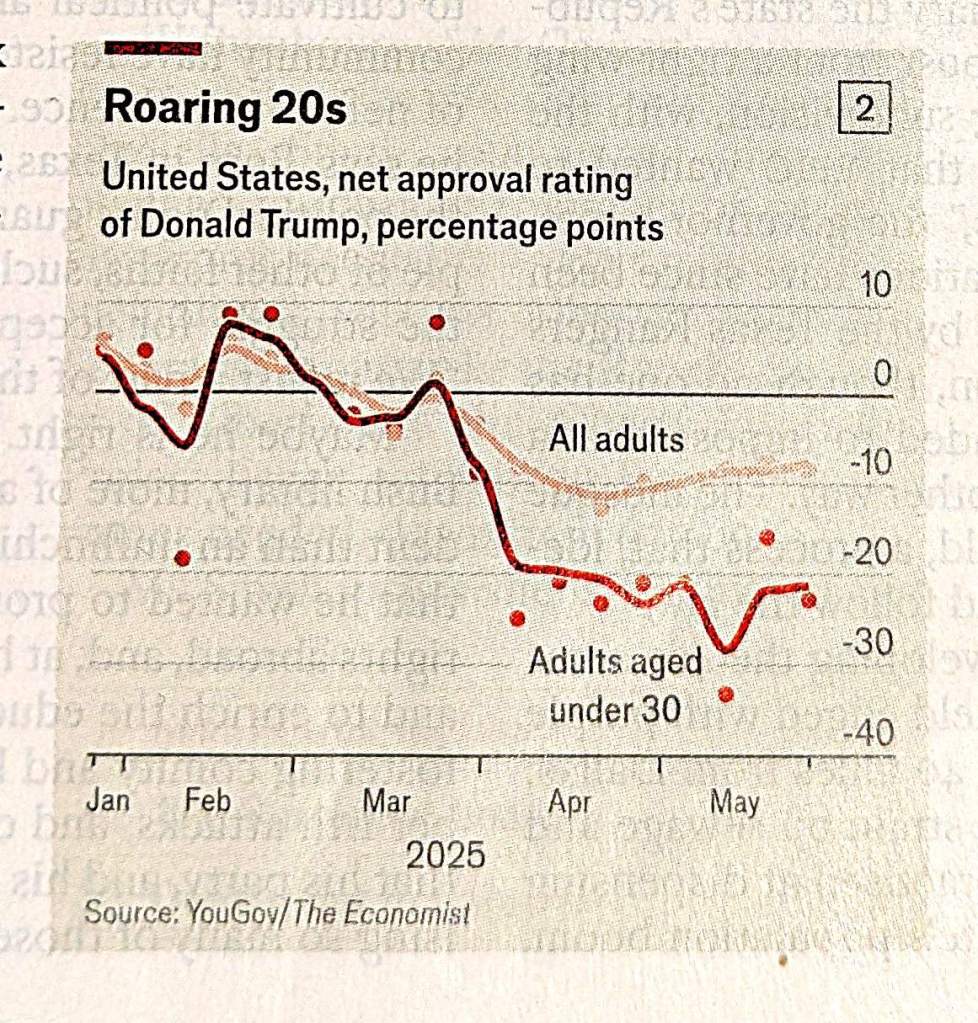
The article goes on to suggest that this group’s vote for Kamala Harris was 12 points smaller than the vote for Joe Biden in 2020. Further, it is suggested that economic pressure was a significant issue. This group’s consumption of ‘news from non-traditional sources’ was also important.
The good news for Democrats is ‘that millennial and GenZ voters appear persuadable. Already, data from YouGov/The Economist show that many of the gains Mr Trump made for his party amongst the youngest voters have begun to diminish…the president’s net approval has fallen by around 13 points nationwide. Among the undr-30s it has plunged 25 points, from net positive to a net negative 21. See graphic below:
Secret London
A Stunning Secret Garden Filled With Lavender Is Opening For The Summer – And It’s Less Than An Hour From London
The season for frolicking in fields of flowers is finally here, and a picture-perfect purple paradise is about open its secretive gates for the occasion.
Katie Forge – Staff Writer • 5 June, 2025

Very much like myself, lavender truly comes into its own during the summer months. And despite the mild identity crisis the weather is currently experiencing; summer is slowly but surely (emphasis on the word slowly) making its way to the capital city – and I’m well-and-truly ready for a season of live, laugh, lav-ing.
Now, you’ve probably heard of Mayfield Lavender Farm; the purple paradise that Londoners flock to each year to frolic in the fragrant flowers and fill their Instagram feeds with photos captioned ‘a lav-ley day for it’. Or perhaps that’s just me. Anyway, what you may not have heard of, however, is Mayfield’s slightly smaller and far more surreptitious sibling, the Secret Lavender Garden. Sounds pretty interesting, right?
The Secret Lavender Garden
Just ten minutes from Mayfield’s main floral farm, and less than an hour from the capital, is the new-for-this-year Secret Lavender Garden. This exclusive experience allows far fewer people to enter at a time, making for a much more intimate and peaceful way to enjoy lavender season.

This hidden haven is filled with rows upon rows of gorgeous lavender, and also boasts an apple orchard, over 500 fruit trees, sweeping views and plenty of local wildlife. The Secret Lavender Garden is swinging open its gates on June 21 and will remain open until August 24. And by welcoming just 40 guests in each morning slots and 60 in the afternoon, the secluded sanctuary will offer visitors a terrifically tranquil way to revel in the blooms.
If meandering through the sea of lavender leaves you feeling a tad peckish, fear not. There’s an on-site café that will be serving up a whole host of lavender-themed tasty treats. But if you fancy an al-fresco feast, you could pack yourself a picnic to enjoy outdoors, or opt to preorder one of Mayfield’s hand-crafted hampers. It all sounds blooming wonderful to me, that’s for sure.
Getting to the Secret Lavender Garden from London
The nearest station to the Secret Lavender Garden is Epsom Downs, which is a direct and fairly speedy train from London Victoria. The garden is then just a short walk from the station. If you’re travelling by car, the Secret Lavender Garden is approximately an hour’s drive from central London. Parking is free, but spaces are limited and need to be booked in advance on their website.
Find out more about Mayfield’s Secret Lavender Garden and plan your visit here.
BookBar Has Just Opened Its Stunning New Second Site In London – All Set For Your Book Buying And Wine Drinking
BookBar, where wine bar meets bookshop, now has second shop in London, and you can find them over in Chelsea.
Jack Saddler – Editor • 5 June, 2025
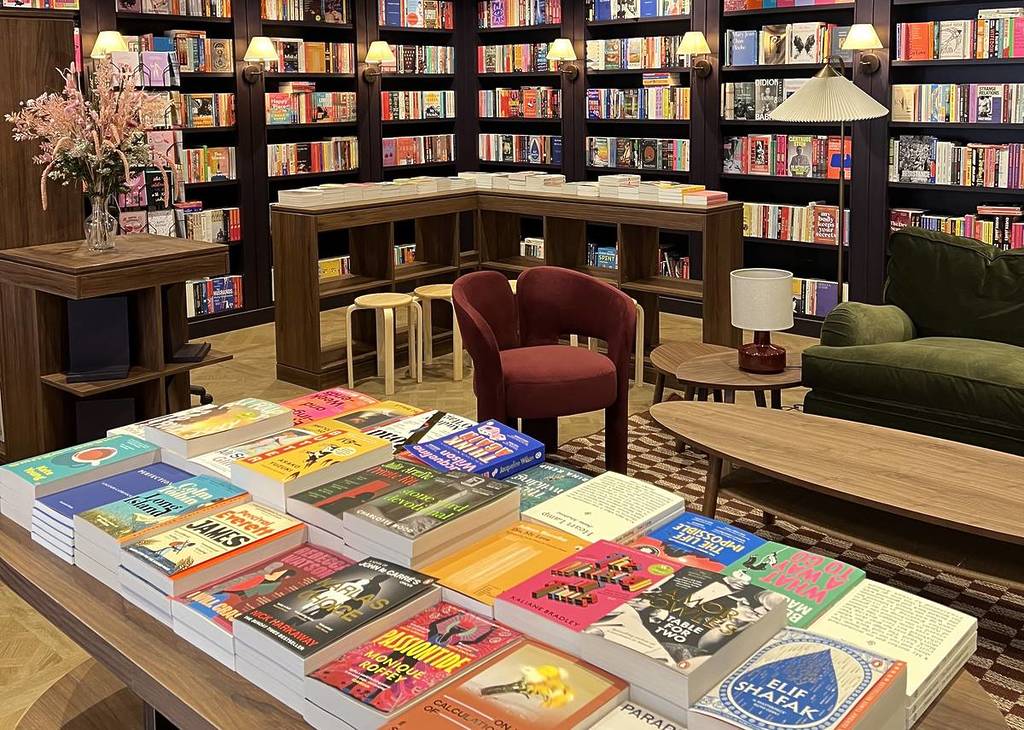
If you’ve strolled down the Blackstock Road in North London, you’ll have noticed the striking yet welcoming exterior of BookBar, a space that has always lived by the mantra of ‘bringing people together through books’. Combining the beauty of a bookshop and wine bar, it’s served as an independent literary hangout for those wanting to browse books, read, or natter while enjoying a glass of wine or coffee.
Earlier this year, it was announced that a second BookBar is opening in London, and now that day is upon us – with a flagship shop just off the King’s Road throwing its doors open today (June 5). Anyone is now welcome to head in to check it out, and those who purchase a book over £9.99 will be offered a complimentary bottle of glass of fizz or bottled soft drink to celebrate.

What can we expect from the second BookBar shop?
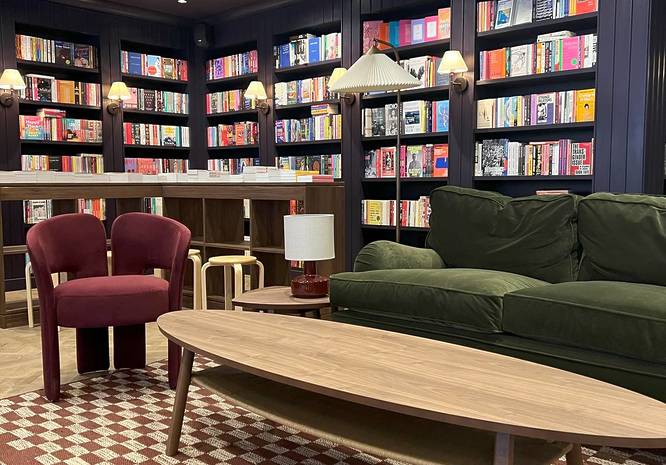
Everything that has endeared the current BookBar to so many will be present in the new 1,200 square foot space, which will also serve as a bookshop, wine and coffee bar, and social space. Plus, the intimate events with writers that have been central to BookBar’s success will be built on at the new flagship space.
BookBar has already revealed a stellar lineup of evenings taking place across the next month to open events at the flagship store in style. On June 19, you can head over to the new space to hear Katie Kitamuta talk about her book Audition with fellow author Caleb Azumah Nelson picking her brain. On June 23, you can attend an evening with the masterful Elif Shafak, author of the stunning There Are Rivers In The Sky and The Island of Missing Trees – the former of which has just come out as a paperback.
Fast forward to June 30, and you can see Jessica Stanley speaking on her romance novel, Consider Yourself Kissed with Natahsa Lunn, before Alice Slater (celebrating the publication of Let The Bad Times Roll) joins BookBar for an evening of cocktails and conversation. Oisín McKenna, author of the acclaimed Evenings And Weekends, will be hitting BookBar on July 29 to speak to Francesca Reece and thus rounding off the opening run of events in style.
Of course, this beautiful lineup is just the start, and there will no doubt be plenty more authors and members of the literary world heading through the doors to share their wisdom. In the past, BookBar has hosted evenings with authors from Gabrielle Zevin to Dolly Alderton and David Nicholls, and there will be plenty more of these to come.

BookBar’s second shop will also act as a space to continue the community ethos established at the Islington site, with their book clubs, meetups, and late-night browsing and wine-sipping. The Bookbar BookClub allows members to view virtual author events, attend in-person meets, enjoy discounts and perks, and with the news of the second BookBar shop coming to London, there hasn’t been a better time to try it out.
Speaking on the news earlier in the year, Chrissy Ryan, founder of BookBar, said: “BookBar has grown from strength to strength since we opened during the pandemic in April 2021. In those four years, BookBar has expanded from two to seven team-members, been a three–times finalist for London’s Independent Bookshop of the Year, hosted high profile events, launched a growing subscription Book Club service and built a large and engaged community of book, wine, and coffee-lovers.
“As a business, we feel ready to take the next step, and I cannot wait to bring our passion for celebrating the social side of reading to Chelsea and contributing to its thriving cultural scene.”
BookBar’s second shop is open now at 11 Chelsea Manor Street, SW3 3TW.
Read more about the original BookBar shop here.

Some residents in Notting Hill are painting the front of their colourful houses black in a bid to put off influencers taking photos outside.
| Secret London is a great publication, and it’s well worth subscribing for people in the UK and those planning a trip – it could even encourage you to do so. |
| Not subscribed yet? It only takes two seconds! Subscribe →Thanks for reading and sharing! We’ll be back next week with more plans. Have a great day and see you in London. |

It is Sara Paretsky’s birthday this week. She was born in Iowa in 1947. She adopted a new approach to the private eye genre with female private eye V.I. Warshawski. She appeared first in Indemnity Only in 1982. Her last book was Pay Dirt in 2024. I enjoyed so many of her novels and was keen to see Kathleen Turner in the role of V.I. Warshawski. However, this film did not take advantage of the numerous story lines that flourish in Paretsky’s novels, and was unsuccessful. All I recall of it is disappointment, and the wonderful red shoes worn by V.I. However, after not having read a Paretsky for years, I feel tempted to read the new one.

 Robin's Room