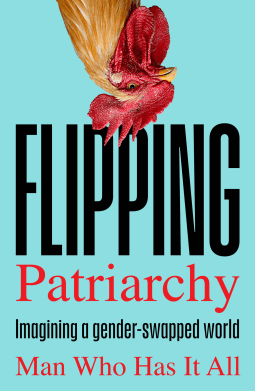
Man Who Has It All Flipping Patriarchy Imagining a gender-swapped world Unbound, March 2025.
Thank you, NetGalley, for providing me with this uncorrected proof for review.
Imagine not having to search through Facebook posts to enjoy page after page of admonitions and guidance which are mischievous on the surface, but so sharp. So sharp indeed that amongst my laughter and enthusiasm to read more there is a gut-wrenching understanding that, yes, this is truth telling that hurts. This book provides all that at your fingertips, no searching, just a dip or two and you have your comic aside from the Man Who Has It All’s ability to see the patriarchy, its foibles, foolishness and its brutality, and make the reality behind the humour glaringly apparent. At the same time, there are explanations of the principles behind the comments. This is both engaging and enraging, inspiring laughter, and distress, but also inspiring: just imagine if everyone could understand, if only a little, what this author is demonstrating.
Claire, CEO, and her husband, Liam feature, together with Facebook respondents’ reflections on Liam’s shortcomings. Sympathy for Claire abounds, that for Liam is couched in admonitory terms. Then comes, Not Just a Pretty Beard, and reference to the TV makeover show, 10 Years Younger in 10 Days. But is a makeover the answer? Where should responsibility for a woman’s improved appearance lie, asks Man Who Has It All? Read the alternative, it is worth it. As is Liam’s predicament when confronted with the need to follow the principles outlined in the original program. List after list of items for him to accomplish. Familiar?
Well worn ‘jokes’ about women are challenged in a serious chapter that must impinge on most of us. How often, to return to the introduction, have we wanted to be nice, to leave horrible behaviour and words unchallenged? This book tells the truth – they are women hating jokes. Which, of course, when flipped, are easy to see them for what they are. Raising, of course, the question, why? The section on ‘Proper Satire’ is a joy to read. And heart breaking.
There is a bibliography, and notes for each chapter. Both make excellent additional reading, with descriptions of the sources adding valuable information about the further reading that sounds accessible and engaging.
While reading the Facebook version of this writer’s work is both fun and infuriating, the warmth that I felt for this courageous and moving writer while reading Flipping Patriarchy was new. As she suggests, take the book in short bursts, I did this, to my relief. Relief, because reading such a strong advocacy for women and a changed world is not necessarily an easy read. But, lest this seems too serious, it is loads and loads of fun too.
Man who has it all’s post
Man who has it all
22 March ·
Thank you Robin Joyce for this review of Flipping Patriarchy on Goodreads (abbreviated below). I nearly shed an actual tear. This is exactly what I wanted the book to be. If you haven’t got round to ordering it yet, most shops have stock back in now. Amazon has 11 copies left.
 5 out of 5 stars

Julie Ann Sipos Horrible Women, Wonderful Girls A Jaycee Grayson Novel Dartmouth Park | Independent Book Publishers, May 2025.
Thank you, NetGalley, for providing me with this uncorrected proof for review.
I should have taken more notice of the title. I would have then established that ‘horrible women’ refers to the real women with whom Jaycee Grayson interacts, and that ‘wonderful girls’ is a brand of doll. If I had done so I would have been prepared to be disappointed in the negative depiction of women and their manoeuvrings to stay on top in a competitive environment. Of course, even the most fervent feminists of us recognise that all women are not perfect, that indeed some are horrible. However, a premise that only recognises dolls as wonderful, and that female supporters are rare, makes for a difficult read for me. As it only gradually dawned on me that this was the inspiration, I was well into the book, so determined to finish it. I am glad that I did, because even with the drawbacks, at times I enjoyed the read, and I ended up wanting to know how Jaycee fared. See Books: Reviews for the complete review.
The Assassin: Keeley Hawes drama is a milestone for menopause on screen
Published: July 30, 2025 10.27pm AEST
Author: Beth Johnson, Professor of Television & Media Studies, University of Leeds
Disclosure statement
Beth Johnson does not work for, consult, own shares in or receive funding from any company or organisation that would benefit from this article, and has disclosed no relevant affiliations beyond their academic appointment.
University of Leeds provides funding as a founding partner of The Conversation UK. View all partners
Republished under –

Keeley Hawes’s new Channel 4 and Prime Video drama, The Assassin, introduces a premise that feels both bold and overdue. It follows Julie (Hawes), a menopausal woman, overlooked and emotionally stalled, who worked as a hitwoman in her youth and unexpectedly comes out of retirement to return to the profession.
It’s pulpy, stylised and laced with dark humour. But beneath the genre trappings lies something more striking – a cultural pivot in how menopause and midlife womanhood is being written and visualised on British television.
Historically, menopause has been television’s silent transition. Onscreen, it was something female characters either didn’t have, didn’t talk about, or, when acknowledged, were mocked for. Sitcoms of the 1980s and 1990s, such as Birds of a Feather or Absolutely Fabulous, played menopausal symptoms for laughs.
In drama, menopause tended to arrive invisibly: women stopped being protagonists, were subtly phased out of storylines, or returned only as wives, mothers, or medical cases.
Television has always been shaped by industry ideas about youth, sex appeal and marketability – ideas that left little room for midlife women unless confined to supporting roles – or contained within the domestic, ensemble structures of soap operas.
While shows like New Tricks (2003), Last Tango in Halifax (2012) and Call the Midwife (2012) gradually shifted the dial, menopause itself remained offscreen: considered either too niche, too biological, or too awkward to dramatise.
What The Assassin offers is not just a menopausal character, but midlife as premise. Rather than sidelining her life stage, the show lets its rhythms – emotional turbulence, internal chaos, flickers of disorientation, flashes of wit and a deep, simmering strength – seep into the storytelling itself.
The story ties her hormonal shifts to emotional volatility, a sense of personal invisibility, fractured family life and existential grief. And then she snaps. But it’s not collapse; it’s re-ignition. She becomes lethal — not in spite of midlife, but because of it.
I research the way midlife female protagonists are presented in British television drama. I’ve recently written about Russell T. Davies’ work in particular, arguing that his dramas (such as It’s a Sin, 2021, and Nolly, 2023) reclaim neglected figures by placing their emotional complexity and cultural marginalisation at the centre.
Nolly offered a compelling reappraisal of Noele Gordon (played by Helena Bonham Carter), the soap star unceremoniously dumped from her own show – a decision now widely understood to be rooted in sexism and ageism. Davies refused to let her disappear quietly, instead making her menopause-era strength and defiance the dramatic core of his show.
Similarly, my work with Professor Kristyn Gorton on Sally Wainwright’s series Happy Valley (2014) explores how Catherine Cawood (played by Sarah Lancashire) embodies emotional realism, grief, rage and midlife fatigue – not as flaws, but as substance. These female characters don’t just react to events; they are the story. Their emotions are not incidental but generative, propelling the narrative, shaping its tone and demanding audience recognition.
The Assassin fits this trajectory. It joins a growing body of British TV that blends genre hybridity with emotional and political resonance. Like Killing Eve (2018) or I Hate Suzie (2020), it uses the structure of the thriller to think critically about gender, ageing and identity.
The menopausal hitwoman is, of course, a metaphor as much as a plot. She is rage personified: a woman no longer governed by the social niceties that often temper female representation. She’s also funny, erratic and uncontained.
A menopausal reckoning
Importantly, The Assassin doesn’t simply celebrate her transformation. It stages it as messy, uncomfortable and morally complex. This is menopause not as a redemptive arc but as a reckoning, with a body that’s changing, a past that won’t stay buried, and a society that prefers women neat, young and silent.
There’s still work to do. British television remains far more comfortable exploring middle-aged male protagonists than women in the same life stage. But what’s changing, and what I frequently explore in my research, is the tone and ambition with which female midlife is now being scripted. Where menopause was once a punchline or absence, it’s becoming a story. And not just any story, but one shaped by genre, irony, feeling and risk.
Thanks to its long-form, visual medium, television can explore the ordinary in ways that resonate deeply, from the exhaustion of grief to the frustration of being dismissed. Menopause, long under-explored, offers rich dramatic territory: emotional volatility, bodily transformation, the redefinition of self. What The Assassin understands is that these aren’t signs of decline. They’re tools of narrative power.
By giving us a menopausal character who is central, subversive and narratively in control, The Assassin signals a broader shift. It reminds us that midlife is not an endpoint, but a site of potential – for drama, for comedy and for cultural critique. British television is, at last, beginning to give menopause the storylines it deserves.
Women’s History Network 33rd Annual Conference
“Hidden in Plain Sight: Women in Archives, Libraries and Museums’
4 -5 September 2025
Fragments, Silences, Dust. The 33rd annual conference will explore and celebrate women in the archives, libraries and museums and the challenge of uncovering their presence. We encourage approaches that foreground marginalised voices and imaginative approaches. Papers which address aspects from all time nations and time periods are welcomed.
More details about the conference, which will be online, and how to submit an abstract are available https://womenshistorynetwork.org/the-womens-history-network-annual-conference/ .

The inner voice of women’s self-loathing
Millie Hill – May 9, 2025
Forwarded this email? Subscribe here for more.
Building a positive relationship with your own reflection can be a life’s work.
On the red carpet at the Met Gala on Monday, Pamela Anderson looked the male gaze straight in the eye and said, “Deal with it”.
And some of them didn’t deal with it very well.

She has been described as ‘make up free’, but even a cursory glance can see that this isn’t the case. As far as I can see, she’s wearing foundation, blush, lipstick, mascara and minimal eye make up, and eyebrow pencil.
It’s interesting how this isn’t enough.

A post shared by pamelaanderson@pamelaanderson
As I write this next paragraph, I realise it’s completely habitual at this point to make some comment myself about how she looks – whether the haircut suits her; whether the dress designer should be fired; whether she looks her age, or more, or less; how she looked then, versus how she looks now. At 57, she and I are in the same decade, and I feel like for my whole life I have been trained to look at other women and critique them. My dear dad, who would have been 99 on the day of this week’s Met Gala, would crack jokes all the time about women in the public eye: “She’s a bit long in the tooth for me”, he would say about any woman over 30 (even when he was beyond his own middle age). Older, less attractive women who had television careers, for example Esther Ranzen, he would say he ‘could not stand’. I’d feel like I was betraying his confidence and his memory a little bit by telling you this, if it weren’t for the fact that I know that you too will have had men you loved who remarked on the appearance of women on the telly, and that like me, you probably joined in at times. “What the heck is going on with her hair?”; “I’m not sure that jacket is doing her any favours”; “She’s put on a few pounds”, and so on, and so on. Maybe their comments weren’t even particularly ill intentioned – my dad’s weren’t. But the point is – they made comments. And so you learned that how women look is something to comment on. As women, we do this to women, and worst of all, we do it to ourselves. Today I had a photographer come to the house from the Times newspaper, an experience that ought to be fun, but that threw me into a complete spiral of negativity about my face, my body, my clothes, my hair, and even my house.
You could see this attack of anxiety as something else that women are doing wrong, something else we should find ourselves ridiculous for. But the fact is, we’ve been trained to think like this. When you see how our culture responds to any woman in the public eye, you can see how self-loathing really is the most obvious and natural default. It’s not just Pamela. Women who have the surgery, women who don’t; women who age naturally, women who don’t; women who lose the weight, women who don’t; confident women, insecure women; younger women, older women; women with multiple partners, single women; the mothers, the child-free; face full of make-up or none – whatever we do and whatever choices we make we will be critiqued in a way that men will never experience.
We internalise all this and then, when we stand in front of the mirror or the camera, unsurprisingly, there it is – our own negative inner voice. We have built this voice, brick by brick, out of every negative comment we have ever heard about other women. And now it’s huge, and it’s our own. And suddenly it’s not Pamela or tonight’s newsreader whose outfit or face we’re loving to hate, it’s ours. “What does she think she looks like?” “She loves herself a bit too much, doesn’t she?” “Gravity went to work on that one I guess” “Is it the outfit that’s lumpy, or her?” It’s like we swallow swallow swallow all the comments we hear about other women and then we kind of vomit it out all over ourselves.
As a mum, I have tried really hard not to teach my own daughters this habit of self-loathing, although I am sure they have been busily learning it all from the rest of the world. I know I’ve not been perfect at it, but I’ve attempted not to make constant derogatory comments about my own appearance – and over nearly two decades of parenting, it’s amazed me how much self-censorship this has entailed. It’s shocking how often I’ve had to stop myself from saying in front of them how fat, ugly, old or downright disgusting I (or other women) look, sometimes in that ‘jokey’ way, sometimes for real. As they’ve grown into teenagers I’ve been a bit more honest with them about the odd relationship that I and all other women have with our bodies, but when they were little I would subversively compliment my reflection in front of them, just to plant seeds. “Wow, you look amazing!”, I’d say to myself in the mirror. I didn’t mean a word of it – I usually thought I looked awful, and it was thinking that, that would remind me to try and break the cycle. I did it for them, because it was definitely too late for me.
All of this is a gigantic waste of our time and a drain on our energy. In The Beauty Myth, Naomi Wolf writes that, “Dieting is the most potent political sedative in women’s history; a quietly mad population is a tractable one.” Being preoccupied with how we look means we spend hours, and often much of our earnings, trying to change and improve ourselves – and it sometimes means we say no to opportunities because we hate ourselves so much. I nearly said no to the photographer. I literally had to have a word with myself. And no wonder I was scared. It’s not just about self-loathing. Don’t try to reassure me that people won’t critique how I look when my face is in the Times. When I got ‘cancelled’ in 2020, my femaleness was a key factor. No doubt how I looked also played its part. At some point people will have loathed me because I was young and thin and beautiful, and now those same people can loathe me because I’m middle aged and not so thin or beautiful any more. How I look can and will be used against me. My face and body can be a battleground, not just for the warring factions of my own psyche, but for those who want to tear down women like me, or just women in general.
Amidst all of this, Pamela Anderson’s zero fucks attitude is a powerful statement. She was in the back of my mind today as I waited for the photographer to turn up. It’s not the first time I’ve had my picture taken by a professional, and each time I have, I’ve noticed a pattern: I absolutely hate the pictures…until about five years later, and then, I look at them again, and I think, ‘Oh!’. When I view them with the distance of time, I realise I actually looked, not necessarily lovely or beautiful, but just ‘me’. The photos look just like me. There’s an element of also thinking, ‘wow, I looked great when I was 35’, etc. But that’s not the whole of it. It’s not just a question of ‘wishing I still looked like that’. It’s more a sense of acceptance, that somehow I wasn’t able to reach when I first saw the image. So today, I decided to try and bring that sense of acceptance forward a few years. And I looked at the pictures on the photographer’s laptop, and I thought: “Yup, that’s me. That’s how I look at this point in my life. I accept myself”. And I have to say I never thought a star of Baywatch would play such a role in my life. Thanks for showing up to rescue us from drowning in self-loathing Pamela!
Australian Politics
The Conversation
June 10, 2025 6.07am AEST
The Racial Discrimination Act at 50: the bumpy, years-long journey to Australia’s first human rights laws
Azadeh Dastyari Director, Research and Policy, Whitlam Institute, Western Sydney University
Disclosure statement
Azadeh Dastyari does not work for, consult, own shares in or receive funding from any company or organisation that would benefit from this article, and has disclosed no relevant affiliations beyond their academic appointment.
Partners – Western Sydney University provides funding as a member of The Conversation AU; View all partners
Published here under
On June 11, Australia marks 50 years since the Racial Discrimination Act became law. This important legislation helps make sure people are treated equally no matter their race, skin colour, background, or where they come from.
But the act didn’t happen overnight. It took nearly ten years for Australia to follow through on the promises it made to the world to fight racism when it signed the International Convention on the Elimination of All Forms of Racial Discrimination in 1966.
When Australia first signed that agreement, it still had laws and attitudes shaped by the White Australia Policy.
Even after Australia started moving away from the White Australia Policy, federal leaders held off on making anti-racism laws. They weren’t sure it was allowed under the Constitution, worried about the cost, and didn’t want to upset the states. Many also feared that Australians wouldn’t support it.
It took the courage of Gough Whitlam, Australia’s 21st prime minister, to pass Australia’s first anti-discrimination law. Between 1973 and 1975, Whitlam and his government made four attempts to pass laws against racial discrimination. The act was the result of their fourth try – this time, it worked.
An uphill battle
The first time the Racial Discrimination Bill was introduced was in 1973, it was alongside a Human Rights Bill. Together, they were part of a bigger plan to give people in Australia more rights and fair treatment.
People had mixed feelings about the idea of a law to protect individual rights. Most of the concern was about the Human Rights Bill, but some also doubted whether a Racial Discrimination Act was needed.
There was debate about whether it would really work or just be a symbolic step, and whether or not it would take away from people’s freedoms.
In the end, the 1973 bill lapsed and did not become law.
The Whitlam government reintroduced the bill twice more in 1974, once in April and then again in October.
The April version added protections for immigrants and focused more on conciliation and education, but it wasn’t debated before an election.

The bill returned in October with minor updates, mainly to strengthen education efforts and clarify that it used civil, not criminal, enforcement.
Still, it was withdrawn in early 1975 because of ongoing political instability.
The 1975 Racial Discrimination Bill was the Whitlam government’s final, and successful, push to make laws tackling racism.
Familiar debates
Labor MPs backed the 1975 version of the bill, highlighting its importance for Indigenous people and other marginalised groups.
But the Liberal–Country Party Coalition, then in opposition, pushed back hard.
While the opposition claimed to support equality, they questioned the legal basis of the bill, feared it gave too much power to the race relations commissioner and warned it might threaten free speech.
Some opposition voices, especially in the Senate, went further, downplaying racism altogether. Senator Ian Wood claimed Australia was “singularly free of racial discrimination”.
Senator Glen Sheil argued immigration was the issue:
Australia over recent years has adopted an immigration policy that has allowed the immigration into this country of blacks, whites, reds, yellows and browns […] because of these problems, once again created by governments, we are now faced with this Racial Discrimination Bill. In my opinion if this bill is implemented it will create more discrimination, not less.
The opposition successfully weakened the bill by removing several key parts, including:
- criminal penalties for inciting racial discrimination
- the ability of the commissioner to start legal proceedings in court or ask a court to make someone give evidence
- and criminal penalties for publishing, distributing or expressing racial hostility.
Despite these setbacks, the Racial Discrimination Act passed.
Change takes time
Even with all the compromises, the passing of the act was a major moment in Australian history.
As Whitlam acknowledged:
it is of course extraordinarily difficult to define racial discrimination and outlaw it by legislative means. Social attitudes and mental habits do not readily lend themselves to codification and statutory prohibition.
The act has not erased racial discrimination, nor is it perfect.
It continues to spark debates and needs to be further strengthened to meet the changing needs of our society.
However, the laws have been used in real cases to protect people’s rights, shown the federal government does have the power under the Constitution to make laws about human rights, and has sent a strong message that everyone deserves to be safe and free from discrimination, regardless of their race, colour or national or ethnic origin.
The story of the Racial Discrimination Act is a reminder that real change takes time, resolve and tenacity.
While the laws finally passed, the Human Rights Bill introduced alongside it in 1973 did not.
More than 50 years later, Australia still does not have a national Human Rights Act. As more people call for stronger human rights protections in our laws, the Racial Discrimination Act stands as both a reminder of what progress can look like and a challenge to imagine what bold leadership could achieve today.
A Human Rights Act is now needed more than ever to protect those most at risk. It will take the same political will, moral clarity, and bravery that brought the Racial Discrimination Act to life.
Digital News Report: Australia 2025 University of Canberra’s News and Media Research Centre
Kelly White
While television remains king for Australian news consumption, social media is quickly catching up, with podcasts close behind, and Artificial Intelligence (AI) chatbots entering the scene.
Television remains the most popular news source for Australians at 37 per cent, but social media’s dominance continues to grow, and this year, for the first time since the Australian survey began, social media platforms have overtaken online news (26 per cent vs 23 per cent) as a main source of news.
When it comes to social media, the preferred channels for news remain divided based on generational differences.
Facebook remains the top social media platform for news consumption overall at 38 per cent (up 6 percentage points from last year), but Instagram is the most widely used platform for news among 18-24s at 40 per cent, up five percentage points from last year. TikTok is being used as a news source by more than one-third of 18–24-year-olds, up a whopping ten percent points since 2024.
This year, one in ten Australians reported using podcasts and six per cent using AI chatbots to get news in the week prior to the survey. X and WhatsApp recorded strong growth in news use as well.
Artificial Intelligence made gains in trust this year. Now, one in five Australians say they are okay with AI producing their news with little human oversight – up four percentage points from last year. However, the majority of Australians (54 per cent) remain somewhat or very uncomfortable with AI produced news.
Women and men continue to have differing preferences in news consumption. Women tend to be lighter consumers of news across all platforms except for social media. Only 44 per cent of women access news more than once a day, which is 23 percentage points lower than men. Women are also much less likely to use newer forms of news, such as podcasts and AI chatbots.
Despite Australians rating online influencers and personalities as a major misinformation threat (57 per cent) – making Australians’ concern about influencers the highest globally – people continue to turn to them as a source of news, particularly young people who use TikTok.
Other misinformation actors, as rated by Australians, included activists (51 per cent), foreign governments (49 per cent), Australian political actors (48 per cent), and news media and journalists (43 per cent).
This year for the first time, participants were asked how trust in news could be improved, revealing six key areas for improvement: more facts and accuracy (26 per cent), less bias and opinion (24 per cent), more breadth and depth in reporting (17 per cent), greater transparency and accountability (15 per cent), increased verification (9 per cent), and more independence from commercial and political interests (9 per cent).
There’s still a strong demand for local news in the information landscape. In fact, interest in local news has risen five percentage points since 2020. Among different local information types, stories about crime and accidents are the most popular (54 per cent), followed by local information services such as bus timetables and weather (41 per cent) and local events and activities (36 per cent).
When asked about which online platforms pose a major misinformation threat, 59 per cent nominated Facebook, followed by TikTok (57 per cent), X (49 per cent), Instagram (42 per cent) and YouTube (35per cent).
When people encounter misinformation, 39 per cent report turning to trusted news sources to check the veracity of the information.
“This represents good fact-checking practice, which is key to navigating a complex media environment,” said lead researcher Professor Sora Park.
For the first time in 2025, DNR measured how many respondents had received formal literacy education – revealing that only a quarter of Australians have.
“Only one in four Australians say they have received training about how to use and understand news,” said Professor Park.
“These people are also more likely to pay for news, trust the news and have a higher interest in it.”
While citizens are navigating misinformation, governments too are examining their role in the information economy and news landscape.
DNR Australia 2025 reveals that Australians are divided on how to tackle harmful content online, particularly when political affiliation is accounted for. 32 per cent of right-wing news consumers in Australia believe too much content is being taken down on social platforms, compared to 18 per cent of left-wing news consumers.
The News and Media Research Centre has run four additional concurrent research projects during the 2025 Australian Federal Election, investigating the impacts of news, misinformation, social media and political advertising, and studying the diversity, equity and inclusion (DEI) messaging in political discourse. Email nmrc@canberra.edu.au to be added to our mailing list for updates on the results.
You can access the full Digital News Report: Australia 2025 here.
Why we still need a women’s prize for fiction
Published: June 16, 2025 12.04am AEST
As we make summer reading lists, some of us will turn to lists of prize winners for recommendations.
One influential prize, the Women’s Prize for Fiction, recently celebrated its 30th award winner, The Safekeep by Dutch writer Yael van der Wouden.
The international prize honours the best novel by a woman written in English and published in the United Kingdom. The prize, first awarded in 1996, was founded after no women writers made the 1991 Booker Prize shortlist.
Considering that fiction by women now regularly makes the shortlists of major prizes, it seems timely to ask: do we still need a prize dedicated to women?
We explored this question by creating a new dataset containing information on 15 British literary prizes, with demographic information for 682 shortlisted and winning authors. Our analysis of the dataset shows how there is still a ways to go before women’s writing is valued — awarded, remunerated and read — equally to men’s.
Who wins what prizes?
We are four research collaborators affiliated with the University of Alberta’s Orlando Project, a project that harnesses the power of digital tools and methods to provide new knowledge about feminist literary scholarship. The Orlando Project has published a searchable digital archive with original coding that focuses of women’s relationship to literary production.
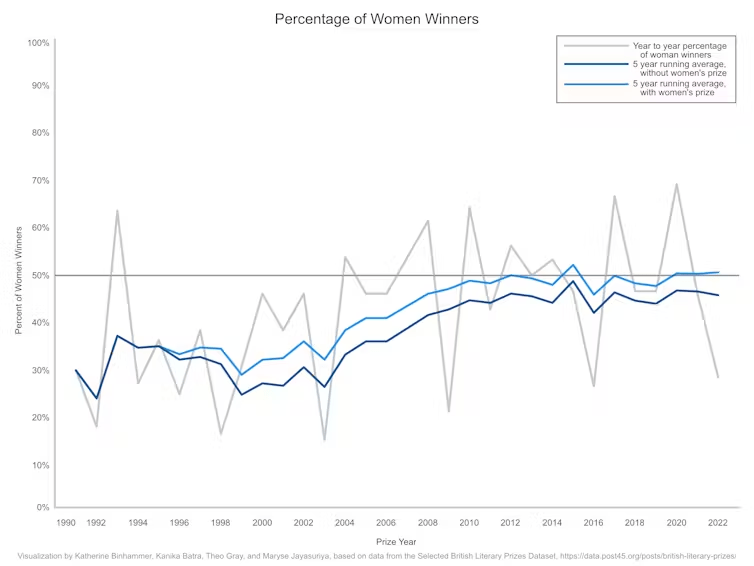
Percentage of women winners of 15 U.K. literary prizes between 1990 and 2022. (Author provided)
Women won just eight per cent of the prizes in our dataset in 2003, whereas they won 53 per cent in 2012. But that increase plateaued in 2012, and for the next decade it held steady at a running average of 45 per cent. As well, we note no steady linear progression upwards or downwards on average, but there were highs and lows (21 per cent in 2016 followed by 64 per cent in 2017).
Booker winners
Some fluctuation in the winners’ genders is, of course, to be expected. But as is apparent by looking at the percentage of women winners year to year, we should not assume things will always get better.
Other insights from our dataset suggest caution is required in assuming women’s fiction is now equally valued by the literary establishment.
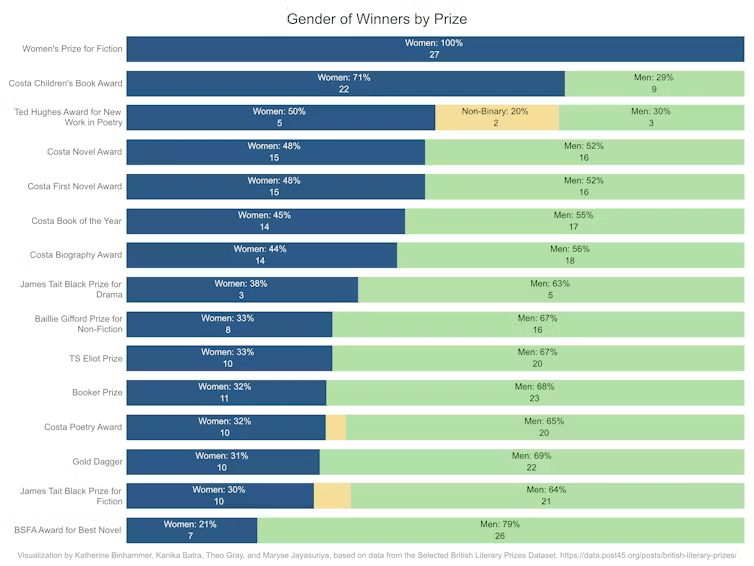
Thirty-nine per cent of Booker shortlisted writers were women, but women have only won 32 per cent of the time. The claim that we don’t need a prize for women since many recent shortlists have been dominated by women needs to be tempered with the fact that while women have made up 57 per cent of the Booker’s shortlist since 2016, only 33 per cent of winners have been women.
Gender and genre
While we expected some differences between genres, we were surprised by just how gendered certain genres are. Seventy-one per cent of the winners of the (now defunct) Costa Children’s Book Award were women, whereas women only constituted 21 per cent for the British Science Fiction Award and 31 per cent for the Crime Writers Association Gold Dagger Award.
Non-fiction writing — which includes history, political science, sport and current affairs — remains male-dominated: the Baillie Gifford award, which bills itself as “U.K.’s premier annual prize for non-fiction books,” has one of the higher percentages of winners who are men, at 67 per cent.
Race and ethnicity
Our dataset includes demographic information on race and ethnicity. It shows that amplifying women’s voices is not simultaneously connected with amplifying all women’s voices.
The Women’s Prize may have succeeded in pushing the Booker to include more women’s fiction (from zero shortlisted when the Women’s Prize was announced in 1990, to 26 per cent when it made its first award in 1996, to 58 per cent in 2022). But the Booker marginally out-performed the Women’s Prize in relation to racialized writers over the period of our dataset (26 per cent for the former, 22 per cent for the latter).
A recent book on white literary taste concentrates on the Women’s Prize to show how prizes in general are part of a literary eco-system that is racially biased.
Fiction reading not as valued as used to be
We also question what it means that women’s fiction has greater visibility at the same time when fewer and fewer people, and especially men, read fiction.
Using Nielsen BookScan data, the Women’s Prize 2024 Impact Report points to statistics on fiction authorship and gendered readership: women published 57 per cent of the top 500 bestselling novels in 2023, but while women constitute 44 per cent of readers of the top men’s fiction, men only account for 19 per cent of readers of fiction by women.
The fact that fewer people are reading fiction at the same time that women are winning more awards, could suggest we are witnessing a repeat of the familiar pattern in women’s history where, at the same historical moment when women achieve dominance, or increase, in a field, and it becomes “feminized,” the field as a whole loses its value or prestige. Examples are family medicine or humanities professors.
Pattern around gender and genre
The Orlando Project’s research on 800 years of women’s writing in Britain reveals a pattern around gender and genre when in comes to remuneration and literary prestige. Genres where women writers dominate, like children’s literature and romance, tend to be the least lucrative.
Novels in the time of Jane Austen illustrate the point. Before Walter Scott and other male writers developed a highbrow “serious” Victorian novel over what they saw as trashy romances, women writers temporarily dominated fiction like they do today. As one of us has argued, when women writers published more novels than men did in the 1790s, novels were the literary genre that paid the least.
There remains a gender pay equity gap in writing: British women earned 58.6 per cent of what men did in 2022, mostly because the genres they chose to write in do not garner the highest earnings.
Rewarding women authors
One way to answer our question of whether we still need a Women’s Prize is this: we will no longer need it when women begin to dominate prizes for prestige genres such as non-fiction; when men read as much writing by women as that by men; and when we pay authors as much as football players.
So far, we’re not there. We therefore celebrate that in 2023, the Women’s Prize added a new award in non-fiction to address that genre’s gender disparity. The Story of a Heart by practising palliative care doctor Rachel Clarke won this year.
We encourage readers to take all the Women’s Prize-winning and nominated books to the beach this summer.
The New York Times
Nonfiction
In ‘Not My Type,’ E. Jean Carroll Gets the Last Gab About the Trump Trials
Her lawyers urged that she keep her testimony short. With legal victories in hand, she’s sharing her life story, and what it was like on the stand.


June 17, 2025
NOT MY TYPE: One Woman vs. a President, by E. Jean Carroll
We already know that E. Jean Carroll looked smashing when she went to court versus Donald J. Trump. But her irrepressible voice was, necessarily, repressed.
For 27 years, with countless exclamation points and emphatic italics, Carroll wrote the “Ask E. Jean” column for Elle magazine, focusing on the perils of modern dating. Advice columns, a quaint holdover from the heyday of print you’d think ChatGPT would make redundant, remain curiously ubiquitous.
Yet even in a crowded field, this adrenalized agony aunt, currently on Substack, stands out, with her giddy feminism (her tuxedo cat is named Vagina T. Fireball); literary references (the Great Pyrenees dog: Miss Havisham); and runaway retro expressions like “egads!” and “twitpiffle.”
Testifying in depositions and two trials, however, Carroll was instructed by her lawyers to keep her answers short. “Very, very short,” she writes in “Not My Type,” a delightful full-gallop account of the experience, and sequel of sorts to “What Do We Need Men For?” (2019), in which she first accused Trump of assaulting her in a Bergdorf Goodman dressing room. “I receive the impression that saying nothing at all would be best,” she adds.
Now she is saying pretty much everything, including a few evidentiary morsels not introduced at trial. Like that Jeffrey Epstein, Trump’s friend, had heard and gossiped about what had happened. And a 1987 “Spy 100” issue listed Bergdorf dressing rooms in an article about places for “lunchtime adultery.” The man the magazine called a “short-fingered vulgarian” was among those on the cover.
Trump has plenty of his own insults at hand, of course. Indeed the title “Not My Type” is taken from one about why he never would have advanced on the unconsenting Carroll: “No. 1, she’s not my type.” (He did, however, mistake her in an old photo for one of his exes, Marla Maples.) “No. 2, it never happened,” he added. “It never happened, OK?”
Last Friday, an appeals court rejected his bid for a redo.

Carroll may not have yet received the combined $88.3 million awarded to her in damages — over $100 million with compounded interest — which she vows here to donate to various causes the president hates.
But with transcript excerpts, morning routines and packing lists (à la the canonical one by the author she calls Saint Joan Didion), she has produced a trial scrapbook that is also a memoir of love and friendship, a photo party, a movie set and — though sprinkled with social media posts — a mash note to Ye Olde New Journalism. She is a Tom Wolfette armored in a “navy-blue Dior-inspired Zara suit” and Revlon’s Toast of New York lipstick, punctuating her observations with a “whoooooooosh!” and a “Swaaaaaaaaaaaaak!”
She notes the Trump lawyer Joe Tacopina’s schmancy tailoring and muscular physique — “leaning a left buttock — as pumped as a tetherball — against the jury box.” She compares the defendant variously to “a finely aged Troy Donahue,” “an elderly gigolo” and, as the wind ruffles his famous coif, Barbara Stanwyck.
A mock jury summoned to prepare her for the trial perceived Carroll as a member of the elite. “How anyone can think a hick raised in sticks so deep the hick is still pulling twigs out of her hair 80 years later is ‘elite,’ is beyond me,” she writes.
Maybe because she savors words like “velutinous” (her attorney warned her against more than three syllables). And because she insists one government chamber resembles a Busby Berkeley ballroom, and she can handily compare the Benadryl recommended by friends concerned about her insomnia to the orange juice laced with whiskey pressed upon Gussie Fink-Nottle in P.G. Wodehouse’s “Right Ho, Jeeves.”
Raised in a redbrick schoolhouse in Fort Wayne, Ind., Carroll — former sorority girl, cheerleader, beauty pageant survivor — began pitching story ideas to magazines when she was 12. Esquire accepted her first article when she was 37. “Can you imagine the relentless, insane, glorious, hot, blistering beat-yourself-up, plow-ahead, never-say-die enthusiasm that drives a woman to go on and on and on through a blizzard of blunt editors’ numbing ‘Nos’ for 25 years?” she marvels. (Honey, I fold after 25 seconds.)
Carroll took Fran Lebowitz camping for Outside, became Playboy’s first female contributing editor and chewed acid with Hunter S. Thompson for an appropriately gonzo biography, wherein she assumed the alter ego of a virginal ornithologist named Miss Laetitia Snap, who was interested in Thompson’s peacock collection.
This adventuresome, anything-goes spirit, Carroll writes, also led her to accept Trump’s suggestion that they visit the lingerie floor of Bergdorf’s, a store with dressing rooms so capacious that Jackie Kennedy used them to pore over manuscripts after lunch when she was an editor at Doubleday.
“Hey, you’re that advice lady,” she remembers Trump saying when they ran into each other in the lobby.
“Hey, you’re that real estate tycoon.”
And before long, she testified, after stroking a fur hat Dr. Evil-style and suggesting some personal shopping, he had pulled down her tights and was “rummaging” and worse in her private parts.
Carroll had attended a Pi Beta Phi pledge dance on the arm of the future basketball star Tom Van Arsdale — “O! I simply adored Tom Van Arsdale!”— and married twice. Among her lovers were the actors Ben Vereen and Richard Harris and the gadabout journalist Anthony Haden-Guest. But after Trump’s attack, she writes, she stopped having sex. “It’s like when shopkeepers pull down the metal grate to secure the store,” she told a trauma specialist. “Little Jeanie who was so boy crazy her whole life just shut it down.”
If only Bergdorf’s had pulled down that grate. But then this book would not exist, topping off Carroll’s whipped-cream oeuvre like a slightly bruised but still buoyant maraschino cherry.
NOT MY TYPE: One Woman vs. a President | By E. Jean Carroll | St. Martin’s | 368 pp. | $30
Alexandra Jacobs is a Times book critic and occasional features writer. She joined The Times in 2010.
See more on: E. Jean Carroll, Donald Trump
British Politics
How did my MP vote on assisted dying?
Data journalism team BBC
MPs have voted to legalise assisted dying in England and Wales after their final debate on the change in the law.
After months of deliberation and scrutiny, the Terminally Ill Adults (End of Life) Bill was backed by 314 votes to 291, a majority of 23.
MPs were given a free vote on the issue, meaning parties did not instruct them what to choose.
The third reading of the bill was the last opportunity for MPs to approve or reject it.
The majority in favour has more than halved since MPs first backed proposals to legalise assisted dying in England and Wales.
In November they supported it by 330 to 275, a majority of 55.
Prior to that, it had been almost a decade since the House of Commons had voted on the issue, deciding in 2015 to reject the “right to die” law.
The bill now passes to the House of Lords for further scrutiny.

The Terminally Ill Adults (End of Life) Bill was introduced by Labour MP Kim Leadbeater.
It proposed letting terminally ill people end their life if they:
- are over 18, live in England or Wales, and have been registered with a GP for at least 12 months
- have the mental capacity to make the choice and be deemed to have expressed a clear, settled and informed wish, free from coercion or pressure
- be expected to die within six months
- make two separate declarations, witnessed and signed, about their wish to die
- satisfy two independent doctors that they are eligible – with at least seven days between each assessment
The bill has since been amended following the committee and report stages, where it was scrutinised line by line by MPs.
Some key changes included dropping the requirement for a High Court judge to approve assisted dying applications, replacing it with a three-person panel featuring a senior legal figure, psychiatrist and social worker.
A separate bill on assisted dying is being considered in Scotland and passed an initial vote at Holyrood in May 2025 but is subject to further debate and changes before a final decision.
In March, the Isle of Man was the first part of the British Isles to approve assisted dying.
While it remains illegal in most countries, more than 300 million people now live in countries which have legalised assisted dying.
Canada, Australia, New Zealand, Spain and Austria have all introduced assisted dying laws since 2015.
American Politics
Heather Cox Richardson from Letters from an American <heathercoxrichardson@substack.com> Unsubscribe
Heather Cox Richardson Jun 20
Just a week ago, the Trump administration was preparing for a sixth round of negotiations with Iran over its nuclear program, scheduled to be held in Oman on June 15.In 2018, President Donald J. Trump pulled the U.S. out of the Joint Comprehensive Plan of Action (JCPOA) negotiated in 2015 by President Barack Obama, under which the U.S., China, France, Germany, Russia, and the United Kingdom lifted economic sanctions against Iran in exchange for limits to Iran’s nuclear program. With the U.S. withdrawal, the agreement fell apart.
Trump launched a “maximum pressure campaign” of stronger sanctions to pressure Iran to renegotiate the JCPOA, which lasted throughout his first term. Back in office, Trump relaunched that campaign in February 2025. Then, in March 2025, Director of National Intelligence Tulsi Gabbard told Congress that the assessment of the Intelligence Community was that Iran was not building a nuclear weapon.
In the same month, Trump said on the Fox News Channel that he had written a letter to Iran’s supreme leader, Ayatollah Ali Khamenei, urging the Iranians to negotiate “because if we have to go in militarily it’s going to be a terrible thing for them.” Iran’s foreign minister, Abbas Araghchi, said Iran would not “enter any direct negotiations with the U.S. so long as they continue their maximum pressure policy and their threats.”
But Iran’s allied militant actors Hamas and Hezbollah in Lebanon have been badly hurt by Israeli strikes since Hamas’s attack on Israel on October 7, 2023, and Iran’s major ally in the Middle East, Bashar al-Assad of Syria, fell in December 2024. Discussions began in April of this year, and negotiators met for five rounds by the end of May.
Israel was not included in the negotiations, and on Thursday, June 12, it launched strikes against nuclear and military targets in Iran. The strikes killed a number of nuclear scientists and senior military personnel. Iran retaliated, and the countries have been in conflict ever since.
After the strikes, U.S. Secretary of State Marco Rubio, who also became the acting national security advisor after Trump fired his first national security advisor for inviting a journalist onto a Signal chat about a military strike against the Houthis, issued a statement distancing the U.S. from Israel’s attack on Iran. “Tonight,” he said, “Israel took unilateral action against Iran. We are not involved in strikes against Iran and our top priority is protecting American forces in the region. Israel advised us that they believe this action was necessary for its self-defense. President Trump and the Administration have taken all necessary steps to protect our forces and remain in close contact with our regional partners. Let me be clear: Iran should not target U.S. interests or personnel.”
But by early Friday morning, Trump appeared to be trying to take credit for the strikes and demanded that Iran make a deal. The next day—Saturday, June 14—was the day of No Kings protests in which at least 2% of the U.S. population turned out to oppose his presidency, as well as the sparsely attended military parade in Washington, D.C., an embarrassing contrast for the president.
The U.S. possesses a 30,000-pound bomb that would perhaps be able to penetrate Iran’s underground nuclear sites, which are fortified against attack. According to Alex Horton, Maham Javaid, and Warren P. Strobel, the “Massive Ordnance Penetrator” (MOP) can penetrate the ground up to at least 200 feet. The U.S. B-2 Spirit stealth bomber is the only Air Force aircraft that can deploy the heavy MOP.
On June 16, while at the G7 meeting in Canada, Trump posted that Iran “should have signed the ‘deal’ I told them to sign.” He continued: “What a shame, and waste of human life. Simply stated, IRAN CAN NOT HAVE A NUCLEAR WEAPON. I said it over and over again! Everyone should immediately evacuate Tehran!” More than 9 million people live in Tehran, with more than 16 million in the metropolitan area.
Then Trump abruptly left the G7 and on the trip home told reporters on Air Force One that he didn’t care what Gabbard said, and thought Iran was close to achieving nuclear capabilities. When France’s president Emmanuel Macron suggested Trump left to work on a ceasefire, Trump posted: “Wrong! He has no idea why I am now on my way to Washington, but it certainly has nothing to do with a Cease Fire. Much bigger than that. Whether purposely or not, Emmanuel always gets it wrong. Stay tuned!” Later that day, he posted that “[w]e”—a word suggesting U.S. involvement—“now have complete and total control of the skies over Iran,” and he credited U.S. weaponry with that dominance.About a half-hour later, he posted: “We know exactly where the so-called “Supreme Leader” is hiding. He is an easy target, but is safe there—We are not going to take him out (kill!), at least not for now. But we don’t want missiles shot at civilians, or American soldiers. Our patience is wearing thin.”
As Trump’s “Stay tuned!” suggested, his hints that he could bring the U.S. into the conflict monopolized the news. It has pushed the No Kings Day protests and the military parade to the background, putting Trump back on the front page.
Josh Marshall at Talking Points Memo interpreted Trump’s shift to back Israel as a typical Trump branding opportunity: “Israel has got a product ready to go to market and they’ve offered Trump the opportunity to slap the Trump name on it.” In the short term, that product offers a quick way to get rid of the Iranian nuclear program, which has long been a U.S. goal.But Trump’s flirting with joining a Middle East war has badly split his supporters. Led by Steve Bannon, the isolationist wing is strongly opposed to intervention and suggests that the U.S. will once again be stuck in an endless war.In contrast, the evangelical MAGA wing sees support for Israel as central to the return of Jesus Christ to Earth in the end times. Earlier this month the U.S. ambassador to Israel, former Arkansas governor Mike Huckabee, said the U.S. was abandoning its longstanding support for a Palestinian state. Huckabee is a strong supporter of the expansion of Israel’s settlements. After the Israeli strikes, Huckabee messaged Trump to urge him to listen to the voice of God. In an apparent reference to Truman’s decision to drop a nuclear weapon on Japan at the end of World War II, Huckabee told Trump: “No President in my lifetime has been in a position like yours. Not since Harry Truman in 1945.”At the unveiling of two 88-foot-tall (30.5 meters) flagpoles at the White House yesterday, Trump told reporters who asked what he planned to do about Iran: “I mean, you don’t know that I’m going to even do it. You don’t know. I may do it, I may not do it. I mean, nobody knows what I’m going to do.” He added, “Nothing’s finished until it’s finished. You know, war is very complex. A lot of bad things can happen. A lot of turns are made.”
He told CNN’s Kaitlan Collins: “I have ideas as to what to do, but I haven’t made a final—I like to make the final decision one second before it’s due, you know, because things change.”
Meanwhile, in a hearing yesterday at the Senate Armed Services Committee, Senator Tammy Duckworth (D-IL) pointed out to Defense Secretary Pete Hegseth that the $1 billion mission he led against the Houthis—who do not have a navy—has not restored the ability of U.S.-flagged commercial vessels to go through the Red Sea. Instead, it cost the U.S. two F18 Hornets, which cost $60 million apiece, and seven Reaper drones that cost another $200 million. Duckworth accused Hegseth of “blowing through money” and said: “Your failures…since you’ve taken office, have been staggering. You sent classified operational information over Signal to chest thump in front of your wife, who, by the way, has no security clearance, risking service member lives in the process…. You’ve created such a hostile command environment that no one wants to serve as your chief of staff or work with you in other senior lead [Department of Defense] leadership roles.”
“But what we should all be talking about more than all of this,” she added, “is that you have an unjustified, un-American misuse of the military in American cities, pulling resources and attention away from core missions to the detriment of the country, the war fighters, and, yes, the war fighting that you claim to love.”
Warren P. Strobel, Alex Horton, and Abigail Hauslohner of the Washington Post reported yesterday that Hegseth and Gabbard have been sidelined in discussions of whether the U.S. will get involved in the conflict. The White House is also operating without a full complement of professional staffers at the National Security Council, since Rubio fired many of them when he took over from Waltz, apparently with the goal of replacing the think-tank mentality of past NSCs with a group that would simply implement the president’s ideas.
Talking Points Memo’s Marshall noted Tuesday that “there is really, literally no one in the inner discussion of U.S. foreign policy today who has any level of foreign policy or military crisis experience at all.”
Meanwhile, a bipartisan group of lawmakers is pushing back on the idea that Trump can unilaterally decide to take the United States into a war. On Monday, Democratic senator Tim Kaine of Virginia introduced a measure to reassert Congress’s power over the authority to make war. The Constitution explicitly gives that authority to Congress, not the president, but presidents have chipped away at that power for decades. Senator Bernie Sanders (I-VT) introduced another measure to bar the use of federal funds for military force without authorization by Congress.
Today, after Iranian missiles hit an Israeli hospital, Trump seemed to change direction. He issued a statement through White House press secretary Karoline Leavitt, falling back on his usual tactic of promising something “in two weeks.” “Based on the fact that there’s a substantial chance of negotiations that may or may not take place with Iran in the near future, I will make my decision whether or not to go within the next two weeks.”Stay tuned.
Marshall of Talking Points Memo noted today: “A through-line through the last five months is that uncertainty is Donald Trump’s personal comfort zone, where he feels *his* power is maximized. But in basically every domain in which he operates uncertainty *in itself* is damaging to everyone else involved.”—
Notes:https://www.france24.com/en/americas/20250307-trump-offers-nuclear-talks-with-iran-in-a-letter-to-its-supreme-leaderhttps://www.washingtonpost.com/world/2025/06/19/iran-israel-conflict-history/https://talkingpointsmemo.com/edblog/an-offer-trump-cant-refuseDonald J. Trump, Truth Social Post, June 13, 2025, 5:56 a.m.Donald J. Trump, Truth Social post, June 16, 2025, 11:50 p.m.Donald J. Trump, Truth Social post, June 17, 2025, 1:15 a.m.
Donald J. Trump, Truth Social post, June 17, 2025, 11:55 a.m.Donald J. Trump, Truth Social post, June 17, 2025, 12:19 a.m.
Mike Huckabee, quoted in Trump, Truth Social post, June 17, 2025, 8:49 a.m.https://www.reuters.com/world/us/trump-faces-uproar-maga-base-over-possible-iran-strike-2025-06-18/https://www.reuters.com/world/middle-east/rubio-says-us-not-involved-israeli-strikes-against-iran-2025-06-13/https://time.com/7295241/trump-iran-israel-tucker-carlson/https://www.cnn.com/2025/06/19/politics/trump-us-strikes-iran-israel-analysishttps://www.theguardian.com/us-news/2025/jun/10/mike-huckabee-independent-palestinian-statehttps://www.theguardian.com/us-news/2025/jun/17/trump-us-iran-israel-warhttps://www.theguardian.com/us-news/2025/jun/16/trump-war-powers-iran-israel-conflicthttps://www.washingtonpost.com/national-security/2025/06/17/massive-ordnance-penetrator-iran-bunker-buster/https://www.washingtonpost.com/national-security/2025/05/23/national-security-council-trump-rubio/https://talkingpointsmemo.com/edblog/thoughts-on-israels-iran-campaign-and-donald-trump/sharetoken/242a4259-3434-4ba9-9820-5cc31b27d92bhttps://apnews.com/article/israel-iran-attacks-nuclear-news-06-19-2025-b508817b78ed8d2f6067c1516215cf94https://www.reuters.com/business/aerospace-defense/trump-contradicts-his-spy-chief-irans-nuclear-program-2025-06-17/https://abcnews.go.com/US/illegal-immigrants-trump-questions-workers-installing-white-house/story?id=122996015https://www.cbsnews.com/news/trump-war-powers-act-congress-iran-israel/https://www.usatoday.com/story/news/politics/2025/06/18/trump-flag-poles-white-house/84257902007/YouTube:watch?v=E1pmY8GIuWAX:KellyO/status/1933324863252410838Bluesky:justinbaragona.bsky.social/post/3lry2wrsgcs2jatrupar.com/post/3lry2qllaev2jjoshtpm.bsky.social/post/3lry456ryqc2ppotustracker.us/post/3lrr25zjtie2npremthakker.bsky.social/post/3lrrs25cxm22mpatriottakes.bsky.social/post/3lrsvzglhns2ucarlzoilus.bsky.social/post/3lrt74orqjc2s
A bit of beauty after all that …


Canberra sunset while walking Leah

 Robin's Room