
Samantha Vérant The Writers’ Retreat Storm Publishing, July 2025.
Thank you, NetGalley, for providing me with this uncorrected proof for review.
A thriller set around a writers’ retreat and writers? What could be a more enticing location and concept? Sadly, the premise promised by the title is not fulfilled. To be fair, it is established that the retreat is also a commercial enterprise selling perfumes, a unique alcoholic beverage and foodstuffs, and custom-made paper. Also, the cleverness of the novel revolves around writing, in this case a memoir and a novel based on events in each of the writer’s lives. This device sets the scene for the possibility that fiction will override fact, that a story can be embellished or even be lies, and that the protagonists whose firsthand accounts make up the chapters might be creating the dramatic effects which are the writer’s prerogative.
The narrative begins with a prologue in which an unnamed person provides advice about removing hurtful people. And perhaps this person has done so – there is a blade in their hand, and they wipe clean all the surfaces before departing. In the first of short chapters, Liv Montgomery introduces herself, her aspirations, her nemesis, Kat, and her successful submission of her thriller to an agent. The agent invites Liv to a writers’ retreat. Coincidently, or not, Miriam a woman from Liv’s past, is part of the agency’s team. Sienna, with a past and current hostile relationship with Liv, is also a participant. She is writing non-fiction which could suggest that her utterances are believable. However, with the twists and turns taken in The Writers’ Retreat this is not necessarily the case. See Books: Reviews for the complete review.

Kelly Oliver, The Case of the Body on the Orient Express, Boldwood Books, July 2025.
Thank you, NetGalley and Boldwood Books for this uncorrected proof for review.
What an absorbing and enjoyable read Kelly Oliver has served up, along with the food that Dorothy L. Sayers consumes throughout the hunt for a murderer. Agatha Christie, only slightly more circumspect with her cups of cream that she enjoys at almost every turn of the plot, joins her, Eliza, and Theo on the Orient Express on its journey to Constantinople, as they knew Istanbul. Jane, Eliza Baker’s sister, also features, as a MI5 agent, introducing a spy theme to the ‘cosy mystery’ as this series is described. This is the first of the Detection Club series that I have read, and I look forward to more as I found it more enticing than the usual cosy mystery.
The combination of real and fictional characters is smart. Agatha’s trip has been arranged to help her recover from her husband, Archie’s, deception. However, personal despair is secondary to her enthusiasm for life – a possible trip to an archaeological dig, and closer to events on the Orient Express, a murder to solve. Her friendship with Dorothy provides plenty of discussion about writing, plotting a murder, and solutions. The introduction of the obnoxious Eric Blair adds to the deft weaving of fact and fiction, not at the Tom Stoppard level in his Rosencranz and Guildenstern Are Dead, but nevertheless, genuine fun. Eliza, Sayers’ companion, and secretary to the secretary of the London Detective Club (and formerly of Scotland Yard) is an engaging character, with her distaste for the humorous way the Club treats death, her commitment to her sister and beloved Queenie, her beagle. Theo Sharp, erstwhile chess companion who disappeared abruptly in the middle of a game, rejoins Eliza and the detective novelists on the Orient Express – in a steward’s uniform.
Death is an almost immediate companion as the Orient Express travels towards Istanbul. But it is accompanied by comic interludes, descriptions of Eliza’s and Jane’s shady past, sharp asides about Eric, who has renamed himself George Orwell, and the red herrings associated with any Agatha Christie plot. Kelly Oliver’s Death on the Orient Express owes something to the latter but has its own daring characters and plotting to make it very much her own. This is a comfortable but nicely harrowing read for a wintry night.

Valerie Keogh, The Writer, Boldwood Books, July 2025.
Thank you, NetGalley, for providing me with this uncorrected proof for review.
Valerie Keogh never disappoints, and as I began The Writer, I knew that a treat was to follow. Cara is working, or trying to, on her thirtieth novel – a psychological drama like her previous successful works. As Arty, her husband leaves for work, Tillie her friend variously supports her or tries tough love to get her over her vacillation and morbid speculations about the notes she has begun to receive, and her agent and editor variously encourage her to bring this thirtieth novel to fruition, Cara sits at her word processor bereft of words, or the means to process the few that she drags up. Cara is not going to succeed in writing the thirtieth novel, until her speculations about the notes become an integral part of her life and her writing.
The interplay of Cara’s fiction and her life become enmeshed in her failure to separate fact and fiction. The notes become an unwieldy part of Cara’s life, encouraging her to reach implausible, to the reader, but all too plausible to Cara, decisions about her friend, husband, and her reality. Interspersed with Cara’s reactions to the notes, her insecurities about herself and suspicions about her husband’s past are the ruminations of a man who wishes her ill. His resentment of her success in contrast with his failures, lead him into punishing her for what he sees as a past unforgivable slight. See Books: Reviews for the complete review.
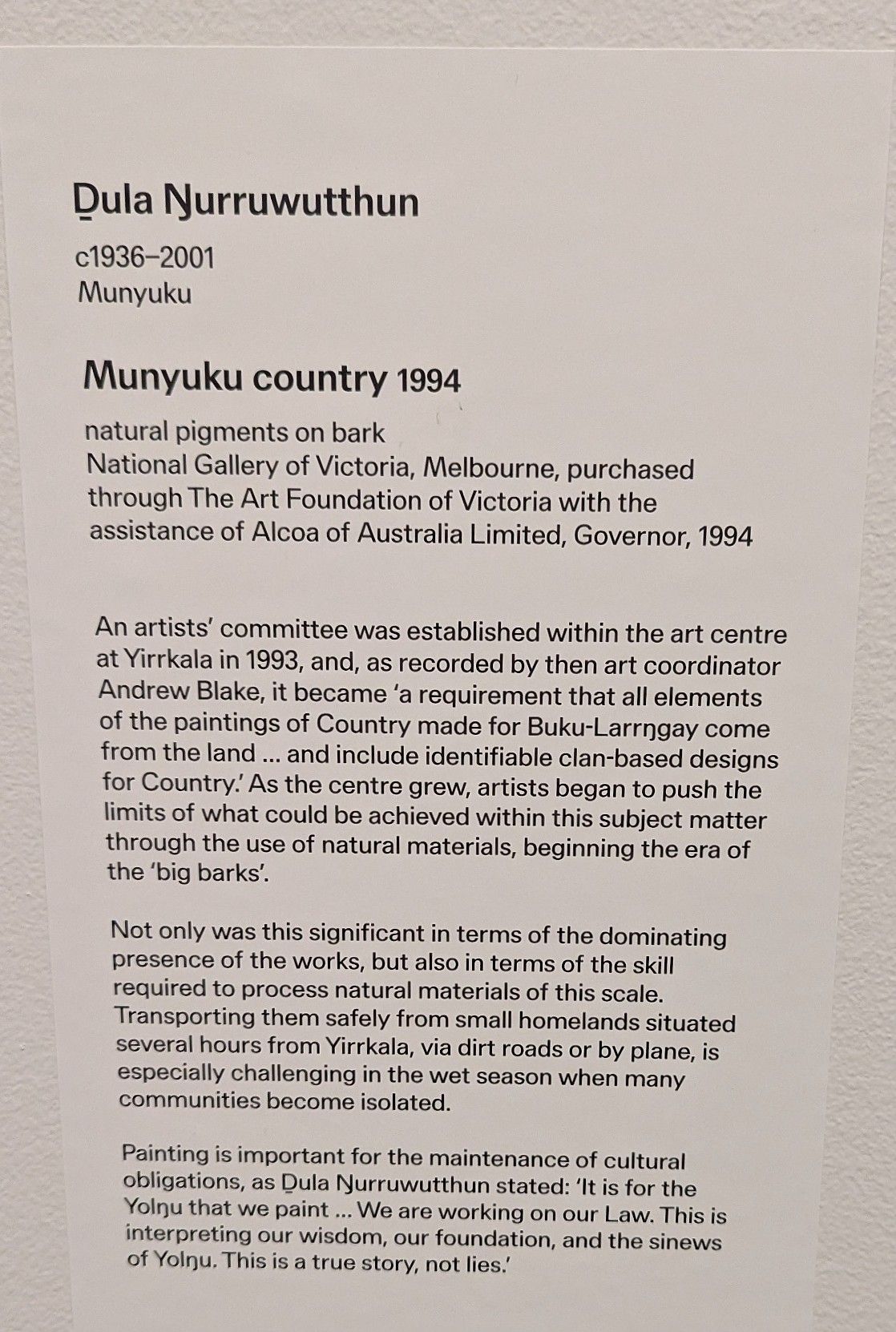
Art Gallery of New South Wales
More photos from the wonderful Yolŋu power: the art of Yirrkala exhibition.















Raw Story October 9 2025
Thom Hartman
I just saw the movie that will define our age — you can tell because right-wingers hate it
This week has felt like one battle after another. We all watched video after video of ICE agents dropping from helicopters onto a Chicago apartment block, kicking in doors and terrorizing Black and Hispanic American and immigrant families, then trashing and stealing their possessions without ever presenting a warrant signed by a judge.
The GOP pushed the country to the brink again with another government shutdown threat while right-wing legislatures redrew districts to erase the votes of millions. We heard more talk of arresting journalists for doing their jobs, and watched as the military rolled through American cities as if people here are the enemy.
Each day has felt like a slow-motion assault on democracy itself.
Louise and I went to see Leonardo DiCaprio’s new movie, One Battle After Another, last weekend, and I was stunned. It’s a film of rare courage and artistry. From the first scene to the last, Paul Thomas Anderson reminds us that cinema can still tell the truth about power and conscience. It’s a film that demands attention, not permission.
The movie runs about two-and-a-half hours, but it’s so action- and drama-packed that it felt like it flew by in less than an hour. I knew people similar to those characterized in this movie when I was in East Lansing SDS back in 1968-69: seeing them portrayed like this was a hoot! This is truly brilliant film-making.
Predictably, conservatives rushed to condemn it. Some labeled it “irresponsible” or claimed it “glorifies violence.” What they really mean is that it unsettles them. They prefer art that flatters authority and soothes the comfortable. This film refuses to do either.
The world Anderson portrays is not a fantasy. When federal agents execute suspects, when protests are manipulated to justify repression, when truth is distorted by propaganda, that is not simply fiction. It reflects the deep anxiety of a society that’s watched Trump’s executive power become far too concentrated and way too cruel. Anyone paying attention to the news knows how real that danger feels.
The rightwing National Review published a piece titled “There Will Be Bloodlust in ‘One Battle After Another’” that accused Anderson of romanticizing 1960s radicalism. Yet DiCaprio, who stars in the film, called it a “timely satire.” Speaking to Reuters, he said, “It’s not a film where people are imposing any political beliefs on anyone else. It’s satire on both ends.”
That contrast says everything. Conservatives want to see chaos; Anderson and his cast are inviting reflection. The violence in the film is not triumphant; it’s painful, personal, and tragic. It shows what happens when injustice festers until ordinary people begin to break, as I saw in the people I knew in the Weather Underground back in the day.
History reminds us that art has always frightened the powerful. Uncle Tom’s Cabin was banned in the South because it forced them to confront slavery. Upton Sinclair’s The Jungle was smeared by industrialists for revealing the cruelty of unregulated capitalism. Protest music of the 1960s and artists like Bob Dylan and Pete Seeger were condemned as “unpatriotic” by the same crowd that called Dr. King a radical.
When art tells the truth, power always howls.
Today the same pattern repeats. The same rightwing billionaires funding “outrage” over this film are working to silence teachers, censor libraries, and rewrite history to protect privilege. They fear a nation that can still feel empathy; they fear what happens when people start asking why power serves so few.
One Battle After Another is not a call to arms. It is, instead, a warning about what happens when corruption becomes normal and compassion becomes rare. It asks us to look at the machinery of cruelty and decide whether we’ll stand by or resist. That choice is the same one that generations before us have faced.
If this film makes people uncomfortable, that’s its purpose. Democracy doesn’t survive by comforting the powerful. It survives when ordinary people demand justice and truth, even when it stings.
One Battle After Another will be called divisive by those who profit from division. They’re wrong. The real division in this country is between those who believe art should serve power and those who believe art should challenge it.
I stand with the challengers, because when we fall silent, we serve power; when we speak, we hold it to account.
American Politics
Heather Cox Richardson from Letters from an American <heathercoxrichardson@substack.com>
Forwarded this email? Subscribe here for more
On October 9, President Donald J. Trump’s office issued an official proclamation declaring Monday, October 13, “Columbus Day.” The proclamation says that the day is one on which “our Nation honors the legendary Christopher Columbus—the original American hero, a giant of Western civilization, and one of the most gallant and visionary men to ever walk the face of the earth. This Columbus Day, we honor his life with reverence and gratitude, and we pledge to reclaim his extraordinary legacy of faith, courage, perseverance, and virtue from the left-wing arsonists who have sought to destroy his name and dishonor his memory.”
The proclamation goes on to present a white Christian nationalist version of American history, with much more emphasis on Christianity than Trump’s previous, similar proclamations. It claims that Columbus was guided by a “noble mission: to discover a new trade route to Asia, bring glory to Spain, and spread the Gospel of Jesus Christ to distant lands.” “Upon his arrival,” it says, “he planted a majestic cross in a mighty act of devotion, dedicating the land to God and setting in motion America’s proud birthright of faith.”
“Guided by steadfast prayer and unwavering fortitude and resolve,” it goes on, “Columbus’s journey carried thousands of years of wisdom, philosophy, reason, and culture across the Atlantic into the Americas—paving the way for the ultimate triumph of Western civilization less than three centuries later on July 4, 1776.”Then the proclamation turns to MAGA’s complaints about modern revisions of this triumphalist history, saying: “Outrageously, in recent years, Christopher Columbus has been a prime target of a vicious and merciless campaign to erase our history, slander our heroes, and attack our heritage.” Our nation, the proclamation says, “will now abide by a simple truth: Christopher Columbus was a true American hero, and every citizen is eternally indebted to his relentless determination.”
This proclamation completely misunderstands the fifteenth-century world of expanding European maritime routes that entirely reworked world trade—including trade in human beings—and the role of Italian mariner Christopher Columbus, who worked for Spain’s monarchs Ferdinand and Isabella, in that expansion.
It also misses what historians call the “Columbian Exchange”: the transfer of plants and animals between the Americas and the “Old World”—Europe, Asia, and Africa—after Columbus’s first landfall in the Bahamas in 1492. That exchange went both ways and transformed the globe, but its effect on the Americas was devastating. When Columbus and his sailors “discovered” the “New World,” they brought with them both ideologies and germs that would decimate the peoples living there.
Estimates of the number of Native people living in North America and South America in 1490 vary widely, but there were at least as many as 50 million, and possibly as many as 100 million. In the next 200 years, displacement, enslavement, war, and especially disease would kill about 90% of those native peoples. Most historians see the destruction of America’s Indigenous peoples as the brutal triumph of European white men over those they perceived to be inferior.Historians are not denigrating historical actors or the nation when they uncover sordid parts of our past. Historians study how and why societies change. As we dig into the past, we see patterns that never entirely foreshadow the present but that give us ideas about how people in the past have dealt with circumstances that look similar to circumstances today. If we are going to get an accurate picture of how a society works, historians must examine it honestly, seeing the bad as well as the good. With luck, seeing those patterns will help us make better decisions about our own lives, our communities, and our nation in the present.
History is different from commemoration. History is about what happened in the past, while commemoration is about the present. We put up statues and celebrate holidays to honor figures from the past who embody some quality we admire.
The Columbus Day holiday began in the 1920s, when a resurgent Ku Klux Klan tried to create a lily-white country by attacking not just Black Americans, but also immigrants, Jews, and Catholics. This was an easy sell in the Twenties, since government leaders during the First World War had emphasized Americanism and demanded that immigrants reject all ties to their countries of origin. From there it was a short step for native-born white American Protestants to see anyone different from themselves as a threat to the nation.
The Klan attacked the Knights of Columbus, a Catholic fraternal organization. Klan members spread the rumor that one became a leader of the Knights of Columbus by vowing to exterminate Protestants and to torture and kill anyone upon orders of Catholic leaders.
To combat the growing animosity toward Catholics and racial minorities, the Knights of Columbus began to highlight the roles those groups had played in American history. In the early 1920s they published three books in a “Knights of Columbus Racial Contributions” series, including The Gift of Black Folk by pioneering Black sociologist W.E.B. Du Bois.
They also turned to an old American holiday. Since the late 1860s, Italian Americans in New York City had celebrated a “Columbus Day” to honor the heritage they shared with the famous Italian explorer. In the 1930s the Knights of Columbus joined with media mogul Generoso Pope, an important Italian American politician in New York City, to rally behind the idea of a national Columbus Day. In 1934, President Franklin Delano Roosevelt, aware of the need to solidify his new Democratic coalition by welcoming all Democratic voters, proclaimed Columbus Day, October 12, a federal holiday. In 1971 the day became unfixed from a date; it is now the second Monday in October.The Knights intended for Columbus Day to honor the important contributions of immigrants—and Catholics—to American society. But in the 1960s a growing focus on the lives and experiences of Indigenous Americans forced a reckoning with the choice of Columbus as a standard bearer. Currently, seventeen states and the District of Columbia use the official holiday to celebrate Indigenous history. Some Oklahoma tribal members simply use the day to honor their tribe.
As society changes, the values we want to commemorate shift. In the 1920s, Columbus mattered to Americans who opposed the Ku Klux Klan because celebrating an Italian defended a multicultural society. Now, though, he represents the devastation of America’s Indigenous people at the hands of European colonists who brought to North America and South America germs and a fever for gold and God. It is not “left-wing arson” to want to commemorate a different set of values than the country held in the 1920s.What is arson, though, is the attempt to skew history to serve a modern-day political narrative. Rejecting an honest account of the past makes it impossible to see accurate patterns. The lessons we learn about how society changes will be false, and the decisions we make based on those false patterns will not be grounded in reality.
And a society grounded in fiction, rather than reality, cannot function.—
Notes:https://www.whitehouse.gov/presidential-actions/2025/10/columbus-day-2025/https://www.pewresearch.org/short-reads/2025/10/07/columbus-day-indigenous-peoples-day-or-just-a-regular-monday-it-depends-on-where-you-are/https://www.presidency.ucsb.edu/documents/proclamation-2101-columbus-dayhttps://www.kofc.org/en/news-room/columbia/2020/july/kofc-racial-equality.html
Joyce Vance from Civil Discourse <joycevance@substack.com> Unsubscribe
Are We the Nazis Now?
Forwarded this email? Subscribe here for more
How do we meet this moment?
Joyce Vance Oct 13 READ IN APP
It’s hard to watch. People being treated like they are less than human because of their perceived immigration status. Like this six-year-old girl.
In early October, federal agents with Border Patrol, the FBI, and ATF arrested 37 people in a raid on a Chicago apartment building at 7500 S. South Shore Drive. They banged on residents’ doors overnight, according to a report in the Chicago Sun Times, “pulling men, women and children from their apartments, some of them naked, residents and witnesses said.” A witness said she saw “agents dragging residents, including kids, out of the building without any clothes on and into U-Haul vans,” and that “kids were separated from their mothers.” DHS claimed the neighborhood was “a location known to be frequented by Tren de Aragua members and their associates,” but offered no evidence in support and didn’t confirm that any of those arrested were members of the Venezuelan gang.
Earlier this month, at West Loop Elementary School in Chicago, Illinois, ICE was forced to release two sisters it pulled out of their car at a school pick up, because they have legal status under DACA. But that didn’t stop the masked agents, captured on video by a quick-thinking teacher, from surrounding the car and smashing its windows before dragging the two out. One of the sisters cried out her name and where she lived to bystanders, an apparent effort to prevent being “disappeared” into ICE custody.
It is already horrible enough. But we read The Diary of Anne Frank in school. Among the book’s important lessons is that where things start is not where they end up. Bad can become worse in the blink of an eye. The propaganda used to dehumanize people, combined with fear, social pressure, and denial, can have devastating results. People who think it’s too dangerous to speak out may decide to take the path of least resistance and turn a blind eye, hoping it will stop. But a government that is already willing to commit the outrages we are observing is unlikely to do so. Fascism, as it did in Europe during World War II, takes its toll.
To be clear, we are already past the point where it’s only people in the U.S. without legal immigration status who are at risk.In Portland, Oregon, on October 5, ICE agents threatened to arrest and kill an ambulance driver. The incident is documented by witness reports filed with the ambulance crew’s employer and its union by different individuals, as well as 911 calls, dispatch reports, and emergency communications. The ambulance was called to the ICE office to treat an injured protester, but agents refused to let the ambulance leave once the patient was loaded. When the driver put the vehicle into park, it rocked forward, and an agent responded angrily, saying the ambulance driver tried to hit him. The driver reported that “they were not only accusing me of such a thing, but crowding and cornering me in the seat, pointing and screaming at me, threatening to shoot and arrest me, and not allowing the ambulance to leave the scene. This was no longer a safe scene, and in that moment, I realized that the scene had not actually been safe the entire time that they were blocking us from exiting, and that we were essentially trapped.”
A video filmed in September that recently went viral shows ICE firing on protestors and hitting Presbyterian minister David Black in the head with a pepper ball. The minister, who was injured, is now suing. DHS Assistant Secretary Tricia McLaughlin tweeted that the shooting was justified because “What this clipped video doesn’t show is that these agitators were blocking an ICE vehicle from leaving the federal facility—impeding operations.” Apparently, the new standard operating protocol is that if an ICE agent decides you’re in the way, they can shoot you. “If you are obstructing law enforcement, you can expect to be met with force,” she concluded her tweet, complaining that the minister had “flipped the bird” at Secretary Noem the previous week.
There are now so many of these stories flooding the country, and they come with such rapidity, that it’s impossible to keep up with all of them. In other words, these incidents aren’t the exceptions. They aren’t unusual. And there’s every indication that they are tolerated, even encouraged, by Trump’s machine.
Trump promised he’d deport violent criminals. Instead, ICE is going after legal residents and terrorizing children. The message: if you’re an American citizen, don’t exercise your First Amendment rights unless you want to become a target too.
A PBS Newsletter story titled “Immigration agents become increasingly aggressive in Chicago” reported on actions that include: “Storming an apartment complex by helicopter as families slept. Deploying chemical agents near a public school. Handcuffing a Chicago City Council member at a hospital … ‘They are the ones that are making it a war zone,’ Illinois Gov. JB Pritzker said Sunday on CNN. ‘They fire tear gas and smoke grenades, and they make it look like it’s a war zone.’”
The Bulwark’s Tim Miller interviewed George Retes, another U.S. citizen. Retes was detained by ICE for three days, two of which he says he spent in solitary confinement. Retes said the conditions he was kept in were dehumanizing. He was given only a hospital dress to wear, the lights remained on 24 hours a day, and he was under constant observation through a glass door.
One of the most chilling comments following that raid on the Chicago apartment building came from a woman named Pertissue Fisher, an American citizen who lives in the building. She said the agents rounded up people, including her, and only asked questions later. “They just treated us like we were nothing,” Fisher said. That’s how federal agents, who took oaths to uphold the law, are behaving under this administration. And no one in the administration seems in the least bit concerned about it.
We aren’t even better off in the ways Trump promised. Deporting school kids doesn’t make us safer. Americans don’t want the jobs that aren’t being done in immigrants’ absence. The Labor Department warned in “an obscure document filed with the Federal Register last week that the near total cessation of the inflow of illegal aliens” is threatening “the stability of domestic food production and prices for U.S. consumers.”
But beyond the absence of benefits from this administration’s mass deportations, it’s the absence of humanity we see around us that threatens us the most. People who aren’t criminals are thrown to the ground. People are treated with a lack of respect for their basic human dignity. Many of them are hard-working folks who want to be able to love this country and give back because of the opportunity it gives them and their families. Instead, a president who is the son of immigrants and has been married twice to immigrants has become the face of nationalism, using hate and horror to expand his control over people, both American citizens and immigrants, on American soil. Are we the Nazis now?
What’s certain is this: No matter where Donald Trump wants to take this country, you and I are not going along for the ride. On Friday, House Speaker Mike Johnson said that the No Kings rally on Saturday was a “hate-America” rally. He said the people attending would be “the pro-Hamas wing” and “the antifa people.” He’s wrong. We are, in the best tradition of America’s Greatest Generation, truly anti-fascist. And in 2025, anti-fascism begins at home, because we love this country and we believe in democracy. We’re ready.
We’re in this together,
Joyce
Joe Biden’s post fromFacebook
Joe Biden
I am deeply grateful and relieved that this day has come – for the last living 20 hostages who have been through unimaginable hell and are finally reunited with their families and loved ones, and for the civilians in Gaza who have experienced immeasurable loss and will finally get the chance to rebuild their lives.
The road to this deal was not easy. My Administration worked relentlessly to bring hostages home, get relief to Palestinian civilians, and end the war. I commend President Trump and his team for their work to get a renewed ceasefire deal over the finish line.
Now, with the backing of the United States and the world, the Middle East is on a path to peace that I hope endures and a future for Israelis and Palestinians alike with equal measures of peace, dignity, and safety.
National Film and Sound Archives
The National Film and Sound Archives has been one of my favourite places to visit. Many years ago, the somewhat creaky displays and crackling soundtracks listened to on large earphones, sitting on stools in front of the display, were of old (very old) radio (wireless) soap operas – “When A Girl Marries” and “Doctor Paul” from America, and our own wonderful “Blue Hills” by Gwen Meredith with its familiar introduction (reminding us that what we were hearing was number…of so many episodes) and its haunting music. Dad and Dave were there, old films giving credit to Dotty Lyall and her ilk and fascinating sounds of hoof beats made by coconut shells etc.
These memories naturally had to make way for newer material’ perhaps A Country Practice featured; this must have been a period in which I visited less frequently. However, what I do recall was that although different, the exhibitions were interesting, numerous and well worth a visit.
On the most recent occasion I visited, two weeks ago, my disappointment was profound. Unfortunately, I see that disappointment echoed in some of the reviews. There was little on display, and the lack of interactive displays of a high standard was a real low point. Although there were tablets accompanying many of the historic displays in the library, these were very ordinary indeed. The posters of well-known Australian films showed that they had been successful overseas. A historic film of Perth showing bread deliveries to houses, The Daily News (long defunct) being delivered, lovely scenery along the Swan River and the old ferries was interesting. However, where was the list outside the theatre advertising this, and the other films that could be seen during a visit?
The ‘star’ of the exhibitions was the installation, Step into Inferno, an audiovisual installation by Paris-based Australian artist, Mikaela Stafford. This was commissioned by the NFSA and created in response to Stafford’s experience as a resident artist.
This was certainly worth viewing. The NFSA site suggests that there is a great deal of activity, films and events taking place at the NFSA. However, there was little evidence of that during our visit.
On the other hand, the information on the NFSA site was extensive, informative and showed what interesting films are being shown in the ARC Cinema. An example appears below:
A Day at the Movies: Send Me No Flowers (Dementia Friendly)
Dementia Friendly Screening Sun 19 Oct 10:15 AM Arc Cinema
Allocated Seating
102 Mins
1964 | DCP | USA |D: Norman Jewison
George (Rock Hudson) and Judy (Doris Day) are a happily married middle-aged couple. When hypochondriac George overhears his doctor discussing a terminally ill patient on the phone, he mistakenly believes that he is the one who is dying and that his days are numbered. In a panic, George enlists the help of his friend Arnold (Tony Randall) to find a new husband for Judy. The two friends begin searching for suitable candidates and eventually settle on Bert (Clint Walker), a successful businessman and an old flame of Judy’s. However, George’s strange behavior leads Judy to suspect that he is hiding an affair.
Based on the stage play of the same name, this delightful romantic comedy is the third and final film that stars Hudson, Day, and Randall together.
A Day at the Movies is the NFSA’s exciting new dementia-friendly film program for cinema-lovers, designed for the enjoyment and comfort of people living with dementia, and their families, friends, carers and companions. The screenings are brought to you by film and media experts Dr Jodi Brooks (Project Lead, University of New South Wales), Dr Fincina Hopgood (University of New England), and independent screen culture and audience development specialist Karina Libbey.
An initiative of the ACT Government, the program is funded by the ACT Government and aligns with its Age-Friendly City Plan. A Day at the Movies receives in-kind support from the National Film and Sound Archive (Venue Partner), Carers ACT, Dementia Australia, the ACT Ministerial Advisory Council on Ageing and Bulla Dairy Foods.
A 10% discount is available on paid tickets for group bookings of 6 or more people. Carers receive a free ticket, courtesy of Carers ACT, and all attendees can enjoy a complimentary Bulla ice cream. For more information, please visit nfsa.gov.au/dementiafriendly, call 02 6248 2000 or email enquiries@nfsa.gov.au.
Event timings
10:15 AM Welcome! Join us for tea and coffee in the courtyard
10:25 AM Take your seat in Arc Cinema
10:30 AM Feature presentation: Send Me No Flowers (with introduction)
11:30 AM Intermission (10 minutes)
12:30 PM Socialising and afternoon tea in the courtyard
1:15 PM Event concludes
For more information on A Day at the Movies and dementia-friendly screenings at NFSA, visit nfsa.gov.au/events-experiences/dementia-friendly-screenings
For additional information about accessibility and planning a visit to the NFSA, visit nfsa.gov.au/visit-us
And, behind the many ‘Staff Only’ doors the work of the archive continues. I just wish more of the marvellous changes in radio, television and film that have taken place since the beloved “Blue Hills” was the star of the exhibition were on display for visitors to see on unplanned visits.
 Robin's Room