
Lisa Murkowski Far from Home An Alaskan Senator Faces the Extreme Climate of Washington, D.C. Penguin Random House Christian publishing | Forum books, June 2025.
Thank you, NetGalley, for providing me with this uncorrected proof for review.
My immediate interest in this book arose from Senator Lisa Murkowski’s vote on the recent ‘Big Beautiful Bill’ adopted by the Senate on the Republican 50/51 vote with Republican Senators, Susan Collins, Rand Paul, and Thom Tillis voting against. Senator Murkowski, having won benefits for her constituency, Alaska, supported the Bill. The fluidity of American voting patterns was an important part of political activity on the fictional The West Wing and has been apparent throughout the time I have been observing American politics via television. These patterns are very different from the Australian process, where an election would not be complete without policy statements, demands about ‘where is the money coming from,’ close media observation of how policies might be implemented and how they compare with alternative party policies. Having voted for a successful party, the Australian electorate understands that the promised polices will usually be implemented by the incoming Government. This underpins most Members of Parliament loyalty to their party and its promises during an election. The American context, however, is remarkably different and Senator Murkowski’s adherence to her constituency and its requirements, even when the bill was so manifestly egregious, is perhaps understandable. That three of her fellow Republicans did not support the Bill, and in my view her support was unacceptable, her decision made me to want to understand more about Murkowski. See Books: Reviews

Brandon Rottinghaus Scandal Why Politicians Survive Controversy in a Partisan Era Columbia University Press, November 2025.
Thank you, NetGalley, for this uncorrected proof for review.
I was interested in this book as a way of discovering what an academic approach to political scandal would be, the way in which various types of scandal would or could be measured and the public response to scandal. Rottinghaus has fulfilled my quest for information. However, I am left with a concern that in an era when the mainstream media appears to be numbing public response to egregious political behaviour, an academic work would risk doing so. There is certainly a role for a history of scandalising political behaviour – after all why not? A valid argument can be made that political life is not immune to the forces that impact other areas of society where scandalous behaviour occurs. I would have liked the work to have made it clear that political life and behaviour is not necessarily more prone to scandal than other areas of power. I would also have appreciated an approach that undermined the prevailing view that various examples of scandalous behaviour are equal. The moral imperative might be similar, but the outcomes for supporting and ensuring that a democratic society remains democratic are markedly different depending on the nature of the behaviour seen as scandalous.
The publication features polling data that contributes to understanding definitions of political scandal, factors affecting perceptions of aversion, and the impact of partisanship. By using Watergate as a point of reference, it compares observer attitudes toward historic and more recent political events. An updated edition addressing commutations and Presidential pardons could offer further insight by contrasting current practices with those of the past, and there are additional topics relevant to contemporary politics that may warrant academic study. See Books: Reviews
Cindy Lou eats at Blackfire
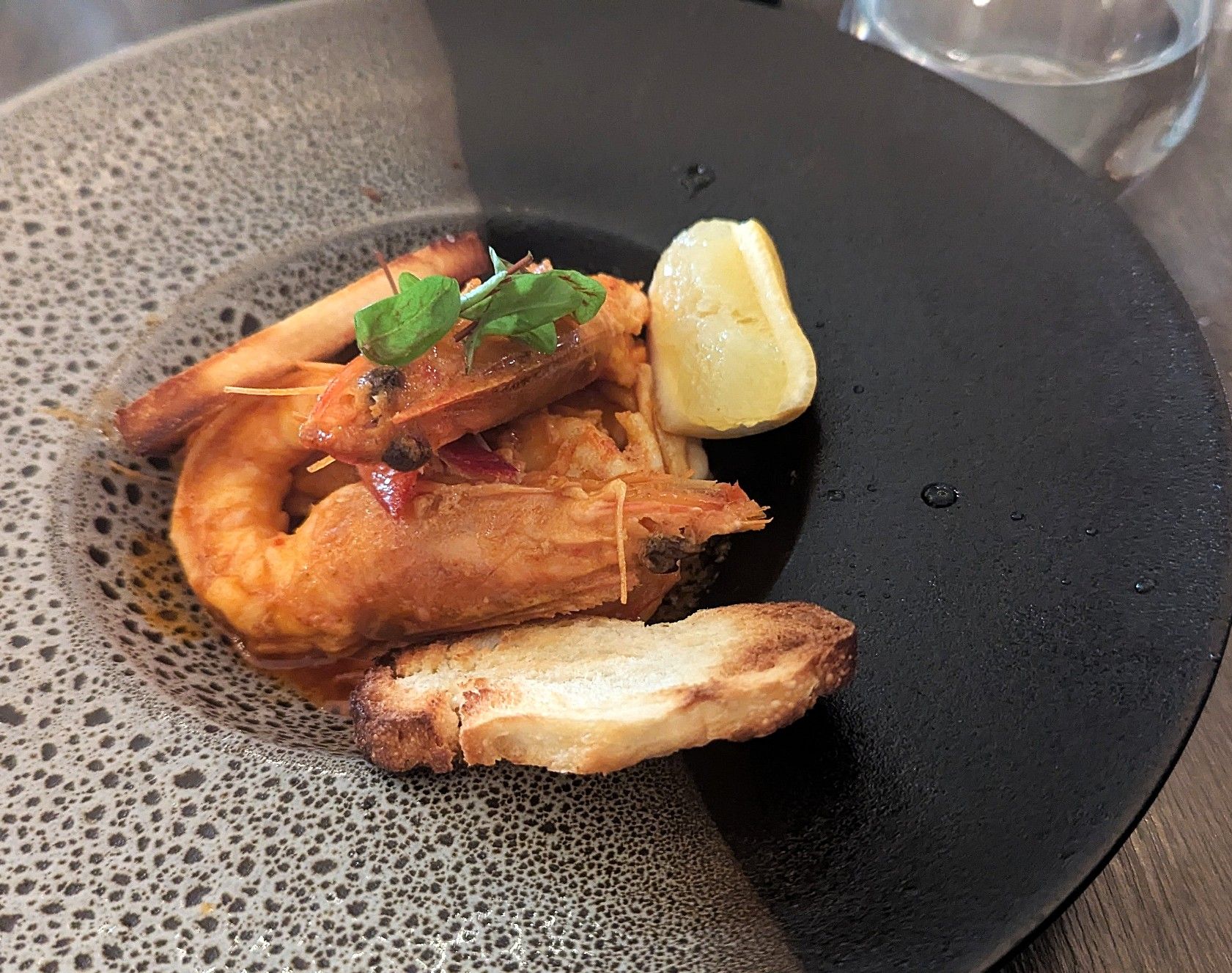
I haven’t been to Blackfire for ages, and this evening really wanted the king prawns that they serve as an entree. Fortunately, we were able to get in, although the restaurant filled rapidly as it neared 7.00pm. I had smoked mussels on bruschetta tapas – very nice indeed, and the prawns as my main course. As the prawns come with a Chilli sauce, I always indulge myself with mashed potato – and this was served with green beans which was an added delight. My friend enjoyed the empanadas and found the lamb ragu pasta excellent – and very generous. The coffees made a pleasant finish to the meal as we can no longer indulge in desserts (although I would have liked a chocolate with mine).



American Politics
No Kings
Joyce Vance from Civil Discourse <joycevance@substack.com>
Forwarded this email? Subscribe here for more
No KingsJoyce Vance Oct 18
People are protesting. It’s a march for our love: Democracy.
“Do marches really work?” I was asked last night. Absolutely. And we are all out there today, proving it. We can’t expect instant results for years of relentless damage to our country. But we are continuing to come together to fix it.
Signs from some of my favorite places.
Send me your pictures and let’s share our experiences with each other in the comments. It is a good day for us.
We’re in this together,
Joyce
‘Huge’ and ‘Massive’ Crowds for No Kings Rallies
The Daily with Sarah Jones <politicususa@substack.com> Unsubscribe
Forwarded this email? Subscribe here for more; 18 October 2025.
News coverage of the No Kings rallies keeps repeating the words “massive” and “huge,” saying this is bigger than the June protest and “quite the scene.”
While it’s too early for official numbers, outlets are reporting “huge” and “massive” crowds for No Kings rallies in larger cities on the East coast, which doesn’t take into account the many smaller rallies that are taking place in red areas, which might make an even bigger political statement than actual numbers.
October 19, 2025
Heather Cox Richardson from Letters from an American <heathercoxrichardson@substack.com>
Forwarded this email? Subscribe here for more
October 19, 2025Heather Cox RichardsonOct 20
All last week, Republican leaders tried to portray the No Kings protests scheduled for Saturday, October 18, as “Hate America” rallies. G. Elliott Morris of Strength in Numbers partnered with Atlanta-based science newsroom The Xylom to estimate that as many as 8.2 million people turned out yesterday to oppose the Trump administration. The mood at the protests was joyful and peaceful, with protesters holding signs that championed American principles of democracy, free speech, equality, and the rule of law. As the Grand Junction, Colorado, Daily Sentinel put it in a front-page headline: “‘This is America’ ‘No Kings’ protests against Trump bring a street party vibe to cities nationwide.”
Then last night, after the protests, the president’s social media account posted an AI-generated video showing Trump in a fighter jet with “KING TRUMP” painted on the side. The president sits in the airplane in front of something round that could be seen as a halo. He is wearing a gold crown; weirdly, the oxygen mask is over his mouth and chin, rather than mouth and nose.
Once in the air, the plane drops excrement on American cities, including what seems to be New York City. The excrement drenches protesters, one of whom is 23-year-old liberal political commentator and influencer Harry Sisson. Journalist Aaron Rupar of Public Notice, who shares media clips that reflect politics, commented: “Trump posts AI video showing him literally dumping sh*t on America.” Historian Larry Glickman noted that media outlets make much of alleged Democratic disdain for ordinary Americans, but have had little to say about the disdain for Americans embodied by Trump’s video.
Several administration videos and images have responded to Americans saying “No Kings” by taking the position “Yes, We Want Kings,” an open embrace of the end of democracy. But they are more than simple trolling. Led by Trump, MAGA Republicans have abandoned the idea of politics, which is the process of engaging in debate and negotiation to attract support and win power. What is left when a system loses the give and take of politics is force.
The idea that leaders must attract voters with reasoned arguments to win power and must concede power when their opponents win has been the central premise of American government since 1800. In that year, after a charged election in which each side accused the other of trying to destroy the country, Federalist John Adams turned the reins of government over to the leader of the opposition, Thomas Jefferson. That peaceful transfer of power not only protected the people, it protected leaders who had lost the support of voters, giving them a way to leave office safely and either retire or regroup to make another run at power.
The peaceful transfer of power symbolized the nation’s political system and became the hallmark of the United States of America. It lasted until January 6, 2021, when sitting president Trump refused to accept the voters’ election of Democrat Joe Biden, the leader of the opposition.
Now back in power, Trump and his loyalists are continuing to undermine the idea of politics, policies, and debate, trying instead to delegitimize the Democratic opposition altogether. Yesterday, during the protests, President Donald Trump, Vice President J.D Vance, and the official White House social media account posted a video of Trump placing a royal crown on his head, draping a royal robe around his shoulders, and unsheathing and brandishing a sword (an image that raises questions about why Trump wanted one of General Dwight D. Eisenhower’s swords so badly that he had the museum director who refused to hand it over fired). In the video, Democratic leaders including former House speaker Nancy Pelosi (D-CA) and what appears to be Senate minority leader Chuck Schumer (D-NY) first kneel and then bow to Trump.
Administration imagery doesn’t simply insult opposition leaders; it undermines the idea of politics by suggesting that Democrats are un-American. Last night the White House continued its racist crusade against Democratic leaders by posted an AI-generated image of Trump and Vance wearing jewel-encrusted crowns positioned above an image of House minority leader Hakeem Jeffries (D-NY) and Senate minority leader Chuck Schumer (D-NY) wearing Mexican sombreros. The caption reads: “We’re built different.”
The administration’s hostility to loyal opposition is translating into direct assaults on our government. House speaker Mike Johnson is refusing to seat a member of the opposition. Voters chose representative-elect Adelita Grijalva (D-AZ) on September 23 to fill a vacant House seat, but Johnson has come up with one reason after another not to seat her. Until she is sworn in, she has no access to government resources and cannot represent her constituents. She also cannot be the 218th signature on a discharge petition that would force a vote on whether to demand the release of the Epstein files, the final signature needed.
Grijalva recorded a video reinforcing the political system, saying: “We need to get to work, get on the floor, and negotiate so we can reopen the government.”
But Republican congressional leaders are refusing even to talk with Democrats to reopen the government, let alone to negotiate with them. They are trying to force Democrats simply to do as they say, despite the fact that 78% of Americans, including 59% of Republicans, support the Democrats’ demand for an extension of the tax credit that lowers the cost of healthcare premiums on the Affordable Care Act markets. Lindsay Wise, Anna Wilde Mathews, and Katy Stech Ferek of the Wall Street Journal reported today that more than three quarters of those who are insured through the ACA markets live in states that voted for Trump.
A video of Trump in a bomber attacking American cities carries an implied threat that the disdain of throwing excrement doesn’t erase. This morning, Trump reinforced that threat when he reminded Fox News Channel host Maria Bartiromo: “Don’t forget I can use the Insurrection Act. Fifty percent of the presidents almost have used that. And that’s unquestioned power. I choose not to, I’d rather do this, but I’m met constantly by fake politicians, politicians that think that, that you know they it’s not like a part of the radical left movement to have safety. These cities have to be safe.”
That “safety” apparently involves detaining U.S. citizens without due process. On Thursday, Nicole Foy of ProPublica reported that more than 170 U.S. citizens have been detained by immigration agents. She reports they “have been dragged, tackled, beaten, tased and shot by immigration agents. They’ve had their necks kneeled on. They’ve been held outside in the rain while in their underwear. At least three citizens were pregnant when agents detained them. One of those women had already had the door of her home blown off while Department of Homeland Security Secretary Kristi Noem watched.”On Friday, the Trump administration pushed its attempt to use the military in Democratic-led cities, asking the Supreme Court to let it deploy troops in Chicago immediately. Chris Geidner of Law Dork notes that four judges, two appointed by Democrats and two appointed by Republicans, have rejected the administration’s arguments for why they must send in troops. Now the Department of Justice has appealed to the Supreme Court, asking for a decision on the so-called shadow docket, which would provide a fast response, but one without any hearings or explanation.
The administration’s appeal to the Supreme Court warned that there was “pressing risk of violence” in Chicago—a premise the judges rejected—and said preventing Trump from going into the city “improperly impinges on the President’s authority.”
How much difference will the No Kings Day protests, even as big as they were, make in the face of the administration’s attempt to get rid of our democratic political system and replace it with authoritarianism? What good is an inflatable frog against federal agents?
Scholar of social movements Lisa Corrigan noted that large, fun marches full of art and music expand connections and make people more willing to take risks against growing state power. They build larger communities by creating new images that bring together recognizable images from the past in new ways, helping more people see themselves in such an opposition. The community and good feelings those gatherings develop help carry opposition through hard moments. Corrigan notes, too, that yesterday “every single rally (including in the small towns) was bigger than the surrounding police force available. That kind of image event is VERY IMPORTANT if you’re…demonstrating social coherence AGAINST a fascist government and its makeshift gestapo.”
Such rallies “bring together multigenerational groups and the playfulness can help create enthusiasm for big tent politics against the monoculture of fascism,” Corrigan writes. “The frogs (and unicorns and dinosaurs) will be defining ideographs of this period of struggle.”—
UPDATE 10:00 AM Oct. 19: After adding new data, our median estimate is 5.2 million, and the upper bound is 8.2. The numbers in this article have been updated. Future estimates will be updated on the spreadsheet, but not here…


Rachel Maddow Explains Why No Kings Could Soon Reach Critical Mass And Topple Trump
Rachel Maddow dove into the numbers behind what the No Kings protests mean and how they could topple Trump’s wannabe regime.
Oct 21, 2025

It isn’t certain yet whether No Kings is a protest movement or a political movement. No Kings will need to transfer its momentum into electoral success to get results, but right now, No Kings is building fast towards critical mass.
Maddow said while discussing what makes No Kings different from other protests:
We’ve talked to them (Indivisible) a lot, many times going back years. You might also have noticed that every time we talk to the folks from Indivisible, going back to the very beginning, uh, they emphasize one specific thing. They emphasize thinking local. So for these No Kings protests, for example, they said if you have to travel more than an hour in order to get to your nearest No Kings protest, then don’t do that.
Don’t travel more than an hour.
If you have to go more than an hour to find one, that means you should be organizing your own wherever it is that you live. Now that is not generic protest advice, that is very specific to this movement and it has specific consequences in practical terms following that principle.
This weekend looked like this not one giant protest in one central place, even though there were some really big protests in some places. Instead though, it was, it was a gazillion different protests. Yes, in some big cities, but also in small towns, in every nook and cranny, all across this country.
Australian Politics
The Australian’s post (from Facebook)
The Australian
Opinion: Donald Trump has come through in spades for Anthony Albanese after locking in the $368bn AUKUS pact, signing-off on an $8.5bn critical minerals deal and waxing lyrical about the Prime Minister. Read more: https://bit.ly/4qs62tR

!!!!!
The post below is an interesting reflection on a song sung at many schools in Australia and the choice of our National Anthem. The writer refers to South Australians singing this song. However, it was also sung in Western Australian schools, and the Facebook comments recalling the song come from other states as well. They also suggest that it is preferred to the chosen national anthem.
Lainie Anderson Author’s post

South Aussies, who remembers Song of Australia?
There is a land where summer skies
Are gleaming with a thousand dyes,
Blending in witching harmonies, in harmonies;
And grassy knoll and forest height
Are flushing in the rosy light,
And all above is azure bright.
Australia, Australia, Australia!
I found it on my recent research trip to the West Terrace Cemetery, and it took me straight back to primary school in Port Vincent. The lyrics were written in 1859 by Adelaide poet and teacher Caroline Carleton, wife of the West Terrace Cemetery sexton (it’s believed she wrote the piece while sitting in the cemetery). The music was written by German immigrant and composer Carl Linger, who helped to create Adelaide’s first philharmonic orchestra.
Hugely popular in SA, it was sung in all public schools from the 1880s right through to the late 20th century. It was one of four songs put to a public vote to choose our official national song in 1977 (the others were God Save the Queen(!!), Advance Australia Fair and Waltzing Matilda). Song of Australia won the South Aussie vote but came fourth overall. Advance Australia Fair became the national anthem in 1984.
Brilliant and Bold – Bold and Brilliant
CONVERSATIONS WITH ‘ORDINARY’ & ‘EXTRAORDINARY’ WOMEN
This meeting on zoom was held on Sunday 19 October and is available on Jocelynne’s Scutt’s Facebook feed.
The flyer (edited) read:
International Struggles for Women’s Autonomy –
Iran, Nepal, and Women & Girls Living Under Occupation
Today, women of Nepal and women of Iran are focused on restoring democracy, freedom, security and peace to their respective countries.
Brilliant & Bold! has a prime opportunity this month of October 2025 to hear from women of the diaspora who are campaigning for democratic rights in Iran and Nepal, and to learn of a campaign for the UN to create the
post of Special Rapporteur for Women and Girls Living Under Occupation (WAGLUO).
The speakers were: Elahr Zibabi, from Iran, is living in London, and is a part of the Iranian diaspora campaigning for freedom, justice, security, democracy and peace for Iran.
Benzu Laxmii Oli, from Nepal, is living in Perth, Western Australia, and engaged in activism directed toward ensuring that women and girls live with freedom and equality, secure in the knowledge that they are entitled to dwell in the land of their birth without fear.
Arising from the discussion, I heard about Sue Crampton’s book, Behind the Oleander, which I was able to purchase during the meeting on my kindle.

 Robin's Room