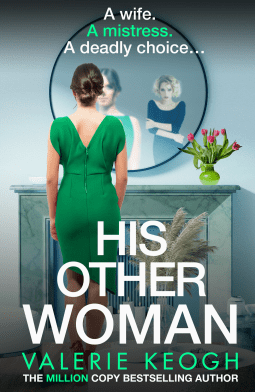
Valerie Keogh, His Other Woman, Boldwood Books, November 2025.
Thank you, NetGalley and Boldwood Books, for this uncorrected proof for review.
Valeria Keogh’s books always have a twist that logically follows the storyline, rather than emerging from nowhere; she always has an intriguing plot; and her writing is always not only engaging but grammatical. Certainly, she stands out from the crowd with these features. But where she truly excels is in her character development. Keogh is brilliant at developing unpleasant characters, seemingly with little to redeem them. However, somehow these flawed beings become people with whom one wants to engage, to see where their flaws lead them with the hope that they will redeem themselves. Vain hope though this usually is, they almost become people for whom one wishes a positive result. Sometimes, as awful as they undoubtably are, there is no doubt that one wishes them well! See Books: Reviews for the complete review.

Keith Warren Lloyd The War Correspondents The Incredible Stories of the Brave Men and Women Who Covered the Fight Against Hitler’s Germany The Globe Pequot Publishing Group, Inc. | Lyons Press, October 2025.
Thank you, NetGalley, for providing me with this uncorrected proof for review.
This is a somewhat sprawling memorial to the Second World War correspondents, with its combination of detailed historical events as well as the stories of those who covered them – the war correspondents. The latter includes work undertaken by correspondents in general, and those who are named. There are correspondents whose platform was the print media, others who filmed events, photographers, and graphic artists. Named correspondents include Ernie Pyle, John Steinbeck, Walter Cronkite, Edward R. Murrow, Ernest Hemingway, Bill Mauldin, Robert Capa, Margaret Bourke-White, Andy Rooney, Martha Gellhorn and Richard Tregaskis. See Books: Reviews for the complete review.
Set Menus On London Rooftops
London’s packed with incredible rooftop restaurants that allow you to see the Big Smoke in all its glory, with everything from a tropical paradise sitting 14 floors up to terraces with insane views of St Paul’s Cathedral.
Better yet, a lot of these incredible sky-high eateries offer a delicious set menu, meaning breaking the bank isn’t necessary. Here is our guide to the best set menus at rooftop restaurants in London. Last edited by Lisa Moore Last updated on 21st May 2025

Perched on the roof of No.1 Poultry, Coq D’Argent …commands spectacular views across the City and landmarks such as St Paul’s Cathedral, Mansion House, Monument and the Bank of England…[serving] delicious French cooking…an impressive wine and cocktail list…

Set in a prime location just off Regent Street and with a stunning covered rooftop terrace, Aqua Kyoto …Serves deliciously unique Japanese dishes alongside carefully crafted cocktails…[presenting] a combination of omakase sushi and sashimi, alongside signature dishes including the mouth-watering rock shrimp tempura and specials from the robata grill. The selection of bento boxes are the perfect pick-me up whilst shopping in the West End, whilst the popular free flow brunches on Saturdays and Sundays needs to be booked well in advance.
https://www.designmynight.com/london/bars/city-of-london/wagtail-rooftop-bar-restaurant
Welcome to Wagtail, our Rooftop Bar and Restaurant, nestled in the eaves of one of the City’s grandest art deco buildings…escape to the skies with unparalleled views, fine wine, exquisite cocktails and delicious food – morning, day, and night. Experts in curating merriment, mischief, and memorable moments. Our late-night license, and resident DJ evenings are the perfect excuse to stay and relax until the early hours.
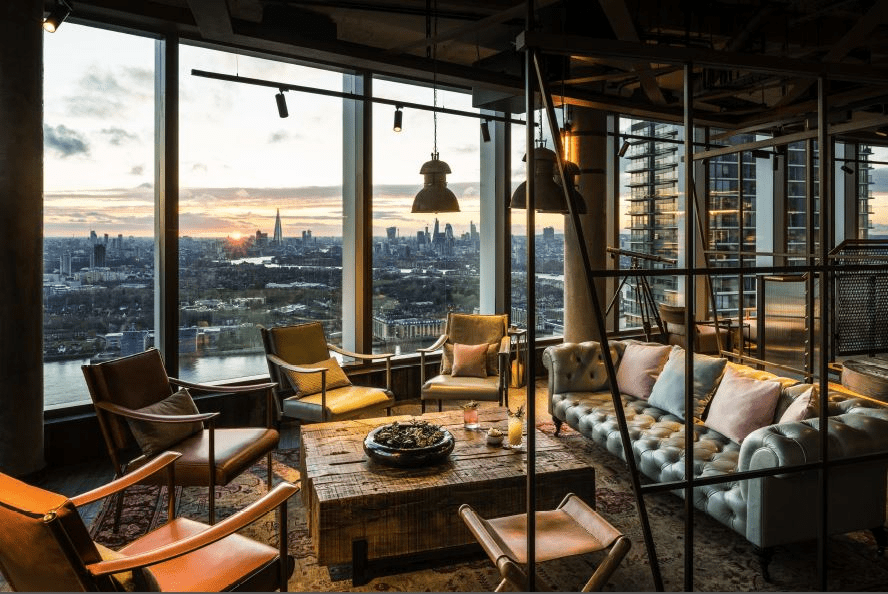
Based on the top of the suave Novotel Hotel in Canary Wharf, Bōkan is an elegant restaurant-bar that’s spread across three opulent floors and boasts a stunning roof terrace… Of course, the food and drinks menu is everything here. Offering both light bar nibbles and belly-filling main dishes, the chefs have curated a menu of classic European dishes, each of which have had a British twist added to them. From flavoursome cheese boards and charcuterie, to mains such as seasoned Lamb shank and line-caught British Cod, the menu caters for whatever mood you might find yourself in. Rounding things off nicely, the talented mixologists hope their array of cocktails prove to be the perfect companion for a serene night on the roof terrace. With views overlooking the whole of London, it’s the ideal spot to unwind and escape the ever-humming city below.

Nestled atop the Page 8 Hotel in the heart of London’s vibrant West End, Kitty Hawk invites you to an extraordinary escape from the city’s dynamic pace. Here, every detail is crafted to create an unforgettable experience, where the energy of London below meets the serenity of an elegant rooftop retreat.
Whether guests are indulging in an exquisite pre-theatre menu, embracing the weekend with a luxurious free-flowing brunch, discovering a new go-to spot for socialising, or simply unwinding with a signature cocktail expertly crafted by our mixologists, Kitty Hawk transforms each moment into a lasting memory…
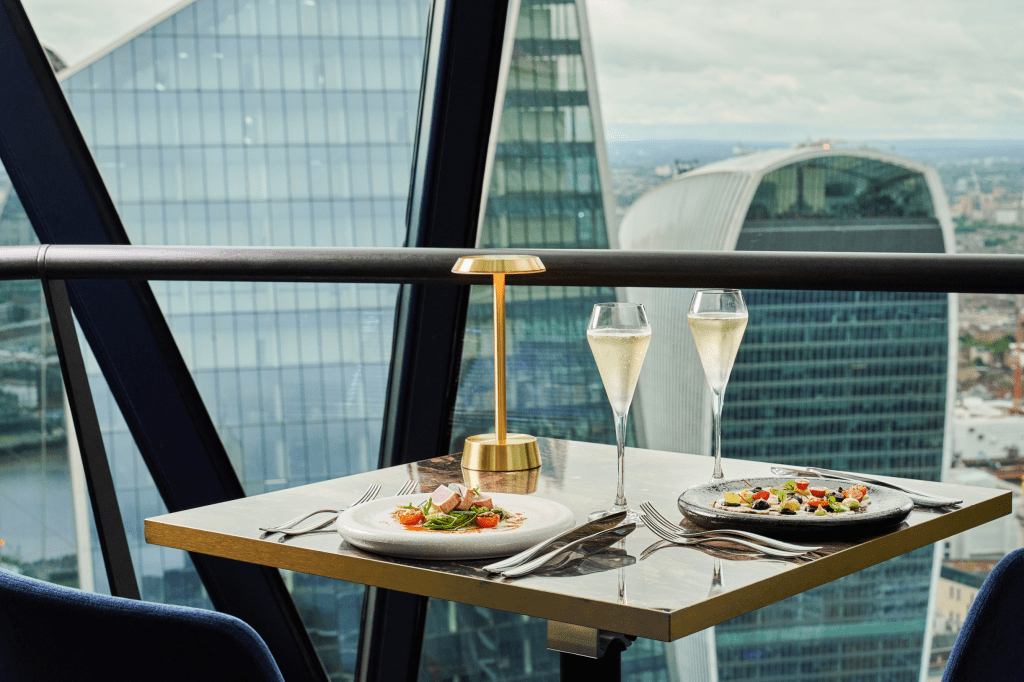
There are few places in London to watch the glorious sunset with 360° degrees of the City…Searcys Helix restaurant at The Gherkin, pairs high-end design with contemporary cooking and Champagne, all while enjoying panoramic views from the top of one of London’s most iconic skyscrapers, offering seasonal set dinners and a sky-high afternoon tea that’s not to miss…
Listed as one of the 50 Most Beautiful Cafes by Chris Moss. Another Pym moment –
Kardomah, Swansea
Story by Chris Moss

Not the original Swansea Kardomah – Hitler put paid to that in 1941 – but it feels and looks like it. Opened in 1957, this wonderful, spacious, family-friendly café-restaurant still has original wood panelling, tiled floor and deco-ish reliefs, providing a nostalgia fix for its many senior clients. As further proof that caffs are about time-travel, Doctor Who used the Kardomah as a location and Russell T Davies has been spotted sipping here. The old Castle St “Kardomah Gang” included Dylan Thomas, Alfred Janes and Vernon Watkins; this one is frequented by the people they wrote about and painted.
Morris Buildings, 11 Portland St (kardomahcafe.com)
Our Story

Welcome, at the Kardomah Cafe we have a long history of excellent service, great food and wonderful coffee. We are an independent, established, family run business of nearly 50 years. Traditional values are important to us and have helped us create a warm and friendly atmosphere, which is seen by many of our customers as an important part of their lives, a place to meet their friends, whilst enjoying quality food and drink.
Australian Politics
On November 11, 1975 I watched history being made, from the best seats in the house By Michelle Grattan From The Conversation
In his just-released memoir, historian and former diplomat Lachlan Strahan recalls being picked up from his Melbourne primary school by a neighbour on November 11 1975, the day Gough Whitlam was sacked as prime minister. His politically active mother “was so upset she didn’t trust herself behind the wheel”.
Journalist Margo Kingston was a teenager and not political at the time. She remembers going to bed that night, pulling the covers over her head and listening on the radio. The next day, she organised a march around her Brisbane school.
The Dismissal is one of those “memory moments” for many Australians who were adults or even children when it happened. They can tell you what they were doing when they heard the news. It was an event that embedded itself in the mind, like news of US President John F. Kennedy’s assassination more than a decade earlier.
This was a life-changing day for many who worked in Canberra’s Parliament House. For Labor politicians and staffers, it bordered on bereavement. Excitement and elation fired up the other side of politics. Those of us in the parliamentary press gallery knew we had front-row tickets for the biggest show in our federation’s history.
Pressure points were everywhere
The Dismissal didn’t come out of nowhere. It followed extraordinarily tense weeks of political manoeuvring, after the opposition, led by Malcolm Fraser, blocked the budget in the Senate in mid-October, and Whitlam refused to call an election.
Pressure points were everywhere. Would Whitlam give in? Would some Liberal senators crack? What would happen if there was no resolution before the government’s money ran out? Would Governor-General John Kerr intervene?
On the morning of Remembrance Day, Whitlam prepared to ask Kerr for an election. Not a general election, but an election for half the Senate — a course that would have little or no prospect of solving the crisis. But Whitlam had fatally misjudged the man he’d appointed governor-general. Kerr was already readying himself to dismiss the prime minister. He gave Whitlam his marching orders at Government House at 1 pm.
That afternoon Whitlam, eyes flashing, deployed his unforgettable rhetoric on the steps of parliament house. “Well may we say God Save the Queen, because nothing will save the governor-general”, he told the crowd, denouncing Fraser as “Kerr’s cur”.
Demonstrators were pouring into Canberra; shredders were revving up in parliamentary offices. That night at Charlie’s restaurant, a famous Canberra watering hole, the Labor faithful and journalists gathered. Many still in shock and emotional, patrons were packed cheek by jowl. See Further Commentary and Articles arising from Books* and continued longer articles as noted in the blog. for the complete article.
The New Daily
Conservative parties should not offer cover for racists

Craig Emerson
Sep 08, 2025, updated Sep 08, 2025
Among all the differences between Australia’s conservative and progressive parties, conservative parties too often have purposefully or unwittingly provided shelter for racists.
One of the first laws passed by the new Australian parliament in 1901 was the Immigration Restriction Act, which implemented the White Australia Policy. It enjoyed the support of all the major political parties for decades, until Liberal prime minister Harold Holt began dismantling it in practice.
His good work was followed by that of John Gorton and Billy McMahon. In 1973, Labor prime Minister gough Whitlam removed it from the statute books.
Yet from time to time, Coalition parliamentarians have sought political advantage in reviving race-based politics.
Most recently, Senator Jacinta Nampijinpa Price – who contested the deputy leadership of the Liberal Party only a couple of months ago – claimed the Albanese government had favoured Indian migrants because they tended to vote Labor.
Despite retracting these comments under pressure from within her own party, Price has refused to apologise for them.
To their great credit, Liberal leader Sussan Ley and Senator Dave Sharma repudiated Price’s comments. Indeed, there is no suggestion that Ley is racist. On the contrary, she seems a very decent person.
Whatever Price’s motivations in singling out Indian nationals in Australia’s immigration program, she has succeeded only in infuriating the Indian community.
Behind India, our next-largest source country for migrants is China. Again, leading Coalition parliamentarians have managed to insult Chinese Australians.
During the recent federal election campaign Liberal shadow minister Jane Hume remarked that there “might be Chinese spies handing out” how-to-vote cards for Labor minister Clare O’Neil.
A video of these remarks was reportedly viewed on WeChat up to 500,000 times in just 24 hours.
Many in the Chinese community appeared to draw the conclusion that the Liberal Party just didn’t trust them. Labor held all its seats with large Chinese Australian enrolments and won at least one (Menzies) from the Liberals.
The Hume and Price controversies might be considered isolated incidents. But they are not. At the 2025 election the Liberal Party did a preference deal with One Nation.
Back in 1988, John Howard had told radio talkback hosts that he considered the rate of Asian immigration too high.
At the time I was a staffer to Bob Hawke. Hawke’s anger with Howard was palpable. Howard repeated his comments over several days, hoping to gain a political advantage for himself and the Liberal Party.
Hawke considered Howard’s opening of a political battlefront based on race reprehensible. He drafted a resolution to be debated in Parliament reaffirming its commitment to a non-discriminatory immigration policy.
The resolution acknowledged that a Liberal government, under Holt’s leadership, had been the first Australian government to adopt the principle of non-discrimination based on race.
Hawke asked me to sit in the advisers’ box as he spoke. I listened to his passionate speech as he expressed his deep beliefs, engendered in him by his father, Clem, a Christian preacher.
Three Liberals crossed the floor to vote with Labor, including a backbencher, Philip Ruddock, who later became immigration minister in the Howard government.
Add to this episode the false claims during the 2001 election campaign that asylum seekers had thrown their children overboard.
Howard insists he was not told before polling day that the claims were incorrect. But Liberal ministers were told. It didn’t suit them to correct the record.
In 2018, then home affairs minister Peter Dutton, who years earlier had left the chamber ahead of the apology to the Stolen Generations, inserted himself into the Victorian state election campaign by claiming that Victorians were scared to go out to restaurants because of “African gang violence.”
Not just gang violence but African gang violence.
All these interventions and remarks can be viewed in the context of the recent anti-immigration marches.
Public discussion about the level of immigration is perfectly legitimate and, indeed, desirable. But rally organisers handing their microphones to neo-Nazis is not.
Yes, there has been a lift in migrant arrivals, peaking in 2023 but subsequently subsiding. This was a catch-up for the Covid-period border closures.
Looking at migrant arrivals in the four pre-Covid years to the end of June 2020, they averaged 531,000 – under a Coalition government.
In the subsequent four years for which data is available, they averaged 495,000 – a reduction on the pre-Covid years.
Australia doesn’t have an immigration program purely out of good heartedness. We need migrants to freshen up the age profile of our population so that we don’t have too few young people earning the incomes and paying the taxes to support older Australians in retirement. Successive intergenerational reports released by Coalition and Labor governments have told us that.
And we need younger migrants to fill skill shortages, such as nurses, physiotherapists and aged-care workers, as well as carpenters, electricians, plumbers, bricklayers and welders to build apartments and houses.
So, let’s discuss the size and skills composition of our immigration program but also try to make it an informed discussion. And may the discussion not be a ready-made platform for white supremacists and other assorted racists.
And let’s give credit where it is due. Among other Coalition leaders who have repudiated the use of race as a political weapon and have supported multiculturalism are Tim Fischer, Malcolm Turnbull and David Littleproud.
Craig Emerson is managing director of Emerson Economics. He was a minister in the previous Labor government and an adviser to prime minister Bob Hawke.

‘Definitely positives and negatives’: Industry considers details of local content quota legislation
Sean Slatter· NewsTV & Streaming ·November 14, 2025
The industry is dissecting the details of the government’s proposed local content obligations for streaming services, following the legislation’s introduction to Parliament last Thursday, expressing cautious optimism while acknowledging the limits of the proposed framework.
After a surprise Melbourne Cup Day announcement that the government would be moving ahead with a long-held promise from its Revive National Cultural Policy, Arts Minister Tony Burke tabled the Communications Legislation Amendment (Australian Content Requirement for Subscription Video On Demand (Streaming) Services) Bill 2025 two days later, setting up a potential vote during the final parliamentary sitting week at the end of this month.
The framework would require services with more than 1 million subscribers to commit 10 per cent of their total program expenditure for Australia on new Australian programming for their services. Alternatively, there is a voluntary option to calculate the obligation as 7.5 per cent of their Australian revenue.
To be eligible, a program must come under drama, children’s, documentary, arts, and educational genres, and be classified as an Australian program; a New Zealand program; an Australian/New Zealand program; or an Australian official co-production. The Act will make use of definitions set out in the Broadcasting Services (Australian Content and Children’s Television) Standards 2020.
In an echo of the previous government’s proposed Streaming Services Reporting and Investment Scheme, SVOD services would be required to submit annual reports to the Australian Communications and Media Authority (ACMA), which may administer civil penalties if requirements are not met. Services are allowed a three-year carry over period for the acquittal of program expenditure, while smaller services that have at least 250,000 subscribers must provide notifications to the ACMA. A statutory review is to be conducted four years after the requirements commence.
In introducing the legislation last Thursday, Burke said the legislation was “not a criticism of the streaming businesses in Australia”, but an “endorsement of Australian stories, a celebration of Australian creatives, and a show of respect for the Australian audience”.
“This bill will guarantee Australians will have access to Australian stories now and into the future,” he said.
“It will ensure that no matter which remote control you are holding, Australian stories will be at your fingertips. Australians will see themselves, know each other, and the world will meet us.”
Only one major SVOD service, Paramount+, has commented on the bill so far, while it was widely welcomed by the industry guilds when first announced last Tuesday.
RMIT Digital Communication lecturer Alexa Scarlata was among those to speak out following the legislation’s introduction to parliament, describing it as a “positive step” but noting that it did not set out a specific quantity of content that streamers will be required to make, or outline any local content promotion requirements – provisions that appear in similar legislation in territories like Canada.
Speaking to IF, Scarlata said the prominence question would need to be tackled “a couple of years down the line” with further clarity around eligible programs “priority number one”.
‘Once they start making things and we start doing research about how visible they are to Australians and whether or not they’re actually buried, that’s when we can deal with prominence,” she said.
“I think the key issue right now is the interpretation of eligible programs. It’s great that they’re focused on key genres, but how much do they have to actually make within those genres? Do they have to make one of everything? Do they have to, or can they just fulfill their obligation producing one documentary or one kid’s show?”
In its Explanatory Memoranda for the bill, the government outlines how a 10 per cent programming expenditure model might operate, using a simplified example of an SVOD with 1 million Australian subscribers generating $150 million in annual revenue, of which around $60 million (40 per cent) is typically spent on programming.
While noting this would vary from company to company, depending on the scale of operation, ownership structure, programming strategies, the memorandum estimates that applying this 10 per cent requirement across all major SVODs would result in a total annual spend of $175-$200 million on new Australian content. It argues this would be “consistent with the current expenditure for Australian adult drama, children’s and documentary programs by SVODs, which is an average of $193.4 million”.
Maintaining the status quo is unlikely to satisfy parts of the sector, many of whom have reported a decline or disruption to their levels of work after the initial deadline for the legislation lapsed.
Screen Producers Australia (SPA) has been at the forefront of the industry’s lobbying efforts, something that was acknowledged by Burke during his speech on Thursday.
CEO Matthew Deaner said there were “definitely positives and negatives in the bill for Australia’s screen businesses”.
“This is a very important step forward for our industry, one we’ve been advocating for over a decade, but on its own it’s not going to address the decline in commissioning of Australian screen stories that has resulted from the delayed legislation,” he said.
“On the positive side, the bill in large part delivers on the government’s commitment to audiences and industry in our National Cultural Policy, Revive. But like all complex reforms, the implementation will matter. SPA will be closely examining this and identifying areas for further action.”
“This legislation creates a framework where streaming platforms finally have quite specific obligations to contribute meaningfully to commissioning Australian content, but it’s only a small but important part of what is needed to rebuild a thriving screen sector.
“The data that will be generated from this regulation will be the start of a new phase of accountability where the real test will be how these rules work in practice and whether they genuinely bring more Australian stories to screen.”
It’s a question also being posed by independent MP Zali Steggall, who conducted a roundtable with industry members earlier this year and has since been a key advocate for the Save Australian Stories campaign.
In a statement to IF, she said she would “continue to advocate strongly to ensure Australian culture, creativity and national identity remain prominent on our screens”.
“I’m pleased the Albanese government has moved to ensure global streaming giants are legally required to invest in Australian stories,” she said.
“Details of the requirements to be imposed on streaming companies are yet to be worked out. I have sought a meeting with Arts Minister Tony Burke to ensure the final legislation delivers for the Australian screen industry and audiences. I look forward to discussing with the Minister the percentage of revenue and expenditure streamers would be required to invest locally, and how these calculations were reached.”
American Politics
An opinion on the re-opening I find plausible below:
Juliet Castille-Cooke
“Before going ballistic about the reopening agreement please read this
Meg Rodham Wolfers:
“It looks like a key group of Senate Democrats are closing a deal to end the shutdown in return for an agreement from Majority Leader Thune to hold a vote on extending the ACA expanded subsidies in December.
At first glance, this may provoke a “Hunh? What are they thinking?”
But whenever the House or Senate Democrats do anything that doesn’t look quite right to me, I dig deeper to figure out the reason for it. Because I don’t automatically assume that the Dems are weak or complicit or stupid. I figure there’s something deeper at play – and more often than not, I’m right.
And it looks like they could be the case here
Some folks are already melting down and accusing the Dems of caving because they say they get nothing out of a deal that includes
“Everyone knows the vote will fail, so they get nothing!!! Dems caved again!”
But wait – let’s do a deeper dive. You will see that that getting that agreement is a brilliant strategic move, even if the vote fails.
Consider:
1. The ACA enhanced subsidies are set to automatically sunset in December if no Congressional action is taken to extend them. If there is no deal before then, they just go away on their own.
2. There was no way in hell the Republicans were going to agree to extend the subsidies, no matter how firmly the Democrats held their ground.
3. If the Democrats insisted on keeping the government closed in order to protect the subsidies, at the end of December, the subsidies would have gone away, the Dems would have gotten nothing, and people would have suffered an extended shutdown without getting anything in return.
And this would have happened without the Republicans having to do anything and bearing no responsibility for the subdidies’ disappearance.
4. When the subsidies disappeared in December, people who are affected would have blamed the Democrats, not the Republicans.
5. By exacting an agreement from Thune for a vote to extend the subsidies, the Democrats are now forcing the Republicans to AFFIRMATIVELY end the subsidies rather than just letting them die a natural death. Every Republican will have to go on record, while every Democrat can be on record voting “YES.”
6. While it is possible that every Republican will vote no, it is possible that the Dems could peel off enough Republicans to vote to extend the subsidies. It would only take a couple and if they put the pressure on over the next few weeks, that could actually happen.
7. If the Democrats can get enough Republicans votes to save the subsidies, that will be a huge win.
8. If the Republicans stand firm and vote no, THEY will own the expiration of the subsidies, not the Democrats.
The bottom line is that the subsidies were going to end in December, no matter what the Dems did. But now, if this deal goes through, if they do end, it will be because the Republicans voted not to extend them, not because they quietly went away. And if they can get enough Republicans on board – which is more possible than it was even just a week ago – they will save the subsidies
The vote will ensure that either the subsidies are extended or the Republicans’ fingerprints are all over the expiration – neither of which could happen without holding a vote.
So, I think we need to back off of the condemnation and attacks and shift our focus toward what we can do to help the Democrats get the Republican votes they need to extend the ACA enhanced subsidies.
Of course, I could be completely wrong in my analysis. I don’t yet know what the underlying reasons are or the ramifications will be.
But drawing the conclusion that the Democrats are operating with a smart strategy is far more logical than assuming they are clueless traitors.
I have more than enough reason to give them the benefit of the doubt.
I think we all should.”
Heather Cox Richardson from Letters from an American <heathercoxrichardson@substack.com> 14 Sept 2025, 16:34
President Donald J. Trump has been trying to remove Federal Reserve governor Lisa Cook from the board of governors, alleging she lied on a mortgage application by claiming two homes as primary residences, which could garner a lower interest rate. Yesterday Chris Prentice and Marisa Taylor of Reuters reported that documents show that, in fact, Cook told the lender who provided a mortgage that a property in Georgia for which she was obtaining a loan would be a “vacation home.”
It appears the documents that director of the Federal Housing Finance Agency Bill Pulte used to accuse her of mortgage fraud were standardized forms that her personal application specifying the house was a second home overrode. It also appears that Cook never applied for a primary residence tax exemption for the Georgia home and that she referred to the home on official documents as a “2nd home.”
In contrast, Reuters reported last week that unlike Cook, Pulte’s own father and stepmother claimed primary residence tax exemptions for two homes in different states. When that news broke, one of the towns in which they reside removed their primary residence exemption and charged them for back taxes.
Trump hoped to use the allegations against Cook to advance his control of the Federal Reserve. Now the revelation that those allegations appear to be false highlights the degree to which this administration is attempting to achieve control of the country by pushing a false narrative and getting what its officers want before reality catches up. Senator Joe McCarthy (R-WI) pioneered this technique in the 1950s when he would grab media attention with outrageous statements and outright lies that destroyed lives, then flit to the next target, leaving fact checkers panting in his wake. By the time they proved he was lying, the news cycle had leaped far ahead, and the corrections got nowhere near the attention the lies had.
While McCarthy eventually went down in disgrace, the right wing adopted his techniques of controlling politics by creating a narrative. Spin turned into a narrative that denigrated opponents as anti-American, and then into the attempt to construct a fictional world that they could make real so long as they could convince voters to believe in it. In 2004, a senior advisor to President George W. Bush told journalist Ron Suskind that people like him—Suskind—lived in “the reality-based community”: they believed people could find solutions based on their observations and careful study of discernable reality. But, the aide continued, such a worldview was obsolete.“That’s not the way the world really works anymore,” the aide said. “We are an empire now, and when we act, we create our own reality. And while you’re studying that reality—judiciously, as you will—we’ll act again, creating other new realities, which you can study too, and that’s how things will sort out. We’re history’s actors…and you, all of you, will be left to just study what we do.”But once you have untethered the political narrative from reality, you are at the mercy of anyone who can commandeer that narrative.
In the wake of the murder of right-wing activist Charlie Kirk in Utah on Wednesday, the radical right is working to distort the country’s understanding of what happened. Long before any information emerged about who the shooter was, the president and prominent right-wing figures claimed that “the Left,” or Democrats, or just “THEY,” had assassinated Kirk.
White House deputy chief of staff Stephen Miller posted an attack on his political opponents on social media: “There is an ideology that has steadily been growing in this country which hates everything that is good, righteous and beautiful and celebrates everything that is warped, twisted and depraved. It is an ideology at war with family and nature. It is envious, malicious, and soulless. It is an ideology that looks upon the perfect family with bitter rage while embracing the serial criminal with tender warmth. Its adherents organize constantly to tear down and destroy every mark of grace and beauty while lifting up everything monstrous and foul. It is an ideology that leads, always, inevitably and willfully, to violence—violence against those [who] uphold order, who uphold faith, who uphold family, who uphold all that is noble and virtuous in this world. It is an ideology whose one unifying thread is the insatiable thirst for destruction.”But in fact, the alleged shooter was not someone on the left. The alleged killer, Tyler Robinson, is a young white man from a Republican, gun enthusiast family, who appears to have embraced the far right, disliking Kirk for being insufficiently radical.Rather than grappling with reality, right-wing figures are using Kirk’s murder to prop up their fictional world. Briefly, they claimed Robinson had been “radicalized” in college. Then, when it turned out he had spent only a single semester at a liberal arts college before going to trade school, MAGA pivoted to attack those who allegedly had celebrated Kirk’s death on social media.
This morning, Miller posted: “In recent days we have learned just how many Americans in positions of authority—child services, law clerks, hospital nurses, teachers, gov[ernmen]t workers, even [Department of Defense] employees—have been deeply and violently radicalized. The consequence of a vast, organized ecosystem of indoctrination.”
Today, billionaire Elon Musk, who just months ago was a key figure in the White House, reposted a spreadsheet of “people who’ve said vile things” about Kirk’s murder. Over the list, he wrote: “They are the ones poisoning the minds of our children.” “So far, teachers and professors are by far the most represented,” the author of the list wrote.
Across the country, educators have been suspended or fired for posting opinions on social media that commented on Kirk’s death in ways officials deemed inappropriate. Legal analyst Asha Rangappa noted that “Americans are being conditioned to be snitches on their fellow citizens who don’t toe a party line on what is ‘allowed’ to be expressed. And employers are going along. It’s the new secret police.”
The deliberate attempt to create a narrative centering around “us” and “them” and to mobilize violence against that other was on display today when Musk told a giant anti-immigrant rally in the United Kingdom: “You’re in a fundamental situation here…where whether you choose violence or not, violence is coming to you. You either fight back or you die. You either fight back or you die. And that’s the truth.”
Of course, that is not the truth. It is a classic case of dividing the world into friends and enemies—a tactic suggested by Nazi political theorist Carl Schmitt—and inciting violence against newly identified enemies by claiming it is imperative to preempt them from using violence against your friends. Miller has vowed to use the power of the government not against the far right, where the violence that killed Kirk appears to have originated, but against MAGA’s political enemies. Flipping victims and offenders, he called his political opponents “domestic terrorists” and warned: “[T]he power of law enforcement under President Trump’s leadership will be used to find you, will be used to take away your money, take away your power, and, if you’ve broken the law, to take away your freedom.”
Where that kind of rhetoric takes a society showed on the Fox News Channel’s Fox & Friends Friday, when host Brian Kilmeade suggested the way to address homelessness was through “involuntary lethal injection. Or something. Just kill them.” When asked “why did we have to get to this point,” he answered: “we’re not voting for the right people.”
And that’s the heart of it. The radical right is frustrated because a majority continues to oppose them. According to Elliott Morris of Strength in Numbers, Trump’s job approval rating is just 42.3% with 53.6% disapproving, and more people disapprove of all of his policies than approve of them. Unable to control the country through the machinery of democracy when it operates fairly and afraid voters will turn them out in 2026, Republicans are working to make the system even more rigged than it already is: just yesterday, Missouri lawmakers approved a mid-decade gerrymander to turn one of the state’s two Democratic seats into a Republican one.
Right now, Trump and his loyalists control all three branches of government, but Trump is not delivering what his supporters believe his fictional vision of his presidency promised. Trump telegraphed great strength and vowed he could end Russia’s war against Ukraine with a single phone call, for example. When he failed to get any buy-in at all from Russia’s president Vladimir Putin for his proposals, Trump threatened to impose strong new sanctions against Russia. This afternoon he backed away from that altogether, saying he would issue sanctions on Russia only after all NATO nations stopped buying oil from Russia and placed 50% to 100% tariffs on China. “This is not TRUMP’S WAR (it would never have started if I was President!), it is Biden’s and Zelenskyy’s WAR,” he posted.
This latest retreat from his threats against Russia after all his previous empty threats makes Trump’s claims of strength ring hollow. Russia is increasing its attacks on Ukraine, and today NATO member Romania scrambled jets when a Russian drone breached its airspace. Polish and NATO aircraft were deployed today to protect Polish airspace as well.
As Trump’s narrative falters on this and so many other fronts, MAGA is moving to the violence of the far right to achieve what he cannot. In that, they are fueled by the right-wing disinformation machine that is whitewashing Kirk’s racism, sexism, and attacks on those he disagreed with and instead portraying Kirk simply as a Christian motivational speaker attacked by a rabid left wing. Trump’s vow to award Kirk the nation’s highest civilian honor, the Presidential Medal of Freedom, posthumously reinforces that image.
The refusal of Republican lawmakers to challenge MAGA’s creation of its own reality has opened the way for believers to try to put that world into place through violence. Their victory would end the rule of law on which the United States was founded and base the government on the whims of an authoritarian cabal.
It would make the United States a country in which people who stand in the way of the regime—people like Lisa Cook—would be at the mercy of hostile officials who allege they are committing crimes in order to get rid of them.—
Notes:https://www.reuters.com/world/us/fed-governor-cook-declared-her-atlanta-property-vacation-home-documents-show-2025-09-12/https://www.reuters.com/world/us/bill-pulte-accused-fed-governor-lisa-cook-fraud-his-relatives-filed-housing-2025-09-05/https://kyivindependent.com/romania-scrambles-jets-poland-closes-airport-over-russian-drone-alerts/https://www.wsj.com/world/these-charts-show-how-putin-is-defying-trump-by-escalating-airstrikes-on-ukraine-f7eee47b?mod=hp_lead_pos5https://www.politico.com/news/2025/08/26/clearly-a-low-moment-u-s-india-relationship-sours-as-new-tariffs-kick-in-00527196https://www.motherjones.com/politics/2025/09/stephen-miller-charlie-kirk-tyler-robinson-extreme-rhetoric-id/https://www.gelliottmorris.com/p/datahttps://www.npr.org/2025/09/12/nx-s1-5537977/redistricting-midterms-trump-missourihttps://www.nbcnews.com/politics/donald-trump/trump-says-will-posthumously-award-charlie-kirk-presidential-medal-fre-rcna230581Bluesky:atrupar.com/post/3lypzw476j723wartranslated.bsky.social/post/3lypphezqak2spaleofuture.bsky.social/post/3lyqfcyxgjk2ajsweetli.bsky.social/post/3lyqs7kehqc22asharangappa.bsky.social/post/3lyre7fpuzc2hthe-ronin.bsky.social/post/3lypnusdo5s2hclairewillett.bsky.social/post/3lyqpmvctj225
Cindy Lou has a casual meal at one of her favourite coffee cafes – Kopiku
Kopiku at O’Connor is an excellent place to enjoy a coffee. Mine is always made to order – with plenty of froth for Leah to enjoy, and enough coffee for me. On this occasion we took advantage of the late-night opening for dinner on a Thursday evening. We both ordered from the Indonesian menu, which is not all chili dominated, to my delight. The Nasi Goring was plentiful, flavoursome, and accompanied by prawn crackers which Leah liked. The prawns that I ordered a while ago, are extremely spicy, great for the chili lovers. However, I took them home and enjoyed them in very small portions.




Cindy Lou eats with friends at the China Tea Club
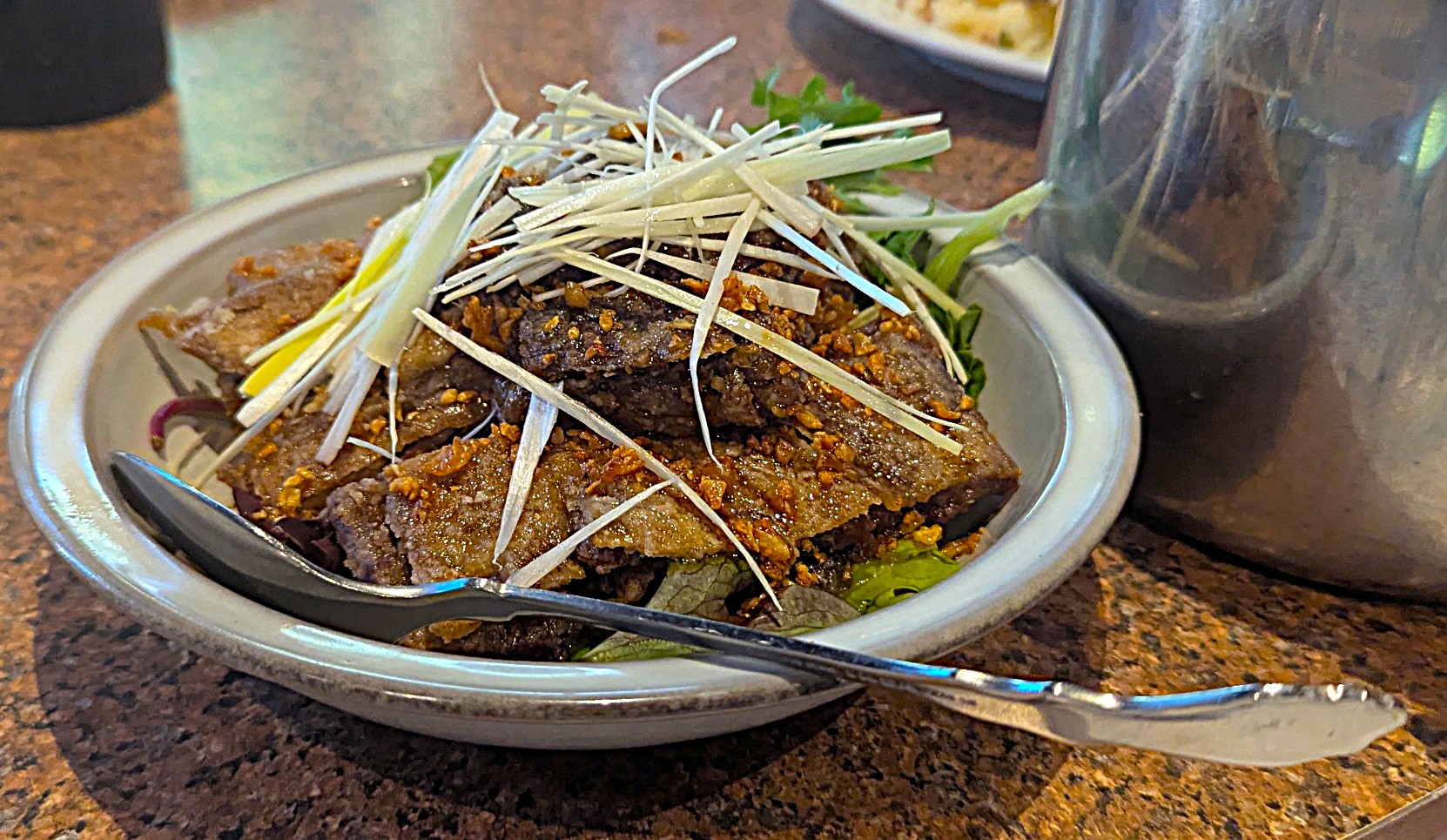
The service is excellent, the ambience pleasant, and the food delicious and plentiful. Dine in or take away, this Chinese restaurant provides the best Chinese food I have had for a long time. Mee Sing, formerly in Lyneham, having closed needed to be replaced, and The Chine Tea Club in Lyneham has done that – thank goodness. Particularly flavoursome is the Egg Plant and Chicken dish. The duck pancakes, prawn and ginger dumplings, prawn cutlets and white bait are delicious. Sizzling beef is served with the right ratio of beef to noodles, and the other meat and prawn dishes met everyone’s satisfaction depending on their dietary requirements.





Cambridge Literature Courses
Literature Cambridge Ltd is an independent educational organisation providing top-quality courses on the best of Classical literature and literature in English. Our courses are taught by leading academics and are open to all.
Email us: info@literaturecambridge.co.uk
Online Study Sessions
We offer live online courses (4 to 6 sessions) on particular writers and themes: on George Orwell, Doris Lessing, Iris Murdoch, Elizabeth von Arnim, Greek and Shakespearean drama, Katherine Mansfield, the Bloomsbury Group, Literary Gardens, mid-20thC Women Writers, and many others.
2025
- Women Writers Season, January 2025 to January 2026, from Mary Shelley to Zora Neale Hurston..
- London in Literature I with Angela Harris, September-November 2025
- Women and Power in 20thC Fiction: 1950s-1980s with Miles Leeson, September-November 2025.
- Close Reading the Poetry of Keats with Mariah Whelan, November 2025. Nearly sold out.
- George Orwell: Power, Freedom, Decency with Lisa Mullen, November-December 2025.
- Elizabeth von Arnim: Men, Women and Dogs with Isobel Maddison and Juliane Römhild, October-December 2025.
- Lecture on Thackeray, Vanity Fair with Clare Walker Gore. Sunday 7 December 2025.
- Lecture for Peace: Trojan Women with Jan Parker, 14 December 2025.
- Close Reading Poems about Winter, with Mariah Whelan, 14 and 21 December 2025.
2026
• Virginia Woolf Season, September 2025 to June 2026.
• Shakespeare and Euripides: Romance Plays with Fred Parker and Jan Parker, January–February 2026
• Close Reading Emily Dickinson with Mariah Whelan, January 2026
• Literary Gardens Course I with Karina Jakubowicz, January–March 2026.
• Close Reading Walt Whitman with Mariah Whelan, February 2026
• Iris Murdoch and the Natural World Course with Miles Leeson, March–May 2026
• Katherine Mansfield Course: Stories of Love, March-April 2026
• Close Reading Terrance Hayes with Mariah Whelan, April 2026
• Jane Austen’s Families Course with Tom Zille, April-May 2026
• Odysseus the Storyteller: trials and return with Jan Parker, May 2026
• Toni Morrison Course with Alex Calder, May-June 2026
• Close Reading Seamus Heaney, June 2026
• Chekhov Course: Stories and Plays with Claire Davison and Trudi Tate, autumn 2026
• Doris Lessing Course with Anne-Laure Brevet, September-October 2026
• Close Reading Shelley Course 2 with Mariah Whelan, September 2026
• Literary Gardens Course 2 with Karina Jakubowicz, September-November 2026
• Brontes Course (to be confirmed)
Dr Trudi Tate Director, Literature Cambridge Ltd
www.literaturecambridge.co.uk
On Barbara Pym, Author… and Stalker?
Evangeline Riddiford Graham Considers the Unrequited Loves of the Celebrated Novelist
Evangeline Riddiford Graham November 17, 2025
Barbara Pym, a novelist sometimes described as the twentieth-century Jane Austen, was a stalker. Her diaries describe her methods of “finding out” her objects of interest in vivid detail: looking them up in directories, “tailing” them across town to discover their home addresses and workplaces and places of worship, staging “chance” encounters, and collecting their “relics.” She invented “sagas,” games of investigation and fantasy that could last several years. Most of her victims were men; they were, to varying degrees, unavailable. Several of them were gay.
Throughout the 1950s, Pym had portrayed the love and labor of “excellent women”—spinsters cooking dinner for curates, bored wives matchmaking, girlfriends helping academics cross-reference the index—with screwball pathos. Praising her second novel as “a perfect book,” the poet John Betjeman wrote, “Excellent Women is England, and, thank goodness, it is full of them.” All of Pym’s respectable women indulge in some form of obsessive love. Her most mild-mannered heroines snoop through curtains and hedges; at their most audacious, her spinsters whip out binoculars and sneak uninvited into other people’s homes. (The men barely notice.)
It wasn’t until The Sweet Dove Died (written between 1963 and 1969, and reissued this September by New York Review of Books), that Pym began to reckon seriously with the impact that unrelenting womanly “devotion” might have on the beloved one—and on the spinster herself. In A Sweet Dove Died, stalking a gay man is rendered not as the expression of unrequited love but as the determined assertion of one woman’s ego.
In swinging sixties London, an elegant middle-aged woman named Leonora swoons in an auction room and is picked up by an antiques dealer and his nephew. The uncle, Humphrey, is solicitous, but Leonora prefers the nephew, James, who is golden-haired, malleable, and of uncertain sexuality. A series of emotional bidding wars ensue. Humphrey takes Leonora to an exhibition of historic portraits; she invites James into her exquisite flat, feeds him pâté, and presents him with her Victorian flower book. “Pink convolvulus,” he reads. The flower signifies “Worth sustained by Tender and Judicious affection”—a principle for which none of the protagonists of The Sweet Dove Died show much regard. See Television,Film and Popular Culture: Comments for the complete article. See also Robin R. Joyce The Reality Behind Barbara Pym’s Excellent Women The Troublesome Woman Revealed and “Another Barbara: New Insights into Barbara Pym”.

 Robin's Room