
John Willingham The Last Woman TCU Press Adult historical fiction, October 2025.
Thank you, NetGalley, for providing me with this uncorrected proof for review.
The Last Woman is based on the real Frenchy McCormick who lived from 1852 to 1941, eventually becoming the sole resident of Tascosa, Texas. She remained there for thirty years after the death of her partner, Mick McCormick, with whom she had travelled from Dodge City to Texas. Earlier, as Catherine McCain, she had travelled from Baton Rouge to St. Louis and then to Dodge City. From this sketchy history, John Willingham became interested in developing a story around Catherine’s journey from Baton Rouge to Tascosa in the 1880s, leading to the creation of a fictional version of Frenchy, whose life might well have been close to the one he depicts in The Last Woman. Willingham has used his knowledge of the social and economic environment of the time to weave a story that provides an explanation for the impetus for Frenchy’s various moves and final desire to remain in Tascosa. This story becomes one of three women, only one of whom survived, dealing with not only the inhospitable landscape, but the need to support themselves in a masculine environment in which the church and its teachings held sway, women’s truth giving way to the power of the law and the church working against them in unison. See Books: Reviews for the complete review.
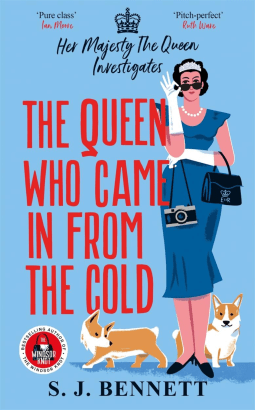
SJ Bennett The Queen Who Came in from the Cold Book 2 of Her Majesty The Queen Investigates, Crooked Lane Books, November 2025.
Thank you, NetGalley, for providing me with this uncorrected proof for review.
Although a murder has its complications, not least that to make a novel based around such a crime fun as well as an exercise in sleuthing, SJ Bennett has achieved this with elegance. The Queen Who Came in from the Cold is such an entertaining read, beginning with its references to Mrs Jones’ foibles – and, of course, Princess Margaret was indeed Mrs Jones, albeit one with a title and tiara – the introduction of Queen Elizabeth chattering with the Duke of Edinburgh while trying to accomplish her work in the royal Daimler and the intricacies of the phone and speaker which mysteriously disconnects as Henry Coxon regales Pavel Michalowski with his royal gossip.
Queen Elizabeth is to be taken from her customary lifestyle, the Royal Train, the Royal Yacht Britannica, Buckingham Palace, gracious international encounters, replete with comforting protocol to a world in which she indeed must encounter vastly different aspirations. Some threaten the Royals’ beloved protocol, and possibly even more beloved, the Royal Yacht Britannica. See Books: Reviews for the complete review/

Michelle Salter Murder in Trafalgar Square Boldwood Books,
September 2025.
Thank you, NetGalley and Boldwood Books, for this uncorrected proof for review.
Cosy murder mysteries are not my favourite, and that is possibly why I found the beginning of this novel a little slow. However, I had been tempted by the suffragette aspect of the work and quickly found that my enthusiasm for that theme was justified by the way in which it was developed. However, my appreciation of Michelle Salter’s murder mystery does not rely upon my initial interest.
This novel highlights characterisation through both historical figures like the Pankhursts and fictional suffragists, illustrating the diversity of the women’s movement. Historical events, such as the repudiation of their aims by politicians initially seen as sympathetic to their cause, violent and sexually motivated treatment of the women as they demonstrate, and the range of activities through which they attempted to bring their cause to public notice are informative. Alongside a murder mystery, unfolds a thoroughly researched story of the suffragists, their aims, and the range of ideas and backgrounds that informed their cause. The police are given a human face through Detective Inspector Flynn and his relationship with his sixteen-year-old daughter whose interest in the WSPU is a source of concern. Journalists’ perspectives are also explored, all these aspects ensuring that the story presents a balanced view. See Books: Reviews for the complete review.
Banijay U.K. Signs Development Deal With Ellie Wood’s Clearwood Films, Sets Adaptation of Barbara Pym Novel ‘Excellent Women’ as First Project
By Alex Ritman

Banijay U.K. has signed a development deal with award-winning producer Ellie Wood (“The Dig,” “Stonehouse”) and her company Clearwood Films and, as the first project, acquired rights to Barbara Pym’s classic 1953 novel “Excellent Women” with an option to develop further Pym books.
Under the terms of the deal, Clearwood will have access to funding to develop ideas and treatments as well as support from central Banijay U.K. resources including finance, legal and business affairs. Once greenlit, Clearwood has the option to partner with Banijay U.K. companies to co-produce. It follows on from a first look deal between Banijay Rights, Banijay’s distribution arm, and Clearwood Films, which ran from 2019. Banijay Rights will continue to distribute Clearwood projects.
Added Wood: “I’m thrilled to be working with Patrick and continuing Clearwood Films’ partnership with the wider Banijay family. I’m particularly excited to be developing the novels of one of my favourite authors, the inimitable Barbara Pym. Just as Jilly Cooper’s Rivals gave us a ‘Cooperverse’, I look forward to creating a ‘Pymverse’ and bringing this iconic author’s uniquely British tales of comic observation and unrequited love not only to her legions of fans but also to a wider TV audience.”
Upcoming Clearwood projects include an as-yet unannounced single scripted project for a linear broadcaster while Wood is executive producer on Film4‘s adaptation of Deborah Levy’s novel “Hot Milk,” starring Emma Mackey, Fiona Shaw and Vicky Krieps, which recently premiered at the Berlinale. Meanwhile, “49 Days,” a political drama by acclaimed writer John Preston, based on the tumultuous short-lived premiership of Liz Truss, backed by Banijay is also in development.
Wood previously produced the multiple BAFTA-nominated Netflix film “The Dig,” starring Carey Mulligan, Ralph Fiennes, Lily James and Johnny Flynn. In 2023, she produced “Stonehouse,” starring Matthew MacFadyen and Keeley Hawes, for ITV/Britbox.


Barbara Pym’s Quartet in Autumn to be staged in 2026 – email from The Barbara Pym Society
This spring (7 May – 13 June 2026) in London, you can see the first ever stage adaptation of Barbara Pym’s Quartet in Autumn. Directed by Dominic Dromgoole, former artistic director of Shakespeare’s Globe and the Bush Theatre, and adapted by Samantha Harvey, whose novel Orbital won the 2024 Booker Prize, the play will feature in Arcola Theatre’s Spring 2026 programme.
The production “brings to life a wry, poignant and hopeful meditation on later life through the lives of four Londoners on the verge of retirement. A rallying cry against loneliness, this is an ode to ageing, friendship and the strange poetry of everyday life,” says the Arcola, one of London’s leading off-West End theatres.

ATV Today
Barbara Pym to be adapted for the stage for the first time, with Samantha Harvey debuting as playwright
By Doug Lambert
Published on November 23, 2025
A Quartet in Autumn …
Barbara Pym, long cherished as a novelist of the quietly seismic, is heading to the stage for the first time. Quartet in Autumn, her 1977 tale of four London office workers edging towards retirement, will receive its world premiere at the Arcola Theatre this spring in a new adaptation by 2024 Booker prize winner Samantha Harvey. The production, directed by former Globe and Bush Theatre artistic director Dominic Dromgoole, runs from 7 May to 13 June.
Harvey, whose novel Orbital was widely acclaimed last year, makes her playwriting debut with the project. She describes Pym’s novel as a work of “humour and sadness, which exist brilliantly at once in every sentence”, adding that its quartet of characters “live enclosed lives that unfold as if on a stage”. The result, she says, was “a burning thought” she had never experienced before: to turn the book into a play.
Set in 1970s London, Quartet in Autumn follows Letty, Marcia, Edwin and Norman – four colleagues whose lives are as circumscribed as they are quietly yearning. Marcia hoards tins and withdraws from the world; Letty toys with dreams of elsewhere; Edwin takes refuge in liturgy; Norman grumbles at the onrush of modernity.
Between them is a kind of fragile social contract, a way of getting through the days as the city shifts around them. Harvey calls it “a tender portrait of loneliness in a changing world… and the grace that can be found in the ordinary”.
 |
 Jane Austen’s Families We are delighted to offer a new course on Jane Austen’s Families, a live online course with Dr Tom Zille, University of Cambridge. This course will examine how the lives of characters in four of Austen’s novels are shaped by family. This was an age when the role of the family was changing under the influence of imperialism, the enlightenment, and industrialisation. We will consider the ways in which Austen’s portrayal of families was shaped by her own life experience and circumstances. Lecture list • Dependents: Sense and Sensibility (1811) • The Family Circle: Pride and Prejudice (1813) • Distant Relations: Mansfield Park (1814) • The Smooth Surface of Family Union: Persuasion (1818) Saturdays, 11 April to 23 May 2026 live online 18.00-20.00 British Summer Time 19.00-21.00 Central European Summer Time Morning/lunchtime in the Americas Dr Trudi TateDirector, Literature Cambridge Ltd www.literaturecambridge.co.uk |
The Economist November 12 2025
The Gilded Age holds lessons for today, says Richard White
The professor of American history at Stanford University considers what might come next
By Richard White, emeritus professor of American history at Stanford University
In 1894, over the objection of the governor and the mayor, President Grover Cleveland sent American soldiers into Chicago and then invoked the Insurrection Act to suppress strikes and protests. His move precipitated the violence it was supposed to prevent. Two years later, Cleveland, the only president before Donald Trump to win a second term after losing a re-election bid, had become a pariah. A bitter presidential election between William Jennings Bryan and William McKinley underscored the deep divisions and glaring problems of the Gilded Age. The era was coming to an end, but not as the result of McKinley’s victory. It sank under its own weight of accumulated problems and aborted solutions.
What lessons does that period hold for today? The 1894 moment resonates in this second Gilded Age. Yet these two eras are not doppelgangers—they have distinct and important differences. Both came at the end of great struggles: the American civil war and the cold war. Victories over rival systems produced euphoric predictions of hegemony and consensus, but the ensuing Gilded Ages instead became revolutionary periods without either revolutionary politics or any dominant social vision. Both transformed the economy. The first turned a nation of independent producers and slaves into a nation of discontented wage labourers. The second shredded the social safety-net that arose in the 20th century and ushered in the gig economy with its associated precarity.
And both eras were periods of technological progress, economic growth and rough parity between parties. Mass immigration produced a diverse population and compensated for declining birth rates. But festering beneath the gilded surface that gave the eras their name lurked political paralysis, corruption, gross economic inequality, a distrust of politicians and institutions, racial conflict and declining material well-being.
In each period intense partisanship produced few lasting political accomplishments. Obamacare may be the only successful constructive rather than destructive legislation of the second Gilded Age. America had its age of Jackson and Roosevelt, but there was no age of Cleveland, and I doubt there will be an age of Trump.
The politics of both periods were backward-looking. Anti-monopolism, present in both political parties, astutely assessed the problems of the first Gilded Age, but was ultimately reactionary, longing for an earlier world of free labour, small producers and Protestant values. The MAGA movement and legal originalists also envisage a return to an earlier America. The legacy of both periods was, and is, their problems—not their solutions.There are no laws of history, except one: it does not go backwards
Charles Francis Adams, president of the Union Pacific Railroad, described the 19th-century tycoons he knew in a way that resonates today. They were “big financially”, but were “mere money-getters and traders” who were “unattractive and uninteresting”.
In the first Gilded Age solutions percolated to the surface only to be blocked by the courts. But they resurfaced later. In the 20th century, new bureaucracies gained power and autonomy. A producer-based economy yielded to a consumer-based one. Overcoming the courts required constitutional amendments: to shift taxation from tariffs to income taxes, institute direct election of senators and enfranchise women.
In the current Gilded Age, attempts are being made to smash some of those reforms—and indeed even some older reforms from the Reconstruction era. But whatever short-term success they achieve, they will ultimately fail. There are no laws of history, except one: it does not go backwards.
For clues to America’s future, consider its problems. There is surprising consensus across the political spectrum on some of them: the struggle to make ends meet for many citizens, corruption, and political and economic unfairness. Other challenges, such as climate change and the difficulty of funding the government, cannot be avoided by denying them.
The Progressive era that followed the first Gilded Age was flawed—it betrayed black Americans and immigrants—but it was forward-looking. It drew upon ideas from both parties and emphasised creating institutions rather than destroying them. The current Gilded Age will end when a new movement abandons today’s politics and tackles the all-too-obvious problems of the past half-century. Periods that follow Gilded Ages are eras in which politics catches up with revolutionary change. ■

 : Getty
After democrats, a small number of Republicans have come to Mark Kelly’s defense. Alaska Senator Lisa Murkowski, *who voted to convict Trump in his second impeachment trial and later won re-election in 2022 against a Trump-endorsed challenger, expressed her support for Kelly in a post on Tuesday.
“Senator Kelly valiantly served our country as an aviator in the U.S. Navy before later completing four space shuttle missions as a NASA astronaut,” she wrote.
“To accuse him and other lawmakers of treason and sedition for rightfully pointing out that servicemembers can refuse illegal orders is reckless and flat-out wrong. The Department of Defense and FBI surely have more important priorities than this frivolous investigation.” Murkowski added.
- See my review of Senator Lisa Murkowski’s autobiography, Far from Home An Alaskan Senator Faces the Extreme Climate of Washington, D.C. Penguin Random House Christian publishing | Forum books, June 2025, in the blog of 22 October 2025.

Australia and India formalise new screen partnerships, including major theatrical pathway for Australian films
An Australian delegation fronted by Rachel Griffiths and Lion director Garth Davis is attending the International Film Festival of India (IFFI) this week, where several agreements between the countries are being formalised, including a new theatrical pathway that aims to give Australian films a more consistent presence across India’s cinemas.
Leading the Australian presence in Goa is the Indian Film Festival of Melbourne (IFFM), under director Mitu Bhowmick Lange, who also heads distributor Mind Blowing Films. Both organisations will sign an MOU (memorandum of understanding) with IFFI and India’s national screen agency, the National Film Development Corporation (NFDC).
Separate agreements will also be signed between Deakin University and India’s premier film schools, the Film and Television Institute of India and the Indian Institute of Creative Technologies, as well as between Mind Blowing Films and PVR INOX, India’s largest cinema chain.
The agreements land at a time of rising collaboration between the two territories. India became Australia’s newest official co-production partner in November 2023, and although no projects have yet been delivered under the treaty, there are understood to be several projects in development. Indian cinema is also booming in Australia, with a recent report finding it now consistently outranks local film at the box office.
Speaking to IF, Lange says the three MOUs have been intentionally designed to touch all points along the creative pipeline, from students, established storytellers and audiences.
“India and Australia, we’ve never been closer,” she says, speaking both politically and culturally.
“I feel this is the right time for such ambitious and historic MOUs to be signed, because it’s going to create these incredible pathways.”
The deal with PVR INOX will see the multiplex chain become the “home of Australian cinema in India”. The country is the world’s largest English-language content market, yet releases of Australian films have so far been sporadic. With more consistency, Lange says the benefit will be proper audience data for the first time, such as what location responds, which demographics show up and what kind of titles resonate.
“Once we start releasing films, we will have this precious data, and we’ll be able to do more. The marketing will be more strategic,” she says.
While there is no formal commitment as yet to the volume of titles PVR INOX will show or the kind of screen space they will get, Lange says the intent is to build a clear pathway for Australian distributors and filmmakers. Mind Blowing is also in discussion with Screen Australia about how they can add support.
Lange released anthology My Melbourne in India earlier this year, and is enthusiastic about the potential of Australian films to resonate. The Aussie version of Masterchef was for a long time one of the most popular shows on Indian television, outperforming the local version. Similarly, she grew up in India watching films like Crocodile Dundee and Picnic at Hanging Rock on public broadcaster Doordarshan.
“The good thing about India is that even a small audience in India is a big audience,” she says.
“If we have the films coming in, slowly and surely, audiences will come. It just needs to be a sustainable collective effort. We are opening that door… and I feel very optimistic.”
In a statement, PVR INOX CEO Kamal Gianchandani said he was excited to showcase fresh Australian storytelling in India.
“There is a growing appetite among Indian audiences for global content, and Australian films bring a unique voice and cultural richness,” he said.
“This partnership marks the beginning of what we hope will be a long and meaningful exchange between our markets.”
The MOU between IFFM, IFFI and NFDC establishes deeper festival and market collaboration, including mutual showcases and expanded opportunities for creatives to meet and exchange ideas. Waves Bazaar and IFFM will also establish a co-distribution fund to see South Asian films reach wider audiences in India and Australia through selective financing and shared risk.
From this year, IFFI will spotlight Australian cinema for three consecutive editions, with five to six Australian films programmed annually. IFFI will also bring a formal industry delegation to Melbourne each August during IFFM.
“The point is to have a platform where we all can meet, explore ideas and see the possibilities,” Lange says.
Deakin University’s agreement with Film & Television Institute of India and the Indian Institute of Creative Technologies will see curriculum collaboration, student and faculty exchanges, joint workshops, and new training pathways. Deakin has an established campus in Gujarat International Finance Tec-City (GIFT City).
The uni’s vice president (global engagement) and CEO South Asia Ravneet Pawha said the MOU reflected the institution’s commitment to building bridges between the two countries and enabling young creators to contribute to rapidly evolving creative economy.
“India and Australia are entering a new phase of heightened cross-cultural and multi-sector knowledge engagement. This is especially through creative and digital tech cooperation, where our shared strengths in innovation, technology and education can shape the industries of the future,” he said.
ndian–Australian collaboration is already part of the workflow at Framestore, which operates studios in both Melbourne and Mumbai. The two outposts recently collaborated on pipelines for Ted season 2 and How to Train Your Dragon, and are gearing up to work together on the upcoming sequel of the latter.
Framestore Melbourne head of animation Nicholas Tripodi is among the Australian delegates at IFFI, keen to build stronger ties with India’s rapidly expanding talent base. He will speak at the festival about India’s creative boom and how Australia can be involved in that growth.
“Traditionally, VFX in India has been a bit more about the prep departments – roto, tracking, things like that. Framestore is going about it a bit differently. We’re trying to hire great artists across all departments and really foster that ability for them to take on much more complex parts of the pipeline,” he tells IF.
“That was evidenced on Ted season two, where we had quite a large animation team working hand in hand with our animators locally.”
Other Australian delegates at IFFI include See Pictures producer Jamie Hilton; Alan Dickson, producer of Indo-Australian animation series Smick and Willow; Chris Watson producer, InterWeaver Films,; Sarini Kamini, producer and writer, SKPL; Ana Tiwary, producer; and The Voice 2024 winner, Reuben De Melo. The Lord Mayor of Melbourne, Councillor Nick Reece, is also in attendance.
Delegates will be involved in panels and masterclasses at IFFI, while Griffiths will walk the red carpet for a retrospective screening of Muriel’s Wedding, newly restored in 4K.
Lange is optimistic the next few years will see greater awareness of Australian cinema in India. Further, with the co-production treaty now in place, she believes the goodwill and appetite on both sides creates the strongest conditions yet for collaboration to accelerate.
“The two industries are raring to go. There’s no reason why it shouldn’t take off,” she says.
“Australia has such a huge Indian diaspora as well. There are so many stories that we can tell together; I just hope that we are all able to tell our shared stories – not in a niche way, but in a more mainstream way.”

 Robin's Room