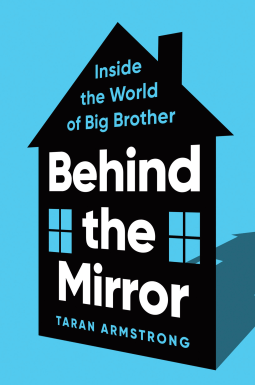
Taran Armstrong Behind the Mirror Inside the World of Big Brother Sourcebooks (non-fiction) Sourcebooks, November 2025.
Thank you, NetGalley, for providing me with this uncorrected proof for review.
Taran Armstrong’s densely detailed and analytical work lies as much in his perceptive approach as his attention to the format, the participants, their strategies, and their personalities. At first glance I was impressed with his knowledge of the workings of the Big Brother format and the way in which participants were able to strategize to achieve their aim of winning at best or at least forcing out those they did not want to win. However, to retain interest in a book with such a specialist approach and detailed account of episodes, strategies and personalities, requires more. Taran Armstrong grew up with Big Brother, and he links its process year after year, with changes of participants, producers’ interventions and audience and media reactions, to his own maturing and changing attitudes and situations. These links are sometimes poignant and at times comic, but always insightful. So, the world behind the mirror becomes a reflection of Armstrong and American societal changes, as well as the enclosed world of the Big Brother house.
I came to the book having watched, written about, * and listened to contemporaries, and observed the media and political fallout, along with the changes as Big Brother Australia adapted to falling ratings. At times, while reading about the amazing strategies adopted by those American participants determined to win, I wondered whether my observations of the Australian competitors with what seemed far less strategizing were naïve. However, although this might be the case, it is also possible that the different formats and levels of competitiveness in the American and Australian models also had an impact. The American model relied only participants’ voting throughout the process. In the Australian Big Brother house, participants voted for the people they would like nominated, and the three most nominated were then subjected to a public phone in vote. See Books: Reviews for the complete review.
*’It’s Time to Go!’ ‘You’re Fired’: Australian Big Brother (2005) and Britain’s The Apprentice (2014) in Women, Law and Culture Conformity, Contradiction and Conflict, ed. Jocelynne A. Scutt, Plagrave Macmillan, 2016.
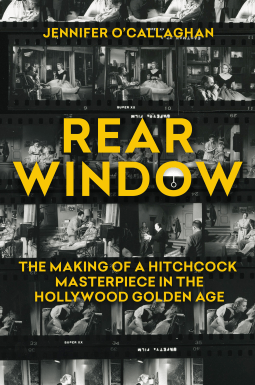
Jennifer O’Callaghan Rear Window The Making of a Hitchcock Masterpiece in the Hollywood Golden Age Kensington Publishing | Citadel, September 2025.
Thank you, NetGallery, for providing me with this uncorrected proof for review.
This is an enticing read, with Rear Window providing the core around which a host of detailed and information about areas which usually would be only of secondary interest are woven. However, here so much becomes of direct interest because of the deft linking of fields of interest beyond matters directly related to the production of Rear Window. Naturally, there is a focus on the set. Its role in achieving Hitchcock’s aim, both artistically and foiling the intransigence of the Production Code Administration Office using the Hays Code guidelines, is intrinsic to the work. However, not only Grace Kelly and Jimmy Stewart’s roles, before and after Rear Window, are discussed. Detail about their personalities, aspirations, and activities before and after the film is revealed. Directly relevant to the film, is Kelly’s wardrobe – the costumes, what they signified, and what happened to them. And so too, is the significance of the costume designer, Edith Head. However, her professional status, past and after Rear Window is also explored. Speculation about Hitchcock’s treatment of women, particularly Tippi Hedren, and the impact of #Me Too is covered, along with Hitchcock’s relationships with other cast members and crew. In this book, Alfred Hitchcock and his directorial ability, the actors and the script is foremost. However, by the time the book is finished the analysis of Rear Window has served to provide exceptional insight into the world in which the film was made, its past and the future. See Books: Reviews for the complete review.


Why Hitchcock’s ‘Rear Window’ Mirrors Today’s Social Media Age
In its exploration of themes like paranoia, voyeurism, and loneliness, Hitchcock’s Rear Window strikes a familiar chord with the social media climate we live in today.
By Jennifer O’Callaghan/ 28 November 2022

Rear Window Alfred Hitchcock Paramount 1 September 1954
Throughout Alfred Hitchcock’s lengthy career, the 1950s were undoubtedly his most glamorous era in filmmaking. With Hollywood’s biggest stars in Technicolor and carefully crafted sequences that would have film scholars talking for decades, Hitchcock entered a new peak in visual storytelling. Rear Window, now approaching the 70th anniversary of its production, is a standout film of that decade with a storyline that still holds relevance in the 21st century. Using the camera as narrator, Rear Window carefully weaves a terrifying thriller through a multi-layered love story. Released in 1954, Rear Window is widely regarded as one of the most accessible and modern of Hitchcock’s 53 films.
These days, Hitchcock’s legacy hardly requires an introduction, but in the early ’50s, he was an outside-of-the-box filmmaker beginning to revolutionize sound and frame editing by putting himself in the audience’s place. Rear Window was released during a trying time to a post-World War II public when fears of Communism and nuclear war generated anxiety in America. Gender stereotypes were tightly intact, and it would be over a decade before the women’s liberation movement shook up the patriarchy. Yet, when re-analyzing Rear Window in our times, it still feels as fresh as the day it was made. The paranoia and isolation experienced by the central character reflect those feelings of loneliness and mistrust in current society. Distortions of social media further mirror Rear Window’s themes, which remain universal in America.
Another reason Rear Window retains its relevance is partially due to the imperfection and relatability of its main character. J.B. Jefferies, known to his friends as Jeff (played by the reliably affable Jimmy Stewart, who even gives this curmudgeon appeal), is a flawed anti-hero. As a combat photographer who’d always been on the go, he’s now confined to a wheelchair after breaking his leg. (In an early scene, he explains the cast on his left leg is a result of getting too close for comfort with his camera at an auto race.) Jeff spends his days of recovering, staring aimlessly through the back window of his Greenwich Village apartment into the courtyard below—and into the windows of his neighbors.

Enter Lisa Fremont (Grace Kelly), a glamourous career girl of Madison Avenue who’s mad about Jeff. Though deeply frustrated at his lack of commitment, she doesn’t back down easily, even if it means going out on a limb to show him her dangerous side. Jeff also receives daily visits from Stella (played by the spunky Thelma Ritter), his nurse who serves as the voice of reason. She does her best to convince him he’s making a mistake by casting Lisa aside. Flabbergasted at the thought of Jeff ending things with her because she’s “too perfect”, Stella sighs, “I can hear you now: “Get out of my life, you wonderful woman. You’re too good for me.”
Jeff, who seems too wrapped up in himself to take Lisa seriously, spends the entirety of Rear Window observing different walks of life through a camera lens at his back window, the same point of view that Hitchcock cleverly limits the audience. Bored to tears, he spies on neighbors, inventing stories about their lives. The curiosities in this intimate setting fulfill Jeff’s overactive imagination. The audience becomes one with him as he leaps from one conclusion to another about the narrow view he has of people he doesn’t know. His act of observing others from a secure, unseen distance isn’t unlike our online world today. See Further Commentary and Articles arising from Books* and continued longer articles as noted in the blog. for the complete article.
DreamBig/Shutterstock, The Conversation
‘Don’t tell me!’ Why some people love spoilers – and others will run a mile
Published: July 18, 2025 6.10am AEST
Author Anjum Naweed Professor of Human Factors, CQUniversity Australia
Disclosure statement
Anjum Naweed does not work for, consult, own shares in or receive funding from any company or organisation that would benefit from this article, and has disclosed no relevant affiliations beyond their academic appointment.
Partners
CQUniversity Australia provides funding as a member of The Conversation AU.
Republished under 
This article contains spoilers!
I once leapt out of a train carriage because two strangers were loudly discussing the ending of the last Harry Potter book. Okay – I didn’t leap, but I did plug my ears and flee to another carriage.
Recently, I found myself in a similar predicament, trapped on a bus, entirely at the mercy of two passengers dissecting the Severance season two finale.
But not everyone shares my spoiler anxiety. I have friends who flip to the last page of a book before they’ve read the first one, or who look up the ending before hitting play. According to them, they simply need to know.
So why do some of us crave surprise and suspense, while others find comfort in instant resolution?
What’s in a spoiler?
Spoilers have become a cultural flashpoint in the age of streaming, social media and shared fandoms.
Researchers define “spoiler” as undesired information about how a narrative’s arc will conclude. I often hear “spoilers!” interjected mid-sentence, a desperate protest to protect narrative ignorance.
Hitchcock’s twist-heavy Psycho elevated spoiler sensitivity. Its release came with an anti-spoilers policy including strict viewing times, lobby warnings recorded by the auteur himself, and even real policemen urging “total enjoyment”. A bold ad campaign implored audiences against “cheating yourselves”.
The twists were fiercely protected.
Even the Star Wars cast didn’t know Darth Vader’s paternity twist until premiere night. Avenger’s Endgame filmed multiple endings and used fake scripting to mislead its stars. And Andrew Garfield flat-out lied about his return to Spider-Man: No Way Home – a performance worthy of an Oscar – all for the sake of fan surprise and enjoyment.
But do spoilers actually ruin the fun, or just shift how we experience it?
The satisfaction of a good ending
In 2014, a Dutch study found that viewers of unspoiled stories experienced greater emotional arousal and enjoyment. Spoilers may complete our “mental models” of the plot, making us less driven to engage, process events, or savour the unfolding story.
But we are also likely to overestimate the negative effect of a spoiler on our enjoyment. In 2016, a series of studies involving short stories, mystery fiction and films found that spoiled participants still reported high levels of enjoyment – because once we’re immersed, emotional connection tends to eclipse what we already know.
But suspense and enjoyment are complex bedfellows.
American media psychology trailblazer Dolf Zillmann said that suspense builds tension and excitement, but we only enjoy that tension once the ending lands well.
The thrill isn’t fun while we’re hanging in uncertainty – it’s the satisfying resolution that retroactively makes it feel good.
That could be why we scramble for an “ending explained” when a film or show drops the ball on closure. We’re trying to resolve uncertainty and settle our emotions.
Spoilers can also take the pressure off. A 2009 study of Lost fans found those who looked up how an episode would end actually enjoyed it more. The researchers found it reduced cognitive pressure, and gave them more room to reflect and soak in the story.
Spoilers put the audience back in the driver’s seat – even if filmmakers would rather keep hold of the wheel. People may seek spoilers out of curiosity or impatience, but sometimes it’s a quiet rebellion: a way to push back against the control creators hold over when and how things unfold.
That’s why spoilers are fertile ground for power dynamics. Ethicists even liken being spoiled to kind of moral trespass: how dare someone else make that decision for me?!
But whether you avoid spoilers or seek them out, the motive is often the same: a need to feel in control.
Shaping your emotions
Spoiler avoiders crave affect: they want emotional transportation.
When suspense is part of the pleasure, control means choosing when and how that knowledge lands. There’s a mental challenge to be had in riding the story as it unfolds, and a joy in seeing it click into place.
That’s why people get protective, and even chatter about long-aired shows can spark outrage. It’s an attempt to police the commentary and preserve the experience for those still waiting to be transported.
Spoiler seekers want control too, just a different kind. They’re not avoiding emotion, they’re just managing it. A spoiler affords control over our negative emotions, but also softens the blow, and inoculates us against anxiety.
Psychologists dub this a “non-cognitive desensitisation strategy” to manage surprise, a kind of “emotional spoiler shield” to protect our attachments to shows and characters, and remind us that TV, film and book narratives are not real when storylines hit close to home.
Knowing what happens turns into a subtle form of self-regulation.
So, what did I do when Severance spoilers floated by? Did I get off the bus? Nope, I stayed put and faced the beast. As I tried to make sense of the unfamiliar plot points (The macrodata means what? Mark stays where?), I found the unexpected chance to dive deeper.
Maybe surprise is not the sum of what makes something entertaining and worth engaging with. Spoiler alert! It’s good to have an end to journey towards, but it’s the journey that matters, in the end.
Cindy Lou breakfasts at Via Dolce
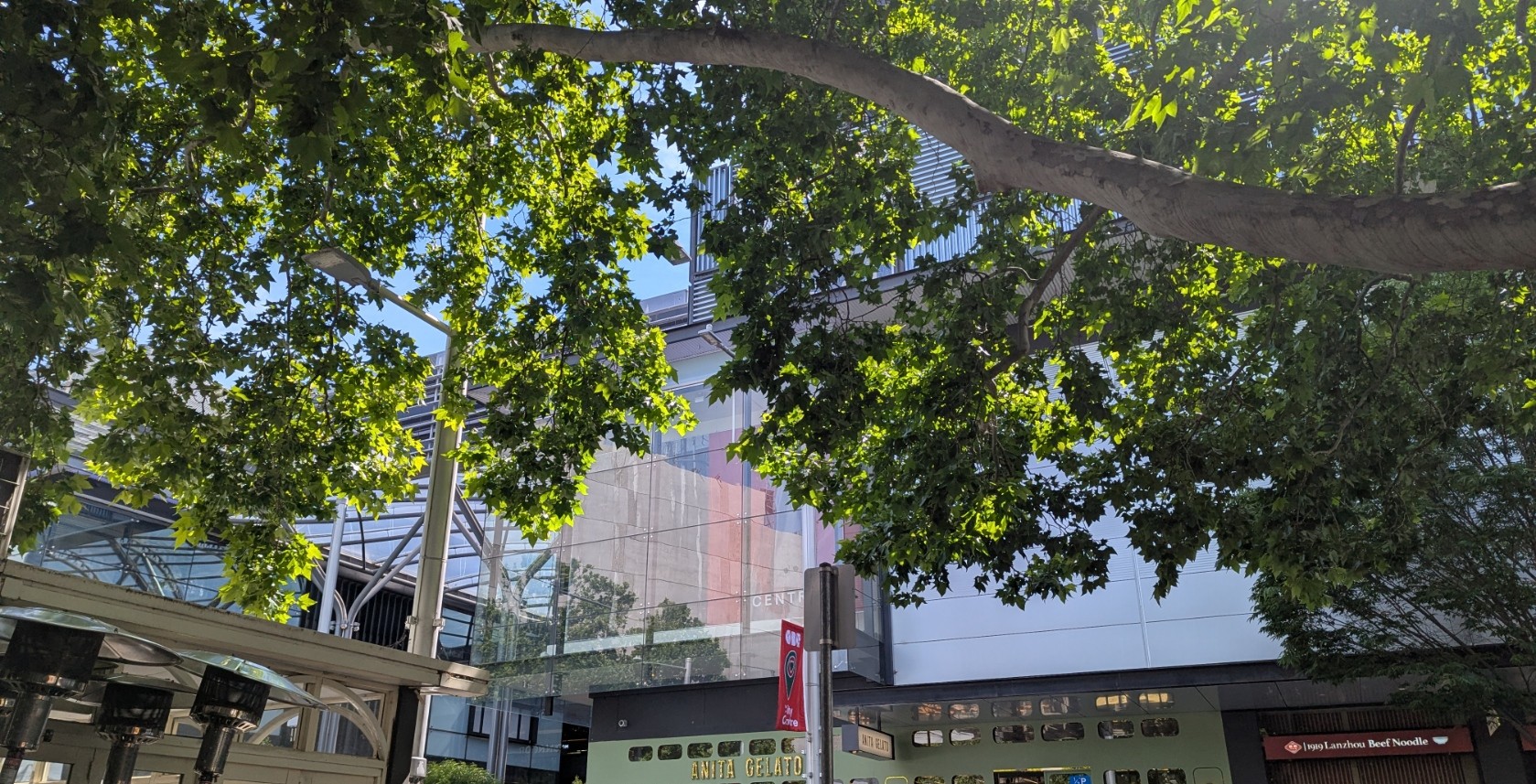
Via Dolce is a pleasant cafe in Civic with indoor and outside seating. The range of pastries and ice-creams is magnificent. However, the breakfast menu is also extensive, offering a splendid variety of dishes. Corn fritters with an addition of poached eggs made a huge breakfast, as did the haloumi and poached eggs. The addition of a generous salad is a nice touch. The elegant mugs are generous and the coffee good. Although the service was rather slow on this morning, the sunny outdoor setting with lovely trees made the wait easy.



Birthday celebration at Courgette

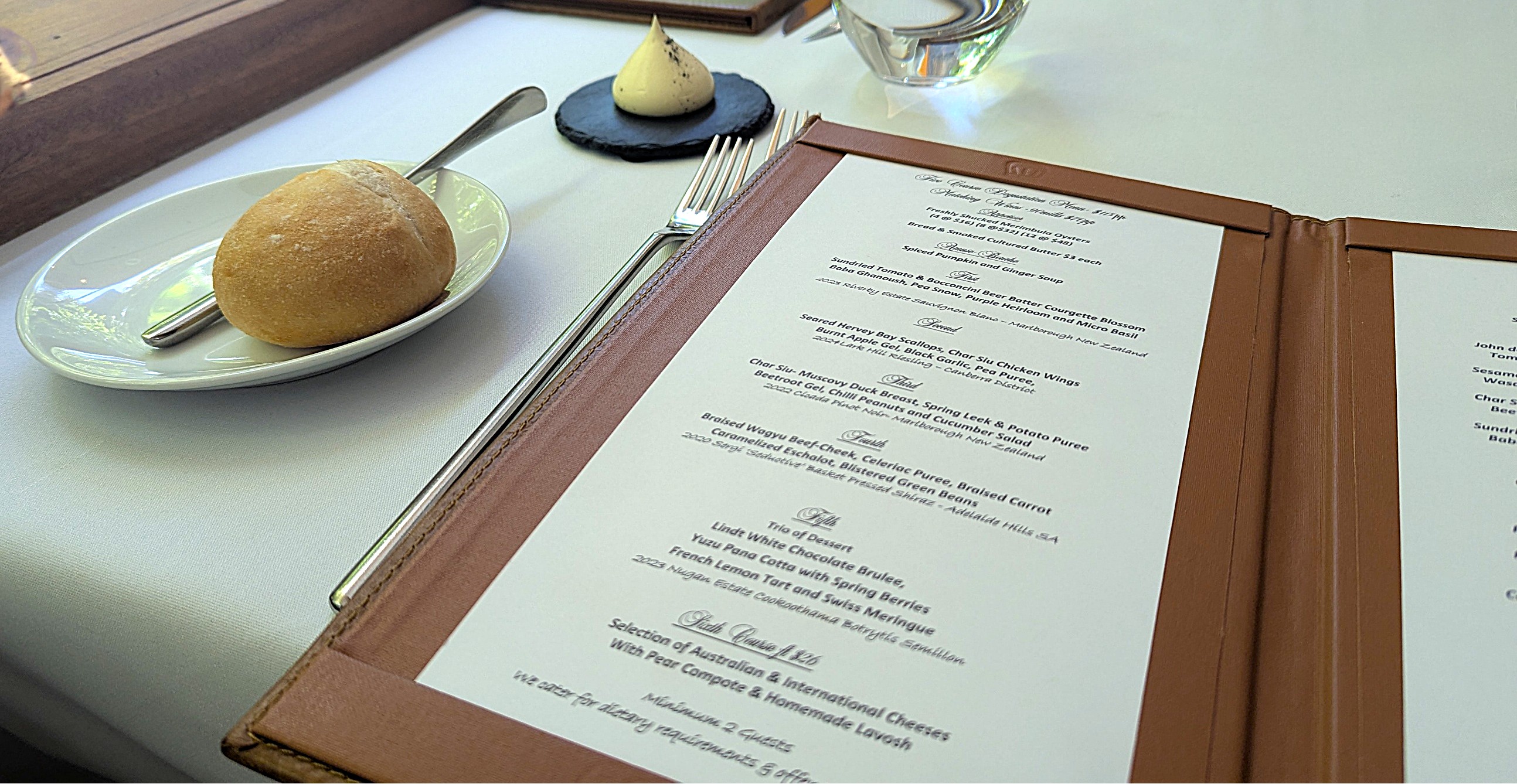
A table next to the window is always a bonus.
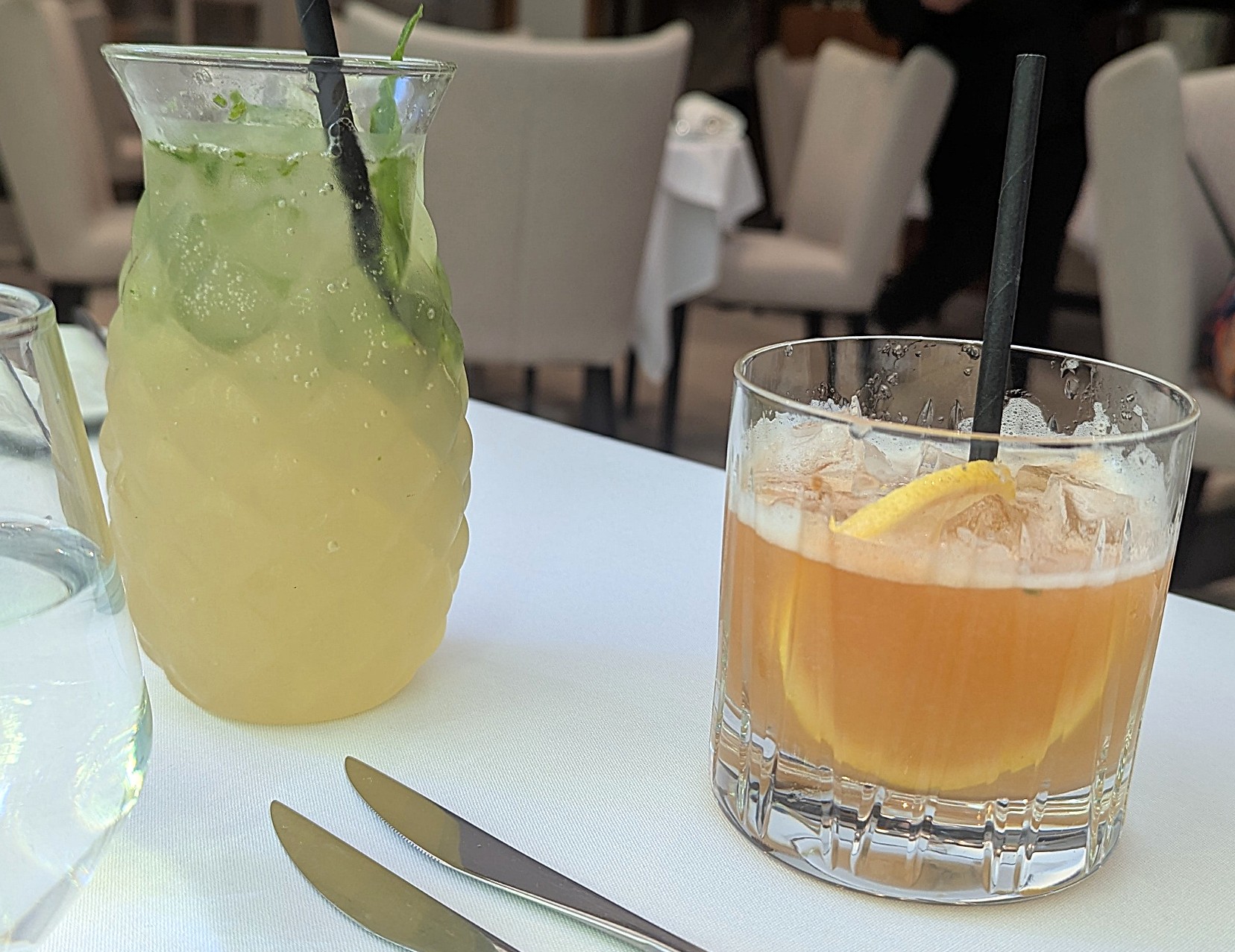
Courgette has a new menu and combination of meals available in its two-course menu. The latter is an excellent innovation, as the desserts are charged for separately, and the two courses comprise an entree and a main meal. I began with four oysters – served with lemon and a vinaigrette. The warm bread rolls and ash butter cannot be resisted. I ordered two entrees and resisted the offer to have one served as a main in size – thank goodness as, delightful as both were, they were more than adequate. Our choices were:
John dory & Prawns Ballotine, Avocado and Mandrin olive Oil,
Tomato Salsa, Dijon Mustard and Crispy Shallot Basil; Char Siu- Muscovy Duck Breast, Spring Leek & Potato Puree Beetroot Gel, Chilli Peanuts and Cucumber Salad and Sundried Tomato & Bocconcini Crispy Batter Courgette Blossom Baba Ghanoush, Pea Snow, Purple Heirloom and Micro Basil. The one main course was Grass-fed Black Angus Beef FilletMB-4, Spring Pea Puree, Candy Orange Carrot and Bush Pepper Sauce.







Twenty Books that Got Experts through their Twenties
When our arts desk asked 20 experts to list the books that got them through their 20s, I doubt they expected one of them to come back with Heart of Darkness. A mesmerising work of genius, sure, but a companion to surviving early adulthood? When I read the explanation as to why this book made it on to the list, however, I was immediately convinced.I think that’s why this two-part series – the second of which we published this week – has proven so popular. It’s an unexpected reading list for an uncertain period in anyone’s life. Madame Bovary isn’t a character you would want to emulate in your 20s but her story has a lot to teach us, so it made the cut. In fact, there’s arguably something to offer readers of any age in the lineup and certainly inspiration for Christmas pressies for the young people in your life.
Laura hood Senior Politics Editor, Assistant Editor
Your 20s can be an intense decade. In the words of Taylor Swift, those years are “happy, free, confused and lonely at the same time”. Many of us turn to literature to guide us through the highs and the lows of this formative time. We asked 20 of our academic experts to recommend the book that steered them through those ten years.
The complete article appears at Further Commentary and Articles arising from Books* and continued longer articles as noted in the blog. However, the list of books dealt with in more detail there, appears below.
Part 1- Butterfly Burning by Yvonne Vera (1998); The Remains of the Day by Kazuo Ishiguro (1989); The History Man by Malcolm Bradbury (1975); Palestine by Joe Sacco (1993); Lost Illusions by Honoré de Balzac (1843); Hotel Du Lac by Anita Brookner (1984); Never Far From Nowhere by Andrea Levy (1996); The Long Goodbye by Raymond Chandler (1953); The City by Valerian Pidmohylnyi (1928); The Mezzanine by Nicholson Baker (1988).
Part 2- A Manor House Tale by Selma Lagerlöf (1899); To the Lighthouse by Virginia Woolf (1927);The Best of Everything by Rona Jaffe (1958); Candide by Voltaire (1759); The Sparrow by Mary Doria Russell (1996); The Song of Achilles by Madeline Miller (2011); The God of Small Things by Arundhati Roy (1997); Heart of Darkness by Joseph Conrad (1899); Mrs Dalloway by Virginia Woolf (1925); Madame Bovary by Gustave Flaubert (1856).
American Politics
The Supreme Court handed Republicans a shiny new map, but Texans aren’t dumb; misery, inflation, and desperation don’t vote red; they vote for whoever fixes their lives.
Michael Cohen and MeidasTouch Network Dec 5
Guest article by Michael Cohen. Michael Cohen can be followed on Substack for more by clicking here.
Let me save everyone a little time and a lot of aspirin: the Supreme Court screwed up. Again. And not in the subtle, legal-nerd, “well actually…” way that lets the conservative justices preen while pretending they are the intellectual heirs of Madison. No, this was the full-blown, ham-fisted political hack job we have come to expect from a Court that now treats the Constitution like it is a suggestion box at a Mar-a-Lago brunch buffet.
This time, the Justices blessed Texas’ brand-new, carefully engineered congressional map, a map designed with all the precision and moral clarity of a drunk surgeon, to ensure Republicans squeeze out up to five more House seats. Five. Not because voters demanded it. Not because demographic shifts required it. But because Greg Abbott, Ken Paxton, and the entire Trump political machine ordered it. And the Court, like obedient little foot soldiers in judicial robes, saluted.
Texas walked in with an emergency application, whispered “midterms,” “partisan advantage,” and “Biden bad,” and the Supreme Court practically sprinted to their pens. They did not just greenlight gerrymandering. They handed Texas the keys to the bulldozer and said, “Go wild.”
But here is the giant, screaming, flashing-red mistake the Court and the GOP made; the one even their clerks probably recognized as they typed this fiasco:
They ignored the actual suffering of Americans. Including Texans.
And voters are not nearly as stupid as Republicans think they are.
Because while Abbott, Paxton, and Trump world are out here popping champagne, Texans are trying to figure out how to afford groceries without auctioning off a kidney. According to the newest Politico poll — and polls rarely deliver clarity this sharp — the top issues in America are not “owning the Libs,” “men in women’s sports,” or “swearing mass deportations will lower rent like immigrants were secretly your landlord.”
No. The issues crushing Americans right now are cost of living, the economy, taxes, healthcare, and democracy itself.
And guess who is underwater on every single one of them.
The very administration celebrating this map like it is the Sistine Chapel of partisan manipulation.
Here is where Republicans truly demonstrate their genius-level stupidity:
They think a rigged map can override lived reality.
You can gerrymander a district.
You can gerrymander a state.
But you cannot gerrymander your way out of a hungry child, an empty bank account, a medical bill that hits like a monthly hate crime, or a voter who has had enough.
No Texan gives a damn about Abbott’s beautifully sculpted partisan crescents when they are paying twenty dollars for coffee and eight hundred for utilities. You can shift minority voters like chess pieces, but you cannot distract them from inflation that strangles. You can carve districts that look like Rorschach tests on acid, but you cannot carve out the creeping dread people feel about the future.
And here is what Republicans missed, spectacularly:
Texans are not going to vote Republican simply because Republicans drew them into a Republican-shaped district.
They are going to vote for whoever convinces them they can fix this mess and make their lives better.
Let us talk about the decision itself. The lower court found “substantial evidence,” which is judge-speak for “holy shit, this is obvious,” that Texas purposely reconfigured districts based on race. The Trump administration even sent a letter telling Texas to eliminate “coalition districts,” where nonwhite voters together form a majority. They practically signed the racial motive with a Sharpie.
But magically — magically — the Supreme Court concluded it was not racial gerrymandering, just regular old partisan gerrymandering. The kind the Court fully legalized in 2019 when it declared political map rigging perfectly fine so long as you are not openly racist about it.
Justice Alito, in his usual condescending “let me explain democracy to you peasants” tone, chastised challengers for not producing their own alternative map. Meanwhile, Justice Kagan, one of the last adults in the room, said the Court disrespected the lower court and “the millions of Texans” shoved into racially targeted districts. And she is right. It is not just disrespect. It is contempt. Judicial cowardice dressed up as constitutional deference.
Ken Paxton called the new map a “massive win.” My man, the only thing massive here is the delusion. Texans are not dancing in the streets over this map while they are drowning in inflation, unaffordable healthcare, stagnant wages, and the sense that everything is somehow getting worse.
And here is the punchline Republicans refuse to acknowledge:
Gerrymandering can win you an election.
It cannot make voters forget their own misery.
It cannot make groceries affordable.
It cannot bring back jobs.
It cannot fix a collapsing healthcare system.
It cannot stop a democracy from feeling like it is being run by a committee of arsonists.
Sure, the Supreme Court handed Republicans a map.
But voters are holding the scorecard.
Texans know exactly what is going on. They see the manipulation. They feel the pain. They know their lives are not getting better under this administration, and no district lines can convince them otherwise.
Republicans got their districts.
But whether they get the votes, that is up to the people living in the wreckage.
And Texans, like Americans everywhere, are done voting based on party branding.
They are voting based on survival.
The Supreme Court gave Republicans a victory today.
But reality is coming.
And you cannot redraw your way out of that.
Australian Politics
Social media can cause real harm to our kids, exposing them to risks and pressures they’re just not ready for.
Labor wants every child to get the best start in life, and that means supporting parents to keep them safe online. That’s why we’re taking bold action, banning social media accounts for under-16s from December 10.
It will mean more time for kids to learn, grow, and just be kids – without algorithms getting in the way.
Australia’s social media ban for under-16s starts today. Here is what you should know
By political reporter Samantha Dick
Australia’s social media ban for people aged under 16 has officially started, marking a world-first push to protect children from phone addiction and online harms.
From now on, a group of social media platforms will face penalties of up to $50 million if they do not take “reasonable steps” to prevent children and teenagers aged under 16 from holding a social media account.
Australia’s age-restricted social media apps:
- Threads
- Kick
- Snapchat
- TikTok
- Twitch
- X (formerly Twitter)
- YouTube
In a video address, Prime Minister Anthony Albanese encouraged kids to “make the most of school holidays coming up, rather than spending it scrolling on your phone”.
“Start a new sport, learn a new instrument or read that book that’s been sitting there on your shelf for some time,” he said.
“Importantly, spend quality time with your friends and your family, face to face.”
The government’s list of age-restricted apps will almost certainly grow in the coming weeks.
Australia’s online safety watchdog is keeping an eye out for other platforms that fit the criteria, and tech companies are required to constantly monitor if they are likely to be captured by the restrictions at any time.
Already, social media apps Lemon8 and Yope have been put on notice after experiencing a surge in popularity as young people have looked for alternative platforms.
And while the ban technically starts today, the government has admitted it won’t be perfect.
Bipartisan support for the ban is also appearing shaky.
Opposition Leader Sussan Ley has increasingly cast doubt over the rollout, declaring she has “no confidence” the ban will work under Labor.
Quick guide to the social media banCarousel
Why are platforms being age-restricted?
Australian children under 16 are now banned from 10 popular social media platforms. The world-first ban aims to protect young people from the harms of social media use. Platforms are required to take reasonable steps to stop kids from having accounts on their platforms.
How will it work?
Accounts of people suspected of being under 16 will be closed unless they can pass an age verification check. Users who want to stay on the age-restricted platforms can be asked to undergo facial recognition scans or provide government-issued identification such as a driver’s licence. There have been concerns the technology designed to restrict access can be fooled.
What’s banned?
Not all platforms are completely banned
Children under 16 should be removed from 10 platforms — but other platforms will allow kids under 16 with some restrictions and some will continue as normal. The government could add more apps in the future. Swipe to find out what’s covered by the ban.
Banned
TikTok
It’s a place to create, share and discover short videos and is owned by Chinese tech company ByteDance. While TikTok has its own minimum age of 13, the regulator has found it has been one of the most popular platforms for users aged between eight and 12.
Banned
Prior to December, Instagram had more than a million monthly active users aged 13–17, according to the eSafety Commission. Users can share images and videos and send direct messages. The platform has teen accounts with some limits already but is still banned completely for under-16s. Threads is a microblogging platform similar to X. Users need an Instagram account to access Threads so it is also banned.
Banned
Snapchat
This was among the most popular apps for young people, with more than a million of its 8.3 million Australian users aged 17 or under before the ban. Snapchat is a messaging app that allows users to send images, videos and texts that are only available for a short period once they’re opened. Users can also choose to share their location with friends on Snap Map.
Banned
YouTube
YouTube logo
It had more than 643,000 users aged 17 and under prior to December. The regulator found it was the top platform for users aged between eight and 12. YouTube is only blocking kids from using its platform with an account. So under-16s can still watch videos if they’re not logged in. As for YouTube Kids…
Allowed
YouTube Kids
YouTube Kids logo
This is a filtered version of YouTube’s main platform that allows parents to create accounts for children under 12. Google, which owns YouTube, says YouTube Kids will not be affected by the new rules.
Banned
It’s the platform even your mum is on to share photos and videos and join groups. Facebook had an estimated 455,000 Australian users aged between 13 and 17 before December 4. While its main platform is banned, Facebook Messenger and Messenger Kids apps remain available to under-16s.
Banned
X (Formerly Twitter)
X logo
This is not among the most popular apps for young people. Users post short-form commentary and it was once a place for online discussion but the eSafety Commission has concerns about the prevalence of “online hate” on the platform.
Banned
Twitch
Twitch logo
Streaming platform Twitch was added to the list of banned apps after the eSafety Commission found it had the sole or significant purpose of online social interaction. Twitch is mainly used by gaming and eSport players to broadcast their gameplay with audio commentary, but it’s also used to share and broadcast music, live sports and food programs.
Banned
Reddit is the seventh-most-visited site in the world. The platform offers users a message board service organised into topics also known as sub-Reddits.
Banned
Kick
Kick is an Australian competitor to video live streaming platform Twitch, where users can watch live video steams covering games, music and gambling.
Allowed
GitHub
This platform allows multiple software developers to work on projects simultaneously. It has an open-source version control system that tracks every change to a project’s files.
Allowed
LEGO Play
This platform was designed for kids to design and build in 3D and create stop-motion animation. Users can also design personal avatars and play games.
Allowed
Roblox
This online universe housing millions of user-generated games has about 50 million children globally on it each day. Aussie kids who use the platform spend over two hours a day on it on average, according to a 2024 study.
Allowed
Discord
Users can join or create servers to communicate with others via text, voice and video. It was originally designed for gamers but is used more widely now.
Allowed
Steam & Steam Chat
Steam is a digital game distribution platform for PC games while Steam Chat is the integrated messaging service within the platform that allows users to communicate with friends.
Allowed
Google Classroom
This is the one platform kids were probably hoping to have banned. This platform is used in many Australian schools to distribute lessons and assignments to students and allows students to complete and submit their schoolwork.
Allowed
Lemon8 & Yope
…for now. The eSafety Commission has asked both platforms to self-assess, which means they are likely to be captured under the ban. Both apps have become increasingly popular as the ban has drawn closer. Lemon8 is owned by ByteDance — the same company that owns TikTok. It has been described as a lifestyle-focused app with content on fashion, beauty, food and travel. Yope is a photo-sharing app.
Some underage users have previously vowed to find a way around the ban, and the law only says platforms must take “reasonable steps” to prevent them from having accounts.
Read more about the social media ban:
- Social media ban live: Our experts answer your questions to help navigate the new rules
- EXPLAINER: What’s changing under the new rules
- Which apps are included in the ban?
How a social media app determines a user’s age will vary from platform to platform.
In many cases, a platform can reasonably infer someone’s age by looking at how long an account has existed and by examining their posts and personal networks.
One way is to request a government-issued ID, such as a drivers licence, though platforms are prohibited from compelling users to provide ID and must offer an alternative.
Another option is to use artificial intelligence to guess someone’s age based on their appearance.
Underage users might be able to reactivate their accounts once they turn 16, but that is not guaranteed, and it all depends on the platform.
Every platform is using a different approach, and it is likely some teenagers will slip through the cracks.
Besides, people under 16 will still be able to see publicly available social media content that does not require a login.
In other words, it will not be flawless.
But the Australian government insists it is worth trying anyway if it means protecting children from endless “doomscrolling” and other harms such as cyberbullying and grooming. Teens who support the social media ban
Patrick, 15, does not use social media and hopes he never does. Nick, 15, had a flip phone for the first few years of high school. Here is why they support the social media ban.
Though the move is popular with many parents, some kids in regional towns say the ban will worsen isolation — particularly for LGBTQIA+ teens, who have found acceptance and support among online communities.
Two teenagers have taken their fight against the ban all the way to the High Court.
The 15-year-olds are backed by the Digital Freedom Project, which claims the laws restrict the implied right to freedom of political communication.
The group initially announced in November that it was trying to stall the laws. However, the court will hear a special case next year instead.
Other young people have welcomed the ban, saying they resent the way tech companies keep them hooked by using their data to develop addictive algorithms.
Australia’s social media ban marks the first time a nation has attempted to take on the big tech giants — and the world is watching closely to see how it unfolds.
The European Union is now considering similar bans, as well as proposals for a late-night “curfew”, an age-verification app, and limits on addictive features such as infinite scrolling and excessive push notifications.
Malaysia is set to join the list of countries restricting access to social media, with its own ban for under-16s coming into effect on January 1.
Inside Story
The Dismissal from below
Fifty years later, what impact has the Dismissal had on Australian democracy?
Frank Bongiorno (with James Watson) 28 November 2025 5374 words
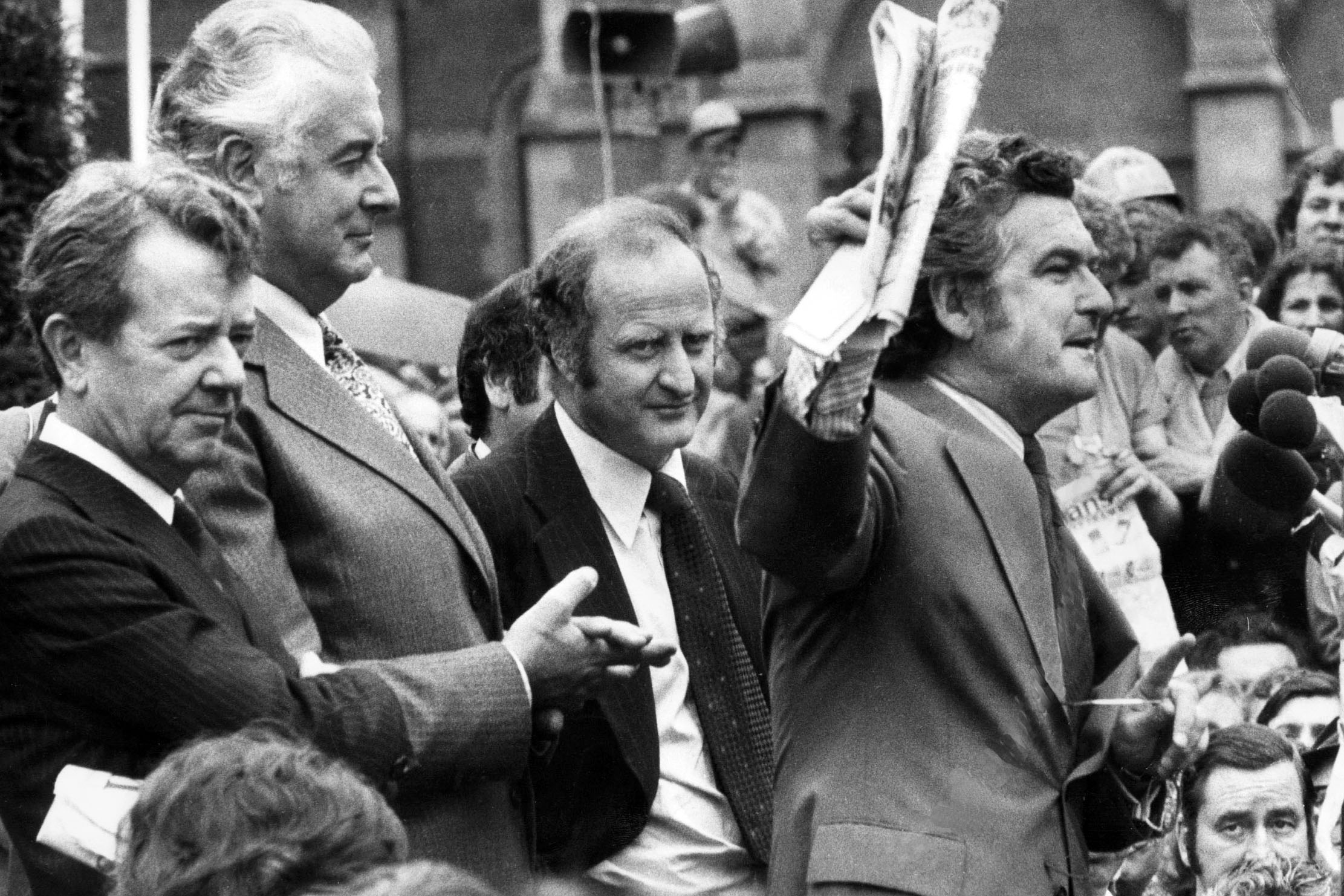
Gathering storm: senator John Wheeldon, prime minister Gough Whitlam and Clyde Holding MP watch as Bob Hawke addresses a 20 October protest in Melbourne’s City Square during the supply crisis. Sydney Morning Herald
In November 1975 the Dismissal seemed the biggest of big deals in Australian political history. For years after, you could still, without great difficulty, find the “rage” Gough Whitlam had asked his supporters to maintain during the 1975 election campaign.
The passionate ones survive today, but in dwindling numbers. Few who rallied for and against Whitlam and Malcolm Fraser in November 1975 could have foreseen that before the end of the century those two men — political giants and fierce enemies in the 1970s — would collaborate in support of a republic, among various causes, and even appear together at public events, as they did at Kevin Rudd’s apology to the stolen generations in 2008. But the Dismissal itself faded into a distant, blurry history — passing, as even dramatic events must, from current affairs to living history to collective memory.
The egyptologist Jan Assmann’s distinction between two types of “collective memory” — “communicative” and “cultural” — might be helpful in understanding how to think about where the Dismissal now sits in Australian life. Communicative memory is the product of everyday interactions that lead to “numerous collective self-images and memories” and is distinguished by “its limited temporal horizon.” This variety of memory might last three or four generations: say, eighty to one hundred years. “Cultural memory,” by way of contrast, is characterised by its “distance from the everyday,” as well as its role in constituting a social group’s identity. It might be seen as shading into “legend” or even “myth.”
The fiftieth anniversary of the Dismissal suggests that the event, as well as the brief, turbulent history of the Whitlam government itself, still lives within communicative memory. People will tell you where they were when it happened. They will tell you how they felt. They might tell you what the Whitlam government meant to them, and what its Dismissal signified and signifies. Such memories are held, and communicated, in and beyond families and other small groups, even allowing for Australians’ reputed reluctance to tie their identity to political history or civic life.
But I would also like to suggest that the Dismissal is moving towards what Assmann calls cultural memory, with its greater abstractions. It will continue to play a role in telling us something about who we are: but as an event capable of shaping everyday action and understanding, as a truly lived history, it is fast fading.
One test of this is how we talk about our democracy. There is now an entrenched discourse that celebrates the robustness of Australian democracy: it is there in the ABC program, Civic Duty, hosted by Annabel Crabb. It is there, too, in the use of the term “democracy sausage,” which began not much more than a decade ago and seeks to connect the Australian way of life, represented by the pleasures of the barbecue, with to the act of voting, represented as the epitome of democratic fairness.
This discourse equates democracy with voting. It ignores trade union and social movement activism. It hides the decidedly undemocratic way political parties so often operate, including the large donations they receive from vested interests that won’t be revealed until well after election day, if at all. It tells us nothing about the actual exercise of political power, the quiet lobbying and buying of access, the marginalisation and exclusion of voices politicians don’t wish to hear, the oppressions experienced by those without wealth, status, connections and power. It has nothing to say about social and economic inequality.
It also has nothing to say about the Dismissal. That would surprise the generations of 1975, those enjoined to “maintain your rage and enthusiasm” — and perhaps even those who loathed the Whitlam government and were glad to see the back of it. The nation left the Dismissal behind, tucked away in the back of the wardrobe along with safari suits, flared trousers, wide collars and other unfashionable legacies of the 1970s — to be retrieved, perhaps, for the occasional 1970s party.
Each anniversary of the Dismissal was still dutifully noticed in the media, but the idea that the events of November 1975 might carry deeper meaning for one’s judgements about the quality of Australian democracy seemed to be less in evidence as the years passed. New books came out, along with the occasional media documentary. New discoveries about the inner workings of the Dismissal were made possible by historian and Whitlam biographer Jenny Hocking’s long legal fight for the release of the Palace Letters, the correspondence between governor-general Sir John Kerr and the Queen’s private secretary, Sir Martin Charteris. But the task of demonstrating the contemporary relevance of the Dismissal had become tough.
This disconnect could not easily have been imagined in November and December 1975. The generations of 1975 fought for a version of Australian democracy they believed to be under threat. They believed that vested interests had mobilised, the media had played dirty, a chief justice had betrayed his claim to neutrality, opposition parties had thrown aside propriety, and a representative of the Queen, a “colonial relic” who should confine himself to opening the occasional fete, had sacked a democratically elected government using powers most considered had fallen into disuse.
Part of the process of submerging the Dismissal was to normalise it. The Coalition parties worked that way in 1975: they framed their actions, and Kerr’s, as a working out of the democratic system, the constitution displaying its capacity to resolve a crisis. As we saw in some fiftieth-anniversary public statements by Liberal politicians, including shadow education minister Julian Leeser, and right-wing media commentators, this remains integral to their defence of the Dismissal: that it was legal, proper and, even if hardly a common event, nonetheless a normal and acceptable process.
The work I’ve been doing with James Watson, thanks to support from the Whitlam Institute, tells another story, although not via the usual means of closer study of the elite actors — Whitlam, Kerr, Fraser and chief justice Garfield Barwick — or their principal actions. Rather, we turned to social and political movements, and the engagements of citizens and activists.
There is one sense in which their responses to the Dismissal were indeed “normal”: we are seeking to recover the Dismissal less as a unique constitutional event than as an emblematic and supremely important example of the wider popular politics of that time. It was an era of social protest, political mobilisation and industrial militancy.
We need to recover the history of the Dismissal as part of a more expansive sense of the possibilities of democratic citizenship in the 1970s, and on a less happy note, to see in the course of the protest movement of 1975–77 a harbinger of the disarming of much of this radical hope in the later 1970s, 1980s and beyond.
A gathering crisis
When the Coalition deferred supply on 16 October, it broke a convention of parliamentary politics that many Australians felt was central to the health of their democracy. Few Australians would have believed that a government with a democratically elected majority in the lower house should be blocked by the Senate from governing, despite there being some recent precedents, at least at state level.
The Cain Labor government in Victoria had lost office in 1947 when supply was blocked in the upper house but then forced its way back into government in 1952 by denying supply to the Country Party. Similarly, the Tasmanian Legislative Council had forced an election in 1948 by refusing supply to Robert Cosgrove’s Labor government. And in 1970 Whitlam himself had defended voting against a budget in both the House of Representatives and the Senate in an effort to “destroy the government” (a quote that was often used against him by Kerr and his supporters after 1975). But it is one thing to talk in such terms in the heat of parliamentary debate and in the absence of a Senate majority, and another to actually do it.
In response to Fraser’s denial of supply, Australia’s unions organised large-scale protests. The massive, powerful and militant Amalgamated Metal Workers’ Union held “spontaneous strikes.” Sydney members of the Waterside Workers’ Federation announced a twenty-four-hour stoppage for Friday; 1000 of them marched from the union rooms to the rally addressed by Whitlam and the ACTU’s Bob Hawke, the Labor Party president, in Hyde Park.
Outside Parliament House in Canberra on the Thursday, while the budget bills were being considered by the Senate, Hawke told a crowd of 2500 that if the opposition refused to grant supply, “the Australian trade union movement may very well think about withholding supplies from them.” Was that a threat of a general strike? Probably not, given the meeting had considered and then rejected a motion for such action. Still, the National Country Party leader Doug Anthony accused Hawke of “incitement to lawlessness.”
The role of the perceived potential for social disorder in the events leading up to the Dismissal has been underestimated by historians. At the beginning of October, with the plan to block supply on the opposition’s informal agenda but not yet a reality, Liberal Movement senator Steele Hall publicly warned Fraser he would fail to build a “popular base” for his leadership if the community “contained the bitter and growing discontent of Labor supporters who believed the ballot box had lost its democratic function.” Kerr himself, writing shortly after the first rallies and strikes following the blocking of supply in mid-October, told the Queen’s private secretary: “As the money runs out many problems will arise and the reaction of the trade unions has to be considered. There are threats of protest strikes and industrial ‘war’.”
Ian Macphee, a leading Victorian Liberal moderate, wrote a couple of weeks later along similar lines: if the Coalition won an election “stemming from the present crisis we will have the outright hostility of nearly 50 per cent of the electorate.” He worried especially over the unions, which “would feel justified in destroying our government as they believe the Senate destroyed their government.” The confrontation involved, he said, was “frightening to contemplate.” The Labor senator John Wheeldon told the Senate during the budget debate on 16 October:
This government has been trying to maintain the economy of this country on an even keel, by advocating wage indexation and by restraint in public expenditure. If we are removed, will opposition members be able to convince the Amalgamated Metal Workers Union or the Miners Federation to restrain their wage demands? Why should the Amalgamated Metal Workers Union or the Miners Federation restrain their wage demands if they know that they are living in a society in which anything goes.
Fear of violence and disorder was real, even while the rallies and protests held in the immediate wake of the blocking of supply were mainly orderly and peaceful. But at a Liberal rally at Brisbane’s Festival Hall on 31 October, Liberal MP John Hughes was punched in the stomach and on the nose after he tried to snatch a placard from Labor supporters. A picture of his bloodied face appeared on the front page of the Courier Mail the next day. The ugly confrontation, although isolated and minor, exposed the danger of peaceful protest degenerating into physical violence amid an increasingly passionate politics.
The Dismissal and its aftermath
Many Australians would later remember where they were when they first heard about the Dismissal, usually reporting a sense of shock or disbelief. Some simply couldn’t believe what others told them or had heard over the radio. When the news did sink in, some were relieved and others angered, but anyone with even a basic appreciation of the country’s political culture understood they were witnessing something unusual and momentous. A young journalist, Niki Savva, described the scenes in Canberra that followed Fraser’s parliamentary announcement as “memorable, awesome and frightening.”
Demonstrators began assembling outside Parliament House — a few thousand by late afternoon — with smaller numbers going to Government House at Yarralumla where they lowered the flag to half-mast. The Canberra protests were peaceful overall, although demonstrators yelled “Sieg Heil” at Coalition politicians and invited those watching from the upper balcony of Parliament House to jump. When Fraser walked down the building’s famous steps to visit Government House for the second time that day, some protesters tried to punch him. Angry crowds also surged around his car on his return.
Good humour infused the remarkable appearance of comedian Garry McDonald, in character as Norman Gunston, who had flown from Sydney to join in the excitement. His appearance outside Parliament House delighted the crowd, to whom he made a well-received and rousing speech asking if the Dismissal was an “affront to the constitution of this country” or “just a stroke of good luck for Mr Frazier” (possibly confusing the new prime minister with the famous boxer). That people — even a leading player such as Bill Hayden, recently appointed treasurer — could find humour in these moments of high tension probably says more about the basic serenity of the country’s politics than any detailed account of the more aggressive forms of protest.
While Australia’s stock exchanges “went berserk” at the news of the Dismissal and “launched into the biggest buying spree” since the mining bubble of 1970, the events of 11 November raised the spectre of serious civil violence for the first time since the Depression. Protests occurred in the country’s capital cities over the following days, perhaps the largest and most destructive occurring in Melbourne on the 11th.
There, a pro-Whitlam protest at Liberal Party headquarters “erupted into one of the most violent demonstrations ever seen in the city” — according to the Australian — as protesters clambered over police cars and “kicks and punches were freely given.” Police were “led from the taunting crowd bleeding from head wounds and with their shirts torn.” A police wagon drove through the melee, knocking down protesters and police, while a horse used repeatedly to charge through the protesters was “battered with sticks and stones.” Glaziers refused to fix the broken windows of the party offices. “Each time they are asked to repair them, they just can’t quite seem to bring themselves to do it,” a helpful Furnishing Trades Society secretary explained.
In Sydney, about 2000 marched that day, mainly students, with scuffles but no arrests. Smaller protests were held in Adelaide and Brisbane.
Unions and the general strike
At a time when about 55 per cent of workers belonged to trade unions, by far the greatest potential for social disorder came from the possibility of mass industrial action. Sam Oldham has shown in Without Bosses: Radical Australian Trade Unionism in the 1970s that the decade was a period of significant labour movement militancy, not all of it securely under the control of union officials. Ideas of industrial democracy gained a significant foothold in many industries and contributed to shopfloor militancy. As Phil Griffiths has suggested, general accounts of the Dismissal mainly ignore the strikes that did occur and greatly underestimate the potential for mass action.
The Commonwealth Labor Advisory Committee, chaired by Bob Hawke and including the party’s federal parliamentary leaders and officers, ACTU leaders and representatives of the public service unions, met at John Curtin House in Canberra for several hours on 11 November. It passed a resolution expressing a “total dedication and determination to have the Whitlam Labor government re-elected.” Critically, there would be no support for a general strike.
Left-wing unions were most put out by what they saw as the unseemly haste of the rejection of mass strikes, the blame for which they laid squarely at the feet of Bob Hawke. The Melbourne branch of the Waterside Workers Federation, disagreeing with Hawke’s “reaction to the fascist onslaught on Australian democratic government,” urged that “industrial strength must be organised to move Fraser now.” The Federal Council of the Builders Labourers’ Federation donated a massive $20,000 to Labor’s election fund but also found “words hard to describe your [Hawke’s] gutless and cowardly statements regarding the current drive to fascism by Fraser. You have only strengthened current view that you are in the hands of the multinationals.”
The South Australian branch of the Australian Building and Construction Workers’ Federation wanted “an immediate general strike to demonstrate our disgust and complete opposition to the fascist moves of Fraser, the Governor-General and the multinationals.” It also called for “abolition of the colonial positions of Governor-General and State Governors, the expropriation without compensation of the multinationals and resolve to establish Australia as a truly Independent Republic, ruled by the working class, free of Imperialist domination.”
The Australian Railways Union rejected the “passive role” of the ACTU and called for “immediate and positive leadership.” Several unions wanted a twenty-four-hour stoppage, others forty-eight hours, but many others expressed their support for Hawke’s position, which had received subsequent endorsement by the ACTU executive.
Many unionists walked off the job on the afternoon of 11 November to attend hastily organised rallies, and hundreds of thousands went on strike in the days that followed. Seamen walked out, thereby tying up ships in the country’s ports. E.V. Elliott, veteran federal secretary of the Seamen’s Union and a communist, detected echoes of Hitler and Mussolini in Kerr’s actions and reported that many of his 5000 members had walked off the job on the 11 November, with some crews collecting as much as $1000 for the struggle ahead. Many of those at sea had radioed in their objections to Kerr’s actions.
On the 12th, hundreds of members of the union as well as some kindred maritime unions crowded into Sydney’s Trades Hall, where they pledged support for the re-election of Labor, promised at least a day’s pay and continuing political activity, and then marched through Sydney’s streets to Chifley Square. They returned to their ships on the 13th. Meanwhile, waterside workers began a twenty-four-hour strike at midnight as the 11th turned into the 12th.
Other workers — in the metal trades and railway workshops of Sydney and Newcastle, for example, and about 2000 at the Newcastle State Dockyard — spontaneously walked off the job soon after the news of the dismissal reached them. But the leaders of several large unions stood behind the ACTU’s support for the ballot box over strike action. The leaders of the Australian Workers’ Union, the Federated Ironworkers’ Union, and the Australian Postal and Telecommunications Union — all right-leaning — either opposed striking or said that any action needed to await further consultation between the political and industrial wings of the labour movement.
Among other white-collar unions, the Council of Australian Government Employee Organisations federal president, Ken Turbet, called on federal public servants to refrain from strike action. His position that “government are our employers, not political adversaries or friends, who should be served loyally and impartially” received the fullest commendation of one of its large constituent unions, the Administrative and Clerical Officers’ Association, which insisted on the political neutrality of public servants despite some pressure from the rank and file. If public servants had walked out, they could well have disrupted arrangements for the transition of the Coalition to caretaker government from 11 November and the 13 December election. Another group of public employees, ABC staff, held a four-hour stoppage on 14 November to protest against the management’s handling of reports on the crisis.
An emphasis on fundraising emerged quickly. Unions announced fundraising drives among their members and approved large donations to support Labor’s campaign, or in the case of the Teachers’ Federation to highlight the differences between the parties on education.
It is important not to see these actions through our knowledge of their ultimate fruitlessness, given the magnitude of Labor’s defeat on 13 December, because that was obviously not how matters appeared to many observers at the time. With the Whitlam government’s position improving in the opinion surveys, pollster Gary Morgan predicted a close result.
It was the maritime unions — seamen and waterside workers — who provided the strongest counterpoint to the emphasis on overturning the Dismissal at the ballot-box. They remained on strike for several days, while a walkout of Queensland meat workers closed many abattoirs. The massive Amalgamated Metal Workers’ Union required its members in the metropolitan areas to walk off the job for at least four hours on Friday 14 November, a day of nationwide protest. In Melbourne, it and other left-wing unions called out about 400,000 workers that day, contributing to the strong attendance at Defend Democracy rallies.
Isolated calls for a national strike continued, but even the left-wing unions appear to have realised that the time for any such action had passed, if indeed it had ever existed. On 25 November Pat Clancy, federal secretary of the Building Workers Industrial Union and a member of the Soviet-line Socialist Party of Australia, placed before the ACTU executive a call for a national strike during the election campaign as a last-resort response to “provocation” from the political right. But Hawke had already won the debate, and that victory would have consequences for Australian politics well beyond the election of 13 December 1975.
Grateful campaigners
The 1975 election campaign really began when a bomb blew out the right eye of Keith Macfarlane, a clerk in Queensland premier Joh Bjelke-Petersen’s Brisbane mailroom. On 19 November, just as the day was starting, Macfarlane called over a colleague, Garry Kross, to look at a white envelope addressed to the premier and marked “press release kit.” Inside were white wires. When Kross put the envelope down “a flash and a whoosh” blew a hole in the desk and cut his face and hand. Another envelope had been sent to Fraser the same day, but in that case an x-ray machine caught the bomb before anyone could be hurt. Two days later, a third was sent to Kerr’s office.
These acts of terrorism attracted understandable attention, but the larger story was of peaceful campaigning, drawing on the capacities for social movement mobilisation already well demonstrated in recent years and the credibility the government had built up in such quarters. On the very day of the Dismissal, 8500 women insurance workers had gained equal pay as the result of an Arbitration Commission decision creating a common salary scale in their industry. The Whitlam government had supported equal pay from the moment it came to office in December 1972 and its record of achievement for women had, in the end, exceeded the initial expectations of many feminists.
That was in no small part due to Elizabeth Reid, women’s adviser to the government — a world first at the time of her appointment in 1973. Reid had resigned on 2 October 1975, frustrated at relentlessly negative and sexist media coverage that had eroded support for her among the men advising Whitlam.
The Women’s Liberation Movement was an ambivalent campaigner in 1975, choosing to support Labor as the better alternative to a Fraser-led Coalition government. CAMP, the major pro-gay rights organisation in New South Wales, displayed a similar attitude, its executive having decided during the supply crisis in late October “to strongly urge all members” to support the Labor government at rallies and elsewhere, because compared with Coalition governments, it “has been shown to be the only instrument for reform in Australia.”
Women’s groups also rallied, with “Women for Whitlam” groups emerging around the country. In Melbourne, seventy women representing twenty-one women’s organisations resolved to support Labor and Whitlam, acknowledging that “over the last three years, and especially in International Women’s Year, women’s issues had received recognition for the first time in Australia’s history.” In the same city, Margaret Whitlam addressed a Women for Democracy rally, declaring that “[f]or the first time an Australian Government has dedicated itself to the principle that every woman has the right and should have the opportunity to choose the way of life best suited to her.”
In Adelaide, Women’s Liberation, the Women’s International League for Peace and Freedom formed a Women’s Action Group with Labor women and held a lunchtime rally in Rundle Mall; it also decided to door-knock “in swinging electorates.”
In Sydney, 1500 members of a People’s Action Coalition met at a Hyde Park rally where speakers represented Women’s Liberation, CAMP, the Australian Union of Students and the Italian community. Members of these organisations then marched with resident action and environmental groups to a rally in the Domain being addressed by Gough Whitlam. Stop Fraser committees were formed among Greeks, Italians and other migrant groups; at the big Sydney Domain rally addressed by Whitlam, “We want Gough” was said to have been heard in almost as many languages as there were migrant groups in Australia. Students and academics also mobilised.
There was gratitude, too, for what the government had done for First Nations peoples. Whitlam had only recently, in August, handed back land to the Gurindji people of the Northern Territory. Yolŋu artist and activist Wandjuk Marika now announced that his people, who lived on the Gove Peninsula, would give the Labor campaign $12,000 raised from the sale of their paintings “because Labor is for the people. If Labor gets in we will get land rights.”
When it came, the election result — a massive Coalition majority in the House and Senate — was a crushing blow for Labor supporters. Many felt betrayed, powerless and depressed. Guido Barrachi, whose career in radical politics stretched back to the first world war and its aftermath as a founding member of the Communist Party, had come out of retirement as an activist to hand out election material for Labor, wandering the hot streets of Penrith with a sign around his neck. Lugging his heavy sack of paper on a hot summer’s day proved too much. He collapsed and died that night, just as the political analysts were calling a victory for Fraser and the Coalition.
Memory does its work
As C.V. Wedgwood warned, history is “lived forwards, but is written in retrospect. We know the end before we consider the beginning and we can never wholly recapture what it was to know the beginning only.” We know that Australian democracy was not destroyed by the Dismissal. There was no outbreak of mass violence. There was no revolution. There was no republic. We know that the Coalition won the 13 December 1975 election in a landslide. But the major actors could not be certain of that result on 11 November. The Dismissal and 1975 election weighed heavily on Labor supporters and the left, who believed their democracy was coming undone before their eyes.
Yet it is possible to discern in the events that followed something of the political order that would take shape in the 1980s. “With passing of time I maintained the rage but its heat diminished,” Labor senator John Button explained. “I could forgive but not forget the indulgences of the Whitlam government. I was convinced that the next Labor government could not be as undisciplined as the last. It would need strategies and patience.” Many of the Labor politicians who, like Button, would do so much to reshape the country from 1983 seem to have drawn similar conclusions from the experience.
Most significantly, there was Bob Hawke. One can detect in his campaigning in November and December 1975 the first stage of his bid for the Lodge. While, as we have seen, some left-wing unions were unhappy with Hawke’s dampening of mass industrial action, there was nonetheless wider support for his position among ordinary members of the public. Hannah Sweeney, a Queenslander, wrote at 11pm on 13 December to congratulate Hawke for the way he had fought the election:
I did not vote for your party, but I admired the spirit of moderation and of true democracy which you showed in many of your public speeches, and which were dangerously lacking in the statements of some other public figures of both parties. When our country has been so deeply divided, we need responsible leaders to heal our divisions. You have helped do this.
Another Liberal voter, Robert Ellis from Melbourne, was deeply impressed by Hawke’s conduct during the election night coverage, admiring the courage with which he endured defeat and his capacity to stay cool despite “unnecessary needling” from Billy Snedden. Ellis continued:
Both the extreme Left and the extreme Right of Australian politics have the potential to threaten the Australian people and are to be feared. I believe that you can do more, by reason and persuasion, to prevent the excesses of both extremes, than can almost anyone in Australia… On Saturday, you proved, at least to me, that you are one of the people on whom the future of this country depends.
We don’t know if Hannah Sweeney or Robert Ellis voted Labor in 1983. We do know that these citizens saw in Hawke’s politics the appeal of a consensus that would form the centrepiece of his appeal to voters a little over seven years later.
For many years, certainly through the Hawke and Keating era, the manner of Whitlam’s demise and the character of his response would dominate collective memory of his government. At some point, though, probably from the mid-1990s, the Dismissal became more marginal to Whitlam’s reputation. He was no longer mainly the martyr of 1975. As he became older, he became ever more venerable, associated more with a great transformation in Australian life he had helped bring about than with the chaos of his government’s demise. The government’s legislative record, achieved in just three years, was remarkable and enviable by later standards.
Fraser’s reputation, too, improved over time as he moved leftward and reconciled with Whitlam. People associated him with his various public stands — now often against the Liberal Party under his former treasurer John Howard — and less with the Dismissal. Kerr, who died much earlier than the others in 1991, was left to carry the worst of the Dismissal’s reputation, as he does today. By displacing responsibility from Fraser to Kerr, it became easier to see the Dismissal as the handiwork of a man of poor character and judgement — possibly a drunkard — rather than the product of a flawed democracy.
Australians have made and remade the events of October to December 1975 in their national imaginary, exercising the kind of agency in evidence during the crisis itself. Today, they are more likely to note that Whitlam gave them the chance of a university education than to recall much about the events of 11 November or the weeks surrounding the dismissal. Many of them were there saying as much outside the Sydney Town Hall in 2014 at the service to celebrate Whitlam’s life and mark his death.
The people were not mere extras in a play acted out by Whitlam, Fraser, Kerr, Barwick and Hawke. Rather, they were at the centre of the drama, just as the nature and quality of their democracy was at the heart of what was in contention. But although the Dismissal remains in the living memory of many older Australians and is still conventionally regarded as the most significant single event in the country’s political history, it paradoxically seems to have very little influence on how most of us regard our democracy today. Is that just Australia’s famous complacency? Are we so easy-going, so practical and matter-of-fact as a people, that we simply decided to put it behind us and move on, letting bygones be bygones?
Yet democracy is now probably more central to Australia’s national self-image than it was in 1975. In a world where democracy is in decay, Australians have been increasingly inclined to celebrate the robustness of the Australian version, with regular and affectionate nodding to the democracy sausage as shorthand for a pride in their success in holding free and fair elections and producing governments with popular consent and legitimacy. In 1975, however, Australian democracy seemed a more fragile thing.
The basic institutional design of our system remains unchanged from those turbulent times. Much of the union protest that occurred in 1975 would today be impossible unless the leaders concerned were prepared to risk massive fines. In some ways, and certainly in that respect, our democracy is less healthy than it was as spring turned to summer in 1975. We would perhaps do well to regard it with a more critical eye, and with a more careful vigilance, than has become fashionable in the land of the democracy sausage.
Frank Bongiorno (with James Watson)
Frank Bongiorno is Professor of History at the Australian National University and Distinguished Fellow of the Whitlam Institute within Western Sydney University. This is the text of a keynote lecture delivered at The Spirit of 1975: Transformations in Australian Labour History, the nineteenth conference of the Australian Society for the Study of Labour History in Melbourne on 28 November 2025. It is part of a larger project undertaken with James Watson of the Australian National University with the support of the Whitlam Institute.

 Robin's Room