
Martin Edwards Miss Winter in the Library with a Knife Aria & Aries, September 2025.
Thank you, NetGalley, for providing me with this uncorrected proof for review.
Miss Winter in the Library with a Knife – how could any player of Cluedo resist reading this book? And then, when it becomes clear that Martin Edwards has produced a pure example of a Golden Age detective story, the result is unquestionable. It must be read. With murder mystery game within murder mystery, this novel is an amalgam of engaging storytelling, clear plotting, a blend of subtle and sharp characterisation, and a feast for the reader-investigator. One story line is the game devised by the hosts, the Midwinter Trust; the other is what happens to the six guests; their hosts, the four Midwinter Trust members; and the two staff members, a chef, and a chauffeur. The guests have a great deal resting upon their success at solving the mystery as each has suffered a severe decline in their career, prospects and hope for the future.
The reader-investigator has two mysteries to unravel – the game, and the events that occur over the freezing Christmas at Midwinter Village. The guests must solve the puzzles they are given. The reader also has an option to do so as they are provided in Bonus Puzzle Content throughout the book. Puzzles and written material provide plenty of clues. The clues to the mystery in which guests, staff and Trust members become embroiled are, as with any skilled Golden Age mystery, scattered throughout the text. At the end of the book these are presented politely to the reader – politely in that even with my poor showing in deduction I did not feel too foolish. See Books: Reviews for the complete review.
.

Alison Stockham Let Her Go Boldwood Books, November 2025.
Thank you, NetGalley and Boldwood Books, for this uncorrected proof for review.
Let Her Go is an engrossing mixture of psychological thriller and a compelling insight into the behaviour of a stalker, its impact on those pursued and on the stalker themselves. Hannah, Libby, and Matt have been a close-knit threesome since their university days, and into Libby and Matt’s marriage. Hannah is Libby’s best friend, and will do anything for her, anything to protect her…anything to keep her by her side. Matt does not miss out on Hannah’s support either – she refers to herself as his second wife, while keeping well within the bounds of fidelity to her and Libby’s friendship. With the prologue, in which Libby is threatened at gunpoint in a burglary at her favourite expensive shop, their lives change, with Libby disappearing, Matt seemingly secretive about her whereabouts, and Hannah becoming increasingly distressed about his behaviour and the loss of her friend, compounded by her unsatisfactory relationships at work and with other acquaintances.
The claustrophobic nature of Hannah’s ruminations and actions becomes increasingly difficult to navigate. At the same time, there is enough interaction with Matt raising questions and reminders of the closeness of Hannah and Libby’s friendship to maintain the mounting tension – what has happened to Libby? Is Hannah right to pursue her feelings of concern about her withdrawal of friendship? Is she unreasonable, or is her behaviour validated by the long-term friendship and past? What is the explanation of Libby’s behaviour? These questions mount, with Hannah’s various interactions with friends and family raising more questions. The twists and turns in this novel are plausible at the same time as creating further speculation about the characters’ motivations and conduct. See Books: Reviews for the complete review.
A great start to Christmas Day – coffee at Kopiku
We all enjoyed our coffee, avoiding the lovely meals that we could see others consuming -Indonesian and Australian breakfasts – as we were preparing for our generous Christmas lunch.




This time we had breakfast, on another sunny day in Canberra.




News & Media

Now released short film: Gossip!
East Anglia, 1584. When a young woman goes into labour a group of women, led by the local midwife, guide her through the trials of labour. But as they celebrate the safe arrival of new life, a greater danger arrives at the door.
Directed and co-written by Hannah Renton, and now part of Birth Rites Collection, Gossip tells the untold story of witches as they really were – midwives, healers, women with knowledge and power. The film has been made available online for the first time from 11 December, in partnership with the Birth Rites Collection, the world’s first contemporary art collection dedicated to childbirth.
The film is now available to watch worldwide on Vimeo on demand: here. The Birth Rites Collection is committed to making art accessible and inclusive. We are asking for a symbolic £1.99 fee, with all proceeds going directly to support the artist and our public programmes.
Call for Papers for ‘Women, Money, and Markets; Crisis and Resilience (1650-1950)’, the 2026 Annual Conference held by The Foundling Museum
The conference will be held at the Foundling Museum, London (U.K.) Friday and Saturday, June 12-13, 2026.
We invite submissions for our 9th interdisciplinary conference exploring how women’s interactions with money, markets, and finance have shaped, and been shaped by, economic crises, financial literacy practices, and strategies for resilience across time and borders. This year, we especially welcome reflections on how evolving political landscapes reshape economic power, knowledge access, and inclusion. womenmoneymarkets.co.uk.
We will be celebrating the publication of our first edited collection, Women, Money, and Markets: Uncovering the Invisible Hands of the Economy (Boydell & Brewer, 2026).
Possible areas of interest include but are not limited to:
Material Culture and Financial Activism;
Drawing inspiration from The Foundling Hospital’s archives, how material items, including sewing/knitting, tokens, calendars, etc., were used by women to teach, learn, or execute financial skills, especially when formal institutions excluded them; how artifacts—e.g. pocketbooks, receipts, letters, teaching pamphlets—help to reveal financial practices that women adopted when formal systems were under threat or failed.
Resilience in Marginalisation;
Women’s survival strategies, real or fictional—e.g. cooperatives, informal credit, communal aid—in the face of systemic exclusion from formal markets, such as through –
Literature, Media, and Representation;
Historical and fictional portrayals of women’s money agency, and financial roles during economic collapses or shifts.
Comparative and Cross-Cultural Dimensions;
Global case studies comparing diverse legal and economic environments, from colonial economies to more recent policy changes.
Differences and commonalities in how women in different societies responded to economic marginalisation or inclusion
Surviving Economic and Political Backlash;
Fictional depictions of women exhibiting financial ingenuity against barriers, or amidst repression, particularly when legal safeguards are weakened.
Women’s resilience practices during discriminatory regimes or policy rollbacks. How women acquired, deployed, or withheld financial knowledge during periods of political and economic upheaval.
Submission Guidelines
How diminished legal protections have disrupted women’s financial agency.
Abstracts: Up to 300 words for individual papers.
Panel Proposals: Include abstracts (≤300 words each) for up to three speakers.
·Formats: Individual papers, panels, or roundtable discussions.
Submit to: Enquiries to Dr. Emma Newport at e.newport@sussex.ac.uk. Submissions via Google Form in link here . Deadline January 15, 2026
American Politics
Joyce Vance from Civil Discourse <joycevance@substack.com> Tue 30 Dec, 17:04
Forwarded this email? Subscribe here for more
It’s quicker than going to court, like Congress can, to enforce a subpoena in a civil case. It doesn’t involve referring a case to DOJ, which can (and almost always does when the executive branch is concerned) decline to prosecute a criminal contempt. Inherent contempt is the third type of contempt power Congress possesses—not used since 1935. But Congress used it repeatedly before the civil and criminal contempt laws were passed.
It’s an understatement at this point to say that both Democrats and Republicans in Congress aren’t happy with how Attorney General Pam Bondi is “complying” with the Epstein Files Transparency Act. It’s not just the botched production of documents; it’s also her failure to comply with deadlines, the incomplete production, and the heavily redacted releases, which seem to be offering protection to some of the powerful men who spent time with Jeffrey Epstein, which the Act explicitly prohibits.
House Democrat Ro Khanna and Republican Thomas Massie are leading the charge for the House to bring inherent contempt charges against Bondi, to force her to comply with the law.
Although inherent contempt doesn’t have a constitutional basis, the Supreme Court has repeatedly held it’s an essential part of Congress’s essential legislative powers. In 1927, in McGrain v. Daugherty, the Supreme Court ruled on a case where the brother of a former attorney general received a subpoena for testimony and records from a Senate committee. But he refused to comply, not just once, but twice, so the Senate issued a warrant for his arrest using its inherent contempt power. Daugherty went to court, and the Supreme Court held that Congress has the power to enforce compliance with its subpoenas “to obtain information in aid of the legislative function.” That’s inherent contempt.“Each house of Congress has power, through its own process, to compel a private individual to appear before it or one of its committees and give testimony needed to enable it efficiently to exercise a legislative function belonging to it under the Constitution,” the Court held. It found that there was support for inherent contempt as “in long practice of the houses separately, and in repeated Acts of Congress, all amounting to a practical construction of the Constitution.”
Khanna and Massey understand that if they seek civil enforcement, they’ll end up tied up in court. DOJ is not going to bring a criminal contempt case against Trump’s attorney general. Using inherent contempt, although it’s a throwback to almost one hundred years ago, permits them to go straight to holding Bondi accountable if a majority in the House will vote for it—something that remains to be seen and may well turn on how strong public opinion is on the issue. The House doesn’t even need the Senate’s approval to do it.
Inherent contempt has traditionally been used to put offenders in jail, but there is support for the view that it can also be used to impose fines, which is what’s under discussion here—Bondi could be fined $5000 a day, each day, for as long as DOJ fails to comply with the Epstein Files Transparency Action. In an 1821 Supreme Court case, Anderson v. Dunn, the Court suggested that Congress should use “the least possible power adequate to the end proposed,” when invoking inherent contempt. While that may be imprisonment in the case of a person who refused to testify, in a case like this one involving failure to comply with a law, there is a solid argument that a few is the “least possible power” Congress could bring to bear to force a recalcitrant attorney general into compliance.
Whether Bondi would respond is uncertain, perhaps even unlikely, but inherent contempt would be a modest first step toward getting the administration to comply with the law and release the files. If it failed, it would be easier to justify a more serious step like impeaching Bondi, particularly if the public is determined to see the files released. At the end of the day, Bondi has a law license to worry about. The cautionary tale of state bars that disbarred lawyers like Rudy Giuliani who strayed too far from their ethical obligations as lawyers in service of Trump during his first term should weigh heavily on anyone who hopes to have a future, post-Trump.
Inherent contempt “has been described as ‘unseemly,’ cumbersome, time-consuming, and relatively ineffective, especially for a modern Congress with a heavy legislative workload that would be interrupted by a trial at the bar.” Commentators have suggested that’s why it hasn’t been used since 1935. But in the unique circumstance the country now finds itself in, it may be that Congress should decline to let the perfect be the enemy of the good, and reemploy this practicable solution to what otherwise appears to be an intractable problem. Epstein’s survivors deserve justice. Right now, that’s up to Congress.
Thank you for being here with me at Civil Discourse. Writing the newsletter takes time, care, and decades of experience to sort through the noise and explain what actually matters for our democracy. If being part of a thoughtful, engaged community matters to you, I hope you’ll become a paid subscriber. It’s what makes this work possible.
We’re in this together, Joyce
Simon Rosenberg December 30
Morning all. Got a few things for you today…..
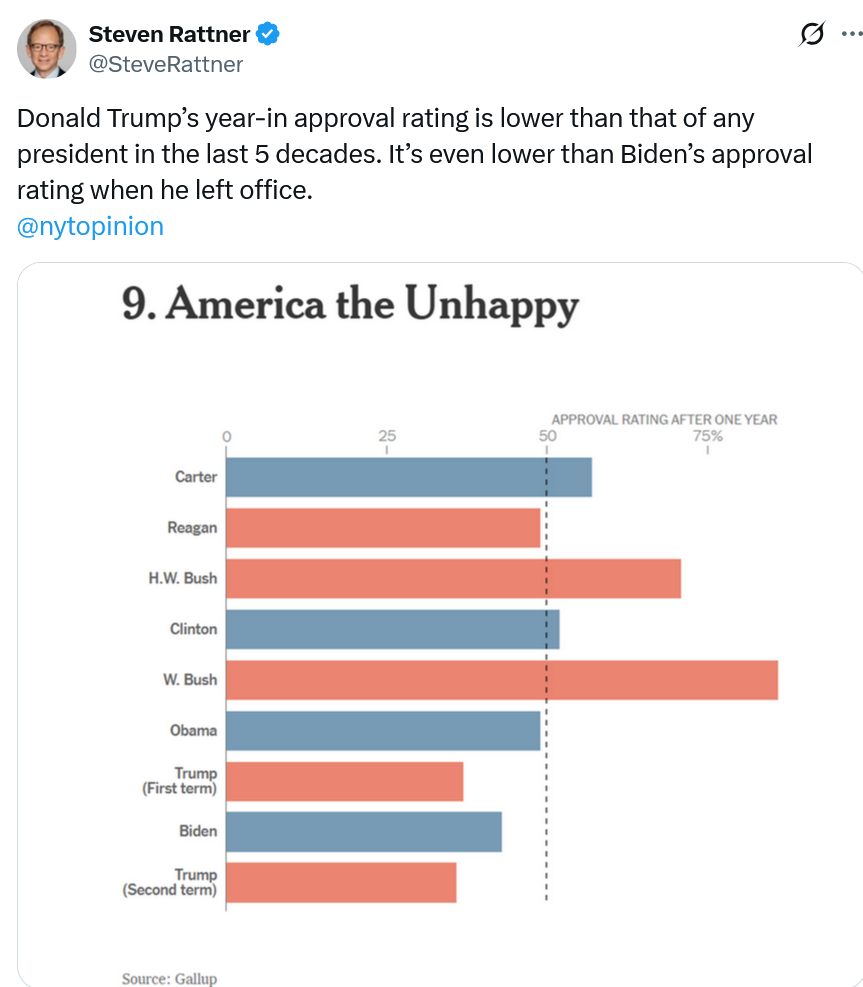
Steve Rattner’s very worthwhile Annual Year in Charts for the NYT (gift link) has this this encouraging look at Gallup data over time:
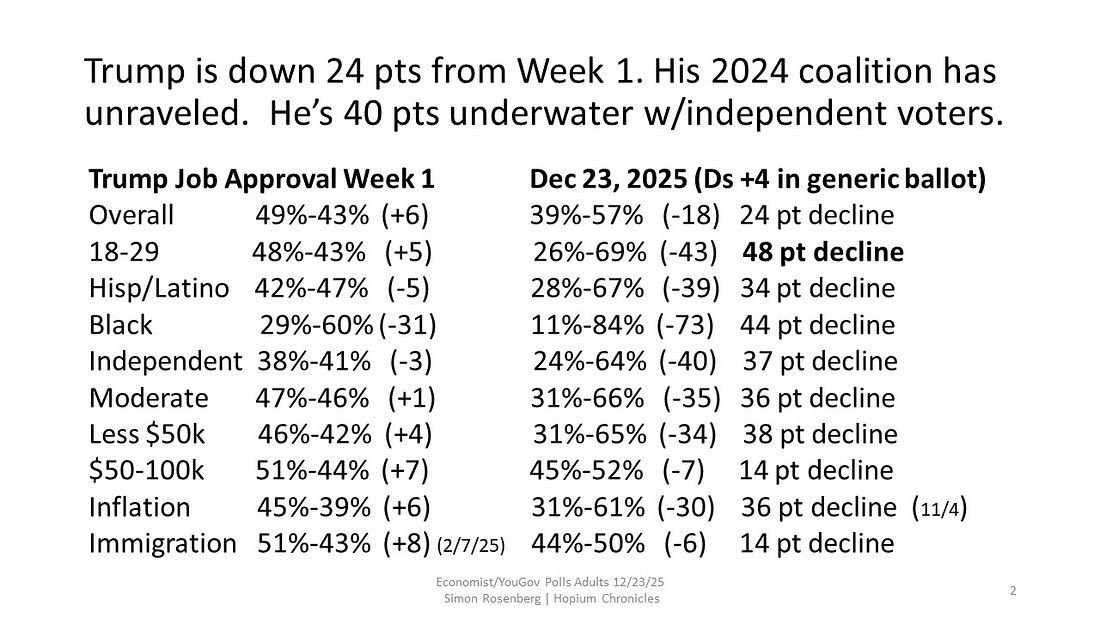
Here’s our latest look at the weekly Economist/YouGov tracker:
House Democratic Leader Hakeem Jeffries sent the following letter to his colleagues yesterday:
Dear Colleague:
I write with respect to the upcoming solemn anniversary of the January 6th brutal attack on the Capitol. Nearly five years ago, a violent mob incited by Donald Trump attempted to halt the peaceful transfer of power. As a result of the extraordinary bravery of the men and women of the U.S. Capitol Police and other law enforcement professionals, the treacherous effort to prevent certification of the results of the 2020 presidential election failed.However, the cost was profound. More than 140 heroic police officers were seriously injured and many suffered lasting physical and psychological trauma. Several tragically lost their lives. In the years since that disgraceful day, far-right Republicans in Congress have repeatedly attempted to rewrite history and whitewash the events of January 6th. Our country has been indelibly scarred.
Donald Trump promised to lower the high cost of living on day one of his presidency. One year later, costs are out of control, America is too expensive and Republicans believe that the affordability crisis is a hoax. They have done nothing to lower costs for everyday Americans, but are gutting healthcare and enacted massive tax breaks for their billionaire donors.
The toxic priorities of the Republican Party are clear. On day one of his second term, President Trump issued blanket pardons and commutations to the nearly 1,600 individuals charged in connection with the January 6th attack, including hundreds of violent felons who brutally assaulted law enforcement officers. Several of those individuals have been charged with new crimes throughout the country, putting the safety of the American people in jeopardy. A troubling number of the criminals pardoned by Donald Trump have been arrested for child molestation, sexual assault and kidnapping. Republicans own the failed economy, their broken promise to lower costs and the crime spree the dangerous criminals pardoned by the President have visited on our country.
We must never forget the horrors of January 6th and will continue to honor the brave law enforcement officers who were injured and lost their lives defending the rule of law in the United States. To that end, on the fifth anniversary of that fateful day, led by the Honorable Bennie Thompson and the Members of the January 6th Select Committee, House Democrats will hold a special hearing that will commence at 10:00 a.m.
At the hearing, we will examine ongoing threats to free and fair elections posed by an out-of-control Trump administration, expose the election deniers who hold high-level positions of significance in the executive branch and detail the threats to public safety posed by the hundreds of violent felons who were pardoned on the President’s first day in office. We will also present a panel of Members who wish to share their personal experiences from that horrific day. If you wish to testify, please contact Emily Berrett by 12:00 p.m. ET on Friday, January 2.
Thank you for your leadership and I look forward to our continued work in the new year to make life better for the American people.
Australian Politics
PM Anthony Albanese: We’re responding to the Bondi antisemitic terror attack with unity and urgency, not division and delay.
PM Anthony Albanese: To the doctors, nurses and medical staff across Sydney, thank you.
After Bondi, you’ve been caring for those injured, comforting families and saving lives.
In the darkest moments, your strength and compassion have shone through.
Australia is deeply grateful.
Anthony Albanese announces terms for Richardson review of Bondi terrorist attack.

(By Brianna Morris-Grant, ABC)
Prime Minister Anthony Albanese has announced the terms of an independent review of the Bondi Beach terror attack, resisting calls for a royal commission by victim’s families.
The review, led by Dennis Richardson AC, will examine the actions of Australia’s federal law enforcement and intelligence agencies leading up to the attack that claimed the lives of 15 people, including a 10-year-old child.
Seventeen families of those injured and killed in the attack signed a plea on Monday calling for a royal commission.
Their letter demanded “answers and solutions”, asking why “clear warning signs were ignored”.
The independent review will assess whether multiple agencies — including the Australian Security Intelligence Organisation (ASIO) and the Australia Federal Police — operated as effectively as possible prior to the attack.
Mr Albanese said his “heart breaks” for the families of those affected.
“Just over two weeks ago, antisemitic terrorists tried to tear our country apart, but our country is stronger than these cowards,” he said.
“They went to Bondi Beach to unleash mass murder against our Jewish community. We need to respond with unity and urgency rather than division and delay.”
Review to be given ‘full access’ to materials for Bondi inquiry
The review was slated to be completed and published in April.
Mr Albanese and other federal officials had expressed concerns about the length of time a royal commission would take and the potential platforming of antisemitism during the process.
Mr Richardson, the former head of ASIO and of the departments of defence and foreign affairs, has led earlier reviews into the intelligence community and sections of home affairs.
Mr Albanese’s announcement followed another meeting of the National Security Committee in Canberra.
“Mr Richardson will assess whether Commonwealth agencies performed to maximum effectiveness,” he said.
“He will consider what these agencies knew about the alleged offenders before the attack, the information sharing between Commonwealth agencies and between Commonwealth and state agencies.”
The review will also consider what judgements agencies made and if there were additional measures that could have prevented the attack.
“Mr Richardson will [have] full access to all material he considers may be relevant to his inquiry,” Mr Albanese said.
“Departments and agencies will cooperate fully with the review and provide assistance in the form of documents, data, material and meetings.”
He added parliament would resume in 2026 to consider legislation “as soon as possible”.
Royal commission would ‘revive some of the worst examples of antisemitism’… [the opposing views are canvassed below].

Albanese sorry but rejects royal commission, as Labor MPs break ranks

Paul Karp NSW political correspondent
Updated Dec 22, 2025 – 4.17pm,first published at 9.42am
Two Labor MPs have broken ranks to call for a national inquiry into the Bondi terror attack, including the issue of Islamic extremism, joining Jewish Australian groups to demand more action at the federal level.
Despite the calls from Ed Husic and Mike Freelander, Prime Minister Anthony Albanese dug in further on Monday against the idea, arguing a NSW royal commission and narrower federal review would be enough.
Freelander told The Australian Financial Review that the attack, which killed 15 people and one Islamic State-inspired terrorism gunman, raised “national issues and the national government needs to be the one dealing with it”.
Ed Husic, the first Muslim cabinet minister before he was dumped from the ministry in May, called for a royal commission to find out “how this happened [and] what we can do to root out extremism whichever form it comes in”.
“I’ve previously said I don’t care if it’s Islamist or far-right extremism, anything that presents a threat to Australians must be confronted,” he said.
“I’d be concerned that federal agencies might feel that they wouldn’t have the ability to participate fully in a state-based inquiry. Let’s remove the uncertainty and have a proper and thorough look at this.”

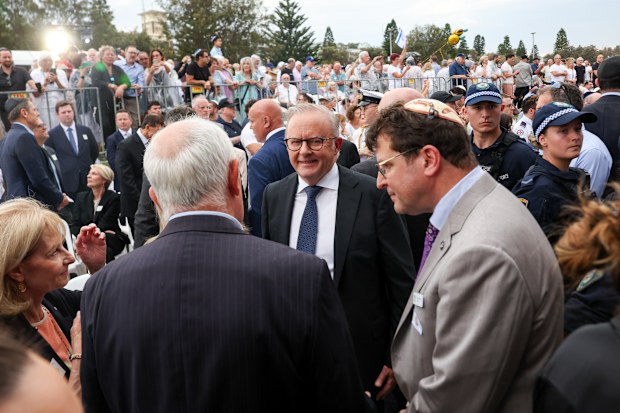
Prime Minister Anthony Albanese has been heckled as he arrived at Bondi Beach for the candlelight vigil.
Albanese has supported a NSW royal commission and set up a federal inquiry into intelligence agencies and law enforcement to be run by the Department of Prime Minister and Cabinet and former public servant Dennis Richardson.
On Monday, Albanese told reporters in Canberra he did not favour a federal royal commission because he wanted to act with “urgency and unity, not division and delay”.
“As prime minister, I feel the weight of responsibility for an atrocity that happened whilst I’m prime minister,” he said. “And I’m sorry for what the Jewish community and our nation as a whole has experienced. The government will work every day to protect Jewish Australians.”
Attorney-General Michelle Rowland and Home Affairs Minister Tony Burke outlined a series of measures, including making it easier to cancel visas, a new offence of inciting hatred and the creation of an aggravated offence targeting adults who seek to influence and radicalise children.
Earlier, the former treasurer Josh Frydenberg labelled the Richardson review a cop out, and Opposition Leader Sussan Ley proposed terms for a broader federal royal commission, including into antisemitism and the effectiveness of the Albanese government’s response.
Freelander, the member for Macarthur in south-western Sydney, said: “The general feeling in my electorate is people want to see all levels of government – state, local, and federal – work together try and get some answers about the event that happened at Bondi.”
“That has changed us forever. We need to bury the dead, we then need to look at how to rationally approach all the issues across all levels of government.”
Asked about Albanese’s assurance that federal authorities would co-operate with the planned NSW royal commission, Freelander replied: “I’m not sure what that means, what authority a state royal commission would have, and how far that co-operation would go.”
“It seems to me that there are national issues, so the national government needs to be the one dealing with it. Sure, there are state and local government issues as well, so all levels of government need to work together.
“But surely, there are deep operational issues, security issues, even philosophical issues about what we do with Muslim extremists … that certainly has to be a national inquiry.”
NSW Board of Jewish Deputies president David Ossip and Executive Council of Australian Jewry president Daniel Aghion used their contributions at a Bondi terror attack memorial on Sunday to call for a royal commission.
Ossip said it “cannot be disputed” that a federal royal commission was needed. “In a more just world, we wouldn’t be trying to pick up the pieces and understand how last week took place.”
“How, after two years of escalating antisemitism and warnings from the Jewish community and ASIO that lives were going to be lost, that the terrorist attack still took place?” he said.
“Because, while we are all in shock and deeply sad, we are not surprised. We feared and suspected that this moment was coming.”
Aghion said that “every level of government from the federal government down and every sector of society must take the necessary steps to make us all safe”.
“One necessary step is, as David Ossip has already said, and I thank him for the courage to say it, a Commonwealth royal commission.”
Former High Court chief justice Robert French has said in a statement that there is a “moral imperative” to inquire into the “surreal evil” of the Bondi attack, and a Commonwealth royal commission would be most effective.
At a press conference on Monday, Ley said, “The Jewish community made it abundantly clear they want a Commonwealth royal commission into this attack and into the hideous antisemitism that has been allowed to fester in this country.”
Opposition education spokesman Julian Leeser said the departmental review into the Bondi attack was “another attempt at deflecting and minimising the Jew hate that has been allowed to go on in this country”.
But Albanese said the Coalition’s proposed terms of reference – which include education, the arts, culture, and migration – amounted to an inquiry into “the whole functioning of Australia”.
“What we need to do is to work immediately. That is what the Richardson review will do. And in addition to that, it will feed into the inquiry, which hasn’t been announced in NSW,” he said. “The idea that we would have multiple royal commissions as well as a review running at the same time is going to simply delay action.”
Earlier on Monday, NSW Premier Chris Minns confirmed the state royal commission would examine federal agencies, including spy agency ASIO, describing it as a “comprehensive investigation” into the Bondi attack.

 Robin's Room