
Julia Golding The Austen Intrigue Book 4 of Regency Secrets, HarperCollins UK, One More Chapter | One More Chapter, November 2025.
Thank you, NetGalley, for providing me with this uncorrected proof for review.
I have mixed feelings about this novel – the Jane Austen link was interesting, the European political and historical background informative and easily understood, and the two main characters, Dora Fitz-Pennington and Jacob Sandys introduce complexities of class, friendships, and professional background. However, there are also some jarring moments which conflict with the measured writing that seems relevant to the period.
Each book in the series, of which this is the fourth, introduces a historical character who assists in the investigations that Fitz-Pennington and Sandys encounter in their detective agency. Jane Austen’s brother, Henry and his wife, Eliza also feature. The first chapter is set in the Austen household, providing a background to their lives – Henry a successful banker and Jane, an unacknowledged writer, but very acknowledged spinster of uncertain age move from this family circle into the path of murder. Henry Austen’s reputation and bank is to be saved by the investigation; Jane Austen, assisting the investigation at his command, is to be first perceived as an irritating spinster who lies about her background and then recognised as the writer of Sense and Sensibility, which Fitz-Pennington reads avidly in a night. See Books: Reviews for the complete review.
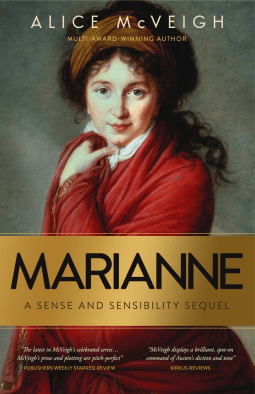
Alice McVeigh Marianne A Sense and Sensibility Sequel Warleigh Hall Press | Independent Book Publishers Association (IBPA), Members’ Titles, October 2025.
Thank you NetGalley and Alice McVeigh for providing me with this uncorrected proof for review.
This series has been a joy to read from the first novel, a wonderful encounter with the young woman who was to become Austen’s Lady Susan, Susan, A Jane Austen Prequel. McVeigh has never moved away from her meticulous rendering of Austen’s language and time and the introduction of credible events: her novels are clearly the end point of not only research, but an enduring knowledge and love for Austen’s work. Marianne A Sense and Sensibility Sequel is particularly elegant in its weaving together characters from several Austen novels – Sense and Sensibility, Mansfield Park, Emma, Lady Susan, Pride and Prejudice and Northanger Abbey.
Marianne Brandon is widowed at twenty – a sad state that does not prevent her from romantic musings, tinged with regret, wrath, and self-delusion about the young men she encounters throughout the novel. Her truly foolish and romantic persona is adopted by Margaret, her younger sister. Margaret’s romantic musings are fully developed in her diary in which she reflects upon her attempts to write a novel. This adds to the humour in the narrative, as well as being reminiscent of Northanger Abbey. There are other delightful reminders of Austen’s fine hand in Willoughby’s self-justification for his treatment of Marianne which recalls the conversation between her aunt and uncle in Sense and Sensibility. Although in this novel, John redeems himself by providing something for the sisters in his will, Willoughby’s self-justification is a potent reminder of the past impoverishment of the sisters that led to his decision to abandon Marianne.
Is Jane Austen’s work so well reflected in Alice McVeigh’s that she is replaced, her own novels unnecessary reading? No, because that is far too high a demand to make of any writer whose work is a variation on another’s. However, does McVeigh capture the essence of Austen so well that we can return to her world through these new novels? I believe that there can be only a resounding yes to that query. In this latest work McVeigh has given us Marianne, a more thoughtful character, but retaining much of her younger, impetuous self. She has also provided other characters with a past that rings true, and a future that is a pleasure to see revealed.
Dr Christopher Herbert Jane Austen’s Favourite Brother, Henry Pen & Sword | Pen & Sword History, May 2025.

Thank you, NetGalley, for providing me with this uncorrected proof for review.
Christoher Herbert’s history employs one of the most useful strategies when dealing with a subject for whom the material is sparse. In this case, there is an abundance of material about Jane Austen who has been the subject of so many biographies. However, Herbert does not rely solely on this, adroitly using his independent research and bolstering it with material that sets the context for events that are not recorded. He also uses the more conventional way of contributing to research when dealing with a writer – studying the author’s work for clues. In this case, both Jane and Henry Austen’s writing. This is a work of substance, accessible writing, a broad history of the time and social mores, and an intriguing insight into Henry and his family, including Jane for whom it becomes clear, Henry was indeed her favourite brother.
There are wonderfully comic passages – the discussion of studying at Oxford and Cambridge in the period was delightful. Less attractive is the recognition of the family’s slavery connections. However, these topics and a multitude of others, including reference to Austen’s novels, provide a picture of the father of these two affectionate siblings. See Books: Reviews for the complete review.
American Politics

Jeff Jacoby’s Arguable: From two Egyptian midwives to Martin Luther King

The Boston Globe <newsletters@bostonglobe.com>Tuesday, January 13, 2026
By Jeff Jacoby, Globe Opinion columnist
New to Arguable? Click here to subscribe. Follow me on X
From two midwives in Egypt to Martin Luther King Around the corner from my home in Brookline, Mass., is the William Ingersoll Bowditch House at 9 Toxteth Street. In the 1840s and 1850s, the house was a “station” on the Underground Railroad, part of the elaborate network of secret routes and safe havens that helped 100,000 or more enslaved Black Americans in the United States escape to freedom in the decades before the Civil War. The Underground Railroad, a great collaborative effort in defense of liberty, was also a massive campaign of civil disobedience at a time when federal law made it a crime to assist freedom seekers fleeing bondage. That means that everyone involved in the Underground Railroad was a lawbreaker — and a moral champion.
I pass that house regularly, and often find myself thinking about the Americans who sheltered refugees there. They knew the law (Bowditch was a lawyer) and understood the penalties they risked by flouting it — prosecution, heavy fines, imprisonment. They did it anyway, because their conscience gave them no choice. The Fugitive Slave Act was lawful, duly enacted by Congress and signed by the president. But it was also profoundly unjust, and the men and women of the Underground Railroad recognized a higher obligation than obedience to such a law.
They were not the first to face that dilemma.
The tradition of righteous lawbreaking reaches back far beyond antebellum America. The earliest recorded acts of civil disobedience were committed by three women, whose stories are told in the opening chapters of the book of Exodus. They came from opposite ends of ancient Egypt’s social ladder. Two were lowly midwives named Shifra and Puah. The third was a princess, the daughter of Ramesses II, the most powerful pharaoh in Egyptian history.
Their tales begin with a genocidal decree. Pharaoh, alarmed by the growing population of his enslaved Hebrews, orders Shifra and Puah to kill every newborn Hebrew boy they deliver. But the women cannot bring themselves to follow such orders. As Exodus 1 relates: “The midwives feared God; they did not do as the king of Egypt commanded them, but they let the boys live.”
When summoned to explain their disobedience, they offer Pharaoh a transparently absurd excuse: Hebrew women give birth so quickly that the babies arrive before the midwives can get there. Their defiance is not merely courageous but bold to the point of mockery.
This happened in the 13th century BCE, millennia before any theory of civil disobedience existed. The notion of universal human rights was unknown. Yet Shifra and Puah instinctively grasped a principle that would not be codified for many centuries — that some orders are so immoral they must not be obeyed, regardless of who issues them or what punishment disobedience might bring. The text says simply that the women “feared God”— they had a conscience that wouldn’t let them commit murder, even under direct command from the most powerful ruler on earth.
Then, in Exodus 2, comes another act of defiance, equally remarkable.

The serene setting of The Finding of Moses, painted by Nicholas Poussin in 1638, belies the gravity of the civil disobedience it portrays: Pharaoh’s daughter openly defying her tyrannical father’s order to drown all Hebrew baby boys. (Wikimedia) Pharaoh, thwarted by the midwives, issues a public edict, binding on every Egyptian: All male Hebrew newborns are to be drowned in the Nile. One Hebrew mother hides her infant son as long as she can, then sets him afloat in a basket, hoping desperately that someone might rescue him.
Someone does, and it turns out to be the daughter of Pharaoh himself. She finds the baby, realizes immediately that he’s a Hebrew, and decides to save him anyway. Her handmaids, witnessing this defiance, must surely have warned her of the risk. Yet she stands her ground. Indeed, the princess doesn’t simply rescue the child in secret — she adopts him openly and raises him in the royal palace, in direct violation of her father’s genocidal decree.
As the late Rabbi Jonathan Sacks observed, to get a sense of the magnitude of her act, replace the phrase “Pharaoh’s daughter” with “Hitler’s daughter” or “Stalin’s daughter.” In refusing to assist a homicidal regime into whose highest ranks she was born, she demonstrated that even in the heart of darkness, moral courage is possible.
These women — the midwives and the princess — had nothing in common except their refusal to participate in evil. They acted without the benefit of historical precedent or political theory. But they set the pattern for all those who would choose to fight unjust laws by breaking them and accepting the consequences — people like Rosa Parks, Henry David Thoreau, Mahatma Gandhi, Oskar Schindler, the Soviet refuseniks, Bowditch and the Underground Railroad abolitionists, and the Dutch couple who helped hide Anne Frank and her family.
Next week, Americans will honor the life and legacy of Martin Luther King Jr., whose commitment to civil disobedience in the cause of racial justice made him one of the 20th century’s towering figures. As a Baptist minister, King was of course familiar with the legacy of moral courage that stretches back to Shifra, Puah, and Pharaoh’s daughter. His writings and speeches contain many biblical references, and his philosophy of nonviolent resistance rested on the same foundation as the ancient midwives’: There is a law higher than human law, and decent people must sometimes choose between obedience and justice.
In his renowned “Letter from Birmingham Jail,” written in 1963 while imprisoned for organizing a nonviolent march against segregation, King addressed white clergymen who had criticized him for defying an injunction banning civil rights protests. He drew a crucial distinction between just and unjust orders, arguing that “one has a moral responsibility to disobey unjust laws.” But unlike those who simply buck authority, King insisted that genuine civil disobedience requires accepting the penalty. “One who breaks an unjust law must do so openly, lovingly, and with a willingness to accept the penalty,” he wrote. “I submit that an individual who breaks a law that conscience tells him is unjust, and who willingly accepts the penalty of imprisonment in order to arouse the conscience of the community over its injustice, is in reality expressing the highest respect for law.”
This was no license for lawlessness or violence. King explicitly rejected both. Those who sat down at lunch counters, who marched in the streets, who refused to move to the back of the bus — they weren’t anarchists or revolutionaries. On the contrary, King argued, they were standing up for America’s deepest values, carrying the nation “back to those great wells of democracy which were dug deep by the Founding Fathers.”
In truth, they were reaching back even further — back to the midwives of Egypt who stood before the most powerful ruler of their age and said no. Back to the princess who defied her own father’s genocidal decree. Back to the first people in recorded history who understood that conscience can demand disobedience, and that such disobedience represents not a rejection of law but its highest expression.
This ancient principle is once again a live issue. Last month, six Democratic members of Congress, all military veterans, released a video reminding active-duty service members of their legal obligation under the Uniform Code of Military Justice to refuse unlawful orders. That is hardly a novel or partisan claim. It is settled military law, codified after the Nuremberg trials in order to prevent “just following orders” from serving as a defense for atrocities. The principle is taught at every service academy and appears in every military legal handbook.
Yet the video provoked an unhinged response. In a series of characteristically over-the-top posts, President Trump claimed the lawmakers had committed “SEDITIOUS BEHAVIOR, punishable by DEATH!” Secretary of Defense Pete Hegseth has moved to deprive one of the legislators, Senator Mark Kelly, of his rank and pension as a retired Navy captain. Ironically, Hegseth himself said in a 2016 video that US troops “won’t follow unlawful orders” and that “if you’re doing something that is completely unlawful and ruthless, then there is a consequence for that.” Kelly now faces the prospect of significant financial penalties for saying essentially the same thing.
But the principle endures because it is true: Obedience to human authority has limits. Shifra and Puah understood this without legal theory. Pharaoh’s daughter acted on it at enormous personal risk. The conductors of the Underground Railroad staked their freedom on it. King gave his life for it. And in our generation, too, men and women must decide whether they will uphold this inheritance or abandon it.
As Americans prepare to honor Martin Luther King Jr.’s legacy, it is worth remembering that his commitment to civil disobedience was neither abstract nor comfortable. It meant jail cells and death threats, beatings and bombs. But King believed, as the Egyptian midwives believed 33 centuries earlier, that some laws must be violated and some orders refused.
The Bowditch House still stands on a quiet residential street, long after the law it defied has been consigned to ignominy. The people who sheltered fugitives there did not know how history would judge them; they only knew what they could not do. That is how moral progress usually begins — not with certainty, but with refusal. That is how it must continue, whenever law demands what conscience forbids.

Should ICE Agents Be Able To Wear Masks?
Joyce Vance from Civil Discourse <joycevance@substack.com>
Forwarded this email? Subscribe here for more
Should ICE Agents Be Able To Wear Masks?Joyce VanceJan 14
Protect and serve. That’s supposed to be the job. What could be further from that than masked agents roaming American streets in packs, refusing to identify themselves, and terrorizing—there is no other word for it at this point—American citizens? Early on, the excuse for wearing masks was that it was necessary to protect the agents. From what? There were reports that they were being doxxed, which no one in law enforcement likes to deal with. But they’re the ones assaulting and killing people, which is far more problematic. Back in July, the Acting Director of ICE, Todd Lyons, said that he did not encourage agents to use masks but would continue to let them wear them in the field “if that’s a tool they need to keep them and their families safe.” Now masks and gaiters are emblematic of ICE agents and their colleagues from CBP (Customs and Border Protection) doing immigration work in places like Minneapolis.
You don’t routinely see the FBI or U.S. Marshals out doing their jobs with masks on. There is literally no legitimate reason for ICE and Customs Border Patrol (CBP) to continue to operate this way during immigration “enforcement actions,” especially in light of the recent history of documented abuses. Anonymity accelerates that kind of behavior. It tells the agents they aren’t accountable for violating people’s civil rights.
There has been concern about the kind of people the administration is rushing into service in ICE and as deportation officers. Congressional Democrats are asking for information on whether hiring includes now-pardoned Jan. 6 defendants.
The overwhelming majority of federal law enforcement agents I worked with during my 25-year career at DOJ were men and women who were committed to following the law themselves while protecting their communities and prosecuting crimes. They believed citizens had constitutional rights. There’s no reason for the sudden change, a world where an agent shoots and kills a woman for no good reason, except that the current leadership in the White House and at DHS is willing to tolerate, if not encourage, what we’re now seeing. There are people ripped out of their cars, homes entered without a judicial warrant, agents who treat American citizens like they have no rights. This administration dishonors the service of the federal agents who spent their careers committed to constitutional policing.
Law enforcement officers are trained to de-escalate tense situations. Instead, we’re watching ICE agents act like the accelerant to a smoldering fire. The administration’s take on the failure of agents to behave like the good guys they’re supposed to be isn’t to put a stop to it. Instead, they revel in the Gestapo-like images of doors being busted down, school kids being knocked to the ground, and peaceful protesters being hit with pepper spray. So, it’s up to someone else to stop it.
The state of training at ICE is unclear, as new agents are rapidly hired and deployed. But what we’re seeing is troubling.
Some states have tried passing laws to prohibit masking.
California passed SB 627 (the “No Secret Police Act”) in late 2025, restricting law enforcement, including federal agents, from using extreme face coverings like ski masks during operations, effective Jan 1, 2026. There are logical exemptions to protect officer safety and the identity of undercover operatives. California Governor Gavin Newsom said at the time, “This is about the secret police. We’re not North Korea, Mr. President. We’re not the Soviet Union. This is the United States of America.”
The language of the bill explains that “facial coverings limit the visibility of facial expressions, which are essential components of nonverbal communication. In high-stress or emotionally charged interactions, the inability to read an officer’s expression may lead to misinterpretation of tone or intent, increasing the risk of conflict escalation” and that “the visibility of an officer’s face is vital for promoting transparency, facilitating communication, and building trust between law enforcement agencies and the communities they serve.” It also points out that “when officers are not readily identifiable, it increases the risk of impersonation by unauthorized individuals, which further undermines public trust, endangers public safety, and hinders legitimate law enforcement operations.”
But the Constitution protects federal supremacy, and the predictable challenge to the law from DOJ ensued in November 2025, arguing that the measure infringes on federal authority and endangers agent safety in an environment of accelerating threats made against them. California agreed it would not enforce the law until a judge had the opportunity to rule on the federal government’s request for a preliminary injunction. The concession was viewed as “a tactical decision by the state, speeding the court proceedings toward a conclusion while avoiding a temporary restraining order that likely would have prevented the law from taking effect in the meantime.” A preliminary injunction hearing is scheduled to take place this week.
Rep Eric Swalwell told me exactly this in an interview on Friday, adding defunding ICE, an end to immunity and more support for state prosecutions of criminal agents: newrepublic.com/article/2051...Mon, 12 Jan 2026 14:01:58 GMT View on Bluesky
Law enforcement can adapt to measures that prohibit masking except when necessary (as in SWAT operations or for undercover agents). Although federal law doesn’t contain any restrictions on wearing masks, in 2022, the Secret Service and the Park Police agreed to wear badges and identify themselves in public, as a result of the debacle in Lafayette Square during the first Trump administration, when rubber bullets, tear gas, and flash bangs were used on peaceful protestors. Federal agents and police cleared the Square to facilitate Trump’s desire for a photo opportunity at St. John’s Church.
Whether or not the California law passes constitutional muster, its rationale is strong. In a moment where the focus should be on de-escalating tension between federal agents and communities, masks are making it worse. It would be a simple measure and a show of good faith toward communities like Minneapolis to end their use. That the administration won’t take even that simple step tells you all you need to know about where this is headed.Thanks for being here with me at Civil Discourse. I appreciate your support. Paid subscriptions make the work and resources that go into the newsletter possible and allow us to expand the community of people who believe it’s our duty as citizens to participate in our democracy.
We’re in this together, Joyce
British Politics
Fiona Hill: “The UK needs to think of its own sovereignty” *
The foreign policy expert on spheres of influence and what America First really means
By Megan Gibson
Fiona Hill knows more than almost anyone just how fraught this geopolitical moment is. The British-born Russia expert not only served as an adviser to presidents George W Bush, Barack Obama and Donald Trump, she also sat on the US’s National Security Council until 2019. Later that year, she became a star witness in Congress’s impeachment inquiry over Trump’s relationship with Russia ahead of the 2020 presidential election.
More recently, as people scrambled for information in the immediate aftermath of the US’s strikes in Venezuela, a 2019 deposition resurfaced in which Hill detailed a “strange swap arrangement” that Russia was floating at the time. According to the proposal, Russia suggested it would cede its interests in Venezuela if the US would abandon Ukraine. Hill spoke to the New Statesman about that proposal, the return of the Monroe Doctrine and the prospect of a US attack on Europe.
Megan Gibson: Your 2019 deposition has gained a lot of attention in recent days. When you gave the deposition it was well before the full-scale invasion of Ukraine, but was the revelation of the swap proposal picked up on at the time?
Fiona Hill: It wasn’t really. That’s why it’s probably resonated in such a major way now, because people are looking back for explanations. What we have to do is cast ourselves back to that first Trump administration in 2019. You just had another election in Venezuela. Maduro had absolutely, clearly lost. At that point, the US was part of a much larger discussion about how to persuade Maduro to give up power, to leave and to put a coalition government to place that would then start that process of putting Venezuela on a different footing. There were a lot of European countries [involved], including the UK, Italy, Spain, Colombia, Mexico, Brazil. There was a question about where Maduro would go, and that was certainly not off to the Southern District Court of New York. The idea was that like many former dictators, he’d find somewhere to go. In the midst of all of this there are also rumours spreading around that the US might basically try to topple Maduro.
The Russians had vested interests: they’d been using Venezuela as a launchpad for all kinds of disinformation in the Spanish language. They’re still playing up all these old leftist connections from the Soviet period, and there’s oil. So the Russians had specialists they put in place basically to help Maduro push back against the possibility of a US invasion.
Meanwhile, you’ve got some Russian officials basically saying, “Perhaps if [we left you to] focus on Venezuela, then you could basically butt out of whatever it is that you think you’re doing in Ukraine.” I had hints dropped – that nudge-nudge, wink-wink kind of approach – by the Russian ambassador to the US at the time, Anatoly Antonov. But the proposal was not picked up at that point, even by people within the [first] Trump administration, because the people at the time who were interested in the demise of Maduro were not interested in doing a swap for Ukraine.
But was there anyone in the first administration who seemed especially intrigued by the prospect of a return to the Monroe Doctrine?
Well, there were certainly plenty of people talking about it. I would say that our Secretary of State, Marco Rubio – at that point he was in the Senate – was then making very strong comments about the importance of the US playing a more forceful role in its hemisphere. Now we seem to have gone back to an old role, or even an expansion of an old role of the US throwing its weight around. I’m not sure that’s really what, at the time, Rubio had in mind. But there certainly were plenty of people who wanted to see the end of Maduro. The Russians, of course, knew that, and they kept making all these comments about Cuba as well.
And now we see Trump is talking about attacking Cuba, as well as attacking Colombia and Mexico, and annexing Greenland. Were these countries part of the Russian conversation back then?
No, of course not. Greenland was already emerging as a fixation of Trump’s, but it wasn’t linked at that point to any larger idea of dominating the Western hemisphere. It was more about the risks of China muscling in. Look, the president is saying there’s all these ships from China and Russia around Greenland – no, there is not. Remember, Greenland is part of Nato and the US has had bases in Greenland since the 1950s. It [already] plays an important role in North Atlantic security, which is recognised by the Danes, by the Greenlanders themselves and Canada, Norway and the UK. Perhaps rudimentary fragments were there in that period around 2019 or so but they weren’t then taking the shape of: “I can do whatever I want in the Western hemisphere. It’s my domain.”
How concerned should the residents of Greenland – and Europe – be now?
They should be very concerned. You had Katie Miller – the wife of Stephen Miller, Trump’s chief adviser – putting out on X a picture of Greenland with the US map [overlaid]. Is this trolling? Obviously, but it’s also got some real menace behind it.
It’s the kind of thing we expect from the Russians. It’s intimidation.
It all depends how this plays out in Venezuela. Spheres of influence might be all nice and neat and great for historians to talk about, but they rarely go uncontested. The US is not the overlord of every country in Latin and South America in the way that it might have been. Brazil is a major power, it’s got options. Other countries are not as weak as Venezuela is. Are Canadians really going to just go along with anything that is pushed upon them? We can see from recent events in Ukraine and elsewhere that when people are put under a lot of pressure, some of them decide to fight back.
Should we take Trump at his word that this is a return of the Monroe Doctrine and that he’s simply seizing command of his backyard? Could it be part of a wider attempt at asserting US supremacy?
I don’t think these things have to be mutually exclusive. The National Security Strategy makes things very clear that the Western hemisphere is now the focal point but what is our vision for the region other than: “We own this, and everyone else can keep out”? Now Europe is a secondary consideration and so is the Middle East. Everyone is at pains to say that China is still a major priority, which doesn’t suggest that leaving the whole of Asia to President Xi is entirely on thecards.
[But] there’s a whole wide world out there [to push back] – not just Brazil but India, South Africa, Indonesia, Japan, South Korea, all kinds of other countries that were not in the picture during the Cold War. This is a totally different place, the world we live in now, than it was 80 years ago, 40 years, 30 years, or even 20 years ago. It’s much more complicated, and I’m not so sure how much Trump is going to be able to throw his weight around.
His second term has recast a lot of thinking about Trump as an isolationist and what America First means exactly. Do his actions align with any recognisable doctrine? Or is it a mistake to think that he has one?
Well, there’s lots of people around him who have recognisable doctrines. But with Trump, it’s about him and it’s about his perceptions. A lot of this is personal whim. He is a pattern-breaker. That’s why he’s so successful, actually, because people expect all kinds of things from him and then he often does things they weren’t expecting at all.
He says he is America First – no, he’s himself first. Anywhere [he sees the opportunity to gain] some benefit for him and his own extended business interests, then you can be sure he’ll take it if he thinks he can get away with it. [So they] put pressure on Denmark, put pressure on Europeans because Europe doesn’t have any leverage. Wherever he can leverage something – and this is exactly what Putin and the Russians do – he will leverage it.
How much of this foreign policy comes down to Trump’s own pursuit of self-enrichment?
Oh, it’s a lot about that. And enrichment isn’t just in monetary terms. It’s in terms of the mantle of power and his own status. It’s about his ego, and renaming everything after him. I’m sure Venezuela will now have some new appendage attached to it [bearing Trump’s name].
So it’s his legacy?
I don’t think he’s really interested in legacy. He wants the accolades in real time because he won’t be around to enjoy them when he is dead. Putin and Xi are somewhat different because they see themselves as the inheritors of great history – millennia-long [history] in the case of China. For Trump, it is just Trump. He completely trashes every other American leader – he doesn’t have a good word for any of them.
Is China more likely to launch its own military operation in Taiwan after Venezuela? Does it figure at all into the calculation?
Well, it basically removes any moral high ground that the US – or anybody else, frankly, if they don’t push back against this – would have. The Russians already have made all these cases about Zelensky not being legitimate, for example, and [guilty of] all kinds of corruption. In the case of Taiwan, could we start to see some kind of manufacturing about rogue behaviour [to justify an invasion]? That might give them an excuse, but perhaps they don’t even need that. But [the Venezuela strike] removes the ability for others to push back against it.
The idea of spheres of influence where Russia looks after its patch, China has its patch and the US has the Western hemisphere – it leaves Europe a bit adrift…
It’s somebody else’s patch.
Exactly. But Marco Rubio has always been hawkish on China and Russia, and thus quite supportive of Taiwan and Europe compared to other figures in the administration – like JD Vance. Rubio seems to be ascendant within the administration at the moment, so how do you think he’ll influence these various geopolitical calculations?
It’s really hard to say. Rubio might be ascendant on this issue, but he certainly hasn’t been in the case of Ukraine or in the Middle East. [Latin America] is an issue that he is deeply familiar with. On the other issues – Europe, the larger geopolitical landscape – he’s extraordinarily well versed. But can he have that same impact? I’m not so sure.
And if the Russians are thinking of trade-offs, then you’ve got people like Vance and others who do not want to see any more support for Ukraine or Europe. You look at the people who helped put together that National Security Strategy: itdoesn’t necessarily bode well for any kind of coherence here. What it does suggest is that it’s just gonna be this tug of war, all the time. If I were sitting in London and Europe, I’d be getting my own act together.
You helped write the UK’s Strategic Defence Review, so you have more insight than almost anyone on where Britain falls short. At the moment, how great of a concern are British capabilities?
They are of concern. And all of Europe and Canada is probably feeling quite discomforted at the moment as well. It was never a great idea: 80 years of the US dominating European security and everybody just basically acquiescing to that because they believed they were dealing with a benevolent country. It was always inevitable that the US at some point was going to say, enough.
So what we should be doing is really taking a long, hard look – as we tried to do in the Strategic Defence Review – at our own security position. Who is it that we should be working most closely with? In the review you will see there was a lot of advocation of focusing on the European security front. In the period that we were finishing it in March of last year, it was just prior to the whole blow-up at the 2025 Munich Security Conference, and there was still the idea that the US would remain a major bilateral partner. But this is a place that’s in a constant amount of flux. The UK, like other European neighbours, needs to re-engage with Canada, Denmark and Greenland and Norway, all the Scandinavian countries, [as part] of a multifaceted security realm in the North Atlantic, the North Sea, the northern part of Europe. The UK also has overseas interest and it has to take care of themas well.
But it has to do that in conjunction with others. It’s fair to say, and some people will disagree, but Brexit was a colossal mistake because it assumed a benign security environment. And I’m sorry, you could have foreseen these kinds of things happening. Making yourself entirely dependent on the US at a time when the world was changing dramatically was a strategic blunder. The world was changing [then] and it’s well and truly changed now. The UK will have to work very closely with its other allies to figure out how to address this, and we need a national conversation. It doesn’t mean [saying], “We’re gonna be under attack any second now from the Russians pouring over this border, land, sea, or air.” But we’re in a real predicament and we haven’t taken care of our critical national infrastructure. We also have to think about the informational and propaganda environment that we’re in: it’s informational warfare, which the Russians are winning all the time, and frankly, the United States is engaging now with the same degrees of hostile propaganda. The UK needs to think of its own sovereignty as other countries do.
Would you have liked to see a stronger initial reaction from European leaders and Keir Starmer to what happened in Venezuela?
[It’s important to make] it clear that there have been violations of international law and process here, and recognising that the UK and Europe and others cannot be complicit in this. Do they have to tread very carefully? Absolutely. And they better start thinking about what they are going to do about Panama. What about Greenland? What about Canada?
We also have to see what happens. There’s always a rush [to think] the world is ending here. I’m probably contributing to that somewhat by some of the things I’m laying out. But I’m going to pause here [to note that] the US doesn’t exist in a vacuum. It will get pushback. Some of that pushback could well come from the UK and other European allies, and Canada basically saying “no”. Everybody has agency. This is not going to be a linear triumphal march from Venezuela to [the US dominating] everything else.
Back to the idea of Russia and the US swapping Venezuela for Ukraine: if you are Zelensky at this moment, how worried should you be?
Pretty worried. But it seems to be more par for the course for poor Zelensky. There’s been all kinds of pressure on Ukraine [already] to give up territory. We’ve been dealing with all of that for the last several months, but it really does undercut the US as an honest broker. I think the Ukrainians were already quite aware of this. It just means we’re in a territory where the Russians double and triple down. Trump says all the time: “Ukraine’s a little country.” It’s not actually a little country, it’s a big country. But [in Trump’s mind] it belongs in the sphere of Russia, where might makes right.
This is an edited extract from a longer interview. Hear the full conversation on the New Statesman’s Daily Politics podcast, below.
[Further reading: America’s imperial fights are not necessarily ours]
- See my review of Fiona Hill’s autobiography, There is Nothing For You Here in my blog October 2021.
Listen to the New Statesman podcast
The Sydney Morning Herald Rob Harris and Matthew Knott
Updated January 8, 2026 — 7.57pmfirst published at 4.31pm
‘I’ve taken the time to reflect’: Anthony Albanese bows to intense pressure, announces antisemitism royal commission
An unprecedented royal commission will probe the explosion of antisemitism and a deterioration in social cohesion following the worst terror attack in the nation’s history after the federal government caved to three weeks of fierce calls from the victims’ families, public figures, the opposition and some within Labor to hold a federal inquiry.
Prime Minister Anthony Albanese stared down last-minute resistance from prominent Jewish Australians, including former treasurer Josh Frydenberg, by appointing former High Court justice Virginia Bell to lead the national inquiry, who has been asked to complete her inquiry and report by the end of the year.
He said the inquiry would address four key areas: investigating the nature and prevalence of antisemitism; making recommendations to assist law enforcement or to control immigration and security agencies to tackle antisemitism; examining the circumstances surrounding the Bondi terrorist attack on December 14; and examining ways to strengthen social cohesion and counter the spread of ideological and religiously motivated extremism in Australia.
“I’ve taken the time to reflect, to meet with leaders in the Jewish community, and most importantly, I’ve met with many of the families of victims and survivors of that horrific attack,” Albanese said after constantly rejecting calls for weeks to hold a national inquiry. “They’ve had their lives and worlds shattered … I’ve shed tears with them. I want to thank people for those honest and open-hearted conversations.”
He said it became clear to him that a federal royal commission was needed into the broader issue rather that a NSW-based inquiry because antisemitism was not confined between “the Tweed River and the Murray”. Following Albanese’s announcement, the NSW government confirmed its planned inquiry would no longer proceed.
Albanese said the inquiry would not be “a drawn-out process”, and the government has asked Bell to deliver her final report before December 14. The commissioner has also been directed not to prejudice any future criminal proceedings against 24-year-old gunman Naveed Akram, who faces 59 charges, including 15 counts of murder.
Pressed later on whether the backdown had made him appear weak, Albanese told the ABC’s 7.30: “I think that people expressing their views is a good thing. Governments should be open to listening, and we have done that.”
Despite refusing to publicly commit to a royal commission in the weeks since the terror attack, Albanese said the government had been working on the details of the royal commission for some time.
The government was determined to avoid a “half-hearted” announcement of intention that only fuelled more speculation, he said.
Former senior public servant Dennis Richardson’s existing work examining the roles of the security and intelligence agencies will be incorporated into the commission. Richardson will support Bell’s inquiry and deliver an interim report by April.
The four key terms of the Royal Commission on Antisemitism and Social Cohesion
- Investigate the prevalence of antisemitism in Australia, including how it is driven by religious and ideologically motivated extremism and radicalisation
- Help law enforcement and security agencies tackle antisemitism, including through training organisations on how to respond to antisemitic conduct
- Examine the circumstances surrounding the Bondi terrorist attack
- Make any other recommendations that could strengthen social cohesion and counter the spread of extremism
The Islamic State-inspired attack on a Jewish festival event at Bondi on December 14 left 15 people dead and more than 40 injured.
Hitting out at critics within his own left-wing political base, who believe the role of Israel’s assault on the Gaza Strip in October 2023 are to blame for the uptick in antisemitic acts and violence, Albanese said he was determined that he wanted to build social cohesion, and not tear it apart.
“I don’t want a royal commission into whether we provide a solution on Gaza or on the Middle East,” he said.
“That’s not the role of a royal commission … Australians want two things. When it comes to the Middle East, they want it to stop – they want peace for Israelis and Palestinians. But the other thing that they want is for conflict to not be brought here.”
The commission will also examine the adequacy of law enforcement, border, immigration and security agency responses to antisemitism and make recommendations to strengthen social cohesion and counter ideological and religious radicalisation.
Albanese said Bell’s experience would allow the commission to meaningfully examine the impact of antisemitism on the daily lives of Jewish Australians without providing a platform for hatred.
“This royal commission is the right format, the right duration and the right terms of reference to deliver the right outcome for our national unity and our national security,” Albanese said.
Opposition Leader Sussan Ley criticised Albanese for taking three weeks to agree to hold a federal investigation, saying: “This will forever be the Commonwealth royal commission Anthony Albanese was forced to have. Few issues in Australian history have united such a broad and credible coalition against a sitting prime minister.”
Ley said the decision to appoint a single commissioner showed Albanese still failed “to grasp the gravity of the issues at stake”.
The Coalition had called for three royal commissioners to be appointed: a former judge, a person with lived experience of antisemitism and a national security expert.
Frydenberg, now chairman of Goldman Sachs Australia, said following the announcement that the commission must be fiercely independent, rigorous, trusted and transparent.
“The bar is high. The stakes are higher,” he said in a post on X. “It is a tragic reality that antisemitism has become normalised in Australia. It is a cancer that must be rooted out.”
The Zionist Federation of Australia welcomed the establishment of the royal commission as a “necessary and important step” and praised the scope of its terms of reference.
“The work now is to ensure the commission is able to examine all relevant issues fully and rigorously, so it can follow the evidence wherever it leads and deliver practical reforms that strengthen the safety and wellbeing of Jewish Australians and the broader community,” the federation’s president, Jeremy Liebler, said.
Executive Council of Australian Jewry President Daniel Aghion said the government had made the right decision by heeding the calls made by the Jewish community and the families affected by the shootings.
Related Article

Virginia Bell
Who is Virginia Bell, the former justice who will lead the Bondi royal commission?
“We are especially grateful to the eminent artists, lawyers, business leaders, sporting legends, political figures, women’s organisations and other groups who added their powerful voices to this call.”
Aghion said the executive council would cooperate fully Bell with as commissioner and “make every effort to ensure that the full force of the community’s views and experiences of antisemitism in various sectors of society are brought to the forefront of the inquiry”.
Jewish leaders had earlier warned Albanese against appointing Bell amid concerns over her previous High Court ruling in favour of public protest as an act of political expression, while others said she could be viewed as an overly political choice after Labor appointed her in 2022 to probe Scott Morrison’s multiple ministries.
Asked directly about the criticisms of Bell, Albanese said there had been a range of views but there was “no one of the stature of Virginia Bell”, adding her background in the criminal law would be critical, and she was “widely respected right across the board”.
A Jewish community leader said that, while there had been some disquiet about Bell’s perceived close ties to Labor, criticism of the government’s response to the Bondi massacre would simmer down. “Now the decision has been made, everyone will do their best to support it,” the community leader said.
Albanese had been subjected to three weeks of pressure both publicly and, increasingly, internally after he suggested a royal commission was not best placed to deal with national security issues and risked giving a platform to antisemitic hate speech.
After several interventions, he this week changed his message, opening the door to calls for a royal commission which had come from the families of Bondi victims, national and state Jewish community groups, more than 200 senior members of the Australian Bar, more than 100 captains of industry, the Business Council of Australia, the Law Council of Australia, Catholic bishops, prominent sports stars and three Labor backbenchers.
Albanese said Israeli President Isaac Herzog was still formally invited to visit the country in coming weeks despite opposition from pro-Palestinian advocates in Labor’s rank and file.
The AI revolution is here. Will the economy survive the transition?
The Substack Post <post+unstacked@substack.com> 10 January 2026
Forwarded this email? Subscribe here for more
The AI revolution is here. Will the economy survive the transition?
The man who predicted the 2008 crash, Anthropic’s co-founder, and a leading AI podcaster jump into a Google doc to debate the future of AI—and, possibly, our lives.
Michael Burry, Dwarkesh Patel, Patrick McKenzie, and Jack Clark
Michael Burry called the subprime mortgage crisis when everyone else was buying in. Now he’s watching trillions pour into AI infrastructure, and he’s skeptical. Jack Clark is the co-founder of Anthropic, one of the leading AI labs racing to build the future. Dwarkesh Patel has interviewed everyone from Mark Zuckerberg to Tyler Cowen about where this is all headed. We put them in a Google doc with Patrick McKenzie moderating and asked: Is AI the real deal, or are we watching a historic misallocation of capital unfold in real time?
The story of AI
Patrick McKenzie: You’ve been hired as a historian of the past few years. Succinctly narrate what has been built since Attention Is All You Need. What about 2025 would surprise an audience in 2017? What predictions of well-informed people have not been borne out? Tell the story as you would to someone in your domain—research, policy, or markets.
Jack Clark: Back in 2017, most people were betting that the path to a truly general-purpose system would come from training agents from scratch on a curriculum of increasingly hard tasks, and through this, create a generally capable system. This was present in the research projects from all the major labs, like DeepMind and OpenAI, trying to train superhuman players in games like Starcraft, Dota 2, and AlphaGo. I think of this as basically a “tabula rasa” bet—start with a blank agent and bake it in some environment(s) until it becomes smart. Of course, as we all know now, this didn’t actually lead to general intelligences—but it did lead to superhuman agents within the task distribution they were trained on. At this time, people had started experimenting with a different approach, doing large-scale training on datasets and trying to build models that could predict and generate from these distributions. This ended up working extremely well, and was accelerated by two key things: the Transformer framework from Attention Is All You Need, which made this type of large-scale pre-training much more efficient, and the roughly parallel development of “Scaling Laws,” or the basic insight that you could model out the relationship between capabilities of pre-trained models and the underlying resources (data, compute) you pour into them. By combining Transformers and the Scaling Laws insights, a few people correctly bet that you could get general-purpose systems by massively scaling up the data and compute. Now, in a very funny way, things are coming full circle: people are starting to build agents again, but this time, they’re imbued with all the insights that come from pre-trained models. A really nice example of this is the SIMA 2 paper from DeepMind, where they make a general-purpose agent for exploring 3D environments, and it piggybacks on an underlying pre-trained Gemini model. Another example is Claude Code, which is a coding agent that derives its underlying capabilities from a big pre-trained model.
Patrick: Due to large language models (LLMs) being programmable and widely available, including open source software (OSS) versions that are more limited but still powerful relative to 2017, we’re now at the point where no further development on AI capabilities (or anything else interesting) will ever need to be built on a worse cognitive substrate than what we currently have. This “what you see today is the floor, not the ceiling” is one of the things I think best understood by insiders and worst understood by policymakers and the broader world. Every future Starcraft AI has already read The Art of War in the original Chinese, unless its designers assess that makes it worse at defending against Zerg rushes.
Jack: Yes, something we say often to policymakers at Anthropic is “This is the worst it will ever be!” and it’s really hard to convey to them just how important that ends up being. The other thing which is unintuitive is how quickly capabilities improve—one current example is how many people are currently playing with Opus 4.5 in Claude Code and saying some variation of “Wow, this stuff is so much better than it was before.” If you last played with LLMs in November, you’re now wildly miscalibrated about the frontier.
Michael Burry: From my perspective, in 2017, AI wasn’t LLMs. AI was artificial general intelligence (AGI). I think people didn’t think of LLMs as being AI back then. I mean, I grew up on science fiction books, and they predict a lot, but none of them pictured “AI” as something like a search-intensive chatbot.For Attention Is All You Need and its introduction of the transformer model, these were all Google engineers using Tensor, and back in the mid-teens, AI was not a foreign concept. Neural networks, machine learning startups were common, and AI was mentioned a lot in meetings. Google had the large language model already, but it was internal. One of the biggest surprises to me is that Google wasn’t leading this the whole way given its Search and Android dominance, both with the chips and the software. Another surprise is that I thought application-specific integrated circuits (ASICs) would be adopted far earlier, and small language models (SLMs) would be adopted far earlier. That Nvidia has continued to be the chip for AI this far into inference is shocking. The biggest surprise to me is that ChatGPT kicked off the spending boom. The use cases for ChatGPT have generally been limited from the start—search, students cheating, and coding. Now there are better LLMs for coding. But it was a chatbot that kicked off trillions in spending. Speaking of that spending, I thought one of the best moments of Dwarkesh’s interview with Satya Nadella was the acknowledgement that all the big software companies are hardware companies now, capital-intensive, and I am not sure the analysts following them even know what maintenance capital expenditure is.
Dwarkesh Patel: Great points. It is quite surprising how non-durable leads in AI so far have been. Of course, in 2017, Google was far and away ahead. A couple years ago, OpenAI seemed way ahead of the pack. There is some force (potentially talent poaching, rumor mills, or reverse engineering) which has so far neutralized any runaway advantages a single lab might have had. Instead, the big three keep rotating around the podium every few months. I’m curious whether “recursive superintelligence” would actually be able to change this, or whether we should just have a prior and strong competition forever.
For the remainder of this lengthy discussion see Further Commentary and Articles arising from Books* and continued longer articles as noted in the blog.

 Robin's Room