- all material in this section is copyright to Robin Joyce (unless attributed to another author).


This section includes some book reviews where they are relevant to the commentary.
Notes from Heather Cox Richardson 28 March 2026 – Notes: https://www.nytimes.com/live/2026/us/minneapolis-shooting-ice/1f84e779-0bca-5a4a-8f50-5c79afbeabd4https://www.nytimes.com/live/2026/us/minneapolis-shooting-ice/108890fb-be19-5718-9f56-786ed1b3958dhttps://www.nytimes.com/live/2026/us/minneapolis-shooting-ice/8404e3b2-1720-5936-9b0b-55aea7fcff4bhttps://www.cnn.com/us/live-news/ice-minneapolis-shooting-01-24-26?post-id=cmksrkzmi000k3b6pgzs16rayhttps://www.startribune.com/ice-raids-minnesota/601546426https://www.democracydocket.com/news-alerts/attorney-general-bondi-minnesota-voter-rolls-border-patrol-fatal-shooting/https://iq.govwin.com/neo/marketAnalysis/view/DHS-Funding-Provisions-in-the-One-Big-Beautiful-Bill-Act/8497https://www.wpr.org/news/the-man-killed-by-a-federal-officer-in-minneapolis-was-an-icu-nurse-family-sayshttps://www.splcenter.org/resources/hatewatch/stephen-millers-affinity-white-nationalism-revealed-leaked-emails/https://storage.courtlistener.com/recap/gov.uscourts.mnd.230788/gov.uscourts.mnd.230788.4.0.pdfYouTube:shorts/hyqtAyuI8LIX:TheDemocrats/status/2015109925412700479?s=20DHSgov/status/2015115351797780500?s=20Bluesky:seanokane.bsky.social/post/3md6y2b5xa22latrupar.com/post/3md6zon4a4j2dpatdeklotz.bsky.social/post/3md6zn3x5ck2vchicyph80.bsky.social/post/3md6zlv52ac2edimitridrekonja.bsky.social/post/3md6xdjppvs27simonwdc.bsky.social/post/3md6wp7tqa223petermorley.bsky.social/post/3md6rwhcrqc2xpbump.com/post/3md6xhxw47k2zpiperformissouri.bsky.social/post/3md6utaxsh22fatrupar.com/post/3md6qwufxms2sreichlinmelnick.bsky.social/post/3md76borpls2cgomez.house.gov/post/3md76w5zids23charlotteclymer.bsky.social/post/3md76ilmo6c2dgelliottmorris.com/post/3md6tocfxxs2jsahilkapur.bsky.social/post/3md7g75pv2s23esqueer.net/post/3md7e62sjtk25obarcala.bsky.social/post/3md77ysayes2zadamjschwarz.bsky.social/post/3md7bx7llxc25acyn.bsky.social/post/3md7b3wt72t2ekenklippenstein.bsky.social/post/3md75h7mhis2kjeffrueter.bsky.social/post/3md7iqqr5622imusicologyduck.bsky.social/post/3md6wrft7cs24atrupar.com/post/3md6rzvjvx22adavidcorn.bsky.social/post/3md6xn43hn22qchrismurphyct.bsky.social/post/3md6w3h4pwk2ksanho.bsky.social/post/3md7tkdg2os26ag.state.mn.us/post/3md7pjqoihc2yrickhasen.bsky.social/post/3md7o7llmok2tkyledcheney.bsky.social/post/3md7y3pdxv72vbritculpsapp.bsky.social/post/3md6xioc3ds2u
The AI revolution is here. Will the economy survive the transition?
The Substack Post <post+unstacked@substack.com> 10 January 2026
Forwarded this email? Subscribe here for more
The AI revolution is here. Will the economy survive the transition?
The man who predicted the 2008 crash, Anthropic’s co-founder, and a leading AI podcaster jump into a Google doc to debate the future of AI—and, possibly, our lives.
Michael Burry, Dwarkesh Patel, Patrick McKenzie, and Jack Clark
Michael Burry called the subprime mortgage crisis when everyone else was buying in. Now he’s watching trillions pour into AI infrastructure, and he’s skeptical. Jack Clark is the co-founder of Anthropic, one of the leading AI labs racing to build the future. Dwarkesh Patel has interviewed everyone from Mark Zuckerberg to Tyler Cowen about where this is all headed. We put them in a Google doc with Patrick McKenzie moderating and asked: Is AI the real deal, or are we watching a historic misallocation of capital unfold in real time?
The story of AI
Patrick McKenzie: You’ve been hired as a historian of the past few years. Succinctly narrate what has been built since Attention Is All You Need. What about 2025 would surprise an audience in 2017? What predictions of well-informed people have not been borne out? Tell the story as you would to someone in your domain—research, policy, or markets.
Jack Clark: Back in 2017, most people were betting that the path to a truly general-purpose system would come from training agents from scratch on a curriculum of increasingly hard tasks, and through this, create a generally capable system. This was present in the research projects from all the major labs, like DeepMind and OpenAI, trying to train superhuman players in games like Starcraft, Dota 2, and AlphaGo. I think of this as basically a “tabula rasa” bet—start with a blank agent and bake it in some environment(s) until it becomes smart. Of course, as we all know now, this didn’t actually lead to general intelligences—but it did lead to superhuman agents within the task distribution they were trained on. At this time, people had started experimenting with a different approach, doing large-scale training on datasets and trying to build models that could predict and generate from these distributions. This ended up working extremely well, and was accelerated by two key things: the Transformer framework from Attention Is All You Need, which made this type of large-scale pre-training much more efficient, and the roughly parallel development of “Scaling Laws,” or the basic insight that you could model out the relationship between capabilities of pre-trained models and the underlying resources (data, compute) you pour into them. By combining Transformers and the Scaling Laws insights, a few people correctly bet that you could get general-purpose systems by massively scaling up the data and compute. Now, in a very funny way, things are coming full circle: people are starting to build agents again, but this time, they’re imbued with all the insights that come from pre-trained models. A really nice example of this is the SIMA 2 paper from DeepMind, where they make a general-purpose agent for exploring 3D environments, and it piggybacks on an underlying pre-trained Gemini model. Another example is Claude Code, which is a coding agent that derives its underlying capabilities from a big pre-trained model.
Patrick: Due to large language models (LLMs) being programmable and widely available, including open source software (OSS) versions that are more limited but still powerful relative to 2017, we’re now at the point where no further development on AI capabilities (or anything else interesting) will ever need to be built on a worse cognitive substrate than what we currently have. This “what you see today is the floor, not the ceiling” is one of the things I think best understood by insiders and worst understood by policymakers and the broader world. Every future Starcraft AI has already read The Art of War in the original Chinese, unless its designers assess that makes it worse at defending against Zerg rushes.
Jack: Yes, something we say often to policymakers at Anthropic is “This is the worst it will ever be!” and it’s really hard to convey to them just how important that ends up being. The other thing which is unintuitive is how quickly capabilities improve—one current example is how many people are currently playing with Opus 4.5 in Claude Code and saying some variation of “Wow, this stuff is so much better than it was before.” If you last played with LLMs in November, you’re now wildly miscalibrated about the frontier.
Michael Burry: From my perspective, in 2017, AI wasn’t LLMs. AI was artificial general intelligence (AGI). I think people didn’t think of LLMs as being AI back then. I mean, I grew up on science fiction books, and they predict a lot, but none of them pictured “AI” as something like a search-intensive chatbot.For Attention Is All You Need and its introduction of the transformer model, these were all Google engineers using Tensor, and back in the mid-teens, AI was not a foreign concept. Neural networks, machine learning startups were common, and AI was mentioned a lot in meetings. Google had the large language model already, but it was internal. One of the biggest surprises to me is that Google wasn’t leading this the whole way given its Search and Android dominance, both with the chips and the software. Another surprise is that I thought application-specific integrated circuits (ASICs) would be adopted far earlier, and small language models (SLMs) would be adopted far earlier. That Nvidia has continued to be the chip for AI this far into inference is shocking. The biggest surprise to me is that ChatGPT kicked off the spending boom. The use cases for ChatGPT have generally been limited from the start—search, students cheating, and coding. Now there are better LLMs for coding. But it was a chatbot that kicked off trillions in spending. Speaking of that spending, I thought one of the best moments of Dwarkesh’s interview with Satya Nadella was the acknowledgement that all the big software companies are hardware companies now, capital-intensive, and I am not sure the analysts following them even know what maintenance capital expenditure is.
Dwarkesh Patel: Great points. It is quite surprising how non-durable leads in AI so far have been. Of course, in 2017, Google was far and away ahead. A couple years ago, OpenAI seemed way ahead of the pack. There is some force (potentially talent poaching, rumor mills, or reverse engineering) which has so far neutralized any runaway advantages a single lab might have had. Instead, the big three keep rotating around the podium every few months. I’m curious whether “recursive superintelligence” would actually be able to change this, or whether we should just have a prior and strong competition forever.
Jack: On recursion, all the frontier labs are speeding up their own developers using AI tools, but it’s not very neat. It seems to have the property of “you’re only as fast as the weakest link in the chain”—for instance, if you can now produce 10x more code but your code review tools have only improved by 2x, you aren’t seeing a massive speedup. A big open question is whether it’ll be possible to fully close this loop, in which case you might see some kind of compounding R&D advantage.Do AI tools actually improve productivity?
Dwarkesh: The million-dollar question is whether the METR productivity study (which shows that developers working in codebases they understood well had a roughly 20% decrease on merging pull requests from coding tools) or human equivalent time horizons of self-contained coding tasks (which are already in the many-hours range and doubling every four to seven months) is a better measure of how much speedup researchers and engineers at labs are actually getting. I don’t have direct experience here, but I’d guess it’s closer to the former, given that there isn’t a great feedback verification loop and the criteria are open-ended (maintainability, taste, etc.).Jack: Agreed, this is a crucial question—and the data is conflicting and sparse. For example, we did a survey of developers at Anthropic and saw a self-reported 50% productivity boost from the 60% of those surveyed who used Claude in their work. But then things like the METR study would seem to contradict that. We need better data and, specifically, instrumentation for developers inside and outside the AI labs to see what is going on. To zoom out a bit, the massive and unprecedented uptake of coding tools does suggest people are seeing some major subjective benefit from using them—it would be very unintuitive if an increasing percentage of developers were enthusiastically making themselves less productive.
Dwarkesh: Not to rabbit hole on this, but the self-reported productivity being way higher than—and potentially even in the opposite direction of—true productivity is predicted by the METR study.
Jack: Yes, agreed. Without disclosing too much, we’re thinking specifically about instrumentation and figuring out what is “true” here, because what people self-report may end up being different from reality. Hopefully we’ll have some research outputs on this in 2026!Which company is winning?
Michael: Do you think the podium will keep rotating? From what I’m hearing, Google is winning among developers from both AWS and Microsoft. And it seems the “search inertia” has been purged at the company.
Dwarkesh: Interesting. Seems more competitive than ever to me. The Twitter vibes are great for both Opus 4.5 and Gemini 3.5 Pro. No opinion on which company will win, but it definitely doesn’t seem settled.Jack: Seems more competitive than ever to me, also!
Dwarkesh: Curious on people’s take on this: how many failed training runs/duds of models could Anthropic or OpenAI or Google survive? Given the constant need to fundraise (side question: for what exactly?) on the back of revenue and vibes.
Michael: The secret to Google search was always how cheap it was, so that informational searches that were not monetizable (and make up 80% or more) did not pile up as losses for the company. I think this is the fundamental problem with generative AI and LLMs today—they are so expensive. It is hard to understand what the profit model is, or what any one model’s competitive advantage will be—will it be able to charge more, or run cheaper?Perhaps Google will be the one that can run cheapest in the end, and will win the commodity economy that this becomes.
Dwarkesh: Great point. Especially if you think many/most of the gains over the last year have been the result of inference scaling, which requires an exponential increase in variable cost to sustain.Ultimately, the price of something is upper-bounded by the cost to replace it. So foundation model companies can only charge high margins (which they currently seem to be) if progress continues to be fast and, to Jack’s point, becomes eventually self-compounding.Why hasn’t AI stolen all our jobs?
Dwarkesh: It’s really surprising how much is involved in automating jobs and doing what people do. We’ve just marched through so many common-sense definitions of AGI—the Turing test is not even worth commenting on anymore; we have models that can reason and solve difficult, open-ended coding and math problems. If you showed me Gemini 3 or Claude 4.5 Opus in 2017, I would have thought it would put half of white-collar workers out of their jobs. And yet the labor market impact of AI requires spreadsheet microscopes to see, if there is indeed any.I would have also found the scale and speed of private investment in AI surprising. Even as of a couple years ago, people were talking about how AGI would have to be a government, Manhattan-style project, because that’s the only way you can turn the economy into a compute and data engine. And so far, it seems like good ol’-fashioned markets can totally sustain multiple GDP percentages of investment in AI.
Michael: Good point, Dwarkesh, re: the Turing test—that was definitely the discussion for a good while. In the past, for instance, during the Industrial Revolution and the Services Revolution, the impacts on labor were so great that mandatory schooling was instituted and expanded to keep young people out of the labor pool for longer. We certainly have not seen anything like that.
Jack: Yes, Dwarkesh and Michael, a truism for the AI community is they keep on building supposedly hard tasks that will measure true intelligence, then AI systems blow past these benchmarks, and you find yourself with something which is superficially very capable but still likely makes errors which any human would recognize as bizarre or unintuitive. One recent example is LLMs were scored “superhuman” on a range of supposedly hard cognitive tasks, according to benchmarks, but were incapable of self-correcting when they made errors. This is now improving, but it’s an illustration of how unintuitive the weaknesses of AI models can be. And you often discover them alongside massive improvements.
Dwarkesh: I wonder if the inverse is also true—humans reliably make classes of errors that an LLM would recognize as bizarre or unintuitive, lol. Are LLMs actually more jagged than people, or just jagged in a different way?
Patrick: Stealing an observation from Dwarkesh’s book, a mundane way in which LLMs are superhuman is that they speak more languages than any human—by a degree that confounds the imagination—and with greater facility than almost all polyglots ever achieve. Incredibly, this happens by accident, even without labs specifically training for it. One of the most dumbfounding demos I’ve ever seen was an LLM trained on a corpus intended to include only English documents yet able to translate a CNN news article to Japanese at roughly the standard of a professional translator. From that perspective, an LLM that hadn’t had politeness trained into it might say, “Humans are bizarre and spiky; look how many of them don’t speak Japanese despite living in a world with books.”Why many workers aren’t using AI (yet)
Patrick: Coding seems to be the leading edge for widespread industrial adoption of AI, with meteoric revenue growth for companies like Cursor, technologists with taste taking to tools like Claude Code and OpenAI Codex, and the vibes around “vibe coding.” This causes a pronounced asymmetry of enthusiasm for AI, since most people are not coders. What sector changes next? What change would make this visible in earnings, employment, or prices rather than demos?
Jack: Coding has a nice property of being relatively “closed loop”—you use an LLM to generate or tweak code, which you then validate and push into production. It really took the arrival of a broader set of tools for LLMs to take on this “closed loop” property in domains outside of coding—for instance, the creation of web search capabilities and the arrival of stuff like Model Context Protocol (MCP) connectivity has allowed LLMs to massively expand their “closed loop” utility beyond coding. As an example, I’ve been doing research on the cost curves of various things recently (e.g. dollars of mass to orbit, or dollars per watt from solar), and it’s the kind of thing you could research with LLMs prior to these tools, but it had immense amounts of friction and forced you to go back and forth between the LLM and everything else. Now that friction has been taken away, you’re seeing greater uptake. Therefore, I expect we’re about to see what happened to coders happen to knowledge workers more broadly—and this feels like it should show up in a diffuse but broad way across areas like science research, the law, academia, consultancy, and other domains.
Michael: At the end of the day, AI has to be purchased by someone. Someone out there pays for a good or service. That is GDP. And that spending grows at GDP rates, 2% to 4%—with perhaps some uplift for companies with pricing power, which doesn’t seem likely in the future of AI.Economies don’t have magically expanding pies. They have arithmetically constrained pies. Nothing fancy. The entire software pie—SaaS software running all kinds of corporate and creative functions—is less than $1 trillion. This is why I keep coming back to the infrastructure-to-application ratio—Nvidia selling $400 billion of chips for less than $100 billion in end-user AI product revenue.AI has to grow productivity and create new categories of spending that don’t cannibalize other categories. This is all very hard to do. Will AI grow productivity enough? That is debatable. The capital expenditure spending cycle is faith-based and FOMO-based. No one is pointing to numbers that work. Yet.There is a much simpler narrative out there that AI will make everything so much better that spending will explode. It is more likely to take spending in. If AI replaces a $500 seat license with a $50 one, that is great for productivity but is deflationary for productivity spend. And that productivity gained is likely to be shared by all competitors.
Dwarkesh: Michael, isn’t this the “lump of labor” fallacy? That there’s a fixed amount of software to be written, and that we can upper bound the impact of AI on software by that?
Michael: New markets do emerge, but they develop slower than acutely incentivized futurists believe. This has always been true. Demographics and total addressable market (TAM) are too often marketing gimmicks not grounded in reality. China’s population is shrinking. Europe’s is shrinking. The U.S. is the only major Western country growing, and that is because of immigration, but that has been politicized as well. FOMO is a hell of a drug. You look at some comments from Apple or Microsoft, and it seems they realize that.
Dwarkesh: As a sidenote, it’s funny that AI comes around just when we needed it to save us from the demographic sinkhole our economies would have otherwise been collapsing into over the next few decades.Michael: Yes, Dwarkesh. In medicine, where there are real shortages, there is no hope for human doctors to be numerous enough in the future. Good medical care has to become cheaper, and technology is needed to extend the reach and coverage of real medical expertise.Are engineers going to be out of work?
Patrick: AppAmaGooFaceSoft [Apple, Amazon, Google, Facebook, Microsoft] presently employ on the order of 500,000 engineers. Put a number on that for 2035 and explain your thinking—or argue that headcount is the wrong variable, and name the balance-sheet or productivity metric you’d track instead.
Michael: From 2000, Microsoft added 18,000 employees as the stock went nowhere for 14 years. In fact headcount barely moved at Cisco, Dell, and Intel, despite big stock crashes. So I think it is the wrong variable. It tells us nothing about value creation, especially for cash-rich companies and companies in monopoly, duopoly, or oligopoly situations. I think it will be lower, or not much higher, because I think we are headed for a very long downturn. The hyperscalers laid off employees in 2022 when their stocks fell, and hired most of them back when their stocks rose. This is over a couple years.I would track shareholder-based compensation’s (SBC) all-in cost before saying productivity is making a record run. At Nvidia, I calculated that roughly half of its profit is eliminated by compensation linked to stock that transferred value to those employees. Well, if half the employees are now worth $25 million, then what is the productivity gain on those employees? Not to mention, margins with accurate SBC costs would be much lower.The measure to beat all measures is return on invested capital (ROIC), and ROIC was very high at these software companies. Now that they are becoming capital-intensive hardware companies, ROIC is sure to fall, and this will pressure shares in the long run. Nothing predicts long-term trends in the markets like the direction of ROIC—up or down, and at what speed. ROIC is heading down really fast at these companies now, and that will be true through 2035.In his interview with Dwarkesh, Satya Nadella said that he’s looking for software to maintain ROIC through a heavy capital expenditure cycle. I cannot see it, and even to Nadella, it sounds like only a hope.
Dwarkesh: Naive question, but why is ROIC more important than absolute returns? I’d rather own a big business that can keep growing and growing (albeit as a smaller fraction of investment) than a small business that basically prints cash but is upper-bounded in size.So many of the big tech companies have lower ROIC, but their addressable market over the next two decades has increased from ads ($400 billion in revenue a year) to labor (tens of trillions in revenue a year).
Michael: Return on invested capital—and, more importantly, its trend—is a measure of how much opportunity is left in the company. From my perspective, I have seen many roll-ups where companies got bigger primarily through buying other companies with debt. This brings ROIC into cold focus. If the return on those purchases ends up being less than the cost of debt, the company fails in a manner akin to WorldCom.At some point, this spending on the AI buildout has to have a return on investment higher than the cost of that investment, or there is just no economic value added. If a company is bigger because it borrowed a lot more or spent all its cash flow on something low-return, that is not an attractive quality to an investor, and the multiple will fall. There are many non-tech companies printing cash with no real prospects for growth beyond buying it, and they trade at about 8x earnings.Where is the money going?
Patrick: From a capital-cycle perspective, where do you think we are in the AI build-out—early over-investment, mid-cycle shakeout, or something structurally different from past tech booms? What would change your mind?
Michael: I do see it as different from prior booms, except in that the capital spending is remarkably short-lived. Chips cycle every year now; data centers of today won’t handle the chips of a few years from now. One could almost argue that a lot of this should be expensed, not capitalized. Or depreciated over two, three, four years.Another big difference is that private credit is financing this boom as much as or more than public capital markets. This private credit is a murky area, but the duration mismatch stands out—much of this is being securitized as if the assets last two decades, while giving the hyperscaler outs every four to five years. This is just asking for trouble. Stranded assets. Of course, the spenders are the richest companies on earth, but whether from cash or capital markets, big spending is big spending, and the planned spending overwhelms the balance sheets and cash flow of even today’s massive hyperscalers.Also, construction in progress (CIP) is now an accounting trick that I believe is already being used. Capital equipment not yet “placed into service” does not start depreciating or counting against income. And it can be there forever. I imagine a lot of stranded assets will be hidden in CIP to protect income, and I think we are already seeing that potential.In Dwarkesh’s interview, Nadella said he backed off some projects and slowed down the buildout because he did not want to get stuck with four or five years of depreciation on one generation of chips. That is a bit of a smoking-gun statement.We are mid-cycle now—past the point where stocks will reward investors for further buildout, and getting into the period where the true costs and the lack of revenue will start to show themselves.In past cycles, stocks and capital markets peaked about halfway through, and the rest of the capital expenditure occurred as a progressively pessimistic, or realistic, view descended on the assets of concern.
Dwarkesh: I think this is so downstream of whether AI continues to improve at a rapid clip. If you could actually run the most productive human minds on a B200 (Nvidia’s B200 GPU), then we’re obviously massively underinvesting. I think the revenues from the application layer so far are less informative than raw predictions about progress in AI capabilities themselves.
Jack: Agreed on this—the amount of progress in capabilities in recent years has been deeply surprising and has led to massive growth in utilization of AI. In the future, there could be further step-change increases in model capabilities, and these could have extremely significant effects on the economy. What the market gets wrong
Patrick: Where does value accrue in the AI supply chain? How is this different from recent or historical technological advances? Who do you think the market is most wrong about right now?
Michael: Well, value accrues, historically, in all industries, to those with a durable competitive advantage manifesting as either pricing power or an untouchable cost or distribution advantage.It is not clear that the spending here will lead to that.Warren Buffett owned a department store in the late 1960s. When the department store across the street put an escalator in, he had to, too. In the end, neither benefited from that expensive project. No durable margin improvement or cost improvement, and both were in the same exact spot. That is how most AI implementation will play out.This is why trillions of dollars of spending with no clear path to utilization by the real economy is so concerning. Most will not benefit, because their competitors will benefit to the same extent, and neither will have a competitive advantage because of it.I think the market is most wrong about the two poster children for AI: Nvidia and Palantir. These are two of the luckiest companies. They adapted well, but they are lucky because when this all started, neither had designed a product for AI. But they are getting used as such.Nvidia’s advantage is not durable. SLMs and ASICs are the future for most use cases in AI. They will be backward-compatible with CUDA [Nvidia’s parallel computing platform and programming model] if at all necessary. Nvidia is the power-hungry, dirty solution holding the fort until the competition comes in with a completely different approach.Palantir’s CEO compared me to [bad actors] because of an imagined billion-dollar bet against his company. That is not a confident CEO. He’s marketing as hard as he can to keep this going, but it will slip. There are virtually no earnings after stock-based compensation.
Dwarkesh: It remains to be seen whether AI labs can achieve a durable competitive advantage from recursive self-improvement-type effects. But if Jack is right and AI developers should already be seeing huge productivity gains, then why are things more competitive now than ever? Either this kind of internal “dogfooding” cannot sustain a competitive advantage or the productivity gains from AI are smaller than they appear.If it does turn out to be the case that (1) nobody across the AI stack can make crazy profits and (2) AI still turns out to be a big deal, then obviously the value accrues to the customer. Which, to my ears, sounds great.
Michael: In the escalator example, the only value accrued to the customer. This is how it always goes if no monopoly rents can be charged by the producers or providers.What would change their minds
Patrick: What 2026 headline—technological or financial—would surprise you and cause you to recalibrate your overall views on AI progress or valuation? Retrospectively, what was the biggest surprise or recalibration to date?
Michael: The biggest surprise that would cause me to recalibrate would be autonomous AI agents displacing millions of jobs at the biggest companies. This would shock me but would not necessarily help me understand where the durable advantage is. That Buffett escalator example again.Another would be application-layer revenue hitting $500 billion or more because of a proliferation of killer apps.Right now, we will see one of two things: either Nvidia’s chips last five to six years and people therefore need less of them, or they last two to three years and the hyperscalers’ earnings will collapse and private credit will get destroyed.Retrospectively, the biggest surprises to date are:Google wasn’t leading the whole way—the eight authors of Attention Is All You Need were all Google employees; they had Search, Gmail, Android, and even the LLM and the chips, but they fumbled it and gave an opening to competitors with far less going for them. Google playing catch-up to a startup in AI: that is mind-blowing.ChatGPT—a chatbot kicked off a multi-trillion-dollar infrastructure race. It’s like someone built a prototype robot and every business in the world started investing for a robot future.Nvidia has maintained dominance this far into the inference era. I expected ASICs and SLMs to be dominant by now, and that we would have moved well beyond prompt engineering. Perhaps the Nvidia infatuation actually held players back. Or anticompetitive behavior at Nvidia did.
Dwarkesh: Biggest surprises to me would be:2026 cumulative AI lab revenues are below $40 billion or above $100 billion. It would imply that things have significantly sped up or slowed down compared to what I would have expected.Continual learning is solved. Not in the way that GPT-3 “solved” in-context learning, but in the way that GPT-5.2 is actually almost human-like in its ability to understand from context. If working with a model is like replicating a skilled employee that’s been working with you for six months rather than getting their labor on the first hour of their job, I think that constitutes a huge unlock in AI capabilities.I think the timelines to AGI have significantly narrowed since 2020. At that point, you could assign some probability to scaling GPT-3 up by a thousand times and reaching AGI, and some probability that we were completely on the wrong track and would have to wait until the end of the century. If progress breaks from the trend line and points to true human-substitutable intelligences emerging over the next 5 to 20 years, that would be the biggest surprise to me.Jack: If “scaling hits a wall,” that would be truly surprising and would have very significant implications for both the underlying research paradigm as well as the broader AI economy. Obviously, the infrastructure buildout, including the immense investments in facilities for training future AI models, suggests that people are betting otherwise.One other thing I’d find surprising is if there was a combination of a technological breakthrough that improved the efficiency of distributed training, and some set of actors that put together enough computers to train a very powerful system. If this happened, it would suggest you can not only have open-weight models but also a form of open model development where it doesn’t take a vast singular entity (e.g. a company) to train a frontier model. This would alter the political economy of AI and have extremely non-trivial policy implications, especially around the proliferation of frontier capabilities. Epoch has a nice analysis of distributed training that people may want to refer to.How they actually use LLMs
Patrick: What was your last professionally significant interaction with an LLM? File off the serial numbers, if need be. How did you relate to the LLM in that interaction?
Michael: I use Claude to produce all my charts and tables now. I will find the source material, but I spend no time on creating or designing a professional table, chart, or visual. I still don’t trust the numbers and need to check them, but that creative aspect is in the past for me. Relatedly, I will use Claude in particular to find source material, as so much source material these days is not simply at the SEC or in a mainstream report.
Patrick: I think people outside of finance do not understand how many billions of dollars have been spent having some of the best-paid, best-educated people in the world employed as Microsoft PowerPoint and Excel specialists. There is still value in that, for the time being, and perhaps the shibboleth value of pivot tables and VLOOKUP() will endure longer than they do, but my presentation at the Bank of England also used LLMs for all the charts. It feels almost bizarre that we once asked humans to spend hours carefully adjusting them.
Dwarkesh: They are now my personal one-on-one tutors. I’ve actually tried to hire human tutors for different subjects I’m trying to prep for, and I’ve found the latency and speed of LLMs to just make for a qualitatively much better experience. I’m getting the digital equivalent of people being willing to pay huge premiums for Waymo over Uber. It inclines me to think that the human premium for many jobs will not only not be high, but in fact be negative.
Michael: On that point, many point to trade careers as an AI-proof choice. Given how much I can now do in electrical work and other areas around the house just with Claude at my side, I am not so sure. If I’m middle class and am facing an $800 plumber or electrician call, I might just use Claude. I love that I can take a picture and figure out everything I need to do to fix it.Risk, power, and how to shape the future
Patrick: The spectrum of views on AI risk among relatively informed people runs the gamut from “it could cause some unpleasantness on social media” to “it would be a shame if China beat the U.S. on a very useful emerging technology with potential military applications” to “downside risks include the literal end of everything dear to humanity.” What most keeps you up at night? Separately, if you had five minutes with senior policymakers, what new allocation of attention and resources would you suggest?
Jack: The main thing I worry about is whether people succeed at “building AI that builds AI”—fully closing the loop on AI R&D (sometimes called recursively self-improving AI). To be clear, I assign essentially zero likelihood to there being recursively self-improving AI systems on the planet in January 2026, but we do see extremely early signs of AI getting better at doing components of AI research, ranging from kernel development to autonomously fine-tuning open-weight models. If this stuff keeps getting better and you end up building an AI system that can build itself, then AI development would speed up very dramatically and probably become harder for people to understand. This would pose a range of significant policy issues and would also likely lead to an unprecedented step change in the economic activity of the world, attributable to AI systems. Put another way, if I had five minutes with a policymaker, I’d basically say to them, “Self-improving AI sounds like science fiction, but there’s nothing in the technology that says it’s impossible, and if it happened it’d be a huge deal and you should pay attention to it. You should demand transparency from AI companies about exactly what they’re seeing here, and make sure you have third parties you trust who can test out AI systems for these properties.”
Michael: Jack, I imagine you have policymakers’ ears, and I hope they listen.AI as it stands right now does not worry me much at all, as far as risks to humanity. I think chatbots have the potential to make people dumber—doctors that use them too much start to forget their actual innate medical knowledge. That is not good, but not catastrophic. The catastrophic worries involving AGI or artificial superintelligence (ASI) are not too worrying to me. I grew up in the Cold War, and the world could blow up at any minute. We had school drills for that. I played soccer with helicopters dropping Malathion over all of us. And I saw Terminator over 30 years ago. Red Dawn seemed possible. I figure humans will adapt.
If I had the ear of sen


When our arts desk asked 20 experts to list the books that got them through their 20s, I doubt they expected one of them to come back with Heart of Darkness. A mesmerising work of genius, sure, but a companion to surviving early adulthood? When I read the explanation as to why this book made it on to the list, however, I was immediately convinced. I think that’s why this two-part series – the second of which we published this week – has proven so popular. It’s an unexpected reading list for an uncertain period in anyone’s life. Madame Bovary isn’t a character you would want to emulate in your 20s but her story has a lot to teach us, so it made the cut. In fact, there’s arguably something to offer readers of any age in the lineup and certainly inspiration for Christmas pressies for the young people in your life.
Laura hood Senior Politics Editor, Assistant Editor
Your 20s can be an intense decade. In the words of Taylor Swift, those years are “happy, free, confused and lonely at the same time”. Many of us turn to literature to guide us through the highs and the lows of this formative time. We asked 20 of our academic experts to recommend the book that steered them through those ten years.
The complete article appears at Further Commentary and Articles arising from Books* and continued longer articles as noted in the blog. However, the list of books dealt with in more detail there, appears below.
1. Butterfly Burning by Yvonne Vera (1998)

Growing up, I didn’t have much guidance in discovering Black writers, especially not Black women writers. I’d read African classics like Chinua Achebe’s Things Fall Apart (1958), Ngũgĩ wa Thiong’o’s Devil on the Cross (1980), or Amos Tutuola’s The Palm-Wine Drinkard (1952), but I found it hard to connect with them.
As a young woman I was drawn to feminist and poetic writing about the body rather than political parables about places I’d never been to. That’s why Butterfly Burning – a fiercely poetic and mysteriously intimate novel – was such a revelation.
In 1997, Vera described her practice in a short essay called Writing Near the Bone. There she recalled her earliest memories of writing: being sent outside with her cousins where they would play by tracing their names in the mud and dust covering their legs. “We wrote deep into the skin and under skin where the words could not escape.” If a sentence can be a muse, this was destined to become mine.
Mathelinda Nabugodi is a lecturer in comparative literature
2. The Remains of the Day by Kazuo Ishiguro (1989)

Do you lie awake at night wondering what it would be like to work as a butler in a magnificent British manor during the first half of the 20th century? No? Still, it’s hard to escape such thoughts while reading Kazuo Ishiguro’s masterful 1989 novel The Remains of the Day.
The protagonist, Stevens, strives to become a “great” butler, which – according to him – means being able to carry out his duties even in the most extreme circumstances.
Emotions have no place in that job description, which leads to tragic consequences. Stevens is unable to express his deep feelings for his colleague Miss Kenton. Nor does he question his employer Lord Darlington’s political misjudgments.
The novel is a brilliant portrayal of class divisions and restrained masculinity – alas, traits not limited to a bygone era. In many ways, these are timeless themes. We must all reflect on how we balance our inner butler in our daily lives.
Torbjörn Forslid is a professor in literary studies
3. The History Man by Malcolm Bradbury (1975)
The History Man is my favourite campus novel. Like most successful satires, it pinballs between funny and bleak.

It follows an academic year in the life of sociology professor Howard Kirk, his wife Barbara, students and colleagues. His alternate charming and bullying outraged moralists and feminists on the book’s release.
After the #MeToo campaign, Howard is yet more likely to be termed emotionally and sexually abusive. I read the book the year I started teaching and immediately put it on my syllabus. Some cohorts loved it, some loathed it. Either reaction from my class of 20-somethings was better than indifference.
The political and activist energy of youth will be recognisable to many in their 20s, though the book cautions readers to consider who is agitating and why. It confronts readers with unethical and unjust scenarios in workplace and social settings that, unfortunately, will still be relatable to many young people – even if, today, their responses might differ from those of the characters.
Sarah Olive is a senior lecturer in English literature
4. Palestine by Joe Sacco (1993)

I was 25 when I first read Joe Sacco’s Palestine. Drawn in serialised chapters in the early 1990s, in the wake of the first intifada and on the eve of the Oslo accords, Sacco’s non-fiction comic offers a snapshot of history that will open your eyes to the deprivations of the Israeli occupation of Gaza.
It overturned the west’s media blackout on the Palestinian experience when it was first published, and it continues to serve as urgent testimony to the suffering of civilians who have lived their whole lives under settler colonial power. Sacco maintains his self-deprecating style throughout, reflexively satirising his reader’s consumption of war and violence as entertainment and bringing the architecture of the occupied territories to life.
Palestine will make you see through to the roots of conflict and feel the thickness of history as a force that accumulates in real people’s lives – in their eyes, their bodies, their homes, their landscapes.
Dominic Davies is a Reader in English
5. Lost Illusions by Honoré de Balzac (1843)

Reading Lost Illusions profoundly shaped my 20s. It follows Lucien de Rubempré, a poor young poet from the provinces who arrives in Paris full of idealism, believing talent alone ensures success. He soon learns that literary success in Paris depends more on corruption, social connections and birth than on merit.
The novel prepared me for my own “loss of illusions”. In my youth, I joined the 2011 India Against Corruption movement and protests in Delhi, convinced that corruption could be eradicated overnight. That movement later became a political party which now faces corruption charges. Like many young people back then, I believed in the possibility of overnight transformation, only to confront the disappointments of reality and the slow nature of change.
What makes Balzac’s novel valuable for people in their 20s is how it celebrates romantic idealism through the Cénacle (a group of idealist characters) all the while preparing readers, through Lucien’s story, for inevitable disillusionment.
Harsh Trivedi is a teaching associate in French studies
6. Hotel Du Lac by Anita Brookner (1984)

I bought Anita Brookner’s Hotel Du Lac at the Brookline Booksmith in Boston, having been stunned by the author’s other novel, Look at Me (1983). I was 25, acquisitive and impulsive, and newly caught up in the restive and wordy life of US grad school.
The protagonist, Edith Hope, is a writer of romance novels. She’s banished to the damp solitude of a Swiss hotel, with its assortment of affluent misfits, melancholics and the inveterately companionless. A hopeless affair and an abandoned wedding in her wake, Edith tries to restart her writing here, now that domesticity had been set aside like the “creditable” Chanel copy that was her bridal suit.
That novel is not written, the heart hardly mended, but she dodges another disastrous proposal. I credit this novel for teaching me the aliveness of being unhoused, benumbed, and lonely. How to be tortoise reader, not a hare, for “hares have no time to read”.
Ankhi Mukherjee is Professor of English and World Literatures
7. Never Far From Nowhere by Andrea Levy (1996)

Andrea Levy’s most acclaimed novels are those released in the early 21st century, but her 1990s novels are some of my favourites, and were important to me during my 20s.
Never Far From Nowhere is a coming-of-age story that follows sisters Olive and Vivien, born in London to Jamaican parents. The book’s perspective alternates between sisters, and readers are brought into the very different lives they lead as they navigate diasporic identities, violence, racism, colourism friendships and more.
As a Caribbean woman raised in London, this book was influential in my 20s because of the carefulness with which Levy writes characters who are raised between places and cultures, and the way she explores strategies for belonging for her “third culture” characters (“third culture” refers to people who are raised in different cultures to that of their parents). This novel, as with all of Levy’s work, probes the intimate and fluid relationship between Britain and the Caribbean through prose that is beautifully crafted and full of heart.
Leighan Renaud is a lecturer in the Department of English
8. The Long Goodbye by Raymond Chandler (1953)

In my 20s I undertook a PhD examining representations of war trauma in the work of American crime writer Raymond Chandler. At the time, the Iraq and Afghanistan wars were intensifying, with misinformation over the so-called war on terror’s effectiveness and a lack of transparency leading to mistrust and suspicion.
The Long Goodbye – where the “long goodbye” becomes a metaphor for the slow erosion of trust, friendship and human closeness in a commodified, cynical age – fit the era well. Chandler transforms the hardboiled story into a humanist meditation on the struggle to remain moral in a corrupt and dehumanising world.
Chandler revealed a deeply moral and human-centered worldview to me, where integrity triumphed over corruption, and human flaws and weaknesses were treated with compassion and empathy. This humanistic perspective developed further in me as I watched nightly accounts of increasing military casualties. It echoed Chandler’s existential humanist concerns: how to live authentically in a world without clear moral or spiritual certainty.
Sarah Trott is a senior lecturer in American studies and history
9. The City by Valerian Pidmohylnyi (1928)

If there is one book I could recommend to any 20-year-old, it would be The City by Ukrainian writer, Valerian Pidmohylnyi. The English translation is beautifully written by Maxim Tarnawsky.
It follows an ambitious young writer who has just arrived in a capital city and has to sleep in a shed of a friend of a friend to make ends meet. He enters university and starts his path to glory, using any means necessary to get the private apartment he covets in a bohemian neighbourhood, where he imagines sitting with a morning coffee and writing a bestseller.
Whether they’re living in early 20th century Kyiv, or today’s Edinburgh or London, there are certain things that young people want – and Pidmohylnyi captures them. The novel is sharp, very honest and bitingly funny. It’s a book you need to read in your twenties, then return to it in your thirties – it will hit some very different notes a decade on.
Viktoriia Grivina is a PhD candidate in energy ethics
10. The Mezzanine by Nicholson Baker (1988)

For many people, their 20s are their point of entry into the world of work. The lucky ones find professional fulfilment. Others, however, discover with horror that they are doing what the anthropologist David Graeber famously called “bullshit jobs”. Rather than feeling creative or empowered, they occupy one (or more) of the roles that Graeber identifies in the modern workplace: “flunkies,” “goons”, “duct tapers”, “box tickers” and “taskmasters”.
Nicholson Baker’s wonderfully distinctive short novel, The Mezzanine (1988), offers respite from such stultification. Howie, its narrator, toils as a corporate drudge. Far from letting routine work matters absorb his thoughts, however, he allows his mind to take flight, dwelling for pages at a time on esoteric things such as drinking straws, staplers and footnotes (of which, quirkily, this novel is full).
The book stages a polite rebellion against the conformist professional life. Reading it in your 20s, as soon as you start to feel such pressures, will help to keep your imagination open.
Andrew Dix is a senior lecturer in American literature and film
Part 2
11. A Manor House Tale by Selma Lagerlöf (1899)

To be young is to feel alone with your suffering. Whatever has happened to you – a broken heart, bullying, your parents’ divorce, a death – you feel you are alone with your fate. No one else understands how much it hurts, no one tells you how it really is.
In my own 20s, I felt less alone by reading the older classics. In particular, the Swedish Nobel prize laureate Selma Lagerlöf’s gothic novel A Manor House Tale moved me deeply. The portrayal of two young people who fall in love, yet are separated by mental illness and financial hardship, taught me something about love beyond superficial dating and convention.
It helped me understand that love is the strength to endure the deepest darkness for the sake of the other, and how difficult that is. Both protagonists are struck by mental illness, and each must struggle with their own affliction to be able to receive love.
Katarina Båth is a senior lecturer in comparative literature
12. To the Lighthouse by Virginia Woolf (1927)
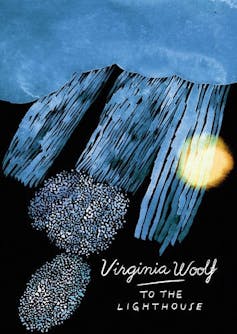
When I first encountered Woolf’s work, her prose struck me as impossibly, infuriatingly vague. Luckily for me, her novels were required reading on the course I was taking, so I had no choice but to persevere. It took a while for my inner ear to attune to the poetry of her rhythmical cadences; but once I learnt to attend to them properly, they utterly transformed my sense of what writing could be.
It took time, too, for my life to catch up with the existential and elegiac tenor of Woolf’s writing. Loss and grief came to me in my 20s, and amid the utter devastation of those times it was to Woolf that I turned. To the Lighthouse, in particular – in which she reconjures her childhood and the parents she had lost decades before – afforded me a powerful sense of recognition.
Amid the sorrow it evokes, I marvelled at Woolf’s depiction of many moments of “ecstasy” and “rapture” arising from the most mundane situations – moments which, in their radiance, seemed to point to the importance of living on.
Scarlett Baron is an associate professor of 20th- and 21st-century literature
13. The Best of Everything by Rona Jaffe (1958)

I surprised myself with this choice. Standing before my bookshelf, full of colourful spines, broken and creased, evidence of stories told and read, my fingers reached for an unsuspecting novel: The Best of Everything.
It was given to me by a friend who sometimes knows me better than I know myself. I first heard about it from the actor Sarah Jessica Parker, who said that without it, Sex and the City would not exist. The book reaches for a certain universality. I am sceptical of that word, but I do wonder: What touches us all?
As a Black woman, it might seem unlikely I would find fragments of myself in four white women in 1950s New York, yet I do. In the quiet recognitions, the man who does not love you back, the first day you realise what you are good at, the sudden throb of ambition, the book crystallises something electric. It bottles the shock of adulthood that strikes every 20-something-year-old. Who am I? And what do I want?
Olumayokun Ogunde is a doctoral researcher in English
14. Candide by Voltaire (1759)
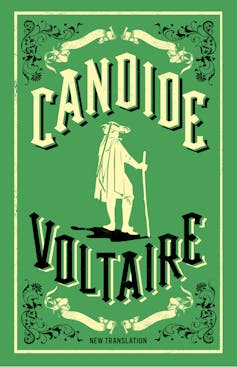
When I turned 23, I landed a graduate IT role for an international bank. It was a long commute to a pretty, northern city so daily, for an hour each way, I read.
Reading made late trains, weather and crowded buses tolerable. It wasn’t what I’d imagined after my English degree and master’s but I appreciated it, and had been awarded a place on a competitive employee environmental project in the Kalahari desert (I still lament leaving before taking up this opportunity).
One week, I reread Voltaire’s Candide. Candide is about journeys, changes and seeking “the best of all possible worlds”. Violent, impossible, ridiculous and laconic, it turned me into an annoyingly vocal reader. Suddenly, I knew I must return to university – I started my PhD soon after.
Candide’s desperate situations and peaks and troughs of optimism and despair shook me out of my routine during my 20s, a rare period in life when I could change direction. I recommend it for anyone seeking encouragement to take a calculated risk.
Jenni Ramone is an associate professor of postcolonial and global literature and director of the Postcolonial and Global Studies Research Group
15. The Sparrow by Mary Doria Russell (1996)
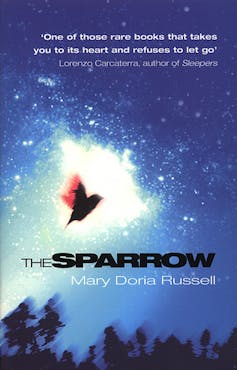
What does it mean to have a calling? And what do you do when that calling betrays you and leads the people you love to unbearable suffering? Mary Doria Russell’s novel The Sparrow ostensibly tells the story of Emilio Sandoz, a Jesuit priest and linguist who joins a mission to the planet Rakhat to translate the language of its inhabitants, but these questions burn at its heart.
I first read The Sparrow in my mid-20s, fighting to balance my newfound vocation to progressive Christian ministry with multiple family members’ deaths and the unravelling of a young marriage. For many, our 20s are a time when we struggle to define who we are and what we are called to do in the world. Both inspiring and harrowing, The Sparrow speaks to that struggle – and to the discernment we must use to avoid doing more harm than good as we wage it.
The Reverend Tom Emanuel is PhD candidate in English literature.
16. The Song of Achilles by Madeline Miller (2011)
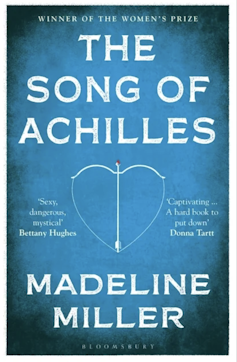
The Song of Achilles came out right at the beginning of my PhD in classics. It was the start of my 20s, and I’d just become interested in how fiction can challenge the classical canon, especially epics like Homer’s.
I’d been reading Margaret Atwood’s The Penelopiad, and I’d begun writing the early chapters (though I didn’t know it then) of what would become my first novel, For the Most Beautiful (itself a retelling of the Iliad, through the women). And then Madeline Miller came to Yale, and I heard her speak about what it means to retell stories as she does. I read (or rather, devoured) her beautiful book, and something clicked.
There is nothing more powerful than to have trailblazers like Miller who lay the path. The Song of Achilles is a masterful, gorgeous, timeless novel that I come back to again and again. I would encourage anyone in their 20s who wants to know that there is more than one way of telling a story – and that that can be its own story and its own gift, in itself – to turn to this book.
Emily Hauser is a senior lecturer in classics
17. The God of Small Things by Arundhati Roy (1997)
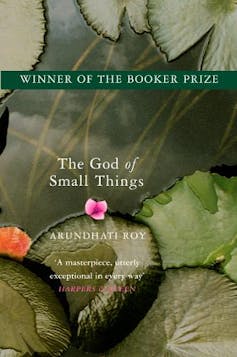
I first read this stunning, Booker prize-winning novel at the age of 22, as part of my master’s degree at the University of Edinburgh.
At the time, I was reading voraciously for classes, sometimes getting through a book a day. But Roy’s opening chapter, a challenging piece that contains all the elements of the story she’s about to tell, stopped me in my tracks because of its beauty, tragedy and complexity. I was instantly hooked.
Set in Kerela, India, The God of Small Things traces the lives of fraternal twins, Rahel and Estha, and their extended family from the late 1960s to the early 1990s. Roy puts the small stories of the family’s life into conversation with the big narratives and structures that shape Indian society over this period. The book’s revelations enthralled me in terms of plot, while Roy’s stylistic innovations and intricate structuring (her training as an architect perhaps played a role here) made it a mesmerising read.
The God of Small Things examines the specifics of Indian society such as (de)colonisation and caste while also speaking to questions of family, death and ultimately, love. It is a novel to savour at any age but since it’s one worth returning to, reading it in your 20s just means more chances to do so!
Ellen Howley is an assistant professor in the School of English
18. Heart of Darkness by Joseph Conrad (1899)
Heart of Darkness is crucial reading in your 20s because it contains multiple opportunities for discovery, including self-discovery. Or at least, that’s what my future self can tell my past self.
On the face of it, Conrad’s novella is a journey into the heart of Africa. It is also, though, a story about the discovery of historic injustice as it reports on Belgium’s colonial regime. To learn about colonial history is a vital education.

Less obviously, it also exposes you to a narrative style which gets you questioning how a work of fiction can play with your confidence in truth. We’re warned early on of “old sailor’s yarns” while imposters, facades and silences can be found throughout the story. Reading it in my 20s, I discovered that critical thinking and observation skills make for valuable mental equipment.
Conrad’s story teaches you how to be a better reader, a crucial skill in our times – and rewards a reader that pays attention.
Lewis Mondal is a lecturer in African American literature
19. Mrs Dalloway by Virginia Woolf (1925)
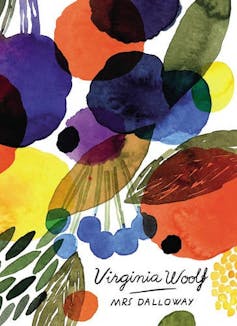
Virginia Woolf’s Mrs Dalloway (1925) came to me in my early 20s, as I was beginning to understand how the life we live inwardly rarely mirrors the one other people perceive.
Set across a single day in post-war London, the novel captures the texture of our thoughts: fleeting, associative, irrepressible. Clarissa Dalloway’s quiet crisis – was this the right life? did she love the right way? – and Septimus Smith’s descent into trauma spoke to the realisation that adulthood isn’t a destination but a continual negotiation of memory, grief and the mundane.
For readers in their 20s, Mrs Dalloway is invaluable because it resists the binary of success and failure. Instead, it explores the richness of interiority, how past selves linger in present choices, and how the smallest gestures can shape a life. Woolf teaches us that meaning is stitched not in milestones but in moments, in glances, in a solitary walk to buy flowers.
Nada Saadaoui is a PhD candidate in English literature
20. Madame Bovary by Gustave Flaubert (1856)
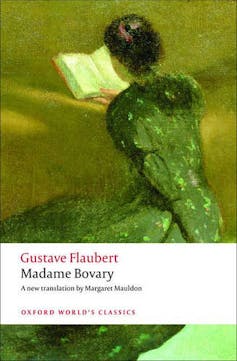
Since having children in my 30s, I am reduced to a sobbing ball by media in which people get depressed, or toddlers worry about things, or inanimate objects seem like they might be lonely. But in my 20s, when I was better equipped to face the realities of the human condition, I returned frequently to Madame Bovary.
It tells of Emma, a sheltered young woman who marries a kind but prosaic country doctor. Desperate for romance, she embarks on affairs and spends beyond her means, with predictably tragic results. There is some hauntingly beautiful imagery, as in the scene when Emma incinerates her wedding bouquet and watches petals flit like butterflies up the chimney.
Mainly, though, the novel reassured me that there was someone out there (albeit a fictional someone) making a bigger mess of life than me. My ill-advised student purchases included unwearable shoes, fishnet tights for the Scottish winter, and a pool table – but at least I never spent 14 francs in a month on lemons for polishing my nails.
Martha McGill is a historian of mem
Why Hitchcock’s ‘Rear Window’ Mirrors Today’s Social Media Age
In its exploration of themes like paranoia, voyeurism, and loneliness, Hitchcock’s Rear Window strikes a familiar chord with the social media climate we live in today.
By Jennifer O’Callaghan/ 28 November 2022

Rear Window Alfred Hitchcock Paramount 1 September 1954
Throughout Alfred Hitchcock’s lengthy career, the 1950s were undoubtedly his most glamorous era in filmmaking. With Hollywood’s biggest stars in Technicolor and carefully crafted sequences that would have film scholars talking for decades, Hitchcock entered a new peak in visual storytelling. Rear Window, now approaching the 70th anniversary of its production, is a standout film of that decade with a storyline that still holds relevance in the 21st century. Using the camera as narrator, Rear Window carefully weaves a terrifying thriller through a multi-layered love story. Released in 1954, Rear Window is widely regarded as one of the most accessible and modern of Hitchcock’s 53 films.
These days, Hitchcock’s legacy hardly requires an introduction, but in the early ’50s, he was an outside-of-the-box filmmaker beginning to revolutionize sound and frame editing by putting himself in the audience’s place. Rear Window was released during a trying time to a post-World War II public when fears of Communism and nuclear war generated anxiety in America. Gender stereotypes were tightly intact, and it would be over a decade before the women’s liberation movement shook up the patriarchy. Yet, when re-analyzing Rear Window in our times, it still feels as fresh as the day it was made. The paranoia and isolation experienced by the central character reflect those feelings of loneliness and mistrust in current society. Distortions of social media further mirror Rear Window’s themes, which remain universal in America.
Another reason Rear Window retains its relevance is partially due to the imperfection and relatability of its main character. J.B. Jefferies, known to his friends as Jeff (played by the reliably affable Jimmy Stewart, who even gives this curmudgeon appeal), is a flawed anti-hero. As a combat photographer who’d always been on the go, he’s now confined to a wheelchair after breaking his leg. (In an early scene, he explains the cast on his left leg is a result of getting too close for comfort with his camera at an auto race.) Jeff spends his days of recovering, staring aimlessly through the back window of his Greenwich Village apartment into the courtyard below—and into the windows of his neighbors.

Enter Lisa Fremont (Grace Kelly), a glamourous career girl of Madison Avenue who’s mad about Jeff. Though deeply frustrated at his lack of commitment, she doesn’t back down easily, even if it means going out on a limb to show him her dangerous side. Jeff also receives daily visits from Stella (played by the spunky Thelma Ritter), his nurse who serves as the voice of reason. She does her best to convince him he’s making a mistake by casting Lisa aside. Flabbergasted at the thought of Jeff ending things with her because she’s “too perfect”, Stella sighs, “I can hear you now: “Get out of my life, you wonderful woman. You’re too good for me.”
Jeff, who seems too wrapped up in himself to take Lisa seriously, spends the entirety of Rear Window observing different walks of life through a camera lens at his back window, the same point of view that Hitchcock cleverly limits the audience. Bored to tears, he spies on neighbors, inventing stories about their lives. The curiosities in this intimate setting fulfill Jeff’s overactive imagination. The audience becomes one with him as he leaps from one conclusion to another about the narrow view he has of people he doesn’t know. His act of observing others from a secure, unseen distance isn’t unlike our online world today.
Navigating social media platforms with similar access to friends and strangers can result in the same lack of connection Jeff is experiencing in his inner life (perhaps even more so in a post-pandemic world). When we indulge in social media to feel more connected to others, known and unknown, the nature of these platforms creates a further sense of disconnection and, like Jeff’s predicament, isolates us from our real-life networks, leading to more loneliness. The ’50s-era Rear Window demonstrates that people have always had the same counterproductive tendencies to overcome loneliness. It’s no wonder Rear Window‘s commentary on humanity remains ageless.
Though certain aspects of Rear Window, like the fashions and technology of the ’50s are of its era, its underlying messages on the common feeling of alienation and the tendency to judge others from a distance remains a tale as old as time. Upon release, film critic Bosley Crowther of The New York Times summed it up well, stating, “It exposes many facets of the loneliness of city life and it tacitly demonstrates the impulse of morbid curiosity.”
Stewart’s Jeff makes one wonder if they’d genuinely like him upon meeting him. On one hand, he is played with great charm by the most “Regular Joe” movie star of all time. (Visions of Stewart usually bring to mind the wholesome George Bailey in Frank Capra’s 1946 film It’s a Wonderful Life, happily embracing his family on Christmas Day). From another angle, Jeff spends his days and nights with a camera – out of sheer boredom at being stuck inside – peeping into other’s windows. Though, with the blinds up in many of these apartments, it could be debated that some of these characters possibly want to be seen. This is comparable to the exhibitionism we see in the desired accumulation of “likes” in the social media world. As much as online privacy protection has been discussed in the media, people still want to be seen and positively acknowledged.
As Jeff scans his neighbors’ windows, he makes snap judgments about who they are. He looks down on the loved-up newlyweds and the bickering old couple as he rejects the “suffocating” institution of marriage for himself. He dubs the shapely dancer who entertains male suitors “Miss Torso”, and the unmarried woman who entertains imaginary dates in the next apartment over “Miss Lonelyhearts”. Jeff’s behavior shares similarities with the comments sections of many social media platforms. People anonymously pass judgment and make snide remarks about others, yet in the real world, they wouldn’t dare say such things face to face.
Jeff’s old-world misogyny doesn’t allow him to see much about these women beyond what they physically represent. In his mind, women seem to belong in two categories – the “vamp” or “the spinster”. What he’s unconsciously observing in his multi-box display of domestic dramas is relationship commitment (and his potential future with Lisa) in its various stages and forms. In his mind, Lisa is from another world. Her distaste for combat boots and hostels instead of three-star hotels demonstrates a stark incompatibility between the two. Jeff views her desire to marry him as a ball and chain that will slow him down and impede his photography career.
To emphasize their differences, Hitchcock ensured Lisa Fremont’s wardrobe was considered with meticulous detail for every scene. When meeting with legendary Hollywood costume designer, Edith Head, he stressed that Lisa must appear so perfect that she’s almost untouchable. Head needed to create a nearly unattainable dream-like air about Lisa. Drawing inspiration from Christian Dior’s post-war “New Look”, the costumes range from an elegant monochromatic dress with a full white skirt and off-the-shoulder top to a pistachio-colored suit with a tailored white halter top. The on-camera effect is breathtaking as Lisa enters and leaves his apartment. The visual contrast of her exquisite clothes next to the dingy apartment and Jeff’s baggy pajamas further emphasize the different worlds Lisa and Jeff aspire to.
When Lisa first appears, Hitchcock uses a clever trick by shaking the camera for a shimmering effect. The result is a desired dream-like sequence. She whispers to Jeff.
Lisa: How’s your leg?
Jeff: Hurts a little
Lisa: Your stomach?
Jeff: Empty as a football
Lisa: And your love life?
Jeff: Not too active.
Lisa: Anything else bothering you?
Jeff: Yes—who are you?
As she moves about his small apartment to switch on his three lamps, the romantic haze slowly lifts, and reality sets in. Jeff’s defenses are up. He won’t open up to Lisa, and her exasperation mounts as, at one point, she wonders aloud, “How far does a girl have to go before you notice her?”
If Jeff is the voyeur of Rear Window and, essentially, the filmmaker who follows a killer, then Lisa is the heart of the film and the more courageous of the two in expressing her feelings and desires. “I’m in love with you,” she says plainly. ”I don’t care what you do for a living. I’d just like to be part of it somehow.” Lisa embraces life in the real world. Each night when she visits Jeff, she’s full of stories and excitement about her work day, which he resents. For almost eight weeks, he’s been stuck in a dark room with his overactive imagination, peering out and creating paranoid ideas about the world. In today’s context, Jeff represents the typical lonely internet addict, whereas Lisa embodies someone with a healthier relationship with the outside world.
Soon Jeff begins to confront the worst-case scenario of spying on his neighbors. Through his camera lens, he sees what he believes is Lars Thorwold (Raymond Burr) murdering his wife by poisoning her, then following up that horrible act by dispensing her body parts in the East River. Jeff’s world is shaken by what he’s sure he’s just witnessed. It’s one thing to stare across the courtyard and fabricate murder mysteries to pass time, but he suddenly realizes the reality of someone taking another human life is absolutely stomach-turning.
What makes Rear Window‘s murder scene unique is that it takes place out of sight with the blinds drawn. Mrs. Thorwald’s scream goes mostly unnoticed in the heat of the Manhattan summer night, and not an ounce of gore is shown. Jeff and the audience observe as Thorwald quickly moves in and out of his apartment with a heavy suitcase of presumed evidence, and we are left to conclude what it contains.
Compared to Hitchcock’s later acclaimed films like Psycho (1961) or The Birds (1963), where the violence is more blatant and intense, he made an interesting choice with Rear Window. Here, he plays on the viewer’s mounting anxiety about what may be happening instead of showing what is happening. In Psycho, the aggressive murder scene where Marion Crane (Janet Leigh) is stabbed to death on-screen in the shower by Norman Bates (Anthony Perkins) is terrifyingly effective. Rear Window’s murder is just as horrible an act, but that it happens behind closed curtains taps into the audience’s emotions of apprehension.
In his effort to prove Thorwald murdered his wife, Jeff receives help from Lisa and Stella. Unlike Jeff, trapped in his apartment, the women go out searching for concrete evidence to show the police, and they even deliver Jeff’s handwritten note to Thorwald, which simply says, “What have you done with her?” To prove her gumption and willingness to get her hands dirty, Lisa steals into Thorwald’s apartment in search of further proof of murder while he’s away. Confined to a wheelchair, Jeff (and the audience) look on with utter anxiety, as the murderer will be returning any minute. When Thorwald comes home and begins to interrogate and manhandle Lisa, Jeff falls to pieces as all he can do is peer across the courtyard in sheer agony.
The police, of course, arrive just in time, and she’s free to go. In triumph, Lisa flashes Mrs. Thorwald’s wedding ring to Jeff as she leaves the scene. Thorwald, unfortunately, catches onto this as well. For the first time, he looks across the courtyard and locks eyes with Jeff. It is a chilling moment. Jeff’s voyeurism has now been revealed, and his secretive judgment of his neighbors is no longer his private – and safe – world.
Later that night, Thorwald’s entrance into Jeff’s apartment is one of the most suspenseful climaxes of all of Hitchcock’s films. His face is unrecognizable in the blackness of the night as he taunts Jeff from the doorway. “What do you want from me?” he says sinisterly. By now, the audience has become Jeff, if you will. As a viewer, it’s impossible not to experience his feelings of paralysis and helplessness. Thorwald wastes no time trying to kill Jeff, ironically attempting to toss him out of his rear window – and succeeding. Once again, the police arrive to take Thorwald away.
The next frame shows a rough landing for Jeff, and not without further casualties. In the final scene, Jeff, now in two leg casts, is resting, notably with his back turned to the rear window. Lisa, now his caretaker, is dressed casually and resting beside him with a copy of William O. Douglas’ 1952 travel book, Beyond the High Himalayas. Just before the credits roll, as if to note that she won’t be changing herself entirely for Jeff, Lisa casts the book aside and begins to leaf through a copy of Harper’s Bazaar.
A script loaded with social commentary by John Michael Hayes and a central character conflicted in his psyche are key elements that firmly place Rear Window in the category of one of the best films of all time. Keeping the audience in a small, dark apartment along with Jeff so they hear and see exactly what he hears and sees created new territory in mainstream film back in 1954, but it has the same effect on our anxieties today. “I was feeling very creative at the time,” Hitchcock said of the Rear Window’s success. “The batteries were well charged.” (The Art of Alfred Hitchcock: Fifty Years of His Motion Pictures, 1976). In his artistic vision for Rear Window, it’s almost as if Hitchcock predicted the future of social media and voyeuristic reality television.
Going into production, Hitchcock was no stranger to working with Stewart. They had previously made Rope together in 1948 (another murder caper, which, coincidently, was also filmed entirely on one apartment). Soon after Rear Window, they made The Man Who Knew Too Much (1956) and Vertigo (1958). Kelly had also worked with Hitchcock earlier that year in Dial M for Murder (1954). They would reunite after Rear Window for To Catch a Thief (1955). When Kelly first decided to do Rear Window, she had an agonizing decision on her hands. At the same time, she had also received the script for On the Waterfront, with an offer to play Marlon Brando’s girlfriend in the film directed by Elia Kazan.
“I sat in my apartment with two screenplays—one was to be filmed in New York with Marlon Brando, and the other was going to be filmed in Hollywood, with James Stewart. Making a picture in New York suited my plans better—but working again with Hitch…well, it was a dilemma.” (High Society: The Life of Grace Kelly, 2009). She knew her destiny was to work with Hitchcock, the director she fully trusted. Besides, due to her upbringing in a prominent Philadelphia family, playing a privileged woman of New York high society was a character she deeply understood.
Rear Window received four Oscar nominations in 1955 for Best Director (Hitchcock), Best Writing (John Michael Hayes), Best Cinematography, and Best Sound. Though it shockingly didn’t take home any statues that year, it’s still considered by filmgoers, scholars, and critics to be one of the top films of American cinema. In 1997, Rear Window received the credit it deserved when the Librarian of Congress placed it on the National Film Registry.
Over time, Rear Window has set off a chain reaction of inspiration in modern films on the dangers of loneliness and self-destructive behavior. Even in recent years, it has influenced multiple voyeuristic films like Sam Mendes’ drama American Beauty (1999), a modern fable about the mid-life crisis in America and a lonely teen with a camcorder. Another example is D.J. Caruso’s crime drama Disturbia (2007), a tale taken directly from Rear Window about a teen on house arrest whose boredom leads him to suspect his next-door neighbor is a wanted serial killer.
Rear Window’s thesis seems to state that everybody’s watching everyone, but what we all need is a genuine connection. As Stella put it so aptly, “What people ought to do is get outside their own house and look in for a change.”
On Barbara Pym, Author… and Stalker?
Evangeline Riddiford Graham Considers the Unrequited Loves of the Celebrated Novelist
Evangeline Riddiford Graham November 17, 2025
Barbara Pym, a novelist sometimes described as the twentieth-century Jane Austen, was a stalker. Her diaries describe her methods of “finding out” her objects of interest in vivid detail: looking them up in directories, “tailing” them across town to discover their home addresses and workplaces and places of worship, staging “chance” encounters, and collecting their “relics.” She invented “sagas,” games of investigation and fantasy that could last several years. Most of her victims were men; they were, to varying degrees, unavailable. Several of them were gay.
Throughout the 1950s, Pym had portrayed the love and labor of “excellent women”—spinsters cooking dinner for curates, bored wives matchmaking, girlfriends helping academics cross-reference the index—with screwball pathos. Praising her second novel as “a perfect book,” the poet John Betjeman wrote, “Excellent Women is England, and, thank goodness, it is full of them.” All of Pym’s respectable women indulge in some form of obsessive love. Her most mild-mannered heroines snoop through curtains and hedges; at their most audacious, her spinsters whip out binoculars and sneak uninvited into other people’s homes. (The men barely notice.)
It wasn’t until The Sweet Dove Died (written between 1963 and 1969, and reissued this September by New York Review of Books), that Pym began to reckon seriously with the impact that unrelenting womanly “devotion” might have on the beloved one—and on the spinster herself. In A Sweet Dove Died, stalking a gay man is rendered not as the expression of unrequited love but as the determined assertion of one woman’s ego.
In swinging sixties London, an elegant middle-aged woman named Leonora swoons in an auction room and is picked up by an antiques dealer and his nephew. The uncle, Humphrey, is solicitous, but Leonora prefers the nephew, James, who is golden-haired, malleable, and of uncertain sexuality. A series of emotional bidding wars ensue. Humphrey takes Leonora to an exhibition of historic portraits; she invites James into her exquisite flat, feeds him pâté, and presents him with her Victorian flower book. “Pink convolvulus,” he reads. The flower signifies “Worth sustained by Tender and Judicious affection”—a principle for which none of the protagonists of The Sweet Dove Died show much regard. See Television,Film and Popular Culture: Comments for the complete article.
She invented “sagas,” games of investigation and fantasy that could last several years. Most of her victims were men; they were, to varying degrees, unavailable. Several of them were gay.
The first half of the book is a deliciously tart comedy, the currency of seduction here being chiefly tasty treats (shrimp in “an avocado pear,” chocolate mousse), self-consciously retrograde cultural outings, and what Leonora calls “objets d’art e de vertu.” (Leonora’s French accent is delightful, as we’d expect from a woman who dresses in shades of amethyst, lilac, and, in a wicked little jab from the author, “prune.”)
When James falls into bed with a woman his own age, the barbs of Pym’s humor sharpen. Plotting to safely install James in her own house, Leonora decides to evict her elderly upstairs tenant. When James moves in, he is surprised to find the windows have bars. The Oedipal undertone of Leonora’s explanation—that his room used to be a nursery—is more worrisome still.
But Leonora meets a serious rival in Ned, a glittering, young gay American who counters Leonora’s wistful Victoriana with a modern flat replete with shag rug—and a large bed covered in mauve velvet. As if unable to resist her own mortification, Leonora asks if the bed is comfortable. “I guess so,” says Ned, “though maybe comfort isn’t all I go for.”
Male homosexuality wasn’t decriminalized in Britain until 1967. But Pym, whose novels about conventional behavior shouldn’t be mistaken for conventional themselves, wrote about gay or bisexual male characters in almost all her books. Several characters were thinly disguised portraits of the novelist Robert Liddell, a friend from her time at Oxford. In her first mature novel, Crampton Hodnet (written in 1940 and published posthumously), “two giggling pansies” propel the plot with their gossip. In Excellent Women (1952), a civil servant with a sharp tongue and a taste for fine wine takes fright when his female friend starts musing on the nature of marriage. In Less Than Angels (1955), working-class Digby is startled when his roommate Mark picks up a debutante. She’s rich, Mark explains:
“She and the girl friend she lives with have a flat in Curzon Street and she said she might be taking a secretarial course or doing some modelling but that Daddy didn’t really want her to, only everyone did something nowadays …” he drifted out of the room.
“What hidden talents spring up in one’s friends,” Digby said. “I didn’t know Mark could imitate a young girl so well. I hope he’ll be able to follow up this promising start.”
Pym would go further in her next novel, A Glass of Blessings (1958), in which a gay character is cast as the leading man. The plot prefigures several elements of The Sweet Dove Died, but in a gentler register: Wilmet, a silly woman with soft hands, decides to reform the vaguely disreputable Piers by allowing him to fall in love with her—so it is for Piers’s own good that she enrolls in the class he teaches, visits his office unannounced, and pressures him to invite her home. Wilmet is married, pretty, and rich, and everyone—including Piers himself—observes her antics with a degree of indulgence. But when Wilmet finally secures an invitation to Piers’s flat, she is received by Keith, a young man who models sweaters for knitting catalogues and has gone to great effort to lay out a tea worthy of his lover’s upper-class female friend.
From early on, Pym’s romances in real life seemed to follow a pattern: dizzying infatuation then a mystifying fizzle—accompanied by stalking campaigns that combined giddy self-indulgence and exquisite self-torture. Many of these affairs had an unlikely quality. The man was aloof and somewhat resistant. He was 18 and she was 24. He was married to—if amicably separated from—her best friend and housemate. He was 33 and she was 39—and he wasn’t known to have relationships with women. Given how closely Pym’s novels drew from observation of her own milieu, perhaps it isn’t surprising that life started to imitate art. A version of Wilmet’s agonizing meal with Piers and Keith, with its mixture of personal embarrassment (Keith is beautiful) and snobbery (his table is covered with plastic doilies), would be endured by Pym herself several years later.
In early March 1966, Pym went out to dinner with the man she loved, Richard “Skipper” Campbell Roberts. In her diary, she recorded that two people joined them: her sister, Hilary, and a friend of Skipper’s, a man named Gordon. He was “fortyish but dressed and coiffed in Beatle style,” Pym wrote. Worse, Gordon gave Skipper a ridiculously domestic gift—”a drying cloth patterned with dachshunds.”
Pym had been immediately taken with Skipper, a handsome antiques dealer 18 years her junior, when she met him, in late 1962. He was flattered by her attention: At 50, Pym was the critically acclaimed author of six published novels. Skipper, for his part, was enticingly exotic to Pym. His family had been among the first white settlers in the Bahamas, and he had grown up in Nassau, in a mansion named “Lucky Hill.” He was devoted to a domineering, peacock-owning mother. Perhaps with regret, Pym decided this material was outside her range.
From early on, Pym’s romances in real life seemed to follow a pattern: dizzying infatuation then a mystifying fizzle—accompanied by stalking campaigns that combined giddy self-indulgence and exquisite self-torture.
She must have had some idea early on that her love-object was gay. For one thing, when Pym met him, Skipper—despite his wealth—was sharing a house with “a nice young man called John.” There were other warning signs: Pym and Skipper were introduced by the critic Robert Smith, another younger gay man on whom Pym had once pinned romantic hopes. (She had met Smith through Robert Liddell, the gay friend who, though never a love interest, she had briefly targeted in her pursuit of his best friend during her undergraduate years.)
Nonetheless, Pym spent several months in a “romantic haze” after meeting Skipper, as her friend and biographer Hazel Holt writes in A Lot to Ask (Macmillan, 1990). When Skipper began to pull away, Pym sent a love letter, demanded its return—and then wrote again, disappointed he had returned it without a reply of his own. In The Adventures of Miss Barbara Pym (2021), biographer Paula Byrne observes that Pym used her status as a novelist to hold Skipper’s attention, sending him short fiction scenes that showed him to be her muse. Just a few weeks before the dachshund-patterned dinner, she wrote Skipper a valentine:
O, Sweet Bahamian, cruel Fate
Has sent you to me much too late
Tormenting me with many a Scene
Of Happiness that might have been …
Pym’s collected letters and diaries reflect many attempts to rekindle the spark—and a heartbreak that lasted years. They also show that she almost immediately started to mine the relationship for a new book, The Sweet Dove Died.
By the time the bombshell scene of Wilmet-Piers-Keith (or Barbara-Skipper-Gordon) is reanimated in The Sweet Dove Died, it has taken on a different register again. After showing off his flat with its purple bed, Ned abruptly sends Leonora home in a cab. After she leaves, Ned advises James that Leonora will “get the message” once he moves out and stops calling her. “She’s the proud type who prefers to suffer in silence,” jeers Ned. “Like a wounded animal crawling away to die.”
Ned’s disdain is almost as crushing as James’s betrayal because it says something larger about Leonora’s right to exist in the 1960s at all. In A Glass of Blessings, Wilmet’s relationship with Piers and Keith ultimately leaves Wilmet disinhibited—and improved. She and her husband confess their respective attempts at infidelity, laugh about them, and become modern people. Ned—like many of Pym’s gay characters—is someone with contemporary taste. He could invite Leonora into the modern world (as Keith and Piers do Wilmet), but instead he rejects her, relegating her to the past. She might as well be dead.
And unlike Wilmet, Leonora doesn’t have the security of marriage and youth to fall back on. Ned’s “wounded animal” descriptor is apt: By the time we meet her in The Sweet Dove Died, Leonora has developed the feral ruthlessness of an aging unmarried woman fighting to preserve the social status of sexual attractiveness without sacrificing her autonomy. When Humphrey touches Leonora with “appraising” hands, she feels a wave of fear and revulsion. The affection of James, by contrast, affirms the power of her femininity without threatening an assault on her personal dignity. After a trip to Covenant Garden with Skipper in May 1964, Pym wrote a diary entry fusing heroine and author’s pleasure in a relationship of her own design: “If ‘they’ went to Covent Garden Leonora would like to feel the touch of his sleeve against her bare arm … Here he is mine she thinks, the young admirer she had created for herself.”
But in taking on the role of Pygmalion, Leonora (and Pym) exposes herself to the treachery of her own admiring “creation.” In its final act, The Sweet Dove Died opens into the crevasse of Leonora’s grief, in which she gains self-knowledge but loses her sense of hope for the future. Even if James returns to her, even if she marries Humphrey, she will be alone.
In the 1940s and 50s, Pym’s spinsters had occupied a status of respectable wrongness. As memorably characterized in Excellent Women, they are the “rejected ones”—women expected to dedicate their lives to good works as a kind of penance for their failure to marry. “Being unmarried,” Pym wrote, was “a positive rather than negative state”—and likely a permanent one for a generation of women living in the aftermath of World War II. Perhaps more importantly, like Jane Austen’s Anne Elliot, they were “English gentlewomen,” taught that it is a woman’s wait for love in “desolate tranquility.” Left to the company of her thoughts and feelings, Pym’s spinster becomes observant. She is the novelist within the novel: an appreciator of the monumental significance of the trivial things. And when in need of sexual, emotional, or intellectual outlet, she stalks.
In a particularly zany period in the 1950s, Pym and her sister would invent a “saga” about their young gay male neighbors, whom they nicknamed “Bear” and “Squirrel.” Pym kept a log of the men’s movements, and Bob Smith and Hazel Holt were enlisted to help. As Paula Byrne points out in The Adventures of Miss Barbara Pym, Squirrel’s orange pullover would later be worn by Keith in A Glass of Blessings.
For unmarried middle-class women indulging in occasional bursts of sexually charged espionage, closeted gay bachelors were natural persons of interest, similarly careful and inventive in living within the limits of social toleration. Indeed, as Pym acknowledged in another diary entry in which she and Leonora appear interchangeable, an erotic but impossible love-object like Skipper or James might even be preferable: “She thinks perhaps this is the kind of love I’ve always wanted because absolutely nothing can be done about it.”
In taking on the role of Pygmalion, Leonora (and Pym) exposes herself to the treachery of her own admiring “creation.” In its final act, The Sweet Dove Died opens into the crevasse of Leonora’s grief, in which she gains self-knowledge but loses her sense of hope for the future.
But by this time, the introduction of the oral contraceptive pill had transformed Britain, and the delicate sexual frisson of spinsterhood was out of date—at least in the eyes of editors. In March 1963, Pym’s longtime publisher, Jonathan Cape, summarily rejected not just her latest manuscript, An Unsuitable Attachment, but all her work as no longer publishable. Other publishers followed suit. In the years that followed, manuscripts for An Unsuitable Attachment, The Sweet Dove Died, and Quartet in Autumn (eventually shortlisted for the Booker Prize) would be rejected by twenty publishers. Pym would spend nearly fifteen years in the “wilderness” of unfashionability.
No wonder Skipper’s attention meant so much—and the suggestion that she might bore him was so painful. It must have seemed not just a comment on her personal desirability but a comment on her relevance as a writer, one with the power to enchant and entertain.
Pym was “rediscovered” in 1977, when both Philip Larkin and Lord David Cecil nominated her as the most underrated writer of the past 75 years in a Times Literary Supplement poll. Reissues and new publications followed; The Sweet Dove Died was finally released with Macmillan, in 1978, to critical acclaim. Pym enjoyed the accolades and outpouring of public affection while she could. Her breast cancer had returned, and aware that she was dying, she worked quickly to complete a novel she knew would be published posthumously. She gave it a wry, bittersweet title: A Few Green Leaves. She died in January 1980, at 66 years old.
In The Sweet Dove Died, James treats Leonora callously, but he isn’t to blame for the high stakes the relationship has for her. Leonora’s artistry, by which she sculpts a version of James more handsome, sophisticated, and loving than the model himself, is her own undoing. Yet that same artistry is more than manipulative narcissism; it is the talent Leonora has to offer the world. Just as James isn’t wrong in refusing to play the part, she isn’t wrong to attempt to build something beautiful.
In an interview after Pym’s death, her friend Henry Harvey made a curious observation. During her time at Oxford, Pym had made Harvey the target of one of her most intense stalking campaigns. Their hot-cold relationship was a source of pain and inspiration: Of Pym’s oblivious male characters, the handsome and bad-tempered Archbishop Henry Hoccleve in Some Tame Gazelle is among the most memorable. Yet even as Pym stalked him, slept with him, and pined after him, there was an element of unreality in her ardor, Harvey recalled. This “pretend play” of “being-in-love” and “being-in-Oxford” were, for Pym, “better kept as pretend play,” he said. “That way they could be turned into art.”
A Few Green Leaves A Glass of Blessings An Unsuitable Attachment Barbara Pym Evangeline Riddiford Graham Excellent Women Quartet in Autumn The Sweet Dove Died

Evangeline Riddiford Graham
Evangeline Riddiford Graham holds an MFA in Creative Writing from The New School. She is the founder and host of the poetry podcast Multi-Verse. Her recent and forthcoming writing can be found in Divagations, Art News, Landfall, and Poets & Writers.
See also my comments on The Sweet Dove Died and the role that Henry Harvey played in Pym’s Oxford days that could well have been the impetus for some of this work. Robin R. Joyce The Reality behind Barbara Pym’s Excellent Women The Troublesome Woman Revealed and “Another Barbara: New Insights into Barbara Pym” Robin Joyce, Paper presented at the 15th North American Conference of the Barbara Pym Society, Cambridge, Massachusetts, 16-17 March 2013.
Australian Politics
On November 11, 1975 I watched history being made, from the best seats in the house By Michelle Grattan From The Conversation
In his just-released memoir, historian and former diplomat Lachlan Strahan recalls being picked up from his Melbourne primary school by a neighbour on November 11 1975, the day Gough Whitlam was sacked as prime minister. His politically active mother “was so upset she didn’t trust herself behind the wheel”.
Journalist Margo Kingston was a teenager and not political at the time. She remembers going to bed that night, pulling the covers over her head and listening on the radio. The next day, she organised a march around her Brisbane school.
The Dismissal is one of those “memory moments” for many Australians who were adults or even children when it happened. They can tell you what they were doing when they heard the news. It was an event that embedded itself in the mind, like news of US President John F. Kennedy’s assassination more than a decade earlier.
This was a life-changing day for many who worked in Canberra’s Parliament House. For Labor politicians and staffers, it bordered on bereavement. Excitement and elation fired up the other side of politics. Those of us in the parliamentary press gallery knew we had front-row tickets for the biggest show in our federation’s history.
Pressure points were everywhere
The Dismissal didn’t come out of nowhere. It followed extraordinarily tense weeks of political manoeuvring, after the opposition, led by Malcolm Fraser, blocked the budget in the Senate in mid-October, and Whitlam refused to call an election.
Pressure points were everywhere. Would Whitlam give in? Would some Liberal senators crack? What would happen if there was no resolution before the government’s money ran out? Would Governor-General John Kerr intervene?
On the morning of Remembrance Day, Whitlam prepared to ask Kerr for an election. Not a general election, but an election for half the Senate — a course that would have little or no prospect of solving the crisis. But Whitlam had fatally misjudged the man he’d appointed governor-general. Kerr was already readying himself to dismiss the prime minister. He gave Whitlam his marching orders at Government House at 1 pm.
That afternoon Whitlam, eyes flashing, deployed his unforgettable rhetoric on the steps of parliament house. “Well may we say God Save the Queen, because nothing will save the governor-general”, he told the crowd, denouncing Fraser as “Kerr’s cur”.
Demonstrators were pouring into Canberra; shredders were revving up in parliamentary offices. That night at Charlie’s restaurant, a famous Canberra watering hole, the Labor faithful and journalists gathered. Many still in shock and emotional, patrons were packed cheek by jowl. See Further Commentary and Articles arising from Books* and continued longer articles as noted in the blog. for the complete article.
On parliament’s steps, Whitlam had urged the crowd to “maintain your rage and enthusiasm through the campaign” (an exhortation later taken to apply more generally). In the subsequent weeks, Labor supporters did so. I spent much of the election campaign in the media contingent travelling with Whitlam: it felt like there was momentum for him.
The feeling was, of course, totally deceptive, in terms of the election’s outcome. As the opinion polls had shown before the sacking the voters, who had enthusiastically embraced the “It’s Time” Whitlam slogan and promise in 1972, had lost faith in Labor three years on.
Kerr paid a high price
Whitlam’s had been an enormously consequential, reforming government. It transformed Australia, with landmark changes in health, education, welfare and social policy. It inspired the baby boomers. But it had been shambolic administratively, disorganised and corner-cutting. Some ministers had run riot. Whitlam was charismatic and visionary, but he lacked one essential prime ministerial quality: the ability to run a well-disciplined team. Then, as things started to go wrong, the government’s media enemies became feral.
A combination of how he ran his government and how that government ended made Whitlam in later years both an example to be avoided by subsequent Labor governments and a martyr in Labor’s story.
Despite his huge electoral mandate, Fraser’s road to power in part defined how he was seen as prime minister, especially in his early years. Some believed it made him more cautious; many in the media viewed him in more black-and-white terms than the reality.
Kerr paid a high price. Leaving aside the partisans, many observers condemned his actions, particularly on two grounds: that he had intervened prematurely and, most damning, that he had deceived Whitlam, rather than warning him he’d be dismissed if he continued to hold out. Kerr’s fear (probably reasonably-based) that if he alerted him, Whitlam would ask Buckingham Palace to remove him, didn’t convince critics. He was branded as dishonourable and cowardly.
Even Fraser eventually thought Kerr should have warned Whitlam. Journalist Troy Bramston, who has just published a biography of Whitlam, uncovered a never-published obituary Fraser wrote of Whitlam decades after the tumultuous events.
Fraser wrote he had come to the view “the Governor-General should have consulted the Prime Minister more freely. He thought he must protect the Monarch to make sure the Queen could not become involved in domestic political battles fiercely fought. It was the cautious approach but, on reflection, I think there was a higher duty to consult the Prime Minister of the day and to warn of the consequences that could follow.”
Kerr’s personal behaviour, notably being drunk at the Melbourne Cup in 1977, ensured he became a figure of ridicule as well as a political target. Fraser took care in appointing the next governor-general. He chose a widely respected, unifying figure in Zelman Cowen.
Impossibly long odds
The Dismissal left fractures in our politics for years and its legacies forever. But Labor recovered faster than many had expected (despite Whitlam being trounced again in 1977). It was back in office in under a decade.
Our constitutional arrangements remained basically the same, with the governor-general retaining the reserve powers to dismiss a government. There was one change, however: Fraser ran a successful referendum to prevent recalcitrant state governments from stacking the Senate by appointing rogue candidates to fill upper house vacancies. That loophole had enabled the blocking of supply. The Dismissal did not push Australia towards a republic.
Could we see a repeat? Who knows what may have happened by the time we reach the 100th anniversary. But as far ahead as we can see, the events of 1975 have inoculated the system against a re-run. And, as many have pointed out, to have the combination of three such characters as Whitlam, Fraser and Kerr, and similar circumstances, would be impossibly long odds.
The main characters are dead. Some of those still around from the time maintain their rage, which has lasted through the many years, long after that election campaign.
David Solomon, Whitlam’s press secretary in 1975, says: “I haven’t changed. I’ve become, in fact, even more concerned about what Kerr did, the more information we have about why Kerr acted as he did and the material that he had before him when he decided to do this.”
And what of the views of the young? Frank Bongiorno, professor of history at the Australian National University, says today’s students find the events “fascinating in the way political science and history students did in the late 1970s.
“But the high-stakes game that played out is a bit like ancient history for them. They would see it as if it was like contemplating Pericles of Athens or Caesar of Rome.”
Gough would be pleased enough with the comparison to Caesar Augustus. He did like to quote Neville Wran’s joking compliment: “It was said of Caesar Augustus that he found Rome brick and left it marble. It will be said of Gough Whitlam that he found the outer suburbs of Sydney, Melbourne and Brisbane unsewered, and left them fully flushed.”
Michelle Grattan is a professorial fellow at the University of Canberra and chief political correspondent
Democrats swept elections far beyond the big races in referendum on Trump
From clerks to coroners, Democrats on Tuesday flipped city councils, school boards and county commissions.
November 8, 2025

In Pennsylvania’s Bucks County, voters elected a Democratic district attorney for the first time since the 1800s, part of a Democratic sweep of every county office, including controller and recorder of deeds.
In Georgia, Democrats ousted two Republicans on the Public Service Commission, the party’s first capture of a nonfederal statewide office in Georgia since 2006. In Connecticut, Democrats took control of 28 towns from the GOP. In New Jersey, Democrats won their biggest majority in the General Assembly since the Watergate era.
Much of the attention Tuesday night focused on the Democrats’ big wins in the Virginia and New Jersey governor’s races, as well as in the New York mayor’s contest. But the party also won hundreds of lower-profile state and local contests — often swamping Republican incumbents with overwhelming turnout, suggesting that voters’ desire to send a message opposing President Donald Trump was deep and wide.
“Voters are not just mad — they’re really mad, and they are willing to do something about it,” said Dan McCormick, a Pennsylvania Democratic strategist who is now serving as campaign manager for congressional candidate Bob Harvie. “Voters got their first opportunity to push back on the chaos that is happening within the Trump administration.”
Republican strategist Christopher Nicholas estimated that of the 480-plus contested races in Allegheny County, which includes Pittsburgh, Republicans won 11.
Still, he noted that just a year ago it was the GOP that was celebrating unexpected wins, and he said politics is always cyclical. “We have a pendulum in politics, and it is undefeated,” Nicholas said. “Last year you could say was a referendum on Joe Biden’s America. And Tuesday you could say was a referendum on Trump 2’s first year.”
Voters seemed intent on showing their displeasure with Trump even if that meant voting against a random Republican city council member. In a recent Washington Post-ABC News-Ipsos poll, 41 percent of Americans said they approved of Trump’s performance while 59 percent disapproved — the president’s worst showing since January 2021, a week after the attack by a pro-Trump mob on the U.S. Capitol.
In Connecticut, numerous towns, from Plymouth to Westport, had their mayor or first selectman positions switch from Republican to Democrat, or else saw the council majority flip to the Democrats.
“It was historic, not just a periodic pendulum swing,” Sen. Richard Blumenthal (D-Connecticut) said in an interview. “It reflects a deep dissatisfaction with the rising costs of electricity, rents, mortgages, food — everything, including health care.”
Tuesday’s surge was exemplified by Bucks County, a suburban stretch outside Philadelphia that is widely considered a crucial swing county in a hotly contested state. Trump defeated Vice President Kamala Harris there by a few hundred votes.
Tuesday was a different story.
In the race for Bucks County district attorney, Democrat Joe Khan ousted incumbent Republican Jennifer Schorn by 54 percent to 46 percent, becoming the first Democrat since the 19th century to win the office.
In a closely watched sheriff’s race, Democrat Danny Ceisler knocked off Republican Fred Harran, unseating an incumbent who played up his partnership with U.S. Immigration and Customs Enforcement, the agency spearheading the Trump administration’s controversial mass deportation effort.
They were part of a sweep that put Democrats in charge of every one of the county’s nine elected executive offices for the first time since the 1800s. And it wasn’t just the county races; in Bensalem Township, a Republican stronghold within Bucks County, Democrats flipped three of the five seats on the township council to seize the majority.
Accustomed to scraping for every vote in the area, Democrats suddenly found themselves winning races by 10 percentage points.
“To see this type of a surge, especially leading up to the midterms, we are feeling pretty confident,” McCormick said. “This was the first time Bucks County voters had the opportunity push back against Trump, and they made their voices heard quite loudly.”
Republicans, while acknowledging their losses, downplayed them as typical results in Democratic-leaning areas and argued they said little about the mood of the country.
“There’s no surprises,” House Speaker Mike Johnson (R-Louisiana) told reporters Wednesday. “What happened last night was blue states and blue cities voted blue. We all saw that coming. And no one should read too much into last night’s election results.”
But other Republicans said their party needs to get the message that Americans are deeply concerned about the cost of living. Trump ran on a promise to end inflation, but the headlines of his second term have focused on his firing of federal workers, his construction of a ballroom, the government shutdown and similar hot-button issues.
“I think we need to heed what the voters are telling us — they want us to focus on pocketbook issues, which is part and parcel of how Trump got elected in the first place,” Nicholas said. “Perhaps we have run enough ads on the trans issue for a while.”
Local elections attract far less attention than races for governor or senator. But these offices are critically important, and they often prepare local politicians to rise to higher office. Democrats in recent years have struggled to capture them, leaving the party without a robust farm-team system.
Tuesday’s sweep is hardly a guarantee that Democrats will do well in next year’s congressional elections. But decisive victories can create momentum, sparking a surge in a party’s donations, enthusiasm and recruitment.
Democratic leaders acknowledge they have a long way to go in crafting a message and identity that will appeal to voters independent of their opposition to Trump. That identity may not emerge until Democrats settle on a presidential nominee in 2028.
For now, party leaders are enjoying the unexpected scope of Tuesday’s wins.
In New Jersey, Democrats seem poised to capture at least a 56-24 majority in the General Assembly, giving them a two-thirds supermajority for the first time since 2019, and their biggest edge in the Assembly since the Watergate era.
That was driven by a surging Democratic turnout. Micah Rasmussen, director of the Rebovich Institute for New Jersey Politics at Rider University in Lawrence, said Democrats dominated mail-in voting, then in-person early voting, and then Election Day voting.
“Republicans just could not keep up,” Rasmussen said. “A wave came their way and they couldn’t get out of the way.”
That startling turnout was prompted by a startling presidency, he said.
“We have not had somebody knocking down part of the White House before. We haven’t had people in the street rounding up people before,” Rasmussen said. “I think all those gains that Trump made in the electorate last year are seemingly gone, at least for the moment. Trump giveth and Trump taketh away.”
Some of Democrats’ gains came in unlikely parts of the country. In Georgia, Democrats unexpectedly knocked off two incumbents on the state’s Public Service Commission, which regulates major utilities.
That marked the first time Democrats had won statewide office beyond the U.S. Senate in Georgia since 2006. While the positions are relatively low-profile, they are tied directly to the volatile issue of affordability, since the commission helps determine Georgians’ energy bills. And the Democratic victors, Alicia Johnson and Peter Hubbard, both won their seats by decisive margins of roughly 63-37.
Zachary Peskowitz, a political science professor at Emory University, said the results do not mean much for the midterms, including the closely watched reelection campaign of Democratic Sen. Jon Ossoff. Many of Georgia’s Democratic-leaning municipalities held elections on Tuesday, Peskowitz said, driving up the party’s turnout in a way that will not hold true for 2026.
“The surprising aspect was that the Democrats won with overwhelming margins,” Peskowitz said. “But I would caution against saying this is reflective of a big Democratic shift that will continue in Georgia in 2026 and beyond.”
Other states also saw Democratic gains. In Mississippi, Democrats took two seats in the state senate, breaking a Republican supermajority, although that may have reflected a court-ordered redistricting rather than a Democratic surge.
Republicans also suffered losses on school boards across the country. In Colorado, progressives swept out conservative majorities in at least three school districts, according to the industry publication Chalkbeat.
In Pennsylvania, Democrats won each of the four contested races on the Central Bucks School District, leaving them with all nine seats on the panel.
That marked a sharp reversal from several years ago, when Moms for Liberty and other conservative groups took over numerous school districts. At the time, the country was engulfed in a debate over how to teach about sexual orientation and racial discrimination.
Many Democrats contend that the powerful anti-Trump sentiment evident in Tuesday’s results will carry over to the midterms, especially since the president’s record suggests he will not moderate his behavior in response to political trends.
But Blumenthal warned against taking anything for granted, in part because of Trump’s sweeping efforts to affect the vote through redistricting, intervening in state election systems and similar heavy-handed measures.
“As an elected official, I always tell supporters complacency is the enemy,” Blumenthal said. He added, “The president has the biggest megaphone of anyone in the country. He has a platform that eclipses everybody else’s, and he has shown that he has no scruples about misinformation and myths.”
What readers are saying
The comments reflect a strong sentiment against the Trump administration and the Republican Party, highlighting recent Democratic victories in traditionally Republican areas as a significant shift in voter sentiment.
This summary is AI-generated. AI can make mistakes and this summary is not a replacement for reading the comments.
Ethical Fiction: Essential? Desirable? Irrelevant?
Robin Joyce
‘We often need literature to make our feelings intelligible to us.’
Joanna Trollope, The Rector’s Wife
Recap
When a readers’ blog asked for examples of ethical fiction there was a strong response. However, it is quite uncommon for mainstream reviewers to use ethics as a criterion in judging fiction. The focus of debate about Gillian Flynn’s Gone Girl is unusual. Some find it unforgivably sexist; others agree but say, ‘So what!’ Whether fiction should be ethical is a good question. Journalists have a code of ethics; documentaries are expected to be truthful and speculation acknowledged. In contrast, imaginary works are not controlled by such rules or expectations. If they were, would fiction be spoilt? Would novels primarily concerned with ethics risk becoming didactic? If novels are unethical do they encourage their readers to be unethical too? Does unethical fiction create an unethical society? Does ethical literature contribute to an ethical society?
Part 2
Are there any circumstances where ethical fiction is irrelevant? While my initial response is, ‘Of course fiction should be ethical. Writers should not encourage racism, sexism or classism. They should not give credibility to unethical behavior.’ However, I enjoy the Tom Ripley series, Talented Mr. Ripley, Ripley Under Ground, Ripley’s Game, The Boy Who Followed Ripley and Ripley Under Water, by Patricia Highsmith which take the reader into an amoral world. Although in one of the final paragraphs of the first novel Ripley envisions a group of police officers waiting to arrest him, and wonders, “…was he going to see policemen waiting for him on every pier that he ever approached?”, this seems a small punishment for murder, theft and forgery – and Ripley’s chosen unethical lifestyle. Paranoia is a typical penalty for Highsmith’s protagonists but is more punishing in her other novels. Ripley continues to prosper. Unethical novels also prosper – Gone Girl is a best seller and the film a box office hit. Perhaps, in a diverse society, ethical fiction is merely desirable?
The value of ethical fiction is partly in its role in bringing a critical reading to unethical fiction. However, even if it is accepted that ethical fiction is merely desirable in a diverse society, where it is vital is in new democracies.
The most important feature of ethical fiction is its role in providing readers with a multifaceted way of looking at the world. Although it would be ideal to be able to demonstrate the impact of ethical fiction to my knowledge research is not available. However, we are able to surmise that attacks on books encouraging diversity are the product of fear of such diversity. Of course the media can have an important and more immediate role in promoting a range of views. However, freedom of the press in a newly democratic society is a concept that needs development, including government legislation. And, athough freedom of the press may be boosted by media laws, that may not be enough. To understand that a multiplicity of choices is available can be nurtured by ethical fiction. The fiction does not need to be didactic, indeed it is better that it is not, but an ethical sub-text is valuable. Ethical fiction provides a long term underlying challenge to unethical practices of government and other powerful institutions.
The typical ethical novel is when an ethical dilemma is posed and the protagonists seek to resolve it. The reader is also drawn into the conflict of ideas. Liane Moriarty, an Australian writer, provides examples in The Husband’s Secret, Small Lies and The Hypnotist’s Love Story. In the first novel a wife finds out by chance that her husband killed a young woman when both were teenagers. It transpires that his mother knew from the first but has done nothing. The wife also does nothing. Both claim their responsibilities towards their own children are paramount and ignore the impact on the dead girl’s parents. The mother of the girl believes she knows the guilty person. She provides a video she believes proves his guilt to the police. When they refuse to act she drives her car at her suspect, maiming the child of the guilty man. In the second novel lies about criminal assault at home and the effects of prejudice provide the dilemma. The third novel focuses on the effect of a stalker on their victim: in this case a man stalked by a woman. A complex moral dilemma, the story involves not only a woman as stalker, but her relationship to the man and his child. The hypnotist, the man’s new prospective partner is initially amused.
ML Stedman’s The Light Between Oceans raises a poignant ethical dilemma, the rights of children, the biological parents and foster parents who have cared for a child through its formative years. After four harrowing years on the Western Front, Tom Sherbourne returns to Australia and takes a job as the lighthouse keeper on Janus Rock, nearly half a day’s journey from the coast. To this isolated island, where the supply boat comes once a season and shore leaves are granted every other year at best, Tom brings a young, bold, and loving wife, Isabel. Years later, afte…more After four years on the Western Front, the male protagonist becomes a lighthouse keeper on an isolated island. He brings a young wife to share a life in which there is little contact with the mainland or other people. Years later, after two miscarriages and one stillbirth, a baby and dead man are washed ashore. The couple claim the baby as their own, the lighthouse keeper neglecting one of his most important tasks, keeping a record of all events. When she is two, the foster parents and child return to the mainland where they meet the grieving mother.
Academic theft is a major topic of ethical literature. AS Byatt’s Possession, Barbara Pym’s An Academic Question, Philippa Gregory’s Perfectly Correct and Henry James’ Aspern Papers all raise questions about intellectual ownership. Public rights to access to works of artistic merit are often outweighed by the unattractive characterisation of the would-be thieves. In Possession and An Academic Question information that could be lost is brought to light, by (possibly) unscrupulous academics. In The Aspern Papers and Perfectly Correct elderly women thwart young men’s access to their material. In the first novel the narrator tries to steal letters written to a now elderly woman. She catches him, but collapses and dies. His second chance to retrieve the letters is offered in exchange for marriage to her niece. By the time he agrees she has burnt the letters. In the second novel, an elderly woman tempts an academic with her suggestion that she knew the Pankhursts intimately and has relevant papers. He decides to write the history, but knows so little about the period and published material that he does not realise she has completed the research and already published.
Other novelists give value to people and events that are usually undervalued. For example, Pym valorises spinsterhood in an era in which marriage was considered the only option for a woman. She consistently undermines the contention that spinsters fulfil the stereoptype:
The old maid provides a […] convenient butt for hostility against women […] since she [does] not justify herself by being a wife or mother. Hence she was often depicted as a figure of fun, stripped of the sentimental chivalry with which other women were swathed, caricatured as ugly, disagreeable, and relentlessly in pursuit of men.’[i]
Zoe Fairbairns’ novels are feminist, persistently pursuing feminist ideas, giving them value and demonstrating their importance by relating, through accessible fiction, their significance. Women’s friendships are the focus of many novels, again undermining not only the commercial and coldness of the adage, ‘Diamonds are a girl’s best friend’ but the idea that women are necessarily opposed to or in competition with each other. Long Song by Andrea Levy highlights racism through slaves’ lives in Jamaica; her Small Island the racism exhibited towards Jamaicans in Britain. Philippa Gregory’s A Respectable Trade is the story of the African slave trade in Britain.
Dickens’ novels are descriptive of appalling conditions and class differences. Elizabeth Gaskell’s work makes a more analytical examination of class differences.
In contrast with the ethical novels that infer that behavior can justifiably be different over time and location The Poisonwood Bible by Barbara Kingsolver centres on the direct question of whether there is an eternal rightness of particular behaviour. Set in 1959 in a mission in the Belgian Congo an evangelical Baptist and his family bring everything they think they’ll need, but none of it, including their deeply felt religious beliefs, makes a lot of sense in their new environment.
It is possible that other types of novels can be labelled ethical. The examples I have used cover the fictional ethical dilemma; works that describe inequitable conditions; analytical examination of unethical conditions; promoting ethical positions through fictional accounts; undermining harmful stereotypes; the conflict between the public right to know and privacy with academic ownership an integral part of the debate; and questioning the infallibility of particular behaviours. The question of ethics in fiction can be muddied by, for example concerns about censorship. However, I believe that ethics in fiction writing needs to be considered apart from censorship. A diverse society can cope with a range of ethical and non-ethical writing. In a society where diversity is not apparent, again censorship should not be part of the debate. What promoting ethical fiction is about is ensuring that readers are given tools with which to make feelings, ideas and events intelligible and choices available.
[i] Katherine M. Rogers, The Troublesome Helpmate: A History of Misogyny in Literature, Washington: University of Washington Press, 1966, p. 201.
Millicent Preston Stanley’s vocation
The first woman elected to NSW parliament used any means possible — from petitions to theatrical melodrama — to advance her causes
Politics as public service: Millicent Preston Stanley c. 1952. Mitchell Library, State Library of New South Wales
Though the Liberal Party’s “women problem” might seem perennial, the conservative side of Australian politics could once boast of being at the vanguard of female parliamentary representation — with the important caveat that Australia was never as advanced on this issue as we were with our early granting of female suffrage.
Eight of the first ten women elected to federal parliament were Liberal Party members, with one of the remainder being the Independent Labor MP for the Victorian seat of Bourke, Doris Blackburn. Likewise, almost every woman to achieve the honour of being the first elected to each of our nation’s state parliaments sat on the centre-right of the political divide. The sole exception was a Tasmanian, Margaret McIntyre, who was elected to the Legislative Council in May 1948 as a true independent, only to be tragically killed in a plane crash less than four months later.
But, as Wendy Michaels shows in A Battle-Axe in the Bear Pit, her new biography of the NSW record-holder Millicent Preston Stanley, these conservative trailblazers hardly received the consistent support of their male colleagues. That support was even less forthcoming and reliable a century ago — when “Miss” Preston Stanley became one of the members for the multiseat Eastern Suburbs electorate in 1925 — than it is today.
A full-length biography of Millicent, as the author refers to her subject throughout, is long overdue. Not only did she crash through the gender barrier in our oldest parliament and most populous state; as founder of the Australian Women’s Movement Against Socialisation, or AWMAS, she also led a national campaign that may well have tipped the scales towards Robert Menzies at the watershed federal election of 1949 — and thus altered the course of Australian political history. That Millicent did so by deliberately keeping her organisation separate from the newly formed Liberal Party tells you all you need to know about her experience of dealing with patriarchal party machines. See Further Commentary and Articles arising from Books* and continued longer articles as noted in the blog for the complete article.
Standalone conservative women’s organisations have a storied history across Australia. Often predating or outliving their male counterparts, groups like the Australian Women’s National League in Victoria and the Women’s Liberal League in New South Wales played an essential role in the broader story of Australian liberalism. It was in the latter that Millicent would receive her initial political mentorship from prominent Swedish-born suffragette Hilma Molyneux Parkes, after whom Hilma’s Network, an organisation designed to lobby for increased women’s representation in the Liberal Party, has recently been named.
But despite the depth of this history and all that has been written about it, Michaels doesn’t establish exactly why Millicent was attracted to the Liberal side of politics, beyond the fact that her single mother somehow managed to move her family “from their various domiciles in the working-class suburbs of Surry Hills and Redfern to a flat in the middle class suburb of Darling Point.” That aspirational journey might be interpreted as an example of the social mobility on which contemporary Liberal leaders like Joseph Cook pinned much of their ideology.
Michaels implies that Millicent’s anti-socialism came from being around the Women’s Liberal League. But it didn’t inspire her to join that organisation, and throughout the book Michaels is clearly more comfortable talking about her subject as a feminist pioneer than as a Liberal partisan by conviction. Indeed, Millicent oversaw a split in the Feminist Club whereby the more progressive members left and formed their own organisation. She even had a physical altercation with radical feminist “Red Jessie” Street when the latter gatecrashed an AWMAS rally.
Michaels’s less-than-full understanding of her subject’s political perspective reaches a climax at the end, when she suggests that Millicent would have applauded Julia Gillard’s famous misogyny speech, ignoring the fact that it came in response to criticism of her government’s appointment to the parliamentary speakership of Peter Slipper, who was revealed to have sent misogynist messages, and was therefore interpreted by many conservative women as compromising the very principles it was supposed to be championing.
But any failure to appreciate Millicent’s broader political philosophy is more than made up for by the fact that her story as feminist pioneer is a remarkable and fascinating one. Despite Millicent’s limited personal papers, Michaels has succeeded in reconstructing that story by drawing heavily on the National Library’s Trove newspaper database.
Most important is Michaels’s reconstruction of Millicent’s childhood backstory, which she appears to have deliberately obscured. Millicent’s father was an abusive drunkard who ultimately abandoned the family, chased an unearned fortune in the West Australian goldfields and met an ignoble end. But Millicent never revealed the arduous divorce proceedings her mother went through, instead insisting that her father had simply died. The divorce did have the unexpected bonus of leaving her with the double-barrelled surname that gave her an aristocratic air valuable in some conservative circles.
This early experience shaped Millicent’s choices and political career. She notably eschewed marriage until she was well beyond childbearing age, a fact her opponents attempted to use against her by claiming she couldn’t accurately speak of a typical woman’s experiences. She nevertheless became a fierce advocate of investments in maternal and child health, inspired perhaps by the loss of an infant sibling who had died of dehydration after two weeks of diarrhoea and vomiting.
Her father’s behaviour also inspired her fervent belief in the temperance cause, an issue that led many women to her side of politics at the turn of the twentieth century. She was a vocal proponent of the early closing referendum of 1916, which created the infamous six o’clock swill, and her decision to join the Women’s Liberal League notably coincided with NSW Liberal leader Joseph Carruthers’s endorsement of “local option” prohibition polls in each electorate. (Carruthers later admitted that the scheme only ended up restricting the liquor trade in suburbs where it had scarcely been an issue in the first place.)
As Michaels documents, Millicent even had an unfortunate flirtation with eugenics at around the time this still-mainstream idea was advertised at the Panama–Pacific International Exposition that she attended in San Francisco in 1915. Her hope was that it might alleviate some of the human misery associated with what many women endured in domestic life.
But arguably the most important manner in which a broken home inspired Millicent to take action was over child custody. This was a time when NSW law still upheld the “father right” principle, under which a man could only be denied custody of children if he had demonstrably rendered himself unfit for “paternal control.” As with modern debates over whether courts have gone too far the other way in preferencing mothers, this issue evoked the deepest of political passions.
The passion was especially evident after a NSW court granted custody of the daughter of English actress Emélie Ellis to her clearly inadequate husband, partly on the assumption that Ellis’s career was not conducive to the commitment required for motherhood. Millicent used this case as the casus belli in her fourteen-year crusade to have the law changed, first through petition, then in parliament, and finally in highlighting the case’s absurdity in a melodramatic play whose opening-night audience included the governor, the prime minister and premier.
Michaels’s description of Millicent’s repeated efforts to have private member’s bills debated to rectify this and other issues is a highlight of A Battle-Axe in the Bear Pit. As readers, we witness her anguish as she must turn down a Labor minister who tried to bribe her with a promise that he would take action in exchange for her vote when Jack Lang’s Labor government held an extremely slim parliamentary majority. Michaels conveys Millicent’s ever-building frustration as she makes attempt after failed attempt to bring about change.
Although Michaels lacked evidence of Millicent’s inner thoughts, Trove allows her to quote myriad other opinions of her subject and her campaigns. In fact, the sheer quantity of views might be taken as a meta-commentary on how female politicians are often bombarded with greater scrutiny than their male counterparts.
Ironically, it was by writing, directing and starring in Whose Child?, and thereby embracing the attention and superficial judgements, that Millicent was ultimately able to win the legislative change that her parliamentary efforts could not. Although justice minister Lewis Martin’s “spontaneous” change of heart while watching the play was clearly stage managed, the publicity given to the show is sure to have been a telling factor weighing on his mind.
Similarly with the mass rallies of the AWMAS and her regular women’s section for the Daily Telegraph, it was often outside the Legislative Assembly that Millicent was able to make her greatest impact. She only served one term; and while the Nationalists did preselect her for the new single-member seat of Bondi, they not only allowed an Independent Nationalist candidate to defeat her but also rewarded him with admission to the party room. Her later attempts to win preselection for the Senate were unsuccessful.
But for all the indifferent colleagues and the general isolation (she was given an office in a parliamentary annex away from where the vast majority of MPs went about their business) there were exceptions that made Millicent’s endeavour more endurable. These included long-time supporter and former prime minister Billy Hughes, campaign manager Reginald Weaver (who would go on to become the first leader of the modern NSW Liberal Party) and of course the women whose cause Millicent felt she was championing.
At a time when the payment of members was a relatively new, involvement in politics was still thought of as an act of public service. For Millicent, it was a true vocation that consumed a lifetime, bringing with it many joys and privileges, but also sorrows and exasperations. We are lucky to have this new record of some of the personal sacrifices that were required to bring us to our present state of relative equality and opportunity, and some indication of the sacrifices that will be required to more adequately achieve the ideals — both liberal and feminist — for which people like Millicent strived. •
A Battle-Axe in the Bear Pit: Millicent Preston Stanley MP
By Wendy Michaels | Connor Court | $29.99 | 250 pages
The Tyranny of Structurelessness
by Jo Freeman
‘The Tyranny of Structurelessness’, by Jo Freeman, http://www.jofreeman.com was first printed by the women’s liberation movement, USA, in 1970. It was reprinted in Berkeley Journal of Sociology in 1970 and later issued as a pamphlet by Agitprop in 1972. It was again issued as a pamphlet by the Leeds
women’s group of the Organization of Revolutionary Anarchists (ORA) and then reprinted by the Kingston group of the Anarchist Workers’ Association (AWA). It was later Published jointly by Dark Star Press and Rebel Press in 1984 in a pamphlet called ‘Untying the Knot – Feminism, Anarchism & Organization’, with the printing done by Algate Press [84b Whitechapel High
St, London E1]. This edition was taken from the AWA edition, but is without the additions to the text added by the AWA and ORA, or additional text from Dark Star/Rebel Press.
THE TYRANNY OF STRUCTURELESSNESS
During the years in which the women’s liberation movement has been taking shape, a great emphasis has been placed on what are called leaderless, structureless groups as the main form of the movement. The source of this idea was a natural reaction against the overstructured society in which most of us found ourselves, the inevitable control this gave others over our lives, and the continual elitism of the Left and similar groups among those who were supposedly fighting this over-structuredness. The idea of structurelessness, however, has moved from a healthy counter to
these tendencies to becoming a goddess in its own right. The idea is as little examined as the term is much used, but it has become an intrinsic and unquestioned part of women’s liberation ideology. For the early development of the movement this did not much matter. It early defined its main method as consciousness raising, and the structureless rap group was an excellent means to this end. Its looseness and informality encouraged participation in
discussion and the often supportive atmosphere elicited personal insight. If nothing more concrete than personal insight ever resulted from these groups, that did not much matter, because their purpose did not really extend beyond this.
The basic problems didn’t appear until individual rap groups exhausted the virtues of consciousness raising and decided they wanted to do something more specific. At this point they usually floundered because most groups 1 were unwilling to change their structure when they changed their task.
Women had thoroughly accepted the idea of structurelessness without realizing the limitations of its uses. People would try to use the structureless group and the informal conference for purposes for which they were unsuitable out of a blind belief that no other means could possibly be anything but oppressive.
If the movement is to move beyond these elementary stages of development,
it will have to disabuse itself of some of its prejudices about organization and
structure. There is nothing inherently bad about either of these. They can be
and often are misused, but to reject them out of hand because they are
misused is to deny ourselves the necessary tools to further development. We
need to understand why structurelessness does not work.
Formal and Informal Structures
Contrary to what we would like to believe, there is no such thing as a
structureless group. Any group of people of whatever nature coming together
for any length of time, for any purpose, will inevitably structure itself in some
fashion. The structure may be flexible, it may vary over time, it may evenly or
unevenly distribute tasks, power and resources over the members of the
group. But it will be formed regardless of the abilities, personalities and
intentions of the people involved. The very fact that we are individuals with
different talents, predispositions and backgrounds makes this inevitable. Only
if we refused to relate or interact on any basis whatsoever could we
approximate structurelessness and that is not the nature of a human group.
This means that to strive for a structureless group is as useful and as deceptive,
as to aim at an ‘objective’ news story, ‘value-free’ social science or a ‘free’
economy. A ‘laissez-faire’ group is about as realistic as a ‘laissez-faire’ society;
the idea becomes a smokescreen for the strong or the lucky to establish
unquestioned hegemony over others. This hegemony can easily be
established because the idea of structurelessness does not prevent the
formation of informal structures, but only formal ones. Similarly, ‘laissez
faire’ philosophy did not prevent the economically powerful from
establishing control over wages, prices and distribution of goods; it only
prevented the government from doing so. Thus structurelessness becomes a
way of masking power, and within the women’s movement it is usually most
strongly advocated by those who are the most powerful (whether they are
conscious of their power or not). The rules of how decisions are made are
known only to a few and awareness of power is curtailed by those who know
the rules, as long as the structure of the group is informal. Those who do not
know the rules and are not chosen for initiation must remain in confusion, or
2
The Tyranny of Structurelessness
suffer from paranoid delusions that something is happening of which they are
not quite aware.
For everyone to have the opportunity to be involved in a given group and to
participate in its activities the structure must be explicit, not implicit. The
rules of decision making must be open and available to everyone, and this can
only happen if they are formalized. This is not to say that normalization of a
group structure will destroy the informal structure. It usually doesn’t. But it
does hinder the informal structure from having predominant control and
makes available some means of attacking it. structurelessness is
organizationally impossible. We cannot decide whether to have a structured
or structureless group; only whether or not to have a formally structured one.
Therefore, the word will not be used any longer except to refer to the idea
which it represents. Unstructured will refer to those groups which have not
been deliberately structured in a particular manner. Structured will refer to
those which have. A structured group always has a formal structure, and may
also have an informal one. An unstructured group always has an informal, or
covert, structure. It is this informal structure, particularly in unstructured
groups, which forms the basis for elites.
The Nature of Elitism
‘Elitist’ is probably the most abused word in the women’s liberation
movement. It is used as frequently, and for the same reasons, as ‘pinko’ was in
the ’50s. It is never used correctly. Within the movement it commonly refers to
individuals though the personal characteristics and activities of those to
whom it is directed may differ widely. An individual, as an individual, can
never be an ‘elite’ because the only proper application of the term ‘elite’ is to
groups. Any individual, regardless of how well known that person is, can
never be an elite.
Correctly, an elite refers to a small group of people who have power over a
larger group of which they are part, usually without direct responsibility to
that larger group, and often without their knowledge or consent. A person
becomes an elitist by being part of, or advocating, the rule by such a small
group, whether or not that individual is well known or not known at all.
Notoriety is not a definition of an elitist. The most insidious elites are usually
run by people not known to the larger public at all. Intelligent elitists are
usually smart enough not to allow themselves to become well known. When
they become known, they are watched, and the mask over their power is no
longer firmly lodged.
3
The Tyranny of Structurelessness
Because elites are informal does not mean they are invisible. At any small
group meeting anyone with a sharp eye and an acute ear can tell who is
influencing whom. The member of a friendship group will relate more to each
other than to other people. They listen more attentively and interrupt less.
They repeat each other’s points and give in amiably. The ‘outs’ they tend to
ignore or grapple with. The ‘outs’ approval is not necessary for making a
decision; however it is necessary for the ‘outs’ to stay on good terms with the
‘ins’. Of course, the lines are not as sharp as I have drawn them. They are
nuances of interaction, not prewritten scripts. But they are discernible, and
they do have their effect. Once one knows with whom it is important to check
before a decision is made, and whose approval is the stamp of acceptance, one
knows who is running things.
Elites are not conspiracies. Seldom does a small group of people get together
and try to take over a larger group for its own ends. Elites are nothing more
and nothing less than a group of friends who also happen to participate in the
same political activities. They would probably maintain their friendship
whether or not they were involved in political activities; they would probably
be involved in political activities whether or not they maintained their
friendships. It is the coincidence of these two phenomena which creates elites
in any groups and makes them so difficult to break.
These friendship groups function as networks of communication outside any
regular channels for such communication that may have been set up by a
group. If no channels are set up, they function as the only networks of
communication. Because people are friends, usually sharing the same values
and orientations, because they talk to each other socially and consult with
each other when common decisions have to be made, the people involved in
these networks have more power in the group than those who don’t. And it is
a rare group that does not establish some informal networks of
communication through the friends that are made in it.
Some groups, depending on their size, may have more than one such informal
communication network. Networks may even overlap. When only one such
network exists, it is the elite of an otherwise unstructured group, whether the
participants in it want to be elitists or not. If it is the only such network in a
structured group it may or may not be an elite depending on its composition
and the nature of the formal structure. If there are two or more such networks
of friends, they may compete for power within the group thus forming
factions, or one may deliberately opt out of the competition leaving the other
as the elite. In a structured group, two or more such friendship networks
usually compete with each other for formal power. This is often the healthiest
situation. The other members are in a position to arbitrate between the two
4
The Tyranny of Structurelessness
competitors for power and thus are able to make demands of the group to
whom they give their temporary allegiance.
Since movement groups have made no concrete decisions about who shall
exercise power within them, many different criteria are used around the
country. As the movement has changed through time, marriage has become a
less universal criterion for effective participation, although all informal elites
still establish standards by which only women who possess certain material
or personal characteristics may join. The standards frequently include:
middleclass background (despite all the rhetoric about relating to the
workingclass), being married, not being married but living with someone,
being or pretending to be a lesbian, being between the age of 20 and 30, being
college educated or at least having some college background, being ‘hip’, not
being too ‘hip’, holding a certain political line or identification as a ‘radical’,
having certain ‘feminine’ personality characteristics such as being ‘nice’,
dressing right (whether in the traditional style or the anti-traditional style),
etc. There are also some characteristics which will almost always tag one as a
‘deviant’ who should not be related to. They include: being too old, working
fulltime (particularly if one is actively committed to a ‘career’), not being
‘nice’, and being avowedly single (i.e. neither heterosexual nor homosexual).
Other criteria could be included, but they all have common themes. The
characteristic prerequisite for participating in all the informal elites of the
movement, and thus for exercising power, concern one’s background,
personality or allocation of time. They do not include one’s competence,
dedication to feminism, talents or potential contribution to the movement.
The former are the criteria one usually uses in determining one’s friends. The
latter are what any movement or organization has to use if it is going to be
politically effective.
Although this dissection of the process of elite formation within small groups
has been critical in its perspectives, it is not made in the belief that these
informal structures are inevitably bad; merely that they are inevitable. All
groups create informal structures as a result of the interaction patterns among
the members. Such informal structures can do very useful things. But only
unstructured groups are totally governed by them. When informal elites are
combined with a myth of structurelessness, there can be no attempt to put
limits on the use of power. It becomes capricious.
This has two potentially negative consequences of which we should be aware.
The first is that the informal structure of decision making will be like a
sorority: one in which people listen to others because they like them, not
because they say significant things. As long as the movement does not do
5
The Tyranny of Structurelessness
significant things this does not much matter. But if its development is not to
be arrested at this preliminary stage, it will have to alter this trend. The
second is that informal structures have no obligation to be responsible to the
group at large. Their power was not given to them; it cannot be taken away.
Their influence is not based on what they do for the group; therefore they
cannot be directly influenced by the group. This does not necessarily make
informal structures irresponsible. Those who are concerned with maintaining
their influence will usually try to be responsible. The group simply cannot
compel such responsibility; it is dependent on the interests of the elite.
The ‘Star’ System
The ‘idea’ of structurelessness has created the ‘star’ system. We live in a society
which expects political groups to make decisions and to select people to
articulate those decisions to the public at large. The press and the public do
not know how to listen seriously to individual women as women; they want
to know how the group feels. Only three techniques have ever been
developed for establishing mass group opinion: the vote or referendum, the
public opinion survey questionnaire and the selection of group spokespeople
at an appropriate meeting. The women’s liberation movement has used none
of these to communicate with the public. Neither the movement as a whole
nor most of the multitudinous groups within it have established a means of
explaining their position on various issues. But the public is conditioned to
look for spokespeople.
While it has consciously not chosen spokespeople, the movement has thrown
up many women who have caught the public eye for varying reasons. These
women represent no particular group or established opinion; they know this
and usually say so. But because there are no official spokespeople nor any
decision making body the press can interview when it wants to know the
movement’s position on a subject, these women are perceived as the
spokespeople. Thus, whether they want to or not, whether the movement
likes it or not, women of public note are put in the role of spokespeople by
default.
This is one source of the tie that is often felt towards the women who are
labeled ‘stars’. Because they were not selected by the women in the movement
to represent the movement’s views, they are resented when the press
presumes they speak for the movement…Thus the backlash of the ‘star’
system, in effect, encourages the very kind of individual non responsibility
that the movement condemns. By purging a sister as a ‘star’, the movement
loses whatever control it may have had over the person, who becomes free to
commit all of the individualistic sins of which she had been accused.
6
The Tyranny of Structurelessness
Political Impotence
Unstructured groups may be very effective in getting women to talk about
their lives; they aren’t very good for getting things done. Unless their mode of
operation changes, groups flounder at the point where people tire of ‘just
talking’ and want to do something more. Because the larger movement in
most cities is as unstructured as individual rap groups, it is not much more
effective than the separate groups at specific tasks. The informal structure is
rarely together enough or in touch enough with the people to be able to
operate effectively. So the movement generates much emotion and few
results. Unfortunately, the consequences of all this motion are not as
innocuous as the results, and their victim is the movement itself.
Some groups have turned themselves into local action projects, if they do not
involve too many people, and work on a small scale. But this form restricts
movement activity to the local level. Also, to function well the groups must
usually pare themselves down to that informal group of friends who were
running things in the first place. This excludes many women from
participating. As long as the only way women can participate in the
movement is through membership of a small group, the non-gregarious are at
a distinct disadvantage. As long as friendship groups are the main means of
organizational activity, elitism becomes institutionalized.
For those groups which cannot find a local project to devote themselves to,
the mere act of staying together becomes the reason for their staying together.
When a group has no specific task (and consciousness raising is a task), the
people in it turn their energies to controlling others in the group. This is not
done so much out of a malicious desire to manipulate others (though
sometimes it is) as out of lack of anything better to do with their talents. Able
people with time on their hands and a need to justify their coming together
put their efforts into personal control, and spend their time criticizing the
personalities of the other members in the group. Infighting and personal
power games rule the day. When a group is involved in a task, people learn to
get along with others as they are and to subsume dislikes for the sake of the
larger goals. There are limits placed on the compulsion to remold every
person into our image of what they should be.
The end of consciousness raising leaves people with no place to go and the
lack of structure leaves them with no way of getting there. The women in the
movement either turn in on themselves and their sisters or seek other
alternatives of action. There are few alternatives available. Some women just
‘do their own thing’. This can lead to a great deal of individual creativity,
much of which is useful for the movement, but it is not a viable alternative for
7
The Tyranny of Structurelessness
most women and certainly does not foster a spirit of cooperative group effort.
Other women drift out of the movement entirely because they don’t want to
develop an individual project and have found no way of discovering, joining
or starting group projects that interest them.
Many turn to other political organizations to give them the kind of structured,
effective activity that they have not been able to find in the women’s
movement. Thus, those political organizations which view women’s liberation
as only one issue among many find the women’s liberation movement a vast
recruiting ground for new members. There is no need for such organizations
to ‘infiltrate’ (though this is not precluded). The desire for meaningful political
activity generated by women by becoming part of the women’s liberation
movement is sufficient to make them eager to join other organizations. The
movement itself provides no outlets for their new ideas and energies.
Those women who join other political organizations while remaining within
the women’s liberation movement, or who join women’s liberation while
remaining in other political organizations, in turn become the framework for
new informal structures. These friendship networks are based upon their
common non-feminist politics rather than the characteristics discussed earlier;
however, the network operates in much the same way. Because these women
share common values, ideas and political orientations, they too become
informal, unplanned, unselected, unresponsible elites; whether they intend to
be so or not.
These new informal elites are often perceived as threats by the old informal
elites previously developed within different movement groups. This is a
correct perception. Such politically orientated networks are rarely willing to
be merely ‘sororities’ as many of the old ones were, and want to proselytize
their political as well as their feminist ideas. This is only natural, but its
implications for women’s liberation have never been adequately discussed.
The old elites are rarely willing to bring such differences of opinion out into
the open because it would involve exposing the nature of the informal
structure of the group. Many of these informal elites have been hiding under
the banner of ‘anti-elitism’ and structurelessness. To counter effectively the
competition from another informal structure, they would have to become
‘public’ and this possibility is fraught with many dangerous implications.
Thus, to maintain its own power, it is easier to rationalize the exclusion of the
members of the other informal structure by such means as ‘red-baiting’,
‘lesbian-baiting’ or ‘straight- baiting’. The only other alternative is formally to
structure the group in such a way that the original power is institutionalized.
This is not always possible. If the informal elites have been well structured
and have exercised a fair amount of power in the past, such a task is feasible.
8
The Tyranny of Structurelessness
These groups have a history of being somewhat politically effective in the
past, as the tightness of the informal structure has proven an adequate
substitute for a formal structure. Becoming structured does not alter their
operation much, though the institutionalization of the power structure does
not open it to formal challenge. It is those groups which are in greatest need
of structure that are often least capable of creating it. Their informal structures
have not been too well formed and adherence to the ideology of
structurelessness makes them reluctant to change tactics. The more
unstructured a group it is, the more lacking it is in informal structures; the
more it adheres to an ideology of structurelessness, the more vulnerable it is to
being taken over by a group of political comrades.
Since the movement at large is just as unstructured as most of its constituent
groups, it is similarly susceptible to indirect influence. But the phenomenon
manifests itself differently. On a local level most groups can operate
autonomously, but only the groups that can organize a national activity are
nationally organized groups. Thus, it is often the structured feminist
organizations that provide national directions for feminist activities, and this
direction is determined by the priorities of these organizations. Such groups
as National Organization of Women and Women’s Equality Action League
and some Left women’s caucuses are simply the only organizations capable of
mounting a national campaign. The multitude of unstructured women’s
liberation groups can choose to support or not support the national
campaigns, but are incapable of mounting their own. Thus their members
become the troops under the leadership of the structured organizations. They
don’t even have a way of deciding what the priorities are.
The more unstructured a movement is, the less control it has over the
directions in which it develops and the political actions in which it engages.
This does not mean that its ideas do not spread. Given a certain amount of
interest by the media and the appropriateness of social conditions, the ideas
will still be diffused widely. But diffusion of ideas does not mean they are
implemented; it only means they are talked about. Insofar as they can be
applied individually they may be acted upon; insofar as they require
coordinated political power to be implemented, they will not be.
As long as the women’s liberation movement stays dedicated to a form of
organization which stresses small, inactive discussion groups among friends,
the worst problems of unstructuredness will not be felt. But this style of
organization has its limits; it is politically inefficacious, exclusive and
discriminatory against those women who are not or cannot be tied into the
friendship networks. Those who do not fit into what already exists because of
class, race, occupation, parental or marital status, or personality will
9
The Tyranny of Structurelessness
inevitably be discouraged from trying to participate. Those who do not fit in
will develop vested interests in maintaining things as they are.
The informal groups’ vested interests will be sustained by the informal
structures that exist, and the movement will have no way of determining who
shall exercise power within it. If the movement continues deliberately not to
select who shall exercise power, it does not thereby abolish power. All it does
is abdicate the right to demand that those who do exercise power and
influence be responsible for it. If the movement continues to keep power as
diffuse as possible because it knows it cannot demand responsibility from
those who have it, it does prevent any group or person from totally
dominating. But it simultaneously ensures that the movement is as ineffective
as possible. Some middle ground between domination and ineffectiveness can
and must be found.
These problems are coming to a head at this time because the nature of the
movement is necessarily changing. Consciousness raising, as the main
function of the women’s liberation movement, is becoming obsolete. Due to
the intense press publicity of the last two years and the numerous overground
books and articles now being circulated, women’s liberation has become a
household word. Its issues are discussed and informal rap groups are formed
by people who have no explicit connection with any movement group. Purely
educational work is no longer such an overwhelming need. The movement
must go on to other tasks. It now needs to establish its priorities, articulate its
goals and pursue its objectives in a coordinated way. To do this it must be
organized locally, regionally and nationally.
Principles of Democratic Structuring
Once the movement no longer clings tenaciously to the ideology of
structurelessness, it will be free to develop those forms of organisation best
suited to its healthy functioning. This does not mean that we should go to the
other extreme and blindly imitate the traditional forms of organisation. But
neither should we blindly reject them all . Some traditional techniques will
prove useful, albeit not perfect; some will give us insights into what we
should not do to obtain certain ends with minimal costs to the individuals in
the movement. Mostly, we will have to experiment with different kinds of
structuring and develop a variety of techniques to use for different situations.
The ‘lot system’ is one such idea which has emerged from the movement. It is
not applicable to all situations, but it is usefull, in some. Other ideas for
structuring are needed. But before we can proceed to experiment intelligently,
we must accept the idea that there is nothing inherently bad about structure
itself – only its excessive use.
10
The Tyranny of Structurelessness
While engaging in this trial-and-error process, there are some principles we
can keep in mind that are essential to democratic structuring and are
politically effective also:
- Delegation of specific authority to specific individuals for specific tasks
by democratic procedures. Letting people assume jobs or tasks by
default only means they are not dependably done. If people are
selected to do a task, preferably after expressing an interest or
willingness to do it, they have made a commitment which cannot
easily be ignored. - Requiring all those to whom authority has been delegated to be
responsible to all those who selected them. This is how the group has
control over people in positions of authority. Individuals may exercise
power, but it is the group that has the ultimate say over how the power
is exercised. - Distribution of authority among as many people as is reasonably
possible. This prevents monopoly of power and requires those in
positions of authority to consult with many others in the process of
exercising it. It also gives many people an opportunity to have
responsibility for specific tasks and thereby to learn specific skills. - Rotation of tasks among individuals. Responsibilities which are held
too long by one person, formally or informally, come to be seen as that
person’s ‘property’ and are not easily relinquished or controlled by the
group. Conversely, if tasks are rotated too frequently the individual
does not have time to learn her job well and acquire a sense of
satisfaction of doing a good job. - Allocation of tasks along rational criteria. Selecting someone for a
position because they are liked by the group, or giving them hard work
because they are disliked, serves neither the group nor the person in
the long run. Ability, interest and responsibility have got to be the
major concerns in such selection. People should be given an
opportunity to learn skills they do not have, but this is best done
through some sort of ‘apprenticeship’ programme rather than the ‘sink
or swim’ method. Having a responsibility one can’t handle well is
demoralising. Conversely, being blackballed from what one can do
well does not encourage one to develop one’s skills. Women have been
punished for being competent throughout most of human history; the
movement does not need to repeat this process. - Diffusion of information to everyone as frequently as possible.
Information is power. Access to information enhances one’s power.
When an informal network spreads new ideas and information among
themselves outside the group, they are already engaged in the process
of forming an opinion; without the group participating. The more one
11
The Tyranny of Structurelessness
knows about how things work, the more politically effective one can
be. - Equal access to resources needed by the group. This is not always
perfectly possible, but should be striven for. A member who maintains
a monopoly over a needed resource (like a printing press or a
darkroom owned by a husband) can unduly influence the use of that
resource. Skills and information are also resources. Members’ skills and
information can be equally available only when members are willing to
teach what they know to others.
When these principles are applied, they ensure that whatever structures are
developed by different movement groups will be controlled by and be
responsible to the group. The group of people in positions of authority will be
diffuse, flexible, open and temporary. They will not be in such an easy
position to institutionalize their power because ultimate decisions will be
made by the group at large. The group will have the power to determine who
shall exercise authority within it.
Jo Freeman
12
The Tyranny of Structu
9 Books About Female Friendship in Every Decade of Life
Romance has nothing on the impact of a lifelong best friend

Aug 12, 2025
Michelle Herman
As a child in Brooklyn, my spirits rose and fell on the tides of a girl named Susan’s moods and disposition. We met in 1958, when both of us were three, our mothers both pregnant with unwanted (by us) younger siblings. We were inseparable—soulmates, I would have said, if I’d known the word—for years. Eight years, to be exact. And then my family moved a half-mile away, into a different school district.

Susan was only the first of a lifelong parade of best and near-best, second-, third-, and close-but-not-best friends (I often maintained a deep bench). I think about them all, whether we’re still close (Hula) or not (Ronnie). Whether we are still in touch or not—whether they are still alive or not. I think about them all—Maria, Amy, Vicki, Debra, Marly, Kathy, et al.—far more often, and with far more feeling (sadness, gladness, longing, love, regret, nostalgia—and, in one case, hurt and grief) than I think about any of my ex-boyfriends.
The truth is that even in my youth—my boy-crazy teens, my heat-missile-seeking 20s/early 30s—my friendships have always been more crucial to me than the romances that came and went. These were the relationships I knew I could count on (until, once in a while, I couldn’t—and then it was more shattering, and harder to get over, than a failed romance). It’s no surprise that I have gravitated all my life to good stories that center friendship. Or that I’ve been writing about friendship since before I published my first story in 1979. My latest book, the essay collection If You Say So, is dedicated to the friends who’ve come into my life in the last decade. It is also populated by them—a whole community that I lucked into in my 60s, a time when it’s supposed to be practically impossible to make new friends. The title essay is about one of them. Others sweep (and spin and leap) throughout. (This is not a metaphor. We take dance classes and perform together, and much of the book takes place in the dance studio.) And since stories about women’s and girls’ friendships—unlike those about romantic love—are not a dime a dozen, here’s a list of books in which it’s friendship that matters most, in every decade of a woman’s life.
In Childhood
The Betsy-Tacy Treasury by Maud Hart Lovelace
I’m cheating a bit with this first one, as the Treasury includes all four of the first books in the Betsy-Tacy series—four of my favorite books of all time. Written in the 1940s, set in the last years of the 19th century, the depiction of friendship may be the most accurate, authentic, loving, nuanced one I’ve ever encountered. In these first four, the girls are five through 12 years old. The books chart their adventures and discoveries—their imaginative play, their lives at school and at home, their differences in temperament, the way they help each other understand the world. Light on plot, rich on characterization, insight, and emotion, these semi-autobiographical novels include moments of gravity and great profundity–including a scene, late in the first book, that dares to reckon with a child’s death. It’s a scene I’ve returned to again and again over the years–it is that beautiful, generous, and comforting.
In Their Teens
Another Brooklyn by Jacqueline Woodson
This extraordinary novel is narrated by the now-adult August, an anthropologist whose research on customs and practices around death takes her all over the world. The slow reveal of her mother’s suicide by drowning, nearly three decades before—and August’s yearslong refusal to believe that her mother is dead—gives the book its shape; the story of her friendship with Sylvia, Angela, and Gigi—four Black girls in 1970s Bushwick holding onto one another for dear life—is at the book’s heart. The narrative weaves in and out of past and present, circuitously tracing August’s childhood from its start, on a decaying family farm in Tennessee—and the coming undone of her mother after the Vietnam war death of her sensitive, artistic brother, August’s Uncle Clyde—through the move to Brooklyn and the years August spends growing up there, “sharing the weight of growing up Girl” with her three best friends. In terms of pages, August and her friends’ teenage years are a small part of this slim, lyrical novel, but they are the book’s focal point, and it is only after the intensely close friendship between the four girls comes to an abrupt end when they are 15 that August acknowledges her mother’s death. (The novel opens with the line, “For a long time, my mother wasn’t dead yet.”)
Take a break from the news
We publish your favorite authors—even the ones you haven’t read yet. Get new fiction, essays, and poetry delivered to your inbox.Submit
In Their 20s*
Absolution by Alice McDermott
Absolution is a looking-back novel, too, but of a different kind. It’s mostly written in direct address, as if in letters—or one very, very long letter—by Patricia, to the daughter of a woman who had been her friend six decades ago, when they were young wives and “helpmeets” in Saigon: two white American wives—Patricia, naïve, newly arrived, desperate to have a child, and haunted by an earlier friendship, and Charlene, careless mother of three, recklessly determined, driven by what she fiercely believes is altruism. The narrative, in the first and third parts of the novel, is such that one often forgets Patricia is writing to anyone: whole scenes unfold, in vivid and eventually searing detail, along with Patricia’s thoughts and feelings at the time. The periodic reminders (“the little girl, of course, was you”) serve to gently turn what might have been a more conventional first-person narrative (not that there’s anything wrong with that) into something warmer and more intimate. The epistolary form also complicates the narrative’s intention, as Patricia’s feeling about Charlene—then as well as now—are complex and contradictory, and her avowed purpose in telling this story to Charlene’s daughter Rainey is to help her understand her mother. (The middle third of the book is from Rainey’s point of view.) The story Patricia tells is, as the title suggests, one of absolution. But it is also about friendship—the way it changes us, the way it reverberates long after it is over. * I particularly admire this novel and reviewed it in my blog of July 5, 2023.
In Their 30s
Still Born by Guadalupe Nettel, translated by Rosalind Harvey
The friendship between Alina and Laura in their mid-30s, in Mexico City, is rendered through Laura’s eyes. Part of what has long united them, as other friends from their 20s have fallen away, is their shared conviction that motherhood is off the table for them. When they come to what might have been—what the novel prepares us to expect to be, and what at first seems to be—a crossroads that will separate them (Laura reveals that she’s had her tubes tied—a decision made final; in return, Alina confesses that she has been trying to have a child), Laura surprises us—she surprises herself—by ultimately drawing closer to her friend. What follows is a deeply moving, subtle, and engrossing portrait of a friendship that sustains the two women in it, even as each of their own lives are challenged, even as they find themselves changing in ways they could not have foreseen. Alina’s storyline made me think of Heather Lanier’s beautiful memoir, Raising a Rare Girl (which I recommend as an excellent companion read to Still Born), and the story that unfolds in parallel to it, of Laura’s growing attachment to the troubled child of a neighbor who is too depressed to properly care for him, is so unexpected yet believable and affecting, the empathetic energy that’s generated makes reading this novel a transformational experience.
In Their 40s
Let’s Take the Long Way Home by Gail Caldwell
Here’s an outlier: a memoir, not a novel. I had to sneak it into this list because it’s one of the best memoirs I’ve ever read, and the only book I know of, in any genre, that does full justice to what having a best friend in middle age can be like. Caldwell was in her 40s when she met the writer Caroline Knapp (Pack of Two, Drinking: A Love Story, and other books—all of which are also well worth reading), and the two women—and their respective dogs—fell deeply in friendship-love almost at once. Caldwell writes: “Apart, we had each been frightened drunks and single women and dog lovers; together, we became a small corporation.” The two writers are inseparable: ferociously, determinedly independent women, devoted to their dog companions, holding onto one another for dear life, in continuous conversation. We know from the start that Knapp’s death (far too young, from stage IV lung cancer) is coming: the memoir opens with this information. Yet when the narrative brings us to her diagnosis, the blow is devastating. This chronicle of a once-in-a-lifetime friendship—in a way, the Platonic ideal of friendship—is imbued with so much tenderness, drawn with such lyric precision, it is something like the prose equivalent of a love sonnet.
In Their 50s and 60s
What Are You Going Through by Sigrid Nunez
This is a short, fierce novel sharply focused on a friendship (just as Nunez’s previous novel, The Friend, was). The two women in What Are You Going Through, both writers, are at the tail end of middle age—rough waters for us all. They have been friends for a long time, but it is only now that they’ve become particularly close—so close that one of them, who’s dying, asks the other to help her die, to go away with her and stay with her until she’s ready to take the pills that will end her life before cancer takes her “in mortifying anguish.” The narrator (of most of the novel, I hasten to say; there is a brief, wry, utterly perfect first-person account by a cat of its early, terrible life) reckons with the knowledge that saying yes and saying no are both morally perilous. Empathy, love—friendship—wins.
In Their 70s
The Weekend by Charlotte Wood
Now we’ve reached old age and we must brace ourselves (I just turned 70 myself; I’m happy to be your navigator). If the 50s and 60s are still euphemistically called “middle age,” there is no fooling oneself in the seventh decade of a life. Now we are old, like it or not. The friends in The Weekend—Jude, Wendy, and Adele—gather at the beach house that belonged to a fourth friend, Sylvie, who has died. They are in mourning and in full Marie Kondo-mode as they clear out the house, at the same time releasing long-buried old grievances against one another, but they are also worried about their careers, their bodies, lovers who won’t text them back, children and childlessness—in short, all the same preoccupations of women decades younger. This novel came out in 2020 and it thrilled me—I read it in the early days of lockdown, grateful for the company of women older than I (I had just turned 65), pleased beyond measure that these women and their friendship were being given their due. I’d never read anything remotely like it.
In Their 80s
Fellowship Point by Alice Elliott Dark
Until two years later, when Dark’s novel was published. It’s a very different kind of novel—a thick, sprawling one that grounds big philosophical, political, sociological, and psychological ideas in individuals and tackles its big subjects in dramatic ways (there is a big plot to match—not usually my thing, but in this instance it captivated me). What it has in common with The Weekend is how seriously it takes its main characters, Agnes and Polly, who have been friends for 80 years—since they were babies. There is nothing sentimental or cute in the portrayal of either their relationship or their old age. Agnes is a solitary, never-married, irritable, famous writer of children’s books with a secret identity as the author of a best-selling series of novels skewering the thinly disguised women of her social class—a feminist and conservationist who has been seething with anger for years at her friend, Polly, whose devotion and attention to her husband, Dick, infuriates her, both on principle and because Agnes wants to be (don’t we all?) the most important person in her best friend’s life. There are too many complicated plot lines to describe (trust me: they’re fascinating), but a secondary pairing—a cross-generational friendship that develops between Agnes and an indomitable 27-year-old editorial assistant named Maud—is a powerful force in the novel too. And just as in the great novels of the 19th century that I love most—Middlemarch and War and Peace and Anna Karenina—everything, remarkably, comes together in the end.
In Their 90s
Ladies’ Lunch and Other Stories by Lore Segal
No round-up of books about women’s friendship would be complete without this one by Lore Segal. Brilliant, witty, fierce, full of surprises, this book was published a year almost to the day before her death, in 2024, at 96. (Full disclosure: Lore Segal and I were longtime friends.) If you don’t know her work, I urge you to read all of it, but there’s no reason not to start with this final collection, most of which is about a group of friends, now in their 90s, who’ve been close for decades. They meet regularly for lunch, where they tell each other everything. “We are the people to whom we tell our stories,” one of them tells the others. And so, when they can no longer meet in person, they talk on the phone and over Zoom—they persevere. As Lore Segal did.
About the Author
Michelle Herman is the author of the novels Missing, Dog, Devotion, and Close-Up and the collection of novellas A New and Glorious Life, as well as four essay collections—The Middle of Everything, Stories We Tell Ourselves, Like A Song, and If You Say So—and a book for children, A Girl’s Guide to Life. She writes a popular family and relationship advice column for Slate, and for many years she taught creative writing at Ohio State, in the MFA program she was a founder of in the early nineties. More about the author .
The new battle of brothers: Prince William and Prince Harry and ‘upholding Diana’s true legacy’
Story by Natalie Oliveri
The long-running feud between Prince William and Prince Harry has largely been talked about in terms of their disagreements over Meghan and the fallout from the Sussexes’ royal exit.
Going hand-in-hand with their sibling rivalry growing up (which Harry documented at length in his memoir, Spare) there has been another battle playing out between the two brothers in their adult years: that is, which brother best represents their late mother, Diana.
“It’s like there’s a church schism going on, both of them seem to think that they are upholding Diana’s true legacy,” author Edward White told 9honey from his home in Kent.
The brothers are carefully choosing their royal work to align with things that are “truly important about her”, he said.
“The point of my book is that people – from different communities and backgrounds – are seeing in Diana what they want to see and the same seems to be true even of her children,” White said.
White’s book Dianaworld: An Obsession is not your traditional royal biography, instead exploring the way the royal was viewed by various groups and the mania that was created by her mere existence.
The book is an exploration of the world Diana lived in, looking at her reputation from differing perspectives and the legacy that has been created nearly 30 years on from her death.
In White’s words, the books is “a vehicle for everybody else’s neurosis and obsessions and their own sense of identities”.
“The book isn’t about Diana, it’s just about everybody else. [It’s] a book about her reputation rather than her life.”
As we approach the 30th anniversary of her death (in 2027), she remains a captivating cultural icon, even to a new generation of people born in a post-Diana world.
It was during the first major COVID-19 lockdown of 2020 that he began to research Diana, work that eventually turned into the book.
“The thing that hasn’t been written [about Diana] was this type of book, one that focuses on the thing that really interests me about her, which is her reputation and her existence as a sort of a vehicle for narrative.”
“There’s a particular thing about the lives of royal women that has a really strong hold on our imagination,” he said.
“Nearly 500 years after Anne Boleyn’s death, there’s books and films and TV programs and radio documentaries released every year about her.
“People find new, new things, new lenses to view that story. Quite possibly, there’s a similar thing going on with Diana.
“Who knows whether she’s going to be remembered in 500 years, but I think that, in the foreseeable future, people will continue to reinterpret her and that’s partly because also she’s very much present in the stories of her of her sons.”
Diana’s story has a particular resonance with women, who can identify with parts of their own lives, he said.
“You can see her life in the public eye as kind of a microcosm of women’s experiences of the 20th century from beginning to end.
“Her story has a particular power because of that.”
As much as Diana was loved during her lifetime and after, there was a period when the princess was problematic for the royal family.
“People underestimate how much irritation Diana caused a lot of people when she was alive,” White said.
“There was a sense with Diana that she burned her bridges, she went the whole way, you know, in terms of extricating herself from the royal family.
“Ultimately though, she did get public support.”
White draws comparisons here, again, with Prince Harry and how he’s conducted himself after leaving the UK with the Duchess of Sussex five years ago.
“There’s a sense with Harry that he’s trying to have the best of both worlds … I find it baffling.”
He made reference to Meghan, who caused controversy recently for a note to a friend with the printed message from “HRH The Duchess of Sussex”.
One friend described Diana as someone who would pore over the coverage of herself in the daily newspapers every morning, craving validation.
“She had tethered so much of her sense of self worth to this stuff, but she never could truly understand why, for example, a visit to the dentist would end up on the front page.
White spoke to a number of the princess’ friends for his book and said: “They felt like Diana was just perplexed by it as she lived”.
“Diana had this tremendous need for attention and affirmation as a very young person, which isn’t unusual, in young people who have been through certain things like the breakup of her family as she had, but she needed that and she got it in the most unhealthy way imaginable.”
“I think that she would continue to be baffled by it.
“She was projected as being all these other people and she wasn’t really any of them, she was just herself.
“That’s what she found perplexing and that she would continue to find it perplexing.”
Dianaworld: An Obsession is out now.
Speaker Series Inner West Council, NSW Government Ida Leeson: A Life Not a Blue Stocking Lady with Dr Sylvia Martin
Interviewer [00:00:00] Welcome to the Inner West Library Speaker series. Before we begin, I would like to acknowledge the Gadigal Wangal people of the Eora nation and pay my respects to the elders past, present and emerging. Today, we welcome author and historian Dr. Sylvia Martin, who has published widely. Our conversation will be about her award – winning biography, Ida Leeson A Life, Not a Bluestocking Lady.
Sylvia has written widely about feminist history and the neglected women in Australian history. In 1932, Ida Leeson became the first female librarian at Mitchell Library amidst a male dominated climate. Tying in with the podcast today. I would like to mention the large LGBTQI collection at Inner West Libraries and the podcast today is reflective of this collection. We have also named one of our balconies at Marrickville library after Ida.
[00:00:58] Welcome, Sylvia. Hello, Lysele. How are you? Good. How are you? Good.
[00:01:04] So what inspired you in writing the biography of Ida Leeson A Life?
Dr Sylvia Martin [00:01:11] Well, actually, a librarian inspired me. I was at the launch of my first book, Passionate Friends, which is about an Australian poet called Mary Fullerton. And her long term relationship with a woman called Mabel Singleton and her friendship with Miles Franklin. And I was at the launch of this book. And afterwards, this librarian came up to me and said, I think you should write about Ida Leeson. And I, the name, was familiar to me. And I went back and I found that Miles Franklin knew her really well. And she talked about her in her diary and in her letters. So I had a little bit of introduction and she sounded absolutely fascinating the more I looked into it. And I was fortunate enough to get the S.H. Carey Fellowship at the Mitchell Library to do my research on it.
Interviewer [00:01:59] It sounds fantastic.
[00:02:00] So when I was reading your book, I found the expression the bluestocking lady quite interesting. Could you talk a little bit about that?
Dr Sylvia Martin [00:02:09] Yeah. Yes. The Bluestocking lady was a disparaging
comment that was made by a former public librarian, John Metcalfe, who actually didn’t get the Mitchell Librarianship when Ida Leeson did. But he was promoted above her. So that’s a long story. But anyway, it was in the 80s he was retired and he made this comment about the early lady librarians, as he called them. And he said they were women who had a university degree but weren’t likely to get married. And he was really referring to women like Margaret Windeyer and Maude Fitz Harding, who were early
librarians, who came from the very upper class families. Margaret Windeyer’s father was a Supreme Court judge and Maud came from a very well known legal family, but Ida Leeson couldn’t have been further from that description. So that’s why I called her not a bluestocking lady, because she was born in Leichhardt and Leichhardt when she was born in 1885, was a very working class suburb. It was known as Struggle Town. Her father was a carpenter. And in the eighteen nineties depression, he went to Western Australia to find work and never came back. Her mother was a seamstress, so she brought up the children. There was no way that Ida was going to get to university except
under her own steam. So she got a scholarship to Sydney Girls High School and then she got a scholarship to Sydney University. And she was one of the early women graduates in 1906. And she did a B.A. in History honours and started at the public library in 1906, just after she graduated when she was 21.
Interviewer [00:04:03] That’s really, really fascinating, Sylvia. So how would you
describe Ida? Because, you know, apparently she was extraordinary.
Dr Sylvia Martin [00:04:11] Yes, she was extraordinary, she was extraordinary many ways. I mean, she was extraordinary because of her appearance. She was a very small woman. And there’s a picture of her in the front of my book. Actually, she’s sort of striding across the front of the page. She always wore a suit, a dark suit, but with a skirt and a collar and tie. And she always wore a hat and she wore a sort of a pork pie hat. And then in summer she might have worn a linen suit with a straw hat. And then she wore very sensible lace up shoes and lyle stockings. So she was she was quite unusual to look at, to start off with. And she was also extraordinary because she lived
with her partner, Florence Birch, for, well, they were together for 50 years. And she was extraordinary in her work because she was one which was certainly what we’d call today, a workaholic. She was an absolute, absolutely dedicated researcher. She, on her long service leave even when she was away on holidays in London, she found the missing Matthew Flinders log in a public record office in 1927. And she made other amazing discoveries. And, you know, yes, we certainly called her a workaholic.
Interviewer [00:05:25] So the Matthew Flinders Log is also very interesting because I actually come from Mauritius, and I do know, the story of Matthew Flinders being imprisoned on the island. I was quite fascinated reading that part. So in terms of Ida. She was very much instrumental in developing the collection and exhibitions at Mitchell Library. Yes. Why was that? Was that due to her passion or her initiative? What else can you tell me about that?
Dr Sylvia Martin [00:05:54] Well, I think it was her passion and her initiative. She was an amazing. She first started off in the Mitchell Library after she transferred from the public library when the Mitchell Library was started as a cataloguer. She learned cataloguing from the poet Christopher Brennan, who also worked there and cataloguing in those days was a pretty difficult subject. You know, it required quite a lot of research, it required her working in other languages. So she was a brilliant woman and she was just dedicated to her work there.
Interviewer [00:06:32] So I know that from your book, Ida was friendly with many people, but also she was quite stern with others. But I do remember her being very friendly with prominent people such as Miles Franklin and the Griffins.
[00:06:46] What attracted what had what attracted them to her? Well, Miles Franklin was one of the writers at the time, and she used to go into Mitchell nearly nearly every day, several days a week. She’d go in on the train from where she lived and come in and work in the Mitchell. And a lot of writers did. I mean, we might not realize today that the Mitchell Library was actually the hub of literary activity and intellectual activity in Sydney at the time that you couldn’t just go to a bookshop and buy a book. So Mitchell Library got all the new Australian books. So a lot of the writers used to actually go in to do their research, but also to read the latest writing. So many writers collected in the
library and Miles became friendly with Ida and used to bring her flowers from her garden. She’d have zinnias on her desk. And Ida also helped in proofreading, for instance, she proofread the woman I wrote my P.H.D on Mary Fullerton. She proofread a book of her poems that Miles was getting published. So there was a lot of interaction in the library.
[00:07:59] I think a very social person as well. I believe that she was very much involved in the, you know, the young theatrical productions that the Griffins put together.
Dr Sylvia Martin [00:08:10] Yes, she was. The Griffins and Ida are together because of will they come together because of Florence really. Florence Birch, Ida’s partner was a Theosophist. She was actually an anthroposothist which was the breakaway movement from theosophy. And so were Marion Mahony Griffin and Walter Burley Griffin. And Ida and Florence rented a house in Castlecrag, the suburb that the Griffins started as sort of the ideal suburb. And they lived in a Griffin house there. So that’s how they came to know the Griffins, who became very friendly with them.
[00:08:54] What’s the rest of your question.
Interviewer [00:08:55] So I think she was involved very much in doing the lighting for the productions that the Griffins put together.
Dr Sylvia Martin [00:09:01] Oh, yes, she was. She was. Yet there was the. Was an
amphitheatre in Castlecrag and Marion Mahony Griffin used to put on plays there. Florence was involved in them. And Ida was not a thespian, but there is a wonderful photo of her that’s in the Willoughby Library. And it’s reproduced in my book of Ida sitting in the audience.
[00:09:20] And she’s opened up in a winter coat and a hat and she’s holding a car headlamp at the stage to light the stage for one of the productions. Extremely eccentrically lady.
Interviewer [00:09:33] So you’ve mentioned a little bit about Florence Birch already. Could you expand more about the relationship between the two women and also how controversial that was for the time?
Dr Sylvia Martin [00:09:44] Well, it was controversial for the time, except that they just Ida just went around her way through her life. Florence was involved in everything she did. Everybody knew about her at the library. She used to bring her to functions. Florence was always there. And I don’t know that Ida ever mentioned the word lesbian, but they were an accepted couple and they were an open couple, which may have had something to do with the fact that it was very hard for Ida to get the Mitchell librarian position, although she was the most qualified for it in 1932. The word was that it was because she was a woman and that that position could never go to a woman. But I suspect that it had a bit to do with the fact that she was a lesbian as well. But anyway,
to get back to where she met Florence, I found it really hard to find out where they met this. There was nothing.
[00:10:40] Nobody remembered where they met. And I discovered that Florence worked for the YWCA in Sydney and she was a New Zealander. But she came and she worked in Sydney for the YWCA. And I looked through their records. And in 1910, Florence had a literary circle at the YWCA and Ida’s name is there. So I suspect that’s where they met. So they kind of met at a formal version of a book club, really in about 1910. And then Florence went back to New Zealand in 1912 because she got a very senior job with the YWCA there. And she opened a whole of different branches in New Zealand. She used to come back every year and stay with Ida. And then she actually retired. She
was really exhausted in 1923. So that’s quite a long time after they met. But then they moved in together for the first time and they, first of all, lived in a flat in Stanley Street just near the library. And then they moved to Castlecrag in 1930 and lived there for three years. And the rest of their lives, they lived in a flat in Kirribilli and they were together until Florence died in 1957.
[00:11:53] So as I mentioned before, obviously that was very controversial from the times. But it seems that the relationship was very strongly. Well, very strong and had a strong foundation.
[00:12:10] After Florence died a friend of theirs told me that when she met Ida just after Florence had died, she said Ida was pale yellow in colour and she asked her how she was feeling. And she said, I’m bleeding inside. So I found that incredibly touching and moving, very sad about her partner that she’d been with for 50 years.
Interviewer Yeah. Very sad as well.
Interviewer [00:12:37] Yeah. So, Sylvia, there’s been a lot of speculation about Ida’s bloomers. Can you talk about this?
Dr Sylvia Martin [00:12:46] I can. I can. There is I devoted a whole chapter at the end of the book called the spinsters bloomers Ida’s bloomers because it kept coming up. Whenever I interviewed anybody, there’s this Bloomers story would come up and others. It’s so weird. And I found out that it originated with the historian Manning Clark, who was in fact, very friendly with Ida and Florence, but he used to circulate the story about Ida’s bloomers, and he says that when Ida was the Mitchell Librarian and because she always wore a skirt, she didn’t wear slacks, but she would go up the ladder to get books and the readers would ask her to go up to the ladder because every day she had bloomers down to her knees and they would be have a different coloured bow on them. So the readers wouldn’t. It’s a complete myth. It never happened. Florence was the one who had bows and not Ida. And also Ida did didn’t go up. There was no ladder in the Mitchell Library where the Mitchell Library was then, is now the reader’s room. And the main Mitchell library was the public library. And so the old Mitchell Library didn’t have ladders to the shelves. The young readers didn’t read in. They were mainly well established researchers who read in there. And Ida wouldn’t have been climbing ladders us to fetch books for them. So I don’t know where the story comes from. But anyway, Manning Clark perpetuated it and told it everywhere. And it it’s a story that’s lived on.
Interviewer [00:14:22] How strange!
Dr Sylvia Martin [00:14:24] Well, I sort of think that Ida was a woman that men couldn’t quite cope with. They couldn’t. You know, she was such an unusual woman. And although it’s about bloomers. But she was a middle aged woman when he met her. And so it’s sort of not sexual, but it’s slightly prurient. I think it’s I think it’s a very, very weird story. And I do try to tease it out in the book. See Further Commentary and Articles arising from Books* and continued longer articles as noted in the blog for the complete discussion.
Interviewer [00:14:54] Very strange.
[00:14:55] So working in a library. I would like to ask you what you’re reading or
watching and listening at the moment? Dr Sylvia Martin [00:15:03] Well, I’ve just read a wonderful biography by Cathy Perkins, who actually works at the State Library about Zora Cross, who was a writer who is now totally unknown, but who published a book of love poetry in 1917, which was pretty unusual for the time. And nobody knows about her. Nobody knows about her much
these days. I do. But that’s because I happened to work on Miles Franklin and her contemporaries. But Cathy found this book in the State library and became fascinated by her life. And it’s a really wonderful biography. So I would recommend that. What else have I been reading? I’ve just finished Rebecca Makkai’s book The Right Believers. She’s a US writer, and it’s about the AIDS era in Chicago in the 1980s. So it’s sort of very moving. And to be reading about a pandemic that’s earlier than this one. Yes. And it’s a fascinating book.
Interviewer [00:16:03] Interesting. So I believe that you have a new book out this year. Can you tell us a little bit about that?
Dr Sylvia Martin [00:16:08] Yes. Yes, I do. [00:16:09] It’s a book called Sky Swimming, and the subtitle is Reflections on Autos Slash Biography People and Place. And in this, I’ve sort of turned my well what has been my biographer’s lens onto myself.
[00:16:25] And somebody said to me when they read a couple of the essays, you you’re really writing a biography of your life rather than any sort of confessional autobiography. So I quite like that description and it’s a series of memoir essays. So it’s about my family. It’s about my relationship with my partner of over 30 years. And we built a mud brick house together in the 1980s, which was fairly unusual for two women. And so there’s also it also talks quite a bit about writing biography. So my subject of my biographies do crop up in the book, including Ida Leeson. And the book was published
by my wonderful publisher, very Terry and White of University of Western Australian Publishing. And she published it came out in February this year. She also published my last biography, which was about Aileen Palmer, who was a poet and an activist, and she published that book too.
Interviewer [00:17:30] I look forward to reading your new book, Sylvia. I think we’ve come to a close. Thank you so much for your time today, Sylvia.
Oh, you’re welcome.
American reflections on the Australian Election
After Canada, Australia swings left
The candidates’ ability to deal with the US president had been a talking point of the campaign. Despite criticism that he had been unable to get Trump on the phone, Albanese said they had shared “warm” conversations in the past and he saw no reason not to trust him. Canberra remains a staunch ally of Washington, despite Trump’s tariffs threat.
Dutton entered the five-week campaign on a strong footing. But analysts say his chances were badly damaged by policy misses and reversals, and weighed down by Trump’s wrecking-ball approach to the global order.
By contrast, Albanese’s Labor Party was able to demonstrate a steady hand – striking an authoritative tone in response to Trump’s decision to impose 10% tariffs on Australia, which were later paused, analysts said.
After Trump’s April 2 “Liberation Day” announcement, Albanese called a press conference and, flanked by his foreign and trade ministers, said: “This is not the act of a friend.” In contrast, Dutton struggled to shake off comparisons to Trump by his opponents, not just because some policies appeared to have been inspired by the US leader.
During the campaign, the senator he tapped to become shadow minister for government efficiency declared she wanted to “make Australia great again.” Jacinta Nampijinpa Price later said she didn’t realize she’d said it. Asked Saturday if the Trump comparisons had hurt Dutton, Price said: “If you sling enough mud, it will stick.”
Labor handed a strong mandate
In the last three years, Albanese has been credited with improving relations with China, leading to the lifting of tariffs imposed during his predecessor’s term. His government has also repaired relations with Pacific island nations, in part to prevent Beijing from filling a leadership vacuum. On foreign relations, he’s promised more of the same.
Within Australia, Albanese’s government has been widely criticized for not being aggressive enough in efforts to tame rising living costs during a period of high global inflation. In the years ahead, he’s promised a tax cut, cheaper medicines, lower deposits for first-time buyers and 1.2 million houses to ease the housing crisis.
Albanese first took office in the so-called “climate election” of 2022, with promises to cut Australia’s carbon emissions and reach net zero by 2050. Despite a rapid rollout of renewable projects – enough to power 10 million homes – his government has been criticized for also approving new coal and gas projects.
On Saturday, Albanese reiterated his commitment to climate action in contrast to the rolling assault inflicted by the new US administration on environment agencies and research.
All Australians know “renewable energy is an opportunity we must work together to seize for the future of our economy,” Albanese said to cheers.
The Liberal Party’s loss means Dutton’s plan to build seven nuclear plants at public expense won’t move forward, a proposal critics said was a stalling tactic to extend Australia’s reliance on fossil fuels.
“Today’s election result shows that Australians have comprehensively rejected the Coalition’s Trumpist agenda of climate and nature destruction, and its plan to force dangerous nuclear on communities,” said David Ritter, CEO of Greenpeace Australia Pacific.
A unifying force
Dutton’s loss ends a long political career for the ex-police officer who held high-profile roles as minister for defense, immigration and home affairs in the former Coalition government.
Dutton assumed the Liberal leadership after Morrison’s election loss in 2022 and brought with him a reputation as a strongman of the party’s right wing. During the 2025 election campaign, Dutton chided the prime minister for failing to secure exemptions from the US president’s global tariffs, and said he could have negotiated a better deal.
As polls started to suggest voters were turned off by his Trump-style approach, Dutton seemed to try to put some distance between himself and the US leader. But in the final week of campaigning, he seemed to again tap into Trump rhetoric, referring to Australia’s national broadcaster and left-leaning newspaper The Guardian as “hate media.”
In 2023, Dutton launched himself into contention as prime minister by successfully campaigning against the government’s referendum on the Voice proposal, which included constitutional recognition for Indigenous Australians.
Dutton had called the Voice referendum divisive, because it proposed to give one group recognition over another. For the same reason, he said Aboriginal and Torres Strait Islander flags would no longer be present at press conferences under his leadership – because all Australians should be united under one flag. Albanese took the opposing view.
As he claimed victory, Albanese made a deliberate attempt to cast himself as a “kinder” leader, in contrast to the model offered by an administration he accused his rival of emulating.
“Now that the Australian people have made their clear choice, let us reflect on what we have in common, because no matter who you voted for, no matter where you live, no matter how you worship, or who you love, or whether you belong to a culture that has known and cared for this great continent for 65,000 years, or you have chosen our nation as your home and enrich our society with your contribution, we are all Australians,” Albanese said.
Australia’s center-left Labor Party retains power in vote seen as test of anti-Trump sentiment
Hilary Whiteman, CNN and Angus Watson, CNN, 00:32Brisbane and Sydney, Australia CNN —
Australia’s Prime Minister Anthony Albanese has secured a second term in office in a disastrous night for his conservative rivals, as voters chose stability over change against a backdrop of global turmoil inflicted by US President Donald Trump.
Australia’s return of a left-leaning government follows Canada’s similar sharp swing towards Mark Carney’s Liberal Party, another governing party whose fortunes were transformed by Trump. The loss of Liberal Party leader Peter Dutton’s seat mirrors that of Conservative Party leader Pierre Poilievre.
While Australia wasn’t facing the same threats to its sovereignty as Canada, Trump’s global tariffs and policy swings have undermined Australians’ trust in the US, according to recent surveys.
Albanese’s victory makes him the first Australian prime minister to win re-election for two decades and he will start his second term with at least 87 seats in the 150-seat lower house, according to the most recent estimates.
A clearly emotional Albanese took the stage to cheers just before 10 p.m. local time to thank Australians for choosing a majority Labor government, defying predictions both major parties would lose seats.
“In this time of global uncertainty, Australians have chosen optimism and determination,” Albanese said, at the Labor victory party in Sydney.
Dutton, who had hoped to end the night as prime minister, lost the outer-suburban Brisbane seat that he’s held for more than 20 years, ending a brutal night for the veteran politician who held senior seats in the last Coalition government.
In conceding defeat, Dutton said he accepted full responsibility for the election loss.
“Our Liberal family is hurting across the country tonight,” Dutton said. “We’ve been defined by our opponents in this election, which is not the true story of who we are, but we’ll rebuild from here.”
World powers have been congratulating Albanese. US Secretary of State Marco Rubio called Australia a “valued ally” while UK Prime Minister Keir Starmer said “long-distance friendships can be the strongest.”
After Canada, Australia swings left
The candidates’ ability to deal with the US president had been a talking point of the campaign. Despite criticism that he had been unable to get Trump on the phone, Albanese said they had shared “warm” conversations in the past and he saw no reason not to trust him. Canberra remains a staunch ally of Washington, despite Trump’s tariffs threat.
Dutton entered the five-week campaign on a strong footing. But analysts say his chances were badly damaged by policy misses and reversals, and weighed down by Trump’s wrecking-ball approach to the global order.
By contrast, Albanese’s Labor Party was able to demonstrate a steady hand – striking an authoritative tone in response to Trump’s decision to impose 10% tariffs on Australia, which were later paused, analysts said.
After Trump’s April 2 “Liberation Day” announcement, Albanese called a press conference and, flanked by his foreign and trade ministers, said: “This is not the act of a friend.” In contrast, Dutton struggled to shake off comparisons to Trump by his opponents, not just because some policies appeared to have been inspired by the US leader.
During the campaign, the senator he tapped to become shadow minister for government efficiency declared she wanted to “make Australia great again.” Jacinta Nampijinpa Price later said she didn’t realize she’d said it. Asked Saturday if the Trump comparisons had hurt Dutton, Price said: “If you sling enough mud, it will stick.”
Some Australian reflections on the result
Multiple factors played into this debacle for the Coalition, here’s where it went wrong.
The Conversation

Michelle Grattan
May 04, 2025, updated May 04, 2025
In a dramatic parallel, what happened in Canada at the beginning of this week has now been replicated in Australia at the end of the week.
An opposition that a few months ago had looked just possibly on track to dislodge the government, or at least run it close, has bombed spectacularly.
Opposition Leader Peter Dutton has lost his Queensland seat of Dickson, as did the Conservative leader Pierre Poilievre in Canada.
Far from being forced into minority government, as most observers had been expecting, Labor has increased its majority with a substantial swing towards it.
Its strong victory reflects not just the the voters’ judgement that the Coalition was not ready to govern. It was worse than that. People just didn’t rate the Coalition or its offerings.
Multiple factors played into this debacle for the Coalition.
A first-term government historically gets a chance of a second term.
The Trump factor overshadowed this election. It made people feel it was best to stick with the status quo. People also were very suspicious of Dutton, whom they saw (despite disclaimers) as being too like the hardline US president.
After the last election, Dutton was declared by many to be unelectable, and that proved absolutely to be the case, despite what turned out to be a misleading impression when the polls were so bad for Labor.
Even if they’d had a very good campaign, the Coalition would probably not have had a serious chance of winning this election.
But its campaign was woeful. The nuclear policy was a drag and a distraction. Holding back policy until late was a bad call. When the policies came, they were often thin and badly prepared. The ambitious defence policy had no detail. The gas reservation scheme had belated modelling.
The forced backflip on working from home, and the late decision to offer a tax offset, were other examples of disaster in the campaign.
Dutton must wear the main share of the blame. He kept strategy and tactics close to his chest.
But the performance of the opposition frontbench, with a few exceptions, has been woeful.
Shadow Treasurer Angus Taylor and finance spokeswoman Jane Hume have been no match for their Labor counterparts Jim Chalmers and Katy Gallagher.
Albanese and Labor ran a very disciplined campaign. Albanese himself performed much better than he did in 2022.
Labor was helped by an interest rate cut in February and the prospect of another to come later this month.
Albanese transformed himself, or was transformed, from last year tothis year.
The cost of living presented a huge hurdle for Labor, but the government was able to point to relief it had given on energy bills, tax and much else.
The Coalition had opposed several of Labor’s measures and was left trying to play catch-up at the end.
The Liberal Party now has an enormous task to rebuild. The “target the suburbs” strategy has failed. At the same time, the old inner-city Liberal heartland is deeply teal territory.
Hume said, in an unfortunately colourful comment, on Friday: “You do not read the entrails until you have gutted the chicken”.
The chicken has now been gutted. There will be a much more bitter post mortem than in 2022. The leadership choices are less than optimal for the party: Angus Taylor? Andrew Hastie? Sussan Ley?
An interesting thought: If Josh Frydenberg had held his seat in 2022, and led the Liberal party to this election, would be result have been better? One thing is clear, Frydenberg took the right decision in not re-contesting Kooyong, which teal Monique Ryan has held.
Anyway, who would want to lead the Liberals at this moment?
Michelle Grattan, Professorial Fellow, University of Canberra
This article is republished from The Conversation under a Creative Commons license. Read the original article.
Inside Story
How Peter Dutton misread the electorate
A misconceived election strategy’s long history
Karen Middleton 2 May 2025
If there was a moment that set the course for the 2025 electoral contest, it was the Liberals’ defeat in the Aston by-election on April Fool’s Day 2023. When his party became the first opposition in a century to lose a seat to a government at a by-election, Peter Dutton’s immediate response was to change the narrative and pull his team in behind him. Within days, he called a snap parliamentary meeting and locked the Coalition into opposing a constitutionally enshrined Indigenous Voice to Parliament.
Dutton certainly opposed the Voice personally, but his decision was at least as much about shoring up his own leadership as about what the proposal would mean for the country. Focus group research had identified community confusion about the concept along with a simmering resentment at what the opposition leader calls “wokeness,” especially on the fringes of Australia’s big cities. He set about drawing those groups together and amplifying both sets of concerns.
This approach to policy-making became a pattern for the Liberals in the two ensuing years: taking a position more for political reasons than because it’s necessarily the best thing for Australia.
It may be a pollyannaish reflection in these social-media times, but good governments and oppositions have generally done it the other way around. They’ve decided what they believed was best for the country and then worked — hard — at taking the nation with them and turning the politics to their advantage.
Two years on, as the Liberals now contemplate snatching electoral defeat from genuine hopes of victory — hopes still not quite extinguished with just a day to go — this abandonment of values-based political practice is what has many long-time party members and supporters in despair. More than a few traditional Labor types are disillusioned with their own side for similar reasons, especially on environmental matters.
Still, that is only part of the story of the legacy of Aston.
Peter Dutton tapped into a widespread reluctance about the Voice that was ripe for reinforcement. And when voters overwhelmingly rejected the idea at the October 2023 referendum, he took it as vindication of his approach. He had correctly read that people were hesitating about the Voice. What he misread was why.
While some opposed the Voice because it represented “wokeness,” a good many voted No because it wasn’t clear to them how it would work and what it would do. They wanted more detail. Despite their own role in bolstering that sentiment by urging “if you don’t know, vote No,” Dutton and his staff and confidantes didn’t heed the message in their own success.
The referendum result convinced them they could beat Labor simply by continuing to amplify the resentment of those outer suburbs. There was little emphasis on reclaiming the blue-ribbon seats that had turned teal in 2022, the seats that had produced party luminaries past and whose donors had filled the coffers for decades.
Their assumption appeared to be based on the referendum victory alone, not on any previous election campaign experience. Dutton and his staff didn’t have any.
The referendum affected the political landscape in a couple of other ways that added to their confidence. It helped activate hardline conservatives and the extreme right who would ultimately lean their way. It also badly damaged prime minister Anthony Albanese, sapping both his political capital and his confidence and sending the government into a defensive spiral.
Never the clearest public communicator, Albanese got wafflier. His government was caught seemingly unprepared for the High Court’s curveball overturning indefinite detention of asylum seekers, which became a rolling political disaster, and he lost momentum — even after regaining some through unexpectedly reshaping the Morrison government’s stage three tax cuts in January last year.
Buoyed by Albanese’s plunging poll ratings, Dutton and co shunned the strategy — successful for most of the Howard years — of setting and explaining policy well ahead of an election, always pairing negative political messages with positive ones about the economy and starting to hammer those themes early. Howard’s approach, premised on his oft-repeated doctrine that “you can’t fatten the pig on market day,” was jettisoned.
The Dutton opposition didn’t set about designing and outlining a suite of economic policies to explain how a Liberal government would turn the economy around and make people’s lives better. Instead, they concentrated on seeding and feeding the doubt about their Labor opponents and reinforcing the anxieties and resentments that are always exacerbated in times of economic stress.
The one signature early policy was the plan to establish nuclear reactors at seven sites around Australia. Again, that had its genesis in imperatives of politics rather than energy efficiency. Dutton realised he couldn’t afford to stand against the weight of public opinion on climate change and would need to commit to getting emissions to net zero by 2050. He also knew the Nationals would resist strongly, risking a potentially fatal Coalition split. The solution was to adopt a policy that seemed to solve both problems at once: embracing a baseload power source that didn’t contribute to carbon emissions and one that the Nationals had long supported.
The nuclear policy allowed the Coalition to shift the focus from the process of reducing emissions gradually to what the figure would be in 2050. Never mind that the whole point of a net-zero target is to start reducing emissions now by winding back reliance on fossil fuels. Under the on-paper Coalition policy, that phase-out need not ramp up seriously for at least a decade, maybe two. Political problem solved — sort of.
Talking up an interim reliance on gas then required a gas policy, preferably one that might help win back support from teal-inclined wanderers and emphasise driving down cost. So “gas reservation” was adopted as policy yet only unveiled in the budget reply speech on the night before the election was called — and it managed to enrage some traditional corporate backers who didn’t welcome what would amount to more government regulation and a curb on their potential profits.
Some further populist last-minute offerings, in the shape of a promised temporary 25c-a-litre cut to fuel excise and a $12,000 tax concession for some mortgage holders, plus some housing infrastructure measures, rounded out the key economic offerings, all unveiled at the eleventh hour.
Rather than engaging in serious economy policy development, Dutton and his colleagues spent many months attacking Labor and its leader for failing to ease the cost-of-living crisis. They zeroed in on focus-group research highlighting impressions of Albanese as “weak.” They pushed hard onto the historically fruitful ground of immigration and floated ideas aimed at reinforcing negative sentiment about Indigenous people — what Albanese, Greens leader Adam Bandt and, privately, the odd Liberal described recently as “punching down.” Policies such as the doomed work-from-home restrictions, urgently reversed, and shambolic proposed public service cuts gave the impression of policy on the run designed to pick off some groups and punish them. And they didn’t think they needed to lay the groundwork with the media, either. Aside from a few friendly outlets, the stance towards the news media ranged from cool to hostile.
All of this worked pretty well for about eighteen months, when the election was a way off. But then, as polling day approached, people who were jack of the government and thinking of voting against it started looking at the alternative. They wanted to know what was on offer. They wanted to know the details.
Instead of reinforcing a clear set of Liberal values and leveraging an historical reputation as the better economic manager, the Coalition had a whole lot of messages to sell. Mid-campaign it rolled out more policies that looked half-baked, including a promise to outlay $21 billion on defence without saying what it would be spent on and how it would be funded.
Dutton ramped up his attacks on journalists, lambasting some organisations as “hate media.” But even those he might call the mutual-admiration media haven’t been satisfied with the paltry detail in his offerings.
As support for Labor started increasing again in recent weeks, the Liberals struck a deal with Pauline Hanson’s One Nation that each would print how-to-vote cards encouraging their supporters to give the other their second preference. The contrast with the put-them-last approach of the Howard years could not be more stark.
If Hanson’s voters follow her advice, their preferences could help elect Liberals in some tight lower house seats and the move will be seen as a success. If Liberals do likewise on their Senate ballot papers, Hanson could increase her numbers there — including getting her daughter into parliament in Tasmania at the expense of current independent Jacqui Lambie.
The preferences-swapping deal has seen the Liberals produce a how-to-vote card for moderate incumbent Tasmanian MP for Bass, Bridget Archer — who opposed her own party on a range of social issues in the last two parliaments — that recommends putting the One Nation candidate ahead of all others after a right-leaning independent. It’s hard to believe that was Archer’s choice.
Some Liberals are asking why political expediency has been allowed to obscure both the party’s traditional values and its proven traditional policy approach and, as Dutton continues to rail about Indigenous welcomes and acknowledgments, why their campaign isn’t just all about the economy.
This grab-bag approach could still work for Dutton because of strong local candidates and ground-game campaigners and could sneak him into minority government. But some Liberals worry about how he would interpret the result if it does. One frontbencher even observed privately last week that a Labor majority government would be better than any minority version, including their own.
Increasingly, Liberals have been fearing that the Dutton strategy has failed and Anthony Albanese will be returned — even though they’re likely to regain the seat of Aston.
And if that’s the case, Labor would do well not to ignore the lessons of their wild electoral ride either. Albanese can’t afford to just campaign well. He needs to govern well too. Maybe that’s Aston’s ultimate legacy.
Political journalist Karen Middleton is based in the Canberra Press Gallery. Her books include Albanese: Telling It Straight (Penguin, 2016).
President Trump Job Approval – https://www.realclearpolling.com/polls/approval/donald-trump/approval-rating
Biden Job Approval | Trump First Term Job Approval | Obama Job Approval | Bush Job Approval
Trump Approval on Issues: Economy | Foreign Policy | Immigration | Inflation | Russia/Ukraine | Direction of the Country
| pollster | date | sample | Approve | Disapprove | spread |
|---|---|---|---|---|---|
| RCP Average | 4/7 – 4/25 | — | 45.3 | 52.4 | Spread-7.1 |
| ABC News/Wash Post | 4/18 – 4/22 | 1992 RV | 42 | 55 | Spread-13 |
| NY Times/Siena | 4/21 – 4/24 | 913 RV | 42 | 54 | Spread-12 |
| CNN | 4/17 – 4/24 | RV | 43 | 57 | Spread-14 |
| CBS News | 4/23 – 4/25 | 2365 A | 45 | 55 | Spread-10 |
| Rasmussen Reports | 4/20 – 4/24 | 1500 LV | 47 | 51 | Spread-4 |
| Quantus Insights | 4/21 – 4/23 | 1000 RV | 48 | 50 | Spread-2 |
| Economist/YouGov | 4/19 – 4/22 | 1446 RV | 44 | 53 | Spread-9 |
| RMG Research* | 4/16 – 4/24 | 3000 RV | 49 | 48 | Spread+1 |
| FOX News | 4/18 – 4/21 | 1104 RV | 44 | 55 | Spread-11 |
| Morning Consult | 4/18 – 4/20 | 2207 RV | 46 | 52 | Spread-6 |
| Reuters/Ipsos | 4/16 – 4/21 | 4306 A | 42 | 53 | Spread-11 |
| Daily Kos/Civiqs | 4/12 – 4/15 | 1124 RV | 46 | 53 | Spread-7 |
| Daily Mail | 4/10 – 4/14 | 1002 RV | 54 | 46 | Spread+8 |
| Atlas Intel | 4/10 – 4/14 | 2347 A | 46 | 52 | Spread-6 |
| CNBC | 4/9 – 4/13 | 1000 A | 44 | 51 | Spread-7 |
| Harvard-Harris | 4/9 – 4/10 | 2286 RV | 48 | 46 | Spread+2 |
| Pew Research | 4/7 – 4/13 | 3589 A | 40 | 59 | Spread-19 |
JANE AUSTEN: WAS SHE A TROUBLESOME WRITER?
First published in the Women’s History Network Blog, March 29, 2016
Part 2 (Part 1 appears in my Blog, 9th April, 2025.)
Austen was apparently trapped by conventional ideology. At the same time, she attempted to advance progressive ideas about women’s situation without appearing to recommend Wollstonecraft’s sexual irregularities and her suicide attempts. To write novels of social criticism, authors had to develop strategies of subversion (Johnson p.19). Resisting the boundaries, Austen’s strength is in portraying women who, while not feminist, raise awareness of the cracks at the very foundation of her culture. Austen achieves this through a variety of strategies: irony; mockery; drawing upon expectations of male and female behaviour and transposing such characteristics to confound expectations; or using the conforming woman who raises radical ideas or changes to become a troublesome woman as the narrative progresses. [1]
Austen also exhibits her unwillingness to set her women into the model that sees marriage as the only happy ending for a woman by her ‘notorious refusal to depict her heroine in the act of saying “yes’ to proposals of marriage’ (Johnson, p. 21). Although it is suggested that Austen is uncomfortable with the associated emotion (Johnson, pp. 21-22) this analysis fits uneasily with Austen’s ability to describe rejection of proposals in detail. This is a far more emotional situation as a woman is not only defying a man but is refusing an economic necessity. Austen proposes that the reader chose a solution that defies convention: ‘I leave it to be settled by whomsoever it may concern, whether the tendency of this work be altogether to recommend parental tyranny, or reward filial disobedience’ (NA quoted in Johnson, p.24).
Chawton

While ‘gaze’ is a modern feminist concept (The Female Gaze, 1994) Austen also uses it to make a point. She never describes a scene between two men when no woman is present. Although it is suggested that this is because she has never seen one [2] this is self-explanatory and rather simplistic, suggesting that Austen merely records events with which she is familiar. She clearly does use her imagination throughout her narratives so is there another explanation? One is that Austen considers men only important under a woman’s gaze.
Another aspect of Austen’s refusal to accept women’s secondary role is the way in which she gives Anna Laetitia Barbauld, a ‘leading critic of fiction with her groundbreaking edition of The British Novelists (1810)’ a place in Persuasion (1993). It is argued that Austen adopts Barbauld’s ideas (McMaster and Stovel, pp.8-9). Anne’s argument that gender differences are due to social environment rather than gender is particularly radical, and contrasts with her conforming role early in the novel. Contradictory images of female and male roles in this novel are another example of her non-conformity. Sir William’s vanity, Mrs. Clay’s comment on gainful employment and how it might spoil a man’s looks, Anne’s mother’s solid judgement despite a youthful infatuation, the Crofts, Anne’s ability to see the comic while she is distressed about Wentworth (McMaster and Stovel, pp.10-11) are all examples of Austen’s asking difficult questions.
Although Austen’s letters (Le Faye, Jane Austen’s Letters) are compromised because some are missing, they provide some insights into her preparedness to identify women’s inequality. Her letters clarify the idea more subtly embraced by her novels that marriage is not necessarily the happy ending to romance, despite the courtships that form the core of her narratives. Austen’s letters also confirm her lack of romantic ideals. In addition, while she supports some of the social conventions, there are others she disregards, if only in the privacy of her correspondence to Cassandra. Lastly, she demonstrates a business-like approach to the publication and sale of her novels, clearly wishing to make her writing pay, rather than hiding behind a ladylike demeanour and purporting to write only for the pleasure of herself and her family. In many ways a private person, she happily claimed a public image for herself as a writer of challenging ideas.
Austen’s attitudes toward marriage expressed through her novels are littered throughout her letters to Cassandra, suggesting that it does not take a particular reading of the fiction to establish her unromantic view of matrimony. For example, she highlights the importance of availability, cynically commenting that where there were two curates available Mary ‘must fall in love with one or other’ (Le Faye, p.191). Her belief that marriage was often entered to meet community expectations rather than romantic attachment is demonstrated through her statement that ‘She wanted to have a husband I suppose, once in her life and he a Lady Francis (Le Faye, p.157), and again, that a bride must be happy just because she is a bride – whatever the husband’s qualities (Le Faye, p.197 and see also pp.153-154). In both these statements, Austen shows that in the economic interaction between women and men marrying women are worth less. In the first example, the woman attains a husband, but he wins not only a wife but one who has a particular status; in the second case, a woman’s happiness resides in being a bride, the man does not have to be anything more than a man – he can be quite without merit.
Lady Susan provides the fictional correlation to Austen’s personal view that commitment to the niceties of 19th century convention should be questioned. Lady Susan is a manipulative widow. Fay Weldon comments in her Letters to Alice On First Reading Jane Austen that Austen’s family would have found it ‘…unedifying and foolish, and the wicked adventuresses should not be heroines’. Austen did not try to have Lady Susan published and nor did her family. It is often described as the forgotten novel, but it is possible that Austen gave herself licence to go as far as possible in developing this character while restraining herself in future novels.
Most importantly Austen embraces what was to become the overriding question that focussed 1970s feminists’ minds: the injustices of patriarchy. By developing the whole of Sense and Sensibility around the story of four women’s attempts to redress economic poverty because they lose a husband and father Austen demonstrates the economic necessity for marriage. Reinforcing the power associated with being male and the idiosyncratic manner in which that power can be used is Henry Dashwood’s decision to leave his estate to John and Fanny’s son. While demonstrating his power over property, capricious but well within the ideology of the time, the impossibility of women’s good behaviour to gain favour is also clear. They are unable win to themselves anything the powerful male wishes to deprive them of despite their former care for him. Benefit to a young male who has captivated rather than to the family which has nurtured is the story of patriarchy. By showing the consequences of Dashwood’s decision Austen questions men’s power and its effect on not only its victims but its beneficiaries.
AI and the future of literature.
Henry Oliver and Sam Kahn Feb 14
When Sam Kahn asked if I wanted to have a written debate about AI and literature (after my recent piece ‘Literary Culture Can’t Just Dismiss AI’) I immediately agreed. What a good idea!
We conducted the discussion over email for the last couple of weeks. As you’ll see, we don’t agree at all (though we do have some overlap), and so it was a very stimulating discussion. My thanks to Sam for suggesting this!
Sa: Hi
Henry: Nice to have this exchange!
We can start with AI, and start with the exchange we’ve already had, and branch out from there. I imagine the terrain we’ll really want to get to is the sort of moral obligation of literature to keep pace with the times (which is something that I certainly have mixed feelings about).
So — for readers joining us — the jumping off point for this is this fiery manifesto that the editors wrote up for The Metropolitan Review, in which we denounced AI (in addition to denouncing many other things). You wrote on your Substack that you liked the general idea of the publication but that something struck you as wilfully atavistic about our stance here. “But the most significant thing happening to writing and culture right now is Artificial Intelligence,” you wrote. “It is changing everything. Suddenly [by rejecting AI], they [The Metropolitan Review] are not racing to the future anymore.”So, first of all, I think of you as such a classicist that I was surprised to see you leap to AI’s defense! Do you want to lay out how you think the literary community should view AI and where there can be some sort of harmonious interaction between literature and whatever is coming out of AI?
All best!- Sam
Henry: Hello Sam,
Many thanks for suggesting this! I am always interested to have these discussions. Let me start by reiterating my enthusiasm for your attitude at The Metropolitan Review, which is not only one of opposition to the dreariness of much modern culture, but a willingness to do something new in response.
I will try and answer your question, but I want to fill in a few relevant points that come prior to what you asked.
I am a classicist in the sense that I promote the value of old books, but not, alas, in the sense that I can read Latin and Greek. So in the longer view, I am a modern. (Obviously, I venerate the ancients.) The old debates, from the time of Shakespeare and running through Swift and Johnson, were about the ancient classics versus the modern classics. It’s a debate we still have: traditional literature or modernism and its inheritors? Like Swift, I want to take an ambivalent position. I like both. I want both. I choose abundance. I love Shakespeare and Helen DeWitt.
One reason why we are able to have the luxury of this discussion is technology. Without the printing press, there would be no First Folio, no Paradise Lost. As John Pistelli so lucidly discussed (I would give my fingernails to be able to write like that), many other technologies, such as the typewriter, have been instrumental to the production of literature. Of course, yes, there would still be literature without these technologies, but not the same sort of literature.
Art is often the result of technology: Shakespeare and the indoor theatre, Hollywood and celluloid. The essence of poetry, said Samuel Johnon, is invention. He was describing the way poets found new ways to say old things, but he knew full well that in the modern world (the world of innovation in technology) that has meant new ways of saying new things as well. He saw the rise of the novel, which is still shifting and changing as a form.
The biggest change technology has inflicted upon literature was the invention of the radio. That produced a break with the past unlike anything else. Voices in the air! From there on, entertainment technology became an alternative to print: film, television, videogames, computers, the internet, social media, and smartphones. AI is the latest in that line.
Television was clearly the worst of these inventions. I cannot request anything from television: no Shakespeare, no Mozart, no Rembrandt. Not on demand. But now? I am listening to Mitsuko Uchida as I type this! When I write about Shakespeare, I can summon up the texts, in various formats and editions. I have been released from the grim mono-cultural dross of the 1990s into a world of art. I saw Uchida play live last night. And why? Because I saw the details on Twitter. No social media, no Metropolitan Review, in form or in ideology.AI is a much broader, more general technology than any of these, but one of its most important functions is to re-organise the internet. I asked GPT o1 recently (not pro, alas, I am too poor) whether the 1980s were an especially good time for Mozart recordings. In my follow up question, I told it two of my favorite recordings from that period and asked for others. Both answers were splendid. With other models (including o3, Perplexity, and r1, though I have stopped using that for now), I can get links to supporting sites. Rather than thinking of AI as some glib predictive word-arranger, I see it as a super-Google, a much more advanced means of calling up information from the internet. I listened to several excellent Mozart recordings as a result of that one query. Ask it about Bakhtin: you get a decent result.
Now, this is just one example. AI is going to do (is already doing) so much more. It is being used to help scientists understand how animals communicate with each other. It is helping historians read old documents. It is increasingly able to mark homework accurately and give helpful feedback. (Daisy Christodoulou is changing her mind.) It makes management consultants more productive. It is being used to make medical research quicker, too. We are going to see the development of more drugs that save and improve our lives. The quicker we get those drugs, the more people we help. AI is also an excellent coder, and it helps us repair potholes. Students can learn twice as much with an AI tutor than in some classes.
Now, AI is not all good news. As I wrote, every technology is a Faustian pact. The printing press unleashed all sorts of disorder onto the world! But when I see people say that AI is all nonsense, I assume they are not reading the right sources. If you read opinion columnists, including here on Substack, you’ll see a lot about their opinions on what the media are saying about what the tech companies are saying, but a bit less on whether AI will help us cure dementia. The idea that the primary use is “scams” is obtuse. Read Rohit instead!
So what I want is to see literary people take AI seriously. Writing it off, ignoring it, assuming it is a slop machine and little more, being a lot of Cassandras about it, is a narrow, badly informed, and false view of what is going on. Many people still don’t like the internet, but the world is what it is. We can only live in the times we have. Why is it that when I see pieces like this one (recommended: George Eliot and tech) they are not often coming from the literati?
The world is going to change. The way we work will change. The way we manage our health will change. Education, politics, war: everything. How can literature ignore this?
I have been a teaching assistant, law-firm blogger, Parliamentary research (bag carrier), and marketing consultant with large corporate clients. In any of those jobs, I would find AI hugely useful, interesting, and unignorable. One of the first things I tested it on when GPT3.5 came out were the sorts of questions I would have used in my old consulting role, and, you know, it gave good answers!
In the literary world, AI is not so obviously applicable. There is understandable hostility to the idea of an AI novel. (Though I think people are quite confused about those issues.) But we still have to think about it! I will say again: it’s going to be part of everything. Hollis Robbins has just written an excellent piece about how we ought to re-think the way we teach literature in an AI world. Hollis has been thinking about this for a while, as have I. I had been interested in AI for several years before GPT 3.5 arrived. People back then would say, “oh but chatbots are useless”. They were right. I would tell them that car insurance claims were processed by AI, or that half of the work for Goldman Sachs to bring a company to IPO was done by AI. They were reluctant to follow the implications. But here we are. (I have previously written about AI and criticism, though even in this short while it has improved,So my piece was simply trying to say that ignoring AI, as you plan to do at The Metropolitan Review, isn’t just misguided — I suspect it isn’t possible. It reminds me of people telling me chatbots were useless. AI might produce new art, or it might simply become so pervasive that for literature to ignore it would be like trying to write novels without trains, cars, or electric lights.
As for how AI and literature can interact… well, I feel like I have already gone on for long enough!
Sam: Nice points Henry. As stylish as I would expect from you!
So it’s a little interesting for me to be cast as the atavist in one of these conversations (and this against someone who can fluently quote Samuel Johnson!) since, in other skirmishes elsewhere on the platform, I get accused more often of being a techno-optimist (which mostly has to do with my being so irritatingly bullish about Substack).I fundamentally agree with you that literature has some obligation to keep pace with the times, and for its borders to be permeable enough to allow in both the cutting-edge technology of the moment and (more crucially) to take into account how that technology is reshaping the culture. No argument there.
There are two ways in which this gets more complicated.
One way is that sometimes technologies come along that are of no particular use to literature. You named radio and television, which are both perfect examples of that. Both would seem to be conducive to good writing, but the market realities of radio and television at their peak (the need for near-constant ad breaks, control by corporations endlessly looking for profits, the low attention-span of most consumers, who were, after all, driving or cooking or in the middle of doing something else) combined to make their value for writers close to nil. There were people who could adapt to the form — Larry David figured out how to make network television work for him, for instance — and there were the moments when the form adapted to let talented writers operate with freedom, as with Garrison Keillor or Jean Shepherd’s radio shows for instance, or as happened in a big way once streaming came in and effectively replaced the old commercial-driven television model. But for close to a full century, in which radio and television utterly dominated mass media, serious writers were nonetheless well-advised to give the new forms a wide berth, to stick to mediums that allowed them creative control and artistic freedom. For writers who went the other way and tried to wholeheartedly embrace the new forms under the principle that new had to be good, they very often ended up as cautionary tales. That’s, for instance, what happened to Clifford Odets, who dropped his career as America’s leading playwright to be buried alive in a Hollywood studio. That story is memorialized in the Coen Brothers’ Barton Fink, but the real-life version of it is even more macabre with Odets shouting from his deathbed that he might still write some play that would “redeem the last sixteen wasted years.”
The other way this gets more complicated is that there are some technologies that — I believe — represent existential threats to a discipline. AI may well be one of these. Photography is a perfect example of a technology that represented an existential threat to figurative painting — and, in a very real sense, painting has never recovered from photography’s advent (certainly, painting, and visual art in general, have nowhere close to the cultural centrality that they did before the camera’s invention). Faced with an existential threat like photography, the art world — I’m talking about figures like Van Gogh and Picasso — did the intelligent thing. They figured out how to draw a line in the sand, to cede to photography everything that photography was capable of doing (for a long time it was passé for painters to engage in representational art at all) and to identify the real core of their activity, which was self-expression, which was something that no camera, however advanced, could replicate. Theater (and to some extent the traditional novel) faced a similar existential threat with the arrival of film, and theater responded in the best way it could — by emphasizing the live-ness of the performance, by moving away from the kind of garish spectacles that were very popular in the 19th century and that were soon transported over to the new medium. Writing was less affected by the invention of the camera, but, now, a new machine is showing up that can put together words with intelligence, that can replicate most of the core functions of a writer. When a beast like that appears, the intelligent thing, usually, is to RUN — to draw the line in the sand, to concede various kinds of technical writing to the machine, but to really try to delineate what the core vital qualities of writing are (e.g. soulful expression, mementoes of lived experience) and to keep the machine as far away from them as possible.The next question is (as we watch warily from the shrubbery) what the nature of the new beast is. I think you’re right that ultimately — or at least in its current incarnation — it’s basically a super-google, just presenting web searches in more easily digestible format. That’s not so dangerous, and writers may find themselves using it as we currently use google — as an assistant, as a way of quickly looking up relevant information. But, as I think we all know, AI’s impact is soon going to be greater than that. I think the real disruption is going to occur in film, where there are so many barriers to entry, and AI will slash through many of them. AI will eliminate most of the costs associated with making films and give complete outsiders, intelligently using prompts, the ability to make fully functional films that can compete with what the studios are putting out. From a democratic perspective, it’s hard to argue with that — since it allows people who otherwise wouldn’t have the capacity to express themselves to find an outlet for their expression. The case is different, however, with writing. There, the only barrier to entry is a paper and pencil (or word processor), so it’s difficult to think of AI in writing as anything other than cheating, i.e. as moving away from self-expression and letting the automatic pilot fly the plane.
Now if we think about where AI is likely to enter into writing, the obvious place, I suppose, is to help writers through difficult patches. Like you, I’m an Eisenhower man. I was writing a novel about Eisenhower and that meant that I had to write out a bunch of battle scenes, and that meant that I had to spend months doing a lot of pretty technical research to feel like I was able to inhabit Eisenhower’s world. I could easily imagine — this may be possible already — that I could have spared myself all of that by telling the AI to write the battle scenes for me and then to concentrate on the rest of the narrative, which was in any case more important. I imagine that that sort of temptation will soon be overwhelming for writers, but I think it’s very important that we draw the line in the sand somewhere around here. I wasn’t writing about Eisenhower because I wanted to accurately render Eisenhower’s life or even to write a great novel about Eisenhower, it was because there was something about Eisenhower that, strange as it sounds, was important for me and I wanted to explore that. To let AI directly into the process would be to, fundamentally, corrode what the process is about, which is self-exploration. In other activities – activities that are directly affected by AI –- we are able to draw the line in the sand without too much trouble. Chess players, for instance, can play against computers or study with computers to their heart’s content (and, on the whole, it makes them better chess players), but access to computers is strictly banned in live play — for the perfectly good reason that chess is, ultimately, a game, a test of skill and will against an opponent, and the second a computer shows up with its answer key of the best move in a particular position, the game stops being fun. Writing doesn’t have rules in the same way that chess does, but I think that we in the literary community (you should picture me sniffing haughtily as I say this) are able to agree on some parameters, and that AI actually helps to think us about what writing really is, in the way that the camera helped early 20th century painters to think about art. Writing isn’t just putting words together, and it isn’t just some high-quality technical achievement. It’s a mainline to the soul. Since AI doesn’t have a soul (unless DeepSeek, or whatever the fuck, is working on that), AI, however good it gets, isn’t capable of the crucial work of writing, and it falls to writers and (sniff, sniff) the literary community to draw the line in the sand here, to rule AI out of bounds and to focus on what is really important, which is our own passion and our own enrichment.
Henry: I don’t know how you could possibly justify this statement: “Writing isn’t just putting words together, and it isn’t just some high-quality technical achievement. It’s a mainline to the soul.” Since when was writing a mainline to the soul? What does that even mean?
You are not describing what writing is; you are describing how writing makes you feel. One swallow does not a summer make! Remember the Turing Test is dead. We don’t always know what is AI and what is human. However good we are at telling the difference now, we will be worse in the future.
Shakespeare said, “The truest art is the most feigning.” We know nothing of Shakespeare’s soul. His writing is not a mainline to anything. These declarations about writing are never as universal as they sound. The temptations of aphorism are to be avoided. Unless they are written by Oscar Wilde: “Lying, the telling of beautiful untrue things, is the proper aim of Art.”
As for your proposal to draw a line in the sand. Impossible! The fact that you offered this dialogue, despite the policy of The Metropolitan Review, is an example of that. If literature is going to deal with the world as it is, AI is unavoidable. Cinema changed how the modernists wrote novels. Radio very much did affect writers. Think of how different dialogue is in post-radio novels! Think of the stories by Kipling and Cheever with radios in! Larkin wrote a poem with a radio in, too. Maybe they hated the radio. But they did not ignore it. Fictional characters watched TV. Think of the boy in Equus always singing and advertising jingle.
Plenty of writers worked in radio and television and had good careers. They might not otherwise have been “literary” writers, but so what? The few examples of literati being defeated by the system are merely that: a few examples. The Mousetrap was a radio play before it was a stage play. Helene Hanff wrote scripts for TV dramas. Was that so wrong?
You are muddling the literary and the non-literary and reasoning from too small a set of examples. Even if it is true that no serious writer will produce anything with AI (and I simply don’t believe it, but we cannot predict), there is no serious future for literature that doesn’t involve AI.
First, it will become inevitable for the bureaucracy and administration of The Metropolitan Review, it will be an essential research tool (have you seen the recent announcements from OpenAI….), it will be able to proof-read, offer robust editorial feedback, provide new lines of thought, give you a reading list… I say will be, it already can. Writers who cannot use AI will be left behind in more ways than the purely literary.
Second, AI is going to be part of everything. A novel without the internet already feels stale. This will get worse. How will realistic novels remain appealing if they keep feeling like they are set, technologically, in my childhood or earlier? Yes, that’s what Middlemarch was, and War & Peace, but it’s not what Pride and Prejudice was, or Jane Eyre, or The Way We Live Now. The novel incorporates. Dickens loved writing about the 1830s. Still, the train arrives in Dombey and Son. Ronald Firbank incorporated radio, telephone, cinema … Waugh took that influence and used it well. Fiction made such splendid use of the telegram!Third, I don’t agree, at all, with what you say about technology destroying art forms. Figurative art was exhausted. Watercolour landscapes were still being painted in the late nineteenth century, well after photography was invented. They were dull. Turner made abstract paintings in the 1840s! Impressionism wasn’t a mere tactic against technology: it was a clearer vision of a changing world. Art is not so crabbed or defensive as you think. It is a constant struggle for excellence. After a period of great discovery, modes and mediums become tired and repetitive. Shakespeare’s sonnets are largely anti-sonnets: he is trying to do something original in a form that had been worked to death in the 1590s. Figurative painting peaked in the Dutch golden age. The longer your view, the more you can see this. Art is always working with innovation.AI may or may not produce something great. It might be a new radio or a new Hollywood. We don’t know. I can well imagine someone producing an entirely new sort of book, one which integrates writing, images, videos, commentaries, footnotes, live search, voice recognition, audio narration … someone will surely produce a digital novel that blends and merges several mediums. It will be a whole new experience, akin to the time when photographs began to move and voices came out of the air. We are so inured to these great changes, we forget. We forget that before Edison, hearing voices was a sign of ghosts and madness. Seeing pictures move was a hallucination before celluloid. Remember the moving portraits in Harry Potter? AI will make that for us now. Imagine an edition of Harry Potter that is like the book combined with the film in some new VR experience. You might recoil from this. You might say this is not reading. This is not a mainline to the soul. Join the leagues of people who hated impressionism, hated the novel, hated the theatre. On and on they go.
Imagine if you can use the AI to create the world of the book as you imagined it. Won’t writers use it for world-building? Won’t they want to see their words live? I am just as attached to the book as you, but this is the world we live in now.
Someone is going to try and use this new technology in a process of discovery. They are going to do what artists have always done. When we discovered perspective, we got the Renaissance. The financial crash of 1825 started us on the periodical novel. Who knows what’s coming now? If the current writers don’t do it, they might not be so current …Your view of art is a kind of degraded Romanticism. It is a particular thing from a particular time. It might not be true anymore. I doubt it was ever really true, not quite as true as we wanted it to be. And I say this as an individualist. You are sceptical of the market forces that gave us television. Market forces also gave us Mozart! It’s true, there is no FirstFolio of HBO. I am a Netflix sceptic. (Yes, I watch, I just don’t admire.) Still, the people who wrote those shows had good careers as writers. not my sort of writer, but who cares? We never get given that many geniuses. When was the Golden Age for writers? They complain in every generation.Whether AI produces great art or not depends on many other factors. Art relies on the innovation of ideas as well as technology. It needs a receptive and demanding audience, maybe a fastidious one. It requires a market, maybe a flourishing polis, or at least a lively one. It often does well in times of moral rearrangement. Because it is a response to the past, it is made in the crucible of present change. (I wrote about this here.)AI is that change for us. It might be terrible, it might not be to our taste, it might not benefit us or people like us. It still might produce great art. It certainly will have to be incorporated into many, many aspects of literature.
I am only a critic, a self-proclaimed critic at that. It doesn’t matter what I believe or what I want. What I shall do is pay attention. Jane Austen (1775-1817) lived through wars, revolutions, the first era of fast fashion, and a time of new ideas in moral philosophy and economics. She was part of a society that looked different, dressed differently, had more wealth, new machines, new shops, more social mobility, new ideas about economics and virtue. She could have stuck to the old ways. She was, after all, a conservative. But she read Adam Smith. She knew about the social upheavals of the war. She was interested in abolition. Her letters show a fascination with the new textiles. Her novels are all about how social life changes as the world changes.She watched and she wrote. That’s what we need to do with our own stirring world.SamWe’re a bit talking past each other – it’s a surprise to me how much we disagree! – so I’ll try to be a little more down-to-earth in my last post and to be clearer with my terms.We seem to be talking about three different components of the AI revolution and it’s important to distinguish between them. There’s 1) the content of a story and whether or not it includes whatever the cutting-edge technology of the moment happens to be. At least from my point of view, this is a fairly uncontroversial subject. Insofar as artists have any kind of ethical obligation, it’s to render whatever the emotional content is of their time – and that can be ‘timeless’ themes (e.g. how does love play out at our moment in time) or can be specific to the technology they come across. That’s really up to the artist. If somebody writes something interesting about AI, in the way that Patricia Lockwood wrote something interesting about Twitter, then we’re happy to cover it and give it its due, but we (or I) don’t particularly think there’s any obligation among artists to be, like, technological early adopters and to zero in on whatever the current gizmo happens to be. If the dirty word you throw at me is “degraded Romanticism” (why ‘degraded’ by the way, maybe it’s just “Romanticism?”), the dirty word I’d throw back at you is “technodeterminist”! Were the best books of the ‘90s about AOL Instant Messenger? The best books of the ‘60s about fax machines? Artists can engage with whatever they find interesting. The technology of the time may make inroads into our emotional lives, but I don’t think it’s necessarily inevitable that we are shaped by it. We do have say, and choice, in the degree to which we allow technology to dominate our lives.
Then there’s 2) the use of AI as a research tool. This is also fairly uncontroversial. If it works for you, it works for you – and AI can be seen as just being part of a succession of other tools (Google or the microfilm library, or whatever). I don’t have any particular objection to employing AI as an assistant. (I myself have, in the time between my last post and this one, been talked into using some sort of AI tool to catch typos for The Metropolitan Review.) At a personal level, I’m just wary of it because, in my lifetime, I’ve seen what smartphones did to the society – the way they captured everybody’s attention spans – and I’m acutely aware of how a “tool” can go on to manipulate its user.
But the real point here is 3) the use of AI to actually generate the “main body” of written content. And this is, I believe, categorically different from any other use of AI or anything else that has ever existed in writing. The only real analogy is that AI may soon be to writing as the 19th century camera was to figurative imagery – with a machine taking over the core function of an activity (doing it with greater technical proficiency than a human being could possibly manage) and in so doing profoundly reshaping our understanding of that activity. If we allow AI to write for us – not help us in our research, not suggest directions but actually write (which is what all sorts of trade publications are in the process of doing, laying off their staff and “welcoming in” AI to generate the content) – then we are giving over our agency to a machine and in the most profound way we ourselves are no longer engaged in the activity, we become a spectator and consumer and no longer derive the deep meaning and satisfaction that the activity can offer us. I regard the advent of AI in this sense to be an existential threat to the activity of writing, and I believe that it’s fairly easy to draw the line in the sand here. It’s the difference between somebody playing the game and watching the game. The person playing that game might not be the world’s greatest at it, but at least they get to play. Turning that agency over to AI – and there’s about to be abundant pressure to do so in all walks of life – is to actively participate in our own obsolescence.As for what I mean about the “mainline to the soul,” I guess we first have to agree on what we mean by the word “soul.” I don’t mean anything explicitly “religious” or “mystical.” I just mean the interior domain of a person’s being that acts as an analogue to the external impressions they receive throughout their lives – their “inner life,” to put it more simply. When it comes to Shakespeare, we may not know that much about his biography, but we know an enormous amount about his soul (or the soul of whoever wrote the plays …. I’m very slightly a Baconian but we can have that mud fight some other time). We know his meditations on love, death, power, friendship, you name it, and know it – because he had a unique ability to put words to his reflections – better than we do the soul of just about anybody else. (Let’s not be hung up here, by the way, on questions of literalism – speaking imaginatively or fantastically is just as much, if not more, a reflection of the workings of the soul than the lived “realistic” experiences of one’s external life.)When I sit down to read something, what I am interested in is the honest truth (however fantastical or whimsical or distorted) of that person’s experience of the world. Since AI has no experience of the world, and no individuality, I am categorically uninterested in what the AI has to say, however artful its magic trick of feigning individuality and experience. Where it gets more complicated, I suppose, is if we think about the AI not as a machine but as a collective intelligence – as the entirety of the Internet (all those pixels) combining together to speak in a single Frankensteinian voice. Is that interesting? Maybe at some level (DeLillo’s “the future belongs to crowds” comes to mind) but we very much get a choice in who we extend a hearing to, and in whether we opt in to our own agency or surrender it. If we’re listening to (or reading) AI, that means that we’re at that given moment choosing not to listen to the experience of an individual human. If we turn over our own creative functions to AI, that means we’re surrendering our own agency – and, from the perspective of the soul (i.e. from the perspective of our lifelong endeavor to express and to understand ourselves), that self-surrender is indefensible.
Henry:I think you are right about a lot of this, and we probably disagree less than it appears. I am not, for example, a techno-determinist. Merely a pragmatist.
Let me put it like this. If, say, Catherine Lacey decides that she will never touch an AI and that it would be detrimental to her art, I think that is a fine and sensible decision that may well work-out very well for her. If the entire group of people who currently constitute the literati make that decision, it will not be so smart. One day soon, you will read something that moves you, and you will not know, or be able to know, if a human wrote it.
I was playing with an LLM recently trying to make it write a half decent poem. It gave me one line, in a poem set in the American Civil War, describing a letter box at the end of a lawn as a “sentinel of hope”, which, honestly, is a good image. If you saw it out of context, you’d likely fall for it. That model is now out of date.
What we disagree on is this: When I sit down to read something, what I am interested in is the honest truth (however fantastical or whimsical or distorted) of that person’s experience of the world.
Who ever said this before AI was invented? It became a meme in the last year or two. But it’s not true, or not entirely true. When you read, you want your sympathies excited and your mind engaged. You want beauty, truth, wit, excitement, character, learning, feeling, plot, trope, inventive imagery, and so on. It is often the case that writers transmogrify their own experiences, and often the case that they do not. You often cannot tell. (This is one of the great lessons of literary biography.)Great writing can be engaged in saying the same thing again and again in different ways (as I quoted Johnson saying earlier). Maybe we are going to witness a return of this form of writing, that prizes tradition? You do not read Agatha Christie for her “experience of the world” but for her ingenious plotting. You cannot know Shakespeare’s experience of the world: he seems to have written about almost every experience of the world. Literature is a much higher art than this: it is a means of thinking, not just a means of reporting. It is an act of imagination, not just of experience. A novel like The Fountain Overflows does very much give you Rebecca West’s experience of the world, but in a transformed way, so that she also gives you the experiences (or sympathies with those experiences) of other people. One does not read Proust merely to know what it was like to be Proust, and irrespective of his style.
This idea which is, I think, a defence against the possible problems of AI (which I am not as uncomprehending of as I perhaps appear) would be totally inadequate to explain the nineteenth century novel. The theories of Bakhtin would have to be thrown out if it were true! This is what I mean by a degraded Romanticism, (which was not intended as an insult!). To degrade is to put out of office (de-grade), and I think what has happened is that the core ideal of Romanticism has been put out of office in the current discourse that is looking to find a defence against AI ever being able to write a great poem or novel. It was never really the Romantic ideal only to make a self-expression. Indeed, the great Romantic image of the Aeolian harp might give you pause about the idea of “surrendering agency”.
I happen to agree that AI’s lack of experience of the world — a lack of personality — may be what is currently stopping it from writing great literature, but this is only speculation. The models are improving so much…I have said more than enough, again, so let me end by thanking you for this discussion. It has been stimulating! I hope we can talk more as the models change and the reality we are discussing has become new again.
Sam: Enjoyed it Henry. Thanks for doing this!
A guest post by Sam Kahn – Sam Kahn writes the Substack Castalia. Subscribe to Sam

INTERNATIONAL WOMEN’S DAY*
Celebrating just some of WA’s leading women in the field of architecture and design.
Philippa Mowbray & Malvina Stone
The renovation of a modest 1960s house on a stunning cliff block in Mosman Park is both dramatic and architecturally significant. A seamless composition of muted tones, austere lines, and stunning outlooks, it is a family home that is both warm and sophisticated.
Mariia GabrielA sanctuary and escape to nature were what this owner hoped to evoke in her Karrinyup haven. Set on a long narrow site overlooking lush parklands, the modern stone, timber and iron home makes a strong statement yet is understated in its elegance. Read More
Kelly Donougher When top designer Kelly Donougher from 13 Interiors set eyes on this former display home in Mindarie, she knew she had scored the perfect blank canvas.Read MoreElissa ColemanThe Coleman family home in Dunsborough is as chic as it is warm and enveloping.Read MoreJess O’SheaA bold palette of finishes lends depth and definition to this midcentury-inspired Cottesloe kitchen. Read More
Jane Ledger A stone’s throw from Cottesloe Beach, this contemporary home combines design, whimsy, luscious detailing, and cosy touches. Read More
Lisa Quinn-SchofieldLisa Quinn-Schofield’s church project in Subiaco is a fabulous modern family haven housed in a heritage1900s brick church. The original Aloysius’ Convent School-Church is of considerable significance for the City of Subiaco. Read More
Kim Pearson When an international family began seeking a beachside bolthole as a respite from fast-paced city life, Cottesloe proved the ideal locale. Read More
Emma Hann A luxurious Dalkeith kitchen renovation amps up the drama for everyday pizazz. Read More
Katie Bossong & Helen Marchesani The dynamic City Beach home, complete with a roof bar, is high on style and big on entertainment. Read More
Claire McFerran & Angela Lyon One owner, two city apartments with serious style confidence. Located in adjacent buildings, each on Level 21, they breathe in city views and river expanses. Read More
Emma Mackie A curved wall, oval table and cosy banquette seating are key to this French-flavoured dining space. Read More
Sam Tatulli Impeccably composed and drawing inspiration from mid-century design, Circe Circle home in Dalkeith is a comfy contemporary home for a family of five.Read More
We acknowledge the Whadjuk Noongar people of the Bibbulmun Nation; the custodians of the land on which we so passionately design, build and style our beautiful havens. And we pay our respects to elders past and present.
Havenist™, PO Box 426, Wembley WA 6913, Australia
*Thank you, Jan d’Arcy for sending me Havenist. It is a great magazine and always a pleasure to read and digest the articles and enjoy the photos.
Barbara Pym: A Quiet Social Historian

From the flyleaf of Barbara Pym’s first edition of Some Tame Gazelle.
WHN / November 2, 2013
Barbara Pym’s novels provide a social history of the period over which she wrote from the 1920s to 1980. ‘Young Men in Fancy Dress’, written when she was sixteen, inspired by the 1920s, is unpublished. Unlike the novels that follow it depends on its 1920s setting for its story. In comparison, the later novels are subtle historic accounts. From her first published novel, Some Tame Gazelle (written 1935-50, published 1950) to her posthumously published An Academic Question (written 1970, published 1986), Pym’s work is a social history of England from the 1930s to 1980. Although her novels are seen as stories of middle class village life, largely featuring spinsters and vicars, they cover some of the big questions of the era as well as deft descriptions of life in villages, the suburbs and city communities. Her approach to feminist issues, most clearly enunciated in Quartet in Autumn (written 1973-76, published 1977) and An Academic Question permeates her work from the 1930s; class and race, although less fundamental to her reflections, appear in particularly strong terms in An Unsuitable Attachment (written 1960-65, published 1982) in which class is central to the suitability of the attachment at the heart of the novel; in Less Than Angels (written 1953-54, published 1955) the racist elements of anthropological endeavour are probed; and An Academic Question in which the strong reference to race issues apparent in the original draft is moderated but not entirely lost.
Other writers use the exigencies of war on the home front as the focus of their work. For example, Elizabeth Jane Howard’s impressive trilogy[1] is a family saga of the war years and aftermath. The trilogy illuminates a major difference between a detailed treatment and Pym’s sparse but equally effective depiction of English society after the Second World War. Howard’s social history is a detailed account about a specific period, while Pym places her characters in a perceptive, but gently observed context. She observes the aftermath of war, such as lack of housing, rationing and bombed buildings though poignant as well as comic scenes, characters’ ruminations and understandings, topical issues associated with the church as well as class, race and feminism.
Some Tame Gazelle; Civil to Strangers (written 1936 -1938, published 1988) and Crampton Hodnet (written 1939 – 1940, published 1985) depict a particular type of English society between the wars. Two spinsters’ interest in the church, the Archdeacon and curates provide the opening scene. However, we also learn that marocain is used for semi-evening wear, that corsets are worn (and sometimes need to be ‘strengthened’), garments are made over (although the Archdeacon’s wife’s smart attire is unlikely to suffer this particular fate), an Albanian embroidered waistcoat can be worn with a white blouse and home spun skirt, that the serial in the parish magazine can include a ‘drunken organist’ and, as expected, a garden fete is in the offing. Even an unconventional allusion to the lavatories in turn reflects the war work undertaken by one woman protagonist. The concert features local identities and a mixture of recitations, classical music and songs such as Believe me if all those endearing young charms. Meals include boiled chicken or duck (for the curate) and cauliflower cheese (for the seamstress); mutton; scrambled eggs or even baked beans (complete with cigarette ash – there is a lot of smoking); risotto (the Count’s recipe) or another exotic dish, ravioli; tongue and trifles, jellies and fruit salad and cream. They drink sherry, gin, coffee or tea to deal with the anticipation of a wedding, and champagne at the wedding. Women darn socks, contribute to the garden party and concert, are spinsters, wives, home owners and academics. The numbers of the latter have become increased to the extent that toilet facilities have been built in the main library! Transport is by train and taxi. A lantern slide show accompanies a lecture, is presided over by a woman and, more significantly, attests to missionary intrusion into African life. Russians visit the Oxford library and China is visited by an English librarian.
In Civil to Strangers we learn that camphorated oil is an ‘old fashioned’ cold remedy; the Times crossword was in vogue; a grey squirrel coat is acceptable wear; and although lacrosse is played, cricket is a constant sporting motif. However, the major theme is the allure of foreign places and visors to the village. Crampton Hodnet provides less social history but introduces one of Pym’s strongest women, in a traditional role of the time, a companion. Pym’s imagined future for the Nazis were, prudently, edited from Some Tame Gazelle by the time it was published.
In her later novels, Pym the social historian is more apparent, together with a more comprehensive canvas. In Excellent Women central characters share a bathroom, not because of their economic circumstances but because of the post-war lack of housing. Helena is an anthologist, affects trousers and married to the decorative Rockingham who has just left the navy; Mildred appears to be typical spinster, working on behalf of impoverished gentlewomen but by giving her a strong inner voice Pym raises feminist issues; Edward Bone is an anthropologist who works with Helena, but unlike her, combines his application to scientific study with religious beliefs.
An Academic Question, while some aspects maintain Pym’s subtlety, returns in some ways to the way in which the social environment was explicitly revealed in her earliest novel. The 1970s are drawn through Caro Grimshaw, her concerns about whether she should be in paid work and her limited options, her responses to her child and attitudes towards her husband’s infidelities; a new university where radical activity is an important part of the academic scene, the male/female roles at the university and questions around academic research; and explicit reference to the questions raised by the women’s movement in the period. Quartet in Autumn, a more poignant novel than most of Pym’s work, raises the questions that must be asked about women’s earlier entrée to the workforce. The four work in an unidentifiable office with unidentifiable work. However, Pym’s novel highlights the role of the women who retire: they will not be replaced. Marcia’s retirement hastens her dementia; Letty is faced with having to find new accommodation and some interests. Letty’s future is not entirely bleak, but this is because she does not ask very much of life; Marcia demands more and dies.
This year is the centenary of Barbara Pym’s birth on the 2nd June 1913. Her novels are being reconsidered at conferences and readings in the UK and US. In the main these have concentrated on Pym’s life and its relevance to her writing. However, while her novels are worth reading for many reasons, they are wonderfully observed and it is also important to recognise them as significant pieces of social history.
Robin R. Joyce, October 2013
[1] Elizabeth Jane Howard, The Light Years: Volume 1 of The Cazalet Chronicle (London: Macmillan, 1991); Marking Time: Volume 2 of The Cazalet Chronicle (London: Macmillan, 1992) Confusion: Volume 3 of The Cazalet Chronicle (London: Macmillan, 1994) and Casting Off: Volume 4 of The Cazalet Chronicle (Macmillan, 1995).
The Four Corners of the Heart An Unfinished Novel, Françoise Sagan, Amazon Crossing, 2023.*
Thank you, NetGalley, for providing me with this uncorrected proof for review.
How I wish that I had originally known Françoise Sagan’s work through this clever, comic , sensitive and thoughtful novel rather than the one with which I understood her work until now. Bonjour Tristesse was, to me, a self-absorbed work which left me with a feeling of antipathy and distress that I have carried over to my much later reading of Ian McKean’s Atonement. The Four Corners of the Heart, unfinished though it is, is such a satisfying read, with enough information to speculate about if you want a resolution. If this is not your only reason for reading a book, and I acknowledge it is not mine, this novel is something to be savoured, with its complex characters, edifying and unedifying moments, comedy and fully developed writing.
Ludovic Cresson survives a car accident, and begins to survive a more serious situation, his family’s belief that he is now mentally incapacitated. He has been ‘cared’ for in institutions, and, with this understanding of his abilities, he returns to his family. The chief mourners of his past capabilities and current fragile state are his glamorous wife, Marie-Laure, and his father, the patriarch, Henri. Henri is unimpressed by the remainder of his family and evinces concern for Ludovic’s seemingly fragile health and mental capacity. However, Ludovic’s fragility is based on his family’s expectations and misunderstanding. They are unable to see past their perceptions to the realities of the accident and its consequences. Their complicity in Ludovic’s treatment since the accident is perhaps innocent, but nevertheless impacts on their current relationships and the new connection made with Marie-Laure’s mother. These become apparent as the novel progresses, although never fully explained.
Ludovic is a party to the misconceptions about his abilities, perhaps because of his treatment since the accident or perhaps because of some event in his past. This is a question that is not answered, but drawing upon the information available is a worthwhile study. For example, it is abundantly clear that Ludovic has married unwisely, that he is prepared to abandon his marriage vows, and is able to enter an alliance that seems bound to result in a dramatic conclusion. We can only speculate what this might be!
Marie-Laure’s mother, Fanny Crawley, visits the estate, and this changes the dynamic of the family – but in ways that are not immediately readily apparent. Tellingly, the family equilibrium eventually falters spectacularly. As Ludovic’s virility returns, because of his visit to a prostitute? mother-in-law’s charms? her capacity for truth telling about the accident? the moderation of the impact of his wife’s rejection by this new woman who clearly admires him? Henri is also enamoured, and decides he should ignore his wife, Sandra, in his pursuit of a more interesting alliance. Sandra is at times a shadowy character, determined upon maintaining her concern with duty, but little else. Nevertheless, she makes for some comic moments, and one wonders what impact she might have had on the resolution of a completed novel. Her brother, Phillipe is an unworthy character – perhaps Sandra might have demonstrated some family likeness in the finished novel?
Behind all the family machinations, love affairs, rejections, and changing relationships broods the dreadful architecture of the family home. The novel begins with this looming above the young married couple, who look at their feet rather than each other, and possibly in preference to surveying their home. With the mixture of comedy, pathos and characterisation the novel begins so well. It is unfortunate that we are not to know the ending, but The Four Corners of the Heart is an excellent read regardless.
*This is the review I wrote in 2003. I thought it worth repeating in conjunction with the article below.
Why We Can’t—and Shouldn’t—Forget Françoise Sagan
Flavien Falantin uplifts the iconic French writer who inspired repressed women worldwide
By Laura MeaderPortrait by Ashley L. Conti January 22, 2025
The French writer Françoise Sagan lived a life of shocking intrigue. Gutsy and reckless, she fascinated readers with her flamboyant lifestyle and forthright novels. Now, 20 years after her death, scholars are revisiting the profound cultural and literary impact of her 1954 debut novel, Bonjour Tristesse, which took the world by storm.
Banned in several European countries and by the Vatican, the book was often read secretly. In South Africa, readers of Bonjour Tristesse (Hello Sadness) faced imprisonment if caught with the book. French readers found it both scandalous and liberating. In America, it reached No. 1 on the New York Times bestseller list a year after its publication. Hollywood turned it into a film in 1958.

Why all the fuss?
Bonjour Tristesse “heralded the arrival of female emancipation in France during the 1950s and the waning dominance of the patriarchal family structure,” said Flavien Falantin, assistant professor of French studies and one of four Sagan scholars worldwide.
Sagan’s pert, new voice erupted on the French literary scene when she was 18. Her slender, lyrical novel recounts a summer vacation 17-year-old Cécile took with her young, widowed father in an idyllic Mediterranean villa. Jealous of her father’s romantic adventures, she sets out to prevent him from remarrying while simultaneously plotting sexual adventures of her own.
Sagan writes with a nonchalance unheard of by a young woman at that time. Her rebelliousness, cynicism, and indifference to risky behavior thrilled young French and American readers while raising the ire of others.
Falantin’s recent book, Bonjour tristesse 1954-2024, examines the international reception, post-colonial dimensions, and psychoanalytic insights of Bonjour Tristesse as well as its influence on literature and adaptations in cinema and comics. The book, he said, seeks to “shed fresh light on Bonjour Tristesse as both a literary milestone and a cultural phenomenon … and to highlight Sagan’s significant contribution to modern literature.” In all, Sagan wrote 20 novels, eight plays, and numerous essays, scenarios, and cinema scripts.
Originally from Champagne, France, Falantin came to the United States as a 19-year-old law student to work at a summer immersive language program at Middlebury College, where he discovered a love of teaching that changed his life trajectory. He enrolled at the University of Wyoming, learned to speak English, and wrote his thesis on the complete works of Sagan. He earned his doctorate at Indiana University, Bloomington, and joined Colby’s faculty in 2020.
The following interview has been edited for clarity.
What is the cultural significance of Françoise Sagan’s Bonjour Tristesse?
For the first time in literature, a young woman, a teenager, was writing about a romance with a boy she didn’t love. At the end of the novel, she is not pregnant or forced into marriage. For us nowadays, it’s normal. But it was a revolution in 1954 because the prevailing rule in literature was that young ladies were martyrs, and they were depicted through the male gaze. And for the first time in literature, after the Second World War, Françoise Sagan said, “But no, you can fall in love, and without consequences.”
Why was her voice important in 1954 France?
At this time, France was very conservative and religious, notably under Catholic influence. Her book was a revolution because, for the first time, a young woman questioned morality with a certain casualness. She was not explicit, and she was not a feminist theorist. She was not saying, “This is a shame! Women should be free.” No. Through her book, she simply set the example to follow, offering women an emancipation they had not yet achieved in society.
How was the book received in France?
In France, she was considered a genius by the younger generation. The book was scandalous, but it was a certain time period. Bonjour Tristesse arrived between the end of the Indochina War and the beginning of the Algerian War when France’s colonial empire was dislocating. It was the right moment to have this kind of freshness for women and women’s liberation.
Was the book translated?
It was translated into 23 languages. It was even translated into Latin and Urdu.
Really?
Yes! In the Soviet Union, kids were learning French in Sagan’s book.
How come?
She was used as a propaganda tool in the USSR to showcase the ideals of the West. By portraying an American way of life, she offered readers a glimpse of what freedom could look like—life as a free woman. She became a star in Algeria, Haiti, America, Japan, and also in the USSR.
Did she inspire other women, other writers?
Yes, writers of her generation were inspired by her. Notably, the French author Annie Ernaux, winner of the 2022 Nobel Prize in Literature. American Pamela Moore wrote the scandalous Chocolates for Breakfast in 1956 and was considered the American Françoise Sagan. French academician Assia Djebar’s first novel was the equivalent of Bonjour Tristesse in an Algerian setting. You can find Lebanese Sagans. Sagans in Syria. She was a true inspiration for women who were not free. These women had no desire to emulate Sagan, but Bonjour Tristesse became a literary model for reaching young people and a broader audience. One could say that this novel became a manifesto of freedom that far surpassed its author.
Why haven’t scholars and others taken her seriously if she was so influential?
In French and Francophone literature, Sagan was never regarded as a serious novelist, likely because her private life often made the tabloids’ front pages. Nicknamed the “James Dean of literature,” she embodied an image far removed from the gravitas expected of writers at the time. She favored excess—speeding behind the wheel, gambling fortunes at casinos, and partying endlessly—over cultivating the reputation of a respected intellectual. In 1950s France, the ideal writer was seen as serious, solitary, and a workaholic. Moreover, selling large numbers of books was often viewed as pretentious. It was an American academic, Judith Grave Miller, who first recognized Sagan’s literary talent, at a time when it was largely underestimated.
How has your work altered that perception?
Things are changing and evolving in positive ways. My October 2024 appearance on the Radio France podcast Le Cours de l’histoire, coupled with other media coverage and a one-hour literary program on French national TV dedicated to Sagan—featuring my coauthor, Céline Hromadova—have boosted interest in the iconic author. Beyond the more intellectual media coverage, there is a growing interest from university publishers in Sagan’s work, which marks a shift from the past.
Her son, Denis Westhoff, has been instrumental in restoring the lost luster of his mother’s work. Notably, he created the Françoise Sagan Literary Prize in 2010, and I had the honor of serving on its jury in 2024.
Do you teach Bonjour Tristesse to Colby students?
Only in my advanced composition and grammar class. I teach it because Sagan was 17 when she was writing it, close to my students’ age, and because the plot is still intriguing. The style is not intimidating, and the story is short. It’s good to show students that you can be famous at 17, and whether in French, another language, or English, never be afraid to write.
How do your students feel about the book?
I think they love it because it’s simple and because the subject is still relevant today. Women’s freedom, even in America, is not something we are certain of with new regulations and legislation. So, it’s important to show that freedom is important. This is the reason why reading Sagan remains relevant today.
In general, why is teaching literature and French studies valuable?
Students need a narrative, a fiction, a story. To escape, first; to understand, second; and to discover new horizons. Literature a
John Marsden
After ‘surviving’ negative experiences in the classroom, author John Marsden founded his own school to try to improve the system
Story by Judd Boaz and Sarah Lawrence
John Marsden was an acclaimed author who turned his talents to teaching. (ABC News: Dave May)
When interviewed by the ABC about the schools he spent the last decades of his life building, author John Marsden shared some insights into his hiring policies.
“I didn’t want teachers whose main interest in life was the colour of their next dishwasher,” he said.
Marsden hoped to find staff who had lived life to the fullest and were as passionate about teaching young people as he was.
The Victorian author had dropped out of three different university courses before finding teaching, a calling he said he fell in love with almost immediately.
Marsden’s passion for education stemmed from his own difficult experiences at school.
“I got in trouble all the time,” Marsden said of his time at The King’s School in Sydney during the 1960s.
“I found it a pretty tough experience and it took all my survival skills to get through the years I had there.”
Sarah Mayor Cox is a literacy expert and long-time friend of John Marsden, and said the author’s own experiences at school drove him to provide a better environment for his students.
A gift at getting on the same wavelength
Ms Mayor Cox said Marsden was able to build a connection with young people by treating them with the same respect as he would adults.
“He did not differentiate young people from anybody else. He just spoke straight to them — didn’t talk down to them, didn’t talk up to them — and he was able to get on their wavelength,” Ms Mayor Cox said.
The respect he paid young people and their experiences extended into his award-winning writing and the subject matter he covered in his novels.
“He really felt that we ripped off young people by not taking them seriously,” Ms Mayor Cox said.
“So he was prepared to go to areas and down emotional rabbit holes that other people were saying ‘Oh, it’s too dark. You can’t do that with young people’.”
“To see them as real human beings, multi-faceted with their own drives and capabilities,” Ms Ryan said.
The ethos extended to the school’s curriculum, which featured an emphasis on real world experiences and outdoor activity.
The philosophy attracted media attention, with television cameras arriving at the school to report on its policy of having students clean the school at the end of the each day.
“This always was a source of great hilarity to us, because it just seemed common sense,” Ms Ryan said.
“The idea that young people can spend their days at the school and then the team of adults will come after hours and secretly clean the place and set it up for them just didn’t seem right to us.”
Student life at John Marsden’s schools
For students coming to Candlebark and Alice Miller from the traditional school system, Marsden’s schools felt like an injection of freedom into their educational lives.
Elfie Munro-Lawrence attended both Candlebark and Alice Miller and said activities like climbing trees or exploring a nearby creek were advertised as major facets of the school experience.
“I remember when I was enrolling, my mum had to sign this long booklet that had essentially all these disclaimers about the risks that the children face because they let you do all these things,” she said.
“I thought it was so nice because I’d never been allowed to climb trees or anything like that at my previous school.”
“It was just nice to be treated with a little bit more autonomy.”
Ms Munro-Lawrence said she remembered less of a separation between students and teachers from her time at the school, including the school’s founder.
When she was the lead in the school play, Ms Munro-Lawrence had Marsden serving as her director.
“He would just tell you how he wanted it done, and he wouldn’t be afraid to tell you if you were doing it wrong,” she said.
“I guess that kind of leads into treating teenagers like the actual human beings rather than like children and trying to sugar coat everything.
“I definitely grew a lot from that kind of feedback.”
She said Marsden should be commended for what he left behind.
“With all the books and the money, he could have just sat back and kept writing books and not done anything with his money,” she said.
“I think it was a pretty cool legacy to leave, leaving a school and an alternative form of education.”
Another former student and current staff member, Eden Shoo, said Marsden’s death had left a big hole in the community.
“He was so incredibly supportive and kind, and just had this wealth of knowledge that we all feel so lucky to have been a part of,” she said.
Candlebark student Jethro Faust has also paid tribute.
“He was just an amazing teacher,” he said. “He would always come into class, we’d always crack jokes at each other, do some random stuff, usually he’d tell a story or two.
“The first thing John ever said to us was ‘Everything you’ve learnt in English is wrong’.”
A lasting legacy
In his final year, Marsden stepped down as principal, but he continued living at the Candlebark campus, coming to the school for lunch each day.
He also continued teaching a Year 7 English class, something he described to other members of staff as one of the most meaningful educational experiences he had in his long career.
In the last week, the author had attended graduation ceremonies for Year 6 and 7 students, seeing off another generation of students.
Sarita Ryan said Marsden spent his last moments doing what he loved best.
“We found him yesterday. He did die at home, he died in his office. It’s hard to talk about but he died writing, which was no surprise to any of us,” she said.
“He died at his desk. In that sense, I know he died doing one of his loves.”
Sarah Mayor Cox said while Marsden’s views on education were not for everyone, he was undeniably a special human being.
“Yes, he was controversial. Yes, he could be a curmudgeon,” Ms Mayor Cox said.
“There were lots of things that we didn’t necessarily agree with, and there were times that he did pontificate, but god, he was lovable.”

Wage Rage for Equal Pay
Australia’s Long, Long Struggle
Jocelynne A. Scutt, Plagrave McMillan © 2024
Overview
Authors:
- Contributes to the continuing legal and historical struggle for equal pay in Australia
- Analyses and recounts campaigns, cases and debates
- Takes law, history and women’s and gender studies into consideration
This is a preview of subscription content, log in via an institution to check access.
Table of contents (20 chapters)
- Front MatterPages i-xxv Download chapter PDF
- Introduction: Work, Theory, Scholarship—Equal Pay, Pay Equity, and the Sex of Gendered Work
- Jocelynne A. Scutt
- Intermission: Pay and Personalities I
- Jocelynne A. Scutt
- A Nineteenth-Century Legacy—Early Days, Equal Pay, and Radical Women
- Jocelynne A. Scutt
- Alarums and Excursions: Infiltrating at the Palace of Versailles
- Jocelynne A. Scutt
- The Fortunes of the Flappers—The 1920s Generation Confronts the ‘30s
- Jocelynne A. Scutt
- Alarums and Excursions: Women Versus Men Versus Women
- Jocelynne A. Scutt
- Intruders on the Rights of Men? 1940s Women at War and Work
- Jocelynne A. Scutt
- Alarums and Excursions: Out of Bounds in the International Arena
- Jocelynne A. Scutt
- A Decade of Darkness—Or Into the Light? The Struggles and Successes of 1950s Women
- Jocelynne A. Scutt
- Alarums and Excursions: Women Versus Women Versus Men
- Jocelynne A. Scutt
- The 1960s—Decade of Radical Change, or Back to 1912?
- Jocelynne A. Scutt
- Intermission: Pay and Personalities II
- Jocelynne A. Scutt
- 1970s Ingenuity and Intellectual Rigour—Brazen Hussies Arguing Back
- Jocelynne A. Scutt
- Intermission: Pay and Personalities III
- Jocelynne A. Scutt
- A 1980s Skirmish into Comparable Worth
- Jocelynne A. Scutt
- Alarums and Excursions: Fictions, Fallacies and Fancies
- Jocelynne A. Scutt
- Enterprising Women Confront Enterprise Bargaining—‘I’m All Right, Jack’ Versus 1990s Woman
- Jocelynne A. Scutt
- Alarums and Excursions: The Inside Story—Women Working for Women in the 1990s
- Jocelynne A. Scutt
- Beyond The New Millennium—Forward to the Past, Back to the Future
- Jocelynne A. Scutt
Keywords
About this book
This book makes a major contribution to the continuing legal and historical struggle for equal pay in Australia, with international references, including Canada, the UK and US. It takes law, history and women’s and gender studies to analyse and recount campaigns, cases and debates. Industrial bodies federally and around Australia have grappled with this issue from the early-twentieth century onwards. This book traces the struggle through the decades, looking at women’s organisations activism and demands, union ‘pro’ and ‘against’ activity, and the ‘official’ approach in tribunals, boards and courts.
Authors and Affiliations
- University of Buckingham, Buckingham, UKJocelynne A. Scutt
About the author
Jocelynne Scutt is Senior Fellow at the University of Buckingham, UK. She published Women and The Magna Carta: A Treaty for Rights or Wrongs, Women, Law and Culture – Conformity, Contradiction and Conflict with Palgrave in 2016, and Beauty, Women’s Bodies and the Law – Performances in Plastic with Palgrave in2020.
Bibliographic Information
- Book TitleWage Rage for Equal Pay
- Book SubtitleAustralia’s Long, Long Struggle
- AuthorsJocelynne A. Scutt
- DOIhttps://doi.org/10.1007/978-3-031-42178-5
- PublisherPalgrave Macmillan Cham
- eBook PackagesHistory, History (R0)
- Copyright InformationThe Editor(s) (if applicable) and The Author(s), under exclusive license to Springer Nature Switzerland AG 2024
- Hardcover ISBN978-3-031-42177-8Published: 12 April 2024
- Softcover ISBN978-3-031-42180-8Due: 18 May 2024
- eBook ISBN978-3-031-42178-5Published: 11 April 2024
- Edition Number1
- Number of PagesXXV, 521
- TopicsHistory, general, Labor History, Legal History, Economic History, Gender Studies
The View from Rural Missouri by Jess Piper
As soon as Senator Katie Britt started speaking, I knew exactly who she is. She is so many of the pastor’s wives and Sunday School teachers I knew growing up in an Evangelical church. Be sweet. Obey.

JESS PIPER 9 MAR 2024
I was about to head to bed after the State of the Union last night, when I heard a voice coming from my television that stopped me in my tracks. I didn’t know who was speaking, but it really didn’t matter—I recognized the voice. It was so many voices from my childhood. It was so many Sunday mornings and Wednesday evenings. It was potlucks, and baby showers, and graduations, and birthday parties.
It was Senator Katie Britt using her well-practiced fundie baby voice.
Senator Katie Britt, (R) Alabama
I threw so many folks for a loop last year when I discussed the voice in a video. I used my “training” as a former Evangelical, a Southern Baptist, to describe the breathy cadence and the soft, child-like high pitch. Folks outside of Fundamentalist culture had never heard the term—they just knew the voice made them uncomfortable.
I know that voice well…in fact I can’t shake it myself. It was engrained in every woman I knew from church and every time I speak about it, folks will point out that I sound that way myself. Yes, friends. That’s the point.
Be sweet. Obey. Prove it by speaking in muted tones.Subscribe
You all know Michelle Duggar. Remember her voice? Too high pitched? Too much like a little girl? Too breathy. That’s purposeful. Michelle has to show submission to her husband in all interactions public. She stared at Jim Bob anytime he spoke. She was quiet until given a question or prompt. She was also harboring secrets and that’s something I can’t forget. Terrible secrets behind that voice.
Christian nationalist Speaker of the House, Mike Johnson, is married to a woman who also uses the voice. I first heard her speak in a Fox News interview. I had the same reaction I had to Senator Britt. I turned the video up and listened…and got a cold shiver. Kelly Johnson says nothing too awfully problematic during the interview, but we all know she holds anti-LGBTQ views and even once correlated gay folks with bestiality and incest.
Johnson removed a document from her Christian Counseling site that said, ““We believe and the Bible teaches that any form of sexual immorality, such as adultery, fornication, homosexuality, bisexual conduct, bestiality, incest, pornography or any attempt to change one’s sex, or disagreement with one’s biological sex, is sinful and offensive to God,”
Some women use their fundie baby voices from habit. From years of lessons, but some have something to hide which they cover for in fundie baby voice and a good-natured temperament. From an abusive husband, to a drinking problem, to hiding a pack of cigarettes in the kitchen, it was often something.
Many of these women also couldn’t keep it up at all times, and I saw lots of masks slip when these women spoke to their children. I remember staying the night with a friend and her mom dropping the voice at home. It can be a little creepy to watch the venom spewed at a child who has spilled his milk when his mother was dripping honey from her mouth just the instant before. It feels cold.
Back to Sen Katie Britt and the Republican response to the State of the Union speech; it was filled with Fundamentalist ideology and the fundie baby voice. The setting was her kitchen—that is not by accident. It is likely that she thinks this is where most women should spend their time. She’s wearing a modest shirt, opened just far enough to see her cross necklace. She started her speech by indicating that she’s “just a mom” mentioning her children’s names to assure other fundamentalist Christians that she understands her role in society.
Her face says as much as her voice in fundie culture—that hyperbolic wince that she performed each time she said “Biden.” It means, “I’m going to say something here that isn’t very nice, but y’all know I’m going to keep it sweet.”
The bless your heart effect.
The breathless speech, the incongruent facial movements and smiles. The cadence of condescension. I am better than you, and here are the ways. I have children. They are perfect. I have a marriage. It is perfect. I am pretty and well-educated. I am a Christian—I am god fearing and I prove it by holding hands with my family and praying for the rest of you. I am better than you.
Now that you know the term and what to look for, I want to warn you that the voice doesn’t always equate to a terrible woman or even a submissive one. I grew up with so many who used the voice because they were trained to use it. They are kind women who show up for others in sickness and in need. They take care of their families and their neighbors and their church sisters and brothers. They are living the life they feel called to lead—I give them grace and understanding. They are not out to harm others.
But, I pay attention to the voice when I hear it from folks in power. I am jolted awake when I hear the voice dripping sugar from a mouth that claims to love all while stripping rights from many.
I know that they believe proximity to power, submitting to men in power, will save them and their families and keep them in the good grace of the men truly in power.
I know they are wrong.
~Jess
Changes around Māori language come into focus as New Zealand government approaches 100-day milestone (edited to refer only to the changes associated with the indigenous language).
By Emily Clark in Waitangi 2 march 2024
At the age of 66, Ihapera Kaihe sometimes calls on her young grandchildren to translate Māori words into English.
Those moments are both a difficult reminder of the injustices of the past and a glimmer of hope that maybe the future can be different.
Because when Ihapera was growing up, her parents were not allowed to speak Māori.
She has memories of them keeping their reo Māori a secret. And with only English spoken at home and at school, her connection to her native language was lost.
In the classroom, she endured years of those around her mispronouncing her name. As she explains how that would come to impact her life, her voice starts to break.
“I went through years of not being able to have it pronounced properly, and it was the reason I named all my kids English names,” she said.
“I never ever spoke reo because Mum and Dad weren’t allowed to at all, and by the time they brought it into my college … I’d finished school by then.”
Ihapera named her children Natasha, Joseph and Ethan.
Natasha Diamond is now 40, but times have changed in New Zealand.
And when Natasha had a daughter of her own, she sent her out into the world with the name Pounamu, teaching her that if someone couldn’t say her name correctly, she didn’t have to respond.
Pounamu grew up in wharekura — a “full-immersion” Māori language school.
“That has a lot to do with past generations. They weren’t as privileged to learn about our culture and our language,” Pounamu said.
“It is definitely a big part of who I am.”
As the three generations of Māori women reflect on how their country, and the experience of their family, has changed over the past 50 years, there is an uneasy feeling that the gains made around Māori language are now at stake.
The new three-party Coalition government has promised to repeal a whole raft of Labour-era policies that impact Māori and has also brought some new policies to the table.
Some of those agenda items have been criticised as trying to diminish the use of te reo Māori in New Zealand. For people like Ihapera, that hits a very deep and very painful nerve.
She starts to cry as she recalls what it was like when it was forbidden to speak Māori in Aotearoa.
Ihapera was 12 years old when one day when her father suddenly broke into reo Māori.
“I never even knew my dad spoke te reo until one day he got up and started speaking Māori. It was very hard,” she said.
“I remember somebody saying, ‘What’s the point in learning reo? You’re not going to do anything with it. You can’t get paid using it.'”
Over the past three months there has been a lot of debate about the future of New Zealand’s treaty document, but the agreements Prime Minister Christopher Luxon made with his two coalition partners also include specific policies on language use.
The government will change the primary names of some public departments from te reo Māori to English, “except for those specifically related to Māori”.
The government will also require departments to communicate “primarily in English” and will work to halt any additional public servants from receiving a bonus for the proficient use of te reo Māori, something that has been part of binding collective agreements since the 1980s.
And new legislation will be drafted to make English an official language of New Zealand, a status it does not currently have.
English isn’t a legislated official language in Australia either. That’s a move sometimes taken when a language needs to be protected.
‘I will not speak Māori’
A lot has changed since Ihapera’s parents were forbidden to speak their language, but not without an immense fight from Māori activists like Tame Iti.
Tame has been fighting for the preservation of te reo Māori for decades, telling crowds gathered at Waitangi this year he walked the grounds 52 years ago as a young man with the same message.
It was 1972 and decades of bans and restrictions on the Māori language had led to fears it would soon die out.
Tame told the ABC that when he was in school he was given a choice.
“I had to write 100 lines every time I got busted for speaking the language on the school grounds,” he said.
“You have a choice, you either go with the wheelbarrow and pick up horse shit or you write 100 lines of ‘I will not speak Māori.'”
Tame would go on to become a key figure in Ngā Tamatoa — The Warriors — one of two Māori protest groups that, in September of 1972, delivered a petition calling for the recognition and revitalisation of te reo Māori to New Zealand’s parliament.
He said the government of the day “perpetuated violence against children”.
“They used children as the first target of [saying] no to the language and it affected a lot of people, my generation,” Tame said.
“As a result of that, us, the young people, formed an organisation to resist against government policy.”
It is likely not a coincidence that as the New Zealand government moves to make changes around language, Tame directed an artistic performance that paid tribute to the members of Ngā Tamatoa.
He has been around long enough to read the politics of the situation.
Government approaches first 100 days
It was in late November when Mr Luxon signed the coalition deal with David Seymour of the ACT Party and Winston Peters of NZ First.
And on Friday, the coalition government will face the first test it set for itself — its 100-day deadline.
Mr Luxon announced a long list of targets the government would reach by March 8 and his government has been pushing changes through…
‘It’s an absolute disgrace’: In three weeks, NZ’s new PM reignited race relations
Luxon’s National Party campaigned on some of these changes, but a lot of the policy shifts that relate to Māori rights and recognition have come out of the coalition agreement, in particular the deal with NZ First.
For some National voters, they have become unexpected distractions.
Political analyst at Victoria University of Wellington Lara Greaves said some of the changes were at odds with what New Zealanders have long said they want action on.
“One of the criticisms of this coalition agreement was there were things in there that no-one really campaigned on, or that no-one voted on.
“They didn’t necessarily expect there to be this change on the tobacco [ban], or necessarily expect there to be this change in the language policy.”
She said in voter surveys there were “very few people who are saying Māori issues, treaty issues are on the top of their agenda”.
“What we saw by and large in every single piece of data in the lead up to the election was cost of living, cost of living, cost of living, Dr Greaves said.
“Mostly we’re talking about Māori issues and most New Zealanders, based on polling data, wanted to talk about the economic issues.”
A spokesperson for Prime Minister Luxon’s office told the ABC in a statement that the changes to the use of te reo Māori were about public access.
“Government organisations will continue to use dual names [or] branding, albeit there may be some change in emphasis,” the statement read.
‘How dare they think that they can erase Māori’: Why this long walk to Waitangi is so significant
“This allows all people of New Zealand to navigate their way easily when they are accessing critical services like health.
“People must be able to effectively access and communicate with public services, no matter what language they use, whether it is te reo Māori, English or New Zealand Sign Language.”
The spokesperson said the government valued “Māori language and culture which are fundamental to New Zealand’s past, present and future”.
Pounamu said she could not see the practical reason for the shift given most public uses of reo Māori were accompanied by an English translation.
“My issue is I just don’t I don’t understand what big change this is going to make, other than make us feel like we’re less of a people,” she said.
“It boils frustration inside me, as a younger generation, knowing what the older generations went through. It frustrates us to know that they’re trying to reverse it.”
Message to government: ‘Bring it on’
Tame believes the language he fought so hard for has become something the next generation will defend too, and they will do it speaking reo Māori.
After so many years of activism, protest and now art, he takes a very long view.
“You get elected for three years, and then they might not get in next time, but I don’t really care what they do because we are going to continue,” he said.
“I’ll just say this, bring it on.
“You’re dealing with a whole different group of young people, they’re a different breed of people. They don’t have the same trauma that a lot of us have. They haven’t been undermined as a child.”
Ihapera is learning te reo Māori, and that younger generation is helping.
Ihapera explains that she will often ask her six-year-old moko, or grandchild, to translate, as she tries to keep up with the conversation going on around her.
“I just ask them ‘What did they say?’ [And he explains] ‘He just wanted you to open up his water bottle’ and this was a six-year-old,’ she said.
“I’m getting there. Slowly, but I’m getting there. It’s so nice.”


| This is The Trump Trials by George T. Conway III, a newsletter that chronicles the former president’s legal troubles. (Did someone forward you this email? Sign up here.)You’re receiving this newsletter because you’ve shown interest in related coverage from The Atlantic. You can always update your preferences at the link in the footer of this email. |
| George T. Conway IIICONTRIBUTING WRITER |
 (Illustration by The Atlantic. Source: Getty) View in browser Eighty-three million, three hundred thousand dollars. When a New York jury awarded that amount to E. Jean Carroll on Friday in her defamation action against former President Donald Trump, I was awestruck.Now, as a lawyer, I had thought a fair verdict could range anywhere from $75 to $100 million—or even more. Carroll had already obtained a $5 million verdict in a trial just last year, an amount comprising roughly $2 million for his having sexually abused Carroll in 1996, and roughly $3 million for his having defamed her in 2022, after he (unwillingly) left office.This trial, the second trial, was held to determine what damages she had suffered when he defamed her in 2019, when Carroll first told the world how Trump had assaulted her. It stood to reason that the damages for that slander would be much greater—after all, that had been the first time he’d lied about her, and, importantly, his status as president had compounded the impact of those lies. On top of all that, he continued to lie about her, over and over again, even during this second trial—displaying a maliciousness that could justify punitive damages several times higher than the amount quantifying her actual harm.So on a professional level, I wasn’t surprised. But on a personal one, I felt overwhelmed. Nine regular people in New York, picked at random, meted out justice to a man who had been president of the United States, a man who claims to have billions of dollars.They showed that the justice system still works in America. Donald J. Trump can’t do whatever he wants with impunity. He is not above the law. |
I’m not ashamed to say tears welled up in my eyes. I watched the television coverage silently. My phone buzzed and beeped, and instead of answering, I turned it off. I took a walk to compose myself.
As I strolled, my mind went back to a hot Monday night in New York City in July 2019, when I had attended a small dinner party at the home of my friend Molly Jong-Fast. Many interesting people were in attendance, and among them was one I had never met. She was an older woman, tall, elegant, with closely cropped hair, somewhere in her late 60s, I would have guessed. But despite never having met her, I knew who she was.
She was E. Jean Carroll. Three weeks before, New York magazine had published an excerpt of a book she had written about the bad men she had met in her life. One was Donald Trump. She said he had raped her in a department-store dressing room in 1996. Trump denied the allegation, accusing her of lying, and, with classic Trumpian mendacity, claimed never to have met her—even though the New York piece included a photograph showing them together at a Saturday Night Live after-party in the ’90s. Trump added that he would never have raped her—not because he would never rape anyone but because she “was not my type.” A few days later, The New York Times posted a taped interview with two upstanding friends of Carroll’s, to whom she had described the sexual assault almost immediately after it had happened.
I had little doubt she was telling the truth. It’s never easy—sometimes it’s impossible—to determine precisely what happened between two people alone in a room. But as we’ve learned during the #MeToo era, when you have a man with a long history of facing sexual-abuse allegations and a woman who contemporaneously told her story to others, you can have a pretty high degree of confidence that the victim is telling the truth.
And now there she was, standing before me. Carroll knew who I was, because of a recent article I had written about her, arguing for her credibility, in The Washington Post. We exchanged greetings. I praised her for her courage in speaking out. She thanked me for my article. She then told me that some people had suggested she sue Donald Trump. My response was immediate: “You have a case.”
I argued that she had a simple, straightforward claim for defamation. She said he had raped her, lied about it, and, in doing so, lied about her—calling her a lunatic and a liar to all the world. That’s defamation—period. I thought to myself, Who should represent her? And that answer, too, came to me in a flash. I told her I knew a fabulous lawyer who might consider doing it. I didn’t tell her who. The conversation was over in just a couple of minutes.
Early the next morning I texted, then called, the lawyer I had in mind, Roberta “Robbie” Kaplan, an outstanding litigator who had become a good friend. Robbie was already famous for having won Windsor v. United States, the landmark Supreme Court case that in 2013 struck down the Defense of Marriage Act. Would you be willing to talk to Carroll? I asked her. She said yes. And so at 8:47 a.m. on Tuesday morning, July 16, 2019, I dashed off an email to Carroll and Kaplan. It contained just two sentences: “Jean and Robbie—I’m putting you together on this email so that you can get in touch. Best regards to you both. g.”
Four and a half years later, when I saw the news of the verdict, I couldn’t get these moments out of my mind. I spent 30 years as a litigator, and I had never become as emotionally invested in a litigation as I did with this one, in which my only contribution was a single short email. And that’s not just because I represented mostly corporations in my practice. It was because this case, more than any I had ever seen, involved justice.
Friends and journalists were messaging me. What did I think? It seemed to me that to talk about the law of defamation, punitive damages, even immediate political impact, almost diminished the meaning of the verdict. Because this case was one act in a morality play of immense significance, involving not just one man—but an entire nation. A larger drama about right and wrong. About truth and lies. About justice and injustice.
And then there is the verdict in the bigger sense of the word—not the dollar amount but the judgment passed on the man, Donald Trump. As Judge Lewis A. Kaplan, the presiding judge in the trials, said in open court, Trump is somebody who “just can’t control” himself. And as I have previously written, he can’t control himself because he’s a deeply disturbed human being. He’s a man who has shown no sign of a conscience, indicated no empathy, given no expression of remorse.
Those of us who have watched him closely for many years know this. But many Americans don’t. They go about their busy lives, and they get little dribs and drabs about politics in a variety of different ways. They see politics as messy—which it certainly is—and find sorting out lies from truth difficult. This has always given Trump an advantage. Some in the media have inadvertently normalized him—not because they think he’s normal, but because they instinctively try to describe events and people in familiar terms. And since January 20, 2021, he’s had yet another advantage: People haven’t seen as much of him as they once did.
But the jurors—in both this trial and the earlier one—got to see Donald Trump, up close and personally. Through their own eyes, throughout these trials, they got to see how Trump had nothing but contempt for the woman who accused him of rape, and whom he had defamed so many times. They saw, just a few feet away, how he had nothing but scorn for the court, the judge, the law—and, by extension, the jury and each and every one of us. They saw that Donald Trump is a man who must be held to account if simple decency and justice are to be upheld.
The verdict tells us a lot about the nation, as well. We live in an age when political tribalism, for so many, has overcome their understanding of right and wrong, of fact and fantasy, and of reason and unreason. Too many Americans support Trump, not because he deserves their support, but because they want to support him, because they consider themselves members of one team against another, or because they’ve done so in the past and don’t want to admit error.
And so they pretend that he is not who he is. A lot of these people don’t know any better, because they’ve walled themselves off from reality, changing the channel whenever they begin to hear things they don’t want to hear.
But in the upper reaches of our nation’s political system, many of his supporters and enablers do know better. They know who Trump is. They talk about who he is behind closed doors. Recall, for example, that, as reported by Peter Baker and Susan Glasser, one of Trump’s chiefs of staff purchased and relied upon a remarkable book, a compendium of essays from psychiatrists, psychologists, and other mental-health professionals describing Trump’s warped psyche and explaining its danger to the nation. Many others have now come forward to acknowledge his moral and psychological deficiencies; even Jenna Ellis, the disgraced lawyer who once devoted herself to Trump, has now publicly described him as a “malignant narcissist.”
But too many elites still won’t tell the truth. When somebody asks them to go on the record about it, they still say things like “no comment,” or “l didn’t see the tweet,” or “I haven’t followed the case”—or change the subject to something else. And they’re all lying and dissembling—to protect the worst liar of all. But it’s long past time for these people to admit what can’t be denied: that they’ve been covering up for a pathological liar, a sexual predator, a man who would put himself over everyone and everything else, including the nation and its Constitution and laws. That he is a man who does not deserve to hold any office of public trust, let alone the highest office in the land.
Some things rise above politics. The challenge posed by Donald Trump is about right and wrong. Everyone needs to look at it that way. And that’s just what the jury did.
The following is a short story written in the Pym style with a connection to Pym character and event for the Pym short story competition.
These Delights in an Italian Garden
Robin R. Joyce ©
‘Miss Jelup! Miss Jelup! Where are my amber beads? Miss Jelup!’
Miss Jelup, crouching close to the television set which flickered with its tempting black and white images of miracle soap powders, amazing weight loss pills and cars that glided and glittered around mysterious lanes and leapt upon open roads quickly pressed the knob. Temptation dwindled to a pin point, briefly flickered and then disappeared.
Pulling her cardigan free from the knobbly sofa, Miss Jelup smoothed her skirt and hurried to the door of the drawing room. Mrs Maudsley did not approve of shouting, unless it was her voice that did so, and hearing her footsteps above Miss Jelup went quickly to the staircase. ‘Your amber beads, Mrs Maudsley? But didn’t you wear them yesterday?’ Miss Jelup, a companion experienced in the ways of her employer, thought that this would divert Mrs Maudsley from an ineffectual, but time consuming and erratic search for the amber beads. Mrs Maudsley was known to criticise others for wearing the same garment or accessory twice in one week. Surely she would consider wearing the amber beads twice in two days unsuitable? Miss Jelup planned to encourage her to wear the pearls snuggling comfortably in their satin lined box in the bureau. Miss Jelup had recently retrieved them from under the sofa. Aware of her employer’s ability to move stealthily, she had hidden her smile as she noted the proximity of pearls and television set. Mrs Maudsley’s superior air about watching afternoon television, relayed to Miss Jelup if she was found in its vicinity before the BBC 6 o’clock news bulletin, was built on shifting sand.
Mrs Maudsley was not to be side-tracked into wearing the pearls. The search for the amber beads began. Miss Jelup thought longingly of her first experience as a companion. She had been very young when Miss Doggett decided to employ her. Somehow, Miss Jelup suspected that her youthfulness suited her employer. Miss Doggett’s satisfaction was even remarked upon, although sotto voce, to visitors. For some reason Miss Jelup could not deduce, the age group of which Miss Doggett was most wary was women in their thirties. Of course, Miss Doggett remained an exacting employer, however youthful her companion, but at least her jewellery was rarely misplaced. The large gold and purple manifestations that cascaded down Miss Doggett’s substantial bosom were far too obvious to disappear under a cushion or down the side of the sofa. It was buns missing from the Balmoral tin that brought cries of dissatisfaction and a search. However, they were usually easy to locate. After all, where would a bun be, unless it had been eaten? Although Miss Doggett would never admit to having given the buns designated for one Oxford tea to an earlier group of visitors, once Miss Jelup conjured up an alternative she could share in their consumption. Mrs Maudsley’s jewellery was a different matter.
Miss Jelup’s memories of North Oxford tea parties were an amusing accompaniment to her ineffectual attempts to moderate Mrs Maudsley’s tempestuous search for the beads. Miss Doggett’s Oxford tea parties had been such splendid affairs. Her quest for the best cakes and buns, after all the young students needed hearty offerings, provided Miss Jelup with some of her fondest memories. The students were such interesting guests. Of course, Miss Doggett preferred young men, after all one might become a curate. Miss Jelup’s search became slower as she thought about Miss Doggett’s dreadful disappointment over one established curate. But that might have had something to do with Miss Doggett’s companion at the time. Jessie Morrow. There was always something vaguely unsuitable about her …Or so Miss Jelup deduced from the slight puzzlement in Miss Doggett’s eyes when she recalled that particular companion. Her air of wonderment contrasted glaringly with her usually unfalteringly gaze when pronouncing upon people and their behaviour.
Mrs Maudsley’s angry scrabbling through cupboards was followed by a frenzied patting at scraps of paper and power puffs on tables, with the attendant descent of bits and pieces on to the floor, a heavy sigh and a swish of skirts from the chaos to another pile of belongings where she resumed the same process. It was rather the reverse of those neat nest building birds that Miss Jelup observed when she walked along the canal. Their purposeful, industrious demeanour encouraged Miss Jelup to return to her duties with new resolutions about how she should also make neatness and sense of the metaphorical twigs and rubbish that cluttered Mrs Maudsley’s extensive home. She meekly followed in Mrs Maudsley’s imperious wake, collecting the debris and setting it neatly in place – until the next time. As the hunt became more hectic, the chaos less easy to control and the amber beads remained undetected, Miss Jelup continued to sustain herself with her memories.
At times Miss Doggett had been unable to restrain herself, and her whispered asides about Mrs Fabian Driver had been a constant source of interest to Miss Jelup. After all, she was in her very early twenties and remained hopeful that she could avoid spinsterhood, the seemingly natural consequence of being a companion. What, Miss Doggett murmured, had encouraged such a suitable man to marry unsuitable Jessie Morrow instead of suitable Prudence? After all, Fabian’s handsome, although worn appearance and his substantial home were surely more appropriate for housing the attractive spinster friend of the rectory than a dowdy companion. However, Miss Doggett’s natural tolerance, she led her listeners to understand, had led to her eventual approval of Miss Morrow’s wedding to Fabian Driver.
Miss Doggett’s change of heart was rather Elizabeth Bennet-like, ruminated Miss Jelup. Although, of course, Fabian’s property of which Miss Morrow became mistress was hardly Pemberly. Romantically, Miss Jelup responded to the story’s implications as much as to the understanding that Miss Morrow was an unusual recipient of a suitable man and a lovely home. Perhaps any companion could hope? Perhaps a handsome, worn bachelor, or even a widower, might appear in her life? After all, if one companion was fortunate, why not another? Of course, the stories of Anthea Cleveland’s many love affairs that for some reason never came to fruition were salutary. Anthea was now at the BBC, but not, to Miss Jelup’s disappointment, one of the flickering images she saw in her illicit afternoon viewings.
Miss Doggett was never one for holding back information that she thought could inspire, inform or shock (although the latter was carefully couched in terms that ensured that the hearer was being told the story for someone’s ‘own good’). Indeed, Miss Jelup admired Miss Doggett’s decisive judgements about people and places when she became the recipient of the splendid etchings of the Bavarian Lakes. Miss Doggett’s will had been a pleasant surprise, particularly as she had so often heard how delighted dear Michael and Gabriel had been to admire them during Miss Doggett’s fondly remembered afternoon teas in Oxford. Michael and Gabriel had been succeeded by other young men, but they had kept their place in Miss Doggett’s affections and reminiscences. They too had been part of Miss Doggett’s more piquant reminiscences. However, even these were supplanted by what Miss Jelup became to think of as the Parisian mystery. Each time Miss Jelup returned to Oxford to visit Miss Doggett’s large headstone to place some flowers in memory of the woman to whom she had been a grateful companion, she pondered the secret that had never been divulged.
Paris. Miss Morrow’s cousin Bertha. What had happened to her? Miss Doggett might compress her lips and raise her eyebrows when Paris was mentioned but little was explained.
Paris is a wicked place Miss Jelup always paraphrased to herself when Miss Doggett mentioned the city in quiet, but nonetheless vehement, asides. But in what way it was wicked Miss Jelup did not know: the details of Miss Doggett’s criticism were uncharacteristically left to the imagination. Even Miss Jelup’s fertile imaginings, as was necessary to a single woman of little excellence, were not equal to the task. Miss Jelup sighed, those slow, wonderful Oxford days were long gone; Mrs Maudsley’s London tea parties were not pools of comfort for students during their university year. They held none of the allure of young people with a future; rather they were dispirited events for people with only a past.
Mrs Maudsley, tiring of the search as it became apparent that there was to be no triumphant display of the amber beads in a place Miss Jelup should have been easily able to find them, retired from the upheaval. She would wear her pearls, she announced, ‘After all, one cannot wear really good adornments too often’. Miss Jelup hastened to fetch the pearls; reflecting that at least some rooms remained intact and perhaps she would enjoy making tidiness from the litter of cushions, papers, hairpins and jewellery that lay strewn in the others. She sighed with relief as the heavy front door banged behind Mrs Maudsley and she was left alone.
Several weeks later Miss Jelup found the amber beads – caught under the sofa cushions in such a way that they had escaped her capable ministrations and even Mrs Maudsley’s rootling. One mystery was solved – but the mystery of Miss Doggett’s disapproval of Paris remained. Miss Jelup dismissed her brooding as she ventured out on her afternoon off. This was a pleasure in a sea of dull companionship and she thought of a treat for each occasion. She dressed carefully, feeling that spring deserved more than a shapeless skirt and olive green cardigan. A spinster she may be, and would probably remain, but spring deserved more. She left the house in her shapeless skirt but wore a new blue coat, and foolish heels. She had almost admired herself as she passed her reflection in the mirror in the hall. Her slim figure and, in the dim lighting, blonde hair under her sensible hat made her look almost sprightly. Today she was going forgo the industrious nest building along the canal and would walk in Kensington Gardens.
The Italian Garden with its ornate fountains and seats was welcoming, particularly as by now Miss Jelup knew that she should not have worn the high heeled shoes. She thankfully lowered herself to the cool stone seat and looked about her. Children played, to their parents’ dismay threatening to splash in the water. Ducks paddled and more exotic birds admired their reflections. Miss Jelup then noticed that a rather worn, but handsome man had perched himself on the other end of the seat. She gathered her coat around her, covering the shapeless skirt again. She blushed when she thought he might have seen it revealed when her pleasure in the warm sun had encouraged her to throw open her coat. She knew that should ignore him and concentrate on the birds and their reflections. But, it was spring. He moved closer and, before she realised what she was doing she was listening to a long story about her similarity to a photo of his mother, one of the first that his father had taken on the day they met in Paris. In Paris!
The skirt reminded him of his mother in that photo, the man gracefully explained. He described how his mother’s lack of guile had so enchanted his father that sunny day in Paris. Even when that beautiful city had wrought its charm the skirt had become a fond memory in a photograph that remained on his father’s desk. Moving closer, the man reminisced about his father recalling the first time he met the woman who was, with undue haste some recipients of the news thought, to become his wife. Miss Jelup could hardly breathe. Memories of Miss Doggett’s reminiscences assailed her. She knew she should leave but was fascinated by the man’s attractive accent as he evoked images of that unsuitable romance. She knew she should not give him her name, but when he asked for it, ‘Bertha Jelup’, she murmured. His reaction was like something from a romantic novel, ‘Bertha! But that is my mother’s name, Bertha Morrow that was. She met my father on a seat in Paris as they both admired the gardens and she never returned to London’. Miss Jelup gasped with joy. She had solved the mystery of what had happened to Miss Morrow’s cousin in Paris. Now she had the delightful experience of deciding what she should do, go to Oxford and when she laid flowers on her grave murmur that she knew why Miss Doggett was repulsed by Paris? Or should she stay on the bench, enjoying the sun and her companion’s approval? Life was so splendid, what wealth there was to be experienced in an Italian Garden, or perhaps even in Paris, she thought as she opened her coat and again displayed the sagging skirt. What a wondrous thing such a garment could be when imbued with imagination.
These Delights in an Italian Garden, Robin R. Joyce (c)
Covering the World: What does Anne mean to readers the world over?
Thank you to – The Anne of Green Gables Manuscript and Saved from L.M. Montgomery Literary Society’s post on Facebook for this wonderful contribution to knowledge about L.M. Montgomery’s Anne of Green Gables.
Various

Emily Woster
Angus and Robertson, Sydney, version of Anne from the 1970s.
Australia
Lisa Bennett and Kylie Cardell, Flinders University, South Australia
Before anything else, we both remember Anne wading thigh-deep through the snow. We live in Australia, but Lisa grew up in Canada. For her, snow was miserable and mundane; it was Anne’s heroism and magic that changed the wintry landscape forever. For Kylie, a girl from Brisbane, the romantic scenery of Anne of Green Gables, so lovingly rendered in Montgomery’s novel and pictured so unforgettably in Sullivan’s mini-series, was inconceivably fantastic—Anne’s desperate dash through the frozen landscape of a wintry night to act as nurse-hero to Diana’s baby sister might well have been a scene from science fiction for all its relevance to my reality. Reading through that scene, we are awash with nostalgia, hearts aglow. No matter where we are, Anne is there, different from how she was in our memories, but still doing the same thing she always did: wending her way through the Canadian landscape, unashamedly daydreaming, reciting lines from the literature that had changed her—and our—life.
Whenever—and wherever—we think of Anne, we are home.
Canada
Catherine Sheldrick Ross, excerpted from “Reading L.M. Montgomery: What Adult Swedish and Canadian Readers Told Us,” by Catherine Sheldrick Ross and Åsa Warnqvist, from the Journal of L.M. Montgomery Studies, 2020.
For some Canadian children, especially those who first encountered L.M. Montgomery decades ago when the children’s books they read were mostly written and set elsewhere, Montgomery’s books were special because they depicted a world that was specifically Canadian and offered readers the opportunity to see themselves mirrored in fiction. … [One reader told me that] “The narrative [Montgomery taught me] is the creation of a world which is similar to our own, but better. And the characters are recognizable going all the way back to fairy tales and all the way forward into popular movies. … It’s that world in which things are just slightly magicked from one’s own real humdrum existence in Saskatoon, Saskatchewan.
Penguin
The 100th anniversary edition of Anne.
PEI just seemed like this magical place. You could see the beauty through Anne’s eyes. This is where we all identified with Anne. We were sure that we had that magic sight. … I believe that this is the Canadian narrative, the Canadian story. It is fundamentally to imagine a better world than the one in which we are currently dwelling.”
Finland
Vappu Kannas, Author and Independent Scholar, Finland
The Anne books have been read in Finnish for a hundred years, and even longer in Swedish, the other official language in Finland. The first Finnish translation of Anne of Green Gables was published in 1920 as Annan nuoruusvuodet (“Anne’s juvenile years”) and four of the sequels followed between 1921 and 1925. Several generations have loved Anne, and the books have been passed on as treasured gifts from mothers to daughters, grandmothers to grandchildren, and godparents, aunts, and friends to other keen readers. Judging from the Finnish readers’ letters published in a collection of reading experiences in the early 2000s, Montgomery’s books and especially Anne have had a huge impact on Finnish girls and women. Anne has served as a rare model of an independent and well-rounded girl character whose love of books and education has been an inspiration to many, especially girls reading the books during and after the war years. It could be said, then, that Anne has impacted the Finnish culture profoundly at the grassroots level, in the reading moments and the way those moments have shaped the lives and life decisions of the readers.

KindredSpaces, Ryrie-Campbell Collection
A Finnish edition from 1961.

KindredSpaces, Ryrie-Campbell Collection
Anne of the Green Hill, the Icelandic translation of the novel.
Iceland
Sigríður Lára Sigurjónsdóttir and Ásta Gísladóttir, The University of Iceland
Anne of Green Gables has an important place in Icelandic readership. Translated in the early days of Icelandic publishing (in 1933), it comes into a literary landscape where books aimed especially at young readers are scarce, so the Icelandic title, Anna í Grænuhlíð is known to the general public. Some of the early Anne books were republished three times in the 20th century in the same, somewhat shortened, versions. The last ones were published in and after 1988, in connection with the Emmy-winning television series that was also very popular in Iceland. Since 2012, Ástrḱi publishing has been working on new translations of the original text of all the Anne books for a very different readership in the 21st century.
But the Anne philosophy, if you will, and the story of the charming, red-haired firecracker, is still alive and well in Icelandic culture, situated somewhere between Pippi Longstocking and Pollyanna on the spectrum of young heroines.
Iran
Dr. Sam Roodi, Fanshawe College, adapted from “Teaching and Reading Anne of Green Gables in Iran, the Land of Omar Khayyam,” in Anne Around the World: L.M. Montgomery and Her Classic, edited by Jane Ledwell and Jean Mitchell, 2013.
Anne Shirley has elicited a surprising degree of identification from female Iranian readers and offered them a fictional medium through which their images and aspirations are projected. Anne has captured the hearts and minds of many Iranian readers because she follows her heart against all odds. She does not allow life to make her a victim of circumstances. No obstacles can thwart her imagination and dreams. Iranian readers can identify themselves with Anne and respond exponentially to her world, despite living in a country whose culture and world are essentially different from those of the author of the novel.

Anne Shirley of Green Gables, translated into Persian by Sarah Ghadyani. Ghadyani Publishing House (Tehran, Iran)
Japan
Eri Muraoka, granddaughter of the first Japanese translator of Anne of Green Gables, Hanako Muraoka
Anne of Green Gables was first introduced to Japanese readers in 1952, seven years after their defeat in World War II. Anne made a striking appearance as a democratic heroine, suitable for a new era. Since then, she has attracted three generations of readers and is the most popular protagonist among children and adults of all ages. Even though times have changed, and our lives have become affluent, Anne always presents and makes us think about the important things that we should keep in mind: what is authentic happiness for human beings? In today’s Japanese publishing world, Anne of Green Gables has gained a firm position and has become a standard. It is our starting point, a set of values that can be shared across generations. And as long as this story continues to be read, it means that we Japanese will never forget our understanding and respect for the culture and people of Canada.
KindredSpaces, Ryrie-Campbell Collection
A 1990 cover of Akage no An, the Japanese translation of Anne of Green Gables.
Barbara Gawronska Pettersson and Susan Lynn Erdmann
A Norwegian edition of Anne from 1940.
Norway
Barbara Gawronska Pettersson and Susan Lynn Erdmann, University of Agder
L.M. Montgomery’s Anne of Green Gables was published in Norwegian as Anne fra Bjørkely in 1918 and has since been retranslated three more times–in 1940, 1982, and 2014. Although containing only a fraction of the original text, the 1940 translation by Mimi Sverdrup Lunden was particularly popular and was republished in multiple editions throughout the 20th Century, introducing several generations of readers to Montgomery’s work. Many features of Avonlea were immediately familiar to the mid-century readers of Anne fra Bjørkely. Although centralization had begun in Norway during the post-war period, a good part of the population continued to live in smaller towns, and the intimate quality of Avonlea’s social life would have struck a chord in the hearts of many Norwegian readers.
Anne’s nearness to the natural world and her appreciation of natural beauty also resonated with the Norwegian experience. And of course, Anne herself represented qualities like independence, hard work, loyalty, resourcefulness that were admired by post-war readers. With the publication of Kristine Quintano’s complete Anne in 2014, new generations of Norwegian readers are being introduced to a complete version of Montgomery’s classic, ensuring the book’s lasting popularity in Norway.
Poland
Dorota Pielorz, Jagiellonian University, Krakow, Poland
Polish reception of Anne of Green Gables (Ania z Zielonego Wzgórza) can be perceived as a fascinating phenomenon. The first Polish translation of Montgomery’s bestseller by Rosalia Bernsteinowa was published in 1911–1912 and was the second rendering of Anne’s adventures in the world (after the Swedish edition, which was a point of reference for Polish Ania). Since then, the red-haired protagonist has been a very important figure in the Polish children’s and youth literary polysystem, but she also played a crucial role in the process of shaping modern Polish culture in general. It is still one of the most important and popular books among children, especially girls, and it certainly can be seen as a children’s classic. Copies of Montgomery’s best renowned novel are often handed down by mothers to their daughters. For more than a century, the ideal of an imaginative, talkative, light-hearted, and exceptionally intelligent, strong, as well as independent, girl has been presented to a Polish audience. It gives them hope and encourages women to strive for emancipation on many different levels. With readers’ and fans’ undiminished interest and developing scholars’ research, Anne’s position as one of the favourite teen protagonists seems to be uncompromised.

Professor Piotr Oczko from Jagiellonian University
A well-loved copy of Anne in Polish from 1912.

Irina Levchenko
A recent Russian translation of Anne.
Russia
Irina Levchenko, University of Vienna
Since she first appeared in Russia in the mid-1990s, Anne has been translated and adapted in a multitude of ways: as a carrier of Christian and traditional family values and as an anarchic girl similar to Pippi Longstocking, as a (simplified) children’s classic and as a bodice-ripper romance. Originally published in a series which consisted of North American girls’ classics such as Little Women and Pollyanna, over the years Anne has continuously been included into various girls’ series by different publishers. Consequently, the novel is largely seen not on its own but as part of the genre.
Unfortunately, this diminished not only Anne’s individuality but also her reputation: as within the Russian children’s literary system, girls’ books are often seen as a conventional genre equivalent to what trivial women’s romance novels are in the world of adult literature—a superfluous label that stuck, in part, due to cheap book design. Recent editions offer a welcome change to this pattern on the visual level: quality design and especially full-colour illustrations not only elevate Anne’s status but suggest female freedom and independence. However, these editions still recycle translations which now need a feminist update, too.
South Africa
Idette Noomé, University of Pretoria
My mother, growing up in the 1930s (when South Africa was a sovereign state in the British Empire), was entranced by Montgomery’s Anne in the Harrap “orangies” editions, including Anne of Windy Willows (not Poplars). The landscape was very different, but Avonlea’s small town and farm life was sufficiently familiar for middle-class English-speaking and some Afrikaans home-language readers to identify with Anne, often read in tandem with Alcott’s Little Women. Many read and lovingly reread the novels, passing them down to daughters and granddaughters. The first two of Sullivan’s 1985 series aired on television (rebroadcast in the 1990s), bringing Anne to new generations. Today, Anne of Green Gables is the only novel in the series freely available, and Montgomery is not well known—English is the lingua franca for commerce and science, but is home language to only about 9% of South Africans, and books are an expensive luxury.
Emily Woster
Anne of Green Gables, published by Harrap London in the 1950s.
It remains to be seen whether CBC’s Anne with an E (on Netflix) will create new Anne readers (Netflix had 2 million subscribers in the country by December 2020, 3% of the population). Anne of Green Gables and Rillla of Ingleside are taught in one postgraduate Children’s Literature course at the University of Pretoria, where two master’s and one honours dissertation have been completed on Montgomery.

KindredSpaces, Ryrie-Campbell Collection
The 1909 Swedish translation of the novel.
Sweden
Åsa Warnqvist, Research Manager and Director of the Swedish Institute for Children’s Books
What does Anne mean to Swedish readers? A lot of different things, according to the readers I was in contact with as I explored this very question in my research. Anne of Green Gables was published in Sweden in 1909, the first ever translation. The rest of the series soon followed and most of the volumes have been in print continuously ever since. Through written accounts submitted to me by Swedish readers of all ages, mostly female, I learned that Montgomery’s books spark a strong emotional response connected to many areas in the lives of everyday readers. The books are a repository for memory and for emotional connections. The readers emphasize strong childhood memories connected to reading the books and equally strong experiences of rereading them over a lifetime. The Anne books are part of a female reading tradition in Sweden, creating a bridge between generations. Anne herself and the universality of her experiences make a deep impression. Readers testify to Anne giving them the gift of looking upon nature with the eye of the imagination, and they describe Anne as a role model when making important life choices, such as moving on to higher education, choosing a profession, or a partner. Anne invites readers to immerse themselves emotionally in the stories. It is she who sparks the comfort, reassurance, hope, and empowerment the readers feel when reading the books.
Ukraine
Olga Nikolenko, Professor, Chair of World Literature Department at Poltava V.G. Korolenko National Pedagogical University, and Kateryna Nikolenko, Ph.D. candidate at Ivan Franko National University of Lviv
Canadian literature is an important part of the World Literature course program for secondary schools in Ukraine. While reading books by Ernest Thompson Seton and Lucy Maud Montgomery, Ukrainian students discover the beautiful nature of Canada and immerse themselves in the breathtaking world of friendship, creativity, and adventure. Maud’s novels are especially meaningful when it comes to building character, attitude, and values. Teachers and students alike take great pleasure in reading Anne of Green Gables, Anne of Avonlea, Emily of New Moon, Emily Climbs and Emily’s Quest. These books have become true favorites among other works included in our suggested reading lists. Not only do they speak to the importance of having a peaceful and cozy home filled with “faithful, tender love”—a home where “old dreams hang thick,” as Anne would say—but they also inspire us to appreciate family, friends, and the stories we tell each other in a new way.

Olga Nikolenko and Kateryna Nikolenko
Anna Vovchenko’s 2012 Ukrainian translation of Anne of Green Gables, cover art by Yuri Symotiuk, published by Urbino in Lviv, Ukraine.
Anne’s imagination is something no one can take away from her. “This stray woman-child,” who dreamt the world around her into being, has inspired many a girl in our country to shape and mold reality as she saw fit, to stay free, and to harness the power of her creative mind. And to this day, Anne keeps teaching us to find joy in anything and everything we can. Despite all the challenges and shortcomings of her life, Maud’s heroine exemplifies the beauty and joy of learning, dreaming, staying true to herself and believing in others.

Olga Nikolenko and Kateryna Nikolenko
Ukrainian children read some of the texts in their World Literature course.
The United Kingdom
Jennifer H Litster, Independent Scholar, Edinburgh
“Anne of Green Gables” is British royalty. Specifically, according to the apocryphal schoolboy, one of the six unfortunate wives of Henry VIII. A jest, yes, and one that delighted L.M. Montgomery, yet it holds a kernel of truth. Anne Shirley’s importance in our literary upbringing earns her a place with Anne Boleyn and Anne of Cleves in the British cultural lexicon. Anne sits on the nursery bookshelves with The Story of the Treasure Seekers (1899), Peter Pan (1904), and The Wind in the Willows (1908). Its imaginative, loquacious, earnest heroine is as much a Sara Crewe or Alice or Mary Lennox as she is a Rebecca, Pollyanna or Jo. Following Montgomery’s newlywed footsteps around England and Scotland, biographer Mary Rubio met no one who hadn’t heard of Anne. Of appeal the world over, Montgomery’s 1908 bestseller has a special seat at the British table because of our shared past.

Jennifer Litster
The special Puffin Classics edition of Anne of Green Gables inspired by the Victoria and Albert Museum’s collection of the work of William Morris.
My doctoral research examined the impact of Scotland—the home of her forebears—on Maud Montgomery. The heart of Anne’s Avonlea beats to a Scottish tune—the Cuthbert cows marching to Scott’s Marmion, the thrills and crinkles sparked by the poetry of Campbell and Thomson, the midnight ride of Tam O’Shanter haunting the spruce wood over the brook. Scottish thistle, Canadian skunk cabbage, English rose—a blend that still smells sweet whatever the name, Queen Anne.

Bantam
The Bantam edition of Anne of Green Gables with cover art by Ben Stahl.
The United States
Emily Woster, University of Minnesota Duluth
Anne of Green Gables has never been out of print in the U.S. “Anne of Green Gables,” the girl, is in the pantheon of “classic” (children’s) book characters. For American readers, Anne resides on the shelf near Jo of Orchard House (Little Women), Laura of the Little Houses (the Little House series), and Francie of Brooklyn (A Tree Grows in Brooklyn). But beyond the lists and the canon—and even more importantly—Anne is central to millions of readers’ coming-of-age experiences. Readers who, with very little prompting, will delightedly share how they were gifted the book by mothers and aunts, grandmas and friends. Readers who come from all regions and backgrounds who speak and write movingly about the effect that Anne had on their first reading and the way she stays with them throughout their lives. There are as many kinds of Anne readers as there are “different Annes.” Something about the story of a plucky, talkative girl who inspires change and joy in those around her speaks to readers across boundaries of time, place, and circumstance. Anne might be “of” Green Gables, but she is “for” all of us.
Uruguay
Doreley Carolina Coll, University of Prince Edward Island, excerpted from “Reading Anne of Green Gables in Montevideo,” in Anne Around the World: L.M. Montgomery and Her Classic, edited by Jane Ledwell and Jean Mitchell, 2013.
When I first read Anne of Green Gables as an eleven-year-old in Montevideo, Uruguay, it gave me a sense of pure joy. On cold south-Atlantic nights, in my mother’s bedroom, the only one with a fireplace, I could cuddle under thick quilts with my book, to be transported in no time to Marilla’s kitchen, the smell of fresh-baked bread, and the “Snow Queen” in all her luminous and fragrant splendour. … But what really captured my imagination was Montgomery’s description of the ice cream available at the Sunday school picnic. … Ice cream at a picnic? Surely the Prince Edward Island described in Anne was an enchanted place! What may be surprising for Montgomery scholars is to find the cheerful, imaginative Anne appropriating and disseminating the [powerful place] of the red-haired woman in Western literature and art through her influence on the Uruguayan teacher, educator, and writer Armonía Somers.

KindredSpaces, Ryrie-Campbell Collection
A recent Spanish translation of Anne of Green Gables.
As a teacher, Armonía Somers was the person responsible for including Ana de las tejas verdes in the Uruguayan curriculum. … The fictional world of Armonía Somers, the writer, was distinctly influenced by Montgomery’s heroine. … Armonía Somers’s powerful influence as a pedagogue and her decision to share her love of L.M. Montgomery’s work shaped my childhood. … In her novels set in Prince Edward Island, Montgomery revealed the limitations of conformist society more gently [than did Armonía Somers] expanding “scope for imagination” beyond rigid expectations based on gender and class. … [T]heir heroines’ fiery tresses generate the sparks good literature creates, and kindle in readers of many places and many times imagined visions of how the world may be.

Related Stories

The Swedish Translation of Anne of Green Gables

Anne in Twenty-first Century Japan

Anne on Screen

Anne at Centre Stage

So Many Different Annes
Anne of Green Gables: Literary Classic
L.M. Montgomery’s Anne of Green Gables Manuscript is presented by the Confederation Centre of the Arts, the L.M. Montgomery Institute, and the University of Prince Edward Island’s Robertson Library. Funded by Digital Museums Canada.


How Agatha Christie used her own experiences to shape her murder mysteries
By Taryn Priadko and Sophie Kesteven for Late Night Live
Posted Thu 1 Dec 2022 at 5:00amThursday 1 Dec 2022 at 5:00am
Agatha Christie is the bestselling novelist of all time. She is said to have sold more than a billion books in English and a billion internationally. Her books are outsold only by Shakespeare’s plays and the Bible.
The late author wrote more than 80 books throughout her life, mostly crime novels.
Now historian, broadcaster and author Lucy Worsley’s new biography of the author, A Very Elusive Woman, considers Christie’s life. In particular, it looks at what it was like to be a female author in the early 20th century.
“In the early parts of her career, in the 1920s, [Christie] would make surprisingly confident statements about her ambition, what she wanted to achieve, how the fact that she liked being a working woman, a working mother even,” Worsley tells ABC RN’s Late Night Live.
But in 1926, everything changed for Christie: it was the year that she got caught up in a real-life crime drama.
“It sounds like the sort of thing that you get from the pen of Agatha Christie herself,” Worsley says.
“And what happened in 1926 is that she disappeared. She vanished.”
The author was missing for 11 days, which resulted in a national manhunt.
Finally she was discovered living under a false name in a hotel in Harrogate, in Yorkshire. She was 200 miles away from where she lived in Berkshire.
Rumours spread fast. Some journalists suggested that she had done it as a publicity stunt to sell books, Worsley says.
Another version of the story suggested that she disappeared deliberately to frame her cheating husband for having murdered her.
But neither are true, Worsley says.
“She actually said in 1926 ‘When I disappeared, it was a really distressing incident of mental illness. I was experiencing suicidal thoughts. All I wanted to do was to get away from my cheating husband, the pressure of my life, and to form a new identity for myself’,” she explains.
Worsley says Christie changed after this public shaming.
“You never hear any more statements of ambition from her, you get this whole ‘Oh, I’m a housewife. I’m just a married woman. My success just happened to me by accident’,” she says.
Worsley says the reluctance to address mental illness at that time can be attributed to the aftermath of the war.
“There was this big debate that was going on in the 1920s about the nature of shell shock, which was a form of trauma experienced by many of the combatants in World War I — except that some people thought they were shirking,” she says.
The horrors of war
Christie gained much of her inspiration, as macabre as some of it may be, for her novels during the war.
When her first husband went to serve in France, Christie returned home to live with her mother. To support the war effort, she worked as a nurse.
“Now for an Edwardian young married lady to be working, it was just unheard of,” Worsley says.
“She assisted operations — without any proper training, it has to be said — and she had to do things like taking an amputated leg down to the hospital furnace to be burned.
Agatha Christie studies documents with her husband, archaeologist Max Mallowan, in a library in her home in 1946. (Getty: Popperfoto)
Real-life inspiration
Christie’s interest in murder mysteries deepened when she began training as a pharmacist assistant.
“The war itself, I feel was kind of a macro reason that she became a detective novelist. But when she moved from the wards at the hospital into a new job in the hospital dispensary … this was the tipping point,” Worsley says.
Her work at the dispensary meant mixing a wide variety of medicines. It was a lot of responsibility.
“If you made a tiny slip, you could turn a medicine from lifesaving to something that was poisonous,” Worsley says.
“She was having these difficult dark experiences. And then, like all the nurses in World War I, I think she had to go home to her mama, and not say that she had done these things, because people were keen to contain the horror of war.”
Worsley believes that understanding what it takes to keep face during difficult times is also what made her such a great detective writer.
“[She became] obsessed with the masks that people wore … when inside themselves, they’re experiencing something very different,” she says.
“In every one of Agatha’s stories, there’s somebody who appears to be respectable, nice, smiling, trustworthy, but actually, that person has a secret. That person has the capacity to be a murderer.”
The job provided her with a wealth of knowledge about poisons, but it also gave her a lot of spare time while she waited patiently for prescriptions to arrive.
“During these empty hours, she got out a notebook and she started to write,” she says.
Her first book, The Mysterious Affair at Styles, was published in 1920, and it featured a death by poisoning.
“It also features a young lady character who works in the dispensary of a wartime hospital. There’s quite a lot of Agatha’s own life that she’s woven into her books and stories,” Worsley says.
At the time, Christie thought she’d have to publish under a male pseudonym.
But that wasn’t the case.
Some women won the right to vote in England in 1918, and so the publisher encouraged her to publish under her full name, Mrs Agatha Christie, which she did.
By 1930, the author was at the height of her powers.
“Now she was ready to create Miss Marple, who is an independent woman. And everybody overlooks her … but to underestimate Miss Marple is kind of like to underestimate Agatha Christie. You will come in time to realise that that’s the smartest person in the room.”
Worsley acknowledges that Christie’s books contained abhorrent views on race and class that would be unacceptable today.
“I do find sometimes young people reading Christie for the first time say, ‘Oh, I don’t like this, it makes me uncomfortable’,” she says.
“But as a historian, I would say that, in fact, you have to read this stuff. You have to know what very large numbers of British and American people believed about the world in the 20s, the 30s and onwards, because it’s left its traces in the world that we live in today.
James Bond follow up from Book Reviews.
Follow up to the review of Dr No. Books: Reviews
Every James Bond Movie Ranked From Worst to Best (Including No Time to Die) (edited)
With the release of No Time to Die, it’s time to rank the James Bond films from worst to best, from Goldfinger to Skyfall, Thunderball to Spectre.
BY KYLE WILSON PUBLISHED OCT 02, 2021

After a long delay James Bond is back in No Time to Die, so there’s no time like the present to rank his cinematic outings from worst to best. Through six Bond actors, 60 years and 25 movies, Ian Fleming’s “blunt instrument” has punched, quipped, and slept his way through a wide variety of adventures in one of the highest-grossing media franchises of all time. Blaring horns, smoking guns, and martinis (shaken, not stirred) have woven themselves into the fabric of cinematic iconography, with the promise “James Bond will return” a constant for multiple generations.
The character first appeared in Fleming’s 1953 novel, Casino Royale, which became a hot property for radio and television adaptations. Less than a decade and exactly nine Fleming novels later, Eon Productions (owned by Harry Saltzman and Albert R. “Cubby” Broccoli), acquired the rights to 007 and released the first film in the series, Dr. No. From the moment Sean Connery introduced himself as “Bond, James Bond,” a legend was born, and the Scottish actor would go on to reprise the role in five entries before launching the tradition of passing the torch to the next 007. George Lazenby, Roger Moore, Timothy Dalton, Pierce Brosnan, and Daniel Craig have all followed, each giving their own spin on the British secret agent.
For a franchise so reliant on formula, there’s a wide variety of types of Bond adventures. Some embrace the ridiculous and some the hard-boiled grit of Fleming’s stories. Some attempt to give 007 something resembling a soul, others have invisible cars and jetpacks. A viewer’s entry point can set the tone for what they expect from a Bond film and because of that, nearly every title in this ranking is probably someone’s favorite. There will be no Never Say Never Again or 1967’s Casino Royale featured, and there will also be no spoilers for No Time to Die; these are the 25 official Eon produced Bond films, ranked from worst to best.
25. Die Another Day (2002)

Invaluable to the series only because the film almost killed it so it could be reborn with Casino Royale, the 20th Bond adventure features all of the franchise’s worst impulses. For being the entry that brought 007 into the 21st century, this is an incredibly tacky-looking movie, from the community theater ice palace to the CGI wave of melted ice Bond surfs. The filmmakers are lost at sea, piling on the gadgets (including a dream machine and the invisible car) and embracing the sexual innuendoes and one-liners so intensely it feels like a parody of Austin Powers. To witness its overblown climax – set on an exploding plane – is to see James Bond gone wrong, to witness the franchise quite literally self-destruct. Bond may have lived to die another day, but this was a close call.
24. The World Is Not Enough (1999)

No Bond film is without its pleasures, but Brosnan’s third time comes close. It doesn’t help that several elements – 007 being wounded in the opening, a past foe of M’s stepping out of the shadows – would all be handled better in Skyfall. Mostly, the movie just feels plodding, both an unfortunate showcase for the series’ most adolescent tendencies and an undercooked preview of what it would do with the Craig entries, but this time with the wrong people involved. Sophie Marceau is an intriguing villain, but Robert Carlyle comes off embarrassed playing a terrorist who doesn’t feel pain due to a bullet lodged in his head. Meanwhile, Denise Richards lays claim to the title of Worst Bond Girl of All Time.
23. The Man With The Golden Gun (1974)

The Man With the Golden Gun, Roger Moore’s second outing as James Bond, isn’t just a low point for its star but the series as a whole. It’s a nearly joyless affair watching 007 careen from Beirut to Macau, from Hong Kong to an island showdown with the three-nippled hitman Francisco Scaramanga, played by a woefully wasted Christopher Lee. Fantasy Island‘s Hervé Villechaize is quite literally hung out to dry and there’s even a flying car. A headache-inducing theme and an incredible car stunt underscored by a lame slide whistle serve as the perfect embodiments of the film as a whole; this is both an obnoxious bang and a lousy whimper, and one of the worst Bonds yet.
22. Diamonds Are Forever (1971)

The Man With the Golden Gun, Roger Moore’s second outing as James Bond, isn’t just a low point for its star but the series as a whole. It’s a nearly joyless affair watching 007 careen from Beirut to Macau, from Hong Kong to an island showdown with the three-nippled hitman Francisco Scaramanga, played by a woefully wasted Christopher Lee. Fantasy Island‘s Hervé Villechaize is quite literally hung out to dry and there’s even a flying car. A headache-inducing theme and an incredible car stunt underscored by a lame slide whistle serve as the perfect embodiments of the film as a whole; this is both an obnoxious bang and a lousy whimper, and one of the worst Bonds yet.
21. Spectre (2015)

All Bond movies are reflections of the cinematic landscape in which they’re released, so it’s not a surprise the MCU’s trend of focusing on an over-arching narrative rather than the film at hand would wind up influencing 007. Blofeld has been Thanos-ing long before Josh Brolin snapped his purple fingers, yet his re-emergence here feels hackneyed. That’s partly due to the uninspired casting of Christoph Waltz, who could do this type of performance in his sleep. More distressingly his claim to being the “author” of Bond’s pain stems from the sort of cynical pandering that would bring Emperor Palpatine back in The Rise of Skywalker. That might all be fine if said reveal didn’t follow a plodding, meandering first hour that unsuccessfully mimics Skyfall‘s “ruined city” existentialism about the state of MI6, itself following a plodding, meandering theme song that unsuccessfully mimics its Adele-sung predecessor. Even a burly brawl between Craig and Dave Bautista on a train feels like a callback to a far superior sequence, in a superior film.
20. For Your Eyes Only (1981)

007 stumbled into the 1980s with this attempt to transplant Moore’s Bond into a gritty throwback to the serious-minded thrills of From Russia With Love. Somehow, that attempt still involves an ice rink battle with a hockey team, a bizarre cameo from a Margaret Thatcher impersonator, and an opening confrontation between Bond and an uncredited Blofeld that feels less like a reunion and more like a Tom and Jerry short. There’s an intriguing Bond girl in Caroline Bouquet’s Melina, who for most of the film is on her own path to avenge the death of her parents, with little sign of being seduced by her leading man. Frustratingly, the screenplay misses the opportunity to bond her and James through their mutual loss of loved ones, a dynamic that might have lent emotion to an otherwise bland entry, particularly with James’ deceased wife Tracy given a rare reference in the film’s opening moments. Alas, For Your Eyes Only abstains, settling for being what no Bond movie wishes to be; forgettable.
19. A View To A Kill (1985)

Moore’s tenure as 007 was mostly notable for its goofiness, but his final film as James Bond is mostly a staid-to-the-point-of-boring affair. There’s the occasional oddity – a ski chase scored to the Beach Boys’ “California Girls,” or a woman in a jacuzzi saying, “The bubbles tickle my Tchaikovsky.” Mostly though, View to a Kill, Moore’s least favorite Bond, stands out for just how old its star is. The screenplay attempts to compensate for this, saddling him through most of the story with the distinctly un-Bondian task of snooping around ornate homes and horse race events, pretending to be a journalist named James Stock. On the rare occasion he gets up to some action, whether it be a chase up the Eiffel Tower or any number of romantic couplings with younger women, the results alternate from creaky to creepy. Christopher Walken fares better as the sadistic Zorin, and together with Grace Jones’ May Day he makes up one of the most dynamic villain duos in the series. Taking that into account, this one also gets a few bonus points for its Golden Gate Bridge finale, and for that bop of a theme.
18. Thunderball (1965)
Were it not for a series of legal disputes beginning shortly after the 1961 publication of Ian Fleming’s novel, Thunderball would have been the first entry in the Bond series. Fortunately, that wasn’t the case, as after the remarkably sure-footed debut of 1962’s Dr. No and the innovations and evolutions of From Russia With Love and Goldfinger, Thunderball feels the most “cruise-control” of the Connery entries. That’s partly to do with its inflated running time, the first in the series to exceed two hours. However, as innovative as the sequel’s copious use of underwater photography was at the time, it now only adds an element of sluggishness to an unfortunately over-padded, ponderous entry.
17. No Time To Die (2021)

The latest 007 adventure, Daniel Craig’s final Bond movie, wants to do a lot in its near-three-hour runtime. It wants to mine the emotion of On Her Majesty’s Secret Service, the first outing to give its hero a soul, as evidenced by the callbacks to that entry. It wants to tie up the loose ends of Spectre, a task probably better left alone, but one that eats up nearly half the runtime. It also wants to return to the Bond franchise’s most eccentric aspects; island lairs, evil plots for world domination, all the things that never fit well into this era of 007. Most of all, it wants to give Daniel Craig’s James Bond, arguably the best 007 of all time and certainly the most dynamic, a proper sendoff, something it achieves once it has the sense to get out of its own way. A cathartic finale is one of the lone standouts here, along with a firecracker cameo from Bond newcomer Ana de Armas and a distinctly un-Bondian prelude. Elsewhere, Rami Malek is a disappointing villain, a COVID-esque plot feels both poorly timed and regressive, and Lashana Lynch’s much-buzzed-about new 007 isn’t given much to do. The Craig era ends with a solid goodbye to its star, but also one of his most bloated adventures. It’s not the annoyance that Spectre was, but the true final Craig film will always be Skyfall.
16. Moonraker (1979)

Often touted as one of the worst entries, Moonraker is at least memorable for its pre-credits skydiving sequence – one of the best stunts in the entire franchise – and for its final act, which improbably sends Bond to space. It’s the film’s middle hour which is the most difficult to get through, as Bond contends with Michael Lonsdale’s villain, Drax, and sleepwalks through a series of uninspired setpieces, most involving Richard Kiel’s metal-mouthed Jaws. Here, he’s transformed into a Wile E. Coyote-esque doofus. After that tedium, the shark-jumping hijinks of the finale, where Jaws finds love with a pig-tailed blonde and Drax reveals himself to be a Space Nazi are a welcome jolt of energy. Moore’s offerings were often guilty of copying the hits of the time, and while the reference here is undoubtedly Star Wars, Ken Adam’s production design and the visual effects are undeniably impressive.
15. Live And Let Die (1973)

Moore’s first outing is not without its problems. The desire to mimic cinematic trends of the time sees 007 co-opting the Blaxploitation genre for a brief foray that only underlines the character’s imperialist sense of superiority over his non-white supporting characters. That’s the dated part of a sequel that stands out for its dark voodoo plotline, tarot card-reading Bond girl Solitaire, and for two of the series’ more unique villains, Yaphet Kotto’s Kananga and Geoffrey Holder’s witch doctor Baron Samedi. That it all kicks off with one of the best Bond songs, by Paul McCartney and Wings, is enough to knock it up a few notches.
RELATED: James Bond: Every Way Daniel Craig’s Era Changed 007
14. Octopussy (1983)

After five entries flirting with the notion of making a complete mockery of the franchise, Moore finally got to turn James Bond into a literal clown. Octopussy gets a bad rap, not for entirely unjust reasons. It squanders its first act India setting with lame stereotypes that make Temple of Doom feel restrained. There’s a Tarzan yell, an incomprehensible plot concerning Fabergé eggs and nuclear holocaust, plus a headscratcher of a moment where Bond seems to recognize his own theme music. Indeed, it’s a far cry from the Connery days, often feeling more like bottom-shelf Mel Brooks (Spaceballs) than Bond. As noticeably long in the tooth as he is here, he’s also the most alive he ever was in the role, surrounded by a film that plays to his strengths and actually makes him relaxed enough to be an engaging action star. Brush away the ridiculousness and Octopussy boasts an impressive succession of setpieces, from chases via rickshaws and trains to a thrilling, death-defying final plane confrontation that almost justifies the film’s awful theme song, “All Time High.”
13. Quantum Of Solace (2008)

Criticisms that Craig’s Bond has lost the franchise’s sense of fun are most likely caused by this brutish, lowkey sequel to the triumphant high of Casino Royale. Nonetheless, Quantum of Solace, whatever that means, isn’t the series-worst entry some fans claim. It’s best viewed as a coda to Casino Royale, one which takes the vengeful Bond girl plot of For Your Eyes Only and the “Bond as angel of death” vibe of the (superior) Licence to Kill, mixing both into the sort of cold-blooded revenge movie that should have followed On Her Majesty’s Secret Service. Shot from an unfinished script due to the writer’s strike, with some of the dialogue written on the fly by director Marc Forster and Craig himself, this is admittedly not the most cohesive entry. Still, Quantum is at its best when it’s focusing on Bond’s struggle for inner peace in the wake of Vesper Lynd’s death, or on his tug-of-war relationship with his boss (featuring some of Judi Dench’s best work as M in the series). It’s considerably less effective when dealing with its evil environmentalist bad guy (a waste of an intimidating Mathieu Amalric), or stumbling through its overly edited action sequences. Daniel Craig makes it all worthwhile, navigating Bond’s journey beautifully from wounded, vengeful lover to cold MI6 assassin.
12. GoldenEye (1995)

The 007 films have always been reactionary, both to cinematic trends and to the public perception of whichever adventure Bond underwent last. It’s no surprise that after two grittier entries and a six-year hiatus, the franchise would come roaring back to life with a desire to please every kind of Bond fan at once. In that way, GoldenEye can be frustratingly regressive, both in its Soviet-centered plot and in the type of megalomaniacal villain plan that felt tired several entries ago. Taken on its own terms as a sort of “greatest hits” Bond film, it’s plenty of fun, with Pierce Brosnan’s suave 007 serving as a solid cocktail of Dalton, Moore and Connery. There’s nothing new or bold about his performance, but also nothing offensive. The only real innovative, tantalizing aspect of this entry is the introduction of Judi Dench as M, who – despite a brief appearance – makes a big impression, setting up the maternal-meets-adversarial relationship with Bond she would develop further in the Craig era. Other than that, this is mostly a splashy toy commercial of a film, exactly the kind of action flick in which the ’90s specialized.
11. Tomorrow Never Dies (1997)
In 1997, Tomorrow Never Dies got roundly beaten by Titanic at the box office – but that doesn’t mean Brosnan’s second Bond adventure is worthy of derision. After the balls-to-the-wall brouhaha of GoldenEye, this one feels a bit more refreshingly relaxed and in control. Its plot, which concerns a Murdoch-esque media magnate played by Jonathan Pryce (The Wife), whose evil plan is to sow mass chaos to achieve – of all things – exclusive broadcasting rights in China for 100 years, is certainly among the series’ more ridiculous. However, it’s also the rare Brosnan film that looked at the present rather than the past, eschewing Cold War conflict for a satire on the evils of the day, exactly the sort of thing the series was doing in its earlier entries. That’s to say nothing of Brosnan’s chemistry with Michelle Yeoh, certainly in the upper echelon of “Bond-and-Bond-girl dynamics,” nor of Vincent Schiavelli’s scene-stealing Dr. Kaufman, one of the series’ most genuinely funny villains.
RELATED:What Would Bond 25 Be Like If Craig Had Left After Spectre?
10. The Living Daylights (1987)
Contemporary audiences didn’t quite know what to make of this entry’s willful contrast to the Roger Moore Bond era, but nowadays, it feels like a breath of fresh air to see Bond actually break a sweat. The Living Daylights is the first entry since From Russia With Love to successfully get back to the meat-and-potatoes espionage and adventure of Fleming’s source material, with Timothy Dalton’s Bond a nervy combination of debonair and dangerous that has largely gone undervalued in evaluations of the series. At times, his first outing can feel like a Bond film in name only, tamping down not only the character’s sex appeal but also the franchise’s reliance on gadgets, diabolical villains or one-liners. Nevertheless, despite a sometimes frustrating lack of humor, this is Bond at some of his leanest and meanest.
9. You Only Live Twice (1967)
The less said about a late-game plot point in this installment which has Connery donning yellow-face to disguise himself as a Japanese fisherman, the better. That ill-conceived moment aside, You Only Live Twice – adapted from one of Fleming’s darker novels – is all about Little Nellie (one of Q’s most satisfying gadgets) and a finale that unveils both production designer Ken Adam’s best set, a hollowed-out volcano lair, and the pivotal moment when Bond’s arch-nemesis Ernst Stavro Blofeld first steps out of the shadows. Played here by Donald Pleasance in the character’s first and greatest appearance, the short-lived but unforgettable performance created an evocative capitalization on the mystery surrounding 007’s arch-villain, one whose absence would linger over most of the subsequent films. The final setpiece is a real barnstormer, with Roald Dahl’s screenplay ushering in a new era of eccentric gadgets and villains for the hero.
8. Licence To Kill (1989)
If there’s one entry in the Bond franchise that benefits from a marathon of the series, it’s Licence to Kill. In a basket of oranges, this stands out as the poisoned apple of the bunch, an impressively daring follow-up to Dalton’s already bold debut. Its plot begins a bit too ugly, with implied rape and dismemberment all being dished out in the first act. Soon, though, it settles into the sort of personal revenge thriller that should have followed On Her Majesty’s Secret Service. As it stands here the final Dalton outing, which sees Bond suspended and striking out on his own is one of the series’ most satisfyingly different. This entry eschews the typical aesthetics of the franchise, delving instead into the obsessive tenacity of a dangerous man who’s lost one too many loved ones. Dalton really stakes his claim as the most under-celebrated 007 here; sure, he paints the character at his most hard-edged, but there’s an aspect he brings to the character that never really existed before – genuine warmth. That quality is evident in his romance with Carey Lowell’s Bond girl and in his rapport with Desmond Llewelyn’s Q, who gets some enjoyable time in the field here. It all culminates with a rough and rowdy oil tanker showdown, and one of the most satisfying villain deaths in the series.
7. The Spy Who Loved Me (1977)
It all starts with that stellar opening stunt, then in comes the schmaltzy piano intro from Marvin Hamlisch’s “Nobody Does It Better,” hands-down the most swoony and romantic of all the Bond themes. From there, it’s mostly smooth sailing through what is arguably one of the most important entries of the entire franchise. Fortunately, the film functions as a return to form following Moore’s last outing, largely thanks to the re-hiring of You Only Live Twice director Lewis Gilbert and series’ MVP Ken Adam, whose production design outdoes itself with the final act’s giant supertanker set. Ultimately, this adventure is a success because it gives Moore, always capable of playing a darker James Bond, constant conflict from his supporting cast. That’s the case with Barbara Bach’s Major Anya, whose uneasy alliance with 007 gives the story a crackling sense of tension.
RELATED:How Many People Craig’s Bond Has To Kill To Become The Deadliest 007
6. Dr. No (1962)
From 007’s punny quips to that iconic Monty Norman theme, it’s incredible how much of the Bond aesthetic arrives fully formed in Dr. No. Of course, the greatest victory of all is the casting of Sean Connery, who crystallizes the sexy swagger, tongue-in-cheek sense of humor, and vicious danger of the spy right from his entrance. The series would expand with more scope and spectacle in subsequent films, but this is still one of the more tautly engaging entries, with its fair share of eye candy, from Adam’s expansive sets to Ursula Andress’ famed emergence from the Caribbean Sea in a white bikini.
5. From Russia With Love (1963)
One of the best sequels ever made (and Connery’s, Dalton’s, and Craig’s favorite entry in the series), From Russia With Love is less a follow-up to Dr. No as it is an alternate take on what a Bond film can be. Less jokey and more of a Cold War spy thriller, the hard-boiled grit of this entry wouldn’t be seen again until Timothy Dalton and Daniel Craig resurrected it. Connery is perfection, with a superb Bond girl in Daniela Bianchi and two series best villains in Lotte Lenya and Robert Shaw. The eleventh hour Hitchcockian train fight with Shaw still ranks as one of the best action sequences in any Bond outing, capping off a film that’s 007 at its best. From Russia With Love’s formula of pulpy mystery, sensuality, globe-trotting, gadgetry, and movie star machismo has rarely been bettered.
4. Casino Royale (2006)
One of the many pleasures of a Bond rewatch is to experience the effect of how much of a pivot Casino Royale was for the series. It’s essentially a two-hour and 20 minute-long mic drop, the kickoff of the finest run the series has experienced since the Connery era. There was much resistance to Daniel Craig’s casting, from his blond hair and blue eyes to his gruff, brooding demeanor. His Bond is without a doubt a gorilla of a man, leaping off scaffolding and propelling himself up with his tree-trunk arms, but the first hour embraces this fully with the kind of scrappy and brutish action beats, no doubt inspired by Jason Bourne, that simply doesn’t exist in studio films with this budget level. By the time he’s taken to the poker table, viewers are primed for a total reinvention and one that seamlessly melds the martinis, tailored tuxes, and dry witticisms they know and love with moments of genuine introspection. Dench’s M finally gets some solid material and a sparring partner in Craig worth her weight, while Mads Mikkelsen’s blood-weeping baddie is a nice tip of the hat to the quirky villains of old.
3. Goldfinger (1964)
Three movies in, Bond reached a perfect synthesis of the straight-faced silliness of Dr. No and the ultra-cool spy thriller of From Russia With Love. Goldfinger is the defining film of the Bond franchise for myriad reasons, from its increased use of gadgets to its often-imitated-but-never-equaled theme song. Its villain Goldfinger is the quintessential 007 baddie, with Oddjob one of the most beloved heavies. There’s the Aston Martin, a bevy of memorable Ken Adam sets, and a Bond girl in Pussy Galore who straddles the line between having her own agenda and being seduced by her leading man. When that man is Sean Connery, it’s hard to deny. In his third time in the role, he’s as perfect a fit as a tailored tux from Saville Row, cementing his 007 as one of the most definitive movie star performances in history, and anchoring the series’ most wholly entertaining offering.
RELATED:Martin Campbell Is Right About Craig’s Disappointing James Bond Movies
2. On Her Majesty’s Secret Service (1969)
Famed film critic Leonard Maltin once said that, if Connery weren’t recast in On Her Majesty’s Secret Service, it would be the best of the Bond films. While it does feel strange to heap such praise on the film starring the only actor to play 007 just once, George Lazenby is also the best agent for this particular job. Sure, he flubs quips Connery would have knocked out of the park, but those asides also feel out of place in a film that is the most human in the series. Bond’s coupling with Diana Rigg’s Tracy gives the franchise a genuine love story, as well as its most tragic punch. Not only does the shattering ending teach Bond why he can never really be human; it also shows why the series, beyond economical reasons, is doomed to go on forever. Lest the promise of romance and tragedy deter casual fans, rest assured the back half is a parade of thrilling action, with the battle between Bond and Blofeld (Telly Savalas here) given its most raw, personal treatment. That’s to say nothing of Michael Reed’s cinematography (matched only by Deakins’ work on Skyfall), nor of John Barry’s doom-laden electronic score, which boasts Louis Armstrong’s heartbreaking “We Have All the Time in the World” and the only instrumental theme which ever dared go toe-to-toe with Monty Norman’s original. On Her Majesty’s Secret Service may be a very different Bond adventure, but it’s also one of the best cinematic offerings the franchise has given viewers thus far.
1. Skyfall (2012)
The James Bond series has always been about aging; it just was never acknowledged. For Sean Connery and Roger Moore, it was business as usual in their final outings. Despite graying hair and wrinkled faces, they fired off one-liners, slipped into bed with significantly younger women and left the big stunts to their doubles. There’s no hiding that with Skyfall, which action and twists aside is entirely about old dogs, antiquated relics of a bygone era and about whether or not the world needs Bond anymore. That’s a valid question to ask after 50 years of movies, but director Sam Mendes manages to answer with a firm, “More than ever.” This is that rarest of things, a well-made, thoughtful, and gorgeous looking (thanks to cinematographer Roger Deakins) action film, one that boils the entire series down to its simplest pieces of iconography, trusting its emotional center to what has been its most dynamic relationship for a while now; Craig’s Bond and Dench’s M. Dench turns in awards-worthy work, as does Javier Bardem as Silva, the cyber-terrorist who would sow the seeds of distrust in M for Bond. Skyfall is the complete package – a satisfying mixture of the old and the new, both a celebration and reflection of all things 007. James Bond will continue to return beyond No Time To Die, but it’ll be difficult for the franchise to ever find as perfect a final resting place as Skyfall.
A fascinating article from Women and Literature Weekly Update June 22, 2022.

IN PRAISE OF NANCY DREW – AND THE WOMEN IN MYSTERY WHO SAVE THEMSELVES
Tracy Gardner on a lifelong passion for strong women and mystery fiction
JUNE 17, 2022 BY TRACY GARDNER
My first hero as a kid was Nancy Drew. My English teacher dad had handmade bookshelves in the den (1970s word for study or office) where he’d grade papers and work on lesson plans, and they were filled with hardcover Nancy Drew by Carolyn Keene novels. He also had most of the Hardy Boys mysteries and tons of classic literary fiction, but from the first few pages of The Hidden Staircase, I was hooked. I know now that I read the second book first, but it didn’t matter at the time. Accompanying Nancy Drew on her secret, compelling adventures, I reveled in the idea that a girl could take it upon herself to solve mysteries while aiding her dad in the process. A girl. Nancy was originally written as sixteen at the beginning of the long running series, but was then aged up to eighteen, which now seems more appropriate to my fifty-two-year-old brain.
When I wrote my first manuscript, and the next, and the eventual manuscript that would finally be my debut novel, I didn’t realize I was writing cozy mysteries until it was pointed out to me. In the upcoming Peril At Pennington Manor, I swear I was not even thinking about Nancy Drew stumbling upon the door to a secret passageway that leads elsewhere when I penned Avery Ayers accidentally triggering a tiny latch to a hidden staircase. Nancy Drew wasn’t on my mind, but once I’d typed the words, I couldn’t take them back. My protagonist Avery Ayers is feisty, brave, and headstrong, so you know she’ll find a way to investigate this discovery, just as she’ll also get herself out of whatever awful incident ensues in the process.
I think in today’s world, encountering women in fiction who save themselves serves as a soothing balm to the reader’s soul. I read an interview recently with the phenomenal Pamela Adlon, in which she admits that the protagonist she wrote in her moving television series Better Things is “me in a cape—the ultra version of me.” She elaborates, saying, “it’s that moment when, after something happens, you think oh, I wish I had said that, or I wish I had done this (From The Daily Show with Trevor Noah, 4/22/22).” My Avery Ayers is me in a cape. Nancy Drew is likely the ultra version of many of the authors who wrote her. Without further ramblings, since I could talk strong, competent women all day long, here are five must-read cozy mysteries with “killer” female protagonists.
ARTICLE CONTINUES AFTER ADVERTISEMENT

The Hidden Staircase by Carolyn Keene
Nancy Drew epitomizes the strong female lead. Curious, independent, empowering, she is a cozy mystery heroine who makes her own rules and won’t be deterred by difficulties. Feminist author and academic Carolyn G. Heilbrun has called the early Nancy Drew mysteries “a monument in the history of feminism.”
4:50 from Paddington by Agatha Christie
Agatha Christie’s Miss Jane Marple is iconic. I was thirteen when I read my first Christie, and I still remember how impressed I was with Miss Marple’s intelligence and cunning. When Miss Marple convinces friend Lucy Eyelesbarrow to take a job at Rutherford Hall over Christmas to help investigate a possible murder, we get the best of both worlds: the seasoned Miss Marple, equipped with experience and spot-on deductive reasoning, and younger protagonist Eyelesbarrow, with a First in Maths from Oxford University and a can-do attitude. Lucy Eyelesbarrow works as a domestic laborer and is considered to be proficient in a wide variety of tasks, a bit like a female MacGyver in this Christie book.
Hollywood Homicide by Kellye Garrett
The triple-threat winner of an Agatha, Lefty, and Anthony award, Hollywood Homicide introduces protagonist Dayna Anderson. All the semi famous, mega-broke actress wants is to help her parents keep their house. So after witnessing a deadly hit-and-run, she pursues the fifteen grand reward. But Dayna soon finds herself doing a full-on investigation. She chases down leads at paparazzi hot spots, celeb homes, and movie premieres, loving every second of it―until someone tries to kill her. Library Journal calls this cozy “A smart, sassy debut, introducing an appealing protagonist with amusing friends.”―Library Journal (starred review) and Debut of the Month

Booked For Death: A Booklovers B&B Mystery by Victoria Gilbert
In the 2020 kick-off of this second successful cozy series by prolific author Victoria Gilbert, we meet recently widowed Charlotte Reed, who’s new to running her late great-aunt’s B&B. When a rare book dealer who suspects Charlotte’s late aunt of shady dealings turns up dead, Charlotte steps up to the plate. Armed with intelligence and courage and assisted by her vibrant older neighbor Ellen, Charlotte is determined to prove her innocence and to clear her great-aunt’s name. Intelligent, well-educated, down-to-earth, sympathetic, willing to stand up for herself and others, Charlotte embodies the independent and resilient nature of a woman who saves herself.
ARTICLE CONTINUES AFTER ADVERTISEMENT
The Murder of Mr. Wickham by Claudia Gray
A summer house party turns into a thrilling whodunit when Jane Austen’s Mr. Wickham—one of literature’s most notorious villains—meets a sudden and suspicious end in this brilliantly imagined mystery featuring Austen’s leading literary characters. This tagline for New York Times bestselling author Gray’s brilliant recent release had me at Jane Austen. When a murder occurs that leaves nearly everyone a suspect, it falls to the party’s two youngest guests to solve the mystery: Juliet Tilney, the smart and resourceful daughter of Catherine and Henry; and Jonathan Darcy, the Darcys’ eldest son. In this tantalizing fusion of Austen and Christie, seventeen-year-old Juliet’s intelligence, drive, and plucky demeanor mirrors that of another indomitable, sleuthing protagonist: the iconic Nancy Drew.
***

Tracy Gardner

Tracy Gardner, a Detroit native, is a cozy mystery and women’s fiction author. A registered nurse and the daughter of two teachers, Tracy lives with her husband and best friend of thirty years, their three great kids who come and go between college schedules, and a menagerie of spoiled rescue dogs and cats. She is a strong believer in the power of family, friends, music, and baked goods as staples to a happy life.
How a new wave of literature is reclaiming spinsterhood
The unmarried woman has long been derided in popular culture and beyond. Now single women are telling their side of the story.
By Emma John

In 1869, the essayist William Rathbone Greg published a 40-page treatise on the worrying trend of the “surplus” – aka unmarried – woman. Under the title “Why Are Women Redundant?” Rathbone regretted these tragic figures who, rather than “sweetening and embellishing the existence of others”, were forced to lead lives both independent and “incomplete”. Greg, along with many other Victorians, was alarmed by the census data: 1.8 million single women in 1851 had been bad enough, but a decade later the figure had grown to 2.5 million. And it wasn’t just men who were concerned. In an essay asking “What Shall We Do With Our Old Maids?”, the reformer Frances Power Cobbe advised that “one in four women are certain not to marry” and advocated for increased education and employment. Reformers and traditionalists both backed emigration policies that would send these “excess women” overseas to work (or marry) in British colonies.
A century and a half later, female singleness is rising the world over – and the awkward question of how society responds remains. Women’s emancipation, gender equality, and the acceptability of love, sex and relationships outside of traditional marriage were meant to neuter the stigma attached to never-married women. The UK government stopped using the word “spinster” on its marriage registers in 2005 and in her new collection of personal essays, She I Dare Not Name, Donna Ward writes that even by the early 1990s “spinsters and bachelors were declared non-existent, a thing of the past”. But as Ward discovered from her own experience, that wasn’t true. “They had simply been hurled, like the hairy crone, into a cage and cast out to the horizon.”
A century and a half later, female singleness is rising the world over – and the awkward question of how society responds remains. Women’s emancipation, gender equality, and the acceptability of love, sex and relationships outside of traditional marriage were meant to neuter the stigma attached to never-married women. The UK government stopped using the word “spinster” on its marriage registers in 2005 and in her new collection of personal essays, She I Dare Not Name, Donna Ward writes that even by the early 1990s “spinsters and bachelors were declared non-existent, a thing of the past”. But as Ward discovered from her own experience, that wasn’t true. “They had simply been hurled, like the hairy crone, into a cage and cast out to the horizon.”
Ward’s book is an unflinching, mesmeric reflection on modern spinsterhood, a subject on which, at 67, the author speaks with authority. The opening depicts a Sunday meet-up with friends, at which she realises she hasn’t spoken to anyone else since Friday afternoon: “Wrapped in the isolation of a foreigner,” she writes, “the enormity of my solitude is incomprehensible to others.” Here is a very different image from the culturally palatable single woman celebrated in the man-hunting high jinks of Bridget Jones and Carrie Bradshaw, who – to our collective cheer of relief – always get their guy in the end.
[See also: In Sexual Revolution, Laurie Penny wages war against bad sex]
The Australian author is one of a growing number of unmarried women reclaiming the image of female singleness. In the recent anthology Unattached, 30 women writers share their experiences of living solo, while Aimée Lutkin’s new memoir The Lonely Hunter chases down the origins of the cultural messaging that stokes women’s fear of being alone (and my own foray into this territory, Self-Contained: Scenes from A Single Life, came out last year). It’s a subject long overdue honest discussion, because the most crushing and demoralising inhibitions for a woman living a single life are the societal codes and internalised narratives that render her embarrassed just to be herself.
Lutkin’s book was inspired by a dinner party involving the cross-examining small talk many single people dread: what’s going on in your love life? When she answered honestly – that she suspected, after six years of near-celibacy, she might never find a partner – her friends told her she only needed to wait, that love would come when she least expected it. “Just wait, and wait, because something better than the life you have now is guaranteed,” writes Lutkin. But waiting “meant diminishing the life I did lead, suggesting it would never, ever be enough as long as I was still on my own”.
Yes, being a spinster still means that something is wrong with you. For Ward, it is “like being diagnosed with a degenerative disease for which there are no treatments, and which doctors scarcely believe exists”. In the UK, the number of women who never married and are not living in a couple is increasing among every age group up to 70, yet the prevailing belief persists that a woman’s failure to find a partner is exactly that – a personal, even fundamental, failure. The independence and sexual opportunity of the bachelor life has been continually celebrated in masculine iconography, from James Bond to The Man With No Name, but a state that’s regarded as neutral or even enviable in men is pitied in women. There’s a reason there are no lists of “ten most eligible spinsters”.
[See also: How we fell out of love with work]
Back in 1999, Germaine Greer observed in The Whole Woman that “the consequences of loosening sexual mores is that the single state is now less respectable than it has ever been”. The more common informal cohabitation became, the more we attributed the “sickly cast of rejectedness” to unpartnered women. And despite the rapid and profound change in patterns of intimacy and family make-up, a 2020 pan-European research study titled The Tenacity of the Couple Norm found that the sense that coupledom is the “ideal state of being” remains fundamental to our humanity. According to the study’s co-authors, it continues to define what it is to be “a fully recognised and rights-bearing member of society”.
Or, as Ward bluntly summarises: “Becoming adult is not easy without coupling or giving birth.” Our shared humanity is recognised by physical and symbolic rites which remind us that “we, too, are virgin, bride, mother, widow and old woman shaman, like all who have gone before”. And if events conspire to bring us a different life – one with no engagement ring, no wedding feast, no christening or naming ceremony, no divorce papers – a person can become invisible.
Or, as Ward bluntly summarises: “Becoming adult is not easy without coupling or giving birth.” Our shared humanity is recognised by physical and symbolic rites which remind us that “we, too, are virgin, bride, mother, widow and old woman shaman, like all who have gone before”. And if events conspire to bring us a different life – one with no engagement ring, no wedding feast, no christening or naming ceremony, no divorce papers – a person can become invisible.
For both Ward and Lutkin, it is this dawning realisation of an untethered existence that becomes central to their experience. Walking through Sydney, Ward has an epiphany as she gives in to her all-encompassing solitude and finds her place in the world around her: “My skin disappears,” she writes. “I become siren and chugging ferry and shining opera house, I am woman and Moreton Bay fig and wiggling shark”. As for Lutkin: “The difference between me and nothingness felt as thin as the wing of a moth.”
If invisibility is the spinster’s curse, scorn and vilification have been her inheritance. Throughout popular culture, the never-married woman has been derided, portrayed as an old maid, evil witch, crazy cat lady. And yet this stigma, centuries in the making, was not preordained, says Mona Chollet. Her book In Defence of Witches, which has just been translated from the French into English by Sophie R Lewis, revisits Europe’s historic witch-hunts to reveal how three kinds of independent women – single, childless and ageing – have come to be demonised by a threatened patriarchy.
As Ward points out, in ancient times a woman was rarely “accidentally” unmarried. “She chose, or was chosen, to be a politician or courtesan, a strategist or warrior, a midwife or medicine woman,” and in these guises she could be respected, feared, even treasured. But our misconceptions about the witch trials – often disparaged as products of a primitive medieval mindset, when actually they arose in the early modern era and continued until the mid-18th century – have led us to assume that unmarried women were always oppressed figures. Chollet
reminds us that women in the middle ages often had far more freedom to live and work independently than in later periods, and formed a “lively and supportive” community.
It was, in fact, “the increasing space taken up by women in the social realm” – widows who took up their late husbands’ businesses, unmarried women who earned their own coin, not to mention a virgin queen who reigned England for 45 years – that triggered fear among Europe’s male power base. Older women were targeted (they were more likely to talk back to male authority), while single and childless women were seen as unnatural, deviant, dangerous. This long-running reign of cruelty and terror amassed between 50,000 and 100,000 victims – not including those who were lynched, died in prison or killed themselves – and effectively eliminated alternative female lifestyles. Yet this brutal oppression is often cast as a near-comical quirk of history: “Which other mass crime,” asks Chollet, “is it possible to speak of… with a smile?”
[See also: The politics of working out]
She argues convincingly that our failure to take this history seriously mirrors our failure to appreciate its influence in the continued oppression and ostracisation of women who are not wives or mothers. A woman’s bond with men and children is still considered the core of her identity, says Chollet, while girls are brought up in ways that discourage solo activity and prize emotional security above all else. It is a theme unconsciously echoed by Donna Ward, who witnessed first-hand the vilification of Australia’s first female prime minister, Julia Gillard: “Beware if you are a childless woman set upon a brilliant career… you will be branded a witch incapable of the love Australians believe to be the most important kind”.
The issue of love, and the different types society valorises, is common among the essays that make up Unattached; various authors argue that we should stop privileging romantic relationships above other forms of connection. Ketaki Chowkhani, who pioneers the academic discipline of Single Studies in India, believes that doing so would make us better able to relate to the world in community: “Instead of focusing on one central relationship – like a marriage – we will have emotionships… beyond our families.” Meanwhile, Chanté Joseph’s celebration of “romantic friendship” reminds us that in heteronormative 19th-century Britain, where male and female social spheres were strictly segregated, emotional intimacies between friends were frequently considered more important than sexual relationships.
It is intriguing that so many of the contributors to Unattached are still in their twenties – a welcome sign, perhaps, that a younger generation is questioning the expectation to find their ultimate fulfilment in one other person. Unfortunately, this is also a little to its detriment; you do end up wondering how much someone who has gone without a boyfriend for a whole year has to teach you about being single. It is the older authors, such as Shaparak Khorsandi and Bella DePaulo, who best offer alternative perspectives to the exhortations to self-love or decentre men in your life.
[See also: Monica Ali’s Love Marriage: sex, class, race and satire]
Perhaps this is why the phrase “single positivity” can make some queasy; it is a one-note solution to an issue with complex sociological and psychological ramifications, an oversimplification that seeks to fix our aversion to the solo life with a trip to the therapist’s couch or some self-willed positive thinking. While it’s absolutely vital for single women to celebrate their autonomy – and themselves – it’s only a stumbled step backwards to the Sex and the City fantasy version of the reclaimed spinster’s life.
“Reclaiming spinsterhood disguises the dark side, distracts from the social alienation, the loneliness before solitude sets in, the process of grief and recovery,” writes Ward. “It ignores the financial stringency, work expectations, and a stranger’s insistence the spinster justify what is assumed to be her life choice.” It also tends to forget or fail to acknowledge the legacy of feminists who confronted these issues long before us, whether at the turn of the 19th century or in the 1970s.
What is most refreshing about the wave of literature (as well as podcasts) tackling this subject is that it finally gives voice to a range of experiences, and conflicting opinions, among single women rather than portraying us as a homogeneous group. After centuries of being cast as the ugly sister and the maiden aunt, we don’t need to spend the next hundred years living up to a new, if self-styled, archetype. What we need is to change attitudes in ways that empower and even ennoble the single life that every human is bound to live at some point. And when that happens, we won’t need permission to be ourselves.
She I Dare Not Name: A Spinster’s Meditations on Life
Donna Ward
Allen & Unwin, 336pp, £14.99
Racism, sexism and classism in Agatha Christie
Racism, sexism and classism in Agatha Christie Part 1
At the same time as Agatha Christie is usually a great read, with a myriad of clues that usually outfox the reader, it cannot be denied that she often endorses questionable themes, usually classist, racist, or sexist. Most of her work reflects her attitudes towards class, with an emphasis on the positive nature of middle-class values and, often a patronising stance towards servants (to be fair, in her early novels, domestic staff later on) and, at times later negative stereotypes for working class criminals. Before reviewing the Agatha Christie novels that I believe exhibit the worst of Christie’s racism, sexism and classism it is worth discussing the value of ethical fiction as a source of alternative ideas, with the possibility that these are strong enough to counteract unethical fictional concepts. I consider the idea that ethical fiction is useful in assessing the way in which Christie’s shortcomings can be considered. The discussion below is an edited version of my article, Ethical Fiction: Essential? Desirable? Irrelevant? which was first published on the Women’s History Network blog on March 6, 2016.
‘We often need literature to make our feelings intelligible to us.’ Joanna Trollope, The Rector’s Wife
It is uncommon for mainstream reviewers to use ethics as a criterion in judging fiction. However, recently (2016) reviewers of Gillian Flynn’s Gone Girl have raised ethical issues as part of their assessment. The criticism is that Gone Girl is sexist. Some commentators disagree, suggesting that by depicting women in a diverse range of ways that undermine stereotypes the novel cannot be sexist. Others disagree. Some agree but say, ‘So what!’
What is ethical and whether ethical fiction is essential, desirable or even irrelevant is clearly a question rather than a given. Unlike journalists who have a code of ethics, writers of fiction do not. Documentaries are expected to be truthful and speculation acknowledged. Is it fair that fiction should be reviewed using some of the same criteria? After all, imaginary works such as Gone Girl are not controlled by journalists’ and documentary makers rules. Should they be?
If imaginary works were restricted by ethical rules, would fiction be spoilt? If novels were primarily concerned with ethics could they justifiably be dismissed as merely didactic? Alternatively, do writers have moral responsibilities, and if their works are unethical are readers encouraged to be unethical too? Does unethical fiction create an unethical society? Does ethical literature contribute to an ethical society?
Jonathon Gottschall’s Why fiction is good for you. The beautiful lies of novels, movies, and TV stories have surprisingly powerful effects — and may even help make society tick (Boston Globe, April 29, 2012) asks questions about the value of fiction: is it ‘good for us?’ Is it ‘mentally and ethically corrosive?’ ‘Does fiction build the morality of individuals and societies, or does it break it down?’ Gottshall argues that recent research (2012) shows that fiction is influential. The more involved the reader becomes in the story, the more influential it becomes. It is suggested that non-fiction increases a reader’s imperviousness to argument and evidence, but the ‘intellectual guard’ is dismissed by the reader of fiction. Gottschall argues:
perhaps the most impressive finding is just how fiction shapes us: mainly for the better, not for the worse. Fiction enhances our ability to understand other people; it promotes a deep morality that cuts across religious and political creeds… So those who are concerned about the messages in fiction — whether they are conservative or progressive — have a point. Fiction is dangerous because it has the power to modify the principles of individuals and whole societies.
Speculation about the dangerous influence of fiction has a long history. So has the classification of the novels that are substantially social commentary or issues based: ‘ethical’ novels. I suggest that novels that address issues or can be described as social commentary are integral to all our lives; readers are not independent of their message. Similarly, novels propounding unethical messages also impact on their readers. Of course, what might be an unethical or ethical message changes over time.
John Tinnon Taylor’s Early Opposition to the English Novel The Popular Reaction from 1760 to 1830 (first published in 1943) deliberates on the history of the novel and its supposed impact. The new form evoked some criticism. Perhaps more importantly, this was paralleled by a rather sneering attitude to novels, novelists and their readers. Typical was Hannah More’s apprehension about groups of women listening to one woman reading “mischievous” books to them while they worked. Readers were often forced to hide their eagerness to read novels. Fighting this narrow mindedness were the circulating libraries. With the even wider dissemination of novels it became clear that scorn had been unsuccessful in dampening readers’ enthusiasm.
Condemnation of the influence of reading fiction increased. Similar to contemporary debate about the type of literature young people should read, well argued in Charlie Jefferies’ ‘Young Adult Literature – Censoring Teenage Sexual Autonomy’, (WHN Blog, 1 February, 2015) historical discussion about the influence of popular works presented two alternatives. Was reading fiction likely to develop an interest in reading or was it more likely to undermine readers’ morals? Arguments about whether women would be harmed or would benefit from reading novels were associated with debate about whether women should be educated. Women readers were accused of taking fiction more seriously than household duties, crying over the imaginary ills of novelists’ characters and ignoring their children’s needs.
In the main, the romantic notions in fiction were seen as the problem. Other concerns were that fiction promoted ‘unusual behavior’: women using fiction as a ‘blueprint’ for rejecting the social mores affecting women.
Today we are confronted with concerns over the racism, sexism and classism in novels, past and present. The riposte to the idea that fiction should be ethical and such ideas rejected can be, ‘Of course fiction should be ethical. Writers should not encourage racism, sexism or classism. They should not give credibility to unethical behaviour’. Is it enough that there are abundant novels which take opposing views, the ethical novels of social commentary, those that raise and explore social issues and come down against racism, sexism and classism?
I suggest that ethical novels are enough to pose an important and adequate antidote to the negative ideas that are often endorsed or seemingly endorsed by popular writing, past and present. It is possible that we do not have to censor our enjoyment in reading works that jar (sometimes relentlessly so) at times. Ethical novels are integral to all our lives, rather than somehow apart from readers. They bring a critical reading to unethical fiction, providing readers with a multifaceted way of looking at the world. This does not mean that the racism, sexism and classism in novels such as Agatha Christie’s can be ignored, indeed, the commentary on Goodreads is heartening in that these failings are so often recognised, abhorred and discussed. At the same time, Agatha Christie novels are the mainstay of the Reading the Detectives thread, with buddy reads, challenges and group readings.
The Mysterious Affair at Styles, first published 1920, Kindle Edition 2017.

As her first published novel, it seems worthwhile investigating whether the seeds of the racist, sexist and classist elements apparent in some of her later works were a mark of Christie’s work from the beginning. At the same time, we hear her voice, that of a supreme detective writer, for the first time.
Christie chooses Hastings to deliver her first musings about the setting, characters, and level of notoriety attending the mystery which is to be unravelled . Initially, the financial and family background of the family at Styles are canvassed. John Cavendish, and his younger brother, Lawrence, are dependent upon their stepmother, who having married their father when they were young has been left their father’s fortune. She is depicted as controlling as well as financially independent, now married to Alfred Inglethorpe, described by John as ‘a bounder’, a cousin of the family ‘factotum’, Evie. Alongside detail about the family at Styles, Hastings’ background as an invalid from the First World War, a man without family ties, and friend of John Cavendish is briefly described. He arrives at Styles at John’s invitation, finding it ‘almost impossible to believe, that not so very far away, a great war was running its appointed course’. The family at Styles works around the requirements of the war, with Mrs Inglethorp’s work with various societies expanding; John working with volunteers and like his wife, Mary, working on the land; and Cynthia, a protégé, working at a Red Cross Hospital. Lawrence is the only one free of war responsibilities, writing some execrable poetry that has cost much and achieved little.

Early in the novel, Hastings expresses his interest in detective work, a Dr Bauerstein is described as ‘sinister’, an argument erupts between Evie and Alfred about an attractive young neighbour, Mrs Raikes. As a consequence of the argument, and Mrs Inglethorpe’s reaction, Evie leaves Styles. Before her departure, she asks Hastings to keep a watch on events, with special attention to Mrs Inglethorp’s welfare.
Racism, sexism and classism in Agatha Christies Part 2
Women in the 1930s novels
Women characters in Christie’s 1930s novels are less of a ‘type’ than those almost flappers in the 1920s works. The only one that continues the depiction of women similarly to Christie’s 1920s main female characters is Why Didn’t They Ask Evans? (1934), featuring Lady Frances Derwent.
Setting that novel aside, Christie’s 1930s output was prolific, and so, too, was the variety of women who appeared in the novels ranging from Nick and Freddie of Peril at End House (1932) to the Boynton women (by marriage or as stepdaughters) and those with whom they came in contact, for good or ill in Appointment With Death (1938). Two rather different Janes appear in the 1930s novels: Jane Wilkinson (Lady Edgeware of Lord Edgeware Dies, 1933) and Jane Grey from Death in the Clouds (1935). Other women of note in these novels are Carlotta Adams, a noted impersonator, supporter of a younger sister and ready for a joke which involves making money; Jenny Driver, a sensible and lively business woman; Madame Giselle, a money lender and businesswoman; The Countess of Horbury, and The Hon. Venetia Kerr.
Murder on the Orient Express (1934) introduces women from all walks of life, each with a distinct personality but all, by the end of the novel, demonstrating that in common they have fortitude, a sense of justice, and the capacity to consider and come to a conclusion about a severe moral dilemma. Cards on the Table (1936) brings together one woman, Ariadne Oliver, who is designated a detective and two who are potential murderers. Oliver is a recurring character in the Christie novels, combining some stereotypical feminine traits with her dependence on intuition to reach various conclusions about the perpetrator. On the other hand, she is a successful author of detective novels, and part of Hercule Poirot’s more successful moves toward pinpointing the actual perpetrator. The two possible murderers are quite different, in financial position and lifestyle, but demonstrate tenacity and strength. An additional young woman is juxtaposed with her friend, one of the women under suspicion. Her characteristics of vivacity, love of adventure and determination to live life to the full are posed in comparison with her companion’s prettiness and femininity to the latter’s detriment at times.
Three Act Tragedy (1935) includes some more traditional images – the timid mother, Lady Mary Lytton Gore, and her vital and opinionated daughter, Hermione, by whom she is ‘a little alarmed’ ; Mrs Babbington, the vicar’s wife is a nice woman, who talks of manure at a cocktail party; Anthony Astor, the playwright, uninspiring in appearance, but successful in her chosen career. The ABC Murders (1936) brings together a range of depictions of women in common cause to find a murderer. However, firstly we have a statement by Hastings about his presence in England for six months – he has business to attend, and ‘Cinderella’ (Murder on the Links) is staying in South America to manage the ranch. It is clear, although not necessarily noted, that she does so on the many occasions Hastings joins Poirot to solve a crime. Here again, there are women with drive and the capacity to assist in bringing the culprit to justice. The murdered women are of different types, one initially a victim of her abusive husband has built up her own business apart from him; the other falls into a more sexist image, in her traditional role as a lively pretty young woman with little depth, intent only on romantic incidents.
In Murder in Mesopotamia (1938), the victim is gaslighted by the perpetrator, a theme that would have its place in today’s psychological thrillers but is not pursued from this perspective by Christie. The storyteller, Nurse Leatheran is a highly competent woman, not only in her chosen profession, but in her rendition of the events. Dumb Witness (1937) is a family drama, with the traditional companion to an elderly woman playing a part, together with family members, including the uninspiring and distressed Mrs Tanios and her vibrant ‘competitor’ in fashion and behaviour, and a couple of spiritualists. Here, it is difficult to discuss the personalities and behaviour of the women without spoilers. However, suffice to say, Christie again provides a range of depictions of women, on the other hand, none is as strong or vital as other women characters of this period.
Standing apart from the 1930s novels in its dependence on the relationship between two men, and the masculinity that imposes on the novel is The Sittaford Mystery. Women do play a part, but their roles are secondary: the mother and daughter who are worried about something beyond the murder that consumes everyone else, are outside the long-term relationships that exist, they are ‘colonials’. Hercule Poirot’s Christmas is similarly a novel in which men feature to the almost extinction of women – perhaps because of its inception as a novel with ‘a good violent murder with lots of blood’ written for Christie’s brother in law. Pilar, comes from the outside to join the Lee family Christmas – a lively and colourful addition to what is depicted as the gloom of an English winter. The daughters in law are different in their approach to the patriarchal Simon Lee and his impact on his sons, but the crucial theme is that impact rather than the wives’ characters. These range from Lydia’s strong and tightly controlled character; Hilda’s mothering wife; Magdalene, the trophy wife of the politician son.
Murder on the Nile (1937) departs from the depictions of women in the 1930s novels as women from a range of backgrounds and abilities, moving outside the confines of traditional expectations based on their sex. Murder on the Nile focusses on an age-old theme, sexist in tone and execution in this novel. Two women compete over a man, to the discerning eye, clearly unworthy of their attention. He is a brainless charmer, but manages to intrigue the wealthy Linnet Ridgeway, an astute businesswoman, and her friend Jackie de Bellafort, ‘poor but proud’, who has managed to sustain herself despite financial misfortune. That the man is so superficial is an added problem in this novel – the women, so able in their non-romantic lives are portrayed as fools in relation to a man.
So, was this novel anticipating the sexism of Nemesis (1971), that started me on this investigation of Christie’s treatment of women in her novels? Unlike the racism and classism that are a recognisable feature of Christie’s novels throughout her writing life, it appears that her treatment of women changed over time. Racism and classism have not been treated in this section on Christie’s depiction of women in the 1930s novels and will be treated in coming weeks.
An indulgence of Agatha Christies
Agatha Christie has always been a favourite author: there was nothing like reading an Agatha Christie to get me through writing university essays. As I read these easy comfortable (despite their topic) novels, the essay information seemed to clarify at another level of my brain, ready to be written on the foolscap pages, in biro, as was the norm in those days. I hope that the markers had something as good as an Agatha Christie to get them through those handwritten pages!
Although some of her later books are not particularly well developed, and I have found some initially almost unreadable (but more about a possible reassessment later) most are a thoroughly enjoyable fast read. Their continued publication, and reassessment such as Sophie Hanna’s of At Bertram’s Hotel, demonstrating that they find their place even in the 2000s. Of course, the writing, settings and social mores are dated. The sexism and racism creating problems for the modern reader. On that, interestingly it is the racism that appears to have resonated, resulting in some changes. Alas, the sexism has not. These issues will be reflected upon in the specific novels as they are reviewed.
Some of the newer novels introduce ideas that are relevant to the times, with the influx of overseas students, the concern with young people’s behaviour, concerns with the psychology of crime and changing living conditions. However, the stories remain having to stand up without Facebook and mobile phones. Train journeys which are a constant feature are still a sensible mode of travel in the UK, avoiding villages as they would have done in the past, and lengthy delays on motorways as happens now. Subtly Christie does question some of the social “niceties” with the introduction of characters who do not fulfill the middle class expectations of those who largely people the novels and her play with the British difficulties with “foreigners” suggests a mind at work on more than a murder mystery.
Some excellent nonfiction books about Agatha Christie and her writing have been published. Reviews of those will be interspersed with reviews of the novels during this period of indulgence with Agatha Christie.
Laura Thompson, Agatha Christie (Kindle Edition) or Agatha Christie: A Mysterious Life (First published 2007; Headline Paperback 2008; Hardcover published March 2018, Pegasus Books).
Laura Thompson’s Agatha Christie is an excellent accompaniment to reading John Curran’s The Secret Notebooks. I read them in close succession and found their perspective and perceptive commentary on Agatha Christie and her novels markedly enhanced my current re-reading of her work. While Curran’s work concentrates on Christie’s development of the novels and short stories, Thompson goes to the heart of her work: Christie’s life and character.
I particularly liked the way Thompson dealt with the 11 day’s disappearance. She used her imagination, based on her knowledge of Christie to develop the story. At the same time, we are taken carefully through the material and information that is available. This certainly puts to rest the idea that Christie’s disappearance was a public act. It was possibly an act that took no account of the media, police ineptitude, the haste to believe assertions which undermined a public figure (which Christie clearly thought did not apply to her) and that, as a well-known writer her life was not her own. As Thompson says, the idea that the media has only recently begun to attack public figures, taking their lives as if they are owned by the public is fallacious. Christie’s story
which is one of immense hurt and private agony – became a hook on which to pillory a woman of some fame. That she manages to deal with this as well as the loss of her beloved husband, Archie Christie, is a mark of her fortitude. Of course, she suffered the consequences all her life, ensuring that her second marriage remained intact.
Despite her determination to make this marriage work, she also wrote prodigiously, both as Christie and as Mary Westmacott. Thompson provides some enlightening explanations of her methods, the stories behind some of the novels (in particular the Westmacott work) and some of the less romantic aspects of being a wealthy writer.
Christie’s marriages and her relationship with her mother, daughter Rosalind, her grandson and friends are dealt with perceptively. Her relationships, as described by Thompson, with her protagonists are a great source of information, about the books and Christie. There are wonderful descriptions of Christie’s homes – including that of her childhood Ashfield in Torquay which she longed for throughout her life; the dreadful Styles, the home from which Archie left her; Wallingford’s Winterbrook House and the delightful Greenway in Cornwall. Christie’s travel, with Archie and later with Max Mallowan on various digs are not only enlightening but instructive. This Australian was displeased to read that she was pleased to leave our accent behind, preferring New Zealand (and their accents?) because she considered it more like home! More seriously, it is heartrending to read of her idyllic archaeological trips in areas now the site of war and refugees.
Thompson’s book is perceptive, immensely readable and an excellent companion to Christie’s work.
John Curran, Agatha Christie’s Complete Secret Notebooks: Stories and Secrets of Murder in the Making (Kindle Edition) (Hardcover: 2016, Harper Collins).

John Curran was an interesting and well informed speaker at a presentation I was fortunate enough to hear at Greenways, Agatha Christie’s home. The talk gave listeners a wonderful insight into Christie’s work that has been a favourite with so many readers. Sometimes such readers are self deprecating, listening all too often to the criticisms of detective fiction. One recently decried the author as formulaic when I mentioned her on Facebook. Curran’s talk and now this well researched, detailed investigation of Christie’s work puts paid to that assessment. Indeed, reading Curran’s book demonstrates how immensely able Christie’s work is. Although he has to be honest about some of the later novels and correctly assesses them negatively, this is what any Christie reader found…but the books still rushed off the shelves when they came into the market. I agree with Curran’s assessment of the later novels and, although I read them, would only keep them for research. His high rating assessment of the remainder is as honest.
I particularly enjoyed reading this book because I do not care about ‘spoilers’, after all, I’ve read all the novels and have gone back to reassess the clues. Curran’s book assists in doing this and adds to the enjoyment of re-reading the novels. He also warns the reader at the beginning of each chapter where such spoilers will appear. If you are concerned, read the book, then the chapter. I am re-reading The ABC Murders after reading the chapter on it – how fascinating it is to see the clues I missed the first time around.
Curran’s writing style, in the main, is very pleasing. My only bugbear is the phrase ‘would seem’. A clear assessment ‘seems’ is preferable. But apart from that grating phrase I enjoyed reading the book. I found the repetition helpful rather than annoying because it made sense. Repetition occurred when various aspects of a novel were investigated as part of a group of types of detection, rather than one chapter dealing with a different novel. After all, the notebooks fastened on one, then another novel, idea, set of characters or type of solution. Rather than formulaic, Christie’s novels covered a huge range of ideas, solutions, set up and explanation. It is Curran’s untying the notes to make these available to the Agatha Christie fan that is one of his major achievements.
Another achievement of the book is to foster a new interest in studying Christie. She is no longer easily dismissed as a middle-class writer writing for middle class readers. Although in one novel we are treated to an obvious antagonism to left wing politics, another takes up cudgels against the right; people from new estates are given a place with the villagers; an elderly women joins a Belgian and two clearly middle class Britains as viable detectives and Curran describes how such characters joined Christie’s repertoire. Curran’s book encourages further investigation of such ideas, as well as alerting readers to the intricacies of plots and wonderful sleight of hand together with a solid commitment to fairness, with which Christie peppered her novels.
For any Agatha Christie fan, this book is a wonderful repository of her thoughts and ideas about her work. To readers of other detective novels, it is a great insight to the work of the ‘Queen of Crime’ against whom such works might be measured.
Agatha Christie, The Agatha Christie Collection (Kindle Edition)

The Agatha Christie Collection is a great ‘starter’ collection for readers new to Christie. It comprises an excellent overview of her work, including four novels and a short story collection. I have some criticism of the way in which the works are sequenced, but not with the variety: two Poirot and Hastings detections; a Tommy and Tuppence; and an independent story that featured none of Christie’s usual sleuths.
I wonder why The Mysterious Affair at Styles, the first Poirot case, was not placed at the beginning of the collection. To get the flavour of the Poirot /Hastings relationship I suggest reading it, and The Murder on the Links in sequence. In The Mysterious Affair at Styles we have the beginning of the important relationship between Poirot and Hastings, its development through the first case where both are relatively young. In The Murder on the Links Hasting’s departure from London upon his marriage takes place, preparing the reader for his more spasmodic involvement with the cases after this. Although the collection does not include any of the future partnerships Poirot enjoys, Hasting’s departure leaves the way open to those between Poirot and Ariadne Oliver, for example.
The Tommy and Tuppence story, The Secret Adversary, relates to their first case, an exciting amalgam of the lives of a post WW1 young couple who had made their mark during the war but are now finding it difficult to find employment. They are drawn into an adventure that includes spies, Americans, important British officials and romance. Including this novel shows Christie’s ability to not only produce her popular Belgian sleuth detective stories which revolve around a small group, Poirot’s unique detection of clues and red herrings, but a fresh young couple whose pace contrasts vividly with Poirot’s.
The independent story, The Man in the Brown Suit, does not rely on a major sleuth. Rather, the characters speak for themselves, with a range of comedy, romance and exciting locales.
Short stories are not my favourite, but Christie turns her mastery of clues and red herrings to effect in this collection.


Train journeys are a significant feature in many Agatha Christie novels. Poirot often prefers the speed of train travel to spending time in isolated comfort in lengthy car trips. The ABC timetable is an important clue in The ABC Murders, and a Bradshaw appeared in another novel. The smoke from a steam engine provides a clue in one novel, placing it historically well in the past – what would have replaced this clue today? 4.50 From Paddington begins with a train journey and a murder that takes place on the train. As I am about to embark on a train journey I was prompted by my daughter’s comment to begin my Agatha Christie indulgence with reviews of her train murder mysteries. Murder on the Orient Express and The Mystery of the Blue Train are both reviewed below. The Ghan, on which I shall be travelling, will be exciting, intriguing and a source of much pleasure I am sure. Not so for the travellers on the Orient Express and the Blue Train, I fear.
Agatha Christie Murder on the Orient Express (first published 1934) (Kindle Edition)
Although the new film of the book has been criticised, and we all know the answer to who stabbed twelve times, I am interested in seeing the characterisation of the broad range of characters Christie introduces in the novel. Some, as Christie’s readers are encouraged to think, are obviously of a criminal background; others are portrayed as clearly innocent. The depiction of Christie’s familiar use of stereotypes will be interesting to see on the screen. It seems a brave venture to portray Poirot in a different guise from that done so well by David Suchet, and could Judy Dench really have the toad like visage described by Christie? On the other hand, the rather glamourous setting of the film with its luxury train and splendid snow scenery, is surely worth a film and a couple of hours’ indulgence.

As indeed is the novel, which I believe is well worth reading first. Agatha Christie’s Poirot is, unusually, drawn into a moral dilemma when he solves the murder of the very unpleasant Rachett who is stabbed twelve times on the stationary Orient Express during a snow storm. In this novel, the familiar village or household scene where everyone knows everyone else is replaced with a luxurious train and passengers, strangers to each other. Poirot must search amongst the group for his perpetrator. Is it the cool, poised and efficient twenty-eight-year-old woman? Colonel Arbuthnot? One of the train conductors? The disappearing woman in the scarlet kimono? Ratchet’s companion? The formidable Princess Dragomiroff? An American, Italian or Englishman?
The investigation is as well littered with clues and the explanation is as inventive as the usual Christie. However, the resolution brings Poirot and reader face to face with a past tragedy, decision-making that defies Christie and her detective’s moral values, and the question of whether justice can always be satisfying.
Harper Collins, 2007
Postscript – I began watching the film on a plane journey. There was plenty of time to do so, and to gird my loins for another try, on the flight from Australia to the UK. I could not be bothered. So, I remain wondering about the characterisation in the new film. I shall use Christie’s stereotypes, as usual.
Agatha Christie, The Mystery of the Blue Train (First published 1928)(Collins Fontana Books, 1975)
The Mystery of the Blue Train is an appealing Christie, with its mix of romance, some good characterisation (and, alas as usual, some unpalatable stereotypes) a murder to be investigated, abundant but often unfathomable, clues and interesting settings. This is another mystery in which Poirot appears, early in his iteration, and before Christie tired of him.

Part of the quote at the front of the novel provides the flavour of the murder, with a hint at the character of the person murdered, while introducing one of the main characters:
‘Katherine sat turning the whole thing over in her had. She felt in a way as if she were betraying a confidence, but with that ugly word ‘Murder’ ringing in her ears she dared not keep anything back. Too much might hang on it. So, as nearly as she could, she repeated word for word the conversation she had with the dead woman’.
The women in this novel cover a wide range of types. Katherine is a sympathetic character, ‘a woman with grey eyes’, and a former companion. This is such a typical role for a ‘gentlewoman’, almost reminiscent of those in Barbara Pym’s novels. Unlike the latter, Katherine is left money, joins her distant relatives on the Riviera, becomes involved in the murder mystery, and helps in its resolution. Katherine’s female relatives are an amusing addition, with a money wise mother, Lady Tamplin, and her brutally honest daughter, Lenox. An exotic mistress, who also loves money and jewels, is a contrast to the depiction of Katherine’s relatively sympathetically portrayed relative, with her callous disregard for humanity. A vignette of father and daughter, early in the novel shows a woman in another role. And then, there is the wealthy but foolish woman, Ruth Van Aldrin, who has talked to Katherine and caused her the angst, described above. The latter’s maid, a relative of Katherine’s former employer, a doctor’s wife who recognises Katherine’s aptitude for her work and well deserved fortune, Miss Viner, a sharp tongued woman from the village who would like a companion, and a maid from the village are further evidence of Christie’s ability to draw a character in a few well chosen words.
Men of different types are also portrayed, from the attractive but suspicious Derek Kettering to the unpleasant Comte de la Roche, to a wealthy strong and determined American Van Aldin, father of Ruth, and his charming social secretary, Major Knighton, and amenable Chubby, Lady Tamplin’s latest husband. And, of course, the detectives, with Poirot playing in this novel, a major part. He has links with the father and daughter of the early vignette, giving the daughter a small, but poignant part in the mystery’s resolution. Goby, the investigator who avoids looking at the person to whom he is speaking, preferring instead, to advise a pot plant, or sofa of his findings, is introduced in this novel. But, the real actors in solving the mystery are Katherine, and Poirot.
Poirot has a major role from early in the novel, a welcome change from the short appearances he makes in later works.
Two novels with an incident or incidents associated with trains have a more domestic flavour. The ABC Murders (first published in 1936) introduces one of the famous UK railway timetables, the ABC, and the other features a train leaving from the well-known station of Paddington, 4.50 From Paddington (first published in 1957). In The ABC Murders, Poirot is the detective; the later novel features Miss Marple. This is the seventh novel in which Miss Marple appears. The first was Murder At The Vicarage, Miss Marple having already been in a short story.
Agatha Christie, The ABC Murders Collins, Fontana Books, 1970
Dealing with the two novels chronologically, The ABC Murders shows Poirot at his best. It is Poirot on whom the detection depends: he is the focus of the murderer who writes to him, under the nomenclature of ABC, advising him of the murders about to take place. Hastings also has a central role, having returned to London for six months from his ranch in South America. The novel is written from Hasting’s observations, his foreword attesting to the chapters that are written in third person being an authentic recount of events. Those events describe Mr Alexander Bonaparte Cust’s movements and ruminations.

Poirot is clearly older, he is dying his hair, much to Hasting’s amazement, but his moustaches are as luxuriant as ever. He has retired, but growing vegetable marrows has not been an enduring occupation; Poirot continues to ‘exercise his little grey cells’ by taking the best of detective cases. In repose he luxuriates in the symmetry of his modern serviced flat. To this flat has come the first of the letters, sneering at Poirot’s ability and the possibility that his pride is misguided, suggesting that he will fail to solve the impending murder, and signed by ABC. This begins the detective hunt that takes Poirot and Hastings to Andover where an elderly woman, Mrs Asher, has been murdered. An ABC timetable is on the counter of her little shop.

The clues in this novel come thick and fast, but never without verisimilitude. At the same time as a clue is served up, the novel takes a turn that obscures what should be readily apparent. Characterisation is an essential part of this work, and the details are meticulous, sharp and telling. Alas, for the detective reader, so often they are subsumed by events and cunning red herrings
Agatha Christie, 4.50 From Paddington
Turning well away from the glamour of the Orient Express and the Blue Train to the most domestic of train murders in 4.50 From Paddington, Agatha Christie replaces the internationalist Poirot with the village bound Miss Marple. Quite different from Hercule Poirot, with his luxuriant moustaches, background as a police officer, profession as detective with the resources to choose only particular investigations, Miss Jane Marple is grounded firmly in the British fiction tradition of the fluffy spinster with a meandering way of achieving her purpose. Where Poirot uses his ‘little grey cells’ to solve problems, Miss Marple ruminates on village parallels to solve the crimes into which she, at times, unwittingly, becomes involved. Even when she ventures from her village, its models remain her template for solving crime.
In 4.50 From Paddington, rather than chancing upon a crime that needs solving, Miss Marple chooses to investigate a murder observed by her friend. As she travelled on the 4.50 from Paddington Mrs McGillicuddy had seen a tall dark-haired man strangle a woman in a train carriage. Fortuitously, for solving the crime, and unfortunately for the perpetrator, while the trains run parallel to each other the blind in the victim’s carriage snaps up, highlighting the ghastly scene.
Miss Marple begins her sleuthing by replicating her friend’s journey on the 4.50 from Paddington, observing the long curve which the train track follows during the time the murder took place and its proximity to a large property, Rutherford Hall, where a body might, in her estimation, be found – if there is one to be found. Miss Marple, trusting her friend’s perspicacity, believes this will be the case; the police are less impressed. Here Christie plays upon the way in which middle aged women ‘making a fuss’ are often viewed by authority. While demonstrating the fallacy of this view, Christie compounds the undermining of such myths by cleverly using the stereotype of the spinster. She uses appearance, language, activities, and behaviour, to give Miss Marple a non-threatening presence while she investigates crime. Christie also undermines stereotypes in her portrayal of Lucy Eyelsbarrow, an intelligent university graduate who uses her talents to provide superior domestic services at superior prices to fund a life that she finds satisfying between work she enjoys, and splendid travels.

Two further murders occur at Rutherford Hall, with one of Christie’s familiar weapons, poison. The boys have been deftly removed to stay in the friend’s home before these take place, not only avoiding their becoming victims, but also placing them in a position to contribute, by chance, to solving one part of the mystery. The additional murders seemingly add no clues to finding the perpetrator: there is no likelihood that they have seen anything to identify the murderer, so why? Who is the mystery woman, and her relationship with the Crackenthorpes? And, less seriously, who will win Lucy Eyelesbarrow’s heart?
The chance nature of observation of the murder, the comfortable images of Mrs McGillicuddy and Miss Marple, and the travel of an ordinary train departing from Paddington Station to various towns and villages in the English countryside give the novel a somewhat domestic air. Further, juxtaposed with the shrewdness associated with catching the murderer is a familiar domestic setting. Clues are not as abundant or as cleverly hidden as in some of Christie’s other novels. However, characterisation and the clues that are provided give this particular Agatha Christie its special flavour. Not glamorous, even Rutherford Hall in its fade grandeur it is not particularly attractive, but one of Christie’s more pleasant works.
My first review of The Mysterious Affair at Styles, originally published on Goodreads:
The Mysterious Affair at Styles is full of important introductions. Most important is Agatha Christie. This is her first published detective novel
At first reading The Mysterious Affair at Styles is a competent mystery, drawing upon Christie’s knowledge of poisons through her work as a dispenser. Having read several of her later works, before reading this one, I wondered – where are the witty observations? the ironic touches? the humour in Christie’s reflections upon character and idiosyncratic behaviour? These were to come with the later novels, but though missed in this one, we are introduced to Christie’s greatest contribution to detective writing: her plotting and use of clues. Once I accepted this, I enjoyed the novel. For, in The Mysterious Affair at Styles the reader is given, not only competence, but the fairness in which Christie imbues all her work is readily apparent: clues that abound if only preconceived ideas are pushed aside; Christie’s clever but always fair, camouflage; and characters with flaws but not necessarily murder as their consequence.
Secondly, two important and enduring characters are introduced: Hercule Poirot, together with his partner in detection, Captain Hastings. Both are characters whose foibles and positive characteristics are developed quickly and cleverly. Poirot’s vanity and careful observation, in which red herrings are cast aside (giving the reader the opportunity, rarely adopted, to emulate this manner of solving the mystery)are readily apparent from the start. Hasting’s role as a foil to Poirot, but not always a fool, also serves to provide the astute reader with clues with which to solve the mystery – again rarely realised!
Thirdly, secondary characters, none of whom are necessarily to be seen again, form another introduction: the role played by sympathetic characters who might be guilty; the aspects of unsympathetic characters, again not necessarily guilty, but showing the beginnings of Christie’s ability to make the reader think.
As her first published novel, it seems worthwhile investigating whether the seeds of the racist, sexist and classist elements apparent in some of her later works were a mark of Christie’s work from the beginning. At the same time, we hear her voice, that of a supreme detective writer, for the first time.
Christie chooses Hastings to deliver her first musings about the setting, characters, and level of notoriety attending the mystery which is to be unravelled . Initially, the financial and family background of the family at Styles are canvassed. John Cavendish, and his younger brother, Lawrence, are dependent upon their stepmother, who having married their father when they were young has been left their father’s fortune. She is depicted as controlling as well as financially independent, now married to Alfred Inglethorpe, described by John as ‘a bounder’, a cousin of the family ‘factotum’, Evie. Alongside detail about the family at Styles, Hastings’ background as an invalid from the First World War, a man without family ties, and friend of John Cavendish is briefly described. He arrives at Styles at John’s invitation, finding it ‘almost impossible to believe, that not so very far away, a great war was running its appointed course’. The family at Styles works around the requirements of the war, with Mrs Inglethorp’s work with various societies expanding; John working with volunteers and like his wife, Mary, working on the land; and Cynthia, a protégé, working at a Red Cross Hospital. Lawrence is the only one free of war responsibilities, writing some execrable poetry that has cost much and achieved little.
Early in the novel, Hastings expresses his interest in detective work, a Dr Bauerstein is described as ‘sinister’, an argument erupts between Evie and Alfred about an attractive young neighbour, Mrs Raikes. As a consequence of the argument, and Mrs Inglethorpe’s reaction, Evie leaves Styles. Before her departure, she asks Hastings to keep a watch on events, with special attention to Mrs Inglethorp’s welfare.
An interesting aspect of this early exposition is John Cavendish’s attitude towards his lack of financial independence. Although as the eldest son, he becomes the owner of Styles, he sees his father’s will, leaving his money to his widow, as unjustified, suggesting that the fortune should have been left to him. And, in this era, and well afterwards, this would be the case – so much so that Christie has to explain the anomaly by describing John’s father as ‘completely under [his wife’s] ascendancy’. The responsibility she must have had for the care of a widow and his young children for many years is considered irrelevant – the eldest son has an entitlement to the family property and that he has not received it demands reasons. Christie is at one with her era, unlike her pronouncements on, for example, rape in Nemisis, published in 1971 (to be reviewed as part of this series of reviews).
Detection is a topic of conversation before Evie leaves. She almost foreshadows Ariadne Oliver in her statement that, although she likes a good detective novel, ‘lots of nonsense [is] written, though. Criminal discovered in the last chapter. Everyone dumbfounded. Real crime – you’d know at once’. Here, Christie is introducing herself into her first novel – for indeed, this is exactly how she intends to write her detective novels. With the introduction of Poirot in Chapter 4, Christie has her plot structure and detective, together with one of the recurring methods of murder she uses, poison which has been dangled in front of the reader from Chapter 1 with Mary’s comments and the introduction of Cynthia who works in the hospital dispensary.
Although the first chapter is full of event, description and possibilities, life proceeds peacefully from Hastings’ arrival at Styles on the 5th July, to the events of the 16th and 17th July carefully enumerated by Hastings in Chapter 2. Hasting’s personal satisfaction with himself, that is to become a feature of further novels, and a source of humour, is touched on in his wonderment that Mary Cavendish prefers the company of Dr Bauerstein to his! A visit to Cynthia’s pharmacy, a new aspect to her and Lawrence’s relationship – and the arrival of Hercule Poirot who knows Cynthia and Mrs Inglethorpe as the recipient of the latter’s generosity towards Belgian refugees. Although the death does not occur until Chapter 3, the ending of Chapter 2 holds out any number of possibilities for the agitation that afflicts members of the family, and visitors.
To help describe the tragedy, and provide assistance to the reader detective, Christie includes a plan of the house, the bedroom in which the death occurs, and a fragment of paper with some partial words – devices she continues to use in subsequent novels. The locked rooms, the heavy sleeping of one of the family, the breaking down of the door, the expressions on people’s faces in the candlelight, the suspicion of poisoning, and then the introduction of Poirot to detect the perpetrator all occur fairly quickly – and now it is the reader’s opportunity to find the criminal, but Poirot’s to outwit us all.

The novel builds Poirot’s and Hasting’s characters, their relationship to detection and each other, so that the reader becomes involved in this partnership as well as deduction of the particular mystery. Christie is preparing the way for more about Poirot and Hastings, and indeed they appear together in several more novels, as well as Poirot’s spasmodic partnerships with Ariadne Oliver, and his lone sleuthing. The police character, Detective James Japp, has a minor role, foreshadowing his more comprehensive appearances in further novels and characters such as Inspector Battle, and the more bothersome Inspectors Slack and Monsieur Giraud, a famous detective from Paris, who appear in future novels. However, Poirot and Hastings have centre stage.
The relationship between the two develops, with Hastings finding Poirot’s behaviour alternatively worthy of respect, aggravating, evidence of his ageing, and eventually, as the mystery is solved, wholehearted admiration. Poirot alternatively provides clues for Hastings (and the reader) sees him as a useful adjunct in solving some of the mystery (sometimes because of his obtuseness, or admiration of unworthy opponents) and a good companion. Their characters are also exposed, with Poirot’s fastidious behaviour, to using ‘his little grey cells’ and meticulous attention to detail. In this first novel he also uses the device of building a card house to assist his thought process. Unfortunately, this feature does not survive all the novels, but does appear at Greenway as if it remains important. It is a pity that it does not. The touch of romance, that is a feature of all her crime novels, appears in this one – Poirot going to what are great lengths to restore a marriage.
The method, the laying of clues that mean so much, if only we could see, the clever plotting and denouement, which become so familiar in the Poirot novels are apparent in The Mysterious Affair at Styles. All this is such a positive beginning, clearly setting the stage for a popular crime series, with a captivating star detective, Hastings a sympathetic follower whose failure to understand all Poirot’s intelligent unravelling clues resonates with readers; a cast of characters which include some romantic interests; interesting settings; and the dramatic denouement.
On the classist, sexist and racist front, not so good. Christie is very comfortable with her middleclass view of the world, on many occasions replicating her own lifestyle on paper. In this 1920 novel, the Cavendishes have servants, accepted as part of the lifestyle, but patronised. The respect given the Hall family by servants is replicated in the village when a chemist staffer is recorded as saying that selling strychnine was acceptable ‘seeing it was Mr. Inglethorpe of the Hall, I thought there was no harm in it’. As mentioned above, the way in which the dispersal of Mr. Cavendish’s house and fortune is treated, ignores some issues that would be considered pertinent today. However, the attitudes are of their time, and part of the understood financial arrangements. Also, in relation to the treatment of women in the novel, Christie gives the women paid positions, or positions of financial power, of Cynthia, the dispenser it is said, ‘Women are doing great work nowadays, and Mademoiselle Cynthia is clever—oh, yes, she has brains, that little one.’ The final words are condescending, but in Poirot’s mouth, they form an essential, and continuing part of his character. Women’s ability to understand the law is questioned – possibly necessary to the plot in this particular novel, but the understanding that women have limited faculties in relation to various professions is a sign to look for in forthcoming novels. Racism is a real problem, where the title of another novel, now Then There Were None, has been changed, the offensive word remains in this novel. In addition, the antisemitism is gratuitous, with John Cavendish saying of Bauerstein, ‘I’ve had enough of the fellow hanging about. He’s a Polish Jew, anyway,‘ and his wife continuing this anti-Semitic trope in an argument with him, saying, ‘A tinge of Jewish blood is not a bad thing. It leavens the…stolid stupidity of the ordinary Englishman.’ And the observation that Bauerstein is clever, ‘but a Jew , of course’. Although it might be argued that the two last comments praise Bauerstein and one criticises John Cavendish, the intention of the latter comment is to bait someone, using a stereotype to achieve this. The second comment puts a proviso on the man’s cleverness. To be fair, the latter cannot be seen as sowing the seeds for future novels endorsing anti- Semitism, although it appears spasmodically in various forms. I am left with a question about whether the possibility there is a wealth of alternative texts, as described in my introduction. Some editing, as has occurred with Then There Were None, would be welcome. To be fair, the racism, sexism and classism does not seep so egregiously into Christie’s next novels, The Murder on the Links (1923), which again stars Poirot and Hastings, and The Secret Adversary (1922), the first featuring Tommy and Tuppence .
The Mysterious Affair at Styles is an impressive first novel, and deservedly led to many years of Hercule Poirot works, as he moves through working as a well paid private detective, taking only the cream of cases, to an unhappy retirement and return to detection, to Christie’s last novel starring the Belgian detective, Curtain.

Agatha Christie Mallowan Come, Tell Me How You Live (Kindle Edition) First published William Collins Sons & Co Ltd 1946
Agatha Christie refers to her response to the question, tell me how you live, as a ‘meandering chronicle’. The chronicle covers her journeys to Syria and Iraq in the 1930s, accompanying her husband, Max Mallowan, on archaeological digs, becoming enmeshed in the life, but also writing her novels. In the 1930s she published: Murder at the Vicarage (1930), The Sittaford Mystery (1931), Peril At End House (1932), Lord Edgeware Dies (1933), Murder on the Orient Express, Three Act Tragedy and Why Didn’t They Ask Evans? (all 1934) Death in the Clouds (1935) The ABC Murders, Murder in Mesopotamia and Cards On The Table (all published in 1936) , Death On The Nile and Dumb Witness (both 1937) Appointment With Death and Hercule Poirot’s Christmas (both 1938), and Murder Is Easy and Then There Were None (both 1939). Additionally, several books of short stories were published in this period.
Several of the novels relate to the environment in which she worked, although They Came to Baghdad (1951), featuring a young woman who arrives unexpectedly at an archaeological dig and takes up some of the work described by Christie in her chronicle, seems closest to her experiences. In reality, as Jacquetta Hawkes notes in her 1983 Introduction, Christie had been visiting Baghdad and stayed with Leonard and Katherine Woolley in Ur on the site they were excavating. Max Mallowan, their assistant, escorted her sightseeing, and home – resulting in their marriage at the end of the year.

Written during her time in Syria and Iraq are Murder in Mesopotamia, Appointment with Death and Death On The Nile. Each features locations and associated areas in which Mallowan worked, and introduced into the cast of characters are local inhabitants familiar in the areas in which Christie worked, lived and wrote.
In the chronicle of her life in Syria and Iraq, Christie describes different racial and cultural groups, the Sheik to whom money and goods were distributed in exchange for working the site, the workers on the dig, drivers, cooks, general domestic assistants, the post master and the man in charge of customs, food vendors and, importantly to Christie, the women, Kurds, Arabs and Armenians. Christie saw each group as depicting particular characteristics, the Kurdish women being lively and independent, for example, in comparison with the other women. However, at the same time as she could be said to be stereotyping each group, she also refers to individual characteristics.
One of the possible criticisms of Christie’s novels is her tendency to stereotype groups, most egregiously in the case of Jews. However, her experience during the 1930s, seeing groups of people as particular types of workers, or women, could be a part of her mindset that encouraged such an easy way of depicting people in her novels. At the same time, her capacity for seeing differences through her experiences, is muted because of the written form – detective or mystery novel – with which she worked. Unlike this simple way of suggesting a type of behaviour that is part of her fiction, her recollections of her days in close contact with different cultural groups is abundant with lively stories and real understanding of what motivated the people who worked with them, domestically, on the dig and in the community.


The wonderful sense of humour Christie exhibits in much of her fiction, unfortunately in abeyance in the later works, is evident in her stories of how she, Mallowan and the other archaeological professionals interacted with each other, and the local workers. She introduces her story with humorous anecdotes of trying to purchase summer clothing in wintery England, in preparation for her first trip to Syria. She buys a ‘memsahib’ outfit in desperation and dismay, after recognising in the salesperson’s countenance and modulated horror that a woman of her girth might want cruise clothes. In a delightful aside much later in the book, Mallowan is also shocked at the ‘memsahib’ outfit – a positive comment on their taste and dislike of such a classification and its role. Here there is an undermining of Christie’s classism deployed so easily in the novels – perhaps she really is just writing of what she knows, rather than suggesting that there is a particularly ‘right’ way to live? Her pursuit of a suitable felt hat is also full of comic incident. Mallowan’s packing – books with a few clothes thrown in between – is also a source of comment, as well as later appearing in They Came To Baghdad. Instead of books Christie has many pairs of shoes!
Through Stamboul, Alep and Beyrout, as they were known, and into the Habur and Jaghjagha region, the archaeological life that Christie is to live through the thirties, interspersed with returns to England, begins. And, with this, the story of a very different life rolls out.
Christie’s chronical is filled with amusing anecdotes, powerful observations, and an intelligent understanding of life, not only on the dig, but in the communities in which they live. Arguments between workers from different groups have to be dealt with, the indifference to life accepted, and the way in which misunderstandings can arise from what Christie believes are simple propositions are observed and reflected upon.
The first thing I thought about Come, Tell Me How You Live is what fun it was to read. It tells of a life that moves at the pace of people dedicate to working carefully, scrupulously cleaning, observing and cataloguing. Christie is thoughtful in this work, observing and reflecting on lives that are very different from hers, and finding them different, but worthwhile. She appreciates the independence and liveliness of the Kurdish women, and is thoughtful about the less exuberant lives led by the other women, and their partners’ attitudes. Secondly, as a reflection on her work and the ideas behind it, the chronicles of the thirties are a valuable source for thinking about the Racism, Sexism and Classism evident in some of her fiction. And, sadly, how wonderful to read about people working, eating, going about their lives in relative peace, and then to think of these areas today. When reading Christie’s chronicle, and her novels set in this area, it is impossible to ignore the way in which life there has changed. When I read about the Syria known by Christie personally and in fiction, and think about the Syria that Rosamund Lupton writes about in Three Hours (to be reviewed later) the feelings are overwhelming.
To finish on a brighter note, at the end of the book there are several photographs. They are an excellent reflection on the life and people – Christie and Mallowan; Hamoudie, the foreman; a family celebrating the birth of their baby; the trenches and workers; building the exhibition house (a very grand affair, later to become the property of the sheik); and ‘Mary’ the faithful truck. They demonstrate the breadth of Christie’s life as an a lively and interested companion, and sometime assistant to the archaeologists, while remaining silent on the immense beavering she must have done at her desk to produce her writing and published books of the 1930s .
Appletree Yard Louise Doughty, Kindle Edition (Faber, 2014)
Is this the story of an affair or a marriage? Ostensibly, the main protagonists are Yvonne Carmichael, eminent scientist and X, a spook. The novel begins with them in the dock, we are not sure why, but we do know that we feel afraid for them. The reader is then drawn into the first meeting and their relationship. Illicit sex is driving force for both and this relationship becomes pivotal in the novel, with Yvonne’s night time letters to X, her meetings with him, some sexual and later, some caring. Throughout the novel other characters seemingly provide a backdrop, Guy, the husband and Carrie and Adam, Yvonne’s adult children. However, by the end of the novel, the resolution of the trial and affair, it is Yvonne’s marriage, troubled though it may be, that provides the focus of her thoughts.
Recognising this, the hints about the marriage, an affair, a rape and its consequences, Yvonne’s concern with fairness over work, career and professional status become not only a backdrop but an important element of the story. Why is it, for example, that Guy’s changing a nappy elicits such congratulatory commentary – and Yvonne’s ability to reserve only short spates of study for her PhD between full time child rearing go unremarked? Who is she? A scientist with an essential role as a commentator at parliamentary committee hearings or on a panel deciding on young scientists’ futures? Or is she a victim of rape, a trollop, a woman who can be described as of ‘jelly baby’ appearance or a treacherous woman who evokes strong feelings that have led to the trial?
I began reading this novel after seeing two episodes of the BBC television series of Apple Tree Yard, starring Emily Watson. I could not wait for the next episode to see what happened so bought the book. The series (so far) is excellent and the novel from which it springs a satisfyingly complex work. Juxtaposing a plaque honouring Emily Wilding Davidson’s overnight stay in the House of Commons on census night 1911 and Yvonne and X’s first sexual encounter provides a context for Doughty’s questioning of women’s role and its place in Yvonne’s marriage, her work and her trial. Davidson’s plaque, and the beginning of Yvonne and X’s relationship are in a small cupboard, complete with a mop and bucket.
If all of Louise Doughty’s novels comprise seemingly clear cut story lines with complexity hovering only slightly beneath the surface I shall be looking for more of her work.
Louise Doughty, Appletree Yard, faber&faber, 2013
Nicholas Coleridge, The Glossy Years, Magazines, Museums, and Selected Memoirs (Kindle Edition)
I found Nicholas Coleridge’s memoir a profoundly informative social commentary about the lives led by the glossy people of a somewhat enclosed privileged world. As such, the name dropping is less aggravating than could be the case. Indeed, it is so enlightening that, together with Coleridge’s charming writing, self deprecation and admission that luck played a large place in his life this Labour/Labor supporting reader forgave his Toriness and went along for the ride. Perhaps part of my willingness to do so is that Coleridge, as Chairman, was part of a panel that supported a Labour member’s application to head the Victoria and Albert Museum. A photo of him with Jeremy Corbyn is also something that amused me – how would Jeremy have felt about that? It is far less sad than the anecdote about Princess Diana, who when seated next to him at a dinner, asked whether he thought her breasts too small. The photo of her leaving the function shows a beautiful woman who, together with her contribution to changing attitudes towards AIDS and work in other aspects of public life, should have been
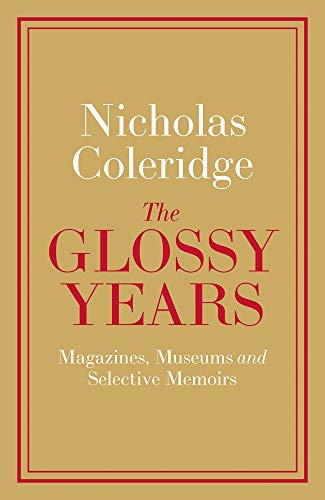
immune to such worries. But, perhaps Coleridge, with his bevy of godchildren, spiritual healer wife and happy family, lover of India and his numerous trips there may have been a comfortable shoulder to rely on?
Despite his somewhat cool approach to the deaths of several colleagues and friends, Coleridge comes across as a person, who within the constraints of his class, attempts to provide that shoulder for his friends, family, and it appears, his professional contacts. The constraints of his class is what makes this book an illuminating commentary on that class. It is easy to see how the disastrous aspects of Tory policies, such as austerity, really do pass such people by. Coleridge talks of his luck at the end of the book, but, while acknowledging this seems profoundly unaware of what other people’s bad luck can do to them. He is so closely involved with his glossies, a world of its own, that to him Fashion Week, advertising accounts, the success of a magazine means more than any foray into a world outside might mean.
Where he does move outside that world, children in India tapping on the windows of his car, are briefly acknowledged. That they are tapping for sustenance (or goods to give to their employers in exchange for their meagre livelihood) seems to pass him by. But that is my own social conscience talking.
Moving forward to where perhaps a more legitimate criticism can be made, the world of glossies and museums was amusingly related. As Managing Director of British Conde Nast for thirty years and President of Conde Nast International his stories of editors’ rise and demise; efforts to maintain the glossies afloat and resist takeovers; enacting takeovers; aspects of interviews he conducted and attended were interesting. However, to me they lacked the depth that I had wanted when I bought this book. Conde Nast published 130 magazines, including Vogue, Vanity Fair, Tatler, House and Garden and GQ; Coleridge had been a journalist, and editor before his major promotions. However, the detail on the Victoria and Albert Museum seemed to me more impressively drawn than the world of the glossies, that depended so much on the name dropping -fun, but not enough to make up for the lack of ‘nitty, gritty’ information.


And, now to Dicken’s Dotheboy Hall reference to Coleridge’s early schooldays . This section was well worth reading; with its aside to sexual harassment (deflected neatly, but reflected in the care Coleridge took in choosing his children’s schooling), his admission to Eton and years there.

I have to admit to being pleased that I did not pay full price for The Glossy Years Magazines, Museums and Selective Memoirs. However, I also have to admit being drawn willingly into a world that reflects so much I dislike, but under Coleridge’s deft touch was understandably alluring to so many readers and reviewers. And, at times, me.
The Glossy Years, Magazines, Museums and Selective Memoirs, Penguin, 1919.
Patricia Highsmith, People Who Knock On The Door, Heinemann (UK) 1983, Panzier (US) 1985. Initially, it was not published in America. Panzier, a small publishing house accepted it in 1985 (Beautiful Shadow, A Life of Patricia Highsmith, Andrew Wilson, Bloomsbury, 2003).
Highsmith wrote this novel as an exposition of the breakdown in relations between a Christian fundamentalist, Born Again Christian, and a liberal son. It arose from her interest in the rise of television fundamentalism in the US, exemplified by proponents such as Jerry Falwell, and the Moral Majority. The novel and its ideas resonate with current ideological conflicts in America, currently being highlighted by the 2020 Presidential election. Andrew Wilson’s Beautiful Shadow Patricia Highsmith (to be reviewed later in this series of reviews) refers in some detail to the background of the novel.
When I read People Who Knock on the Door quite a few years ago I saw it only as a commentary on fundamentalist religion and its hypocrisies. Certainly, Patricia Highsmith’s biographer sees the kernel for the novel coming from this source. In many ways the story of the Alderman family and Richard Alderman’s born again religiosity lends itself to this assessment: the depiction of the church personnel and their followers; the attitudes over abortion; and the smug assertiveness by Richard of his rectitude in comparison with that of his son, Arthur. After all, when it is observed that the church personnel and Richard have on the one hand been ‘saving’ Irene, a former prostitute, but also taking sexual advantage of her; when Richard’s physically easy job is contrasted graphically with Arthur’s hard physical labour and then offer of a responsible job as a youthful manager; and the way in which Arthur’s science bent undermines religious belief, the story appears to be quite a simple moral tale. But Highsmith also saw the novel as the exploration of the breakdown of human relations between fundamentalist Christian ideas and ideas informed by liberalism and science. Read at this level, it is certainly compelling, and deservedly so. This understanding resonates with the conflicts apparent in the current election speeches from the main figures and their followers.

Arthur is a positive character, together with the well meaning neighbour and his grandmother; Lois, Arthur and Robbie’s mother is a good person who supports her husband; Maggie (Arthur’s girlfriend) and her family are reasonable, enlightened and friendly to ‘our hero’. On the other hand, Richard is the repository of religious hypocrisy, failure to provide for his son’s education and a gossip; the church personnel are also gossips and smug; Robbie, Arthur’s younger brother is erratic, takes to his father’s religion with avidity and cannot make friends of his own age, depending on a group of older men for his social life of fishing and hunting.
However, while not denying the impact of the novel as a warning about fundamentalism, with Highsmith, there is more. The role of empathy is human relations is also explored with equal care.
On my second reading I began to reassess the novel. I think that it is far more layered than my original assessment allows. The writing has a great deal to do with the idea that People Who Knock On The Door is a report of life in America at the time, the variety of attitudes to religion and social mores and a clear eyed assessment of those that might be determined heroes or villains. That there is a resurgence (or appears to be so) makes this report prescient. But, nevertheless, however the current proponents of the ideas in the novel express them, it is possible that Highsmith is not writing of heroes or villains. Perhaps, for her, there are none in the novel, just flawed people trying to live as best they can. Sometimes they make egregious mistakes, and at others they are just getting through problems with doggedness, not heroism.
This is not to say that Highsmith does not provide the reader with the capacity to choose a preference which is valid when considering current American politics.
Lois is one of the most complex characters. She is a daughter, wife, mother and carer of children in an institutional setting. It is possible that the latter is where she feels most comfortable, certainly a great deal of her thought and time is taken up with the children outside her home. As a daughter, she seems to rely heavily on her mother to support her sons (but not at the price of antagonising their father), galvanise her into refurbishing the house, encourage her though the moral morass of dealing with an unfaithful husband, a child born out of wedlock that has a personal rather than institutional link with her, and death. Lois is not an entirely pleasant character, whatever her obvious concern for others. Her attitude toward Irene is cruel, with little laughs at her expense throughout the episodes of her appearance at the family Christmas with her huge sister, her pregnancy, and the arrival of the baby.
Arthur is the other character whom we are led to initially see as a hero. But is he? A lovelorn youth, who works hard, achieves well academically, and organises his college life after he loses the financial support of his father is not necessarily a hero. Arthur loves Maggie, does a great deal to help her with the abortion, supports his mother as far as possible, loves his grandmother and is reasonable towards his friend Gus. The characters with whom he has no difficulty he treats well. However, it is clear from his mother’s and grandmother’s comments that he is known to have teased his particularly vulnerable brother (this is also shown, early in the novel); he harbours violent thoughts of the student who replaces him as Maggie’s boyfriend; he looks for someone to help him get over her with a somewhat cold approach to human relations; he investigates Robbie’s friends, realises their shortcomings, but leaves it at that; he follows up Irene at her current workplace, replicating his mother’s derisory attitude towards her. His gossip about her is little different from the gossip he abhorred when aimed at him and Maggie and the abortion. Perhaps Arthur’s scientific bent is not just academic, but denotes a fairly cold character?
It is possible that the Alderman family has always been dysfunctional, perhaps waiting only for Robbie’s near death and Richard’s religious fervour to show the chinks. In comparison with Gus’s family, large, warm and open with Gus sustaining a loving relationship with his girlfriend from early in the novel to the end, the Aldermans are an uneasy group, lacking in real warmth, living lives that superficially are pleasant but ready to fall at the first encounter with crisis.
As always, Patricia Highsmith gives the reader something to think about. She seems to write almost for herself, leaving us to catch up with her if we can. She is not interested in giving us characters with whom we can identify, love, or even like. On the other hand, unlike some more contemporary writers, she is not lazy in her depiction of characters. None is just dislikable, each is complex enough to make us wonder what she meant the character to convey. Rereading this novel has encouraged me to reassess some of her others. But, the discomfort she leaves behind each reading suggests that this should be done between less demanding novelists’ work.
Southern States Issues, The American Civil War and its Aftermath: Heath Hardage Lee, Kate Cote Gillin and Blain Roberts.
These reviews appeared first on the Women’s History Network Blog as part of the Women’s History Network’s recognition of UK Black History Month.
Heath Hardage Lee Winnie Davis Daughter of The Lost Cause, United States of America: Potomac Press, 2014.
Kate Cote Gillin Shrill Hurrahs Women, Gender, and Racial Violence in South Carolina, 1865-1900, South Carolina: University of South Carolina Press, 2013.
Blain Roberts Pageants, Parlors, & Pretty Women Race and Beauty in the Twentieth Century South, North Carolina: University of North Carolina Press, 2014.
Winnie Davis, Daughter of The Lost Cause, Shrill Hurrahs Women, Gender, and Racial Violence in South Carolina, 1865-1900 and Pageants, Parlors, & Pretty Women Race and Beauty in the Twentieth – Century South reflect not only the powerful influence of Southern mores encapsulated in ‘the Southern Belle’ but the profound embedding of those values arising from the South’s loss of the American Civil War. Together the three books cover the American Civil War from early 1865 and its aftermath to the Civil Rights era. At their heart is the legacy of the ideas given legitimacy by the South in its quest for an identity as an escape from a devastating military defeat. Women’s role and racial conflict are at the core of each of the books, ending with Blain Robert’s study of beauty pageants and parlours, well after the initial conflict ended. Heath Hardage Lee has written a version of the aftermath American Civil War giving Davis’ biography a central place, while expanding to enhance further understanding of the war. Kate Cote Gillin takes a broader approach in her particularly thoughtful study of the politics of gender and racial violence in the south after the Civil War. Each of the books is a worthy read as a stand-alone work. However, together they accomplish a valuable trio of approaches, accessibility and style which provide effective explanations of the feelings and motivations that impact on contemporary Southern women and black Americans.
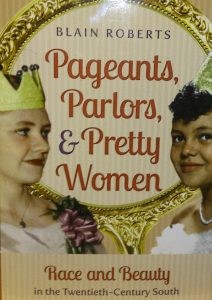
Although the birth of Varina (Winnie) Davis in June 1846, is at the centre, her life is not the whole of the ideas and events covered in Lee’s work. The forward compels the reader to look further than a biography of a Southern daughter, linking Winnie’s birth with the death of the General J.E.B. Stuart, a young and revered commander of the Northern Virginian cavalry. As much a representative of the post-war era as Stuart was of its battles, Winnie grows up with the full mantle of expectations of Southern womanhood upon her. Southern archetypes about race and gender embellish these expectations, to the detriment of Winnie and her right to a life independent of the South’s past and her parentage. She is described by Lee as being ‘a wistful, nervous heroine such as one might find described in the novels of Kate Chopin (The Awakening) or Charlotte Perkins Gilman (The Yellow Wallpaper)… ‘fitting the cultural mold of the times’ (p.67). As the Daughter of the Confederacy Winnie’s life culminated in her devotees’ destruction of her relationship with a man with Northern sympathies. The stricken South demanded ‘a goddess or an angel, someone otherworldly who was above banal domestic occupations’ (p.80). Winnie’s novels, written in the 1890s demonstrate the conflict over women’s attempts to gain independence, the impact of the war on their aims and her own experiences as a victim of the control the South demanded of her as the embodiment of the lost cause.
The later years of the senior Davis family and last years of the war are also described, including another part of the puzzle of associated with the perception of women. Lee describes the way in which the Northern papers controlled images of Southern devastation using gender as a weapon of denigration: graphically described in female images in the capture of Jefferson F. Davis in May 1865 (pp.24-26). In this image, together with the way in which Winnie was viewed by her admirers, Lee presents the complexities of demands upon women by both North and South. In the South if women were Daughters of the Confederacy or associated with ‘the cause’ they represented the antidote to the loss of the war. If they deviated from this image in behaviour, class or race they could be treated with violence. The North’s use of women’s attributes such as clothing or demeanour as a method of denigration is a further example of the complexity of women’s position. Lee’s story of one woman’s role as a daughter of the lost cause raises through her some of the issues which are the basis of Gillin’s and Roberts’ work.
Gillin’s book is the most complex of the three and begins with the most appalling image of the impact on a woman who deviates from a role as a daughter of the lost cause. In 1871 the Klan’s treatment of a white woman who helped three black men was well beyond that meted out to the men. Together with the overtly sexual nature of the attack, this example establishes the impact on women of the ‘undeclared racial war’ (p.1) which is the theme of this book. This war impacted on the relationships between black and white women, as often their perceived interests were in conflict. White women who believed the myth that black women were willing participants in their domestic slavery in tasks undertaken for women were disillusioned. ‘They assumed they knew them well’ (p.25) but the women freed from slavery were keen to adopt their freedom and claim wages for their work and the status to which they were entitled. Despite maintaining trappings of the past in their demands toward their former slaves the myth about Southern white woman is also questioned by Gillin. She suggests that ‘few women were the demure, fainting victims of an oppressive northern regime and its black allies, as they would later claim. Most championed the interests of their race and class with vigor’ (p.26).

Violence was not only inflicted by men against women as black and white women struggled to deal with their own challenges arising from the end of slavery. The salient point made here is that where one group of people has control over another violence is a likely consequence, as Gillin observes, ‘dramatic exchanges [between women] were emblematic of the battle to determine the future of land and labor and of the war over gender and the power of womanhood’ (p.29). Beyond the domestic challenges they encountered, women became involved in politics and ‘White women were a constant and accepted presence at Democratic functions throughout the state … [entering] the traditional male arena of political meetings, rallies, demonstrations, and even coercion’ (p.94). However, their image recalled the past: ‘white women brought their sense of presentation and decoration …women and girls became living representations of the cause for which they were fighting’ (p.95). While Gillin establishes the continuation of women as the embodiment of virtue during and after the American Civil War her reflections on lynching also establish the role of violence, not only as male but female. It was ‘the final stage in the white man’s campaign to completely expel blacks from the world of southern manhood and restore… gender roles’ (p.130) and ‘black and white women best distorted the antebellum roles by adopting lynching as their own crusade’ (p.130): ‘violence became a universal and interracial tool’ (p.131).
Gillin concludes with one of her underlying themes, the appeal of vigilantism as one consequence of ungendered acceptance of violence as a response to racial tension in South Carolina. Vigilantes reacted immediately to slaves winning their freedom and their claims to economic recompense for their labour; secondly, vigilante action centred around blacks’ claims to electoral independence demonstrated by their voting Republican; lastly, where black parents sought education for their children vigilante violence was enacted against them, the schools and teachers. Her claim that where ‘men and women changed the nature of violence, and violence changed the nature of men and women’ is challenging but Gillin makes a compelling argument.
Blain Roberts reaches back to the Civil War to explain modern ideas of beauty in the South. In her lively description and explanation Roberts demonstrates how the manifest influence of racism intensified in responses to the war impacts on understandings of feminine beauty. Her study also shows how, while continuing to impact on twentieth century ideals, racist reflections on beauty have had to adapt to the modern love of sunbathing and tanning. White as beauty was a universal imposition on all Southern women. Advertisements for whitening products ‘absolutely monopolized the women’s sections of southern rural periodicals, playing on an undercurrent of perceived insecurity among rural women’ (p.40). Diverging from the demand that women should beautify themselves was the idea that ‘the use of beauty products [was] a sign of an unforgiveable artifice rooted in female rebellion (p.17). Blain’s work constantly raises conflicting images and understandings of the way in which beauty is imposed on women, but also about the way in which they respond, giving the work a wonderful complexity. The reader is constantly kept alert to new ideas and possibilities about the meanings associated with women and their ideas of ideal beauty.
With her detailed examination of beauty parlours, Roberts continues to raise diverse ways of considering women and their relationship to images of beauty and enhancement. In particular, she addresses the conflict between ideology and the economic issues associated with black women’s embrace of beauty parlours as a business or employment. Her claim: ‘I am careful to balance the insights of feminism with the demands of my evidence’ (p.9) is also an important factor in her work, in which she argues that contemporary concerns about female subordination through beauty practices may not hold true for all circumstances and times. In the south, in the interwar years, they were seen as ‘instruments of female liberation’ (p.9) by conservatives. Beauty contests are also given a different perspective when Roberts claims that celebrations of black southern women through this medium ‘were more than a demand for recognition…[they were designed to do ‘the race proud’ (pp.149-150). The gauntlets she throws down makes the book an invigorating read.
Each of the books has a useful bibliography and index. Lee’s bibliography, while concise, includes some primary sources which are evidence of the period of over twenty years in which she worked with private collections and their owners and interviewed relatives of the Davis family. Harding’s rich bibliography provides the opportunity to further engage with her complex study. Roberts’ bibliography provides evidence of the wide range of contrasting ideas, many controversial, which provide this book with its impact.
Charity Norman Collection (Kindle Edition)
I bought this collection as a Book Bub special, and have no regrets at trying this, for me new author. The five novels are a splendid addition to my easy but thought provoking reads. I prefer fiction that includes social commentary, and Charity Norman provides this in each of the novels. Her background as a lawyer, and also someone who has moved from the UK to New Zealand are important contributors to the thoughtful work in the collection.
The first novel, Freeing Grace, is the stand out as a sensitive account of a baby whose biological family and a possible adopting family vie for her in a court battle over parenthood. The families’ stories are complex, told independently for much of the novel, and only coming together when the reader has had time to digest the rights and wrongs of the case each family is making.
Adoption as an option, with all its ramifications, is debated through Leila and David and their wider family. The sorrow of infertility, the role of paid work and economic concerns, relationships with social workers and courage are laid out, layer on layer, as Leila and David acknowledge their only option is to adopt, and fight to do so.
Baby Grace Serenity’s biological family has a far more complex story. The prologue describes her birth to a young unmarried mother, the social worker’s and medical attendants’ attitudes, and the accident that leaves Grace the subject of possible adoption. However, this story is mainly told through anti-commitment Jake and the family of his work colleague, Anna. In this many layered story women’s role as parent and family support versus her right to independence is debated.


The resolution is sustained by the arguments made throughout the vying families, rather than a simplistic happy ending. A good beginning to the collection.
The second story, After the Fall, is the one with which the collection was advertised. This suggests that it has been a successful stand alone novel. It possibly draws in part upon Norman’s move to New Zealand in its understanding of the complexities a major change in location makes for any family. In the novel, the teenage girl is particularly affected, and it is her story that leads to the novel working on the difficulties of dealing with change, the lies that accumulate in families, and a resolution that, while possibly the only one, leaves a family depleted.
The Son in Law is, to me, a really disturbing story with worrying values. It brings issues of domestic violence (a somewhat soft term for criminal assault at home), family relationships, children’s rights and needs and the workings of the judicial system to the fore. A mother is murdered in front of her children, a ten year old daughter who phones the ambulance, a baby on her hip, and a small son who hides behind the sofa. The father is goaled for manslaughter (his punch in her face did not necessarily kill her, her head hitting the fender did), and upon his release wants to resume his role as the children’s father. His in-laws who have cared for them since their mother’s death are opposed. This novel relied heavily on the mother’s background and behaviour as a ‘reason’ for her husband’s attack.
It is told though the daughter’s eyes and recall, the in-laws’ arguments, and the court reports leading up to the court decision. I remain disturbed at the conclusion, and since. Perhaps it is this that leads to my appraisal that this particular novel was lacking in the sensitive and thoughtful writing observed in the others in the collection.

The New Woman deals with the huge issue of transgender. As such, it seems to consciously take one side in the current debate over transgender women and their right to be seen as women with women’s rights.
Early descriptions of Luke, who is to become Lucia, are heartbreaking. His story begins with his exclusion from the girls’ cloakroom. Both his four year old friend, a girl, and he feel strongly that is where he belongs. Their teacher is adamant that he does not. Access to women’s toilets, is of course, a matter of debate in the current discussion of transgender. Another distressing vignette is that of his collecting a shiny tiara, a ballet frock and other ‘girl’s’ accoutrements to the dismay of his mother.
At the same time as Norman seemingly makes an argument for one side of the debate, she also consciously or unconsciously demonstrates that Luke has ingrained male characteristics: when he is physically attacked he does not cower and clutch at the hands encircling his throat. He punches, hard and effectively, leaving his attacker as bruised and battered as he. A woman has very different training and responses.
The family’s reactions to the changes Luke wants to make are horrendous, and difficult to understand. However, with Norman’s approach to her material I have little doubt that they are faithfully depicted.
What a thoroughly impressive piece of work! It made me reel and think harder about the current debate.
The last novel, See You in September, is gripping. An ordinarily happy family see a member off at Heathrow as she travels before finishing her degree. The family are not without flaws, a sister who is spiky; a father who is vigorous in his understanding of what his daughters should achieve; and a mother who does little to curtail this as she too wants worldly achievements.

A sense of fear is engendered from early in the novel, and does not dissipate. The prologue tells the reader that deaths have occurred, and who the victims are is unresolved until the very end. The excellent short sections on how to entice members to a cult, and sustain their loyalty warn the reader, but unfortunately not the protagonist.
I have recently read other novels where involvement in a cult has been a well drawn feature. This one is no different: the sense of disbelief that anyone could be so naïve is beautifully woven with arguments as to indeed how could they not?
Charity Norman’s collection was an excellent read. Although I take issue with some of the values expressed, that on the whole there are social issues so well debated gives these works an extra dimension. Yes, they are very accessible, they are fairly easy read. However, to be left with the haunting feelings about some of the issues and their resolution is, to me, the hallmark of a very worthy read.


The Wife Meg Wolitzer (Kindle Edition)
The Wife is an excellent novel with which to assess one’s own moral compass. As a feminist, I appreciate the way in which the stark differences between the acceptance of male writers’ behaviour and successes and the few accolades associated with women’s writing are drawn. Some of the development and description of the characters, women and men, is quite cruel – deservedly so. In particular, male writers are shown as inflated egos with a penchant for infidelity. The main male writer character, is eventually outed as having large feet of clay. I say eventually outed, but for me the signals were very apparent, without spoiling the denouement. Female characters, despite their flaws, are shown in their frailty, as possible writers but with little appreciation or assistance (certainly in comparison with that afforded the men) and devoted wives who keep the structures strong for the ego driven men.

That being said, I then began to think about these women, and in particular, the wife. It is clear that the three children of the marriage are suffering from the nature of the parents’ partnership. In this case ‘the wife’ is as guilty of the damage wrought upon them as ‘the husband’. The son is a truly damaged person – and the only one who attempts to force the truth from his parents. Culpability remains an important focus to the end, with the journalist , who also seeks the truth, being thwarted (and criticised).
This novel makes the reader think about the nature of the patriarchal world that impresses upon us the value of men and their work and lack of value acceded to women. However, it also highlights the importance of individual action and culpability for the way in which personal relationships as well as, in this case, public ones, develop. I enjoyed the way in which I was forced to ponder the wife’s role in the damage to her family. The arrogance and unpleasantness of the husband hides this for most of the novel, but by the end what seem to be simple answers are not.
The Wife, Meg Wolitzer, Scribner, first published March, 2003.

The Sister in Law, Sue Watson (Kindle edition)
I found this book a real grind to read.
The story is told through Clare’s experience of her marriage, the Taylor family into which she has married, and, currently, the summer holiday at a villa in Italy . Joy, Clare’s mother-in-law has chosen and arranged the holiday, the family business in which Clare’s husband, Dan, works, pays for it. The holiday, taken annually as a family, this year is to be the culmination of Clare’s insecurities, her husband’s infidelities, her brother-in-law’s irresponsibility and his new wife’s manipulations, sustained by the seemingly strong but benign influence of the matriarch and her husband, Bob.
There are no pleasant characters in this novel. Although the most clearly manipulative and nasty character, the new wife Ella, stands out, she is not alone. The sister-in-law of the title could relate equally to Ella and Clare. The women are sisters- in -law to each other, but also to the brothers. The relationships between the four have few redeeming features. Clare’s memories of her positive relationship with Jamie are marred by her feelings about his marriage, and, eventually, when a secret from the past is featured. Ella’s relationship with her brother- in -law results in a power play between the four young people. The sisters- in -law are ‘out to get each other’. Clare is a needy woman, with some justification, but there is little else to redeem this mean spirited character. Ella’s assessment of Clare is really apt. Clare, however, although generally correct about Ella, makes some serious mistakes in her assessment.
Clare needed to be a more sympathetic character for the novel to work well. Instead, I found her constant neediness, use of ‘her’ children, and attempts to get people ‘on her side’ really unedifying. She works as a nurse, has major responsibility for the children and therefore has no time to care for her appearance. This does not excuse the way in which she is treated by Ella and Dan, but doesn’t endear her to me. No time to shave her legs? Either do it quickly in the shower the morning they are to leave, as soon as she gets to the villa and has time, or wear her hairy legs as badge of feminist honour. Please. Clare uses work and children as an excuse for everything to do with her appearance. Although she acknowledges she is 40 and has the signs of having borne three children, Clare seems to want to compete with a woman 17 years younger on appearance, with the brothers in mind. With her mother- in- law it is competition for space in the kitchen cooking family meals. The competition over food does not end there – the children are drawn into the sisters- in- law’ antagonism over vegan versus meat, and who will buy ice-creams. Of course Ella is manipulative, that is abundantly clear, but Clare – please grow up.
I have read many novels in which a woman’s insecurities due to aging and lack of time are dealt with cleverly so that the reader feels her pain, her busy day and hastily grasped moments for herself. There are many in which the husband’s infidelities and their impact can only draw sympathy from the reader – and sometimes a great surge of desire for her to revenge herself. Sadly, this novel just left me just wondering why Clare stayed, and stayed, and stayed.


The Glass Castle, Jeanette Walls (Kindle edition).
Jeannette Walls’ compelling autobiography introduces a lifestyle that left me in awe of her and her siblings’ fortitude, love and a way of looking at the world through the eyes of dreamers with an amazing resourcefulness. Walls and her three siblings, older sister, Lori; and younger brother and sister, Brian and Maureen, live a life of moving from place to place; living in circumstances that amazingly escape the impact of social welfare officers; and dreams.
I was introduced to Rex and Rose Mary Walls and their children in the film which follows the book so well that I kept thinking I had read it previously. This is not always a mark of a good film, but in this case, I found both very satisfying. Both begin with Jeannette hiding in the back of a limousine on her way to a dressy function when she sees her mother scrabbling in a bin on the New York street. Then, both turn to her early years: Walls at three, cooking hotdogs while her mother paints oblivious to the possible danger to her child. The fancy dress she is wearing bursts into flame, leaving Walls with a lifelong scar covering much of her torso. Her hospitalisation does not last long: Rex, her father, dismantles the equipment, gathers her into a blanket, leaves the hospital in a flurry of wheels, and the Walls family is again on the move in one of their never ending number of old cars.

One of Rex Walls’ refrains is ‘But I never let you down, did I?’ and Jeannette aids and abets him in this sense of his identity until she can no longer hold on to the dream of a wonderful father whose life has the purpose of caring for his family. It takes almost the whole of the novel for her to recognise his failures, but to the end he remains a man remembered more for life with him never being boring, rather than the alcoholic who cannot keep a job. The way in which he is depicted envelopes the reader in the charm his family felt. It seems cruel to even describe Walls as a selfish alcoholic, at the same time as recognising his behaviour is also unforgivable. In the same way, while Jeannette, and therefore the reader, eventually acknowledges the difficulties of living with such a man, her mother is also a character who is difficult to dismiss as a neglectful parent. We know Rose Mary is neglectful, unloving and selfish, how can a woman who knows her children have little to eat, refuse to return to her teaching job, preferring to paint? And yet…It is this and ‘yet’ that makes the book so very powerful, the children are taught resilience, encouraged in their scholastic endeavours, given a life of boundless freedoms and aspirations to be different. They are unwashed, but given stars for Christmas; wear charity store clothes, but Jeannette strokes a cheetah at the zoo; they are often hungry but given the resources for choosing their own directions.

The glass castle of the title, and Jeannette’s father’s dream, never eventuates. The hole the children dig for its foundations is slowly filled with garbage. The plans of the glass castle with which he tries to lure Jeannette into remaining in the West Virginia township are meticulous, but no longer Jeannette’s dream. She becomes a writer and journalist – a profession begun in her early school days ; Lori is an artist and Brian a police officer – anathema to his father; Maureen, the only child to escape the Walls full experience by living with neighbours has had a breakdown.
That the family was able to escape welfare officers is perhaps appalling. But the wonder of Jeannette Walls’ work is that it is not entirely convincing that their lives would have been fuller and better if removed than the ones they made themselves. It is the questions about the role a dreamer (even if he is an alcoholic and she a – well what is she?) can play in providing a life that can result in the Walls’ siblings success in a different world that remains after the book is read. For Jeanette, there is so much magic, amongst the distress it is impossible for the reader to ignore, despite massive misgivings. At the end of book I am left with the magic that informs Jeannette Walls’ writing. She makes me believe that amongst the dross, her parents’ dreams and beliefs created a world in which Jeanette and her siblings not only survived, but did so with their own dreams ready to be realised: different from those with which they were raised, but nurtured by them.
Not an easy read in many ways, and depiction of a lifestyle which is hard to adapt to a world view in which we are led to believe that a warm house, nurturing parents, regular schooling, food on the table and school lunches, cleanliness and enough clothing are the ideal. I return to my reference to Rose Mary where I ponder ‘and yet’. Is the ideal lifestyle an ideal if it features none of the aspects which Jeanette Walls clearly admires and wants to evoke for her readers? While hiding her early life until this memoir, she has not wanted to let her positive recollections go. It is in this spirit, believing that Jeanette Walls’ feelings are valid, that the magic she weaves is most easily accepted and understood.
Published January 17th 2006 by Scribner (first published March 2005)
What She Saw (Kindle Edition) by Wendy Clarke
There are some clever moments in this novel, but not enough to overcome the implausible behaviour of Leona towards her daughter, Beth. I recognise that to make a story work there has to be some erratic behaviour -or, at least in this one, it was necessary. However, perhaps a more cleverly devised plot could have ironed out the necessity, given Leona and her daughter some foolish but understandable moments, and the novel become one that remained gripping to the end.
A clever device was the interweaving of Leona and Beth’s story with that of Ria, Lilly, and Leo’s. The former have a happy, companionable relationship with each other and Leona’s partner (referred to as her father by Beth), Scott. They live in a cluttered cottage in the Lake district where Scott is tourist walk leader, Leona makes silver jewelry in a successful cottage industry, and Beth attends a highly acclaimed private school. Ria is married to an abusive man whose abuse begins with controlling behaviour which, by the end of the marriage becomes physically violent. Lilly is their daughter , who may or may not be fully aware of the nature of the marriage. Leo, Ria’s best friend is an unwilling observer of some of these events.
The crisis in Leona’s life interacts with that in her daughter’s: Beth is bullied at school and finds comfort in walking on the hills, drawing the predatory birds that circle above her, and her meeting with an older man who photographs the beautiful surrounds in the Lake District. The ideal relationship between mother and daughter crumbles under the weight of Leona’s fears for her, the secrets they both keep, and outside forces associated with Ria.
It is here that Leona’s behaviour seems to be so irrational – if she really wants to care for her daughter why the continued controlling behaviour and secrecy? Why does Leona, supposedly dedicated to her daughter’s safety beyond all else travel to London? Why is she careless in hiding the information she should not have kept and which then gets into Beth’s hands? All of this section needed to be far more subtle and clever. I have to admit I lost patience with Leona. I also felt uncomfortable about the older man/child relationship. In addition, this relationship with a man who had been in prison seemed to have potential for tying into the main plot, but did not.
Perhaps the novel had potential that could have been met with a little more work on making the Leona/Beth story more feasible. However, to lay all the problems at the door of the idea that teenagers rebel and secrets are dangerous is to give the writer an out that she does not deserve. I wanted more from this psychological thriller. The genre is popular and there are some excellent examples, sadly, this is not one.
Published by Bookouture, 2019.
 Robin's Room
What an interesting review you wrote of my memoir The Glossy Years. I stumbled upon it, and was glad I did. You were very generous. Thank you. I was struck by the fact that you clearly categorise things and people in more political terms than I do. I have friends who vote in many directions. I expect most vote Conservative (since the people of the UK have always tended to prosper more under Tory regimes, poor as well as richer) but many don’t vote that way. Anyway, I’m flattered and delighted you found so much to enjoy in The Glossy Years. Much appreciated.
LikeLike
Thank you so much. Yes, you are quite right about my political approach! I recall it serving me very badly when studying Joyce Carey’s The Horses Mouth in the early 1970s. I was incensed by the unfair distribution of wealth that forced Gulley Jimson to steal so that he could paint. As you can imagine this did not bode well for my English results at the time. However, by the 2020s I was able to write of feminism in Barbara Pym’s novels with more success.
I too, have friends who vote differently from me. But I have tramped the streets of Cambridge in the snow for the Labour Party!
LikeLike
Enjoying your site very much. Would like to make contact again after all these years. What a sad and uninformed world it would be without books, you can’t have enough in the bookcase(s).
LikeLiked by 1 person
Yes, I have bookcases full of books boxes full of books a store room full of books…and a kindle!
LikeLike