Reviews for Bright Young Things by Jane A. Adams and All the Lights Above Us seem to have been lingering on my NetGalley shelf, without being transposed to this blog. So here they are – two fiction books sent to me by NetGalley for honest reviews.
Jane A. Adams Bright Young Things Severn House 2021.

Bright Young Things begins in a quietly menacing manner, an unknown person reads loving words from an admirer, and sneers at the correspondent. This sense of unease remains throughout the novel, even though the recipient, and probable murderer, is identified early.
Two detectives are brought into the case when a young woman’s body is publicly deposited on a beach. Henry Johnstone is introduced as a man ensconced comfortably in his sister’s pleasant home, reading the newspaper in which the story of the body, the way it was placed on the beach and the man who carried her is described. Henry has been bodily and mentally damaged from a previous case involving his niece – will he become involved in this one? Sergeant Mickey Hitchens arrives and solves this question. Although Henry is much his superior, Mickey decides for both. The two will take on the case, and together with an intelligent young officer from the local force, solve it. Read the full review at Books: Reviews
M B Henry All the Lights Above Us Alcove Press 2021

My first reaction to All the Lights Above Us was admiration for the cleverness with which M B Henry relates the political, personal, and military drama of June 5 to June 7, 1944. The narrative follows the events of the day before and following D Day in their horrors, passion, courage, foolishness, treachery, and self-deception through the experiences of five women. Flora, Adelaide, and Emilia are in Caen, France; Mildred in Berlin, Germany; and Theda in Portsmouth, England. Their stories are largely independent of each other, although Flora’s and Emilia’s stories converge in the last hours of the invasion of France by the Allies. This coming together is another intelligent device, not only providing a conclusion to Flora’s story, but adding to the characterisation of Emilia. Each woman’s story is told in short, but strong chapters, evoking their past, developing characterisation, and moving the story forward. This story is full of event, emotion, and social commentary, its impact makes it seem as though we have been with the women for far longer. As I stated at the beginning – so clever. Read the complete review at Books: Reviews.
Articles after the Covid update: Reinventing a way to deal with racist artefacts – Karla Dickens; Cindy Lou enjoys lunch at The Boathouse; Bob McMullan says Macron is more likely to be reelected than Morrison – read quickly in case the leadership rumours are true; Heather Cox Richards and a number of American political activities which are worthy of serious thought (in particular re the renaming of the insurrection at the Capitol) .
Post lockdown Covid in Canberra

February 3 showed another decline in the new cases reported – 549. Patients in hospital – 61, with one in intensive care and ventilated. ACT residents five t o eleven who have received their first dose of the vaccine – 70.3%. Boosters are now available for 16 and 17 year olds and 51% of ACT residents over 18 have received theirs. On 4 February 449 new cases were recorded, and there are now 2,954 active cases.
New cases recorded on 5 February – 372; and another drop in recorded cases on 6 February – 323. The number of hospital cases has also decreased to sixty, with two people in in intensive care, and one ventilated. The vaccination rate continue to rise with 53.2% people 18 and over having received their booster, and children five t o eleven to have received one dose is 71.9%.
On 7th February changes to the check in requirements were announced. The new requirements will better reflect new conditions, and will only be required for licensed bars and pubs, registered clubs, nightclubs, strip clubs abd brothels, organised events that are not ticketed or pre-registered, such as conferences, markets, music and cultural events, and schools and early childhood education and care. Other venues are encouraged to retain their QR codes so that people who wish to do so can keep a record of where they have been.
The figures for the 7th February are: 54.7% residents over 16 have received their booster; 73.1% children 5 – 11 have received one dose of the vaccine. O the 8th these figures increased again so that now boosters are at 56.3%; 5-11 are at 74.4%; and over16 fully vaccinated are 98.6%. One death was recorded. The number of cases recorded was 495, so that there are now 2,369 active cases, with 55 in hospital and one ventilated in intensive care.
On 9 February there were 475 new cases recorded. Vaccinations continue to increase with boosters for people over sixteen at 57.2%, and first doses for children five to eleven at 74.5%. There are fifty four patients in hospital, including four in intensive care, of whom one is ventilated. One death was recorded. The ACT has had a total of 39,613 cases and thirty one deaths.
Reinventing a way to deal with racist artefacts.*
The story below links to the story in the blog of 5 January 2022 (accessible at the link at the end of this post) Reenvisaging racist artefacts.
Karla Dickens’ work at the National Gallery of Australia was included in my visit there in the post for 2 February 2022.
Karla Dickens has spent years collecting racist vintage postcards, which she reframes and subverts to tell stories of First Nations resilience.
By Smriti Daniel for The Art Show
Posted Wed 26 Jan 2022 at 6:22amWednesday 26 Jan 2022 at 6:22am, updated Thu 27 Jan 2022 at 1:18pmThursday 27 Jan 2022 at 1:18pm
When the tip shops closed during COVID-19, Karla Dickens turned to eBay.
For decades, the artist of Wiradjuri heritage has incorporated discarded or recycled objects into her mixed-media installations and sculptural collages.
She re-contextualises the objects by adding layers of drawing, painting or embroidery as a form of commentary and reframes the narrative for contemporary audiences.
During lockdown, Dickens found she could feed her obsession with vintage postcards in that giant tip shop of the internet.
What started out as a modest collection in a tin (with a koala on the lid) now numbers in the hundreds.
These postcards form the heart of her new exhibition, Return to Sender, at Carriageworks in Sydney until January 30.
Dickens came across the first postcard in her collection many years ago, sandwiched between the pages of a book she’d picked up at an op-shop.
That discovery inspired her to go looking for more examples of vintage Australian postcards depicting First Nations men, women and families.
The examples she unearthed ranged from dehumanising caricatures to beautiful portraits, but Dickens found the most revealing aspect was often the notes written on the back.
“Some of the messages have got nothing to do with the postcard at all … but other ones are really derogatory comments about the women – ‘Check out this style!’ [under the image of a half-naked woman] and ‘How would you like to show up here?'” Dickens told ABC RN’s The Art Show.
One image, of a beautiful Aboriginal woman, shows her bare-chested. The caption on the front reads: Winnie, the belle of the camp.
Dickens pored over each postcard, trying to see the world through the eyes of someone who would choose to send something like this, and from the perspective of the person who received it.
“The fronts and backs [of the postcards] are kind of equally telling,” she says.
Scanned and enlarged, the postcards are now part of large-scale wall collages in her Carriageworks exhibition.
Dickens says working with the postcards was difficult but she knew, ultimately, that she wanted to transmute them into art.
“It’s not just my responsibility to sit with this history. It’s a shared history,” she says.
“Healing isn’t always a cheery occupation. I’ve worked on change for many years. It’s not easy; you have to look at lots of hard things if you want to change.”
Return to the KKK and Aussie Sheila
“I had never used images of people before, and I sat with these objects for a long time. It’s probably the longest brewing and hardest work that I’ve created because of the respect that needs to be shown to these objects,” says Dickens.
She was also very aware of the families of the Aboriginal and/or Torres Strait Islander people represented in the photographs.
Many of the images she selected were over a century old, which meant the people in them had passed away many years ago.
“If somebody had passed away in the last 10 or 20 years, I would not want to use those photos, just out of respect to their living families,” she explains.
Many of the images had also been staged: “The person posed for a photographer and so would have given their permission.”
She chose to cover the eyes of each person depicted with a black bar.
“In the 60s and 70s they would cover the victim’s eyes in the newspaper — and if that was your ancestor, you would know regardless of whether the eyes were covered, but it was about giving some respect to these people.”
She also consulted with the Australian Institute of Aboriginal and Torres Strait Islander Studies (AIATSIS) to make sure none of the content in the images related to sacred or secret material.
In a final touch, Dickens stamped each postcard with a red circle bearing the words “return to sender”.
Within the exhibition, she installed a row of small personal letterboxes bearing the names of imagined senders: Mr Wally White, Karen, Racist Rick, Bob Bigot, KKK and Aussie Sheila.
Over each of the exhibition’s two collages of enlarged postcard images, she superimposed a photograph of a contemporary First Nations person: one of model Cindy Paden, wearing a sequined Australian flag mini dress and flipping the bird at the audience; the other of a man called Jeff, covered in tattoos and with his fists raised.
“There is vulnerability in those [postcard] images, and Cindy just steps it up and goes, ‘This is our past, and we’re still here, we’re still strong’,” says Dickens.
“It’s that strength, that resilience, and not cockiness but pride — and a little bit of f*** you — in both those people who are imposed over these postcards.”
‘I could not have filled the flag with enough crosses for the loss’
Since the lockdowns have lifted, Dickens is back to trawling the tip sites around her home in Lismore, in north-eastern New South Wales.
There are a good number, she reports, some of which are more than 50 years old.
Like an archaeologist, she is looking for clues about the society she lives in.
In this way, Dickens invites audiences to reflect on the enduring legacy of racism, and confront painful questions around identity and country.
This process of reflection is lifelong, and responds to her family history.
Karla Dickens: Return to Sender is showing at Carriageworks until January 30.
Aboriginal and Torres Strait Islander Peoples are advised that the exhibition contains images of deceased persons, and the work includes images and themes that Aboriginal and Torres Strait Islander Peoples may find sensitive and distressing.
- This article has been edited to concentrate on the reinvention through postcards which links to the previous articles on reenvisaging racist artefacts. For full interview see: abc.net.au/news/karla-dickens-interview-return-to-sender-carriageworks/100780016COPY LINKSHARE
Cindy Lou reviews The Boathouse
Cindy Lou has a delightful lunch at The Boathouse. The Boathouse has been a favourite in the past, and I am again relishing the excellent meals that are served here. The lunch menu provides for a two or three course meal, with three sides, and bread with smoked butter. Oysters are also on the menu. The wine menu is on a QR Code on the main menu. In keeping with the particular care this restaurant takes with Covid protocols menus are provided fresh to each table. The tables are set at an impressive distance, staff wore masks, as did patrons if they moved around the restaurant. I chose the two course meal, meaning to return for dessert. Alas, this was impossible – note the unfinished dishes at the end of a delicious meal.


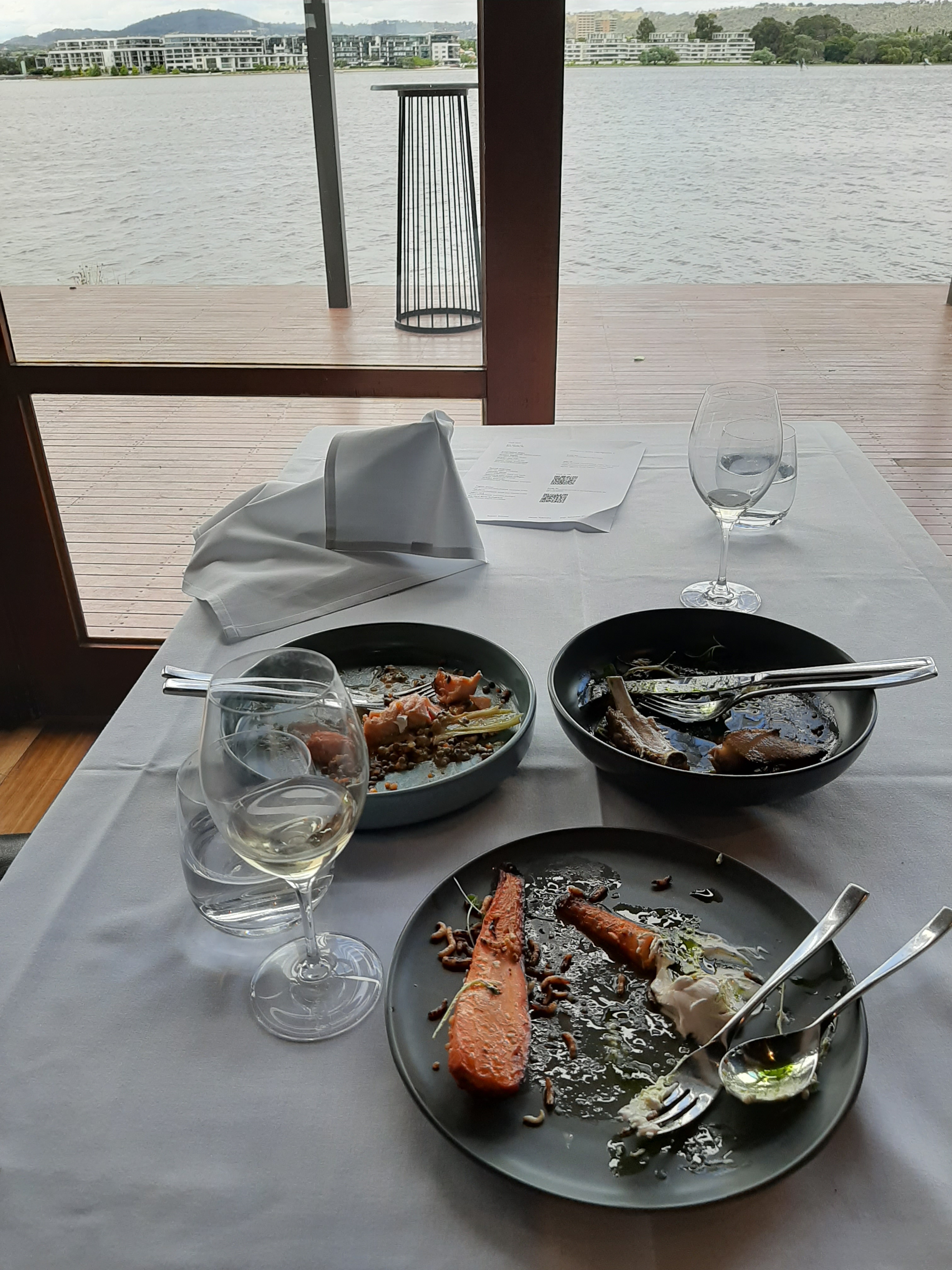
The smoked butter was served with warm, crusty bread. Yes, the smoked butter is the attraction – as must be recognised by The Boathouse as the serve was generous. I chose a chicken with miso cabbage and eel sauce as an entrée – it could not have been more delicious; my friend’s heirloom tomatoes with a beautiful sauce and cheese was also a winner. My salmon was perfectly cooked with a crisp skin and beautifully moist. The carrots made a wonderful accompaniment. Next time perhaps we might have an entrée and dessert. I cannot miss out on the splendid choice offered again.
Sitting by the window was an extra bonus, and one of the reasons I choose the lunch option while there is sun (even if it is intermittent) over Lake Burley Griffin.
PS It seem that some lovely people are taking my friend and me there for dinner next month – and there is a four course menu! I am looking forward to that and the company.
Macron is more likely to be reelected than Morrison
Bob McMullan

Given their recent history, it is ironic that Macron and Morrison will come up for election at very
close to the same time.
The French presidential election is due to hold both rounds of voting in April. It is probable that the
next Australian election will be in May.
The main purpose of this article is to assess the probability of a Macron victory in the French Presidential election.
The comparison with Australia is principally to illustrate the French situation, but given their recent history it is also interesting to examine Macron and Morrison’s respective prospects of re-election.
Of course, it is far too early to be very confident in either case. Polling is a notoriously imperfect guide to election prospects, but it remains the best guide we have.
In France, some trends are already clear. Macron is not outstandingly popular. His latest approval rating based on the Politico poll of polls
stood at 40%. His overall net rating was -18. However, Macron is blessed with a divided and divisive opposition. Last election he was fortunate enough to be in the second-round run-off against Marine Le Pen who
proved too extreme for mainstream French voters to support. In fact, Macron won in a landslide.
Until very recently it has looked most likely that the second-round this time would be a re-run of 2017, in which case the result would be likely to be similar. However, recently Ms. Le Pen has been outflanked from both the centre right and the extreme right! The emerging leading challenger from the extreme right is M. Zemmour, who has been described as
the French Trump. While this is in some way unfair it does illustrate the direction of travel. The other challenge to Ms. Le Pen comes from the candidate of the traditional right of centre party, Ms. Pecresse.
The latest poll numbers suggest that Ms. Le Pen’s standing as the right candidate is under serious threat. Although Zemmour is fading, Le Pen and Pecresse are neck and neck for second place behind Macron.
This matters because in the French electoral system if no one gets 50% in the first round of voting, a second round is held two weeks later in which only the first two candidates are included. This is effectively a similar method to the Australian ranked-choice voting system. In 2017,Macron and Le Pen were leaders after the first round with 24% and 21% respectively, Macron won the second round 66/34.
The current polling suggests that Macron would beat either of the most likely opponents in the second round. The current average of the polls suggest Macron would defeat Le Pen 57/43 and would beat Pecresse 53/47. The most recent poll had Macron and Pecresse much closer, but for the moment this appears to be an outlier.
There is a considerable amount of support for more left-wing candidates. Some analysts suggest as much as 25%. However, it is hopelessly split amongst 7 or more candidates, ranging from Trotskyists to the mainstream Socialist Party which elected Mitterrand and Hollande in the past. While they remain so divided none of them have even a remote chance of winning but their support will be important to Macron, particularly if he is up against Le Pen. So, it is probable but not certain that Macron will win, particularly if he is up against Le Pen, which remains the most likely outcome. As support for Zemmour continues to fade, logically this should help Le Pen more than Pecresse, although time will tell.
As an incumbent Macron (and Morrison) should be able to improve his position during the campaign as attention shifts from a referendum on the incumbent to a choice between alternative leaders.
Australian polling is not so positive for Morrison.
His approval ratings until recently have been a little better than those for Macron. However, his most recent approval rating is 39% and his overall net rating was -19. The Poll Bludgers poll trend suggests that Morrison is trailing Labor in two party preferred terms 44/56. If this were to be the actual result it would be the worst result for a major party at an Australian election since 1966 and the worst result for an incumbent government since WW2.
This is far from insuperable even if the polling is accurate(which I don’t believe it is), but as a starting point it is less encouraging than the polling for Macron.
The only safe answer to the question: “who will win?” in either country is to say it is too early to tell.
But a betting person would prefer to have his or her money on Macron rather than Morrison at this stage.
Heather Cox Richardson – RNC decision, insurrection renamed, archives material during the Trump administration, Hilary’s coffee mug

February 7, 2022 (Monday)
It appears that the Republican National Committee’s censure of Representatives Liz Cheney (R-WY) and Adam Kinzinger (R-IL), along with its declaration that the riot at the U.S. Capitol on January 6, 2021, was “legitimate political discourse,” has created a problem for Republican lawmakers as they try to position the party for the midterms and the 2024 election. Coming, as the statement did, just after former president Trump said that Pence had the power to “overturn the election” and that if reelected, Trump would pardon those who attacked the Capitol, it has put the Republican Party openly on the side of overturning our democracy.
Trump loyalists have been insisting that the rioters were “political prisoners,” and clearly the RNC was speaking for them. This wing of the party got a boost this evening when venture capitalist Peter Thiel, the libertarian whose wealth Forbes estimates to be about $2.6 billion, announced that he is stepping down from the board of Meta, the parent company of Facebook, to focus on electing Trump-aligned candidates in 2022. Thiel famously wrote in 2009 that he “no longer believe[s] that freedom and democracy are compatible,” and deplored “the vast increase in welfare beneficiaries and the extension of the franchise to women” after 1920.
It also got a boost today when the Supreme Court halted a lower court’s order saying that a redistricting map in Alabama violated the Voting Rights Act by getting rid of a Black majority district. Alabama’s population is 27% Black, which should translate to 2 congressional seats, but by the practice of “packing and cracking”—that is, packing large numbers of Black voters into one district and spreading them thinly across all the others—only one district will likely have a shot at electing a Black representative. The vote for letting the new maps stand was 5 to 4, with Chief Justice John Roberts siding with the liberals against the new right-wing majority, in control thanks to the three justices added by Trump.
But the backlash against the RNC’s statement suggests that most Americans see the deadly attack on our democracy for what it was, and Republican lawmakers are now trying to deflect from the RNC’s statement.
RNC chair Ronna McDaniel said that media quotes from the resolution are a “lie” and says the committee did not mean it to be taken as it has been. But other Republicans seemed to understand that the RNC has firmly dragged the Republican Party into Trump’s war on our democracy.
National Review called the statement “both morally repellent and politically self-destructive,” and worried that “it will be used against hundreds of elected Republicans who were not consulted in its drafting and do not endorse its sentiment.” If indeed the RNC simply misworded their statement, the editors said, “its wording is political malpractice of the highest order coming from people whose entire job is politics.”
Sunday, former New Jersey governor Chris Christie, who seems to entertain hopes for 2024, said on ABC’s This Week that “January 6 was a riot incited by Donald Trump in an effort to intimidate Mike Pence and Congress into doing exactly what he said in his own words—overturn the election.”
But others, like Senator Todd Young (R-IN), seem to be trying to split the baby. Young told Christiane Amanpour that those saying the attack was legitimate political discourse are “a fringe group,” although the RNC is quite literally the official machinery of the Republican Party. Young is up for reelection in 2022. He is also from Indiana, as is former vice president Mike Pence, who seems to be positioning himself to take over the party as Trump’s legal woes knock him out of the running for 2024.
On Friday, Pence told the Federalist Society that Trump was “wrong” to say that he, Pence, had the power to overturn the election. But he did not say that Biden won the election fairly. Then, on Sunday, Pence’s former chief of staff Marc Short seemed to try to let Trump off the hook for his pressure on Pence, telling Chuck Todd on Meet the Press that the former president “had many bad advisers who were basically snake oil salesmen giving him really random and novel ideas as to what the vice president could do.”
They seem to be trying to keep Trump’s voters while easing the former president himself offstage, hoping that voters will forget that the Republican leadership stood by Trump until he openly talked of overturning the election.
Representative Adam Schiff (D-CA), chair of the House Intelligence Committee and a member of the House Select Committee to Investigate the January 6th Attack on the U.S. Capitol, seems unlikely to stand by as the country moves on, as the National Review editors indicated they were hoping. As he said in his closing at Trump’s first impeachment trial: “History will not be kind to Donald Trump. If you find that the House has proved its case, and still vote to acquit, your name will be tied to his with a cord of steel and for all of history.”
The other big news of the past day is that it turns out that Trump and his team mishandled presidential records, suggesting that we will never get the full story of what happened in that White House.
By law, presidential records and federal records belong to the U.S. government. An administration must preserve every piece of official business. Some of the documents that the Trump team delivered to the January 6 committee had been ripped up and taped back together, some were in pieces, and some, apparently, were shredded and destroyed. Legal commentator Asha Rangappa noted that Trump’s impeachments mean that such shredding could have amounted to an obstruction of justice.
Today we learned that the National Archives and Records Administration had to retrieve 15 boxes of material from Trump’s Florida residence Mar-a-Lago, including correspondence with North Korean leader Kim Jong Un and the letter that former president Barack Obama left for Trump (which would have brought a pretty penny if it were sold). Trump aides say they are trying to determine what other records need to be returned.
Former Republican Kurt Bardella noted, “If this had happened during a Democratic Administration while Republicans were in the majority, I guarantee you [the Oversight Committee] would be launching a massive investigation into this and writing subpoenas right now to any and every W[hite] H[ouse] official that was involved in this.”
Former Secretary of State Hillary Clinton used the story to raise money for her progressive organization, Onward Together. She linked to the story as she urged people to “Take a sip from your new mug as you read the news.” With the tweet was the picture of a mug with her image and the caption “But Her Emails.”
House January 6 committee member Jamie Raskin (D-MD) says that the committee is planning to hold public hearings in April or May. They have been slowed down by the reluctance of the Trump team to cooperate.

 Robin's Room