Ayesha Inoon Untethered Harlequin Australia, HQ (Fiction, Non Fiction, YA) & MIRA, 2023
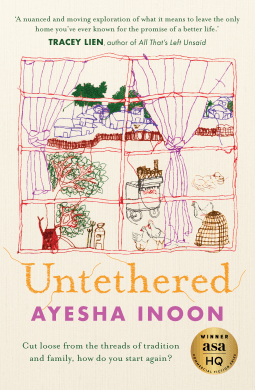
Thank you, NetGalley and Harlequin Australia, for providing me with this uncorrected proof for review.
I am even more grateful to Ayesha Inoon for writing this book – it’s a story that remains long after reading, creating the emotion and some of the understanding that is so essential to gaining any insight of a life lived through two cultures. In my Goodreads review I gave Ayesha Inoon an additional half star in appreciation for her wonderful rendering of Australia’s capital city, Canberra. I have not fed swans at Lake Ginninderra but have felt guilty at turning on the heating before the Canberra designated date – after Anzac Day! The descriptions of the streets, quiet but then birdsongs filling the air, Floriade, shopping in Belconnen at the mall, and more bring alive an Australian city. And, before this, the life in Colombo is colourful, family oriented and more – a picture unknown to me until the descriptions permeated not only Zia’s life, but mine as I read.
Zia is an appealing and endearing character whose strength helps her make such a success of both lives. She arrives in Canberra with her and Rashid’s daughter, Farah, joining him in a new life. She has had to leave behind her the results of the first choices she has had to make before embarking on the journey from Sri Lanka. She has lost closeness with her large extended family of not only parents, parents in law, sibling and sister-in-law but other relatives, their friends, and her friends. Belongings are left. Memories bound up in these are a source of regret, and it will take time, effort, and acceptance to make new memories. Unfamiliar is the environment, her new home, and more seriously, Rashid. Close to her relationship with Rashid in importance and unfamiliarity is learning to be by herself, be responsible for Farah alone, learning the isolation of a new Australian life in contrast with the past. See complete review at Books: Reviews.
Covid Update
ACT summary on 5 May shows that there were 826 new cases, with 38 in hospital and 3 in ICU. One life was lost.

16–20 AUGUST The 2023 Canberra Writers Festival returns
THE CANBERRA WRITERS FESTIVAL RETURNS
16–20 AUGUST 2023
In the spirit of our passion for words and ideas, we are delighted to announce that the 2023 Canberra Writers Festival will be staged from Wednesday 16 August through to Sunday 20 August, with Artistic Director, Beejay Silcox at the helm.
As is the Canberra Writers Festival tradition, the driving theme is ‘Power Politics Passion’. It is a theme that begs big questions: What do we value? Whose stories are heard? How do we reckon with the past and imagine the future? It is our hope that CWF will provide a space to explore these questions, and to celebrate the heft and craft of Australian storytellers — a joyful collision of art-makers, big thinkers, big dreamers and readers.

| Welcome to Canberra’s Biggest Book ClubThank you all for all the wonderful messages of support we received when we announced Beejay Silcox as our new Artistic Director. Beejay is working at a cracking pace to create a magnificent festival for us, opening on August 16th this year. We are thrilled to announce her first initiative – Canberra’s Biggest Book Club – featuring one of the finest novels published in the last year, Bad Art Mother by Edwina Preston. Shortlisted for both the Christina Stead Prize for Fiction and the Stella Prize, Bad Art Mother is redolent of the cultural life in 1960s Melbourne inhabited by luminaries such as Georges and Mirka Mora, John and Sunday Reed and the writers and artists in their orbit. Good mothers are expected to be selfless. Artists are seen as selfish. So what does this mean for a mother with artistic ambitions? Enter: frustrated poet Veda Gray, who is offered a Faustian bargain when a wealthy childless couple, the Parishes, invite her to exchange her young son Owen for time to write. Bad Art Mother is inspired – to a degree – by the life of Australian poet Gwen Harwood who Preston describes as a mischievous, daring, hilarious, flawed, and brave writer. Beejay chose Bad Art Mother because it is evocative, ambitious and rich with questions. “Who gets to be an art-maker? At what cost? Whose artistic voices are valued, and whose are lost? These questions are as relevant today as they were half a century ago. This novel defies easy answers – that’s why it’s so beguiling. Edwina Preston invites us – she dares us – to make up our own minds.” As part of Canberra’s Biggest Book Club, you and your reading buddies will have access to exclusive content including a reading guide and book club questions. Over the next three months we will send you updates on the novel, insights into its creation and naturally you will have priority booking for Canberra’s Big Book Club with Edwina Preston on August 19. You can submit questions for the author in advance on behalf of yourself or your whole book club. And we will give you a sneak peak at the full festival program to give you more time to plan what you want to see. Both Preston’s novel and her life as a writer in contemporary Australia will provide rich fodder for a lively discussion. You have plenty of time to read the book, receive regular updates and then come along on Saturday 19th August for a Spoiler-tastic session with Preston and book clubbers across Canberra. The Festival Team |
| Visit canberawritersfestival.com.au for more festival information. Follow the Canberra Writers Festival on Facebook or Instagram.We acknowledge the Traditional Custodians of the ACT, the Ngunnawal people. We acknowledge and respect their continuing culture and the contribution they make to the life of Canberra and this region. |
| Copyright © 2023 Canberra Writers Festival, All rights reserved. You are receiving this email because you subscribed to our mailing list on our website. Our mailing address is: Canberra Writers Festival GPO Box 2495 Canberra City ACT 2601 Australia |
Two Responses to American gun violence
Joe Scarborough MSNBC
A combination of graphics and commentary made this special program from Joe Scarborough a telling contribution to debate – one in which Republicans and those who vote for them engage in only with superficial responses.


Heather Cox Richardson’s information might be widely known in America. However, it rarely overcomes the platitudes about gun violence and the Second Amendment which air after a shooting – oh, I forgot, the thoughts and prayers.
May 6, 2023 HEATHER COX RICHARDSON

Heather Cox Richardson @HEATHERCOXRICHARDSON
Letters from an American By Heather Cox Richardson A newsletter about the history behind today’s politics.
For years now, after one massacre or another, I have written some version of the same article, explaining that the nation’s current gun free-for-all is not traditional but, rather, is a symptom of the takeover of our nation by a radical extremist minority. The idea that massacres are “the price of freedom,” as right-wing personality Bill O’Reilly said in 2017 after the Mandalay Bay massacre in Las Vegas, in which a gunman killed 60 people and wounded 411 others, is new, and it is about politics, not our history.
The Second Amendment to the Constitution, on which modern-day arguments for widespread gun ownership rest, is one simple sentence: “A well regulated militia, being necessary for the security of a free state, the right of the people to keep and bear arms, shall not be infringed.” There’s not a lot to go on about what the Framers meant, although in their day, to “bear arms” meant to be part of an organized militia.
As the Tennessee Supreme Court wrote in 1840, “A man in the pursuit of deer, elk, and buffaloes might carry his rifle every day for forty years, and yet it would never be said of him that he had borne arms; much less could it be said that a private citizen bears arms because he has a dirk or pistol concealed under his clothes, or a spear in a cane.”
Today’s insistence that the Second Amendment gives individuals a broad right to own guns comes from two places.
One is the establishment of the National Rifle Association in New York in 1871, in part to improve the marksmanship skills of American citizens who might be called on to fight in another war, and in part to promote in America the British sport of elite shooting, complete with hefty cash prizes in newly organized tournaments. Just a decade after the Civil War, veterans jumped at the chance to hone their former skills. Rifle clubs sprang up across the nation.
By the 1920s, rifle shooting was a popular American sport. “Riflemen” competed in the Olympics, in colleges, and in local, state, and national tournaments organized by the NRA. Being a good marksman was a source of pride, mentioned in public biographies, like being a good golfer. In 1925, when the secretary of the NRA apparently took money from ammunition and arms manufacturers, the organization tossed him out and sued him.
NRA officers insisted on the right of citizens to own rifles and handguns but worked hard to distinguish between law-abiding citizens who should have access to guns for hunting and target shooting and protection, and criminals and mentally ill people, who should not. In 1931, amid fears of bootlegger gangs, the NRA backed federal legislation to limit concealed weapons; prevent possession by criminals, the mentally ill and children; to require all dealers to be licensed; and to require background checks before delivery. It backed the 1934 National Firearms Act, and parts of the 1968 Gun Control Act, designed to stop what seemed to be America’s hurtle toward violence in that turbulent decade.
But in the mid-1970s a faction in the NRA forced the organization away from sports and toward opposing “gun control.” It formed a political action committee (PAC) in 1975, and two years later it elected an organization president who abandoned sporting culture and focused instead on “gun rights.”
This was the second thing that led us to where we are today: leaders of the NRA embraced the politics of Movement Conservatism, the political movement that rose to combat the business regulations and social welfare programs that both Democrats and Republicans embraced after World War II.
Movement Conservatives embraced the myth of the American cowboy as a white man standing against the “socialism” of the federal government as it sought to level the economic playing field between Black Americans and their white neighbors.
Leaders like Arizona Senator Barry Goldwater personified the American cowboy, with his cowboy hat and opposition to government regulation, while television Westerns showed good guys putting down bad guys without the interference of the government.
In 1972 the Republican platform had called for gun control to restrict the sale of “cheap handguns,” but in 1975, as he geared up to challenge President Gerald R. Ford for the 1976 presidential nomination, Movement Conservative hero Ronald Reagan took a stand against gun control. In 1980, the Republican platform opposed the federal registration of firearms, and the NRA endorsed a presidential candidate—Reagan—for the first time.
E. Jean Carroll – congratulations E. Jean. More next week, together with a review of The Me Too Effect by Leigh Gilmore.
 Robin's Room
Reblogged this on Robin's Room.
LikeLike